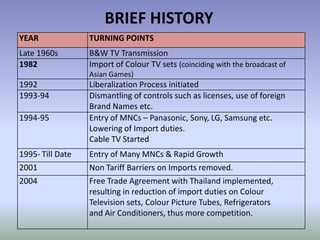
BRIEF HISTORY
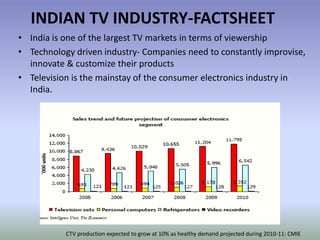
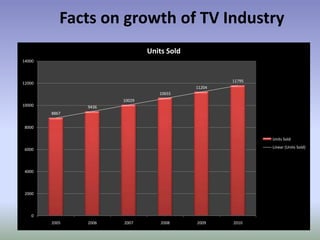
INDIAN TV INDUSTRY-FACTSHEETIndia is one of the largest TV markets in terms of viewershipTechnology driven industry- Companies need to constantly improvise, innovate & customize their productsTelevision is the mainstay of the consumer electronics industry in India.                                       CTV production expected to grow at 10% as healthy demand projected during 2010-11: CMIE
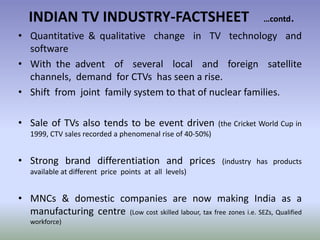
INDIAN TV INDUSTRY-FACTSHEET …contd.Quantitative & qualitative  change  in  TV  technology  and  software  With the advent  of  several  local  and  foreign  satellite  channels,  demand  for CTVs  has seen a rise.Shift  from  joint  family system to that of nuclear families.Sale of TVs also tends to be event driven (the Cricket World Cup in 1999, CTV sales recorded a phenomenal rise of 40-50%)Strong brand differentiation and prices (industry has products available at different  price  points  at  all  levels)MNCs & domestic companies are now making India as a manufacturing centre (Low cost skilled labour, tax free zones i.e. SEZs, Qualified workforce)
Major market playersLG electronicsPositioned itself as a frontrunner by developing groundbreaking products such as LCD & Plasma TVs with built-in DVR.SamsungStrategy of Samsung in India to create premium image had failed.
Competition with LG has led Samsung to play price game
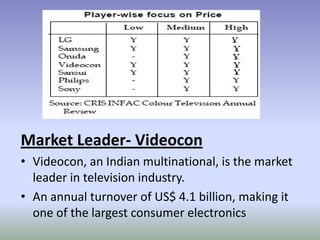
Seeking for digital leadership in India by introducing its digital ready televisions like the 40" LCD Projection TV, 43" Projection TV and the Plano series of Flat Color televisions.OnidaFailure of  devil ad in revitalizing its positionTechnical tie up with JVC(Japan victor company)Requires more strategy to compete with the marketSony7000 channel partners, 215 Sony world and Sony 21 branchLocationsPhilipsOperates in Medium and high range priceVideoconPrice player and image as a low price brand
Market Leader- VideoconVideocon, an Indian multinational, is the market leader in television industry.An annual turnover of US$ 4.1 billion, making it one of the largest consumer electronics
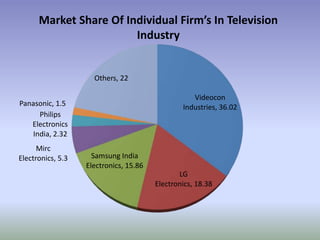
Market ShareMarket share, in strategic management and marketing is, according to Carlton O'Neal, the percentage or proportion of the total available market or market segment that is being serviced by a company. It can be expressed as a company's sales revenue (from that market) divided by the total sales revenue available in that market.
Market Share Of Individual Firm’s In Television Industry
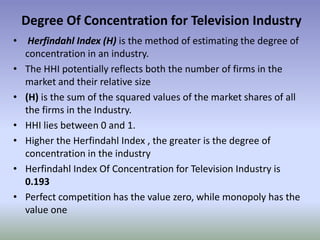
Degree Of Concentration for Television IndustryHerfindahl Index (H)is the method of estimating the degree of concentration in an industry.The HHI potentially reflects both the number of firms in the market and their relative size(H) is the sum of the squared values of the market shares of all the firms in the Industry.HHI lies between 0 and 1.Higher the Herfindahl Index , the greater is the degree of concentration in the industryHerfindahl Index Of Concentration for Television Industry is 0.193Perfect competition has the value zero, while monopoly has the value one
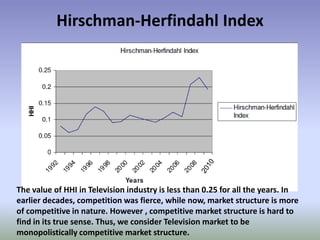
Hirschman-Herfindahl Index2010The value of HHI in Television industry is less than 0.25 for all the years. In earlier decades, competition was fierce, while now, market structure is more of competitive in nature. However , competitive market structure is hard to find in its true sense. Thus, we consider Television market to be monopolistically competitive market structure.
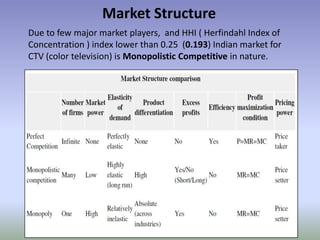
Market StructureDue to few major market players,  and HHI ( Herfindahl Index of Concentration ) index lower than 0.25  (0.193) Indian market for CTV (color television) is Monopolistic Competitive in nature.
Monopolistic Competitive in nature, characteristics of CTV Market Market is dominated by a small number of participants who are able to collectively exert control over supply and market prices.
The sellers are the price makers and not price takers, since the few sellers mutually dominate the pricing decisions.
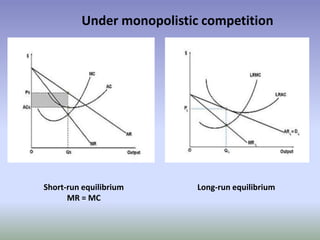
Firms are interdependent for decision making.Under monopolistic competitionShort-run equilibriumMR = MCLong-run equilibrium
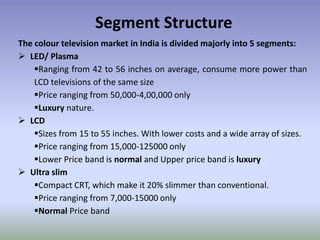
Segment StructureThe colour television market in India is divided majorly into 5 segments: LED/ Plasma
Ranging from 42 to 56 inches on average, consume more power than LCD televisions of the same size
Price ranging from 50,000-4,00,000 only
Luxury nature.
LCD
Sizes from 15 to 55 inches. With lower costs and a wide array of sizes.
Price ranging from 15,000-125000 only

Televison industry

  • 2.
  • 3.
    INDIAN TV INDUSTRY-FACTSHEETIndiais one of the largest TV markets in terms of viewershipTechnology driven industry- Companies need to constantly improvise, innovate & customize their productsTelevision is the mainstay of the consumer electronics industry in India. CTV production expected to grow at 10% as healthy demand projected during 2010-11: CMIE
  • 4.
    INDIAN TV INDUSTRY-FACTSHEET…contd.Quantitative & qualitative change in TV technology and software With the advent of several local and foreign satellite channels, demand for CTVs has seen a rise.Shift from joint family system to that of nuclear families.Sale of TVs also tends to be event driven (the Cricket World Cup in 1999, CTV sales recorded a phenomenal rise of 40-50%)Strong brand differentiation and prices (industry has products available at different price points at all levels)MNCs & domestic companies are now making India as a manufacturing centre (Low cost skilled labour, tax free zones i.e. SEZs, Qualified workforce)
  • 5.
    Major market playersLGelectronicsPositioned itself as a frontrunner by developing groundbreaking products such as LCD & Plasma TVs with built-in DVR.SamsungStrategy of Samsung in India to create premium image had failed.
  • 6.
    Competition with LGhas led Samsung to play price game
  • 7.
    Seeking for digitalleadership in India by introducing its digital ready televisions like the 40" LCD Projection TV, 43" Projection TV and the Plano series of Flat Color televisions.OnidaFailure of devil ad in revitalizing its positionTechnical tie up with JVC(Japan victor company)Requires more strategy to compete with the marketSony7000 channel partners, 215 Sony world and Sony 21 branchLocationsPhilipsOperates in Medium and high range priceVideoconPrice player and image as a low price brand
  • 8.
    Market Leader- VideoconVideocon,an Indian multinational, is the market leader in television industry.An annual turnover of US$ 4.1 billion, making it one of the largest consumer electronics
  • 9.
    Market ShareMarket share,in strategic management and marketing is, according to Carlton O'Neal, the percentage or proportion of the total available market or market segment that is being serviced by a company. It can be expressed as a company's sales revenue (from that market) divided by the total sales revenue available in that market.
  • 10.
    Market Share OfIndividual Firm’s In Television Industry
  • 11.
    Degree Of Concentrationfor Television IndustryHerfindahl Index (H)is the method of estimating the degree of concentration in an industry.The HHI potentially reflects both the number of firms in the market and their relative size(H) is the sum of the squared values of the market shares of all the firms in the Industry.HHI lies between 0 and 1.Higher the Herfindahl Index , the greater is the degree of concentration in the industryHerfindahl Index Of Concentration for Television Industry is 0.193Perfect competition has the value zero, while monopoly has the value one
  • 12.
    Hirschman-Herfindahl Index2010The valueof HHI in Television industry is less than 0.25 for all the years. In earlier decades, competition was fierce, while now, market structure is more of competitive in nature. However , competitive market structure is hard to find in its true sense. Thus, we consider Television market to be monopolistically competitive market structure.
  • 13.
    Market StructureDue tofew major market players, and HHI ( Herfindahl Index of Concentration ) index lower than 0.25 (0.193) Indian market for CTV (color television) is Monopolistic Competitive in nature.
  • 14.
    Monopolistic Competitive innature, characteristics of CTV Market Market is dominated by a small number of participants who are able to collectively exert control over supply and market prices.
  • 15.
    The sellers arethe price makers and not price takers, since the few sellers mutually dominate the pricing decisions.
  • 16.
    Firms are interdependentfor decision making.Under monopolistic competitionShort-run equilibriumMR = MCLong-run equilibrium
  • 17.
    Segment StructureThe colourtelevision market in India is divided majorly into 5 segments: LED/ Plasma
  • 18.
    Ranging from 42to 56 inches on average, consume more power than LCD televisions of the same size
  • 19.
    Price ranging from50,000-4,00,000 only
  • 20.
  • 21.
  • 22.
    Sizes from 15to 55 inches. With lower costs and a wide array of sizes.
  • 23.
    Price ranging from15,000-125000 only