Gaining the Competitive Edge in Telecom Managed ServicesJason Marcheck |Director of Custom Research | Current AnalysisEd Mitchell | Chief Technology Officer | Trade WingsMay 18, 2010
AgendaIntroductionsMarket & Vendor Services OverviewBenefitsChallengesDriving DifferentiationThe Managed Services DilemmaVisibility and Asset IntelligenceExtending Product LifecyclesSustainability and Ecology ManagementQuestion & Answer Session
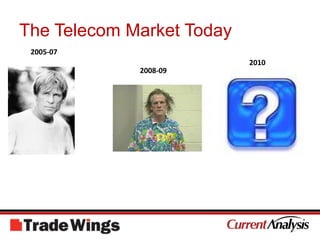
The Telecom Market Today2005-0720102008-09
Impact on Carriers and VendorsNetwork OperatorsStruggling against becoming the “dumb pipe”Networks filling up Revenue per bit fallingRelying on professional & managed services like never beforeVendorsStruggling against supplying commodity boxesNeeding to diversify revenue sourcesRacing to provide managed & professional services like never before
Vendor Services Overview
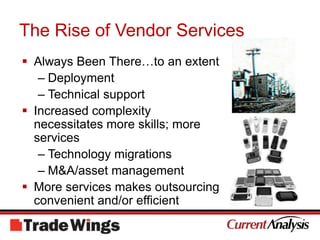
The Rise of Vendor ServicesAlways Been There…to an extentDeploymentTechnical supportIncreased complexity necessitates more skills; more servicesTechnology migrationsM&A/asset managementMore services makes outsourcing convenient and/or efficient
Benefits to OperatorsFills Knowledge GapsBusiness IssuesTechnology IssuesIncreased EfficiencyOpEx reduction at every turn
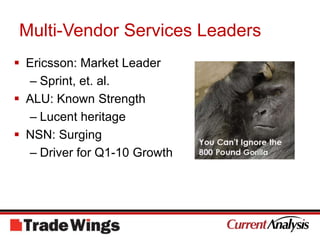
Multi-Vendor Services LeadersEricsson: Market LeaderSprint, et. al.ALU: Known StrengthLucent heritageNSN: SurgingDriver for Q1-10 Growth
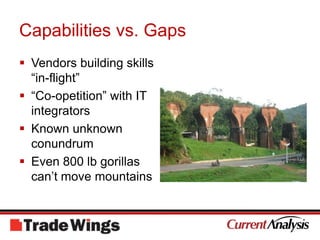
Capabilities vs. GapsVendors building skills “in-flight”“Co-opetition” with IT integratorsKnown unknown conundrumEven 800 lb gorillas can’t move mountains
DrivingDifferentiation
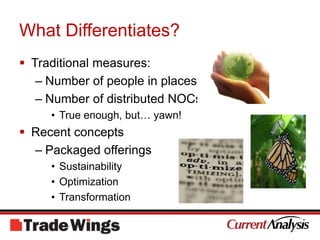
What Differentiates?Traditional measures:Number of people in placesNumber of distributed NOCsTrue enough, but… yawn!Recent conceptsPackaged offeringsSustainabilityOptimizationTransformation
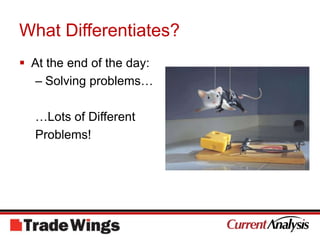
What Differentiates?At the end of the day:Solving problems……Lots of DifferentProblems!
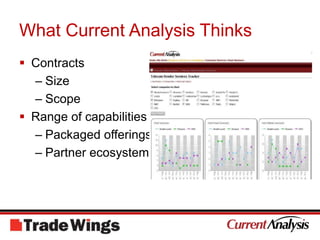
What Current Analysis ThinksContractsSizeScopeRange of capabilitiesPackaged offeringsPartner ecosystem
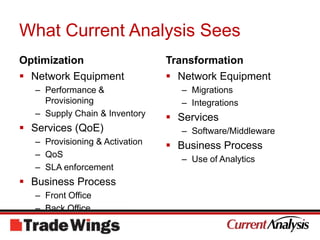
What Current Analysis SeesOptimizationTransformationNetwork EquipmentPerformance & ProvisioningSupply Chain & InventoryServices (QoE)Provisioning & ActivationQoSSLA enforcementBusiness ProcessFront OfficeBack OfficeNetwork EquipmentMigrationsIntegrationsServicesSoftware/MiddlewareBusiness ProcessUse of Analytics
The Managed Services Dilemma“Now that you’re responsible for servicing another company’s equipment, how are you going to maximize the value – and use – of assets to your clients’ satisfaction and at the lowest cost to you?”
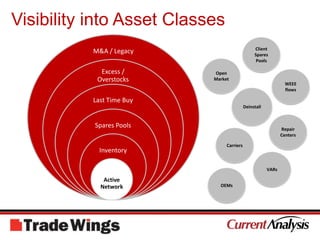
Visibility into Asset ClassesClient SparesPoolsOpen MarketWEEEflowsDeinstallRepair CentersCarriersVARsOEMs
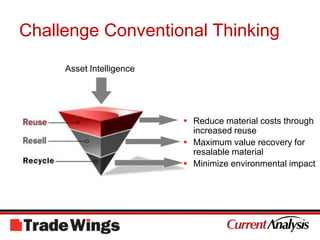
Challenge Conventional ThinkingAsset IntelligenceReduce material costs through increased reuse
Maximum value recovery for resalable material
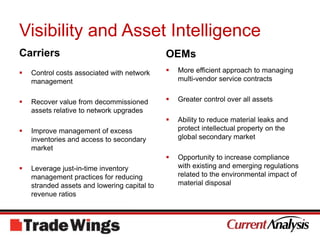
Minimize environmental impactVisibility and Asset IntelligenceCarriersOEMsMore efficient approach to managing multi-vendor service contractsGreater control over all assetsAbility to reduce material leaks and protect intellectual property on the global secondary marketOpportunity to increase compliance with existing and emerging regulations related to the environmental impact of material disposalControl costs associated with network managementRecover value from decommissioned assets relative to network upgradesImprove management of excess inventories and access to secondary marketLeverage just-in-time inventory management practices for reducing stranded assets and lowering capital to revenue ratios
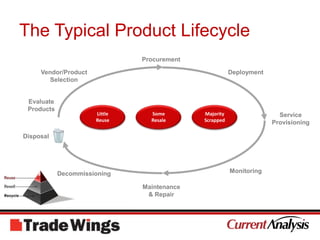
The Typical Product LifecycleProcurementVendor/ProductSelectionDeploymentEvaluateProductsLittleReuseSome ResaleMajority ScrappedService ProvisioningDisposalMonitoringDecommissioningMaintenance & Repair
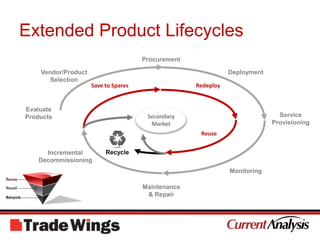
Extended Product LifecyclesProcurementVendor/ProductSelectionDeploymentSave to SparesRedeployEvaluateProductsSecondaryMarketService ProvisioningReuseRecycleIncrementalDecommissioningMonitoringMaintenance & Repair
Sustainability & Ecology ManagementDesire to be environmentally-conscious is pushing business relationships in a new direction.There’s significant value in helping clients be ‘greener’Few environmental positives associated with millions of assets sitting idly in a large warehouse consuming energy, shipped without a plan from one location to the next, melted down or worse.For those in a position to make the highest and best use of their network equipment, environmental stewardship represents an opportunity – at little upfront cost – to:Improve cash flowMarket shareStreamline regulatory compliance
Sustainability & Ecology ManagementTransportation EventsUse visibility into asset inventories to dictate movement of assets from one location to the next based on fuel consumption and carbon emissions.Waste StreamsIdentify excess stocks and then resell them on the secondary market to reduce the flow of material to recyclers.WarehousingKnowing where surplus assets can be used contributes to a measurable savings in storage and other physical plant costs.Regulatory ComplianceMandates governing the disposal of equipment are on the rise, visibility can prove to be a mitigating factor in the level of ‘cradle-to-grave’ accountability required to assure compliance.

Telecom Managed Services Webinar

  • 1.
    Gaining the CompetitiveEdge in Telecom Managed ServicesJason Marcheck |Director of Custom Research | Current AnalysisEd Mitchell | Chief Technology Officer | Trade WingsMay 18, 2010
  • 2.
    AgendaIntroductionsMarket & VendorServices OverviewBenefitsChallengesDriving DifferentiationThe Managed Services DilemmaVisibility and Asset IntelligenceExtending Product LifecyclesSustainability and Ecology ManagementQuestion & Answer Session
  • 3.
    The Telecom MarketToday2005-0720102008-09
  • 4.
    Impact on Carriersand VendorsNetwork OperatorsStruggling against becoming the “dumb pipe”Networks filling up Revenue per bit fallingRelying on professional & managed services like never beforeVendorsStruggling against supplying commodity boxesNeeding to diversify revenue sourcesRacing to provide managed & professional services like never before
  • 5.
  • 6.
    The Rise ofVendor ServicesAlways Been There…to an extentDeploymentTechnical supportIncreased complexity necessitates more skills; more servicesTechnology migrationsM&A/asset managementMore services makes outsourcing convenient and/or efficient
  • 7.
    Benefits to OperatorsFillsKnowledge GapsBusiness IssuesTechnology IssuesIncreased EfficiencyOpEx reduction at every turn
  • 8.
    Multi-Vendor Services LeadersEricsson:Market LeaderSprint, et. al.ALU: Known StrengthLucent heritageNSN: SurgingDriver for Q1-10 Growth
  • 10.
    Capabilities vs. GapsVendorsbuilding skills “in-flight”“Co-opetition” with IT integratorsKnown unknown conundrumEven 800 lb gorillas can’t move mountains
  • 11.
  • 12.
    What Differentiates?Traditional measures:Numberof people in placesNumber of distributed NOCsTrue enough, but… yawn!Recent conceptsPackaged offeringsSustainabilityOptimizationTransformation
  • 13.
    What Differentiates?At theend of the day:Solving problems……Lots of DifferentProblems!
  • 14.
    What Current AnalysisThinksContractsSizeScopeRange of capabilitiesPackaged offeringsPartner ecosystem
  • 15.
    What Current AnalysisSeesOptimizationTransformationNetwork EquipmentPerformance & ProvisioningSupply Chain & InventoryServices (QoE)Provisioning & ActivationQoSSLA enforcementBusiness ProcessFront OfficeBack OfficeNetwork EquipmentMigrationsIntegrationsServicesSoftware/MiddlewareBusiness ProcessUse of Analytics
  • 16.
    The Managed ServicesDilemma“Now that you’re responsible for servicing another company’s equipment, how are you going to maximize the value – and use – of assets to your clients’ satisfaction and at the lowest cost to you?”
  • 17.
    Visibility into AssetClassesClient SparesPoolsOpen MarketWEEEflowsDeinstallRepair CentersCarriersVARsOEMs
  • 18.
    Challenge Conventional ThinkingAssetIntelligenceReduce material costs through increased reuse
  • 19.
    Maximum value recoveryfor resalable material
  • 20.
    Minimize environmental impactVisibilityand Asset IntelligenceCarriersOEMsMore efficient approach to managing multi-vendor service contractsGreater control over all assetsAbility to reduce material leaks and protect intellectual property on the global secondary marketOpportunity to increase compliance with existing and emerging regulations related to the environmental impact of material disposalControl costs associated with network managementRecover value from decommissioned assets relative to network upgradesImprove management of excess inventories and access to secondary marketLeverage just-in-time inventory management practices for reducing stranded assets and lowering capital to revenue ratios
  • 21.
    The Typical ProductLifecycleProcurementVendor/ProductSelectionDeploymentEvaluateProductsLittleReuseSome ResaleMajority ScrappedService ProvisioningDisposalMonitoringDecommissioningMaintenance & Repair
  • 22.
    Extended Product LifecyclesProcurementVendor/ProductSelectionDeploymentSaveto SparesRedeployEvaluateProductsSecondaryMarketService ProvisioningReuseRecycleIncrementalDecommissioningMonitoringMaintenance & Repair
  • 23.
    Sustainability & EcologyManagementDesire to be environmentally-conscious is pushing business relationships in a new direction.There’s significant value in helping clients be ‘greener’Few environmental positives associated with millions of assets sitting idly in a large warehouse consuming energy, shipped without a plan from one location to the next, melted down or worse.For those in a position to make the highest and best use of their network equipment, environmental stewardship represents an opportunity – at little upfront cost – to:Improve cash flowMarket shareStreamline regulatory compliance
  • 24.
    Sustainability & EcologyManagementTransportation EventsUse visibility into asset inventories to dictate movement of assets from one location to the next based on fuel consumption and carbon emissions.Waste StreamsIdentify excess stocks and then resell them on the secondary market to reduce the flow of material to recyclers.WarehousingKnowing where surplus assets can be used contributes to a measurable savings in storage and other physical plant costs.Regulatory ComplianceMandates governing the disposal of equipment are on the rise, visibility can prove to be a mitigating factor in the level of ‘cradle-to-grave’ accountability required to assure compliance.

Editor's Notes

  • #4 Warily optimistic – macro economy is getting better, but challenges abound
  • #5 Slide looks negative, but instead depicts that both carriers and vendors are in a challenging place right now 2009 2008Ericsson 27% 23%ALU 23% 19.6%NSN 45%OTT phenomenon a primary driver for this
  • #7 Whereas network operators could afford to maintain their own networks, it is increasingly less attractive to bear the cost of honing and then retaining the myriad of capabilities required to maintain networksMigrations – can mean so much it’s a webinar series in itselfM&A – consolidation places a lot of pressure on operators to merge and manage their assets
  • #8 Talked a little about it already, but basically these businesses have become too complex to run by themselves in many cases. Far from an indictment of management of these companies, it is a statement about the number of issues they deal with.Emerging market – often don’t have the skill set and/or experience at their disposalMature market – dynamics of running a network and providing services has changed a lot in a relatively short timBusiness issues – how to monetize assets, deal with over the tops, manage churn, manage their assets in situations where most operators now consist of a series of acquired networksTechnology Issues – the oft-discussed need to take advantage of IP, when there are many ways to skin the catAll while… needing to cut OpEx out of every variable in the equation
  • #9 Ericsson: benefits from is heritage as WI hegemon; admittedly not nearly as strong in fixed line dealsALU: major initiative for Lucent pre-merger; continued momentum post-merger, and exhibits strength across all parts of the fixed and mobile network; carrier and large enterpriseNSN: Its recent success with services as well known as its struggles with equipment
  • #11 More salient challenges from the vendor perspective is in this slide. As vendors seek to assert themselves at more points in the value chain, they need to build skills that they don’t have – leads in to the co-opetition concept. While direct competition between an ALU and IBM is limited, ALU – and its peers – would definitely like to capture more of that software and integration type revenue, especially in the areas of OSS/BSS and SDP.Then there’s the known unknown problem they know challenges are going to arise – things like addressing the Cloud – that are going to crop up that they aren’t ready to handle right now… have to craft stories and solutions – and then try to move their customers in the direction even while they don’t have a complete idea of what needs to be done – and even where they might have clear ideas in mind, it is often difficult to get carriers to move
  • #13 Goal is to position managed and professional services as a tool for growth and competition. Sure.. But how does a vendor do this?Sustainability – ALU and NSN both have branded Green services initiativesPackaged offerings – Highlighting specific capabilities Moto’s Optimization Services HP’s transformation services
  • #14 Purposely vague, because while there is a relatively simple answer - the number of permutations are perhaps limitless.
  • #15 So, when we’re stacking vendor offerings against each other, what do we look for
  • #16 Specific examples of problem solvingAnimation for Supply Chain Mgmt.Optimization – perf and provisioning includes stuff like BTS load balancing, optical parameters, etc.
  • #18 Different asset classes managed by disparate systems. Procurement uses ERP to manage purchasesOSS applications manage active network deployment – but not necessarily spares. Decommissioned assets simply get deleted from OSS with no effort to recover value or repurpose.Finance has little or no visibility into OSS/deployment of assets – result is most reordering must be expeditedManaged services engagement suffer from to these systemic barriersLack of visibility across operational silosMissed opportunities to reuse/repurpose assetsUndervaluation of surplus equipment
  • #19 To be success with managed servers, one must overcomeDecentralized dataDifficult to compileIsolated decision making
  • #20 Given our experience implementing Reuse Optimization strategies with OEMs and carriers, we’ve learned that visibility to assets (active, spare, and excess/overstocks, and in the secondary market) is absolutely essential. There’s no opportunity to repurpose equipment without knowing where it is and what condition it is in. For the sake of time, I’m not going to get into each of these points – you can read them for yourselves.Visibility is critical to efficiently managing all assets and gaining transparency to all of the disparate equipment that you, as the multi-vendor services provider, have SLA responsibility for servicing.
  • #21 Direct attention to the bottom of the circle
  • #23 The effect is that this approach reduces what goes into the waste stream. This can be a key differentiator as a multi-vendor services provider. Whereas most MV service providers tout their size and years in the business, this approach positions you as an innovator – responsive to client and consumer attitudes toward “green” initiatives.
  • #24 This slide illustrates how “green” thinking manifests itself in terms of logistics, energy consumption, and government mandates. This is a practice that is sustainable as well as profitable. It’s just good business, both economically and ecologically.