TELE25892
WIRELESS NETWORK PRINCIPLES
Winter 2023
802.11 MAC Architecture
Agenda
 IEEE 802.11 MAC Architecture Elements
 Fames types
 Frame subtypes
 Protection mechanism
 Power management
TELE_25892_Princuples of Wreless Networking
2
Reference/Reading
 Reading:
 Ch 10 [COL3]
 Reference:
 Most of the slides are taken from the text book
 Web reference:
 See inline
TELE_25892_Princuples of Wreless Networking
3
Learning Objectives
 Explain encapsulation of IEEE 802.11 frames
 Explain the phases of Wireless connection formation
 Name and describe various types of roaming
TELE_25892_Princuples of Wreless Networking
4
IEEE 802.11 MAC Architecture Elements
 Packets, Frames, and Bits
 Physical Layer
 Data Link Layer
 802.11 and 802.3 Interoperability
 Three 802.11 Frame Types
 Beacon Management Frame (Beacon)
 Passive Scanning
 Active Scanning
 Authentication
 Authentication and Association States
 Basic and Supported Rates
TELE_25892_Princuples of Wreless Networking
5
IEEE 802.11 MAC Architecture Elements
 Roaming
 Reassociation
 Disassociation
 Deauthentication
 ACK Frame
 Fragmentation
 Protection Mechanism
 RTS/CTS
 CTS-to-Self
 Data Frames
 Power Management
TELE_25892_Princuples of Wreless Networking
6
Packets, Frames, and Bits
 Packets
 Data Units at the Network Layer
 Frames
 Data Units at the Data Link Layer
 Bits
 Binary Digits
TELE_25892_Princuples of Wreless Networking
7
Data Link Layer
 Data Link Layer (DLL) has two sublayers
 Logical Link Control (LLC)
 Establishes Flow control
 Maintains Flow Control
 Media Access Control (MAC)
 802.11 Specified Operations
 Where the MAC address resides
 MAC Service Data Unit (MSDU)
 Data portion of MAC coming from LLC
 MAC Protocol Data Unit (MPDU)
 After encapsulation in MAC frame
TELE_25892_Princuples of Wreless Networking
8
MAC Service Data Unit (MSDU)
 Contains Data From Layers 3-7 and the LLC
 The Data Payload
 Only Data Frames Carry the MSDU
 Maximum Size of 2,304 bytes
TELE_25892_Princuples of Wreless Networking
9
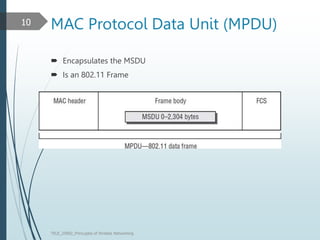
MAC Protocol Data Unit (MPDU)
 Encapsulates the MSDU
 Is an 802.11 Frame
TELE_25892_Princuples of Wreless Networking
10
Physical Layer
 Has two Sub-Layers
 Physical Layer Convergence Protocol (PLCP)
 Physical Media Dependent (PMD)
 PLCP Services Data Unit (PSDU)
 PLCP Protocol Data Unit (PPDU)
TELE_25892_Princuples of Wreless Networking
11
PLCP Data Units
 PLCP Services Data Unit (PSDU)
 The Same Frame as the MPDU
 PLCP Protocol Data Unit (PPDU)
 Adds Preamble and PHY Header
TELE_25892_Princuples of Wreless Networking
12
Data Link Layer and Physical Layer
Expanded
TELE_25892_Princuples of Wreless Networking
13
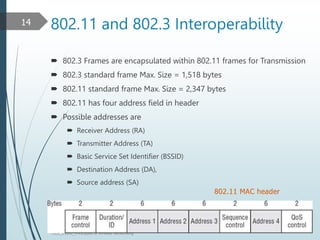
802.11 and 802.3 Interoperability
 802.3 Frames are encapsulated within 802.11 frames for Transmission
 802.3 standard frame Max. Size = 1,518 bytes
 802.11 standard frame Max. Size = 2,347 bytes
 802.11 has four address field in header
 Possible addresses are
 Receiver Address (RA)
 Transmitter Address (TA)
 Basic Service Set Identifier (BSSID)
 Destination Address (DA),
 Source address (SA)
TELE_25892_Princuples of Wreless Networking
14
802.11 MAC header
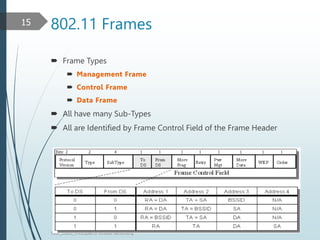
802.11 Frames
 Frame Types
 Management Frame
 Control Frame
 Data Frame
 All have many Sub-Types
 All are Identified by Frame Control Field of the Frame Header
TELE_25892_Princuples of Wreless Networking
15
Management Frames
 Association request, and response
 Reassociation request and response
 Probe request, and response
 Beacon
 Announcement Traffic Indication Message (ATIM)
 Disassociation
 Authentication, and Deauthentication
 Action
 Action No ACK
 Timing advertisement
TELE_25892_Princuples of Wreless Networking
16
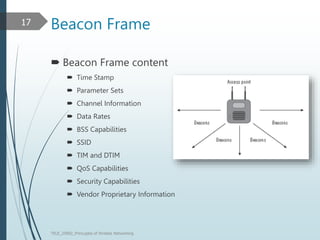
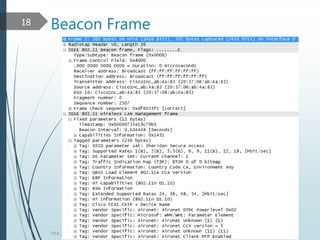
Beacon Frame
 Beacon Frame content
 Time Stamp
 Parameter Sets
 Channel Information
 Data Rates
 BSS Capabilities
 SSID
 TIM and DTIM
 QoS Capabilities
 Security Capabilities
 Vendor Proprietary Information
TELE_25892_Princuples of Wreless Networking
17
Beacon Frame
TELE_25892_Princuples of Wreless Networking
18
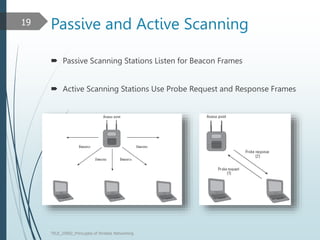
Passive and Active Scanning
 Passive Scanning Stations Listen for Beacon Frames
 Active Scanning Stations Use Probe Request and Response Frames
TELE_25892_Princuples of Wreless Networking
19
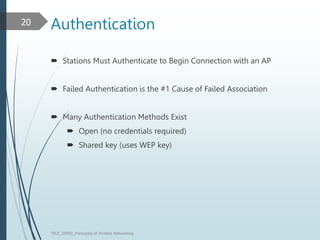
Authentication
 Stations Must Authenticate to Begin Connection with an AP
 Failed Authentication is the #1 Cause of Failed Association
 Many Authentication Methods Exist
 Open (no credentials required)
 Shared key (uses WEP key)
TELE_25892_Princuples of Wreless Networking
20
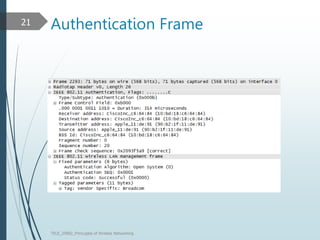
Authentication Frame
TELE_25892_Princuples of Wreless Networking
21
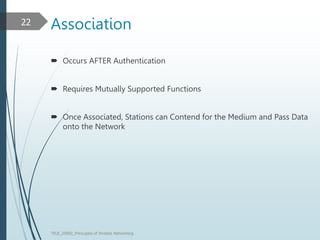
Association
 Occurs AFTER Authentication
 Requires Mutually Supported Functions
 Once Associated, Stations can Contend for the Medium and Pass Data
onto the Network
TELE_25892_Princuples of Wreless Networking
22
Association Request
TELE_25892_Princuples of Wreless Networking
23
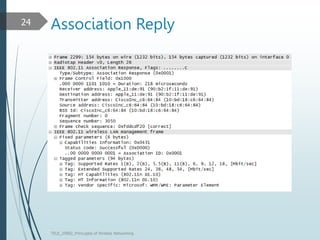
Association Reply
TELE_25892_Princuples of Wreless Networking
24
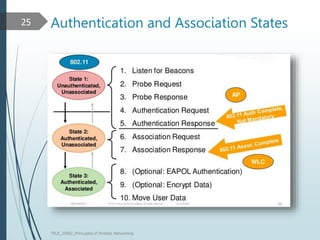
Authentication and Association States
TELE_25892_Princuples of Wreless Networking
25
Basic and Supported Data Rates
 Basic Rates are the MANDITORY Data Rates of the BSS
 Supported Rates are the OPTIONAL Data Rates of the BSS
 Information is Found in the Beacon Management Frame
TELE_25892_Princuples of Wreless Networking
26
Control Frame
 Power Save Poll (PS-Poll)
 Request to send (RTS)
 Clear to send (CTS)
 Acknowledgment (ACK)
 Contention Free-End (CF-End)
 CF-End + CF-ACK
 Block ACK Request (BlockAckReq)
 Block ACK (BlockAck)
 Control wrapper
TELE_25892_Princuples of Wreless Networking
30
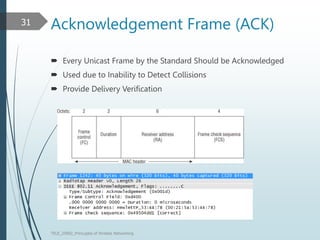
Acknowledgement Frame (ACK)
 Every Unicast Frame by the Standard Should be Acknowledged
 Used due to Inability to Detect Collisions
 Provide Delivery Verification
TELE_25892_Princuples of Wreless Networking
31
Protection Mechanisms
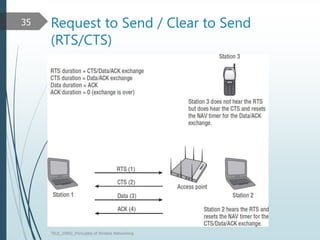
 Request to Send / Clear to Send (RTS/CTS)
 Clear to Send to Self (CTS-to-Self)
 Help Combat Hidden Node Issues
 Allows Mixed Mode Operations
 Creates Additional Overhead
 Frames Sent at Lowest Basic Rate
TELE_25892_Princuples of Wreless Networking
32
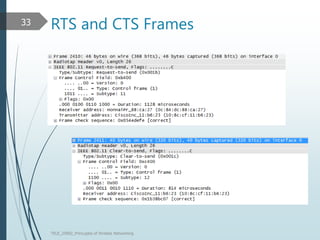
RTS and CTS Frames
TELE_25892_Princuples of Wreless Networking
33
Timing Diagram of RTS/CTS
TELE_25892_Princuples of Wreless Networking
34
Request to Send / Clear to Send
(RTS/CTS)
TELE_25892_Princuples of Wreless Networking
35
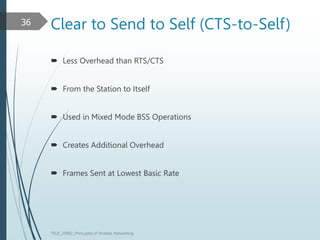
Clear to Send to Self (CTS-to-Self)
 Less Overhead than RTS/CTS
 From the Station to Itself
 Used in Mixed Mode BSS Operations
 Creates Additional Overhead
 Frames Sent at Lowest Basic Rate
TELE_25892_Princuples of Wreless Networking
36
Data Frames
 Can be Pure Data
 Can be Null Data
 Can be Combined with other Functions
 Contains the MSDU
TELE_25892_Princuples of Wreless Networking
37
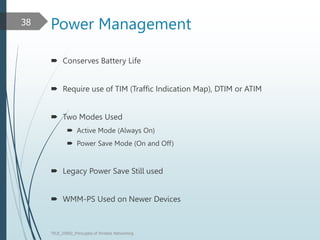
Power Management
 Conserves Battery Life
 Require use of TIM (Traffic Indication Map), DTIM or ATIM
 Two Modes Used
 Active Mode (Always On)
 Power Save Mode (On and Off)
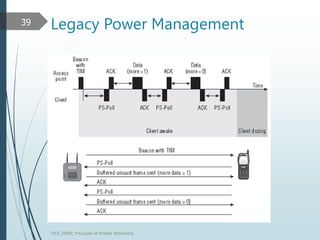
 Legacy Power Save Still used
 WMM-PS Used on Newer Devices
TELE_25892_Princuples of Wreless Networking
38
Legacy Power Management
TELE_25892_Princuples of Wreless Networking
39
Summary
 In this lesson we reviewed the concept of encapsulation and decapsulation
 We studied the fields of MPDU and relationship between MPDU and PPDU
 We studied the IEEE 802.11 frame types
 We studied the different types of management frames used in IEEE 802.11
standard
 We studied how authentication and Association are performed in IEEE
802.11
 We studied how roaming takes place
 We studied where fragmentation can be useful and where it add overhead
 We studied various types of control frames and the use of
acknowledgement as well as RTS-CTS and CTS-to- self messages
 We studied power management features of IEEE 802.11 and how
interoperability can be achieved while power saving mode is being used by
the clients
TELE_25892_Princuples of Wreless Networking
41
Key Terms
 Beacon
 RTS/CTS
 Traffic indication map (TIM)
 Delivery traffic indication message (DTIM)
 Announcement traffic indication message (ATIM)
 WMM Power Save (WMM-PS)
TELE_25892_Princuples of Wreless Networking
42
Some Sample Questions
 Describe the main functions of the sublayers in data link layer and
physical layer of 802.11 MAC architecture.
 What are the four addresses in 802.11 MAC frames?
 With a flow diagram, mention the states of authentication and
association in 802.11.
 What are the three types of frames in 802.11? Briefly describe the
functions/purpose of each. Give some examples of each.
 List some important information you find in a beacon frame.
 What is the difference between active scanning and passive scanning?
 Explain why every unicast frame in 802.1 1 requires
acknowledgement.
 With a diagram, explain why and how RTS/CTS mechanism is used in
802.11.
TELE_25892_Princuples of Wreless Networking
43

TELE25892-4.3 802.11 MAC Architecture.pptx

  • 1.
  • 2.
    Agenda  IEEE 802.11MAC Architecture Elements  Fames types  Frame subtypes  Protection mechanism  Power management TELE_25892_Princuples of Wreless Networking 2
  • 3.
    Reference/Reading  Reading:  Ch10 [COL3]  Reference:  Most of the slides are taken from the text book  Web reference:  See inline TELE_25892_Princuples of Wreless Networking 3
  • 4.
    Learning Objectives  Explainencapsulation of IEEE 802.11 frames  Explain the phases of Wireless connection formation  Name and describe various types of roaming TELE_25892_Princuples of Wreless Networking 4
  • 5.
    IEEE 802.11 MACArchitecture Elements  Packets, Frames, and Bits  Physical Layer  Data Link Layer  802.11 and 802.3 Interoperability  Three 802.11 Frame Types  Beacon Management Frame (Beacon)  Passive Scanning  Active Scanning  Authentication  Authentication and Association States  Basic and Supported Rates TELE_25892_Princuples of Wreless Networking 5
  • 6.
    IEEE 802.11 MACArchitecture Elements  Roaming  Reassociation  Disassociation  Deauthentication  ACK Frame  Fragmentation  Protection Mechanism  RTS/CTS  CTS-to-Self  Data Frames  Power Management TELE_25892_Princuples of Wreless Networking 6
  • 7.
    Packets, Frames, andBits  Packets  Data Units at the Network Layer  Frames  Data Units at the Data Link Layer  Bits  Binary Digits TELE_25892_Princuples of Wreless Networking 7
  • 8.
    Data Link Layer Data Link Layer (DLL) has two sublayers  Logical Link Control (LLC)  Establishes Flow control  Maintains Flow Control  Media Access Control (MAC)  802.11 Specified Operations  Where the MAC address resides  MAC Service Data Unit (MSDU)  Data portion of MAC coming from LLC  MAC Protocol Data Unit (MPDU)  After encapsulation in MAC frame TELE_25892_Princuples of Wreless Networking 8
  • 9.
    MAC Service DataUnit (MSDU)  Contains Data From Layers 3-7 and the LLC  The Data Payload  Only Data Frames Carry the MSDU  Maximum Size of 2,304 bytes TELE_25892_Princuples of Wreless Networking 9
  • 10.
    MAC Protocol DataUnit (MPDU)  Encapsulates the MSDU  Is an 802.11 Frame TELE_25892_Princuples of Wreless Networking 10
  • 11.
    Physical Layer  Hastwo Sub-Layers  Physical Layer Convergence Protocol (PLCP)  Physical Media Dependent (PMD)  PLCP Services Data Unit (PSDU)  PLCP Protocol Data Unit (PPDU) TELE_25892_Princuples of Wreless Networking 11
  • 12.
    PLCP Data Units PLCP Services Data Unit (PSDU)  The Same Frame as the MPDU  PLCP Protocol Data Unit (PPDU)  Adds Preamble and PHY Header TELE_25892_Princuples of Wreless Networking 12
  • 13.
    Data Link Layerand Physical Layer Expanded TELE_25892_Princuples of Wreless Networking 13
  • 14.
    802.11 and 802.3Interoperability  802.3 Frames are encapsulated within 802.11 frames for Transmission  802.3 standard frame Max. Size = 1,518 bytes  802.11 standard frame Max. Size = 2,347 bytes  802.11 has four address field in header  Possible addresses are  Receiver Address (RA)  Transmitter Address (TA)  Basic Service Set Identifier (BSSID)  Destination Address (DA),  Source address (SA) TELE_25892_Princuples of Wreless Networking 14 802.11 MAC header
  • 15.
    802.11 Frames  FrameTypes  Management Frame  Control Frame  Data Frame  All have many Sub-Types  All are Identified by Frame Control Field of the Frame Header TELE_25892_Princuples of Wreless Networking 15
  • 16.
    Management Frames  Associationrequest, and response  Reassociation request and response  Probe request, and response  Beacon  Announcement Traffic Indication Message (ATIM)  Disassociation  Authentication, and Deauthentication  Action  Action No ACK  Timing advertisement TELE_25892_Princuples of Wreless Networking 16
  • 17.
    Beacon Frame  BeaconFrame content  Time Stamp  Parameter Sets  Channel Information  Data Rates  BSS Capabilities  SSID  TIM and DTIM  QoS Capabilities  Security Capabilities  Vendor Proprietary Information TELE_25892_Princuples of Wreless Networking 17
  • 18.
  • 19.
    Passive and ActiveScanning  Passive Scanning Stations Listen for Beacon Frames  Active Scanning Stations Use Probe Request and Response Frames TELE_25892_Princuples of Wreless Networking 19
  • 20.
    Authentication  Stations MustAuthenticate to Begin Connection with an AP  Failed Authentication is the #1 Cause of Failed Association  Many Authentication Methods Exist  Open (no credentials required)  Shared key (uses WEP key) TELE_25892_Princuples of Wreless Networking 20
  • 21.
  • 22.
    Association  Occurs AFTERAuthentication  Requires Mutually Supported Functions  Once Associated, Stations can Contend for the Medium and Pass Data onto the Network TELE_25892_Princuples of Wreless Networking 22
  • 23.
  • 24.
  • 25.
    Authentication and AssociationStates TELE_25892_Princuples of Wreless Networking 25
  • 26.
    Basic and SupportedData Rates  Basic Rates are the MANDITORY Data Rates of the BSS  Supported Rates are the OPTIONAL Data Rates of the BSS  Information is Found in the Beacon Management Frame TELE_25892_Princuples of Wreless Networking 26
  • 27.
    Control Frame  PowerSave Poll (PS-Poll)  Request to send (RTS)  Clear to send (CTS)  Acknowledgment (ACK)  Contention Free-End (CF-End)  CF-End + CF-ACK  Block ACK Request (BlockAckReq)  Block ACK (BlockAck)  Control wrapper TELE_25892_Princuples of Wreless Networking 30
  • 28.
    Acknowledgement Frame (ACK) Every Unicast Frame by the Standard Should be Acknowledged  Used due to Inability to Detect Collisions  Provide Delivery Verification TELE_25892_Princuples of Wreless Networking 31
  • 29.
    Protection Mechanisms  Requestto Send / Clear to Send (RTS/CTS)  Clear to Send to Self (CTS-to-Self)  Help Combat Hidden Node Issues  Allows Mixed Mode Operations  Creates Additional Overhead  Frames Sent at Lowest Basic Rate TELE_25892_Princuples of Wreless Networking 32
  • 30.
    RTS and CTSFrames TELE_25892_Princuples of Wreless Networking 33
  • 31.
    Timing Diagram ofRTS/CTS TELE_25892_Princuples of Wreless Networking 34
  • 32.
    Request to Send/ Clear to Send (RTS/CTS) TELE_25892_Princuples of Wreless Networking 35
  • 33.
    Clear to Sendto Self (CTS-to-Self)  Less Overhead than RTS/CTS  From the Station to Itself  Used in Mixed Mode BSS Operations  Creates Additional Overhead  Frames Sent at Lowest Basic Rate TELE_25892_Princuples of Wreless Networking 36
  • 34.
    Data Frames  Canbe Pure Data  Can be Null Data  Can be Combined with other Functions  Contains the MSDU TELE_25892_Princuples of Wreless Networking 37
  • 35.
    Power Management  ConservesBattery Life  Require use of TIM (Traffic Indication Map), DTIM or ATIM  Two Modes Used  Active Mode (Always On)  Power Save Mode (On and Off)  Legacy Power Save Still used  WMM-PS Used on Newer Devices TELE_25892_Princuples of Wreless Networking 38
  • 36.
  • 37.
    Summary  In thislesson we reviewed the concept of encapsulation and decapsulation  We studied the fields of MPDU and relationship between MPDU and PPDU  We studied the IEEE 802.11 frame types  We studied the different types of management frames used in IEEE 802.11 standard  We studied how authentication and Association are performed in IEEE 802.11  We studied how roaming takes place  We studied where fragmentation can be useful and where it add overhead  We studied various types of control frames and the use of acknowledgement as well as RTS-CTS and CTS-to- self messages  We studied power management features of IEEE 802.11 and how interoperability can be achieved while power saving mode is being used by the clients TELE_25892_Princuples of Wreless Networking 41
  • 38.
    Key Terms  Beacon RTS/CTS  Traffic indication map (TIM)  Delivery traffic indication message (DTIM)  Announcement traffic indication message (ATIM)  WMM Power Save (WMM-PS) TELE_25892_Princuples of Wreless Networking 42
  • 39.
    Some Sample Questions Describe the main functions of the sublayers in data link layer and physical layer of 802.11 MAC architecture.  What are the four addresses in 802.11 MAC frames?  With a flow diagram, mention the states of authentication and association in 802.11.  What are the three types of frames in 802.11? Briefly describe the functions/purpose of each. Give some examples of each.  List some important information you find in a beacon frame.  What is the difference between active scanning and passive scanning?  Explain why every unicast frame in 802.1 1 requires acknowledgement.  With a diagram, explain why and how RTS/CTS mechanism is used in 802.11. TELE_25892_Princuples of Wreless Networking 43