TEENS
THE GOOD, THE BAD, AND THE
AWESOME
Angela Dubinger
Indiana State Library
Children’s Services Consultant
Professional Development Office
Indiana State Library
Introductions
Who am I?
Who are you?
ACTIVITY
 Just for fun, let’s go around and share…you can
either share a service that your library provides
for teens or…
 You can share an issue your library has with
teens
Today we are going to….
 Learn why teens are the way they are.
 Learn about challenges that teens face.
 Learn ways to more positively interact with them
in our library settings.
Adolescents are:
 Age: 10-19
 42.7 million
You think YOU have it bad?
Three Challenges for Adolescents
You think YOU have it bad?
• Biological Development
• Cognitive Development
• Social/Emotional Development
Challenge #1
7Early maturation
12-1410-12Growth spurt
11-1310-12Onset of puberty
Biological Development
Eating Disorders:
Anorexia - 13.2% of Indiana Teens are self described Anorexics
Bulimia – 5.4% of Indiana Teens are self described as Bulimic
Nutrition:
15.1% of Indiana Teens do not eat fruit in a typical week
45.8% of Indiana Teens do not eat salad in a typical week
17.9% of Indiana Teens do not eat any vegetables in a typical week
Excercise:
40.5% of Indiana Teens do not exercise for weight management
65.2% of Indiana Teens do not attend a PE class in a typical week
43.6% of Indiana Teens did not play on a sports team in 2010
Biological Development
Challenge #2
 to argue for the sake of arguing
 to be self- centered
 to constantly find fault in adult’s position
 to be overly dramatic
Normal adolescent behavior?
YES!
Cognitive Development – Big One for US!
Cognitive Development
• ability to think abstractly
• ability to analyze situations
logically
• ability to think realistically about
the future, goal setting
• moral reasoning
• Entertain hypothetical situations,
use of metaphors
Need guidance for rational
decision making
10 years
19 years
“The Teen Brain: Still Under
Construction”
 “…the brain doesn’t look
like that of an adult until
the early 20s.
 Loss of synapses=brain
efficiency increase
 Genes play a role, but
also experience also
shapes the decline.
 Synapses "exercised" by
experience survive and
are strengthened, while
others are pruned away.
 National Institute of
Mental Health article
Brain Research Findings
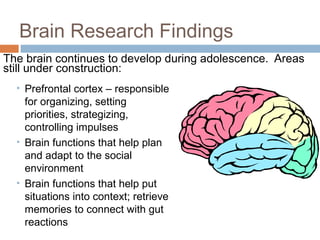
The brain continues to develop during adolescence. Areas
still under construction:
• Prefrontal cortex – responsible
for organizing, setting
priorities, strategizing,
controlling impulses
• Brain functions that help plan
and adapt to the social
environment
• Brain functions that help put
situations into context; retrieve
memories to connect with gut
reactions
Challenge #3
 Who am I? Where do I belong?
- Identity development (gender, sexual, ethnic)
- Self-esteem
- Role of peer group
Social Emotional Development
 How do I relate to others?
- Social Skills
- Emotional Intelligence
Experimenting with Intimacy
• 13% of teens have had sex by age 15
• 70% of teens have had sex by age 19
• 7% of young women aged 18-24 who had sex before they
were 20 report that their first sexual experience was
nonvoluntary.
• 10% of all US births are to girls ages 19 or younger
Teen Suicide – IYI Issue Brief
2014
 Suicide has been the second-leading cause of
death for young Hoosiers between the ages of
15 and 24 since 2009.
 In a national survey that included 43 states,
Indiana had the nation’s highest rate of
students who have contemplated suicide (19
percent) and the country’s second-highest rate
of high school students who have attempted
suicide.
Environmental Settings
YOUTH
Peers
Com
m
unity
(This
is
us!)
School
(This is us too!)
Fam
ily
Neighborhood
(This can also
be us!)
Media/
Internet
Social Toxicity
Social factors that poison youth’ well
being and healthy development
Main Sources:
 National Campaign to Prevent Teen Pregnancy 2005.
Freeze Frame: A Snapshot of America’s Teens
www.teenpregnancy.org
 The Teen Brain-Still Under Construction” – NIMH -
http://1.usa.gov/1el25lz
 2012 United States Census
 Guttmacher.org – In Brief: Fact Sheet copyright 2012
 Indiana Youth Institute Issue Brief October 2011 & April
2014
 American Psychological Association, De ve lo ping
Ado le sce nts .
http://www.apa.org/pi/families/resources/develop.pdf
Edward T. Sullivan
“Teenagers are not luggage:
they don’t need handling.”
So What Does This Mean For
Us?
 Let’s Look at our own Library Behavior Policy
 1. Assess each situation.
 IS IT A NUISANCE, OR A HAZARD?
Strategies for Dealing with
Teens
 Listen
 Cooperate
 Establish relationships
 Establish outside relationships
 Be creative
 Keep your cool
 Don’t take it personally
Strategies for Dealing with
Teens
 Develop mutual understanding – empathize
 Be accepting
 Avoid stereotyping teens
 Avoid stereotyping yourselves as library staff
 Be non-judgemental
 Be enthusiastic
 Watch your face
 Be flexible
Strategies for Dealing with
Teens
 Share, don’t teach
 Be tolerant
 Be firm, fair and consistent –criticize behavior
not person
Teens Pushing Each
Other
Teens Talking Loudly
Wondering around in
large groups…
Blocking the front door
of the library…
Hugging each other for
long periods of time or
laying on each other…
Leaving bags around
the library…
Of course…
 It is all according to your library’s policies,
but…
Take Immediate Action
 Nuisance - we can ALL handle nuisances.
 Speak to them in a calm nonjudgmental manner
 Don’t be overly loud
 Make Eye Contact
 Give them CONCRETE DIRECTIONS
 You are being too loud for the library. You need to
quiet down or you will be asked to leave.
 You all need to find something to do and have a seat.
 Please, no running in the library.
 If you have to speak to them more than once or twice,
ask them to leave. They can try to behave better
tomorrow.
Take Immediate Action
 Follow the Library Behavior Policy
Take Immediate Action
 Hazard – get help
 Use Teamwork
 Call Police
 Give them CONCRETE DIRECTIONS
 Pushing and fighting is not allowed in the library. You
need to leave for today.
Safe Child Policy…do you have
one?
New Castle-Henry County Public Library:
 Children under age eight must be directly supervised in the Children’s
library by a person who is age 16 or older. Children from age eight through
twelve must be accompanied by a person age 16 or older who remains IN
the library while the child is in the library.
 Unattended children age 8-12 must NOT be left in the Children’s Library
more than one hour.
 If a parent or guardian of an unattended child under the age of thirteen
cannot be contacted or located within one-half hour of the discovery that
the child is unattended, the library will ask the local Police department to
contact Child Protective Services.
 If the library is closing and a parent or guardian of a child under age 16
cannot be contacted or located, the library will ask the local Police
department to contact Child Protective Services. 
Don’t Take It Personally
 What do you do when they…
 Talk back?
 Call you names?
 Yell at you?
Well, if they follow your
directions…
 Watch their ACTIONS…they will speak louder
than their WORDS.
 You asked them to leave. They may call you a
name as they are leaving the building…but they
ARE leaving the building.
 You told them to be quieter. They questioned
your authority…but now they are quieter
Bottom Line:
 They are still developing
 They will make poor decisions (because they
are still developing)
 They may have needs we don’t know about
(but we might be the safest place they are at
all day)
 They are still our future patron base.
So, when you have a problem:
 Is it a nuisance or a hazard?
 Take action / get help.
 Follow the Library Behavior Policy.
 Don’t take it personally.
 Notice the patterns of behavior…we have
changes that follow the school year, cycles of
the moon, etc.
 And…
Be glad you aren’t a teenager
anymore!
40 Developmental Assets
 Helping kids become caring, responsible,
productive adults.
 http://www.search-institute.org/what-we-
study/developmental-assets
 http://www.scouting.org/filestore/pdf/40_Devel
opmental_Assets_Search_Institute.pdf
“What Public Libraries Do For Teens”
Infograph
 There are more public libraries in the U.S.
than McDonalds or Starbucks.
 http://www.ala.org/yalsa/sites/ala.org.yalsa/file
s/content/Infographic2_FINAL.pdf
Our GREAT Teen Patrons
 Who knows some great teens?
Our GREAT Teen Patrons
 Teen Council
 Volunteers – tech input and support
 Tutors
 Staff
The End!
Angela Dubinger
Indiana State Library
Children’s Services Consultant
Professional Development Office
adubinger@library.in.gov
Direct Line: (317) 234-5649

Teen development

  • 1.
    TEENS THE GOOD, THEBAD, AND THE AWESOME Angela Dubinger Indiana State Library Children’s Services Consultant Professional Development Office Indiana State Library
  • 2.
  • 3.
    ACTIVITY  Just forfun, let’s go around and share…you can either share a service that your library provides for teens or…  You can share an issue your library has with teens
  • 4.
    Today we aregoing to….  Learn why teens are the way they are.  Learn about challenges that teens face.  Learn ways to more positively interact with them in our library settings.
  • 5.
    Adolescents are:  Age:10-19  42.7 million
  • 7.
    You think YOUhave it bad? Three Challenges for Adolescents
  • 8.
    You think YOUhave it bad? • Biological Development • Cognitive Development • Social/Emotional Development
  • 9.
    Challenge #1 7Early maturation 12-1410-12Growthspurt 11-1310-12Onset of puberty Biological Development
  • 10.
    Eating Disorders: Anorexia -13.2% of Indiana Teens are self described Anorexics Bulimia – 5.4% of Indiana Teens are self described as Bulimic Nutrition: 15.1% of Indiana Teens do not eat fruit in a typical week 45.8% of Indiana Teens do not eat salad in a typical week 17.9% of Indiana Teens do not eat any vegetables in a typical week Excercise: 40.5% of Indiana Teens do not exercise for weight management 65.2% of Indiana Teens do not attend a PE class in a typical week 43.6% of Indiana Teens did not play on a sports team in 2010 Biological Development
  • 11.
    Challenge #2  toargue for the sake of arguing  to be self- centered  to constantly find fault in adult’s position  to be overly dramatic Normal adolescent behavior? YES! Cognitive Development – Big One for US!
  • 12.
    Cognitive Development • abilityto think abstractly • ability to analyze situations logically • ability to think realistically about the future, goal setting • moral reasoning • Entertain hypothetical situations, use of metaphors Need guidance for rational decision making 10 years 19 years
  • 13.
    “The Teen Brain:Still Under Construction”  “…the brain doesn’t look like that of an adult until the early 20s.  Loss of synapses=brain efficiency increase  Genes play a role, but also experience also shapes the decline.  Synapses "exercised" by experience survive and are strengthened, while others are pruned away.  National Institute of Mental Health article
  • 14.
    Brain Research Findings Thebrain continues to develop during adolescence. Areas still under construction: • Prefrontal cortex – responsible for organizing, setting priorities, strategizing, controlling impulses • Brain functions that help plan and adapt to the social environment • Brain functions that help put situations into context; retrieve memories to connect with gut reactions
  • 15.
    Challenge #3  Whoam I? Where do I belong? - Identity development (gender, sexual, ethnic) - Self-esteem - Role of peer group Social Emotional Development  How do I relate to others? - Social Skills - Emotional Intelligence
  • 16.
    Experimenting with Intimacy •13% of teens have had sex by age 15 • 70% of teens have had sex by age 19 • 7% of young women aged 18-24 who had sex before they were 20 report that their first sexual experience was nonvoluntary. • 10% of all US births are to girls ages 19 or younger
  • 17.
    Teen Suicide –IYI Issue Brief 2014  Suicide has been the second-leading cause of death for young Hoosiers between the ages of 15 and 24 since 2009.  In a national survey that included 43 states, Indiana had the nation’s highest rate of students who have contemplated suicide (19 percent) and the country’s second-highest rate of high school students who have attempted suicide.
  • 18.
    Environmental Settings YOUTH Peers Com m unity (This is us!) School (This isus too!) Fam ily Neighborhood (This can also be us!) Media/ Internet
  • 19.
    Social Toxicity Social factorsthat poison youth’ well being and healthy development
  • 20.
    Main Sources:  NationalCampaign to Prevent Teen Pregnancy 2005. Freeze Frame: A Snapshot of America’s Teens www.teenpregnancy.org  The Teen Brain-Still Under Construction” – NIMH - http://1.usa.gov/1el25lz  2012 United States Census  Guttmacher.org – In Brief: Fact Sheet copyright 2012  Indiana Youth Institute Issue Brief October 2011 & April 2014  American Psychological Association, De ve lo ping Ado le sce nts . http://www.apa.org/pi/families/resources/develop.pdf
  • 21.
    Edward T. Sullivan “Teenagersare not luggage: they don’t need handling.”
  • 22.
    So What DoesThis Mean For Us?  Let’s Look at our own Library Behavior Policy  1. Assess each situation.  IS IT A NUISANCE, OR A HAZARD?
  • 23.
    Strategies for Dealingwith Teens  Listen  Cooperate  Establish relationships  Establish outside relationships  Be creative  Keep your cool  Don’t take it personally
  • 24.
    Strategies for Dealingwith Teens  Develop mutual understanding – empathize  Be accepting  Avoid stereotyping teens  Avoid stereotyping yourselves as library staff  Be non-judgemental  Be enthusiastic  Watch your face  Be flexible
  • 25.
    Strategies for Dealingwith Teens  Share, don’t teach  Be tolerant  Be firm, fair and consistent –criticize behavior not person
  • 26.
  • 27.
  • 28.
  • 29.
    Blocking the frontdoor of the library…
  • 30.
    Hugging each otherfor long periods of time or laying on each other…
  • 31.
  • 32.
    Of course…  Itis all according to your library’s policies, but…
  • 33.
    Take Immediate Action Nuisance - we can ALL handle nuisances.  Speak to them in a calm nonjudgmental manner  Don’t be overly loud  Make Eye Contact  Give them CONCRETE DIRECTIONS  You are being too loud for the library. You need to quiet down or you will be asked to leave.  You all need to find something to do and have a seat.  Please, no running in the library.  If you have to speak to them more than once or twice, ask them to leave. They can try to behave better tomorrow.
  • 34.
    Take Immediate Action Follow the Library Behavior Policy
  • 35.
    Take Immediate Action Hazard – get help  Use Teamwork  Call Police  Give them CONCRETE DIRECTIONS  Pushing and fighting is not allowed in the library. You need to leave for today.
  • 36.
    Safe Child Policy…doyou have one? New Castle-Henry County Public Library:  Children under age eight must be directly supervised in the Children’s library by a person who is age 16 or older. Children from age eight through twelve must be accompanied by a person age 16 or older who remains IN the library while the child is in the library.  Unattended children age 8-12 must NOT be left in the Children’s Library more than one hour.  If a parent or guardian of an unattended child under the age of thirteen cannot be contacted or located within one-half hour of the discovery that the child is unattended, the library will ask the local Police department to contact Child Protective Services.  If the library is closing and a parent or guardian of a child under age 16 cannot be contacted or located, the library will ask the local Police department to contact Child Protective Services. 
  • 37.
    Don’t Take ItPersonally  What do you do when they…  Talk back?  Call you names?  Yell at you?
  • 38.
    Well, if theyfollow your directions…  Watch their ACTIONS…they will speak louder than their WORDS.  You asked them to leave. They may call you a name as they are leaving the building…but they ARE leaving the building.  You told them to be quieter. They questioned your authority…but now they are quieter
  • 39.
    Bottom Line:  Theyare still developing  They will make poor decisions (because they are still developing)  They may have needs we don’t know about (but we might be the safest place they are at all day)  They are still our future patron base.
  • 40.
    So, when youhave a problem:  Is it a nuisance or a hazard?  Take action / get help.  Follow the Library Behavior Policy.  Don’t take it personally.  Notice the patterns of behavior…we have changes that follow the school year, cycles of the moon, etc.  And…
  • 41.
    Be glad youaren’t a teenager anymore!
  • 42.
    40 Developmental Assets Helping kids become caring, responsible, productive adults.  http://www.search-institute.org/what-we- study/developmental-assets  http://www.scouting.org/filestore/pdf/40_Devel opmental_Assets_Search_Institute.pdf
  • 43.
    “What Public LibrariesDo For Teens” Infograph  There are more public libraries in the U.S. than McDonalds or Starbucks.  http://www.ala.org/yalsa/sites/ala.org.yalsa/file s/content/Infographic2_FINAL.pdf
  • 44.
    Our GREAT TeenPatrons  Who knows some great teens?
  • 45.
    Our GREAT TeenPatrons  Teen Council  Volunteers – tech input and support  Tutors  Staff
  • 46.
    The End! Angela Dubinger IndianaState Library Children’s Services Consultant Professional Development Office adubinger@library.in.gov Direct Line: (317) 234-5649

Editor's Notes

  • #2 This will be a brief presentation on adolescent development. The focus will be on examining key developmental challenges along with some recent research findings and behavior trends. The purpose of this presentation is to remind us who the young people are we are talking about. What distinguishes them from children and adults? What are the main challenges and influences? The goal is to give us a common framework for discussing positive youth development which focuses on the social infrastructure young people need to thrive.
  • #6 There is no consensus about the age range that defines adolescence. A fairly common one is young people ages 10-19. I am using this one just because the 2010 census used this categorization. According to that last census there are approximately 42.7 million adolescents in the US. The exact number is 42,717,537 Close your eyes – Patrick Jones activity
  • #7 There is no consensus about the age range that defines adolescence. A fairly common one is young people ages 10-19. I am using this one just because the 2010 census used this categorization. According to that last census there are approximately 42.7 million adolescents in the US. The exact number is 42,717,537
  • #8 Here is what they look like.
  • #11 One challenge all adolescents have to face is the physical maturation process. Puberty starts typically earlier for girls than for boys; and its starts earlier than it used to. Review slide. Recent pediatric studies have shown that an increasing number of girls start showing signs of puberty as early as age 7 (6.7% white girls, 27.2% African American; see American Psychological Association 2002. Developing Adolescents). What are the implications? Young people need information about upcoming body changes and their significance at an earlier age so that they can cope with these physical and hormonal changes. Sex education at age 13 might be too late. Optional question: Some young girls are fully developed at age 13 – they might be judged to be older - 16 or 17 years old. What are the implications? How do people in their environment react to them? Possible conflicts?
  • #12 Several health issues emerge during this time of biological maturation. Adolescents undergoing many physical changes naturally pay much attention to physical appearance. Puberty is associated with weight gain. For girls in particular concerns about their changing appearance can lead to health problems. Pressured by our societal standard that slim is beautiful, young woman develop eating disorders. Fat shaming is prevalent in media and even in the very teen literature Another health concern that has become a national public health issue is obesity. Over the past 30 years, an increasing percentage of young people is diagnosed as overweight. Some of the factors that influence this trend: decrease in physical activity, an increasingly sedentary life style (much time in front of computer and TV), poor nutrition, larger serving sizes. Additional information: ACT for Youth. Research Facts and Findings: Childhood Obesity, www.actforyouth.net/documents/july_03_obesity.pdf) My statistics from the October 2011 Issue Brief from the Indiana Youth Institute
  • #13 The second challenge – cognitive development. Do you recognize this behavior? Review interactive slide. Do you agree with these descriptions? Talking and reasoning with adolescents can be tough. Why is that?
  • #14 Cognitive processes and skills continue to grow over the years (10-19). Increasingly adolescents fine tune their abilities (review the abilities listed). And progress from concrete to more abstract skill levels. Recent research in adolescent brain development has demonstrated that the brain is still developing. Neural connections are still being formed until the mid 20’s. It confirms what parents probably have known all along -- adolescents do not process and think the same way adults do.
  • #16 Review findings. These findings help us understand why teens do not always understand the consequences of their behaviors, in particular risk taking behaviors; it helps explain why they might interpret social situation differently and respond with different emotions. It also means that young people can influence their brain development through their activities. It makes the case for meaningful activities and participation. Young people who “exercise” their brains by learning to order their thoughts, understand abstract concepts, and control their impulses are laying neural foundations that will serve them for the rest of their lives. Do they want to hard-wire their brain for sports, playing music, doing math – or lying on the couch watching TV? Additional information: http://www.actforyouth.net/resources/rf/rf_brain_0502.pdf
  • #17 The third challenge of adolescence is to look for answers to the questions: Who am I? What is my place in this world? In interaction with their social environments young people are trying to figure out who they are, what makes them unique, and where do they fit in. Identity formation is critical and closely linked to how they feel about themselves and what they think others expect from them. Recent studies have shown that minority youth who developed a strong sense of ethnic identity tend to have higher self-esteem than those who don’t. The search for identity can be more complex when adolescents face the additional challenges of social injustice and discrimination; this might be especially true for LGBT youth who often start their identify development by being “different”. (American Psychological Association. 2002. Developing Adolescents.) - Peer group important for the process of separating from family; most influential during mid-adolescence - The other aspect of social emotional development is highlighted by the question: How do I relate to others? Young people have to develop skills how to communicate, interact with others; how to assess, cope with and control their emotions. Additional reading: ACT for Youth. Facts and Research Findings. Identify Formation in Adolescence. Self-Esteem. Peers. (www.actforyouth.net)
  • #18 Dating typically starts in mid adolescence although many younger teens start experimenting with intimacy (often using the internet) Early romantic relationships often have a short duration – a few months Reliable data on teen sexual behaviors are limited especially data on other sexual behavior than intercourse (oral sex, anal sex) Recent surveys show a decline in sexual relationships among teens , in particular boys (see National Campaign to Prevent Teen Pregnancy 2005. Freeze Frame) African American tend to engage in sexual activity (intercourse) at an earlier age than White and Hispanic teens (National Longitudinal Study on Adolescent Health, in: APA 2002. Developing Adolescents); also, National Adolescent Health Information Center. A Health profile of Adolescent and Young Males:2005, http://nahic.ucsf.edu/downloads/BoysBrief.pdf More teens engage in oral sex (more recent now than intercourse); anecdotal evidence points at younger teens (middle school age) engaging in oral sex Why? E.g. to avoid pregnancy, stay a virgin, delay pressure to have intercourse Implications? One is that too many teens feel oral sex is safe. Others? (see: Science Says: Teens and Oral Sex, www.teenpregnancy.org/works/pdf/ScienceSays_17_OralSex.pdf)
  • #20 Young people are immersed in these challenges throughout their adolescent years. It is important to remember that they do not do this in a vacuum. Their development is filtered through and influenced by the social environments their in. Review the groups as they come up. How well they do and master these challenges depends to some degree on how support and nurturing these environments are. For some young people the odds are stacked much higher than for others. How successful young people are depends on the level of “social toxicity” - as James Garbarino phrased it. (Garbarino, James. 1995. Raising this way Children in a Socially Toxic Environment. Jossey-Bass Publishers. San Francisco)
  • #21 Although some of these social issues have improved over the years, they still have impact on the lives of young people (and adults) Most of them all well know, here are few key points: Racism – resulting in a gap in academic performance (African American and Hispanic do less well); they are overrepresented in special education classes and prisons Poverty – we know that young people growing up in poverty have less opportunities and support; they often face additional problems such as violence & disrupted family relationships (single parenting, domestic violence) Sexual exploitation – internet, marketing, body image Health threats – drugs/alcohol, AIDS Lack of benevolent adults authority – lack of role models that promote positive social and moral values (most current roles models are about accumulation of wealth)