Tave Hawkins
              PSP 1209
Week 2: TED Talk Evaluation Slide Show
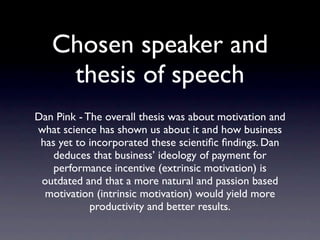
Chosen speaker and
     thesis of speech
      Dan Pink - The overall thesis was about
motivation and what science has shown us about
   it and how business has yet to incorporated
    these scientific findings. Dan deduces that
 business’ ideology of payment for performance
 incentive (extrinsic motivation) is outdated and
that a more natural and passion based motivation
       (intrinsic motivation) would yield more
           productivity and better results.
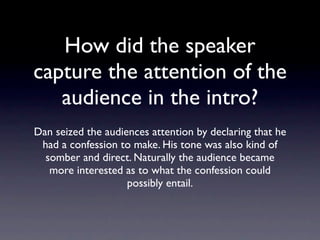
How did the speaker
capture the attention of
  the audience in the
         intro?
Dan seized the audiences attention by declaring
 that he had a confession to make. His tone was
  also kind of somber and direct. Naturally the
audience became more interested as to what the
         confession could possibly entail.
How did the speaker
  maintain the audience
  attention throughout
       the speech?
 Dan was successful at maintaining the audience
attention by introducing the candle problem and
engaging them through fun problem solving while
  simultaneously evoking passion and inflection
   throughout different stages of the speech.
Which of the ten TED
commandments does Dan
     best follow?
 Don’t read your talk - Dan’s speech was
 delivered organically and despite having it
 feel well organized, I could tell that it
 flowed naturally and that he was passionate
 about the information he was delivering.
Which of the ten TED
commandments does Dan
     best follow?
 Don’t flaunt your ego - Despite having a law
 degree, Dan chose to poke fun of himself as
 a lawyer and often times criticized his
 abilities as one. At one point he talks about
 finishing towards the bottom of his class and
 even invoked the notion that he was paid
 NOT to practice law.
Which of the ten TED
commandments does Dan
     best follow?
 Connect with peoples emotions - Dan is
 passionate about changing the way we’re
 motivated. He demonstrates this with his
 discussion about the current economy and
 how motivating the work force intrinsically
 would produce a better outcome that would
 help in getting the economy on back on
 track.
Which of the ten TED commandments
       does Dan best follow?


  Make the complex plain - Dan simplified his
  argument of intrinsic vs extrinsic motivation
  by supplying factual studies. He tied
  everything together by using the studies
  that supported his claim thus making the
  argument more tangible when the audience
  heard the outcomes. The example of the
  company using; FedEx days, 20% time, and
  ROWE
How did the speaker
      rate in terms of
         dynamism?
  On a scale of 1 (lowest) to 5 (highest) I would
give Dan a 4. His energy was appropriate for the
     kind of speech he gave being that it was
 informative. The one think I would have liked to
   see him do more is implement the occasional
pause to allow the information to sink in and add
  more of a dramatic effect. Some of the speech
     felt as if it was coming from a fire hose.
What tips were used
   from Nancy Duarte?
 Dan was able to balance the factual aspect of
  his speech through telling a story about how
  intrinsic motivation in the business world has
 been able to yield better results for employees
and employers alike. He took the data and found
 the meaning of it to convey the argument that
            supports intrinsic motivation.
               As Nancy Duarte says,
 “A little bit of report with a little bit of story”
What did I learn about
  delivery based on
 watching Dan Pink?
 What I took from Dan’s presentation is that it’s
 not only important to have factual data but in
order to link that data to my listeners I need to
have a compelling story that connects to people
  emotionally. Ultimately I feel this will have a
          greater impact on my speech.
Compare & Contrast
        the speakers
 I think Sir Ken Robinson comes off very passionate
 about transforming the way education is applied to
 younger generations. In both speeches we listened
        to, an emphasis is paid to stopping the
institutionalization of schooling and begin to apply a
  more broad approach to how youths learn. This is
  pointed out in his speech “School Kills Creativity”,
 where he argues that most adolescence have their
   natural creativity killed due to archaic forms of
   teaching that focus on a traditional approach to
 academia and ignoring the cultivation of those who
            show an aptitude for creativity.
Compare & Contrast
        the speakers
In Ken’s second speech, “Changing Education Paradigms”,
 he continues to focus on today’s youth and challenges
   “how” todays children are being educated. He feels
    that the rising diagnosis of ADHD, higher drop out
 rates, and a diminishing appreciation for the arts is in
 direct correlation with how children are being taught.
  His argument is that the current education paradigm
 (originally developed for the enlightenment culture of
the industrial revolution) needs to be changed and that
 if this doesn’t occur, we risk alienating millions of kids
     who don’t see the importance of continuing their
                         education.
Compare & Contrast
        the speakers
      Dan Pink’s speech “The Surprising Science of
Motivation” also focuses on how to get better results
 from changing the way we do things. Dan’s argument
 hinges on scientific proof that motivating individuals
 through intrinsic (passionate) means rather extrinsic
   (this for/or that) means yields better results and
      ultimately can improve our current struggling
economy. Dan concludes that if we’re doing something
  we love and are passionate about it, the end results
are far better than doing something simply to be paid
    for it. He utilizes case studies to prove his point.
Compare & Contrast
       the speakers
Dan also focuses on three elements that provide
 the optimal intrinsic approach to “doing stuff”.

 Autonomy - The urge to direct our own lives.

Mastery - The desire to get better at something
                that matters.

Purpose - The yearning to do what we do in the
  service of something larger than ourselves.
Compare & Contrast
        the speakers
 All of Dan’s three elements are vital but he chooses to
 focus on Autonomy to provide more proof that intrinsic
       motivation is more successful than extrinsic.
     This is further supported in his story about the
      popular encyclopedia war of the 90‘s between
   Wikipedia (free non paid contributors) vs Microsoft’s
 Encarta (hired and paid employees). Today, Wikipedia is
 the largest and most complete encyclopedia model and
    is completely free to access. Dan argues that the
reason it worked is because the people who contributed
  to Wikipedia did so (successfully) because they loved
                doing what they were doing.
Summary
 Dan Pink and Sir Ken Robinson obviously had more
    similarities than contrasts. Both speakers are
   passionate about a fundamental change in the
 approach to educating and productivity. These two
  men have acknowledged that the the systematic
      approach to the way we learn and work is
   extremely outdated and should be reformed to
      include a more creative and passion based
 approach. Both support their arguments with data
    and case studies that show evidence to their
respective arguments. As one who suffers from ADD,
  I feel that it’s vital to find more ways to get the
       right brained thinker back into the game.

TED slideshow

  • 1.
    Tave Hawkins PSP 1209 Week 2: TED Talk Evaluation Slide Show
  • 2.
    Chosen speaker and thesis of speech Dan Pink - The overall thesis was about motivation and what science has shown us about it and how business has yet to incorporated these scientific findings. Dan deduces that business’ ideology of payment for performance incentive (extrinsic motivation) is outdated and that a more natural and passion based motivation (intrinsic motivation) would yield more productivity and better results.
  • 3.
    How did thespeaker capture the attention of the audience in the intro? Dan seized the audiences attention by declaring that he had a confession to make. His tone was also kind of somber and direct. Naturally the audience became more interested as to what the confession could possibly entail.
  • 4.
    How did thespeaker maintain the audience attention throughout the speech? Dan was successful at maintaining the audience attention by introducing the candle problem and engaging them through fun problem solving while simultaneously evoking passion and inflection throughout different stages of the speech.
  • 5.
    Which of theten TED commandments does Dan best follow? Don’t read your talk - Dan’s speech was delivered organically and despite having it feel well organized, I could tell that it flowed naturally and that he was passionate about the information he was delivering.
  • 6.
    Which of theten TED commandments does Dan best follow? Don’t flaunt your ego - Despite having a law degree, Dan chose to poke fun of himself as a lawyer and often times criticized his abilities as one. At one point he talks about finishing towards the bottom of his class and even invoked the notion that he was paid NOT to practice law.
  • 7.
    Which of theten TED commandments does Dan best follow? Connect with peoples emotions - Dan is passionate about changing the way we’re motivated. He demonstrates this with his discussion about the current economy and how motivating the work force intrinsically would produce a better outcome that would help in getting the economy on back on track.
  • 8.
    Which of theten TED commandments does Dan best follow? Make the complex plain - Dan simplified his argument of intrinsic vs extrinsic motivation by supplying factual studies. He tied everything together by using the studies that supported his claim thus making the argument more tangible when the audience heard the outcomes. The example of the company using; FedEx days, 20% time, and ROWE
  • 9.
    How did thespeaker rate in terms of dynamism? On a scale of 1 (lowest) to 5 (highest) I would give Dan a 4. His energy was appropriate for the kind of speech he gave being that it was informative. The one think I would have liked to see him do more is implement the occasional pause to allow the information to sink in and add more of a dramatic effect. Some of the speech felt as if it was coming from a fire hose.
  • 10.
    What tips wereused from Nancy Duarte? Dan was able to balance the factual aspect of his speech through telling a story about how intrinsic motivation in the business world has been able to yield better results for employees and employers alike. He took the data and found the meaning of it to convey the argument that supports intrinsic motivation. As Nancy Duarte says, “A little bit of report with a little bit of story”
  • 11.
    What did Ilearn about delivery based on watching Dan Pink? What I took from Dan’s presentation is that it’s not only important to have factual data but in order to link that data to my listeners I need to have a compelling story that connects to people emotionally. Ultimately I feel this will have a greater impact on my speech.
  • 12.
    Compare & Contrast the speakers I think Sir Ken Robinson comes off very passionate about transforming the way education is applied to younger generations. In both speeches we listened to, an emphasis is paid to stopping the institutionalization of schooling and begin to apply a more broad approach to how youths learn. This is pointed out in his speech “School Kills Creativity”, where he argues that most adolescence have their natural creativity killed due to archaic forms of teaching that focus on a traditional approach to academia and ignoring the cultivation of those who show an aptitude for creativity.
  • 13.
    Compare & Contrast the speakers In Ken’s second speech, “Changing Education Paradigms”, he continues to focus on today’s youth and challenges “how” todays children are being educated. He feels that the rising diagnosis of ADHD, higher drop out rates, and a diminishing appreciation for the arts is in direct correlation with how children are being taught. His argument is that the current education paradigm (originally developed for the enlightenment culture of the industrial revolution) needs to be changed and that if this doesn’t occur, we risk alienating millions of kids who don’t see the importance of continuing their education.
  • 14.
    Compare & Contrast the speakers Dan Pink’s speech “The Surprising Science of Motivation” also focuses on how to get better results from changing the way we do things. Dan’s argument hinges on scientific proof that motivating individuals through intrinsic (passionate) means rather extrinsic (this for/or that) means yields better results and ultimately can improve our current struggling economy. Dan concludes that if we’re doing something we love and are passionate about it, the end results are far better than doing something simply to be paid for it. He utilizes case studies to prove his point.
  • 15.
    Compare & Contrast the speakers Dan also focuses on three elements that provide the optimal intrinsic approach to “doing stuff”. Autonomy - The urge to direct our own lives. Mastery - The desire to get better at something that matters. Purpose - The yearning to do what we do in the service of something larger than ourselves.
  • 16.
    Compare & Contrast the speakers All of Dan’s three elements are vital but he chooses to focus on Autonomy to provide more proof that intrinsic motivation is more successful than extrinsic. This is further supported in his story about the popular encyclopedia war of the 90‘s between Wikipedia (free non paid contributors) vs Microsoft’s Encarta (hired and paid employees). Today, Wikipedia is the largest and most complete encyclopedia model and is completely free to access. Dan argues that the reason it worked is because the people who contributed to Wikipedia did so (successfully) because they loved doing what they were doing.
  • 17.
    Summary Dan Pinkand Sir Ken Robinson obviously had more similarities than contrasts. Both speakers are passionate about a fundamental change in the approach to educating and productivity. These two men have acknowledged that the the systematic approach to the way we learn and work is extremely outdated and should be reformed to include a more creative and passion based approach. Both support their arguments with data and case studies that show evidence to their respective arguments. As one who suffers from ADD, I feel that it’s vital to find more ways to get the right brained thinker back into the game.