Cisco Hyperflex
Systems
Jeff MacTavish and Chris Nichols
April 27, 2016
Jeff MacTavish
Global Sales BDM Hyperconverged solutions at Cisco
Chris Nichols
Americas Technical lead for Hyperconverged solutions at Cisco
Cisco HyperFlex Systems
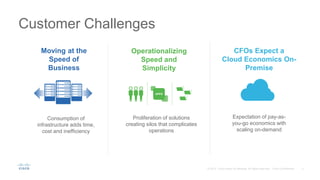
Customer Challenges
CFOs Expect a
Cloud Economics On-
Premise
Expectation of pay-as-
you-go economics with
scaling on-demand
Moving at the
Speed of
Business
Consumption of
infrastructure adds time,
cost and inefficiency
Operationalizing
Speed and
Simplicity
Proliferation of solutions
creating silos that complicates
operations
APPS
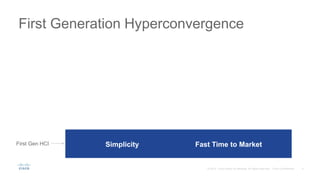
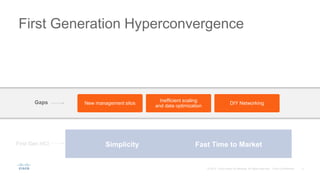
First Generation Hyperconvergence
Fast Time to MarketSimplicityFirst Gen HCI
First Generation Hyperconvergence
Gaps
Fast Time to MarketSimplicity
New management silos
Inefficient scaling
and data optimization
DIY Networking
First Gen HCI
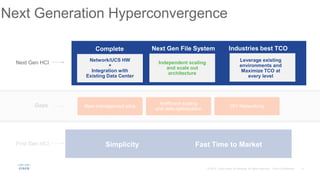
Next Generation Hyperconvergence
Next Gen HCI
Gaps
Fast Time to MarketSimplicity
New management silos
Inefficient scaling
and data optimization
DIY Networking
Complete
Network/UCS HW
+
Integration with
Existing Data Center
Independent scaling
and scale out
architecture
First Gen HCI
Next Gen File System Industries best TCO
Leverage existing
environments and
Maximize TCO at
every level
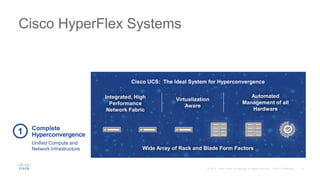
Cisco HyperFlex Systems
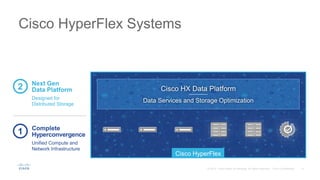
1 Complete
Hyperconvergence
Unified Compute and
Network Infrastructure Wide Array of Rack and Blade Form Factors
Integrated, High
Performance
Network Fabric
Automated
Management of all
Hardware
Virtualization
Aware
Cisco UCS: The Ideal System for Hyperconvergence
Cisco HyperFlex Systems
1 Complete
Hyperconvergence
Unified Compute and
Network Infrastructure
Cisco HyperFlex
Cisco HX Data Platform
Data Services and Storage Optimization
2 Next Gen
Data Platform
Designed for
Distributed Storage
Cisco HyperFlex Systems
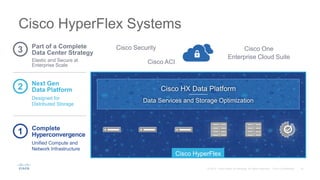
1
3
Complete
Hyperconvergence
Unified Compute and
Network Infrastructure
Part of a Complete
Data Center Strategy
Elastic and Secure at
Enterprise Scale
Cisco HyperFlex
Cisco HX Data Platform
Data Services and Storage Optimization
2 Next Gen
Data Platform
Designed for
Distributed Storage
Cisco One
Enterprise Cloud Suite
Cisco ACI
Cisco Security
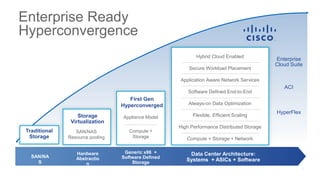
Traditional
Storage
SAN/NA
S
Hardware
Abstractio
n
Data Center Architecture:
Systems + ASICs + Software
First Gen
Hyperconverged
Appliance Model
Compute +
Storage
Generic x86 +
Software Defined
Storage
Storage
Virtualization
SAN/NAS
Resource pooling
Hybrid Cloud Enabled
Secure Workload Placement
Application Aware Network Services
Software Defined End-to-End
Always-on Data Optimization
Flexible, Efficient Scaling
High Performance Distributed Storage
Compute + Storage + Network
Enterprise Ready
Hyperconvergence
Enterprise
Cloud Suite
ACI
HyperFlex
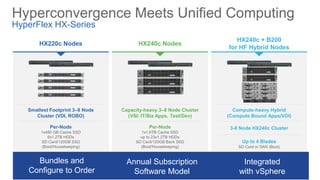
HX240c Nodes
Capacity-heavy 3–8 Node Cluster
(VSI: IT/Biz Apps, Test/Dev)
Per-Node
1x1.6TB Cache SSD
up to 23x1.2TB HDDs
SD Card/120GB Back SSD
(Boot/Housekeeping)
HX240c + B200
for HF Hybrid Nodes
Compute-heavy Hybrid
(Compute Bound Apps/VDI)
Up to 4 Blades
SD Card or SAN (Boot)
3-8 Node HX240c Cluster
HX220c Nodes
Smallest Footprint 3–8 Node
Cluster (VDI, ROBO)
Per-Node
1x480 GB Cache SSD
6x1.2TB HDDs
SD Card/120GB SSD
(Boot/Housekeeping)
Bundles and
Configure to Order
Annual Subscription
Software Model
Integrated
with vSphere
Hyperconvergence Meets Unified Computing
HyperFlex HX-Series
Cisco HX Data Platform
Overview
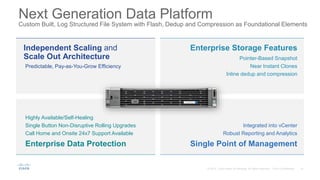
Next Generation Data Platform
Custom Built, Log Structured File System with Flash, Dedup and Compression as Foundational Elements
Independent Scaling and
Scale Out Architecture
Predictable, Pay-as-You-Grow Efficiency
Enterprise Storage Features
Pointer-Based Snapshot
Near Instant Clones
Inline dedup and compression
Enterprise Data Protection
Highly Available/Self-Healing
Single Button Non-Disruptive Rolling Upgrades
Call Home and Onsite 24x7 Support Available
Single Point of Management
Integrated into vCenter
Robust Reporting and Analytics
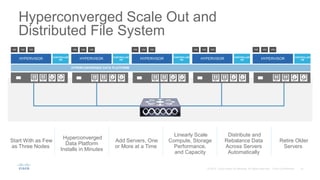
Hyperconverged Scale Out and
Distributed File System
CONTROLLER
VMHYPERVISOR
VM VM VM
HYPERCONVERGED DATA PLATFORMHYPERCONVERGED DATA PLATFORMHYPERCONVERGED DATA PLATFORM
Start With as Few
as Three Nodes
Hyperconverged
Data Platform
Installs in Minutes
Add Servers, One
or More at a Time
Linearly Scale
Compute, Storage
Performance,
and Capacity
Distribute and
Rebalance Data
Across Servers
Automatically
Retire Older
Servers
HYPERCONVERGED DATA PLATFORM
CONTROLLER
VMHYPERVISOR
VM VM VM
CONTROLLER
VMHYPERVISOR
VM VM VM
CONTROLLER
VMHYPERVISOR
VM VM VM
CONTROLLER
VMHYPERVISOR
VM VM VM
CONTROLLERHYPERVISOR
VM VMVM
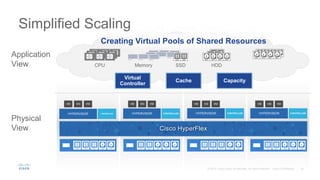
Simplified Scaling
CONTROLLERHYPERVISORHYPERVISOR CONTROLLERHYPERVISOR
VM VMVM VM VMVMVM VMVM
CONTROLLER
Physical
View
Application
View
HX Data PlatformCisco HyperFlex
Virtual
Controller
Cache Capacity
Creating Virtual Pools of Shared Resources
SSD HDDMemoryCPU
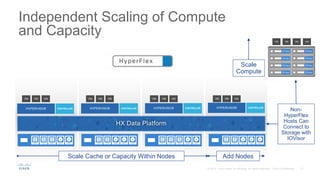
Independent Scaling of Compute
and Capacity
Scale
Compute
HX Data Platform
Add NodesScale Cache or Capacity Within Nodes
HX Data Platform
CONTROLLERHYPERVISORCONTROLLERHYPERVISOR CONTROLLERHYPERVISOR CONTROLLERHYPERVISOR
IOVisorIOVisor
IOVisorIOVisor
IOVisorIOVisor
IOVisorIOVisor
VM VM VM VM
Non-
HyperFlex
Hosts Can
Connect to
Storage with
IOVisor
VM VMVM VM VMVM VM VMVM VM VMVM
HyperFlex Technical Overview
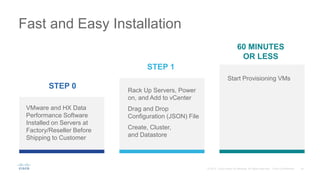
Fast and Easy Installation
STEP 0
STEP 1
60 MINUTES
OR LESS
VMware and HX Data
Performance Software
Installed on Servers at
Factory/Reseller Before
Shipping to Customer
Rack Up Servers, Power
on, and Add to vCenter
Drag and Drop
Configuration (JSON) File
Create, Cluster,
and Datastore
Start Provisioning VMs
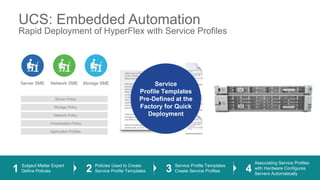
UCS: Embedded Automation
Rapid Deployment of HyperFlex with Service Profiles
Uplink port configuration,
VLAN, VSAN, QoS, and
EtherChannels
Server port configuration
including LAN and SAN
settings
Network interface card (NIC)
configuration: MAC address,
VLAN, and QoS settings;
host bus adapter HBA configuration:
worldwide names (WWNs), VSANs,
and bandwidth constraints;
and firmware revisions
Unique user ID (UUID),
firmware revisions,
and RAID controller settings
Service profile assigned to server,
chassis slot, or pool
configuration: MAC
address,
VLAN, and QoS settings;
host bus adapter HBA
configuration:
worldwide names (WWNs),
VSANs,
configuration: MAC
address,
VLAN, and QoS settings;
host bus adapter HBA

configuration:
worldwide names (WWNs),
VSANs,
configuration: MAC
address
VLAN, and QoS settings;
host bus adapter HBA
configuration:
worldwide names (WWNs),
VSANs,
Application Profiles
Virtualization Policy
Network Policy
Storage Policy
Server Policy
Storage SMENetwork SMEServer SME
1 Subject Matter Expert
Define Policies 2 Policies Used to Create
Service Profile Templates 3 Service Profile Templates
Create Service Profiles 4
Associating Service Profiles
with Hardware Configures
Servers Automatically
Service
Profile Templates
Pre-Defined at the
Factory for Quick
Deployment
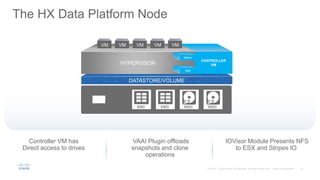
The HX Data Platform Node
VAAI Plugin offloads
snapshots and clone
operations
Controller VM has
Direct access to drives
IOVisor Module Presents NFS
to ESX and Stripes IO
DATASTORE/VOLUME
CONTROLLER
VMHYPERVISOR
VMVMVMVMVM
HDD
HDD
SDD
SDD
IOVisor
VAAI
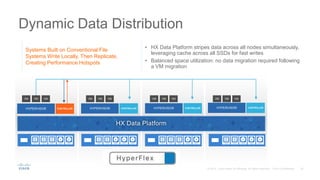
Dynamic Data Distribution
• HX Data Platform stripes data across all nodes simultaneously,
leveraging cache across all SSDs for fast writes
• Balanced space utilization: no data migration required following
a VM migration
Systems Built on Conventional File
Systems Write Locally, Then Replicate,
Creating Performance Hotspots
CONTROLLERHYPERVISORHYPERVISOR CONTROLLERHYPERVISOR CONTROLLERHYPERVISOR
VM VMVM VM VMVM VM VMVM
HX Data Platform
VM VMVM
CONTROLLERCONTROLLER
HYPERVISOR
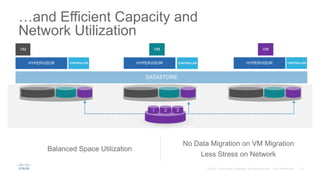
…and Efficient Capacity and
Network Utilization
HYPERVISOR HYPERVISOR
VM VM
1 2 3
VM
DATASTORE
CONTROLLER CONTROLLER CONTROLLER
Balanced Space Utilization
No Data Migration on VM Migration
Less Stress on Network
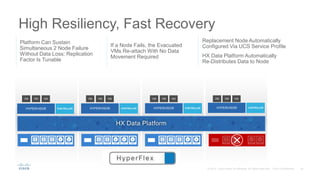
High Resiliency, Fast Recovery
Platform Can Sustain
Simultaneous 2 Node Failure
Without Data Loss; Replication
Factor Is Tunable
If a Node Fails, the Evacuated
VMs Re-attach With No Data
Movement Required
Replacement Node Automatically
Configured Via UCS Service Profile
HX Data Platform Automatically
Re-Distributes Data to Node
CONTROLLERHYPERVISORCONTROLLERHYPERVISOR CONTROLLERHYPERVISOR CONTROLLERHYPERVISOR
VM VMVM VM VMVM VM VMVM VM VMVM
HX Data PlatformHX Data Platform
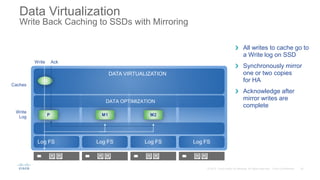
Data Virtualization
Write Back Caching to SSDs with Mirroring
Distributed Objects
All writes to cache go to
a Write log on SSD
Synchronously mirror
one or two copies
for HA
Acknowledge after
mirror writes are
complete
Log FS Log FS Log FS
DATA OPTIMIZATION
DATA VIRTUALIZATION
Caches
Log FS
Write Ack
M1 M2
Write
Log P
DATA VIRTUALIZATION
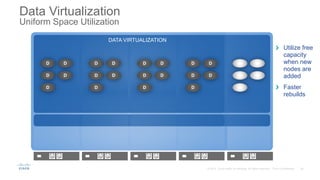
Data Virtualization
Uniform Space Utilization
Utilize free
capacity
when new
nodes are
added
Faster
rebuilds
DATA VIRTUALIZATION
D D D DD D
D D D DD D
D D
D D
D DD D
DATASTORE DATASTORE
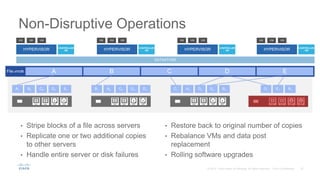
• Stripe blocks of a file across servers
• Replicate one or two additional copies
to other servers
• Handle entire server or disk failures
• Restore back to original number of copies
• Rebalance VMs and data post
replacement
• Rolling software upgrades
Non-Disruptive Operations
CONTROLLER
VMHYPERVISOR
VM VM VM
CONTROLLER
VMHYPERVISOR
VM VM VM
CONTROLLER
VMHYPERVISOR
VM VM VM
CONTROLLER
VMHYPERVISOR
VM VM VM
File.vmdk
D1 E1A1 B1 C1B2 A2 A3C2 C3 D2D3 E2E3 D1E1 B3 B3
EDCBA
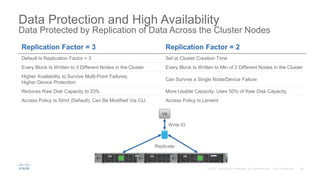
Data Protection and High Availability
Data Protected by Replication of Data Across the Cluster Nodes
VM
Replicate
Write IO
Replication Factor = 3 Replication Factor = 2
Default Is Replication Factor = 3 Set at Cluster Creation Time
Every Block Is Written to 3 Different Nodes in the Cluster Every Block Is Written to Min of 2 Different Nodes in the Cluster
Higher Availability to Survive Multi-Point Failures;
Higher Device Protection
Can Survive a Single Node/Device Failure
Reduces Raw Disk Capacity to 33% More Usable Capacity; Uses 50% of Raw Disk Capacity
Access Policy Is Strict (Default); Can Be Modified Via CLI Access Policy Is Lenient
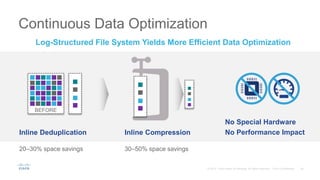
Continuous Data Optimization
BEFORE
Inline Deduplication
20–30% space savings
Inline Compression
30–50% space savings
No Special Hardware
No Performance Impact
Log-Structured File System Yields More Efficient Data Optimization
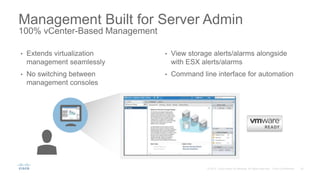
• Extends virtualization
management seamlessly
• No switching between
management consoles
• View storage alerts/alarms alongside
with ESX alerts/alarms
• Command line interface for automation
Management Built for Server Admin
100% vCenter-Based Management
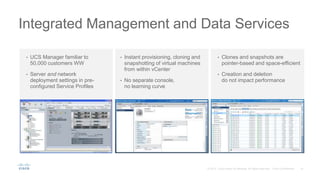
Integrated Management and Data Services
• Clones and snapshots are
pointer-based and space-efficient
• Creation and deletion
do not impact performance
• Instant provisioning, cloning and
snapshotting of virtual machines
from within vCenter
• No separate console,
no learning curve
• UCS Manager familiar to
50,000 customers WW
• Server and network
deployment settings in pre-
configured Service Profiles
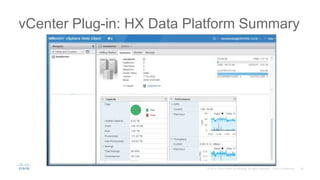
vCenter Plug-in: HX Data Platform Summary
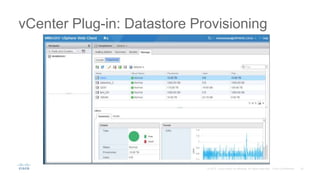
vCenter Plug-in: Datastore Provisioning
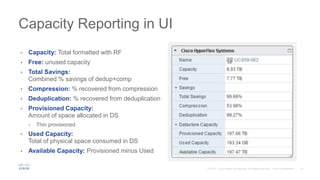
Capacity Reporting in UI
• Capacity: Total formatted with RF
• Free: unused capacity
• Total Savings:
Combined % savings of dedup+comp
• Compression: % recovered from compression
• Deduplication: % recovered from deduplication
• Provisioned Capacity:
Amount of space allocated in DS
• Thin provisioned
• Used Capacity:
Total of physical space consumed in DS
• Available Capacity: Provisioned minus Used
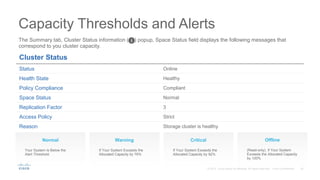
Your System Is Below the
Alert Threshold
Normal
If Your System Exceeds the
Allocated Capacity by 76%
Warning
If Your System Exceeds the
Allocated Capacity by 92%
Critical
(Read-only). If Your System
Exceeds the Allocated Capacity
by 100%
Offline
Capacity Thresholds and Alerts
Cluster Status
Status Online
Health State Healthy
Policy Compliance Compliant
Space Status Normal
Replication Factor 3
Access Policy Strict
Reason Storage cluster is healthy
The Summary tab, Cluster Status information ( ) popup, Space Status field displays the following messages that
correspond to you cluster capacity.
i
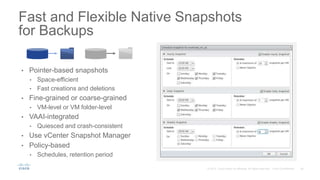
• Pointer-based snapshots
• Space-efficient
• Fast creations and deletions
• Fine-grained or coarse-grained
• VM-level or VM folder-level
• VAAI-integrated
• Quiesced and crash-consistent
• Use vCenter Snapshot Manager
• Policy-based
• Schedules, retention period
Fast and Flexible Native Snapshots
for Backups
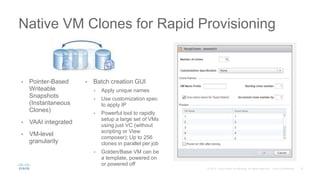
• Pointer-Based
Writeable
Snapshots
(Instantaneous
Clones)
• VAAI integrated
• VM-level
granularity
Native VM Clones for Rapid Provisioning
• Batch creation GUI
• Apply unique names
• Use customization spec
to apply IP
• Powerful tool to rapidly
setup a large set of VMs
using just VC (without
scripting or View
composer); Up to 256
clones in parallel per job
• Golden/Base VM can be
a template, powered on
or powered off
Cisco HyperFlex
Business Value
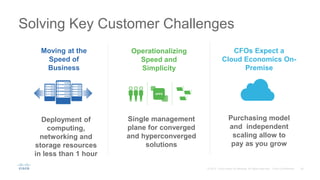
Solving Key Customer Challenges
CFOs Expect a
Cloud Economics On-
Premise
Purchasing model
and independent
scaling allow to
pay as you grow
Moving at the
Speed of
Business
Deployment of
computing,
networking and
storage resources
in less than 1 hour
Operationalizing
Speed and
Simplicity
Single management
plane for converged
and hyperconverged
solutions
APPS
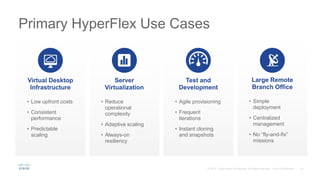
Primary HyperFlex Use Cases
• Agile provisioning
• Frequent
iterations
• Instant cloning
and snapshots
Test and
Development
• Low upfront costs
• Consistent
performance
• Predictable
scaling
Virtual Desktop
Infrastructure
• Reduce
operational
complexity
• Adaptive scaling
• Always-on
resiliency
Server
Virtualization
• Simple
deployment
• Centralized
management
• No “fly-and-fix”
missions
Large Remote
Branch Office
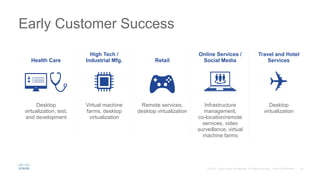
Early Customer Success
Desktop
virtualization, test,
and development
Health Care
Virtual machine
farms, desktop
virtualization
High Tech /
Industrial Mfg.
Remote services,
desktop virtualization
Retail
Infrastructure
management,
co-location/remote
services, video
surveillance, virtual
machine farms
Online Services /
Social Media
Desktop
virtualization
Travel and Hotel
Services
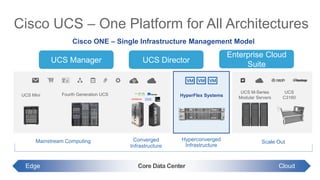
Mainstream Computing Scale Out
UCS M-Series
Modular Servers
UCS
C3160
Fourth Generation UCS
Cisco UCS – One Platform for All Architectures
HyperFlex Systems
Hyperconverged
Infrastructure
Converged
Infrastructure
Core Data CenterEdge Cloud
Cisco ONE – Single Infrastructure Management Model
UCS Mini
UCS Manager UCS Director
Enterprise Cloud
Suite
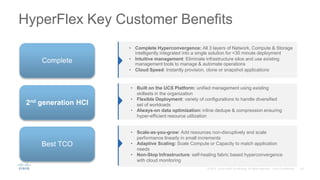
HyperFlex Key Customer Benefits
• Complete Hyperconvergence: All 3 layers of Network, Compute & Storage
intelligently integrated into a single solution for <30 minute deployment
• Intuitive management: Eliminate infrastructure silos and use existing
management tools to manage & automate operations
• Cloud Speed: Instantly provision, clone or snapshot applications
• Built on the UCS Platform: unified management using existing
skillsets in the organization
• Flexible Deployment: variety of configurations to handle diversified
set of workloads
• Always-on data optimization: inline dedupe & compression ensuring
hyper-efficient resource utilization
• Scale-as-you-grow: Add resources non-disruptively and scale
performance linearly in small increments
• Adaptive Scaling: Scale Compute or Capacity to match application
needs
• Non-Stop Infrastructure: self-healing fabric based hyperconvergence
with cloud monitoring
Complete
2nd generation HCI
Best TCO
Infrastructure for Next Generation
Hyperconvergence
HCI Solutions Combine Computing, Networking, Storage for rapid
deployment
Elimination of management silos within and between data centers
and remote sites simplify operations
Unique capacity scaling and pricing models allow you to scale as you
grow
Thank you
Thank you for watching.

TechWiseTV Workshop: Cisco HyperFlex Systems

  • 1.
    Cisco Hyperflex Systems Jeff MacTavishand Chris Nichols April 27, 2016
  • 2.
    Jeff MacTavish Global SalesBDM Hyperconverged solutions at Cisco Chris Nichols Americas Technical lead for Hyperconverged solutions at Cisco Cisco HyperFlex Systems
  • 3.
    Customer Challenges CFOs Expecta Cloud Economics On- Premise Expectation of pay-as- you-go economics with scaling on-demand Moving at the Speed of Business Consumption of infrastructure adds time, cost and inefficiency Operationalizing Speed and Simplicity Proliferation of solutions creating silos that complicates operations APPS
  • 4.
    First Generation Hyperconvergence FastTime to MarketSimplicityFirst Gen HCI
  • 5.
    First Generation Hyperconvergence Gaps FastTime to MarketSimplicity New management silos Inefficient scaling and data optimization DIY Networking First Gen HCI
  • 6.
    Next Generation Hyperconvergence NextGen HCI Gaps Fast Time to MarketSimplicity New management silos Inefficient scaling and data optimization DIY Networking Complete Network/UCS HW + Integration with Existing Data Center Independent scaling and scale out architecture First Gen HCI Next Gen File System Industries best TCO Leverage existing environments and Maximize TCO at every level
  • 7.
  • 8.
    Cisco HyperFlex Systems 1Complete Hyperconvergence Unified Compute and Network Infrastructure Wide Array of Rack and Blade Form Factors Integrated, High Performance Network Fabric Automated Management of all Hardware Virtualization Aware Cisco UCS: The Ideal System for Hyperconvergence
  • 9.
    Cisco HyperFlex Systems 1Complete Hyperconvergence Unified Compute and Network Infrastructure Cisco HyperFlex Cisco HX Data Platform Data Services and Storage Optimization 2 Next Gen Data Platform Designed for Distributed Storage
  • 10.
    Cisco HyperFlex Systems 1 3 Complete Hyperconvergence UnifiedCompute and Network Infrastructure Part of a Complete Data Center Strategy Elastic and Secure at Enterprise Scale Cisco HyperFlex Cisco HX Data Platform Data Services and Storage Optimization 2 Next Gen Data Platform Designed for Distributed Storage Cisco One Enterprise Cloud Suite Cisco ACI Cisco Security
  • 11.
    Traditional Storage SAN/NA S Hardware Abstractio n Data Center Architecture: Systems+ ASICs + Software First Gen Hyperconverged Appliance Model Compute + Storage Generic x86 + Software Defined Storage Storage Virtualization SAN/NAS Resource pooling Hybrid Cloud Enabled Secure Workload Placement Application Aware Network Services Software Defined End-to-End Always-on Data Optimization Flexible, Efficient Scaling High Performance Distributed Storage Compute + Storage + Network Enterprise Ready Hyperconvergence Enterprise Cloud Suite ACI HyperFlex
  • 12.
    HX240c Nodes Capacity-heavy 3–8Node Cluster (VSI: IT/Biz Apps, Test/Dev) Per-Node 1x1.6TB Cache SSD up to 23x1.2TB HDDs SD Card/120GB Back SSD (Boot/Housekeeping) HX240c + B200 for HF Hybrid Nodes Compute-heavy Hybrid (Compute Bound Apps/VDI) Up to 4 Blades SD Card or SAN (Boot) 3-8 Node HX240c Cluster HX220c Nodes Smallest Footprint 3–8 Node Cluster (VDI, ROBO) Per-Node 1x480 GB Cache SSD 6x1.2TB HDDs SD Card/120GB SSD (Boot/Housekeeping) Bundles and Configure to Order Annual Subscription Software Model Integrated with vSphere Hyperconvergence Meets Unified Computing HyperFlex HX-Series
  • 13.
    Cisco HX DataPlatform Overview
  • 14.
    Next Generation DataPlatform Custom Built, Log Structured File System with Flash, Dedup and Compression as Foundational Elements Independent Scaling and Scale Out Architecture Predictable, Pay-as-You-Grow Efficiency Enterprise Storage Features Pointer-Based Snapshot Near Instant Clones Inline dedup and compression Enterprise Data Protection Highly Available/Self-Healing Single Button Non-Disruptive Rolling Upgrades Call Home and Onsite 24x7 Support Available Single Point of Management Integrated into vCenter Robust Reporting and Analytics
  • 15.
    Hyperconverged Scale Outand Distributed File System CONTROLLER VMHYPERVISOR VM VM VM HYPERCONVERGED DATA PLATFORMHYPERCONVERGED DATA PLATFORMHYPERCONVERGED DATA PLATFORM Start With as Few as Three Nodes Hyperconverged Data Platform Installs in Minutes Add Servers, One or More at a Time Linearly Scale Compute, Storage Performance, and Capacity Distribute and Rebalance Data Across Servers Automatically Retire Older Servers HYPERCONVERGED DATA PLATFORM CONTROLLER VMHYPERVISOR VM VM VM CONTROLLER VMHYPERVISOR VM VM VM CONTROLLER VMHYPERVISOR VM VM VM CONTROLLER VMHYPERVISOR VM VM VM
  • 16.
    CONTROLLERHYPERVISOR VM VMVM Simplified Scaling CONTROLLERHYPERVISORHYPERVISORCONTROLLERHYPERVISOR VM VMVM VM VMVMVM VMVM CONTROLLER Physical View Application View HX Data PlatformCisco HyperFlex Virtual Controller Cache Capacity Creating Virtual Pools of Shared Resources SSD HDDMemoryCPU
  • 17.
    Independent Scaling ofCompute and Capacity Scale Compute HX Data Platform Add NodesScale Cache or Capacity Within Nodes HX Data Platform CONTROLLERHYPERVISORCONTROLLERHYPERVISOR CONTROLLERHYPERVISOR CONTROLLERHYPERVISOR IOVisorIOVisor IOVisorIOVisor IOVisorIOVisor IOVisorIOVisor VM VM VM VM Non- HyperFlex Hosts Can Connect to Storage with IOVisor VM VMVM VM VMVM VM VMVM VM VMVM
  • 18.
  • 19.
    Fast and EasyInstallation STEP 0 STEP 1 60 MINUTES OR LESS VMware and HX Data Performance Software Installed on Servers at Factory/Reseller Before Shipping to Customer Rack Up Servers, Power on, and Add to vCenter Drag and Drop Configuration (JSON) File Create, Cluster, and Datastore Start Provisioning VMs
  • 20.
    UCS: Embedded Automation RapidDeployment of HyperFlex with Service Profiles Uplink port configuration, VLAN, VSAN, QoS, and EtherChannels Server port configuration including LAN and SAN settings Network interface card (NIC) configuration: MAC address, VLAN, and QoS settings; host bus adapter HBA configuration: worldwide names (WWNs), VSANs, and bandwidth constraints; and firmware revisions Unique user ID (UUID), firmware revisions, and RAID controller settings Service profile assigned to server, chassis slot, or pool configuration: MAC address, VLAN, and QoS settings; host bus adapter HBA configuration: worldwide names (WWNs), VSANs, configuration: MAC address, VLAN, and QoS settings; host bus adapter HBA configuration: worldwide names (WWNs), VSANs, configuration: MAC address VLAN, and QoS settings; host bus adapter HBA configuration: worldwide names (WWNs), VSANs, Application Profiles Virtualization Policy Network Policy Storage Policy Server Policy Storage SMENetwork SMEServer SME 1 Subject Matter Expert Define Policies 2 Policies Used to Create Service Profile Templates 3 Service Profile Templates Create Service Profiles 4 Associating Service Profiles with Hardware Configures Servers Automatically Service Profile Templates Pre-Defined at the Factory for Quick Deployment
  • 21.
    The HX DataPlatform Node VAAI Plugin offloads snapshots and clone operations Controller VM has Direct access to drives IOVisor Module Presents NFS to ESX and Stripes IO DATASTORE/VOLUME CONTROLLER VMHYPERVISOR VMVMVMVMVM HDD HDD SDD SDD IOVisor VAAI
  • 22.
    Dynamic Data Distribution •HX Data Platform stripes data across all nodes simultaneously, leveraging cache across all SSDs for fast writes • Balanced space utilization: no data migration required following a VM migration Systems Built on Conventional File Systems Write Locally, Then Replicate, Creating Performance Hotspots CONTROLLERHYPERVISORHYPERVISOR CONTROLLERHYPERVISOR CONTROLLERHYPERVISOR VM VMVM VM VMVM VM VMVM HX Data Platform VM VMVM CONTROLLERCONTROLLER
  • 23.
    HYPERVISOR …and Efficient Capacityand Network Utilization HYPERVISOR HYPERVISOR VM VM 1 2 3 VM DATASTORE CONTROLLER CONTROLLER CONTROLLER Balanced Space Utilization No Data Migration on VM Migration Less Stress on Network
  • 24.
    High Resiliency, FastRecovery Platform Can Sustain Simultaneous 2 Node Failure Without Data Loss; Replication Factor Is Tunable If a Node Fails, the Evacuated VMs Re-attach With No Data Movement Required Replacement Node Automatically Configured Via UCS Service Profile HX Data Platform Automatically Re-Distributes Data to Node CONTROLLERHYPERVISORCONTROLLERHYPERVISOR CONTROLLERHYPERVISOR CONTROLLERHYPERVISOR VM VMVM VM VMVM VM VMVM VM VMVM HX Data PlatformHX Data Platform
  • 25.
    Data Virtualization Write BackCaching to SSDs with Mirroring Distributed Objects All writes to cache go to a Write log on SSD Synchronously mirror one or two copies for HA Acknowledge after mirror writes are complete Log FS Log FS Log FS DATA OPTIMIZATION DATA VIRTUALIZATION Caches Log FS Write Ack M1 M2 Write Log P
  • 26.
    DATA VIRTUALIZATION Data Virtualization UniformSpace Utilization Utilize free capacity when new nodes are added Faster rebuilds DATA VIRTUALIZATION D D D DD D D D D DD D D D D D D DD D
  • 27.
    DATASTORE DATASTORE • Stripeblocks of a file across servers • Replicate one or two additional copies to other servers • Handle entire server or disk failures • Restore back to original number of copies • Rebalance VMs and data post replacement • Rolling software upgrades Non-Disruptive Operations CONTROLLER VMHYPERVISOR VM VM VM CONTROLLER VMHYPERVISOR VM VM VM CONTROLLER VMHYPERVISOR VM VM VM CONTROLLER VMHYPERVISOR VM VM VM File.vmdk D1 E1A1 B1 C1B2 A2 A3C2 C3 D2D3 E2E3 D1E1 B3 B3 EDCBA
  • 28.
    Data Protection andHigh Availability Data Protected by Replication of Data Across the Cluster Nodes VM Replicate Write IO Replication Factor = 3 Replication Factor = 2 Default Is Replication Factor = 3 Set at Cluster Creation Time Every Block Is Written to 3 Different Nodes in the Cluster Every Block Is Written to Min of 2 Different Nodes in the Cluster Higher Availability to Survive Multi-Point Failures; Higher Device Protection Can Survive a Single Node/Device Failure Reduces Raw Disk Capacity to 33% More Usable Capacity; Uses 50% of Raw Disk Capacity Access Policy Is Strict (Default); Can Be Modified Via CLI Access Policy Is Lenient
  • 29.
    Continuous Data Optimization BEFORE InlineDeduplication 20–30% space savings Inline Compression 30–50% space savings No Special Hardware No Performance Impact Log-Structured File System Yields More Efficient Data Optimization
  • 30.
    • Extends virtualization managementseamlessly • No switching between management consoles • View storage alerts/alarms alongside with ESX alerts/alarms • Command line interface for automation Management Built for Server Admin 100% vCenter-Based Management
  • 31.
    Integrated Management andData Services • Clones and snapshots are pointer-based and space-efficient • Creation and deletion do not impact performance • Instant provisioning, cloning and snapshotting of virtual machines from within vCenter • No separate console, no learning curve • UCS Manager familiar to 50,000 customers WW • Server and network deployment settings in pre- configured Service Profiles
  • 32.
    vCenter Plug-in: HXData Platform Summary
  • 33.
  • 34.
    Capacity Reporting inUI • Capacity: Total formatted with RF • Free: unused capacity • Total Savings: Combined % savings of dedup+comp • Compression: % recovered from compression • Deduplication: % recovered from deduplication • Provisioned Capacity: Amount of space allocated in DS • Thin provisioned • Used Capacity: Total of physical space consumed in DS • Available Capacity: Provisioned minus Used
  • 35.
    Your System IsBelow the Alert Threshold Normal If Your System Exceeds the Allocated Capacity by 76% Warning If Your System Exceeds the Allocated Capacity by 92% Critical (Read-only). If Your System Exceeds the Allocated Capacity by 100% Offline Capacity Thresholds and Alerts Cluster Status Status Online Health State Healthy Policy Compliance Compliant Space Status Normal Replication Factor 3 Access Policy Strict Reason Storage cluster is healthy The Summary tab, Cluster Status information ( ) popup, Space Status field displays the following messages that correspond to you cluster capacity. i
  • 36.
    • Pointer-based snapshots •Space-efficient • Fast creations and deletions • Fine-grained or coarse-grained • VM-level or VM folder-level • VAAI-integrated • Quiesced and crash-consistent • Use vCenter Snapshot Manager • Policy-based • Schedules, retention period Fast and Flexible Native Snapshots for Backups
  • 37.
    • Pointer-Based Writeable Snapshots (Instantaneous Clones) • VAAIintegrated • VM-level granularity Native VM Clones for Rapid Provisioning • Batch creation GUI • Apply unique names • Use customization spec to apply IP • Powerful tool to rapidly setup a large set of VMs using just VC (without scripting or View composer); Up to 256 clones in parallel per job • Golden/Base VM can be a template, powered on or powered off
  • 38.
  • 39.
    Solving Key CustomerChallenges CFOs Expect a Cloud Economics On- Premise Purchasing model and independent scaling allow to pay as you grow Moving at the Speed of Business Deployment of computing, networking and storage resources in less than 1 hour Operationalizing Speed and Simplicity Single management plane for converged and hyperconverged solutions APPS
  • 40.
    Primary HyperFlex UseCases • Agile provisioning • Frequent iterations • Instant cloning and snapshots Test and Development • Low upfront costs • Consistent performance • Predictable scaling Virtual Desktop Infrastructure • Reduce operational complexity • Adaptive scaling • Always-on resiliency Server Virtualization • Simple deployment • Centralized management • No “fly-and-fix” missions Large Remote Branch Office
  • 41.
    Early Customer Success Desktop virtualization,test, and development Health Care Virtual machine farms, desktop virtualization High Tech / Industrial Mfg. Remote services, desktop virtualization Retail Infrastructure management, co-location/remote services, video surveillance, virtual machine farms Online Services / Social Media Desktop virtualization Travel and Hotel Services
  • 42.
    Mainstream Computing ScaleOut UCS M-Series Modular Servers UCS C3160 Fourth Generation UCS Cisco UCS – One Platform for All Architectures HyperFlex Systems Hyperconverged Infrastructure Converged Infrastructure Core Data CenterEdge Cloud Cisco ONE – Single Infrastructure Management Model UCS Mini UCS Manager UCS Director Enterprise Cloud Suite
  • 43.
    HyperFlex Key CustomerBenefits • Complete Hyperconvergence: All 3 layers of Network, Compute & Storage intelligently integrated into a single solution for <30 minute deployment • Intuitive management: Eliminate infrastructure silos and use existing management tools to manage & automate operations • Cloud Speed: Instantly provision, clone or snapshot applications • Built on the UCS Platform: unified management using existing skillsets in the organization • Flexible Deployment: variety of configurations to handle diversified set of workloads • Always-on data optimization: inline dedupe & compression ensuring hyper-efficient resource utilization • Scale-as-you-grow: Add resources non-disruptively and scale performance linearly in small increments • Adaptive Scaling: Scale Compute or Capacity to match application needs • Non-Stop Infrastructure: self-healing fabric based hyperconvergence with cloud monitoring Complete 2nd generation HCI Best TCO
  • 44.
    Infrastructure for NextGeneration Hyperconvergence HCI Solutions Combine Computing, Networking, Storage for rapid deployment Elimination of management silos within and between data centers and remote sites simplify operations Unique capacity scaling and pricing models allow you to scale as you grow
  • 45.
  • 46.
    Thank you forwatching.

Editor's Notes

  • #2 This cover slide should be updated with current information and left on screen as people log in. - Replace ‘Topic’, ‘Guest Speaker’ , ‘Date’
  • #3 Notes Duarte: Look for more branch or retail intro background
  • #4 Let’s take a look first at some of the challenges that you’re facing – challenges which are causing you to evaluate hyperconverged-based infrastructures. First, in this new mode of speed and agility has created a mismatch with infrastructure. Current infrastructure for the applications you’re considering, adds cost, time and inefficiency. Much of the infrastructure typically available – storage arrays, traditional blade servers, networking – requires a degree of expertise which can hamper rapid deployment. The drive towards hyperconverged solutions fills the need for moving at the speed of business, but often there’s another cost – proliferation of solutions that are managed separately, which complicates infrastructure management and operations. Most solutoins today solve the Day 0 challenge, which is infrastructure procurement and standing up the infrastructure. HCI solves that, but day 2. So there’s an opportunity leverage to deploy a hyperconverged infrastructure with a common management paradigm to other solutions. The final challenge is around the “promise” of cloud economics. Note that cloud doesn’t save you money – it provides simplified scaling at far more granular levels with scale out and allows you to spend the money when you need it. So for these new applications and operational models, a solution is required that helps you scale capabilities as you need it.
  • #5 Many hyperconverged solutions solve these problems to varying extents. All HCI solutions claim to be agile: you can rapidly provision, clone and snapshot applications. That means you can get solutions up and running quickly. Additionally, these solutions are efficient in that the solutions can handle a wide range of workloads, such as desktop virtualization, virtualized app environments and dev and test. And many claim to scale as you grow, which means you can scale linearly and in small increments.
  • #6 However, there are numerous gaps in the first generation systems. First generation systems do provide fast setup of HCI software on nodes, however it does so by adding new consoles with little integration into existing tools, such as vCenter. First generation systems provide intelligent placement and migration of VMs, but do so without security or taking into account provisioning and configuration of the network (they’ll focus only on computing and storage). Many of these systems don’t provide centralized faults, logs and inventory. What this results in is the creation of a new management silo – a set of infrastructure that must be managed separately from the rest of the enviornment. Current systems don’t provide cloud-like resource expansion/contraction. They are often fixed systems with little flexibility in scaling specific elements of memory, computing, storage as needed. Current solutions have limited ability to provide remotely distributed deployments. Solutions today to not provide scale-up and out integration, where Cisco HyperFlex solutions can leverage both. Current solutions only leverage scale-out deployments and, even then, only in fixed configuration blocks.
  • #7 Cisco is delivering on the next generation of hyperconvergence. This will deliver: Agility. Cisco HyperFlex adds to that with automated bare metal and virtualized infrastructure set-up, install and configuration as well as automated networking and server configuration as well as distributed storage cluster. Cisco provides a single, easy to use interface that simplifies daily operations. No new consoles are required and it can be managed via integration with existing tools. Cisco adds to that by providing secure application containers for VM, bare metal and dynamic network deployments. UCS Director support for application containers with one or more fenced networks and VMs/BMs Cisco provides common infrastructure control plane, centralized monitoring and integrations with third tools, as well as an API for servers, networking with centralized logs, error reporting in existing tools. Efficiency Current systems don’t provide cloud-like resource expansion/contraction. Cisco provides a simple automated expansion at the cluster level and subscription pricing. This includes one-button expansion at the cluster level, auto-discovery of infrastructure elements and subscription pricing per server Current solutions have limited ability to provide remotely distributed deployments. Cisco delivers the ability to manage remote infrastructure as easily as easily as a single system, including simplified global management using domains and service profiles Current systems create infrsatructure and management silos by providing new interfaces. Cisco provides orchestration across traditional, converged, HCI and composable infrastructure across vendor and third party infrastructure. HyperFlex provides integration with UCS Director provides IaaS and orchestration across Cisco and third party infrastructure Cisco provides a programmable networking with consistent workflows and integrations with a broad partner ecosystem for UCS and ACI through UCS Director. Adaptable solutions Solutions today to not provide scale-up and out integration, where Cisco HyperFlex solutions can leverage both. Current solutions only leverage scale-out deployments First generation solutions scale via fixed ratios. Cisco provides linearly independent CPU and storage scaling. We are able to scale CPU and storage separately using different server types Cisco HyperFlex is architecturally adaptable to expanded uses case, whereas most solutions today support a very limited set. The architecture overcomes the performance overhead of SDS and virtual fabric to support more workloads by leveraging the performance advantages of the UCS fabric architecture
  • #9 BUILT ON UCS Fabric-centric, built for scale-out computing Unified management of all physical and virtual infrastructure Easy to deploy/ scale/manage
  • #10 c
  • #11  3) Part of a complete Data Center Strategy Cisco ACI Application Network services Secure micro-segmentation and workload placement Combined with UCS = End-to-End Fabric and Systems programmability and automation ECS Integrations for cross-data center orchestration IaaS Hybrid Cloud Bursting
  • #13 3-8 Node Clusters 1x480 GB Cache SSD 6x1.2TB HDDs SD Card/120GB SSD (Boot/Housekeeping) 3-8 Node Clusters 1x1.6TB Cache SSD up to 23x1.2TB HDDs SD Card/120GB Back SSD (Boot/Housekeeping) 3-8 Node Clusters Up to 4 Blades* SD Card/SAN (Boot)
  • #15 Now let’s turn to the HX Data Platform, which is the revolutionary software at the heart of Cisco HyperFlex. The HX Data Platform has taken an extremely innovative and differentiated approach that begins with a log-structured file system they developed from scratch, expressly designed for hyperconvergence.   HyperFlex provides high resiliency and fast recovery. The HX data platform defaults to a 2X replication factor, which means three copies of data are distributed across the system and it can sustain a simultaneous two-node failure without data loss. Customers can increase the replication factor if they wish. When a node fails, the VM’s that are evacuated to other nodes re-attach to the data store seamlessly; no data movement is required among the remaining nodes in the cluster. When the node is replaced, bare metal hardware is automatically configured with all identity information and network settings via UCS service profile in a matter of minutes. The HX data platform then re-distributes data automatically to the recovered node. This capability also allows for non-disruptive rolling upgrades.   HyperFlex provides Continuous data optimization Always-on inline data deduplication and inline compression provide highly-efficient resource utilization, minimizing the amount of infrastructure required. This is tuning-free and done automatically. First Gen HCI solutions often suffer significant performance penalties for de-dupe and compression, forcing customers to buy more capacity than they need, or to buy hardware accelerators in the cast of Simplivity. This is another benefit of the purpose-built HX Data Platform vs. systems built on conventional filesystems   HyperFlex provides extensible, flexible storage interfaces. The HX Data Platform has been designed to support today’s workloads as well as next-generation applications. The overwhelming majority of customers have built their current operational framework around VMware virtual machines. At launch HyperFlex will support VMware as well as file access by other servers, with future support built in for containers and other virtual machine types.   HyperFlex provides integration with existing tools and processes is an essential tenet of next-generation Hyperconvergence UCS Manager is the most advanced systems management framework and familiar to 50,000 customers worldwide. Cisco HyperFlex ships from the factory with pre-configured services profiles that will allow customers to deploy the total environment – servers and networking - quickly and error-free. The HX Data Platform features Integrated, native Data Management Features. Native storage functionality is integrated into vCenter, allowing instant provisioning, cloning and snapshotting of applications, dramatically simplifying daily operations and avoiding additional management toolsets. Let’s now go into two of very unique capabilities of the system: Independent scaling or compute and capacity and dynamic data distribution.
  • #17 How does Dynamic Data Distribution work in practice? We look at both the physical and logical sides of the architecture. On the physical side, you have the HX nodes. They have computing, memory, SSD, hard-drives and so forth. What the application actually sees is the logical component – it seems computing resources, a virtual storage controller, cache and capacity layers. Dynamic Data Distribution strips the data across all nodes in the cluster – there is no data locality. The application and virtual machine see a pool of resources that scales linearly as you add nodes. The application sees a greater pool of resources. More cache means more performance; more controllers mean more I/O and more capacity means more storage. This has a huge benefit from the standpoint of resiliency – if a node fails, the data exists on the other nodes, so recovery is immediate.
  • #18 Independent Scaling - HX Data Platform is designed for independent scaling of compute, caching or capacity, allowing full flexibility to scale the environment based evolving business needs Nutanix does not have IOVisor component to scale compute without bottlenecks So, they cannot support Blade based scaling for compute --- Disaggregation of caching, capcity and compute layers results in ability to sacle each tier seperately
  • #21 Parallelizes new server installs Role-based access control allows for domain experts to have control of their pools Server admins LAN admins Storage admins GUI or command line Extensible XML API gives you full control and scriptability with a single tool
  • #23 Dynamic Data Distribution - incoming data is distributed across multiple servers in the cluster and accelerated by the Cisco UCS Network Fabric in order to eliminate performance bottlenecks and achieve high IO performance
  • #25 Dynamic Data Distribution - incoming data is distributed across multiple servers in the cluster and accelerated by the Cisco UCS Network Fabric in order to eliminate performance bottlenecks and achieve high IO performance
  • #30 Continuous data optimization – always-on inline data deduplication and inline compression provide highly-efficient resource utilization, minimizing overall IT footprint 2–5X Data Reduction Need some VO on how the filesystem lends itself to higher efficiency here.
  • #32  Integrated native Data Management Features – native storage functionality is integrated into existing management tools allowing instant provisioning, cloning and snapshotting of applications, dramatically simplifying daily operations Policy Snapshot Pointer Based Snapshots Fast creations and deletions No consolidation overhead Fine-grained or coarse grained VM-Level or VM Folder Level VAAI/Cinder integrated Quiesced and Crash-consistent Use vCenter Snapshot Manager Policy based Schedules, Retention period Pointer Based Writeable Snapshots VM-level VAAI integrated Batch creation GUI Clone names Use Customization spec
  • #35 Total Formatted with RF – 10%
  • #40 If we look back now at the challenges that IT sees with hyperconverged ysstems, there are a number of things that HyperFlex solves. Speed and consumption of infrastructure is one of the core promises of HCI systems, though previous generations of product “forgot” about the network. HyperFlex delivers this, which means you can deploy ALL of the infrastructure in less than an hour – you don’t have to wait a week for the network configuration to get your system up and running. Secondly, HyperFlex is part of an overall management system delivered by UCS. UCS Manager, UCS Central and UCS Director provides element management, global management and automatoin, respectively, of the overall UCS system. HyperFlex inherits that capability, which means customers can manage UCS blade or rack systems, converged infrastructure systems such as FlexPod or Vblock and HyperFlex in exactly the same way. Finally, HyperFlex, with the HX Data Platform we’ll discuss shortly, allows you to scale as you go. You have the capability of adding computing and storage separately and scaling out your hyperconverged system as pools of resource instead of fixed configurations This yields significant economic benefits. Taking into the account the network, software and warranty esrvices between HyperFlex and a lead competing solution, you’ll see 46% overall savings with HyperFlex over 3 years
  • #41 Today, we see four primary use cases for hyperconverged solutions. HyperFlex delivers key values for each of these solutions in addition to being adaptable, efficient and agile. You may ask “what about other applications?” Today, many mission critical applications are deployed on converged infrastructure solutions and Cisco is more than happy to talk to you about those solutions if that is the direction you’d like to go. Many first generation vendors do not offer converged solutions and it’s important to realize that you have options. For many solutions where you might want converged infrastructure but with the speed of hyperconvergence, Cisco and our storage partners are working on infrastructure automation solutions that dramatically simplify deployment of converged solutions.
  • #42 We are extremely excited by the positive results our early access customers are reporting. The consistent theme is performance that exceeds their expectations and the satisfaction of having an HCI solution on the UCS platform their teams already know and love.   Health care provider: Stopped their plans to deploy Nutanix and have placed an order for HyperFlex for desktop virtualization and test/dev   High-Tech: pulled 2 drives simultaneously on separate nodes; the cluster fully recovered in 20 min with no data loss; customer very impressed   Another health care provider: They are really impressed with the data distribution. The absence of data locality makes VM movement nearly instantaneous with no interruption to the user video streaming in VDI
  • #43 HyperFlex is based on UCS, which means our customers can adopt hyperconverged technology - for the applications where it is the right fit - and still continue to operate the other forms of infrastructure they need, all without creating new management silos.
  • #44 End-to-end simplicity that helps IT move faster, enabling digital transformation Keeps your data optimized and your infrastructure aligned to application requirements Ready for an expanding range of applications and operating models Time to value Day 0 aspect Factory automation – Simplicity & Economics UCS_M Services profiles and unified fabric, connecting once for bandwidth sake, 160 servers Data SDS, 2-3 copies, default (replication factor) – configurable resiliency On Demand provisioning, cloning, snpa to build and automate an Agile IT infrastructure – speed of cloud on your private infra UCS managed infrastructure for a seamless continuous Refresh Capability. enterprise grade level support and services (single support for DC) VM density….
  • #45 Let’s revisit how we are solving some of your key challenges with the HyperFlex solution: We can deploy computing, networking and storage resources in less than 1 hour. Many other vendors “forget” about the network. Cisco provides a single management plane for converged and hyperconverged solutions The purchasing model and independent scaling mechanisms of the HX Data Platform allow to pay as you grow