
-Rashi 
Wadhwa
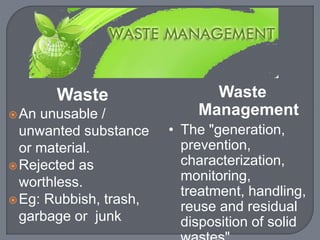
Waste 
An unusable / 
unwanted substance 
or material. 
Rejected as 
worthless. 
Eg: Rubbish, trash, 
garbage or junk 
Waste 
Management 
• The "generation, 
prevention, 
characterization, 
monitoring, 
treatment, handling, 
reuse and residual 
disposition of solid 
wastes"
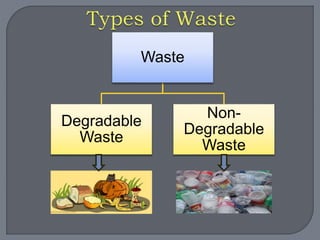
Waste 
Degradable 
Waste 
Non- 
Degradable 
Waste
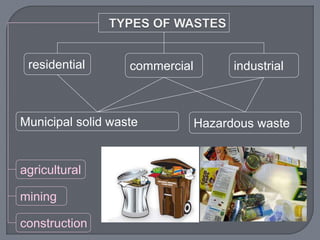
residential commercial industrial 
Municipal solid waste Hazardous waste 
agricultural 
mining 
construction
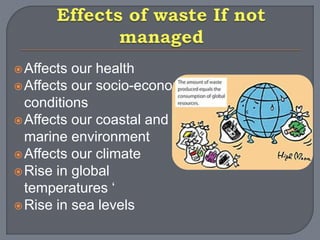
Affects our health 
Affects our socio-economic 
conditions 
Affects our coastal and 
marine environment 
Affects our climate 
Rise in global 
temperatures ‘ 
Rise in sea levels
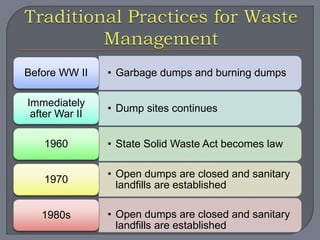
Before WW II • Garbage dumps and burning dumps 
• Dump sites continues 
Immediately 
after War II 
1960 • State Solid Waste Act becomes law 
• Open dumps are closed and sanitary 
landfills are established 
1970 
• Open dumps are closed and sanitary 
landfills are established 
1980s
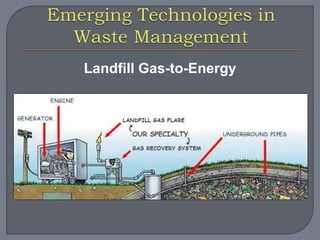
Landfill Gas-to-Energy
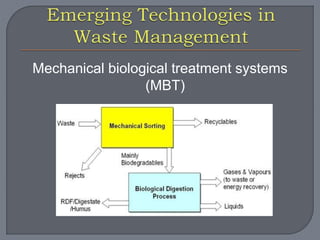
Mechanical biological treatment systems 
(MBT)
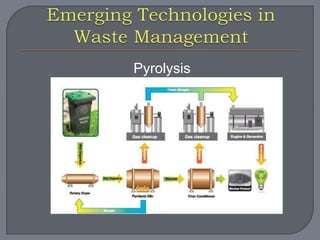
Pyrolysis
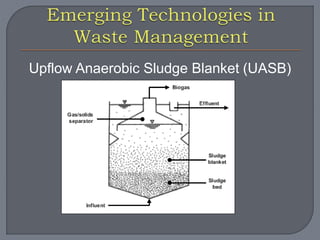
Upflow Anaerobic Sludge Blanket (UASB)
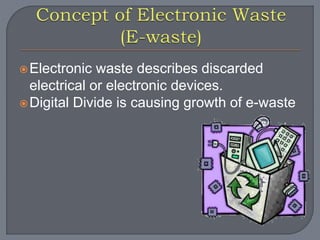
Electronic waste describes discarded 
electrical or electronic devices. 
Digital Divide is causing growth of e-waste
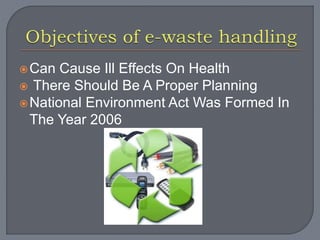
Can Cause Ill Effects On Health 
 There Should Be A Proper Planning 
National Environment Act Was Formed In 
The Year 2006
Reporting 
Avoid waste and minimize the sources 
 Reuse and recycling of the e-waste 
Treating the e-waste and improving 
storage options
Technology enabledwastemanagement

Technology enabledwastemanagement

  • 1.
  • 2.
    Waste An unusable/ unwanted substance or material. Rejected as worthless. Eg: Rubbish, trash, garbage or junk Waste Management • The "generation, prevention, characterization, monitoring, treatment, handling, reuse and residual disposition of solid wastes"
  • 3.
    Waste Degradable Waste Non- Degradable Waste
  • 4.
    residential commercial industrial Municipal solid waste Hazardous waste agricultural mining construction
  • 5.
    Affects our health Affects our socio-economic conditions Affects our coastal and marine environment Affects our climate Rise in global temperatures ‘ Rise in sea levels
  • 6.
    Before WW II• Garbage dumps and burning dumps • Dump sites continues Immediately after War II 1960 • State Solid Waste Act becomes law • Open dumps are closed and sanitary landfills are established 1970 • Open dumps are closed and sanitary landfills are established 1980s
  • 7.
  • 8.
  • 9.
  • 10.
  • 11.
    Electronic waste describesdiscarded electrical or electronic devices. Digital Divide is causing growth of e-waste
  • 12.
    Can Cause IllEffects On Health  There Should Be A Proper Planning National Environment Act Was Formed In The Year 2006
  • 13.
    Reporting Avoid wasteand minimize the sources  Reuse and recycling of the e-waste Treating the e-waste and improving storage options

Editor's Notes

  • #6 Once upon a time, when the density of population was low, the exploitation of the world's natural resources was minimal and manageable. Plus, there was not much of industrialization and the wastes generated by humans were mostly biodegradable and thus their impact on the environment, minimal. This coupled with the fact that not much waste was generated, man did not feel the necessity to manage it. Time flew, population grew and before humans knew it, the industrial revolution set in (18th Century). People from rural areas migrated to cities and industrial towns en masse. Human consumption began to get concentrated and waste began multiplying. The proliferation of waste led to many diseases such as bubonic plague, cholera and typhoid, which led to suffering and death.
  • #7 1960- Prohibits open burning; solid waste permitting process established; landfills upgraded; put emphasis on creating sanitary landfills
  • #8 Landfill gas production results from chemical reactions and microbes acting upon the waste as the putrescible materials begins to break down[2] in the landfill. The rate of production is affected by waste composition and landfill geometry, which in turn influence the microbial populations within it, chemical make-up of waste, thermal range of physical conditions, and the biological ecosystems co-existing simultaneously within most sites. This heterogeneity, together with the frequently unclear nature of the contents, makes landfill gas production more difficult to predict and control than standard industrial bioreactors for sewage treatment.
  • #9 The terms mechanical biological treatment or mechanical biological pre-treatment relate to a group of solid waste treatment systems. These systems enable the recovery of materials contained within the mixed waste and facilitate the stabilisation of the biodegradable component of the material.[1][2] The sorting component of the plants typically resemble a materials recovery facility. This component is either configured to recover the individual elements of the waste or produce a Refuse-derived fuel that can be used for the generation of power. The components of the mixed waste stream that can be recovered include: Ferrous Metal Non-ferrous metal Plastic Glass
  • #10 These are thermal techniques, using these, waste is treated at high temperatures and at a very high pressure. In Pyrolysis, the waste material is converted to solid or liquid. The solid material can be further refined into a carbon form while the liquid extract can be used as energy-giving oil. In gasification, the waste material is converted into a synthetic gas, which can be burned to produce more energy. Pyrolysis decomposes organic material at high temperatures without oxygen. Tyre pyrolysis converts plastic waste and tires into industrial fuels like pyrolysis oil, carbon black and hydrocarbon gas, which are used to generate heat, steam and electricity.
  • #11 These are thermal techniques, using these, waste is treated at high temperatures and at a very high pressure. In Pyrolysis, the waste material is converted to solid or liquid. The solid material can be further refined into a carbon form while the liquid extract can be used as energy-giving oil. In gasification, the waste material is converted into a synthetic gas, which can be burned to produce more energy. Pyrolysis decomposes organic material at high temperatures without oxygen. Tyre pyrolysis converts plastic waste and tires into industrial fuels like pyrolysis oil, carbon black and hydrocarbon gas, which are used to generate heat, steam and electricity.
  • #13 In order to deal with the problem of e-waste the government formulated some rules that could be effective. These rules were designed with an aim and therefore many things together combine to form an excellent management strategy. The objectives of the various strategies of e-waste are given below:- Effective management is important for the reason that it can bring a positive effect on nature. If the e-waste is not handled in the right manner there are chances that it can cause ill effects on health. The handling of e-waste has to be best and therefore it is essential that each and every step is followed one by one to attain superb outcomes. For the strategy there should be a proper planning. Either the organizations can come forward for the help or even the government can devise some rules for this purpose. There are many strategies which can work but recycling is one of the best one that is followed by many countries as well developed nations. There is less cost involved in this process and beneficial at the same time. Disposal is another option which can be tried to get the right result. National Environment Act was formed in the year 2006 which devised new methodologies for e-waste handling. As it is a common issue going in many countries hence policies are designed to meet the current needs in the best manner. Emphasis is laid on using the clean technologies as it will make the atmosphere clean and a place to live in. An Act to make provision about bodies concerned with the natural environment and rural communities; to make provision in connection with wildlife, sites of special scientific interest, National Parks and the Broads; to amend the law relating to rights of way; to make provision as to the Inland Waterways Amenity Advisory Council; to provide for flexible administrative arrangements in connection with functions relating to the environment and rural affairs and certain other functions; and for connected purposes.
  • #14 1. Reporting Every year many industries are set up and the ways of generating the products are improving. Thus a large e-waste is generated which can be harmful. Thus it becomes the duty of the industries to submit a report of the e-waste generated by their industry so that adequate steps can be taken to combat with the problem. Even if they collect the waste the time period should not exceed by 90 days at the maximum. 2. Avoid waste and minimize the sources Most of the industries generate e-waste and leave it either in waste or by burning it. It is not the right thing as you are polluting air as well as water. The air we breathe in contains harmful gases which are injurious to health. Similarly with water too you can become prone to a number of diseases. There is a proper hierarchy which is followed in the management system by introducing each level at the right time. 3. Reuse and recycling of the e-waste There are lots of ways which can be used for recycling but the suitable one is important. Waste exchange centers can be designed where waste can be collected and then proper utilization can be done afterwards. Proper channels can be planned by which the e-waste can reach to its place. This will not affect the environment and the pollution will be lowered. Even water can be recycled in a number of ways as it has also become a source of problem. 4. Treating the e-waste and improving storage options There are only 12 states which are initially having the best storage facilities for e-waste. This includes the 25 centers which are managing the activities according to the needs. Storage place is important or else the industries will dump the waste at wrong places. Thus it becomes essential to set up areas for this purpose. Though it is difficult to decide the site for such things hence the government can render their help to the organizations which are involved in this work. Escrow fund facility is adopted which is a new platform for the government. It helps in monitoring the problems and finding the solution for it. Even in case of calamities the funds can be utilized to deal with the problem and getting over it as soon as possible. The central government is taking measures in dealing with e-waste handling and trying to formulate rules for it. Many acts are being proposed along with the changes that can better the rising graph of e-waste mismanagement.