Prepared by
Reshma
key concepts………..
1. Introduction
2. what is Solid waste management?
3. Types of solid wastes
4. How solid waste management is done?
5. Uses of solid wastes
6. Approximate investments
7. Machinery used
8. Advantages
9. Conclusion
Introduction
Any material that is discarded ,useless or
unwanted is considered as waste
Waste management is the collection, transport
, processing, recycling or disposal and
monitoring of waste materials
TYPES OF WASTESA. Generation and Characteristics
Municipal Solid Waste
Industrial Solid Waste
Agricultural Waste and Residues
Hazardous Waste
Nuclear Waste
5
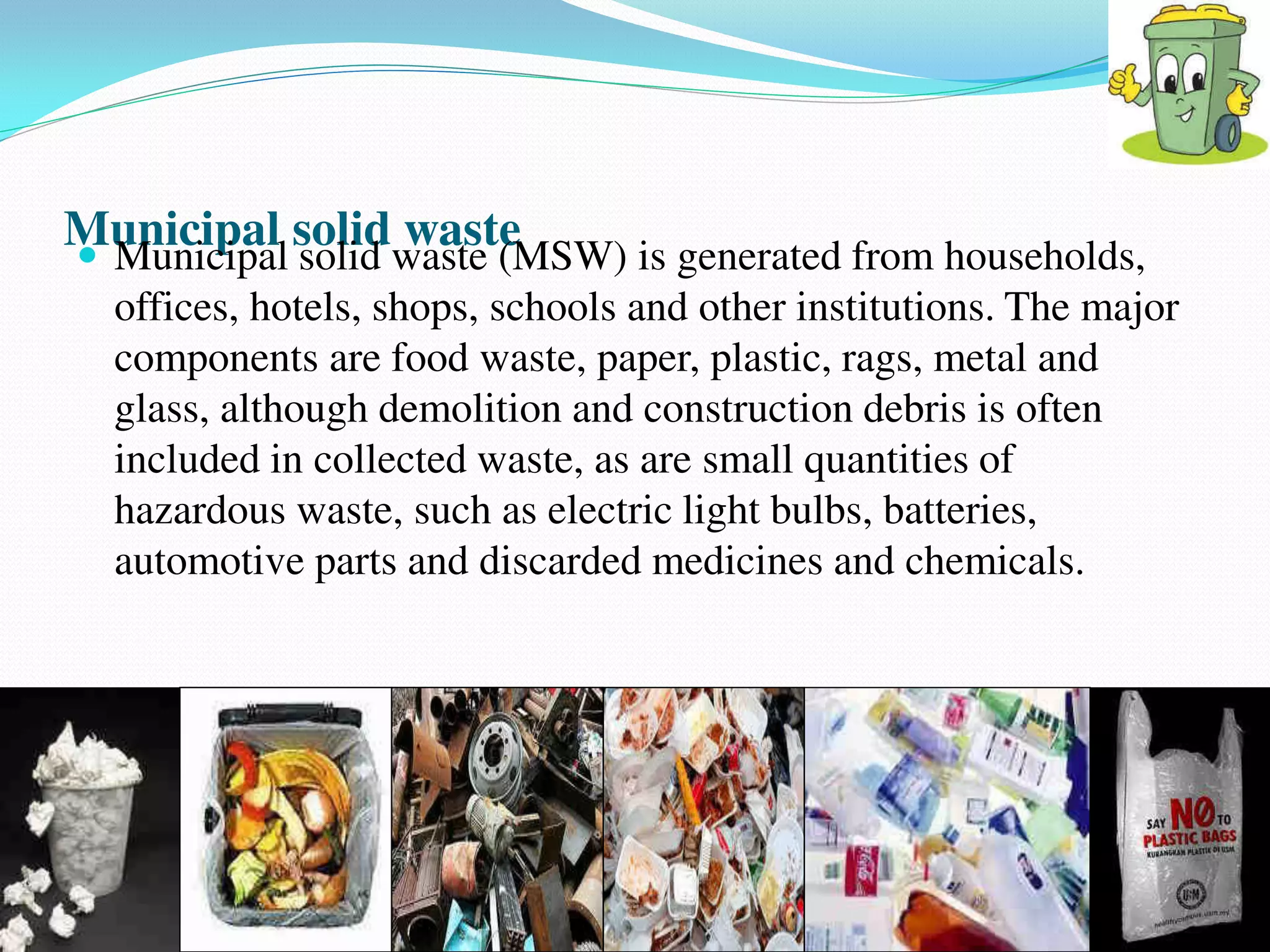
Municipal solid waste Municipal solid waste (MSW) is generated from households,
offices, hotels, shops, schools and other institutions. The major
components are food waste, paper, plastic, rags, metal and
glass, although demolition and construction debris is often
included in collected waste, as are small quantities of
hazardous waste, such as electric light bulbs, batteries,
automotive parts and discarded medicines and chemicals.
6
Industrial Solid Waste
 Industrial solid waste in the Asian and Pacific Region, as
elsewhere, encompasses a wide range of materials of varying
environmental toxicity. Typically this range would include
paper, packaging materials, waste from food processing, oils,
solvents, resins, paints and sludges, glass, ceramics, stones,
metals, plastics, rubber, leather, wood, cloth, straw, abrasives,
etc.
7
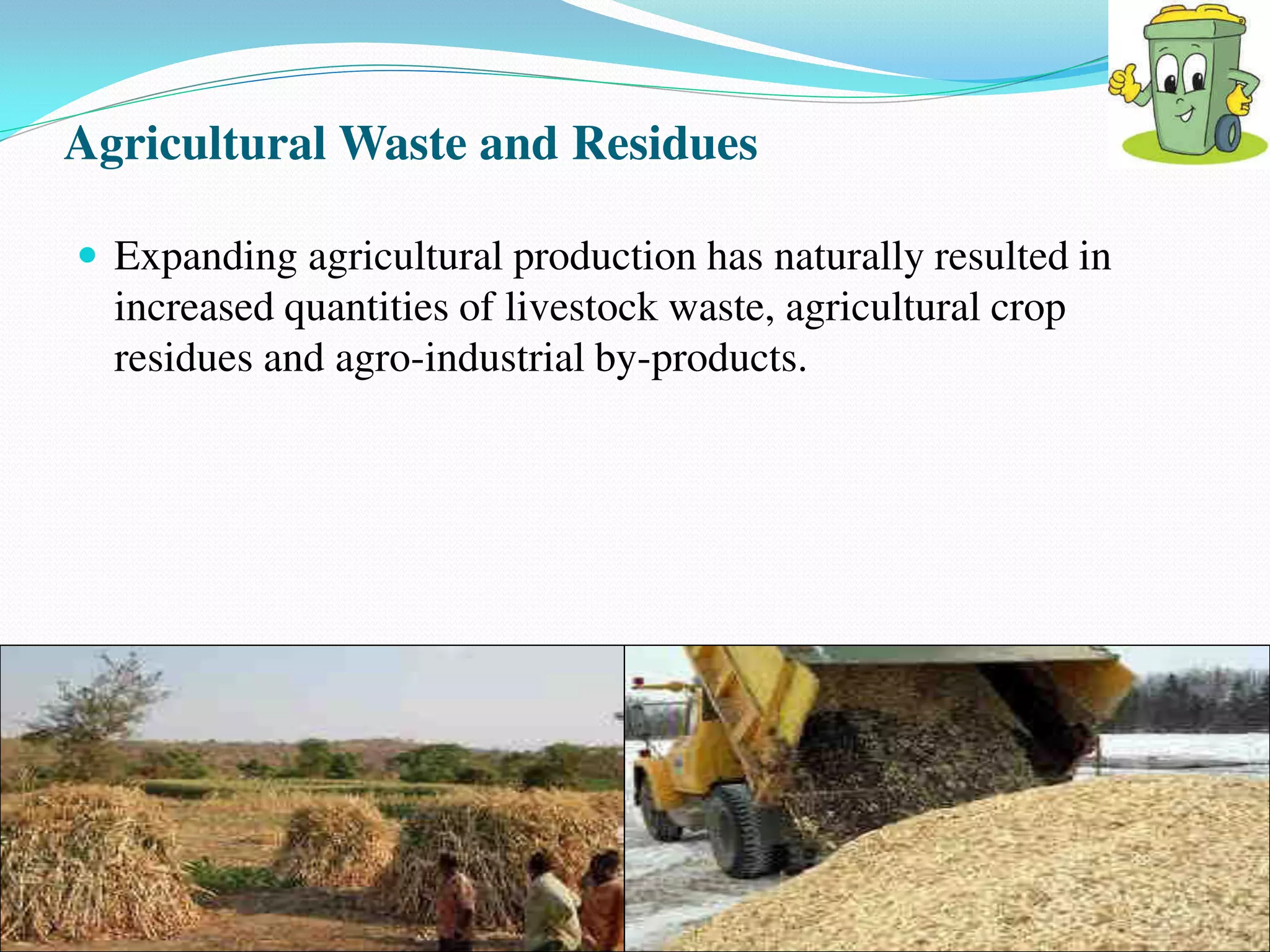
Agricultural Waste and Residues
 Expanding agricultural production has naturally resulted in
increased quantities of livestock waste, agricultural crop
residues and agro-industrial by-products.
8
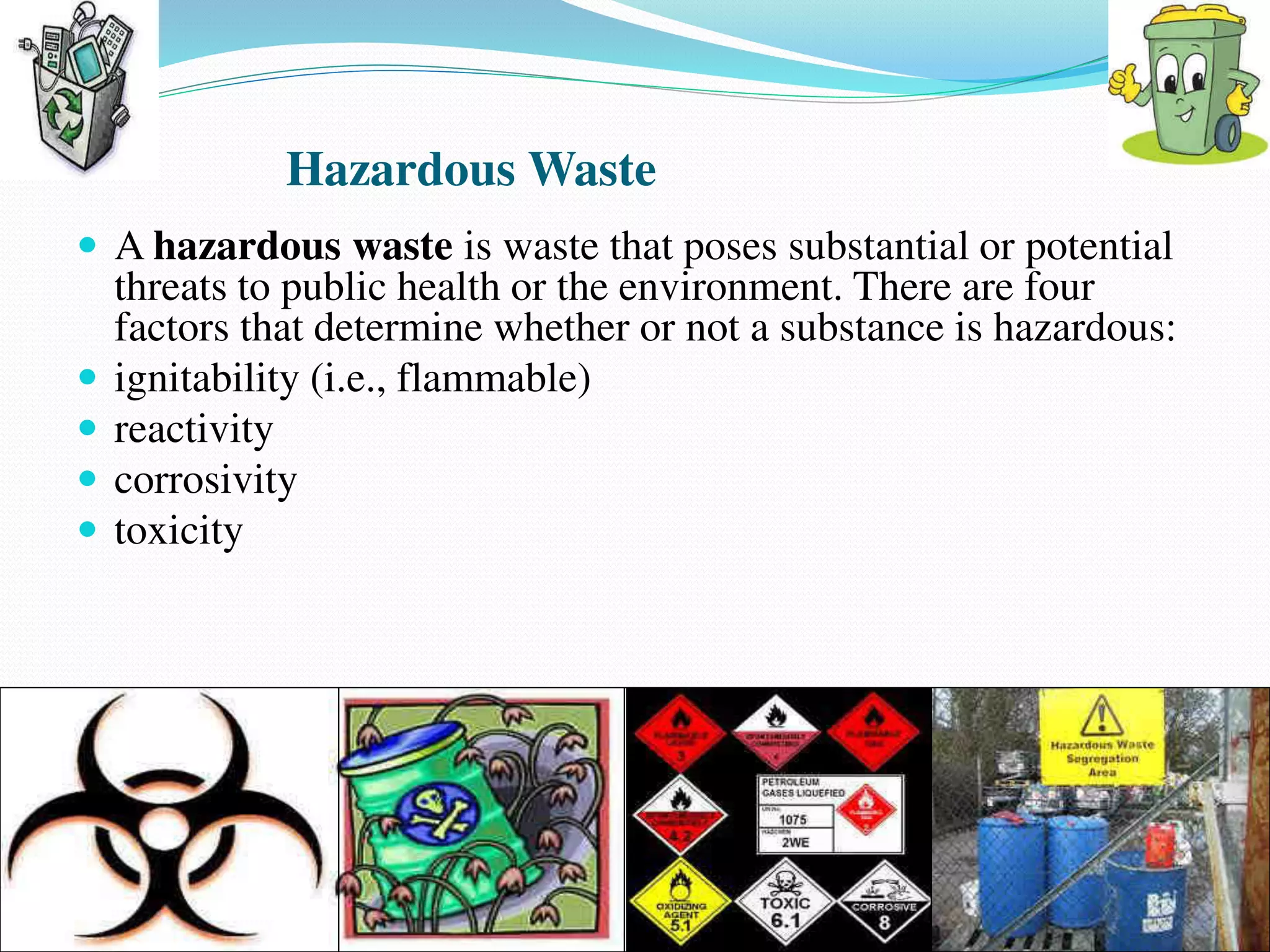
Hazardous Waste
 A hazardous waste is waste that poses substantial or potential
threats to public health or the environment. There are four
factors that determine whether or not a substance is hazardous:
 ignitability (i.e., flammable)
 reactivity
 corrosivity
 toxicity
9
Nuclear Waste Nuclear waste is the radioactive waste left over from nuclear
reactors, nuclear research projects, and nuclear bomb
production. Nuclear waste is divided into low, medium, and
high-level waste by the amount of radioactivity the waste
produces.
10
How solid waste management is done?
(a) Collection and Transfer
 door-to-door collection
 indirect collection - containers, communal bins placed
near markets, in residential areas and other appropriate
locations.
11
Municipal Solid Waste/ Industrial Solid Waste
(b) Material Recovery, Reuse and Recycling
Recycling involves processing used waste materials into new
products to prevent waste of potentially useful materials,
reduce the consumption of fresh raw materials, reduce energy
usage, reduce air pollution (from incineration) and water
pollution (from landfilling) by reducing the need for
"conventional" waste disposal, and lower greenhouse gas
emissions as compared to virgin production.
12
(c) Disposal Methods for MSW/ISW
Open Dumping
Land filling
Incineration
13
Open Dumping
 Most widespread
method of solid waste
disposal
 Uncontrolled disposal of
waste without measures
to control leachate, dust,
odor, landfill gas or
vermin.
 Open burning of waste
is practiced at
dumpsites.
 Waste is dumped along
the shoreline and into
the sea.
Drawbacks :
 scarcity of available land.
 build-up of landfill gas
(predominantly methane),
which can led to outbreaks
of fire and adverse health
effects on workers and
adjacent residents.
14
Bio-Medical Waste
 ‘Bio-medical waste’ means any
solid and/or liquid waste including
its container and any intermediate
product, which is generated during
the diagnosis, treatment or
immunization of human beings or
animals or in research pertaining
thereto or in the production or
testing thereof.
 It differs from other hazardous
waste because of its source of
generation.
15
Landfilling
 disposal of waste materials by burial
 Its impacts includes,
- fatal accidents
- infrastructure damage
- pollution of local environment
- Off gassing of landfill gas (Methane)
- harboring of disease vectors
16
Effects on environment and human health
 Computer wastes that are landfilled produces contaminated
leachates which eventually pollute the groundwater. Acids and
sludge obtained from melting computer chips, if disposed on
the ground causes acidification of soil.
 Incineration of e-wastes can emit toxic fumes and gases,
thereby polluting the surrounding air.
 Improperly monitored landfills can cause environmental
hazards.
 The most dangerous form of burning e-waste is the open-air
burning of plastics in order to recover copper and other metals.
17
Uses of solid wastes
Anaerobic digestion
 Anaerobic digestion is a series of processes in which
microorganisms break down biodegradable material in the
absence of oxygen, used for industrial or domestic purposes to
manage waste and/or to release energy.
 Anaerobic digestion is widely used as a renewable energy
source because the process produces a methane and carbon
dioxide rich biogas suitable for energy production, helping to
replace fossil fuels. The nutrient-rich digestate which is also
produced can be used as fertilizer.
19
biogas
 cycle
 plastics
MATERIALS USED FOR ROAD
CONSTRUCTION
Size:20mm and 10mm
Bitumen:
60/70, 80/100 grade
Aggregate: Waste plastic:
Waste plastic in
shredded form
SOME PLASTIC ROADS IN INDIA
Bangalore T.V. tower road Bangalore-Mysore state highway
Machinery costs
FOB
Price:
US $15,000 -
200,000 / Set Get
Latest Price
Min.Order
Quantity:
1 Set/Sets
Supply
Ability:
5 Set/Sets per
Month
Port: Shanghai
Payment
Terms:
L/C,T/T,Western
Union
high quality a plant for the recycling of solid waste sales
FOB
Price:
Get Latest Price
Min.Order
Quantity:
1 Set/Sets
Supply
Ability:
200 Set/Sets per
Year
Port: China
Payment
Terms:
L/C,T/T
Solid Waste Shredder/Solid Waste Recycling Machine
Solid waste mgmt

Solid waste mgmt

  • 1.
  • 2.
    key concepts……….. 1. Introduction 2.what is Solid waste management? 3. Types of solid wastes 4. How solid waste management is done? 5. Uses of solid wastes 6. Approximate investments 7. Machinery used 8. Advantages 9. Conclusion
  • 3.
  • 4.
    Any material thatis discarded ,useless or unwanted is considered as waste Waste management is the collection, transport , processing, recycling or disposal and monitoring of waste materials
  • 5.
    TYPES OF WASTESA.Generation and Characteristics Municipal Solid Waste Industrial Solid Waste Agricultural Waste and Residues Hazardous Waste Nuclear Waste 5
  • 6.
    Municipal solid wasteMunicipal solid waste (MSW) is generated from households, offices, hotels, shops, schools and other institutions. The major components are food waste, paper, plastic, rags, metal and glass, although demolition and construction debris is often included in collected waste, as are small quantities of hazardous waste, such as electric light bulbs, batteries, automotive parts and discarded medicines and chemicals. 6
  • 7.
    Industrial Solid Waste Industrial solid waste in the Asian and Pacific Region, as elsewhere, encompasses a wide range of materials of varying environmental toxicity. Typically this range would include paper, packaging materials, waste from food processing, oils, solvents, resins, paints and sludges, glass, ceramics, stones, metals, plastics, rubber, leather, wood, cloth, straw, abrasives, etc. 7
  • 8.
    Agricultural Waste andResidues  Expanding agricultural production has naturally resulted in increased quantities of livestock waste, agricultural crop residues and agro-industrial by-products. 8
  • 9.
    Hazardous Waste  Ahazardous waste is waste that poses substantial or potential threats to public health or the environment. There are four factors that determine whether or not a substance is hazardous:  ignitability (i.e., flammable)  reactivity  corrosivity  toxicity 9
  • 10.
    Nuclear Waste Nuclearwaste is the radioactive waste left over from nuclear reactors, nuclear research projects, and nuclear bomb production. Nuclear waste is divided into low, medium, and high-level waste by the amount of radioactivity the waste produces. 10
  • 11.
    How solid wastemanagement is done? (a) Collection and Transfer  door-to-door collection  indirect collection - containers, communal bins placed near markets, in residential areas and other appropriate locations. 11 Municipal Solid Waste/ Industrial Solid Waste
  • 12.
    (b) Material Recovery,Reuse and Recycling Recycling involves processing used waste materials into new products to prevent waste of potentially useful materials, reduce the consumption of fresh raw materials, reduce energy usage, reduce air pollution (from incineration) and water pollution (from landfilling) by reducing the need for "conventional" waste disposal, and lower greenhouse gas emissions as compared to virgin production. 12
  • 13.
    (c) Disposal Methodsfor MSW/ISW Open Dumping Land filling Incineration 13
  • 14.
    Open Dumping  Mostwidespread method of solid waste disposal  Uncontrolled disposal of waste without measures to control leachate, dust, odor, landfill gas or vermin.  Open burning of waste is practiced at dumpsites.  Waste is dumped along the shoreline and into the sea. Drawbacks :  scarcity of available land.  build-up of landfill gas (predominantly methane), which can led to outbreaks of fire and adverse health effects on workers and adjacent residents. 14
  • 15.
    Bio-Medical Waste  ‘Bio-medicalwaste’ means any solid and/or liquid waste including its container and any intermediate product, which is generated during the diagnosis, treatment or immunization of human beings or animals or in research pertaining thereto or in the production or testing thereof.  It differs from other hazardous waste because of its source of generation. 15
  • 16.
    Landfilling  disposal ofwaste materials by burial  Its impacts includes, - fatal accidents - infrastructure damage - pollution of local environment - Off gassing of landfill gas (Methane) - harboring of disease vectors 16
  • 17.
    Effects on environmentand human health  Computer wastes that are landfilled produces contaminated leachates which eventually pollute the groundwater. Acids and sludge obtained from melting computer chips, if disposed on the ground causes acidification of soil.  Incineration of e-wastes can emit toxic fumes and gases, thereby polluting the surrounding air.  Improperly monitored landfills can cause environmental hazards.  The most dangerous form of burning e-waste is the open-air burning of plastics in order to recover copper and other metals. 17
  • 18.
  • 19.
    Anaerobic digestion  Anaerobicdigestion is a series of processes in which microorganisms break down biodegradable material in the absence of oxygen, used for industrial or domestic purposes to manage waste and/or to release energy.  Anaerobic digestion is widely used as a renewable energy source because the process produces a methane and carbon dioxide rich biogas suitable for energy production, helping to replace fossil fuels. The nutrient-rich digestate which is also produced can be used as fertilizer. 19
  • 20.
  • 21.
  • 22.
  • 23.
    MATERIALS USED FORROAD CONSTRUCTION Size:20mm and 10mm Bitumen: 60/70, 80/100 grade Aggregate: Waste plastic: Waste plastic in shredded form
  • 24.
    SOME PLASTIC ROADSIN INDIA Bangalore T.V. tower road Bangalore-Mysore state highway
  • 25.
    Machinery costs FOB Price: US $15,000- 200,000 / Set Get Latest Price Min.Order Quantity: 1 Set/Sets Supply Ability: 5 Set/Sets per Month Port: Shanghai Payment Terms: L/C,T/T,Western Union high quality a plant for the recycling of solid waste sales FOB Price: Get Latest Price Min.Order Quantity: 1 Set/Sets Supply Ability: 200 Set/Sets per Year Port: China Payment Terms: L/C,T/T Solid Waste Shredder/Solid Waste Recycling Machine