Redefining TESOL in the Digital Age
            Technological Language Immersion


3/30/2011         © 2011 American TESOL Institute               1
TESOL2 - Technological Language Immersion

  •How the English language is evolving today.
  •How humans learn second languages now.
  •How humans will learn languages in the future.
  •Will language become obsolete?


3/30/2011             © 2011 American TESOL Institute   2
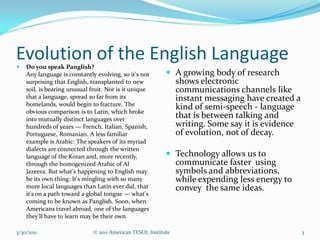
Evolution of the English Language
   Do you speak Panglish?
    Any language is constantly evolving, so it's not        A growing body of research
    surprising that English, transplanted to new             shows electronic
    soil, is bearing unusual fruit. Nor is it unique            communications channels like
    that a language, spread so far from its                     instant messaging have created a
    homelands, would begin to fracture. The
    obvious comparison is to Latin, which broke
                                                                kind of semi-speech - language
    into mutually distinct languages over
                                                                that is between talking and
    hundreds of years — French, Italian, Spanish,               writing. Some say it is evidence
    Portuguese, Romanian. A less familiar                       of evolution, not of decay.
    example is Arabic: The speakers of its myriad
    dialects are connected through the written
    language of the Koran and, more recently,               Technology allows us to
    through the homogenized Arabic of Al                        communicate faster using
    Jazeera. But what's happening to English may                symbols and abbreviations,
    be its own thing: It's mingling with so many                while expending less energy to
    more local languages than Latin ever did, that              convey the same ideas.
    it's on a path toward a global tongue — what's
    coming to be known as Panglish. Soon, when
    Americans travel abroad, one of the languages
    they'll have to learn may be their own.

3/30/2011                     © 2011 American TESOL Institute                                      3
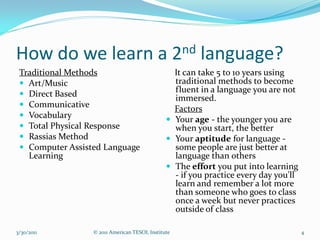
How do we learn a 2nd language?
 Traditional Methods                             It can take 5 to 10 years using
  Art/Music                                     traditional methods to become
  Direct Based
                                                 fluent in a language you are not
                                                 immersed.
  Communicative
                                                 Factors
  Vocabulary
                                                Your age - the younger you are
  Total Physical Response                       when you start, the better
  Rassias Method                               Your aptitude for language -
  Computer Assisted Language                    some people are just better at
   Learning                                      language than others
                                                The effort you put into learning
                                                 - if you practice every day you'll
                                                 learn and remember a lot more
                                                 than someone who goes to class
                                                 once a week but never practices
                                                 outside of class

3/30/2011         © 2011 American TESOL Institute                                     4
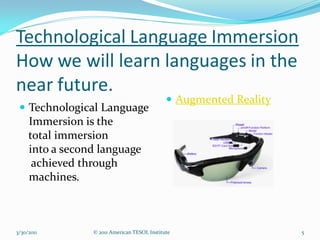
Technological Language Immersion
How we will learn languages in the
near future.
                                            Augmented Reality
  Technological Language
   Immersion is the
   total immersion
   into a second language
    achieved through
   machines.


3/30/2011     © 2011 American TESOL Institute                    5
How We Will Learn Languages in
the Distant Future.
  Eventually humans will                     Human-Computer
   perfect nanocomputers                      Symbiosis
   for wireless                              Nanocomputers
   communication over
   networks. These
   nanocomputers will
   symbiotically fit into
   areas of the brain
   responsible for
   transmitting and
   receiving information.

3/30/2011      © 2011 American TESOL Institute                  6
Will Language Become Obsolete?

            In the distant future it is conceivable that communication
             will be achieved through human-computer symbiosis, and all
            forms of communication will be represented in a universal code.


            Sources: Wired.com, About.com, Seeingwithsound.com, AmericanTESOL.com


3/30/2011                      © 2011 American TESOL Institute                      7

Technological Language Immersion

  • 1.
    Redefining TESOL inthe Digital Age Technological Language Immersion 3/30/2011 © 2011 American TESOL Institute 1
  • 2.
    TESOL2 - TechnologicalLanguage Immersion •How the English language is evolving today. •How humans learn second languages now. •How humans will learn languages in the future. •Will language become obsolete? 3/30/2011 © 2011 American TESOL Institute 2
  • 3.
    Evolution of theEnglish Language  Do you speak Panglish? Any language is constantly evolving, so it's not  A growing body of research surprising that English, transplanted to new shows electronic soil, is bearing unusual fruit. Nor is it unique communications channels like that a language, spread so far from its instant messaging have created a homelands, would begin to fracture. The obvious comparison is to Latin, which broke kind of semi-speech - language into mutually distinct languages over that is between talking and hundreds of years — French, Italian, Spanish, writing. Some say it is evidence Portuguese, Romanian. A less familiar of evolution, not of decay. example is Arabic: The speakers of its myriad dialects are connected through the written language of the Koran and, more recently,  Technology allows us to through the homogenized Arabic of Al communicate faster using Jazeera. But what's happening to English may symbols and abbreviations, be its own thing: It's mingling with so many while expending less energy to more local languages than Latin ever did, that convey the same ideas. it's on a path toward a global tongue — what's coming to be known as Panglish. Soon, when Americans travel abroad, one of the languages they'll have to learn may be their own. 3/30/2011 © 2011 American TESOL Institute 3
  • 4.
    How do welearn a 2nd language? Traditional Methods It can take 5 to 10 years using  Art/Music traditional methods to become  Direct Based fluent in a language you are not immersed.  Communicative Factors  Vocabulary  Your age - the younger you are  Total Physical Response when you start, the better  Rassias Method  Your aptitude for language -  Computer Assisted Language some people are just better at Learning language than others  The effort you put into learning - if you practice every day you'll learn and remember a lot more than someone who goes to class once a week but never practices outside of class 3/30/2011 © 2011 American TESOL Institute 4
  • 5.
    Technological Language Immersion Howwe will learn languages in the near future.  Augmented Reality  Technological Language Immersion is the total immersion into a second language achieved through machines. 3/30/2011 © 2011 American TESOL Institute 5
  • 6.
    How We WillLearn Languages in the Distant Future.  Eventually humans will  Human-Computer perfect nanocomputers Symbiosis for wireless  Nanocomputers communication over networks. These nanocomputers will symbiotically fit into areas of the brain responsible for transmitting and receiving information. 3/30/2011 © 2011 American TESOL Institute 6
  • 7.
    Will Language BecomeObsolete? In the distant future it is conceivable that communication will be achieved through human-computer symbiosis, and all forms of communication will be represented in a universal code. Sources: Wired.com, About.com, Seeingwithsound.com, AmericanTESOL.com 3/30/2011 © 2011 American TESOL Institute 7