THE PHILOSOPHY OF
YOUTH DEVELOPMENT
AT THE BELGIAN FA

Bob Browaeys
01.03.10, 18:00 - 18:30

UEFA STUDY GROUP MARCH 2010
Development Vision of the Belgian FA
• Development vision of the Coach Education School
is the reference
– has been developed, taught and adapted for 8 years
– has been tested in pratice during training sessions at the topsport
school and in the national youth teams

• Adjustment of the playing systems since the season
2003-2004
– 5-5, 8-8 and 11-11 instead of 5-5, 7-7, 9-9 and 11-11
– based upon scientific research (KUL)

• Spreading of the vision towards all Belgian FA projects
and Belgian clubs
• The final product has a wide bearing surface: consultation
and feedback of clubs, youth coaches, teachers, ...

UEFA STUDY GROUP MARCH 2010
Development Vision of the Belgian FA

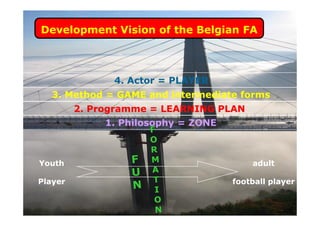
4. Actor = PLAYER
3. Method = GAME and intermediate forms
2. Programme = LEARNING PLAN
1. Philosophy = ZONE

Youth

adult

Player

football player

UEFA STUDY GROUP MARCH 2010
Development Vision of the
Belgian FA

1.
The FUN-aspect
FUN-

UEFA STUDY GROUP MARCH 2010
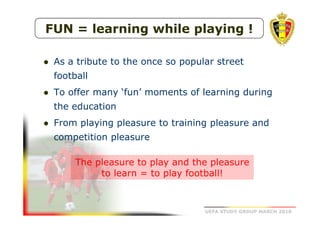
FUN = learning while playing !
As a tribute to the once so popular street
football
To offer many ‘fun’ moments of learning during
the education
From playing pleasure to training pleasure and
competition pleasure
The pleasure to play and the pleasure
to learn = to play football!

UEFA STUDY GROUP MARCH 2010
FUN = learning while playing !
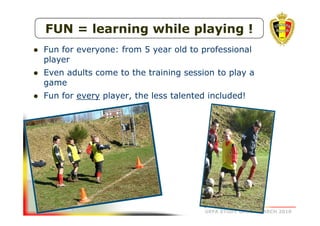
Fun for everyone: from 5 year old to professional
player
Even adults come to the training session to play a
game
Fun for every player, the less talented included!

UEFA STUDY GROUP MARCH 2010
FUN = learning while playing !

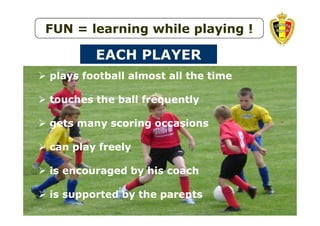
EACH PLAYER
plays football almost all the time
touches the ball frequently
gets many scoring occasions
can play freely
is encouraged by his coach
is supported by the parents
UEFA STUDY GROUP MARCH 2010
FUN = learning while playing !

We lost, we won,
either we have fun !
UEFA STUDY GROUP MARCH 2010
DEVELOPMENT
VISION OF THE
BELGIAN FA
2.
The EDUCATION
aspect

UEFA STUDY GROUP MARCH 2010
EDUCATION = learning step by step
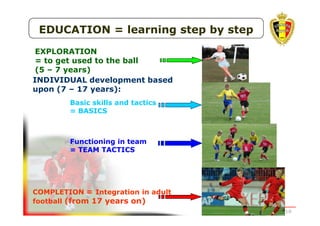
EXPLORATION
= to get used to the ball
(5 – 7 years)
INDIVIDUAL development based
upon (7 – 17 years):
Basic skills and tactics
= BASICS

Functioning in team
= TEAM TACTICS

COMPLETION = Integration in adult
football (from 17 years on)
UEFA STUDY GROUP MARCH 2010
DEVELOPMENT
VISION OF THE
BELGIAN FA
3. ZONE
PHILOSOPHY

UEFA STUDY GROUP MARCH 2010
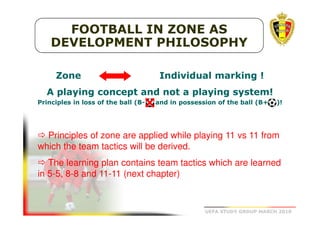
FOOTBALL IN ZONE AS
DEVELOPMENT PHILOSOPHY
Zone

Individual marking !

A playing concept and not a playing system!
system!
Principles in loss of the ball (B(B-

and in possession of the ball (B+

)!

Principles of zone are applied while playing 11 vs 11 from
which the team tactics will be derived.
The learning plan contains team tactics which are learned
in 5-5, 8-8 and 11-11 (next chapter)

UEFA STUDY GROUP MARCH 2010
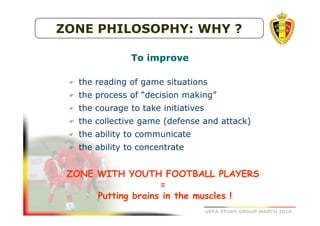
ZONE PHILOSOPHY: WHY ?
To improve
the reading of game situations
the process of “decision making”
the courage to take initiatives
the collective game (defense and attack)
the ability to communicate
the ability to concentrate

ZONE WITH YOUTH FOOTBALL PLAYERS
=
Putting brains in the muscles !
UEFA STUDY GROUP MARCH 2010
DEVELOPMENT
VISION OF THE
BELGIAN FA

4.
THE LEARNING PLAN

UEFA STUDY GROUP MARCH 2010
THE MODEL OF DEVELOPMENT IN FOOTBALL
• To learn is:
– a continuous process: objectives of development via.... via.... to (= lines
of development)
– cumulative: the acquired skills represent the basis for the skills yet to be
learned

• The model of development in football:
– based upon the development model in « ball sports »
– 4 phases of development : fluent transition of one phase into the other
– the football age is the clue: big individual differences are possible in
each development area (f.e. physical inferiority in relation to mental
lead, taking into acount the biological age)
– The youth instructor chooses learning objectives and contents based
upon the level in the model of development

UEFA STUDY GROUP MARCH 2010
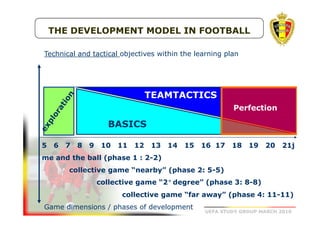
THE DEVELOPMENT MODEL IN FOOTBALL
Technical and tactical objectives within the learning plan

TEAMTACTICS
Perfection

BASICS
5

6

7

8

9

10

11

12

13

14

15

16 17

18

19

20

21j

me and the ball (phase 1 : 2-2)
collective game “nearby” (phase 2: 5-5)
collective game “2° degree” (phase 3: 8-8)
collective game “far away” (phase 4: 11-11)
Game dimensions / phases of development

UEFA STUDY GROUP MARCH 2010
THE MODEL OF DEVELOPMENT IN FOOTBALL
Mental objectives within the learning plan

Use of mental skills in competition
Use of mental skills in training sessions
Teaching of
mental basic
skills
5

6

7

8

9

10

11

1.
2.
3.
4.
5.
6.

12

Motivation
Self controll and self discipline
Concentration
Self confidence
Inter-personal and team relations
Lifestyle

13

14

15

16 17

Vervolmaking

18

19

20

21j

me and the ball (phase 1 : 2-2)
collective game “nearby” (phase 2: 5-5)
collective game “2° degree” (phase 3: 8-8)
collective game “far away” (phase 4: 11-11)
Game dimensions / phases of development
UEFA STUDY GROUP MARCH 2010
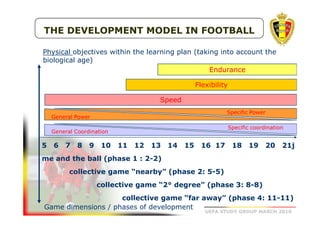
THE DEVELOPMENT MODEL IN FOOTBALL
Physical objectives within the learning plan (taking into account the
biological age)
Endurance
Flexibility
Speed
Specific Power

General Power

Specific coordination

General Coordination

5

6

7

8

9

10

11

12

13

14

15

16 17

18

19

20

21j

me and the ball (phase 1 : 2-2)
collective game “nearby” (phase 2: 5-5)
collective game “2° degree” (phase 3: 8-8)
collective game “far away” (phase 4: 11-11)
Game dimensions / phases of development
UEFA STUDY GROUP MARCH 2010
THE DEVELOPMENT MODEL IN FOOTBALL
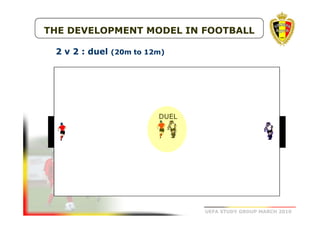
2 v 2 : duel (20m to 12m)

DUEL

UEFA STUDY GROUP MARCH 2010
THE DEVELOPMENT MODEL IN FOOTBALL
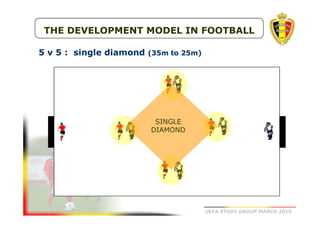
5 v 5 : single diamond (35m to 25m)

SINGLE
DIAMOND

UEFA STUDY GROUP MARCH 2010
THE DEVELOPMENT MODEL IN FOOTBALL
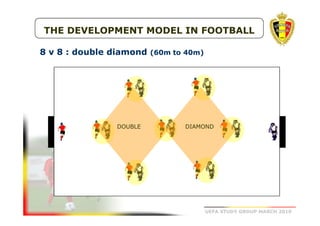
8 v 8 : double diamond (60m to 40m)

DOUBLE

DIAMOND

UEFA STUDY GROUP MARCH 2010
THE DEVELOPMENT MODEL IN FOOTBALL
11 v 11 : 1-4-3-3 (100m to 60m)
1-

UEFA STUDY GROUP MARCH 2010
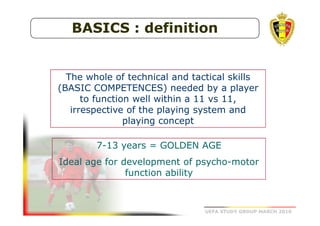
BASICS : definition

The whole of technical and tactical skills
(BASIC COMPETENCES) needed by a player
to function well within a 11 vs 11,
irrespective of the playing system and
playing concept
7-13 years = GOLDEN AGE
Ideal age for development of psycho-motor
function ability

UEFA STUDY GROUP MARCH 2010
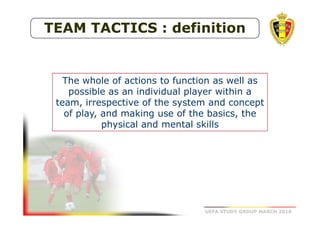
TEAM TACTICS : definition

The whole of actions to function as well as
possible as an individual player within a
team, irrespective of the system and concept
of play, and making use of the basics, the
physical and mental skills

UEFA STUDY GROUP MARCH 2010
Description of different aspects
according to the development model
1+K/1+K

2/2

4+K/4+K
(7y to 9y)

7+K/7+K

8/8

(9y to 11y)
10+K/10+K
(11y to 17y)

opposition games

U8

application 2/2

U9

5/5

ball acquaintance

U7

(5y to 7y)

U6

evolution towards
game nearby

U10

application 2/2 +
5/5

U11
11/11
(1)

evolution to
medium long play

U12U13

Football as a short passing game
without off-side rule

Football as a halflong passing
game without off-side rule

application 2/2,
5/5 and 8/8

U14U15
11/11
(2)

Football as a dribbling and
shooting game

evolution to game
far away

U16U17

Football as a long passing game
with off-side rule

to perfect
UEFA STUDY GROUP MARCH 2010
Description of different aspects
according to the development model
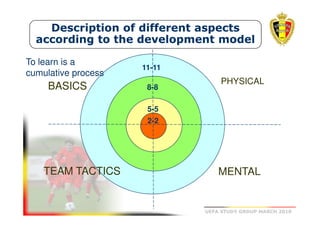
To learn is a
cumulative process

BASICS

11-11
8-8

PHYSICAL

5-5
2-2

TEAM TACTICS

MENTAL

UEFA STUDY GROUP MARCH 2010
Description of different aspects
according to the development model
• Setting out the basics and team tactics for each
development level
• Setting out the training session topics on a physical level
• Setting out the characteristics on a mental level
BASICS

TEAM TACTICS

PHYSICAL

MENTAL

2-2
5-7 years

5-5
7-9 years

8-8
9-11 years

11-11 (1)
11-13 years
13-15 years

11-11(2)
15-17 years
UEFA STUDY GROUP MARCH 2010
DEVELOPMENT
VISION OF THE
BELGIAN FA
5.
GAME and
INTERMEDIATE
forms

UEFA STUDY GROUP MARCH 2010
THE LAW OF THE TRANSFER

?
“An acquired skill in the application of certain
activities (training session) can only be
transferred into a new condition (the match)
when there exists a maximum of resemblances
between the two situations”
UEFA STUDY GROUP MARCH 2010
BUILT-UP OF A TRAINING SESSION
INTERMEDIATE FORMS

W
A
R
M
I
N
G
U
P

MA
T
C
H
F
O
RM
1

M
A
T
C
H
F
O
R
M
2

MA
T
C
H
F
O
RM
3

C
O
O
L
I
N
G
D
O
W
N

t

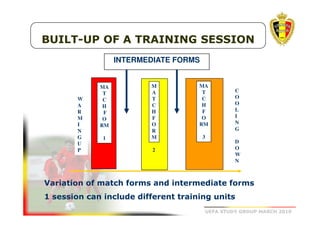
Variation of match forms and intermediate forms
1 session can include different training units
UEFA STUDY GROUP MARCH 2010
METHODICS
PROGRESSIVE METHOD

c
o
m
p
l
e
x
i
t
y

4/4
3/3
3/2
2/1
time

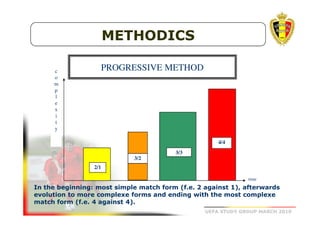
In the beginning: most simple match form (f.e. 2 against 1), afterwards
evolution to more complexe forms and ending with the most complexe
match form (f.e. 4 against 4).
UEFA STUDY GROUP MARCH 2010
METHODICS
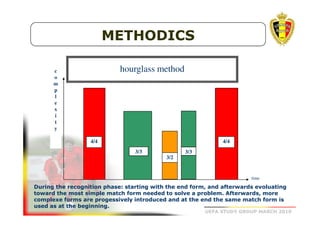
hourglass method

c
o
m
p
l
e
x
i
t
y
4/4

4/4
3/3

3/3
3/2

time

During the recognition phase: starting with the end form, and afterwards evoluating
toward the most simple match form needed to solve a problem. Afterwards, more
complexe forms are progessively introduced and at the end the same match form is
used as at the beginning.
UEFA STUDY GROUP MARCH 2010
DEVELOPMENT
VISION OF THE
BELGIAN FA
6.
FOCUS ON THE
PLAYER

UEFA STUDY GROUP MARCH 2010
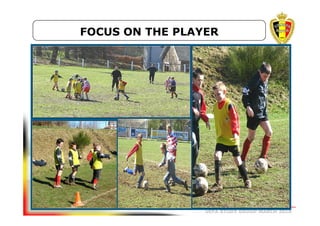
FOCUS ON THE PLAYER

UEFA STUDY GROUP MARCH 2010
Strong learning environment
Definition
•

Inspiring and stimulating learning
environment

•

Interaction youth instructor and player

•

Match focused tasks and game situations

•

Player is given the opportunity to
solve the game problems himself

•

Learning environment is responsible for learning results
UEFA STUDY GROUP MARCH 2010
FOCUS ON THE PLAYER
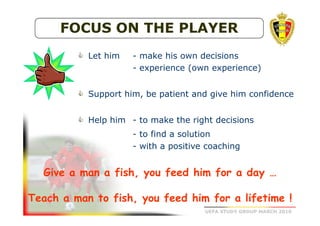
Let him

- make his own decisions
- experience (own experience)

Support him, be patient and give him confidence
Help him - to make the right decisions
- to find a solution
- with a positive coaching

Give a man a fish, you feed him for a day …
Teach a man to fish, you feed him for a lifetime !
UEFA STUDY GROUP MARCH 2010
FOCUS ON THE PLAYER
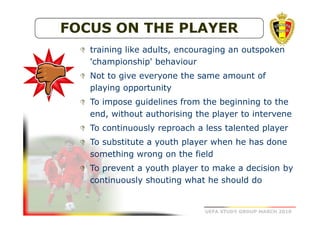
training like adults, encouraging an outspoken
'championship' behaviour
Not to give everyone the same amount of
playing opportunity
To impose guidelines from the beginning to the
end, without authorising the player to intervene
To continuously reproach a less talented player
To substitute a youth player when he has done
something wrong on the field
To prevent a youth player to make a decision by
continuously shouting what he should do

UEFA STUDY GROUP MARCH 2010
DEVELOPMENT VISION BELGIAN FA

More games

More fun

And more brains !

UEFA STUDY GROUP MARCH 2010

Belgia Football Development

  • 1.
    THE PHILOSOPHY OF YOUTHDEVELOPMENT AT THE BELGIAN FA Bob Browaeys 01.03.10, 18:00 - 18:30 UEFA STUDY GROUP MARCH 2010
  • 2.
    Development Vision ofthe Belgian FA • Development vision of the Coach Education School is the reference – has been developed, taught and adapted for 8 years – has been tested in pratice during training sessions at the topsport school and in the national youth teams • Adjustment of the playing systems since the season 2003-2004 – 5-5, 8-8 and 11-11 instead of 5-5, 7-7, 9-9 and 11-11 – based upon scientific research (KUL) • Spreading of the vision towards all Belgian FA projects and Belgian clubs • The final product has a wide bearing surface: consultation and feedback of clubs, youth coaches, teachers, ... UEFA STUDY GROUP MARCH 2010
  • 3.
    Development Vision ofthe Belgian FA 4. Actor = PLAYER 3. Method = GAME and intermediate forms 2. Programme = LEARNING PLAN 1. Philosophy = ZONE Youth adult Player football player UEFA STUDY GROUP MARCH 2010
  • 4.
    Development Vision ofthe Belgian FA 1. The FUN-aspect FUN- UEFA STUDY GROUP MARCH 2010
  • 5.
    FUN = learningwhile playing ! As a tribute to the once so popular street football To offer many ‘fun’ moments of learning during the education From playing pleasure to training pleasure and competition pleasure The pleasure to play and the pleasure to learn = to play football! UEFA STUDY GROUP MARCH 2010
  • 6.
    FUN = learningwhile playing ! Fun for everyone: from 5 year old to professional player Even adults come to the training session to play a game Fun for every player, the less talented included! UEFA STUDY GROUP MARCH 2010
  • 7.
    FUN = learningwhile playing ! EACH PLAYER plays football almost all the time touches the ball frequently gets many scoring occasions can play freely is encouraged by his coach is supported by the parents UEFA STUDY GROUP MARCH 2010
  • 8.
    FUN = learningwhile playing ! We lost, we won, either we have fun ! UEFA STUDY GROUP MARCH 2010
  • 9.
    DEVELOPMENT VISION OF THE BELGIANFA 2. The EDUCATION aspect UEFA STUDY GROUP MARCH 2010
  • 10.
    EDUCATION = learningstep by step EXPLORATION = to get used to the ball (5 – 7 years) INDIVIDUAL development based upon (7 – 17 years): Basic skills and tactics = BASICS Functioning in team = TEAM TACTICS COMPLETION = Integration in adult football (from 17 years on) UEFA STUDY GROUP MARCH 2010
  • 11.
    DEVELOPMENT VISION OF THE BELGIANFA 3. ZONE PHILOSOPHY UEFA STUDY GROUP MARCH 2010
  • 12.
    FOOTBALL IN ZONEAS DEVELOPMENT PHILOSOPHY Zone Individual marking ! A playing concept and not a playing system! system! Principles in loss of the ball (B(B- and in possession of the ball (B+ )! Principles of zone are applied while playing 11 vs 11 from which the team tactics will be derived. The learning plan contains team tactics which are learned in 5-5, 8-8 and 11-11 (next chapter) UEFA STUDY GROUP MARCH 2010
  • 13.
    ZONE PHILOSOPHY: WHY? To improve the reading of game situations the process of “decision making” the courage to take initiatives the collective game (defense and attack) the ability to communicate the ability to concentrate ZONE WITH YOUTH FOOTBALL PLAYERS = Putting brains in the muscles ! UEFA STUDY GROUP MARCH 2010
  • 14.
    DEVELOPMENT VISION OF THE BELGIANFA 4. THE LEARNING PLAN UEFA STUDY GROUP MARCH 2010
  • 15.
    THE MODEL OFDEVELOPMENT IN FOOTBALL • To learn is: – a continuous process: objectives of development via.... via.... to (= lines of development) – cumulative: the acquired skills represent the basis for the skills yet to be learned • The model of development in football: – based upon the development model in « ball sports » – 4 phases of development : fluent transition of one phase into the other – the football age is the clue: big individual differences are possible in each development area (f.e. physical inferiority in relation to mental lead, taking into acount the biological age) – The youth instructor chooses learning objectives and contents based upon the level in the model of development UEFA STUDY GROUP MARCH 2010
  • 16.
    THE DEVELOPMENT MODELIN FOOTBALL Technical and tactical objectives within the learning plan TEAMTACTICS Perfection BASICS 5 6 7 8 9 10 11 12 13 14 15 16 17 18 19 20 21j me and the ball (phase 1 : 2-2) collective game “nearby” (phase 2: 5-5) collective game “2° degree” (phase 3: 8-8) collective game “far away” (phase 4: 11-11) Game dimensions / phases of development UEFA STUDY GROUP MARCH 2010
  • 17.
    THE MODEL OFDEVELOPMENT IN FOOTBALL Mental objectives within the learning plan Use of mental skills in competition Use of mental skills in training sessions Teaching of mental basic skills 5 6 7 8 9 10 11 1. 2. 3. 4. 5. 6. 12 Motivation Self controll and self discipline Concentration Self confidence Inter-personal and team relations Lifestyle 13 14 15 16 17 Vervolmaking 18 19 20 21j me and the ball (phase 1 : 2-2) collective game “nearby” (phase 2: 5-5) collective game “2° degree” (phase 3: 8-8) collective game “far away” (phase 4: 11-11) Game dimensions / phases of development UEFA STUDY GROUP MARCH 2010
  • 18.
    THE DEVELOPMENT MODELIN FOOTBALL Physical objectives within the learning plan (taking into account the biological age) Endurance Flexibility Speed Specific Power General Power Specific coordination General Coordination 5 6 7 8 9 10 11 12 13 14 15 16 17 18 19 20 21j me and the ball (phase 1 : 2-2) collective game “nearby” (phase 2: 5-5) collective game “2° degree” (phase 3: 8-8) collective game “far away” (phase 4: 11-11) Game dimensions / phases of development UEFA STUDY GROUP MARCH 2010
  • 19.
    THE DEVELOPMENT MODELIN FOOTBALL 2 v 2 : duel (20m to 12m) DUEL UEFA STUDY GROUP MARCH 2010
  • 20.
    THE DEVELOPMENT MODELIN FOOTBALL 5 v 5 : single diamond (35m to 25m) SINGLE DIAMOND UEFA STUDY GROUP MARCH 2010
  • 21.
    THE DEVELOPMENT MODELIN FOOTBALL 8 v 8 : double diamond (60m to 40m) DOUBLE DIAMOND UEFA STUDY GROUP MARCH 2010
  • 22.
    THE DEVELOPMENT MODELIN FOOTBALL 11 v 11 : 1-4-3-3 (100m to 60m) 1- UEFA STUDY GROUP MARCH 2010
  • 23.
    BASICS : definition Thewhole of technical and tactical skills (BASIC COMPETENCES) needed by a player to function well within a 11 vs 11, irrespective of the playing system and playing concept 7-13 years = GOLDEN AGE Ideal age for development of psycho-motor function ability UEFA STUDY GROUP MARCH 2010
  • 24.
    TEAM TACTICS :definition The whole of actions to function as well as possible as an individual player within a team, irrespective of the system and concept of play, and making use of the basics, the physical and mental skills UEFA STUDY GROUP MARCH 2010
  • 25.
    Description of differentaspects according to the development model 1+K/1+K 2/2 4+K/4+K (7y to 9y) 7+K/7+K 8/8 (9y to 11y) 10+K/10+K (11y to 17y) opposition games U8 application 2/2 U9 5/5 ball acquaintance U7 (5y to 7y) U6 evolution towards game nearby U10 application 2/2 + 5/5 U11 11/11 (1) evolution to medium long play U12U13 Football as a short passing game without off-side rule Football as a halflong passing game without off-side rule application 2/2, 5/5 and 8/8 U14U15 11/11 (2) Football as a dribbling and shooting game evolution to game far away U16U17 Football as a long passing game with off-side rule to perfect UEFA STUDY GROUP MARCH 2010
  • 26.
    Description of differentaspects according to the development model To learn is a cumulative process BASICS 11-11 8-8 PHYSICAL 5-5 2-2 TEAM TACTICS MENTAL UEFA STUDY GROUP MARCH 2010
  • 27.
    Description of differentaspects according to the development model • Setting out the basics and team tactics for each development level • Setting out the training session topics on a physical level • Setting out the characteristics on a mental level BASICS TEAM TACTICS PHYSICAL MENTAL 2-2 5-7 years 5-5 7-9 years 8-8 9-11 years 11-11 (1) 11-13 years 13-15 years 11-11(2) 15-17 years UEFA STUDY GROUP MARCH 2010
  • 28.
    DEVELOPMENT VISION OF THE BELGIANFA 5. GAME and INTERMEDIATE forms UEFA STUDY GROUP MARCH 2010
  • 29.
    THE LAW OFTHE TRANSFER ? “An acquired skill in the application of certain activities (training session) can only be transferred into a new condition (the match) when there exists a maximum of resemblances between the two situations” UEFA STUDY GROUP MARCH 2010
  • 30.
    BUILT-UP OF ATRAINING SESSION INTERMEDIATE FORMS W A R M I N G U P MA T C H F O RM 1 M A T C H F O R M 2 MA T C H F O RM 3 C O O L I N G D O W N t Variation of match forms and intermediate forms 1 session can include different training units UEFA STUDY GROUP MARCH 2010
  • 31.
    METHODICS PROGRESSIVE METHOD c o m p l e x i t y 4/4 3/3 3/2 2/1 time In thebeginning: most simple match form (f.e. 2 against 1), afterwards evolution to more complexe forms and ending with the most complexe match form (f.e. 4 against 4). UEFA STUDY GROUP MARCH 2010
  • 32.
    METHODICS hourglass method c o m p l e x i t y 4/4 4/4 3/3 3/3 3/2 time During therecognition phase: starting with the end form, and afterwards evoluating toward the most simple match form needed to solve a problem. Afterwards, more complexe forms are progessively introduced and at the end the same match form is used as at the beginning. UEFA STUDY GROUP MARCH 2010
  • 33.
    DEVELOPMENT VISION OF THE BELGIANFA 6. FOCUS ON THE PLAYER UEFA STUDY GROUP MARCH 2010
  • 34.
    FOCUS ON THEPLAYER UEFA STUDY GROUP MARCH 2010
  • 35.
    Strong learning environment Definition • Inspiringand stimulating learning environment • Interaction youth instructor and player • Match focused tasks and game situations • Player is given the opportunity to solve the game problems himself • Learning environment is responsible for learning results UEFA STUDY GROUP MARCH 2010
  • 36.
    FOCUS ON THEPLAYER Let him - make his own decisions - experience (own experience) Support him, be patient and give him confidence Help him - to make the right decisions - to find a solution - with a positive coaching Give a man a fish, you feed him for a day … Teach a man to fish, you feed him for a lifetime ! UEFA STUDY GROUP MARCH 2010
  • 37.
    FOCUS ON THEPLAYER training like adults, encouraging an outspoken 'championship' behaviour Not to give everyone the same amount of playing opportunity To impose guidelines from the beginning to the end, without authorising the player to intervene To continuously reproach a less talented player To substitute a youth player when he has done something wrong on the field To prevent a youth player to make a decision by continuously shouting what he should do UEFA STUDY GROUP MARCH 2010
  • 38.
    DEVELOPMENT VISION BELGIANFA More games More fun And more brains ! UEFA STUDY GROUP MARCH 2010