Technical Composition 1 
Adviser: Dr. Romeo T. Cruz Jr. 
Members: Francisco, Elaine 
: Pingol, Bernadette 
: Sebastian, Ecclesiatica
“Assessment of the Oral Health 
Status of 
Our Lady of Fatima University 
Basic Education students 
As Provided by the Clinicians of 
Dental Wellness Center”
Statement of the Problem 
• Main Problem: 
This research aims to assess the oral 
health status of Basic Education 
students in Our Lady of Fatima 
University as provided by the clinicians 
of College of Dentistry
Sub- Problem: 
1. What is the demographic profile of the 
students in terms of: 
1.1 Age ? , 
1.2 Gender ? .
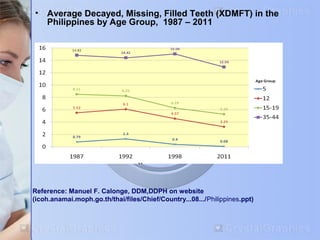
• Average Decayed, Missing, Filled Teeth (XDMFT) in the 
Philippines by Age Group, 1987 – 2011 
• 
Reference: Manuel F. Calonge, DDM,DDPH on website 
• (icoh.anamai.moph.go.th/thai/files/Chief/Country...08.../Philippines.ppt) 
• 
Reference: Manuel F. Calonge, DDM,DDPH on website 
(icoh.anamai.moph.go.th/thai/files/Chief/Country...08.../Philippines.ppt)
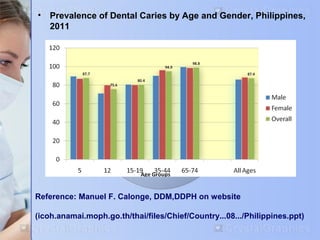
• Prevalence of Dental Caries by Age and Gender, Philippines, 
2011 
Reference: Manuel F. Calonge, DDM,DDPH on website 
(icoh.anamai.moph.go.th/thai/files/Chief/Country...08.../Philippines.ppt)
Summary 
• As a summary to the first question in the sub problem, 
tackles about that the prevalence of decayed, missing, 
and filling (DMF) by age (since 1987 to 2011) in the 
Philippines, the group of age that comes first are the 
65-74 or the older group among the other age group. 
Every year, dentist wants to know the number of DMF, 
to evaluate the patient proper hygiene. Furthermore, 
the dental charting reveals that dental caries are more 
rampant before than nowadays, that’s why dentist 
encourage Filipinos to have some regular check-up 
every six months.
Summary cont.. 
• In the demographic profile, noting about 
the high prevalence in dental caries 
particularly in gender, the highest dental 
caries occur in females than the males. 
Since the information reveals that this are 
common in the female, due to some 
reasons that the dental caries may occur.
Sub- Problem: 
2. What are the most common oral 
condition complaint each children 
experience per age group?
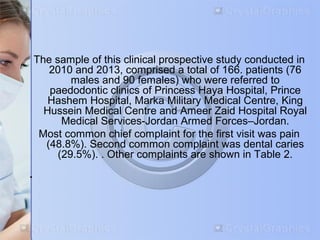
The sample of this clinical prospective study conducted in 
2010 and 2013, comprised a total of 166. patients (76 
males and 90 females) who were referred to 
paedodontic clinics of Princess Haya Hospital, Prince 
Hashem Hospital, Marka Military Medical Centre, King 
Hussein Medical Centre and Ameer Zaid Hospital Royal 
Medical Services-Jordan Armed Forces–Jordan. 
Most common chief complaint for the first visit was pain 
(48.8%). Second common complaint was dental caries 
(29.5%). . Other complaints are shown in Table 2. 
•
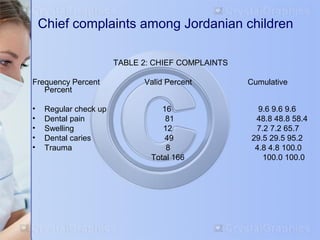
Chief complaints among Jordanian children 
TABLE 2: CHIEF COMPLAINTS 
Frequency Percent Valid Percent Cumulative 
Percent 
• Regular check up 16 9.6 9.6 9.6 
• Dental pain 81 48.8 48.8 58.4 
• Swelling 12 7.2 7.2 65.7 
• Dental caries 49 29.5 29.5 95.2 
• Trauma 8 4.8 4.8 100.0 
Total 166 100.0 100.0
Sub- Problem: 
3. What is the present oral health status of the 
students in terms of: 
3.1 Caries formation?, 
3.2 Calcular deposit?, 
3.3 Number of extraction?.
According to the Pedodontic clinics of Princess 
Haya Hospital, Prince Hashem Hospital, Marka 
Military Medical Centre, King Hussein Medical 
Centre and Ameer Zaid Hospital Royal Medical , 
Services, the most common chief complaint of the 
patient in the first visit in the dental clinic are was 
pain with 48.8% due to some oral problems , the 
second reason why the patient come to the clinic 
was dental caries with 29.5% and other 
complaints that are least chief complaints are the 
swelling, trauma, and for regular check up.
As you can see, patient only consult to the 
dentist when they already felt pain, but not 
to have their mouth to be treated with 
other proper oral hygiene that need to be 
maintain. This may become a problem 
when patient does not come for regular 
check up for the dentist, because pain 
may occur anytime if the oral hard and 
soft tissues have a poor hygiene.
Sub- Problem: 
4. Is there significant difference between the 
elementary students with that of the high 
school students in terms of: 
– Caries formation?, 
– Calcular deposit?, 
– Number of extraction?.
Prevalence of dental caries among school children of Bharatpur 
city, India 
Healthy teeth and oral tissues and the need for oral health care are 
important for any section of society. Oral disorders can have a 
profound impact on the quality-of-life. Good oral health has real 
health gains, in that it can improve general health and quality-of-life 
and contribute to self-image and social interaction. 
Epidemiologic studies may be of value in assessing the 
prevalence of diseases, in disclosing trends in disease 
development, and in analyzing possible factors influencing the 
disease pattern. 
In this study, among the total 1400 (100%) study subjects, 745 
(53.2%) were boys and 655 (46.8%) were girls. Among both 
government and private schools maximum school children were 
boys, that is, 360 (51.4%) and 385 (55%) respectively, which is in 
accordance to the study conducted by Adekoya-Sofowora et al.
Maximum number of school children, that is, 387 
(27.6%) were from the age group of 15 years which is 
in accordance with the study conducted by Pontigo- 
Loyola et al.[ in which maximum number of school 
children belonged to the age group of 15 years, that is, 
850 (55.3%). 
In this study, a maximum number of children, that is, 
1176 (84%) brushed once in a day. These results are 
in accordance with the study conducted by Shailee et 
al.among both government and private school children 
in which also a maximum number of children, that is, 
620 (52.9%) brushed once in a day.
• In the total study population, 5.22 ± 2.68 was the mean DMFT. 
Among the government and private school children, 7.61 ± 2.86 
and 4.76 ± 2.42 was the mean DMFT observed, respectively. In 
the study conducted by Wyne et al. 2.92 ± 3.51 was the mean 
DMFT. Among the government and private school children, 2.85 
± 3.41 and 3.05 ± 3.72 was the mean DMFT observed, 
respectively. 
• In this study, 742 (100%) were caries positive, out of which 392 
(53%) were government school children and 350 (47%) were 
private school children. In the study conducted by Piovesan et al. 
of 141 (100%) caries positive school children, 86 (61%) were 
government school children and 55 (39%) were private school 
children.
The prevalence of dental caries and supragingival plaque and 
calculus in 785 secondary schools students was assessed. More 
than half (53.6%) of the students were caries-free, and the 
majority of those with dental caries experience were aged 14–17 
(68.1%) and females (53%). Mean DMFT was 1.26, with mean D-component 
of 1.05, and molars were most affected. Most 
students had supragingival plaque (74%) and calculus (56.9%) 
and more so in males than females (푃 > 0 . 0 5). Less than half of 
the students had experience of dental caries and those with 
caries were mostly females and of the younger age group. The 
low DMFT was contributed to the D-component, and molars were 
the tooth type most affected.The majority of students had supra-gingival 
plaque and calculus and more so in males than females. 
Dental Caries, and Supragingival Plaque and Calculus among Students, Tanga, Tanzania 
L. C. Carneiro1 and M. N. Kabulwa2
Sub- Problem: 
5. What is the overall result in present oral 
health condition of the basic education 
students in Our Lady of Fatima 
University?
What are the latest dental problems 
statistics of the Philippines? 
The oral health status of Filipino children is alarming. The 
2006 National Oral Health Survey (Monse B. et al, NOHS 
2006) investigated the oral health status of Philippine public 
elementary school students. It revealed that 97.1% of six-year- 
old children suffer from tooth decay. More than four 
out of every five children of this subgroup manifested 
symptoms of dentinogenic infection.
In addition, 78.4% of twelve-year-old children suffer 
from dental caries and 49.7% of the same age 
group manifested symptoms of dentinogenic 
infections. The severity of dental caries, 
expressed as the average number of decayed 
teeth indicated for filling/extraction or filled 
permanent teeth (DMFT) or temporary teeth 
(dmft), was 8.4 dmft for the six-year-old age group 
and 2.9 DMFT for the twelve-year-old age group 
(NOHS 2006).
Technical composition 1 sample

Technical composition 1 sample

  • 1.
    Technical Composition 1 Adviser: Dr. Romeo T. Cruz Jr. Members: Francisco, Elaine : Pingol, Bernadette : Sebastian, Ecclesiatica
  • 2.
    “Assessment of theOral Health Status of Our Lady of Fatima University Basic Education students As Provided by the Clinicians of Dental Wellness Center”
  • 3.
    Statement of theProblem • Main Problem: This research aims to assess the oral health status of Basic Education students in Our Lady of Fatima University as provided by the clinicians of College of Dentistry
  • 4.
    Sub- Problem: 1.What is the demographic profile of the students in terms of: 1.1 Age ? , 1.2 Gender ? .
  • 5.
    • Average Decayed,Missing, Filled Teeth (XDMFT) in the Philippines by Age Group, 1987 – 2011 • Reference: Manuel F. Calonge, DDM,DDPH on website • (icoh.anamai.moph.go.th/thai/files/Chief/Country...08.../Philippines.ppt) • Reference: Manuel F. Calonge, DDM,DDPH on website (icoh.anamai.moph.go.th/thai/files/Chief/Country...08.../Philippines.ppt)
  • 6.
    • Prevalence ofDental Caries by Age and Gender, Philippines, 2011 Reference: Manuel F. Calonge, DDM,DDPH on website (icoh.anamai.moph.go.th/thai/files/Chief/Country...08.../Philippines.ppt)
  • 7.
    Summary • Asa summary to the first question in the sub problem, tackles about that the prevalence of decayed, missing, and filling (DMF) by age (since 1987 to 2011) in the Philippines, the group of age that comes first are the 65-74 or the older group among the other age group. Every year, dentist wants to know the number of DMF, to evaluate the patient proper hygiene. Furthermore, the dental charting reveals that dental caries are more rampant before than nowadays, that’s why dentist encourage Filipinos to have some regular check-up every six months.
  • 8.
    Summary cont.. •In the demographic profile, noting about the high prevalence in dental caries particularly in gender, the highest dental caries occur in females than the males. Since the information reveals that this are common in the female, due to some reasons that the dental caries may occur.
  • 9.
    Sub- Problem: 2.What are the most common oral condition complaint each children experience per age group?
  • 10.
    The sample ofthis clinical prospective study conducted in 2010 and 2013, comprised a total of 166. patients (76 males and 90 females) who were referred to paedodontic clinics of Princess Haya Hospital, Prince Hashem Hospital, Marka Military Medical Centre, King Hussein Medical Centre and Ameer Zaid Hospital Royal Medical Services-Jordan Armed Forces–Jordan. Most common chief complaint for the first visit was pain (48.8%). Second common complaint was dental caries (29.5%). . Other complaints are shown in Table 2. •
  • 11.
    Chief complaints amongJordanian children TABLE 2: CHIEF COMPLAINTS Frequency Percent Valid Percent Cumulative Percent • Regular check up 16 9.6 9.6 9.6 • Dental pain 81 48.8 48.8 58.4 • Swelling 12 7.2 7.2 65.7 • Dental caries 49 29.5 29.5 95.2 • Trauma 8 4.8 4.8 100.0 Total 166 100.0 100.0
  • 12.
    Sub- Problem: 3.What is the present oral health status of the students in terms of: 3.1 Caries formation?, 3.2 Calcular deposit?, 3.3 Number of extraction?.
  • 13.
    According to thePedodontic clinics of Princess Haya Hospital, Prince Hashem Hospital, Marka Military Medical Centre, King Hussein Medical Centre and Ameer Zaid Hospital Royal Medical , Services, the most common chief complaint of the patient in the first visit in the dental clinic are was pain with 48.8% due to some oral problems , the second reason why the patient come to the clinic was dental caries with 29.5% and other complaints that are least chief complaints are the swelling, trauma, and for regular check up.
  • 14.
    As you cansee, patient only consult to the dentist when they already felt pain, but not to have their mouth to be treated with other proper oral hygiene that need to be maintain. This may become a problem when patient does not come for regular check up for the dentist, because pain may occur anytime if the oral hard and soft tissues have a poor hygiene.
  • 15.
    Sub- Problem: 4.Is there significant difference between the elementary students with that of the high school students in terms of: – Caries formation?, – Calcular deposit?, – Number of extraction?.
  • 16.
    Prevalence of dentalcaries among school children of Bharatpur city, India Healthy teeth and oral tissues and the need for oral health care are important for any section of society. Oral disorders can have a profound impact on the quality-of-life. Good oral health has real health gains, in that it can improve general health and quality-of-life and contribute to self-image and social interaction. Epidemiologic studies may be of value in assessing the prevalence of diseases, in disclosing trends in disease development, and in analyzing possible factors influencing the disease pattern. In this study, among the total 1400 (100%) study subjects, 745 (53.2%) were boys and 655 (46.8%) were girls. Among both government and private schools maximum school children were boys, that is, 360 (51.4%) and 385 (55%) respectively, which is in accordance to the study conducted by Adekoya-Sofowora et al.
  • 17.
    Maximum number ofschool children, that is, 387 (27.6%) were from the age group of 15 years which is in accordance with the study conducted by Pontigo- Loyola et al.[ in which maximum number of school children belonged to the age group of 15 years, that is, 850 (55.3%). In this study, a maximum number of children, that is, 1176 (84%) brushed once in a day. These results are in accordance with the study conducted by Shailee et al.among both government and private school children in which also a maximum number of children, that is, 620 (52.9%) brushed once in a day.
  • 18.
    • In thetotal study population, 5.22 ± 2.68 was the mean DMFT. Among the government and private school children, 7.61 ± 2.86 and 4.76 ± 2.42 was the mean DMFT observed, respectively. In the study conducted by Wyne et al. 2.92 ± 3.51 was the mean DMFT. Among the government and private school children, 2.85 ± 3.41 and 3.05 ± 3.72 was the mean DMFT observed, respectively. • In this study, 742 (100%) were caries positive, out of which 392 (53%) were government school children and 350 (47%) were private school children. In the study conducted by Piovesan et al. of 141 (100%) caries positive school children, 86 (61%) were government school children and 55 (39%) were private school children.
  • 19.
    The prevalence ofdental caries and supragingival plaque and calculus in 785 secondary schools students was assessed. More than half (53.6%) of the students were caries-free, and the majority of those with dental caries experience were aged 14–17 (68.1%) and females (53%). Mean DMFT was 1.26, with mean D-component of 1.05, and molars were most affected. Most students had supragingival plaque (74%) and calculus (56.9%) and more so in males than females (푃 > 0 . 0 5). Less than half of the students had experience of dental caries and those with caries were mostly females and of the younger age group. The low DMFT was contributed to the D-component, and molars were the tooth type most affected.The majority of students had supra-gingival plaque and calculus and more so in males than females. Dental Caries, and Supragingival Plaque and Calculus among Students, Tanga, Tanzania L. C. Carneiro1 and M. N. Kabulwa2
  • 20.
    Sub- Problem: 5.What is the overall result in present oral health condition of the basic education students in Our Lady of Fatima University?
  • 21.
    What are thelatest dental problems statistics of the Philippines? The oral health status of Filipino children is alarming. The 2006 National Oral Health Survey (Monse B. et al, NOHS 2006) investigated the oral health status of Philippine public elementary school students. It revealed that 97.1% of six-year- old children suffer from tooth decay. More than four out of every five children of this subgroup manifested symptoms of dentinogenic infection.
  • 22.
    In addition, 78.4%of twelve-year-old children suffer from dental caries and 49.7% of the same age group manifested symptoms of dentinogenic infections. The severity of dental caries, expressed as the average number of decayed teeth indicated for filling/extraction or filled permanent teeth (DMFT) or temporary teeth (dmft), was 8.4 dmft for the six-year-old age group and 2.9 DMFT for the twelve-year-old age group (NOHS 2006).