Data Science : Applying Machine Learning & Deep
Learning Algorithms
Agenda
Overview
Behind the scenes
Technology & Mathematics
Applications
Numbers - Classification Algorithms
Images - Generating Art
Sequential Data - Natural Language Processing
Videos - Driverless Cars
Generative Adversarial networks (GANs)
Resources
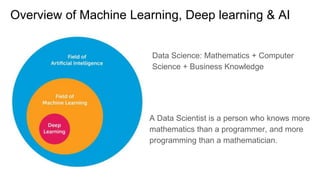
Overview of Machine Learning, Deep learning & AI
A Data Scientist is a person who knows more
mathematics than a programmer, and more
programming than a mathematician.
Data Science: Mathematics + Computer
Science + Business Knowledge
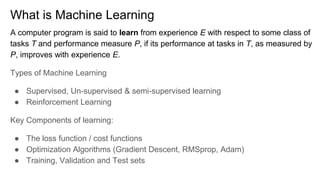
What is Machine Learning
A computer program is said to learn from experience E with respect to some class of
tasks T and performance measure P, if its performance at tasks in T, as measured by
P, improves with experience E.
Types of Machine Learning
● Supervised, Un-supervised & semi-supervised learning
● Reinforcement Learning
Key Components of learning:
● The loss function / cost functions
● Optimization Algorithms (Gradient Descent, RMSprop, Adam)
● Training, Validation and Test sets
What is Deep Learning
Agenda
Overview
Behind the scenes
Technology & Mathematics
Applications
Numbers - Classification Algorithms
Images - Generating Art
Sequential Data - Natural Language Processing
Videos - Driverless Cars
Generative Adversarial networks (GANs)
Resources
Technology & Mathematics behind Data Science
Technology:
Languages: Python, R, SAS, SparkML, PySpark
Hardware: GPUs to run complex mathematical equations
Notebooks: Jupyter notebook (most popular), Google Colab (free with GPU), AWS
Deep Learning Frameworks: Tensorflow, Keras, Theano, Torch, Caffe
Mathematics:
Linear Algebra
Calculus
Probability Theory
Statistics
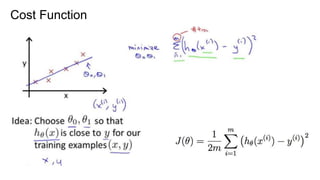
Cost Function
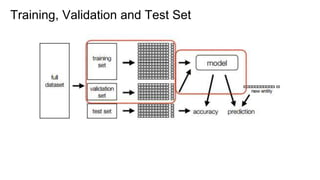
Training, Validation and Test Set
Some Interesting Applications
- Product/Movie Recommendation Engines
- Fraud Detection in Loans & Credit Cards
- NLP - Siri/Alexa/OkGoogle
- NLP - Chatbots, Q&A, Machine Translation
- Art and Music Generation (Deepart.io, DeepJazz.io)
- Facial Recognition
- DeepFake
- Driverless Cars
- DeepMind AlphaGo
Agenda
Overview
Behind the scenes
Technology & Mathematics
Applications
Numbers - Classification Algorithms
Images - Generating Art
Sequential Data - Natural Language Processing
Videos - Driverless Cars
Generative Adversarial networks (GANs)
Resources
Classification Algorithm : Problem Statement
Generic Problem Statement: Classify the data into two or more sets based on
certain features
Loan Singh: Given the demographic and bank statement data of a customer, can
you classify a customer into good or bad (creditworthiness) and predict a probability
of him being a good customer
Airtel Device Finance: Given the telecom data for a customer, can you classify a
customer into good or bad (creditworthiness) and predict a probability of him being a
good customer
Linear Regression : Predict actual value
Logistic Regression: Predict 0 or 1 (binary
classification)
How we built the model with Airtel data to predict customer
default probability
Telecom Data - Multiple
Sources Single view -
User Profile
Targer : CIBIL Data of a
sample 1Million customers
Test Data
Train Data
Scoring
Validation : Actual
vs Predicted
New Customer Prediction
Model
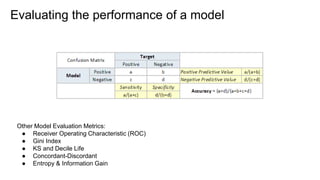
Evaluating the performance of a model
Other Model Evaluation Metrics:
● Receiver Operating Characteristic (ROC)
● Gini Index
● KS and Decile Life
● Concordant-Discordant
● Entropy & Information Gain
Other Classification Algorithms: Decision Trees &
Random Forest
Gini index : if we select two items from a population at random then they must be of same class and probability
for this is 1 if population is pure (p2 + q2)
Random Forest : Ensemble Models
Algorithms run for Loan Singh prediction
Agenda
Overview
Behind the scenes
Technology & Mathematics
Applications
Numbers - Classification Algorithms
Images - Generating Art
Sequential Data - Natural Language Processing
Videos - Driverless Cars
Generative Adversarial networks (GANs)
Resources
Neural Style Transfer
Problem Statement : Generate Artwork from photographs based on the painting
type of famous painters
● Convolutional Neural Networks (CNN)
Vincent van Gogh
Picasso Monet
How does a computer understand images?
Layers in a CNN : Pooling, Convolution, Dense
Inception Network Architecture
How does CNN understand an Image : Layer 1
How does CNN understand an Image : Layer 2
How does CNN understand an Image : Layer 3
How does CNN understand an Image : Layer 4
How does CNN understand an Image : Layer 5
Neural Style Transfer
Example
Agenda
Overview
Behind the scenes
Technology & Mathematics
Applications
Numbers - Classification Algorithms
Images - Generating Art
Sequential Data - Natural Language Processing
Videos - Driverless Cars
Generative Adversarial networks (GANs)
Resources
Sequence Data : Recurrent Neural Networks
How does an algorithm understand language?
A language model estimates the probability of a sentence (sequence or words) occuring together, and provides a
comparison between different possible combination or variants of similar sentence.
Recurrent Neural Network
Input Sentence: Cats average 15 hours of sleep everyday.
Long - Short Term Memory Network
Input Sentences:
(1) Dog was playing
(2) Dogs were playing
Input Sentences:
(1) Dog, who is a beagle and name is Hazel, was playing
(2) Dogs, who are golden retrievers and 15 in number, were playing
Word Embeddings
Man:Woman = King:?
Agenda
Overview
Behind the scenes
Technology & Mathematics
Applications
Numbers - Classification Algorithms
Images - Generating Art
Sequential Data - Natural Language Processing
Videos - Driverless Cars
Generative Adversarial networks (GANs)
Resources
Driverless Cars - YOLO
Problem Statement : Given an image (a frame of a video) - Identify the boundary
box of cars and other objects
Algorithm Used: YOLO (You Look Only Once)
How does YOLO work?
Detecting multiple objects in an image
Agenda
Overview
Behind the scenes
Technology & Mathematics
Applications
Numbers - Classification Algorithms
Images - Generating Art
Sequential Data - Natural Language Processing
Videos - Driverless Cars
Generative Adversarial networks (GANs)
Resources
Generative Adversarial Networks (GANs)
Agenda
Overview
Behind the scenes
Technology & Mathematics
Applications
Numbers - Classification Algorithms
Images - Generating Art
Sequential Data - Natural Language Processing
Videos - Driverless Cars
Generative Adversarial networks (GANs)
Resources
Resources
● Learn
○ Coursera Machine Learning & Deep Learning Specializations
○ Fast.ai
○ Analytics Vidhya Blogs, KDNuggets Blog
○ Twitter feeds and Blogs of Data Scientists
● Practice
○ Kaggle Competitions (+ win money)
○ Google Colab Notebooks / AWS / Gaming PC with Nvidia GPU + CUDA
Thank You
Ashutosh Kumar
ashutosh@seynse.com
9741329821Blog on Machine learning:
http://www.ashukumar27.io/

Tech showcase: Artificial Intelligence, Machine Learning, Deep Learning

  • 1.
    Data Science :Applying Machine Learning & Deep Learning Algorithms
  • 2.
    Agenda Overview Behind the scenes Technology& Mathematics Applications Numbers - Classification Algorithms Images - Generating Art Sequential Data - Natural Language Processing Videos - Driverless Cars Generative Adversarial networks (GANs) Resources
  • 3.
    Overview of MachineLearning, Deep learning & AI A Data Scientist is a person who knows more mathematics than a programmer, and more programming than a mathematician. Data Science: Mathematics + Computer Science + Business Knowledge
  • 4.
    What is MachineLearning A computer program is said to learn from experience E with respect to some class of tasks T and performance measure P, if its performance at tasks in T, as measured by P, improves with experience E. Types of Machine Learning ● Supervised, Un-supervised & semi-supervised learning ● Reinforcement Learning Key Components of learning: ● The loss function / cost functions ● Optimization Algorithms (Gradient Descent, RMSprop, Adam) ● Training, Validation and Test sets
  • 5.
    What is DeepLearning
  • 6.
    Agenda Overview Behind the scenes Technology& Mathematics Applications Numbers - Classification Algorithms Images - Generating Art Sequential Data - Natural Language Processing Videos - Driverless Cars Generative Adversarial networks (GANs) Resources
  • 7.
    Technology & Mathematicsbehind Data Science Technology: Languages: Python, R, SAS, SparkML, PySpark Hardware: GPUs to run complex mathematical equations Notebooks: Jupyter notebook (most popular), Google Colab (free with GPU), AWS Deep Learning Frameworks: Tensorflow, Keras, Theano, Torch, Caffe Mathematics: Linear Algebra Calculus Probability Theory Statistics
  • 8.
  • 9.
  • 10.
    Some Interesting Applications -Product/Movie Recommendation Engines - Fraud Detection in Loans & Credit Cards - NLP - Siri/Alexa/OkGoogle - NLP - Chatbots, Q&A, Machine Translation - Art and Music Generation (Deepart.io, DeepJazz.io) - Facial Recognition - DeepFake - Driverless Cars - DeepMind AlphaGo
  • 11.
    Agenda Overview Behind the scenes Technology& Mathematics Applications Numbers - Classification Algorithms Images - Generating Art Sequential Data - Natural Language Processing Videos - Driverless Cars Generative Adversarial networks (GANs) Resources
  • 12.
    Classification Algorithm :Problem Statement Generic Problem Statement: Classify the data into two or more sets based on certain features Loan Singh: Given the demographic and bank statement data of a customer, can you classify a customer into good or bad (creditworthiness) and predict a probability of him being a good customer Airtel Device Finance: Given the telecom data for a customer, can you classify a customer into good or bad (creditworthiness) and predict a probability of him being a good customer
  • 13.
    Linear Regression :Predict actual value
  • 14.
    Logistic Regression: Predict0 or 1 (binary classification)
  • 15.
    How we builtthe model with Airtel data to predict customer default probability Telecom Data - Multiple Sources Single view - User Profile Targer : CIBIL Data of a sample 1Million customers Test Data Train Data Scoring Validation : Actual vs Predicted New Customer Prediction Model
  • 16.
    Evaluating the performanceof a model Other Model Evaluation Metrics: ● Receiver Operating Characteristic (ROC) ● Gini Index ● KS and Decile Life ● Concordant-Discordant ● Entropy & Information Gain
  • 17.
    Other Classification Algorithms:Decision Trees & Random Forest Gini index : if we select two items from a population at random then they must be of same class and probability for this is 1 if population is pure (p2 + q2)
  • 18.
    Random Forest :Ensemble Models
  • 19.
    Algorithms run forLoan Singh prediction
  • 20.
    Agenda Overview Behind the scenes Technology& Mathematics Applications Numbers - Classification Algorithms Images - Generating Art Sequential Data - Natural Language Processing Videos - Driverless Cars Generative Adversarial networks (GANs) Resources
  • 21.
    Neural Style Transfer ProblemStatement : Generate Artwork from photographs based on the painting type of famous painters ● Convolutional Neural Networks (CNN) Vincent van Gogh Picasso Monet
  • 22.
    How does acomputer understand images?
  • 23.
    Layers in aCNN : Pooling, Convolution, Dense
  • 24.
  • 25.
    How does CNNunderstand an Image : Layer 1
  • 26.
    How does CNNunderstand an Image : Layer 2
  • 27.
    How does CNNunderstand an Image : Layer 3
  • 28.
    How does CNNunderstand an Image : Layer 4
  • 29.
    How does CNNunderstand an Image : Layer 5
  • 30.
  • 31.
  • 32.
    Agenda Overview Behind the scenes Technology& Mathematics Applications Numbers - Classification Algorithms Images - Generating Art Sequential Data - Natural Language Processing Videos - Driverless Cars Generative Adversarial networks (GANs) Resources
  • 33.
    Sequence Data :Recurrent Neural Networks
  • 34.
    How does analgorithm understand language? A language model estimates the probability of a sentence (sequence or words) occuring together, and provides a comparison between different possible combination or variants of similar sentence.
  • 35.
    Recurrent Neural Network InputSentence: Cats average 15 hours of sleep everyday.
  • 36.
    Long - ShortTerm Memory Network Input Sentences: (1) Dog was playing (2) Dogs were playing Input Sentences: (1) Dog, who is a beagle and name is Hazel, was playing (2) Dogs, who are golden retrievers and 15 in number, were playing
  • 37.
  • 38.
    Agenda Overview Behind the scenes Technology& Mathematics Applications Numbers - Classification Algorithms Images - Generating Art Sequential Data - Natural Language Processing Videos - Driverless Cars Generative Adversarial networks (GANs) Resources
  • 39.
    Driverless Cars -YOLO Problem Statement : Given an image (a frame of a video) - Identify the boundary box of cars and other objects Algorithm Used: YOLO (You Look Only Once)
  • 40.
  • 41.
  • 42.
    Agenda Overview Behind the scenes Technology& Mathematics Applications Numbers - Classification Algorithms Images - Generating Art Sequential Data - Natural Language Processing Videos - Driverless Cars Generative Adversarial networks (GANs) Resources
  • 43.
  • 44.
    Agenda Overview Behind the scenes Technology& Mathematics Applications Numbers - Classification Algorithms Images - Generating Art Sequential Data - Natural Language Processing Videos - Driverless Cars Generative Adversarial networks (GANs) Resources
  • 45.
    Resources ● Learn ○ CourseraMachine Learning & Deep Learning Specializations ○ Fast.ai ○ Analytics Vidhya Blogs, KDNuggets Blog ○ Twitter feeds and Blogs of Data Scientists ● Practice ○ Kaggle Competitions (+ win money) ○ Google Colab Notebooks / AWS / Gaming PC with Nvidia GPU + CUDA
  • 46.
    Thank You Ashutosh Kumar ashutosh@seynse.com 9741329821Blogon Machine learning: http://www.ashukumar27.io/