The Changing Landscape of
Disruptive Technologies
Part 2 of 6
Disruptive
technologies&
innovationbarriers
kpmg.com/techinnovation
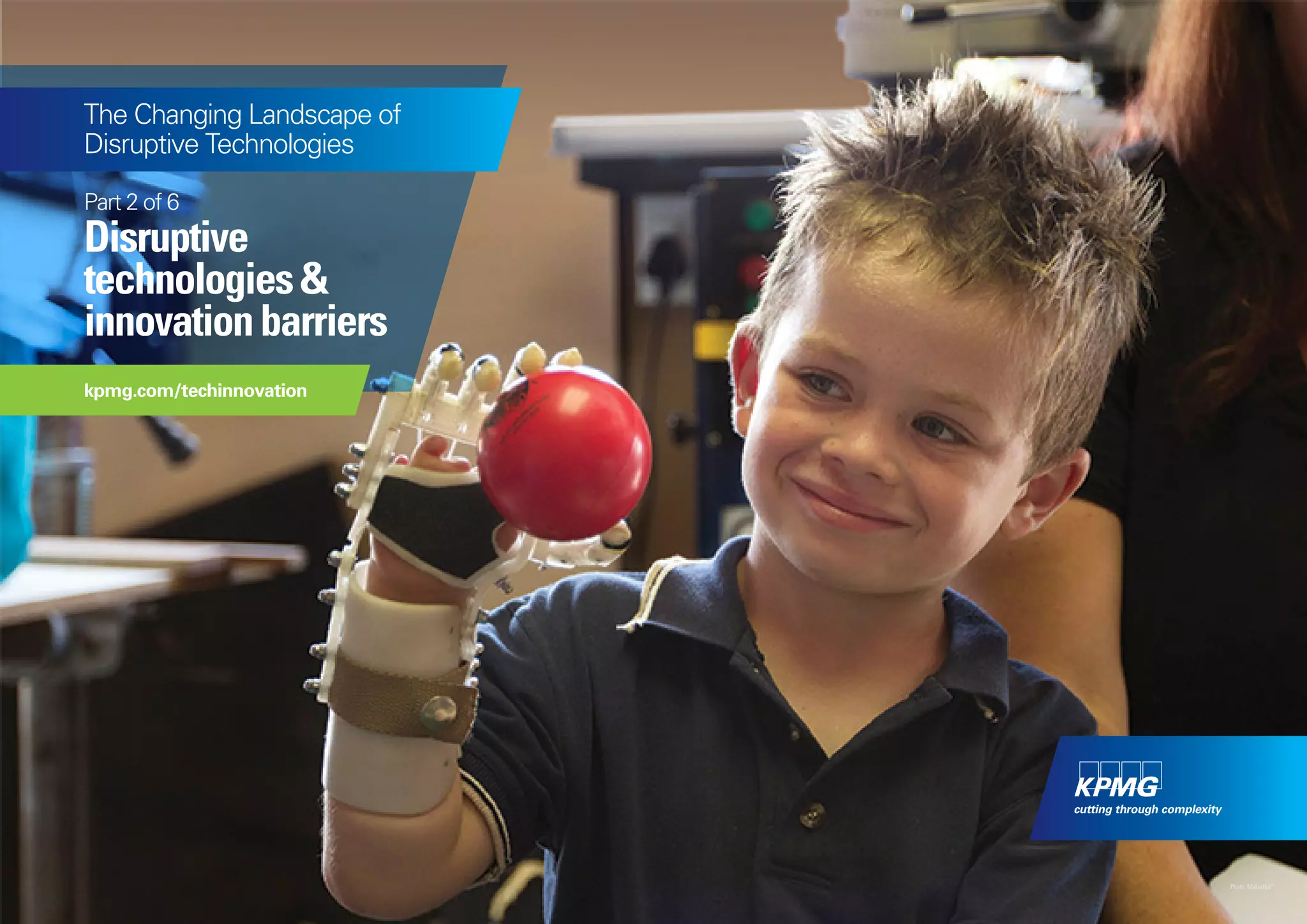
Photo: MakerBot®
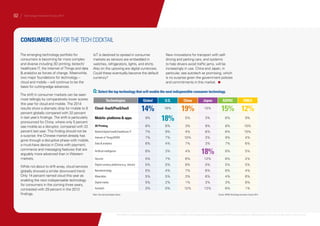
The emerging technology portfolio for
consumers is becoming far more complex
and diverse including 3D printing, biotech/
healthcare IT, the Internet of Things and data
& analytics as forces of change. Meanwhile,
two major foundations for technology –
cloud and mobile – will continue to be the
basis for cutting-edge advances.
The shift in consumer markets can be seen
most tellingly by comparatively lower scores
this year for cloud and mobile. The 2014
results show a dramatic drop for mobile to 9
percent globally compared with 32 percent
in last year’s findings. The shift is particularly
pronounced for China, where only 5 percent
see mobile as a disruptor, compared with 22
percent last year. This finding should not be
a surprise: the Chinese market already has
gone through a disruptive phase with mobile,
a must-have device in China with payment,
commerce and messaging features that are
arguably more advanced than in Western
markets.
While not about to drift away, cloud services
globally showed a similar downward trend.
Only 14 percent named cloud this year as
enabling the next indispensable technology
for consumers in the coming three years,
contrasted with 29 percent in the 2013
findings.
CONSUMERS GO FOR THE TECH COCKTAIL
Source: KPMG Technology Innovation Survey 2014Note: Only top technologies shown.
IoT is destined to spread in consumer
markets as sensors are embedded in
watches, refrigerators, lights, and shirts.
Also on the upswing are digital currencies.
Could these eventually become the default
currency?
New innovations for transport with self-
driving and parking cars, and systems
to help drivers avoid traffic jams, will be
increasingly in use. China and Japan, in
particular, see autotech as promising, which
is no surprise given the government policies
and commitments in this market. 1
Technologies Global U.S. China Japan ASPAC EMEA
Cloud–SaaS/PaaS/IaaS 14% 16%
19% 15%
15% 12%
Mobile–platforms & apps 9%
18% 5% 3% 6% 9%
3D Printing 8% 6% 3% 9% 8% 10%
Biotech/digital health/healthcare IT 7% 9% 4% 6% 6% 10%
Internet of Things/M2M 7% 7% 10% 3% 9% 4%
Data & analytics 6% 4% 7% 3% 7% 6%
Artificial intelligence 6% 3% 4%
18% 8% 5%
Security 5% 7% 6% 12% 6% 2%
Digital currency platforms (e.g., bitcoin) 5% 5% 8% 0% 5% 5%
Nanotechnology 5% 4% 7% 6% 6% 4%
Wearables 5% 5% 3% 6% 4% 6%
Digital media 5% 2% 1% 3% 3% 8%
Autotech 3% 0% 12% 12% 6% 1%
Q:Select the top technology that will enable the next indispensible consumer technology.
© 2014 KPMG LLP, a Delaware limited liability partnership and the U.S. member firm of the KPMG network of independent member firms affiliated with KPMG International Cooperative (“KPMG International”), a Swiss entity. All rights reserved. Printed in the U.S.A.
02 / Technology Innovation Survey 2014
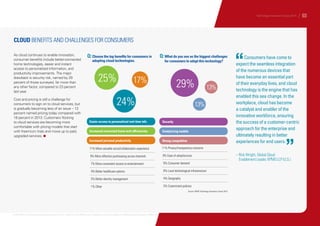
As cloud continues to enable innovation,
consumer benefits include better-connected
home technologies, easier and instant
access to personalized information, and
productivity improvements. The major
drawback is security risk, named by 29
percent of those surveyed, far more than
any other factor, compared to 23 percent
last year.
Cost and pricing is still a challenge for
consumers to sign on to cloud services, but
is gradually becoming less of an issue – 13
percent named pricing today compared with
18 percent in 2013. Customers flocking
to cloud services are becoming more
comfortable with pricing models that start
with freemium trials and move up to paid,
upgraded services. 1
Q:Choose the top benefits for consumers in
adopting cloud technologies.
Q:What do you see as the biggest challenges
for consumers to adopt this technology?
CLOUD BENEFITS AND CHALLENGES FOR CONSUMERS
11% More valuable social/collaboration experience
9% More effective purchasaing across channels
7% More convenient access to entertainment
4% Better healthcare options
3% Better identity management
1% Other
Easier access to personalized real-time info
Increased connected home tech efficiencies
Increased personal productivity
25%
24%
17%
Source: KPMG Technology Innovation Survey 2014
13%
13%29%
11% Privacy/transparency concerns
9% Ease of adoption/use
9% Consumer demand
9% Local technological infrastructure
4% Geography
3% Covernment policies
Security
Cost/pricing models
Strong competition
Consumers have come to
expect the seamless integration
of the numerous devices that
have become an essential part
of their everyday lives, and cloud
technology is the engine that has
enabled this sea change. In the
workplace, cloud has become
a catalyst and enabler of the
innovative workforce, ensuring
the success of a customer-centric
approach for the enterprise and
ultimately resulting in better
experiences for end users.
– Rick Wright, Global Cloud
Enablement Leader, KPMG LLP (U.S.)
“
”
© 2014 KPMG LLP, a Delaware limited liability partnership and the U.S. member firm of the KPMG network of independent member firms affiliated with KPMG International Cooperative (“KPMG International”), a Swiss entity. All rights reserved. Printed in the U.S.A.
Technology Innovation Survey 2014 / 03
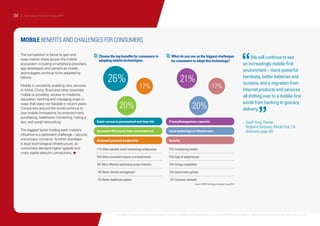
Q:Choose the top benefits for consumers in
adopting mobile technologies.
Q:What do you see as the biggest challenges
for consumers to adopt this technology?
The competition is fierce to gain and
keep market share across the mobile
ecosystem including smartphone providers,
app developers and carriers as mobile
technologies continue to be adopted by
billions.
Mobile is constantly enabling new services.
In Africa, China, Brazil and other countries
mobile is providing access to medicine,
education, banking and managing crops in
ways that were not feasible in recent years.
Consumers around the world continue to
love mobile innovations for entertainment,
purchasing, healthcare monitoring, hailing a
taxi, and social networking.
The biggest factor holding back mobile’s
influence is a persistent challenge – security
and privacy concerns. Another drawback
is local technological infrastructure, as
consumers demand higher speeds and
more stable telecom connections. 1
MOBILE BENEFITS AND CHALLENGES FOR CONSUMERS
26% 21%
20% 20%
17% 17%
11% More valuable social networking/collaboration
10% More convenient access to entertainment
9% More effective purchasing across channels
4% Better identity management
3% Better healthcare options
14% Cost/pricing models
13% Ease of adoption/use
6% Strong competition
6% Government policies
3% Consumer demand
Easier access to personalized real-time info
Increased efficiencies from connected tech
Increased personal productivity
Privacy/transparency concerns
Local technological infrastructure
Security
Source: KPMG Technology Innovation Survey 2014
We will continue to see
an increasingly mobile-first
environment – more powerful
handsets, better batteries and
screens, and a migration from
Internet products and services
all shifting over to a mobile-first
world from banking to grocery
delivery.
– Geoff Yang, Partner,
Redpoint Ventures, Menlo Park, CA
(Interview page 30)
“
”
© 2014 KPMG LLP, a Delaware limited liability partnership and the U.S. member firm of the KPMG network of independent member firms affiliated with KPMG International Cooperative (“KPMG International”), a Swiss entity. All rights reserved. Printed in the U.S.A.
04 / Technology Innovation Survey 2014
Disruptive
technologyTRENDS IN ENTERPRISE MARKETS
Photo:A.J.MuellerPhotography
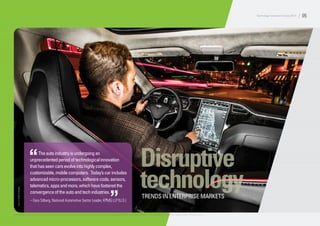
Theautoindustryisundergoingan
unprecedentedperiodoftechnologicalinnovation
thathasseencarsevolveintohighlycomplex,
customizable,mobilecomputers. Today’scarincludes
advancedmicro-processors,softwarecode,sensors,
telematics,appsandmore,whichhavefosteredthe
convergenceoftheautoandtechindustries.
– Gary Silberg, National Automotive Sector Leader, KPMG LLP (U.S.)
“
”
© 2014 KPMG LLP, a Delaware limited liability partnership and the U.S. member firm of the KPMG network of independent member firms affiliated with KPMG International Cooperative (“KPMG International”), a Swiss entity. All rights reserved. Printed in the U.S.A.
Technology Innovation Survey 2014 / 05
CLOUD AND DATA  ANALYTICS DRIVE INNOVATION
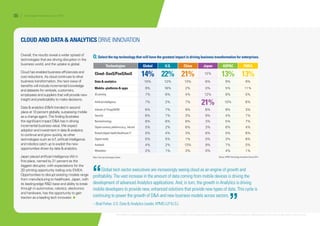
Overall, the results reveal a wider spread of
technologies that are driving disruption in the
business world, and the uptake is global.
Cloud has enabled business efficiencies and
cost reductions. As cloud continues to drive
business transformation, the next wave of
benefits will include incremental knowledge
and datasets for verticals, customers,
employees and suppliers that will provide new
insight and predictability to make decisions.
Data  analytics (DA) trended in second
place at 10 percent globally, surpassing mobile
as a change agent. The finding illustrates
the significant impact DA has in driving
incremental business value. We expect
adoption and investment in data  analytics
to continue and grow quickly, as other
technologies such as IoT, artificial intelligence
and robotics catch up to exploit the new
opportunities driven by data  analytics.
Japan placed artificial intelligence (AI) in
first place, named by 21 percent as the
biggest disruptor, with expectations for the
3D printing opportunity trailing only EMEA.
Opportunities to disrupt existing models range
from manufacturing to healthcare. Japan, with
its leading-edge RD base and ability to break
through in automotive, robotics, electronics
and hardware, has the opportunity to gain
traction as a leading tech innovator. 1
Q:Select the top technology that will have the greatest impact in driving business transformation for enterprises.
Technologies Global U.S. China Japan ASPAC EMEA
Cloud–SaaS/PaaS/IaaS 14% 22% 21% 12%
13% 13%
Data  analytics 10% 12% 13% 6% 9% 9%
Mobile–platforms  apps 9% 16% 2% 0% 5% 11%
3D printing 7% 6% 4% 12% 8% 5%
Artificial intelligence 7% 2% 7%
21% 10% 6%
Internet of Things/M2M 6% 7% 9% 6% 9% 3%
Security 6% 7% 3% 9% 4% 7%
Nanotechnology 6% 6% 8% 3% 5% 7%
Digital currency platforms (e.g., bitcoin) 5% 2% 6% 3% 6% 4%
Biotech/digital health/healthcare IT 5% 4% 3% 6% 5% 6%
Digital media 5% 5% 1% 0% 3% 8%
Autotech 4% 2% 13% 9% 7% 0%
Wearables 2% 1% 3% 0% 4% 1%
Source: KPMG Technology Innovation Survey 2014
Global tech sector executives are increasingly seeing cloud as an engine of growth and
profitability. The vast increase in the amount of data coming from mobile devices is driving the
development of advanced Analytics applications. And, in turn, the growth in Analytics is driving
mobile developers to provide new, enhanced solutions that provide new types of data. This cycle is
continuing to power the growth of DA and new business models across sectors.
– Brad Fisher, U.S. Data  Analytics Leader, KPMG LLP (U.S.)
“
”
Note: Only top technologies shown.
© 2014 KPMG LLP, a Delaware limited liability partnership and the U.S. member firm of the KPMG network of independent member firms affiliated with KPMG International Cooperative (“KPMG International”), a Swiss entity. All rights reserved. Printed in the U.S.A.
06 / Technology Innovation Survey 2014
LITTLE PROGRESS WITH SECURITY,
COMPLEXITY ISSUES
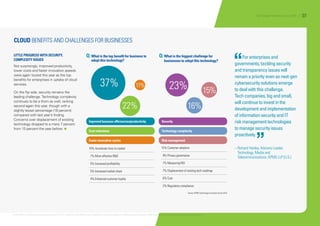
Not surprisingly, improved productivity,
lower costs and faster innovation speeds
were again touted this year as the top
benefits for enterprises in uptake of cloud
services.
On the flip side, security remains the
leading challenge. Technology complexity
continues to be a thorn as well, ranking
second again this year, though with a
slightly lesser percentage (16 percent)
compared with last year’s finding.
Concerns over displacement of existing
technology dropped to a mere 7 percent
from 15 percent the year before. 1
Q:What is the top benefit for business to
adopt this technology?
Q:What is the biggest challenge for
businesses to adopt this technology?
CLOUD BENEFITS AND CHALLENGES FOR BUSINESSES
10% Accelerate time to market
7% More effective RD
5% Increased profitability
5% Increased market share
4% Enhanced customer loyalty
Improved business efficiencies/productivity
Cost reductions
Faster innovation cycles
23%
16%
15%
Source: KPMG Technology Innovation Survey 2014
15% Customer adoption
9% Privacy governance
7% Measuring ROI
7% Displacement of existing tech roadmap
6% Cost
2% Regulatory compliance
Security
Technology complexity
Risk management
11%
22%
37%
For enterprises and
governments, tackling security
and transparency issues will
remain a priority even as next-gen
cybersecurity solutions emerge
to deal with this challenge.
Tech companies, big and small,
will continue to invest in the
development and implementation
of information security and IT
risk management technologies
to manage security issues
proactively.
– Richard Hanley, Advisory Leader,
Technology, Media and
Telecommunications, KPMG LLP (U.S.)
“
”
© 2014 KPMG LLP, a Delaware limited liability partnership and the U.S. member firm of the KPMG network of independent member firms affiliated with KPMG International Cooperative (“KPMG International”), a Swiss entity. All rights reserved. Printed in the U.S.A.
Technology Innovation Survey 2014 / 07
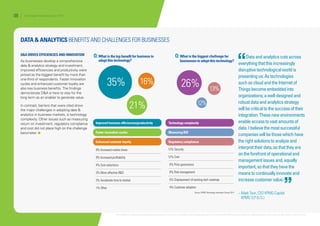
DA DRIVES EFFICIENCIES AND INNOVATION
As businesses develop a comprehensive
data  analytics strategy and investment,
improved efficiencies and productivity were
picked as the biggest benefit by more than
one-third of respondents. Faster innovation
cycles and enhanced customer loyalty are
also key business benefits. The findings
demonstrate DA is here to stay for the
long term as an enabler to generate value.
In contrast, barriers that were cited show
the major challenges in adopting data 
analytics in business markets, is technology
complexity. Other issues such as measuring
return on investment, regulatory compliance
and cost did not place high on the challenge
barometer. 1
DATA  ANALYTICS BENEFITS AND CHALLENGES FOR BUSINESSES
Q:What is the top benefit for business to
adopt this technology?
9% Increased market share
9% Increased profitability
4% Cost reductions
3% More effective RD
3% Accelerate time to market
1% Other
Improved business efficiencies/productivity
Faster innovation cycles
Enhanced customer loyalty
21%
35% 16%
Q:What is the biggest challenge for
businesses to adopt this technology?
Source: KPMG Technology Innovation Survey 2014
13%
26%
12% Security
12% Cost
9% Price governance
8% Risk management
5% Displacement of existing tech roadmap
4% Customer adoption
Technology complexity
Measuring ROI
Regulatory compliance
12%
Dataandanalyticscutsacross
everythingthatthisincreasingly
disruptivetechnologicalworldis
presentingus.Astechnologies
suchascloudandtheInternetof
Thingsbecomeembeddedinto
organizations,awell-designedand
robustdataandanalyticsstrategy
willbecriticaltothesuccessoftheir
integration.Thesenewenvironments
enableaccesstovastamountsof
data.Ibelievethemostsuccessful
companieswillbethosewhichhave
therightsolutionstoanalyzeand
interprettheirdata,sothattheyare
ontheforefrontofoperationaland
managementissuesand,equally
important,sothattheyhavethe
meanstocontinuallyinnovateand
increasecustomervalue.
– Mark Toon, CEO KPMG Capital
KPMG LLP (U.S.)
“
”
© 2014 KPMG LLP, a Delaware limited liability partnership and the U.S. member firm of the KPMG network of independent member firms affiliated with KPMG International Cooperative (“KPMG International”), a Swiss entity. All rights reserved. Printed in the U.S.A.
08 / Technology Innovation Survey 2014
BarriersTO COMMERCIALIZING TECHNOLOGY INNOVATION
WeseeaperfectstormtakingshapeinChina–on
theonehandtheriseoftheChineseconsumerandonthe
other,Chinaisleapfroggingothercountriesinanumber
oftechnologiessuchasmobilecommerceandpayments.
Thesefactorsaredrivingthefastadoptionofemerging
technologiesandinturnthereisincreasedtechnology
complexity.Facilitatinghowtogettothevalueofthese
newtechnologieswillbeakeymarketdifferentiator.
– Edge Zarrella, Partner, Clients and Innovation Consulting, KPMG China
“
”
© 2014 KPMG LLP, a Delaware limited liability partnership and the U.S. member firm of the KPMG network of independent member firms affiliated with KPMG International Cooperative (“KPMG International”), a Swiss entity. All rights reserved. Printed in the U.S.A.
Technology Innovation Survey 2014 / 09
COMPLEXITY, SECURITY ISSUES LIMIT
INNOVATION
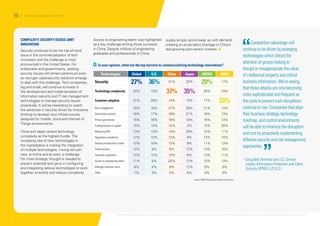
Security continues to be the top-of-mind
issue in the commercialization of tech
innovation and the challenge is most
pronounced in the United States. For
enterprises and governments, tackling
security issues will remain paramount even
as next-gen cybersecurity solutions emerge
to deal with this challenge. Tech companies,
big and small, will continue to invest in
the development and implementation of
information security and IT risk management
technologies to manage security issues
proactively. It will be interesting to watch
the advances in security driven by innovative
thinking to develop new infrastructures
designed for mobile, cloud and Internet of
Things environments.
China and Japan ranked technology
complexity as the highest hurdle. The
increasing rate of new technologies in
the marketplace is making the integration
of multiple technologies, mixing old with
new, at home and at work, a challenge.
Far more strategic thought is needed to
prevent potential tech jams in configuring
and integrating various technologies to work
together smoothly and reduce complexity.
Access to engineering talent was highlighted
as a key challenge among those surveyed
in China. Despite millions of engineering
graduates and professionals in China,
supply simply cannot keep up with demand,
creating an acute talent shortage in China’s
fast-growing tech-centric markets. 1
Technologies Global U.S. China Japan ASPAC EMEA
Security 27% 36% 31% 32% 29% 17%
Technology complexity 22% 13% 37% 35% 26% 19%
Customer adoption 21% 29% 14% 15% 17% 23%
Risk management 18% 16% 27% 29% 21% 14%
Government policies 16% 17% 16% 21% 18% 13%
Privacy governance 15% 16% 18% 18% 16% 13%
Funding/access to capital 15% 15% 12% 3% 12% 20%
Measuring ROI 13% 12% 14% 29% 15% 11%
Regulatory compliance 12% 13% 12% 9% 12% 10%
Develop monetization model 12% 10% 12% 9% 11% 13%
Patent process 12% 9% 8% 12% 13% 15%
Customer acquisition 12% 12% 12% 6% 13% 11%
Access to engineering talent 11% 5% 22% 12% 13% 13%
Manage customer churn 8% 4% 8% 12% 8% 9%
Other 1% 2% 0% 0% 0% 0%
Q:In your opinion, what are the top barriers to commercializing technology innovations?
Source: KPMG Technology Innovation Survey 2014
Competitiveadvantagewill
continuetobedrivenbyemerging
technologieswhichattractthe
attentionofgroupslookingto
disruptormisappropriatethevalue
ofintellectualpropertyandcritical
businessinformation.We’reseeing
thattheseattacksareonlybecoming
moresophisticatedandfrequentas
thecoststopreventsuchdisruptions
continuetorise.Companiesthatalign
theirbusinessstrategy,technology
roadmap,andcontrolenvironments
willbeabletominimizethedisruption
andcostbyproactivelyimplementing
effectivesecurityandriskmanagement
approaches.
– Greg Bell, America and U.S. Service
Leader, Information Protection and Cyber
Security, KPMG LLP (U.S.)
“
”
© 2014 KPMG LLP, a Delaware limited liability partnership and the U.S. member firm of the KPMG network of independent member firms affiliated with KPMG International Cooperative (“KPMG International”), a Swiss entity. All rights reserved. Printed in the U.S.A.
10 / Technology Innovation Survey 2014
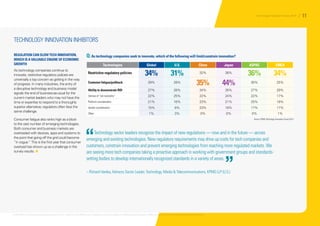
REGULATION CAN SLOW TECH INNOVATION,
WHICH IS A VALUABLE ENGINE OF ECONOMIC
GROWTH
As technology companies continue to
innovate, restrictive regulatory policies are
universally a top concern as getting in the way
of progress. In many industries, the entry of
a disruptive technology and business model
signals the end of business-as-usual for the
current market leaders who may not have the
time or expertise to respond to a thoroughly
superior alternative; regulators often face the
same challenge.
Consumer fatigue also ranks high as a block
to the vast number of emerging technologies.
Both consumer and business markets are
overloaded with devices, apps and systems to
the point that going off the grid could become
“in vogue.” This is the first year that consumer
overload has shown up as a challenge in the
survey results. 1
Technologies Global U.S. China Japan ASPAC EMEA
Restrictive regulatory policies 34% 31% 32% 38%
36% 34%
Customer fatigue/pullback 29% 28%
35% 44% 30% 25%
Ability to demonstrate ROI 27% 28% 34% 35% 27% 29%
Demise of “net neutrality” 22% 25% 22% 24% 22% 17%
Platform consideration 21% 16% 23% 21% 25% 18%
Vendor consideration 15% 8% 23% 18% 17% 17%
Other 1% 3% 0% 0% 0% 1%
Q:As technology companies seek to innovate, which of the following will limit/constrain innovation?
TECHNOLOGY INNOVATION INHIBITORS
Source: KPMG Technology Innovation Survey 2014
Technology sector leaders recognize the impact of new regulations — now and in the future — across
emerging and existing technologies. New regulatory requirements may drive up costs for tech companies and
customers, constrain innovation and prevent emerging technologies from reaching more regulated markets. We
are seeing more tech companies taking a proactive approach in working with government groups and standards-
setting bodies to develop internationally recognized standards in a variety of areas.
– Richard Hanley, Advisory Sector Leader, Technology, Media  Telecommunications, KPMG LLP (U.S.)
“
”
© 2014 KPMG LLP, a Delaware limited liability partnership and the U.S. member firm of the KPMG network of independent member firms affiliated with KPMG International Cooperative (“KPMG International”), a Swiss entity. All rights reserved. Printed in the U.S.A.
Technology Innovation Survey 2014 / 11
Authors
Gary Matuszak / Global Chair, Technology,
Media and Telecommunications, KPMG, LLP (U.S.)
Gary Matuszak is the global chair – KPMG’s TMT industries
and Chair of KPMG’s Technology Innovation Center. Mr.
Matuszak works with global technology companies ranging
from the Fortune 500 to pre-IPO startups, and represents
KPMG in a number of organizations impacting the industry.
Mr. Matuszak has devoted virtually his entire career to
serving the technology industry and has influenced the
industry thinking on several key issues. He is a frequent
speaker on technology industry trends, including cloud
and mobile business strategies, global technology industry
perspectives, and C-suite technology business outlooks.
His speaking engagements include the Stanford Directors
College annual conference and CNBC’s Squawk On The
Street. Before joining KPMG in 2002, he was the Silicon
Valley office managing partner for Arthur Andersen where
he led the U.S. Software practice.
Richard Hanley / Advisory Industry Leader, Technology,
Media and Telecommunications, KPMG LLP (U.S.)
Based in Silicon Valley, Richard works with U.S. and global
clients in the areas of management and risk consulting,
as well as transactions and restructuring. Mr. Hanley’s
previous responsibilities at KPMG include Advisory practice
leader for the Bay Area and Pacific Northwest and the
national technology sector leader for Transaction Services.
Richard provides advice on domestic and cross-border
mergers, acquisitions, and disposals to leading technology
companies as well as private-equity and sovereign-wealth
funds. He advises clients on due diligence, including
evaluation of commercial, financial, and accounting
aspects of potential acquisition targets and assistance with
purchase agreements. He also assists with postmerger
integration. Mr. Hanley has an economics degree in
accounting and business finance from Manchester
University and is a member of the Institute of Chartered
Accountants in England and Wales.
Patricia Rios / Global Director,
Technology Innovation Center, KPMG LLP (U.S.)
Patricia Rios manages the Technology Innovation Center,
which is a global entity created to identify and evaluate
the impact of disruptive technologies that may result
in business transformation. Ms. Rios joined KPMG in
2008 as the technology industry marketing director and
assumed her current responsibilities in 2011. Before joining
KPMG, Patricia held global marketing leadership roles in
the information technology industry, including more than
seven years at Oracle and Sun Microsystems. She also has
extensive sales and business development experience in
private banking at JPMorgan Chase. Ms. Rios has served
as an advisor to startup companies involved in outsourcing,
smartcards and other emerging technologies. She holds
an MBA degree in finance and a bachelor’s degree in
marketing from the Illinois Institute of Technology.
Dr. Michele Guarnieri / Co-founder, HiBot
Dr. Shigeo Hirose / Professor Emeritus,
Co-founder, HiBot
Jon Medved / Founder  CEO, OurCrowd
Sameer Patel / SVP  GM, Enterprise Social
Software, SAP
Sonny Vu / Co-founder  CEO, Misfit Wearables
Geoff Yang / Partner, Redpoint Ventures
Interviewees Contributors
We appreciate the insights and support of the following individuals
in the development of this publication:
Hasan Dajani / Associate Director, Primary Research, KPMG LLP (U.S.)
Kevin Davidson / Marketing Director, Technology, KPMG LLP (U.S.)
Charles Garbowski / Director, Primary Research, KPMG LLP (U.S.)
Paul Pullara / Associate Director, Design, KPMG LLP (U.S.)
We thank the following tech sector leaders for theirvaluable insights:
© 2014 KPMG LLP, a Delaware limited liability partnership and the U.S. member firm of the KPMG network of independent member firms affiliated with KPMG International Cooperative (“KPMG International”), a Swiss entity. All rights reserved. Printed in the U.S.A.
12 / Technology Innovation Survey 2014
About KPMG
KPMG: AN EXPERIENCED TEAM, A GLOBAL NETWORK
KPMG’s technology professionals combine industry knowledge with
technical experience to provide insights that help technology leaders take
advantage of existing and emerging technology opportunities and proactively
manage business challenges.
Our network of professionals has extensive experience working with global
technology companies ranging from Fortune 500 companies to pre-IPO
startups. We aim to go beyond today’s challenges to anticipate the potential
long- and short-term consequences of shifting business, technology and
financial strategies.
ACKNOWLEDGEMENT
KPMG would like to thank Rebecca A. Fannin for her support in conducting
the interviews and co-writing the publication.
Rebecca A. Fannin is a contributor to Forbes writing about emerging tech
markets and innovation trends. She is the author of two widely read and
influential books, Silicon Dragon and Startup Asia. Ms. Fannin runs news,
events and research group Silicon Dragon Ventures, and is a public speaker
and media commentator. She has contributed to several KPMG publications.
KPMG: Technology Innovation Center
KPMG recognizes the importance of innovation. In 2012 we
launched a global Technology Innovation Center to identify
and evaluate the impact of future disruptive technologies.
The center connects leading global technology thinkers
including entrepreneurs, Fortune 500 technology executives,
venture capitalists and KPMG member firm professionals.
The KPMG Technology Innovation Center is headquartered in
the United States. The global network includes Australia, Brazil,
Canada, China (and Hong Kong), Germany, Finland, France, India,
Ireland, Israel, Italy, Japan, Korea, Netherlands, Russia, Singapore,
Slovakia, South Africa, Spain, Taiwan, the United Kingdom and
other countries.
The center provides access to a number of programs including the
following:
• Tap into unique insights identifying technologies that will drive
business transformation and reshape the future of the tech sector and
other industries
• Access a global network of tech sector visionaries
• Join digital and in person programs with tech visionaries
• Drive ideas for global research about emerging technologies
• Opportunity to be a featured speaker in KPMG’s global Technology
Innovation Center and country summits.
Join today!
kpmg.com/techinnovation
© 2014 KPMG LLP, a Delaware limited liability partnership and the U.S. member firm of the KPMG network of independent member firms affiliated with KPMG International Cooperative (“KPMG International”), a Swiss entity. All rights reserved. Printed in the U.S.A.
Technology Innovation Survey 2014 / 13
KPMG Technology Innovation Center Contacts
© 2014 KPMG International Cooperative (“KPMG International”), a Swiss entity. Member firms of the KPMG network of independent firms are affiliated with KPMG International. KPMG International provides
no client services. No member firm has any authority to obligate or bind KPMG International or any other member firm vis-à-vis third parties, nor does KPMG International have any such authority to obligate or
bind any member firm. All rights reserved.
The information contained herein is of a general nature and is not intended to address the circumstances of any particular individual or entity. Although we endeavor to provide accurate and timely information,
there can be no guarantee that such information is accurate as of the date it is received or that it will continue to be accurate in the future. No one should act on such information without appropriate
professional advice after a thorough examination of the particular situation.
The KPMG name, logo and “cutting through complexity” are registered trademarks or trademarks of KPMG International.
Global
Gary Matuszak
Global and U.S. Chair,
Technology, Media  Telecommunications
KPMG LLP (U.S.)
gmatuszak@kpmg.com
Patricia Rios
Global Director, Technology Innovation Center,
KPMG LLP (U.S.)
patriciarios@kpmg.com
Countries
Australia
Peter Mercieca
Technology, Media and Telecommunications,
National Partner in Charge,
KPMG in Australia
pmercieca@kpmg.com.au
Canada
Brendan Maher
National Industry Leader,
Technology, Media and Telecommunications,
KPMG in Canada
bmaher@kpmg.ca
China
Edge Zarrella
Partner, Clients and Innovation Consulting,
KPMG in China
Egidio.zarrella@kpmg.com
India
Akhilesh Tuteja
National Head – Technology sector,
KPMG in India
atuteja@kpmg.com
Ireland
Anna Scally
Partner,
KPMG in Ireland
Anna.scally@kpmg.ie
Israel
Ofer Sela
Technology Partner, KPMG in Israel
osela@kpmg.com
Japan
Hiroto Kaneko
Head of Technology,
Media and Telecommunications,
KPMG in Japan
Eiichi Fujita
Technology Lead Partner,
KPMG in Japan
eiichi.fujita@jp.kpmg.com
Korea
Sung Rae Park
National Industry Leader,
Technology, Media  Telecommunications,
KPMG in Korea
seungyongchoi@kr.kpmg.com
Russia
Alisa Melkonian
Partner, Head of Innovation  Technology,
KPMG in Russia and the CIS
amelkonian@kpmg.ru
Singapore
Juvanus Tjandra
Partner, Management Consulting,
KPMG in Singapore
juvanustjandra@kpmg.com.sg
Slovakia
Vladimír Švac
Head of Innovation Advisory Services,
KPMG in Slovakia
vsvac@kpmg.sk
S. Africa
Frank Rizzo
Technology Sector Leader,
KPMG in South Africa
frank.rizzo@kpmg.co.za
Taiwan
Samuel Au
Partner, Head of Technology,
Media and Telecommunications,
KPMG in Taiwan
syau@kpmg.com.tw
United Kingdom
Tudor Aw
Technology Sector Head,
KPMG in Europe ELLP
tudor.aw@kpmg.co.uk
United States
Richard Hanley
Advisory Sector Leader,
Technology, Media  Telecommunications,
KPMG LLP (U.S.)
rhanley@kpmg.com
Gary Matuszak
Global and U.S. Chair,
Technology, Media  Telecommunications
KPMG LLP (U.S.)
gmatuszak@kpmg.com
For further information about this survey, and how KPMG can help your business, please contact:

Global Technology Innovation Center 2014

  • 1.
    The Changing Landscapeof Disruptive Technologies Part 2 of 6 Disruptive technologies& innovationbarriers kpmg.com/techinnovation Photo: MakerBot®
  • 2.
    The emerging technologyportfolio for consumers is becoming far more complex and diverse including 3D printing, biotech/ healthcare IT, the Internet of Things and data & analytics as forces of change. Meanwhile, two major foundations for technology – cloud and mobile – will continue to be the basis for cutting-edge advances. The shift in consumer markets can be seen most tellingly by comparatively lower scores this year for cloud and mobile. The 2014 results show a dramatic drop for mobile to 9 percent globally compared with 32 percent in last year’s findings. The shift is particularly pronounced for China, where only 5 percent see mobile as a disruptor, compared with 22 percent last year. This finding should not be a surprise: the Chinese market already has gone through a disruptive phase with mobile, a must-have device in China with payment, commerce and messaging features that are arguably more advanced than in Western markets. While not about to drift away, cloud services globally showed a similar downward trend. Only 14 percent named cloud this year as enabling the next indispensable technology for consumers in the coming three years, contrasted with 29 percent in the 2013 findings. CONSUMERS GO FOR THE TECH COCKTAIL Source: KPMG Technology Innovation Survey 2014Note: Only top technologies shown. IoT is destined to spread in consumer markets as sensors are embedded in watches, refrigerators, lights, and shirts. Also on the upswing are digital currencies. Could these eventually become the default currency? New innovations for transport with self- driving and parking cars, and systems to help drivers avoid traffic jams, will be increasingly in use. China and Japan, in particular, see autotech as promising, which is no surprise given the government policies and commitments in this market. 1 Technologies Global U.S. China Japan ASPAC EMEA Cloud–SaaS/PaaS/IaaS 14% 16% 19% 15% 15% 12% Mobile–platforms & apps 9% 18% 5% 3% 6% 9% 3D Printing 8% 6% 3% 9% 8% 10% Biotech/digital health/healthcare IT 7% 9% 4% 6% 6% 10% Internet of Things/M2M 7% 7% 10% 3% 9% 4% Data & analytics 6% 4% 7% 3% 7% 6% Artificial intelligence 6% 3% 4% 18% 8% 5% Security 5% 7% 6% 12% 6% 2% Digital currency platforms (e.g., bitcoin) 5% 5% 8% 0% 5% 5% Nanotechnology 5% 4% 7% 6% 6% 4% Wearables 5% 5% 3% 6% 4% 6% Digital media 5% 2% 1% 3% 3% 8% Autotech 3% 0% 12% 12% 6% 1% Q:Select the top technology that will enable the next indispensible consumer technology. © 2014 KPMG LLP, a Delaware limited liability partnership and the U.S. member firm of the KPMG network of independent member firms affiliated with KPMG International Cooperative (“KPMG International”), a Swiss entity. All rights reserved. Printed in the U.S.A. 02 / Technology Innovation Survey 2014
  • 3.
    As cloud continuesto enable innovation, consumer benefits include better-connected home technologies, easier and instant access to personalized information, and productivity improvements. The major drawback is security risk, named by 29 percent of those surveyed, far more than any other factor, compared to 23 percent last year. Cost and pricing is still a challenge for consumers to sign on to cloud services, but is gradually becoming less of an issue – 13 percent named pricing today compared with 18 percent in 2013. Customers flocking to cloud services are becoming more comfortable with pricing models that start with freemium trials and move up to paid, upgraded services. 1 Q:Choose the top benefits for consumers in adopting cloud technologies. Q:What do you see as the biggest challenges for consumers to adopt this technology? CLOUD BENEFITS AND CHALLENGES FOR CONSUMERS 11% More valuable social/collaboration experience 9% More effective purchasaing across channels 7% More convenient access to entertainment 4% Better healthcare options 3% Better identity management 1% Other Easier access to personalized real-time info Increased connected home tech efficiencies Increased personal productivity 25% 24% 17% Source: KPMG Technology Innovation Survey 2014 13% 13%29% 11% Privacy/transparency concerns 9% Ease of adoption/use 9% Consumer demand 9% Local technological infrastructure 4% Geography 3% Covernment policies Security Cost/pricing models Strong competition Consumers have come to expect the seamless integration of the numerous devices that have become an essential part of their everyday lives, and cloud technology is the engine that has enabled this sea change. In the workplace, cloud has become a catalyst and enabler of the innovative workforce, ensuring the success of a customer-centric approach for the enterprise and ultimately resulting in better experiences for end users. – Rick Wright, Global Cloud Enablement Leader, KPMG LLP (U.S.) “ ” © 2014 KPMG LLP, a Delaware limited liability partnership and the U.S. member firm of the KPMG network of independent member firms affiliated with KPMG International Cooperative (“KPMG International”), a Swiss entity. All rights reserved. Printed in the U.S.A. Technology Innovation Survey 2014 / 03
  • 4.
    Q:Choose the topbenefits for consumers in adopting mobile technologies. Q:What do you see as the biggest challenges for consumers to adopt this technology? The competition is fierce to gain and keep market share across the mobile ecosystem including smartphone providers, app developers and carriers as mobile technologies continue to be adopted by billions. Mobile is constantly enabling new services. In Africa, China, Brazil and other countries mobile is providing access to medicine, education, banking and managing crops in ways that were not feasible in recent years. Consumers around the world continue to love mobile innovations for entertainment, purchasing, healthcare monitoring, hailing a taxi, and social networking. The biggest factor holding back mobile’s influence is a persistent challenge – security and privacy concerns. Another drawback is local technological infrastructure, as consumers demand higher speeds and more stable telecom connections. 1 MOBILE BENEFITS AND CHALLENGES FOR CONSUMERS 26% 21% 20% 20% 17% 17% 11% More valuable social networking/collaboration 10% More convenient access to entertainment 9% More effective purchasing across channels 4% Better identity management 3% Better healthcare options 14% Cost/pricing models 13% Ease of adoption/use 6% Strong competition 6% Government policies 3% Consumer demand Easier access to personalized real-time info Increased efficiencies from connected tech Increased personal productivity Privacy/transparency concerns Local technological infrastructure Security Source: KPMG Technology Innovation Survey 2014 We will continue to see an increasingly mobile-first environment – more powerful handsets, better batteries and screens, and a migration from Internet products and services all shifting over to a mobile-first world from banking to grocery delivery. – Geoff Yang, Partner, Redpoint Ventures, Menlo Park, CA (Interview page 30) “ ” © 2014 KPMG LLP, a Delaware limited liability partnership and the U.S. member firm of the KPMG network of independent member firms affiliated with KPMG International Cooperative (“KPMG International”), a Swiss entity. All rights reserved. Printed in the U.S.A. 04 / Technology Innovation Survey 2014
  • 5.
    Disruptive technologyTRENDS IN ENTERPRISEMARKETS Photo:A.J.MuellerPhotography Theautoindustryisundergoingan unprecedentedperiodoftechnologicalinnovation thathasseencarsevolveintohighlycomplex, customizable,mobilecomputers. Today’scarincludes advancedmicro-processors,softwarecode,sensors, telematics,appsandmore,whichhavefosteredthe convergenceoftheautoandtechindustries. – Gary Silberg, National Automotive Sector Leader, KPMG LLP (U.S.) “ ” © 2014 KPMG LLP, a Delaware limited liability partnership and the U.S. member firm of the KPMG network of independent member firms affiliated with KPMG International Cooperative (“KPMG International”), a Swiss entity. All rights reserved. Printed in the U.S.A. Technology Innovation Survey 2014 / 05
  • 6.
    CLOUD AND DATA ANALYTICS DRIVE INNOVATION Overall, the results reveal a wider spread of technologies that are driving disruption in the business world, and the uptake is global. Cloud has enabled business efficiencies and cost reductions. As cloud continues to drive business transformation, the next wave of benefits will include incremental knowledge and datasets for verticals, customers, employees and suppliers that will provide new insight and predictability to make decisions. Data analytics (DA) trended in second place at 10 percent globally, surpassing mobile as a change agent. The finding illustrates the significant impact DA has in driving incremental business value. We expect adoption and investment in data analytics to continue and grow quickly, as other technologies such as IoT, artificial intelligence and robotics catch up to exploit the new opportunities driven by data analytics. Japan placed artificial intelligence (AI) in first place, named by 21 percent as the biggest disruptor, with expectations for the 3D printing opportunity trailing only EMEA. Opportunities to disrupt existing models range from manufacturing to healthcare. Japan, with its leading-edge RD base and ability to break through in automotive, robotics, electronics and hardware, has the opportunity to gain traction as a leading tech innovator. 1 Q:Select the top technology that will have the greatest impact in driving business transformation for enterprises. Technologies Global U.S. China Japan ASPAC EMEA Cloud–SaaS/PaaS/IaaS 14% 22% 21% 12% 13% 13% Data analytics 10% 12% 13% 6% 9% 9% Mobile–platforms apps 9% 16% 2% 0% 5% 11% 3D printing 7% 6% 4% 12% 8% 5% Artificial intelligence 7% 2% 7% 21% 10% 6% Internet of Things/M2M 6% 7% 9% 6% 9% 3% Security 6% 7% 3% 9% 4% 7% Nanotechnology 6% 6% 8% 3% 5% 7% Digital currency platforms (e.g., bitcoin) 5% 2% 6% 3% 6% 4% Biotech/digital health/healthcare IT 5% 4% 3% 6% 5% 6% Digital media 5% 5% 1% 0% 3% 8% Autotech 4% 2% 13% 9% 7% 0% Wearables 2% 1% 3% 0% 4% 1% Source: KPMG Technology Innovation Survey 2014 Global tech sector executives are increasingly seeing cloud as an engine of growth and profitability. The vast increase in the amount of data coming from mobile devices is driving the development of advanced Analytics applications. And, in turn, the growth in Analytics is driving mobile developers to provide new, enhanced solutions that provide new types of data. This cycle is continuing to power the growth of DA and new business models across sectors. – Brad Fisher, U.S. Data Analytics Leader, KPMG LLP (U.S.) “ ” Note: Only top technologies shown. © 2014 KPMG LLP, a Delaware limited liability partnership and the U.S. member firm of the KPMG network of independent member firms affiliated with KPMG International Cooperative (“KPMG International”), a Swiss entity. All rights reserved. Printed in the U.S.A. 06 / Technology Innovation Survey 2014
  • 7.
    LITTLE PROGRESS WITHSECURITY, COMPLEXITY ISSUES Not surprisingly, improved productivity, lower costs and faster innovation speeds were again touted this year as the top benefits for enterprises in uptake of cloud services. On the flip side, security remains the leading challenge. Technology complexity continues to be a thorn as well, ranking second again this year, though with a slightly lesser percentage (16 percent) compared with last year’s finding. Concerns over displacement of existing technology dropped to a mere 7 percent from 15 percent the year before. 1 Q:What is the top benefit for business to adopt this technology? Q:What is the biggest challenge for businesses to adopt this technology? CLOUD BENEFITS AND CHALLENGES FOR BUSINESSES 10% Accelerate time to market 7% More effective RD 5% Increased profitability 5% Increased market share 4% Enhanced customer loyalty Improved business efficiencies/productivity Cost reductions Faster innovation cycles 23% 16% 15% Source: KPMG Technology Innovation Survey 2014 15% Customer adoption 9% Privacy governance 7% Measuring ROI 7% Displacement of existing tech roadmap 6% Cost 2% Regulatory compliance Security Technology complexity Risk management 11% 22% 37% For enterprises and governments, tackling security and transparency issues will remain a priority even as next-gen cybersecurity solutions emerge to deal with this challenge. Tech companies, big and small, will continue to invest in the development and implementation of information security and IT risk management technologies to manage security issues proactively. – Richard Hanley, Advisory Leader, Technology, Media and Telecommunications, KPMG LLP (U.S.) “ ” © 2014 KPMG LLP, a Delaware limited liability partnership and the U.S. member firm of the KPMG network of independent member firms affiliated with KPMG International Cooperative (“KPMG International”), a Swiss entity. All rights reserved. Printed in the U.S.A. Technology Innovation Survey 2014 / 07
  • 8.
    DA DRIVES EFFICIENCIESAND INNOVATION As businesses develop a comprehensive data analytics strategy and investment, improved efficiencies and productivity were picked as the biggest benefit by more than one-third of respondents. Faster innovation cycles and enhanced customer loyalty are also key business benefits. The findings demonstrate DA is here to stay for the long term as an enabler to generate value. In contrast, barriers that were cited show the major challenges in adopting data analytics in business markets, is technology complexity. Other issues such as measuring return on investment, regulatory compliance and cost did not place high on the challenge barometer. 1 DATA ANALYTICS BENEFITS AND CHALLENGES FOR BUSINESSES Q:What is the top benefit for business to adopt this technology? 9% Increased market share 9% Increased profitability 4% Cost reductions 3% More effective RD 3% Accelerate time to market 1% Other Improved business efficiencies/productivity Faster innovation cycles Enhanced customer loyalty 21% 35% 16% Q:What is the biggest challenge for businesses to adopt this technology? Source: KPMG Technology Innovation Survey 2014 13% 26% 12% Security 12% Cost 9% Price governance 8% Risk management 5% Displacement of existing tech roadmap 4% Customer adoption Technology complexity Measuring ROI Regulatory compliance 12% Dataandanalyticscutsacross everythingthatthisincreasingly disruptivetechnologicalworldis presentingus.Astechnologies suchascloudandtheInternetof Thingsbecomeembeddedinto organizations,awell-designedand robustdataandanalyticsstrategy willbecriticaltothesuccessoftheir integration.Thesenewenvironments enableaccesstovastamountsof data.Ibelievethemostsuccessful companieswillbethosewhichhave therightsolutionstoanalyzeand interprettheirdata,sothattheyare ontheforefrontofoperationaland managementissuesand,equally important,sothattheyhavethe meanstocontinuallyinnovateand increasecustomervalue. – Mark Toon, CEO KPMG Capital KPMG LLP (U.S.) “ ” © 2014 KPMG LLP, a Delaware limited liability partnership and the U.S. member firm of the KPMG network of independent member firms affiliated with KPMG International Cooperative (“KPMG International”), a Swiss entity. All rights reserved. Printed in the U.S.A. 08 / Technology Innovation Survey 2014
  • 9.
    BarriersTO COMMERCIALIZING TECHNOLOGYINNOVATION WeseeaperfectstormtakingshapeinChina–on theonehandtheriseoftheChineseconsumerandonthe other,Chinaisleapfroggingothercountriesinanumber oftechnologiessuchasmobilecommerceandpayments. Thesefactorsaredrivingthefastadoptionofemerging technologiesandinturnthereisincreasedtechnology complexity.Facilitatinghowtogettothevalueofthese newtechnologieswillbeakeymarketdifferentiator. – Edge Zarrella, Partner, Clients and Innovation Consulting, KPMG China “ ” © 2014 KPMG LLP, a Delaware limited liability partnership and the U.S. member firm of the KPMG network of independent member firms affiliated with KPMG International Cooperative (“KPMG International”), a Swiss entity. All rights reserved. Printed in the U.S.A. Technology Innovation Survey 2014 / 09
  • 10.
    COMPLEXITY, SECURITY ISSUESLIMIT INNOVATION Security continues to be the top-of-mind issue in the commercialization of tech innovation and the challenge is most pronounced in the United States. For enterprises and governments, tackling security issues will remain paramount even as next-gen cybersecurity solutions emerge to deal with this challenge. Tech companies, big and small, will continue to invest in the development and implementation of information security and IT risk management technologies to manage security issues proactively. It will be interesting to watch the advances in security driven by innovative thinking to develop new infrastructures designed for mobile, cloud and Internet of Things environments. China and Japan ranked technology complexity as the highest hurdle. The increasing rate of new technologies in the marketplace is making the integration of multiple technologies, mixing old with new, at home and at work, a challenge. Far more strategic thought is needed to prevent potential tech jams in configuring and integrating various technologies to work together smoothly and reduce complexity. Access to engineering talent was highlighted as a key challenge among those surveyed in China. Despite millions of engineering graduates and professionals in China, supply simply cannot keep up with demand, creating an acute talent shortage in China’s fast-growing tech-centric markets. 1 Technologies Global U.S. China Japan ASPAC EMEA Security 27% 36% 31% 32% 29% 17% Technology complexity 22% 13% 37% 35% 26% 19% Customer adoption 21% 29% 14% 15% 17% 23% Risk management 18% 16% 27% 29% 21% 14% Government policies 16% 17% 16% 21% 18% 13% Privacy governance 15% 16% 18% 18% 16% 13% Funding/access to capital 15% 15% 12% 3% 12% 20% Measuring ROI 13% 12% 14% 29% 15% 11% Regulatory compliance 12% 13% 12% 9% 12% 10% Develop monetization model 12% 10% 12% 9% 11% 13% Patent process 12% 9% 8% 12% 13% 15% Customer acquisition 12% 12% 12% 6% 13% 11% Access to engineering talent 11% 5% 22% 12% 13% 13% Manage customer churn 8% 4% 8% 12% 8% 9% Other 1% 2% 0% 0% 0% 0% Q:In your opinion, what are the top barriers to commercializing technology innovations? Source: KPMG Technology Innovation Survey 2014 Competitiveadvantagewill continuetobedrivenbyemerging technologieswhichattractthe attentionofgroupslookingto disruptormisappropriatethevalue ofintellectualpropertyandcritical businessinformation.We’reseeing thattheseattacksareonlybecoming moresophisticatedandfrequentas thecoststopreventsuchdisruptions continuetorise.Companiesthatalign theirbusinessstrategy,technology roadmap,andcontrolenvironments willbeabletominimizethedisruption andcostbyproactivelyimplementing effectivesecurityandriskmanagement approaches. – Greg Bell, America and U.S. Service Leader, Information Protection and Cyber Security, KPMG LLP (U.S.) “ ” © 2014 KPMG LLP, a Delaware limited liability partnership and the U.S. member firm of the KPMG network of independent member firms affiliated with KPMG International Cooperative (“KPMG International”), a Swiss entity. All rights reserved. Printed in the U.S.A. 10 / Technology Innovation Survey 2014
  • 11.
    REGULATION CAN SLOWTECH INNOVATION, WHICH IS A VALUABLE ENGINE OF ECONOMIC GROWTH As technology companies continue to innovate, restrictive regulatory policies are universally a top concern as getting in the way of progress. In many industries, the entry of a disruptive technology and business model signals the end of business-as-usual for the current market leaders who may not have the time or expertise to respond to a thoroughly superior alternative; regulators often face the same challenge. Consumer fatigue also ranks high as a block to the vast number of emerging technologies. Both consumer and business markets are overloaded with devices, apps and systems to the point that going off the grid could become “in vogue.” This is the first year that consumer overload has shown up as a challenge in the survey results. 1 Technologies Global U.S. China Japan ASPAC EMEA Restrictive regulatory policies 34% 31% 32% 38% 36% 34% Customer fatigue/pullback 29% 28% 35% 44% 30% 25% Ability to demonstrate ROI 27% 28% 34% 35% 27% 29% Demise of “net neutrality” 22% 25% 22% 24% 22% 17% Platform consideration 21% 16% 23% 21% 25% 18% Vendor consideration 15% 8% 23% 18% 17% 17% Other 1% 3% 0% 0% 0% 1% Q:As technology companies seek to innovate, which of the following will limit/constrain innovation? TECHNOLOGY INNOVATION INHIBITORS Source: KPMG Technology Innovation Survey 2014 Technology sector leaders recognize the impact of new regulations — now and in the future — across emerging and existing technologies. New regulatory requirements may drive up costs for tech companies and customers, constrain innovation and prevent emerging technologies from reaching more regulated markets. We are seeing more tech companies taking a proactive approach in working with government groups and standards- setting bodies to develop internationally recognized standards in a variety of areas. – Richard Hanley, Advisory Sector Leader, Technology, Media Telecommunications, KPMG LLP (U.S.) “ ” © 2014 KPMG LLP, a Delaware limited liability partnership and the U.S. member firm of the KPMG network of independent member firms affiliated with KPMG International Cooperative (“KPMG International”), a Swiss entity. All rights reserved. Printed in the U.S.A. Technology Innovation Survey 2014 / 11
  • 12.
    Authors Gary Matuszak /Global Chair, Technology, Media and Telecommunications, KPMG, LLP (U.S.) Gary Matuszak is the global chair – KPMG’s TMT industries and Chair of KPMG’s Technology Innovation Center. Mr. Matuszak works with global technology companies ranging from the Fortune 500 to pre-IPO startups, and represents KPMG in a number of organizations impacting the industry. Mr. Matuszak has devoted virtually his entire career to serving the technology industry and has influenced the industry thinking on several key issues. He is a frequent speaker on technology industry trends, including cloud and mobile business strategies, global technology industry perspectives, and C-suite technology business outlooks. His speaking engagements include the Stanford Directors College annual conference and CNBC’s Squawk On The Street. Before joining KPMG in 2002, he was the Silicon Valley office managing partner for Arthur Andersen where he led the U.S. Software practice. Richard Hanley / Advisory Industry Leader, Technology, Media and Telecommunications, KPMG LLP (U.S.) Based in Silicon Valley, Richard works with U.S. and global clients in the areas of management and risk consulting, as well as transactions and restructuring. Mr. Hanley’s previous responsibilities at KPMG include Advisory practice leader for the Bay Area and Pacific Northwest and the national technology sector leader for Transaction Services. Richard provides advice on domestic and cross-border mergers, acquisitions, and disposals to leading technology companies as well as private-equity and sovereign-wealth funds. He advises clients on due diligence, including evaluation of commercial, financial, and accounting aspects of potential acquisition targets and assistance with purchase agreements. He also assists with postmerger integration. Mr. Hanley has an economics degree in accounting and business finance from Manchester University and is a member of the Institute of Chartered Accountants in England and Wales. Patricia Rios / Global Director, Technology Innovation Center, KPMG LLP (U.S.) Patricia Rios manages the Technology Innovation Center, which is a global entity created to identify and evaluate the impact of disruptive technologies that may result in business transformation. Ms. Rios joined KPMG in 2008 as the technology industry marketing director and assumed her current responsibilities in 2011. Before joining KPMG, Patricia held global marketing leadership roles in the information technology industry, including more than seven years at Oracle and Sun Microsystems. She also has extensive sales and business development experience in private banking at JPMorgan Chase. Ms. Rios has served as an advisor to startup companies involved in outsourcing, smartcards and other emerging technologies. She holds an MBA degree in finance and a bachelor’s degree in marketing from the Illinois Institute of Technology. Dr. Michele Guarnieri / Co-founder, HiBot Dr. Shigeo Hirose / Professor Emeritus, Co-founder, HiBot Jon Medved / Founder CEO, OurCrowd Sameer Patel / SVP GM, Enterprise Social Software, SAP Sonny Vu / Co-founder CEO, Misfit Wearables Geoff Yang / Partner, Redpoint Ventures Interviewees Contributors We appreciate the insights and support of the following individuals in the development of this publication: Hasan Dajani / Associate Director, Primary Research, KPMG LLP (U.S.) Kevin Davidson / Marketing Director, Technology, KPMG LLP (U.S.) Charles Garbowski / Director, Primary Research, KPMG LLP (U.S.) Paul Pullara / Associate Director, Design, KPMG LLP (U.S.) We thank the following tech sector leaders for theirvaluable insights: © 2014 KPMG LLP, a Delaware limited liability partnership and the U.S. member firm of the KPMG network of independent member firms affiliated with KPMG International Cooperative (“KPMG International”), a Swiss entity. All rights reserved. Printed in the U.S.A. 12 / Technology Innovation Survey 2014
  • 13.
    About KPMG KPMG: ANEXPERIENCED TEAM, A GLOBAL NETWORK KPMG’s technology professionals combine industry knowledge with technical experience to provide insights that help technology leaders take advantage of existing and emerging technology opportunities and proactively manage business challenges. Our network of professionals has extensive experience working with global technology companies ranging from Fortune 500 companies to pre-IPO startups. We aim to go beyond today’s challenges to anticipate the potential long- and short-term consequences of shifting business, technology and financial strategies. ACKNOWLEDGEMENT KPMG would like to thank Rebecca A. Fannin for her support in conducting the interviews and co-writing the publication. Rebecca A. Fannin is a contributor to Forbes writing about emerging tech markets and innovation trends. She is the author of two widely read and influential books, Silicon Dragon and Startup Asia. Ms. Fannin runs news, events and research group Silicon Dragon Ventures, and is a public speaker and media commentator. She has contributed to several KPMG publications. KPMG: Technology Innovation Center KPMG recognizes the importance of innovation. In 2012 we launched a global Technology Innovation Center to identify and evaluate the impact of future disruptive technologies. The center connects leading global technology thinkers including entrepreneurs, Fortune 500 technology executives, venture capitalists and KPMG member firm professionals. The KPMG Technology Innovation Center is headquartered in the United States. The global network includes Australia, Brazil, Canada, China (and Hong Kong), Germany, Finland, France, India, Ireland, Israel, Italy, Japan, Korea, Netherlands, Russia, Singapore, Slovakia, South Africa, Spain, Taiwan, the United Kingdom and other countries. The center provides access to a number of programs including the following: • Tap into unique insights identifying technologies that will drive business transformation and reshape the future of the tech sector and other industries • Access a global network of tech sector visionaries • Join digital and in person programs with tech visionaries • Drive ideas for global research about emerging technologies • Opportunity to be a featured speaker in KPMG’s global Technology Innovation Center and country summits. Join today! kpmg.com/techinnovation © 2014 KPMG LLP, a Delaware limited liability partnership and the U.S. member firm of the KPMG network of independent member firms affiliated with KPMG International Cooperative (“KPMG International”), a Swiss entity. All rights reserved. Printed in the U.S.A. Technology Innovation Survey 2014 / 13
  • 14.
    KPMG Technology InnovationCenter Contacts © 2014 KPMG International Cooperative (“KPMG International”), a Swiss entity. Member firms of the KPMG network of independent firms are affiliated with KPMG International. KPMG International provides no client services. No member firm has any authority to obligate or bind KPMG International or any other member firm vis-à-vis third parties, nor does KPMG International have any such authority to obligate or bind any member firm. All rights reserved. The information contained herein is of a general nature and is not intended to address the circumstances of any particular individual or entity. Although we endeavor to provide accurate and timely information, there can be no guarantee that such information is accurate as of the date it is received or that it will continue to be accurate in the future. No one should act on such information without appropriate professional advice after a thorough examination of the particular situation. The KPMG name, logo and “cutting through complexity” are registered trademarks or trademarks of KPMG International. Global Gary Matuszak Global and U.S. Chair, Technology, Media Telecommunications KPMG LLP (U.S.) gmatuszak@kpmg.com Patricia Rios Global Director, Technology Innovation Center, KPMG LLP (U.S.) patriciarios@kpmg.com Countries Australia Peter Mercieca Technology, Media and Telecommunications, National Partner in Charge, KPMG in Australia pmercieca@kpmg.com.au Canada Brendan Maher National Industry Leader, Technology, Media and Telecommunications, KPMG in Canada bmaher@kpmg.ca China Edge Zarrella Partner, Clients and Innovation Consulting, KPMG in China Egidio.zarrella@kpmg.com India Akhilesh Tuteja National Head – Technology sector, KPMG in India atuteja@kpmg.com Ireland Anna Scally Partner, KPMG in Ireland Anna.scally@kpmg.ie Israel Ofer Sela Technology Partner, KPMG in Israel osela@kpmg.com Japan Hiroto Kaneko Head of Technology, Media and Telecommunications, KPMG in Japan Eiichi Fujita Technology Lead Partner, KPMG in Japan eiichi.fujita@jp.kpmg.com Korea Sung Rae Park National Industry Leader, Technology, Media Telecommunications, KPMG in Korea seungyongchoi@kr.kpmg.com Russia Alisa Melkonian Partner, Head of Innovation Technology, KPMG in Russia and the CIS amelkonian@kpmg.ru Singapore Juvanus Tjandra Partner, Management Consulting, KPMG in Singapore juvanustjandra@kpmg.com.sg Slovakia Vladimír Švac Head of Innovation Advisory Services, KPMG in Slovakia vsvac@kpmg.sk S. Africa Frank Rizzo Technology Sector Leader, KPMG in South Africa frank.rizzo@kpmg.co.za Taiwan Samuel Au Partner, Head of Technology, Media and Telecommunications, KPMG in Taiwan syau@kpmg.com.tw United Kingdom Tudor Aw Technology Sector Head, KPMG in Europe ELLP tudor.aw@kpmg.co.uk United States Richard Hanley Advisory Sector Leader, Technology, Media Telecommunications, KPMG LLP (U.S.) rhanley@kpmg.com Gary Matuszak Global and U.S. Chair, Technology, Media Telecommunications KPMG LLP (U.S.) gmatuszak@kpmg.com For further information about this survey, and how KPMG can help your business, please contact: