1CORE ELEMENTS FOR VISION ZERO COMMUNITIES
CORE ELEMENTS
FOR VISION ZERO COMMUNITIES
Introduction
Vision Zero – the strategy to eliminate traffic
fatalities and severe injuries – is being adopted by
a growing number of communities across North
America and beyond. While safe mobility is not a
new concept, Vision Zero requires a shift in how
communities approach decisions, actions, and
attitudes around safe mobility.
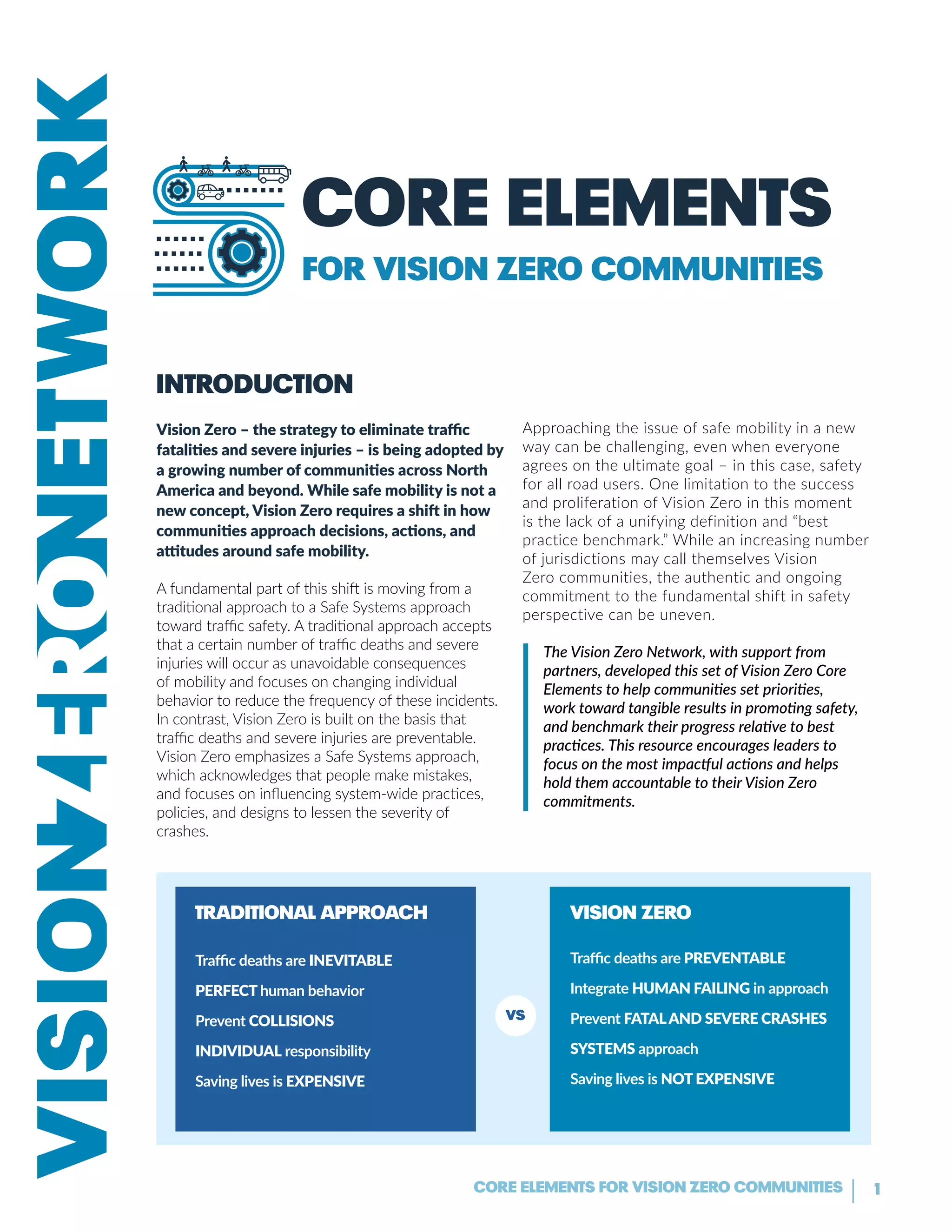
A fundamental part of this shift is moving from a
traditional approach to a Safe Systems approach
toward traffic safety. A traditional approach accepts
that a certain number of traffic deaths and severe
injuries will occur as unavoidable consequences
of mobility and focuses on changing individual
behavior to reduce the frequency of these incidents.
In contrast, Vision Zero is built on the basis that
traffic deaths and severe injuries are preventable.
Vision Zero emphasizes a Safe Systems approach,
which acknowledges that people make mistakes,
and focuses on influencing system-wide practices,
policies, and designs to lessen the severity of
crashes.
Approaching the issue of safe mobility in a new
way can be challenging, even when everyone
agrees on the ultimate goal – in this case, safety
for all road users. One limitation to the success
and proliferation of Vision Zero in this moment
is the lack of a unifying definition and “best
practice benchmark.” While an increasing number
of jurisdictions may call themselves Vision
Zero communities, the authentic and ongoing
commitment to the fundamental shift in safety
perspective can be uneven.
The Vision Zero Network, with support from
partners, developed this set of Vision Zero Core
Elements to help communities set priorities,
work toward tangible results in promoting safety,
and benchmark their progress relative to best
practices. This resource encourages leaders to
focus on the most impactful actions and helps
hold them accountable to their Vision Zero
commitments.
Traditional Approach
Traffic deaths are inevitable
Perfect human behavior
Prevent collisions
Individual responsibility
Saving lives is expensive
Vision Zero
Traffic deaths are preventable
Integrate human failing in approach
Prevent fataland severe crashes
Systems approach
Saving lives is NOT EXPENSIVE
VS
VISION ZERO
CORE ELEMENTS
2CORE ELEMENTS FOR VISION ZERO COMMUNITIES
Leadership and Commitment
1. Public, High-Level, and Ongoing Commitment.
The Mayor and key elected officials and leaders within public agencies,
including transportation, public health, and police, commit to a goal
of eliminating traffic fatalities and serious injuries within a specific
timeframe. Leadership across these agencies consistently engages in
prioritizing safety via a collaborative working group and other resource-
sharing efforts.
2. Authentic Engagement. Meaningful and accessible community
engagement toward Vision Zero strategy and implementation is
employed, with a focus on equity.
3. Strategic Planning. A Vision Zero Action Plan is developed, approved, and used to guide work. The Plan
includes explicit goals and measurable strategies with clear timelines, and it identifies responsible stakeholders.
4. Project Delivery. Decision-makers and system designers advance projects and policies for safe, equitable multi-
modal travel by securing funding and implementing projects, prioritizing roadways with the most pressing safety issues.
Safe Roadways and Safe Speeds
5. Complete Streets for All. Complete Streets concepts are integrated into communitywide plans and
implemented through projects to encourage a safe, well-connected transportation network for people using all
modes of transportation. This prioritizes safe travel of people over expeditious travel of motor vehicles.
6. Context-Appropriate Speeds. Travel speeds are set and managed to achieve safe conditions for the
specific roadway context and to protect all roadway users, particularly those most at risk in crashes. Proven
speed management policies and practices are prioritized to reach this goal.
Data-driven Approach, Transparency, and Accountability
7. Equity-Focused Analysis and Programs. Commitment is made to an equitable approach and outcomes,
including prioritizing engagement and investments in traditionally under-served communities and adopting
equitable traffic enforcement practices.
8. Proactive, Systemic Planning. A proactive, systems-based approach to safety is used to identify and
address top risk factors and mitigate potential crashes and crash severity.
9. Responsive, Hot Spot Planning. A map of the community’s fatal and serious injury crash locations is
developed, regularly updated, and used to guide priority actions and funding.
10. Comprehensive Evaluation and Adjustments. Routine evaluation of the performance of all safety
interventions is made public and shared with decision makers to inform priorities, budgets, and updates to the Vision
Zero Action Plan.
CORE ELEMENTS
FOR VISION ZERO COMMUNITIES
Read on for more information about implementing these Vision Zero Core Elements in your community.
Equity and Engagement
Elevating equity and meaningful
community engagement,
particularly in low-income
communities and communities of
color, should be a priority in all
stages of Vision Zero work.
3CORE ELEMENTS FOR VISION ZERO COMMUNITIES
Leadership and commitment
1. Public, High-Level, and Ongoing Commitment. The Mayor and key elected officials and
leaders within public agencies, including transportation, public health, and police, commit to a
goal of eliminating traffic fatalities and serious injuries within a specific timeframe.
• Leadership across these agencies consistently prioritizes safety via a collaborative working group
and other resource-sharing efforts
2. Authentic Engagement. Meaningful and accessible community engagement toward
Vision Zero strategy and implementation is employed, with a focus on equity.
• Engage the community in meaningful, culturally-relevant ways and support involvement by
respected community leaders
• Prioritize support of communities most impacted by traffic crashes and most traditionally
underserved by safety efforts
High-level leadership and sustained political commitment
are essential to Vision Zero success. The Mayor and
other key elected officials must set the tone and
direction for Vision Zero and back up their words of
commitment with action, reflected in spending decisions,
policies, and practices that prioritize safety (even when
this means a shift from the status quo). Following
from this, the leaders of the public health, police, and
transportation agencies should be closely involved
with the day-to-day work of Vision Zero and ensure
consistent interagency coordination. In short, a Vision
Zero commitment is only as strong as it is demonstrated
in the actions of the city’s leadership and staff.
Setting an explicit timeline for Vision Zero is part of this
core element because it underscores the urgency of
the issue, provides measurability, and incorporates the
fundamental Safe Systems principle that these traffic
tragedies are preventable.
Vision Zero efforts should meaningfully engage the
community and prioritize equitable processes and
outcomes. This is especially true in neighborhoods that
often bear the brunt of high-injury streets and where
community members may be grappling with the results
of historic underinvestment in safe mobility, as well as
a multitude of other, interrelated systemic inequities.
Community input should be valued and incorporated into
Vision Zero planning and implementation.
This includes:
» Engaging sincerely and with cultural competence,
recognizing and respecting the history, culture, and
expertise of local communities.
» Collaborating with community members who
are genuinely engaged in neighborhoods and who have
strong connections with and respect of locals. These
community leaders are likely to convey the experiences,
hopes, and concerns of long-time residents in ways that
traditional planning processes have not.
» Using this collaboration to inform project design
and implementation, not just as a “listening exercise”.
» Recognizing that coordination is work, for which
community groups deserve compensation to
support time commitment, expertise, and long-term
engagement. Additional resources are included in
Vision Zero Equity Strategies.
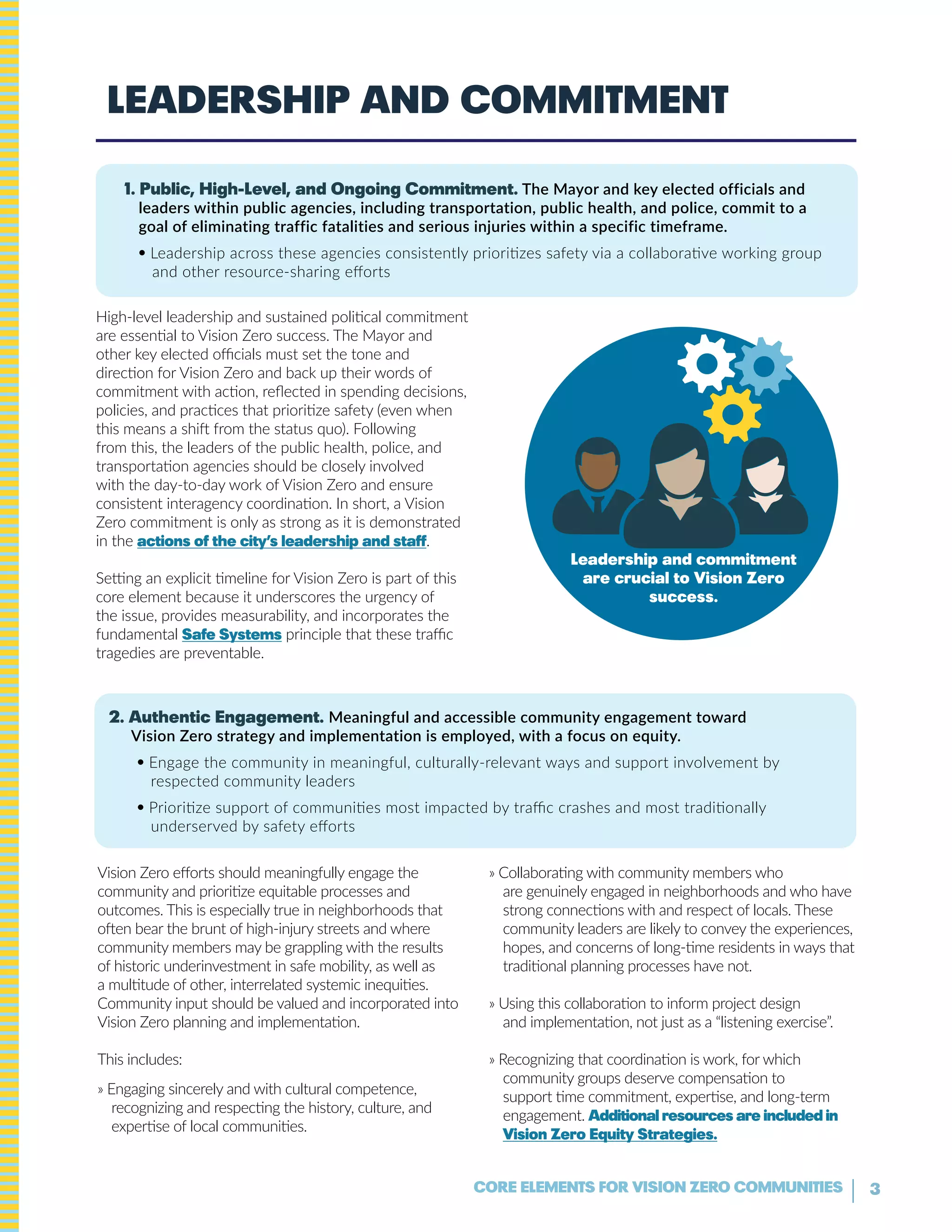
Leadership and commitment
are crucial to Vision Zero
success.
4CORE ELEMENTS FOR VISION ZERO COMMUNITIES
3. Strategic Planning. A Vision Zero Action Plan is developed, approved, and used to guide work.
The Plan includes explicit goals and measurable strategies with clear timelines, and it identifies
responsible stakeholders.
• The Action Plan and corresponding strategies are built on the Safe Systems approach by designing and
maintaining a transportation system where human error does not result in loss of life or severe injury
• Leadership across these agencies consistently prioritizes safety via a collaborative working group
and other resource-sharing efforts
The core element for leadership and commitment
recognizes that Vision Zero – starting with the
Action Plan – is built on the Safe Systems approach,
which recognizes that people will make mistakes and
that it is the responsibility of system designers and
policymakers to set practices and policies to lessen
the severity of inevitable crashes.
The Action Plan should include an explicit
commitment and related actions to prevent
Vision Zero efforts from resulting in unintended
consequences, such as racial profiling or inequitable
treatment of communities of color.
Clear ownership of Action Plan strategies is important
to achieving accountability and trust for Vision Zero’s
principles and outcomes. More about actionable
strategies that have led to Vision Zero success in
other cities are included in the Vision Zero Action
Plan Guidelines.
4. Project Delivery. Decision-makers and system designers advance projects and policies for safe,
equitable multi-modal travel by securing funding and implementing projects, prioritizing roadways with
the most pressing safety issues.
• Decision-makers provide leadership on policy reforms needed to prioritize safety
• System designers are supported by city leaders to advance safety projects
• System designers and decision-makers advance crosscutting measures to reduce car dependence,
improve transit, and support safe walking and biking
Vision Zero requires more than incremental, individual
behavior change. It requires political backbone to
advance projects and policies that are proven to
improve safety – particularly redesigning roadways
and managing speeds – even in the face of opposition
to change (e.g., removing parking spaces or reducing
speeds for safety benefits).
Moving past the business-as-usual approach also
means evolving beyond the cars-first attitude that has
dominated transportation policies and practices in the
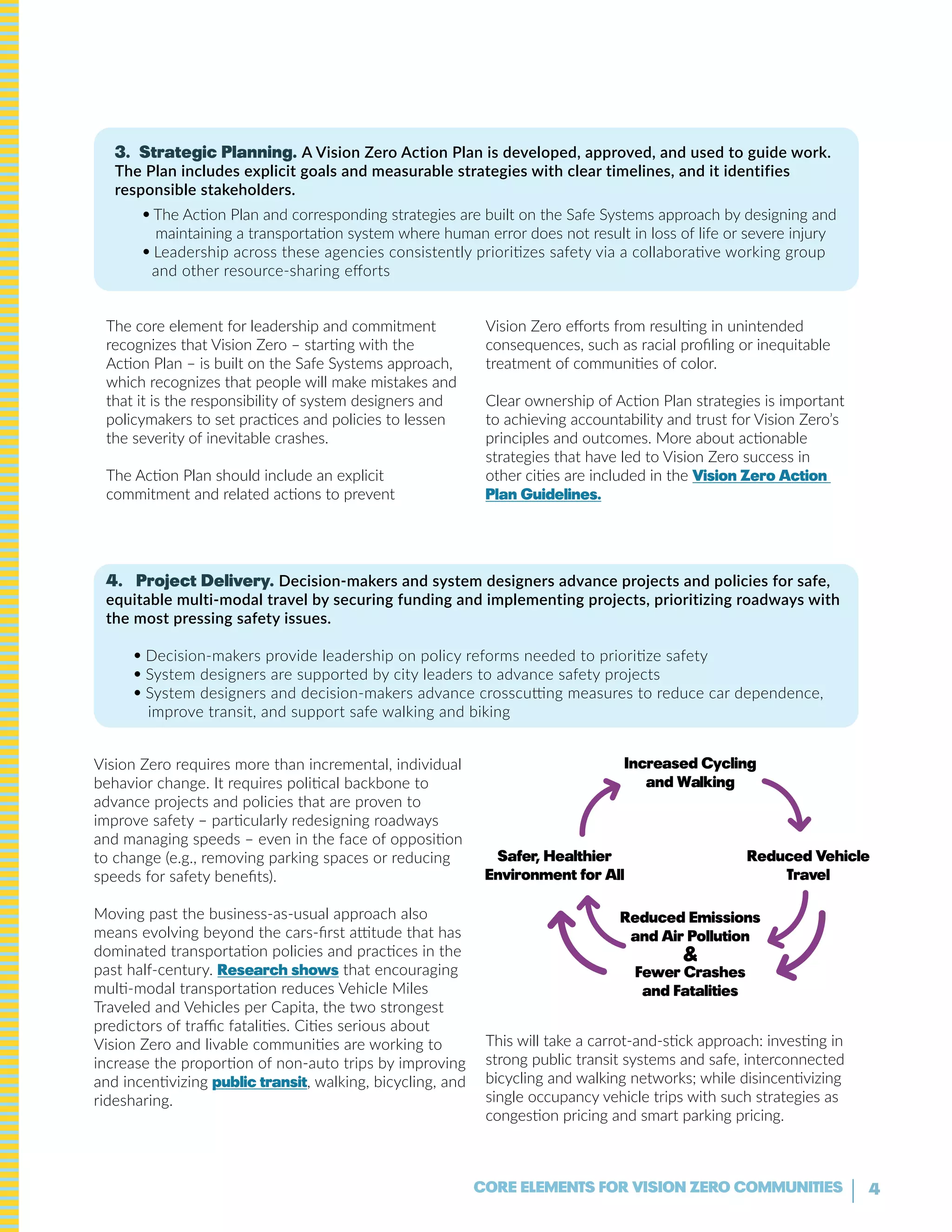
past half-century. Research shows that encouraging
multi-modal transportation reduces Vehicle Miles
Traveled and Vehicles per Capita, the two strongest
predictors of traffic fatalities. Cities serious about
Vision Zero and livable communities are working to
increase the proportion of non-auto trips by improving
and incentivizing public transit, walking, bicycling, and
ridesharing.
This will take a carrot-and-stick approach: investing in
strong public transit systems and safe, interconnected
bicycling and walking networks; while disincentivizing
single occupancy vehicle trips with such strategies as
congestion pricing and smart parking pricing.
Safer, healthier
Environment for all
Reduced Vehicle
Travel
Increased Cycling
and walking
Reduced Emissions
and air pollution
&
Fewer Crashes
and Fatalities
5CORE ELEMENTS FOR VISION ZERO COMMUNITIES
Safe Roadways and safe speeds
5. Complete Streets for All. Complete Streets concepts are integrated into community wide
plans and implemented through projects to encourage a safe, well-connected transportation
network for people using all modes of transportation. This prioritizes safe travel of people over
expeditious travel of motor vehicles.
• Multimodal street design and countermeasures prioritize safety over speed
• Safety improvements to roadways are prioritized for people walking and biking and in
historically underserved communities
6. Context-Appropriate Speeds. Travel speeds are set and managed to achieve safe conditions
for the specific roadway context and to protect all roadway users, particularly those most at risk in
crashes. Proven speed management policies and practices are prioritized to reach this goal.
• Roadways are designed (or redesigned) to prioritize safety over speed
• Speed limits are lowered where data and community experience show need
• Automated speed enforcement is implemented where needed, with strategies to address
disproportionate impacts on low-income communities
Prioritizing proven engineering countermeasures and
multimodal street design is essential to safety.
Examples include:
» Using safe design measures such as advance
stop or yield lines, high visibility crosswalks, lane
narrowing, pedestrian refuge islands and medians,
and physically separated bikeways. More measures
– and examples from cities that have implemented
them – are described in NACTO design guides,
the Traffic Safety Best Practices Matrix, and the
FHWA Achieving Multimodal Networks resource.
» Creating Slow Zones in areas with high
volumes of children, seniors, public transit users,
commercial activity, pedestrian/bicycle activity.
Along with lower speeds, self-enforcing traffic
calming measures help mark these areas as
different and thus encourage safe behavior.
Work toward Complete Streets should prioritize the
protection of physically vulnerable road users and
investment in historically disadvantaged communities.
Performance measures for Complete Streets should
include consideration of these communities of concern.
Read more on the fundamentals of Complete Streets
elements from the Complete Streets Coalition.
High speeds make crashes more likely and more
likely to be deadly. An effective Vision Zero program must
manage speed in order to reduce severe and fatal traffic
injuries. Efforts to influence individual behavior primarily with
education and enforcement campaigns have fallen short.
Addressing speed requires changing organizational practices
and reforming policies. Existing practices, such as designing
roads for inappropriately high speeds and setting speed
limits too high, often prioritize moving more cars over the
safety of road users.
Vision Zero calls on system designers and policymakers
to better align our systems and policies with goals of safe
speeds, including:
» Measure and analyze the scope of problem related to
inappropriate speeds, share this data to raise awareness,
and develop measurable improvement strategies with
timelines for action.
» Implement infrastructure changes to prioritize safety
over speed. Examples include reducing travel lanes
and adding self-enforcing traffic calming measures to
encourage safe travel speeds.
» Change policies to align with safety goals, including
setting appropriate speed limits, particularly where motor
vehicle traffic is mixing with those walking and biking.
» Implement automated speed enforcement where
needed, incorporating strategies to measure and address
disproportionate impacts on low-income communities and
others who may be overly burdened.
» Raise awareness about speed as a primary factor
in traffic deaths and injuries, similar to increased awareness
about drunk driving.
In many cases, State and Federal agencies influence
speed limits either directly or indirectly. While speed
management efforts may be time-consuming and politically
challenging, it is critical to Vision Zero success. Cities facing
barriers from other levels of government need to make the
policy, legislative, or other changes required to advance
proven speed management strategies.
6CORE ELEMENTS FOR VISION ZERO COMMUNITIES
Data and experience reveal that low-income communities and
communities of color carry a disproportionate burden of traffic-
related injuries and fatalities in the U.S. This is not arbitrary; it
reflects patterns of historic under-investment and racial bias
in some communities, particularly black, brown and immigrant
communities, as well as low-income communities. Vision Zero
leaders need to recognize these disparities and to center equity
in theirwork in clear and measurable ways to prevent traffic
safety efforts from having unintended, harmful consequences.
The realm of traffic enforcement is a particularly timely and
urgent area of attention. It is important that promoters of
Vision Zero acknowledge that officer-initiated traffic stops
allow for higher levels of individual discretion and unintended
gateways to racial bias and even aggressive police action. The
broaderVision Zero community has a role and responsibility in
improving, not exacerbating, these problems.
Vision Zero focuses on Safe Systems, not more traffic stops.
Cities such as Portland, Oregon are working to prevent over-
policing or racial bias from becoming unintended byproducts of
theirVision Zero efforts. Portland limits enforcement actions in
order to reduce the possibility of racial profiling and disparate
economic impacts. Portland’s Vision Zero Action Plan
explicitly excludes increased enforcement by police officers.
It also offers education classes as alternatives to increased
penalties for first time offenders.
Similarly, any enforcement efforts included in Vision Zero
strategies should focus on the most dangerous violations. An
example is San Francisco’s Focus on the Five program, which
commits officers to focus on the five top roadway dangers, such
as speeding and violating pedestrians’ right of way, rather than
on “nuisance” issues such as broken taillights or tinted windows.
Other examples of focusing on equity concerns within Vision
Zero efforts include:
» Requiring transparency, including analyzing and sharing data
on how traffic funding is spent and how traffic stops are
conducted and citations issued, including disaggregating stop
and citation data by race.
» Encouraging accountability by requiring regular discussions
amongst policymakers and the public to address equity
disparities in efforts and results.
» Requiring equity-based trainings ofVision Zero staff,
including law enforcement officials, and including equity-based
measurements of their efforts.
» Investing in automated speed enforcement’s proven safety
effectiveness and lower risk of racial profiling. Efforts should be
made to avoid disproportionate impacts of fines on low-income
communities, such as setting up alternative fee structures.
» Recognizing that we cannot enforce (nor educate) our
way out of today’s traffic safety problems, so we need to
better design roadways and manage speeds for safety.
Additional resources are included in Vision Zero Equity
Strategies.
7. Equity-Focused Analysis and Programs. Commitment is made to an equitable approach and
outcomes, including prioritizing engagement and investments in traditionally under-served communities
and adopting equitable traffic enforcement practices.
• Explicit commitment and actions prevent Vision Zero efforts from increasing disproportionate
enforcement levels in communities of color
• Any enforcement efforts within Vision Zero are focused on dangerous moving violations, as identified by
quality data analysis
Data-Driven approach,
transparency, and accountability
Chance of Being Stopped and Searched:
New York Times, 2015
Communities With Sidewalks:
Bridging the Gap, 2012
People Killed While Walking:
Governing, 2014
Governing, 2014
Low Income
High Income
49%
7CORE ELEMENTS FOR VISION ZERO COMMUNITIES
Data can help identify
disproportionate safety impacts
79%
7%
other
2%7%
5%
Denver
Commute
Modes
5%
38% 42%
15%
Denver
Traffic
Deaths
of physically vulnerable populations and communities
traditionally underserved by traffic safety efforts.
Police-collected data should be supplemented with
information gathered by hospitals and emergency
medical services. Analysis shows that people involved in
traffic crashes who are part of systemically marginalized
communities are less likely to report traffic crashes and
that, when they do, their reports are less likely to be treated
adequately. Increasingly, communities are supplementing
their police crash records with public health data for a fuller
picture, as described here.
8. Systemic, Proactive Planning. A proactive, systems-based approach to safety is used to identify
and address top risk factors and mitigate potential crashes and crash severity.
• Data is used to identify trends of problems, which are addressed systematically rather than as
isolated incidents
Vision Zero’s Safe Systems approach means
moving from purely rearward crash map reviews
to more forward-facing identification of problem
areas and working to prevent severe crashes before
they happen. This means determining, analyzing, and
addressing the underlying risk factors that influence
dangerous actions: the where, how, and why serious
crashes happen.
For example, based on analysis showing a trend
of left-turn vehicle movements being particularly
dangerous on certain types of streets, New York
City’s Department of Transportation is proactively
addressing areas with proven countermeasures,
rather than reacting to each individual problem after
serious crashes occur. More examples of proactive
approaches to addressing top risk factors are shared
in this summary and webinar.
9. Responsive, Hot Spot Planning. A map of the community’s fatal and serious injury crash
locations is developed, regularly updated, and used to guide priority actions and funding.
• Top risk factors and locations of serious traffic crashes are identified, mapped, and utilized
• Quality data on traffic deaths and serious injuries are posted publicly and updated regularly
The community should develop a High Injury Network (HIN)
derived from quantitative (“hot spot” problem locations) and
qualitative data (based on community input) to inform its
prioritization and implementation.
Recommendations include:
» Identify top risk factors and locations of serious
traffic crashes.
» Include equity-driven data (such as locations of low-
income communities and communities of color) and
commit to prioritizing actions and funding in areas of
overlap with the HIN.
» Include speed as a data layer. A large proportion
of serious crashes occur on roads with higher speed limits
– often arterials and state-owned roads – which require
the aforementioned work on speed.
» Collaborate within and between city agencies.
Work to address problems on the HIN is an important
place to involve the Vision Zero Taskforce.
» Utilize this information and coordination to
prioritize and implement strategies.
» Post and regularly update data on traffic deaths and
serious injuries – beyond police reports.
For more information, see this Vision Zero Network case
study and webinar.
Data analysis and public input should highlight unsafe
locations, and this should be overlaid with locations
10. Comprehensive Evaluation and Adjustments. Routine evaluation of the performance of all
safety interventions is made public and shared with decision makers to inform priorities, budgets, and
updates to the Vision Zero Action Plan.
• Regular progress reports are produced and shared publicly
• Use of pilot implementation and community feedback shape safety efforts
Monitoring efforts and impacts, updating and sharing
data regularly, and institutionalizing Vision Zero in the
city’s systems will help build trust and set expectations
for accountability between key stakeholders.
This includes:
» Proactively monitor, evaluate, and share progress,
including regular public progress reports, such as
these from New York City and Seattle.
» Use comparative data to link social and
environmental factors with traffic injury data to
better understand connections and strategies for
improvements.
» Use temporary pilot programs or projects to test
strategies within shorter timeframes and for less
cost investment.
Acknowledgements
We are honored to support the work of public sector staff and community-based leaders and advocates
around the country to reduce traffic deaths and severe injuries. We appreciate valuable input from many
partners, including Clay Veka, Dana Weissman, Jeff Lindley, Jeff Paniati, Lainie Motamedi, Megan Wier,
Meghan Mitman, Nicole Ferrara, Richard Retting, Stacy Thompson, and Veronica Vanterpool. This report’s
primary authors are Jenn Fox and Leah Shahum. Graphic design is by Rachel Krause of Banjo Creative.
The Vision Zero Network is a nonprofit project committed to advancing Vision Zero in the U.S.
We are proud to support the life-saving efforts of the dedicated policymakers, implementers,
and community leaders working toward safe mobility for all.
Learn more at VisionZeroNetwork.org.
Next steps
We share these Core Elements recognizing
the urgency of the issue before us: an average
of 100 people lose their lives each day in this
nation in traffic crashes. This loss and suffering
is preventable, and we have a responsibility to
prevent these tragedies.
We also recognize that resources, time, and
political will are all limited. What we do matters.
Vision Zero is not just a tagline, not even just a
program, but rather a fundamental shift in how
our communities approach the issue of safe
mobility. To make a real difference, it will take a
firm commitment to change.
Implementing Vision Zero requires 1) leadership
and commitment to safety, 2) implementing
safe roadways and safe speeds, 3) ongoing
transparent use of data, and 4) centering equity
and community engagement throughout.
Committing to and meaningfully incorporating
these Core Elements can help Vision Zero
communities prioritize efforts, benchmark
progress, set expectations, and ensure
accountability. Each Core Element is important to
advance the ultimate goal of safe mobility for all.
8CORE ELEMENTS FOR VISION ZERO COMMUNITIESThis report was released November 2018

Vision Zero Network Core Elements

  • 1.
    1CORE ELEMENTS FORVISION ZERO COMMUNITIES CORE ELEMENTS FOR VISION ZERO COMMUNITIES Introduction Vision Zero – the strategy to eliminate traffic fatalities and severe injuries – is being adopted by a growing number of communities across North America and beyond. While safe mobility is not a new concept, Vision Zero requires a shift in how communities approach decisions, actions, and attitudes around safe mobility. A fundamental part of this shift is moving from a traditional approach to a Safe Systems approach toward traffic safety. A traditional approach accepts that a certain number of traffic deaths and severe injuries will occur as unavoidable consequences of mobility and focuses on changing individual behavior to reduce the frequency of these incidents. In contrast, Vision Zero is built on the basis that traffic deaths and severe injuries are preventable. Vision Zero emphasizes a Safe Systems approach, which acknowledges that people make mistakes, and focuses on influencing system-wide practices, policies, and designs to lessen the severity of crashes. Approaching the issue of safe mobility in a new way can be challenging, even when everyone agrees on the ultimate goal – in this case, safety for all road users. One limitation to the success and proliferation of Vision Zero in this moment is the lack of a unifying definition and “best practice benchmark.” While an increasing number of jurisdictions may call themselves Vision Zero communities, the authentic and ongoing commitment to the fundamental shift in safety perspective can be uneven. The Vision Zero Network, with support from partners, developed this set of Vision Zero Core Elements to help communities set priorities, work toward tangible results in promoting safety, and benchmark their progress relative to best practices. This resource encourages leaders to focus on the most impactful actions and helps hold them accountable to their Vision Zero commitments. Traditional Approach Traffic deaths are inevitable Perfect human behavior Prevent collisions Individual responsibility Saving lives is expensive Vision Zero Traffic deaths are preventable Integrate human failing in approach Prevent fataland severe crashes Systems approach Saving lives is NOT EXPENSIVE VS VISION ZERO CORE ELEMENTS
  • 2.
    2CORE ELEMENTS FORVISION ZERO COMMUNITIES Leadership and Commitment 1. Public, High-Level, and Ongoing Commitment. The Mayor and key elected officials and leaders within public agencies, including transportation, public health, and police, commit to a goal of eliminating traffic fatalities and serious injuries within a specific timeframe. Leadership across these agencies consistently engages in prioritizing safety via a collaborative working group and other resource- sharing efforts. 2. Authentic Engagement. Meaningful and accessible community engagement toward Vision Zero strategy and implementation is employed, with a focus on equity. 3. Strategic Planning. A Vision Zero Action Plan is developed, approved, and used to guide work. The Plan includes explicit goals and measurable strategies with clear timelines, and it identifies responsible stakeholders. 4. Project Delivery. Decision-makers and system designers advance projects and policies for safe, equitable multi- modal travel by securing funding and implementing projects, prioritizing roadways with the most pressing safety issues. Safe Roadways and Safe Speeds 5. Complete Streets for All. Complete Streets concepts are integrated into communitywide plans and implemented through projects to encourage a safe, well-connected transportation network for people using all modes of transportation. This prioritizes safe travel of people over expeditious travel of motor vehicles. 6. Context-Appropriate Speeds. Travel speeds are set and managed to achieve safe conditions for the specific roadway context and to protect all roadway users, particularly those most at risk in crashes. Proven speed management policies and practices are prioritized to reach this goal. Data-driven Approach, Transparency, and Accountability 7. Equity-Focused Analysis and Programs. Commitment is made to an equitable approach and outcomes, including prioritizing engagement and investments in traditionally under-served communities and adopting equitable traffic enforcement practices. 8. Proactive, Systemic Planning. A proactive, systems-based approach to safety is used to identify and address top risk factors and mitigate potential crashes and crash severity. 9. Responsive, Hot Spot Planning. A map of the community’s fatal and serious injury crash locations is developed, regularly updated, and used to guide priority actions and funding. 10. Comprehensive Evaluation and Adjustments. Routine evaluation of the performance of all safety interventions is made public and shared with decision makers to inform priorities, budgets, and updates to the Vision Zero Action Plan. CORE ELEMENTS FOR VISION ZERO COMMUNITIES Read on for more information about implementing these Vision Zero Core Elements in your community. Equity and Engagement Elevating equity and meaningful community engagement, particularly in low-income communities and communities of color, should be a priority in all stages of Vision Zero work.
  • 3.
    3CORE ELEMENTS FORVISION ZERO COMMUNITIES Leadership and commitment 1. Public, High-Level, and Ongoing Commitment. The Mayor and key elected officials and leaders within public agencies, including transportation, public health, and police, commit to a goal of eliminating traffic fatalities and serious injuries within a specific timeframe. • Leadership across these agencies consistently prioritizes safety via a collaborative working group and other resource-sharing efforts 2. Authentic Engagement. Meaningful and accessible community engagement toward Vision Zero strategy and implementation is employed, with a focus on equity. • Engage the community in meaningful, culturally-relevant ways and support involvement by respected community leaders • Prioritize support of communities most impacted by traffic crashes and most traditionally underserved by safety efforts High-level leadership and sustained political commitment are essential to Vision Zero success. The Mayor and other key elected officials must set the tone and direction for Vision Zero and back up their words of commitment with action, reflected in spending decisions, policies, and practices that prioritize safety (even when this means a shift from the status quo). Following from this, the leaders of the public health, police, and transportation agencies should be closely involved with the day-to-day work of Vision Zero and ensure consistent interagency coordination. In short, a Vision Zero commitment is only as strong as it is demonstrated in the actions of the city’s leadership and staff. Setting an explicit timeline for Vision Zero is part of this core element because it underscores the urgency of the issue, provides measurability, and incorporates the fundamental Safe Systems principle that these traffic tragedies are preventable. Vision Zero efforts should meaningfully engage the community and prioritize equitable processes and outcomes. This is especially true in neighborhoods that often bear the brunt of high-injury streets and where community members may be grappling with the results of historic underinvestment in safe mobility, as well as a multitude of other, interrelated systemic inequities. Community input should be valued and incorporated into Vision Zero planning and implementation. This includes: » Engaging sincerely and with cultural competence, recognizing and respecting the history, culture, and expertise of local communities. » Collaborating with community members who are genuinely engaged in neighborhoods and who have strong connections with and respect of locals. These community leaders are likely to convey the experiences, hopes, and concerns of long-time residents in ways that traditional planning processes have not. » Using this collaboration to inform project design and implementation, not just as a “listening exercise”. » Recognizing that coordination is work, for which community groups deserve compensation to support time commitment, expertise, and long-term engagement. Additional resources are included in Vision Zero Equity Strategies. Leadership and commitment are crucial to Vision Zero success.
  • 4.
    4CORE ELEMENTS FORVISION ZERO COMMUNITIES 3. Strategic Planning. A Vision Zero Action Plan is developed, approved, and used to guide work. The Plan includes explicit goals and measurable strategies with clear timelines, and it identifies responsible stakeholders. • The Action Plan and corresponding strategies are built on the Safe Systems approach by designing and maintaining a transportation system where human error does not result in loss of life or severe injury • Leadership across these agencies consistently prioritizes safety via a collaborative working group and other resource-sharing efforts The core element for leadership and commitment recognizes that Vision Zero – starting with the Action Plan – is built on the Safe Systems approach, which recognizes that people will make mistakes and that it is the responsibility of system designers and policymakers to set practices and policies to lessen the severity of inevitable crashes. The Action Plan should include an explicit commitment and related actions to prevent Vision Zero efforts from resulting in unintended consequences, such as racial profiling or inequitable treatment of communities of color. Clear ownership of Action Plan strategies is important to achieving accountability and trust for Vision Zero’s principles and outcomes. More about actionable strategies that have led to Vision Zero success in other cities are included in the Vision Zero Action Plan Guidelines. 4. Project Delivery. Decision-makers and system designers advance projects and policies for safe, equitable multi-modal travel by securing funding and implementing projects, prioritizing roadways with the most pressing safety issues. • Decision-makers provide leadership on policy reforms needed to prioritize safety • System designers are supported by city leaders to advance safety projects • System designers and decision-makers advance crosscutting measures to reduce car dependence, improve transit, and support safe walking and biking Vision Zero requires more than incremental, individual behavior change. It requires political backbone to advance projects and policies that are proven to improve safety – particularly redesigning roadways and managing speeds – even in the face of opposition to change (e.g., removing parking spaces or reducing speeds for safety benefits). Moving past the business-as-usual approach also means evolving beyond the cars-first attitude that has dominated transportation policies and practices in the past half-century. Research shows that encouraging multi-modal transportation reduces Vehicle Miles Traveled and Vehicles per Capita, the two strongest predictors of traffic fatalities. Cities serious about Vision Zero and livable communities are working to increase the proportion of non-auto trips by improving and incentivizing public transit, walking, bicycling, and ridesharing. This will take a carrot-and-stick approach: investing in strong public transit systems and safe, interconnected bicycling and walking networks; while disincentivizing single occupancy vehicle trips with such strategies as congestion pricing and smart parking pricing. Safer, healthier Environment for all Reduced Vehicle Travel Increased Cycling and walking Reduced Emissions and air pollution & Fewer Crashes and Fatalities
  • 5.
    5CORE ELEMENTS FORVISION ZERO COMMUNITIES Safe Roadways and safe speeds 5. Complete Streets for All. Complete Streets concepts are integrated into community wide plans and implemented through projects to encourage a safe, well-connected transportation network for people using all modes of transportation. This prioritizes safe travel of people over expeditious travel of motor vehicles. • Multimodal street design and countermeasures prioritize safety over speed • Safety improvements to roadways are prioritized for people walking and biking and in historically underserved communities 6. Context-Appropriate Speeds. Travel speeds are set and managed to achieve safe conditions for the specific roadway context and to protect all roadway users, particularly those most at risk in crashes. Proven speed management policies and practices are prioritized to reach this goal. • Roadways are designed (or redesigned) to prioritize safety over speed • Speed limits are lowered where data and community experience show need • Automated speed enforcement is implemented where needed, with strategies to address disproportionate impacts on low-income communities Prioritizing proven engineering countermeasures and multimodal street design is essential to safety. Examples include: » Using safe design measures such as advance stop or yield lines, high visibility crosswalks, lane narrowing, pedestrian refuge islands and medians, and physically separated bikeways. More measures – and examples from cities that have implemented them – are described in NACTO design guides, the Traffic Safety Best Practices Matrix, and the FHWA Achieving Multimodal Networks resource. » Creating Slow Zones in areas with high volumes of children, seniors, public transit users, commercial activity, pedestrian/bicycle activity. Along with lower speeds, self-enforcing traffic calming measures help mark these areas as different and thus encourage safe behavior. Work toward Complete Streets should prioritize the protection of physically vulnerable road users and investment in historically disadvantaged communities. Performance measures for Complete Streets should include consideration of these communities of concern. Read more on the fundamentals of Complete Streets elements from the Complete Streets Coalition. High speeds make crashes more likely and more likely to be deadly. An effective Vision Zero program must manage speed in order to reduce severe and fatal traffic injuries. Efforts to influence individual behavior primarily with education and enforcement campaigns have fallen short. Addressing speed requires changing organizational practices and reforming policies. Existing practices, such as designing roads for inappropriately high speeds and setting speed limits too high, often prioritize moving more cars over the safety of road users. Vision Zero calls on system designers and policymakers to better align our systems and policies with goals of safe speeds, including: » Measure and analyze the scope of problem related to inappropriate speeds, share this data to raise awareness, and develop measurable improvement strategies with timelines for action. » Implement infrastructure changes to prioritize safety over speed. Examples include reducing travel lanes and adding self-enforcing traffic calming measures to encourage safe travel speeds. » Change policies to align with safety goals, including setting appropriate speed limits, particularly where motor vehicle traffic is mixing with those walking and biking. » Implement automated speed enforcement where needed, incorporating strategies to measure and address disproportionate impacts on low-income communities and others who may be overly burdened. » Raise awareness about speed as a primary factor in traffic deaths and injuries, similar to increased awareness about drunk driving. In many cases, State and Federal agencies influence speed limits either directly or indirectly. While speed management efforts may be time-consuming and politically challenging, it is critical to Vision Zero success. Cities facing barriers from other levels of government need to make the policy, legislative, or other changes required to advance proven speed management strategies.
  • 6.
    6CORE ELEMENTS FORVISION ZERO COMMUNITIES Data and experience reveal that low-income communities and communities of color carry a disproportionate burden of traffic- related injuries and fatalities in the U.S. This is not arbitrary; it reflects patterns of historic under-investment and racial bias in some communities, particularly black, brown and immigrant communities, as well as low-income communities. Vision Zero leaders need to recognize these disparities and to center equity in theirwork in clear and measurable ways to prevent traffic safety efforts from having unintended, harmful consequences. The realm of traffic enforcement is a particularly timely and urgent area of attention. It is important that promoters of Vision Zero acknowledge that officer-initiated traffic stops allow for higher levels of individual discretion and unintended gateways to racial bias and even aggressive police action. The broaderVision Zero community has a role and responsibility in improving, not exacerbating, these problems. Vision Zero focuses on Safe Systems, not more traffic stops. Cities such as Portland, Oregon are working to prevent over- policing or racial bias from becoming unintended byproducts of theirVision Zero efforts. Portland limits enforcement actions in order to reduce the possibility of racial profiling and disparate economic impacts. Portland’s Vision Zero Action Plan explicitly excludes increased enforcement by police officers. It also offers education classes as alternatives to increased penalties for first time offenders. Similarly, any enforcement efforts included in Vision Zero strategies should focus on the most dangerous violations. An example is San Francisco’s Focus on the Five program, which commits officers to focus on the five top roadway dangers, such as speeding and violating pedestrians’ right of way, rather than on “nuisance” issues such as broken taillights or tinted windows. Other examples of focusing on equity concerns within Vision Zero efforts include: » Requiring transparency, including analyzing and sharing data on how traffic funding is spent and how traffic stops are conducted and citations issued, including disaggregating stop and citation data by race. » Encouraging accountability by requiring regular discussions amongst policymakers and the public to address equity disparities in efforts and results. » Requiring equity-based trainings ofVision Zero staff, including law enforcement officials, and including equity-based measurements of their efforts. » Investing in automated speed enforcement’s proven safety effectiveness and lower risk of racial profiling. Efforts should be made to avoid disproportionate impacts of fines on low-income communities, such as setting up alternative fee structures. » Recognizing that we cannot enforce (nor educate) our way out of today’s traffic safety problems, so we need to better design roadways and manage speeds for safety. Additional resources are included in Vision Zero Equity Strategies. 7. Equity-Focused Analysis and Programs. Commitment is made to an equitable approach and outcomes, including prioritizing engagement and investments in traditionally under-served communities and adopting equitable traffic enforcement practices. • Explicit commitment and actions prevent Vision Zero efforts from increasing disproportionate enforcement levels in communities of color • Any enforcement efforts within Vision Zero are focused on dangerous moving violations, as identified by quality data analysis Data-Driven approach, transparency, and accountability Chance of Being Stopped and Searched: New York Times, 2015 Communities With Sidewalks: Bridging the Gap, 2012 People Killed While Walking: People Killed While Walking: Governing, 2014 Governing, 2014 Low Income High Income 49%
  • 7.
    7CORE ELEMENTS FORVISION ZERO COMMUNITIES Data can help identify disproportionate safety impacts 79% 7% other 2%7% 5% Denver Commute Modes 5% 38% 42% 15% Denver Traffic Deaths of physically vulnerable populations and communities traditionally underserved by traffic safety efforts. Police-collected data should be supplemented with information gathered by hospitals and emergency medical services. Analysis shows that people involved in traffic crashes who are part of systemically marginalized communities are less likely to report traffic crashes and that, when they do, their reports are less likely to be treated adequately. Increasingly, communities are supplementing their police crash records with public health data for a fuller picture, as described here. 8. Systemic, Proactive Planning. A proactive, systems-based approach to safety is used to identify and address top risk factors and mitigate potential crashes and crash severity. • Data is used to identify trends of problems, which are addressed systematically rather than as isolated incidents Vision Zero’s Safe Systems approach means moving from purely rearward crash map reviews to more forward-facing identification of problem areas and working to prevent severe crashes before they happen. This means determining, analyzing, and addressing the underlying risk factors that influence dangerous actions: the where, how, and why serious crashes happen. For example, based on analysis showing a trend of left-turn vehicle movements being particularly dangerous on certain types of streets, New York City’s Department of Transportation is proactively addressing areas with proven countermeasures, rather than reacting to each individual problem after serious crashes occur. More examples of proactive approaches to addressing top risk factors are shared in this summary and webinar. 9. Responsive, Hot Spot Planning. A map of the community’s fatal and serious injury crash locations is developed, regularly updated, and used to guide priority actions and funding. • Top risk factors and locations of serious traffic crashes are identified, mapped, and utilized • Quality data on traffic deaths and serious injuries are posted publicly and updated regularly The community should develop a High Injury Network (HIN) derived from quantitative (“hot spot” problem locations) and qualitative data (based on community input) to inform its prioritization and implementation. Recommendations include: » Identify top risk factors and locations of serious traffic crashes. » Include equity-driven data (such as locations of low- income communities and communities of color) and commit to prioritizing actions and funding in areas of overlap with the HIN. » Include speed as a data layer. A large proportion of serious crashes occur on roads with higher speed limits – often arterials and state-owned roads – which require the aforementioned work on speed. » Collaborate within and between city agencies. Work to address problems on the HIN is an important place to involve the Vision Zero Taskforce. » Utilize this information and coordination to prioritize and implement strategies. » Post and regularly update data on traffic deaths and serious injuries – beyond police reports. For more information, see this Vision Zero Network case study and webinar. Data analysis and public input should highlight unsafe locations, and this should be overlaid with locations
  • 8.
    10. Comprehensive Evaluationand Adjustments. Routine evaluation of the performance of all safety interventions is made public and shared with decision makers to inform priorities, budgets, and updates to the Vision Zero Action Plan. • Regular progress reports are produced and shared publicly • Use of pilot implementation and community feedback shape safety efforts Monitoring efforts and impacts, updating and sharing data regularly, and institutionalizing Vision Zero in the city’s systems will help build trust and set expectations for accountability between key stakeholders. This includes: » Proactively monitor, evaluate, and share progress, including regular public progress reports, such as these from New York City and Seattle. » Use comparative data to link social and environmental factors with traffic injury data to better understand connections and strategies for improvements. » Use temporary pilot programs or projects to test strategies within shorter timeframes and for less cost investment. Acknowledgements We are honored to support the work of public sector staff and community-based leaders and advocates around the country to reduce traffic deaths and severe injuries. We appreciate valuable input from many partners, including Clay Veka, Dana Weissman, Jeff Lindley, Jeff Paniati, Lainie Motamedi, Megan Wier, Meghan Mitman, Nicole Ferrara, Richard Retting, Stacy Thompson, and Veronica Vanterpool. This report’s primary authors are Jenn Fox and Leah Shahum. Graphic design is by Rachel Krause of Banjo Creative. The Vision Zero Network is a nonprofit project committed to advancing Vision Zero in the U.S. We are proud to support the life-saving efforts of the dedicated policymakers, implementers, and community leaders working toward safe mobility for all. Learn more at VisionZeroNetwork.org. Next steps We share these Core Elements recognizing the urgency of the issue before us: an average of 100 people lose their lives each day in this nation in traffic crashes. This loss and suffering is preventable, and we have a responsibility to prevent these tragedies. We also recognize that resources, time, and political will are all limited. What we do matters. Vision Zero is not just a tagline, not even just a program, but rather a fundamental shift in how our communities approach the issue of safe mobility. To make a real difference, it will take a firm commitment to change. Implementing Vision Zero requires 1) leadership and commitment to safety, 2) implementing safe roadways and safe speeds, 3) ongoing transparent use of data, and 4) centering equity and community engagement throughout. Committing to and meaningfully incorporating these Core Elements can help Vision Zero communities prioritize efforts, benchmark progress, set expectations, and ensure accountability. Each Core Element is important to advance the ultimate goal of safe mobility for all. 8CORE ELEMENTS FOR VISION ZERO COMMUNITIESThis report was released November 2018