Health Communications Systems AHRQ National Resource Center for Health IT
Outline Health Communications Systems Interactive Health Communication Applications Telehealth Technology Perspective Physician Perspective Financial Perspective AHRQ Grantee Profiles
Health Communication The art and technique of informing, influencing, and motivating individual, institutional, and public audiences about important health issues. The scope of health communication includes disease prevention, health promotion, health care policy, and the business of health care as well as enhancement of the quality of life and health of individuals within the community. *Healthy People 2010
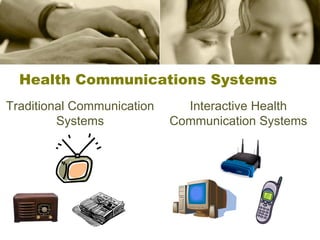
Health Communications Systems Traditional Communication Systems Interactive Health Communication Systems
Interactive Health Communication The interaction of an individual—consumer, patient, caregiver, or professional—with or through an electronic device or communication technology to access or transmit health information or to receive guidance and support on a health-related issue. *Robinson, et al., 1998
IHC System/Application Functions Relay Information Enable Informed Decision Making Promote Healthful Behavior Promote Peer Information Exchange and Emotional Support Promote Self-care Manage Demand for Health Services *Robinson, et al., 1998
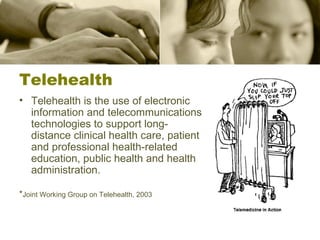
Telehealth Telehealth is the use of electronic information and telecommunications technologies to support long-distance clinical health care, patient and professional health-related education, public health and health administration. * Joint Working Group on Telehealth, 2003
Increased access to care (esp. specialty care) Decreased health care disparities (e.g. rural communities) Increased timeliness of care Increased continuity of care Increased quality of care Save patients time, $$, and travel Decreased provider isolation Decreased costs (???) Telehealth: Benefits
Telehealth: Common Technologies Digital Images (Store and Forward) Teleradiology consult Interactive Video Long term care facility patients interact with geriatric care specialist or PCP from their room. (Virtual House Call)
Telehealth: Common Technologies Telemonitoring Devices Glucose Meter Blood Pressure/Pulse Cuff “ Smart” Pill Box Video Phones (Promise for Future) Pediatrics: Virtual House Call In winter children could be “seen” from home to eliminate potential exposure to RSV *CHCF, 2005
Physician Perspective: Introduction Issues Workflow Barriers and Provider Adoption Referral Patterns Payment – Reimbursement Great Overview Document: http://www.technology.gov/reports/TechPolicy/Telehealth/2004Report.pdf
Physician Perspective: Adoption Early projects were “demonstration projects” that  did  show a positive ROI but only in limited, highly specialized applications Fundoscopy, Radiological consultation, Dermatology, Cardiology (EKGs, Echocardiograms etc.) Furthermore, these installations required  significant workflow changes  and were therefore generally not accepted by providers
Physician Perspective: Adoption Barriers to Adoption: Poor integration with existing workflows Interface is terrible Not well integrated into  administrative  functions (scheduling, billing, availability of consultants, connection delays, medical records etc.) Limited or non-existent provider input during development phases Lack of reimbursement for many types of services Private insurers, however,  do  pay for these services in many areas Medico-legal issues abound, related to licensure Videoconferencing raises some serious legal issues related to what is considered “malpractice” Confidentiality and Privacy issues (HIPAA Security) esp. within the boundaries of  state  laws (Stark)
Physician Perspective: Adoption Other Barriers to acceptance included: Physicians are averse to using new technologies A global issue not just limited to telehealth Decision makers (clinicians, CIOs) need firm evidence in support of the value of telehealth Although this is not always true if a technology is common-sense and “makes sense to the users” but in most cases, telehealth systems  distract  from a traditional workflow  and  costs money to implement so the ROI may not be all that clear
Physician Perspective: Referral Markets for TeleHealth Market demand estimated to be $380 Million in 2004 dollars. The main buckets fall into: Homeland Security Rural and Medically Underserved Areas Continuity of Care Home Healthcare
Physician Perspective: Referral Referral Patterns: Moderate penetration into certain niche areas: Prisons (>50% state and 39% federal prisons) Rural and Medially Underserved Areas Teleradiology, Teledermatology Military Markets Smaller penetration into specialties: Telecardiology, Telepathology, etc.
Physician Perspective: Reimbursement Reimbursement: Great URLs:  http://telehealth.hrsa.gov/licen/   http://tie.telemed.org/     http://tie.telemed.org/programs/   http://www.atsp.org/   URL on Funding:  http://tie.telemed.org/funding/   Will talk about: Medicare Medicaid Private Insurers
Physician Perspective: Reimbursement Medicare Reimbursement of Tele-health Divided into 3 payment categories: Remote face-to-face services via videoconferencing Non face-to-face interactions (store/forward) Home tele-health services The kinds of services reimbursed include: Office visits (CPT 99241-99275) Tele-consultations (CPT 99201-99215) Individual Psychotherapy (CPT 90804-90809) Pharmacological Management (CPT 90862)
Physician Perspective: Reimbursement Medicare Reimbursement of Tele-health Types of providers eligible : Physician, PA, NP, Midwives, Social workers, psychologists, clinical nurse specialist Sites eligible :  Hospital, Physician Office, Critical Access Hospital, Rural Health Clinic, Federally Qualified Health Center Coding and Billing : Reimbursement  is the same as the parent service CPT codes + “GT” modifier (by interactive audio/video technologies) Submit claims to your primary claims processing entity Remote sites can claim a special “facility fee” by adding the “Q3014” modifier
Physician Perspective: Reimbursement Medicaid Federal Medicaid Law  does not recognize telemedicine as a distinct service However, in some cases (in order to reduce cost), states  can  opt to have medicaid pay for  some  telemedicine initiatives
Physician Perspective: Reimbursement Private Insurers: Over 100 private payers currently pay for telemedicine services (in > 25 states) Several states have passed legislation making it mandatory for private payers to reimburse for telemedicine services: Louisiana, California, Oklahoma, Texas, and Kentucky  Directory is at:   http:// www.amdtelemedicine.com/private_payer/index.cfm
Telehealth: Ways to Look at $$$ Travel Expenses Managed Care: Delivering healthcare providers to patients Captive Patient Populations (e.g. Prisons): Delivering patients to providers (or vice versa) General: Travel to provider (e.g. rural, specialty care) Multi-Payer Environment Cost of follow-up visits (e.g. surgery, OB)
Telehealth: Ways to Look at $$$ Alternative Savings Interactive video technology reuse for in-service activities Travel expenses for in-service presenters/trainers Reimbursement Medicare Face-to-Face: limited to the type of services provided, geographic location, type of institution delivering the services and type of health provider Remote: not considered telehealth; coverage is same Home: telehomecare encounters do not meet the definition of a visit Third Party Insurers = Varies *American Telemedicine Association, 2005
AHRQ THQIT Grant Profile Grant Information Technology Exchange for Cancer Health Network (TECH-Net) THQIT Implementation Grant Karen Fox, M.B.A. University of Tennessee Health Science Center Grant Characteristics Cancer Patients Mississippi Delta: Rural TN, MS, and AR Combine the power of the UTHSC telehealth network with a shared, community EMR so that rural physicians and specialists have access to identical information
AHRQ THQIT Grant Profile Grant Information Home HF Care Comparing Patient-Driven Technology Models THQIT Value Grant Lee Goldberg, M.D., M.P.H. University of Pennsylvania Grant Characteristics Chronic Heart Failure Rural Montana, Rural Wyoming, and Urban Philadelphia Randomized Control Trial Standard Care: HF care managed by PCP Case Management: HF care supplemented with telemonitoring system and telephonic nurse case management Self Management: HF care supplemented with telemonitoring system and expert CDSS to guide patient self-management
Reality Check Telephone is a form of Telehealth Telehealth is becoming ubiquitous to healthcare As the cost of technology continues to decrease, more healthcare entities will adopt IT to improve quality of care for rural and underserved populations ANY implementation must be based on sound health IT practices AHRQ National Resource Center for Health IT
For More Information AHRQ National Resource Center for Health IT http://healthit.ahrq.gov Information on the current AHRQ HIT portfolio, future HIT awards, and the national HIT landscape; access to plethora of knowledge articles and content from national HIT experts Some content is there now; many improvements and additions are in the works
References CHCF, “Patient Self-Management Tools: An Overview” http://www.chcf.org/documents/chronicdisease/PatientSelfManagementToolsOverview.pdf Health People 2010 http://www.healthypeople.gov/document/HTML/Volume1/11HealthCom.htm Pong, et al. “Reimbursing Physicians for Telehealth Practice: Issues and Policy Options.” Health Law Review Volume 9, Number 1 (2000). http://www.law.ualberta.ca/centres/hli/pdfs/hlr/v9_1/pongfrm.pdf   Am. Telemedicine Assoc. “MEDICARE PAYMENT OF TELEMEDICINE AND TELEHEALTH SERVICES.” June 2, 2005. http://www.atmeda.org/news/Medicare%20Payment%20Of%20Services%20Provided%20Via%20Telecommunications.pdf Robinson, et al. “An Evidence-Based Approach to Interactive Health Communication.”  JAMA.  1998;280:1264-1269. http:// www.ncbi.nlm.nih.gov/entrez/query.fcgi?cmd = Retrieve&db = pubmed&dopt = Abstract&list_uids =9786378&query_hl=9
Contact Information Brian Dixon, M.P.A. [email_address] (317) 554-0000 x4484 Atif Zafar, M.D. [email_address] (317) 554-0000 x2067 Julie McGowan, Ph.D., FACMI [email_address] (317) 274-7183

Health Communications Systems

  • 1.
    Health Communications SystemsAHRQ National Resource Center for Health IT
  • 2.
    Outline Health CommunicationsSystems Interactive Health Communication Applications Telehealth Technology Perspective Physician Perspective Financial Perspective AHRQ Grantee Profiles
  • 3.
    Health Communication Theart and technique of informing, influencing, and motivating individual, institutional, and public audiences about important health issues. The scope of health communication includes disease prevention, health promotion, health care policy, and the business of health care as well as enhancement of the quality of life and health of individuals within the community. *Healthy People 2010
  • 4.
    Health Communications SystemsTraditional Communication Systems Interactive Health Communication Systems
  • 5.
    Interactive Health CommunicationThe interaction of an individual—consumer, patient, caregiver, or professional—with or through an electronic device or communication technology to access or transmit health information or to receive guidance and support on a health-related issue. *Robinson, et al., 1998
  • 6.
    IHC System/Application FunctionsRelay Information Enable Informed Decision Making Promote Healthful Behavior Promote Peer Information Exchange and Emotional Support Promote Self-care Manage Demand for Health Services *Robinson, et al., 1998
  • 7.
    Telehealth Telehealth isthe use of electronic information and telecommunications technologies to support long-distance clinical health care, patient and professional health-related education, public health and health administration. * Joint Working Group on Telehealth, 2003
  • 8.
    Increased access tocare (esp. specialty care) Decreased health care disparities (e.g. rural communities) Increased timeliness of care Increased continuity of care Increased quality of care Save patients time, $$, and travel Decreased provider isolation Decreased costs (???) Telehealth: Benefits
  • 9.
    Telehealth: Common TechnologiesDigital Images (Store and Forward) Teleradiology consult Interactive Video Long term care facility patients interact with geriatric care specialist or PCP from their room. (Virtual House Call)
  • 10.
    Telehealth: Common TechnologiesTelemonitoring Devices Glucose Meter Blood Pressure/Pulse Cuff “ Smart” Pill Box Video Phones (Promise for Future) Pediatrics: Virtual House Call In winter children could be “seen” from home to eliminate potential exposure to RSV *CHCF, 2005
  • 11.
    Physician Perspective: IntroductionIssues Workflow Barriers and Provider Adoption Referral Patterns Payment – Reimbursement Great Overview Document: http://www.technology.gov/reports/TechPolicy/Telehealth/2004Report.pdf
  • 12.
    Physician Perspective: AdoptionEarly projects were “demonstration projects” that did show a positive ROI but only in limited, highly specialized applications Fundoscopy, Radiological consultation, Dermatology, Cardiology (EKGs, Echocardiograms etc.) Furthermore, these installations required significant workflow changes and were therefore generally not accepted by providers
  • 13.
    Physician Perspective: AdoptionBarriers to Adoption: Poor integration with existing workflows Interface is terrible Not well integrated into administrative functions (scheduling, billing, availability of consultants, connection delays, medical records etc.) Limited or non-existent provider input during development phases Lack of reimbursement for many types of services Private insurers, however, do pay for these services in many areas Medico-legal issues abound, related to licensure Videoconferencing raises some serious legal issues related to what is considered “malpractice” Confidentiality and Privacy issues (HIPAA Security) esp. within the boundaries of state laws (Stark)
  • 14.
    Physician Perspective: AdoptionOther Barriers to acceptance included: Physicians are averse to using new technologies A global issue not just limited to telehealth Decision makers (clinicians, CIOs) need firm evidence in support of the value of telehealth Although this is not always true if a technology is common-sense and “makes sense to the users” but in most cases, telehealth systems distract from a traditional workflow and costs money to implement so the ROI may not be all that clear
  • 15.
    Physician Perspective: ReferralMarkets for TeleHealth Market demand estimated to be $380 Million in 2004 dollars. The main buckets fall into: Homeland Security Rural and Medically Underserved Areas Continuity of Care Home Healthcare
  • 16.
    Physician Perspective: ReferralReferral Patterns: Moderate penetration into certain niche areas: Prisons (>50% state and 39% federal prisons) Rural and Medially Underserved Areas Teleradiology, Teledermatology Military Markets Smaller penetration into specialties: Telecardiology, Telepathology, etc.
  • 17.
    Physician Perspective: ReimbursementReimbursement: Great URLs: http://telehealth.hrsa.gov/licen/ http://tie.telemed.org/ http://tie.telemed.org/programs/ http://www.atsp.org/ URL on Funding: http://tie.telemed.org/funding/ Will talk about: Medicare Medicaid Private Insurers
  • 18.
    Physician Perspective: ReimbursementMedicare Reimbursement of Tele-health Divided into 3 payment categories: Remote face-to-face services via videoconferencing Non face-to-face interactions (store/forward) Home tele-health services The kinds of services reimbursed include: Office visits (CPT 99241-99275) Tele-consultations (CPT 99201-99215) Individual Psychotherapy (CPT 90804-90809) Pharmacological Management (CPT 90862)
  • 19.
    Physician Perspective: ReimbursementMedicare Reimbursement of Tele-health Types of providers eligible : Physician, PA, NP, Midwives, Social workers, psychologists, clinical nurse specialist Sites eligible : Hospital, Physician Office, Critical Access Hospital, Rural Health Clinic, Federally Qualified Health Center Coding and Billing : Reimbursement is the same as the parent service CPT codes + “GT” modifier (by interactive audio/video technologies) Submit claims to your primary claims processing entity Remote sites can claim a special “facility fee” by adding the “Q3014” modifier
  • 20.
    Physician Perspective: ReimbursementMedicaid Federal Medicaid Law does not recognize telemedicine as a distinct service However, in some cases (in order to reduce cost), states can opt to have medicaid pay for some telemedicine initiatives
  • 21.
    Physician Perspective: ReimbursementPrivate Insurers: Over 100 private payers currently pay for telemedicine services (in > 25 states) Several states have passed legislation making it mandatory for private payers to reimburse for telemedicine services: Louisiana, California, Oklahoma, Texas, and Kentucky Directory is at: http:// www.amdtelemedicine.com/private_payer/index.cfm
  • 22.
    Telehealth: Ways toLook at $$$ Travel Expenses Managed Care: Delivering healthcare providers to patients Captive Patient Populations (e.g. Prisons): Delivering patients to providers (or vice versa) General: Travel to provider (e.g. rural, specialty care) Multi-Payer Environment Cost of follow-up visits (e.g. surgery, OB)
  • 23.
    Telehealth: Ways toLook at $$$ Alternative Savings Interactive video technology reuse for in-service activities Travel expenses for in-service presenters/trainers Reimbursement Medicare Face-to-Face: limited to the type of services provided, geographic location, type of institution delivering the services and type of health provider Remote: not considered telehealth; coverage is same Home: telehomecare encounters do not meet the definition of a visit Third Party Insurers = Varies *American Telemedicine Association, 2005
  • 24.
    AHRQ THQIT GrantProfile Grant Information Technology Exchange for Cancer Health Network (TECH-Net) THQIT Implementation Grant Karen Fox, M.B.A. University of Tennessee Health Science Center Grant Characteristics Cancer Patients Mississippi Delta: Rural TN, MS, and AR Combine the power of the UTHSC telehealth network with a shared, community EMR so that rural physicians and specialists have access to identical information
  • 25.
    AHRQ THQIT GrantProfile Grant Information Home HF Care Comparing Patient-Driven Technology Models THQIT Value Grant Lee Goldberg, M.D., M.P.H. University of Pennsylvania Grant Characteristics Chronic Heart Failure Rural Montana, Rural Wyoming, and Urban Philadelphia Randomized Control Trial Standard Care: HF care managed by PCP Case Management: HF care supplemented with telemonitoring system and telephonic nurse case management Self Management: HF care supplemented with telemonitoring system and expert CDSS to guide patient self-management
  • 26.
    Reality Check Telephoneis a form of Telehealth Telehealth is becoming ubiquitous to healthcare As the cost of technology continues to decrease, more healthcare entities will adopt IT to improve quality of care for rural and underserved populations ANY implementation must be based on sound health IT practices AHRQ National Resource Center for Health IT
  • 27.
    For More InformationAHRQ National Resource Center for Health IT http://healthit.ahrq.gov Information on the current AHRQ HIT portfolio, future HIT awards, and the national HIT landscape; access to plethora of knowledge articles and content from national HIT experts Some content is there now; many improvements and additions are in the works
  • 28.
    References CHCF, “PatientSelf-Management Tools: An Overview” http://www.chcf.org/documents/chronicdisease/PatientSelfManagementToolsOverview.pdf Health People 2010 http://www.healthypeople.gov/document/HTML/Volume1/11HealthCom.htm Pong, et al. “Reimbursing Physicians for Telehealth Practice: Issues and Policy Options.” Health Law Review Volume 9, Number 1 (2000). http://www.law.ualberta.ca/centres/hli/pdfs/hlr/v9_1/pongfrm.pdf Am. Telemedicine Assoc. “MEDICARE PAYMENT OF TELEMEDICINE AND TELEHEALTH SERVICES.” June 2, 2005. http://www.atmeda.org/news/Medicare%20Payment%20Of%20Services%20Provided%20Via%20Telecommunications.pdf Robinson, et al. “An Evidence-Based Approach to Interactive Health Communication.” JAMA.  1998;280:1264-1269. http:// www.ncbi.nlm.nih.gov/entrez/query.fcgi?cmd = Retrieve&db = pubmed&dopt = Abstract&list_uids =9786378&query_hl=9
  • 29.
    Contact Information BrianDixon, M.P.A. [email_address] (317) 554-0000 x4484 Atif Zafar, M.D. [email_address] (317) 554-0000 x2067 Julie McGowan, Ph.D., FACMI [email_address] (317) 274-7183