What makes us buy, and why?
The future of consumers’ roles and motivations
Contact information
Research led and report prepared by:
Soren Kaplan, Ph.D.
Managing Principal
skaplan@innovation-point.com
www.innovation-point.com
San Francisco - USA
Soren  Kaplan  is  the  author  of  the  award‐winning  bestseller,  Leapfrogging.  He  is  founder  of 
InnovationPoint, a recognized speaker on innovation, and consults to Cisco, Colgate, Disney, NBC 
Universal, Medtronic, Red Bull, and others. He led the innovation group at HP in Silicon Valley and 
teaches  in  the  Imagineering  Academy  at  NHTV  Breda  University  in  The  Netherlands  and  the 
executive  education  program  at  Copenhagen  Business  School.  To  learn  more  about  Soren,  visit 
www.leapfrogging.com 
InnovationPoint  is  a  non‐traditional  consulting  firm  with  a  laser  focus  on  “Strategic  Innovation.” 
InnovationPoint helps drive breakthrough, profitable topline growth by working collaboratively with 
cross‐functional teams to challenge the status quo, to identify and capitalize on new growth.  Clients 
include Disney, Visa, Medtronic, Colgate, Red Bull, Cisco, Grundfos, ArcelorMittal, and other global 
innovators.  For more information, visit www.innovation‐point.com.
Tekes – the Finnish Funding Agency for Innovation
Tekes is the main public funding organisation for research, development and innovation in Finland.
Tekes funds wide-ranging innovation activities in research communities, industry and service sectors
and especially promotes cooperative and risk-intensive projects. Tekes’ current strategy puts strong
emphasis on growth seeking SMEs.
1
Roles &
Motivations
of the Future
What will get people to buy or participate what we have to offer?
This simple question is at the heart of most marketing programs, business strategies,
innovation initiatives, and business models. Companies make huge investments
based on the hope of hitting upon unmet needs or finding the hook to get people
engaged.
Most purchase decisions are driven by motivations. Sometimes these motivations
are conscious calculations. In other cases, motivations may be unconscious –
though they’re just as powerful (or even more powerful) in influencing why someone
might choose one product or service over another.
Today’s reality is that our social institutions and personal experiences are
increasingly fragmented. We may act differently at home than at work. We may
want things for our children that we don’t splurge on for ourselves. The social
networks we care about may be different from those of our closest friends, or even
our spouses. We may work from home certain days, while jump on airplanes or go
into a corporate office other times. Life has become a complex combination of
choices and options.
The motivations that lead us to choose to do business with one company over
another are influenced by our backgrounds, social context, and culture. Just like
each of us possesses unique DNA, so do we possess unique life experiences that
impact what we think, feel, and do.
Through extensive research, we identified eight primary roles that consumers play as
they interact with companies, products, and services. At certain times we may let
one role drive our behavior over others. At other times and in other contexts, we
might assume a different role. We also might also take on two or more roles at the
same time. The person who loves Apple’s technology, stores, and user experience,
for example, might be completely committed to Apple’s higher end offerings – while
at the same time deciding to purchase a used iPad from the online classifieds to save
money. This individual is a high-end brand lover who demonstrates cost conscious
behavior.
2
Deep
Motivators
for the
Future
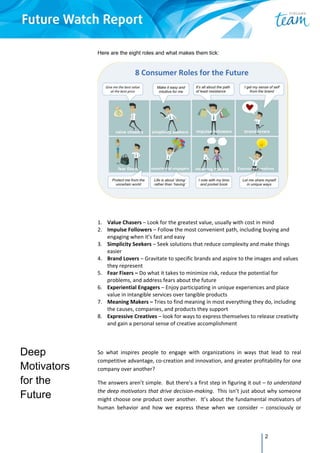
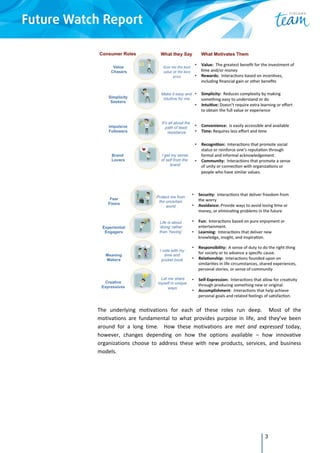
Here are the eight roles and what makes them tick:
 
1. Value Chasers – Look for the greatest value, usually with cost in mind 
2. Impulse Followers – Follow the most convenient path, including buying and 
engaging when it’s fast and easy 
3. Simplicity Seekers – Seek solutions that reduce complexity and make things 
easier 
4. Brand Lovers – Gravitate to specific brands and aspire to the images and values 
they represent 
5. Fear Fixers – Do what it takes to minimize risk, reduce the potential for 
problems, and address fears about the future 
6. Experiential Engagers – Enjoy participating in unique experiences and place 
value in intangible services over tangible products 
7. Meaning Makers – Tries to find meaning in most everything they do, including 
the causes, companies, and products they support 
8. Expressive Creatives – look for ways to express themselves to release creativity 
and gain a personal sense of creative accomplishment 


So  what  inspires  people  to  engage  with  organizations  in  ways  that  lead  to  real 
competitive advantage, co‐creation and innovation, and greater profitability for one 
company over another? 
The answers aren’t simple.  But there’s a first step in figuring it out – to understand 
the deep motivators that drive decision‐making.  This isn’t just about why someone 
might choose one product over another.  It’s about the fundamental motivators of 
human  behavior  and  how  we  express  these  when  we  consider  –  consciously  or 
2
unconsciously – if we will buy something, be served, co‐create, or interact with a 
product,  service,  or  business  model.    It’s  about  how  companies  can  connect  into 
deep motivators as a source of business transformation for the future. 
Most  successful  products,  services,  and  business  models  already  tap  into  these 
motivators in some way or another.  In the future, the companies that harness the 
power of these motivators in new ways will reap the biggest rewards.  Here are the 
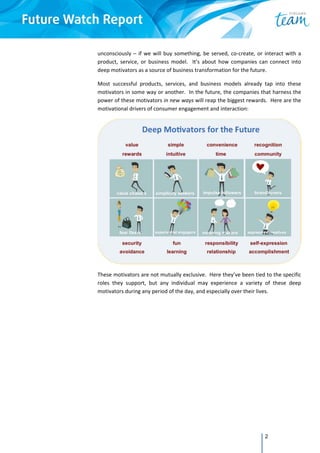
motivational drivers of consumer engagement and interaction: 
These motivators are not mutually exclusive.  Here they’ve been tied to the specific 
roles  they  support,  but  any  individual  may  experience  a  variety  of  these  deep 
motivators during any period of the day, and especially over their lives. 
3
The  underlying  motivations  for  each  of  these  roles  run  deep.    Most  of  the 
motivations  are  fundamental  to  what  provides  purpose  in  life,  and  they’ve  been 
around  for  a  long  time.    How  these  motivations  are  met  and  expressed  today, 
however,  changes  depending  on  how  the  options  available  –  how  innovative 
organizations  choose  to  address  these  with  new  products,  services,  and  business 
models. 


4
Business
Implications
and
Opportunities
Most  companies  provide  products  or  services  that  focus  on  delivering  specific 
features and benefits.  Without an understanding  of the deeper motivations that 
drive  consumer  behavior,  it  becomes  much  harder  to  create  differentiation  in  a 
crowded market. 
Companies that address deep motivators in creative ways can protect themselves 
from commoditization.  Deep motivators are essentially the building blocks of great 
customer experiences and business models that create competitive advantage. 
As today’s world becomes increasingly complex, a vast array of technological, social, 
political, and other trends shape our local and global environment every day.  Here 
are 10 examples of trends that highlight how leading‐edge companies are tapping 
into some of the deep motivators to innovate their way to future success.  As you 
review these, consider: 
1. How might these trends apply in my markets and for my customers? 
2. Which trends, roles, and deep motivators are most relevant for what we do 
today? 
3. Which trends, roles, and deep motivators represent opportunities for future 
innovation – to tap into new customer segments or as the basis for new 
products, services, processes, experiences, or business models? 
4. What other trends in your own industry tap into the deep motivators, and 
how can you use them as a source of innovation? 
 
 
1. Instapreneurship: 
The Internet makes it easier for brands and consumers to connect and “co‐
create.” A number of platforms have emerged that enable aspiring 
entrepreneurs to design, create, develop, and sell their products, ideas, and 
or services. These are the so‐called “Instapreneurs” who are able to create 
businesses and accomplish great things in (almost) an instant. It empowers 
consumers whom may have never developed their ideas without these 
programs.  
 
Key Target:  Expressive Creatives, Value Chasers  


5
 
Zazzle  
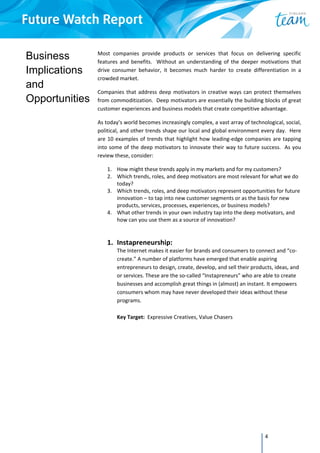
The  online  community  enables  consumers  to  become  co‐designers  of  by  making 
custom‐made  bags  and  other  merchandises,  this  co‐designer  can  then  check  out, 
vote on, and buy from other users and/or branded partners, and set licensing fees 
for their own designs. These consumers are able to express themselves by creating 
something of their own while belonging to a specific community as well as having 
the sense of accomplishment and recognition.  
Website:  Zazzle  
Video:  Zazzle 
 
Huggies Mominspired  
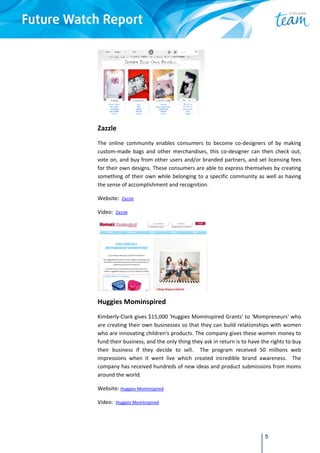
Kimberly‐Clark gives $15,000 'Huggies MomInspired Grants' to 'Mompreneurs' who 
are creating their own businesses so that they can build relationships with women 
who are innovating children's products. The company gives these women money to 
fund their business, and the only thing they ask in return is to have the rights to buy 
their  business  if  they  decide  to  sell.    The  program  received  50  millions  web 
impressions  when  it  went  live  which  created  incredible  brand  awareness.    The 
company has received hundreds of new ideas and product submissions from moms 
around the world. 
Website: Huggies MomInspired  
Video:  Huggies MomInspired  
 
6
2. Social Currency Marketing 
 
Key Targets:  Brand Lovers, Experiential Engagers, Value Chasers 
Marketing  messages  bombard  consumers  every  day.    To  cut  through  the  noise, 
many companies now provide merchandise or discounts in return for consumers’ 
social sharing and promotion to their friends.  Consumers who are passionate about 
certain  products,  brands,  or  experiences  share  with  their  networks  –  and  receive 
financial incentives in return for promoting the company.  
 
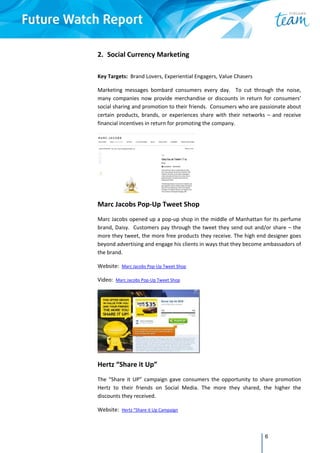
Marc Jacobs Pop‐Up Tweet Shop 
Marc Jacobs opened up a pop‐up shop in the middle of Manhattan for its perfume 
brand, Daisy.  Customers pay through the tweet they send out and/or share – the 
more they tweet, the more free products they receive. The high end designer goes 
beyond advertising and engage his clients in ways that they become ambassadors of 
the brand. 
Website:  Marc Jacobs Pop‐Up Tweet Shop  
Video:  Marc Jacobs Pop‐Up Tweet Shop  
 
Hertz “Share it Up” 
The “Share it UP” campaign gave  consumers the opportunity to share promotion 
Hertz  to  their  friends  on  Social  Media.  The  more  they  shared,  the  higher  the 
discounts they received. 
Website:  Hertz “Share it Up Campaign  
7
3. Affinity Networks: 
 
Key Targets: Meaning Makers, Expressive Creatives, Brand Lovers 
Affinity Networks are communities where people come together around a shared 
purpose  or  focus.  Companies  create  networks  where  people  connect,  share,  and 
interact with each other based on specific common interests. 
 
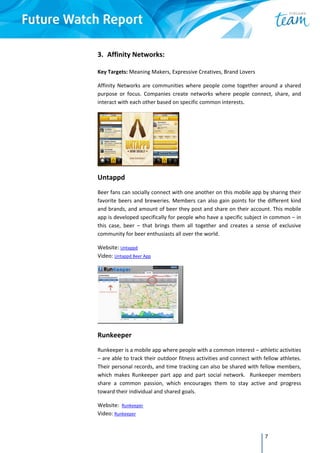
Untappd 
Beer fans can socially connect with one another on this mobile app by sharing their 
favorite beers and breweries. Members can also gain points for the different kind 
and brands, and amount of beer they post and share on their account. This mobile 
app is developed specifically for people who have a specific subject in common – in 
this  case,  beer  –  that  brings  them  all  together  and  creates  a  sense  of  exclusive 
community for beer enthusiasts all over the world. 
Website: Untappd  
Video: Untappd Beer App 
 
Runkeeper 
Runkeeper is a mobile app where people with a common interest – athletic activities 
– are able to track their outdoor fitness activities and connect with fellow athletes. 
Their personal records, and time tracking can also be shared with fellow members, 
which  makes  Runkeeper  part  app  and  part  social  network.    Runkeeper  members 
share  a  common  passion,  which  encourages  them  to  stay  active  and  progress 
toward their individual and shared goals. 
Website:  Runkeeper  
Video: Runkeeper  
8
4. Rent‐a‐Anything:  
 
Key Targets:  Fear Fixers, Simplicity Seekers, Meaning Makers 
Many  consumers  increasingly  recognize  the  value  in  approaches  that  share,  rent, 
swap, or loan products, services, and experiences.  Concern for the environment, a 
desire  for  greater  simplicity,  freedom  from  accumulating  “stuff”,  and  a  sense  of 
community are triggers for participation in such marketplaces. 
 
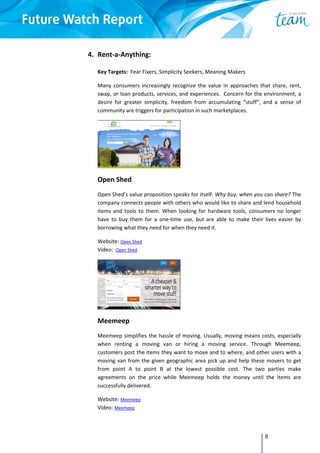
Open Shed 
Open Shed’s value proposition speaks for itself: Why buy, when you can share? The 
company connects people with others who would like to share and lend household 
items  and  tools  to  them.  When  looking  for  hardware  tools,  consumers  no  longer 
have  to  buy  them  for  a  one‐time  use,  but  are  able  to  make  their  lives  easier  by 
borrowing what they need for when they need it. 
Website: Open Shed 
Video:  Open Shed 
 
Meemeep 
Meemeep simplifies the hassle of moving. Usually, moving means costs, especially 
when  renting  a  moving  van  or  hiring  a  moving  service.  Through  Meemeep, 
customers post the items they want to move and to where, and other users with a 
moving van from the given geographic area pick up and help these movers to get 
from  point  A  to  point  B  at  the  lowest  possible  cost.  The  two  parties  make 
agreements  on  the  price  while  Meemeep  holds  the  money  until  the  items  are 
successfully delivered.  
Website: Meemeep 
Video: Meemeep 
9
5. Peer Support for Motivation & Change:  
 
Key Targets:  Fear Fixers, Simplicity Seekers 
Most people want to change something about themselves.  But change is tough!  A 
new breed of company now brokers connections with peers and experts to promote 
greater compliance with goals and the motivation to achieve personal objectives. 
Whether financial planning, weight loss, or just sticking to a New Year’s resolution, 
social support is one of the most powerful drivers of personal change. 
 
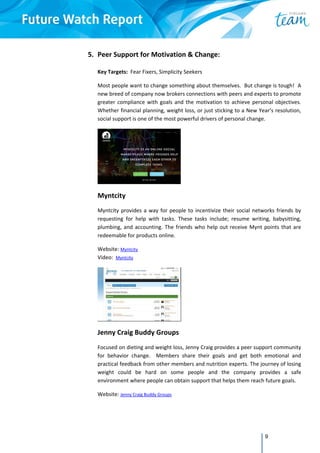
Myntcity 
Myntcity provides a way for people to incentivize their social networks friends by 
requesting  for  help  with  tasks.  These  tasks  include;  resume  writing,  babysitting, 
plumbing, and accounting. The friends who help out receive Mynt points that are 
redeemable for products online.  
Website: Myntcity  
Video:  Myntcity 
 
Jenny Craig Buddy Groups 
Focused on dieting and weight loss, Jenny Craig provides a peer support community 
for  behavior  change.    Members  share  their  goals  and  get  both  emotional  and 
practical feedback from other members and nutrition experts. The journey of losing 
weight  could  be  hard  on  some  people  and  the  company  provides  a  safe 
environment where people can obtain support that helps them reach future goals. 
Website: Jenny Craig Buddy Groups 
 
 
10
6. Interactive (Virtual) Shopping:  
 
Key Targets:  Experiential Engagers, Impulse Followers, Simplicity Seekers 
The  line  between  physical  and  virtual  shopping  is  rapidly  becoming  blurred,  and 
shopping, itself, will likely become a blended virtual and retail experience.  While 
wiz‐bang  technology  may  feel  novel  initially,  interactive  shopping  can  save  time, 
reveal options for customization and personalization not available in physical stores, 
and deliver engaging experiences as part of the purchase process. 
 
Tesco/ Home Plus 
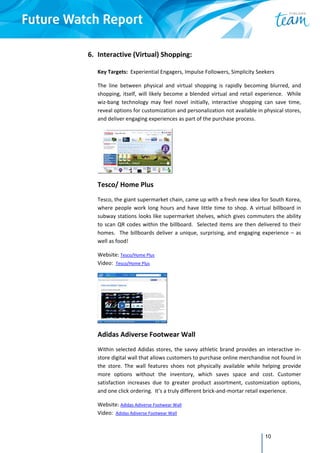
Tesco, the giant supermarket chain, came up with a fresh new idea for South Korea, 
where people work long hours and have little time to shop. A virtual billboard in 
subway stations looks like supermarket shelves, which gives commuters the ability 
to scan QR codes within the billboard.  Selected items are then delivered to their 
homes.  The billboards deliver a unique, surprising, and engaging experience – as 
well as food!  
Website: Tesco/Home Plus  
Video:  Tesco/Home Plus 
 
Adidas Adiverse Footwear Wall 
Within selected Adidas stores, the savvy athletic brand provides an interactive in‐
store digital wall that allows customers to purchase online merchandise not found in 
the  store.  The  wall  features  shoes  not  physically  available  while  helping  provide 
more  options  without  the  inventory,  which  saves  space  and  cost.  Customer 
satisfaction  increases  due  to  greater  product  assortment,  customization  options, 
and one click ordering.  It’s a truly different brick‐and‐mortar retail experience. 
Website: Adidas Adiverse Footwear Wall 
Video:  Adidas Adiverse Footwear Wall 
11
7. “Fun‐and‐Games‐Agement” (Engagement for Fun & Games) 
 
Key Targets: Experiential Engagers, Impulse Followers   
With the struggle to gain consumer mindshare, many brands are looking to interact 
with consumers by creating experiences that rely on fun, games, and humor. Often 
these strategies and programs take consumers by surprise, tapping into the impulse 
to explore, try something new, or just have fun. 
 
Traffic Light Pong 
This crosswalk traffic light in downtown Germany engages fellow pedestrians from 
the opposite side of the street with a game of pong. Each side uses a controller on a 
street post. Strangers become game opponents while waiting for the light to green, 
and are able to express their glory or defeat after the traffic light turns green. This 
‘urban  interactions’  was  originally  created  as  an  art  installation,  but  commercial 
applications may be right around the corner.  
Website: Traffic Light Pong 
Video: Traffic Light Pong 
 
Coca Cola Small Worlds Machine 
Two countries with high tensions came together to share happiness when Coca‐Cola 
placed two vending machines in two malls, one in India and the other in Pakistan.  
The vending machines were connected with touchscreens and a live streaming video 
feed.  Consumers from both countries were encouraged to complete tasks together 
including dancing, peace sign drawing, and waving, before receiving their Coke. 
Website: Coca Cola Small Worlds Machine  
Video:  Coca Cola Small Worlds Machine 
12
8. Upgrade‐ability:  
 
Key Targets: Meaning Makers, Brand Lovers, Value Chasers 
Upgrade‐ability isn’t about consumers making new purchases every time they want 
something  new.  It’s  about  constantly  upgrading  or  improving  existing  products. 
Tapping into consumers’ desire for instant access to the “next version,” the whole 
concept of “upgrades” are now being applied to physical objects.  Preserving the 
environment, obtaining a sense of community, and saving money are all triggers for 
engaging in upgrade‐ability.  
 
Phonebloks 
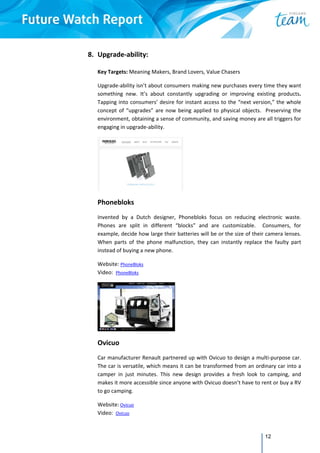
Invented  by  a  Dutch  designer,  Phonebloks  focus  on  reducing  electronic  waste. 
Phones  are  split  in  different  “blocks”  and  are  customizable.    Consumers,  for 
example, decide how large their batteries will be or the size of their camera lenses. 
When  parts  of  the  phone  malfunction,  they  can  instantly  replace  the  faulty  part 
instead of buying a new phone.  
Website: PhoneBloks  
Video:  PhoneBloks 
 
Ovicuo 
Car manufacturer Renault partnered up with Ovicuo to design a multi‐purpose car. 
The car is versatile, which means it can be transformed from an ordinary car into a 
camper  in  just  minutes.  This  new  design  provides  a  fresh  look  to  camping,  and 
makes it more accessible since anyone with Ovicuo doesn’t have to rent or buy a RV 
to go camping. 
Website: Ovicuo  
Video:  Ovicuo 
13
9. Social Enterprise Business Models: 
 
Key Targets:  Meaning Makers, Experiential Engagers  
Social enterprises are businesses that bring social value to society while at the same 
generating  revenue.  Their  goal  is  to  provide  a  win‐win  that  allows  consumers  to 
“give back” to society by doing business with them. 
 
Granny’s Finest 
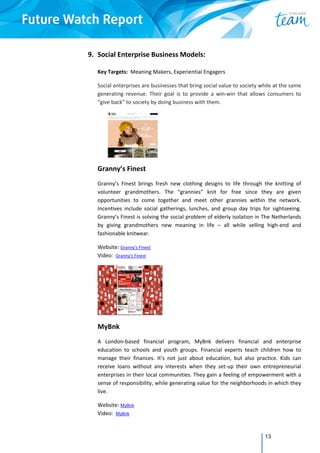
Granny’s  Finest  brings  fresh  new  clothing  designs  to  life  through  the  knitting  of 
volunteer  grandmothers.  The  “grannies”  knit  for  free  since  they  are  given 
opportunities  to  come  together  and  meet  other  grannies  within  the  network.  
Incentives  include  social  gatherings,  lunches,  and  group  day  trips  for  sightseeing. 
Granny’s Finest is solving the social problem of elderly isolation in The Netherlands 
by  giving  grandmothers  new  meaning  in  life  –  all  while  selling  high‐end  and 
fashionable knitwear.  
Website: Granny's Finest  
Video:  Granny's Finest 
 
MyBnk  
A  London‐based  financial  program,  MyBnk  delivers  financial  and  enterprise 
education  to  schools  and  youth  groups.  Financial  experts  teach  children  how  to 
manage  their  finances.  It’s  not  just  about  education,  but  also  practice.  Kids  can 
receive  loans  without  any  interests  when  they  set‐up  their  own  entrepreneurial 
enterprises in their local communities. They gain a feeling of empowerment with a 
sense of responsibility, while generating value for the neighborhoods in which they 
live.  
Website: MyBnk  
Video:  MyBnk 
 
14
10.Grassroots Experiential Marketing Campaigns (GEMCs): 
 
Key Targets:  Experiential Engagers, Meaning Makers  
GEMCs  are  interactive  consumer  “activation”  campaigns  in  which  consumers  are 
directly engaged as the driving force behind a product rollout or marketing strategy. 
 
Volkswagen Fast lane 
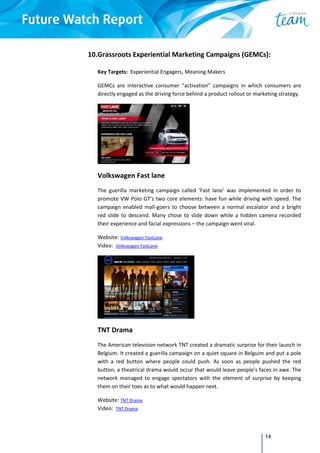
The  guerilla  marketing  campaign  called  ‘Fast  lane’  was  implemented  in  order  to 
promote VW Polo GT’s two core elements: have fun while driving with speed. The 
campaign enabled mall‐goers to choose between a normal escalator and a bright 
red slide to descend. Many chose to slide down while a hidden camera recorded 
their experience and facial expressions – the campaign went viral. 
Website: Volkswagen FastLane  
Video:  Volkswagen FastLane 
 
TNT Drama 
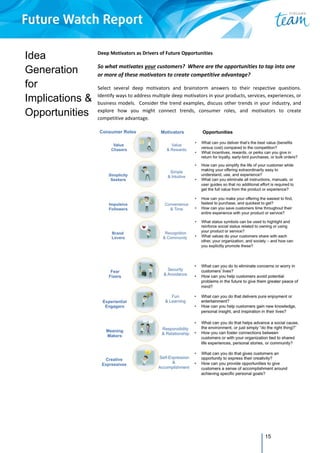
The American television network TNT created a dramatic surprise for their launch in 
Belgium. It created a guerilla campaign on a quiet square in Belguim and put a pole 
with  a  red  button  where  people  could  push.  As  soon  as  people  pushed  the  red 
button, a theatrical drama would occur that would leave people’s faces in awe. The 
network  managed  to  engage  spectators  with  the  element  of  surprise  by  keeping 
them on their toes as to what would happen next.  
Website: TNT Drama  
Video:  TNT Drama 
15
Idea
Generation
for
Implications &
Opportunities
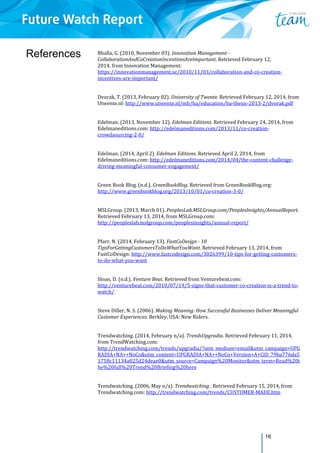
Deep Motivators as Drivers of Future Opportunities 
So what motivates your customers?  Where are the opportunities to tap into one 
or more of these motivators to create competitive advantage? 
Select  several  deep  motivators  and  brainstorm  answers  to  their  respective  questions.  
Identify ways to address multiple deep motivators in your products, services, experiences, or 
business models.  Consider the trend examples, discuss other trends in your industry, and 
explore  how  you  might  connect  trends,  consumer  roles,  and  motivators  to  create 
competitive advantage. 


16
References Bhalla,	G.	(2010,	November	03).	Innovation	Management	‐	
CollaborationAndCoCreationIncentivesAreImportant.	Retrieved	February	12,		
2014,	from	Innovation	Management:	
https://innovationmanagement.se/2010/11/03/collaboration‐and‐co‐creation‐
incentives‐are‐important/	
Dvorak,	T.	(2013,	February	02).	University	of	Twente.	Retrieved	February	12,	2014,	from	
Utwente.nl:	http://www.utwente.nl/mb/ba/education/ba‐thesis‐2013‐2/dvorak.pdf		
Edelman.	(2013,	November	12).	Edelman	Editions.	Retrieved	February	24,	2014,	from	
Edelmaneditions.com:	http://edelmaneditions.com/2013/11/co‐creation‐
crowdsourcing‐2‐0/	
Edelman.	(2014,	April	2).	Edelman	Editions.	Retrieved	April	2,	2014,	from	
Edelmaneditions.com:	http://edelmaneditions.com/2014/04/the‐content‐challenge‐
driving‐meaningful‐consumer‐engagement/	
Green	Book	Blog.	(n.d.).	GreenBookBlog.	Retrieved	from	GreenBookBlog.org:	
http://www.greenbookblog.org/2013/10/01/co‐creation‐3‐0/		
MSLGroup.	(2013,	March	01).	PeoplesLab.MSLGroup.com/PeoplesInsights/AnnualReport.	
Retrieved	February	13,	2014,	from	MSLGroup.com:	
http://peopleslab.mslgroup.com/peoplesinsights/annual‐report/	
Pfarr,	N.	(2014,	February	13).	FastCoDesign	‐	10	
TipsForGettingCustomersToDoWhatYouWant.	Retrieved	February	13,	2014,	from	
FastCoDesign:	http://www.fastcodesign.com/3026399/10‐tips‐for‐getting‐customers‐
to‐do‐what‐you‐want	
Sloan,	D.	(n.d.).	Venture	Beat.	Retrieved	from	Venturebeat.com:	
http://venturebeat.com/2010/07/19/5‐signs‐that‐customer‐co‐creation‐is‐a‐trend‐to‐
watch/	
Steve	Diller,	N.	S.	(2006).	Making	Meaning:	How	Successful	Businesses	Deliver	Meaningful	
Customer	Experiences.	Berkley,	USA:	New	Riders	.	
Trendwatching.	(2014,	February	n/a).	TrendsUpgradia.	Retrieved	February	11,	2014,	
from	TrendWatching.com:	
http://trendwatching.com/trends/upgradia/?utm_medium=email&utm_campaign=UPG
RADIA+NA++NoCo&utm_content=UPGRADIA+NA++NoCo+Version+A+CID_79ba776da5
1758c11134a025d24deae0&utm_source=Campaign%20Monitor&utm_term=Read%20t
he%20full%20Trend%20Briefing%20here	
Trendwatching.	(2006,	May	n/a).	Trendwatching	.	Retrieved	February	15,	2014,	from	
Trendwatching.com:	http://trendwatching.com/trends/CUSTOMER‐MADE.htm
17
Turner,	P.	(2007,	April	26).	Freethinkr.wordpress	
RewardReputationTheCurrencyOfConsumerInvolvement.	Retrieved	February	14,	2014,	
from	Wordpress:	http://freethinkr.wordpress.com/2007/04/26/reward‐reputation‐
the‐currency‐of‐customer‐involvement‐in‐product‐co‐creation‐part‐1/	
Urbick,	B.	(2013,	March	26).	Innovation	Management	.	Retrieved	February	20,	2014,	
from	Innovationmanagement.se:	
https://www.innovationmanagement.se/2012/03/26/innovation‐through‐co‐creation‐
consumers‐can‐be‐creative/	
Wise,	R.	(2014,	February	08).	MoveOverProductDesignUXIsTheFuture.	Retrieved	
February	08,	2014,	from	FastCoDesign:	http://www.fastcodesign.com/3025274/move‐
over‐product‐design‐ux‐is‐the‐future?utm_source=facebook	
Yanning.	(2011,	February	23).	New.Eyeka.Net	‐	FantasticFourMotivationsForCoCreation.	
Retrieved	February	14,	2014,	from	Eyeka.net:	
http://news.eyeka.net/2011/02/fantastic‐four‐motivations‐for‐co‐creation/	


Team finland future_watch_report_what_makes_us_buy_and_why