Future Watch
Health & Wellbeing in the Digital World – Vision 2025
2019
2
Chapter Page Number
Project Scope, Objectives, and Methodology 4
Executive Summary 6
1. Transformations in care delivery – the drivers and economic imperatives for anytime, anywhere care 9
1.1. System wide challenges that need to be addressed globally 12
1.2. Health system goals 20
1.3. Consumer / patient centric challenges that need addressing 25
1.4. Wellness management – prescriptive or ownership based 30
1.5. Alternate care locations 38
1.6. Patient management 65
2. The move towards Population Health Management and the role of Preventative Medicine – an
integrated and holistic approach
92
2.1. Population wide initiatives 95
2.2. Predictive Medicine 97
2.3. The Patient as the focal point – motivations and expectations 102
3. The Digital Health Ecosystem in 2025 107
3.1. What will this ecosystem look like? 109
3.2. Changes in the management of the care paradigm 117
Contents
3
Contents
Chapter Page Number
4. Key enabling Digital Solutions supporting Individual Centric Health & Wellbeing through 2025 119
4.1. eHealth 120
4.2. 5G 124
4.3. Analytics and AI 126
4.4. Robotics and automation supporting care assistance 129
4.5. VR / AR 139
4.6. Cloud infrastructure and solutions 145
4.7. Smart devices – IOT 151
4.8. Other consideration – GDPR, Cyber security etc. 159
5. Next Generation Solutions – R&D and Investment Focus 163
5.1. Regional hot spots for development of Wellness enabling solutions 164
5.2. Role of Academic hubs 171
5.3. Innovation Focus through 2025 – OEM’s and SME’s 175
6. Consumerism and Participative Healthcare – Paradigm shifts in the next decade 183
6.1. Willingness to adopt and pay for solutions 185
6.2. Share of wallet towards investment in wellbeing 188
6.3. Trends towards wellbeing, stay healthy 191
6.4. Geographical variations and maturity in terms of adoption and usage 200
6.5. Scalability of operations 203
4
Back to Contents
REPORT OBJECTIVES AND METHODOLOGY
5
Report Objectives & Methodology
Healthcare as an industry is transforming. The concept of wellbeing is increasing in importance. Living environments are evolving
(smart homes/assisted living/robotics/etc.). Technologies and innovations are having major impacts. Individuals are taking more
control.
Business Finland commissioned this report on the landscape of developments that will impact the delivery of Health & Wellbeing, to
better understand the anticipated transformations, impacts and opportunities to support its strategy for ensuring Finland is well
positioned to take advantage of such trends and to help drive better decision making for all stakeholders in Finland.
Frost & Sullivan (F&S) compiled this report by using existing data and secondary research inputs from public information sources to profile
future projections in terms of healthcare delivery transformations, to understand the economic imperative in key geographic markets, and to
look at the activities of key digital health firms across the globe. We also conducted selected primary research interviews with futurists in
medical device and life sciences firms, stakeholders from digital health solution providers, key opinion leaders from the provider sector and
R&D stakeholder to understand their views of developments, adoption, and sustainability of the new solutions.
Based on the gathered data, F&S conducted holistic analysis of the ecosystem and needs to identify unmet and evolving needs. This
helped build a list of digital health solution areas across patient touch points along their care pathway, and will also help define new
service and business models.
We hope this substantive report will help add value to insight and decision making by all stakeholders in the Finnish healthcare
ecosystem.
6
Back to Contents
EXECUTIVE SUMMARY
7
Source: Our World in Data, The Lancet Diabetes & Endocrinology Journal, Stanford University
Executive Summary
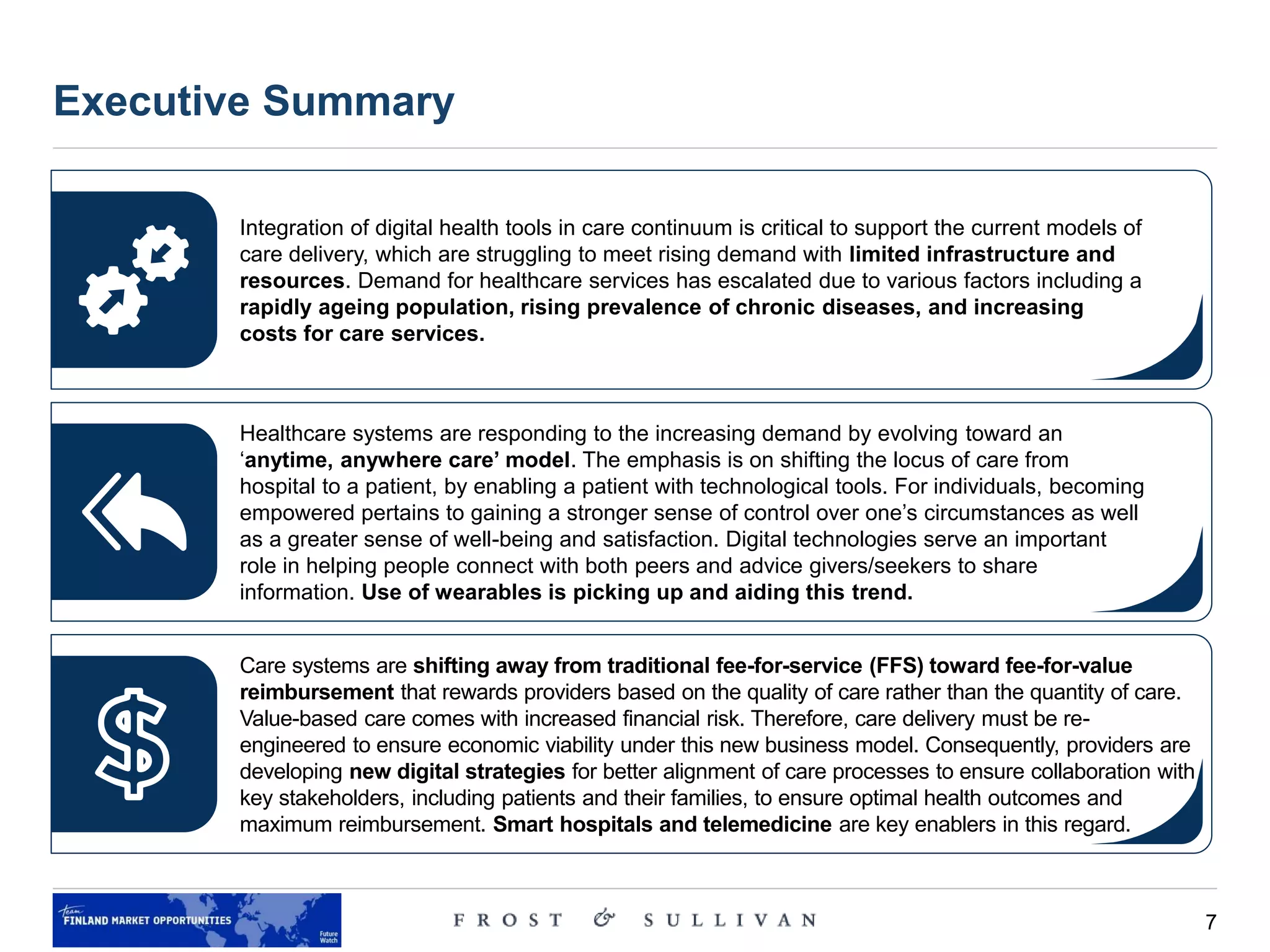
Integration of digital health tools in care continuum is critical to support the current models of
care delivery, which are struggling to meet rising demand with limited infrastructure and
resources. Demand for healthcare services has escalated due to various factors including a
rapidly ageing population, rising prevalence of chronic diseases, and increasing
costs for care services.
Healthcare systems are responding to the increasing demand by evolving toward an
‘anytime, anywhere care’ model. The emphasis is on shifting the locus of care from
hospital to a patient, by enabling a patient with technological tools. For individuals, becoming
empowered pertains to gaining a stronger sense of control over one’s circumstances as well
as a greater sense of well-being and satisfaction. Digital technologies serve an important
role in helping people connect with both peers and advice givers/seekers to share
information. Use of wearables is picking up and aiding this trend.
Care systems are shifting away from traditional fee-for-service (FFS) toward fee-for-value
reimbursement that rewards providers based on the quality of care rather than the quantity of care.
Value-based care comes with increased financial risk. Therefore, care delivery must be re-
engineered to ensure economic viability under this new business model. Consequently, providers are
developing new digital strategies for better alignment of care processes to ensure collaboration with
key stakeholders, including patients and their families, to ensure optimal health outcomes and
maximum reimbursement. Smart hospitals and telemedicine are key enablers in this regard.
8
Executive Summary (continued)
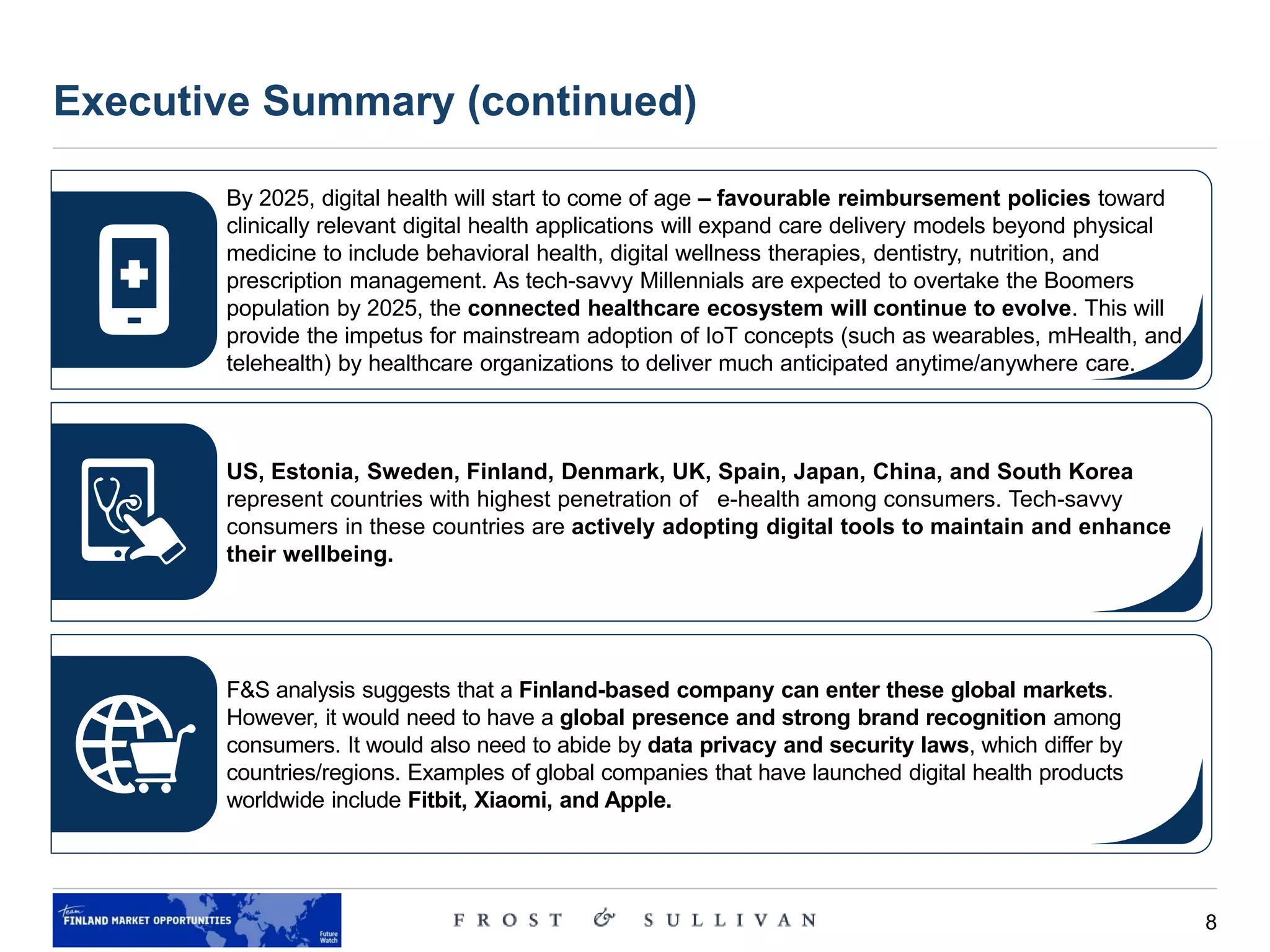
By 2025, digital health will start to come of age – favourable reimbursement policies toward
clinically relevant digital health applications will expand care delivery models beyond physical
medicine to include behavioral health, digital wellness therapies, dentistry, nutrition, and
prescription management. As tech-savvy Millennials are expected to overtake the Boomers
population by 2025, the connected healthcare ecosystem will continue to evolve. This will
provide the impetus for mainstream adoption of IoT concepts (such as wearables, mHealth, and
telehealth) by healthcare organizations to deliver much anticipated anytime/anywhere care.
US, Estonia, Sweden, Finland, Denmark, UK, Spain, Japan, China, and South Korea
represent countries with highest penetration of e-health among consumers. Tech-savvy
consumers in these countries are actively adopting digital tools to maintain and enhance
their wellbeing.
F&S analysis suggests that a Finland-based company can enter these global markets.
However, it would need to have a global presence and strong brand recognition among
consumers. It would also need to abide by data privacy and security laws, which differ by
countries/regions. Examples of global companies that have launched digital health products
worldwide include Fitbit, Xiaomi, and Apple.
9
1. TRANSFORMATIONS IN CARE DELIVERY
Back to Contents
10
Source: Our World in Data, The Lancet Diabetes & Endocrinology Journal, Stanford University
Transformations in care delivery – discussion
Evolving societal needs are straining current healthcare systems, making it imperative
to transform care delivery
Healthcare delivery systems across the globe strive to meet three core objectives: improving the quality of care,
increasing access of services, and reducing per capita costs of healthcare. Major societal strides taken in the past
century have made it imperative for care delivery systems to challenge their status quo in order to meet the ever
increasing demand.
Most important social changes during the past century include the rise in average life expectancy and population. While
in 1900, the global population stood at around 1.6 billion and on an average people didn’t expect to live beyond 40
years of age, today the global population is above 7 billion with people living above 80 years of age in many parts of
the world.
In parallel to the rising population there has been an increase in the adoption of technological solutions, which have
reduced the need of manual labor. This is encouraging a sedentary lifestyle where people are consuming fast food,
with minimal exercises. These societal changes are producing a rapidly unfit population which is prone to chronic
disease such as diabetes, cancer and cardiovascular disorders.
There is a pressing need for care delivery to evolve in order to meet the challenges posed by evolving social dynamics.
Hospital systems, with their limited infrastructure and funds, cannot meet the needs of such a large patient cohort. For
instance, it is estimated that the number of adults with type 2 diabetes is expected to rise from 406 million in 2018 to 511
million in 2030 due to ageing, urbanization, and associated changes in diet and physical activity. Amount of insulin
needed to effectively treat type 2 diabetes will rise by more than 20% worldwide by 2030. Without major improvements in
access, insulin will be beyond the reach of around 40 million adults with type 2 diabetes who will need it in 2030.
11
Source: Our World in Data, The Lancet Diabetes & Endocrinology Journal, Stanford University
Transformations in care delivery – discussion
By 2025, digital health will come of age. Healthcare organizations will adopt IoT
concepts (such as wearables, and telehealth) to deliver anytime/anywhere care.
Healthcare delivery systems need to lay the onus on people. Instead of clamoring for meeting the
increasing demand, which will be difficult to meet due to limited resources, healthcare delivery
systems should try to spur individuals toward a healthier lifestyle. Focus should be on
prevention of disease rather than trying to remedy it.
People should be sensitized toward using digital technologies to monitor their health. Payers
need to innovate medical insurance models, such that there are economic incentives for
people to stay fit, such as lower co-pay and deductibles. Such moves will prompt individuals to
take more responsibility for their health.
Another direction which governments need to review is decentralization of healthcare services.
There is a need to reduce loads on hospitals. Government should promote healthcare at the
community level. If a person gets sick, care should be available at a primary care center in a
retail pharmacy. Such a model will help reduce the load on over burdened hospitals, which should
be used only in case of emergency, critical care. To further reduce load on hospitals and create
capacity for people who need it more, people recovering from chronic conditions or post
operation should do so at their homes, instead of hospitals. Smart digital technologies
can help in this regard.
12
Back to Contents
1.1 SYSTEM WIDE CHALLENGES THAT NEED TO BE
ADDRESSED GLOBALLY
13
• On one hand, rising population, aging population and more patients with chronic and multiple
co-morbidities are putting immense pressure on current healthcare systems, which is expected to rise
by 2025.
• On the other hand, governments are struggling to balance healthcare budgets with other
expenses. This is resulting in an overburdened infrastructure and healthcare workforce, which has little
scope for expansion. This imbalance in demand and supply is expected to balloon further by 2025,
presenting serious challenges for global healthcare systems.
Increasing number of
Chronic patients
Source: United Nations, World Health Organization
System wide challenges
If nothing is done, these challenges are strong enough to cripple economies.
System-wide Challenges Unbalancing Healthcare Demand & Supply
Rising
population
Ageing
population
Shortage of healthcare
professionals
Limited healthcare
infrastructure
Burgeoning healthcare budgets falling
short of expected outcomes
SUPPLY
DEMAND
14
Source: United Nations
Global Challenges
Rapidly rising population pressurizes healthcare systems in India and China
• The current model of sick care is unsustainable due to a number of compelling reasons — rapidly rising population
burden tops the list.
• As per the United Nations, Asia and Africa will have significant population growth, putting immense pressure on
their already stressed healthcare infrastructure.
World Population Distribution by Region (billion,
2015-2100)
Rising population
World Population to 2100 (billion)
By 2025, the global population will reach 8.1 billion. India is expected to surpass China as the most populous
country in the world, with around a 1.5 billion population.
15
Source: United Nations’ World Population Aging Report
Global Challenges
Rapidly ageing population demands more healthcare services
• The share of the elderly population (aged 60 and above) is set to rise, while the share of the working adult
population to support this elderly population remains constant, and even drops after 2030.
20 18 16 15 14
28
25 24 24
21
42
45 45 45 43
10 12
15 16
22
0
5
10
15
20
25
30
35
40
45
50
2000 2015 2025 2030 2050
0-9
10-24
25-59
60 & above
Population
(%)
Population Distribution by Age Group, Global, 2000-2050
The young children (0-9) population
base is likely to decrease marginally;
however, populations of all other age
groups are set to grow
Elderly population is rapidly
increasing, and the population
base of adults to support them is
decreasing, making it a challenge
Ageing population
16
Source: World Health Organization
Global Challenges
Lifestyle changes are increasing chronic disorders
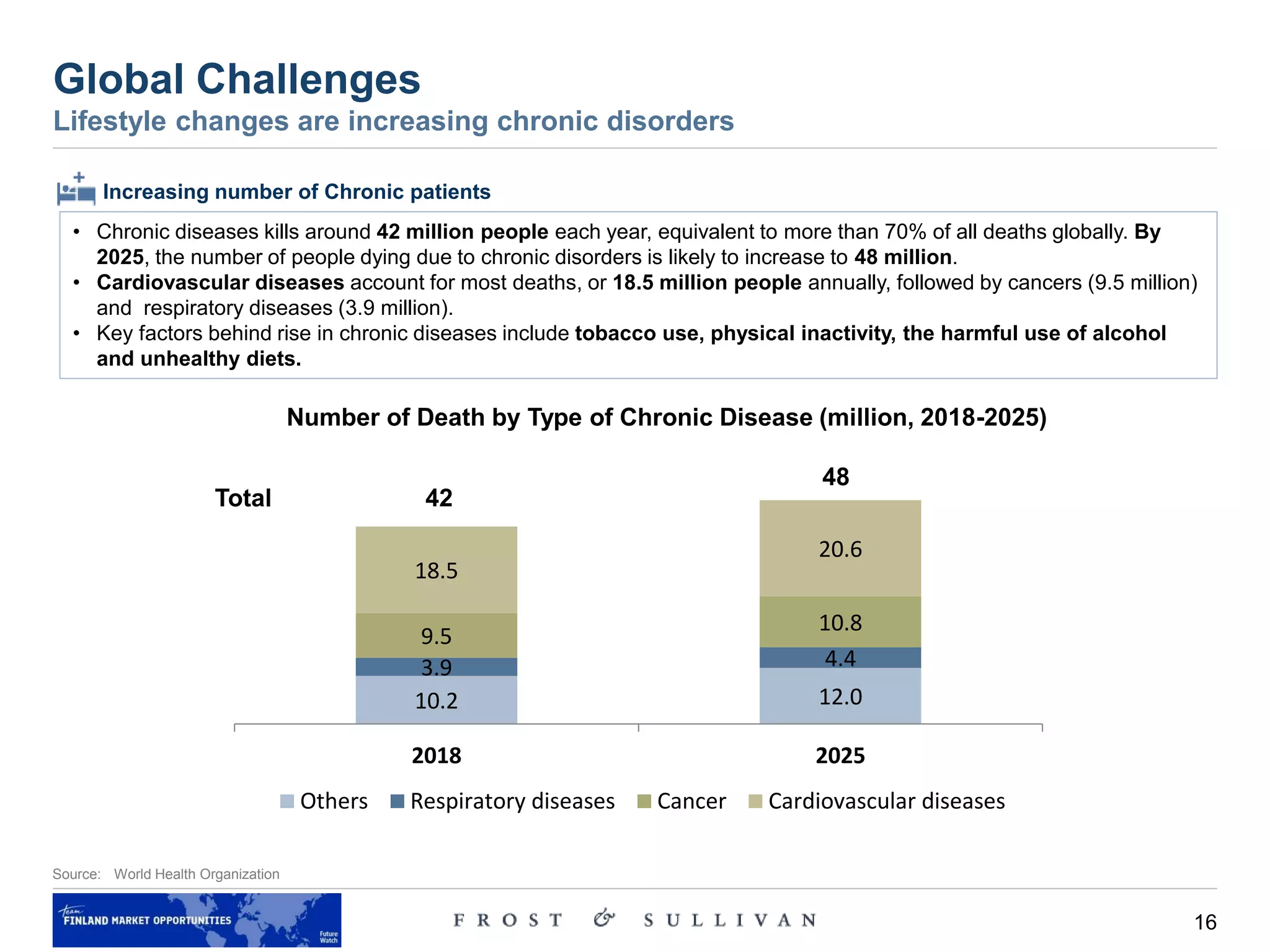
• Chronic diseases kills around 42 million people each year, equivalent to more than 70% of all deaths globally. By
2025, the number of people dying due to chronic disorders is likely to increase to 48 million.
• Cardiovascular diseases account for most deaths, or 18.5 million people annually, followed by cancers (9.5 million)
and respiratory diseases (3.9 million).
• Key factors behind rise in chronic diseases include tobacco use, physical inactivity, the harmful use of alcohol
and unhealthy diets.
Increasing number of Chronic patients
10.2 12.0
3.9 4.4
9.5
10.8
18.5
20.6
2018 2025
Others Respiratory diseases Cancer Cardiovascular diseases
Total 42
48
Number of Death by Type of Chronic Disease (million, 2018-2025)
17
Source: World Bank, Health Expenditure and Financing – OECDstat (2017), Our World in Data
Global Challenges
Disconnect between healthcare spending and patient outcomes
• The world is grappling with a significant disconnect between health spending and actual patient outcomes.
• Developed countries including the US, Switzerland and Sweden, spend higher than the rest, and yet that does not
lead to a proportionate increase in life expectancy.
Life Expectance vs. health expenditure, Global, 1970 to 2015
Ballooning healthcare budgets yielding little gains
Lifeexpectancyatbirth
Per capita health expenditure
18
Source: OECD.Stat
Global Challenges
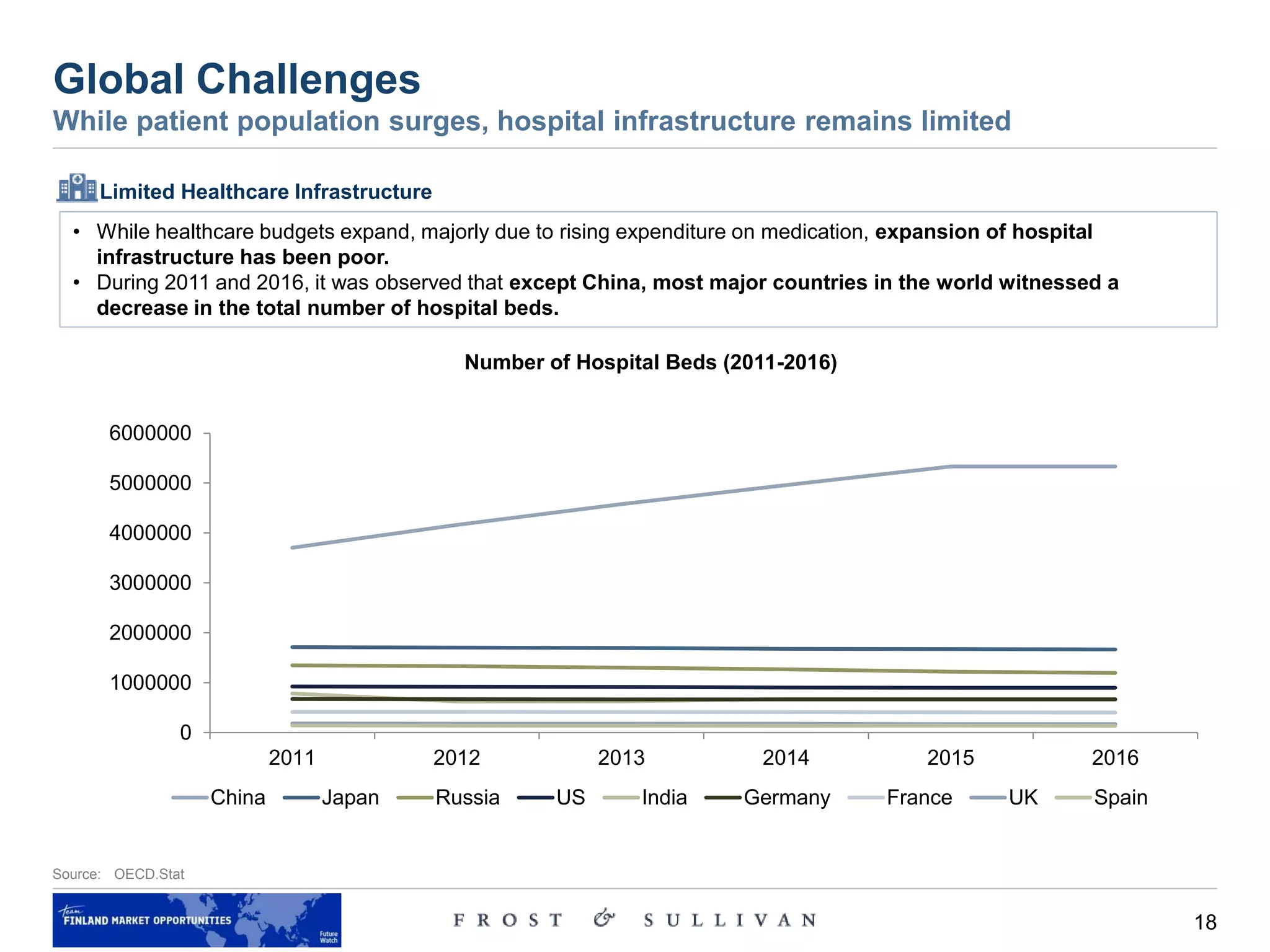
While patient population surges, hospital infrastructure remains limited
• While healthcare budgets expand, majorly due to rising expenditure on medication, expansion of hospital
infrastructure has been poor.
• During 2011 and 2016, it was observed that except China, most major countries in the world witnessed a
decrease in the total number of hospital beds.
Limited Healthcare Infrastructure
0
1000000
2000000
3000000
4000000
5000000
6000000
2011 2012 2013 2014 2015 2016
China Japan Russia US India Germany France UK Spain
Number of Hospital Beds (2011-2016)
19
Source: Mercer’s US Healthcare External Labor Market Analysis (2017).
Global Challenges
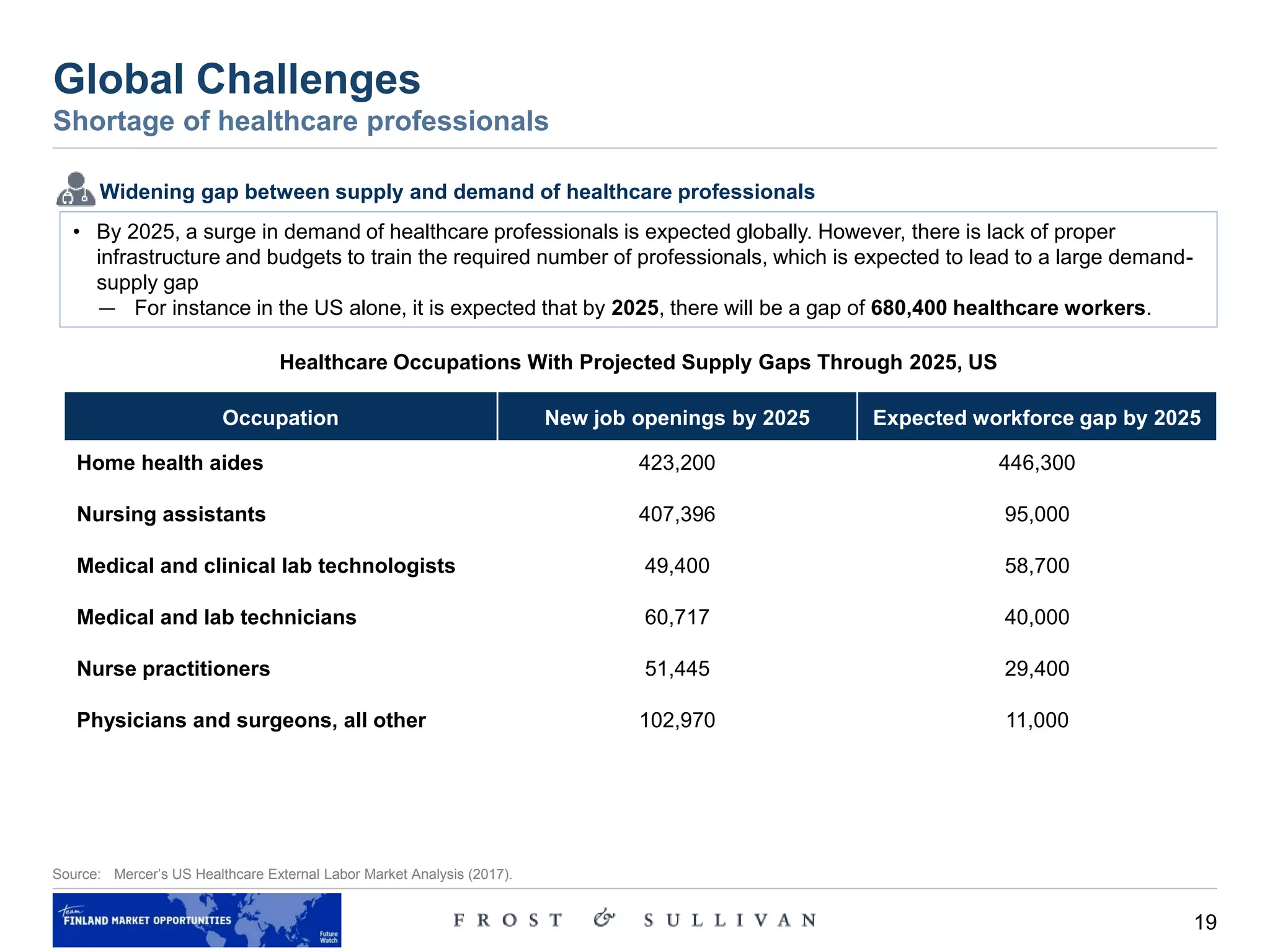
Shortage of healthcare professionals
• By 2025, a surge in demand of healthcare professionals is expected globally. However, there is lack of proper
infrastructure and budgets to train the required number of professionals, which is expected to lead to a large demand-
supply gap
— For instance in the US alone, it is expected that by 2025, there will be a gap of 680,400 healthcare workers.
Healthcare Occupations With Projected Supply Gaps Through 2025, US
Widening gap between supply and demand of healthcare professionals
Occupation New job openings by 2025 Expected workforce gap by 2025
Home health aides 423,200 446,300
Nursing assistants 407,396 95,000
Medical and clinical lab technologists 49,400 58,700
Medical and lab technicians 60,717 40,000
Nurse practitioners 51,445 29,400
Physicians and surgeons, all other 102,970 11,000
20
Back to Contents
1.2. HEALTH SYSTEM GOALS
21
Source: WHO, ‘Here's an incentive that really makes people exercise more’, CNN (February 2016)
Health system goals – discussion
Health system goals vary between the developed and developing nations of the world
Wide heterogeneity exists between the global healthcare systems. While the developed countries
such as the US and the UK have large funding, and access to all the latest and cutting-edge
technologies, developing countries such as India and China struggle to meet even the basic
healthcare demands of their populations.
Developed health systems are aiming at increasing the accountability of patients. Their focus in
on spreading awareness and educating the people. One of the most celebrated examples of this is
Finland’s ‘North Karelia’ project, where the country’s health system introduced a variety of activities
and innovative programs such as nationwide TV series and Cholesterol-lowering competitions that
resulted in reduction of heart attacks incidence rate by 75%. Similarly, workplace wellness programs
are gaining popularity in the US, and more than 80% of large employers are now using some form of
financial incentive to increase physical activity. Health systems are promoting the use of self-health
monitoring apps to motivate people to stay healthy.
In developing countries, healthcare systems are focused on increasing access to care for their
citizens, especially in the rural areas. Countries such as China and India are exploring various
digital options to increase penetration of healthcare services. For instance, China has launched a
‘Healthy China 2030 Program’ in which it is investing in digital health tools for providing equitable
access to healthcare—overcoming the rural-urban divide, and efficient utilization of healthcare
resources.
22
Source: European Commission policy on transformation of health care in the Digital Single Market (April 2018)
Health system goals – developed countries
Europe aims to increase funding to accelerate innovations in digital health
Secure access and exchange of health
data Health data pooled for research
and personalised medicineAmbition: Citizens securely access their health
data and health providers can exchange them
across the EU.
Actions
• eHealth Digital Service Infrastructure will
deliver initial cross-border services (patient
summaries and ePrescriptions) and
cooperation between participating countries
will be strengthened.
• Proposals to extend scope of eHealth
cross-border services to additional cases,
e.g. full electronic health records.
• Recommended exchange format for
interoperability of existing electronic
health records in Europe.
European Commission policy on transformation of health care in the Digital Single Market, 2018
Ambition: Shared health resources
allowing targeted and faster research,
diagnosis and treatment.
Actions
• Voluntary collaboration mechanisms
for health research and clinical
practice, starting with “one million
genomes by 2022” target
• Specifications for secure access and
exchange of health data.
• Pilot actions on rare diseases,
infectious diseases and impact data.
Ambition: Citizens can monitor their health, adapt their lifestyle and interact with their doctors and carers
Actions
• Facilitate supply of innovative digital-based solutions for health, also by SMEs, with common
principles and certification.
• Support demand uptake of innovative digital-based solutions for health, notably by healthcare
authorities and providers, with exchange of practices and technical assistance.
• Mobilise more efficiently public funding for innovative digital-based solutions for health, including
EU funding.
Digital tools and data for citizen
empowerment and person-centred healthcare
23
Source: Digital Health Innovation Action Plan, US FDA (July 2017)
Health system goals – developed countries
In the US, a conducive regulatory environment is being created to foster innovation in
digital health
• The US FDA is recalibrating its approach to digital health to assure safe and fast access for its people.
• One of its key initiatives is the launch of its ‘Pre-Cert Program’ under which certified manufacturers of digital health
software will qualify to be able to market their lower-risk devices without additional FDA review or with a more
streamlined premarket review.
• Pre-Cert firms could also collect real-world data postmarket that might be used, for example, to affirm the regulatory
status of the product, as well as to support new and evolving product functions.
― Pre-Cert 1.0, the first version of the program will be available in 2019
Digital Health Innovation Action Plan
24
Source: Healthy China 2030 Program
Health system goals – developing countries
Focus is on improving health access and overcoming regional fragmentation
Objectives Initiatives and Emerging Models
• Improving key indicators of healthcare delivery
• Streamline investments in healthcare
• Improving healthcare resource utilization
• Increasing access to healthcare insurance
• Healthy China 2030 Program, announced by
President Xi Jinping in October 2016
• Medium to long-term plan is being executed currently
(2017-2025) and is executed by State Council
• Tiered healthcare services including transformation of
primary care
• Using healthcare IT to transform healthcare delivery
in China
• Integrate healthcare services
• Healthcare modernization, optimize resource
utilisation, innovative services, improve efficiency,
reduce costs and meet the increasing demand on
healthcare
• China’s national planning guideline for the healthcare
service system - establishing digital health
information database network which will integrate
patient health profiles and medical records in
electronic form by 2020
• Rise of several digital and E-commerce companies
• Online hospitals and virtual care
• State guidance on developing Internet plus
Healthcare
25
Back to Contents
1.3. CONSUMER / PATIENT CENTRIC CHALLENGES THAT
NEED ADDRESSING
26
Source: WHO, FAO, World Bank
Consumer / patient centric challenges – discussion
Attitudes of consumers/patients has resulted in serious global challenges including
rising obesity and low adherence to medication
The term “patient engagement” is increasingly used to convey the idea of
consumerism or patient-directed healthcare. The Center for Advancing Health
defines patient engagement as “actions individuals must take to obtain the greatest
benefit from the healthcare services available to them.”
For patients, these actions involve taking on more personal responsibility to learn
about how to care for themselves beyond what happens within the four walls of the
hospital or doctor’s office, including managing a chronic condition or preparing for a
medical procedure or hospitalization. Studies have shown that patients who are
involved in their health decisions are more likely to cooperate and understand
their disease process. In addition, educated, engaged consumers tend to have
better outcomes at lower resource utilization.
The patient engagement movement is real, but barriers continue to exist as many
consumers still lack the interest and motivation needed to take a more proactive role in
their health. This is leading to serious issues such as rising obesity due to poor
diets and limited exercise and lower medical adherence.
27
Consumer/ Patient Centric Roadblocks
High consumption of unhealthy food escalating obesity
Source: WHO, FAO, World Bank DataBank
650
million
(2016)
>1 billion
(2025)
Total Number of Obese Adults (>18 years) - Global
11.7%
(2011)
13.2%
(2016)
Percentage of Obese Adults (>18 years) - Global
20.0%
(2025)
• Swayed by marketing and advertisement and other factors such as ease of access and low cost, people are
consuming unhealthy, fast junk food items which are rich in fat, calories and salt, but lack essential nutrients.
• Such unhealthy diet is linked with obesity which in turn leads to high blood pressure, cardiovascular disorders
and diabetes.
• Globally, the US, the UK, Ireland, Australia, Canada and New Zealand lead, have almost a fifth of world’s obese
adults. By 2025, the UK will become the most obese nation in Europe, with about 38% of its adults seen as obese.
“Fast and junk food is cheaper, and easier to access and prepare than fresh food, particularly for poor people in urban areas. The
consumption of these cheap foods comes however, at a high cost to society with obesity a risk factor for many non-communicable
diseases such as heart disease, stroke, diabetes and some cancers. If we do not adopt urgent actions to halt the increasing obesity
rates, we soon may have more obese people than undernourished people in the world.“ — José Graziano da Silva, Director-
General, FAO
28
Consumer/ Patient Centric Roadblocks
Sedentary lifestyles with limited exercises increasing unfit population
Source: ‘Lack of exercise puts one in four people at risk, WHO says’, BBC News (September 2018)
As per the World Health Organization (WHO), nearly 1.4 billion people in the world are not doing physical exercises
Inactivity raises the risk of numerous chronic conditions, including cardiovascular disorders, type-2 diabetes
and cancer
29
Consumer/ Patient Centric Roadblocks
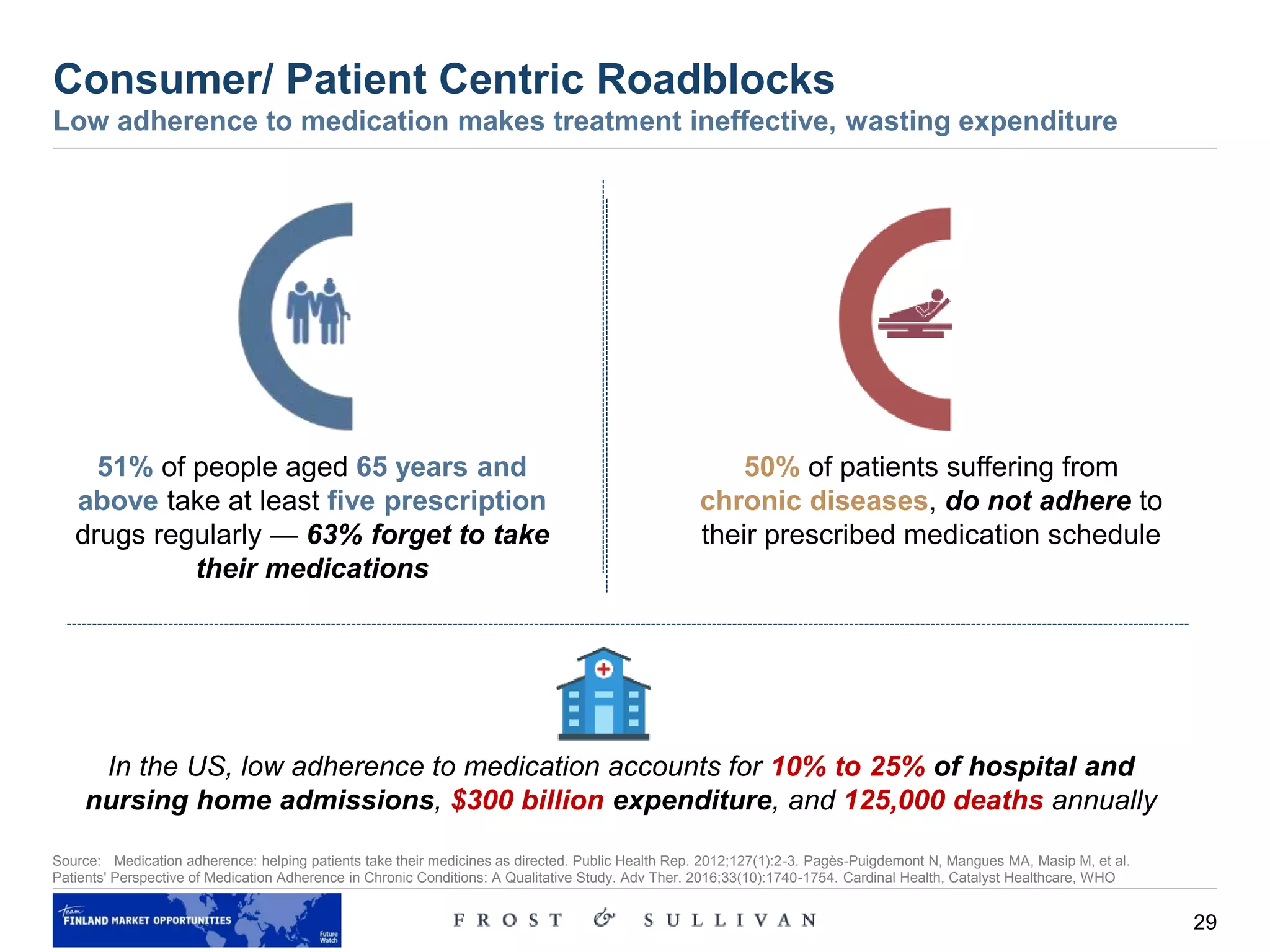
Low adherence to medication makes treatment ineffective, wasting expenditure
Source: Medication adherence: helping patients take their medicines as directed. Public Health Rep. 2012;127(1):2-3. Pagès-Puigdemont N, Mangues MA, Masip M, et al.
Patients' Perspective of Medication Adherence in Chronic Conditions: A Qualitative Study. Adv Ther. 2016;33(10):1740-1754. Cardinal Health, Catalyst Healthcare, WHO
51% of people aged 65 years and
above take at least five prescription
drugs regularly — 63% forget to take
their medications
50% of patients suffering from
chronic diseases, do not adhere to
their prescribed medication schedule
In the US, low adherence to medication accounts for 10% to 25% of hospital and
nursing home admissions, $300 billion expenditure, and 125,000 deaths annually
30
Back to Contents
1.4. WELLNESS MANAGEMENT – PRESCRIPTIVE OR
OWNERSHIP BASED
31
• Providers continue to encourage patient
engagement and ensure that efforts are
sustainable to positively impact health
outcomes. Fortunately, a variety of new
strategies have been developed that
encourage and motivate patients to take
ownership and become more involved in
decisions about their care.
• These strategies include increased
deployment of a range of consumer-
facing digital solutions, including digital
educational content, wearable sensors,
mobile apps, and other tools.
• The future healthcare expenditure spend
will evolve to focus less on treating
diseases and more on prevention,
diagnosis, and monitoring.
Prevention
Diagnosis
Treatment
Monitoring
$$$$
CARECONTINUUM
*Not to Scale
Healthcare Market: Shifting Healthcare Spend*
Across Care Continuum, Global, 2017
Source: Frost & Sullivan
Wellness management – prescriptive or ownership based
Healthcare industry shifting ownership on patients - focusing on prevention and
wellness
32
Source: US Patient Engagement Solutions Market, Landscape Assessment, Frost & Sullivan
Wellness management – prescriptive or ownership based
Gaps encountered in a typical patient engagement workflow and their impact on
national health expenditure
33
Source: US Patient Engagement Solutions Market, Landscape Assessment, Frost & Sullivan
Wellness management – prescriptive or ownership based
Patient engagement strategy for a value-based healthcare ecosystem based on three
key objectives
34
Source: Technology Innovations for Patient Engagement, Frost & Sullivan
Wellness management – prescriptive or ownership based
Patient engagement enabling patient centric care
35
Source: Technology Innovations for Patient Engagement, Frost & Sullivan
Wellness management – prescriptive or ownership based
Technology advances improving patient engagement solutions
36
Source: Technology Innovations for Patient Engagement, Frost & Sullivan
Wellness management – prescriptive or ownership based
Technology advances and convergence for patient engagement
37
Source: Technology Innovations for Patient Engagement, Frost & Sullivan
Wellness management – prescriptive or ownership based
Patient engagement solution enabling treatment adherence, disease management, and
overall population health management
38
Back to Contents
1.5. ALTERNATE CARE LOCATIONS
39
Source: Vision 2025 – Healthcare in the Smart Home, Frost & Sullivan, HealthCatalyst
Alternate care locations – discussion
Care delivery moving to the home environment
• The industry is gradually evolving to acknowledge the ‘anytime, anywhere care’ model, and the result is the remodeling
of healthcare services to suit this trend. Technological developments and the Internet of Things (IoT) enable a home to
evolve into a connected home. We believe that the convergence of these trends—focus on prevention and
wellness, care delivery moving in to the home and endless home automation possibilities—is imminent.
• According to a report on the Clinically Appropriate & Cost-Effective Placement Project (CACEP) from the Alliance for
Home Health Care Quality and Innovation, Medicare could reduce its spending by $34.7 billion over a 10-year period
by shifting patient care settings from facility-based care to home and community-based care. Additional $100 billion
could be saved if care delivery were restructured to be less wasteful and more effective.
Pharmacy
Patient
Visits
Path lab
Clinic
Health &
wellness
stores
Telemedicine
Home testing/collection
Online stores
[nutrition, wellness, medical devices]
House call
Products
and
Services
Visit
Patient.
ePharmacy/third-party delivery
Past Present
Healthcare Market: State of Care Delivery, Global, Past, Present & Future
In future, integration of
digital solutions will be
more concrete and visible
40
Source: Vision 2025 – Healthcare in the Smart Home, Frost & Sullivan
Alternate care locations
Smart home provides multiple healthcare services
Analytics/
Informatics
Storage
Machine
Learning
Cybersecurity Interoperability Decision Support
Common Healthcare Services in a Smart Home
Diet & Nutrition
Monitoring
Activity, Exercise, Rest &
Sleep Monitoring
Vaccination and
Medication Management
Telehealth Services
Wearables/Contactless
Vitals Monitoring
Smart Toilets for Waste
Monitoring
Virtual Home Assistants
Diagnostic Devices
41
Source: Vision 2025 – Healthcare in the Smart Home, Frost & Sullivan
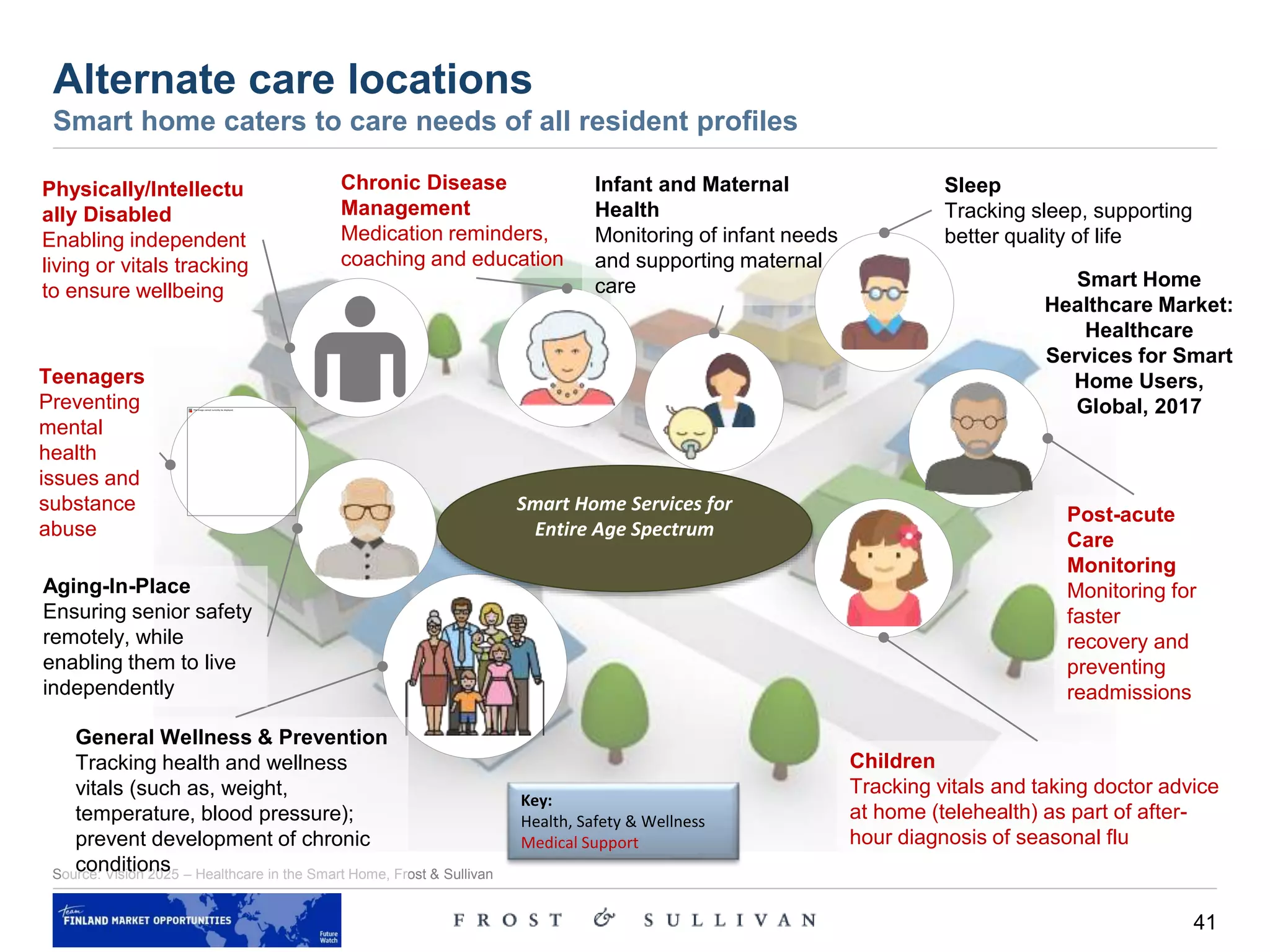
Alternate care locations
Smart home caters to care needs of all resident profiles
General Wellness & Prevention
Tracking health and wellness
vitals (such as, weight,
temperature, blood pressure);
prevent development of chronic
conditions
Aging-In-Place
Ensuring senior safety
remotely, while
enabling them to live
independently
Physically/Intellectu
ally Disabled
Enabling independent
living or vitals tracking
to ensure wellbeing
Sleep
Tracking sleep, supporting
better quality of life
Chronic Disease
Management
Medication reminders,
coaching and education
Post-acute
Care
Monitoring
Monitoring for
faster
recovery and
preventing
readmissions
Children
Tracking vitals and taking doctor advice
at home (telehealth) as part of after-
hour diagnosis of seasonal flu
Smart Home Services for
Entire Age Spectrum
Key:
Health, Safety & Wellness
Medical Support
D
Infant and Maternal
Health
Monitoring of infant needs
and supporting maternal
care
D
Teenagers
Preventing
mental
health
issues and
substance
abuse
Smart Home
Healthcare Market:
Healthcare
Services for Smart
Home Users,
Global, 2017
42
Source: Vision 2025 – Healthcare in the Smart Home, Frost & Sullivan
Alternate care locations
Aspects of aging in smart home
Safety & Security
• Alarms and notifications for residents to be aware of any open doors,
windows
• Reminders for appliances not switched off after use
• Warnings for potentially dangerous leaks (water, gas)
• Automatic notifications for loved ones to check on residents
Isolation & Loneliness
• Virtual companions or social robotic companions
• Video communication for staying in touch with friends and family
• Mixed reality for virtually attending family events and get-togethers
• Mixed or virtual reality devices to relive past memories
Health & Wellbeing
• All aspects of senior lives and body monitored unobtrusively—vitals,
weight, diet, excreta, gait, memory and moods—and updated in patient
records and made available to doctors
• Review of information and real-time alerts (by doctors), if any, and
connect via telehealth with patients weekly to provide medical advice
• Use of mixed reality devices (by doctors) to connect with patients, to
explain complex health conditions visually
43
Source: Vision 2025 – Healthcare in the Smart Home, Frost & Sullivan
Alternate care locations
Aspects of aging in smart home
On-Body Wearables
 Smart implants
 Vitals/activity tracking devices
and apparel
• PERS
• Fall detection
• Smart hearing aids
Bathroom
 Smart pill dispensers
 Diagnostic devices
 Smart mirrors
 Smart weighing scale
 Smart toilets
Entire Home
 Contactless monitoring
sensors and devices for vitals
monitoring
 Motion sensors for detecting
activity, turning lights on/off
 Carbon monoxide, smoke and
water leakage sensors for
preventing mishaps
• Smart plugs or sockets, tags
and sensors for monitoring
activities of daily living (ADL),
keep caregivers and family
members informed
• Flashing tags to remind
performing ADLs for dementia
sufferers
• Smart tags to detect location
of keys, wallets, reading
glasses and other items
• Assistance robots to help with
tasks and for lifting residents
from bed to wheelchair
Smartphone Apps
 Medication adherence
 Activity tracking
• Location tracking/geofencing
Living Room
 Telehealth visits
Kitchen
 Connect with nutritionist for
diet and meal suggestions
• Smart bin to track & reorder
groceries
• Smart cups, spoons and
plates for countering tremors
Bedroom
Sleep Quality
Monitoring
 spO2 monitoring
 Ambient
environment
Social Engagement Tools
• Companion robots
• Virtual companions with digital avatars that
have human caregivers in the background
• Video communication devices or screens
for virtually visiting friends and family
• Mixed/virtual reality headsets for virtual
presence/reliving memories
Voice Interactive
Diagnosis & Control Tools
Artificial Intelligence + Data Analytics
Insights
Legend
 Active Care |  Monitoring |  Support
44
Alternate care locations
Chronic disease management in the smart home
Source: Vision 2025 – Healthcare in the Smart Home, Frost & Sullivan
Seniors Prone to Expensive Chronic Diseases
80% 77%
One Chronic
Disease
Two Chronic
Diseases
Proportion of
Elderly Suffering
from Chronic
Diseases, US,
2017
$317 billion
Cardiovascular
Disease
$245 billion
Diabetes
Annual Cost of
Chronic Diseases,
US, 2017
Proportion of Deaths
Attributed to Non-
communicable
Diseases, Global,
2015 and 2030
2015 2030
68.4% 73.9%
Lack of
Information
Between doctor visits, on
• Symptoms: normal, abnormal
• Diet and nutrition
• Activity
• Side-effects of medication
• Actual health progress
Mental Health
Detecting and managing mental health
issues arising out of managing chronic
conditions for a lifetime
• Anxiety
• Depression
Treatment and
Medication
Adherence
Chronic Condition Patient Challenges
Reminders and ‘nudges’ to stay on track
with provided medical advice, and treatment
regimen
Engagement
Engagement, support and motivation for
managing condition, in terms of diet and
exercise
45
Alternate care locations
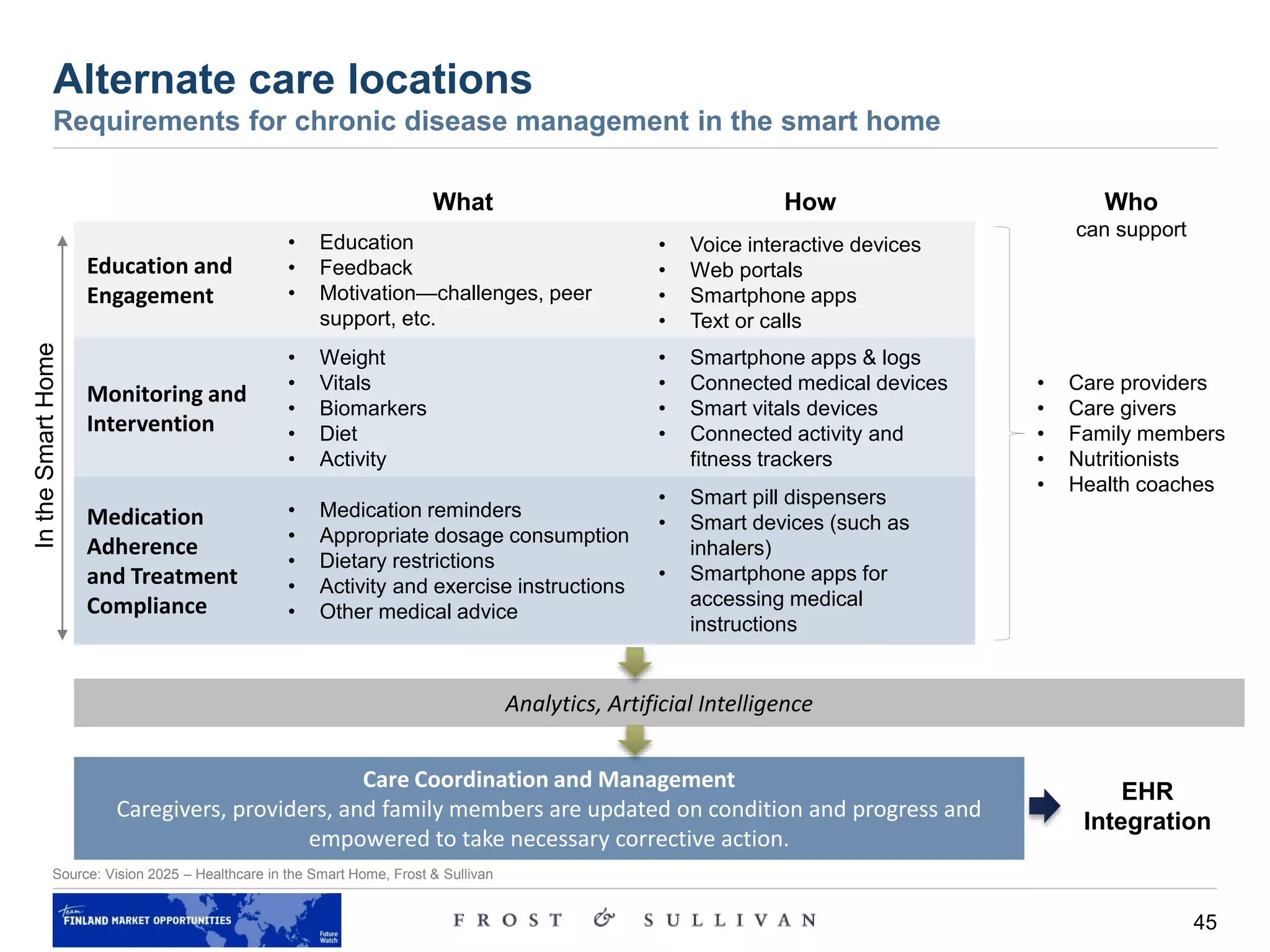
Requirements for chronic disease management in the smart home
Source: Vision 2025 – Healthcare in the Smart Home, Frost & Sullivan
Analytics, Artificial Intelligence
Education and
Engagement
Monitoring and
Intervention
Medication
Adherence
and Treatment
Compliance
Care Coordination and Management
Caregivers, providers, and family members are updated on condition and progress and
empowered to take necessary corrective action.
• Education
• Feedback
• Motivation—challenges, peer
support, etc.
• Smartphone apps & logs
• Connected medical devices
• Smart vitals devices
• Connected activity and
fitness trackers
• Smart pill dispensers
• Smart devices (such as
inhalers)
• Smartphone apps for
accessing medical
instructions
• Weight
• Vitals
• Biomarkers
• Diet
• Activity
IntheSmartHome
What How
• Medication reminders
• Appropriate dosage consumption
• Dietary restrictions
• Activity and exercise instructions
• Other medical advice
• Voice interactive devices
• Web portals
• Smartphone apps
• Text or calls
Who
can support
• Care providers
• Care givers
• Family members
• Nutritionists
• Health coaches
EHR
Integration
46
Alternate care locations
Requirements for chronic disease management in the smart home
Source: Vision 2025 – Healthcare in the Smart Home, Frost & Sullivan
On-Body Wearables
 Smart biomarker monitoring
devices
 Vitals measurement devices
and apparel
 Chronic pain management
Bathroom
 Smart pill dispensers
 Diagnostic devices
 Smart mirrors
 Smart weighing scale
 Smart toilets
Entire Home
 Voice assistants to
 Answer basic questions on
managing disease or to
connect with care
providers to seek answers
from experts
 Remind taking medicines
 Motivate users to exercise
and follow prescribed
regimen of diet and activity
 Contactless monitoring sensors
and devices for vitals
monitoring
• Prepare analytics-based
reports on overall progress,
share (if consented) with
family and friends, and with
care providers
Smartphone Apps
 Medication adherence tools
 Personal disease management
diaries or logs
• Disease management
information tools
Living Room
 Telehealth visits
 Peer support forums (video)
Bedroom
 Sleep apnea support
for diagnosis &
therapy
 Sleep quality
monitoring
Kitchen
 Connect with nutritionist for diet and meal suggestions
 Smart bin to track used food and check compliance with treatment regimen
• Smart refrigerator that keeps track of expired items and suggests recipes on the
basis of available ingredients and diet recommendations
Voice Interactive
Diagnosis & Control Tools
Artificial Intelligence + Data Analytics
Insights
Legend
 Active Care |  Monitoring |  Support
47
Alternate care locations
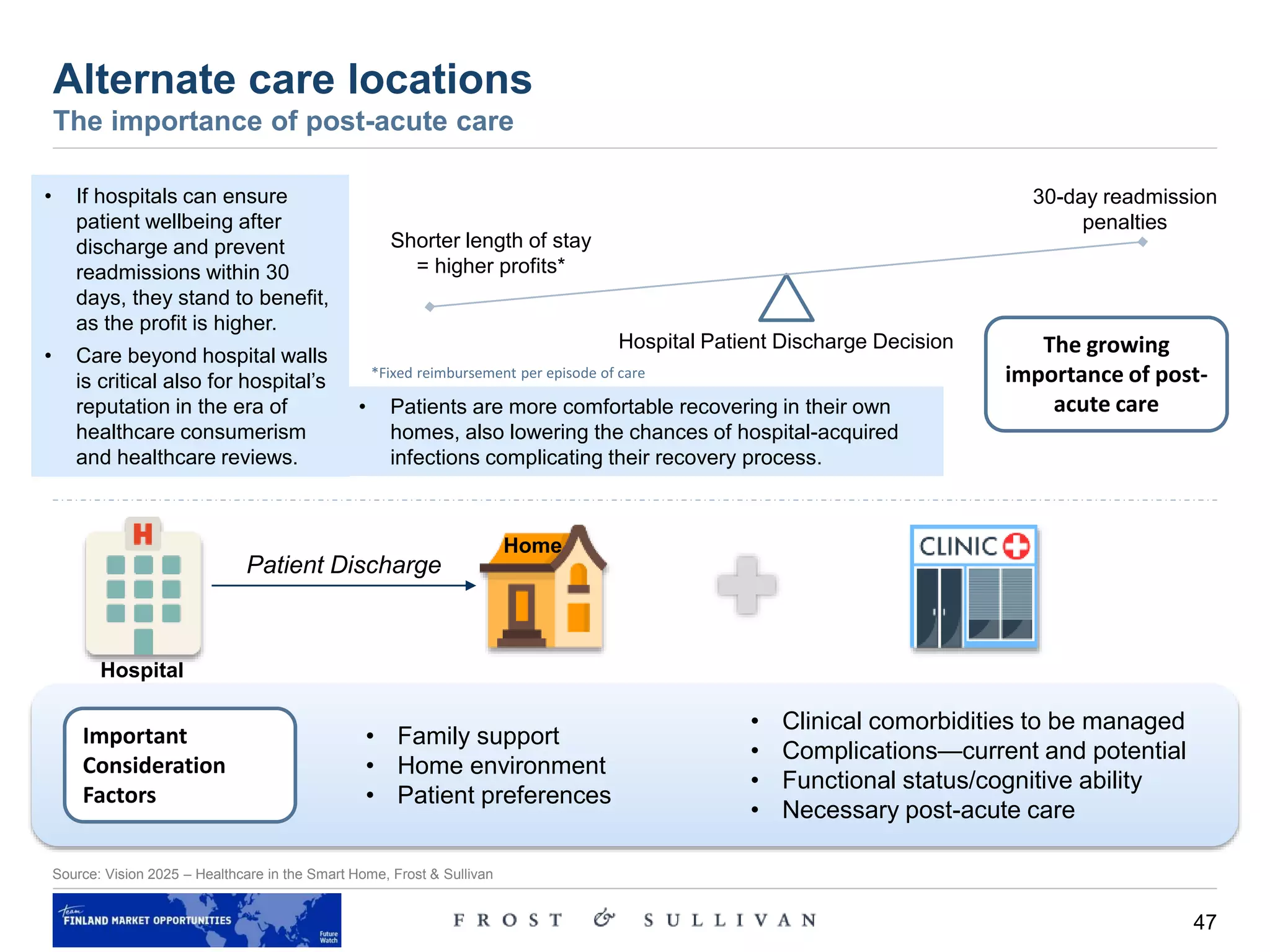
The importance of post-acute care
Source: Vision 2025 – Healthcare in the Smart Home, Frost & Sullivan
• Clinical comorbidities to be managed
• Complications—current and potential
• Functional status/cognitive ability
• Necessary post-acute care
Patient Discharge
Home
Shorter length of stay
= higher profits*
30-day readmission
penalties
Hospital Patient Discharge Decision
*Fixed reimbursement per episode of care
• If hospitals can ensure
patient wellbeing after
discharge and prevent
readmissions within 30
days, they stand to benefit,
as the profit is higher.
• Care beyond hospital walls
is critical also for hospital’s
reputation in the era of
healthcare consumerism
and healthcare reviews.
• Patients are more comfortable recovering in their own
homes, also lowering the chances of hospital-acquired
infections complicating their recovery process.
Important
Consideration
Factors
• Family support
• Home environment
• Patient preferences
The growing
importance of post-
acute care
Hospital
48
Alternate care locations
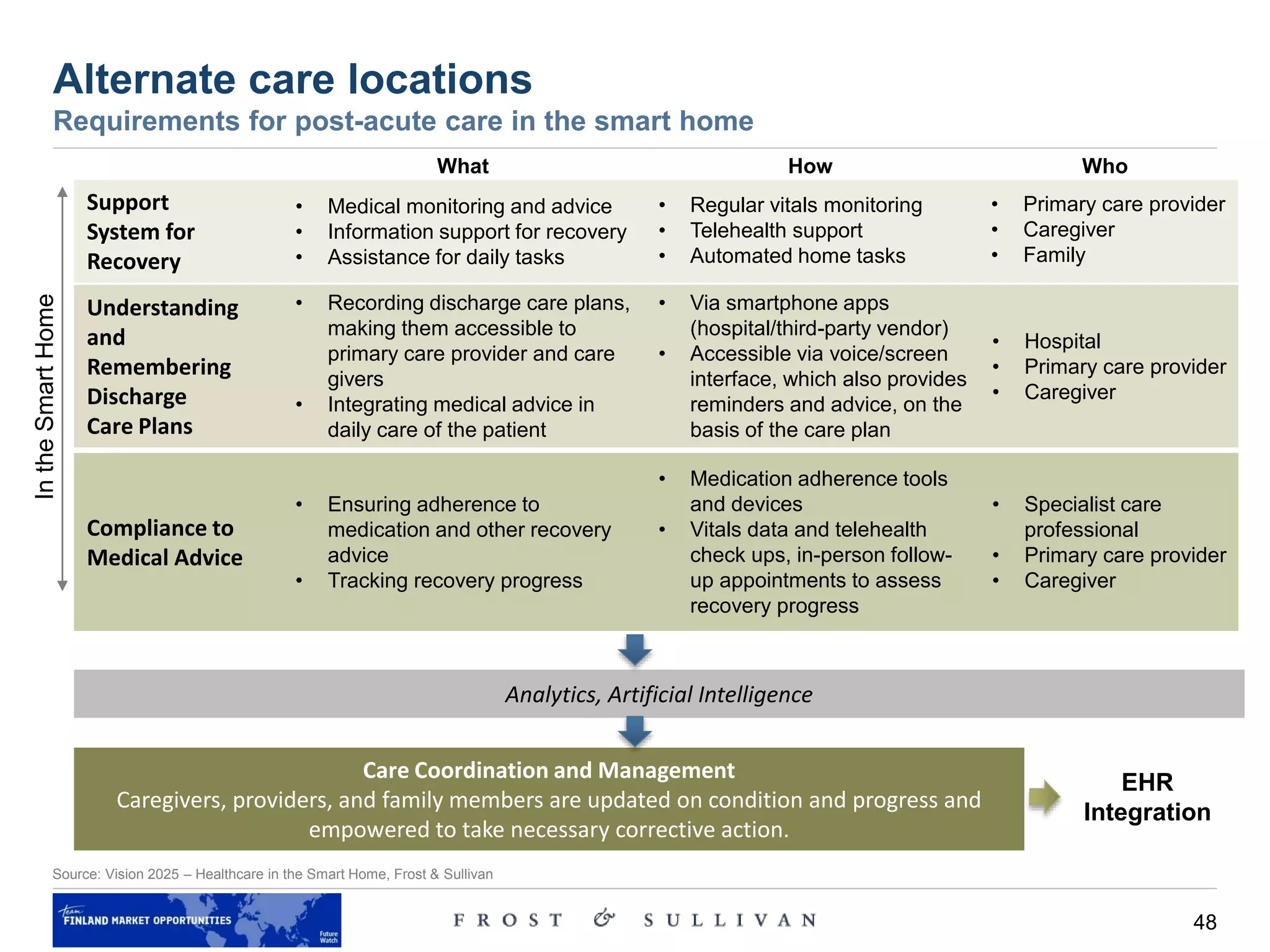
Requirements for post-acute care in the smart home
Source: Vision 2025 – Healthcare in the Smart Home, Frost & Sullivan
Support
System for
Recovery
Understanding
and
Remembering
Discharge
Care Plans
Compliance to
Medical Advice
IntheSmartHome
Analytics, Artificial Intelligence
Care Coordination and Management
Caregivers, providers, and family members are updated on condition and progress and
empowered to take necessary corrective action.
EHR
Integration
• Medical monitoring and advice
• Information support for recovery
• Assistance for daily tasks
• Regular vitals monitoring
• Telehealth support
• Automated home tasks
• Primary care provider
• Caregiver
• Family
• Recording discharge care plans,
making them accessible to
primary care provider and care
givers
• Integrating medical advice in
daily care of the patient
• Via smartphone apps
(hospital/third-party vendor)
• Accessible via voice/screen
interface, which also provides
reminders and advice, on the
basis of the care plan
• Hospital
• Primary care provider
• Caregiver
• Ensuring adherence to
medication and other recovery
advice
• Tracking recovery progress
• Medication adherence tools
and devices
• Vitals data and telehealth
check ups, in-person follow-
up appointments to assess
recovery progress
• Specialist care
professional
• Primary care provider
• Caregiver
What How Who
49
Alternate care locations
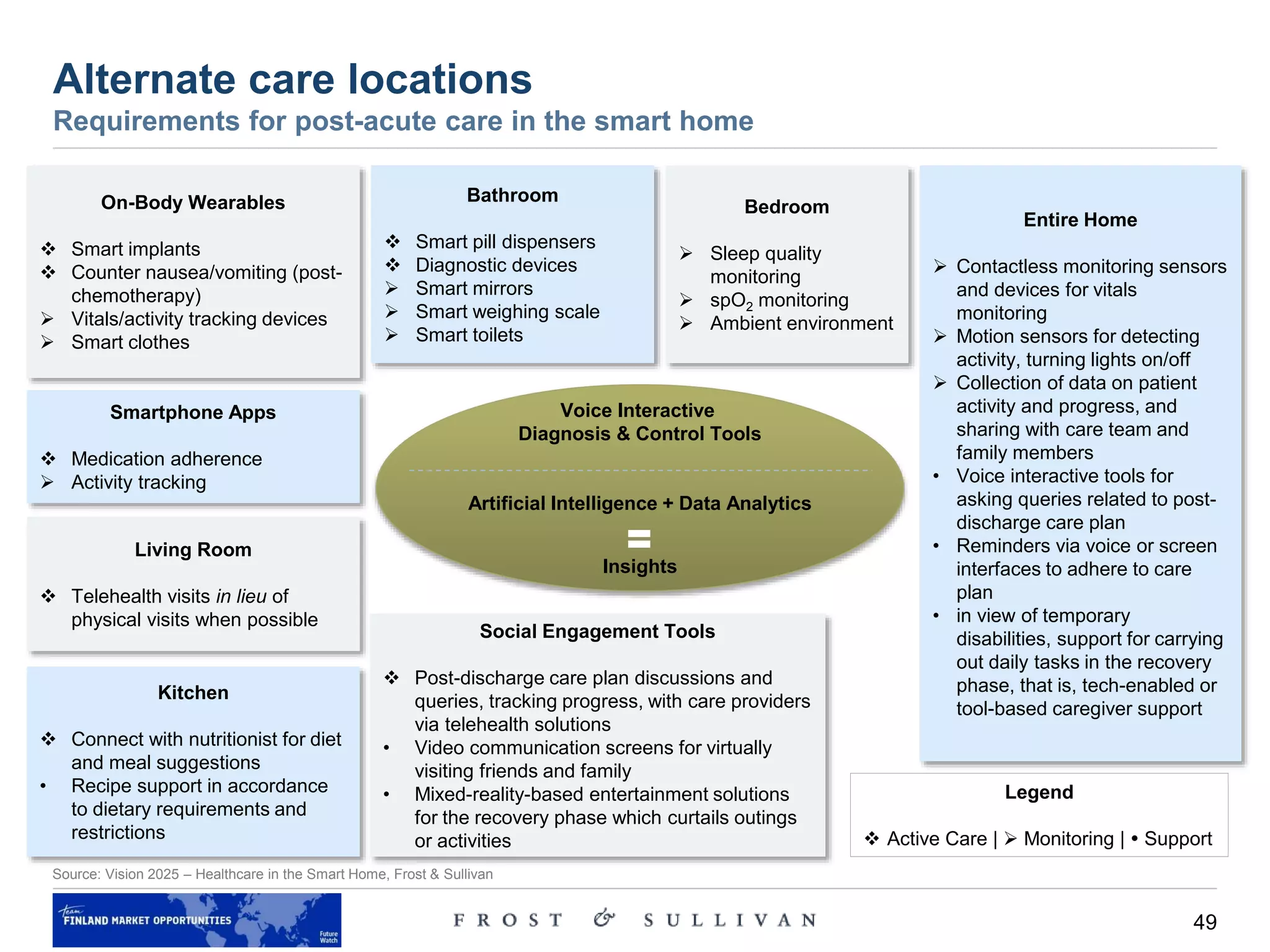
Requirements for post-acute care in the smart home
Source: Vision 2025 – Healthcare in the Smart Home, Frost & Sullivan
On-Body Wearables
 Smart implants
 Counter nausea/vomiting (post-
chemotherapy)
 Vitals/activity tracking devices
 Smart clothes
Bathroom
 Smart pill dispensers
 Diagnostic devices
 Smart mirrors
 Smart weighing scale
 Smart toilets
Entire Home
 Contactless monitoring sensors
and devices for vitals
monitoring
 Motion sensors for detecting
activity, turning lights on/off
 Collection of data on patient
activity and progress, and
sharing with care team and
family members
• Voice interactive tools for
asking queries related to post-
discharge care plan
• Reminders via voice or screen
interfaces to adhere to care
plan
• in view of temporary
disabilities, support for carrying
out daily tasks in the recovery
phase, that is, tech-enabled or
tool-based caregiver support
Smartphone Apps
 Medication adherence
 Activity tracking
Living Room
 Telehealth visits in lieu of
physical visits when possible
Kitchen
 Connect with nutritionist for diet
and meal suggestions
• Recipe support in accordance
to dietary requirements and
restrictions
Bedroom
 Sleep quality
monitoring
 spO2 monitoring
 Ambient environment
Social Engagement Tools
 Post-discharge care plan discussions and
queries, tracking progress, with care providers
via telehealth solutions
• Video communication screens for virtually
visiting friends and family
• Mixed-reality-based entertainment solutions
for the recovery phase which curtails outings
or activities
Voice Interactive
Diagnosis & Control Tools
Artificial Intelligence + Data Analytics
Insights
Legend
 Active Care |  Monitoring |  Support
50
Alternate care locations
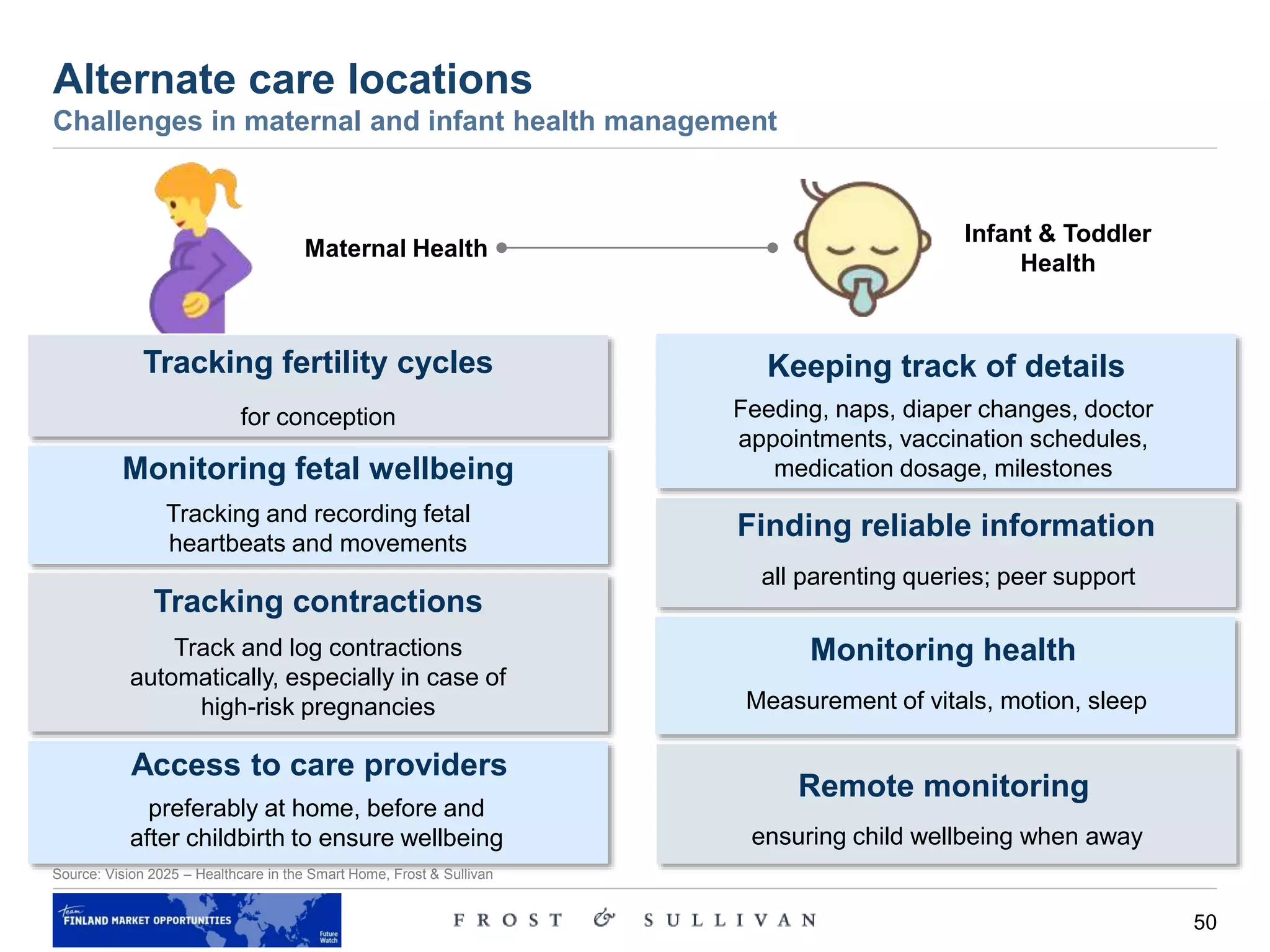
Challenges in maternal and infant health management
Source: Vision 2025 – Healthcare in the Smart Home, Frost & Sullivan
Tracking fertility cycles
for conception
Monitoring fetal wellbeing
Tracking contractions
Tracking and recording fetal
heartbeats and movements
Track and log contractions
automatically, especially in case of
high-risk pregnancies
Maternal Health
Infant & Toddler
Health
Keeping track of details
Feeding, naps, diaper changes, doctor
appointments, vaccination schedules,
medication dosage, milestones
Finding reliable information
all parenting queries; peer support
Monitoring health
Measurement of vitals, motion, sleep
Remote monitoring
ensuring child wellbeing when away
Access to care providers
preferably at home, before and
after childbirth to ensure wellbeing
51
Alternate care locations
Requirements for maternal and infant health management in the smart home
Source: Vision 2025 – Healthcare in the Smart Home, Frost & Sullivan
Preconception
Prenatal care
Delivery
Postnatal care
Tracking sleep cycles, feeding patterns and growth
Vaccinations, growth checkups
Weaning, supplements
General health monitoring
Learning, wellbeing and safety
Tracking periods, fertility, family planning support
Monitoring maternal
and fetal health and
wellbeing
Normally occurs in
traditional care delivery
sites
Ensuring mother’s
recovery
Allergies, deficiencies
Ensuring appropriate growth
Ensuring a growth-conducive environment and support
Minor ailments diagnosis and treatment
Preventing injuries and appropriate learning
Smart Support—From Preconception to Infant Management
52
Alternate care locations
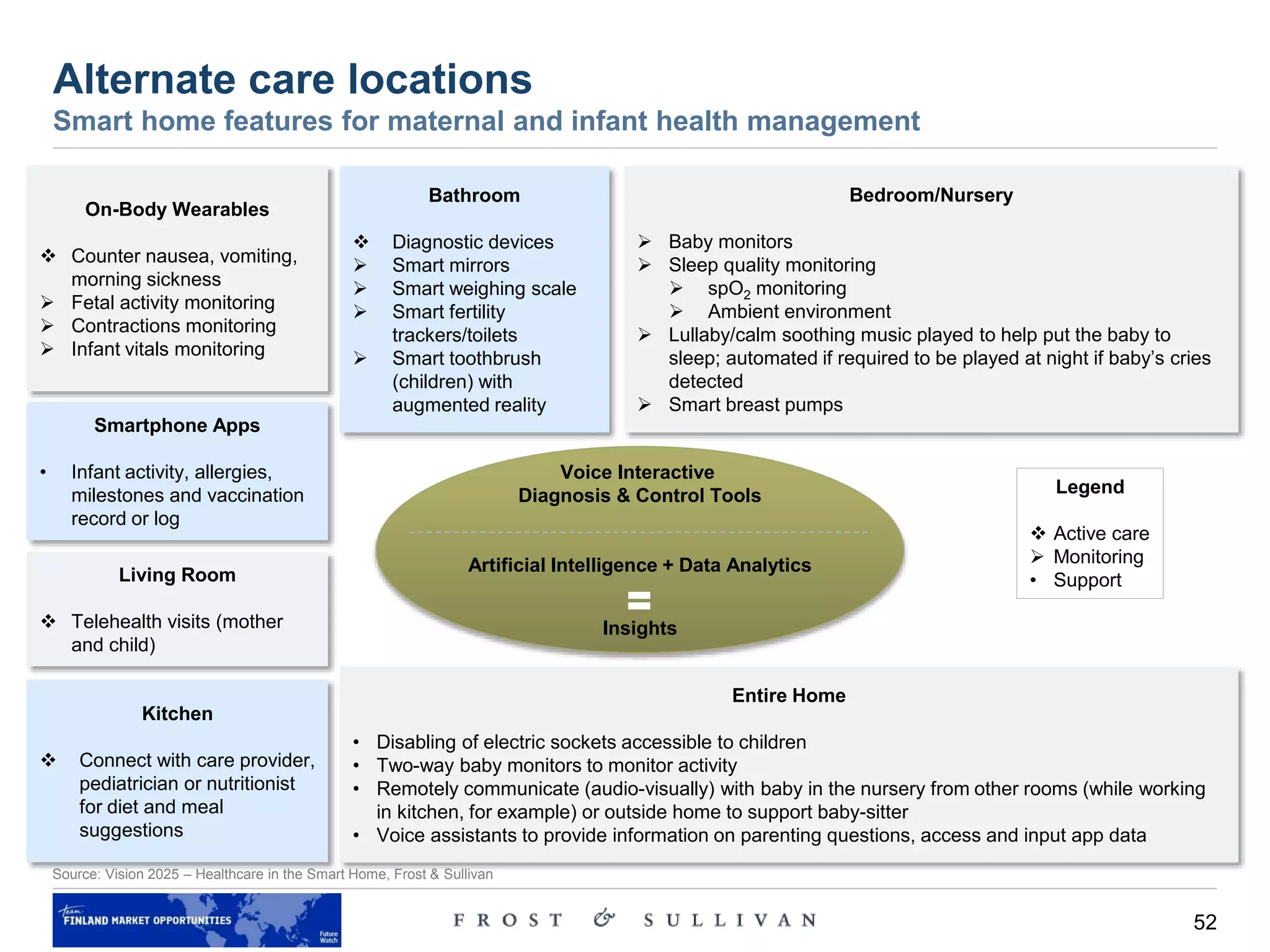
Smart home features for maternal and infant health management
Source: Vision 2025 – Healthcare in the Smart Home, Frost & Sullivan
On-Body Wearables
 Counter nausea, vomiting,
morning sickness
 Fetal activity monitoring
 Contractions monitoring
 Infant vitals monitoring
Bathroom
 Diagnostic devices
 Smart mirrors
 Smart weighing scale
 Smart fertility
trackers/toilets
 Smart toothbrush
(children) with
augmented reality
Smartphone Apps
• Infant activity, allergies,
milestones and vaccination
record or log
Living Room
 Telehealth visits (mother
and child)
Kitchen
 Connect with care provider,
pediatrician or nutritionist
for diet and meal
suggestions
Bedroom/Nursery
 Baby monitors
 Sleep quality monitoring
 spO2 monitoring
 Ambient environment
 Lullaby/calm soothing music played to help put the baby to
sleep; automated if required to be played at night if baby’s cries
detected
 Smart breast pumps
Entire Home
• Disabling of electric sockets accessible to children
• Two-way baby monitors to monitor activity
• Remotely communicate (audio-visually) with baby in the nursery from other rooms (while working
in kitchen, for example) or outside home to support baby-sitter
• Voice assistants to provide information on parenting questions, access and input app data
Voice Interactive
Diagnosis & Control Tools
Artificial Intelligence + Data Analytics
Insights
Legend
 Active care
 Monitoring
• Support
53
Alternate care locations
Smart home requirements for the physically and intellectually disabled
Source: Vision 2025 – Healthcare in the Smart Home, Frost & Sullivan
Tasks or Functions that are a Challenge for Patients with Disabilities
Vision
Hearing
Thinking
Learning
Movement
Mental health
Remembering
Communicating
Social relationships
Daily Tasks
• Opening doors to rooms and of cabinets
• Switching on/switch off lights, drawing
blinds/curtains
• Controlling thermostats, environments
• Bathing and toileting challenges
• Accessing cabinets, kitchen counters,
sinks and cook-tops
• Watching television, changing channels
• Answering doorbell, opening door
• Locating items (such as smartphone)
• Understanding voicemails
• Dispensing medication
• Self-evaluating vitals
• Maintaining home security
• Housekeeping activities
• Support after falls/emergencies
• Guidance and reminders for daily
activities
• Communicating, socializing with others
• Writing/typing, reading, math
54
Alternate care locations
Smart home requirements for the physically and intellectually disabled
Source: Vision 2025 – Healthcare in the Smart Home, Frost & Sullivan
• Each type of
disability poses a
unique set of
challenges, with an
additional need for
‘personalization’ of
solutions designed
for the smart home
resident, depending
on their level of
disability.
• Smart home tools
are a necessity more
than a novelty,
allowing disabled
residents to increase
their capabilities and
maintain
independence, while
maintaining their
dignity.
Visually
Impaired
Hearing
Impaired
Physically
Disabled
Intellectually
Disabled
Heavy reliance on interaction with voice-enabled devices:
• Warning for obstacles, open doors
• Finding objects like smartphones, medications or other devices
• Helping identify objects or people at the door.
• Ascertaining status of environment: curtains, cooktops, thermostats.
• Reliance on visual feedback, depending on level of hearing loss:
o Send notifications for door bell ring, innovative wake up ‘alarms.’
o Transcribe incoming voice mails.
o Hearing aids that connect directly with smart devices and phones
• Tracking ear health and ability, and impact on overall health
• High need for customization, depending on the level of disability
• Environmental control via remote interfaces: blinds, lights, thermostat,
internal doors, countertops, cabinets, etc.
• Activities of daily living (e.g., prepared baths at desired temperature,
and smart door locks or door bells)
• Reminders for daily exercises to hone mental skills (e.g., math)
• Monitoring vitals and activity without contact, especially for those who
cannot detect/express symptoms for ailments
• Tracking moods, emotions and developmental progress or
deterioration on the basis of activities, movements, and behavior
55
Alternate care locations
Smart home features for the disabled
Source: Vision 2025 – Healthcare in the Smart Home, Frost & Sullivan
On-Body Wearables
 Smart implants (including
future brain implants)
 Vitals/activity tracking
devices
 Smart clothes
Bathroom
 Specialized medication
dispensing devices
 Diagnostic devices
 Smart mirrors, bath
 Smart toilets
Smartphone Apps
 Tracking development
and emotions (intellectual
disability)
Living Room
 Telehealth visits
• Voice-controlled smart
TVs, projectors
Kitchen
• Movable countertops,
cooktops
• Fast-cooling cooktops to
prevent burn injuries
Bedroom/Nursery
 Sleep Quality Monitoring: spO2 monitoring, ambient
environment
 Height adjustable beds, cribs
 Soothing lights, sound therapy for intellectually disabled
 Light-based, vibration-based notifications/alarms for the hearing
impaired
Entire Home
• Motion sensing and/or voice-controlled and/or display controlled lights, thermostats, blinds
• Automatic doors and windows, smart locks
• Robots for home assistance – transporting residents between beds, bathrooms, wheelchairs
• Therapeutic and teaching robots for the intellectually disabled.
Voice Interactive
Diagnosis & Control Tools
Artificial Intelligence + Data Analytics
Insights
Legend
 Active care
 Monitoring
• Support
56
Alternate care locations
Exploring health and wellness areas
Source: Vision 2025 – Healthcare in the Smart Home, Frost & Sullivan
Physical Intellectual Spiritual Occupational
Emotional Social Environmental
Types of
Wellness in
the Smart
Homes
Context,
Global, 2017
Complete, balanced wellness also leads to better health.
• Diet
• Exercise
• Sleep
• Sharp memories
• Active brains
• Thinking skills
Living a
purposeful
life
Being able to
balance work and
personal lives
• Decreasing stress
• Improving mental
wellbeing and happiness
Staying engaged with
friends and family,
ensuring positive and
meaningful relationships
Protection from
environmental toxins, sharing
a harmonious relationship
with nature and environment
57
Alternate care locations
Smart home features for health and wellness
Bedroom
Sleep Quality Monitoring
 spO2 monitoring
 Ambient environment
• Sleep support—aroma,
sound or light therapy,
other tools for insomnia
Bathroom
 Smart pill dispensers
 Diagnostic devices
 Smart mirrors
 Smart weighing scale
 Smart toilets
On-Body Wearables
 Smart implants
 Neuromodulation for pain
management, mood
enhancement or goal
achievements
 Vitals/activity tracking devices
and apparel
Entire Home
 Contactless monitoring
sensors and devices for
monitoring of vitals
 Motion sensors for detecting
activity, turning lights on/off
 Carbon monoxide, carbon di-
oxide, smoke and water
leakage sensors for
preventing mishaps and
tracking exposure
• Air and water quality testing
for environmental toxins
• Music, light, aromatic
ambience to create
environments relevant to
residents’ moods
• Smart furniture to help
improve posture and health,
and to promote activity
Smartphone Apps
 Medication adherence
 Activity tracking
• Daily health/diet logs
• Brain exercises
Living Room
 Telehealth visits
 Smart exercise equipment
Kitchen
 Diet and meal monitoring,
suggestions for appropriate
recipes
Social Engagement Tools
• Companion robots
• Pets with smart trackers and other smart pet
devices
• Video communication devices or screens for
virtually visiting friends and family
• Mixed/virtual reality headsets for virtual
presence/reliving memories
Voice Interactive
Diagnosis & Control Tools
Artificial Intelligence + Data Analytics
Insights
Legend
 Active Care |  Monitoring |  Support
Source: Vision 2025 – Healthcare in the Smart Home, Frost & Sullivan
58
Source: Vision 2025 – Healthcare in the Smart Home, Frost & Sullivan
Alternate care locations
A smart home will gradually evolve into a more sophisticated and interactive
healthcare monitoring environment
PERS
Diet &
Nutritional
Monitoring
Chronic
Disease
Management
Siloed
Implementations
Platform-based
Implementations
Remote
Patient
Monitoring
Digital
Coaching
Smart
Wellness
Activity
Monitoring
Medication
Management
Evolution of Healthcare Services in the Smart Home
Independent
Devices
Voice
Tablets
Smartphone
Apps
Mixed
Reality
Past Present Future
Increasing use of data integration, analytics and artificial intelligence
Smart
Toilet
Monitoring
Environmental
Monitoring
Smartwatch
Chatbots
InterfacesLegend Services
59
Source: Internet of Medical Things, Forecast to 2021, Frost & Sullivan
Alternate care locations
There are many potential smart home applications with in home IoT
60
Source: Internet of Medical Things, Forecast to 2021, Frost & Sullivan
Alternate care locations
In home health virtual assistants can provide a holistic health view
61
Source: Internet of Medical Things, Forecast to 2021, Frost & Sullivan
Alternate care locations
In home health virtual assistants can provide a holistic health view
62
Source: Vision 2025 – Healthcare in the Smart Home, Frost & Sullivan
Alternate care locations
Tech savvy consumers are very interested in living in an integrated home health
monitoring environment.
Yes
32%
No
33%
Already
Have One
4%
Don't
Know
31%
35%
41%
31%
22%
12%
9%
0% 20% 40% 60%
18–24
25–34
35–44
45–54
55–64
65 or older
Have or Wish to Have
There is sufficient interest in an integrated connected home environment (grown over previous year’s results).
Interest in a home health monitoring network is definitely high, especially amongst the 25-to-34 year age group
which is tech savvy and tends to be the ‘tech decision maker’ of the house.
A connected home environment includes a home network; a
multi-room video experience; voice, video and data services;
home security monitoring; and wireless smartphone access to
home systems.
A home health network service can include services
that track vitals or overall health conditions via
wearables, sensors and devices, or telehealth.
(n=1,505 North American adult consumers)
2018 Frost & Sullivan North American Consumers Survey for Connected Home Preferences
Question: If a communication carrier offered a connected home package that included setting up a home network; providing a multi-room video experience; voice, video and data services;
home security monitoring; and wireless smartphone access to home systems, would you/your household consider buying it?
Do you have a home health-monitoring network (tracking vitals, sleep quality, health conditions, etc.)? Would you be interested in such home health-monitoring network (tracking vitals,
sleep quality, health conditions, etc.) if a digital health company designed it and installed it for you?
Willingness to Buy Connected Home
Environment Solutions, North America, 2018
Interest in Home Health Network by Age
Group, North America, 2018
63
Source: Vision 2025 – Healthcare in the Smart Home, Frost & Sullivan
Alternate care locations
North America and Europe are most likely to pick up on alternate care trend and adopt
smart homes for monitoring health and wellbeing
Middle East
and Africa
When compared for overall smart homes readiness, the regions show an unsurprising trend. Given that healthcare delivery in smart
homes will also depend on the development of the overall smart home ecosystem, this assessment is reflective of the care delivery
trends in smart homes, as well as of the prevalent healthcare industry trends.
North
America Europe Asia-Pacific
Infrastructure
Technology
Government Push
(Energy Efficiency)
Consumer
Awareness
Affordability &
Willingness to Invest
Low High
Legend
Latin
America
Rank 1 2 3 4 5
Smart Home Healthcare Market: Regional Readiness Assessment, Global, 2017
64
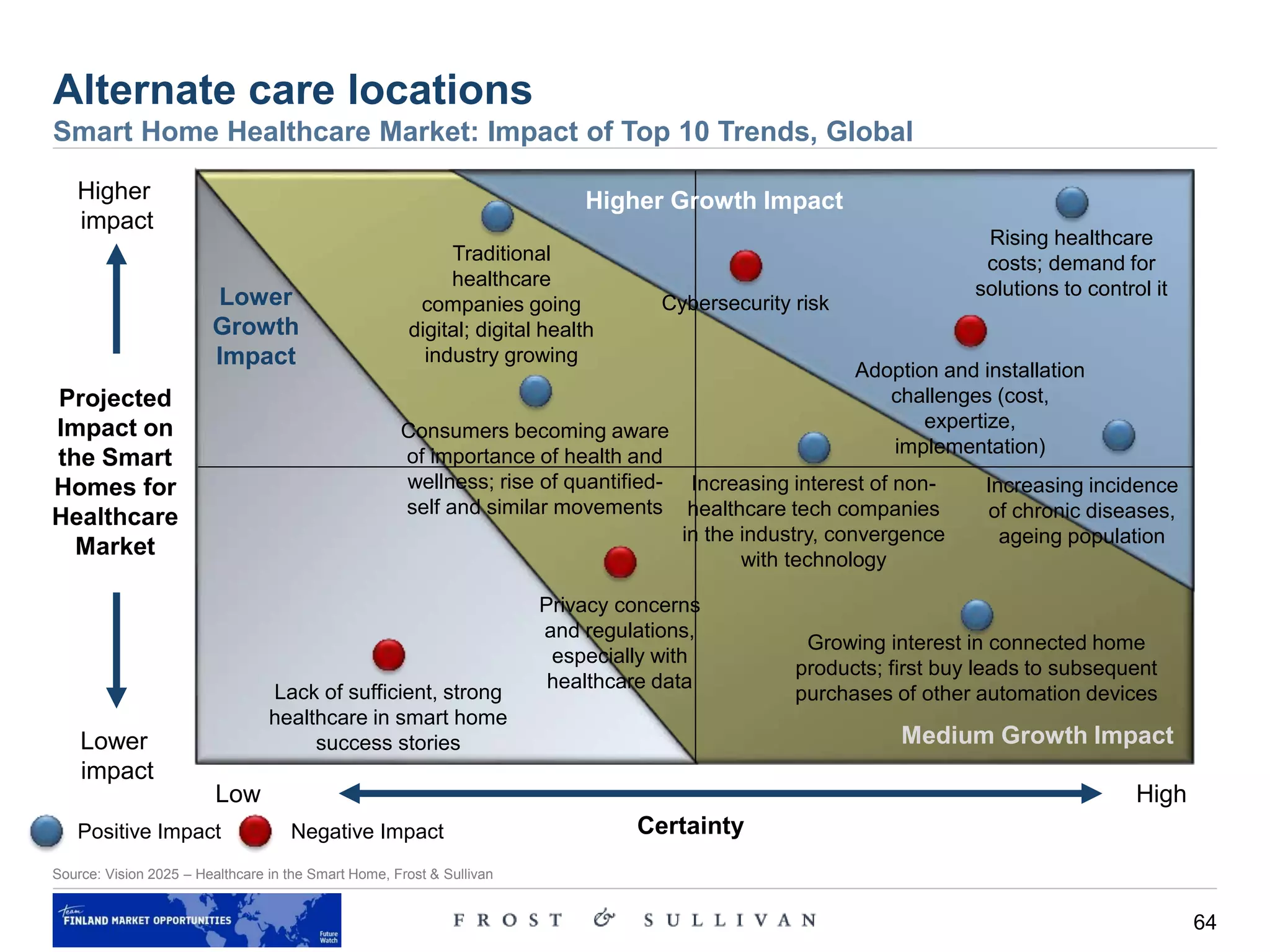
Alternate care locations
Smart Home Healthcare Market: Impact of Top 10 Trends, Global
Source: Vision 2025 – Healthcare in the Smart Home, Frost & Sullivan
Higher
impact
Projected
Impact on
the Smart
Homes for
Healthcare
Market
Lower
impact
Certainty
Low High
Rising healthcare
costs; demand for
solutions to control itLower
Growth
Impact
Medium Growth Impact
Higher Growth Impact
Positive Impact Negative Impact
Increasing incidence
of chronic diseases,
ageing population
Increasing interest of non-
healthcare tech companies
in the industry, convergence
with technology
Growing interest in connected home
products; first buy leads to subsequent
purchases of other automation devices
Adoption and installation
challenges (cost,
expertize,
implementation)
Privacy concerns
and regulations,
especially with
healthcare data
Cybersecurity risk
Lack of sufficient, strong
healthcare in smart home
success stories
Consumers becoming aware
of importance of health and
wellness; rise of quantified-
self and similar movements
Traditional
healthcare
companies going
digital; digital health
industry growing
65
Back to Contents
1.6. PATIENT MANAGEMENT – USE OF WEARABLES
66
Source: Frost & Sullivan
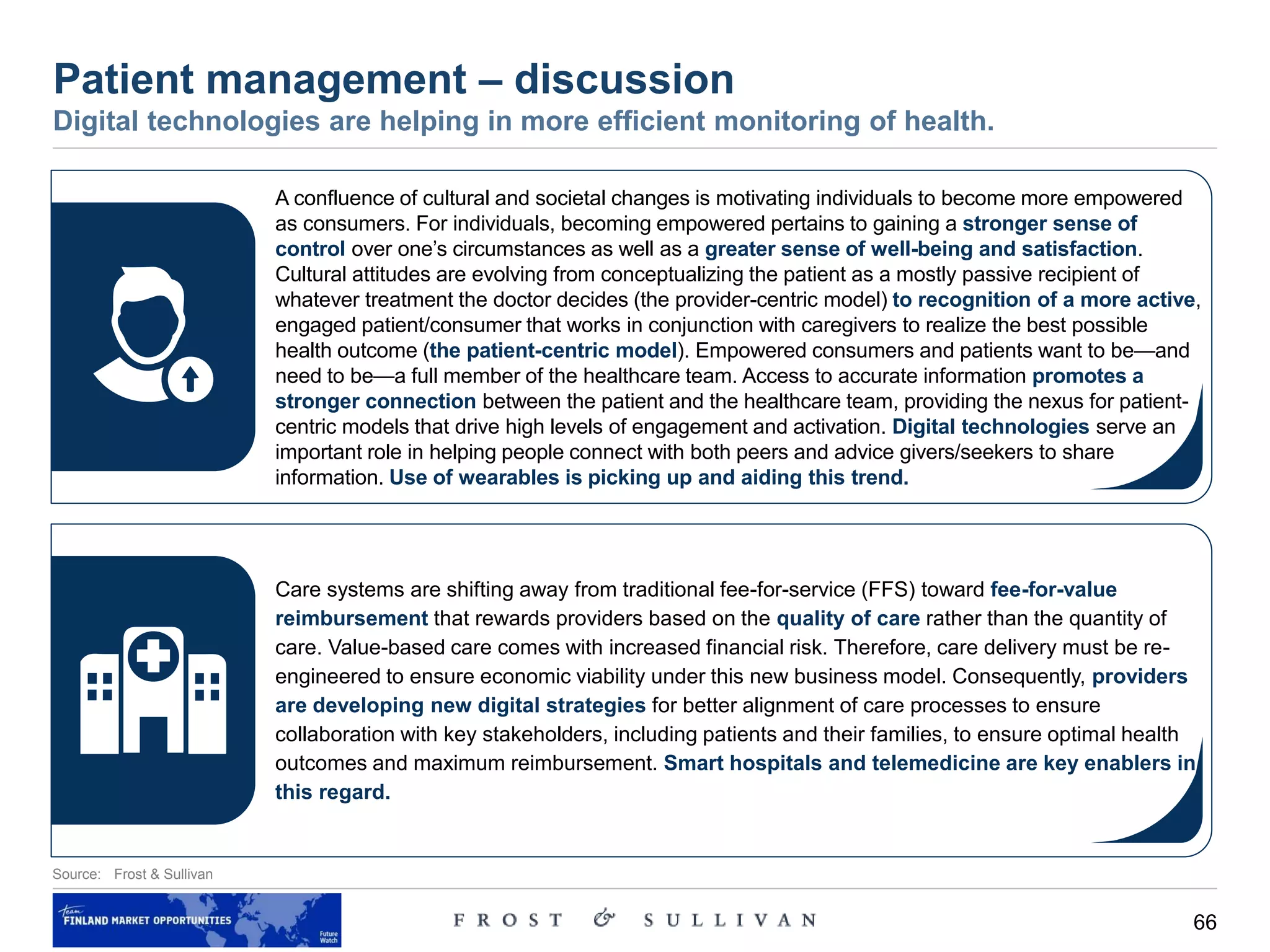
Patient management – discussion
Digital technologies are helping in more efficient monitoring of health.
A confluence of cultural and societal changes is motivating individuals to become more empowered
as consumers. For individuals, becoming empowered pertains to gaining a stronger sense of
control over one’s circumstances as well as a greater sense of well-being and satisfaction.
Cultural attitudes are evolving from conceptualizing the patient as a mostly passive recipient of
whatever treatment the doctor decides (the provider-centric model) to recognition of a more active,
engaged patient/consumer that works in conjunction with caregivers to realize the best possible
health outcome (the patient-centric model). Empowered consumers and patients want to be—and
need to be—a full member of the healthcare team. Access to accurate information promotes a
stronger connection between the patient and the healthcare team, providing the nexus for patient-
centric models that drive high levels of engagement and activation. Digital technologies serve an
important role in helping people connect with both peers and advice givers/seekers to share
information. Use of wearables is picking up and aiding this trend.
Care systems are shifting away from traditional fee-for-service (FFS) toward fee-for-value
reimbursement that rewards providers based on the quality of care rather than the quantity of
care. Value-based care comes with increased financial risk. Therefore, care delivery must be re-
engineered to ensure economic viability under this new business model. Consequently, providers
are developing new digital strategies for better alignment of care processes to ensure
collaboration with key stakeholders, including patients and their families, to ensure optimal health
outcomes and maximum reimbursement. Smart hospitals and telemedicine are key enablers in
this regard.
67
Source: Frost & Sullivan
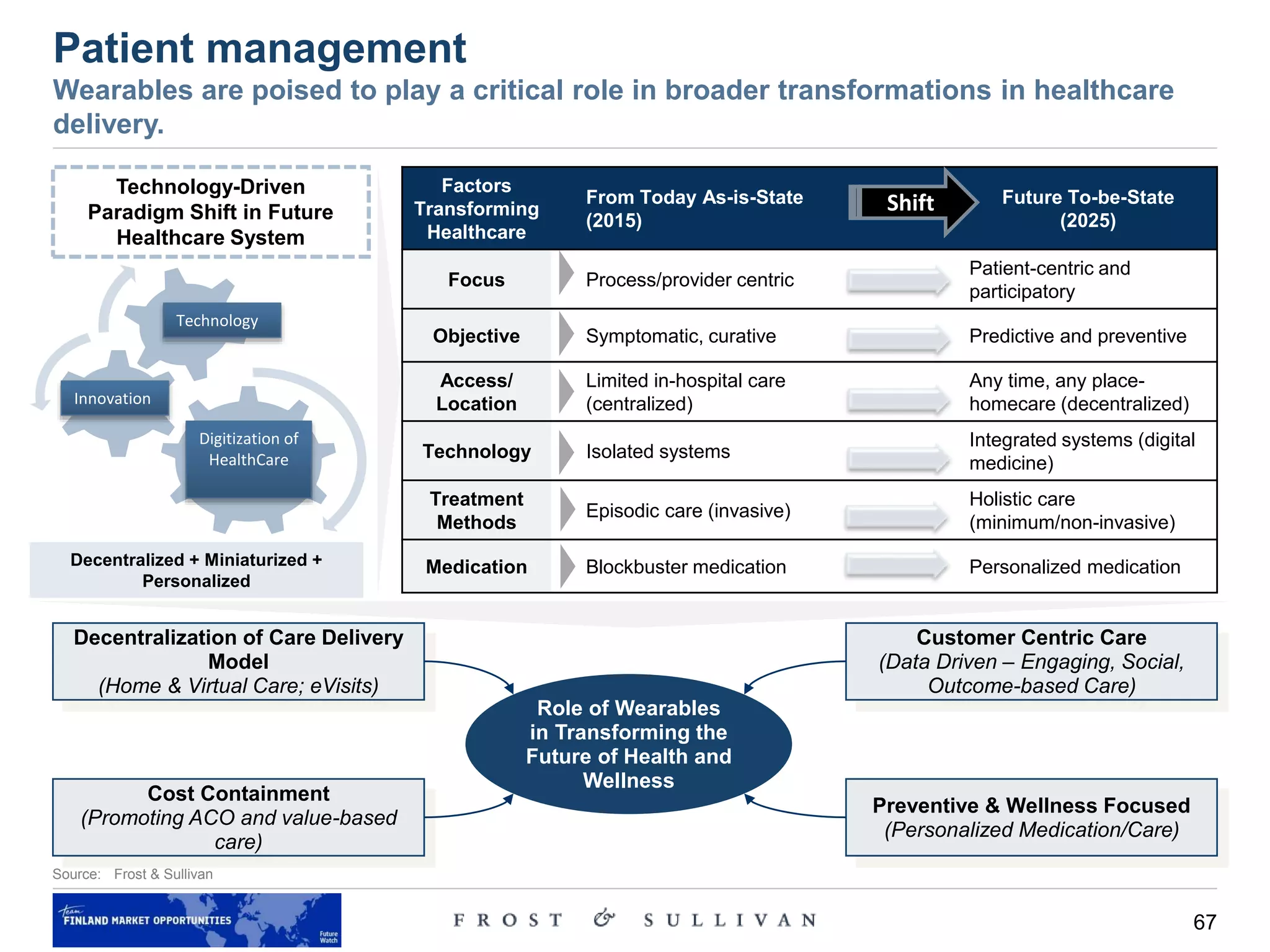
Patient management
Wearables are poised to play a critical role in broader transformations in healthcare
delivery.
Technology-Driven
Paradigm Shift in Future
Healthcare System
Factors
Transforming
Healthcare
From Today As-is-State
(2015)
Future To-be-State
(2025)
Focus Process/provider centric
Patient-centric and
participatory
Objective Symptomatic, curative Predictive and preventive
Access/
Location
Limited in-hospital care
(centralized)
Any time, any place-
homecare (decentralized)
Technology Isolated systems
Integrated systems (digital
medicine)
Treatment
Methods
Episodic care (invasive)
Holistic care
(minimum/non-invasive)
Medication Blockbuster medication Personalized medication
Technology
Innovation
Digitization of
HealthCare
Decentralized + Miniaturized +
Personalized
Shift
Role of Wearables
in Transforming the
Future of Health and
Wellness
Customer Centric Care
(Data Driven – Engaging, Social,
Outcome-based Care)
Cost Containment
(Promoting ACO and value-based
care)
Preventive & Wellness Focused
(Personalized Medication/Care)
Decentralization of Care Delivery
Model
(Home & Virtual Care; eVisits)
68
Source: Frost & Sullivan, AJM
Patient management
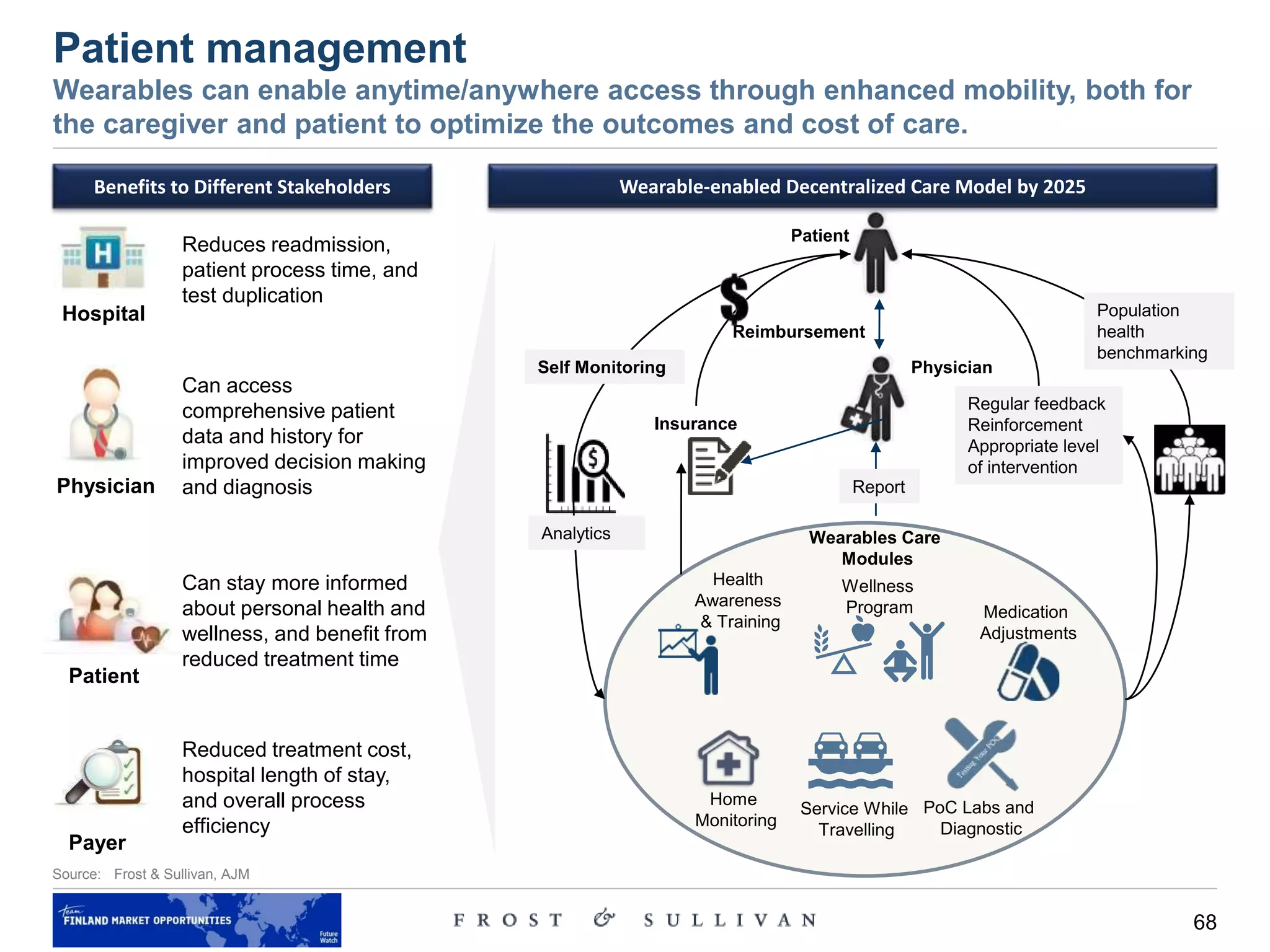
Wearables can enable anytime/anywhere access through enhanced mobility, both for
the caregiver and patient to optimize the outcomes and cost of care.
Hospital
Reduces readmission,
patient process time, and
test duplication
Physician
Can access
comprehensive patient
data and history for
improved decision making
and diagnosis
Patient
Can stay more informed
about personal health and
wellness, and benefit from
reduced treatment time
Benefits to Different Stakeholders
Payer
Reduced treatment cost,
hospital length of stay,
and overall process
efficiency
Wellness
Program
Home
Monitoring
Medication
Adjustments
Service While
Travelling
PoC Labs and
Diagnostic
Health
Awareness
& Training
Patient
Physician
Insurance
Self Monitoring
Regular feedback
Reinforcement
Appropriate level
of intervention
Analytics
Report
Population
health
benchmarking
Reimbursement
Wearables Care
Modules
Wearable-enabled Decentralized Care Model by 2025
69
Source: Frost & Sullivan
Patient management
Advancement in sensor and wireless platform technologies is driving the evolving
need of consumers for smart wearables.
• Emerging paradigm for wearables in the consumer space
• Hardware with multiple applications and platform
integration
• Emerging market with competing platforms and
advanced user interface
• For example, smart watches, smart bands, smart glasses
• Created from the point of view of being a
special-purpose device
• Limited functionality and does not run on
third-party apps
• Product cycle has reached the peak and the
market is mature
• For example, Basic activity trackers and
bands
Overview
Always-On
Interconnected
Flash ROM SRAM
Apps
CPU
Interconnected
ROM SRAM DMC
Always-
On
GPU
Display
Processor
Video
Processor
Architecture
Fitbit, Xiaomi, Nike, Jawbone,
Microsoft, Garmin, Samsung, Sony
Apple Watch, Samsung, Microsoft, Google,
Sony, LG, Pebble, Motorola
Passive Tracking Smart WearablesWired Devices
Past Current Future
First Generation Second Generation
70
Source: Frost & Sullivan
Patient management
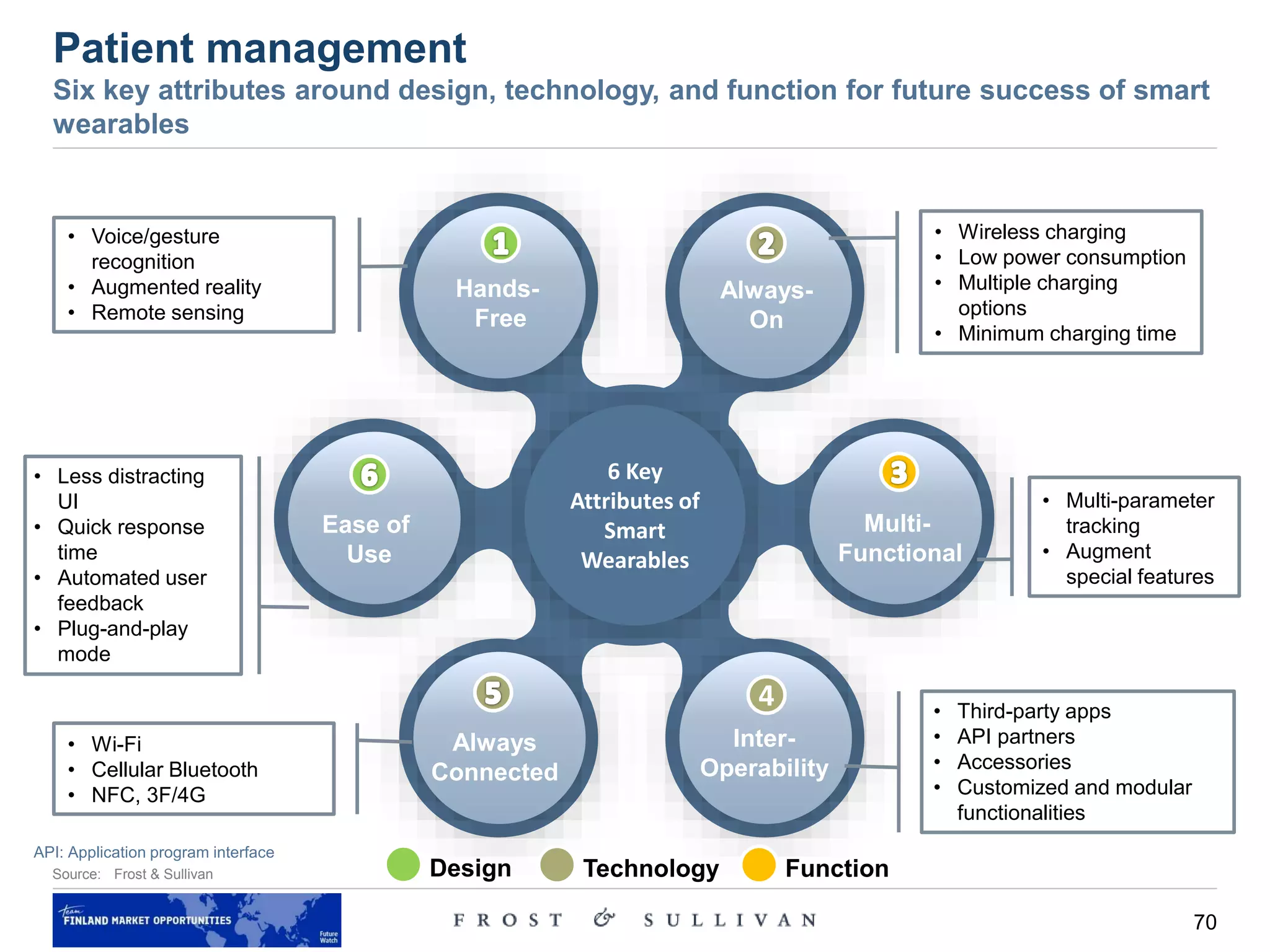
Six key attributes around design, technology, and function for future success of smart
wearables
6 Key
Attributes of
Smart
Wearables
• Wireless charging
• Low power consumption
• Multiple charging
options
• Minimum charging time
• Multi-parameter
tracking
• Augment
special features
• Third-party apps
• API partners
• Accessories
• Customized and modular
functionalities
• Voice/gesture
recognition
• Augmented reality
• Remote sensing
• Wi-Fi
• Cellular Bluetooth
• NFC, 3F/4G
• Less distracting
UI
• Quick response
time
• Automated user
feedback
• Plug-and-play
mode
Inter-
Operability
Always-
On
Multi-
Functional
Ease of
Use
Hands-
Free
Always
Connected
4
Design Technology Function
API: Application program interface
71
Source: Frost & Sullivan
Patient management
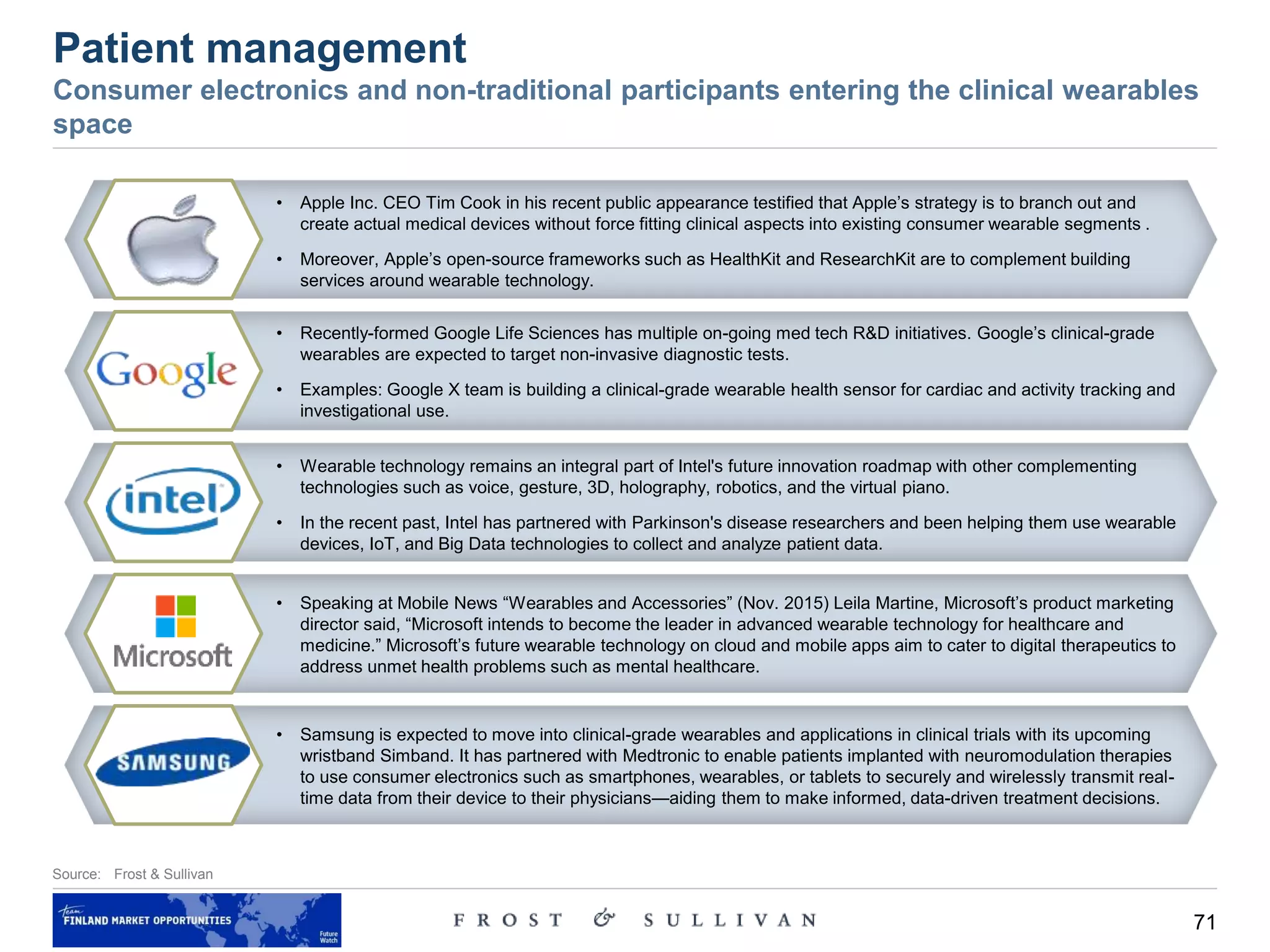
Consumer electronics and non-traditional participants entering the clinical wearables
space
• Apple Inc. CEO Tim Cook in his recent public appearance testified that Apple’s strategy is to branch out and
create actual medical devices without force fitting clinical aspects into existing consumer wearable segments .
• Moreover, Apple’s open-source frameworks such as HealthKit and ResearchKit are to complement building
services around wearable technology.
• Recently-formed Google Life Sciences has multiple on-going med tech R&D initiatives. Google’s clinical-grade
wearables are expected to target non-invasive diagnostic tests.
• Examples: Google X team is building a clinical-grade wearable health sensor for cardiac and activity tracking and
investigational use.
• Speaking at Mobile News “Wearables and Accessories” (Nov. 2015) Leila Martine, Microsoft’s product marketing
director said, “Microsoft intends to become the leader in advanced wearable technology for healthcare and
medicine.” Microsoft’s future wearable technology on cloud and mobile apps aim to cater to digital therapeutics to
address unmet health problems such as mental healthcare.
• Wearable technology remains an integral part of Intel's future innovation roadmap with other complementing
technologies such as voice, gesture, 3D, holography, robotics, and the virtual piano.
• In the recent past, Intel has partnered with Parkinson's disease researchers and been helping them use wearable
devices, IoT, and Big Data technologies to collect and analyze patient data.
• Samsung is expected to move into clinical-grade wearables and applications in clinical trials with its upcoming
wristband Simband. It has partnered with Medtronic to enable patients implanted with neuromodulation therapies
to use consumer electronics such as smartphones, wearables, or tablets to securely and wirelessly transmit real-
time data from their device to their physicians—aiding them to make informed, data-driven treatment decisions.
72
Source: Frost & Sullivan
Patient management
Companies need to find the optimum marketing trade-off between mass and niche
healthcare wearables.
Activity
Tracker
Single-
Purpose
Clinical
Wearable
Multi-
purpose
Health
Wearables
Strategic Approach:
• Improve
software/insights
• Add more biosensors
• High acuity health
features
Strategic Approach:
• Create wearables for
family of health
segments
• Feature extension by
improving
interoperability and
Integration
Degree of Clinical Relevance/ Product Novelty
AddressableMarket
Low High
HighLow
Fail to gain widespread
adoption due to lack of
usefulness/ROI
Highly valued but
limited to niche
segments
Fear of regulations
Companies that fail to embrace regulatory
requirements (FDA, HIPPA, CE, and so on), and
avoid making their devices truly medical-grade
may get to market faster, but will eventually restrict
their long-term potential in the saturated
consumer-grade wearable market.
Too Niche, Fail to Gain
Widespread Adoption
Wearable devices that address a very niche use
case often fail to achieve widespread adoption.
Companies that fail to achieve customer-centric
integrations often over-estimated the value and
expectation for adoption and market size.
73
Source: Frost & Sullivan
Patient management
Companies should assess the future attractiveness rating by segment for clinical and
medical-grade wearables
Low HighKey :
PayerPatient Physician
Respiratory & COPD Low High
1 52 3 4
Low High
1 52 3 4
Low High
51 432
Heart & CVD Low High
1 52 3 4
Low High
1 52 3 4
Low High
51 432
Multi-Parameter RPM Low High
1 52 3 4
Low High
1 52 3 4
Low High
51 432
Aging in Place
Low High
1 52 3 4
Low High
1 52 3 4
Low High
51 432
Diabetes and Obesity Low High
1 52 3 4
Low High
1 52 3 4
Low High
51 432
Pediatric Health Low High
1 52 3 4
Low High
1 52 3 4
Low High
51 432
Women‘s Health
Low High
1 52 3 4
Low High
1 52 3 4
Low High
51 432
Neurological & Mental Health Low High
1 52 3 4
Low High
1 52 3 4
Low High
51 432
Attractiveness to
Sleep Disorders
Low High
1 52 3 4
Low High
1 52 3 4
Low High
51 432
Chronic Pain Management Low High
1 52 3 4
Low High
1 52 3 4
Low High
51 432
74
Back to Contents
1.6. PATIENT MANAGEMENT – SMART HOSPITALS
75
Patient management – Smart hospitals
The popular notion of Digital = Smart is incorrect; going digital is only the first step.
Source: Future of Smart Hospitals, Frost & Sullivan
Optimize / Redesign / Build New
Smart Hospitals
Smart hospitals are those that optimize, redesign, or build new clinical processes, management systems and potentially even
infrastructure, enabled by underlying digitized networking infrastructure of interconnected assets, to provide a valuable service
or insight, which was not possible or available earlier, to achieve better patient care, experience, and operational efficiency.
Clinical Processes Management Systems Infrastructure
Digitized, networking infrastructure of interconnected assets
Achieve better patient care, experience and operational efficiency
Frost & Sullivan Defines Smart Hospitals as:
Smart Hospital
implementations
involve strategy, not a
to-do list
For providing a valuable service or insight, not possible or available earlier
The ‘Smart
Component’
76
Patient management – Smart hospitals
Healthcare transformation impact on hospitals
Source: Future of Smart Hospitals, Frost & Sullivan
Market Forces Emerging Trends
Rising care delivery costs,
reimbursement pressures
Aging population, increasing
incidence of non-
communicable diseases
Healthcare consumerization
Improve productivity and
efficiency, reduce
operational costs
Employ multi-disciplinary
approaches, improve care
coordination
Cater to needs of
empowered patients who
are active participants in
care decision making
HOSPITALS
77
Patient management – Smart hospitals
Hospitals Facing Increasing Pressure to Adapt or Close.
Source: Future of Smart Hospitals, Frost & Sullivan
PRESSURE
• Evolving Re-imbursement Landscape
• Changes in Healthcare Delivery Models
CHANGE
Next level of supply chain
savings
• Implement data standards
• Change contracting process
• End-to-end supply chain costs
• Expand scope of products in
distribution
CHANGE
Moving beyond the acute care
setting
• Enable home care setting
• New front-line care models
• Leverage non-acute data
CHANGE
Supporting outcomes
• Link products and outcomes
• Data for actionable insights
• Share risk
• Standardization
CHANGE
Restructuring for consolidation
• Transparency on product-service costs
• Strip away supply chain costs
• New capabilities to enhance care outcomes
HOSPITAL
78
Patient management – Smart hospitals
Smart hospital impact on healthcare industry.
Source: Future of Smart Hospitals, Frost & Sullivan, Image Source: Flaticon (Smashicons), Thinkstock
PRESENT FUTURE
• Healthcare consumerization is a growing trend,
affecting hospitals’ ability to attract patients as
well as reimbursements in some countries.
• Smart hospitals, with a patient-centric approach,
ensure patient experience is optimal, allowing
for better revenue generation.
• In line with the cost reduction targets, patient
outcomes will also need to be improved to
reduce or even eliminate preventable,
expensive hospitalizations.
• Smart hospitals will enable better quality of care
with personalized approaches and reduced
medical errors to achieve better patient
outcomes.
• Hospital expenditures account for the largest
share of healthcare expenditures.
• As global economies struggle to reduce the
overall expenditures on health, smart hospitals
will prove to be an effective tool to achieve that
target.
Healthcare
Industry
Outcomes
Cost
Experience
Smart
Hospitals
79
Patient management – Smart hospitals
Smart hospitals are utilizing a myriad of digital technologies to deliver on patient-centric
care.
Source: Future of Smart Hospitals, Frost & Sullivan
Wearables
H O S P I T A L S
Representative list, not exhaustive
Robots
Augmented/
Virtual Reality
mHealth
Artificial
Intelligence
Community
Enhancement
Telehealth
Currently implemented
as singular efforts
Technologies lie in
disparate systems
Unplanned applications
lead to significant
manual coordination
efforts
Reduced workflow
efficiency: opposite of
what is actually
expected
Current State of
Implementation
Patient
Management
Tablets
Patient Monitoring
Sensors
RFID Tags
Internet of Things
Blockchain
Open API
Analytics
Big Data Tools
Security & Identity
Management
Population Health
Management
Chronic Disease
Management
Financial
Support
Wellness Plans
Support
Smart Hospitals: Digital Technologies and Services Landscape
80
Patient management – Smart hospitals
Digital health has long-term healthcare implications.
Source: Frost & Sullivan, Intel Health Innovation Barometer, McKinsey Survey
Patients want to use digital
health services in the future
More than
75%
39.7 M
Healthcare smartphone apps
in use
150+ exabytes
Amount of healthcare data
that exists today
24 months
Rate at which healthcare data
doubles
20-30 B
Internet of Medical
Things Devices by
2020
Increasing digitization complexity in healthcare
Are hospitals prepared for
a digital future? 57%
People who believe
traditional hospitals will
be obsolete in future
Healthcare Industry: Increasing Digitization
Complexity, Global, 2016
81
Present Future
Patients
Patients can view their medical records, lab test
results and learn more about their health
conditions on tablets in their rooms
Patients’ educated about their health conditions, diet
and activity requirements via smart in-room devices,
with content progressing in-line with patient
recovery as tracked by the Electronic Health Record
data
Physicians
Patients’ vitals tracked using wearable /in-room
devices and automatically recorded in EHR;
physicians can access data on tablets while on
rounds
Integrated, live patient data from various body, room
sensors and lab results visible to doctors, allowing for
‘virtual’ rounds, in addition to alarms when patient
health deteriorates
Nursing Staff
All of patient’s condition and medication history
stored in EHR on hospital servers, accessible from
any computer/tablet after authorization
Nurses have access to information on
wearable/mobile devices allowing them to perform
clinical duties without excusing themselves from
patient room to access their EHR data
Administrator
Administrators can view all housekeeping and
facilities management details online to identify
incomplete tasks or equipment faults in real-time
and fix them immediately
Administrators for areas such as housekeeping and
facilities management have access to basic patient
information to speak to them and clinical staff to get
feedback about expectations being met
Patient management – Smart hospitals
Digital health has long-term healthcare implications
Source: Future of Smart Hospitals, Frost & Sullivan, Image Source: Flaticon
Beyond digitization, hospitals must align processes and workflows, eliminate technology implementation silos,
and ‘connect’ all technologies to ‘talk’ to one another, with an objective to enhance patient experience and to
improve care, to harness the true potential of a smart hospital.
Smart Hospitals: Present and Future Utilities
82
Patient management – Smart hospitals
What smart hospitals do different than digital ones
Source: Future of Smart Hospitals, Frost & Sullivan, Image Source: Flaticon (Freepik)
• Digital hospitals are ‘connected’, but just because they are networked, does not make them ‘smart’!
• Truly smart hospitals derive insight and value from the networked services in a digital hospital
Reduce
operational
costs, improve
margins
Help patients
recover faster
Reduce staff
burden, make
jobs easier
Improve patient
satisfaction and
experience
Smart Hospital:
Areas for Development
Operational Efficiency1
Clinical Excellence2
Patient Centricity3
Advantages
83
Patient management – Smart hospitals
The smart hospital concept overview
Source: Future of Smart Hospitals, Frost & Sullivan, Image Source: Flaticon (Freepik)
Facilities
Building Automation Systems
Network Infrastructure
Asset Maintenance and Management
Mobile Asset Tracking
Logistics
Inventory Control
Other Logistics
People Flow
Personnel
Nurses
Patient Rooms
OPERATIONAL
EFFICIENCY
CLINICAL
EXCELLENCE
PATIENT
CENTRICITY
Doctors
Departments
Patient Outcomes
Emergency
Surgery
Radiology
Hospital-Wide
Patient Monitoring
Referrals
Patient Engagement
Hospital Services
Technology Initiatives
Hospital Design
84
Patient management – Smart hospitals
The smart hospital framework
Source: Future of Smart Hospitals, Frost & Sullivan
DATALAYER
SMARTINSIGHT
LAYER
ACCESSLAYER
FACILITY
SYSTEMS
CLINICAL
DEVICES
OPERATIONS
DEVICES
OTHER
DEVICES
Sensors Systems
Interconnected Networks
INFORMATION
DATA DATA DATA DATA
Connectivity
ANALYTICS
MACHINE LEARNING
DEEP LEARNING
ARTIFICIAL INTELLIGENCE CLOUD
(Optional)
Enable devices and
machines to become
smart; automate some
tasks to make human job
easier /faster
AND
INSIGHT
MobileDesktop Tablet
Appropriate level of insight customized to every potential user (clinical staff, operations staff, support staff) to enable them to
perform their job faster and efficiently. Also, appropriate information provided to the patient, on demand.
User inputs and
instructions can also
enable smart,
automated operations,
reducing workload for
staff
Ability to provide
commands/instructions to take action
85
Patient management – Smart hospitals
Clinical areas in a smart hospital
Source: Future of Smart Hospitals, Frost & Sullivan
Ear, Nose,
Throat
Geriatrics Gastroenterology Hematology
Obstetrics/Gy-
necology
Maternity
Neonatal Nephrology Neurology Oncology Ophthalmology Orthopedics
Rheumatology Urology Emergency
Operating
Room
General Surgery Anesthetics
Critical/Intens-
ive Care
Psychiatry Outpatient* Inpatient
Radiology Pathology Pharmacy* Physiotherapy
Sterilization
Unit
Nutrition/Dieteti-
cs Services
Administration
Human
Resources
Finance
Information
Technology
Facilities
Management
Food
Services/Caterin
g
Non-clinical areas not considered in this analysis
Least Impact Medium Impact Maximum ImpactLEGEND:
Cardiology
Supporting Areas
86
Patient management – Smart hospitals
Departments—Emergency
Source: Future of Smart Hospitals, Frost & Sullivan, Image Source: Flaticon (Smashicons)
• Patients can register pre-arrival
using app/Web site
• This allows them to view
approximate wait times, as well
as helps the ED better plan for
patient flow
• Paramedics can transmit patient
vitals and other clinical
information from ambulance to
the ED, for better preparedness
• Interoperability between
emergency services and
hospital medical records can
also help for better patient
outcomes
I N F L O W
The Emergency Department
Patient Information Screen(s)
Helps manage patient flow, communication and care coordination within the ED
Feed information to central information screen
Digital whiteboards in every exam room/next to bed
Provides information on:
• Care team members – names and pictures
• Status of lab tests
• Diet information
• Discharge information
• Staff member responding to alert
Eliminates:
• Back-and-forth phone calls
• Communication by hand-written
notes
• Delays in decision-making due to
unavailability of latest test results
87
Patient management – Smart hospitals
Departments—Surgery and Operating Room
Source: Future of Smart Hospitals, Frost & Sullivan, Image Source: Flaticon
Smartphone app/Web-based
interactive tools, checklists, and
reminders for patients to adhere
to pre-surgery instructions
• Smartphone app/Web-based
tools for customized aftercare
plans
• These aim to educate and
guide the patients on recovery,
as well assess their progress
• These also provide the
relevant contact information of
hospital staff/physicians for
follow-up questions
Training
• Virtual reality-based training
and simulation tools
Planning
• Virtual/Augmented reality-
based surgery planning and
rehearsal
• 3D printed anatomical
models for planning
• Robotic surgery (with potential
for autonomous surgery)
• Augmented reality-based
surgical navigation tools
• 3D printed tools and implants
• Surgery optimization tools
• Accurate orthopedic implant
positioning tools
• Other tools, such as blood
loss measurement tools
PATIENTS
SURGEONS
• Tools for assessing patient
recovery
• Tools for gauging implant
performance (for example,
orthopedic implants with
sensors)
Pre-surgery During Surgery Post-surgery
88
Patient management – Smart hospitals
Departments—Radiology
Source: Future of Smart Hospitals, Frost & Sullivan, Image Source: Flaticon (Dinosoft Labs, Freepik, Nikita Golubev
Using inputs from traditional 2D images to construct 3D models of anatomies to
better understand maladies – as a personalized tool to help patients comprehend
their conditions and also for doctors and surgeons to design therapies tailored to each
unique patient condition
Deep learning algorithms to
• Help radiologists process images and diagnose faster,
addressing personnel shortages
• Improve diagnosis of rare conditions
• Design precision radiation treatments for oncology
patients
Patients’ images available within and across health
systems, helping construct a complete picture of
patients’ health history and disease progression
• Advanced, state-of-the art
imaging equipment
• Portable device solutions for
imaging in patient
rooms/outpatient point of care,
to help patients with limited
mobility and for streamlining
bottleneck issues in the
department
EQUIPMENT TECHNOLOGIESIMAGE ANALYSIS
Cloud
Machine Learning
/ Artificial
Intelligence
3D Modeling
Higher application of interventional radiology procedures to help replace other costlier and invasive procedures
89
Patient management – Smart hospitals
Departments—Intensive Care
Source: Future of Smart Hospitals, Frost & Sullivan, Image Source: Image Source: Thinkstock
Continuous Monitoring Remote Care Tele-Care
Use of algorithms to process
data generated by patient-
monitoring devices to
• Minimize need for periodic
checks by nursing staff
• Reduce alarm fatigue
• Raise pertinent alarms for
deteriorating patient condition
• Serve as pre-requisite for
remote care
• Single location control room to
remotely monitor patients
spread across different health
systems locations’ intensive
and special care patients who
do not have specialists during
the night shift
• Data from monitoring devices
flows into this control room for
monitoring patients and
alerting ground staff for
appropriate interventions when
necessary
• Some intensive care patients
can be discharged to their
homes earlier than usual,
leveraging the same
technology as for remote care
• Under constant monitoring at
home, patients can video call
any doctor or nurse at any
point of the day
• This concept was run by
Banner Health in the US as a
pilot for its 28 hospitals, and it
estimates saving 33% costs
90
Patient management – Smart hospitals
Regional readiness for smart hospital adoption
Source: Future of Smart Hospitals, Frost & Sullivan
4.5
4.0
2.5
4.8
4.3
3.5
4.0
3.7
3.03.0 3.0
2.5
End-user Readiness
Consumer interest in health and
wellness and in movements like
Quantified Self is important.
However, more important is
clinician comfort with and
education in medical
technologies to help them
navigate their day-to-day tasks.
Spending Power
Health systems with clear
incentives for providers and
vendors to collaborate and enter
into risk-sharing agreements are
better positioned for smart hospital
development. Sources of funds
could be public or private, as long
as they are transparent and
accountable.
Technological
Sophistication
High levels of Electronic
Medical Records and Health
Information Systems (>70%)
adoption in hospitals and
increasing adoption in primary
care are foundational
infrastructure that contribute
to smart hospital success.
While the technologies may
be easily available in all
regions, uniform ICT
penetration is a challenge.
Regulatory Landscape
Regulations that support
payments for quality are
limited to the US. Other
regions have invested in the
concept but do not have
advanced regulations yet.
Compliance is building up
across regions and emerging
as a key driver for smart
hospital investment.
North
America
Europe APAC
Score(1–5)
Smart Hospitals Market: Regional
Readiness Assessment for Smart
Hospitals Adoption, Global, 2016
For each of these Assessment Domains, Frost & Sullivan rated the largest
geographic regions, North America, Europe, and APAC, on a five-point
scale.
91
Patient management – Smart hospitals
3 Big Predictions
Source: Future of Smart Hospitals, Frost & Sullivan
2
Cybersecurity will continue to be a major concern; guidelines, standards, and best
practices are still being developed and shared. By 2025, a major cyberattack targeting a
smart solution vulnerability in hospitals will underscore the need for stronger security
strategies and measures.
3
An explosive growth for smart hospital augmentation solutions is expected by 2020,
when hospitals with implemented solutions report extensive benefits and substantial
return on investments. Greenfield ventures (especially hospital building replacements) are
likely to take-off gradually due to a minimal need for new hospitals.
1
By 2025, 10% of hospitals across the globe will become or will have started
implementations to become smart hospitals, located likely in Canada, the Nordic
regions, Australia, and the medical tourism focused regions of Singapore and Dubai.
Beyond 2030, today’s traditional hospitals without any smart elements will simply cease to
exist.
92
Back to Contents
2. THE MOVE TOWARDS POPULATION
HEALTH MANAGEMENT AND THE ROLE OF
PREVENTATIVE MEDICINE
Back to Contents
93
Source: Frost & Sullivan
Population health management
PHM is a powerful tool to identify at-risk patients and engage with them earlier, to
optimize care and achieve better outcomes.
• The concept of population health management (PHM) was created to
address critical challenges encountered by all healthcare entities—
government, providers, health plans, and patients. The emphasis of
healthcare systems has been on patient conditions that require
immediate attention. In most cases, systems have failed to
successfully manage at-risk patients, and indirectly catalyzed
incremental demand for healthcare services. Some of the critical
factors that prompted PHM are as follows:
— Massive cost burden of chronic condition management
— Evolving reimbursement programs
— Rising demand for healthcare services, indicating the need
for efficient IT solutions that can better manage patient
requirements
• Patient care is moving into a broader but coordinated environment
where PHM solutions automate routine, manual tasks. These
offerings integrate siloed systems, stratify at-risk patients, empower
patients through engagements, benchmark outcomes, and generate
evidence-based, patient-specific workflows at point of care. The
PHM ecosystem is larger and inclusive of data management, risk
management, care management, and performance management
solutions. Therefore, PHM requires long-term strategic
commitment from top-level executives, physicians, and
care managers.
94
Source: Frost & Sullivan
2
Prevalence of AI-powered health IT tools will enable payers and providers to stratify the
patient, employee and consumer populations by their receptivity for treating cost-intensive
and life-threatening diseases. Academic institutes and clinical researchers will be more receptive
to collaborate with providers to aid evidence-based clinical interventions for these populations.
3
Non-traditional healthcare stakeholders including pharmaceutical, medical device, and ICT
vendors will aspire to leverage population health data to customize product and go-to-market
strategies. As a result, payers and providers are likely to perceive them as key sponsors of
PHM programs.
1
It is highly likely that major multi-year PHM programs will be conceived, managed and
monitored in collaboration with end-users‘ internal IT governance teams and third-party IT
solutions providers to offset concerns about data privacy, quality control, and KPI management.
Population health management
3 big predictions
95
Back to Contents
2.1. POPULATION WIDE INITIATIVES
96
Population wide initiatives
In the US, PHM adoption has witnessed fast growth among ACOs and payers.
Source: US Population Health Management Market, Forecast to 2022, Frost & Sullivan
97
Back to Contents
2.2. PREDICTIVE MEDICINE: USING DATA TO PREDICT
DISEASE AND TAKE TIMELY CLINICAL DECISIONS
98
Source: Evariant,, Frost & Sullivan, ‘NHS tackling mental health with targeted ads’, Sky News (May 2018)
Predictive medicine
Discussion
Currently, data from disparate sources are collected and analyzed to draw insights into population health
management. These sources include electronic health records, claims data, genetic registries and others.
However, a key data set that is mostly missing is the patient data. Wearable technology can track different health
metrics such as sleep patterns, activities and heart rate. This type of information is could be incredibly valuable for
understanding the current state of health of patients. It can help in patient stratification on the basis of current
metrics and assist in timely identification of at-risk patients.
For example, Cedars Sinai found that data from cancer patients’ Fitbits could help them assess the effectiveness
of chemotherapy treatment. In a test of 30 adult cancer patients, researchers monitored metrics such as miles
walked and heart rate during chemotherapy treatments, and used these data to correlate patient activity levels with
outcomes from cancer treatments.
Patients can also benefit by being active participants population management health initiatives. Insights drawn from
there data can be used to derive consumer insights and used to create population health marketing campaigns.
Such campaigns are effective drivers of patient engagement and therefore improved health outcomes as their level
of personalization appeals to consumers and encourages them to further their relationship with their provider.
For example, digital division at Public Health England is using social media platforms and Google to target
people who have exhibited online behaviours which suggest they might be affected by a psychological disorder
such as sleeplessness, anxiety, low mood and stress. Such targeted marketing to individuals who may be suffering
from mental health problems, but did not previously reach out for help, has yielded positive results. Referrals are up
35% in past three years – last year, there were 500,000 referrals more to NHS psychological therapies for stress
and anxiety, compared to the year before.
99
Source: Evariant,, Frost & Sullivan, ‘NHS tackling mental health with targeted ads’, Sky News (May 2018)
Predictive medicine
Discussion
Prevention: From 2000 to 2020, the average number of visits to ambulatory, outpatient, and inpatient
emergency departments is projected to grow from 374 (per 100 people) to 450. Payers and providers need to
identify the patient population suitable for proactive outreach and initiate individualized communication
pertaining to lifestyles, medicine adherence, tests, visits, and follow-ups. In this way, the population raises
awareness on primary prevention factors and chronic symptoms that contribute towards preventing first-
time hospital admissions, readmissions, and repeat disease occurrence.
Prediction: It is critical that value-based healthcare providers predict comorbidities and chances of hospital
acquired infections, as most providers concentrate on patients’ primary care needs that drive the maximum
healthcare costs. These healthcare organizations fail to forecast that at-risk members are likely to drive
clinical utilizations and escalate cost for every episode of care as they continue acquiring new health conditions
during care. We estimate that the total yearly cost burden of a single chronic condition such as stroke can be as
much as $7 billion in the US. Technology-enabled patient engagement and secured cross-continuum
communication between care managers, physicians, and health plans allow health systems to track at-risk
patients and manage comorbidities. Personalized interactions and goal setting during and post care can
prevent comorbidities from turning into various primary chronic conditions.
Treatment: Agile PHM solutions stratify a whole in-patient population in defined care cohorts that represent
patients bearing similar symptoms, carrying similar health histories, utilizing similar clinical services, and
exhibiting similar coverage. Patient engagement solutions tied to these PHM platforms then prioritize a
proactive reach out and reactive transition support through patient portals and other cloud services which allow
patients and care providers to access, download, and transfer medical records, test results, prescriptions,
medication dosages, clinical trail eligibility status, doctor appointments, and payment coverage options.
100
Source: Evariant,, Frost & Sullivan, ‘NHS tackling mental health with targeted ads’, Sky News (May 2018)
Predictive medicine
Technologies enabling population health management.
101
Source: Evariant,, Frost & Sullivan, ‘NHS tackling mental health with targeted ads’, Sky News (May 2018)
Predictive medicine
Patient engagement a key component of population health management
102
Back to Contents
2.3. THE PATIENT AS THE FOCAL POINT – MOTIVATIONS
AND EXPECTATIONS
103
Source: The Commonwealth Fund, WellSteps
Motivations and expectations
Discussion
• Payers are increasingly adopting innovative methods to promote healthy
behavior amongst consumers in their network. Many states in the US are
developing programs to motivate members to control weight, minimize
smoking and promote vaccination. They are trying to give members a
greater stake in improving their health status, by rewarding their healthy
behavior.
• For example, California's Medicaid program provides non-health-related
incentives, such as movie tickets or gift certificates, to reward parents who
keep up with scheduled well-child visits for their infants and adolescents.
• Similar incentives are being offered by corporates to encourage
employees to take charge of their own health. Some common examples
of such incentives include the following:
— Tobacco free discount on medical plan premiums (20% off medical
premiums for non-users or users who participate in a certified smoking
cessation program)
— Drawings for iPads, TVs with Wii Fit, gift cards, travel vouchers,
fitness equipment, T-shirts
— 5% premium discount for sustained yearlong participation in the
wellness program
• At the same time, consumers are gradually taking up ownership of their
wellness. They are engaging more online to equip themselves with the
latest know-how about their disease and available wellness options. It is
expected that this behavior will increase as share of tech-savvy
Millennials rises in the global population.
104
Source: Global Healthcare Industry Outlook, 2018, Frost & Sullivan, Global Wellness Institute, Image Source: Thinkstock, Frost Database
Motivations and expectations
Incentive-based wellness programs to gain global popularity
105
Source: Technology Innovations for Patient Engagement, Frost & Sullivan
Wellness management – prescriptive or ownership based
Technology innovations have significantly improved patient engagement
106
Source: Frost & Sullivan US Consumer Engagement Survey Report 2016
Wellness management – prescriptive or ownership based
Evolution of patient engagement
107
3. THE DIGITAL HEALTH
ECOSYSTEM IN 2025
Back to Contents
108
Source: Frost & Sullivan
2
All healthcare stakeholders have one thing in common: they are all concerned about security
and privacy within connected healthcare. Some industry experts are concerned that one
large-scale hack could create a barrier that would curtail the progress in digital health for several
years.
3
Despite numerous challenges, patient engagement, and improved outcomes will increase as
the value proposition associated with connected healthcare becomes more obvious to all
healthcare stakeholders.
1
Digital health innovation will continue to accelerate at a rapid pace by 2025, with notable
progress for new enterprise, cloud, digital, and AI services. A mix of regulatory pressure,
positive experiences among all stakeholders, and new entrants from the ICT space
transforming the market will drive the momentum.
The Digital Health Ecosystem in 2025
3 big predictions
109
Back to Contents
3.1. WHAT WILL THIS ECOSYSTEM LOOK LIKE?
110
Source: Frost & Sullivan
The Digital Health Ecosystem in 2025
Digital health will encompass solutions across the care continuum
On- Body
In- Home
Community
In-Clinic
In- Hospital
Home Medical
Devices
Peripherals
Wearables
Implants
Digital
Assistants
Smart
Devices
Activity
Monitoring
Consultations/
Coaching
Emergency
Response
Intelligence
Supply Chain
Logistics
Mobility
Automated
Kiosks
Lab on a
Chip
Care
Coordination
Tech
Hand held Medical
Tech
Ambulatory
Therapies
Smart
OR
Patient
Surveillance
Connected
Equipment
RTLS
Analytics/
Informatics
Storage
Machine
Learning
Cyber-
security
Inter-
operability
Decision
Support
A connected ecosystem of sensors and devices on and around
the individual serve the function of:
• Capture & Measure
• Identify
• Stratify Risks
• Inform
• Make Decision
• Take Action
While conforming to
Privacy and
Security
111
The Digital Health Ecosystem in 2025
By 2025, benefits from AI and virtual assistants will gain more visibility, propelling
their adoption.
Source: Global Digital Health Outlook, 2018, Frost & Sullivan
112
The Digital Health Ecosystem in 2025
Digital health ecosystem will benefit as ICT tech leaders gear up to ramp up their
healthcare strategy.
Source: Global Digital Health Outlook, 2018, Frost & Sullivan
113
The Digital Health Ecosystem in 2025
Digital therapeutics will achieve results
Source: Global Digital Health Outlook, 2018, Frost & Sullivan
114
The Digital Health Ecosystem in 2025
Patient experience will become the cornerstone of digital brand strategy.
Source: Global Digital Health Outlook, 2018, Frost & Sullivan
Competition drives strong growth opportunities for digital
solutions that enable patient satisfaction with all aspects of
healthcare encounters.
• The rapid pace of change is placing increasing competitive
pressure on healthcare organizations. In particular, hospitals face
new challenges and threats in the form of more consumer-focused
care settings, such as retail pharmacies and telehealth providers.
• The demands of consumerism and the shift to value-based
reimbursements require all healthcare enterprises to embrace a
more patient-centric mindset as a competitive necessity and as a way
to ensure strong Hospital Consumer Assessment of Healthcare
Providers and Systems (HCAHPS) and Star ratings that impact
reimbursement.
• Improving the patient experience requires tools and strategies
that address both clinical and non-clinical aspects of healthcare
encounters, including ease of scheduling and bill pay,
communication with caregivers and administrative staff, quality of care
and outcomes, and access to information/education resources.
• Digital health tools, such as patient portals, mobile apps for secure
patient/provider texting, and customized patient education
content designed to improve compliance and self-care, are set for
strong growth by 2025.
115
The Digital Health Ecosystem in 2025
Digital health companies to watch – big players
Source: Global Digital Health Outlook, 2018, Frost & Sullivan
• The IT industry is delivering transformative approaches to using, storing, exchanging, viewing,
accessing, and interacting with data and information, which will have a profound impact on healthcare
and IT vendors serving the industry. Big Tech ICT companies, such as Google, Microsoft, Amazon,
IBM, Samsung, and Apple, are deeply interested in growing opportunities presented by supporting
the data infrastructure of the vast $3.3 trillion US healthcare system.
• Google announced its open-source Google Cloud Healthcare API, which extracts data from EHR
and other sources using DICOM, FHIR, and HL7 protocols. IBM continues to grow its presence in
healthcare, driven by a focus on analytics, AI, and population health management through its Watson
Health business. Apple has stepped up efforts in health IT as well, with its new health records
initiative, announced in January 2018, that allows iPhone users to obtain their health data from
multiple providers through the Apple Health app. Additionally, Amazon is making inroads into various
aspects of healthcare and could make a big move—or several big moves—in healthcare in 2018.
• Major EHR companies are committing to reducing physicians’ IT burden by incorporating AI-enabled
and voice-based medical assistants into their incumbent EHR workflows. Epic recently announced
it has integrated Nuance’s AI-powered virtual assistant platform into its EHR. Functionalities include
the ability for clinicians to ask for lab results, medication lists, visit summaries, and other information in
the Epic Haiku mobile app. Athenahealth is partnering with progressive start-ups that help
physicians automate the process of patient scheduling, clinical documentation, and coding.
116
The Digital Health Ecosystem in 2025
Digital health companies to watch – big players
Source: Global Digital Health Outlook, 2018, Frost & Sullivan
• Democratization of AI is made possible by Big Tech companies that offer cost-effective infrastructure
support to other vendors, striving to help end users, mainly hospitals, to embrace new ways to
optimize informed diagnosis and treatment. IBM Watson Health, Amazon, and Google are
examples of companies exploring this business model.
• Consumerism of healthcare is expected to change the game for all stakeholders and pave the way for
real-time patient engagement (before, during, and post care). The adoption of telehealth and remote
patient monitoring services is expected to accelerate. Such factors are driving strategic movements
by vendors to work with one another across the value chain. For example, Cerner announced a
partnership with Salesforce to promote seamless patient engagement, and American Well
announced a collaboration with Samsung.
• Great opportunities in the healthcare market create a greater responsibility to safeguard consumer
interest against concerns about monopolies and their impact on market pricing and data privacy.
Big Tech companies must acknowledge that patient-generated data interpreted by next-generation IT
platforms has multiple utilities for diverse healthcare stakeholders. To remain relevant in the market,
obtaining fully informed consent from patients, coupled with 100% compliance with stringent data use
regulation, has to be ensured.
117
Back to Contents
3.2. CHANGES IN THE MANAGEMENT OF THE
CARE PARADIGM
118
Changes in the management of the care paradigm
Discussion
Source: Global Digital Health Outlook, 2018, Frost & Sullivan
Traditionally healthcare systems around the globe have been based on the experience and
medical knowledge of physicians. Although diagnostic tests have been their guiding tools,
their prescriptions are largely based on their experience with patients and the medical knowledge
that they have.
Today, healthcare systems are experimenting with AI enabled solutions that have access to
patient data, much richer than what a single physician can cater to. As such systems grow in
sophistication, they can even be linked to track the latest developments and see what worked in
which patient, etc. and guide physicians based on the latest available data. Physicians will take
decisions based on personalized data which will be delivered through a highly connected
environment of wearable devices. IoT and smart devices will enable continuous tracking of
vital health parameters including heart rate, blood pressure and so on.
AI-based systems such as IBM Watson have seen popular usage among global hospitals. The latest to
enroll IBM Watson in their hospital is Apollo Hospitals in Chennai, India, which will adopt two of IBM's
cognitive platforms — Watson for Oncology and Watson for Genomics — across 10 of its 64 hospitals.
Watson for Oncology will helps physicians in identifying relevant treatment options for cancer patients.
Watson for Genomics will assist physicians in personalizing chemotherapy according to patients'
genomic, clinical and pharmacological data. It can draw insights into a patients potential genetic
alterations while suggesting relevant drugs and clinical trials targeted toward a patient's tumor.
119
4. KEY ENABLING DIGITAL SOLUTIONS
SUPPORTING INDIVIDUAL CENTRIC HEALTH &
WELLBEING THROUGH 2025
Back to Contents
120
Back to Contents
4.1. EHEALTH
121
eHealth
Top predictions—hospital-based medical device connectivity
Source: Global Hospital-based Medical Device Connectivity Market, Frost & Sullivan
122
eHealth
Strategic imperatives for device connectivity vendors and healthcare systems
integrators.
Source: Global Hospital-based Medical Device Connectivity Market, Frost & Sullivan
123
eHealth
Evolving eHealth landscape to when hospital care comes to home
Source: Global Hospital-based Medical Device Connectivity Market, Frost & Sullivan
The advent of digital health solutions has enabled patients to get quality hospital care at home. It requires a meticulously planned
coordination between multiple stakeholders – nurses, aides, physical therapists and referring physicians – making the need to
improve data sharing critical. The demands of consumerism and the shift to value-based reimbursements require all healthcare
enterprises to embrace a more patient-centric mindset as a competitive necessity and as a way to ensure strong Hospital Consumer
Assessment of Healthcare Providers and Systems (HCAHPS) and Star ratings that impact reimbursement.
Improving the patient experience requires tools and strategies that address both clinical and non-clinical aspects of healthcare
encounters, including ease of scheduling and bill pay, communication with caregivers and administrative staff, quality of care and
outcomes, and access to information/education resources. Digital health tools, such as patient portals, mobile apps for secure
patient/provider texting, and customized patient education content designed to improve compliance and self-care, are set for
strong growth.
It is creating a plethora of personalized health and lifestyle data, manifesting a sense of healthcare consumerism. Today,
consumers are more receptive to healthcare information, and they want to actively participate in healthcare at all levels of care.
For example, a recent Frost & Sullivan survey revealed that about 69% of consumers in the US track their health symptoms. More-over,
41% will definitely change their physicians if they are not allowed to access their health records, and 74% of patients appreciate receiving
customized alerts and news feeds post care. However, a majority of health consumers acknowledge that the existing patient engagement
initiatives of major healthcare enterprises fail to effectively engage them during their experience in primary care. They seldom receive access
to personalized treatment options, referral support and adherence alerts outside physician offices in real time. This raises important questions
around patient data ownership, access, and privacy issues with current HIT systems and emerging digital health solutions. Additionally, in this
multilayered digital patient engagement space, interoperability and trusted workflows will be critical for future success.
124
Back to Contents
4.2. 5G
125
5G
5G technology to enable IoT and continuous monitoring in healthcare
Source: Global Mobile Suppliers Association; Qualcomm, Frost & Sullivan
By 2025, faster and stable 5G internet will promote data exchange between
patients and providers, significantly accelerating telemedicine
126
Back to Contents
4.3. ANALYTICS AND AI
127
Analytics and AI
AI has proved its utility in performing complex data mining activity and assisting
physicians make better treatment decisions.
Source: Artificial Intelligence and Advanced Analytics in Healthcare, Frost & Sullivan
128
Analytics and AI
Diagnostic centers have been early adopters and late majority in terms of their level of
adoption of AI-based solutions
Source: Artificial Intelligence and Advanced Analytics in Healthcare, Frost & Sullivan
129
Back to Contents
4.4. ROBOTICS AND AUTOMATION SUPPORTING
CARE ASSISTANCE
130
Robotics and automation supporting care assistance
Evolution of robotics – from industrial to service robots to future robots
Source: Care Assistance and Pharma Automation Robots,, Frost & Sullivan
DegreeofAutonomy
Last Decade Current Decade Next Decade
Structured and simple tasks with
limited or no human interaction
Unstructured and complex tasks
involved with natural human interaction
Artificial intelligence and self-learning
capabilities, huge healthcare applications
Industrial Robots
Service Robots
Robotics in 2025
• Communicate with environment
• On the basis of planned tasks,
automatic generation of programs
• Capability of understanding
human actions
• Mimic (to a certain extent) human
abilities and shape
• Autonomous performers
High
Low
Degree of Complexity
High
• Task specific commands
• Automatic execution of explicit
programs
• Automatic path planning
• Implicit programs
• Caged environment
• Multisensory information
processing
With the evolution in the robotics field, the degree
of autonomy and complexity has increased and is
expected to continue, as the industry moves
towards more versatile human-centered
applications in the next decade
• Intelligent and cognitive robots
• Drastic increase in intelligence power
and autonomy of robots
• Massive control and action
capabilities for everyday tasks (for
exaple, hospital environments)
• Modular robots that arrange
themselves for pre-set specific tasks
(Productivity Enhancements)
(Application Enhancements)
(AI-based Intelligence Enhancements)
131
Robotics and automation supporting care assistance
Social robots to enhance lifestyle of elderly and children in healthcare applications.
Source: Care Assistance and Pharma Automation Robots,, Frost & Sullivan
132
Robotics and automation supporting care assistance
Categorization of Robots Used in Healthcare
Source: Care Assistance and Pharma Automation Robots,, Frost & Sullivan
Personal Service Robots
Surgical Robots
Medical Robots
Patient
Positioner
Tool
Holders
Open Surgery
Assist
Radiosurgery
Minimally Invasive
Procedures
Person
Carrier Robot
Home Care
Servant
Robots
Medical Service
Delivery Robots
Social
Robots
Soft Robots
Intelligent Robot
Companions
Assistive
Exoskeletons
Diagnostic
Robots
Rehabilitation
Exoskeleton Robots
Nursing
Robots in
Hospitals
Training
Robots
133
Robotics and automation supporting care assistance
Areas served within hospitals
Source: Care Assistance and Pharma Automation Robots,, Frost & Sullivan, Icon from Flaticon
Automated
Guided Vehicles
Elderly
Carriers
Daily Meal and
Specimen
Transporters
Telepresence
and Remote
Monitoring
Exoskeletons
Prosthetics
Medication
Dispensing and
IV
Compounding
Daily
Companions
134
Robotics and automation supporting care assistance
Robot ecosystem by application
Source: Care Assistance and Pharma Automation Robots,, Frost & Sullivan
Care Assistance and Pharma Automation Robots Ecosystem
Daily Care and
Transportation Robots
 Represents class of
care assistant robots
that deal with
movement of patients
and objects within
hospitals or care
center environments
 Mostly involved in
transporting
medications, daily
supplies, waste, and
so on.
 Robot examples
include automated
guided vehicles,
GoCart robot, TUG
robots, RoboCourier
Exoskeleton Robots
 Exoskeleton robots
help disabled
individuals or people
with deformities to
stand upright and walk
using variable
software and
hardware capabilities
 These robots’
category also includes
robotic prosthetics for
hand or lower limb
amputees
 Examples are Rheo
Knee 3, ReWalk, Ekso
GT, i-Limb Ultra, and
so on.
Telepresence and
Rehabilitative Robots
 This segment includes
robots used for
telemedicine and
rehabilitative purposes
 Some robots here act
as remote presence
for doctors to be with
their patients, where
the remote user
guides the system
with commands and
live video
 Examples include
MEDi Robot, InTouch
Vita, Pepper, VGgo
Robots, and so on.
Pharma Automation
Robots
 Robotic systems that
provide pharmacy
automation solutions
for hospitals and retail
pharmacies
 Used for automatic
storage and
dispensing of
medicines, supplies,
I.V. doses, and so on.
 Examples: RIVA
robots, i.v. STATION,
PillPick and BoxPicker
Bot Systems, Robot-
Rx, MACH4 Omnicell
System, and so on.
Robots Price Range:
$20 K to $10 Mn
Robots Price Range:
$1 K to $10 K
Robots Price Range:
$15 K to $100 K
Robots Price Range:
$100 K to $2 Mn
135
Robotics and automation supporting care assistance
Social robots to enhance lifestyle of elderly and children in healthcare applications
Source: Innovations Empowering Social Robots, Frost & Sullivan
136
Robotics and automation supporting care assistance
Social robots to aid children with autism
Source: Innovations Empowering Social Robots, Frost & Sullivan
137
Robotics and automation supporting care assistance
Smart robots enhancing lifestyle of people
Source: Innovations Empowering Social Robots, Frost & Sullivan
138
Robotics and automation supporting care assistance
Robotic Chair to assist elderly in performing daily tasks
Source: Innovations Empowering Social Robots, Frost & Sullivan
139
Back to Contents
4.5. VIRTUAL REALITY
140
Virtual Reality
The technology is at its nascent stage; is expected to pick-up pace by 2025 due to its
numerous applications in medical sciences
Source: Virtual Reality in Healthcare A Look at Growth Opportunities, Leading Vendors, and Market Dynamics as Healthcare Braces for the Fourth Digital Wave, Frost & Sullivan
Virtual reality refers to an interactive, immersive, computer-generated experience that takes place within a
simulated environment. Virtual reality is an umbrella term for immersive technologies that include
augmented reality (AR), mixed reality (MR) and immersive reality (IR), an artificial environment that
mimics the real world. We can refer to these collectively as reality technologies or we can use the term
“virtual reality” to encompass all the technologies.
Reality technologies are on the cusp of disrupting the human-machine interface, giving rise to an entirely
new computing experience. The coming VR wave will be felt across every industry including healthcare
where these technologies could experience significant growth across a wide range of use cases.
Augmented reality, virtual reality, and mixed reality tools can increase the accuracy of diagnoses as
well as provide operational and cost efficiencies for healthcare providers with capacity and resource
limitations.
Key market drivers for augmented and virtual reality in healthcare include the need to find new and
improved methods of efficiently training clinicians and other healthcare professionals across institutional
and geographic boundaries as well as a growing body of proof that virtual reality is an effective and highly
cost-efficient. Virtual reality in healthcare can be seen as a continuation of the broader digitization of
healthcare that has been disrupting the market for the past decade.
By 2025, we will see a considerable uptick in the percent of clinicians that will be willing to experiment
with VR applications. To successfully benefit from these new technologies, healthcare organizations and
providers must clearly understand how new VR tech fits in with the regulatory and reimbursement
environment they live in—how it supports broader clinical programs and organizational goals and where
the long-term value and ROI lie.
141
Virtual Reality
Applications
Source: Virtual Reality in Healthcare A Look at Growth Opportunities, Leading Vendors, and Market Dynamics as Healthcare Braces for the Fourth Digital Wave, Frost & Sullivan
142
Virtual Reality
Vendors to watch
Source: Virtual Reality in Healthcare A Look at Growth Opportunities, Leading Vendors, and Market Dynamics as Healthcare Braces for the Fourth Digital Wave, Frost & Sullivan
 Bioflight VR is a Los Angeles-based company founded in 2015 that provides AR/VR services for medical procedure and
equipment training and behavioral modification for enterprise customers. The company’s specialty is developing motion picture-
level quality, medically accurate high-performance software for biological simulations and medical visualizations including
surgical 360 videos.
 The company’s employees include physicians and software programmers and developers with established expertise in
visualization and visual effects derived from work in the entertainment industry, including visualization work for television
programs like ER and CSI. Bioflight VR’s client base includes hospitals and physicians, medical schools, and pharma and
medtech manufacturers.
 Supporting technology partners include Samsung, HTC Vive, and Nvidia. Bioflight VR is currently working on using VR for
immersive therapy to treat single-factor OCD. They are also partnered with Oculus, AiSolve, and Children’s Hospital LA on
immersive VR pediatric trauma training. The company is also developing an interactive MRI/CT viewer prototype for the Samsung
Gear VR to be used for viewing patient data in a stereoscopic immersive environment.
 UK-based Medical Realities offers AR/VR programs for medical training and serious games. Its Virtual Surgeon program
combines 360° video, 3D, and interactive content to enable a 360° view of surgeries.
 Medical Realities is focused on the use of reality technologies to improve global health by offering medical students and
professionals anywhere in the world the chance to learn from the best surgeons. In 2016, the company hosted a worldwide VR
livestream of a surgery, attracting 50,000 global viewers.
 Medical Realities offers its own branded cardboard VR headset and its programs can also be deployed with other headsets like
the Gear VR. The company provides a free basic service with two interactive learning modules as well as a premium option for all
interactive learning modules at £9.99 per month. The company was founded in 2015 by cancer surgeon Shafi Ahmed. Industry
partners include Samsung.
143
Virtual Reality
Vendors to watch
Source: Virtual Reality in Healthcare A Look at Growth Opportunities, Leading Vendors, and Market Dynamics as Healthcare Braces for the Fourth Digital Wave, Frost & Sullivan
• Palo Alto-based startup Osso VR provides an immersive VR surgical training platform predominately for orthopedic use
cases. Osso’s founder and CEO is orthopedic surgeon Dr. Justin Barad, who strongly believes that VR training improves
outcomes for new surgeons.
• The company works with orthopedic residency programs and medical device companies to improve training and effectiveness,
encourage safe use, and increase med tech sales. The Osso VR platform consists of realistic and haptic-enhanced
interactions to simulate surgical procedures.
• Users visualize a virtual operating room, hold two controllers that track 1:1 with real-life hand movements and respond to these
movements with haptic feedback that mimics performing a live surgical procedure. Osso VR is compatible with Oculus Rift and
HTC Vive headsets.
• The new company, founded in 2016, has had a great track record of adoption at prestigious medical centers and recently
announced a new partnership with Vanderbilt University School of Medicine’s orthopedic residency. Osso VR is also used at
other leading US orthopedic residency programs, including Long Island Jewish Medical Center, Columbia University, David
Geffen School of Medicine at UCLA, Harvard Medical School, and New York’s Hospital for Special Surgery.
• San Francisco-based Vivid Vision provides clinical VR treatment apps for binocular vision disorders such as amblyopia,
strabismus, or convergence insufficiency. These disorders are commonly referred to as “lazy eye” and “crossed eyes” and
affect millions of people around the world, including more than 10% of Americans. Vivid Vision’s interactive VR exercise and
vision assessment games are designed for both kids and adults and can be used at home or in the clinic under doctor
supervision. T
• he app is compatible with Vive, Rift, and GearVR HMDs, with Daydream compatibility coming soon. Vivid Vision launched its
clinical vision therapy suite in late 2015 for optometrists and ophthalmologists.
• Since that time, over 90 clinics around the world have used Vivid Vision to treat more than 6,000 patients. Treatment lasts an
average of eight months, requiring patients to come to the clinic one or two times a week to use the VR system. Vivid Vision
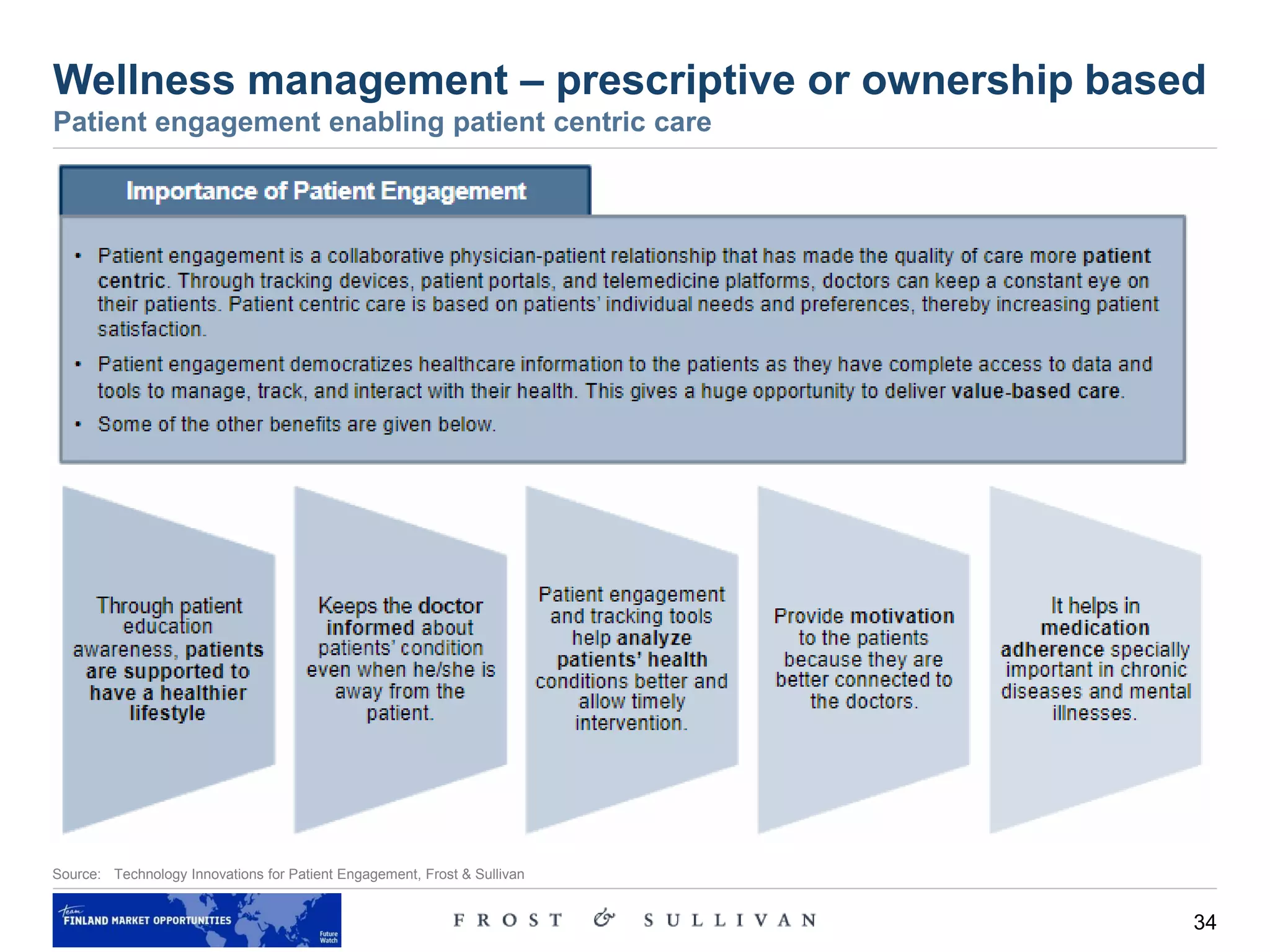
Home runs on both desktop and mobile VR platforms and requires a prescription from an eye doctor.
144
Virtual Reality
Vendors to watch
Source: Virtual Reality in Healthcare A Look at Growth Opportunities, Leading Vendors, and Market Dynamics as Healthcare Braces for the Fourth Digital Wave, Frost & Sullivan
• Firsthand Technology, founded in 2002 and based in San Francisco, is a pioneering company in the area of VR pain control.
Firsthand helped to build the first VR pain relief application, SnowWorld, and today provides proven, evidence-based,
immersive VR programs for lasting acute and chronic pain management.
• Firsthand’s VR system helps reduce pain and stress experienced by patients, reduces reliance on drugs, and lowers the cost
of care. Firsthand is focused on customer service and makes VR easy to use in clinical settings by offering a variety of
deployment models. The company’s two key programs, sold as kits for single patients or hospital settings, are COOL! VR Pain
Relief, which is a journey through beautiful settings, and GLOW Mindfulness Feedback, which lets users perform tasks with their
hands. Cool! and Glow are optimized for full-immersion VR HMDs like HTC Vive or Oculus and are sold by monthly or annual
subscription bundles that may include discounts for multiple licenses. On-site installation and training and extended support
packages are also available.
• Firsthand Technology also offers complete VR hardware setups—HMDs, PC, controllers, biosensors, etc.—and can deploy a
complete, customized VR Pro system on a cart for hospitals.
• MindMaze is a Swiss company founded in 2011 with operations in the UK, the US, and Germany. MindMaze develops medical-
grade AR/VR computing platforms for hospitals and rehab centers that are designed to stimulate neural recovery for patients
with brain injuries, stroke and paralysis. The company is also developing solutions for spinal cord injury and amputee patients.
• The MindMotion platform (MindMotionPRO and MindMotionGO) is an FDA-approved program designed as an intuitive
human-machine interface combining VR, computer graphics, brain imaging, and neuroscience. The program provides access
to more than 30 neurorehabilitation gamified activities. MindMotion helps patients follow a personalized exercise regimen
prescribed by therapists and is equipped with real-time multisensory feedback so patients can monitor their own performance.
MindMaze claims its success is due to zero-latency equipment that transmits images and sound in real time without the delay
normally associated with graphics-heavy programs.
• In 2017, MindMaze launched MASK for use with VR programs. MASK consists of eight small sensors attached to a piece of foam
inserted into an HMD. It detects the electrical signals from a user’s face muscles, capturing and interpreting facial expressions to
predict what is being expressed. In other words, MASK uses software to figure out the user’s emotions. This is a potentially
revolutionary tool for VR and one that can help social reality technologies create truly emotional experiences.
145
Back to Contents
4.6. CLOUD INFRASTRUCTURE AND SOLUTIONS
146
Cloud infrastructure and solutions
Discussion
Source: Healthcare Cloud Computing Outlook, Frost & Sullivan
The global market for healthcare cloud computing—revenue generated by cloud computing
services offered to providers—will be greater than $10 billion by 2025 primarily driven by the
need for storage of the exponentially increasing volume of healthcare data. However, volume is
only the beginning of the story; healthcare data in rapidly increasing in terms of complexity,
sources, and applications—all of which render the potential to develop new and innovative
solutions that leverage cloud platforms. Current cloud applications among healthcare providers
are dominated by non-clinical, back-office functions, especially those supporting information
technology (IT) workflows. However, there is a definite peak in adoption of cloud-based
clinical applications and in the next five years, key opportunities for cloud platforms will be
storage, management, and analytics of imaging data; health information continuity through
electronic medical records (EMRs), electronic health records (EHRs), and health information
exchanges (HIEs); and telehealth solutions, especially teleradiology and virtual consultations.
One major industry game-changer will be real-world data. The volume of unstructured medical
and health data that is generated outside of clinical settings is growing exponentially while the
need for such data sets is even direr among providers, pharmaceuticals, medical technology
vendors, governments, and university researchers. Growing awareness of the benefits of open
platforms and increasing industry focus on interoperability and collaborative solution design is
creating a heavy demand for vertically integrated cloud platforms that open the data to multiple
stakeholders who are willing to share the risks and the rewards of shared data assets.
Technology vendors will introduce cloud-based digital ecosystems that enable sharing and
better utilization of IT and human resources.
147
Cloud infrastructure and solutions
Discussion
Source: Healthcare Cloud Computing Outlook, Frost & Sullivan
At the heart of these healthcare industry innovations are some fundamental shifts in
the perception of cloud solutions globally. Cloud, which was once thought to be an
unknown and uncertain IT environment, is now believed to be more secure than on-
premise infrastructure and has proven to have better outcomes when it comes to
data back-up and disaster recovery. Increasing confidence in cloud platforms,
combined with the need to reduce cost, improve workflow speed and efficiency,
and to leverage meaningful business intelligence is paving way for hybrid cloud
adoption—especially among developed markets. Thus, we see that there have been
some extremely dramatic shifts in the way providers think of and use cloud platforms
in the last few years, which will create opportunities for innovations in care delivery
processes and models in the near future.
148
Cloud infrastructure and solutions
Top reasons for healthcare providers to invest in cloud computing
Source: Healthcare Cloud Computing Outlook, Frost & Sullivan
149
Cloud infrastructure and solutions
Growth opportunities in the global healthcare cloud market
Source: Healthcare Cloud Computing Outlook, Frost & Sullivan
150
Cloud infrastructure and solutions
Healthcare cloud computing vendor landscape by segment
Source: Healthcare Cloud Computing Outlook, Frost & Sullivan
151
Back to Contents
4.7. SMART DEVICES – IOT
152
Smart devices – IoT
Smart sensors for healthcare
Source: Innovations in Smart Sensors, Frost & Sullivan
153
Smart devices – IoT
Application of smart sensors in the healthcare sector
Source: Innovations in Smart Sensors, Frost & Sullivan
154
Smart devices – IoT
IoT enables transition of care delivery
Source: Why Now is The Time for Interoperable Healthcare Solutions?, Frost & Sullivan
155
Smart devices – IoT
IoT enables transition of care delivery
Source: Why Now is The Time for Interoperable Healthcare Solutions?, Frost & Sullivan
156
Smart devices – IoT
Application of smart sensors in the healthcare sector
Source: Innovations in Smart Sensors, Frost & Sullivan
157
Smart devices – IoT
Vendors to watch
Source: Innovations in Smart Sensors, Frost & Sullivan
158
Smart devices – IoT
Vendors to watch
Source: Innovations in Smart Sensors, Frost & Sullivan
159
Back to Contents
4.8. CYBERSECURITY
160
Cybersecurity
For healthcare, improving cybersecurity is the number one priority
Source: Global Digital Health Outlook, 2018, Frost & Sullivan
Healthcare providers, payers, and IT vendors will increasingly turn
to expert advisors to build strong defenses against cyberattacks.
• The pervasive and growing risk of cyberattacks targeting patient data
residing in digital health systems is a dangerous new reality for the
healthcare industry.
• Several high-profile ransomeware attacks in 2017 exposed the extent
of vulnerability faced by everyone, even leading health IT vendors and
health systems. A recent Healthcare Information and Management
Systems Society (HIMSS) survey reveals 96% of HCIT professionals
predict that ransomware/malware attacks will increase in the next 2
years.
• For healthcare, improving cybersecurity is the number one
priority. However, the level of sophistication and the dedicated
resources required to successfully meet growing threats are beyond
the ability of many healthcare-covered entities and business
associates to manage alone.
• Healthcare organizations will increasingly depend on vendor
partners to provide a wide range of expert cyber-risk
management and compliance services, such as threat
assessment, employee training, implementation of policies and
procedures, internal audits, ongoing monitoring, and incidence
response.
161
Cybersecurity
GDPR defines how an individual‘s personal information can be used by organisations,
businesses, and governments
Source: Global Hospital-based Medical Device Connectivity Market, Frost & Sullivan
• The General Data Protection Regulation (GDPR) is Europe‘s new framework for data protection laws.
• GDPR is designed to complement data privacy laws across Europe. It aims at protecting and empowering
all EU citizens‘ data privacy, and changing the way organizations across the EU manage data privacy.
• It came into effect on May 25, 2018 and will apply to all 28 member states of the EU.
162
Cybersecurity
Key features of GDPR
Source: Global Hospital-based Medical Device Connectivity Market, Frost & Sullivan
163
5. NEXT GENERATION SOLUTIONS –
R&D AND INVESTMENT FOCUS
Back to Contents
164
Back to Contents
5.1. REGIONAL HOT SPOTS FOR DEVELOPMENT OF
WELLNESS ENABLING SOLUTIONS
165
Digital Health Regional Hot Spots
Digital health regional trends and highlights—US
Source: Global Digital Health Outlook, 2018, Frost & Sullivan
166
Digital Health Regional Hot Spots
Digital health regional trends and highlights—Western Europe
Source: Global Digital Health Outlook, 2018, Frost & Sullivan
167
Digital Health Regional Hot Spots
Digital health regional trends and highlights—Central and Eastern Europe
Source: Global Digital Health Outlook, 2018, Frost & Sullivan
168
Digital Health Regional Hot Spots
Global Perspective―Emerging Markets
Source: Global Digital Health Outlook, 2018, Frost & Sullivan
169
Digital Health Regional Hot Spots
Digital health regional trends and highlights—APAC
Source: Global Digital Health Outlook, 2018, Frost & Sullivan
170
Digital Health Regional Hot Spots
Digital health regional trends and highlights—APAC
Source: Global Digital Health Outlook, 2018, Frost & Sullivan
171
Back to Contents
5.2. ROLE OF ACADEMIC HUBS
172
Role of Academic hubs
Collaboration between academia, industry and government nurtures the medical
technology industry by providing the platform for clinically led innovation
Source: Global Digital Health Outlook, 2018, Frost & Sullivan
Academia Industry
Government
• New/ targeted funding
for translational research
• Increased private-public
partnership
• Encouraging flow of
talent between sectors/
interdisciplinary training
• Opportunities to
expand/diversify without
direct investment
• Flexible partnerships
• Open innovation model
• Specific allocation of budgets
• Partnerships between
government and universities/
research institutes.
• Creating a culture of research
and innovation
• Research and development of digital
health devices faces several challenges
such as financial constraints, long
lead times to bring the product to
market, and even a lack of viable
business models.
• This has motivated several stakeholders
in the industry to reconsider collaborative
approaches to technology innovation.
• Best examples for medical device
innovation are seen where collaborators
each uses their core competence. For
instance, the clinical community
provides end user input and
professional opinion, academia
powers innovation with its research,
and industry participants with their
manufacturing prowess. This is also
supported by governments and regional
authorities through a favourable
business environment and through
research support.
Triple Helix Model of Academia-
Industry-Government Collaboration
173
Role of Academic hubs
Globally, Stanford Byers Center for Biodesign is a leading example of clinically led
innovative academic hub
Source: Succeeding in Delivery of Value-Based Care, Frost & Sullivan
• Numerous academic institutions in the US are
innovating in the digital health space, making it a
leading global destination for digital health R&D.
Stanford Byers Center for Biodesign is a
leading example of clinically led innovation that
has benefited immensely from effective
partnerships between academia and the health
technology industry.
• By offering innovation fellowships and training
programs, students and research fellows are
encouraged to benefit from the facilities provided
by the Stanford Institutions for engineering,
design and business to create innovative
solutions for the healthcare industry. These
innovators-in-training are supported to take their
solution to the next level, whether via start-up,
corporate investment, or other implementation
channels by using their worldwide network of
innovators.
• To date, the network has attracted an overall
investment of $453 million and 32 health
technology companies have been formed from
fellowship projects.
• Canada has its own ‘Digital Health
Hub (DGH)’, which is a
conglomeration of Simon Fraser
University, Fraser Health, City of
Surrey and many others within the
emerging Surrey Innovation
Boulevard.
• The various programs running in the
DGH are focused on mobile
solutions, cloud computing and
computer aided diagnosis.
174
Role of Academic hubs
Europe has several academic hubs that are leading in digital health innovation
Source: Succeeding in Delivery of Value-Based Care, Frost & Sullivan
• The prominent medical innovation clusters in Europe are scattered around the Grand Est area of
France, Medical Valley in Nurnberg and Tuttlingen in Germany, Emilia-Romagna of Italy, Galway in
Ireland, BioRegion of Catalonia, in Spain, Canton Zurich in Switzerland and the “golden triangle”
between London, Cambridge and Oxford in the United Kingdom.
• The Asia-Pacific region is not far behind in
establishing Medical technology hubs.
• Examples include the Biopolis, biomedical sciences
research and development (R&D) hub in Singapore,
Japan Agency for Medical Research and
Development (AMED) and China Center for
mHealth Innovation (CCmHI).
While clinical led innovation and academic partnerships can drive research, medical technology
innovation clusters provide the infrastructure, facilities and opportunity to attract investment
from industry.
175
Back to Contents
5.3. INNOVATION FOCUS THROUGH 2025 – OEMS
AND SMES
176
Innovation Focus through 2025 – OEMs and SMEs
Digital health companies to watch – big players
Source: Global Digital Health Outlook, 2018, Frost & Sullivan
177
Innovation Focus through 2025 – OEMs and SMEs
Digital health companies to watch – big players
Source: Global Digital Health Outlook, 2018, Frost & Sullivan
178
Innovation Focus through 2025 – OEMs and SMEs
Digital health companies to watch – big players
Source: Global Digital Health Outlook, 2018, Frost & Sullivan
179
Innovation Focus through 2025 – OEMs and SMEs
Digital health companies to watch – big players
Source: Global Digital Health Outlook, 2018, Frost & Sullivan
180
Innovation Focus through 2025 – OEMs and SMEs
Digital health companies to watch – US startups
Source: Global Digital Health Outlook, 2018, Frost & Sullivan
181
Innovation Focus through 2025 – OEMs and SMEs
Digital health companies to watch – Europe startups
Source: Global Digital Health Outlook, 2018, Frost & Sullivan
182
Innovation Focus through 2025 – OEMs and SMEs
Digital health companies to watch – APAC startups
Source: Global Digital Health Outlook, 2018, Frost & Sullivan
183
6. CONSUMERISM AND PARTICIPATIVE HEALTHCARE
– PARADIGM SHIFTS IN THE NEXT DECADE
Back to Contents
184
Consumerism and Participative Healthcare
Discussion
Source: Frost & Sullivan
Healthcare today is not about just going to the doctor at the time of illness or on regular
appointments to check the overall disease progression. It is shifting to a more proactive
rather than reactive approach with patients being more aware and willing to be involved in their
own health. The traditional culture of healthcare and how people engage in healthcare is being
dramatically reshaped by new cultural attitudes and the pervasive adoption of mobile
phones/smartphones/social media by the general population as well as digital health tools
increasingly used by healthcare providers. This opens up new possibilities for reshaping
behaviors, especially for younger demographics.
Furthermore, health systems around the world are reeling under the pressure of rising costs,
shortage of personnel, and the ever-increasing burden of chronic ailments. Digital health
solutions are the saviors in such a landscape driving Patient Engagement 2.0. Not only do the
IT solutions empower the patients, they also provide a cost-effective alternate channel for
managing chronic patients.
Broadly, digital health solutions cater to patient touch points across the care continuum and target
clinical (remote monitoring, telehealth and so on), administrative (appointment scheduling, reminders
etc.), and financial (billing, payer communications and so on) functions. A plethora of pure-play patient
engagement companies are offering innovative solutions. EHR providers and medical device companies
are not far behind. Different vendor types are targeting different gaps in the care journey. Innovations and
start-up activity is abundant in this area with trends such as healthcare consumerization shaping up.
Increasingly, there is a demand for clinical-grade digital solutions which offer the ease of use of
consumer-grade devices and the accuracy and efficacy of medical-grade ones.
185
Back to Contents
6.1. WILLINGNESS TO ADOPT AND PAY FOR SOLUTIONS
186
Willingness to adopt and pay for solutions
In Europe, UK and Spain are most willing to use digital health to connect with providers
Source: Accenture Survey 2016, Health-tech Resource Guide 2018, HIMSS 2018 Insights
187
Willingness to adopt and pay for solutions
Denmark and Estonia lead the way in adoption of digital health technologies
Source: Accenture Survey 2016, Health-tech Resource Guide 2018, HIMSS 2018 Insights
188
Back to Contents
6.2. SHARE OF WALLET TOWARDS INVESTMENT
IN WELLBEING
189
Share of wallet towards investment in wellbeing
People are open and willing to invest on gadgets and wellbeing programs that can
help them stay healthy
Source: eHealth, Insurance Journal, Rock Health, Frost & Sullivan
Globally, each healthcare system is uniquely funded. While healthcare in the US – the largest healthcare market by value
– is funded through private and public funds, and a patient is required to pay premiums and co-pays to their insurers,
in the Europe, healthcare is largely publicly funded. In contrast, developing regions such as India offer limited
support in terms of healthcare funding; patient pays for healthcare services and medication.
Healthcare funding model in the US has always been ranked lower than the European model since it costs higher,
while the healthcare outcome metrics are comparatively lower. However, as time progresses, both the economic
models are gradually becoming unsustainable. Due to a rapidly ageing population and rising prevalence of chronic
diseases, healthcare spending has reached an alarming level. In the US alone, healthcare spending is expected to reach
nearly $5 trillion by 2020.
To counter this immense pressure on healthcare budgets, insurers are rapidly increasing the premiums that patients
pay towards their healthcare insurance. For instance, in the US, during 2013-2018, average monthly premiums for
families has increased by 174%. Similarly, the UK has increased the insurance premium tax three times between
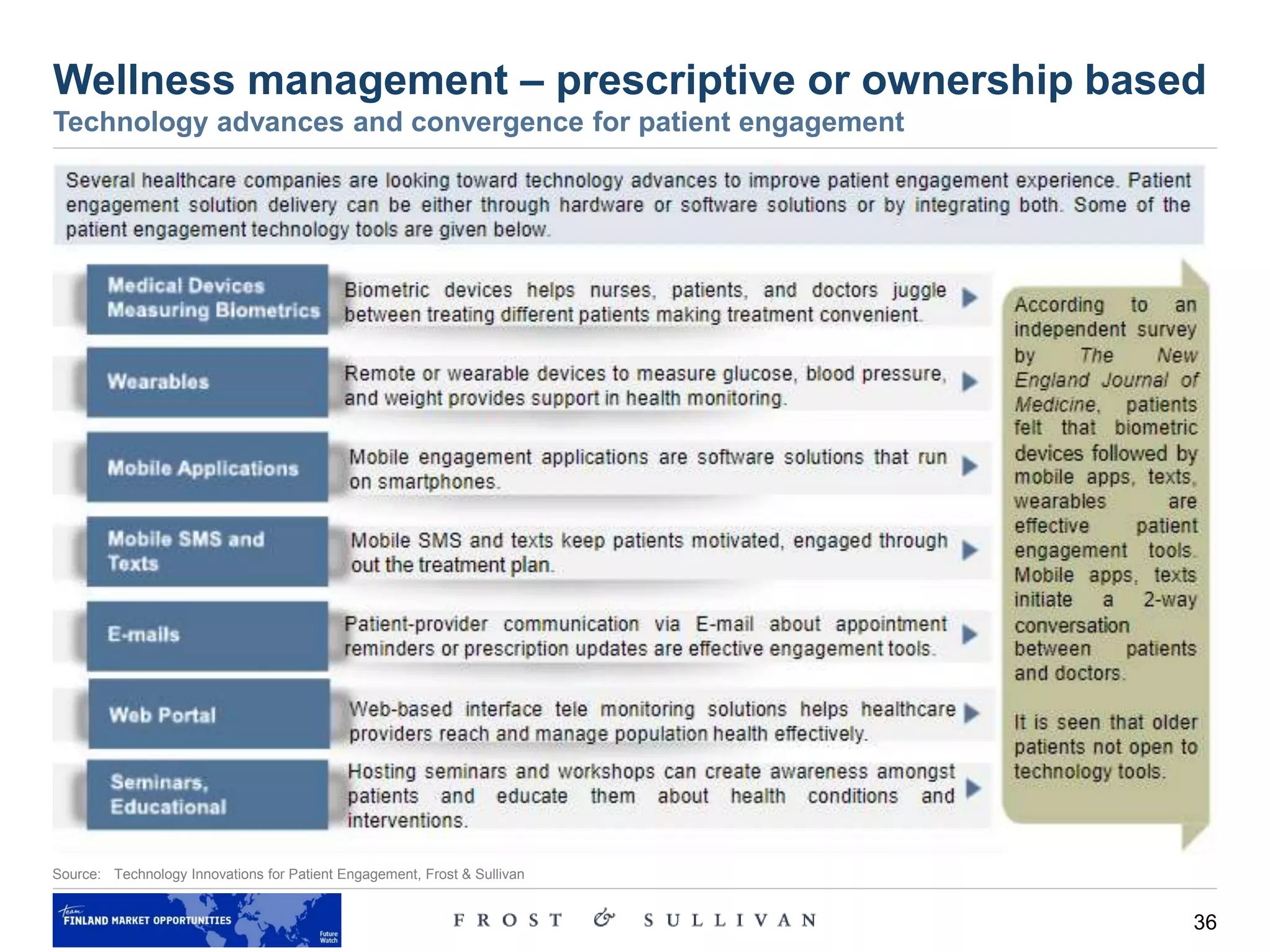
November 2015 and June 2017, from 6% to 12%.
Rising economic contribution towards healthcare has brought about a massive change in people’s perception of
healthcare services. While previously it was sought as a right, it is beginning to be seen as a privilege. People are
today more conscious of their wellness and are willing to spend on their over all well being, so as to avoid utilization
of healthcare services.
In survey findings, shared by Rock Health (a US market research firm) in 2017, it was reported that 46% of consumers
are now considered active digital health adopters, having used three or more tools in categories such as telemedicine
and wearables over a course of 12 months. 39% of consumers strongly agreed that they are willing to pay for
digital health tools out of pocket. Rising premiums was reported as a key driver behind this attitude.
190
Share of wallet towards investment in wellbeing
A company needs to highlight the value its digital health offering brings to a patient’s
life, to earn their trust and continued involvement.
Source: MBNA, PwC
In UK, consumers expressed a high willingness to spend on tools and services that can help
them attain physical, mental or social wellbeing, as reported by MBNA, a Llyods Banking
Group company. Forecasts from PwC suggest that consumers in UK are estimated to spend
£24bn per year on wellness by 2020, up from £20 bn in 2015. A majority are willing to
spend up to £100 each year on wellness. While a large number of people have bought a
digital activity tracker or downloaded a digital health app, people are also actively
spending on nutritive diets, and wellness programs that help in mental wellbeing.
However, an important consideration for any digital health company should be the value it
proposes to bring forth a consumer. Patients and caregivers experiencing value from
digital health apps are willing to pay out of pocket for them. For instance, Empatica Inc.
is able to generate a subscription-based revenue stream of $12 to $53 per month from users
as it provides them with of peace of mind and a sense of safety by alerting their caregivers in
case of convulsive seizures. In another instance, 23andMe a direct-to-consumer genetic
testing company, which sells its tests for $99, not only has witnessed an uptake in demand
backed by rising awareness of the benefits of genetic diagnoses, it has also witnessed
strong customer involvement in their health. In a recent survey that 23andMe conducted
to gauge their consumers interest for participation in clinical trials, the company was surprised
to find that consumers were keen in participating and contributing their health data.
191
Back to Contents
6.3. TRENDS TOWARDS WELLBEING, STAY HEALTHY
192
Trends towards wellbeing, stay healthy
There is a shift in culture among patients with them taking a more active role in managing
their health.
Source: HIMSS EU Insights, The Future of Patient Engagement 2.0 in Europe, Frost & Sullivan
193
Trends towards wellbeing, stay healthy
Current health, concern about health, and level of engagement in healthcare in the US.
Source: Creating a Culture of Health, Frost & Sullivan
194
Trends towards wellbeing, stay healthy
Budget-constrained health consumers ― US
Source: Creating a Culture of Health, Frost & Sullivan
195
Trends towards wellbeing, stay healthy
Self-motivated suburbanite health consumers ― US
Source: Creating a Culture of Health, Frost & Sullivan
196
Trends towards wellbeing, stay healthy
Afflicted urban professional health consumers ― US
Source: Creating a Culture of Health, Frost & Sullivan
197
Trends towards wellbeing, stay healthy
Physician-Dependent Senior Health Consumers ― US
Source: Creating a Culture of Health, Frost & Sullivan
198
Trends towards wellbeing, stay healthy
Engaged urban techie health consumers ― US
Source: Creating a Culture of Health, Frost & Sullivan
199
Trends towards wellbeing, stay healthy
Healthcare skeptic health consumers ― US
Source: Creating a Culture of Health, Frost & Sullivan
200
Back to Contents
6.4. GEOGRAPHICAL VARIATIONS AND MATURITY IN
TERMS OF ADOPTION AND USAGE
201
Geographical variations and maturity
Discussion
Source: Frost & Sullivan
Healthcare stakeholders (medical diagnostics and device companies, pharmaceutical companies,
providers, and payer systems) are focusing on patients as a way to improve care quality,
outcomes, access, and cost efficiencies in light of growing cost and resource constraints across the
globe. The traditional culture of, and how people engage with, healthcare is being dramatically
reshaped by new cultural attitudes and the pervasive adoption of mobile
phones/smartphones/social media by the general population, as well as digital health tools that
are increasingly being used by healthcare providers. This combination opens up new possibilities for
reshaping behaviors, especially for younger demographics.
In 2018, the United States is the most mature digital health market, comprising technologically
advanced solutions, a highly complex market landscape, and increasingly tech-savvy consumers.
Key reasons for this include a regulatory environment that creates dependence on sophisticated
data technologies and greater awareness and adoption willingness among consumers and
healthcare providers. Value-based care concepts have the most profound impact on digital health
revenues in North America; however, other countries and regions are interested in exploring how
they can deliver better patient outcomes at lower costs, thus devising their own versions of value-
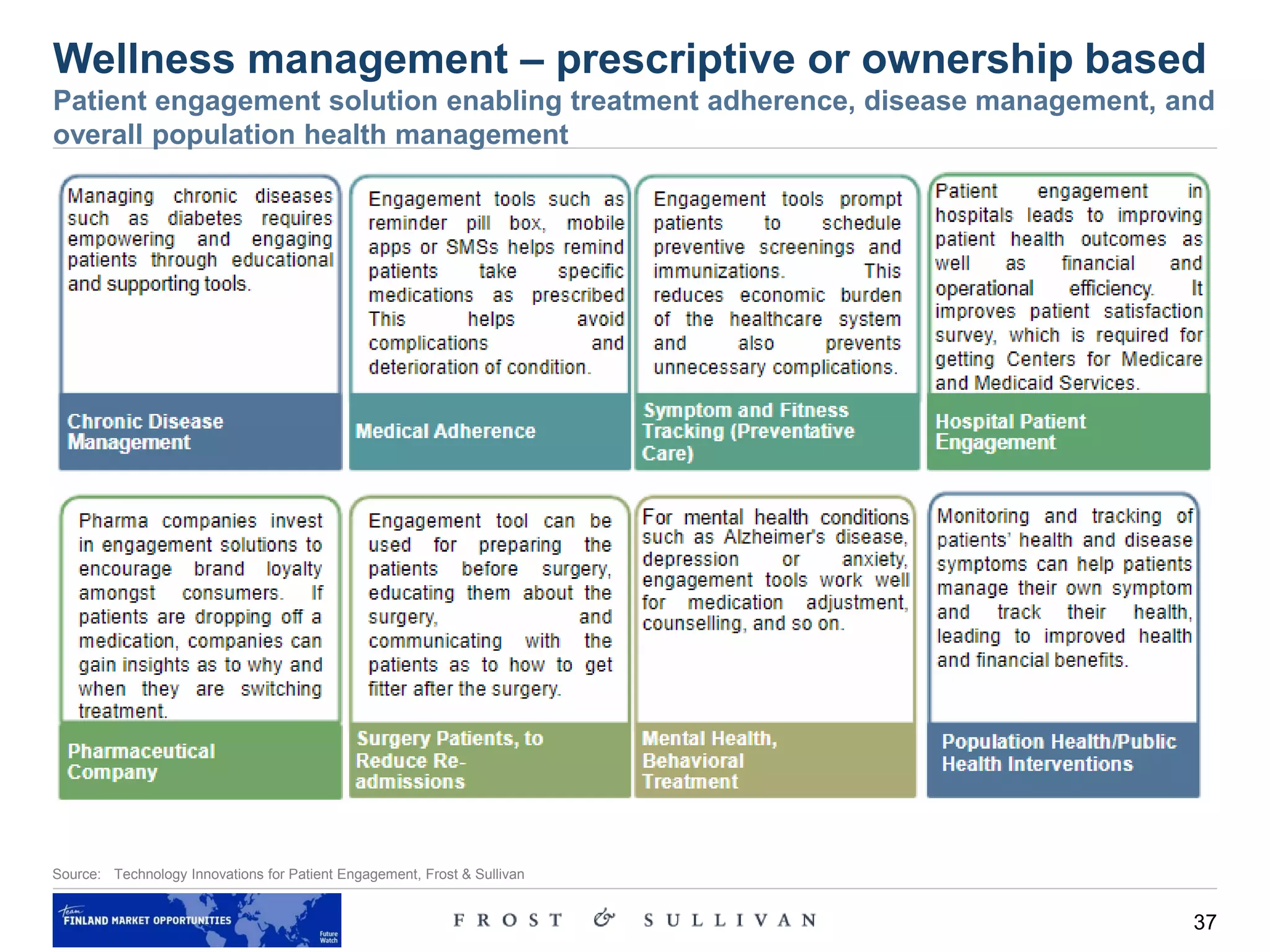
based care models.
Europe is emerging as a strong market with some countries becoming more attractive for such solutions.
The regulatory framework of countries, IT infrastructure, and sociocultural factors have a major impact on the
uptake of patient engagement solutions. The value of engaging patients digitally is not just being seen among
the healthcare providers, but also with medical diagnostics, devices, pharmaceuticals, and insurance
providers. Among key European countries, Estonia, the Netherlands, Norway, Spain, and the United
Kingdom
are the evolving digital health hotspots based on their IT infrastructure development, sociocultural factors,
regulatory frameworks, and health system parameters. Telemedicine, remote patient monitoring, patient
access to EHRs, mHealth, and interoperability are priorities in these countries.
202
Geographical variations and maturity
Estonia, Finland and Denmark lead in terms of percentage of individuals who have
adopted e-health solutions.
Source: European Commission, Euromonitor International
Global Digital Health Hotspots
Represents high adoption of digital health tools by individuals in a country
United
States
Japan
South
Korea
China
Estonia
Spain
United
Kingdom
Sweden
Denmark
Finland
Slovenia
203
Back to Contents
6.5. SCALABILITY OF OPERATIONS
204
Scalability of operations
F&S believes that solutions supporting health and wellbeing are scalable at a global
level
Source: Frost & Sullivan
Barriers to scalability of operations for a Finnish e-health company
Consumer
privacy
Data security
Consumer attitude
towards wellbeing
Attitude towards
out-of-pocket
payment
Government
focus on
e-health
Digital health
infrastructure
Digital health
funding and
expenditure
Barriers
A large company, with global presence and brand
recognition can cater to global consumers
It is imperative that this company is able to ensure
abidance to local data privacy and security laws in
each country
Examples of
companies that
found acceptance
of digital health
products globally
205
Back to Contents
7. APPENDIX
206
Patient management
Selected Vendor Profiles—Multi-Parameter RPM Wearables
Company &
Device Name
Functionality Use Case
Future
Applications
Vital Connect Inc.
• A chest patch with a reusable sensor module and a disposable patch that can
capture 8 FDA-grade vital signs (single-Lead ECG, heart rate, heart rate
variability, respiratory rate, skin temperature, body posture, fall detection,
activity including steps)
• Provides real-time access with cloud connectivity using Bluetooth wireless and
Wi-Fi connections
• It is one the best clinical-grade marketed wearables with approval from FDA for
sales in the United States, CE Mark for distribution in the European Union,
Ninsho certification in Japan, and registered for distribution in Canada.
• Hospital
monitoring
• Post-discharge
monitoring
• Clinical trial
monitoring
• Enables real-time non-
obtrusive clinical-grade
multi-parameter VSM
• Can improve hospital
efficiency and quality of
care through real-time
clinical-grade
continuous patient
surveillance
• Enables patients to
seamlessly access and
monitor health vitals
without interfering with
their activities
• Increase clinical trial
efficiency by enabling
home trials to improve
therapeutic outcomes
• Capable of
simultaneously
transmitting data using
cloud or other
connected device such
as smartphone, tablets,
PCs, or EHR
Cloud DX Inc.
• The device comprises sensors worn over the shoulders with two electrodes to
measure electrical activity of the heart and an ear piece sensor to capture body
temperature and oxygen saturation.
• Can log real-time data to cloud while connected to a smartphone or tablet
• However, its is a patent pending device with ongoing approval process from
Canada and US FDA (Dec. 2015). It is also one of the 10 finalists in the
Qualcomm Tricorder XPRIZE competition 2017.
• Remote patient
monitoring
• Home care
Sotera Wireless
• A wrist and chest wearable device capable of continuously measuring and
displaying most vital signs (ECG, heart/pulse rate, SpO2, BP, respiration rate,
and skin temperature) with monitoring accuracy and resolution typically found
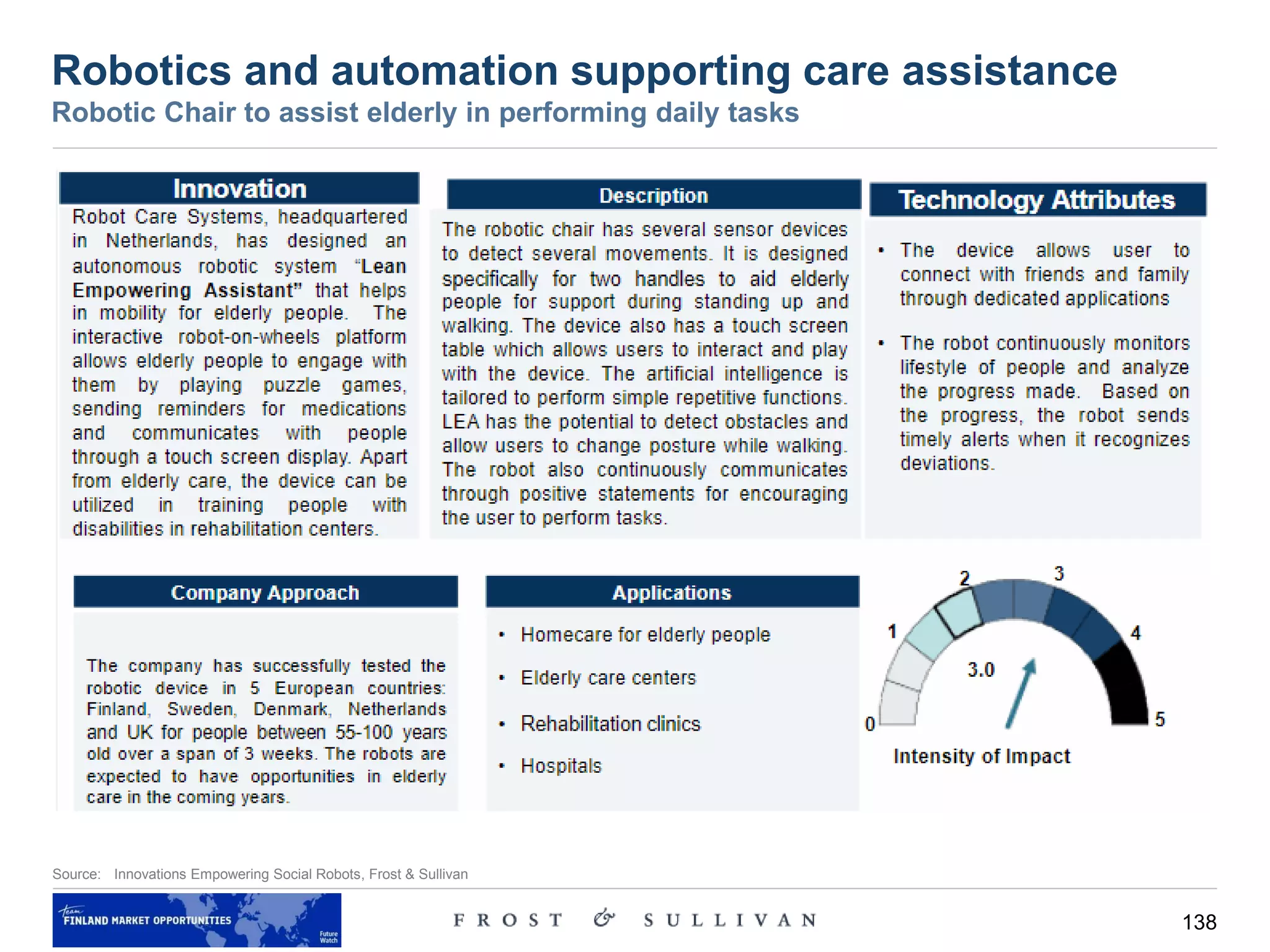
in ICUs (CE and FDA cleared)
• Provides color touchscreen display on the patient-worn device, platforms such
as desktop or tablet PCs. Also able to wirelessly transmit data, leveraging
existing hospital Wi-Fi infrastructure, and designed to provide information
output in electronic form (i.e., EMR connectivity) as well as printouts
• Intensive care
• Hospital
monitoring
• Post-discharge
monitoring
Source: Frost & Sullivan
207
Patient management
Select Vendor Profiles—Clinical-Grade AF Wearables
Company &
Device Name
Functionality Use Case
Future
Applications
AliveCor, Inc.
• Smartphone-enabled single-plate device that
records ECG through fingers rested on the attached
plate; FDA cleared
• Identifies AF with 96% specificity and 100%
sensitivity
• Does not replace a 12-lead ECG
• Non-continuous RPM
• Home monitoring for
heart conditions and
ECG
• Efficient for post-heart-related
procedure follow-ups
• Effective tool for third-world countries
• Limited widespread adoption, as it fails
to provide in-depth information for
screening of prior ischemic heart
disease or related abnormalities
Medtronic, Inc. • A wireless cardiac telemetry system with a single-
use adhesive chest patch that continuously
measures, records, and periodically transmits
physiological data; FDA approved
• Detects the presence of AF in patients, with a
sensitivity of 96.1%
• Continuous RPM
• Home monitoring: ECG
and heart rate
• Detection of non-lethal cardiac
arrhythmias
• Limited application for patients with
potentially life-threatening arrhythmias,
or who require inpatient/hospital
monitoring
iRhythm Technologies, Inc.
• A single-use adhesive chest patch with FDA-cleared
algorithms and ZIO report services analysed by
certified cardiac technicians
• Helps physicians achieve definitive diagnosis with a
single test in 90% of the cases
• Ambulatory cardiac
monitoring
• Continuous RPM
• Home monitoring - ECG
• Helps avoid heart arrhythmias risk
factors for obesity, diabetes,
obstructive sleep apnea, overuse of
alcohol/caffeine/nicotine
Preventice Solutions, Inc. • A chest-worn rhythm monitoring device that
captures ambulatory ECG for arrhythmias, including
AF, tachycardia, bradycardia, and pause; FDA
cleared
• Real-time patient data is wirelessly shared with
physician using cloud and mHealth platforms;
HIPAA compliant
• Jointly developed with Mayo Clinic and ST
Microelectronics
• Ambulatory cardiac
monitoring
• Continuous RPM
• Home monitoring - ECG
• Allows individuals to remain active and
independent while their heart and
general health are monitored.
• helps physicians remotely monitor
their patient’s experience and help
them refine their care
Mobile ECG
Medtronic
SEEQ
Source: Frost & Sullivan
208
Company &
Device Name
Functionality Use Case
Future
Applications
Medtronic, Inc. • The device uses a combination of a CGM and insulin delivery
system; helps in mimicking some functions of a healthy
pancreas
• Does not replace daily diabetes management. Confirmatory
finger stick is still required prior to making adjustments to
diabetes therapy.
• Minimally invasive
CGM
• Automated insulin
delivery system
• Helps diabetes patients in
providing advanced protection
from hypoglycemic episodes
• Autonomous insulin delivery
mechanism helps patients live a
regular lifestyle.
Tandem Diabetes Care
• An abdomen patch that uses sensor geometry, membrane
technology, and an algorithm for CGM
• Uses a touch-screen pump with CGM
• The device combines features of the t:slim® Insulin Pump and
Dexcom G4® PLATINUM CGM System;
• For patients aged 12 and above who use insulin
• Minimally invasive
CGM
• Automated insulin
delivery system
• Pediatric debate
care
• Convenient displays of CGM
graphs and trend information can
help patients, physician, and
caregivers take informed
decisions and avoid
hypoglycemic conditions
UNILIFE CORPORATION
Imperium™
• A pre-filled, high-precision wearable device capable of
delivering concentrated insulin up to U-500
• No handheld controller required; pre-set basal rate with on-
demand bolus with push of a button
• Wireless connectivity provides integration with smartphone
apps to enable patient reminders and status updates
• Not been evaluated by the FDA; lacks CGM functionality
• Insulin delivery
wearable system
• Empowers patients to gain
control over their blood glucose
levels using prefilled, multi-day
compact insulin delivery
wearable
Johnson & Johnson • FDA-approved wearable patch pump that holds up to 200 units
of insulin and can deliver doses for 3 days
• J&J acquired Calibra Medical in 2012 and is expected to launch
an upgraded version of Calibra Finesse in 2016.
• It is a completely mechanical device with no handheld
controller, displays, batteries, memory, or CGM function
• Insulin delivery
wearable patch
pump
• Minimizes the hassles of taking
insulin and dealing with needles,
with discreet delivery options for
patients
Patient management
Select Vendor Profiles—Minimally Invasive Continuous Glucose Monitoring (CGM) and
Insulin Delivery Wearables
Source: Frost & Sullivan
209
Patient management
Select Vendor Profiles—Potential Non-Invasive CGM Wearables
Company &
Device Name
Description of Non-invasive Glucose Monitoring Wearables
Sano Intelligence Inc.
• Sano is building a wearable sensor that measures metabolic activity to track glucose level. It has not revealed the actual
technology behind the wearable; it plans to release the product in 2016.
ECHO Therapeutics • This glucose sensor is applied directly to an exfoliated area and continuously measures glucose utilizing glucose oxidase
enzyme technology. The proprietary algorithm converts data to accurate glucose values transmitted wirelessly. The
product is expected to be launched in 2016.
• Custom apps display glucose trends and values on any standard platform. A published application program interface
(API) makes it easy for developers to write apps. Clinical trials are ongoing.
Integrity GlucoTrack® • The device uses ultrasonic, electromagnetic, and thermal technologies to non-invasively measure glucose levels in the
blood.
• The company is undertaking on-going FDA clinical trials for new cases; subjected to FDA approval, the clinical-grade
wearable is expected to be marketed in 2016.
Novartis Alcon
and Google
• Google and Novartis AG’s Alcon unit have partnered to develop a contact lens that monitors glucose contained in tears
and transmits the data through a tiny antenna.
Mayo Clinic
• Mayo Clinic has formed a joint venture with 3 companies (Gentag, NovioSense, and Fraunhofer Institute MIS) to develop
a non-invasive blood glucose monitoring wearable device using near-field communications (NFC) wireless technology.
Non-invasive glucose monitoring device remains a billion dollar R&D black hole
• In the last 3 decades, more than 1,600 patent families were filed for non-invasive glucose monitoring by 500+ applicants.
• Despite this opulent R&D investment and innovation around IR spectroscopy, photoacoustic, impedance, etc., the conventional
and painful method of finger pricking is the most reliable way to measure blood glucose
• While several minimally invasive devices are available, bringing to the market a totally non-invasive device would represent a
great change for the market and for diabetics.
• However, with the advent of wearables into the regulated wearables space, the future for non-invasive glucose monitoring
wearables looks promising.
• Below is a selected list of vendors with futuristic non-invasive glucose monitoring wearables.
Source: Frost & Sullivan
210
Patient management
Select Vendor Profiles—Respiratory and COPD Wearables
Company &
Device Name
Functionality Use Case
Future
Applications
Breathe Technologies, Inc.
NIOV™
• The device detects the patient’s spontaneous breathing
by sensor ports located in the nasal interface. It is
clinically proven to reduce dyspnea and promote mobility.
• Intended for operation by trained personnel, patients, or
caregivers under the direction of a physician.
• With early mobilization, the device is claimed to reduce
mechanical ventilation by an average 2.8 days
• Hospital,
rehabilitation
• Home care
• Ambulatory care
• Empowers adult patients with respiratory
insufficiency by providing 3 clinician-
programmed customizable activity
settings
• Continuous application design enables
rehabilitation efforts in an institutional or
remote care environment
Health Care Originals, Inc.
• ADAMM (automated device for asthma monitoring and
management) is a wearable that helps in managing
asthma
• It can continuously detect asthma symptoms and provide
alerts for remedies and medications
• Provides an online portal for accessing daily status from
anywhere, with HIPPA-compliant data storage
• Continuous
remote asthma
management
• This intelligent asthma management
device aids asthma patents in preventive
care
• Provides peace of mind to worried
parents and caregivers by symptom
tracking, trending, and alert forwarding
functionalities
ChemiSense, Inc. • A mobile wearable with sensors that monitor the
environment and provide real-time air-quality data to
proactively avoid unhealthy environments
• The device uses two independently operating PTH
sensors to ensure accurate readings
• Also capable of storing data with immediate access to
past and current data
• Indoor and
outdoor
environment
and air-quality
monitoring
• This technology can help individuals with
respiratory conditions and those who live
in highly polluted areas to keep a check
on their level of exposure
• Provides understanding on hyperlocal
environmental levels through individual
sensor readings
Propeller Health
• A handheld wireless sensor device that syncs with the
smartphone using Bluetooth technology
• The sensor is a small device that attaches to the existing
inhaler and automatically keeps a record and trends
including time, date, and location
• The device lacks a true wearable design
• Respiratory
health
management
• Asthma and
COPD
monitoring
• The sensor helps individuals with
personalized feedback and educates
them on ways to improve their control on
asthma or COPD
Source: Frost & Sullivan
211
Patient management
Select Vendor Profiles—Chronic Pain Management Wearables
Company &
Device Name
Functionality Use Case
Future
Applications
NeuroMetrix, Inc.
• An over-the-counter wearable device for relief from chronic
pain; FDA cleared for sale without a prescription
• It uses intensive nerve stimulation (WINS) technology to
treat chronic pain conditions such as nerve, arthritic, back,
leg, and foot pain
• Built-in Bluetooth technology tracks users’ therapy and sleep
trends, and an accelerometer can adjust therapy levels
according to users’ daily activities
• Drug-free chronic
pain
management
therapy
• An ideal option for pain medication.
Physicians are managing challenging
chronic pain conditions such as in
diabetic neuropathy, sciatica, and
fibromyalgia.
Hocoma AG
• An FDA-approved medical-grade wearable device to treat
non-specific lower back pain by combining therapeutic
exercises with motivating games
• Bluetooth connectivity provides users a personalized
exercise therapy to perform 45+ exercises, developed by
experts, physiotherapists, and physicians
• Gamified back
therapy for home
care
• Empowers individuals with self-
supervised exercise program at home
to effectively manage back pain with
personalized therapy
• Also integrates fun and motivation with
gamified self-therapy training
dorsaVi Ltd.
• The device uses sensor technology that provides objective
data to accurately assess, prevent, and manage lower back
injuries and guide rehabilitation
• The sensors record data at 200 frames per second and send
information wirelessly to synced devices with HD video to
produce real-time objective data
• Neuro pain
management
• Lower back
injury treatment
& rehabilitation
• Objective data with visuals help
individuals to improve assessments,
manage treatment options, and
document therapy progress for
physician referrals and insurance
companies
Philips Electronics N.V
• The device with self-adhesive electrodes uses clinically
proven TENS pain relief technology and provides
personalization by 20 treatments with 60 intensity levels
• Uses Bluetooth wireless to connect with specially designed
app on iOS or Android device
• It can be used for mild to moderate post-surgical pain and
for chronic pain.
• Personalized
remote pain
management
therapy
• This wireless device is comfortable to
wear under clothes and enables
patients to move around freely with
less pain and enjoy an active lifestyle
Source: Frost & Sullivan
212
Patient management
Select Vendor Profiles—Sleep Disorder Wearables
Company &
Device Name
Functionality Use Case
Future
Applications
Kokoon • A headphone with integrated EEG brainwave sensors, it uses
audio to improve sleep quality
• Triple layer noise protection (ANC, isolation and active white
noise) technology removes disruptions and protects
regenerative deep sleep
• Uses Bluetooth 4.0 wireless with aptX® codec to connect with
the mobile app and audio library
• Sleep disorders
• Hearables can seamlessly be
integrated into daily life to increase
usability
• Helps in augmenting hearing ability
and enhances the sleep cycle to
prevent sleep disorders
MyCardio, LLC
• A small knob that a person affixes to their skin, it records and
uploads ECG, actigraphy, snoring, and body position data to a
secure cloud-based Web site, where it is automatically
analyzed
• Also generates sleep quality reports that feature easy-to-read
images and summary tables; FDA approved
• Diagnosis of
sleep apnea,
• Heart rate
variability
• Sleep quality
and obesity
• Screen and identify major health risks
associated with poor sleep
• Empower patients with sleep quality
insights and coaching to prevent
sleep disorders and accident risks
• Provide insight on how prescription
medication affects patients’ sleep
Airing LLC
• A small 3-dollar hoseless, maskless, cordless micro-CPAP
nasal interface device for treating sleep apnea and snoring
• As the patient inhales, air enters through vents, gets filtered,
and drawn into hundreds of micro-blowers that create the
precise airway pressure needed; seeking FDA approval
• Treating sleep
apnea
• Helps in eliminating usage discomfort
while using traditional masked and
wired CPAP masks
• Affordability makes it an effective tool
for third-world countries
ActiGraph, LLC.
• A prescription-grade wristwatch that captures and records
continuous, high-resolution physical activity and sleep/wake
information for clinical assessment and study of sleep disorders
and their relationship with chronic diseases
• A proprietary software (ActiLife) and cloud-based platform
offers a robust selection of advanced sleep/wake analysis and
reporting tools for multi-site studies
• In-home sleep
assessment
• Remote patient
monitoring
• Clinical trial
monitoring
• Makes multi-site clinical studies
efficient by mitigating logistical
challenges and providing access to
data in real time from anywhere
• Helps in benchmarking population
health data collected in large-scale
epidemiology studies to aid the
physician in practicing personalized
treatment
Source: Frost & Sullivan
213
Patient management
Select Vendor Profiles—Neurological and Mental Healthcare Wearables
Company &
Device Name
Functionality Use Case
Future
Applications
Halo Neuro Inc.
• Halo Neuroscience is developing wearable
technology that boosts brain function
• A headband that uses trans-cranial direct-current
stimulation (tDCS) for neurostimulation and boosts
brain function in both healthy and sick people.
• Home care and self-
treatment of pain
and mental
disorders such as
depression
• Halo’s neuromodulation technology has
the potential to improve cognitive
performance even in healthy brains
Thync, Inc.
• A head-strip that delivers pulsed neurostimulation
waveforms to modulate psychophysiological arousal
for lifestyle or wellness applications; accompanying
app manages user’s energy, stress, and sleep
• However the present version is not intended to treat
or diagnose any disease or medical condition
• Mental wellness
• Sleep and stress
management
• Allows users to gain a boost of motivation
or energy
• Helps reduce the brain’s response to
stress in a chemical-free way using
neural pathways, allowing users to dial
up or dial down their stress responses
and energy levels.
myBrain Technologies
• A headset wearable that uses sensors to capture
EEG signals and analyze them for optimal relaxation
• Uses Bluetooth to connect with smartphone or tablet
for live feed; neuro feedback using visual or audio
mode to strengthen and improve cerebral functions
such as relaxation, concentration, and memory
• Minimum age to use Melomind: 8 years
• Mental wellness
• Stress management
• Can be used as a neuroscience coach to
help manage stress that can be used to
track progress anytime, anywhere
Source: Frost & Sullivan
214
Patient management
Select Vendor Profiles—Neurological and Mental Healthcare Wearables (continued)
Company &
Device Name
Functionality Use Case
Future
Applications
Personal Neuro Devices
• A neurowearable headband is a brain monitoring
device that helps to clear the mind and improve
attention using EEG and neurofeedback
• The cloud-hosted system provides users with EEG-
derived numerical metrics to track multiple aspects
of brain health (cloud subscription is required to
avail Introspect account)
• Rehabilitation
• Brain health: focus and
concentration
• Treating child attention
deficit hyperactivity
disorder (ADHD)
• Innovative neuroscience tech, using
apps and games can help the
individual to improve brain health
• Portable brain-sensing devices and
metric-based brain training that
enables users to control their mental
state with a personality assessment
environment
Empatica Inc.
• A wristwatch is linked to the wearer’s mobile device
with a Bluetooth™ connection. This connection
allows the system to analyze the information and
detect unusual events such as convulsive seizures
in real time
• App sends alert notification to caregivers using the
mobile device’s cellular data or Wi-Fi connection
• Monitoring epilepsy
patients
• Convulsive seizures
alert system
• Helps epilepsy patients by alerting
caregivers and people in the vicinity
about any unusual event such as a
convulsive seizure, and ensures that
the user is provided assistance.
Interaxon
• A brain sensing headband with 7 calibrated sensors
to detect and measure brain activity
• Tested and certified by Canadian, US, and
European regulatory standards (FCC, UL, CE) for
consumer use
• Use Bluetooth to connect with the mobile app and
provide real-time feedback on meditation by
translating brain signals into sounds of wind
• Brain fitness
• Meditation -focused
attention based training
exercises
• Can be used to assist people with
mental health issues
• Also can be used by caregivers to
assist them in research to understand
how to cope with patients
• Help in stimulating motivation and
mental wellness by gauging cerebral
activity using EEG signals
Source: Frost & Sullivan
215
Patient management
Select Vendor Profiles—Women’s Health Wearables
Company &
Device Name
Functionality Use Case
Future
Applications
NuVo Technologies • A multi-sensor pregnancy belt to provide real-time
data on the status of the fetus and the mother's
health in the later stages of pregnancy
• Uses Bluetooth and cloud-based host to provided
sophisticated signal processing and data
management
• Smartphone app provides a visual representation to
users
• Late-stage pregnancy
care: mother and
baby's heart rates,
kicking, and position for
fetus
• Helps physicians detect symptoms that
may lead to complications in
pregnancy.
• Also helps avoid potential harm to
tissue posed by ultrasonic devices
Extant Future
Modoo
• A small fetus monitoring patch that helps expectant
mothers to continuously record their babies’ heart
rate, heartbeat, and fetus movement
• Based on the health information and records, users
also receive customized pregnancy tasks such as
exercises and prenatal visits that match their current
health conditions.
• Fetal heart rate and
heartbeat monitoring
• Fetal movements
• Maternal health
• Enables pregnant mothers in home
monitoring and online consulting to
avoid risk of travelling and anxiety
during pregnancy
Bloom Life
BELLI/
BELLI 2.0
• A wireless body patch to monitor pregnant mothers
and their babies; also automatically detects and
counts contractions
• The upcoming version (BELLI 2.0) will also measure
stress, sleep, kick counts, and activity levels
• Mothers in their third
trimester
• Acts as a personalized pregnancy
coach and helps educate and
recommend to expecting mothers
healthy habits to prevent pregnancy
complications by leveraging their
personal health data
BleepBleeps®
• A home-based ultrasound monitor that lets parents
see and hear the baby in the womb
• It links with the BleepBleeps smartphone app and
records video and audio of the baby in the womb
• Comes with usage caution, strict parameters about
how often it can be used
• Home ultrasound
• Connected parenting
• Helps expectant mothers measure
health parameters about themselves
or their babies remotely to ensure
preventive care
Source: Frost & Sullivan
216
Patient management
Select Vendor Profiles—Aging in Place (Elderly Care) Wearables
Company &
Device Name
Functionality Use Case
Future
Applications
KINESIS QTUG™
• A body worn sensor, Class I medical device
• Analyzes a person's walk and benchmarks these data
against existing information, to provide actionable insights
into fall risks
• Fall detection and
prevention
• Improving the quality of care for
older adults
• Enabling caregivers in identifying
specific gait and mobility problems
and fall detection
• By detecting potentially meaningful
changes in an individual’s daily
patterns, homecare staff can provide
more proactive care
• Offers valuable benefits for busy
homecare providers by eliminating
“blind spots” after care staff leave
the home.
Koninklijke Philips N.V. • A neck-worn pendant that senses a fall with the help of a
button and sends an automatic medical alert for 24/7 access
to emergency assistance
• Automatically detects falls and the location using GPS, Wi-Fi,
and cellular networks
• GPS locating
• Fall detection
CarePredict® • Wrist-worn sensor that identifies and monitors elderly
people’s daily activities
• Capable of detecting and reporting subtle changes such as
not waking up at the typical time, eating less than usual,
abnormal repetition of activities, or restless sleep
• Elderly home care
• Senior’s activity
tracker
ActiveProtective
Technologies • A smart garment that reduces traumatic injury by using
wearable airbag technology
• Fall-in-progress technology deploys airbag protection around
the hip immediately prior to impact, to reduce hip fractures
• Elderly care - injury
preventive system
from falls
• Such devices will more seamlessly
integrate with elderly people lifestyle
and autonomously guard against hip
fractures and other injuries from falls
UnaliWear Inc.
Kanega Watch
• A wristband that detects if the user has fallen, offers
reminders for medication, and helps prevent wandering by
offering directions back home with simple notifications and
auditory prompts
• Elderly care
• Medication alerts
• Home direction
guide
• Auditory and voice control features
will enable elderly people to monitor
their routine activities with more
ease
Everon
• A wrist watch or clipped device with location-aware and
personal alarm technology
• Specifically designed for elderly people with dementia;
enabling them for independent and active living
• Elderly care -
Alzheimer’s or
other cognitive
disorders
• Empowers elderly dementia patients
for a more active life in their social
care structures
Source: Frost & Sullivan
217
Patient management
Selected Healthcare Wearables Start-ups to Watch
Brain Health and Neuro Monitoring
Respiratory/ Sleep Monitoring
Pain Management & Wound Care
Mother and Infant Care
Cardio and Multi-Parameter Monitoring
Others
Modoo
Source: Frost & Sullivan
218
Business Finland
https://www.businessfinland.fi/en/whats-new/events/2019/future-
watch-transformations-shaping-future-care-paradigms-in-the-healthcare-
industry/
https://www.businessfinland.fi/en/for-finnish-
customers/services/programs/smart-life-finland/

Future Watch: Health and wellbeing in a digital age - vision 2025

  • 1.
    Future Watch Health &Wellbeing in the Digital World – Vision 2025 2019
  • 2.
    2 Chapter Page Number ProjectScope, Objectives, and Methodology 4 Executive Summary 6 1. Transformations in care delivery – the drivers and economic imperatives for anytime, anywhere care 9 1.1. System wide challenges that need to be addressed globally 12 1.2. Health system goals 20 1.3. Consumer / patient centric challenges that need addressing 25 1.4. Wellness management – prescriptive or ownership based 30 1.5. Alternate care locations 38 1.6. Patient management 65 2. The move towards Population Health Management and the role of Preventative Medicine – an integrated and holistic approach 92 2.1. Population wide initiatives 95 2.2. Predictive Medicine 97 2.3. The Patient as the focal point – motivations and expectations 102 3. The Digital Health Ecosystem in 2025 107 3.1. What will this ecosystem look like? 109 3.2. Changes in the management of the care paradigm 117 Contents
  • 3.
    3 Contents Chapter Page Number 4.Key enabling Digital Solutions supporting Individual Centric Health & Wellbeing through 2025 119 4.1. eHealth 120 4.2. 5G 124 4.3. Analytics and AI 126 4.4. Robotics and automation supporting care assistance 129 4.5. VR / AR 139 4.6. Cloud infrastructure and solutions 145 4.7. Smart devices – IOT 151 4.8. Other consideration – GDPR, Cyber security etc. 159 5. Next Generation Solutions – R&D and Investment Focus 163 5.1. Regional hot spots for development of Wellness enabling solutions 164 5.2. Role of Academic hubs 171 5.3. Innovation Focus through 2025 – OEM’s and SME’s 175 6. Consumerism and Participative Healthcare – Paradigm shifts in the next decade 183 6.1. Willingness to adopt and pay for solutions 185 6.2. Share of wallet towards investment in wellbeing 188 6.3. Trends towards wellbeing, stay healthy 191 6.4. Geographical variations and maturity in terms of adoption and usage 200 6.5. Scalability of operations 203
  • 4.
    4 Back to Contents REPORTOBJECTIVES AND METHODOLOGY
  • 5.
    5 Report Objectives &Methodology Healthcare as an industry is transforming. The concept of wellbeing is increasing in importance. Living environments are evolving (smart homes/assisted living/robotics/etc.). Technologies and innovations are having major impacts. Individuals are taking more control. Business Finland commissioned this report on the landscape of developments that will impact the delivery of Health & Wellbeing, to better understand the anticipated transformations, impacts and opportunities to support its strategy for ensuring Finland is well positioned to take advantage of such trends and to help drive better decision making for all stakeholders in Finland. Frost & Sullivan (F&S) compiled this report by using existing data and secondary research inputs from public information sources to profile future projections in terms of healthcare delivery transformations, to understand the economic imperative in key geographic markets, and to look at the activities of key digital health firms across the globe. We also conducted selected primary research interviews with futurists in medical device and life sciences firms, stakeholders from digital health solution providers, key opinion leaders from the provider sector and R&D stakeholder to understand their views of developments, adoption, and sustainability of the new solutions. Based on the gathered data, F&S conducted holistic analysis of the ecosystem and needs to identify unmet and evolving needs. This helped build a list of digital health solution areas across patient touch points along their care pathway, and will also help define new service and business models. We hope this substantive report will help add value to insight and decision making by all stakeholders in the Finnish healthcare ecosystem.
  • 6.
  • 7.
    7 Source: Our Worldin Data, The Lancet Diabetes & Endocrinology Journal, Stanford University Executive Summary Integration of digital health tools in care continuum is critical to support the current models of care delivery, which are struggling to meet rising demand with limited infrastructure and resources. Demand for healthcare services has escalated due to various factors including a rapidly ageing population, rising prevalence of chronic diseases, and increasing costs for care services. Healthcare systems are responding to the increasing demand by evolving toward an ‘anytime, anywhere care’ model. The emphasis is on shifting the locus of care from hospital to a patient, by enabling a patient with technological tools. For individuals, becoming empowered pertains to gaining a stronger sense of control over one’s circumstances as well as a greater sense of well-being and satisfaction. Digital technologies serve an important role in helping people connect with both peers and advice givers/seekers to share information. Use of wearables is picking up and aiding this trend. Care systems are shifting away from traditional fee-for-service (FFS) toward fee-for-value reimbursement that rewards providers based on the quality of care rather than the quantity of care. Value-based care comes with increased financial risk. Therefore, care delivery must be re- engineered to ensure economic viability under this new business model. Consequently, providers are developing new digital strategies for better alignment of care processes to ensure collaboration with key stakeholders, including patients and their families, to ensure optimal health outcomes and maximum reimbursement. Smart hospitals and telemedicine are key enablers in this regard.
  • 8.
    8 Executive Summary (continued) By2025, digital health will start to come of age – favourable reimbursement policies toward clinically relevant digital health applications will expand care delivery models beyond physical medicine to include behavioral health, digital wellness therapies, dentistry, nutrition, and prescription management. As tech-savvy Millennials are expected to overtake the Boomers population by 2025, the connected healthcare ecosystem will continue to evolve. This will provide the impetus for mainstream adoption of IoT concepts (such as wearables, mHealth, and telehealth) by healthcare organizations to deliver much anticipated anytime/anywhere care. US, Estonia, Sweden, Finland, Denmark, UK, Spain, Japan, China, and South Korea represent countries with highest penetration of e-health among consumers. Tech-savvy consumers in these countries are actively adopting digital tools to maintain and enhance their wellbeing. F&S analysis suggests that a Finland-based company can enter these global markets. However, it would need to have a global presence and strong brand recognition among consumers. It would also need to abide by data privacy and security laws, which differ by countries/regions. Examples of global companies that have launched digital health products worldwide include Fitbit, Xiaomi, and Apple.
  • 9.
    9 1. TRANSFORMATIONS INCARE DELIVERY Back to Contents
  • 10.
    10 Source: Our Worldin Data, The Lancet Diabetes & Endocrinology Journal, Stanford University Transformations in care delivery – discussion Evolving societal needs are straining current healthcare systems, making it imperative to transform care delivery Healthcare delivery systems across the globe strive to meet three core objectives: improving the quality of care, increasing access of services, and reducing per capita costs of healthcare. Major societal strides taken in the past century have made it imperative for care delivery systems to challenge their status quo in order to meet the ever increasing demand. Most important social changes during the past century include the rise in average life expectancy and population. While in 1900, the global population stood at around 1.6 billion and on an average people didn’t expect to live beyond 40 years of age, today the global population is above 7 billion with people living above 80 years of age in many parts of the world. In parallel to the rising population there has been an increase in the adoption of technological solutions, which have reduced the need of manual labor. This is encouraging a sedentary lifestyle where people are consuming fast food, with minimal exercises. These societal changes are producing a rapidly unfit population which is prone to chronic disease such as diabetes, cancer and cardiovascular disorders. There is a pressing need for care delivery to evolve in order to meet the challenges posed by evolving social dynamics. Hospital systems, with their limited infrastructure and funds, cannot meet the needs of such a large patient cohort. For instance, it is estimated that the number of adults with type 2 diabetes is expected to rise from 406 million in 2018 to 511 million in 2030 due to ageing, urbanization, and associated changes in diet and physical activity. Amount of insulin needed to effectively treat type 2 diabetes will rise by more than 20% worldwide by 2030. Without major improvements in access, insulin will be beyond the reach of around 40 million adults with type 2 diabetes who will need it in 2030.
  • 11.
    11 Source: Our Worldin Data, The Lancet Diabetes & Endocrinology Journal, Stanford University Transformations in care delivery – discussion By 2025, digital health will come of age. Healthcare organizations will adopt IoT concepts (such as wearables, and telehealth) to deliver anytime/anywhere care. Healthcare delivery systems need to lay the onus on people. Instead of clamoring for meeting the increasing demand, which will be difficult to meet due to limited resources, healthcare delivery systems should try to spur individuals toward a healthier lifestyle. Focus should be on prevention of disease rather than trying to remedy it. People should be sensitized toward using digital technologies to monitor their health. Payers need to innovate medical insurance models, such that there are economic incentives for people to stay fit, such as lower co-pay and deductibles. Such moves will prompt individuals to take more responsibility for their health. Another direction which governments need to review is decentralization of healthcare services. There is a need to reduce loads on hospitals. Government should promote healthcare at the community level. If a person gets sick, care should be available at a primary care center in a retail pharmacy. Such a model will help reduce the load on over burdened hospitals, which should be used only in case of emergency, critical care. To further reduce load on hospitals and create capacity for people who need it more, people recovering from chronic conditions or post operation should do so at their homes, instead of hospitals. Smart digital technologies can help in this regard.
  • 12.
    12 Back to Contents 1.1SYSTEM WIDE CHALLENGES THAT NEED TO BE ADDRESSED GLOBALLY
  • 13.
    13 • On onehand, rising population, aging population and more patients with chronic and multiple co-morbidities are putting immense pressure on current healthcare systems, which is expected to rise by 2025. • On the other hand, governments are struggling to balance healthcare budgets with other expenses. This is resulting in an overburdened infrastructure and healthcare workforce, which has little scope for expansion. This imbalance in demand and supply is expected to balloon further by 2025, presenting serious challenges for global healthcare systems. Increasing number of Chronic patients Source: United Nations, World Health Organization System wide challenges If nothing is done, these challenges are strong enough to cripple economies. System-wide Challenges Unbalancing Healthcare Demand & Supply Rising population Ageing population Shortage of healthcare professionals Limited healthcare infrastructure Burgeoning healthcare budgets falling short of expected outcomes SUPPLY DEMAND
  • 14.
    14 Source: United Nations GlobalChallenges Rapidly rising population pressurizes healthcare systems in India and China • The current model of sick care is unsustainable due to a number of compelling reasons — rapidly rising population burden tops the list. • As per the United Nations, Asia and Africa will have significant population growth, putting immense pressure on their already stressed healthcare infrastructure. World Population Distribution by Region (billion, 2015-2100) Rising population World Population to 2100 (billion) By 2025, the global population will reach 8.1 billion. India is expected to surpass China as the most populous country in the world, with around a 1.5 billion population.
  • 15.
    15 Source: United Nations’World Population Aging Report Global Challenges Rapidly ageing population demands more healthcare services • The share of the elderly population (aged 60 and above) is set to rise, while the share of the working adult population to support this elderly population remains constant, and even drops after 2030. 20 18 16 15 14 28 25 24 24 21 42 45 45 45 43 10 12 15 16 22 0 5 10 15 20 25 30 35 40 45 50 2000 2015 2025 2030 2050 0-9 10-24 25-59 60 & above Population (%) Population Distribution by Age Group, Global, 2000-2050 The young children (0-9) population base is likely to decrease marginally; however, populations of all other age groups are set to grow Elderly population is rapidly increasing, and the population base of adults to support them is decreasing, making it a challenge Ageing population
  • 16.
    16 Source: World HealthOrganization Global Challenges Lifestyle changes are increasing chronic disorders • Chronic diseases kills around 42 million people each year, equivalent to more than 70% of all deaths globally. By 2025, the number of people dying due to chronic disorders is likely to increase to 48 million. • Cardiovascular diseases account for most deaths, or 18.5 million people annually, followed by cancers (9.5 million) and respiratory diseases (3.9 million). • Key factors behind rise in chronic diseases include tobacco use, physical inactivity, the harmful use of alcohol and unhealthy diets. Increasing number of Chronic patients 10.2 12.0 3.9 4.4 9.5 10.8 18.5 20.6 2018 2025 Others Respiratory diseases Cancer Cardiovascular diseases Total 42 48 Number of Death by Type of Chronic Disease (million, 2018-2025)
  • 17.
    17 Source: World Bank,Health Expenditure and Financing – OECDstat (2017), Our World in Data Global Challenges Disconnect between healthcare spending and patient outcomes • The world is grappling with a significant disconnect between health spending and actual patient outcomes. • Developed countries including the US, Switzerland and Sweden, spend higher than the rest, and yet that does not lead to a proportionate increase in life expectancy. Life Expectance vs. health expenditure, Global, 1970 to 2015 Ballooning healthcare budgets yielding little gains Lifeexpectancyatbirth Per capita health expenditure
  • 18.
    18 Source: OECD.Stat Global Challenges Whilepatient population surges, hospital infrastructure remains limited • While healthcare budgets expand, majorly due to rising expenditure on medication, expansion of hospital infrastructure has been poor. • During 2011 and 2016, it was observed that except China, most major countries in the world witnessed a decrease in the total number of hospital beds. Limited Healthcare Infrastructure 0 1000000 2000000 3000000 4000000 5000000 6000000 2011 2012 2013 2014 2015 2016 China Japan Russia US India Germany France UK Spain Number of Hospital Beds (2011-2016)
  • 19.
    19 Source: Mercer’s USHealthcare External Labor Market Analysis (2017). Global Challenges Shortage of healthcare professionals • By 2025, a surge in demand of healthcare professionals is expected globally. However, there is lack of proper infrastructure and budgets to train the required number of professionals, which is expected to lead to a large demand- supply gap — For instance in the US alone, it is expected that by 2025, there will be a gap of 680,400 healthcare workers. Healthcare Occupations With Projected Supply Gaps Through 2025, US Widening gap between supply and demand of healthcare professionals Occupation New job openings by 2025 Expected workforce gap by 2025 Home health aides 423,200 446,300 Nursing assistants 407,396 95,000 Medical and clinical lab technologists 49,400 58,700 Medical and lab technicians 60,717 40,000 Nurse practitioners 51,445 29,400 Physicians and surgeons, all other 102,970 11,000
  • 20.
    20 Back to Contents 1.2.HEALTH SYSTEM GOALS
  • 21.
    21 Source: WHO, ‘Here'san incentive that really makes people exercise more’, CNN (February 2016) Health system goals – discussion Health system goals vary between the developed and developing nations of the world Wide heterogeneity exists between the global healthcare systems. While the developed countries such as the US and the UK have large funding, and access to all the latest and cutting-edge technologies, developing countries such as India and China struggle to meet even the basic healthcare demands of their populations. Developed health systems are aiming at increasing the accountability of patients. Their focus in on spreading awareness and educating the people. One of the most celebrated examples of this is Finland’s ‘North Karelia’ project, where the country’s health system introduced a variety of activities and innovative programs such as nationwide TV series and Cholesterol-lowering competitions that resulted in reduction of heart attacks incidence rate by 75%. Similarly, workplace wellness programs are gaining popularity in the US, and more than 80% of large employers are now using some form of financial incentive to increase physical activity. Health systems are promoting the use of self-health monitoring apps to motivate people to stay healthy. In developing countries, healthcare systems are focused on increasing access to care for their citizens, especially in the rural areas. Countries such as China and India are exploring various digital options to increase penetration of healthcare services. For instance, China has launched a ‘Healthy China 2030 Program’ in which it is investing in digital health tools for providing equitable access to healthcare—overcoming the rural-urban divide, and efficient utilization of healthcare resources.
  • 22.
    22 Source: European Commissionpolicy on transformation of health care in the Digital Single Market (April 2018) Health system goals – developed countries Europe aims to increase funding to accelerate innovations in digital health Secure access and exchange of health data Health data pooled for research and personalised medicineAmbition: Citizens securely access their health data and health providers can exchange them across the EU. Actions • eHealth Digital Service Infrastructure will deliver initial cross-border services (patient summaries and ePrescriptions) and cooperation between participating countries will be strengthened. • Proposals to extend scope of eHealth cross-border services to additional cases, e.g. full electronic health records. • Recommended exchange format for interoperability of existing electronic health records in Europe. European Commission policy on transformation of health care in the Digital Single Market, 2018 Ambition: Shared health resources allowing targeted and faster research, diagnosis and treatment. Actions • Voluntary collaboration mechanisms for health research and clinical practice, starting with “one million genomes by 2022” target • Specifications for secure access and exchange of health data. • Pilot actions on rare diseases, infectious diseases and impact data. Ambition: Citizens can monitor their health, adapt their lifestyle and interact with their doctors and carers Actions • Facilitate supply of innovative digital-based solutions for health, also by SMEs, with common principles and certification. • Support demand uptake of innovative digital-based solutions for health, notably by healthcare authorities and providers, with exchange of practices and technical assistance. • Mobilise more efficiently public funding for innovative digital-based solutions for health, including EU funding. Digital tools and data for citizen empowerment and person-centred healthcare
  • 23.
    23 Source: Digital HealthInnovation Action Plan, US FDA (July 2017) Health system goals – developed countries In the US, a conducive regulatory environment is being created to foster innovation in digital health • The US FDA is recalibrating its approach to digital health to assure safe and fast access for its people. • One of its key initiatives is the launch of its ‘Pre-Cert Program’ under which certified manufacturers of digital health software will qualify to be able to market their lower-risk devices without additional FDA review or with a more streamlined premarket review. • Pre-Cert firms could also collect real-world data postmarket that might be used, for example, to affirm the regulatory status of the product, as well as to support new and evolving product functions. ― Pre-Cert 1.0, the first version of the program will be available in 2019 Digital Health Innovation Action Plan
  • 24.
    24 Source: Healthy China2030 Program Health system goals – developing countries Focus is on improving health access and overcoming regional fragmentation Objectives Initiatives and Emerging Models • Improving key indicators of healthcare delivery • Streamline investments in healthcare • Improving healthcare resource utilization • Increasing access to healthcare insurance • Healthy China 2030 Program, announced by President Xi Jinping in October 2016 • Medium to long-term plan is being executed currently (2017-2025) and is executed by State Council • Tiered healthcare services including transformation of primary care • Using healthcare IT to transform healthcare delivery in China • Integrate healthcare services • Healthcare modernization, optimize resource utilisation, innovative services, improve efficiency, reduce costs and meet the increasing demand on healthcare • China’s national planning guideline for the healthcare service system - establishing digital health information database network which will integrate patient health profiles and medical records in electronic form by 2020 • Rise of several digital and E-commerce companies • Online hospitals and virtual care • State guidance on developing Internet plus Healthcare
  • 25.
    25 Back to Contents 1.3.CONSUMER / PATIENT CENTRIC CHALLENGES THAT NEED ADDRESSING
  • 26.
    26 Source: WHO, FAO,World Bank Consumer / patient centric challenges – discussion Attitudes of consumers/patients has resulted in serious global challenges including rising obesity and low adherence to medication The term “patient engagement” is increasingly used to convey the idea of consumerism or patient-directed healthcare. The Center for Advancing Health defines patient engagement as “actions individuals must take to obtain the greatest benefit from the healthcare services available to them.” For patients, these actions involve taking on more personal responsibility to learn about how to care for themselves beyond what happens within the four walls of the hospital or doctor’s office, including managing a chronic condition or preparing for a medical procedure or hospitalization. Studies have shown that patients who are involved in their health decisions are more likely to cooperate and understand their disease process. In addition, educated, engaged consumers tend to have better outcomes at lower resource utilization. The patient engagement movement is real, but barriers continue to exist as many consumers still lack the interest and motivation needed to take a more proactive role in their health. This is leading to serious issues such as rising obesity due to poor diets and limited exercise and lower medical adherence.
  • 27.
    27 Consumer/ Patient CentricRoadblocks High consumption of unhealthy food escalating obesity Source: WHO, FAO, World Bank DataBank 650 million (2016) >1 billion (2025) Total Number of Obese Adults (>18 years) - Global 11.7% (2011) 13.2% (2016) Percentage of Obese Adults (>18 years) - Global 20.0% (2025) • Swayed by marketing and advertisement and other factors such as ease of access and low cost, people are consuming unhealthy, fast junk food items which are rich in fat, calories and salt, but lack essential nutrients. • Such unhealthy diet is linked with obesity which in turn leads to high blood pressure, cardiovascular disorders and diabetes. • Globally, the US, the UK, Ireland, Australia, Canada and New Zealand lead, have almost a fifth of world’s obese adults. By 2025, the UK will become the most obese nation in Europe, with about 38% of its adults seen as obese. “Fast and junk food is cheaper, and easier to access and prepare than fresh food, particularly for poor people in urban areas. The consumption of these cheap foods comes however, at a high cost to society with obesity a risk factor for many non-communicable diseases such as heart disease, stroke, diabetes and some cancers. If we do not adopt urgent actions to halt the increasing obesity rates, we soon may have more obese people than undernourished people in the world.“ — José Graziano da Silva, Director- General, FAO
  • 28.
    28 Consumer/ Patient CentricRoadblocks Sedentary lifestyles with limited exercises increasing unfit population Source: ‘Lack of exercise puts one in four people at risk, WHO says’, BBC News (September 2018) As per the World Health Organization (WHO), nearly 1.4 billion people in the world are not doing physical exercises Inactivity raises the risk of numerous chronic conditions, including cardiovascular disorders, type-2 diabetes and cancer
  • 29.
    29 Consumer/ Patient CentricRoadblocks Low adherence to medication makes treatment ineffective, wasting expenditure Source: Medication adherence: helping patients take their medicines as directed. Public Health Rep. 2012;127(1):2-3. Pagès-Puigdemont N, Mangues MA, Masip M, et al. Patients' Perspective of Medication Adherence in Chronic Conditions: A Qualitative Study. Adv Ther. 2016;33(10):1740-1754. Cardinal Health, Catalyst Healthcare, WHO 51% of people aged 65 years and above take at least five prescription drugs regularly — 63% forget to take their medications 50% of patients suffering from chronic diseases, do not adhere to their prescribed medication schedule In the US, low adherence to medication accounts for 10% to 25% of hospital and nursing home admissions, $300 billion expenditure, and 125,000 deaths annually
  • 30.
    30 Back to Contents 1.4.WELLNESS MANAGEMENT – PRESCRIPTIVE OR OWNERSHIP BASED
  • 31.
    31 • Providers continueto encourage patient engagement and ensure that efforts are sustainable to positively impact health outcomes. Fortunately, a variety of new strategies have been developed that encourage and motivate patients to take ownership and become more involved in decisions about their care. • These strategies include increased deployment of a range of consumer- facing digital solutions, including digital educational content, wearable sensors, mobile apps, and other tools. • The future healthcare expenditure spend will evolve to focus less on treating diseases and more on prevention, diagnosis, and monitoring. Prevention Diagnosis Treatment Monitoring $$$$ CARECONTINUUM *Not to Scale Healthcare Market: Shifting Healthcare Spend* Across Care Continuum, Global, 2017 Source: Frost & Sullivan Wellness management – prescriptive or ownership based Healthcare industry shifting ownership on patients - focusing on prevention and wellness
  • 32.
    32 Source: US PatientEngagement Solutions Market, Landscape Assessment, Frost & Sullivan Wellness management – prescriptive or ownership based Gaps encountered in a typical patient engagement workflow and their impact on national health expenditure
  • 33.
    33 Source: US PatientEngagement Solutions Market, Landscape Assessment, Frost & Sullivan Wellness management – prescriptive or ownership based Patient engagement strategy for a value-based healthcare ecosystem based on three key objectives
  • 34.
    34 Source: Technology Innovationsfor Patient Engagement, Frost & Sullivan Wellness management – prescriptive or ownership based Patient engagement enabling patient centric care
  • 35.
    35 Source: Technology Innovationsfor Patient Engagement, Frost & Sullivan Wellness management – prescriptive or ownership based Technology advances improving patient engagement solutions
  • 36.
    36 Source: Technology Innovationsfor Patient Engagement, Frost & Sullivan Wellness management – prescriptive or ownership based Technology advances and convergence for patient engagement
  • 37.
    37 Source: Technology Innovationsfor Patient Engagement, Frost & Sullivan Wellness management – prescriptive or ownership based Patient engagement solution enabling treatment adherence, disease management, and overall population health management
  • 38.
    38 Back to Contents 1.5.ALTERNATE CARE LOCATIONS
  • 39.
    39 Source: Vision 2025– Healthcare in the Smart Home, Frost & Sullivan, HealthCatalyst Alternate care locations – discussion Care delivery moving to the home environment • The industry is gradually evolving to acknowledge the ‘anytime, anywhere care’ model, and the result is the remodeling of healthcare services to suit this trend. Technological developments and the Internet of Things (IoT) enable a home to evolve into a connected home. We believe that the convergence of these trends—focus on prevention and wellness, care delivery moving in to the home and endless home automation possibilities—is imminent. • According to a report on the Clinically Appropriate & Cost-Effective Placement Project (CACEP) from the Alliance for Home Health Care Quality and Innovation, Medicare could reduce its spending by $34.7 billion over a 10-year period by shifting patient care settings from facility-based care to home and community-based care. Additional $100 billion could be saved if care delivery were restructured to be less wasteful and more effective. Pharmacy Patient Visits Path lab Clinic Health & wellness stores Telemedicine Home testing/collection Online stores [nutrition, wellness, medical devices] House call Products and Services Visit Patient. ePharmacy/third-party delivery Past Present Healthcare Market: State of Care Delivery, Global, Past, Present & Future In future, integration of digital solutions will be more concrete and visible
  • 40.
    40 Source: Vision 2025– Healthcare in the Smart Home, Frost & Sullivan Alternate care locations Smart home provides multiple healthcare services Analytics/ Informatics Storage Machine Learning Cybersecurity Interoperability Decision Support Common Healthcare Services in a Smart Home Diet & Nutrition Monitoring Activity, Exercise, Rest & Sleep Monitoring Vaccination and Medication Management Telehealth Services Wearables/Contactless Vitals Monitoring Smart Toilets for Waste Monitoring Virtual Home Assistants Diagnostic Devices
  • 41.
    41 Source: Vision 2025– Healthcare in the Smart Home, Frost & Sullivan Alternate care locations Smart home caters to care needs of all resident profiles General Wellness & Prevention Tracking health and wellness vitals (such as, weight, temperature, blood pressure); prevent development of chronic conditions Aging-In-Place Ensuring senior safety remotely, while enabling them to live independently Physically/Intellectu ally Disabled Enabling independent living or vitals tracking to ensure wellbeing Sleep Tracking sleep, supporting better quality of life Chronic Disease Management Medication reminders, coaching and education Post-acute Care Monitoring Monitoring for faster recovery and preventing readmissions Children Tracking vitals and taking doctor advice at home (telehealth) as part of after- hour diagnosis of seasonal flu Smart Home Services for Entire Age Spectrum Key: Health, Safety & Wellness Medical Support D Infant and Maternal Health Monitoring of infant needs and supporting maternal care D Teenagers Preventing mental health issues and substance abuse Smart Home Healthcare Market: Healthcare Services for Smart Home Users, Global, 2017
  • 42.
    42 Source: Vision 2025– Healthcare in the Smart Home, Frost & Sullivan Alternate care locations Aspects of aging in smart home Safety & Security • Alarms and notifications for residents to be aware of any open doors, windows • Reminders for appliances not switched off after use • Warnings for potentially dangerous leaks (water, gas) • Automatic notifications for loved ones to check on residents Isolation & Loneliness • Virtual companions or social robotic companions • Video communication for staying in touch with friends and family • Mixed reality for virtually attending family events and get-togethers • Mixed or virtual reality devices to relive past memories Health & Wellbeing • All aspects of senior lives and body monitored unobtrusively—vitals, weight, diet, excreta, gait, memory and moods—and updated in patient records and made available to doctors • Review of information and real-time alerts (by doctors), if any, and connect via telehealth with patients weekly to provide medical advice • Use of mixed reality devices (by doctors) to connect with patients, to explain complex health conditions visually
  • 43.
    43 Source: Vision 2025– Healthcare in the Smart Home, Frost & Sullivan Alternate care locations Aspects of aging in smart home On-Body Wearables  Smart implants  Vitals/activity tracking devices and apparel • PERS • Fall detection • Smart hearing aids Bathroom  Smart pill dispensers  Diagnostic devices  Smart mirrors  Smart weighing scale  Smart toilets Entire Home  Contactless monitoring sensors and devices for vitals monitoring  Motion sensors for detecting activity, turning lights on/off  Carbon monoxide, smoke and water leakage sensors for preventing mishaps • Smart plugs or sockets, tags and sensors for monitoring activities of daily living (ADL), keep caregivers and family members informed • Flashing tags to remind performing ADLs for dementia sufferers • Smart tags to detect location of keys, wallets, reading glasses and other items • Assistance robots to help with tasks and for lifting residents from bed to wheelchair Smartphone Apps  Medication adherence  Activity tracking • Location tracking/geofencing Living Room  Telehealth visits Kitchen  Connect with nutritionist for diet and meal suggestions • Smart bin to track & reorder groceries • Smart cups, spoons and plates for countering tremors Bedroom Sleep Quality Monitoring  spO2 monitoring  Ambient environment Social Engagement Tools • Companion robots • Virtual companions with digital avatars that have human caregivers in the background • Video communication devices or screens for virtually visiting friends and family • Mixed/virtual reality headsets for virtual presence/reliving memories Voice Interactive Diagnosis & Control Tools Artificial Intelligence + Data Analytics Insights Legend  Active Care |  Monitoring |  Support
  • 44.
    44 Alternate care locations Chronicdisease management in the smart home Source: Vision 2025 – Healthcare in the Smart Home, Frost & Sullivan Seniors Prone to Expensive Chronic Diseases 80% 77% One Chronic Disease Two Chronic Diseases Proportion of Elderly Suffering from Chronic Diseases, US, 2017 $317 billion Cardiovascular Disease $245 billion Diabetes Annual Cost of Chronic Diseases, US, 2017 Proportion of Deaths Attributed to Non- communicable Diseases, Global, 2015 and 2030 2015 2030 68.4% 73.9% Lack of Information Between doctor visits, on • Symptoms: normal, abnormal • Diet and nutrition • Activity • Side-effects of medication • Actual health progress Mental Health Detecting and managing mental health issues arising out of managing chronic conditions for a lifetime • Anxiety • Depression Treatment and Medication Adherence Chronic Condition Patient Challenges Reminders and ‘nudges’ to stay on track with provided medical advice, and treatment regimen Engagement Engagement, support and motivation for managing condition, in terms of diet and exercise
  • 45.
    45 Alternate care locations Requirementsfor chronic disease management in the smart home Source: Vision 2025 – Healthcare in the Smart Home, Frost & Sullivan Analytics, Artificial Intelligence Education and Engagement Monitoring and Intervention Medication Adherence and Treatment Compliance Care Coordination and Management Caregivers, providers, and family members are updated on condition and progress and empowered to take necessary corrective action. • Education • Feedback • Motivation—challenges, peer support, etc. • Smartphone apps & logs • Connected medical devices • Smart vitals devices • Connected activity and fitness trackers • Smart pill dispensers • Smart devices (such as inhalers) • Smartphone apps for accessing medical instructions • Weight • Vitals • Biomarkers • Diet • Activity IntheSmartHome What How • Medication reminders • Appropriate dosage consumption • Dietary restrictions • Activity and exercise instructions • Other medical advice • Voice interactive devices • Web portals • Smartphone apps • Text or calls Who can support • Care providers • Care givers • Family members • Nutritionists • Health coaches EHR Integration
  • 46.
    46 Alternate care locations Requirementsfor chronic disease management in the smart home Source: Vision 2025 – Healthcare in the Smart Home, Frost & Sullivan On-Body Wearables  Smart biomarker monitoring devices  Vitals measurement devices and apparel  Chronic pain management Bathroom  Smart pill dispensers  Diagnostic devices  Smart mirrors  Smart weighing scale  Smart toilets Entire Home  Voice assistants to  Answer basic questions on managing disease or to connect with care providers to seek answers from experts  Remind taking medicines  Motivate users to exercise and follow prescribed regimen of diet and activity  Contactless monitoring sensors and devices for vitals monitoring • Prepare analytics-based reports on overall progress, share (if consented) with family and friends, and with care providers Smartphone Apps  Medication adherence tools  Personal disease management diaries or logs • Disease management information tools Living Room  Telehealth visits  Peer support forums (video) Bedroom  Sleep apnea support for diagnosis & therapy  Sleep quality monitoring Kitchen  Connect with nutritionist for diet and meal suggestions  Smart bin to track used food and check compliance with treatment regimen • Smart refrigerator that keeps track of expired items and suggests recipes on the basis of available ingredients and diet recommendations Voice Interactive Diagnosis & Control Tools Artificial Intelligence + Data Analytics Insights Legend  Active Care |  Monitoring |  Support
  • 47.
    47 Alternate care locations Theimportance of post-acute care Source: Vision 2025 – Healthcare in the Smart Home, Frost & Sullivan • Clinical comorbidities to be managed • Complications—current and potential • Functional status/cognitive ability • Necessary post-acute care Patient Discharge Home Shorter length of stay = higher profits* 30-day readmission penalties Hospital Patient Discharge Decision *Fixed reimbursement per episode of care • If hospitals can ensure patient wellbeing after discharge and prevent readmissions within 30 days, they stand to benefit, as the profit is higher. • Care beyond hospital walls is critical also for hospital’s reputation in the era of healthcare consumerism and healthcare reviews. • Patients are more comfortable recovering in their own homes, also lowering the chances of hospital-acquired infections complicating their recovery process. Important Consideration Factors • Family support • Home environment • Patient preferences The growing importance of post- acute care Hospital
  • 48.
    48 Alternate care locations Requirementsfor post-acute care in the smart home Source: Vision 2025 – Healthcare in the Smart Home, Frost & Sullivan Support System for Recovery Understanding and Remembering Discharge Care Plans Compliance to Medical Advice IntheSmartHome Analytics, Artificial Intelligence Care Coordination and Management Caregivers, providers, and family members are updated on condition and progress and empowered to take necessary corrective action. EHR Integration • Medical monitoring and advice • Information support for recovery • Assistance for daily tasks • Regular vitals monitoring • Telehealth support • Automated home tasks • Primary care provider • Caregiver • Family • Recording discharge care plans, making them accessible to primary care provider and care givers • Integrating medical advice in daily care of the patient • Via smartphone apps (hospital/third-party vendor) • Accessible via voice/screen interface, which also provides reminders and advice, on the basis of the care plan • Hospital • Primary care provider • Caregiver • Ensuring adherence to medication and other recovery advice • Tracking recovery progress • Medication adherence tools and devices • Vitals data and telehealth check ups, in-person follow- up appointments to assess recovery progress • Specialist care professional • Primary care provider • Caregiver What How Who
  • 49.
    49 Alternate care locations Requirementsfor post-acute care in the smart home Source: Vision 2025 – Healthcare in the Smart Home, Frost & Sullivan On-Body Wearables  Smart implants  Counter nausea/vomiting (post- chemotherapy)  Vitals/activity tracking devices  Smart clothes Bathroom  Smart pill dispensers  Diagnostic devices  Smart mirrors  Smart weighing scale  Smart toilets Entire Home  Contactless monitoring sensors and devices for vitals monitoring  Motion sensors for detecting activity, turning lights on/off  Collection of data on patient activity and progress, and sharing with care team and family members • Voice interactive tools for asking queries related to post- discharge care plan • Reminders via voice or screen interfaces to adhere to care plan • in view of temporary disabilities, support for carrying out daily tasks in the recovery phase, that is, tech-enabled or tool-based caregiver support Smartphone Apps  Medication adherence  Activity tracking Living Room  Telehealth visits in lieu of physical visits when possible Kitchen  Connect with nutritionist for diet and meal suggestions • Recipe support in accordance to dietary requirements and restrictions Bedroom  Sleep quality monitoring  spO2 monitoring  Ambient environment Social Engagement Tools  Post-discharge care plan discussions and queries, tracking progress, with care providers via telehealth solutions • Video communication screens for virtually visiting friends and family • Mixed-reality-based entertainment solutions for the recovery phase which curtails outings or activities Voice Interactive Diagnosis & Control Tools Artificial Intelligence + Data Analytics Insights Legend  Active Care |  Monitoring |  Support
  • 50.
    50 Alternate care locations Challengesin maternal and infant health management Source: Vision 2025 – Healthcare in the Smart Home, Frost & Sullivan Tracking fertility cycles for conception Monitoring fetal wellbeing Tracking contractions Tracking and recording fetal heartbeats and movements Track and log contractions automatically, especially in case of high-risk pregnancies Maternal Health Infant & Toddler Health Keeping track of details Feeding, naps, diaper changes, doctor appointments, vaccination schedules, medication dosage, milestones Finding reliable information all parenting queries; peer support Monitoring health Measurement of vitals, motion, sleep Remote monitoring ensuring child wellbeing when away Access to care providers preferably at home, before and after childbirth to ensure wellbeing
  • 51.
    51 Alternate care locations Requirementsfor maternal and infant health management in the smart home Source: Vision 2025 – Healthcare in the Smart Home, Frost & Sullivan Preconception Prenatal care Delivery Postnatal care Tracking sleep cycles, feeding patterns and growth Vaccinations, growth checkups Weaning, supplements General health monitoring Learning, wellbeing and safety Tracking periods, fertility, family planning support Monitoring maternal and fetal health and wellbeing Normally occurs in traditional care delivery sites Ensuring mother’s recovery Allergies, deficiencies Ensuring appropriate growth Ensuring a growth-conducive environment and support Minor ailments diagnosis and treatment Preventing injuries and appropriate learning Smart Support—From Preconception to Infant Management
  • 52.
    52 Alternate care locations Smarthome features for maternal and infant health management Source: Vision 2025 – Healthcare in the Smart Home, Frost & Sullivan On-Body Wearables  Counter nausea, vomiting, morning sickness  Fetal activity monitoring  Contractions monitoring  Infant vitals monitoring Bathroom  Diagnostic devices  Smart mirrors  Smart weighing scale  Smart fertility trackers/toilets  Smart toothbrush (children) with augmented reality Smartphone Apps • Infant activity, allergies, milestones and vaccination record or log Living Room  Telehealth visits (mother and child) Kitchen  Connect with care provider, pediatrician or nutritionist for diet and meal suggestions Bedroom/Nursery  Baby monitors  Sleep quality monitoring  spO2 monitoring  Ambient environment  Lullaby/calm soothing music played to help put the baby to sleep; automated if required to be played at night if baby’s cries detected  Smart breast pumps Entire Home • Disabling of electric sockets accessible to children • Two-way baby monitors to monitor activity • Remotely communicate (audio-visually) with baby in the nursery from other rooms (while working in kitchen, for example) or outside home to support baby-sitter • Voice assistants to provide information on parenting questions, access and input app data Voice Interactive Diagnosis & Control Tools Artificial Intelligence + Data Analytics Insights Legend  Active care  Monitoring • Support
  • 53.
    53 Alternate care locations Smarthome requirements for the physically and intellectually disabled Source: Vision 2025 – Healthcare in the Smart Home, Frost & Sullivan Tasks or Functions that are a Challenge for Patients with Disabilities Vision Hearing Thinking Learning Movement Mental health Remembering Communicating Social relationships Daily Tasks • Opening doors to rooms and of cabinets • Switching on/switch off lights, drawing blinds/curtains • Controlling thermostats, environments • Bathing and toileting challenges • Accessing cabinets, kitchen counters, sinks and cook-tops • Watching television, changing channels • Answering doorbell, opening door • Locating items (such as smartphone) • Understanding voicemails • Dispensing medication • Self-evaluating vitals • Maintaining home security • Housekeeping activities • Support after falls/emergencies • Guidance and reminders for daily activities • Communicating, socializing with others • Writing/typing, reading, math
  • 54.
    54 Alternate care locations Smarthome requirements for the physically and intellectually disabled Source: Vision 2025 – Healthcare in the Smart Home, Frost & Sullivan • Each type of disability poses a unique set of challenges, with an additional need for ‘personalization’ of solutions designed for the smart home resident, depending on their level of disability. • Smart home tools are a necessity more than a novelty, allowing disabled residents to increase their capabilities and maintain independence, while maintaining their dignity. Visually Impaired Hearing Impaired Physically Disabled Intellectually Disabled Heavy reliance on interaction with voice-enabled devices: • Warning for obstacles, open doors • Finding objects like smartphones, medications or other devices • Helping identify objects or people at the door. • Ascertaining status of environment: curtains, cooktops, thermostats. • Reliance on visual feedback, depending on level of hearing loss: o Send notifications for door bell ring, innovative wake up ‘alarms.’ o Transcribe incoming voice mails. o Hearing aids that connect directly with smart devices and phones • Tracking ear health and ability, and impact on overall health • High need for customization, depending on the level of disability • Environmental control via remote interfaces: blinds, lights, thermostat, internal doors, countertops, cabinets, etc. • Activities of daily living (e.g., prepared baths at desired temperature, and smart door locks or door bells) • Reminders for daily exercises to hone mental skills (e.g., math) • Monitoring vitals and activity without contact, especially for those who cannot detect/express symptoms for ailments • Tracking moods, emotions and developmental progress or deterioration on the basis of activities, movements, and behavior
  • 55.
    55 Alternate care locations Smarthome features for the disabled Source: Vision 2025 – Healthcare in the Smart Home, Frost & Sullivan On-Body Wearables  Smart implants (including future brain implants)  Vitals/activity tracking devices  Smart clothes Bathroom  Specialized medication dispensing devices  Diagnostic devices  Smart mirrors, bath  Smart toilets Smartphone Apps  Tracking development and emotions (intellectual disability) Living Room  Telehealth visits • Voice-controlled smart TVs, projectors Kitchen • Movable countertops, cooktops • Fast-cooling cooktops to prevent burn injuries Bedroom/Nursery  Sleep Quality Monitoring: spO2 monitoring, ambient environment  Height adjustable beds, cribs  Soothing lights, sound therapy for intellectually disabled  Light-based, vibration-based notifications/alarms for the hearing impaired Entire Home • Motion sensing and/or voice-controlled and/or display controlled lights, thermostats, blinds • Automatic doors and windows, smart locks • Robots for home assistance – transporting residents between beds, bathrooms, wheelchairs • Therapeutic and teaching robots for the intellectually disabled. Voice Interactive Diagnosis & Control Tools Artificial Intelligence + Data Analytics Insights Legend  Active care  Monitoring • Support
  • 56.
    56 Alternate care locations Exploringhealth and wellness areas Source: Vision 2025 – Healthcare in the Smart Home, Frost & Sullivan Physical Intellectual Spiritual Occupational Emotional Social Environmental Types of Wellness in the Smart Homes Context, Global, 2017 Complete, balanced wellness also leads to better health. • Diet • Exercise • Sleep • Sharp memories • Active brains • Thinking skills Living a purposeful life Being able to balance work and personal lives • Decreasing stress • Improving mental wellbeing and happiness Staying engaged with friends and family, ensuring positive and meaningful relationships Protection from environmental toxins, sharing a harmonious relationship with nature and environment
  • 57.
    57 Alternate care locations Smarthome features for health and wellness Bedroom Sleep Quality Monitoring  spO2 monitoring  Ambient environment • Sleep support—aroma, sound or light therapy, other tools for insomnia Bathroom  Smart pill dispensers  Diagnostic devices  Smart mirrors  Smart weighing scale  Smart toilets On-Body Wearables  Smart implants  Neuromodulation for pain management, mood enhancement or goal achievements  Vitals/activity tracking devices and apparel Entire Home  Contactless monitoring sensors and devices for monitoring of vitals  Motion sensors for detecting activity, turning lights on/off  Carbon monoxide, carbon di- oxide, smoke and water leakage sensors for preventing mishaps and tracking exposure • Air and water quality testing for environmental toxins • Music, light, aromatic ambience to create environments relevant to residents’ moods • Smart furniture to help improve posture and health, and to promote activity Smartphone Apps  Medication adherence  Activity tracking • Daily health/diet logs • Brain exercises Living Room  Telehealth visits  Smart exercise equipment Kitchen  Diet and meal monitoring, suggestions for appropriate recipes Social Engagement Tools • Companion robots • Pets with smart trackers and other smart pet devices • Video communication devices or screens for virtually visiting friends and family • Mixed/virtual reality headsets for virtual presence/reliving memories Voice Interactive Diagnosis & Control Tools Artificial Intelligence + Data Analytics Insights Legend  Active Care |  Monitoring |  Support Source: Vision 2025 – Healthcare in the Smart Home, Frost & Sullivan
  • 58.
    58 Source: Vision 2025– Healthcare in the Smart Home, Frost & Sullivan Alternate care locations A smart home will gradually evolve into a more sophisticated and interactive healthcare monitoring environment PERS Diet & Nutritional Monitoring Chronic Disease Management Siloed Implementations Platform-based Implementations Remote Patient Monitoring Digital Coaching Smart Wellness Activity Monitoring Medication Management Evolution of Healthcare Services in the Smart Home Independent Devices Voice Tablets Smartphone Apps Mixed Reality Past Present Future Increasing use of data integration, analytics and artificial intelligence Smart Toilet Monitoring Environmental Monitoring Smartwatch Chatbots InterfacesLegend Services
  • 59.
    59 Source: Internet ofMedical Things, Forecast to 2021, Frost & Sullivan Alternate care locations There are many potential smart home applications with in home IoT
  • 60.
    60 Source: Internet ofMedical Things, Forecast to 2021, Frost & Sullivan Alternate care locations In home health virtual assistants can provide a holistic health view
  • 61.
    61 Source: Internet ofMedical Things, Forecast to 2021, Frost & Sullivan Alternate care locations In home health virtual assistants can provide a holistic health view
  • 62.
    62 Source: Vision 2025– Healthcare in the Smart Home, Frost & Sullivan Alternate care locations Tech savvy consumers are very interested in living in an integrated home health monitoring environment. Yes 32% No 33% Already Have One 4% Don't Know 31% 35% 41% 31% 22% 12% 9% 0% 20% 40% 60% 18–24 25–34 35–44 45–54 55–64 65 or older Have or Wish to Have There is sufficient interest in an integrated connected home environment (grown over previous year’s results). Interest in a home health monitoring network is definitely high, especially amongst the 25-to-34 year age group which is tech savvy and tends to be the ‘tech decision maker’ of the house. A connected home environment includes a home network; a multi-room video experience; voice, video and data services; home security monitoring; and wireless smartphone access to home systems. A home health network service can include services that track vitals or overall health conditions via wearables, sensors and devices, or telehealth. (n=1,505 North American adult consumers) 2018 Frost & Sullivan North American Consumers Survey for Connected Home Preferences Question: If a communication carrier offered a connected home package that included setting up a home network; providing a multi-room video experience; voice, video and data services; home security monitoring; and wireless smartphone access to home systems, would you/your household consider buying it? Do you have a home health-monitoring network (tracking vitals, sleep quality, health conditions, etc.)? Would you be interested in such home health-monitoring network (tracking vitals, sleep quality, health conditions, etc.) if a digital health company designed it and installed it for you? Willingness to Buy Connected Home Environment Solutions, North America, 2018 Interest in Home Health Network by Age Group, North America, 2018
  • 63.
    63 Source: Vision 2025– Healthcare in the Smart Home, Frost & Sullivan Alternate care locations North America and Europe are most likely to pick up on alternate care trend and adopt smart homes for monitoring health and wellbeing Middle East and Africa When compared for overall smart homes readiness, the regions show an unsurprising trend. Given that healthcare delivery in smart homes will also depend on the development of the overall smart home ecosystem, this assessment is reflective of the care delivery trends in smart homes, as well as of the prevalent healthcare industry trends. North America Europe Asia-Pacific Infrastructure Technology Government Push (Energy Efficiency) Consumer Awareness Affordability & Willingness to Invest Low High Legend Latin America Rank 1 2 3 4 5 Smart Home Healthcare Market: Regional Readiness Assessment, Global, 2017
  • 64.
    64 Alternate care locations SmartHome Healthcare Market: Impact of Top 10 Trends, Global Source: Vision 2025 – Healthcare in the Smart Home, Frost & Sullivan Higher impact Projected Impact on the Smart Homes for Healthcare Market Lower impact Certainty Low High Rising healthcare costs; demand for solutions to control itLower Growth Impact Medium Growth Impact Higher Growth Impact Positive Impact Negative Impact Increasing incidence of chronic diseases, ageing population Increasing interest of non- healthcare tech companies in the industry, convergence with technology Growing interest in connected home products; first buy leads to subsequent purchases of other automation devices Adoption and installation challenges (cost, expertize, implementation) Privacy concerns and regulations, especially with healthcare data Cybersecurity risk Lack of sufficient, strong healthcare in smart home success stories Consumers becoming aware of importance of health and wellness; rise of quantified- self and similar movements Traditional healthcare companies going digital; digital health industry growing
  • 65.
    65 Back to Contents 1.6.PATIENT MANAGEMENT – USE OF WEARABLES
  • 66.
    66 Source: Frost &Sullivan Patient management – discussion Digital technologies are helping in more efficient monitoring of health. A confluence of cultural and societal changes is motivating individuals to become more empowered as consumers. For individuals, becoming empowered pertains to gaining a stronger sense of control over one’s circumstances as well as a greater sense of well-being and satisfaction. Cultural attitudes are evolving from conceptualizing the patient as a mostly passive recipient of whatever treatment the doctor decides (the provider-centric model) to recognition of a more active, engaged patient/consumer that works in conjunction with caregivers to realize the best possible health outcome (the patient-centric model). Empowered consumers and patients want to be—and need to be—a full member of the healthcare team. Access to accurate information promotes a stronger connection between the patient and the healthcare team, providing the nexus for patient- centric models that drive high levels of engagement and activation. Digital technologies serve an important role in helping people connect with both peers and advice givers/seekers to share information. Use of wearables is picking up and aiding this trend. Care systems are shifting away from traditional fee-for-service (FFS) toward fee-for-value reimbursement that rewards providers based on the quality of care rather than the quantity of care. Value-based care comes with increased financial risk. Therefore, care delivery must be re- engineered to ensure economic viability under this new business model. Consequently, providers are developing new digital strategies for better alignment of care processes to ensure collaboration with key stakeholders, including patients and their families, to ensure optimal health outcomes and maximum reimbursement. Smart hospitals and telemedicine are key enablers in this regard.
  • 67.
    67 Source: Frost &Sullivan Patient management Wearables are poised to play a critical role in broader transformations in healthcare delivery. Technology-Driven Paradigm Shift in Future Healthcare System Factors Transforming Healthcare From Today As-is-State (2015) Future To-be-State (2025) Focus Process/provider centric Patient-centric and participatory Objective Symptomatic, curative Predictive and preventive Access/ Location Limited in-hospital care (centralized) Any time, any place- homecare (decentralized) Technology Isolated systems Integrated systems (digital medicine) Treatment Methods Episodic care (invasive) Holistic care (minimum/non-invasive) Medication Blockbuster medication Personalized medication Technology Innovation Digitization of HealthCare Decentralized + Miniaturized + Personalized Shift Role of Wearables in Transforming the Future of Health and Wellness Customer Centric Care (Data Driven – Engaging, Social, Outcome-based Care) Cost Containment (Promoting ACO and value-based care) Preventive & Wellness Focused (Personalized Medication/Care) Decentralization of Care Delivery Model (Home & Virtual Care; eVisits)
  • 68.
    68 Source: Frost &Sullivan, AJM Patient management Wearables can enable anytime/anywhere access through enhanced mobility, both for the caregiver and patient to optimize the outcomes and cost of care. Hospital Reduces readmission, patient process time, and test duplication Physician Can access comprehensive patient data and history for improved decision making and diagnosis Patient Can stay more informed about personal health and wellness, and benefit from reduced treatment time Benefits to Different Stakeholders Payer Reduced treatment cost, hospital length of stay, and overall process efficiency Wellness Program Home Monitoring Medication Adjustments Service While Travelling PoC Labs and Diagnostic Health Awareness & Training Patient Physician Insurance Self Monitoring Regular feedback Reinforcement Appropriate level of intervention Analytics Report Population health benchmarking Reimbursement Wearables Care Modules Wearable-enabled Decentralized Care Model by 2025
  • 69.
    69 Source: Frost &Sullivan Patient management Advancement in sensor and wireless platform technologies is driving the evolving need of consumers for smart wearables. • Emerging paradigm for wearables in the consumer space • Hardware with multiple applications and platform integration • Emerging market with competing platforms and advanced user interface • For example, smart watches, smart bands, smart glasses • Created from the point of view of being a special-purpose device • Limited functionality and does not run on third-party apps • Product cycle has reached the peak and the market is mature • For example, Basic activity trackers and bands Overview Always-On Interconnected Flash ROM SRAM Apps CPU Interconnected ROM SRAM DMC Always- On GPU Display Processor Video Processor Architecture Fitbit, Xiaomi, Nike, Jawbone, Microsoft, Garmin, Samsung, Sony Apple Watch, Samsung, Microsoft, Google, Sony, LG, Pebble, Motorola Passive Tracking Smart WearablesWired Devices Past Current Future First Generation Second Generation
  • 70.
    70 Source: Frost &Sullivan Patient management Six key attributes around design, technology, and function for future success of smart wearables 6 Key Attributes of Smart Wearables • Wireless charging • Low power consumption • Multiple charging options • Minimum charging time • Multi-parameter tracking • Augment special features • Third-party apps • API partners • Accessories • Customized and modular functionalities • Voice/gesture recognition • Augmented reality • Remote sensing • Wi-Fi • Cellular Bluetooth • NFC, 3F/4G • Less distracting UI • Quick response time • Automated user feedback • Plug-and-play mode Inter- Operability Always- On Multi- Functional Ease of Use Hands- Free Always Connected 4 Design Technology Function API: Application program interface
  • 71.
    71 Source: Frost &Sullivan Patient management Consumer electronics and non-traditional participants entering the clinical wearables space • Apple Inc. CEO Tim Cook in his recent public appearance testified that Apple’s strategy is to branch out and create actual medical devices without force fitting clinical aspects into existing consumer wearable segments . • Moreover, Apple’s open-source frameworks such as HealthKit and ResearchKit are to complement building services around wearable technology. • Recently-formed Google Life Sciences has multiple on-going med tech R&D initiatives. Google’s clinical-grade wearables are expected to target non-invasive diagnostic tests. • Examples: Google X team is building a clinical-grade wearable health sensor for cardiac and activity tracking and investigational use. • Speaking at Mobile News “Wearables and Accessories” (Nov. 2015) Leila Martine, Microsoft’s product marketing director said, “Microsoft intends to become the leader in advanced wearable technology for healthcare and medicine.” Microsoft’s future wearable technology on cloud and mobile apps aim to cater to digital therapeutics to address unmet health problems such as mental healthcare. • Wearable technology remains an integral part of Intel's future innovation roadmap with other complementing technologies such as voice, gesture, 3D, holography, robotics, and the virtual piano. • In the recent past, Intel has partnered with Parkinson's disease researchers and been helping them use wearable devices, IoT, and Big Data technologies to collect and analyze patient data. • Samsung is expected to move into clinical-grade wearables and applications in clinical trials with its upcoming wristband Simband. It has partnered with Medtronic to enable patients implanted with neuromodulation therapies to use consumer electronics such as smartphones, wearables, or tablets to securely and wirelessly transmit real- time data from their device to their physicians—aiding them to make informed, data-driven treatment decisions.
  • 72.
    72 Source: Frost &Sullivan Patient management Companies need to find the optimum marketing trade-off between mass and niche healthcare wearables. Activity Tracker Single- Purpose Clinical Wearable Multi- purpose Health Wearables Strategic Approach: • Improve software/insights • Add more biosensors • High acuity health features Strategic Approach: • Create wearables for family of health segments • Feature extension by improving interoperability and Integration Degree of Clinical Relevance/ Product Novelty AddressableMarket Low High HighLow Fail to gain widespread adoption due to lack of usefulness/ROI Highly valued but limited to niche segments Fear of regulations Companies that fail to embrace regulatory requirements (FDA, HIPPA, CE, and so on), and avoid making their devices truly medical-grade may get to market faster, but will eventually restrict their long-term potential in the saturated consumer-grade wearable market. Too Niche, Fail to Gain Widespread Adoption Wearable devices that address a very niche use case often fail to achieve widespread adoption. Companies that fail to achieve customer-centric integrations often over-estimated the value and expectation for adoption and market size.
  • 73.
    73 Source: Frost &Sullivan Patient management Companies should assess the future attractiveness rating by segment for clinical and medical-grade wearables Low HighKey : PayerPatient Physician Respiratory & COPD Low High 1 52 3 4 Low High 1 52 3 4 Low High 51 432 Heart & CVD Low High 1 52 3 4 Low High 1 52 3 4 Low High 51 432 Multi-Parameter RPM Low High 1 52 3 4 Low High 1 52 3 4 Low High 51 432 Aging in Place Low High 1 52 3 4 Low High 1 52 3 4 Low High 51 432 Diabetes and Obesity Low High 1 52 3 4 Low High 1 52 3 4 Low High 51 432 Pediatric Health Low High 1 52 3 4 Low High 1 52 3 4 Low High 51 432 Women‘s Health Low High 1 52 3 4 Low High 1 52 3 4 Low High 51 432 Neurological & Mental Health Low High 1 52 3 4 Low High 1 52 3 4 Low High 51 432 Attractiveness to Sleep Disorders Low High 1 52 3 4 Low High 1 52 3 4 Low High 51 432 Chronic Pain Management Low High 1 52 3 4 Low High 1 52 3 4 Low High 51 432
  • 74.
    74 Back to Contents 1.6.PATIENT MANAGEMENT – SMART HOSPITALS
  • 75.
    75 Patient management –Smart hospitals The popular notion of Digital = Smart is incorrect; going digital is only the first step. Source: Future of Smart Hospitals, Frost & Sullivan Optimize / Redesign / Build New Smart Hospitals Smart hospitals are those that optimize, redesign, or build new clinical processes, management systems and potentially even infrastructure, enabled by underlying digitized networking infrastructure of interconnected assets, to provide a valuable service or insight, which was not possible or available earlier, to achieve better patient care, experience, and operational efficiency. Clinical Processes Management Systems Infrastructure Digitized, networking infrastructure of interconnected assets Achieve better patient care, experience and operational efficiency Frost & Sullivan Defines Smart Hospitals as: Smart Hospital implementations involve strategy, not a to-do list For providing a valuable service or insight, not possible or available earlier The ‘Smart Component’
  • 76.
    76 Patient management –Smart hospitals Healthcare transformation impact on hospitals Source: Future of Smart Hospitals, Frost & Sullivan Market Forces Emerging Trends Rising care delivery costs, reimbursement pressures Aging population, increasing incidence of non- communicable diseases Healthcare consumerization Improve productivity and efficiency, reduce operational costs Employ multi-disciplinary approaches, improve care coordination Cater to needs of empowered patients who are active participants in care decision making HOSPITALS
  • 77.
    77 Patient management –Smart hospitals Hospitals Facing Increasing Pressure to Adapt or Close. Source: Future of Smart Hospitals, Frost & Sullivan PRESSURE • Evolving Re-imbursement Landscape • Changes in Healthcare Delivery Models CHANGE Next level of supply chain savings • Implement data standards • Change contracting process • End-to-end supply chain costs • Expand scope of products in distribution CHANGE Moving beyond the acute care setting • Enable home care setting • New front-line care models • Leverage non-acute data CHANGE Supporting outcomes • Link products and outcomes • Data for actionable insights • Share risk • Standardization CHANGE Restructuring for consolidation • Transparency on product-service costs • Strip away supply chain costs • New capabilities to enhance care outcomes HOSPITAL
  • 78.
    78 Patient management –Smart hospitals Smart hospital impact on healthcare industry. Source: Future of Smart Hospitals, Frost & Sullivan, Image Source: Flaticon (Smashicons), Thinkstock PRESENT FUTURE • Healthcare consumerization is a growing trend, affecting hospitals’ ability to attract patients as well as reimbursements in some countries. • Smart hospitals, with a patient-centric approach, ensure patient experience is optimal, allowing for better revenue generation. • In line with the cost reduction targets, patient outcomes will also need to be improved to reduce or even eliminate preventable, expensive hospitalizations. • Smart hospitals will enable better quality of care with personalized approaches and reduced medical errors to achieve better patient outcomes. • Hospital expenditures account for the largest share of healthcare expenditures. • As global economies struggle to reduce the overall expenditures on health, smart hospitals will prove to be an effective tool to achieve that target. Healthcare Industry Outcomes Cost Experience Smart Hospitals
  • 79.
    79 Patient management –Smart hospitals Smart hospitals are utilizing a myriad of digital technologies to deliver on patient-centric care. Source: Future of Smart Hospitals, Frost & Sullivan Wearables H O S P I T A L S Representative list, not exhaustive Robots Augmented/ Virtual Reality mHealth Artificial Intelligence Community Enhancement Telehealth Currently implemented as singular efforts Technologies lie in disparate systems Unplanned applications lead to significant manual coordination efforts Reduced workflow efficiency: opposite of what is actually expected Current State of Implementation Patient Management Tablets Patient Monitoring Sensors RFID Tags Internet of Things Blockchain Open API Analytics Big Data Tools Security & Identity Management Population Health Management Chronic Disease Management Financial Support Wellness Plans Support Smart Hospitals: Digital Technologies and Services Landscape
  • 80.
    80 Patient management –Smart hospitals Digital health has long-term healthcare implications. Source: Frost & Sullivan, Intel Health Innovation Barometer, McKinsey Survey Patients want to use digital health services in the future More than 75% 39.7 M Healthcare smartphone apps in use 150+ exabytes Amount of healthcare data that exists today 24 months Rate at which healthcare data doubles 20-30 B Internet of Medical Things Devices by 2020 Increasing digitization complexity in healthcare Are hospitals prepared for a digital future? 57% People who believe traditional hospitals will be obsolete in future Healthcare Industry: Increasing Digitization Complexity, Global, 2016
  • 81.
    81 Present Future Patients Patients canview their medical records, lab test results and learn more about their health conditions on tablets in their rooms Patients’ educated about their health conditions, diet and activity requirements via smart in-room devices, with content progressing in-line with patient recovery as tracked by the Electronic Health Record data Physicians Patients’ vitals tracked using wearable /in-room devices and automatically recorded in EHR; physicians can access data on tablets while on rounds Integrated, live patient data from various body, room sensors and lab results visible to doctors, allowing for ‘virtual’ rounds, in addition to alarms when patient health deteriorates Nursing Staff All of patient’s condition and medication history stored in EHR on hospital servers, accessible from any computer/tablet after authorization Nurses have access to information on wearable/mobile devices allowing them to perform clinical duties without excusing themselves from patient room to access their EHR data Administrator Administrators can view all housekeeping and facilities management details online to identify incomplete tasks or equipment faults in real-time and fix them immediately Administrators for areas such as housekeeping and facilities management have access to basic patient information to speak to them and clinical staff to get feedback about expectations being met Patient management – Smart hospitals Digital health has long-term healthcare implications Source: Future of Smart Hospitals, Frost & Sullivan, Image Source: Flaticon Beyond digitization, hospitals must align processes and workflows, eliminate technology implementation silos, and ‘connect’ all technologies to ‘talk’ to one another, with an objective to enhance patient experience and to improve care, to harness the true potential of a smart hospital. Smart Hospitals: Present and Future Utilities
  • 82.
    82 Patient management –Smart hospitals What smart hospitals do different than digital ones Source: Future of Smart Hospitals, Frost & Sullivan, Image Source: Flaticon (Freepik) • Digital hospitals are ‘connected’, but just because they are networked, does not make them ‘smart’! • Truly smart hospitals derive insight and value from the networked services in a digital hospital Reduce operational costs, improve margins Help patients recover faster Reduce staff burden, make jobs easier Improve patient satisfaction and experience Smart Hospital: Areas for Development Operational Efficiency1 Clinical Excellence2 Patient Centricity3 Advantages
  • 83.
    83 Patient management –Smart hospitals The smart hospital concept overview Source: Future of Smart Hospitals, Frost & Sullivan, Image Source: Flaticon (Freepik) Facilities Building Automation Systems Network Infrastructure Asset Maintenance and Management Mobile Asset Tracking Logistics Inventory Control Other Logistics People Flow Personnel Nurses Patient Rooms OPERATIONAL EFFICIENCY CLINICAL EXCELLENCE PATIENT CENTRICITY Doctors Departments Patient Outcomes Emergency Surgery Radiology Hospital-Wide Patient Monitoring Referrals Patient Engagement Hospital Services Technology Initiatives Hospital Design
  • 84.
    84 Patient management –Smart hospitals The smart hospital framework Source: Future of Smart Hospitals, Frost & Sullivan DATALAYER SMARTINSIGHT LAYER ACCESSLAYER FACILITY SYSTEMS CLINICAL DEVICES OPERATIONS DEVICES OTHER DEVICES Sensors Systems Interconnected Networks INFORMATION DATA DATA DATA DATA Connectivity ANALYTICS MACHINE LEARNING DEEP LEARNING ARTIFICIAL INTELLIGENCE CLOUD (Optional) Enable devices and machines to become smart; automate some tasks to make human job easier /faster AND INSIGHT MobileDesktop Tablet Appropriate level of insight customized to every potential user (clinical staff, operations staff, support staff) to enable them to perform their job faster and efficiently. Also, appropriate information provided to the patient, on demand. User inputs and instructions can also enable smart, automated operations, reducing workload for staff Ability to provide commands/instructions to take action
  • 85.
    85 Patient management –Smart hospitals Clinical areas in a smart hospital Source: Future of Smart Hospitals, Frost & Sullivan Ear, Nose, Throat Geriatrics Gastroenterology Hematology Obstetrics/Gy- necology Maternity Neonatal Nephrology Neurology Oncology Ophthalmology Orthopedics Rheumatology Urology Emergency Operating Room General Surgery Anesthetics Critical/Intens- ive Care Psychiatry Outpatient* Inpatient Radiology Pathology Pharmacy* Physiotherapy Sterilization Unit Nutrition/Dieteti- cs Services Administration Human Resources Finance Information Technology Facilities Management Food Services/Caterin g Non-clinical areas not considered in this analysis Least Impact Medium Impact Maximum ImpactLEGEND: Cardiology Supporting Areas
  • 86.
    86 Patient management –Smart hospitals Departments—Emergency Source: Future of Smart Hospitals, Frost & Sullivan, Image Source: Flaticon (Smashicons) • Patients can register pre-arrival using app/Web site • This allows them to view approximate wait times, as well as helps the ED better plan for patient flow • Paramedics can transmit patient vitals and other clinical information from ambulance to the ED, for better preparedness • Interoperability between emergency services and hospital medical records can also help for better patient outcomes I N F L O W The Emergency Department Patient Information Screen(s) Helps manage patient flow, communication and care coordination within the ED Feed information to central information screen Digital whiteboards in every exam room/next to bed Provides information on: • Care team members – names and pictures • Status of lab tests • Diet information • Discharge information • Staff member responding to alert Eliminates: • Back-and-forth phone calls • Communication by hand-written notes • Delays in decision-making due to unavailability of latest test results
  • 87.
    87 Patient management –Smart hospitals Departments—Surgery and Operating Room Source: Future of Smart Hospitals, Frost & Sullivan, Image Source: Flaticon Smartphone app/Web-based interactive tools, checklists, and reminders for patients to adhere to pre-surgery instructions • Smartphone app/Web-based tools for customized aftercare plans • These aim to educate and guide the patients on recovery, as well assess their progress • These also provide the relevant contact information of hospital staff/physicians for follow-up questions Training • Virtual reality-based training and simulation tools Planning • Virtual/Augmented reality- based surgery planning and rehearsal • 3D printed anatomical models for planning • Robotic surgery (with potential for autonomous surgery) • Augmented reality-based surgical navigation tools • 3D printed tools and implants • Surgery optimization tools • Accurate orthopedic implant positioning tools • Other tools, such as blood loss measurement tools PATIENTS SURGEONS • Tools for assessing patient recovery • Tools for gauging implant performance (for example, orthopedic implants with sensors) Pre-surgery During Surgery Post-surgery
  • 88.
    88 Patient management –Smart hospitals Departments—Radiology Source: Future of Smart Hospitals, Frost & Sullivan, Image Source: Flaticon (Dinosoft Labs, Freepik, Nikita Golubev Using inputs from traditional 2D images to construct 3D models of anatomies to better understand maladies – as a personalized tool to help patients comprehend their conditions and also for doctors and surgeons to design therapies tailored to each unique patient condition Deep learning algorithms to • Help radiologists process images and diagnose faster, addressing personnel shortages • Improve diagnosis of rare conditions • Design precision radiation treatments for oncology patients Patients’ images available within and across health systems, helping construct a complete picture of patients’ health history and disease progression • Advanced, state-of-the art imaging equipment • Portable device solutions for imaging in patient rooms/outpatient point of care, to help patients with limited mobility and for streamlining bottleneck issues in the department EQUIPMENT TECHNOLOGIESIMAGE ANALYSIS Cloud Machine Learning / Artificial Intelligence 3D Modeling Higher application of interventional radiology procedures to help replace other costlier and invasive procedures
  • 89.
    89 Patient management –Smart hospitals Departments—Intensive Care Source: Future of Smart Hospitals, Frost & Sullivan, Image Source: Image Source: Thinkstock Continuous Monitoring Remote Care Tele-Care Use of algorithms to process data generated by patient- monitoring devices to • Minimize need for periodic checks by nursing staff • Reduce alarm fatigue • Raise pertinent alarms for deteriorating patient condition • Serve as pre-requisite for remote care • Single location control room to remotely monitor patients spread across different health systems locations’ intensive and special care patients who do not have specialists during the night shift • Data from monitoring devices flows into this control room for monitoring patients and alerting ground staff for appropriate interventions when necessary • Some intensive care patients can be discharged to their homes earlier than usual, leveraging the same technology as for remote care • Under constant monitoring at home, patients can video call any doctor or nurse at any point of the day • This concept was run by Banner Health in the US as a pilot for its 28 hospitals, and it estimates saving 33% costs
  • 90.
    90 Patient management –Smart hospitals Regional readiness for smart hospital adoption Source: Future of Smart Hospitals, Frost & Sullivan 4.5 4.0 2.5 4.8 4.3 3.5 4.0 3.7 3.03.0 3.0 2.5 End-user Readiness Consumer interest in health and wellness and in movements like Quantified Self is important. However, more important is clinician comfort with and education in medical technologies to help them navigate their day-to-day tasks. Spending Power Health systems with clear incentives for providers and vendors to collaborate and enter into risk-sharing agreements are better positioned for smart hospital development. Sources of funds could be public or private, as long as they are transparent and accountable. Technological Sophistication High levels of Electronic Medical Records and Health Information Systems (>70%) adoption in hospitals and increasing adoption in primary care are foundational infrastructure that contribute to smart hospital success. While the technologies may be easily available in all regions, uniform ICT penetration is a challenge. Regulatory Landscape Regulations that support payments for quality are limited to the US. Other regions have invested in the concept but do not have advanced regulations yet. Compliance is building up across regions and emerging as a key driver for smart hospital investment. North America Europe APAC Score(1–5) Smart Hospitals Market: Regional Readiness Assessment for Smart Hospitals Adoption, Global, 2016 For each of these Assessment Domains, Frost & Sullivan rated the largest geographic regions, North America, Europe, and APAC, on a five-point scale.
  • 91.
    91 Patient management –Smart hospitals 3 Big Predictions Source: Future of Smart Hospitals, Frost & Sullivan 2 Cybersecurity will continue to be a major concern; guidelines, standards, and best practices are still being developed and shared. By 2025, a major cyberattack targeting a smart solution vulnerability in hospitals will underscore the need for stronger security strategies and measures. 3 An explosive growth for smart hospital augmentation solutions is expected by 2020, when hospitals with implemented solutions report extensive benefits and substantial return on investments. Greenfield ventures (especially hospital building replacements) are likely to take-off gradually due to a minimal need for new hospitals. 1 By 2025, 10% of hospitals across the globe will become or will have started implementations to become smart hospitals, located likely in Canada, the Nordic regions, Australia, and the medical tourism focused regions of Singapore and Dubai. Beyond 2030, today’s traditional hospitals without any smart elements will simply cease to exist.
  • 92.
    92 Back to Contents 2.THE MOVE TOWARDS POPULATION HEALTH MANAGEMENT AND THE ROLE OF PREVENTATIVE MEDICINE Back to Contents
  • 93.
    93 Source: Frost &Sullivan Population health management PHM is a powerful tool to identify at-risk patients and engage with them earlier, to optimize care and achieve better outcomes. • The concept of population health management (PHM) was created to address critical challenges encountered by all healthcare entities— government, providers, health plans, and patients. The emphasis of healthcare systems has been on patient conditions that require immediate attention. In most cases, systems have failed to successfully manage at-risk patients, and indirectly catalyzed incremental demand for healthcare services. Some of the critical factors that prompted PHM are as follows: — Massive cost burden of chronic condition management — Evolving reimbursement programs — Rising demand for healthcare services, indicating the need for efficient IT solutions that can better manage patient requirements • Patient care is moving into a broader but coordinated environment where PHM solutions automate routine, manual tasks. These offerings integrate siloed systems, stratify at-risk patients, empower patients through engagements, benchmark outcomes, and generate evidence-based, patient-specific workflows at point of care. The PHM ecosystem is larger and inclusive of data management, risk management, care management, and performance management solutions. Therefore, PHM requires long-term strategic commitment from top-level executives, physicians, and care managers.
  • 94.
    94 Source: Frost &Sullivan 2 Prevalence of AI-powered health IT tools will enable payers and providers to stratify the patient, employee and consumer populations by their receptivity for treating cost-intensive and life-threatening diseases. Academic institutes and clinical researchers will be more receptive to collaborate with providers to aid evidence-based clinical interventions for these populations. 3 Non-traditional healthcare stakeholders including pharmaceutical, medical device, and ICT vendors will aspire to leverage population health data to customize product and go-to-market strategies. As a result, payers and providers are likely to perceive them as key sponsors of PHM programs. 1 It is highly likely that major multi-year PHM programs will be conceived, managed and monitored in collaboration with end-users‘ internal IT governance teams and third-party IT solutions providers to offset concerns about data privacy, quality control, and KPI management. Population health management 3 big predictions
  • 95.
    95 Back to Contents 2.1.POPULATION WIDE INITIATIVES
  • 96.
    96 Population wide initiatives Inthe US, PHM adoption has witnessed fast growth among ACOs and payers. Source: US Population Health Management Market, Forecast to 2022, Frost & Sullivan
  • 97.
    97 Back to Contents 2.2.PREDICTIVE MEDICINE: USING DATA TO PREDICT DISEASE AND TAKE TIMELY CLINICAL DECISIONS
  • 98.
    98 Source: Evariant,, Frost& Sullivan, ‘NHS tackling mental health with targeted ads’, Sky News (May 2018) Predictive medicine Discussion Currently, data from disparate sources are collected and analyzed to draw insights into population health management. These sources include electronic health records, claims data, genetic registries and others. However, a key data set that is mostly missing is the patient data. Wearable technology can track different health metrics such as sleep patterns, activities and heart rate. This type of information is could be incredibly valuable for understanding the current state of health of patients. It can help in patient stratification on the basis of current metrics and assist in timely identification of at-risk patients. For example, Cedars Sinai found that data from cancer patients’ Fitbits could help them assess the effectiveness of chemotherapy treatment. In a test of 30 adult cancer patients, researchers monitored metrics such as miles walked and heart rate during chemotherapy treatments, and used these data to correlate patient activity levels with outcomes from cancer treatments. Patients can also benefit by being active participants population management health initiatives. Insights drawn from there data can be used to derive consumer insights and used to create population health marketing campaigns. Such campaigns are effective drivers of patient engagement and therefore improved health outcomes as their level of personalization appeals to consumers and encourages them to further their relationship with their provider. For example, digital division at Public Health England is using social media platforms and Google to target people who have exhibited online behaviours which suggest they might be affected by a psychological disorder such as sleeplessness, anxiety, low mood and stress. Such targeted marketing to individuals who may be suffering from mental health problems, but did not previously reach out for help, has yielded positive results. Referrals are up 35% in past three years – last year, there were 500,000 referrals more to NHS psychological therapies for stress and anxiety, compared to the year before.
  • 99.
    99 Source: Evariant,, Frost& Sullivan, ‘NHS tackling mental health with targeted ads’, Sky News (May 2018) Predictive medicine Discussion Prevention: From 2000 to 2020, the average number of visits to ambulatory, outpatient, and inpatient emergency departments is projected to grow from 374 (per 100 people) to 450. Payers and providers need to identify the patient population suitable for proactive outreach and initiate individualized communication pertaining to lifestyles, medicine adherence, tests, visits, and follow-ups. In this way, the population raises awareness on primary prevention factors and chronic symptoms that contribute towards preventing first- time hospital admissions, readmissions, and repeat disease occurrence. Prediction: It is critical that value-based healthcare providers predict comorbidities and chances of hospital acquired infections, as most providers concentrate on patients’ primary care needs that drive the maximum healthcare costs. These healthcare organizations fail to forecast that at-risk members are likely to drive clinical utilizations and escalate cost for every episode of care as they continue acquiring new health conditions during care. We estimate that the total yearly cost burden of a single chronic condition such as stroke can be as much as $7 billion in the US. Technology-enabled patient engagement and secured cross-continuum communication between care managers, physicians, and health plans allow health systems to track at-risk patients and manage comorbidities. Personalized interactions and goal setting during and post care can prevent comorbidities from turning into various primary chronic conditions. Treatment: Agile PHM solutions stratify a whole in-patient population in defined care cohorts that represent patients bearing similar symptoms, carrying similar health histories, utilizing similar clinical services, and exhibiting similar coverage. Patient engagement solutions tied to these PHM platforms then prioritize a proactive reach out and reactive transition support through patient portals and other cloud services which allow patients and care providers to access, download, and transfer medical records, test results, prescriptions, medication dosages, clinical trail eligibility status, doctor appointments, and payment coverage options.
  • 100.
    100 Source: Evariant,, Frost& Sullivan, ‘NHS tackling mental health with targeted ads’, Sky News (May 2018) Predictive medicine Technologies enabling population health management.
  • 101.
    101 Source: Evariant,, Frost& Sullivan, ‘NHS tackling mental health with targeted ads’, Sky News (May 2018) Predictive medicine Patient engagement a key component of population health management
  • 102.
    102 Back to Contents 2.3.THE PATIENT AS THE FOCAL POINT – MOTIVATIONS AND EXPECTATIONS
  • 103.
    103 Source: The CommonwealthFund, WellSteps Motivations and expectations Discussion • Payers are increasingly adopting innovative methods to promote healthy behavior amongst consumers in their network. Many states in the US are developing programs to motivate members to control weight, minimize smoking and promote vaccination. They are trying to give members a greater stake in improving their health status, by rewarding their healthy behavior. • For example, California's Medicaid program provides non-health-related incentives, such as movie tickets or gift certificates, to reward parents who keep up with scheduled well-child visits for their infants and adolescents. • Similar incentives are being offered by corporates to encourage employees to take charge of their own health. Some common examples of such incentives include the following: — Tobacco free discount on medical plan premiums (20% off medical premiums for non-users or users who participate in a certified smoking cessation program) — Drawings for iPads, TVs with Wii Fit, gift cards, travel vouchers, fitness equipment, T-shirts — 5% premium discount for sustained yearlong participation in the wellness program • At the same time, consumers are gradually taking up ownership of their wellness. They are engaging more online to equip themselves with the latest know-how about their disease and available wellness options. It is expected that this behavior will increase as share of tech-savvy Millennials rises in the global population.
  • 104.
    104 Source: Global HealthcareIndustry Outlook, 2018, Frost & Sullivan, Global Wellness Institute, Image Source: Thinkstock, Frost Database Motivations and expectations Incentive-based wellness programs to gain global popularity
  • 105.
    105 Source: Technology Innovationsfor Patient Engagement, Frost & Sullivan Wellness management – prescriptive or ownership based Technology innovations have significantly improved patient engagement
  • 106.
    106 Source: Frost &Sullivan US Consumer Engagement Survey Report 2016 Wellness management – prescriptive or ownership based Evolution of patient engagement
  • 107.
    107 3. THE DIGITALHEALTH ECOSYSTEM IN 2025 Back to Contents
  • 108.
    108 Source: Frost &Sullivan 2 All healthcare stakeholders have one thing in common: they are all concerned about security and privacy within connected healthcare. Some industry experts are concerned that one large-scale hack could create a barrier that would curtail the progress in digital health for several years. 3 Despite numerous challenges, patient engagement, and improved outcomes will increase as the value proposition associated with connected healthcare becomes more obvious to all healthcare stakeholders. 1 Digital health innovation will continue to accelerate at a rapid pace by 2025, with notable progress for new enterprise, cloud, digital, and AI services. A mix of regulatory pressure, positive experiences among all stakeholders, and new entrants from the ICT space transforming the market will drive the momentum. The Digital Health Ecosystem in 2025 3 big predictions
  • 109.
    109 Back to Contents 3.1.WHAT WILL THIS ECOSYSTEM LOOK LIKE?
  • 110.
    110 Source: Frost &Sullivan The Digital Health Ecosystem in 2025 Digital health will encompass solutions across the care continuum On- Body In- Home Community In-Clinic In- Hospital Home Medical Devices Peripherals Wearables Implants Digital Assistants Smart Devices Activity Monitoring Consultations/ Coaching Emergency Response Intelligence Supply Chain Logistics Mobility Automated Kiosks Lab on a Chip Care Coordination Tech Hand held Medical Tech Ambulatory Therapies Smart OR Patient Surveillance Connected Equipment RTLS Analytics/ Informatics Storage Machine Learning Cyber- security Inter- operability Decision Support A connected ecosystem of sensors and devices on and around the individual serve the function of: • Capture & Measure • Identify • Stratify Risks • Inform • Make Decision • Take Action While conforming to Privacy and Security
  • 111.
    111 The Digital HealthEcosystem in 2025 By 2025, benefits from AI and virtual assistants will gain more visibility, propelling their adoption. Source: Global Digital Health Outlook, 2018, Frost & Sullivan
  • 112.
    112 The Digital HealthEcosystem in 2025 Digital health ecosystem will benefit as ICT tech leaders gear up to ramp up their healthcare strategy. Source: Global Digital Health Outlook, 2018, Frost & Sullivan
  • 113.
    113 The Digital HealthEcosystem in 2025 Digital therapeutics will achieve results Source: Global Digital Health Outlook, 2018, Frost & Sullivan
  • 114.
    114 The Digital HealthEcosystem in 2025 Patient experience will become the cornerstone of digital brand strategy. Source: Global Digital Health Outlook, 2018, Frost & Sullivan Competition drives strong growth opportunities for digital solutions that enable patient satisfaction with all aspects of healthcare encounters. • The rapid pace of change is placing increasing competitive pressure on healthcare organizations. In particular, hospitals face new challenges and threats in the form of more consumer-focused care settings, such as retail pharmacies and telehealth providers. • The demands of consumerism and the shift to value-based reimbursements require all healthcare enterprises to embrace a more patient-centric mindset as a competitive necessity and as a way to ensure strong Hospital Consumer Assessment of Healthcare Providers and Systems (HCAHPS) and Star ratings that impact reimbursement. • Improving the patient experience requires tools and strategies that address both clinical and non-clinical aspects of healthcare encounters, including ease of scheduling and bill pay, communication with caregivers and administrative staff, quality of care and outcomes, and access to information/education resources. • Digital health tools, such as patient portals, mobile apps for secure patient/provider texting, and customized patient education content designed to improve compliance and self-care, are set for strong growth by 2025.
  • 115.
    115 The Digital HealthEcosystem in 2025 Digital health companies to watch – big players Source: Global Digital Health Outlook, 2018, Frost & Sullivan • The IT industry is delivering transformative approaches to using, storing, exchanging, viewing, accessing, and interacting with data and information, which will have a profound impact on healthcare and IT vendors serving the industry. Big Tech ICT companies, such as Google, Microsoft, Amazon, IBM, Samsung, and Apple, are deeply interested in growing opportunities presented by supporting the data infrastructure of the vast $3.3 trillion US healthcare system. • Google announced its open-source Google Cloud Healthcare API, which extracts data from EHR and other sources using DICOM, FHIR, and HL7 protocols. IBM continues to grow its presence in healthcare, driven by a focus on analytics, AI, and population health management through its Watson Health business. Apple has stepped up efforts in health IT as well, with its new health records initiative, announced in January 2018, that allows iPhone users to obtain their health data from multiple providers through the Apple Health app. Additionally, Amazon is making inroads into various aspects of healthcare and could make a big move—or several big moves—in healthcare in 2018. • Major EHR companies are committing to reducing physicians’ IT burden by incorporating AI-enabled and voice-based medical assistants into their incumbent EHR workflows. Epic recently announced it has integrated Nuance’s AI-powered virtual assistant platform into its EHR. Functionalities include the ability for clinicians to ask for lab results, medication lists, visit summaries, and other information in the Epic Haiku mobile app. Athenahealth is partnering with progressive start-ups that help physicians automate the process of patient scheduling, clinical documentation, and coding.
  • 116.
    116 The Digital HealthEcosystem in 2025 Digital health companies to watch – big players Source: Global Digital Health Outlook, 2018, Frost & Sullivan • Democratization of AI is made possible by Big Tech companies that offer cost-effective infrastructure support to other vendors, striving to help end users, mainly hospitals, to embrace new ways to optimize informed diagnosis and treatment. IBM Watson Health, Amazon, and Google are examples of companies exploring this business model. • Consumerism of healthcare is expected to change the game for all stakeholders and pave the way for real-time patient engagement (before, during, and post care). The adoption of telehealth and remote patient monitoring services is expected to accelerate. Such factors are driving strategic movements by vendors to work with one another across the value chain. For example, Cerner announced a partnership with Salesforce to promote seamless patient engagement, and American Well announced a collaboration with Samsung. • Great opportunities in the healthcare market create a greater responsibility to safeguard consumer interest against concerns about monopolies and their impact on market pricing and data privacy. Big Tech companies must acknowledge that patient-generated data interpreted by next-generation IT platforms has multiple utilities for diverse healthcare stakeholders. To remain relevant in the market, obtaining fully informed consent from patients, coupled with 100% compliance with stringent data use regulation, has to be ensured.
  • 117.
    117 Back to Contents 3.2.CHANGES IN THE MANAGEMENT OF THE CARE PARADIGM
  • 118.
    118 Changes in themanagement of the care paradigm Discussion Source: Global Digital Health Outlook, 2018, Frost & Sullivan Traditionally healthcare systems around the globe have been based on the experience and medical knowledge of physicians. Although diagnostic tests have been their guiding tools, their prescriptions are largely based on their experience with patients and the medical knowledge that they have. Today, healthcare systems are experimenting with AI enabled solutions that have access to patient data, much richer than what a single physician can cater to. As such systems grow in sophistication, they can even be linked to track the latest developments and see what worked in which patient, etc. and guide physicians based on the latest available data. Physicians will take decisions based on personalized data which will be delivered through a highly connected environment of wearable devices. IoT and smart devices will enable continuous tracking of vital health parameters including heart rate, blood pressure and so on. AI-based systems such as IBM Watson have seen popular usage among global hospitals. The latest to enroll IBM Watson in their hospital is Apollo Hospitals in Chennai, India, which will adopt two of IBM's cognitive platforms — Watson for Oncology and Watson for Genomics — across 10 of its 64 hospitals. Watson for Oncology will helps physicians in identifying relevant treatment options for cancer patients. Watson for Genomics will assist physicians in personalizing chemotherapy according to patients' genomic, clinical and pharmacological data. It can draw insights into a patients potential genetic alterations while suggesting relevant drugs and clinical trials targeted toward a patient's tumor.
  • 119.
    119 4. KEY ENABLINGDIGITAL SOLUTIONS SUPPORTING INDIVIDUAL CENTRIC HEALTH & WELLBEING THROUGH 2025 Back to Contents
  • 120.
  • 121.
    121 eHealth Top predictions—hospital-based medicaldevice connectivity Source: Global Hospital-based Medical Device Connectivity Market, Frost & Sullivan
  • 122.
    122 eHealth Strategic imperatives fordevice connectivity vendors and healthcare systems integrators. Source: Global Hospital-based Medical Device Connectivity Market, Frost & Sullivan
  • 123.
    123 eHealth Evolving eHealth landscapeto when hospital care comes to home Source: Global Hospital-based Medical Device Connectivity Market, Frost & Sullivan The advent of digital health solutions has enabled patients to get quality hospital care at home. It requires a meticulously planned coordination between multiple stakeholders – nurses, aides, physical therapists and referring physicians – making the need to improve data sharing critical. The demands of consumerism and the shift to value-based reimbursements require all healthcare enterprises to embrace a more patient-centric mindset as a competitive necessity and as a way to ensure strong Hospital Consumer Assessment of Healthcare Providers and Systems (HCAHPS) and Star ratings that impact reimbursement. Improving the patient experience requires tools and strategies that address both clinical and non-clinical aspects of healthcare encounters, including ease of scheduling and bill pay, communication with caregivers and administrative staff, quality of care and outcomes, and access to information/education resources. Digital health tools, such as patient portals, mobile apps for secure patient/provider texting, and customized patient education content designed to improve compliance and self-care, are set for strong growth. It is creating a plethora of personalized health and lifestyle data, manifesting a sense of healthcare consumerism. Today, consumers are more receptive to healthcare information, and they want to actively participate in healthcare at all levels of care. For example, a recent Frost & Sullivan survey revealed that about 69% of consumers in the US track their health symptoms. More-over, 41% will definitely change their physicians if they are not allowed to access their health records, and 74% of patients appreciate receiving customized alerts and news feeds post care. However, a majority of health consumers acknowledge that the existing patient engagement initiatives of major healthcare enterprises fail to effectively engage them during their experience in primary care. They seldom receive access to personalized treatment options, referral support and adherence alerts outside physician offices in real time. This raises important questions around patient data ownership, access, and privacy issues with current HIT systems and emerging digital health solutions. Additionally, in this multilayered digital patient engagement space, interoperability and trusted workflows will be critical for future success.
  • 124.
  • 125.
    125 5G 5G technology toenable IoT and continuous monitoring in healthcare Source: Global Mobile Suppliers Association; Qualcomm, Frost & Sullivan By 2025, faster and stable 5G internet will promote data exchange between patients and providers, significantly accelerating telemedicine
  • 126.
    126 Back to Contents 4.3.ANALYTICS AND AI
  • 127.
    127 Analytics and AI AIhas proved its utility in performing complex data mining activity and assisting physicians make better treatment decisions. Source: Artificial Intelligence and Advanced Analytics in Healthcare, Frost & Sullivan
  • 128.
    128 Analytics and AI Diagnosticcenters have been early adopters and late majority in terms of their level of adoption of AI-based solutions Source: Artificial Intelligence and Advanced Analytics in Healthcare, Frost & Sullivan
  • 129.
    129 Back to Contents 4.4.ROBOTICS AND AUTOMATION SUPPORTING CARE ASSISTANCE
  • 130.
    130 Robotics and automationsupporting care assistance Evolution of robotics – from industrial to service robots to future robots Source: Care Assistance and Pharma Automation Robots,, Frost & Sullivan DegreeofAutonomy Last Decade Current Decade Next Decade Structured and simple tasks with limited or no human interaction Unstructured and complex tasks involved with natural human interaction Artificial intelligence and self-learning capabilities, huge healthcare applications Industrial Robots Service Robots Robotics in 2025 • Communicate with environment • On the basis of planned tasks, automatic generation of programs • Capability of understanding human actions • Mimic (to a certain extent) human abilities and shape • Autonomous performers High Low Degree of Complexity High • Task specific commands • Automatic execution of explicit programs • Automatic path planning • Implicit programs • Caged environment • Multisensory information processing With the evolution in the robotics field, the degree of autonomy and complexity has increased and is expected to continue, as the industry moves towards more versatile human-centered applications in the next decade • Intelligent and cognitive robots • Drastic increase in intelligence power and autonomy of robots • Massive control and action capabilities for everyday tasks (for exaple, hospital environments) • Modular robots that arrange themselves for pre-set specific tasks (Productivity Enhancements) (Application Enhancements) (AI-based Intelligence Enhancements)
  • 131.
    131 Robotics and automationsupporting care assistance Social robots to enhance lifestyle of elderly and children in healthcare applications. Source: Care Assistance and Pharma Automation Robots,, Frost & Sullivan
  • 132.
    132 Robotics and automationsupporting care assistance Categorization of Robots Used in Healthcare Source: Care Assistance and Pharma Automation Robots,, Frost & Sullivan Personal Service Robots Surgical Robots Medical Robots Patient Positioner Tool Holders Open Surgery Assist Radiosurgery Minimally Invasive Procedures Person Carrier Robot Home Care Servant Robots Medical Service Delivery Robots Social Robots Soft Robots Intelligent Robot Companions Assistive Exoskeletons Diagnostic Robots Rehabilitation Exoskeleton Robots Nursing Robots in Hospitals Training Robots
  • 133.
    133 Robotics and automationsupporting care assistance Areas served within hospitals Source: Care Assistance and Pharma Automation Robots,, Frost & Sullivan, Icon from Flaticon Automated Guided Vehicles Elderly Carriers Daily Meal and Specimen Transporters Telepresence and Remote Monitoring Exoskeletons Prosthetics Medication Dispensing and IV Compounding Daily Companions
  • 134.
    134 Robotics and automationsupporting care assistance Robot ecosystem by application Source: Care Assistance and Pharma Automation Robots,, Frost & Sullivan Care Assistance and Pharma Automation Robots Ecosystem Daily Care and Transportation Robots  Represents class of care assistant robots that deal with movement of patients and objects within hospitals or care center environments  Mostly involved in transporting medications, daily supplies, waste, and so on.  Robot examples include automated guided vehicles, GoCart robot, TUG robots, RoboCourier Exoskeleton Robots  Exoskeleton robots help disabled individuals or people with deformities to stand upright and walk using variable software and hardware capabilities  These robots’ category also includes robotic prosthetics for hand or lower limb amputees  Examples are Rheo Knee 3, ReWalk, Ekso GT, i-Limb Ultra, and so on. Telepresence and Rehabilitative Robots  This segment includes robots used for telemedicine and rehabilitative purposes  Some robots here act as remote presence for doctors to be with their patients, where the remote user guides the system with commands and live video  Examples include MEDi Robot, InTouch Vita, Pepper, VGgo Robots, and so on. Pharma Automation Robots  Robotic systems that provide pharmacy automation solutions for hospitals and retail pharmacies  Used for automatic storage and dispensing of medicines, supplies, I.V. doses, and so on.  Examples: RIVA robots, i.v. STATION, PillPick and BoxPicker Bot Systems, Robot- Rx, MACH4 Omnicell System, and so on. Robots Price Range: $20 K to $10 Mn Robots Price Range: $1 K to $10 K Robots Price Range: $15 K to $100 K Robots Price Range: $100 K to $2 Mn
  • 135.
    135 Robotics and automationsupporting care assistance Social robots to enhance lifestyle of elderly and children in healthcare applications Source: Innovations Empowering Social Robots, Frost & Sullivan
  • 136.
    136 Robotics and automationsupporting care assistance Social robots to aid children with autism Source: Innovations Empowering Social Robots, Frost & Sullivan
  • 137.
    137 Robotics and automationsupporting care assistance Smart robots enhancing lifestyle of people Source: Innovations Empowering Social Robots, Frost & Sullivan
  • 138.
    138 Robotics and automationsupporting care assistance Robotic Chair to assist elderly in performing daily tasks Source: Innovations Empowering Social Robots, Frost & Sullivan
  • 139.
  • 140.
    140 Virtual Reality The technologyis at its nascent stage; is expected to pick-up pace by 2025 due to its numerous applications in medical sciences Source: Virtual Reality in Healthcare A Look at Growth Opportunities, Leading Vendors, and Market Dynamics as Healthcare Braces for the Fourth Digital Wave, Frost & Sullivan Virtual reality refers to an interactive, immersive, computer-generated experience that takes place within a simulated environment. Virtual reality is an umbrella term for immersive technologies that include augmented reality (AR), mixed reality (MR) and immersive reality (IR), an artificial environment that mimics the real world. We can refer to these collectively as reality technologies or we can use the term “virtual reality” to encompass all the technologies. Reality technologies are on the cusp of disrupting the human-machine interface, giving rise to an entirely new computing experience. The coming VR wave will be felt across every industry including healthcare where these technologies could experience significant growth across a wide range of use cases. Augmented reality, virtual reality, and mixed reality tools can increase the accuracy of diagnoses as well as provide operational and cost efficiencies for healthcare providers with capacity and resource limitations. Key market drivers for augmented and virtual reality in healthcare include the need to find new and improved methods of efficiently training clinicians and other healthcare professionals across institutional and geographic boundaries as well as a growing body of proof that virtual reality is an effective and highly cost-efficient. Virtual reality in healthcare can be seen as a continuation of the broader digitization of healthcare that has been disrupting the market for the past decade. By 2025, we will see a considerable uptick in the percent of clinicians that will be willing to experiment with VR applications. To successfully benefit from these new technologies, healthcare organizations and providers must clearly understand how new VR tech fits in with the regulatory and reimbursement environment they live in—how it supports broader clinical programs and organizational goals and where the long-term value and ROI lie.
  • 141.
    141 Virtual Reality Applications Source: VirtualReality in Healthcare A Look at Growth Opportunities, Leading Vendors, and Market Dynamics as Healthcare Braces for the Fourth Digital Wave, Frost & Sullivan
  • 142.
    142 Virtual Reality Vendors towatch Source: Virtual Reality in Healthcare A Look at Growth Opportunities, Leading Vendors, and Market Dynamics as Healthcare Braces for the Fourth Digital Wave, Frost & Sullivan  Bioflight VR is a Los Angeles-based company founded in 2015 that provides AR/VR services for medical procedure and equipment training and behavioral modification for enterprise customers. The company’s specialty is developing motion picture- level quality, medically accurate high-performance software for biological simulations and medical visualizations including surgical 360 videos.  The company’s employees include physicians and software programmers and developers with established expertise in visualization and visual effects derived from work in the entertainment industry, including visualization work for television programs like ER and CSI. Bioflight VR’s client base includes hospitals and physicians, medical schools, and pharma and medtech manufacturers.  Supporting technology partners include Samsung, HTC Vive, and Nvidia. Bioflight VR is currently working on using VR for immersive therapy to treat single-factor OCD. They are also partnered with Oculus, AiSolve, and Children’s Hospital LA on immersive VR pediatric trauma training. The company is also developing an interactive MRI/CT viewer prototype for the Samsung Gear VR to be used for viewing patient data in a stereoscopic immersive environment.  UK-based Medical Realities offers AR/VR programs for medical training and serious games. Its Virtual Surgeon program combines 360° video, 3D, and interactive content to enable a 360° view of surgeries.  Medical Realities is focused on the use of reality technologies to improve global health by offering medical students and professionals anywhere in the world the chance to learn from the best surgeons. In 2016, the company hosted a worldwide VR livestream of a surgery, attracting 50,000 global viewers.  Medical Realities offers its own branded cardboard VR headset and its programs can also be deployed with other headsets like the Gear VR. The company provides a free basic service with two interactive learning modules as well as a premium option for all interactive learning modules at £9.99 per month. The company was founded in 2015 by cancer surgeon Shafi Ahmed. Industry partners include Samsung.
  • 143.
    143 Virtual Reality Vendors towatch Source: Virtual Reality in Healthcare A Look at Growth Opportunities, Leading Vendors, and Market Dynamics as Healthcare Braces for the Fourth Digital Wave, Frost & Sullivan • Palo Alto-based startup Osso VR provides an immersive VR surgical training platform predominately for orthopedic use cases. Osso’s founder and CEO is orthopedic surgeon Dr. Justin Barad, who strongly believes that VR training improves outcomes for new surgeons. • The company works with orthopedic residency programs and medical device companies to improve training and effectiveness, encourage safe use, and increase med tech sales. The Osso VR platform consists of realistic and haptic-enhanced interactions to simulate surgical procedures. • Users visualize a virtual operating room, hold two controllers that track 1:1 with real-life hand movements and respond to these movements with haptic feedback that mimics performing a live surgical procedure. Osso VR is compatible with Oculus Rift and HTC Vive headsets. • The new company, founded in 2016, has had a great track record of adoption at prestigious medical centers and recently announced a new partnership with Vanderbilt University School of Medicine’s orthopedic residency. Osso VR is also used at other leading US orthopedic residency programs, including Long Island Jewish Medical Center, Columbia University, David Geffen School of Medicine at UCLA, Harvard Medical School, and New York’s Hospital for Special Surgery. • San Francisco-based Vivid Vision provides clinical VR treatment apps for binocular vision disorders such as amblyopia, strabismus, or convergence insufficiency. These disorders are commonly referred to as “lazy eye” and “crossed eyes” and affect millions of people around the world, including more than 10% of Americans. Vivid Vision’s interactive VR exercise and vision assessment games are designed for both kids and adults and can be used at home or in the clinic under doctor supervision. T • he app is compatible with Vive, Rift, and GearVR HMDs, with Daydream compatibility coming soon. Vivid Vision launched its clinical vision therapy suite in late 2015 for optometrists and ophthalmologists. • Since that time, over 90 clinics around the world have used Vivid Vision to treat more than 6,000 patients. Treatment lasts an average of eight months, requiring patients to come to the clinic one or two times a week to use the VR system. Vivid Vision Home runs on both desktop and mobile VR platforms and requires a prescription from an eye doctor.
  • 144.
    144 Virtual Reality Vendors towatch Source: Virtual Reality in Healthcare A Look at Growth Opportunities, Leading Vendors, and Market Dynamics as Healthcare Braces for the Fourth Digital Wave, Frost & Sullivan • Firsthand Technology, founded in 2002 and based in San Francisco, is a pioneering company in the area of VR pain control. Firsthand helped to build the first VR pain relief application, SnowWorld, and today provides proven, evidence-based, immersive VR programs for lasting acute and chronic pain management. • Firsthand’s VR system helps reduce pain and stress experienced by patients, reduces reliance on drugs, and lowers the cost of care. Firsthand is focused on customer service and makes VR easy to use in clinical settings by offering a variety of deployment models. The company’s two key programs, sold as kits for single patients or hospital settings, are COOL! VR Pain Relief, which is a journey through beautiful settings, and GLOW Mindfulness Feedback, which lets users perform tasks with their hands. Cool! and Glow are optimized for full-immersion VR HMDs like HTC Vive or Oculus and are sold by monthly or annual subscription bundles that may include discounts for multiple licenses. On-site installation and training and extended support packages are also available. • Firsthand Technology also offers complete VR hardware setups—HMDs, PC, controllers, biosensors, etc.—and can deploy a complete, customized VR Pro system on a cart for hospitals. • MindMaze is a Swiss company founded in 2011 with operations in the UK, the US, and Germany. MindMaze develops medical- grade AR/VR computing platforms for hospitals and rehab centers that are designed to stimulate neural recovery for patients with brain injuries, stroke and paralysis. The company is also developing solutions for spinal cord injury and amputee patients. • The MindMotion platform (MindMotionPRO and MindMotionGO) is an FDA-approved program designed as an intuitive human-machine interface combining VR, computer graphics, brain imaging, and neuroscience. The program provides access to more than 30 neurorehabilitation gamified activities. MindMotion helps patients follow a personalized exercise regimen prescribed by therapists and is equipped with real-time multisensory feedback so patients can monitor their own performance. MindMaze claims its success is due to zero-latency equipment that transmits images and sound in real time without the delay normally associated with graphics-heavy programs. • In 2017, MindMaze launched MASK for use with VR programs. MASK consists of eight small sensors attached to a piece of foam inserted into an HMD. It detects the electrical signals from a user’s face muscles, capturing and interpreting facial expressions to predict what is being expressed. In other words, MASK uses software to figure out the user’s emotions. This is a potentially revolutionary tool for VR and one that can help social reality technologies create truly emotional experiences.
  • 145.
    145 Back to Contents 4.6.CLOUD INFRASTRUCTURE AND SOLUTIONS
  • 146.
    146 Cloud infrastructure andsolutions Discussion Source: Healthcare Cloud Computing Outlook, Frost & Sullivan The global market for healthcare cloud computing—revenue generated by cloud computing services offered to providers—will be greater than $10 billion by 2025 primarily driven by the need for storage of the exponentially increasing volume of healthcare data. However, volume is only the beginning of the story; healthcare data in rapidly increasing in terms of complexity, sources, and applications—all of which render the potential to develop new and innovative solutions that leverage cloud platforms. Current cloud applications among healthcare providers are dominated by non-clinical, back-office functions, especially those supporting information technology (IT) workflows. However, there is a definite peak in adoption of cloud-based clinical applications and in the next five years, key opportunities for cloud platforms will be storage, management, and analytics of imaging data; health information continuity through electronic medical records (EMRs), electronic health records (EHRs), and health information exchanges (HIEs); and telehealth solutions, especially teleradiology and virtual consultations. One major industry game-changer will be real-world data. The volume of unstructured medical and health data that is generated outside of clinical settings is growing exponentially while the need for such data sets is even direr among providers, pharmaceuticals, medical technology vendors, governments, and university researchers. Growing awareness of the benefits of open platforms and increasing industry focus on interoperability and collaborative solution design is creating a heavy demand for vertically integrated cloud platforms that open the data to multiple stakeholders who are willing to share the risks and the rewards of shared data assets. Technology vendors will introduce cloud-based digital ecosystems that enable sharing and better utilization of IT and human resources.
  • 147.
    147 Cloud infrastructure andsolutions Discussion Source: Healthcare Cloud Computing Outlook, Frost & Sullivan At the heart of these healthcare industry innovations are some fundamental shifts in the perception of cloud solutions globally. Cloud, which was once thought to be an unknown and uncertain IT environment, is now believed to be more secure than on- premise infrastructure and has proven to have better outcomes when it comes to data back-up and disaster recovery. Increasing confidence in cloud platforms, combined with the need to reduce cost, improve workflow speed and efficiency, and to leverage meaningful business intelligence is paving way for hybrid cloud adoption—especially among developed markets. Thus, we see that there have been some extremely dramatic shifts in the way providers think of and use cloud platforms in the last few years, which will create opportunities for innovations in care delivery processes and models in the near future.
  • 148.
    148 Cloud infrastructure andsolutions Top reasons for healthcare providers to invest in cloud computing Source: Healthcare Cloud Computing Outlook, Frost & Sullivan
  • 149.
    149 Cloud infrastructure andsolutions Growth opportunities in the global healthcare cloud market Source: Healthcare Cloud Computing Outlook, Frost & Sullivan
  • 150.
    150 Cloud infrastructure andsolutions Healthcare cloud computing vendor landscape by segment Source: Healthcare Cloud Computing Outlook, Frost & Sullivan
  • 151.
    151 Back to Contents 4.7.SMART DEVICES – IOT
  • 152.
    152 Smart devices –IoT Smart sensors for healthcare Source: Innovations in Smart Sensors, Frost & Sullivan
  • 153.
    153 Smart devices –IoT Application of smart sensors in the healthcare sector Source: Innovations in Smart Sensors, Frost & Sullivan
  • 154.
    154 Smart devices –IoT IoT enables transition of care delivery Source: Why Now is The Time for Interoperable Healthcare Solutions?, Frost & Sullivan
  • 155.
    155 Smart devices –IoT IoT enables transition of care delivery Source: Why Now is The Time for Interoperable Healthcare Solutions?, Frost & Sullivan
  • 156.
    156 Smart devices –IoT Application of smart sensors in the healthcare sector Source: Innovations in Smart Sensors, Frost & Sullivan
  • 157.
    157 Smart devices –IoT Vendors to watch Source: Innovations in Smart Sensors, Frost & Sullivan
  • 158.
    158 Smart devices –IoT Vendors to watch Source: Innovations in Smart Sensors, Frost & Sullivan
  • 159.
  • 160.
    160 Cybersecurity For healthcare, improvingcybersecurity is the number one priority Source: Global Digital Health Outlook, 2018, Frost & Sullivan Healthcare providers, payers, and IT vendors will increasingly turn to expert advisors to build strong defenses against cyberattacks. • The pervasive and growing risk of cyberattacks targeting patient data residing in digital health systems is a dangerous new reality for the healthcare industry. • Several high-profile ransomeware attacks in 2017 exposed the extent of vulnerability faced by everyone, even leading health IT vendors and health systems. A recent Healthcare Information and Management Systems Society (HIMSS) survey reveals 96% of HCIT professionals predict that ransomware/malware attacks will increase in the next 2 years. • For healthcare, improving cybersecurity is the number one priority. However, the level of sophistication and the dedicated resources required to successfully meet growing threats are beyond the ability of many healthcare-covered entities and business associates to manage alone. • Healthcare organizations will increasingly depend on vendor partners to provide a wide range of expert cyber-risk management and compliance services, such as threat assessment, employee training, implementation of policies and procedures, internal audits, ongoing monitoring, and incidence response.
  • 161.
    161 Cybersecurity GDPR defines howan individual‘s personal information can be used by organisations, businesses, and governments Source: Global Hospital-based Medical Device Connectivity Market, Frost & Sullivan • The General Data Protection Regulation (GDPR) is Europe‘s new framework for data protection laws. • GDPR is designed to complement data privacy laws across Europe. It aims at protecting and empowering all EU citizens‘ data privacy, and changing the way organizations across the EU manage data privacy. • It came into effect on May 25, 2018 and will apply to all 28 member states of the EU.
  • 162.
    162 Cybersecurity Key features ofGDPR Source: Global Hospital-based Medical Device Connectivity Market, Frost & Sullivan
  • 163.
    163 5. NEXT GENERATIONSOLUTIONS – R&D AND INVESTMENT FOCUS Back to Contents
  • 164.
    164 Back to Contents 5.1.REGIONAL HOT SPOTS FOR DEVELOPMENT OF WELLNESS ENABLING SOLUTIONS
  • 165.
    165 Digital Health RegionalHot Spots Digital health regional trends and highlights—US Source: Global Digital Health Outlook, 2018, Frost & Sullivan
  • 166.
    166 Digital Health RegionalHot Spots Digital health regional trends and highlights—Western Europe Source: Global Digital Health Outlook, 2018, Frost & Sullivan
  • 167.
    167 Digital Health RegionalHot Spots Digital health regional trends and highlights—Central and Eastern Europe Source: Global Digital Health Outlook, 2018, Frost & Sullivan
  • 168.
    168 Digital Health RegionalHot Spots Global Perspective―Emerging Markets Source: Global Digital Health Outlook, 2018, Frost & Sullivan
  • 169.
    169 Digital Health RegionalHot Spots Digital health regional trends and highlights—APAC Source: Global Digital Health Outlook, 2018, Frost & Sullivan
  • 170.
    170 Digital Health RegionalHot Spots Digital health regional trends and highlights—APAC Source: Global Digital Health Outlook, 2018, Frost & Sullivan
  • 171.
    171 Back to Contents 5.2.ROLE OF ACADEMIC HUBS
  • 172.
    172 Role of Academichubs Collaboration between academia, industry and government nurtures the medical technology industry by providing the platform for clinically led innovation Source: Global Digital Health Outlook, 2018, Frost & Sullivan Academia Industry Government • New/ targeted funding for translational research • Increased private-public partnership • Encouraging flow of talent between sectors/ interdisciplinary training • Opportunities to expand/diversify without direct investment • Flexible partnerships • Open innovation model • Specific allocation of budgets • Partnerships between government and universities/ research institutes. • Creating a culture of research and innovation • Research and development of digital health devices faces several challenges such as financial constraints, long lead times to bring the product to market, and even a lack of viable business models. • This has motivated several stakeholders in the industry to reconsider collaborative approaches to technology innovation. • Best examples for medical device innovation are seen where collaborators each uses their core competence. For instance, the clinical community provides end user input and professional opinion, academia powers innovation with its research, and industry participants with their manufacturing prowess. This is also supported by governments and regional authorities through a favourable business environment and through research support. Triple Helix Model of Academia- Industry-Government Collaboration
  • 173.
    173 Role of Academichubs Globally, Stanford Byers Center for Biodesign is a leading example of clinically led innovative academic hub Source: Succeeding in Delivery of Value-Based Care, Frost & Sullivan • Numerous academic institutions in the US are innovating in the digital health space, making it a leading global destination for digital health R&D. Stanford Byers Center for Biodesign is a leading example of clinically led innovation that has benefited immensely from effective partnerships between academia and the health technology industry. • By offering innovation fellowships and training programs, students and research fellows are encouraged to benefit from the facilities provided by the Stanford Institutions for engineering, design and business to create innovative solutions for the healthcare industry. These innovators-in-training are supported to take their solution to the next level, whether via start-up, corporate investment, or other implementation channels by using their worldwide network of innovators. • To date, the network has attracted an overall investment of $453 million and 32 health technology companies have been formed from fellowship projects. • Canada has its own ‘Digital Health Hub (DGH)’, which is a conglomeration of Simon Fraser University, Fraser Health, City of Surrey and many others within the emerging Surrey Innovation Boulevard. • The various programs running in the DGH are focused on mobile solutions, cloud computing and computer aided diagnosis.
  • 174.
    174 Role of Academichubs Europe has several academic hubs that are leading in digital health innovation Source: Succeeding in Delivery of Value-Based Care, Frost & Sullivan • The prominent medical innovation clusters in Europe are scattered around the Grand Est area of France, Medical Valley in Nurnberg and Tuttlingen in Germany, Emilia-Romagna of Italy, Galway in Ireland, BioRegion of Catalonia, in Spain, Canton Zurich in Switzerland and the “golden triangle” between London, Cambridge and Oxford in the United Kingdom. • The Asia-Pacific region is not far behind in establishing Medical technology hubs. • Examples include the Biopolis, biomedical sciences research and development (R&D) hub in Singapore, Japan Agency for Medical Research and Development (AMED) and China Center for mHealth Innovation (CCmHI). While clinical led innovation and academic partnerships can drive research, medical technology innovation clusters provide the infrastructure, facilities and opportunity to attract investment from industry.
  • 175.
    175 Back to Contents 5.3.INNOVATION FOCUS THROUGH 2025 – OEMS AND SMES
  • 176.
    176 Innovation Focus through2025 – OEMs and SMEs Digital health companies to watch – big players Source: Global Digital Health Outlook, 2018, Frost & Sullivan
  • 177.
    177 Innovation Focus through2025 – OEMs and SMEs Digital health companies to watch – big players Source: Global Digital Health Outlook, 2018, Frost & Sullivan
  • 178.
    178 Innovation Focus through2025 – OEMs and SMEs Digital health companies to watch – big players Source: Global Digital Health Outlook, 2018, Frost & Sullivan
  • 179.
    179 Innovation Focus through2025 – OEMs and SMEs Digital health companies to watch – big players Source: Global Digital Health Outlook, 2018, Frost & Sullivan
  • 180.
    180 Innovation Focus through2025 – OEMs and SMEs Digital health companies to watch – US startups Source: Global Digital Health Outlook, 2018, Frost & Sullivan
  • 181.
    181 Innovation Focus through2025 – OEMs and SMEs Digital health companies to watch – Europe startups Source: Global Digital Health Outlook, 2018, Frost & Sullivan
  • 182.
    182 Innovation Focus through2025 – OEMs and SMEs Digital health companies to watch – APAC startups Source: Global Digital Health Outlook, 2018, Frost & Sullivan
  • 183.
    183 6. CONSUMERISM ANDPARTICIPATIVE HEALTHCARE – PARADIGM SHIFTS IN THE NEXT DECADE Back to Contents
  • 184.
    184 Consumerism and ParticipativeHealthcare Discussion Source: Frost & Sullivan Healthcare today is not about just going to the doctor at the time of illness or on regular appointments to check the overall disease progression. It is shifting to a more proactive rather than reactive approach with patients being more aware and willing to be involved in their own health. The traditional culture of healthcare and how people engage in healthcare is being dramatically reshaped by new cultural attitudes and the pervasive adoption of mobile phones/smartphones/social media by the general population as well as digital health tools increasingly used by healthcare providers. This opens up new possibilities for reshaping behaviors, especially for younger demographics. Furthermore, health systems around the world are reeling under the pressure of rising costs, shortage of personnel, and the ever-increasing burden of chronic ailments. Digital health solutions are the saviors in such a landscape driving Patient Engagement 2.0. Not only do the IT solutions empower the patients, they also provide a cost-effective alternate channel for managing chronic patients. Broadly, digital health solutions cater to patient touch points across the care continuum and target clinical (remote monitoring, telehealth and so on), administrative (appointment scheduling, reminders etc.), and financial (billing, payer communications and so on) functions. A plethora of pure-play patient engagement companies are offering innovative solutions. EHR providers and medical device companies are not far behind. Different vendor types are targeting different gaps in the care journey. Innovations and start-up activity is abundant in this area with trends such as healthcare consumerization shaping up. Increasingly, there is a demand for clinical-grade digital solutions which offer the ease of use of consumer-grade devices and the accuracy and efficacy of medical-grade ones.
  • 185.
    185 Back to Contents 6.1.WILLINGNESS TO ADOPT AND PAY FOR SOLUTIONS
  • 186.
    186 Willingness to adoptand pay for solutions In Europe, UK and Spain are most willing to use digital health to connect with providers Source: Accenture Survey 2016, Health-tech Resource Guide 2018, HIMSS 2018 Insights
  • 187.
    187 Willingness to adoptand pay for solutions Denmark and Estonia lead the way in adoption of digital health technologies Source: Accenture Survey 2016, Health-tech Resource Guide 2018, HIMSS 2018 Insights
  • 188.
    188 Back to Contents 6.2.SHARE OF WALLET TOWARDS INVESTMENT IN WELLBEING
  • 189.
    189 Share of wallettowards investment in wellbeing People are open and willing to invest on gadgets and wellbeing programs that can help them stay healthy Source: eHealth, Insurance Journal, Rock Health, Frost & Sullivan Globally, each healthcare system is uniquely funded. While healthcare in the US – the largest healthcare market by value – is funded through private and public funds, and a patient is required to pay premiums and co-pays to their insurers, in the Europe, healthcare is largely publicly funded. In contrast, developing regions such as India offer limited support in terms of healthcare funding; patient pays for healthcare services and medication. Healthcare funding model in the US has always been ranked lower than the European model since it costs higher, while the healthcare outcome metrics are comparatively lower. However, as time progresses, both the economic models are gradually becoming unsustainable. Due to a rapidly ageing population and rising prevalence of chronic diseases, healthcare spending has reached an alarming level. In the US alone, healthcare spending is expected to reach nearly $5 trillion by 2020. To counter this immense pressure on healthcare budgets, insurers are rapidly increasing the premiums that patients pay towards their healthcare insurance. For instance, in the US, during 2013-2018, average monthly premiums for families has increased by 174%. Similarly, the UK has increased the insurance premium tax three times between November 2015 and June 2017, from 6% to 12%. Rising economic contribution towards healthcare has brought about a massive change in people’s perception of healthcare services. While previously it was sought as a right, it is beginning to be seen as a privilege. People are today more conscious of their wellness and are willing to spend on their over all well being, so as to avoid utilization of healthcare services. In survey findings, shared by Rock Health (a US market research firm) in 2017, it was reported that 46% of consumers are now considered active digital health adopters, having used three or more tools in categories such as telemedicine and wearables over a course of 12 months. 39% of consumers strongly agreed that they are willing to pay for digital health tools out of pocket. Rising premiums was reported as a key driver behind this attitude.
  • 190.
    190 Share of wallettowards investment in wellbeing A company needs to highlight the value its digital health offering brings to a patient’s life, to earn their trust and continued involvement. Source: MBNA, PwC In UK, consumers expressed a high willingness to spend on tools and services that can help them attain physical, mental or social wellbeing, as reported by MBNA, a Llyods Banking Group company. Forecasts from PwC suggest that consumers in UK are estimated to spend £24bn per year on wellness by 2020, up from £20 bn in 2015. A majority are willing to spend up to £100 each year on wellness. While a large number of people have bought a digital activity tracker or downloaded a digital health app, people are also actively spending on nutritive diets, and wellness programs that help in mental wellbeing. However, an important consideration for any digital health company should be the value it proposes to bring forth a consumer. Patients and caregivers experiencing value from digital health apps are willing to pay out of pocket for them. For instance, Empatica Inc. is able to generate a subscription-based revenue stream of $12 to $53 per month from users as it provides them with of peace of mind and a sense of safety by alerting their caregivers in case of convulsive seizures. In another instance, 23andMe a direct-to-consumer genetic testing company, which sells its tests for $99, not only has witnessed an uptake in demand backed by rising awareness of the benefits of genetic diagnoses, it has also witnessed strong customer involvement in their health. In a recent survey that 23andMe conducted to gauge their consumers interest for participation in clinical trials, the company was surprised to find that consumers were keen in participating and contributing their health data.
  • 191.
    191 Back to Contents 6.3.TRENDS TOWARDS WELLBEING, STAY HEALTHY
  • 192.
    192 Trends towards wellbeing,stay healthy There is a shift in culture among patients with them taking a more active role in managing their health. Source: HIMSS EU Insights, The Future of Patient Engagement 2.0 in Europe, Frost & Sullivan
  • 193.
    193 Trends towards wellbeing,stay healthy Current health, concern about health, and level of engagement in healthcare in the US. Source: Creating a Culture of Health, Frost & Sullivan
  • 194.
    194 Trends towards wellbeing,stay healthy Budget-constrained health consumers ― US Source: Creating a Culture of Health, Frost & Sullivan
  • 195.
    195 Trends towards wellbeing,stay healthy Self-motivated suburbanite health consumers ― US Source: Creating a Culture of Health, Frost & Sullivan
  • 196.
    196 Trends towards wellbeing,stay healthy Afflicted urban professional health consumers ― US Source: Creating a Culture of Health, Frost & Sullivan
  • 197.
    197 Trends towards wellbeing,stay healthy Physician-Dependent Senior Health Consumers ― US Source: Creating a Culture of Health, Frost & Sullivan
  • 198.
    198 Trends towards wellbeing,stay healthy Engaged urban techie health consumers ― US Source: Creating a Culture of Health, Frost & Sullivan
  • 199.
    199 Trends towards wellbeing,stay healthy Healthcare skeptic health consumers ― US Source: Creating a Culture of Health, Frost & Sullivan
  • 200.
    200 Back to Contents 6.4.GEOGRAPHICAL VARIATIONS AND MATURITY IN TERMS OF ADOPTION AND USAGE
  • 201.
    201 Geographical variations andmaturity Discussion Source: Frost & Sullivan Healthcare stakeholders (medical diagnostics and device companies, pharmaceutical companies, providers, and payer systems) are focusing on patients as a way to improve care quality, outcomes, access, and cost efficiencies in light of growing cost and resource constraints across the globe. The traditional culture of, and how people engage with, healthcare is being dramatically reshaped by new cultural attitudes and the pervasive adoption of mobile phones/smartphones/social media by the general population, as well as digital health tools that are increasingly being used by healthcare providers. This combination opens up new possibilities for reshaping behaviors, especially for younger demographics. In 2018, the United States is the most mature digital health market, comprising technologically advanced solutions, a highly complex market landscape, and increasingly tech-savvy consumers. Key reasons for this include a regulatory environment that creates dependence on sophisticated data technologies and greater awareness and adoption willingness among consumers and healthcare providers. Value-based care concepts have the most profound impact on digital health revenues in North America; however, other countries and regions are interested in exploring how they can deliver better patient outcomes at lower costs, thus devising their own versions of value- based care models. Europe is emerging as a strong market with some countries becoming more attractive for such solutions. The regulatory framework of countries, IT infrastructure, and sociocultural factors have a major impact on the uptake of patient engagement solutions. The value of engaging patients digitally is not just being seen among the healthcare providers, but also with medical diagnostics, devices, pharmaceuticals, and insurance providers. Among key European countries, Estonia, the Netherlands, Norway, Spain, and the United Kingdom are the evolving digital health hotspots based on their IT infrastructure development, sociocultural factors, regulatory frameworks, and health system parameters. Telemedicine, remote patient monitoring, patient access to EHRs, mHealth, and interoperability are priorities in these countries.
  • 202.
    202 Geographical variations andmaturity Estonia, Finland and Denmark lead in terms of percentage of individuals who have adopted e-health solutions. Source: European Commission, Euromonitor International Global Digital Health Hotspots Represents high adoption of digital health tools by individuals in a country United States Japan South Korea China Estonia Spain United Kingdom Sweden Denmark Finland Slovenia
  • 203.
    203 Back to Contents 6.5.SCALABILITY OF OPERATIONS
  • 204.
    204 Scalability of operations F&Sbelieves that solutions supporting health and wellbeing are scalable at a global level Source: Frost & Sullivan Barriers to scalability of operations for a Finnish e-health company Consumer privacy Data security Consumer attitude towards wellbeing Attitude towards out-of-pocket payment Government focus on e-health Digital health infrastructure Digital health funding and expenditure Barriers A large company, with global presence and brand recognition can cater to global consumers It is imperative that this company is able to ensure abidance to local data privacy and security laws in each country Examples of companies that found acceptance of digital health products globally
  • 205.
  • 206.
    206 Patient management Selected VendorProfiles—Multi-Parameter RPM Wearables Company & Device Name Functionality Use Case Future Applications Vital Connect Inc. • A chest patch with a reusable sensor module and a disposable patch that can capture 8 FDA-grade vital signs (single-Lead ECG, heart rate, heart rate variability, respiratory rate, skin temperature, body posture, fall detection, activity including steps) • Provides real-time access with cloud connectivity using Bluetooth wireless and Wi-Fi connections • It is one the best clinical-grade marketed wearables with approval from FDA for sales in the United States, CE Mark for distribution in the European Union, Ninsho certification in Japan, and registered for distribution in Canada. • Hospital monitoring • Post-discharge monitoring • Clinical trial monitoring • Enables real-time non- obtrusive clinical-grade multi-parameter VSM • Can improve hospital efficiency and quality of care through real-time clinical-grade continuous patient surveillance • Enables patients to seamlessly access and monitor health vitals without interfering with their activities • Increase clinical trial efficiency by enabling home trials to improve therapeutic outcomes • Capable of simultaneously transmitting data using cloud or other connected device such as smartphone, tablets, PCs, or EHR Cloud DX Inc. • The device comprises sensors worn over the shoulders with two electrodes to measure electrical activity of the heart and an ear piece sensor to capture body temperature and oxygen saturation. • Can log real-time data to cloud while connected to a smartphone or tablet • However, its is a patent pending device with ongoing approval process from Canada and US FDA (Dec. 2015). It is also one of the 10 finalists in the Qualcomm Tricorder XPRIZE competition 2017. • Remote patient monitoring • Home care Sotera Wireless • A wrist and chest wearable device capable of continuously measuring and displaying most vital signs (ECG, heart/pulse rate, SpO2, BP, respiration rate, and skin temperature) with monitoring accuracy and resolution typically found in ICUs (CE and FDA cleared) • Provides color touchscreen display on the patient-worn device, platforms such as desktop or tablet PCs. Also able to wirelessly transmit data, leveraging existing hospital Wi-Fi infrastructure, and designed to provide information output in electronic form (i.e., EMR connectivity) as well as printouts • Intensive care • Hospital monitoring • Post-discharge monitoring Source: Frost & Sullivan
  • 207.
    207 Patient management Select VendorProfiles—Clinical-Grade AF Wearables Company & Device Name Functionality Use Case Future Applications AliveCor, Inc. • Smartphone-enabled single-plate device that records ECG through fingers rested on the attached plate; FDA cleared • Identifies AF with 96% specificity and 100% sensitivity • Does not replace a 12-lead ECG • Non-continuous RPM • Home monitoring for heart conditions and ECG • Efficient for post-heart-related procedure follow-ups • Effective tool for third-world countries • Limited widespread adoption, as it fails to provide in-depth information for screening of prior ischemic heart disease or related abnormalities Medtronic, Inc. • A wireless cardiac telemetry system with a single- use adhesive chest patch that continuously measures, records, and periodically transmits physiological data; FDA approved • Detects the presence of AF in patients, with a sensitivity of 96.1% • Continuous RPM • Home monitoring: ECG and heart rate • Detection of non-lethal cardiac arrhythmias • Limited application for patients with potentially life-threatening arrhythmias, or who require inpatient/hospital monitoring iRhythm Technologies, Inc. • A single-use adhesive chest patch with FDA-cleared algorithms and ZIO report services analysed by certified cardiac technicians • Helps physicians achieve definitive diagnosis with a single test in 90% of the cases • Ambulatory cardiac monitoring • Continuous RPM • Home monitoring - ECG • Helps avoid heart arrhythmias risk factors for obesity, diabetes, obstructive sleep apnea, overuse of alcohol/caffeine/nicotine Preventice Solutions, Inc. • A chest-worn rhythm monitoring device that captures ambulatory ECG for arrhythmias, including AF, tachycardia, bradycardia, and pause; FDA cleared • Real-time patient data is wirelessly shared with physician using cloud and mHealth platforms; HIPAA compliant • Jointly developed with Mayo Clinic and ST Microelectronics • Ambulatory cardiac monitoring • Continuous RPM • Home monitoring - ECG • Allows individuals to remain active and independent while their heart and general health are monitored. • helps physicians remotely monitor their patient’s experience and help them refine their care Mobile ECG Medtronic SEEQ Source: Frost & Sullivan
  • 208.
    208 Company & Device Name FunctionalityUse Case Future Applications Medtronic, Inc. • The device uses a combination of a CGM and insulin delivery system; helps in mimicking some functions of a healthy pancreas • Does not replace daily diabetes management. Confirmatory finger stick is still required prior to making adjustments to diabetes therapy. • Minimally invasive CGM • Automated insulin delivery system • Helps diabetes patients in providing advanced protection from hypoglycemic episodes • Autonomous insulin delivery mechanism helps patients live a regular lifestyle. Tandem Diabetes Care • An abdomen patch that uses sensor geometry, membrane technology, and an algorithm for CGM • Uses a touch-screen pump with CGM • The device combines features of the t:slim® Insulin Pump and Dexcom G4® PLATINUM CGM System; • For patients aged 12 and above who use insulin • Minimally invasive CGM • Automated insulin delivery system • Pediatric debate care • Convenient displays of CGM graphs and trend information can help patients, physician, and caregivers take informed decisions and avoid hypoglycemic conditions UNILIFE CORPORATION Imperium™ • A pre-filled, high-precision wearable device capable of delivering concentrated insulin up to U-500 • No handheld controller required; pre-set basal rate with on- demand bolus with push of a button • Wireless connectivity provides integration with smartphone apps to enable patient reminders and status updates • Not been evaluated by the FDA; lacks CGM functionality • Insulin delivery wearable system • Empowers patients to gain control over their blood glucose levels using prefilled, multi-day compact insulin delivery wearable Johnson & Johnson • FDA-approved wearable patch pump that holds up to 200 units of insulin and can deliver doses for 3 days • J&J acquired Calibra Medical in 2012 and is expected to launch an upgraded version of Calibra Finesse in 2016. • It is a completely mechanical device with no handheld controller, displays, batteries, memory, or CGM function • Insulin delivery wearable patch pump • Minimizes the hassles of taking insulin and dealing with needles, with discreet delivery options for patients Patient management Select Vendor Profiles—Minimally Invasive Continuous Glucose Monitoring (CGM) and Insulin Delivery Wearables Source: Frost & Sullivan
  • 209.
    209 Patient management Select VendorProfiles—Potential Non-Invasive CGM Wearables Company & Device Name Description of Non-invasive Glucose Monitoring Wearables Sano Intelligence Inc. • Sano is building a wearable sensor that measures metabolic activity to track glucose level. It has not revealed the actual technology behind the wearable; it plans to release the product in 2016. ECHO Therapeutics • This glucose sensor is applied directly to an exfoliated area and continuously measures glucose utilizing glucose oxidase enzyme technology. The proprietary algorithm converts data to accurate glucose values transmitted wirelessly. The product is expected to be launched in 2016. • Custom apps display glucose trends and values on any standard platform. A published application program interface (API) makes it easy for developers to write apps. Clinical trials are ongoing. Integrity GlucoTrack® • The device uses ultrasonic, electromagnetic, and thermal technologies to non-invasively measure glucose levels in the blood. • The company is undertaking on-going FDA clinical trials for new cases; subjected to FDA approval, the clinical-grade wearable is expected to be marketed in 2016. Novartis Alcon and Google • Google and Novartis AG’s Alcon unit have partnered to develop a contact lens that monitors glucose contained in tears and transmits the data through a tiny antenna. Mayo Clinic • Mayo Clinic has formed a joint venture with 3 companies (Gentag, NovioSense, and Fraunhofer Institute MIS) to develop a non-invasive blood glucose monitoring wearable device using near-field communications (NFC) wireless technology. Non-invasive glucose monitoring device remains a billion dollar R&D black hole • In the last 3 decades, more than 1,600 patent families were filed for non-invasive glucose monitoring by 500+ applicants. • Despite this opulent R&D investment and innovation around IR spectroscopy, photoacoustic, impedance, etc., the conventional and painful method of finger pricking is the most reliable way to measure blood glucose • While several minimally invasive devices are available, bringing to the market a totally non-invasive device would represent a great change for the market and for diabetics. • However, with the advent of wearables into the regulated wearables space, the future for non-invasive glucose monitoring wearables looks promising. • Below is a selected list of vendors with futuristic non-invasive glucose monitoring wearables. Source: Frost & Sullivan
  • 210.
    210 Patient management Select VendorProfiles—Respiratory and COPD Wearables Company & Device Name Functionality Use Case Future Applications Breathe Technologies, Inc. NIOV™ • The device detects the patient’s spontaneous breathing by sensor ports located in the nasal interface. It is clinically proven to reduce dyspnea and promote mobility. • Intended for operation by trained personnel, patients, or caregivers under the direction of a physician. • With early mobilization, the device is claimed to reduce mechanical ventilation by an average 2.8 days • Hospital, rehabilitation • Home care • Ambulatory care • Empowers adult patients with respiratory insufficiency by providing 3 clinician- programmed customizable activity settings • Continuous application design enables rehabilitation efforts in an institutional or remote care environment Health Care Originals, Inc. • ADAMM (automated device for asthma monitoring and management) is a wearable that helps in managing asthma • It can continuously detect asthma symptoms and provide alerts for remedies and medications • Provides an online portal for accessing daily status from anywhere, with HIPPA-compliant data storage • Continuous remote asthma management • This intelligent asthma management device aids asthma patents in preventive care • Provides peace of mind to worried parents and caregivers by symptom tracking, trending, and alert forwarding functionalities ChemiSense, Inc. • A mobile wearable with sensors that monitor the environment and provide real-time air-quality data to proactively avoid unhealthy environments • The device uses two independently operating PTH sensors to ensure accurate readings • Also capable of storing data with immediate access to past and current data • Indoor and outdoor environment and air-quality monitoring • This technology can help individuals with respiratory conditions and those who live in highly polluted areas to keep a check on their level of exposure • Provides understanding on hyperlocal environmental levels through individual sensor readings Propeller Health • A handheld wireless sensor device that syncs with the smartphone using Bluetooth technology • The sensor is a small device that attaches to the existing inhaler and automatically keeps a record and trends including time, date, and location • The device lacks a true wearable design • Respiratory health management • Asthma and COPD monitoring • The sensor helps individuals with personalized feedback and educates them on ways to improve their control on asthma or COPD Source: Frost & Sullivan
  • 211.
    211 Patient management Select VendorProfiles—Chronic Pain Management Wearables Company & Device Name Functionality Use Case Future Applications NeuroMetrix, Inc. • An over-the-counter wearable device for relief from chronic pain; FDA cleared for sale without a prescription • It uses intensive nerve stimulation (WINS) technology to treat chronic pain conditions such as nerve, arthritic, back, leg, and foot pain • Built-in Bluetooth technology tracks users’ therapy and sleep trends, and an accelerometer can adjust therapy levels according to users’ daily activities • Drug-free chronic pain management therapy • An ideal option for pain medication. Physicians are managing challenging chronic pain conditions such as in diabetic neuropathy, sciatica, and fibromyalgia. Hocoma AG • An FDA-approved medical-grade wearable device to treat non-specific lower back pain by combining therapeutic exercises with motivating games • Bluetooth connectivity provides users a personalized exercise therapy to perform 45+ exercises, developed by experts, physiotherapists, and physicians • Gamified back therapy for home care • Empowers individuals with self- supervised exercise program at home to effectively manage back pain with personalized therapy • Also integrates fun and motivation with gamified self-therapy training dorsaVi Ltd. • The device uses sensor technology that provides objective data to accurately assess, prevent, and manage lower back injuries and guide rehabilitation • The sensors record data at 200 frames per second and send information wirelessly to synced devices with HD video to produce real-time objective data • Neuro pain management • Lower back injury treatment & rehabilitation • Objective data with visuals help individuals to improve assessments, manage treatment options, and document therapy progress for physician referrals and insurance companies Philips Electronics N.V • The device with self-adhesive electrodes uses clinically proven TENS pain relief technology and provides personalization by 20 treatments with 60 intensity levels • Uses Bluetooth wireless to connect with specially designed app on iOS or Android device • It can be used for mild to moderate post-surgical pain and for chronic pain. • Personalized remote pain management therapy • This wireless device is comfortable to wear under clothes and enables patients to move around freely with less pain and enjoy an active lifestyle Source: Frost & Sullivan
  • 212.
    212 Patient management Select VendorProfiles—Sleep Disorder Wearables Company & Device Name Functionality Use Case Future Applications Kokoon • A headphone with integrated EEG brainwave sensors, it uses audio to improve sleep quality • Triple layer noise protection (ANC, isolation and active white noise) technology removes disruptions and protects regenerative deep sleep • Uses Bluetooth 4.0 wireless with aptX® codec to connect with the mobile app and audio library • Sleep disorders • Hearables can seamlessly be integrated into daily life to increase usability • Helps in augmenting hearing ability and enhances the sleep cycle to prevent sleep disorders MyCardio, LLC • A small knob that a person affixes to their skin, it records and uploads ECG, actigraphy, snoring, and body position data to a secure cloud-based Web site, where it is automatically analyzed • Also generates sleep quality reports that feature easy-to-read images and summary tables; FDA approved • Diagnosis of sleep apnea, • Heart rate variability • Sleep quality and obesity • Screen and identify major health risks associated with poor sleep • Empower patients with sleep quality insights and coaching to prevent sleep disorders and accident risks • Provide insight on how prescription medication affects patients’ sleep Airing LLC • A small 3-dollar hoseless, maskless, cordless micro-CPAP nasal interface device for treating sleep apnea and snoring • As the patient inhales, air enters through vents, gets filtered, and drawn into hundreds of micro-blowers that create the precise airway pressure needed; seeking FDA approval • Treating sleep apnea • Helps in eliminating usage discomfort while using traditional masked and wired CPAP masks • Affordability makes it an effective tool for third-world countries ActiGraph, LLC. • A prescription-grade wristwatch that captures and records continuous, high-resolution physical activity and sleep/wake information for clinical assessment and study of sleep disorders and their relationship with chronic diseases • A proprietary software (ActiLife) and cloud-based platform offers a robust selection of advanced sleep/wake analysis and reporting tools for multi-site studies • In-home sleep assessment • Remote patient monitoring • Clinical trial monitoring • Makes multi-site clinical studies efficient by mitigating logistical challenges and providing access to data in real time from anywhere • Helps in benchmarking population health data collected in large-scale epidemiology studies to aid the physician in practicing personalized treatment Source: Frost & Sullivan
  • 213.
    213 Patient management Select VendorProfiles—Neurological and Mental Healthcare Wearables Company & Device Name Functionality Use Case Future Applications Halo Neuro Inc. • Halo Neuroscience is developing wearable technology that boosts brain function • A headband that uses trans-cranial direct-current stimulation (tDCS) for neurostimulation and boosts brain function in both healthy and sick people. • Home care and self- treatment of pain and mental disorders such as depression • Halo’s neuromodulation technology has the potential to improve cognitive performance even in healthy brains Thync, Inc. • A head-strip that delivers pulsed neurostimulation waveforms to modulate psychophysiological arousal for lifestyle or wellness applications; accompanying app manages user’s energy, stress, and sleep • However the present version is not intended to treat or diagnose any disease or medical condition • Mental wellness • Sleep and stress management • Allows users to gain a boost of motivation or energy • Helps reduce the brain’s response to stress in a chemical-free way using neural pathways, allowing users to dial up or dial down their stress responses and energy levels. myBrain Technologies • A headset wearable that uses sensors to capture EEG signals and analyze them for optimal relaxation • Uses Bluetooth to connect with smartphone or tablet for live feed; neuro feedback using visual or audio mode to strengthen and improve cerebral functions such as relaxation, concentration, and memory • Minimum age to use Melomind: 8 years • Mental wellness • Stress management • Can be used as a neuroscience coach to help manage stress that can be used to track progress anytime, anywhere Source: Frost & Sullivan
  • 214.
    214 Patient management Select VendorProfiles—Neurological and Mental Healthcare Wearables (continued) Company & Device Name Functionality Use Case Future Applications Personal Neuro Devices • A neurowearable headband is a brain monitoring device that helps to clear the mind and improve attention using EEG and neurofeedback • The cloud-hosted system provides users with EEG- derived numerical metrics to track multiple aspects of brain health (cloud subscription is required to avail Introspect account) • Rehabilitation • Brain health: focus and concentration • Treating child attention deficit hyperactivity disorder (ADHD) • Innovative neuroscience tech, using apps and games can help the individual to improve brain health • Portable brain-sensing devices and metric-based brain training that enables users to control their mental state with a personality assessment environment Empatica Inc. • A wristwatch is linked to the wearer’s mobile device with a Bluetooth™ connection. This connection allows the system to analyze the information and detect unusual events such as convulsive seizures in real time • App sends alert notification to caregivers using the mobile device’s cellular data or Wi-Fi connection • Monitoring epilepsy patients • Convulsive seizures alert system • Helps epilepsy patients by alerting caregivers and people in the vicinity about any unusual event such as a convulsive seizure, and ensures that the user is provided assistance. Interaxon • A brain sensing headband with 7 calibrated sensors to detect and measure brain activity • Tested and certified by Canadian, US, and European regulatory standards (FCC, UL, CE) for consumer use • Use Bluetooth to connect with the mobile app and provide real-time feedback on meditation by translating brain signals into sounds of wind • Brain fitness • Meditation -focused attention based training exercises • Can be used to assist people with mental health issues • Also can be used by caregivers to assist them in research to understand how to cope with patients • Help in stimulating motivation and mental wellness by gauging cerebral activity using EEG signals Source: Frost & Sullivan
  • 215.
    215 Patient management Select VendorProfiles—Women’s Health Wearables Company & Device Name Functionality Use Case Future Applications NuVo Technologies • A multi-sensor pregnancy belt to provide real-time data on the status of the fetus and the mother's health in the later stages of pregnancy • Uses Bluetooth and cloud-based host to provided sophisticated signal processing and data management • Smartphone app provides a visual representation to users • Late-stage pregnancy care: mother and baby's heart rates, kicking, and position for fetus • Helps physicians detect symptoms that may lead to complications in pregnancy. • Also helps avoid potential harm to tissue posed by ultrasonic devices Extant Future Modoo • A small fetus monitoring patch that helps expectant mothers to continuously record their babies’ heart rate, heartbeat, and fetus movement • Based on the health information and records, users also receive customized pregnancy tasks such as exercises and prenatal visits that match their current health conditions. • Fetal heart rate and heartbeat monitoring • Fetal movements • Maternal health • Enables pregnant mothers in home monitoring and online consulting to avoid risk of travelling and anxiety during pregnancy Bloom Life BELLI/ BELLI 2.0 • A wireless body patch to monitor pregnant mothers and their babies; also automatically detects and counts contractions • The upcoming version (BELLI 2.0) will also measure stress, sleep, kick counts, and activity levels • Mothers in their third trimester • Acts as a personalized pregnancy coach and helps educate and recommend to expecting mothers healthy habits to prevent pregnancy complications by leveraging their personal health data BleepBleeps® • A home-based ultrasound monitor that lets parents see and hear the baby in the womb • It links with the BleepBleeps smartphone app and records video and audio of the baby in the womb • Comes with usage caution, strict parameters about how often it can be used • Home ultrasound • Connected parenting • Helps expectant mothers measure health parameters about themselves or their babies remotely to ensure preventive care Source: Frost & Sullivan
  • 216.
    216 Patient management Select VendorProfiles—Aging in Place (Elderly Care) Wearables Company & Device Name Functionality Use Case Future Applications KINESIS QTUG™ • A body worn sensor, Class I medical device • Analyzes a person's walk and benchmarks these data against existing information, to provide actionable insights into fall risks • Fall detection and prevention • Improving the quality of care for older adults • Enabling caregivers in identifying specific gait and mobility problems and fall detection • By detecting potentially meaningful changes in an individual’s daily patterns, homecare staff can provide more proactive care • Offers valuable benefits for busy homecare providers by eliminating “blind spots” after care staff leave the home. Koninklijke Philips N.V. • A neck-worn pendant that senses a fall with the help of a button and sends an automatic medical alert for 24/7 access to emergency assistance • Automatically detects falls and the location using GPS, Wi-Fi, and cellular networks • GPS locating • Fall detection CarePredict® • Wrist-worn sensor that identifies and monitors elderly people’s daily activities • Capable of detecting and reporting subtle changes such as not waking up at the typical time, eating less than usual, abnormal repetition of activities, or restless sleep • Elderly home care • Senior’s activity tracker ActiveProtective Technologies • A smart garment that reduces traumatic injury by using wearable airbag technology • Fall-in-progress technology deploys airbag protection around the hip immediately prior to impact, to reduce hip fractures • Elderly care - injury preventive system from falls • Such devices will more seamlessly integrate with elderly people lifestyle and autonomously guard against hip fractures and other injuries from falls UnaliWear Inc. Kanega Watch • A wristband that detects if the user has fallen, offers reminders for medication, and helps prevent wandering by offering directions back home with simple notifications and auditory prompts • Elderly care • Medication alerts • Home direction guide • Auditory and voice control features will enable elderly people to monitor their routine activities with more ease Everon • A wrist watch or clipped device with location-aware and personal alarm technology • Specifically designed for elderly people with dementia; enabling them for independent and active living • Elderly care - Alzheimer’s or other cognitive disorders • Empowers elderly dementia patients for a more active life in their social care structures Source: Frost & Sullivan
  • 217.
    217 Patient management Selected HealthcareWearables Start-ups to Watch Brain Health and Neuro Monitoring Respiratory/ Sleep Monitoring Pain Management & Wound Care Mother and Infant Care Cardio and Multi-Parameter Monitoring Others Modoo Source: Frost & Sullivan
  • 218.