
Future of work 
By 
Coincidencity
The future of work means a lot of things to a 
lot of people 
Mobile, connectivity, social, the 
Internet of things – if you are a tech 
company, software developer or 
hardware vendor, you are likely to 
be excited by the prospects. 
If you are a lawyer, doctor or 
accountant, you have reason to 
worry: research shows that many in 
these “safe” professions have a 
>90% likelihood to be replaced by 
machines in the near future.
The future of work means a lot of things to a 
lot of people 
And if you are one of the >75% of 
employees who feels demotivated 
and disengaged at work, you might 
wonder how many more times you 
will be change processed, made 
lean, culture changed or black 
belted into six sigma – and how to 
press the escape button.
It could be an opportunity to do 
something different 
If you are an business leader and care about your organisations’ purpose, its people and its future, you might wonder if 
the future of work could be about something different altogether… 
How about if the future of work is about creating more engaged, humane, soulful, purposeful organisations? 
Research over the last 40 years has shown that organisation that engage their workforce, where people feel connected, 
who have autonomy over their work and adopt self-managing principles are consistently more successful in all manners 
of speaking.
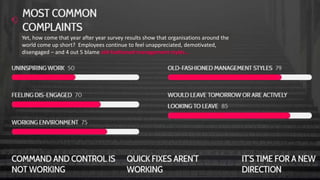
Yet, how come that year after year survey results show that organisations around the 
world come up short? Employees continue to feel unappreciated, demotivated, 
disengaged – and 4 out 5 blame old-fashioned management styles…
The biggest hurdle is the way we think
How we think about organisations shapes our view of employees and determines the way we structure and 
operate. Problem is, the current mind-set was … 
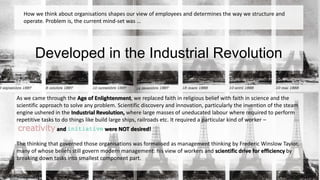
Developed in the Industrial Revolution 
As we came through the Age of Enlightenment, we replaced faith in religious belief with faith in science and the 
scientific approach to solve any problem. Scientific discovery and innovation, particularly the invention of the steam 
engine ushered in the Industrial Revolution, where large masses of uneducated labour where required to perform 
repetitive tasks to do things like build large ships, railroads etc. It required a particular kind of worker – 
creativity and initiative were NOT desired! 
The thinking that governed those organisations was formalised as management thinking by Frederic Winslow Taylor, 
many of whose beliefs still govern modern management: his view of workers and scientific drive for efficiency by 
breaking down tasks into smallest component part.
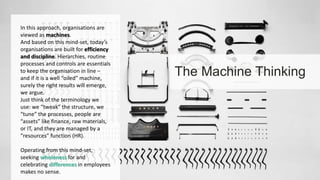
The Machine Thinking 
In this approach, organisations are 
viewed as machines. 
And based on this mind-set, today’s 
organisations are built for efficiency 
and discipline. Hierarchies, routine 
processes and controls are essentials 
to keep the organisation in line – 
and if it is a well “oiled” machine, 
surely the right results will emerge, 
we argue. 
Just think of the terminology we 
use: we “tweak” the structure, we 
“tune” the processes, people are 
“assets” like finance, raw materials, 
or IT, and they are managed by a 
“resources” function (HR). 
Operating from this mind-set, 
seeking wholeness for and 
celebrating differences in employees 
makes no sense.
Implicit assumptions 
• Employees are not capable of understanding 
important matters that affect the economic 
performance of the company – therefore we don’t 
involve employees in decision making and don’t share 
company information with them. Because they are 
not capable to see the “bigger picture”, they need 
central planning, budgeting and controlling functions 
– even though practices of large scale central 
planning have been thoroughly discredited. 
• Employees do not want to be responsible for their 
actions or for decisions that affect the performance of 
the organization, therefore we install parent-like 
bosses to tell them what to do and make these 
decisions for them. 
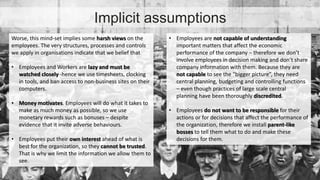
Worse, this mind-set implies some harsh views on the 
employees. The very structures, processes and controls 
we apply in organisations indicate that we belief that 
• Employees and Workers are lazy and must be 
watched closely -hence we use timesheets, clocking 
in tools, and ban access to non-business sites on their 
computers. 
• Money motivates. Employees will do what it takes to 
make as much money as possible, so we use 
monetary rewards such as bonuses – despite 
evidence that it invite adverse behaviours. 
• Employees put their own interest ahead of what is 
best for the organization, so they cannot be trusted. 
That is why we limit the information we allow them to 
see.
Is there an 
alternative?
Let’s explore some organisations that are doing it 
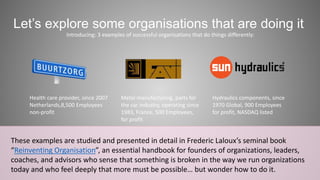
Introducing: 3 examples of successful organisations that do things differently: 
Metal manufacturing, parts for 
the car industry, operating since 
1983, France, 500 Employees, 
for profit 
Health care provider, since 2007 
Netherlands,8,500 Employees 
non-profit 
Hydraulics components, since 
1970 Global, 900 Employees 
for profit, NASDAQ listed 
These examples are studied and presented in detail in Frederic Laloux’s seminal book 
“Reinventing Organisation”, an essential handbook for founders of organizations, leaders, 
coaches, and advisors who sense that something is broken in the way we run organizations 
today and who feel deeply that more must be possible… but wonder how to do it.
Let’s write a new 
chapter 
The three organisations above are examples of 
organisations that are doing things very differently. 
They achieve continuous high levels of employee 
engagement, are creative, innovative, productive and 
resilient in the face of changing circumstances 
They are driven by genuine attachment to the purpose 
they serve. Not a mission statement that is put on a plaque 
on a wall, but what they believe their organisation should 
be about. That purpose goes beyond bottom line profit or 
market share and they are guided by that purpose in their 
daily interactions as much as when making major 
decisions. 
Secondly, they take a positive view of the nature of 
humans: they fundamentally trust their employees, belief 
them to have good intentions, being capable of learning 
and acting as responsible adults. They prize diversity and 
wholeness, creating an environment that invites 
employees to be present as whole, complete beings. 
Therefore, adopting principles and practices of self-management 
rather than a hierarchical structure seems 
the only logical conclusion,
They produce outrageous results 
Organisations that operate on principles of self-management, wholeness and purpose report 
incredible results at all levels. 
Not only do they delight customers and clients, and they have happy staff with lower 
turnover, absence and sickness levels, they also report better financial results, achieving 
higher margins than others in their industry and appear to be more resilient in times of crisis. 
They do this while paying more to their staff and helping their “competitors” 
As an example, FAVI faced two major recessions and continuously increasing price pressures 
from cheap labour countries, yet they never had to lay off staff in 30 year. While their 
competitors shipped out to China, FAVI grew from 80 in 1983 to 500 in 2012. 
Buurtzorg, actually came into existence during one of the worst recessions: it was founded in 
2007 with a small team and grew to 9000 in 2014, despite cut-backs by health care spending.
Self-management – the way to go? 
Although FAVI, Buurtzorg and Sun 
Hydraulics are very different in 
their focus, goals and the industry 
they operate in, they share several 
principles that let them achieve 
outrageous results. 
They all operate without 
traditional hierarchies but on a 
team basis where all decisions are 
made at frontline level. 
They don’t have managers, 
superiors or bosses. 
Individuals report to everyone else 
in the team. And the teams are not 
monitored by a boss or by a 
central function but by all the 
other teams in the organisation. 
Where ever possible, the work that 
such functions would do has been 
absorbed into the team (e.g. 
workload allocation, purchasing, 
budgeting, recruitment, etc.). 
And if there is a need for specialist 
support, so that a “support 
function” element is concentrated 
in one person, they can advise but 
have no budget or other authority 
over the team. 
In these organisation information 
flows freely, all employees are 
trusted with access to finance and 
other information. 
Further, they have done away with 
operations planning, budgeting, 
strategic planning, central 
performance reporting, business 
analysis, training and 
development, and even project 
planning is hugely simplified. 
In fact, for the most of it, they 
don’t have traditional finance, HR, 
marketing and similar business 
support functions at all.
How does it work? 
For example:
How are decisions made? 
If there is no formal hierarchy, how are decisions made? 
Many people jump to the conclusion that is must be based 
on consensus, because everyone is equal, right? Actually, 
no: decision making is neither a free-for-all chaos, nor a 
gruelling let’s-all-agree on the decision. 
Instead, self-managing organisation tend to develop 
specific processes and practices that allow them to make 
decisions much faster and with much better insight than 
those going through traditional hierarchical approval 
processes. 
The general principle is that any person can make any 
decision, yet they must consult all of those who are 
impacted by the decision. The more important the 
decision, the more people do they have to consult.
How are decisions made? 
They don’t HAVE to follow the advice offered, but they 
have to give it serious consideration. The consultation 
process is crucial to build trust, create learning and avoid a 
“blame” culture. It is not always comfortable, though and 
people generally require training and coaching to get used 
to it. 
An important aspect in their decision-making is that they 
don’t aim for the BEST decision or solution but a 
workable one – one that will be fine until a better one can 
be found. The idea is to make many small decisions, 
quickly and iterate as fast as possible.
How is performance managed? 
If there is no boss, how do you stop from 
people being complacent and slacking off? 
Surely, to achieve company goals, you have to 
define a strategy, develop team objectives, 
and cascade them down to align individual 
peoples’ objectives? Actually, self-managing 
organisations rely on something much more 
powerful and durable: utilising a mixture of 
intrinsic motivation, peer-pressure and 
market demands.
How is performance managed? 
Intrinsic motivation arises when people’s values and beliefs are 
aligned, and they have the ability to express themselves 
through their actions, with authority and responsibility for self-determination. 
Peer pressure is enabled by absolute transparency of 
information – all teams know how others are performing. This 
works when there is no fear of blame or the information being 
used against teams- and the team report only against their own 
commitments. Of course, fulfilling their commitments in 
paramount – and teams are held responsible for them – by the 
whole organisation. 
Market demands - as all teams are fully informed on how the 
organisation is doing – no glossed over/hyped up information is 
used to aggrandise an individual or team. 
Individual performance is measured by the team on a real time 
basis. Issues are addressed as they arise – not saved up for 
formal feedback sessions. Thus some organisations don’t have 
even have any formal feedback sessions anymore!
How are finances allocated? 
Most organisations go through regular cycles of 
business planning, budgeting and periodic reporting. 
This generally involved managers submitting their 
proposals to a central department, where they are 
scrutinised and challenged: 
“Is the spend low enough? Are sales projections high 
enough? Do we predict sufficient productivity? Are the 
assumptions aggressive enough? “ 
Numbers are negotiated and adjusted – and it is not 
unusual to end up with figures that bear little 
resemblance to the original submission or – just as bad - 
Finance determines to “hold” a savings pot that has no 
further plans of fulfilment behind them. 
The budget numbers are then held as yardstick – 
achieve them to be rewarded, or punished if you fall 
short. Of course, the numbers are out of date in no 
time…This invites all sort of non-useful behaviours, 
smoke-and-mirror and diverts attention and energy 
from more valuable activities.
How are finances allocated? 
In self-managing organisations, there is no need to play 
such games. As there is no traditional managerial 
hierarchy, size of budget is no indicator for “power”. And 
as anyone can in principle spend company money, no-one 
“owns” the budget anyway. 
Budgets are tools for decision making – not 
performance management. For example when 
investment is needed for new machinery or new teams, 
rough budgets are created to help guide the decision. 
Operationally, forecasts are created in line with the 
natural business rhythms and rolled forward as to be 
continually relevant – unlike traditional budgets. 
As everyone in the organisation has access to financial 
information (and is taught to understand it if necessary), 
monitoring the spend of company money becomes 
everyone’s authority and responsibility.
Often, people are excited about the ideas, but start saying things like 
“This would be amazing but we could 
never do this because….” 
The “because” ranges from “We cannot do this 
because we are too big/small, (not) creative, 
public, private, (not) listed, a special industry, 
have too many/few smart people, have not 
enough cash, have too much bureaucracy, are 
really flat and collaborative already” and so on. 
Yet, the case studies presented here are all very 
different organisations. They are located in 
different parts of the world, have different sizes 
and different purposes.
HHowow to d yoo yuo eua et atht ea n elephant? 
transformation elephant? 
Interestingly enough, these organisations 
did not announce big “culture 
transformation” exercises. While the call 
on experts for specific aspects, they do not 
call it reams of external consultants to 
design the organisation for them. They 
don’t devise change strategies and do not 
roll out phased improvement plans. 
None of these organisations followed a 
pre-defined path. They did not have a 
blueprint, model or tried and tested 
methodology. 
They didn’t even rely on best practices – 
because best practices would tell them 
everything they wanted to do is wrong. 
Instead, these and many other 
organizations are prototyped* their way 
into their current (and continuously 
evolving) form. 
*Prototyping: undertaking small, low cost, 
low risks experiments to test out 
assumptions, seek answers, hone 
proposed solutions and embed changed 
behaviours for continuous improvement, 
learning and development.
Prototyping allows you to experiment, 
evaluate, learn, refine and adapt. 
Prototyping is an essential form of action based 
learning. It enables teams to develop, test, and 
improve different aspects of issues and ideas for 
solutions at an early stage, before committing 
large-scale resources, disrupting large parts of the 
organisation or incurring greater risks. 
Prototyping ensures assumptions are tested, 
solutions are tailored and people are bought into 
them. 
The low-fidelity, playful and iterative aspect of 
prototyping avoids emotional attachment to a 
particular solution (aka “pet projects”). 
Prototyping works because: 
• It removes the pressure to get everything right in one 
go 
• It allows greater stakeholder involvement at earlier 
stages 
• It involved less time, costs or risks than piloting 
• It enables learning by doing and evolution of ideas. 
• It gives permission to explore changes through 
“playing” without the seriousness of committing. 
• It creates shared understanding.
Successful prototyping for transformation 
1. Define your pain-point: what issue do you want to address? 
2. Develop real insight and empathy into who is affected, how are they affected, why does it matter and 
how do they react? 
Don’t assume – ask, observe, interview, survey! 
3. Develop some rough proposals with a core group. Go cross-functional and ideally cross-hierarchical. 
Keep this group small initially, but prepare to go wider with every iteration 
4. Start quickly – don’t get bogged down in theorizing, pick a few ideas for solutions and start to create 
prototypes. 
Good prototypes seek to answers to few, specific questions. Consider the context & define how you will 
get feedback on those – don’t go to broad 
5. Facilitate, capture and integrate feedback. 
6. Iterate and scale to the next level.
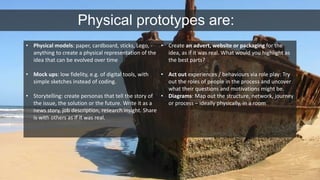
Physical prototypes are: 
• Physical models: paper, cardboard, sticks, Lego, - 
anything to create a physical representation of the 
idea that can be evolved over time 
• Mock ups: low fidelity, e.g. of digital tools, with 
simple sketches instead of coding. 
• Storytelling: create personas that tell the story of 
the issue, the solution or the future. Write it as a 
news story, job description, research insight. Share 
is with others as if it was real. 
• Create an advert, website or packaging for the 
idea, as if it was real. What would you highlight as 
the best parts? 
• Act out experiences / behaviours via role play: Try 
out the roles of people in the process and uncover 
what their questions and motivations might be. 
• Diagrams: Map out the structure, network, journey 
or process – ideally physically, in a room
Future of work 
Next Steps? 
Want to find out more about how you could prototype 
effective transformation? Connect with us here: 
Tweet at 
MiriamRGilbert 
Connect at 
Miriam Gilbert 
Email at: miriam@ 
coincidencity.co.uk

Future of work: Self-management, business purpose and employee engagement

  • 1.
    Future of work By Coincidencity
  • 2.
    The future ofwork means a lot of things to a lot of people Mobile, connectivity, social, the Internet of things – if you are a tech company, software developer or hardware vendor, you are likely to be excited by the prospects. If you are a lawyer, doctor or accountant, you have reason to worry: research shows that many in these “safe” professions have a >90% likelihood to be replaced by machines in the near future.
  • 3.
    The future ofwork means a lot of things to a lot of people And if you are one of the >75% of employees who feels demotivated and disengaged at work, you might wonder how many more times you will be change processed, made lean, culture changed or black belted into six sigma – and how to press the escape button.
  • 4.
    It could bean opportunity to do something different If you are an business leader and care about your organisations’ purpose, its people and its future, you might wonder if the future of work could be about something different altogether… How about if the future of work is about creating more engaged, humane, soulful, purposeful organisations? Research over the last 40 years has shown that organisation that engage their workforce, where people feel connected, who have autonomy over their work and adopt self-managing principles are consistently more successful in all manners of speaking.
  • 5.
    Yet, how comethat year after year survey results show that organisations around the world come up short? Employees continue to feel unappreciated, demotivated, disengaged – and 4 out 5 blame old-fashioned management styles…
  • 6.
    The biggest hurdleis the way we think
  • 7.
    How we thinkabout organisations shapes our view of employees and determines the way we structure and operate. Problem is, the current mind-set was … Developed in the Industrial Revolution As we came through the Age of Enlightenment, we replaced faith in religious belief with faith in science and the scientific approach to solve any problem. Scientific discovery and innovation, particularly the invention of the steam engine ushered in the Industrial Revolution, where large masses of uneducated labour where required to perform repetitive tasks to do things like build large ships, railroads etc. It required a particular kind of worker – creativity and initiative were NOT desired! The thinking that governed those organisations was formalised as management thinking by Frederic Winslow Taylor, many of whose beliefs still govern modern management: his view of workers and scientific drive for efficiency by breaking down tasks into smallest component part.
  • 8.
    The Machine Thinking In this approach, organisations are viewed as machines. And based on this mind-set, today’s organisations are built for efficiency and discipline. Hierarchies, routine processes and controls are essentials to keep the organisation in line – and if it is a well “oiled” machine, surely the right results will emerge, we argue. Just think of the terminology we use: we “tweak” the structure, we “tune” the processes, people are “assets” like finance, raw materials, or IT, and they are managed by a “resources” function (HR). Operating from this mind-set, seeking wholeness for and celebrating differences in employees makes no sense.
  • 9.
    Implicit assumptions •Employees are not capable of understanding important matters that affect the economic performance of the company – therefore we don’t involve employees in decision making and don’t share company information with them. Because they are not capable to see the “bigger picture”, they need central planning, budgeting and controlling functions – even though practices of large scale central planning have been thoroughly discredited. • Employees do not want to be responsible for their actions or for decisions that affect the performance of the organization, therefore we install parent-like bosses to tell them what to do and make these decisions for them. Worse, this mind-set implies some harsh views on the employees. The very structures, processes and controls we apply in organisations indicate that we belief that • Employees and Workers are lazy and must be watched closely -hence we use timesheets, clocking in tools, and ban access to non-business sites on their computers. • Money motivates. Employees will do what it takes to make as much money as possible, so we use monetary rewards such as bonuses – despite evidence that it invite adverse behaviours. • Employees put their own interest ahead of what is best for the organization, so they cannot be trusted. That is why we limit the information we allow them to see.
  • 10.
    Is there an alternative?
  • 11.
    Let’s explore someorganisations that are doing it Introducing: 3 examples of successful organisations that do things differently: Metal manufacturing, parts for the car industry, operating since 1983, France, 500 Employees, for profit Health care provider, since 2007 Netherlands,8,500 Employees non-profit Hydraulics components, since 1970 Global, 900 Employees for profit, NASDAQ listed These examples are studied and presented in detail in Frederic Laloux’s seminal book “Reinventing Organisation”, an essential handbook for founders of organizations, leaders, coaches, and advisors who sense that something is broken in the way we run organizations today and who feel deeply that more must be possible… but wonder how to do it.
  • 12.
    Let’s write anew chapter The three organisations above are examples of organisations that are doing things very differently. They achieve continuous high levels of employee engagement, are creative, innovative, productive and resilient in the face of changing circumstances They are driven by genuine attachment to the purpose they serve. Not a mission statement that is put on a plaque on a wall, but what they believe their organisation should be about. That purpose goes beyond bottom line profit or market share and they are guided by that purpose in their daily interactions as much as when making major decisions. Secondly, they take a positive view of the nature of humans: they fundamentally trust their employees, belief them to have good intentions, being capable of learning and acting as responsible adults. They prize diversity and wholeness, creating an environment that invites employees to be present as whole, complete beings. Therefore, adopting principles and practices of self-management rather than a hierarchical structure seems the only logical conclusion,
  • 13.
    They produce outrageousresults Organisations that operate on principles of self-management, wholeness and purpose report incredible results at all levels. Not only do they delight customers and clients, and they have happy staff with lower turnover, absence and sickness levels, they also report better financial results, achieving higher margins than others in their industry and appear to be more resilient in times of crisis. They do this while paying more to their staff and helping their “competitors” As an example, FAVI faced two major recessions and continuously increasing price pressures from cheap labour countries, yet they never had to lay off staff in 30 year. While their competitors shipped out to China, FAVI grew from 80 in 1983 to 500 in 2012. Buurtzorg, actually came into existence during one of the worst recessions: it was founded in 2007 with a small team and grew to 9000 in 2014, despite cut-backs by health care spending.
  • 14.
    Self-management – theway to go? Although FAVI, Buurtzorg and Sun Hydraulics are very different in their focus, goals and the industry they operate in, they share several principles that let them achieve outrageous results. They all operate without traditional hierarchies but on a team basis where all decisions are made at frontline level. They don’t have managers, superiors or bosses. Individuals report to everyone else in the team. And the teams are not monitored by a boss or by a central function but by all the other teams in the organisation. Where ever possible, the work that such functions would do has been absorbed into the team (e.g. workload allocation, purchasing, budgeting, recruitment, etc.). And if there is a need for specialist support, so that a “support function” element is concentrated in one person, they can advise but have no budget or other authority over the team. In these organisation information flows freely, all employees are trusted with access to finance and other information. Further, they have done away with operations planning, budgeting, strategic planning, central performance reporting, business analysis, training and development, and even project planning is hugely simplified. In fact, for the most of it, they don’t have traditional finance, HR, marketing and similar business support functions at all.
  • 15.
    How does itwork? For example:
  • 16.
    How are decisionsmade? If there is no formal hierarchy, how are decisions made? Many people jump to the conclusion that is must be based on consensus, because everyone is equal, right? Actually, no: decision making is neither a free-for-all chaos, nor a gruelling let’s-all-agree on the decision. Instead, self-managing organisation tend to develop specific processes and practices that allow them to make decisions much faster and with much better insight than those going through traditional hierarchical approval processes. The general principle is that any person can make any decision, yet they must consult all of those who are impacted by the decision. The more important the decision, the more people do they have to consult.
  • 17.
    How are decisionsmade? They don’t HAVE to follow the advice offered, but they have to give it serious consideration. The consultation process is crucial to build trust, create learning and avoid a “blame” culture. It is not always comfortable, though and people generally require training and coaching to get used to it. An important aspect in their decision-making is that they don’t aim for the BEST decision or solution but a workable one – one that will be fine until a better one can be found. The idea is to make many small decisions, quickly and iterate as fast as possible.
  • 18.
    How is performancemanaged? If there is no boss, how do you stop from people being complacent and slacking off? Surely, to achieve company goals, you have to define a strategy, develop team objectives, and cascade them down to align individual peoples’ objectives? Actually, self-managing organisations rely on something much more powerful and durable: utilising a mixture of intrinsic motivation, peer-pressure and market demands.
  • 19.
    How is performancemanaged? Intrinsic motivation arises when people’s values and beliefs are aligned, and they have the ability to express themselves through their actions, with authority and responsibility for self-determination. Peer pressure is enabled by absolute transparency of information – all teams know how others are performing. This works when there is no fear of blame or the information being used against teams- and the team report only against their own commitments. Of course, fulfilling their commitments in paramount – and teams are held responsible for them – by the whole organisation. Market demands - as all teams are fully informed on how the organisation is doing – no glossed over/hyped up information is used to aggrandise an individual or team. Individual performance is measured by the team on a real time basis. Issues are addressed as they arise – not saved up for formal feedback sessions. Thus some organisations don’t have even have any formal feedback sessions anymore!
  • 20.
    How are financesallocated? Most organisations go through regular cycles of business planning, budgeting and periodic reporting. This generally involved managers submitting their proposals to a central department, where they are scrutinised and challenged: “Is the spend low enough? Are sales projections high enough? Do we predict sufficient productivity? Are the assumptions aggressive enough? “ Numbers are negotiated and adjusted – and it is not unusual to end up with figures that bear little resemblance to the original submission or – just as bad - Finance determines to “hold” a savings pot that has no further plans of fulfilment behind them. The budget numbers are then held as yardstick – achieve them to be rewarded, or punished if you fall short. Of course, the numbers are out of date in no time…This invites all sort of non-useful behaviours, smoke-and-mirror and diverts attention and energy from more valuable activities.
  • 21.
    How are financesallocated? In self-managing organisations, there is no need to play such games. As there is no traditional managerial hierarchy, size of budget is no indicator for “power”. And as anyone can in principle spend company money, no-one “owns” the budget anyway. Budgets are tools for decision making – not performance management. For example when investment is needed for new machinery or new teams, rough budgets are created to help guide the decision. Operationally, forecasts are created in line with the natural business rhythms and rolled forward as to be continually relevant – unlike traditional budgets. As everyone in the organisation has access to financial information (and is taught to understand it if necessary), monitoring the spend of company money becomes everyone’s authority and responsibility.
  • 22.
    Often, people areexcited about the ideas, but start saying things like “This would be amazing but we could never do this because….” The “because” ranges from “We cannot do this because we are too big/small, (not) creative, public, private, (not) listed, a special industry, have too many/few smart people, have not enough cash, have too much bureaucracy, are really flat and collaborative already” and so on. Yet, the case studies presented here are all very different organisations. They are located in different parts of the world, have different sizes and different purposes.
  • 23.
    HHowow to dyoo yuo eua et atht ea n elephant? transformation elephant? Interestingly enough, these organisations did not announce big “culture transformation” exercises. While the call on experts for specific aspects, they do not call it reams of external consultants to design the organisation for them. They don’t devise change strategies and do not roll out phased improvement plans. None of these organisations followed a pre-defined path. They did not have a blueprint, model or tried and tested methodology. They didn’t even rely on best practices – because best practices would tell them everything they wanted to do is wrong. Instead, these and many other organizations are prototyped* their way into their current (and continuously evolving) form. *Prototyping: undertaking small, low cost, low risks experiments to test out assumptions, seek answers, hone proposed solutions and embed changed behaviours for continuous improvement, learning and development.
  • 24.
    Prototyping allows youto experiment, evaluate, learn, refine and adapt. Prototyping is an essential form of action based learning. It enables teams to develop, test, and improve different aspects of issues and ideas for solutions at an early stage, before committing large-scale resources, disrupting large parts of the organisation or incurring greater risks. Prototyping ensures assumptions are tested, solutions are tailored and people are bought into them. The low-fidelity, playful and iterative aspect of prototyping avoids emotional attachment to a particular solution (aka “pet projects”). Prototyping works because: • It removes the pressure to get everything right in one go • It allows greater stakeholder involvement at earlier stages • It involved less time, costs or risks than piloting • It enables learning by doing and evolution of ideas. • It gives permission to explore changes through “playing” without the seriousness of committing. • It creates shared understanding.
  • 25.
    Successful prototyping fortransformation 1. Define your pain-point: what issue do you want to address? 2. Develop real insight and empathy into who is affected, how are they affected, why does it matter and how do they react? Don’t assume – ask, observe, interview, survey! 3. Develop some rough proposals with a core group. Go cross-functional and ideally cross-hierarchical. Keep this group small initially, but prepare to go wider with every iteration 4. Start quickly – don’t get bogged down in theorizing, pick a few ideas for solutions and start to create prototypes. Good prototypes seek to answers to few, specific questions. Consider the context & define how you will get feedback on those – don’t go to broad 5. Facilitate, capture and integrate feedback. 6. Iterate and scale to the next level.
  • 26.
    Physical prototypes are: • Physical models: paper, cardboard, sticks, Lego, - anything to create a physical representation of the idea that can be evolved over time • Mock ups: low fidelity, e.g. of digital tools, with simple sketches instead of coding. • Storytelling: create personas that tell the story of the issue, the solution or the future. Write it as a news story, job description, research insight. Share is with others as if it was real. • Create an advert, website or packaging for the idea, as if it was real. What would you highlight as the best parts? • Act out experiences / behaviours via role play: Try out the roles of people in the process and uncover what their questions and motivations might be. • Diagrams: Map out the structure, network, journey or process – ideally physically, in a room
  • 27.
    Future of work Next Steps? Want to find out more about how you could prototype effective transformation? Connect with us here: Tweet at MiriamRGilbert Connect at Miriam Gilbert Email at: miriam@ coincidencity.co.uk

Editor's Notes

  • #2 Intros: Check in Introduction around the room Top frustration
  • #13 Interestingly enough, none of these organisations went through a big “culture transformation” exercise. They did not call it teams of external consultants to design the organisation for them, they didn’t devise a strategy and a big plan that was rolled out in phases. They didn’t even rely on best practices – because best practices would tell them everything they wanted to do was wrong. Instead of those traditional approaches to achieve a change, they were driven by genuine attachment to the purpose they serve. Not the mission that can be put on a plaque on a wall, but what they really believed their organisation should be about. Secondly, they have a view of the nature of humans that is opposite to the one we talked about: they fundamentally trust their employees, belief them to have good intentions, being capable of learning and acting as responsible adults. Therefore, adopting principles and practices of self-management seemed the only logical conclusion, rather than a hierarchical structure. Keep these beliefs in mind!