Woodland Gifted 
Education Program 
2014-2015 
Every child has the right 
to engage in new learning every day.
OUR DISTRICT MISSION 
is to inspire and prepare all 
students 
with CONFIDENCE, COURAGE 
and COMPETENCE 
…to achieve their dreams; 
contribute to community; 
and engage in a lifetime of 
learning.
OUR GIFTED EDUCATION 
MISSION 
is to recognize and appropriately 
serve the academic, social and 
emotional needs of GIFTED 
STUDENTS. 
* GIFTED STUDENTS are those children and youth 
who demonstrate high performance or show the 
potential for high performance relative to others of 
their age, experience or environment.
Outcomes 
Parents/Guardians will 
 be aware of the 4 levels of service Gifted 
Education provides in each elementary 
building 
 Understand how students are formally 
identified for elementary service 
 The “Golden G” or ‘big G’ identification for 
service that carries over year to year until the 
end of elementary school 
 The “little g” one school year identification 
 know details about pull-out Needs-Based- 
Classes
Continuum of 
Services
Services at Woodland Elementary 
School 
o NBC – Needs Based Classes 3-6 
o Students are pulled out based on test information that 
indicates a need for more challenge in Verbal, Non- 
Verbal, Quantitative and Affective areas 
o K-2 Multiple Intelligence Introduction: How 
are you intelligent? Push into classrooms-fall and 
winter 
o K-2 Productive Thinking Skills: Fluency, 
Flexibility, Originality, Elaboration and Evaluation 
Pull out of the classroom- spring 
o Advocating for gifted students 
o Collaboration with classroom, special 
education, English language teachers 
o Case Managing any Level 4 service 
o Other – WordMasters, Fermi, CML, & Others
Pull-Out GE Services 
Students in 3-6, depending on individual needs, 
may participate in NBC’s (up to four strands per 
year) at each grade level: 
a) Affective 
b) Non-Verbal 
c) Verbal 
d) Quantitative 
Students in 3-6, depending on individual needs, 
may participate in WordMasters, Fermi, and CML
Participating in Needs Based Classes (NBC) 
Any student who receives 96% or higher on each of 
the CogAT subtests will participate in the 
corresponding NBC. 
These students also participate in the affective 
NBC. 
Students will also qualify for revolve-in participation 
based on YEARLY MAP data at each site and grade 
level. 
Students may be identified for participation with a 
qualifying IQ score (139). 
* NBC revolve-in participation is an on-going 
process and will vary by site
Needs-Based Classes 2014-15 
AFFECTIVE QUANTITATIVE NON-VERBAL VERBAL 
K 
Needs based 
small group 
pull outs 
Higher Order Thinking Skills I 
Go into classrooms (Kindergarten) 
1 Higher Order Thinking Skills II 
Go into classrooms (Grade 1) 
2 HOTS – Math, Reading, & Creative Thinkers! 
Go into classrooms (Grade 2) 
3 Affective 3 
(Fall) 
Math Patterns 
and Geometry/CML 
Scientific 
Investigation: 
K’NEX Bridges 
Junior Great 
Books/Super 
Heroes 
(Spring) 
4 Affective 4 
(Fall) 
Would you 
Rather?/CML 
Constructive 
Problem Solving: 
LEGO Machines 
Junior Great 
Books 
(Spring) 
5 Affective 5 
(Fall) 
Data Analysis: 
Stock Market 
Constructive 
Problem Solving: 
LEGO Robotics 
Mock 
Trial/Improv 
(Spring) 
6 Affective 6 
(Fall) 
Data Analysis: 
Stock Market 
Forensics: CSI 
Mock 
Trial/Improv 
(Spring)
Go-In Lessons K-2 
GE Teacher goes into the 
regular classroom and teaches 
an enrichment lesson to the 
whole class
HIGHER ORDER THINKING 
Kindergarten 
Back 
OBJECTIVE: 
Students will learn different ways of thinking 
including convergent (detective thinking), 
divergent (inventive thinking), evaluative 
(judgment thinking), and visual thinking 
(making visual images). 
The GE teacher will be going into the 
classrooms to teach this material.
HIGHER ORDER THINKING 
First Grade 
OBJECTIVE: In this literature-based unit, 
based on curriculum created by William and 
Mary College, the students will be engaged in 
challenging reading and writing activities 
through the use of literature with extensive 
figurative language. They will expand their use 
of descriptive and figurative devices, including 
similes, metaphors, and adjectives. 
The GE teacher will be going into the 
classrooms to teach this material. 
Back
MATH & READING THINKERS! 
Second Grade 
OBJECTIVE: Students will be introduced to 
rigorous learning opportunities in the areas 
of Literature and Mathematics. This unit is 
based on state and national standards. 
Creativity will also be explored. 
The CogAT is given to all 2nd graders in 
January. 
The GE teacher will be going into the 
classrooms to teach this material. 
Back
Classroom 
Services 
Go-In Classes 
Cluster-Based Services (CBS) 
Gifted Education (GE) staff collaborates with 
and supports the general education 
classroom teacher. 
GE teacher focuses on differentiating 
instruction in the cluster classroom with 
students who have the greatest need for rigor.
Site 
GSE esitrev seicrviecess in-clude but are not limited to: 
Identification/assessment 
On going review of student data 
Pull-Out classes to GE room (NBC – Needs Based Service) 
Go-In classes in the classroom (CBS – Cluster Based Service) 
Clustering of gifted students based on academic 
needs 
Collaboration with and training for classroom 
teachers 
Acceleration where appropriate (content and grade 
level) 
Advocacy for students’ needs 
* We provide a rigorous and challenging skills-based 
curriculum for students identified with the greatest 
need at each site.
Academic Challenges 
Co-Curricular 
 CML (Continental Math League) 2-6 
 Instruction in classroom or GE room. 
 3 meets (2,3) and 5 meets (4-6) 
 WordMasters (3, 4 & 6) 
 Instruction in classroom at some sites. 
 3 Meets (November, February, April) 
 Egg drop – 4th grade (at some sites) 
Extra-Curricular (fee-based, board policy) 
 Children’s Chorus (4-6) auditions in fall 
 Based on availability of coaches: 
 Including Math Masters grades 5 & 6 Fall-Winter
Support Resources 
 MCGT (Minnesota Council for Gifted and Talented) 
 District #287 Services (WSSS, enrichment classes, 
Northern Star Online, etc.) 
 UMTYMP 
 NAGC (National Association for Gifted Children) 
 PTLC
Additional Information 
 Communications 
 www.district279.org/services/talentedgifted/ 
 Building newsletter 
 Blog –http://blogs.district279.org/thompsonlaura/ 
 Conferences – Stop in or attend one of 3 meetings 
 Please call or email with any questions 
 thompsonlaura@district279.org
Questions ??? 
Thank you for coming.
AFFECTIVE: Grades 3 
Students will know: Students will know: 
- strengths, hobbies, and passions. 
- that others can help achieve goals. 
- that talents guide people in determining 
careers. 
Students will 
understand: 
Students will understand: 
- how group dynamics work. 
- strengths and differences of classmates. 
- that team work is a necessary part of life and 
how to successfully work as a team. 
- how talents can be nourished to become 
careers. 
Students will do: Students will: 
- participate in activities to help determine 
strengths and team building. 
- share descriptive words for self, things they 
love doing, and things they avoid. 
- create a visual explaining the relationship 
between talents and careers. 
- create a mission statement. 
- create a Kidspiration design to show 
understanding about yourself. 
Back
AFFECTIVE: Grades 4 Students will know: Students will know: 
- 12 characteristics of good leaders. 
- helpful hints for public speaking. 
Students will 
understand: 
Back 
Students will understand: 
- traits of leaders. 
- how to identify leadership traits in self and others. 
- the importance of non-verbal and verbal 
communication. 
- importance of communication when needing the 
help of others. 
Students will do: Students will: 
- analyze own leadership traits. 
- create a speech to give to the class. 
- develop a plan to fix a problem in school and 
communicate it to others. 
- evaluate own learning.
AFFECTIVE: Grades 5 Students will know: Students will know: 
- that music can create certain emotions. 
- that public speeches create emotion in people. 
- that experiences create emotion in people. 
Students will 
understand: 
Back 
Students will understand: 
- that emotions are involved in daily life. 
- that emotions often guide decision making. 
- understand and respect the similarities and differences 
among their peers. 
- Emotional Quotient. 
- how emotions guide academics. 
Students will do: Students will: 
- analyze a given speech and the reaction from the audience. 
- analyze music and art to discover emotion. 
- analyze how to channel emotions to help make good 
decisions. 
- reflect on concepts learned regarding emotional intelligence. 
- determine personality type based on a survey. 
- discuss a story that evokes emotions 
and decisions made.
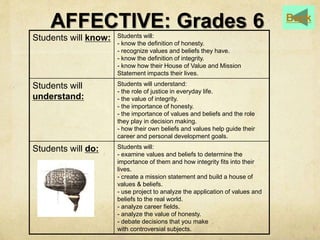
AFFECTIVE: Grades 6 
Students will know: Students will: 
- know the definition of honesty. 
- recognize values and beliefs they have. 
- know the definition of integrity. 
- know how their House of Value and Mission 
Statement impacts their lives. 
Students will 
understand: 
Students will understand: 
- the role of justice in everyday life. 
- the value of integrity. 
- the importance of honesty. 
- the importance of values and beliefs and the role 
they play in decision making. 
- how their own beliefs and values help guide their 
career and personal development goals. 
Students will do: Students will: 
- examine values and beliefs to determine the 
importance of them and how integrity fits into their 
lives. 
- create a mission statement and build a house of 
values & beliefs. 
- use project to analyze the application of values and 
beliefs to the real world. 
- analyze career fields. 
- analyze the value of honesty. 
- debate decisions that you make 
with controversial subjects. 
Back
VERBAL Gr. 3-6 
Junior Great Books 
Students will know: The Shared Inquiry method 
of reading and discussing a 
story 
Students will understand: How individual 
interpretations of literature 
may differ 
Student answers and 
conclusions must be based 
on evidence 
Students will do: Participate in shared inquiry 
discussions of assigned 
stories. 
Back
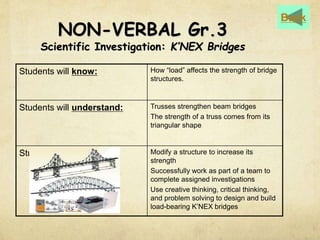
Students will know: How “load” affects the strength of bridge 
structures. 
Students will understand: Trusses strengthen beam bridges 
The strength of a truss comes from its 
triangular shape 
Students will do: Modify a structure to increase its 
strength 
Successfully work as part of a team to 
complete assigned investigations 
Use creative thinking, critical thinking, 
and problem solving to design and build 
load-bearing K’NEX bridges 
Back 
NON-VERBAL Gr.3 
Scientific Investigation: K’NEX Bridges
QUANTITATIVE Gr.3 
Math Patterns/Geometry 
Students will know: A pattern is a sequence described by rules 
Geometry is a section of math that studies 
shapes 
Students will 
understand: 
The study of how numbers or objects are 
arranged in a sequence is a pattern 
A repeating sequence can be used to 
predict and extend patterns 
How to use a table to describe patterns of 
change and solve problems 
Students will do: Use a table to display data sets 
Apply translations (slides) and reflections 
(flips) to figures 
Prepare a presentation for the class to 
explain my answer using appropriate facial 
expressions, body language and voice 
control. 
Back
NON-VERBAL Gr.4 
Constructive Problem Solving: 
LEGO Machines 
Students will know: Identify simple machines and their 
uses/limitations 
Recognize the relationship between 
friction and force 
Recognize the relationship between gear 
ratio and work 
Students will 
understand: 
The work of specific simple machines 
The application of force in work done 
How gear ratio impacts calibration 
Students will do: Investigate the principles of simple 
machines 
Create real-life machines to solve real-world 
problems 
Work successfully as part of a team 
Back
QUANTITATIVE Gr.4 
Data Analysis: In One Day 
Students will know: How to collect the appropriate 
data 
How to accurately average data 
Students will 
understand: 
The the purpose of analogies 
in reporting their data 
Students will do: Create the required graphs to 
represent my collected data 
Write an analogy representing 
their data 
Create an appropriate visual 
representation of their original 
analogy 
Back
QUANTITATIVE Gr.5 
Algebraic Processes for Problem 
Solving 
Students will know: The relationship between ordered 
pairs and graphing 
Students will 
understand: 
Algebraic processes can be used to 
solve problems 
Students will do: Identify patterns 
Express patterns with algebraic 
linear equations 
Contribute to team problem solving 
efforts 
Evaluate and reflect on their 
contributions, effort, and 
understandings 
Back
NON-VERBAL Gr.5 
Robotics 
Students will know: How to program a LEGO mobile 
robots 
The importance of teamwork 
Students will 
understand: 
The steps to programming a robot 
How to analyze the progress of their 
project and make the necessary 
adjustments for success 
Students will do: Take measurements, plan a path 
and program a team robot to 
perform specific tasks 
Back
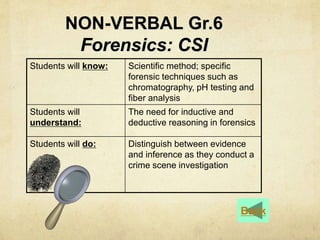
NON-VERBAL Gr.6 
Forensics: CSI 
Students will know: Scientific method; specific 
forensic techniques such as 
chromatography, pH testing and 
fiber analysis 
Students will 
understand: 
The need for inductive and 
deductive reasoning in forensics 
Students will do: Distinguish between evidence 
and inference as they conduct a 
crime scene investigation 
Back
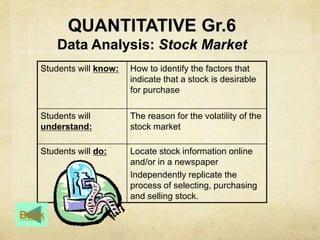
QUANTITATIVE Gr.6 
Data Analysis: Stock Market 
Students will know: How to identify the factors that 
indicate that a stock is desirable 
for purchase 
Students will 
understand: 
The reason for the volatility of the 
stock market 
Students will do: Locate stock information online 
and/or in a newspaper 
Independently replicate the 
process of selecting, purchasing 
and selling stock. 
Back

14 15 ge parent presentation

  • 1.
    Woodland Gifted EducationProgram 2014-2015 Every child has the right to engage in new learning every day.
  • 2.
    OUR DISTRICT MISSION is to inspire and prepare all students with CONFIDENCE, COURAGE and COMPETENCE …to achieve their dreams; contribute to community; and engage in a lifetime of learning.
  • 3.
    OUR GIFTED EDUCATION MISSION is to recognize and appropriately serve the academic, social and emotional needs of GIFTED STUDENTS. * GIFTED STUDENTS are those children and youth who demonstrate high performance or show the potential for high performance relative to others of their age, experience or environment.
  • 4.
    Outcomes Parents/Guardians will  be aware of the 4 levels of service Gifted Education provides in each elementary building  Understand how students are formally identified for elementary service  The “Golden G” or ‘big G’ identification for service that carries over year to year until the end of elementary school  The “little g” one school year identification  know details about pull-out Needs-Based- Classes
  • 5.
  • 6.
    Services at WoodlandElementary School o NBC – Needs Based Classes 3-6 o Students are pulled out based on test information that indicates a need for more challenge in Verbal, Non- Verbal, Quantitative and Affective areas o K-2 Multiple Intelligence Introduction: How are you intelligent? Push into classrooms-fall and winter o K-2 Productive Thinking Skills: Fluency, Flexibility, Originality, Elaboration and Evaluation Pull out of the classroom- spring o Advocating for gifted students o Collaboration with classroom, special education, English language teachers o Case Managing any Level 4 service o Other – WordMasters, Fermi, CML, & Others
  • 7.
    Pull-Out GE Services Students in 3-6, depending on individual needs, may participate in NBC’s (up to four strands per year) at each grade level: a) Affective b) Non-Verbal c) Verbal d) Quantitative Students in 3-6, depending on individual needs, may participate in WordMasters, Fermi, and CML
  • 8.
    Participating in NeedsBased Classes (NBC) Any student who receives 96% or higher on each of the CogAT subtests will participate in the corresponding NBC. These students also participate in the affective NBC. Students will also qualify for revolve-in participation based on YEARLY MAP data at each site and grade level. Students may be identified for participation with a qualifying IQ score (139). * NBC revolve-in participation is an on-going process and will vary by site
  • 9.
    Needs-Based Classes 2014-15 AFFECTIVE QUANTITATIVE NON-VERBAL VERBAL K Needs based small group pull outs Higher Order Thinking Skills I Go into classrooms (Kindergarten) 1 Higher Order Thinking Skills II Go into classrooms (Grade 1) 2 HOTS – Math, Reading, & Creative Thinkers! Go into classrooms (Grade 2) 3 Affective 3 (Fall) Math Patterns and Geometry/CML Scientific Investigation: K’NEX Bridges Junior Great Books/Super Heroes (Spring) 4 Affective 4 (Fall) Would you Rather?/CML Constructive Problem Solving: LEGO Machines Junior Great Books (Spring) 5 Affective 5 (Fall) Data Analysis: Stock Market Constructive Problem Solving: LEGO Robotics Mock Trial/Improv (Spring) 6 Affective 6 (Fall) Data Analysis: Stock Market Forensics: CSI Mock Trial/Improv (Spring)
  • 10.
    Go-In Lessons K-2 GE Teacher goes into the regular classroom and teaches an enrichment lesson to the whole class
  • 11.
    HIGHER ORDER THINKING Kindergarten Back OBJECTIVE: Students will learn different ways of thinking including convergent (detective thinking), divergent (inventive thinking), evaluative (judgment thinking), and visual thinking (making visual images). The GE teacher will be going into the classrooms to teach this material.
  • 12.
    HIGHER ORDER THINKING First Grade OBJECTIVE: In this literature-based unit, based on curriculum created by William and Mary College, the students will be engaged in challenging reading and writing activities through the use of literature with extensive figurative language. They will expand their use of descriptive and figurative devices, including similes, metaphors, and adjectives. The GE teacher will be going into the classrooms to teach this material. Back
  • 13.
    MATH & READINGTHINKERS! Second Grade OBJECTIVE: Students will be introduced to rigorous learning opportunities in the areas of Literature and Mathematics. This unit is based on state and national standards. Creativity will also be explored. The CogAT is given to all 2nd graders in January. The GE teacher will be going into the classrooms to teach this material. Back
  • 14.
    Classroom Services Go-InClasses Cluster-Based Services (CBS) Gifted Education (GE) staff collaborates with and supports the general education classroom teacher. GE teacher focuses on differentiating instruction in the cluster classroom with students who have the greatest need for rigor.
  • 15.
    Site GSE esitrevseicrviecess in-clude but are not limited to: Identification/assessment On going review of student data Pull-Out classes to GE room (NBC – Needs Based Service) Go-In classes in the classroom (CBS – Cluster Based Service) Clustering of gifted students based on academic needs Collaboration with and training for classroom teachers Acceleration where appropriate (content and grade level) Advocacy for students’ needs * We provide a rigorous and challenging skills-based curriculum for students identified with the greatest need at each site.
  • 16.
    Academic Challenges Co-Curricular  CML (Continental Math League) 2-6  Instruction in classroom or GE room.  3 meets (2,3) and 5 meets (4-6)  WordMasters (3, 4 & 6)  Instruction in classroom at some sites.  3 Meets (November, February, April)  Egg drop – 4th grade (at some sites) Extra-Curricular (fee-based, board policy)  Children’s Chorus (4-6) auditions in fall  Based on availability of coaches:  Including Math Masters grades 5 & 6 Fall-Winter
  • 17.
    Support Resources MCGT (Minnesota Council for Gifted and Talented)  District #287 Services (WSSS, enrichment classes, Northern Star Online, etc.)  UMTYMP  NAGC (National Association for Gifted Children)  PTLC
  • 18.
    Additional Information Communications  www.district279.org/services/talentedgifted/  Building newsletter  Blog –http://blogs.district279.org/thompsonlaura/  Conferences – Stop in or attend one of 3 meetings  Please call or email with any questions  thompsonlaura@district279.org
  • 19.
    Questions ??? Thankyou for coming.
  • 20.
    AFFECTIVE: Grades 3 Students will know: Students will know: - strengths, hobbies, and passions. - that others can help achieve goals. - that talents guide people in determining careers. Students will understand: Students will understand: - how group dynamics work. - strengths and differences of classmates. - that team work is a necessary part of life and how to successfully work as a team. - how talents can be nourished to become careers. Students will do: Students will: - participate in activities to help determine strengths and team building. - share descriptive words for self, things they love doing, and things they avoid. - create a visual explaining the relationship between talents and careers. - create a mission statement. - create a Kidspiration design to show understanding about yourself. Back
  • 21.
    AFFECTIVE: Grades 4Students will know: Students will know: - 12 characteristics of good leaders. - helpful hints for public speaking. Students will understand: Back Students will understand: - traits of leaders. - how to identify leadership traits in self and others. - the importance of non-verbal and verbal communication. - importance of communication when needing the help of others. Students will do: Students will: - analyze own leadership traits. - create a speech to give to the class. - develop a plan to fix a problem in school and communicate it to others. - evaluate own learning.
  • 22.
    AFFECTIVE: Grades 5Students will know: Students will know: - that music can create certain emotions. - that public speeches create emotion in people. - that experiences create emotion in people. Students will understand: Back Students will understand: - that emotions are involved in daily life. - that emotions often guide decision making. - understand and respect the similarities and differences among their peers. - Emotional Quotient. - how emotions guide academics. Students will do: Students will: - analyze a given speech and the reaction from the audience. - analyze music and art to discover emotion. - analyze how to channel emotions to help make good decisions. - reflect on concepts learned regarding emotional intelligence. - determine personality type based on a survey. - discuss a story that evokes emotions and decisions made.
  • 23.
    AFFECTIVE: Grades 6 Students will know: Students will: - know the definition of honesty. - recognize values and beliefs they have. - know the definition of integrity. - know how their House of Value and Mission Statement impacts their lives. Students will understand: Students will understand: - the role of justice in everyday life. - the value of integrity. - the importance of honesty. - the importance of values and beliefs and the role they play in decision making. - how their own beliefs and values help guide their career and personal development goals. Students will do: Students will: - examine values and beliefs to determine the importance of them and how integrity fits into their lives. - create a mission statement and build a house of values & beliefs. - use project to analyze the application of values and beliefs to the real world. - analyze career fields. - analyze the value of honesty. - debate decisions that you make with controversial subjects. Back
  • 24.
    VERBAL Gr. 3-6 Junior Great Books Students will know: The Shared Inquiry method of reading and discussing a story Students will understand: How individual interpretations of literature may differ Student answers and conclusions must be based on evidence Students will do: Participate in shared inquiry discussions of assigned stories. Back
  • 25.
    Students will know:How “load” affects the strength of bridge structures. Students will understand: Trusses strengthen beam bridges The strength of a truss comes from its triangular shape Students will do: Modify a structure to increase its strength Successfully work as part of a team to complete assigned investigations Use creative thinking, critical thinking, and problem solving to design and build load-bearing K’NEX bridges Back NON-VERBAL Gr.3 Scientific Investigation: K’NEX Bridges
  • 26.
    QUANTITATIVE Gr.3 MathPatterns/Geometry Students will know: A pattern is a sequence described by rules Geometry is a section of math that studies shapes Students will understand: The study of how numbers or objects are arranged in a sequence is a pattern A repeating sequence can be used to predict and extend patterns How to use a table to describe patterns of change and solve problems Students will do: Use a table to display data sets Apply translations (slides) and reflections (flips) to figures Prepare a presentation for the class to explain my answer using appropriate facial expressions, body language and voice control. Back
  • 27.
    NON-VERBAL Gr.4 ConstructiveProblem Solving: LEGO Machines Students will know: Identify simple machines and their uses/limitations Recognize the relationship between friction and force Recognize the relationship between gear ratio and work Students will understand: The work of specific simple machines The application of force in work done How gear ratio impacts calibration Students will do: Investigate the principles of simple machines Create real-life machines to solve real-world problems Work successfully as part of a team Back
  • 28.
    QUANTITATIVE Gr.4 DataAnalysis: In One Day Students will know: How to collect the appropriate data How to accurately average data Students will understand: The the purpose of analogies in reporting their data Students will do: Create the required graphs to represent my collected data Write an analogy representing their data Create an appropriate visual representation of their original analogy Back
  • 29.
    QUANTITATIVE Gr.5 AlgebraicProcesses for Problem Solving Students will know: The relationship between ordered pairs and graphing Students will understand: Algebraic processes can be used to solve problems Students will do: Identify patterns Express patterns with algebraic linear equations Contribute to team problem solving efforts Evaluate and reflect on their contributions, effort, and understandings Back
  • 30.
    NON-VERBAL Gr.5 Robotics Students will know: How to program a LEGO mobile robots The importance of teamwork Students will understand: The steps to programming a robot How to analyze the progress of their project and make the necessary adjustments for success Students will do: Take measurements, plan a path and program a team robot to perform specific tasks Back
  • 31.
    NON-VERBAL Gr.6 Forensics:CSI Students will know: Scientific method; specific forensic techniques such as chromatography, pH testing and fiber analysis Students will understand: The need for inductive and deductive reasoning in forensics Students will do: Distinguish between evidence and inference as they conduct a crime scene investigation Back
  • 32.
    QUANTITATIVE Gr.6 DataAnalysis: Stock Market Students will know: How to identify the factors that indicate that a stock is desirable for purchase Students will understand: The reason for the volatility of the stock market Students will do: Locate stock information online and/or in a newspaper Independently replicate the process of selecting, purchasing and selling stock. Back