Teaching with Text Generators
(Version 2.0)
Leah Henrickson
L.Henrickson@uq.edu.au
Future Ready with AI (24 July 2025)
These slides: tinyurl.com/futureready-text
But first, who am I?
I’m a Lecturer in Digital Media and Cultures
in UQ’s School of Communication and Arts.
I have two areas of research expertise:
social perceptions of artificial intelligence
and digital storytelling.
My accent is Canadian. 🍁
make monsters
battle monsters
have a good amount of fun while we learn about
AI, LLMs, prompt engineering, and computational thinking
What are we going to do today?
Let’s start analogue.
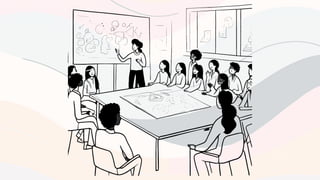
On your tables, imagine the scariest or funniest monster that you can.
What does your monster look like?
Where might your monster be found?
How does it act?
Be as detailed as possible.
Activity substantially adapted from one seen in an Instagram reel of a kindergarten teacher. I can’t find it. Sorry.
10 minutes
Now, let’s get digital!
With your group, use an AI system to make your monster more real.
You’ll need to make sure you instruct the system clearly and specifically.
We’re going to use Gemini (gemini.google.com) or ChatGPT (chat.com).
These are both multimodal systems; they engage multiple
modes of communication (e.g. text, audio, image, video).
One member of the group will need a free acccount.
Activity substantially adapted from one seen in an Instagram reel of a kindergarten teacher. I can’t find it. Sorry.
10 minutes
What could you do?
What couldn’t you do?
Did the generated output change what you had initially imagined?
If yes, how so?
If not, why not?
Do you have any questions about the AI system that just used?
10 minutes
User input and/or instruction into a computational system
Conscious user efforts to adjust prompts for optimal responses.
PROMPT
PROMPT
Engineering
We can learn through writing prompts.
Prompt engineering can help us think through and reimagine ideas.
To engineer prompts well, we must think computationally.
The greatest contribution the young programmers bring isn’t the
software they write. It’s the way they think. It’s a principle called
“computational thinking,” and knowing all of the Java syntax in the
world won’t help if you can’t think of good ways to apply it.
If you get the fundamentals about how computers think, and how
humans can talk to them in a language the machines understand, you
can imagine a project that a computer could do, and discuss it in a
way that will make sense to an actual programmer. Because as
programmers will tell you, the building part is often not the hardest
part: It’s figuring out what to build.
decomposition, pattern recognition,
abstraction, algorithm design
Raja, T. (2014, June 16). Is Coding the New Literacy? Mother Jones. https://www.motherjones.com/media/2014/06/computer-science-programming-code-diversity-sexism-education.
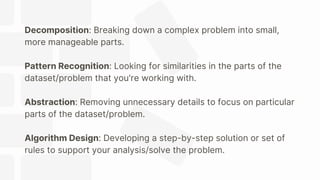
Decomposition: Breaking down a complex problem into small,
more manageable parts.
Pattern Recognition: Looking for similarities in the parts of the
dataset/problem that you're working with.
Abstraction: Removing unnecessary details to focus on particular
parts of the dataset/problem.
Algorithm Design: Developing a step-by-step solution or set of
rules to support your analysis/solve the problem.
Australia is in the middle of a cost of living crisis.
How do we solve this problem?
Let’s start analogue.
On your tables, apply computational thinking to the problem.
Break down the problem into smaller bits.
Identify what you’re going to focus on.
What questions arise?
Any ideas?
Any suggested solutions?
10 minutes
decomposition; pattern recognition; abstraction; algorithm design
Now, let’s get digital!
With your group, bring your ideas to the AI system you used before.
Prompt the system with the necessary context.
Ask for feedback, suggestions, and so forth.
Come up with a solution to the problem.
15 minutes
decomposition; pattern recognition; abstraction; algorithm design
How did you benefit - or not - from computational thinking?
What could you do? What couldn’t you do?
Did the generated output change what you had initially imagined?
If yes, how so?
If not, why not?
Do you have any questions about the AI system that just used?
How might you use this system in your own classroom?
10 minutes
decomposition; pattern recognition; abstraction; algorithm design
How can we use text generators - and AI systems more generally -
to think bigger and differently, rather than just do more of the same?
Trying to figure out what all the fuss is about?
OpenAI’s ChatGPT (chatgpt.com)
Working with texts AND images?
OpenAI’s ChatGPT or Google’s Gemini (gemini.google.com)
Want open source options?
Hugging Face’s Chat UI (huggingface.co/chat)
Microsoft’s Copilot (copilot.microsoft.com) and
Anthropic’s Claude (claude.ai) also have free versions.
Perplexity (perplexity.ai) is emerging as a favoured research tool.
Keep playing!
Compare models at Chatbot Arena: lmarena.ai
Watch top models compete with each other at AI Village:
theaidigest.org/village
You don’t need to know everything about how the technology works.
You’ll never be able to fully keep up anyway.
Play with it alongside your students and have a nice time!
Don’t be afraid to try new and weird things.
You’re not going to break anything.
It’s more important to ask questions than answer them.
Hot Tips
Any questions?
Leah Henrickson
L.Henrickson@uq.edu.au
Future Ready with AI (24 July 2025)
These slides: tinyurl.com/futureready-text

Teaching with Text Generators (Version 2.0) (Workshop)

  • 1.
    Teaching with TextGenerators (Version 2.0) Leah Henrickson L.Henrickson@uq.edu.au Future Ready with AI (24 July 2025) These slides: tinyurl.com/futureready-text
  • 2.
    But first, whoam I? I’m a Lecturer in Digital Media and Cultures in UQ’s School of Communication and Arts. I have two areas of research expertise: social perceptions of artificial intelligence and digital storytelling. My accent is Canadian. 🍁
  • 4.
    make monsters battle monsters havea good amount of fun while we learn about AI, LLMs, prompt engineering, and computational thinking What are we going to do today?
  • 5.
    Let’s start analogue. Onyour tables, imagine the scariest or funniest monster that you can. What does your monster look like? Where might your monster be found? How does it act? Be as detailed as possible. Activity substantially adapted from one seen in an Instagram reel of a kindergarten teacher. I can’t find it. Sorry. 10 minutes
  • 6.
    Now, let’s getdigital! With your group, use an AI system to make your monster more real. You’ll need to make sure you instruct the system clearly and specifically. We’re going to use Gemini (gemini.google.com) or ChatGPT (chat.com). These are both multimodal systems; they engage multiple modes of communication (e.g. text, audio, image, video). One member of the group will need a free acccount. Activity substantially adapted from one seen in an Instagram reel of a kindergarten teacher. I can’t find it. Sorry. 10 minutes
  • 7.
    What could youdo? What couldn’t you do? Did the generated output change what you had initially imagined? If yes, how so? If not, why not? Do you have any questions about the AI system that just used? 10 minutes
  • 8.
    User input and/orinstruction into a computational system Conscious user efforts to adjust prompts for optimal responses. PROMPT PROMPT Engineering
  • 9.
    We can learnthrough writing prompts. Prompt engineering can help us think through and reimagine ideas. To engineer prompts well, we must think computationally.
  • 10.
    The greatest contributionthe young programmers bring isn’t the software they write. It’s the way they think. It’s a principle called “computational thinking,” and knowing all of the Java syntax in the world won’t help if you can’t think of good ways to apply it. If you get the fundamentals about how computers think, and how humans can talk to them in a language the machines understand, you can imagine a project that a computer could do, and discuss it in a way that will make sense to an actual programmer. Because as programmers will tell you, the building part is often not the hardest part: It’s figuring out what to build. decomposition, pattern recognition, abstraction, algorithm design Raja, T. (2014, June 16). Is Coding the New Literacy? Mother Jones. https://www.motherjones.com/media/2014/06/computer-science-programming-code-diversity-sexism-education.
  • 11.
    Decomposition: Breaking downa complex problem into small, more manageable parts. Pattern Recognition: Looking for similarities in the parts of the dataset/problem that you're working with. Abstraction: Removing unnecessary details to focus on particular parts of the dataset/problem. Algorithm Design: Developing a step-by-step solution or set of rules to support your analysis/solve the problem.
  • 12.
    Australia is inthe middle of a cost of living crisis. How do we solve this problem?
  • 13.
    Let’s start analogue. Onyour tables, apply computational thinking to the problem. Break down the problem into smaller bits. Identify what you’re going to focus on. What questions arise? Any ideas? Any suggested solutions? 10 minutes decomposition; pattern recognition; abstraction; algorithm design
  • 14.
    Now, let’s getdigital! With your group, bring your ideas to the AI system you used before. Prompt the system with the necessary context. Ask for feedback, suggestions, and so forth. Come up with a solution to the problem. 15 minutes decomposition; pattern recognition; abstraction; algorithm design
  • 16.
    How did youbenefit - or not - from computational thinking? What could you do? What couldn’t you do? Did the generated output change what you had initially imagined? If yes, how so? If not, why not? Do you have any questions about the AI system that just used? How might you use this system in your own classroom? 10 minutes decomposition; pattern recognition; abstraction; algorithm design
  • 17.
    How can weuse text generators - and AI systems more generally - to think bigger and differently, rather than just do more of the same?
  • 18.
    Trying to figureout what all the fuss is about? OpenAI’s ChatGPT (chatgpt.com) Working with texts AND images? OpenAI’s ChatGPT or Google’s Gemini (gemini.google.com) Want open source options? Hugging Face’s Chat UI (huggingface.co/chat) Microsoft’s Copilot (copilot.microsoft.com) and Anthropic’s Claude (claude.ai) also have free versions. Perplexity (perplexity.ai) is emerging as a favoured research tool. Keep playing!
  • 19.
    Compare models atChatbot Arena: lmarena.ai
  • 20.
    Watch top modelscompete with each other at AI Village: theaidigest.org/village
  • 21.
    You don’t needto know everything about how the technology works. You’ll never be able to fully keep up anyway. Play with it alongside your students and have a nice time! Don’t be afraid to try new and weird things. You’re not going to break anything. It’s more important to ask questions than answer them. Hot Tips
  • 22.
    Any questions? Leah Henrickson L.Henrickson@uq.edu.au FutureReady with AI (24 July 2025) These slides: tinyurl.com/futureready-text