Chatting with
Computers
Leah Henrickson
School of Media and Communication
L.R.Henrickson@leeds.ac.uk
artificial intelligence
book history
digital storytelling
media studies
+ a dash of Canadian charm
Let's get the drier stuff out of the way.
Now, an
introduction to
natural language
generation (NLG).
NLG is considered a sub-field
of NLP, which itself is
a sub-field of AI. However,
there is a longer pre-digital
history to consider. Humans really
seem to like mathematising language.
NLG: Systematised production of
output in everyday human languages.
https://slate.com/technology/2017/08/behold-the-amazing-poetry-generating-machine.html
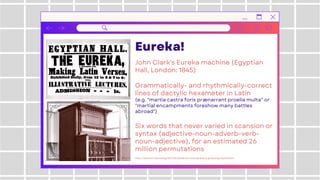
John Clark's Eureka machine (Egyptian
Hall, London: 1845)
Grammatically- and rhythmically-correct
lines of dactylic hexameter in Latin
(e.g. "martia castra foris prænarrant proelia multa" or
"martial encampments foreshow many battles
abroad")
Six words that never varied in scansion or
syntax (adjective-noun-adverb-verb-
noun-adjective), for an estimated 26
million permutations
Eureka!
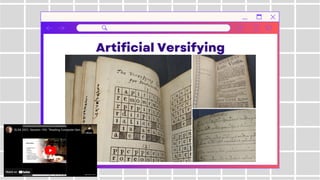
Artificial Versifying
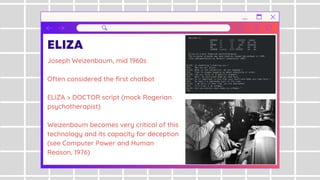
Joseph Weizenbaum, mid 1960s
Often considered the first chatbot
ELIZA > DOCTOR script (mock Rogerian
psychotherapist)
Weizenbaum becomes very critical of this
technology and its capacity for deception
(see Computer Power and Human
Reason, 1976)
ELIZA
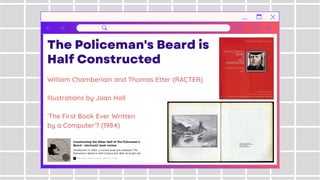
William Chamberlain and Thomas Etter (RACTER)
Illustrations by Joan Hall
'The First Book Ever Written
by a Computer'? (1984)
The Policeman's Beard is
Half Constructed
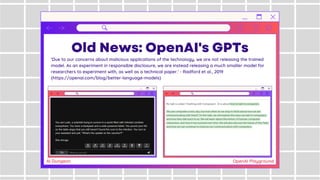
'Due to our concerns about malicious applications of the technology, we are not releasing the trained
model. As an experiment in responsible disclosure, we are instead releasing a much smaller model for
researchers to experiment with, as well as a technical paper.' - Radford et al., 2019
(https://openai.com/blog/better-language-models)
Old News: OpenAI's GPTs
AI Dungeon OpenAI Playground
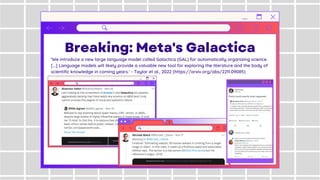
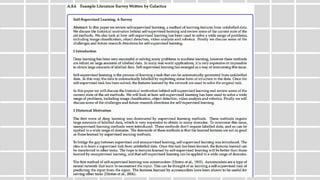
'We introduce a new large language model called Galactica (GAL) for automatically organizing science.
[...] Language models will likely provide a valuable new tool for exploring the literature and the body of
scientific knowledge in coming years.' - Taylor et al., 2022 (https://arxiv.org/abs/2211.09085)
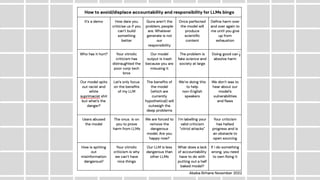
Breaking: Meta's Galactica
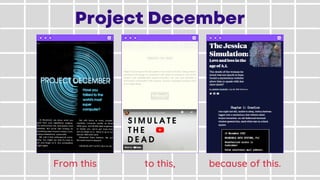
Project December
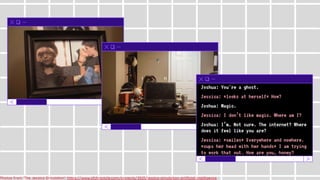
From this to this, because of this.
Photos from 'The Jessica Simulation': https://www.sfchronicle.com/projects/2021/jessica-simulation-artificial-intelligence
Why are we engaging with these systems?
Who or what are we talking to?
How do these systems prompt changes in the ways
in which we see the world? Other people?
Ourselves?
What now?
Leah Henrickson
School of Media and Communication
L.R.Henrickson@leeds.ac.uk
Thank you!