The multilingual webFelix SasakiDFKI / University of Appl. Sciences PotsdamW3C German-Austrian Officefelix.sasaki@dfki.deSlides:http://www.sasakiatcf.com/felix/publications/sasaki-webtechcon2010.pdf
About meStudied Japanese and Linguistics in Germany and JapanPhD in Computational Linguistics with a focus on Web technology & multilingual data2005-2009: Work in Japan within the W3C Internationalization ActivitySince 2009: Professor at Univ. of Appl. Sciences Potsdam / Manager of the W3C German-Austrian OfficeSince Autumn 2010: Senior Researcher at DFKI (German Research Center for Artificial Intelligence)2
About W3C OfficesA contact point for whose whoDon‘t know W3C very well (yet)Want to ask specific questions like “Who is working on topic ABC …”Are considering new web-related standardization work and are wondering where the best place to do that might beSo for any questions related to the topics mentioned above, please don‘t care to bother me too 3
OverviewMultilingual Web – what‘s that?I18N and L10N – traditional topics“The long tail” and its consequences for the multilingual webI18N and L10N on the Web - revisitedTraditional topics & new aspectsNew: bridging technology and market gapsProjects “Multilingual Web“ and “META-NET”4
OverviewMultilingual Web – what‘s that?I18N and L10N – traditional topics“The long tail” and its consequences for the multilingual webI18N and L10N on the Web - revisitedTraditional topics & new aspectsNew: bridging technology and market gapsProjects “Multilingual Web“ and “META-NET”5
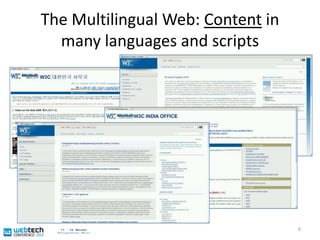
The Multilingual Web: Content in many languages and scripts6
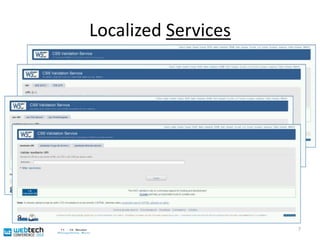
Localized Services7
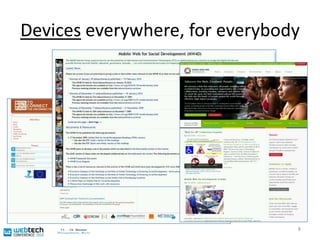
Devices everywhere, for everybody8
OverviewMultilingual Web – what‘s that?I18N and L10N – traditional topics“The long tail” and its consequences for the multilingual webI18N and L10N on the Web - revisitedTraditional topics & new aspectsNew: bridging technology and market gapsProjects “Multilingual Web“ and “META-NET”9
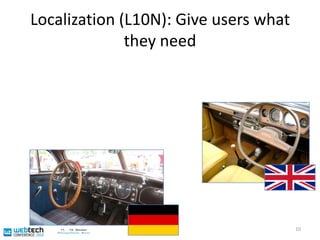
Localization (L10N): Give users what they need10
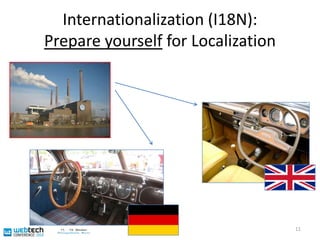
Internationalization (I18N):Prepare yourself for Localization11
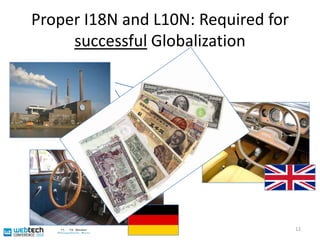
Proper I18N and L10N: Required for successful Globalization12
Traditional topics of I18N on the Web13
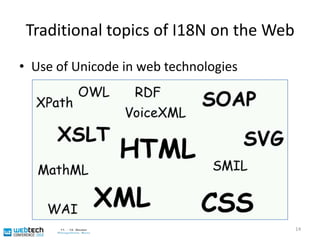
Traditional topics of I18N on the WebUse of Unicode in web technologies14
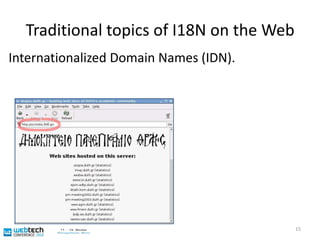
Traditional topics of I18N on the Web15Internationalized Domain Names (IDN).
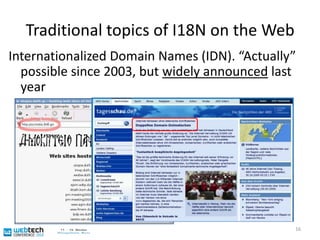
Traditional topics of I18N on the WebInternationalized Domain Names (IDN). “Actually” possible since 2003, but widely announced last year16
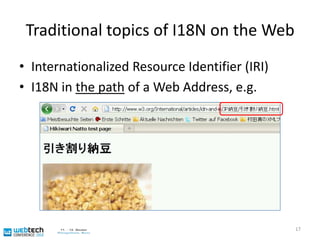
Traditional topics of I18N on the WebInternationalized Resource Identifier (IRI)I18N in the path of a Web Address, e.g. 17
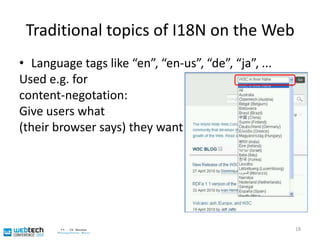
Traditional topics of I18N on the WebLanguage tags like “en”, “en-us”, “de”, “ja”, ...Used e.g. forcontent-negotation:Give users what(their browser says) they want18
OverviewMultilingual Web – what‘s that?I18N and L10N – traditional topics“The long tail” and its consequences for the multilingual webI18N and L10N on the Web - revisitedTraditional topics & new aspectsNew: bridging technology and market gapsProjects “Multilingual Web“ and “META-NET”19
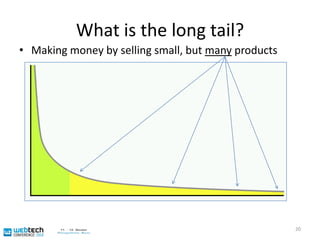
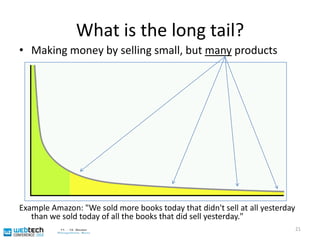
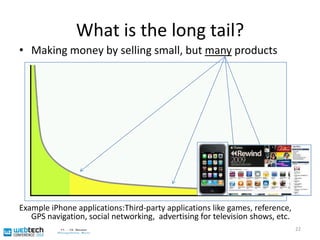
What is the long tail?Making money by selling small, but many products20
What is the long tail?Making money by selling small, but many productsExample Amazon: "We sold more books today that didn't sell at all yesterday than we sold today of all the books that did sell yesterday."21
What is the long tail?Making money by selling small, but many productsExample iPhone applications:Third-party applications like games, reference, GPS navigation, social networking,  advertising for television shows, etc.22
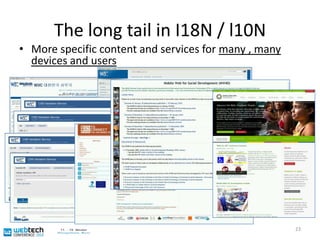
The long tail in I18N / l10NMore specific content and services for many , many devices and users23
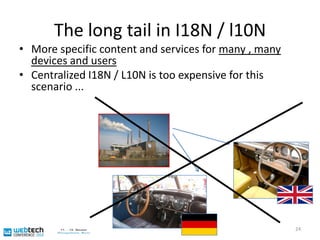
The long tail in I18N / l10N24More specific content and services for many , many devices and users
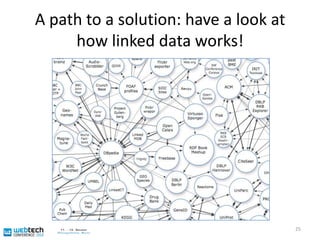
Centralized I18N / L10N is too expensive for this scenario ...A path to a solution: have a look at how linked data works!25
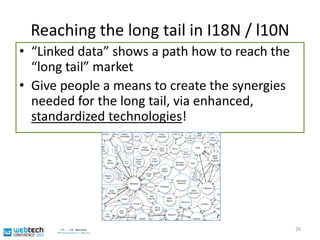
Reaching the long tail in I18N / l10N“Linked data” shows a path how to reach the “long tail” market
Give people a means to create the synergies needed for the long tail, via enhanced, standardized technologies!26
OverviewMultilingual Web – what‘s that?I18N and L10N – traditional topics“The long tail” and its consequences for the multilingual webI18N and L10N on the Web - revisitedTraditional topics & new aspectsNew: bridging technology and market gapsThe project “Multilingual Web“27
Relatively new possibilities of language tags: what does this mean?de-1901de-1996ja-latnja-latn-hepburnja-latn-hepburn-heplocasesgn28
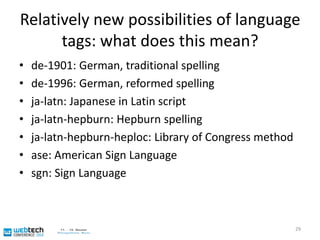
Relatively new possibilities of language tags: what does this mean?de-1901: German, traditional spellingde-1996: German, reformed spellingja-latn: Japanese in Latin scriptja-latn-hepburn: Hepburn spellingja-latn-hepburn-heploc: Library of Congress methodase: American Sign Languagesgn: Sign Language29
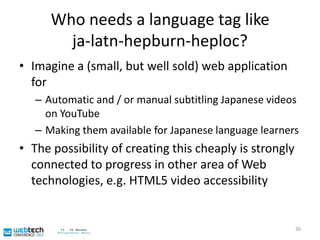
Who needs a language tag likeja-latn-hepburn-heploc?Imagine a (small, but well sold) web application forAutomatic and / or manual subtitling Japanese videos on YouTubeMaking them available for Japanese language learnersThe possibility of creating this cheaply is strongly connected to progress in other area of Web technologies, e.g. HTML5 video accessibility30
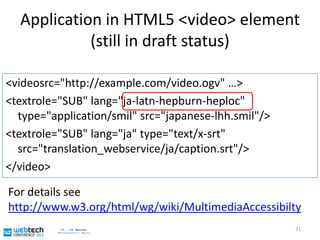
Application in HTML5 <video> element (still in draft status)<videosrc="http://example.com/video.ogv" …> <textrole="SUB" lang="ja-latn-hepburn-heploc" type="application/smil" src="japanese-lhh.smil"/> <textrole="SUB" lang="ja" type="text/x-srt" src="translation_webservice/ja/caption.srt"/></video>31For details seehttp://www.w3.org/html/wg/wiki/MultimediaAccessibilty
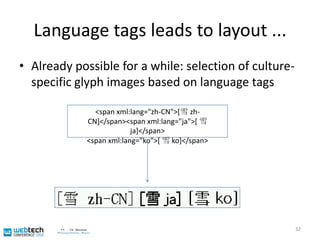
Language tags leads to layout ...Already possible for a while: selection of culture-specific glyph images based on language tags32<span xml:lang="zh-CN">[雪 zh-CN]</span> <span xml:lang="ja">[ 雪 ja]</span><span xml:lang="ko">[ 雪 ko]</span>
With new markets – reading electronic books in “Japanese Layout”Details on Japanese Layout: see http://www.w3.org/TR/jlreq/33
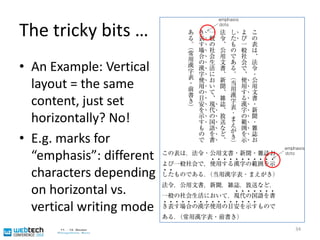
The tricky bits …An Example: Vertical layout = the same content, just set horizontally? No! E.g. marks for “emphasis”: different characters depending on horizontal vs. vertical writing mode34
OverviewMultilingual Web – what‘s that?I18N and L10N – traditional topics“The long tail” and its consequences for the multilingual webI18N and L10N on the Web - revisitedTraditional topics & new aspectsNew: bridging technology and market gapsProjects “Multilingual Web“ and “META-NET”35
Bridging technology gapsTechnologies in Web industryHTML, XML, HTTP, ...Technologies in the localization industryExample TMX: Translation Memory Exchange...How should these be combined for fast & cheap  localization of content and services for many devices?36
Metadata for the rescue!37
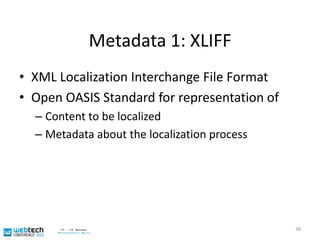
Metadata 1: XLIFFXML Localization Interchange File FormatOpen OASIS Standard for representation ofContent to be localizedMetadata about the localization process38
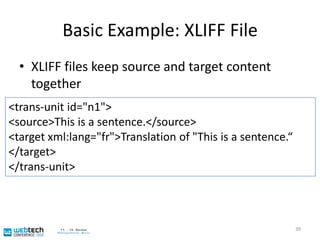
Basic Example: XLIFF FileXLIFF files keep source and target content together39<trans-unit id="n1"> <source>This is a sentence.</source>   <target xml:lang="fr">Translation of "This is a sentence.“ </target></trans-unit>
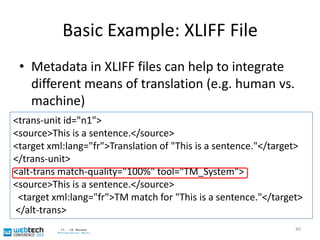
Basic Example: XLIFF FileMetadata in XLIFF files can help to integrate different means of translation (e.g. human vs. machine)40<trans-unit id="n1"> <source>This is a sentence.</source> <target xml:lang="fr">Translation of "This is a sentence."</target></trans-unit> <alt-trans match-quality="100%" tool="TM_System">  <source>This is a sentence.</source>  <target xml:lang="fr">TM match for "This is a sentence."</target> </alt-trans>
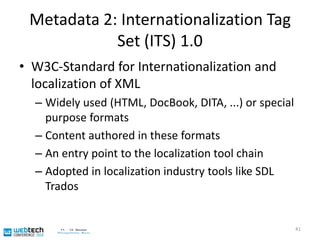
Metadata 2: Internationalization Tag Set (ITS) 1.0 W3C-Standard for Internationalization and localization of XMLWidely used (HTML, DocBook, DITA, ...) or special purpose formatsContent authored in these formatsAn entry point to the localization tool chainAdopted in localization industry tools like SDL Trados41
Basic Principles of ITS 1.0Say important thingsAbout specific contentIn a standard way42
Basic Principles of ITS 1.0Say important things: Do not translateAbout specific content: all “uitext” elementsIn a standard way: its:translate="no"43
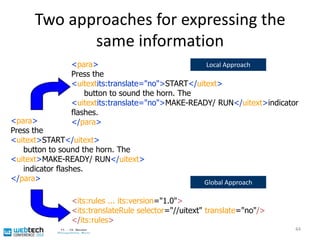
Two approaches for expressing the same information<para>	Press the 	<uitextits:translate="no">START</uitext>	button to sound the horn. The <uitextits:translate="no">MAKE-READY/ RUN</uitext>indicator flashes.</para>Local Approach<para>	Press the 	<uitext>START</uitext>	button to sound the horn. The <uitext>MAKE-READY/ RUN</uitext>	indicator flashes.</para>Global Approach<its:rules ... its:version="1.0"><its:translateRule selector="//uitext" translate="no"/></its:rules>44
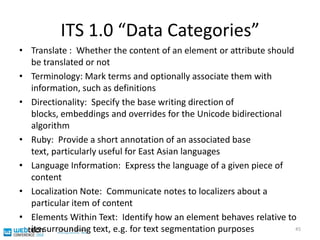
ITS 1.0 “Data Categories”Translate :  Whether the content of an element or attribute should be translated or notTerminology: Mark terms and optionally associate them with information, such as definitionsDirectionality:  Specify the base writing direction of blocks, embeddings and overrides for the Unicode bidirectional algorithmRuby:  Provide a short annotation of an associated base text, particularly useful for East Asian languagesLanguage Information:  Express the language of a given piece of contentLocalization Note:  Communicate notes to localizers about a particular item of contentElements Within Text:  Identify how an element behaves relative to its surrounding text, e.g. for text segmentation purposes45
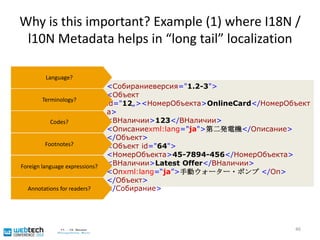
Why is this important? Example (1) where I18N / l10N Metadata helps in “long tail” localization46Language?<Собираниеверсия="1.2-3">  <Объект id="12„>    <НомерОбъекта>OnlineCard</НомерОбъекта>    <ВНаличии>123</ВНаличии>    <Описаниеxml:lang="ja">第二発電機</Описание>  </Объект>  <Объект id="64">    <НомерОбъекта>45-7894-456</НомерОбъекта>    <ВНаличии>Latest Offer</ВНаличии>    <Опxml:lang=“ja”>手動ウォーター・ポンプ </Оп>  </Объект></Собирание>Terminology?Codes?Footnotes?Foreign language expressions?Annotations for readers?
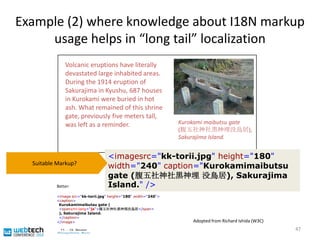
47Volcanic eruptions have literally devastated large inhabited areas. During the 1914 eruption of Sakurajima in Kyushu, 687 houses in Kurokami were buried in hot ash. What remained of this shrine gate, previously five meters tall, was left as a reminder. Kurokami maibutsu gate (腹五社神社黒神埋没鳥居),Sakurajima Island.Example (2) where knowledge about I18N markup usage helps in “long tail” localization<imagesrc="kk-torii.jpg" height="180" width="240" caption="Kurokamimaibutsu gate (腹五社神社黒神埋 没鳥居), Sakurajima Island." />Suitable Markup?Better:<image src="kk-torii.jpg" height="180" width="240"><caption> Kurokamimaibutsu gate ( <spanxml:lang="ja">腹五社神社黒神埋没鳥居</span> ), Sakurajima Island. </caption></image>Adopted from Richard Ishida (W3C)
XLIFF and ITS 1.0ITS 1.0: entry point in the localization chainA pre-requisite for properly internationalized vocabularies and contentXLIFF: the meat of the localization chainITS 1.0 makes XLIFF creation and processing easier48
XLIFF and ITS 1.0 example: ITS2XLIFFSee http://fabday.fh-potsdam.de/~sasaki/its/XSLT-based round tripping tool for generation of XLIFF from XML with ITS markup, and integration of translated content into the original XMLOpen source standard technology based - one example of how “long tail” content localization can become easier49
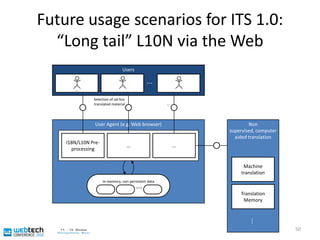
Future usage scenarios for ITS 1.0: “Long tail” L10N via the Web50Users...…Selection of ad-hoc translated material…User Agent (e.g. Web browser)Non supervised, computer aided translationI18N/L10N Pre-processing……Machine translationIn-memory, non persistent data...Translation Memory...
Who can help to make that happen?Of course you!If content authors & developers don’t use ITS, tools which want to generate XLIFF from let’s say HTML will produce a lot of crapWe need you to fix that!51
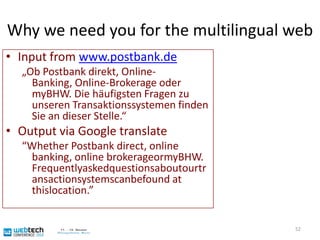
Why we need you for the multilingual web52Input from www.postbank.de„Ob Postbank direkt, Online-Banking, Online-Brokerage oder myBHW. Die häufigsten Fragen zu unseren Transaktionssystemen finden Sie an dieser Stelle.“Output via Google translate“Whether Postbank direct, online banking, online brokerageormyBHW. Frequentlyaskedquestionsaboutourtransactionsystemscanbefound at thislocation.”
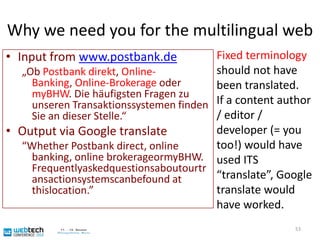
Why we need you for the multilingual webFixed terminologyshould not havebeen translated.If a content author / editor / developer (= you too!) would have used ITS “translate”, Google translate would have worked.Input from www.postbank.de„Ob Postbank direkt, Online-Banking, Online-Brokerage oder myBHW. Die häufigsten Fragen zu unseren Transaktionssystemen finden Sie an dieser Stelle.“Output via Google translate“Whether Postbank direct, online banking, online brokerageormyBHW. Frequentlyaskedquestionsaboutourtransactionsystemscanbefound at thislocation.”53
What do we learn from this? Automatic language processing is better … … if you help it with metadataAbout what is translatable or notAbout terminologyAbout segmentation (“What is a footnote?”)…Your employer will like it too(Long tail) localization with high quality metadata gets betterThe whole localization process gets cheaper 54
The question is now: Who will start?Content creators don‘t use metadata since nobody processes itNobody processes metadata since there is noneThe first company who breaks that vicious circle and develops a successfully model of deploying metadata (see previous slides) will get rich    55
The question is now: Who will start?Some people already have started: WAI-ARIA (cf. talk from Tomas Caspers at this conference)Metadata for “roles” of specified elements“I am navigation”“I am a tab”…Used e.g. by screen readersShows common aspectof barrier free web design and web design for the “automatable, multilingual web”: appropriate metadata 56
OverviewMultilingual Web – what‘s that?I18N and L10N – traditional topics“The long tail” and its consequences for the multilingual webI18N and L10N on the Web - revisitedTraditional topics & new aspectsNew: bridging technology and market gapsProjects “Multilingual Web“ and “META-NET”57
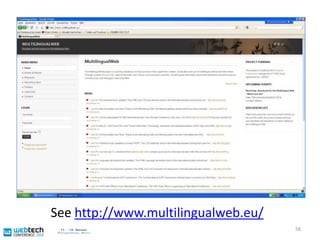
58See http://www.multilingualweb.eu/
BackgroundParticipants from industry and academia (e.g. computational linguistics)Aim: Bridge the gaps between industries (and research areas) describedEducation about new developments (e.g. in the area of language tags, layout, web based localization) – like in this presentation More mutual understanding of users needs and what tools can doSupport via special purpose toolFirst example “I18n checker” http://rishida.net/tools/i18nchecker/59
Participants from: Web, Localization industry, (automatic) translation research, ...ERCIM/W3C: coordinationCNR-ILCFacebook IrelandThe University of Applied Sciences (UAS) PotsdamInstitut Josef Stefan (JSI)Institutul de CercetariPentruIntelegentiaArticificiala (RACAI)The Language Technology CentreLionbridge BelgiumMicrosoft IrelandOpera SoftwareSAPThe Translation Automation User Society (TAUS)Teknillinen KorkeakouluUniversity of Oviedo (ILTO)Universidad Politécnica de Madrid (UPM)The Language Resource CentreUniversity of Economics, PragueTransware Ltd (WeLocalize)XML-INTL60
Workshops as a means for community building - topicsThe landscape of multilingual Web standards and best practicesAuthoring of the Multilingual WebTranslation tool support (with focus on standards like ITS 1.0, XLIFF, TMX)Further topics – to be decidedYour input is more than welcome!61
1st Workshop: “The Multilingual Web – Where Are We?”26-27th October, MadridGoal: Bring developers (you!), content creators, localizers, users, machine processing folks and policy makers togetherProvide input for upcoming workProgram details atwww.w3.org/International/multilingualweb/madrid/program62
META-NETEU-funded project, closely related to “Multilingual Web”Main aim: build an alliance for improving language technologies in EuropeLaaarge: soon 40+ participating organizations in 30+ countriesVery important: bring users of language technology in63
META-NETUsers and language technology companies = in Europe not only large companies, but more and more small SMEsTarget of META-NET are these small and fast units – including you EU has started special funding programs for SMEs – see http://tinyurl.com/eu-lt-sme(“objective 4.1”) 64
META-NETEvent: META-NET ForumBrussels, November 17th/18thAim: Bring users / language technology developers / policy makers togetherDiscuss a road map for the next 10 years of language technology road map and its applicationsDetails and registration athttp://www.meta-net.eu/events65
OverviewMultilingual Web – what‘s that?I18N and L10N – traditional topics“The long tail” and its consequences for the multilingual webI18N and L10N on the Web - revisitedTraditional topics & new aspectsNew: bridging technology and market gapsProjects “Multilingual Web“ and “META-NET”66
SummaryThe basic infrastructure of the multilingual Web is setNevertheless, even core parts like language identification have are being updated to easy international use for many & diverse audiencesLocalization is getting diverse across industries  (Web, Localization, including automatic translation)Specific (Meta)data formats like XLIFF and ITS 1.0 can help bridging gaps between players and users in the fieldWe need you as a metadata user to realize faster and cheaper localizationThe “Multilingual Web” project aims at being a place for gathering possibilities for a “long tail” multilingual web – a web for really everyone’s business!The “META-NET” project aims at building an alliance between language technology providers and users to make the long tail localization model happen 67

Sasaki webtechcon2010

  • 1.
    The multilingual webFelixSasakiDFKI / University of Appl. Sciences PotsdamW3C German-Austrian Officefelix.sasaki@dfki.deSlides:http://www.sasakiatcf.com/felix/publications/sasaki-webtechcon2010.pdf
  • 2.
    About meStudied Japaneseand Linguistics in Germany and JapanPhD in Computational Linguistics with a focus on Web technology & multilingual data2005-2009: Work in Japan within the W3C Internationalization ActivitySince 2009: Professor at Univ. of Appl. Sciences Potsdam / Manager of the W3C German-Austrian OfficeSince Autumn 2010: Senior Researcher at DFKI (German Research Center for Artificial Intelligence)2
  • 3.
    About W3C OfficesAcontact point for whose whoDon‘t know W3C very well (yet)Want to ask specific questions like “Who is working on topic ABC …”Are considering new web-related standardization work and are wondering where the best place to do that might beSo for any questions related to the topics mentioned above, please don‘t care to bother me too 3
  • 4.
    OverviewMultilingual Web –what‘s that?I18N and L10N – traditional topics“The long tail” and its consequences for the multilingual webI18N and L10N on the Web - revisitedTraditional topics & new aspectsNew: bridging technology and market gapsProjects “Multilingual Web“ and “META-NET”4
  • 5.
    OverviewMultilingual Web –what‘s that?I18N and L10N – traditional topics“The long tail” and its consequences for the multilingual webI18N and L10N on the Web - revisitedTraditional topics & new aspectsNew: bridging technology and market gapsProjects “Multilingual Web“ and “META-NET”5
  • 6.
    The Multilingual Web:Content in many languages and scripts6
  • 7.
  • 8.
  • 9.
    OverviewMultilingual Web –what‘s that?I18N and L10N – traditional topics“The long tail” and its consequences for the multilingual webI18N and L10N on the Web - revisitedTraditional topics & new aspectsNew: bridging technology and market gapsProjects “Multilingual Web“ and “META-NET”9
  • 10.
    Localization (L10N): Giveusers what they need10
  • 11.
  • 12.
    Proper I18N andL10N: Required for successful Globalization12
  • 13.
    Traditional topics ofI18N on the Web13
  • 14.
    Traditional topics ofI18N on the WebUse of Unicode in web technologies14
  • 15.
    Traditional topics ofI18N on the Web15Internationalized Domain Names (IDN).
  • 16.
    Traditional topics ofI18N on the WebInternationalized Domain Names (IDN). “Actually” possible since 2003, but widely announced last year16
  • 17.
    Traditional topics ofI18N on the WebInternationalized Resource Identifier (IRI)I18N in the path of a Web Address, e.g. 17
  • 18.
    Traditional topics ofI18N on the WebLanguage tags like “en”, “en-us”, “de”, “ja”, ...Used e.g. forcontent-negotation:Give users what(their browser says) they want18
  • 19.
    OverviewMultilingual Web –what‘s that?I18N and L10N – traditional topics“The long tail” and its consequences for the multilingual webI18N and L10N on the Web - revisitedTraditional topics & new aspectsNew: bridging technology and market gapsProjects “Multilingual Web“ and “META-NET”19
  • 20.
    What is thelong tail?Making money by selling small, but many products20
  • 21.
    What is thelong tail?Making money by selling small, but many productsExample Amazon: "We sold more books today that didn't sell at all yesterday than we sold today of all the books that did sell yesterday."21
  • 22.
    What is thelong tail?Making money by selling small, but many productsExample iPhone applications:Third-party applications like games, reference, GPS navigation, social networking, advertising for television shows, etc.22
  • 23.
    The long tailin I18N / l10NMore specific content and services for many , many devices and users23
  • 24.
    The long tailin I18N / l10N24More specific content and services for many , many devices and users
  • 25.
    Centralized I18N /L10N is too expensive for this scenario ...A path to a solution: have a look at how linked data works!25
  • 26.
    Reaching the longtail in I18N / l10N“Linked data” shows a path how to reach the “long tail” market
  • 27.
    Give people ameans to create the synergies needed for the long tail, via enhanced, standardized technologies!26
  • 28.
    OverviewMultilingual Web –what‘s that?I18N and L10N – traditional topics“The long tail” and its consequences for the multilingual webI18N and L10N on the Web - revisitedTraditional topics & new aspectsNew: bridging technology and market gapsThe project “Multilingual Web“27
  • 29.
    Relatively new possibilitiesof language tags: what does this mean?de-1901de-1996ja-latnja-latn-hepburnja-latn-hepburn-heplocasesgn28
  • 30.
    Relatively new possibilitiesof language tags: what does this mean?de-1901: German, traditional spellingde-1996: German, reformed spellingja-latn: Japanese in Latin scriptja-latn-hepburn: Hepburn spellingja-latn-hepburn-heploc: Library of Congress methodase: American Sign Languagesgn: Sign Language29
  • 31.
    Who needs alanguage tag likeja-latn-hepburn-heploc?Imagine a (small, but well sold) web application forAutomatic and / or manual subtitling Japanese videos on YouTubeMaking them available for Japanese language learnersThe possibility of creating this cheaply is strongly connected to progress in other area of Web technologies, e.g. HTML5 video accessibility30
  • 32.
    Application in HTML5<video> element (still in draft status)<videosrc="http://example.com/video.ogv" …> <textrole="SUB" lang="ja-latn-hepburn-heploc" type="application/smil" src="japanese-lhh.smil"/> <textrole="SUB" lang="ja" type="text/x-srt" src="translation_webservice/ja/caption.srt"/></video>31For details seehttp://www.w3.org/html/wg/wiki/MultimediaAccessibilty
  • 33.
    Language tags leadsto layout ...Already possible for a while: selection of culture-specific glyph images based on language tags32<span xml:lang="zh-CN">[雪 zh-CN]</span> <span xml:lang="ja">[ 雪 ja]</span><span xml:lang="ko">[ 雪 ko]</span>
  • 34.
    With new markets– reading electronic books in “Japanese Layout”Details on Japanese Layout: see http://www.w3.org/TR/jlreq/33
  • 35.
    The tricky bits…An Example: Vertical layout = the same content, just set horizontally? No! E.g. marks for “emphasis”: different characters depending on horizontal vs. vertical writing mode34
  • 36.
    OverviewMultilingual Web –what‘s that?I18N and L10N – traditional topics“The long tail” and its consequences for the multilingual webI18N and L10N on the Web - revisitedTraditional topics & new aspectsNew: bridging technology and market gapsProjects “Multilingual Web“ and “META-NET”35
  • 37.
    Bridging technology gapsTechnologiesin Web industryHTML, XML, HTTP, ...Technologies in the localization industryExample TMX: Translation Memory Exchange...How should these be combined for fast & cheap localization of content and services for many devices?36
  • 38.
  • 39.
    Metadata 1: XLIFFXMLLocalization Interchange File FormatOpen OASIS Standard for representation ofContent to be localizedMetadata about the localization process38
  • 40.
    Basic Example: XLIFFFileXLIFF files keep source and target content together39<trans-unit id="n1"> <source>This is a sentence.</source> <target xml:lang="fr">Translation of "This is a sentence.“ </target></trans-unit>
  • 41.
    Basic Example: XLIFFFileMetadata in XLIFF files can help to integrate different means of translation (e.g. human vs. machine)40<trans-unit id="n1"> <source>This is a sentence.</source> <target xml:lang="fr">Translation of "This is a sentence."</target></trans-unit> <alt-trans match-quality="100%" tool="TM_System"> <source>This is a sentence.</source>  <target xml:lang="fr">TM match for "This is a sentence."</target> </alt-trans>
  • 42.
    Metadata 2: InternationalizationTag Set (ITS) 1.0 W3C-Standard for Internationalization and localization of XMLWidely used (HTML, DocBook, DITA, ...) or special purpose formatsContent authored in these formatsAn entry point to the localization tool chainAdopted in localization industry tools like SDL Trados41
  • 43.
    Basic Principles ofITS 1.0Say important thingsAbout specific contentIn a standard way42
  • 44.
    Basic Principles ofITS 1.0Say important things: Do not translateAbout specific content: all “uitext” elementsIn a standard way: its:translate="no"43
  • 45.
    Two approaches forexpressing the same information<para> Press the <uitextits:translate="no">START</uitext> button to sound the horn. The <uitextits:translate="no">MAKE-READY/ RUN</uitext>indicator flashes.</para>Local Approach<para> Press the <uitext>START</uitext> button to sound the horn. The <uitext>MAKE-READY/ RUN</uitext> indicator flashes.</para>Global Approach<its:rules ... its:version="1.0"><its:translateRule selector="//uitext" translate="no"/></its:rules>44
  • 46.
    ITS 1.0 “DataCategories”Translate : Whether the content of an element or attribute should be translated or notTerminology: Mark terms and optionally associate them with information, such as definitionsDirectionality: Specify the base writing direction of blocks, embeddings and overrides for the Unicode bidirectional algorithmRuby: Provide a short annotation of an associated base text, particularly useful for East Asian languagesLanguage Information: Express the language of a given piece of contentLocalization Note: Communicate notes to localizers about a particular item of contentElements Within Text: Identify how an element behaves relative to its surrounding text, e.g. for text segmentation purposes45
  • 47.
    Why is thisimportant? Example (1) where I18N / l10N Metadata helps in “long tail” localization46Language?<Собираниеверсия="1.2-3"> <Объект id="12„> <НомерОбъекта>OnlineCard</НомерОбъекта> <ВНаличии>123</ВНаличии> <Описаниеxml:lang="ja">第二発電機</Описание> </Объект> <Объект id="64"> <НомерОбъекта>45-7894-456</НомерОбъекта> <ВНаличии>Latest Offer</ВНаличии> <Опxml:lang=“ja”>手動ウォーター・ポンプ </Оп> </Объект></Собирание>Terminology?Codes?Footnotes?Foreign language expressions?Annotations for readers?
  • 48.
    47Volcanic eruptions haveliterally devastated large inhabited areas. During the 1914 eruption of Sakurajima in Kyushu, 687 houses in Kurokami were buried in hot ash. What remained of this shrine gate, previously five meters tall, was left as a reminder. Kurokami maibutsu gate (腹五社神社黒神埋没鳥居),Sakurajima Island.Example (2) where knowledge about I18N markup usage helps in “long tail” localization<imagesrc="kk-torii.jpg" height="180" width="240" caption="Kurokamimaibutsu gate (腹五社神社黒神埋 没鳥居), Sakurajima Island." />Suitable Markup?Better:<image src="kk-torii.jpg" height="180" width="240"><caption> Kurokamimaibutsu gate ( <spanxml:lang="ja">腹五社神社黒神埋没鳥居</span> ), Sakurajima Island. </caption></image>Adopted from Richard Ishida (W3C)
  • 49.
    XLIFF and ITS1.0ITS 1.0: entry point in the localization chainA pre-requisite for properly internationalized vocabularies and contentXLIFF: the meat of the localization chainITS 1.0 makes XLIFF creation and processing easier48
  • 50.
    XLIFF and ITS1.0 example: ITS2XLIFFSee http://fabday.fh-potsdam.de/~sasaki/its/XSLT-based round tripping tool for generation of XLIFF from XML with ITS markup, and integration of translated content into the original XMLOpen source standard technology based - one example of how “long tail” content localization can become easier49
  • 51.
    Future usage scenariosfor ITS 1.0: “Long tail” L10N via the Web50Users...…Selection of ad-hoc translated material…User Agent (e.g. Web browser)Non supervised, computer aided translationI18N/L10N Pre-processing……Machine translationIn-memory, non persistent data...Translation Memory...
  • 52.
    Who can helpto make that happen?Of course you!If content authors & developers don’t use ITS, tools which want to generate XLIFF from let’s say HTML will produce a lot of crapWe need you to fix that!51
  • 53.
    Why we needyou for the multilingual web52Input from www.postbank.de„Ob Postbank direkt, Online-Banking, Online-Brokerage oder myBHW. Die häufigsten Fragen zu unseren Transaktionssystemen finden Sie an dieser Stelle.“Output via Google translate“Whether Postbank direct, online banking, online brokerageormyBHW. Frequentlyaskedquestionsaboutourtransactionsystemscanbefound at thislocation.”
  • 54.
    Why we needyou for the multilingual webFixed terminologyshould not havebeen translated.If a content author / editor / developer (= you too!) would have used ITS “translate”, Google translate would have worked.Input from www.postbank.de„Ob Postbank direkt, Online-Banking, Online-Brokerage oder myBHW. Die häufigsten Fragen zu unseren Transaktionssystemen finden Sie an dieser Stelle.“Output via Google translate“Whether Postbank direct, online banking, online brokerageormyBHW. Frequentlyaskedquestionsaboutourtransactionsystemscanbefound at thislocation.”53
  • 55.
    What do welearn from this? Automatic language processing is better … … if you help it with metadataAbout what is translatable or notAbout terminologyAbout segmentation (“What is a footnote?”)…Your employer will like it too(Long tail) localization with high quality metadata gets betterThe whole localization process gets cheaper 54
  • 56.
    The question isnow: Who will start?Content creators don‘t use metadata since nobody processes itNobody processes metadata since there is noneThe first company who breaks that vicious circle and develops a successfully model of deploying metadata (see previous slides) will get rich    55
  • 57.
    The question isnow: Who will start?Some people already have started: WAI-ARIA (cf. talk from Tomas Caspers at this conference)Metadata for “roles” of specified elements“I am navigation”“I am a tab”…Used e.g. by screen readersShows common aspectof barrier free web design and web design for the “automatable, multilingual web”: appropriate metadata 56
  • 58.
    OverviewMultilingual Web –what‘s that?I18N and L10N – traditional topics“The long tail” and its consequences for the multilingual webI18N and L10N on the Web - revisitedTraditional topics & new aspectsNew: bridging technology and market gapsProjects “Multilingual Web“ and “META-NET”57
  • 59.
  • 60.
    BackgroundParticipants from industryand academia (e.g. computational linguistics)Aim: Bridge the gaps between industries (and research areas) describedEducation about new developments (e.g. in the area of language tags, layout, web based localization) – like in this presentation More mutual understanding of users needs and what tools can doSupport via special purpose toolFirst example “I18n checker” http://rishida.net/tools/i18nchecker/59
  • 61.
    Participants from: Web,Localization industry, (automatic) translation research, ...ERCIM/W3C: coordinationCNR-ILCFacebook IrelandThe University of Applied Sciences (UAS) PotsdamInstitut Josef Stefan (JSI)Institutul de CercetariPentruIntelegentiaArticificiala (RACAI)The Language Technology CentreLionbridge BelgiumMicrosoft IrelandOpera SoftwareSAPThe Translation Automation User Society (TAUS)Teknillinen KorkeakouluUniversity of Oviedo (ILTO)Universidad Politécnica de Madrid (UPM)The Language Resource CentreUniversity of Economics, PragueTransware Ltd (WeLocalize)XML-INTL60
  • 62.
    Workshops as ameans for community building - topicsThe landscape of multilingual Web standards and best practicesAuthoring of the Multilingual WebTranslation tool support (with focus on standards like ITS 1.0, XLIFF, TMX)Further topics – to be decidedYour input is more than welcome!61
  • 63.
    1st Workshop: “TheMultilingual Web – Where Are We?”26-27th October, MadridGoal: Bring developers (you!), content creators, localizers, users, machine processing folks and policy makers togetherProvide input for upcoming workProgram details atwww.w3.org/International/multilingualweb/madrid/program62
  • 64.
    META-NETEU-funded project, closelyrelated to “Multilingual Web”Main aim: build an alliance for improving language technologies in EuropeLaaarge: soon 40+ participating organizations in 30+ countriesVery important: bring users of language technology in63
  • 65.
    META-NETUsers and languagetechnology companies = in Europe not only large companies, but more and more small SMEsTarget of META-NET are these small and fast units – including you EU has started special funding programs for SMEs – see http://tinyurl.com/eu-lt-sme(“objective 4.1”) 64
  • 66.
    META-NETEvent: META-NET ForumBrussels,November 17th/18thAim: Bring users / language technology developers / policy makers togetherDiscuss a road map for the next 10 years of language technology road map and its applicationsDetails and registration athttp://www.meta-net.eu/events65
  • 67.
    OverviewMultilingual Web –what‘s that?I18N and L10N – traditional topics“The long tail” and its consequences for the multilingual webI18N and L10N on the Web - revisitedTraditional topics & new aspectsNew: bridging technology and market gapsProjects “Multilingual Web“ and “META-NET”66
  • 68.
    SummaryThe basic infrastructureof the multilingual Web is setNevertheless, even core parts like language identification have are being updated to easy international use for many & diverse audiencesLocalization is getting diverse across industries (Web, Localization, including automatic translation)Specific (Meta)data formats like XLIFF and ITS 1.0 can help bridging gaps between players and users in the fieldWe need you as a metadata user to realize faster and cheaper localizationThe “Multilingual Web” project aims at being a place for gathering possibilities for a “long tail” multilingual web – a web for really everyone’s business!The “META-NET” project aims at building an alliance between language technology providers and users to make the long tail localization model happen 67