ENGAGING AND EFFECTIVE TEACHING
READING STRATEGIES
Prepared by: Do Thi Phuong Trinh
Work in groups of four,
share your experience in teaching Reading
• 1.What does reading involve?
• 2.What should we teach in a Reading lesson?
• 3. What kinds of activities do you often use when
teaching Reading?
• 4.What difficulties do your students encounter
when reading?
• 5. How do you help them?
Discussion
STAGES OF A READING LESSON
1.PRE- READING
2.WHILE- READING
3.POST-READING
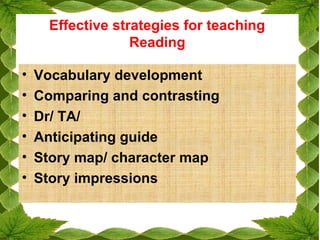
Effective strategies for teaching
Reading
• Vocabulary development
• Comparing and contrasting
• Dr/ TA/
• Anticipating guide
• Story map/ character map
• Story impressions
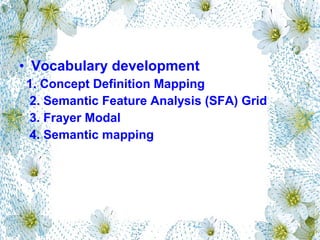
• Vocabulary development
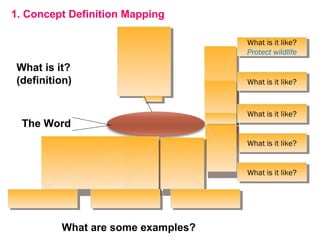
1. Concept Definition Mapping
2. Semantic Feature Analysis (SFA) Grid
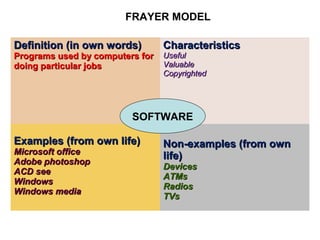
3. Frayer Modal
4. Semantic mapping
What is it like?
Protect wildlife
What is it like?
Protect wildlife
What is it like?What is it like?
1. Concept Definition Mapping
What is it?
(definition)
The Word
What are some examples?
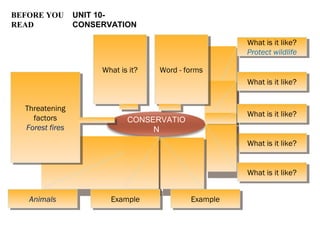
CONSERVATIO
N
What is it?What is it?
What is it like?
Protect wildlife
What is it like?
Protect wildlife
What is it like?What is it like?
AnimalsAnimals ExampleExample ExampleExample
Threatening
factors
Forest fires
Threatening
factors
Forest fires
BEFORE YOU
READ
Word - formsWord - forms
UNIT 10-
CONSERVATION
CONSERVATIO
N
The
protection
and
management
of natural
things.
The
protection
and
management
of natural
things.
Protect wildlifeProtect wildlife
Manage resourcesManage resources
Prevent forest
destruction
Prevent forest
destruction
Find alternative
energy sourses
Find alternative
energy sourses
Reclaim land and
keep water clean
Reclaim land and
keep water clean
AnimalsAnimals PlantsPlants ForestsForests
• Forest fires
• Hunting
• Fishing
• Pollutants
• Careless use of
natural resources
• Disasters
• Wood
construction
projects
• Forest fires
• Hunting
• Fishing
• Pollutants
• Careless use of
natural resources
• Disasters
• Wood
construction
projects
WaterWater EnergyEnergy landland
BEFORE YOU
READ
Conserve (v)
Conservative(
adj)
Conservation
(n)
Conserve (v)
Conservative(
adj)
Conservation
(n)
Semantic feature analysis(SFA GRID)
• How to use semantic feature analysis
• Select a category or topic for the semantic feature
analysis.
• List words and important features related to the topic.
• Vocabulary words should be listed down the left hand
column and the features of the topic across the top row
of the chart.
• Have students place a "+" sign in the matrix when a
vocabulary word aligns with a particular feature of the
topic. If the word does not align students may put a "–" in
the grid. If students are unable to determine a
relationship they may leave it blank
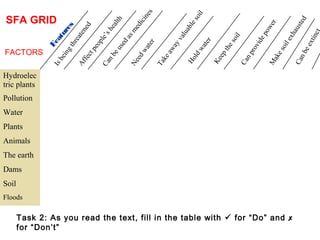
Features
Canbeusedasmedicines
Isbeingthreatened
Affectpeople’shealth
Needwater
Takeawayvaluablesoil
Holdwater
Keepthesoil
FACTORS
Hydroelec
tric plants
Pollution
Water
Plants
Animals
The earth
Dams
Soil
Floods
M
akesoilexhausted
Canprovidepower
Canbeextinct
Task 2: As you read the text, fill in the table with  for “Do” and 
for “Don’t”
SFA GRID
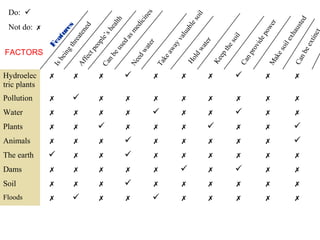
Features
Canbeusedasmedicines
Isbeingthreatened
Affectpeople’shealth
Needwater
Takeawayvaluablesoil
Holdwater
Keepthesoil
FACTORS
Do: 
Not do: 
Hydroelec
tric plants
         
Pollution          
Water          
Plants          
Animals          
The earth          
Dams          
Soil          
Floods          
M
akesoilexhausted
Canprovidepower
Canbeextinct
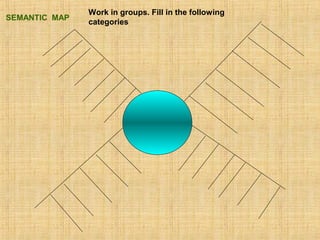
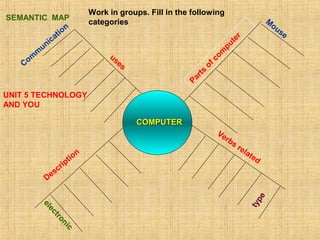
SEMANTIC MAP
Work in groups. Fill in the following
categories
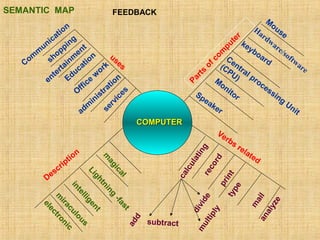
COMPUTERCOMPUTER
uses
Parts
ofcom
puter
Verbs related
Description
SEMANTIC MAP
Com
m
unication
M
ouse
electronic
type
Work in groups. Fill in the following
categories
UNIT 5 TECHNOLOGY
AND YOU
COMPUTERCOMPUTER
uses
Parts
ofcom
puter
Verbs related
Description
Hardware/software
Com
m
unication
m
ail
m
iraculous
intelligent
shopping keyboard
entertainm
ent
Education
O
ffice
w
ork
adm
inistration
services
Lightning
-fast
m
agical
electronic
Central processing
Unit
(CPU)M
onitor
M
ouse
Speaker
analyze
type
print
record
calculating
divide
subtract
add
m
ultiply
SEMANTIC MAP FEEDBACK
Definition (in own words)Definition (in own words) CharacteristicsCharacteristics
UsefulUseful
Examples (from own life)Examples (from own life)
Microsoft officeMicrosoft office
Non-examples (from ownNon-examples (from own
life)life)
DevicesDevices
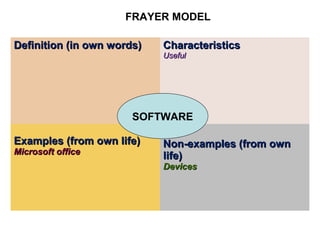
SOFTWARE
FRAYER MODEL
Definition (in own words)Definition (in own words)
Programs used by computers forPrograms used by computers for
doing particular jobsdoing particular jobs
CharacteristicsCharacteristics
UsefulUseful
ValuableValuable
CopyrightedCopyrighted
Examples (from own life)Examples (from own life)
Microsoft officeMicrosoft office
Adobe photoshopAdobe photoshop
ACD seeACD see
WindowsWindows
Windows mediaWindows media
Non-examples (from ownNon-examples (from own
life)life)
DevicesDevices
ATMsATMs
RadiosRadios
TVsTVs
SOFTWARE
FRAYER MODEL
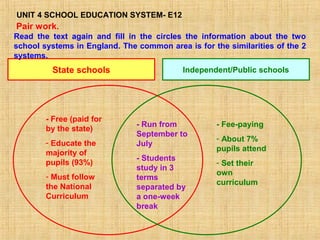
Comparing and contrasting
State schools Independent/Public schools
Pair work.
Read the text again and fill in the circles the information about the two
school systems in England. The common area is for the similarities of the 2
systems.
- Free (paid for
by the state)
- Educate the
majority of
pupils (93%)
- Must follow
the National
Curriculum
- Run from
September to
July
- Students
study in 3
terms
separated by
a one-week
break
- Fee-paying
- About 7%
pupils attend
- Set their
own
curriculum
UNIT 4 SCHOOL EDUCATION SYSTEM- E12
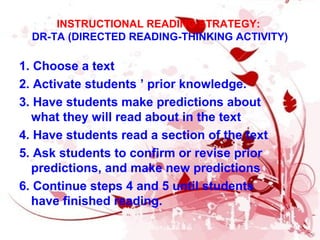
INSTRUCTIONAL READING STRATEGY:
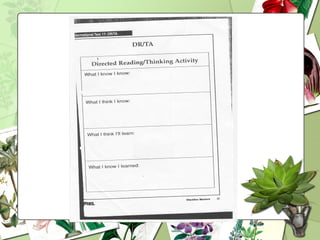
DR-TA (DIRECTED READING-THINKING ACTIVITY)
1. Choose a text
2. Activate students ’ prior knowledge.
3. Have students make predictions about
what they will read about in the text
4. Have students read a section of the text
5. Ask students to confirm or revise prior
predictions, and make new predictions
6. Continue steps 4 and 5 until students
have finished reading.
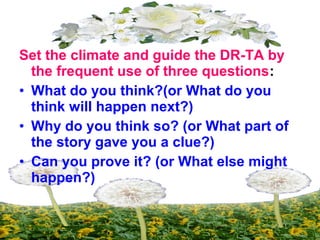
Set the climate and guide the DR-TA by
the frequent use of three questions:
• What do you think?(or What do you
think will happen next?)
• Why do you think so? (or What part of
the story gave you a clue?)
• Can you prove it? (or What else might
happen?)
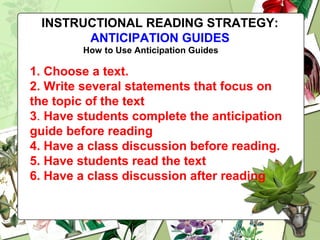
INSTRUCTIONAL READING STRATEGY:
ANTICIPATION GUIDES
How to Use Anticipation Guides
1. Choose a text.
2. Write several statements that focus on
the topic of the text
3. Have students complete the anticipation
guide before reading
4. Have a class discussion before reading.
5. Have students read the text
6. Have a class discussion after reading
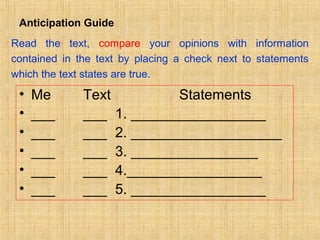
• Me Text Statements
• ___ ___ 1. _________________
• ___ ___ 2. ___________________
• ___ ___ 3. ________________
• ___ ___ 4._________________
• ___ ___ 5. _________________
Anticipation Guide
Read the text, compare your opinions with information
contained in the text by placing a check next to statements
which the text states are true.
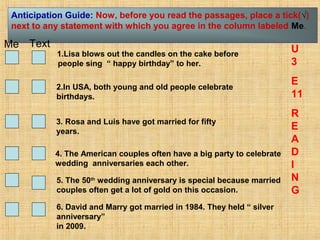
Anticipation Guide: Now, before you read the passages, place a tick(√)
next to any statement with which you agree in the column labeled Me.
1.Lisa blows out the candles on the cake before
people sing “ happy birthday” to her.
2.In USA, both young and old people celebrate
birthdays.
3. Rosa and Luis have got married for fifty
years.
4. The American couples often have a big party to celebrate
wedding anniversaries each other.
5. The 50th
wedding anniversary is special because married
couples often get a lot of gold on this occasion.
6. David and Marry got married in 1984. They held “ silver
anniversary”
in 2009.
Me Text U
3
E
11
R
E
A
D
I
N
G
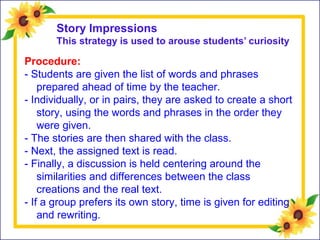
Story Impressions
This strategy is used to arouse students’ curiosity
Procedure:
- Students are given the list of words and phrases
prepared ahead of time by the teacher.
- Individually, or in pairs, they are asked to create a short
story, using the words and phrases in the order they
were given.
- The stories are then shared with the class.
- Next, the assigned text is read.
- Finally, a discussion is held centering around the
similarities and differences between the class
creations and the real text.
- If a group prefers its own story, time is given for editing
and rewriting.
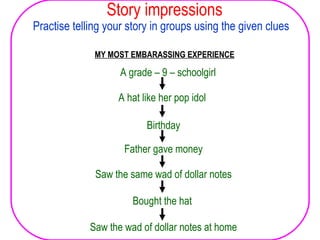
Story impressions
Practise telling your story in groups using the given clues
MY MOST EMBARASSING EXPERIENCE
A grade – 9 – schoolgirl
A hat like her pop idol
Birthday
Father gave money
Saw the same wad of dollar notes
Bought the hat
Saw the wad of dollar notes at home
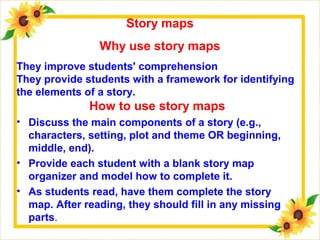
How to use story maps
• Discuss the main components of a story (e.g.,
characters, setting, plot and theme OR beginning,
middle, end).
• Provide each student with a blank story map
organizer and model how to complete it.
• As students read, have them complete the story
map. After reading, they should fill in any missing
parts.
Story maps
Why use story maps
They improve students' comprehension
They provide students with a framework for identifying
the elements of a story.
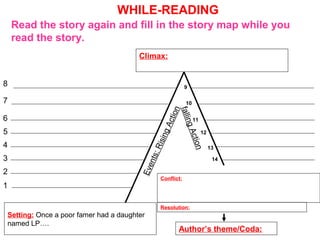
Read the story again and fill in the story map while you
read the story.
WHILE-READING
Setting: Once a poor famer had a daughter
named LP….
Climax:
Events:RisingActionConflict:
Resolution:
Author’s theme/Coda:
8
7
6
5
4
3
2
1
9
10
12
11
13
fallingAction
14
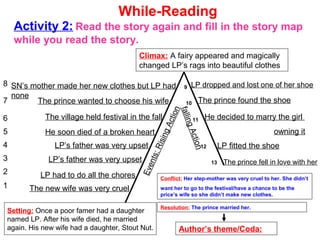
While-Reading
Setting: Once a poor famer had a daughter
named LP. After his wife died, he married
again. His new wife had a daughter, Stout Nut.
The new wife was very cruel
LP had to do all the chores
LP’s father was very upset
He soon died of a broken heart
The village held festival in the fall
The prince wanted to choose his wife
SN’s mother made her new clothes but LP had
none
Climax: A fairy appeared and magically
changed LP’s rags into beautiful clothes
Events:RisingAction
LP dropped and lost one of her shoe
The prince found the shoe
He decided to marry the girl
owning it
LP fitted the shoe
The prince fell in love with her
Conflict: Her step-mother was very cruel to her. She didn’t
want her to go to the festival/have a chance to be the
price’s wife so she didn’t make new clothes.
Resolution: The prince married her.
Author’s theme/Coda:
8
7
6
5
4
3
2
1
9
10
12
11
13
fallingAction
Activity 2: Read the story again and fill in the story map
while you read the story.
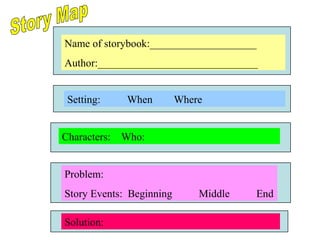
Name of storybook:____________________
Author:______________________________
Setting: When Where
Characters: Who:
Problem:
Story Events: Beginning Middle End
Solution:
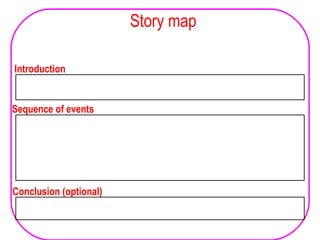
Story map
Sequence of events
Introduction
Conclusion (optional)
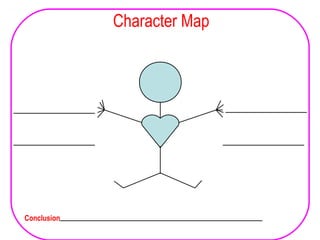
Character Map
Conclusion
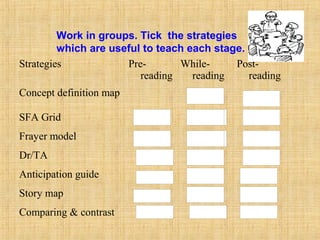
Strategies Pre-
reading
While-
reading
Post-
reading
Concept definition map
SFA Grid
Frayer model
Dr/TA
Anticipation guide
Story map
Comparing & contrast
Work in groups. Tick the strategies
which are useful to teach each stage.
Teaching reading

Teaching reading

  • 1.
    ENGAGING AND EFFECTIVETEACHING READING STRATEGIES Prepared by: Do Thi Phuong Trinh
  • 2.
    Work in groupsof four, share your experience in teaching Reading • 1.What does reading involve? • 2.What should we teach in a Reading lesson? • 3. What kinds of activities do you often use when teaching Reading? • 4.What difficulties do your students encounter when reading? • 5. How do you help them? Discussion
  • 3.
    STAGES OF AREADING LESSON 1.PRE- READING 2.WHILE- READING 3.POST-READING
  • 4.
    Effective strategies forteaching Reading • Vocabulary development • Comparing and contrasting • Dr/ TA/ • Anticipating guide • Story map/ character map • Story impressions
  • 5.
    • Vocabulary development 1.Concept Definition Mapping 2. Semantic Feature Analysis (SFA) Grid 3. Frayer Modal 4. Semantic mapping
  • 6.
    What is itlike? Protect wildlife What is it like? Protect wildlife What is it like?What is it like? What is it like?What is it like? What is it like?What is it like? What is it like?What is it like? 1. Concept Definition Mapping What is it? (definition) The Word What are some examples?
  • 7.
    CONSERVATIO N What is it?Whatis it? What is it like? Protect wildlife What is it like? Protect wildlife What is it like?What is it like? What is it like?What is it like? What is it like?What is it like? What is it like?What is it like? AnimalsAnimals ExampleExample ExampleExample Threatening factors Forest fires Threatening factors Forest fires BEFORE YOU READ Word - formsWord - forms UNIT 10- CONSERVATION
  • 8.
    CONSERVATIO N The protection and management of natural things. The protection and management of natural things. ProtectwildlifeProtect wildlife Manage resourcesManage resources Prevent forest destruction Prevent forest destruction Find alternative energy sourses Find alternative energy sourses Reclaim land and keep water clean Reclaim land and keep water clean AnimalsAnimals PlantsPlants ForestsForests • Forest fires • Hunting • Fishing • Pollutants • Careless use of natural resources • Disasters • Wood construction projects • Forest fires • Hunting • Fishing • Pollutants • Careless use of natural resources • Disasters • Wood construction projects WaterWater EnergyEnergy landland BEFORE YOU READ Conserve (v) Conservative( adj) Conservation (n) Conserve (v) Conservative( adj) Conservation (n)
  • 9.
    Semantic feature analysis(SFAGRID) • How to use semantic feature analysis • Select a category or topic for the semantic feature analysis. • List words and important features related to the topic. • Vocabulary words should be listed down the left hand column and the features of the topic across the top row of the chart. • Have students place a "+" sign in the matrix when a vocabulary word aligns with a particular feature of the topic. If the word does not align students may put a "–" in the grid. If students are unable to determine a relationship they may leave it blank
  • 10.
  • 11.
    Features Canbeusedasmedicines Isbeingthreatened Affectpeople’shealth Needwater Takeawayvaluablesoil Holdwater Keepthesoil FACTORS Do:  Not do: Hydroelec tric plants           Pollution           Water           Plants           Animals           The earth           Dams           Soil           Floods           M akesoilexhausted Canprovidepower Canbeextinct
  • 12.
    SEMANTIC MAP Work ingroups. Fill in the following categories
  • 13.
  • 14.
  • 15.
    Definition (in ownwords)Definition (in own words) CharacteristicsCharacteristics UsefulUseful Examples (from own life)Examples (from own life) Microsoft officeMicrosoft office Non-examples (from ownNon-examples (from own life)life) DevicesDevices SOFTWARE FRAYER MODEL
  • 16.
    Definition (in ownwords)Definition (in own words) Programs used by computers forPrograms used by computers for doing particular jobsdoing particular jobs CharacteristicsCharacteristics UsefulUseful ValuableValuable CopyrightedCopyrighted Examples (from own life)Examples (from own life) Microsoft officeMicrosoft office Adobe photoshopAdobe photoshop ACD seeACD see WindowsWindows Windows mediaWindows media Non-examples (from ownNon-examples (from own life)life) DevicesDevices ATMsATMs RadiosRadios TVsTVs SOFTWARE FRAYER MODEL
  • 17.
  • 18.
    State schools Independent/Publicschools Pair work. Read the text again and fill in the circles the information about the two school systems in England. The common area is for the similarities of the 2 systems. - Free (paid for by the state) - Educate the majority of pupils (93%) - Must follow the National Curriculum - Run from September to July - Students study in 3 terms separated by a one-week break - Fee-paying - About 7% pupils attend - Set their own curriculum UNIT 4 SCHOOL EDUCATION SYSTEM- E12
  • 19.
    INSTRUCTIONAL READING STRATEGY: DR-TA(DIRECTED READING-THINKING ACTIVITY) 1. Choose a text 2. Activate students ’ prior knowledge. 3. Have students make predictions about what they will read about in the text 4. Have students read a section of the text 5. Ask students to confirm or revise prior predictions, and make new predictions 6. Continue steps 4 and 5 until students have finished reading.
  • 20.
    Set the climateand guide the DR-TA by the frequent use of three questions: • What do you think?(or What do you think will happen next?) • Why do you think so? (or What part of the story gave you a clue?) • Can you prove it? (or What else might happen?)
  • 22.
    INSTRUCTIONAL READING STRATEGY: ANTICIPATIONGUIDES How to Use Anticipation Guides 1. Choose a text. 2. Write several statements that focus on the topic of the text 3. Have students complete the anticipation guide before reading 4. Have a class discussion before reading. 5. Have students read the text 6. Have a class discussion after reading
  • 23.
    • Me TextStatements • ___ ___ 1. _________________ • ___ ___ 2. ___________________ • ___ ___ 3. ________________ • ___ ___ 4._________________ • ___ ___ 5. _________________ Anticipation Guide Read the text, compare your opinions with information contained in the text by placing a check next to statements which the text states are true.
  • 24.
    Anticipation Guide: Now,before you read the passages, place a tick(√) next to any statement with which you agree in the column labeled Me. 1.Lisa blows out the candles on the cake before people sing “ happy birthday” to her. 2.In USA, both young and old people celebrate birthdays. 3. Rosa and Luis have got married for fifty years. 4. The American couples often have a big party to celebrate wedding anniversaries each other. 5. The 50th wedding anniversary is special because married couples often get a lot of gold on this occasion. 6. David and Marry got married in 1984. They held “ silver anniversary” in 2009. Me Text U 3 E 11 R E A D I N G
  • 25.
    Story Impressions This strategyis used to arouse students’ curiosity Procedure: - Students are given the list of words and phrases prepared ahead of time by the teacher. - Individually, or in pairs, they are asked to create a short story, using the words and phrases in the order they were given. - The stories are then shared with the class. - Next, the assigned text is read. - Finally, a discussion is held centering around the similarities and differences between the class creations and the real text. - If a group prefers its own story, time is given for editing and rewriting.
  • 26.
    Story impressions Practise tellingyour story in groups using the given clues MY MOST EMBARASSING EXPERIENCE A grade – 9 – schoolgirl A hat like her pop idol Birthday Father gave money Saw the same wad of dollar notes Bought the hat Saw the wad of dollar notes at home
  • 27.
    How to usestory maps • Discuss the main components of a story (e.g., characters, setting, plot and theme OR beginning, middle, end). • Provide each student with a blank story map organizer and model how to complete it. • As students read, have them complete the story map. After reading, they should fill in any missing parts. Story maps Why use story maps They improve students' comprehension They provide students with a framework for identifying the elements of a story.
  • 28.
    Read the storyagain and fill in the story map while you read the story. WHILE-READING Setting: Once a poor famer had a daughter named LP…. Climax: Events:RisingActionConflict: Resolution: Author’s theme/Coda: 8 7 6 5 4 3 2 1 9 10 12 11 13 fallingAction 14
  • 29.
    While-Reading Setting: Once apoor famer had a daughter named LP. After his wife died, he married again. His new wife had a daughter, Stout Nut. The new wife was very cruel LP had to do all the chores LP’s father was very upset LP’s father was very upset He soon died of a broken heart The village held festival in the fall The prince wanted to choose his wife SN’s mother made her new clothes but LP had none Climax: A fairy appeared and magically changed LP’s rags into beautiful clothes Events:RisingAction LP dropped and lost one of her shoe The prince found the shoe He decided to marry the girl owning it LP fitted the shoe The prince fell in love with her Conflict: Her step-mother was very cruel to her. She didn’t want her to go to the festival/have a chance to be the price’s wife so she didn’t make new clothes. Resolution: The prince married her. Author’s theme/Coda: 8 7 6 5 4 3 2 1 9 10 12 11 13 fallingAction Activity 2: Read the story again and fill in the story map while you read the story.
  • 30.
    Name of storybook:____________________ Author:______________________________ Setting:When Where Characters: Who: Problem: Story Events: Beginning Middle End Solution:
  • 31.
    Story map Sequence ofevents Introduction Conclusion (optional)
  • 32.
  • 33.
    Strategies Pre- reading While- reading Post- reading Concept definitionmap SFA Grid Frayer model Dr/TA Anticipation guide Story map Comparing & contrast Work in groups. Tick the strategies which are useful to teach each stage.