DETECTIVE
!
”UNLOCKING THE SECRET
OF MASTERPIECES”
tekhnologic
tekhnologic
7
SPIN
INSTRUCTIONS:
OBSERVE theARTWORKandanswerthefollowingquestions
orally:
1. Whatemotionsdoyouthinktheartworkistryingtoconvey?
2. Whatmessagedoyouthinktheartistwastryingtosend?
3. Whatcanyousayabouttheartwork?
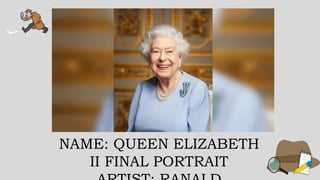
NAME: QUEEN ELIZABETH
II FINAL PORTRAIT
CHARACTERIZING ARTISTICALLY
LITERATE INDIVIDUALS
PRESENTED BY:
ELDRIAN LOUIE B. MANUYAG
BSED FILIPINO - III
COMMON TRAITS OF ARTISTICALLY LITERATE
INDIVIDUALS
 Use a variety of artistic media, symbols, and
metaphors to communicate their own ideas and
respond to the artistic communications of others;
 Develop creative personal realization in at least
one art form in which they continue active
involvement as an adult;
COMMON TRAITS OF ARTISTICALLY LITERATE
INDIVIDUALS
 Cultivate culture, history, and other
connections through diverse forms and
genres of artwork;
 Find joy, inspiration, peace, intellectual
stimulation, and meaning when they
participate in the arts; and
COMMON TRAITS OF ARTISTICALLY LITERATE
INDIVIDUALS
• Seek artistic experiences
and support the arts in
their communities.
ISSUES IN TEACHING CREATIVITY
 In his famous TED talks on creativity and
innovation, Sir Ken Robinson (Do schools kill
creativity? 2006; How to escape education's
death valley, 2013) stressed paradigms in the
education system that hamper the development
of creative capacity among learners.
ISSUES IN TEACHING CREATIVITY
 He emphasized that schools stigmatize
mistakes. This primarily prevents students
from trying and coming up with original
ideas. He also reiterated the hierarchy of
systems.
ISSUES IN TEACHING CREATIVITY
 Firstly, most useful subjects such as
Mathematics and languages for work are at
the top while arts are at the bottom.
 Secondly, academic ability has come to
dominate our view of intelligence.
ISSUES IN TEACHING CREATIVITY
 Curriculum competencies, classroom
experiences, and assessment are geared
toward the development of academic ability.
Students are schooled in order to pass
entrance exams in colleges and universities
later on.
Robinson challenged educators to:
 Educate the well-being of learners and shift
from the conventional leanings toward
academic ability alone;
 Give equal weight to the arts, the humanities,
and to physical education;
Robinson challenged educators to:
Facilitate learning and work toward
stimulating curiosity among
learners;
Awaken and develop powers of
creativity among learners; and
Robinson challenged educators to:
View intelligence as diverse,
dynamic, and distinct, contrary
to common belief that it should
be academic ability-geared.
 In “First Literacies: Art, Creativity, Play,
Constructive Meaning-Making,” McArdle and
Wright asserted that educators should make
deliberate connections with children's first
literacies of art and play.
 A recommended new approach to early
childhood pedagogy would emphasize children's
embodied experience through drawing.
This would include a focus on
children's creation, manipulation, and
changing of meaning through engaged
interaction with art materials (Dourish,
2001), through physical, emotional, and
social immersion (Anderson, 2003).
PROPOSED FOUR ESSENTIAL
COMPONENTS IN DEVELOPING/
DESIGNING A CURRICULUM
- McArdle and Wright
1. Imagination and pretense, fantasy and
metaphor
A creative curriculum
will not simply allow, but
will actively support, play
and playfulness.
2. Active menu to meaning making
In a classroom where children
can choose to draw, write, paint,
or play in the way that suits their
purpose and/or mood, literacy
learning and arts learning will
inform and support each other.
3. Intentional, holistic teaching
A creative curriculum requires a
creative teacher, who
understands the creative
processes, and purposefully
supports learners in their
experiences.
4. Co-player, co-artist
Educators must be reminded of
the importance of
understanding children as
current citizens, with capacities
and capabilities in the here and
now.
PRESENTED BY:
ELDRIAN LOUIE B. MANUYAG
BSED FILIPINO - III

CHARACTERIZING ARTISTICALLY LITERATE INDIVIDUALS (REPORT).pptx

  • 1.
  • 2.
  • 3.
  • 4.
  • 5.
    CHARACTERIZING ARTISTICALLY LITERATE INDIVIDUALS PRESENTEDBY: ELDRIAN LOUIE B. MANUYAG BSED FILIPINO - III
  • 6.
    COMMON TRAITS OFARTISTICALLY LITERATE INDIVIDUALS  Use a variety of artistic media, symbols, and metaphors to communicate their own ideas and respond to the artistic communications of others;  Develop creative personal realization in at least one art form in which they continue active involvement as an adult;
  • 7.
    COMMON TRAITS OFARTISTICALLY LITERATE INDIVIDUALS  Cultivate culture, history, and other connections through diverse forms and genres of artwork;  Find joy, inspiration, peace, intellectual stimulation, and meaning when they participate in the arts; and
  • 8.
    COMMON TRAITS OFARTISTICALLY LITERATE INDIVIDUALS • Seek artistic experiences and support the arts in their communities.
  • 9.
    ISSUES IN TEACHINGCREATIVITY  In his famous TED talks on creativity and innovation, Sir Ken Robinson (Do schools kill creativity? 2006; How to escape education's death valley, 2013) stressed paradigms in the education system that hamper the development of creative capacity among learners.
  • 10.
    ISSUES IN TEACHINGCREATIVITY  He emphasized that schools stigmatize mistakes. This primarily prevents students from trying and coming up with original ideas. He also reiterated the hierarchy of systems.
  • 11.
    ISSUES IN TEACHINGCREATIVITY  Firstly, most useful subjects such as Mathematics and languages for work are at the top while arts are at the bottom.  Secondly, academic ability has come to dominate our view of intelligence.
  • 12.
    ISSUES IN TEACHINGCREATIVITY  Curriculum competencies, classroom experiences, and assessment are geared toward the development of academic ability. Students are schooled in order to pass entrance exams in colleges and universities later on.
  • 13.
    Robinson challenged educatorsto:  Educate the well-being of learners and shift from the conventional leanings toward academic ability alone;  Give equal weight to the arts, the humanities, and to physical education;
  • 14.
    Robinson challenged educatorsto: Facilitate learning and work toward stimulating curiosity among learners; Awaken and develop powers of creativity among learners; and
  • 15.
    Robinson challenged educatorsto: View intelligence as diverse, dynamic, and distinct, contrary to common belief that it should be academic ability-geared.
  • 16.
     In “FirstLiteracies: Art, Creativity, Play, Constructive Meaning-Making,” McArdle and Wright asserted that educators should make deliberate connections with children's first literacies of art and play.  A recommended new approach to early childhood pedagogy would emphasize children's embodied experience through drawing.
  • 17.
    This would includea focus on children's creation, manipulation, and changing of meaning through engaged interaction with art materials (Dourish, 2001), through physical, emotional, and social immersion (Anderson, 2003).
  • 18.
    PROPOSED FOUR ESSENTIAL COMPONENTSIN DEVELOPING/ DESIGNING A CURRICULUM - McArdle and Wright
  • 19.
    1. Imagination andpretense, fantasy and metaphor
  • 20.
    A creative curriculum willnot simply allow, but will actively support, play and playfulness.
  • 21.
    2. Active menuto meaning making
  • 22.
    In a classroomwhere children can choose to draw, write, paint, or play in the way that suits their purpose and/or mood, literacy learning and arts learning will inform and support each other.
  • 23.
  • 24.
    A creative curriculumrequires a creative teacher, who understands the creative processes, and purposefully supports learners in their experiences.
  • 25.
  • 26.
    Educators must bereminded of the importance of understanding children as current citizens, with capacities and capabilities in the here and now.
  • 27.
    PRESENTED BY: ELDRIAN LOUIEB. MANUYAG BSED FILIPINO - III