













Coaching Pointy-Haired Bosses
to be Agile Enablers
@ryanripley
#AgileIndy
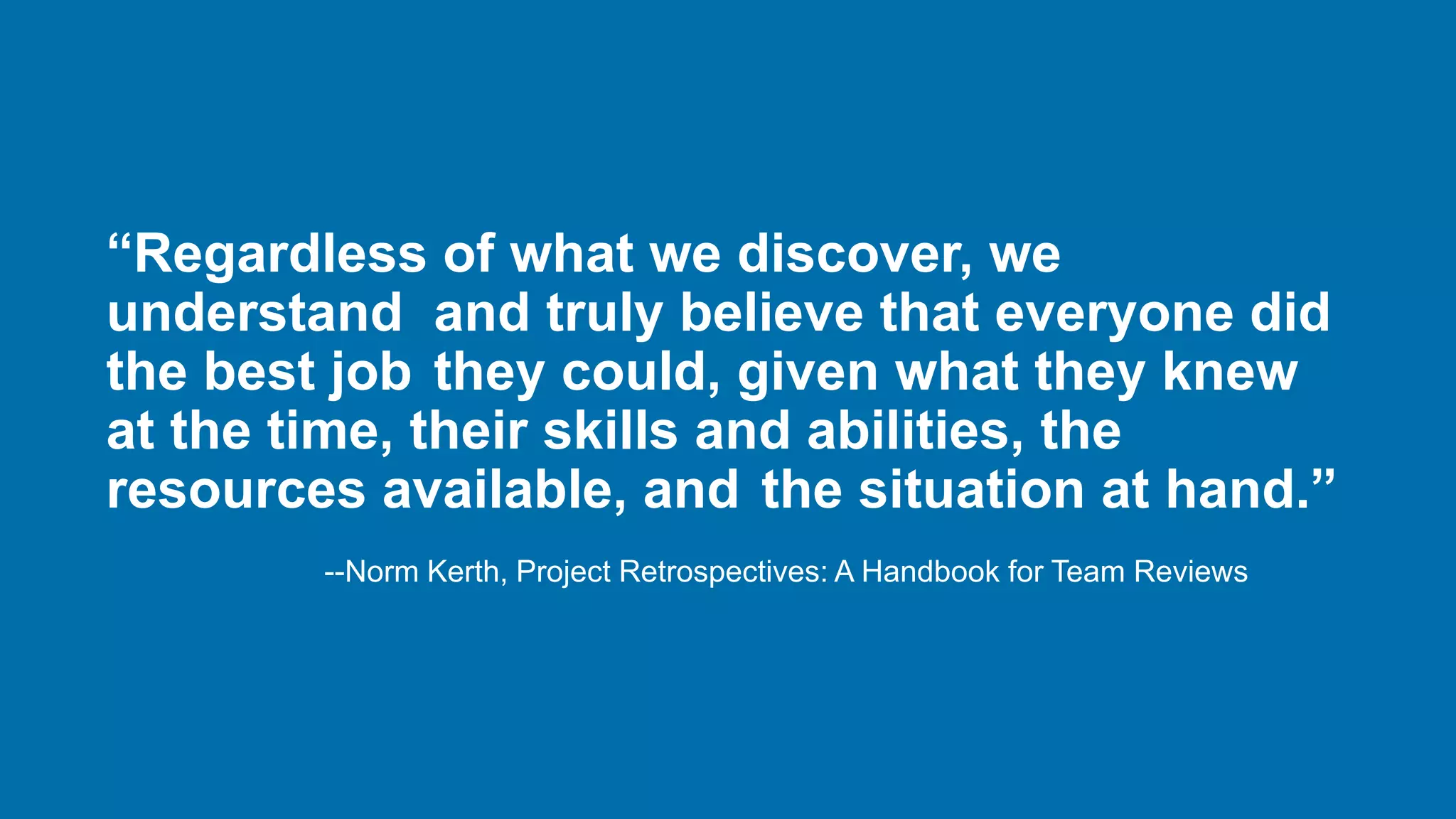
“Regardless of what we discover, we
understand and truly believe that everyone did
the best job they could, given what they knew
at the time, their skills and abilities, the
resources available, and the situation at hand.”
--Norm Kerth, Project Retrospectives: A Handbook for Team Reviews
Management support is critical
to the success of agile projects
and agile adoptions.
What is a manager?
What does a manager do?
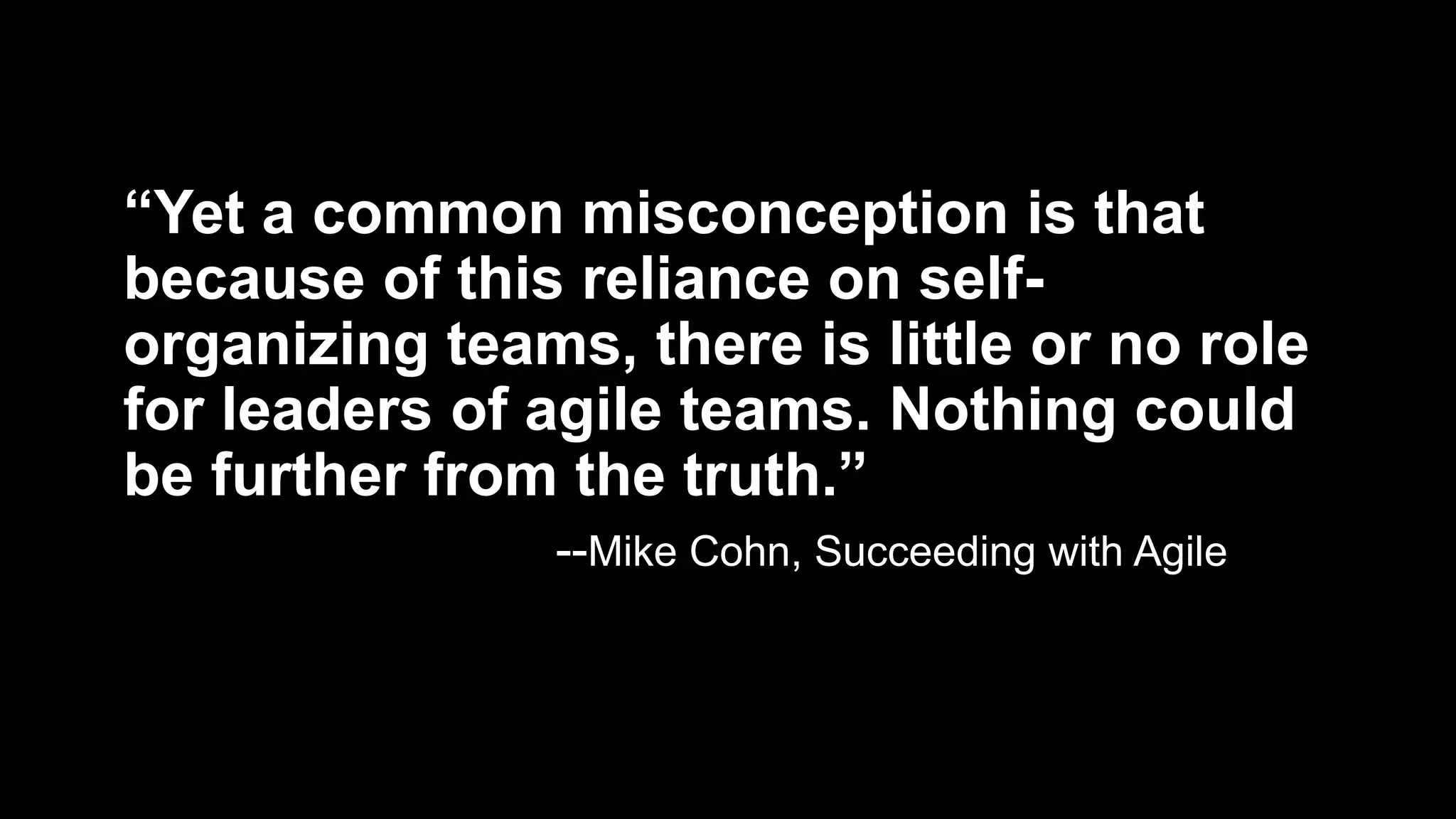
“Yet a common misconception is that
because of this reliance on self-
organizing teams, there is little or no role
for leaders of agile teams. Nothing could
be further from the truth.”
--Mike Cohn, Succeeding with Agile
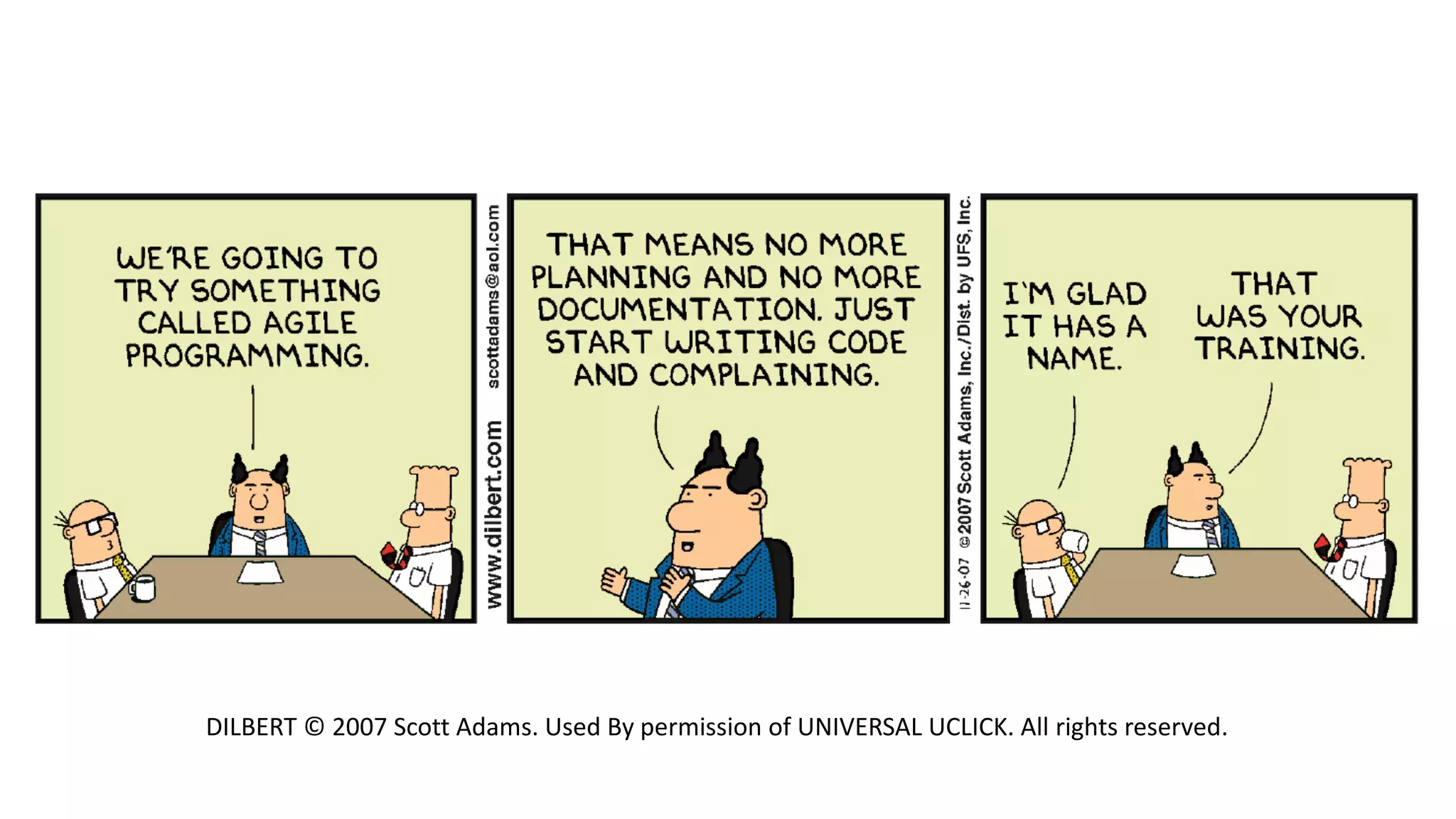
DILBERT © 2007 Scott Adams. Used By permission of UNIVERSAL UCLICK. All rights reserved.
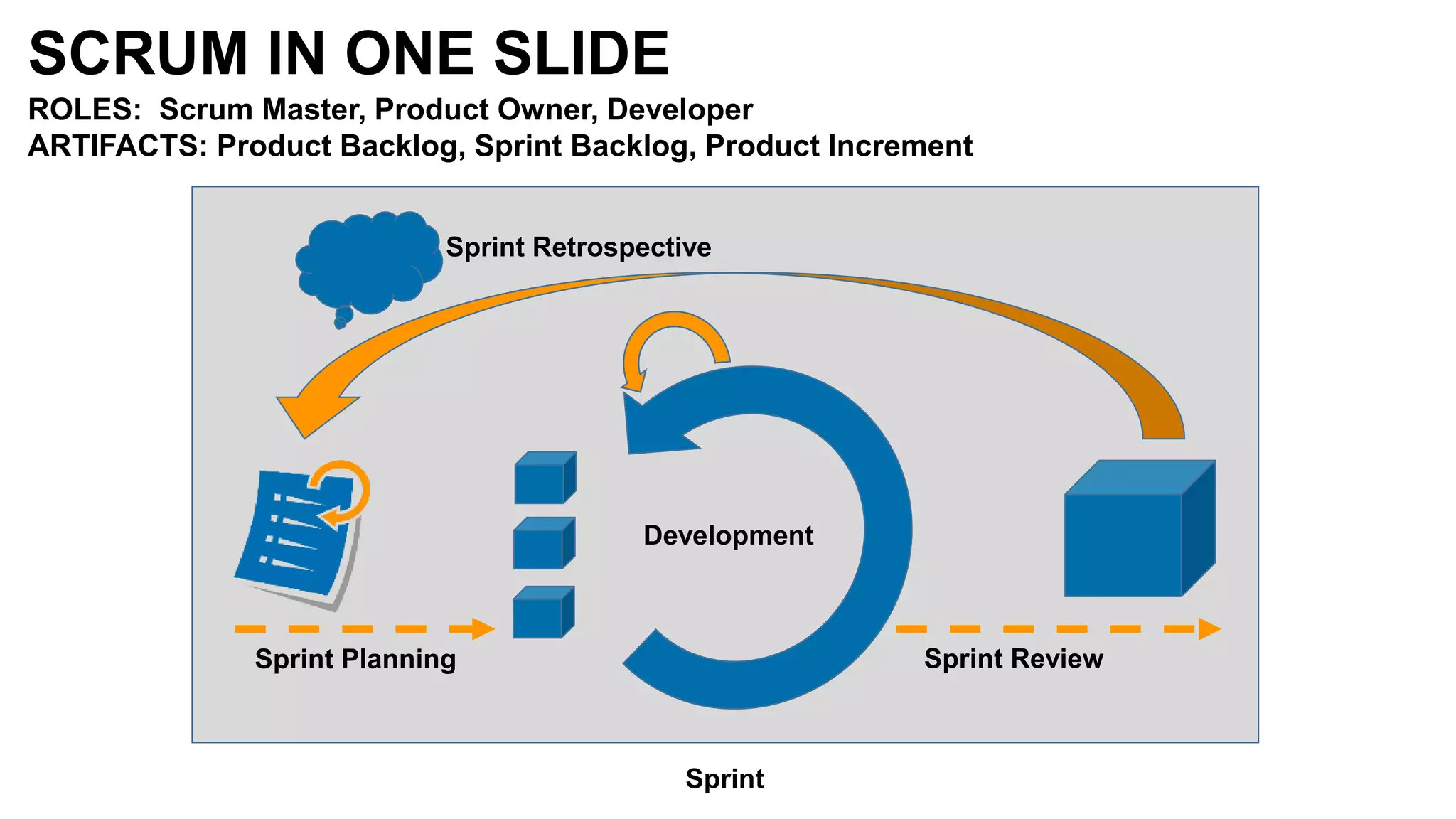
SCRUM IN ONE SLIDE
Development
Sprint Planning Sprint Review
Sprint Retrospective
Sprint
ROLES: Scrum Master, Product Owner, Developer
ARTIFACTS: Product Backlog, Sprint Backlog, Product Increment
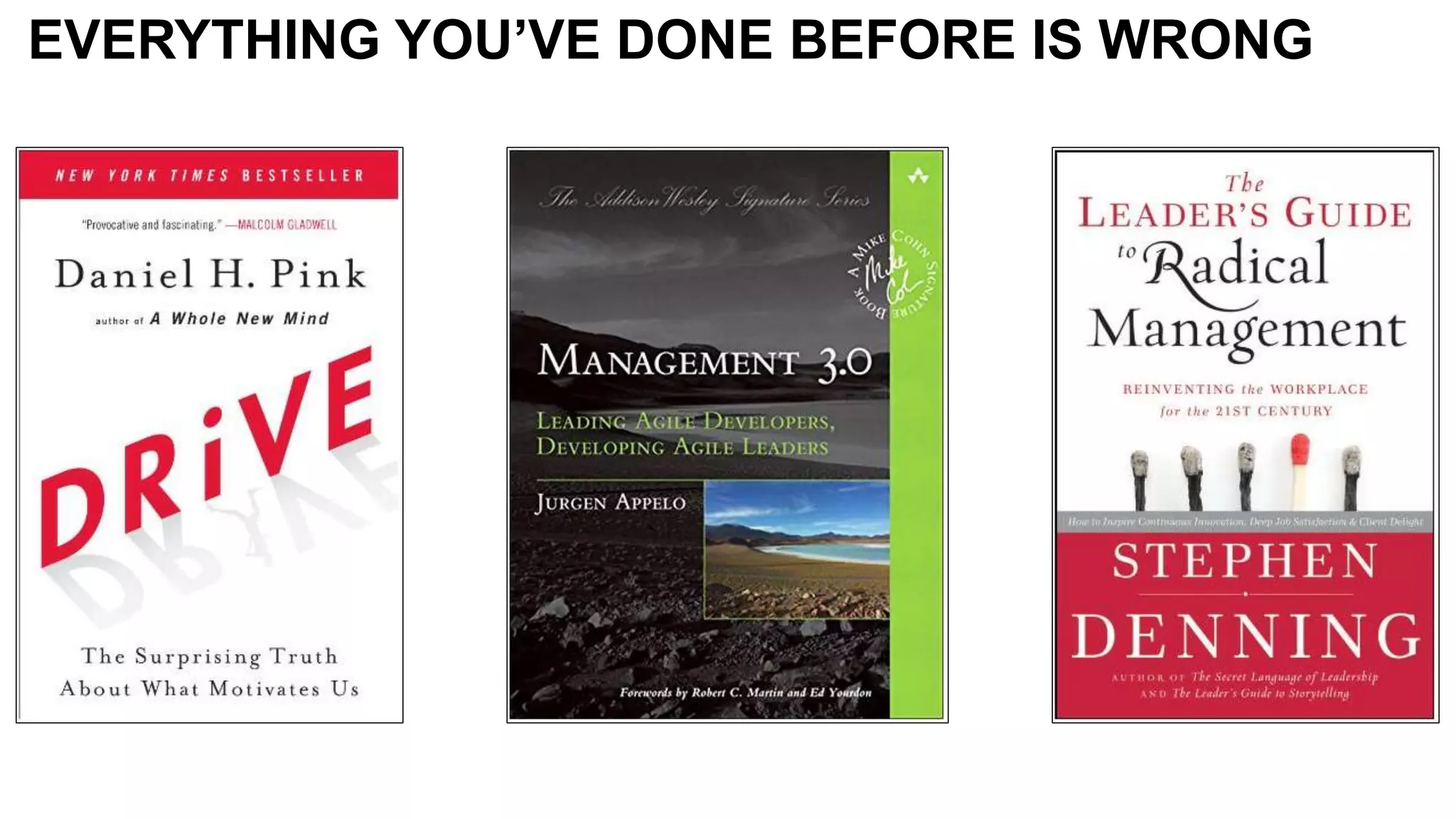
EVERYTHING YOU’VE DONE BEFORE IS WRONG
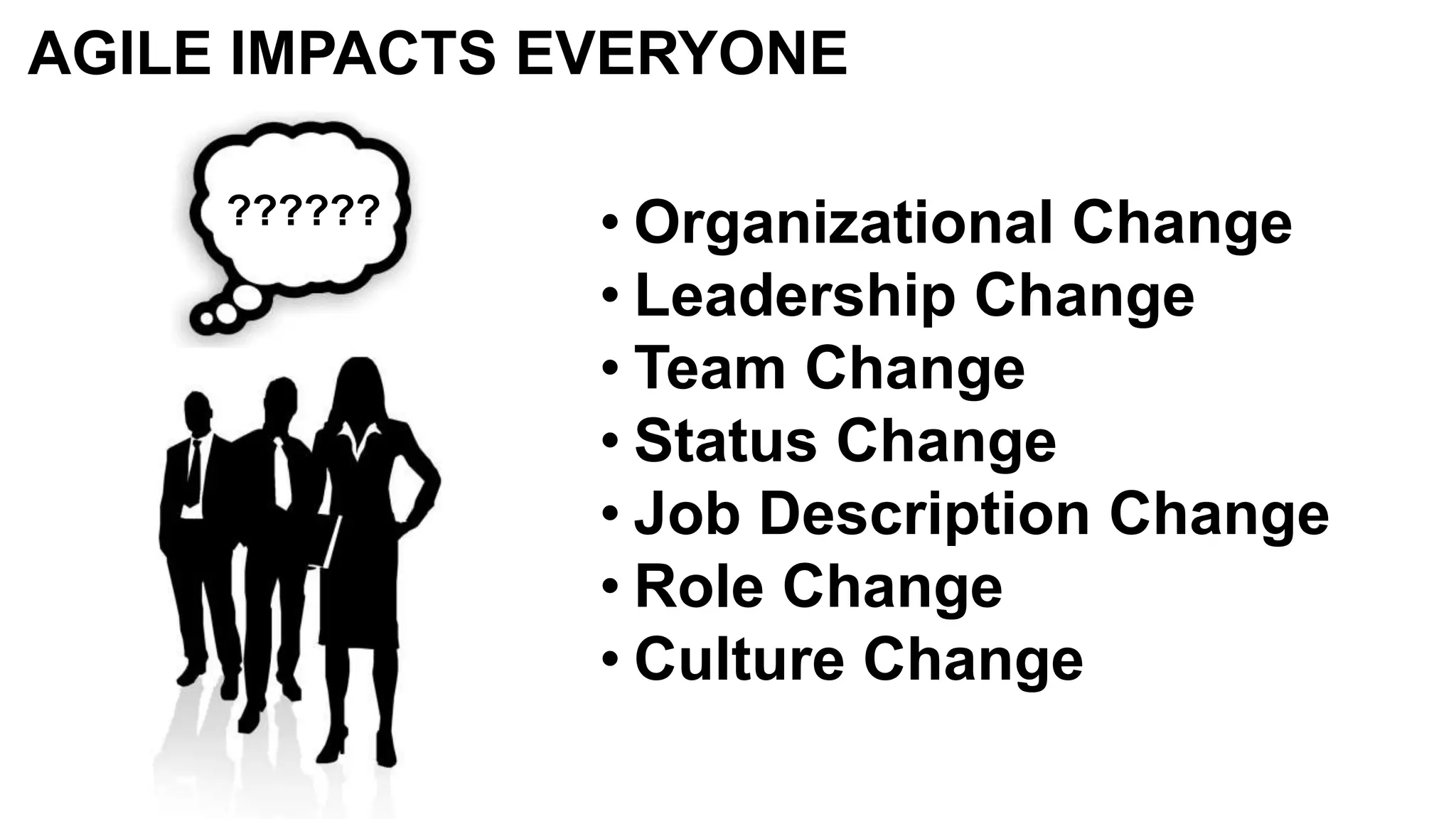
What does a manager stand to lose?
??????
AGILE IMPACTS EVERYONE
• Organizational Change
• Leadership Change
• Team Change
• Status Change
• Job Description Change
• Role Change
• Culture Change
We are telling managers to
give up the tools, methods,
processes, and behaviors
that have made them
successful.
“People who ask others to change may not
understand what value they are asking
people to give up. And in fact, they may not
appreciate or even notice what’s valuable
to the people they expect to change.”
--Esther Derby
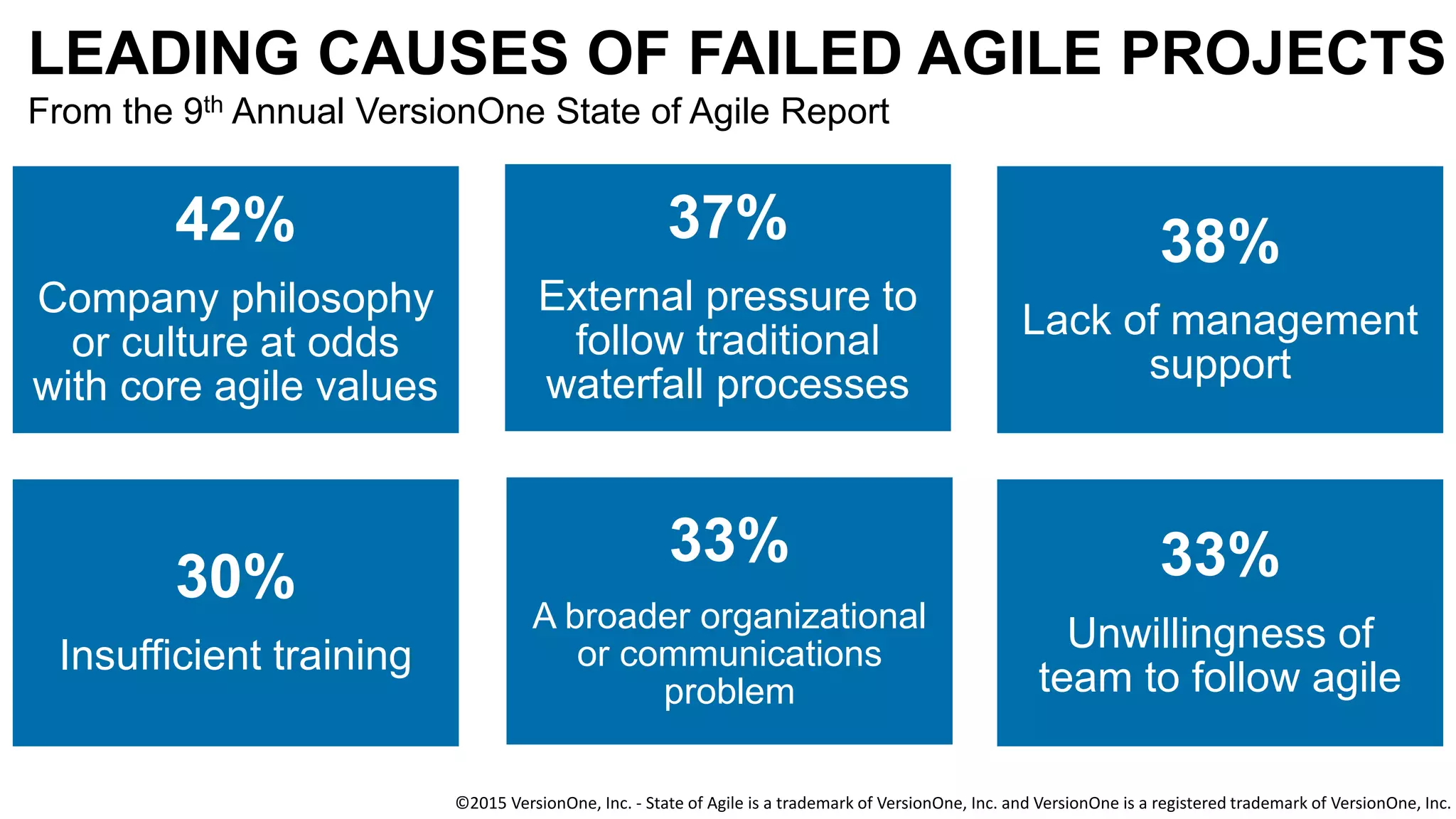
LEADING CAUSES OF FAILED AGILE PROJECTS
From the 9th Annual VersionOne State of Agile Report
©2015 VersionOne, Inc. - State of Agile is a trademark of VersionOne, Inc. and VersionOne is a registered trademark of VersionOne, Inc.
42%
Company philosophy
or culture at odds
with core agile values
37%
External pressure to
follow traditional
waterfall processes
38%
Lack of management
support
30%
Insufficient training
33%
A broader organizational
or communications
problem
33%
Unwillingness of
team to follow agile
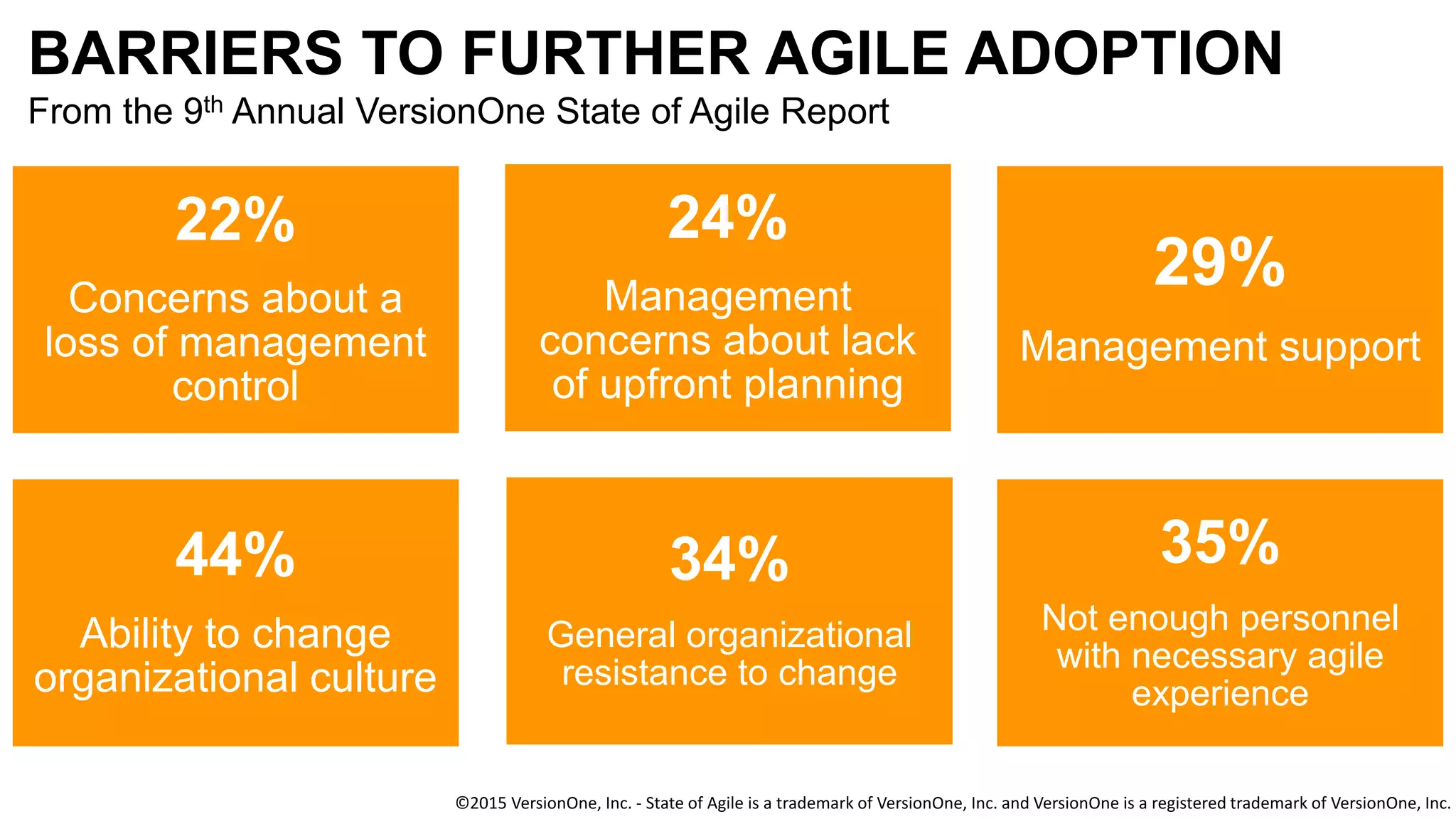
BARRIERS TO FURTHER AGILE ADOPTION
From the 9th Annual VersionOne State of Agile Report
©2015 VersionOne, Inc. - State of Agile is a trademark of VersionOne, Inc. and VersionOne is a registered trademark of VersionOne, Inc.
22%
Concerns about a
loss of management
control
24%
Management
concerns about lack
of upfront planning
29%
Management support
44%
Ability to change
organizational culture
34%
General organizational
resistance to change
35%
Not enough personnel
with necessary agile
experience
Copyright © 2015 Scrum Alliance®
Agile coaches can gain buy-in
from managers during an agile
transformation by focusing on
their needs.
MANAGER PERSONAS
•NEEDS
•WANTS
•GOALS
•LIMITATIONS
How do we build personas?
Talk to a manager!
What is your goal?
Managers communicate their
concerns and fears through the
questions they ask.
What must be true for a
person to ask that
question?
“What do I control on an agile
project?”
“What does it matter how many
times I reassign team members,
isn’t that what self-organization
is for?”
“Agile is for IT. Why are you
talking to HR and finance?"
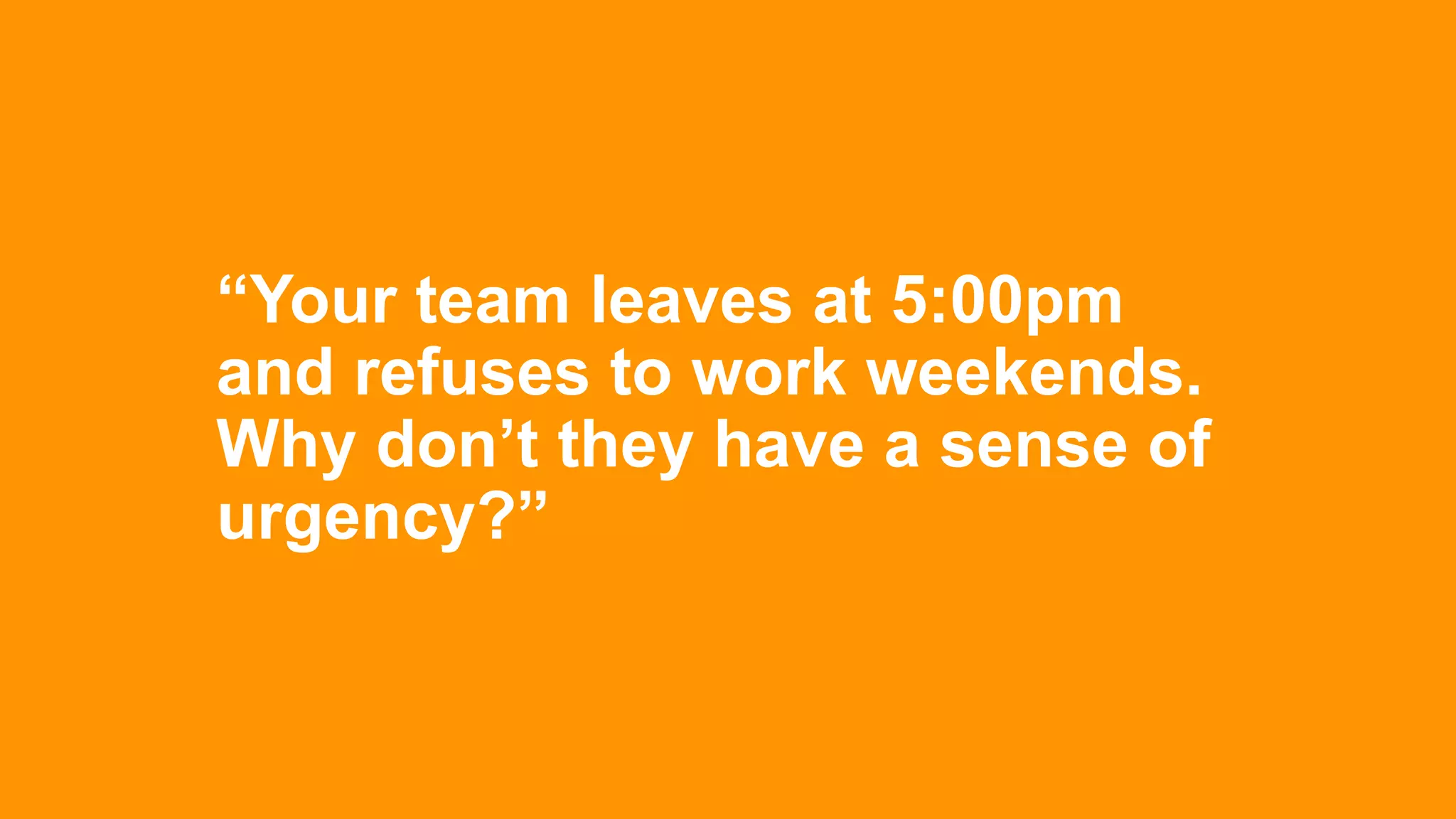
“Your team leaves at 5:00pm
and refuses to work weekends.
Why don’t they have a sense of
urgency?”
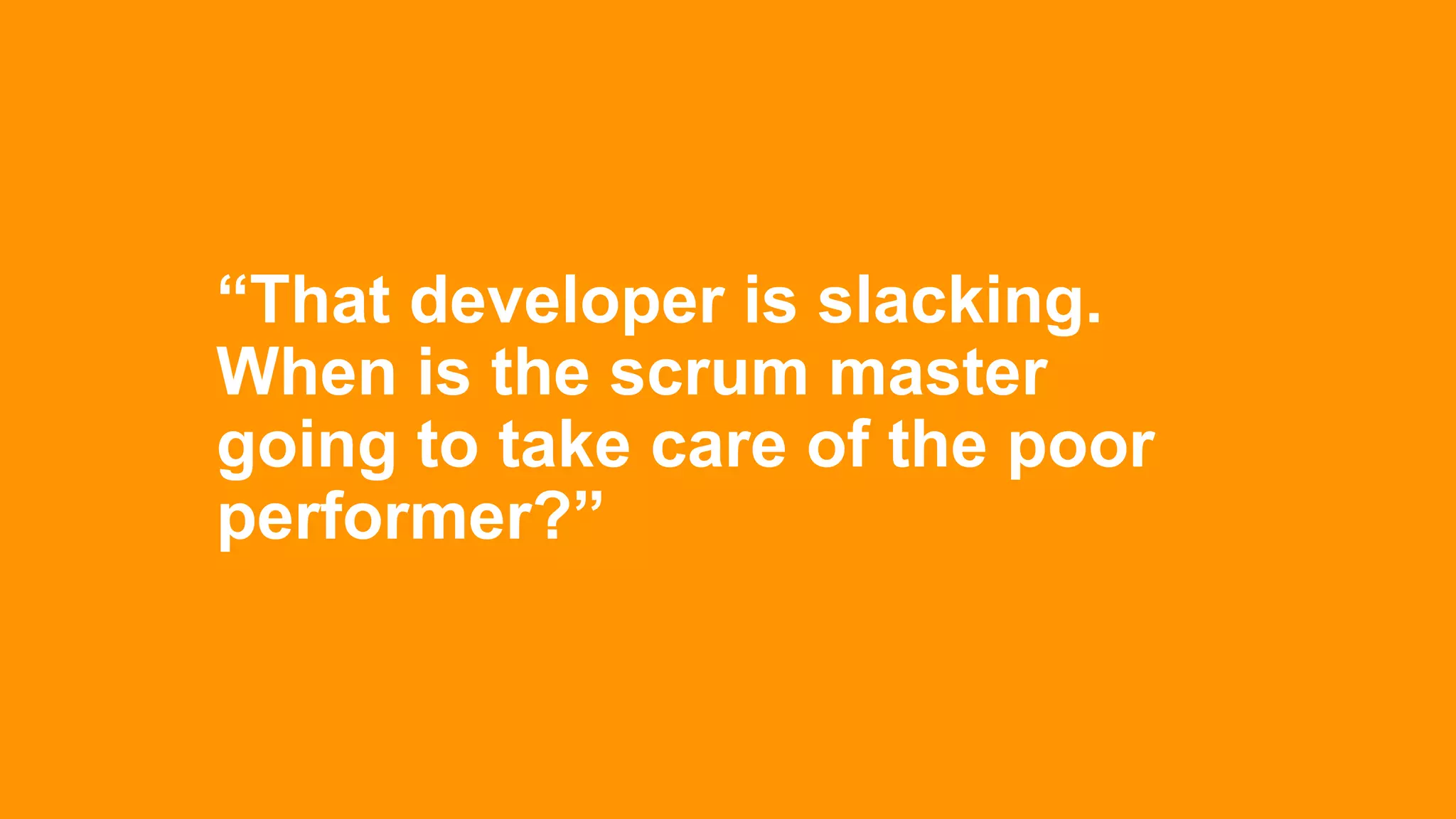
“That developer is slacking.
When is the scrum master
going to take care of the poor
performer?”
Pay attention to the statements
that managers make.
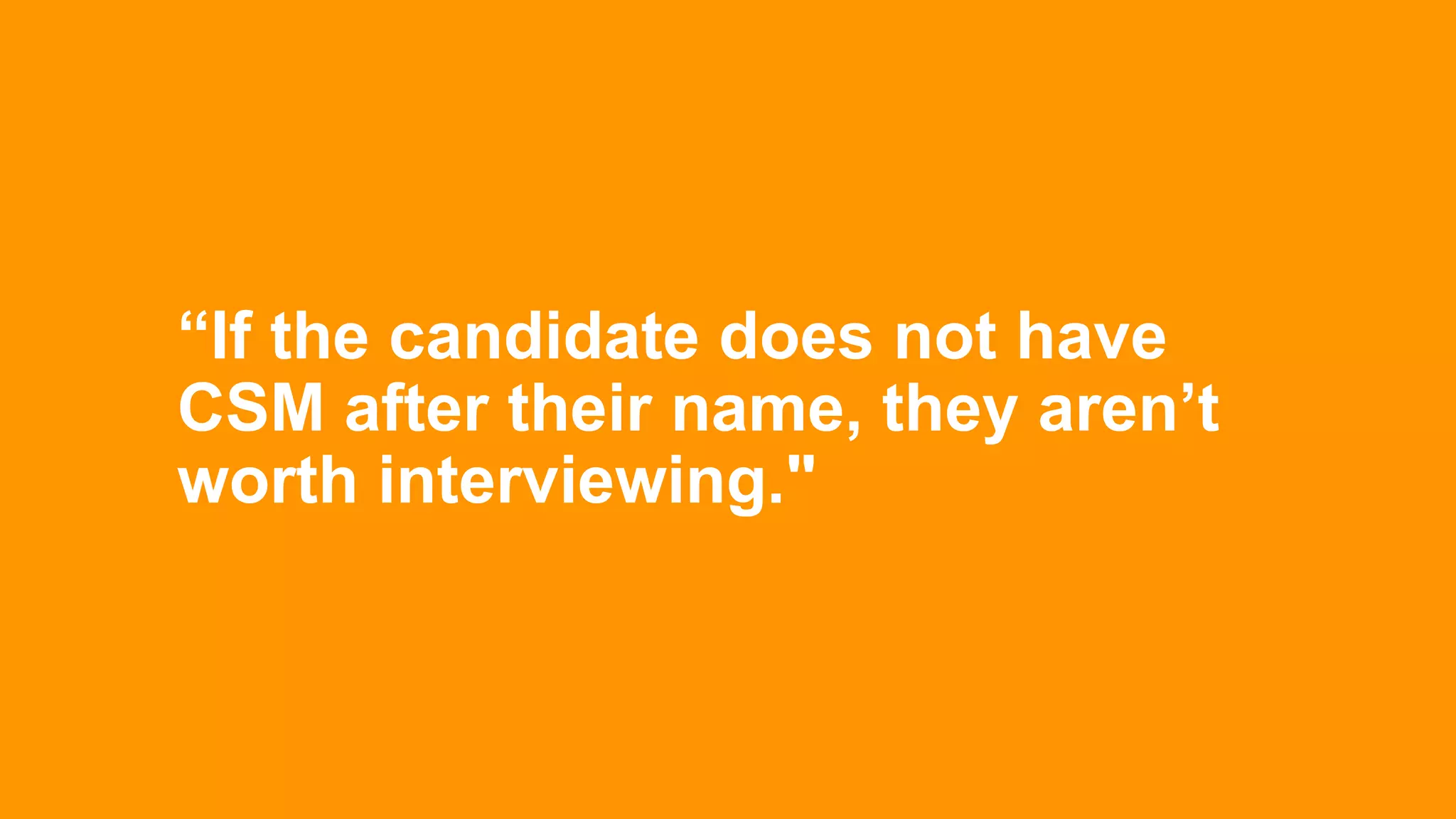
“If the candidate does not have
CSM after their name, they aren’t
worth interviewing."
“You can’t coach if you’ve
never developed software. Pick
another scrum master for this
team."
“Teams ship working software
at the end of each sprint. That’s
why we implemented scrum.
Work the weekends if you’re
behind. The team needs to
deliver on their commitments.”
“Your teams velocity is worse
than the other scrums teams.
Find a way to get your velocity
up, or we may have to reassign
resources.”
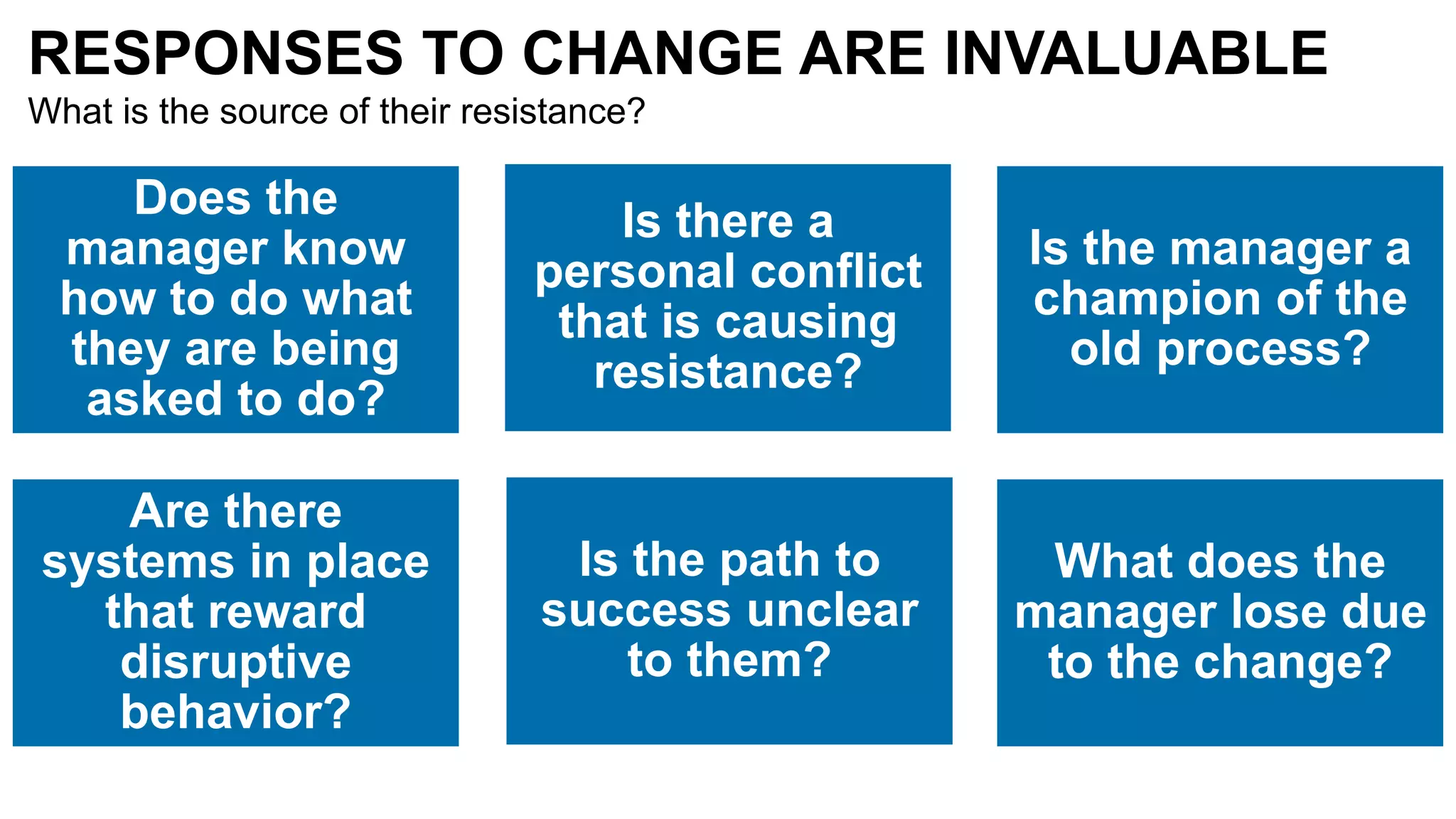
RESPONSES TO CHANGE ARE INVALUABLE
What is the source of their resistance?
Does the
manager know
how to do what
they are being
asked to do?
Is there a
personal conflict
that is causing
resistance?
Is the manager a
champion of the
old process?
Are there
systems in place
that reward
disruptive
behavior?
Is the path to
success unclear
to them?
What does the
manager lose due
to the change?
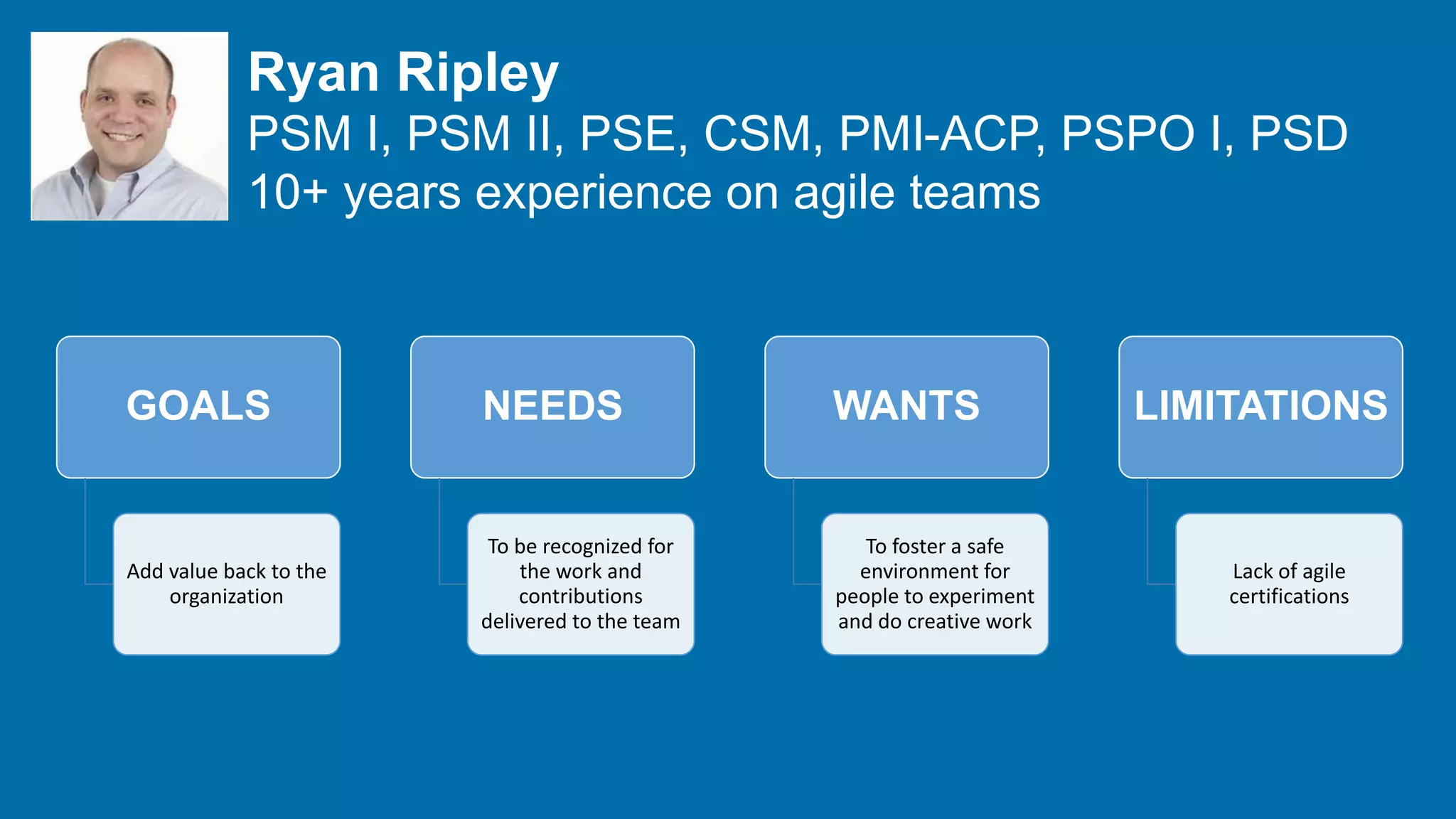
Ryan Ripley
PSM I, PSM II, PSE, CSM, PMI-ACP, PSPO I, PSD
10+ years experience on agile teams
GOALS
Add value back to the
organization
NEEDS
To be recognized for
the work and
contributions
delivered to the team
WANTS
To foster a safe
environment for
people to experiment
and do creative work
LIMITATIONS
Lack of agile
certifications
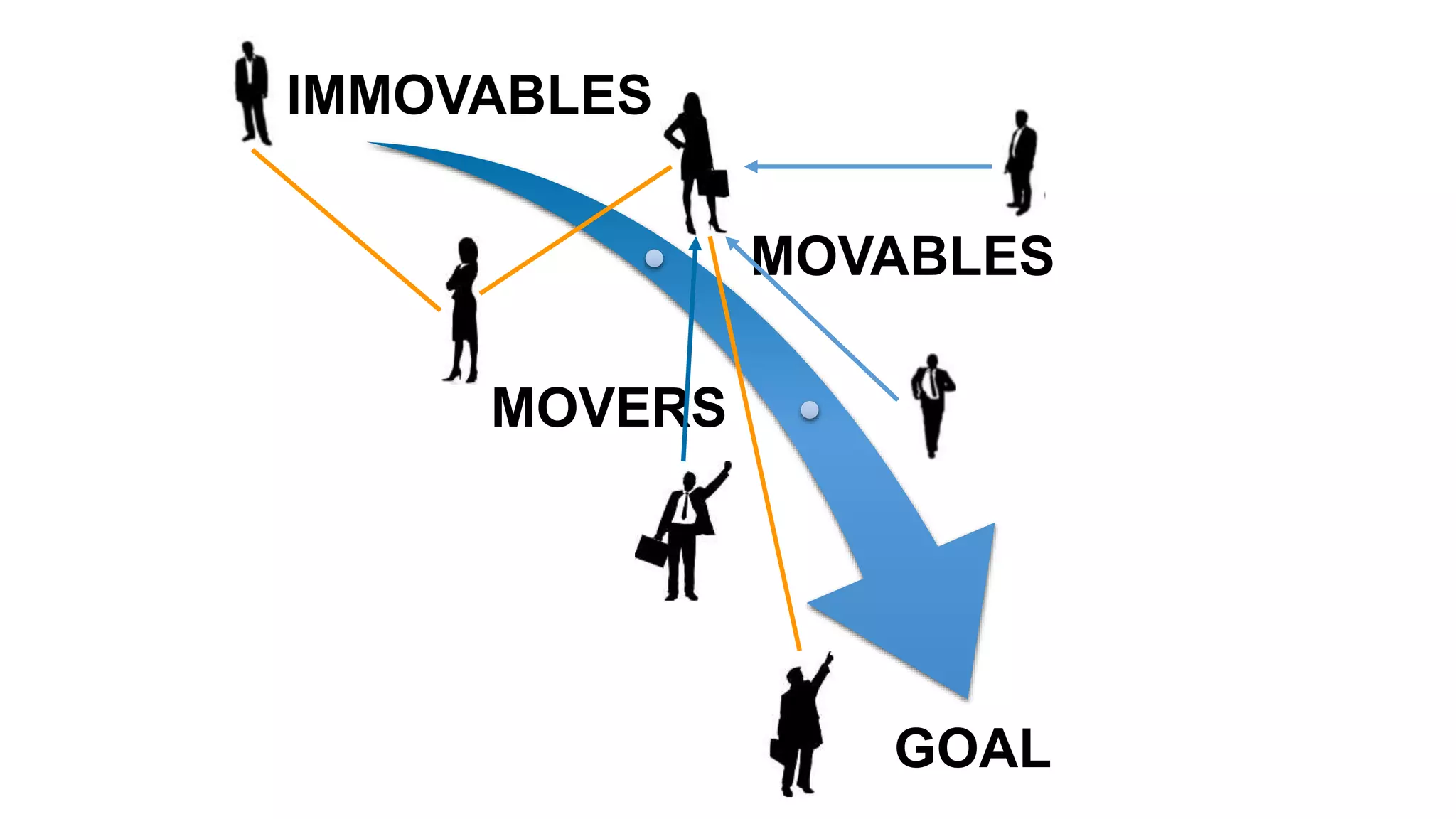
“All mankind is divided into three
classes: those that are immovable,
those that are movable, and those that
move.”
--Benjamin Franklin
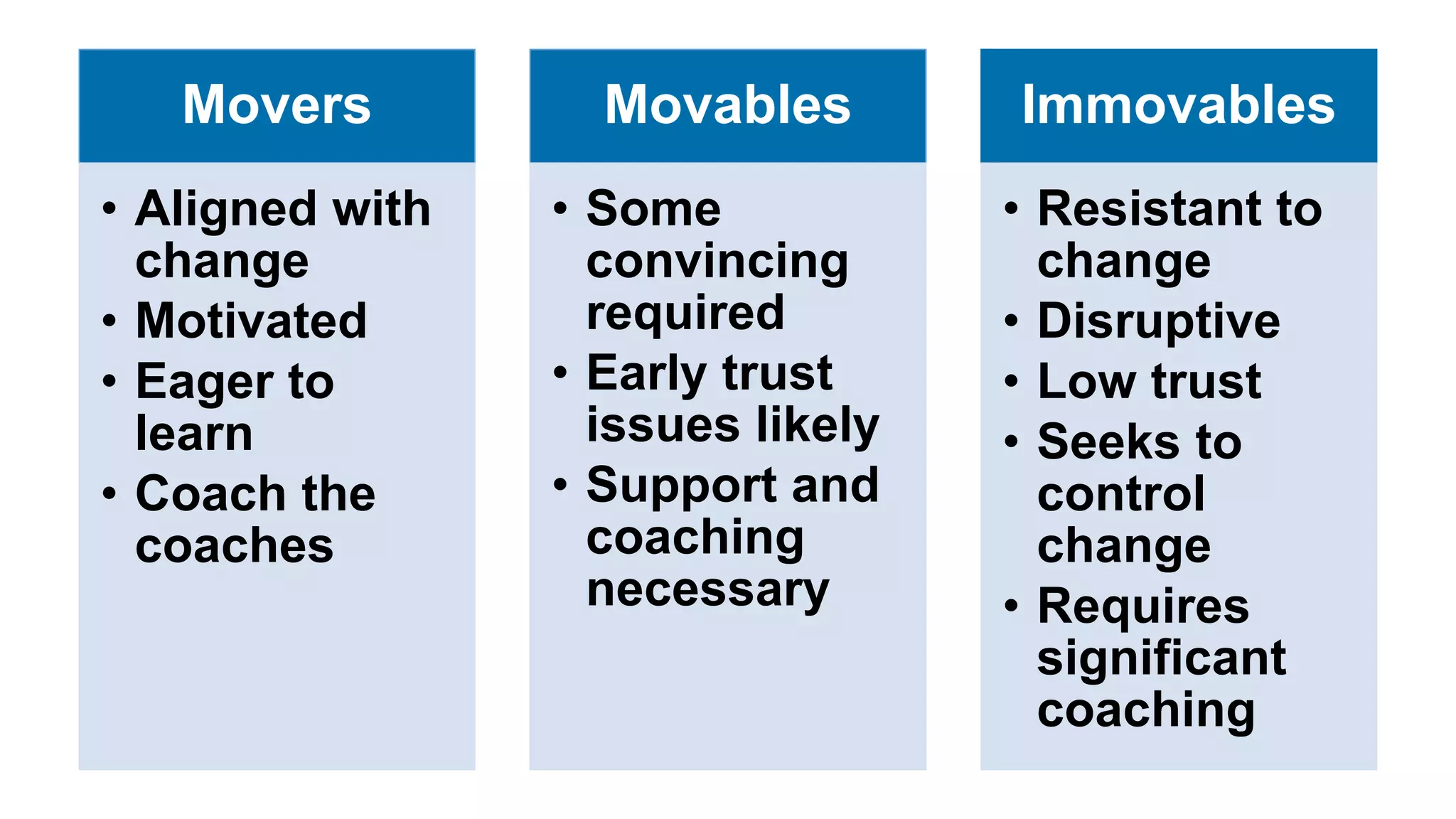
Movers
• Aligned with
change
• Motivated
• Eager to
learn
• Coach the
coaches
Movables
• Some
convincing
required
• Early trust
issues likely
• Support and
coaching
necessary
Immovables
• Resistant to
change
• Disruptive
• Low trust
• Seeks to
control
change
• Requires
significant
coaching
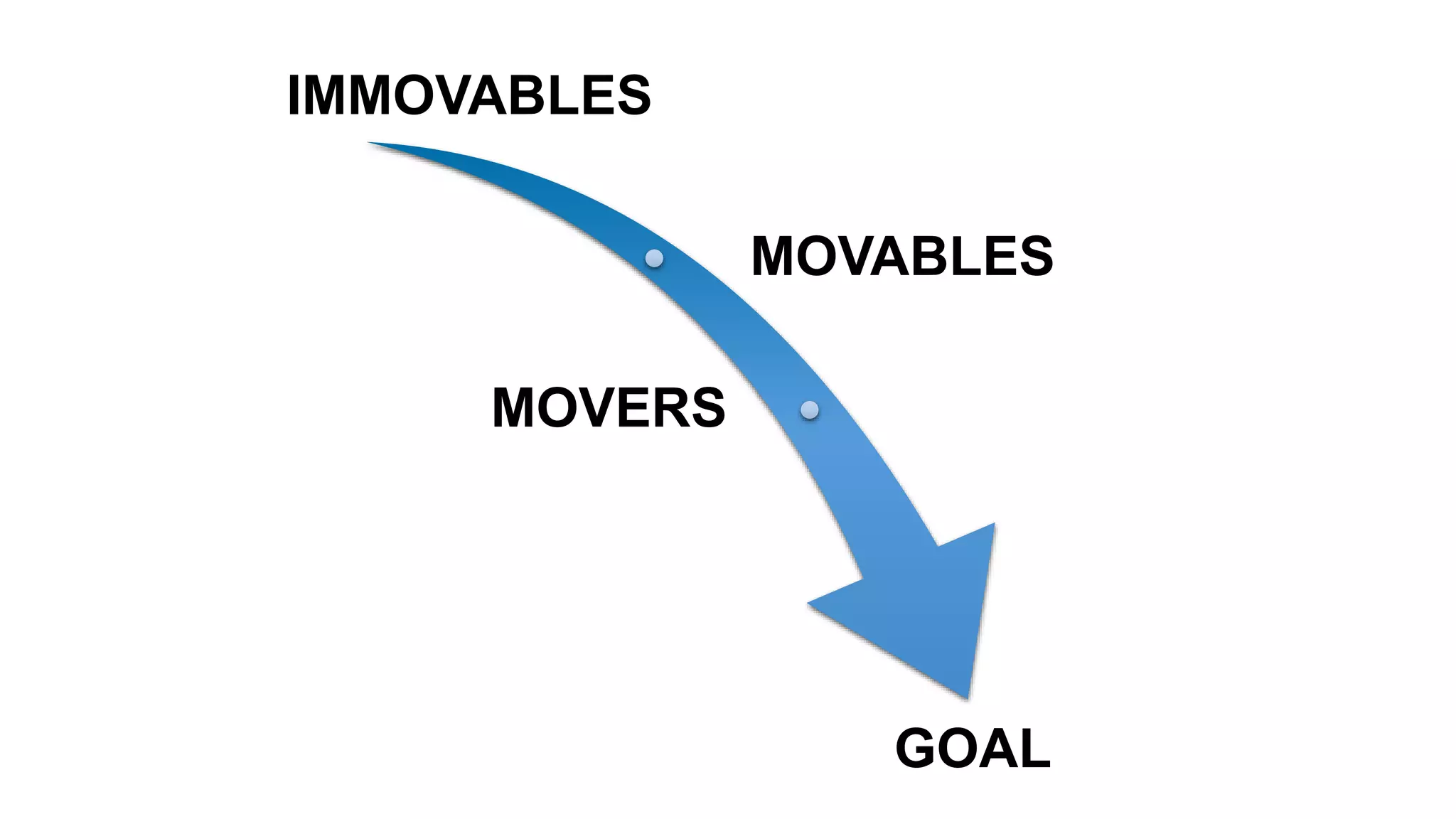
IMMOVABLES
MOVABLES
MOVERS
GOAL
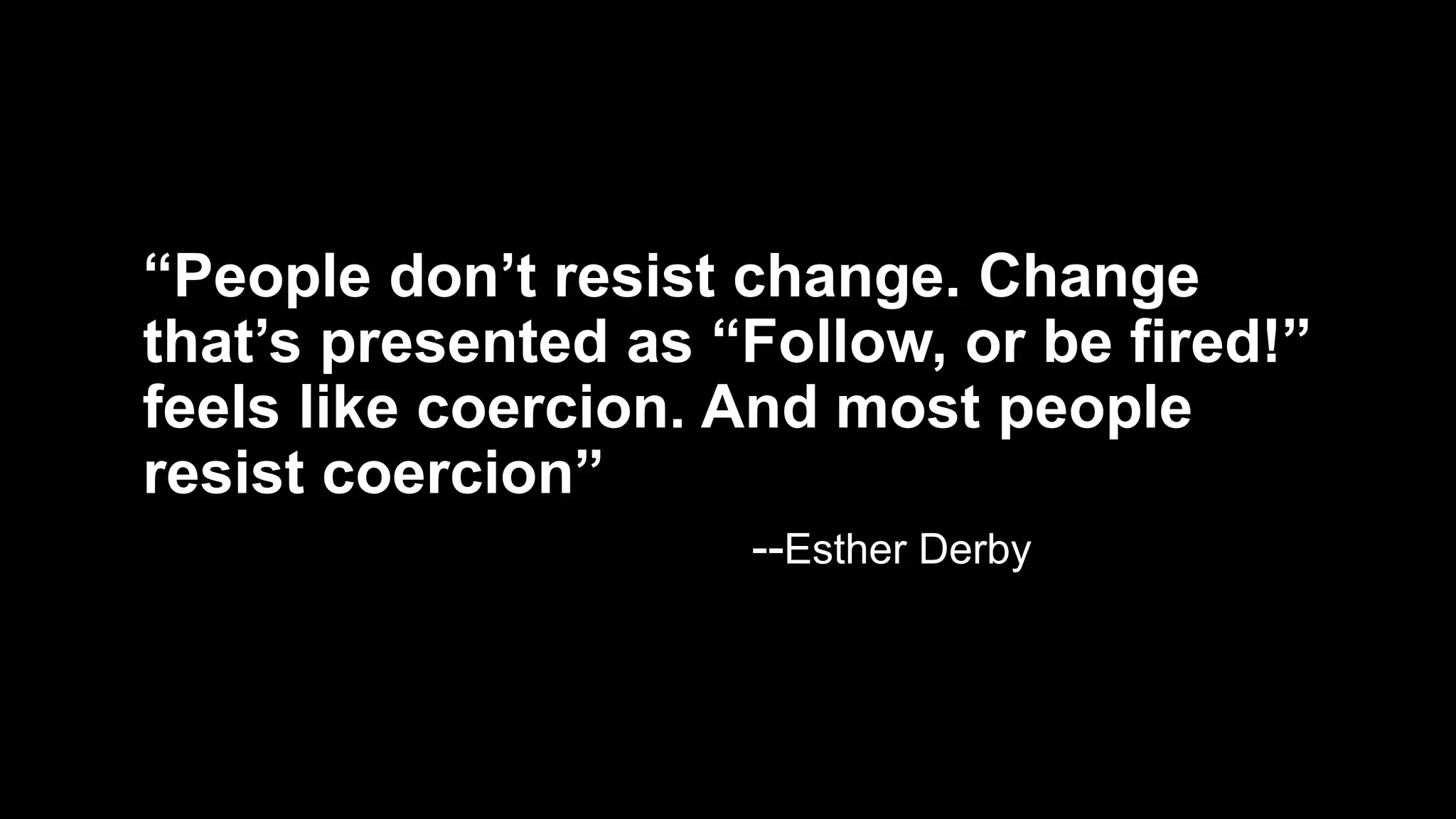
“People don’t resist change. Change
that’s presented as “Follow, or be fired!”
feels like coercion. And most people
resist coercion”
--Esther Derby
Influence vs Coercion
IMMOVABLES
MOVABLES
MOVERS
GOAL
There are no shortcuts
But here are some shortcuts
Make sure people are ready
to hear what you have to say.
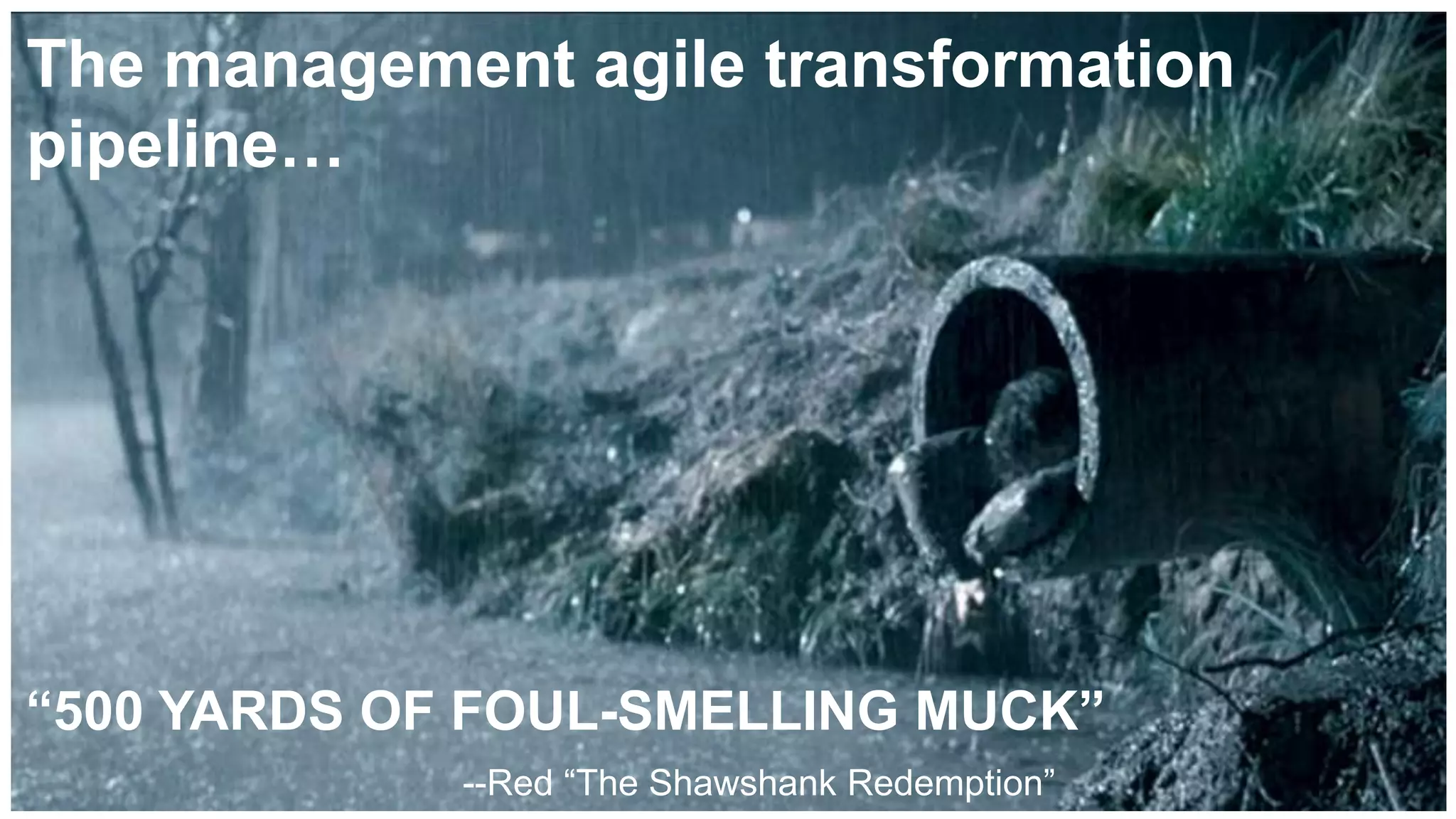
“500 YARDS OF FOUL-SMELLING MUCK”
--Red “The Shawshank Redemption”
The management agile transformation
pipeline…
You are going to face a lot of
wrong premises about what
makes safety and speed
possible.
Self-organization does not
initially feel safe or fast to
a traditional manager.
“A scrum teams job is to self-organize
around the challenges, and within the
boundaries and constraints, put in place
by management.”
--Mike Cohn, Succeeding with Agile
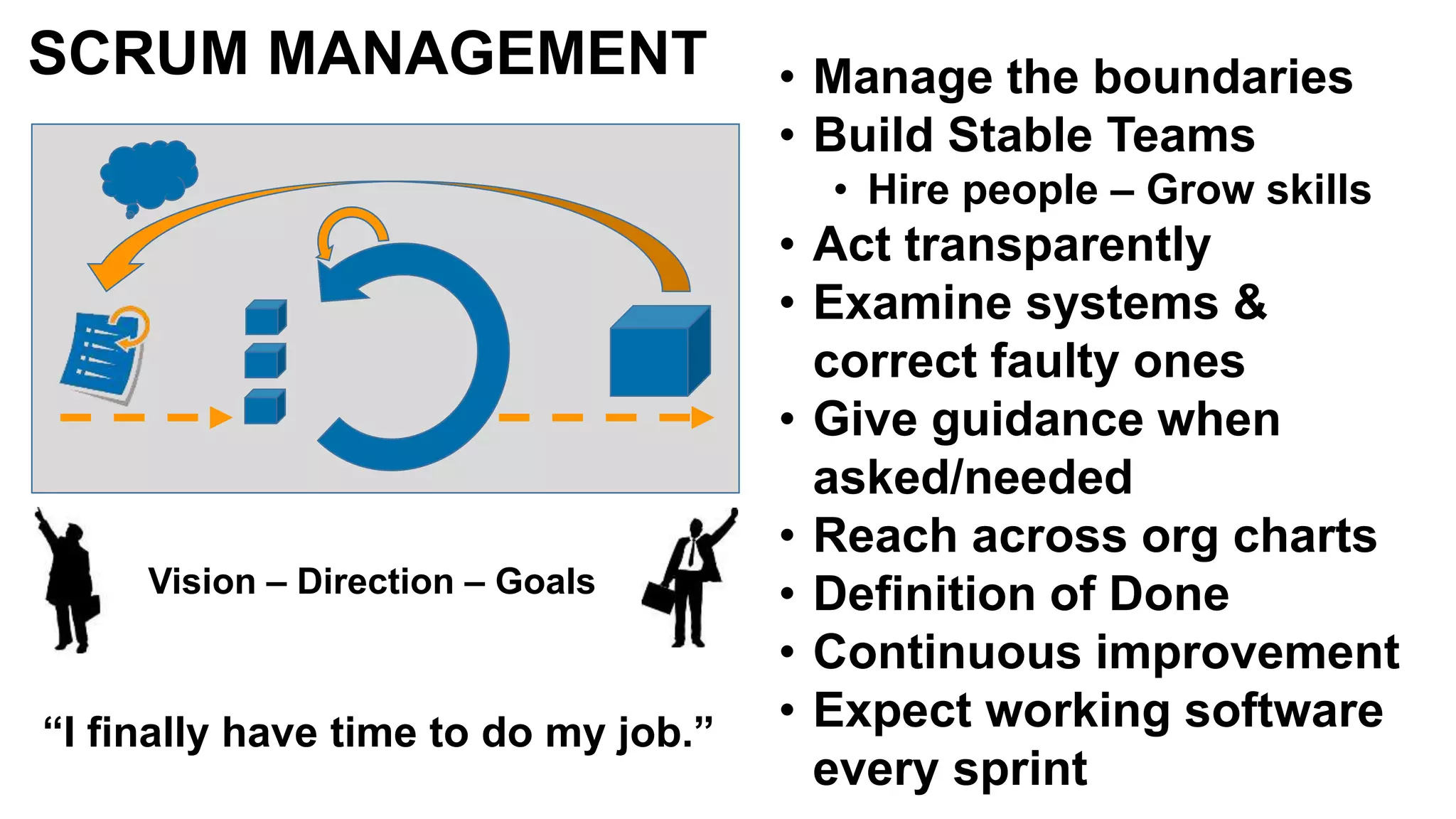
SCRUM MANAGEMENT • Manage the boundaries
• Build Stable Teams
• Hire people – Grow skills
• Act transparently
• Examine systems &
correct faulty ones
• Give guidance when
asked/needed
• Reach across org charts
• Definition of Done
• Continuous improvement
• Expect working software
every sprint
Vision – Direction – Goals
“I finally have time to do my job.”
Copyright © 2015 Scrum Alliance®
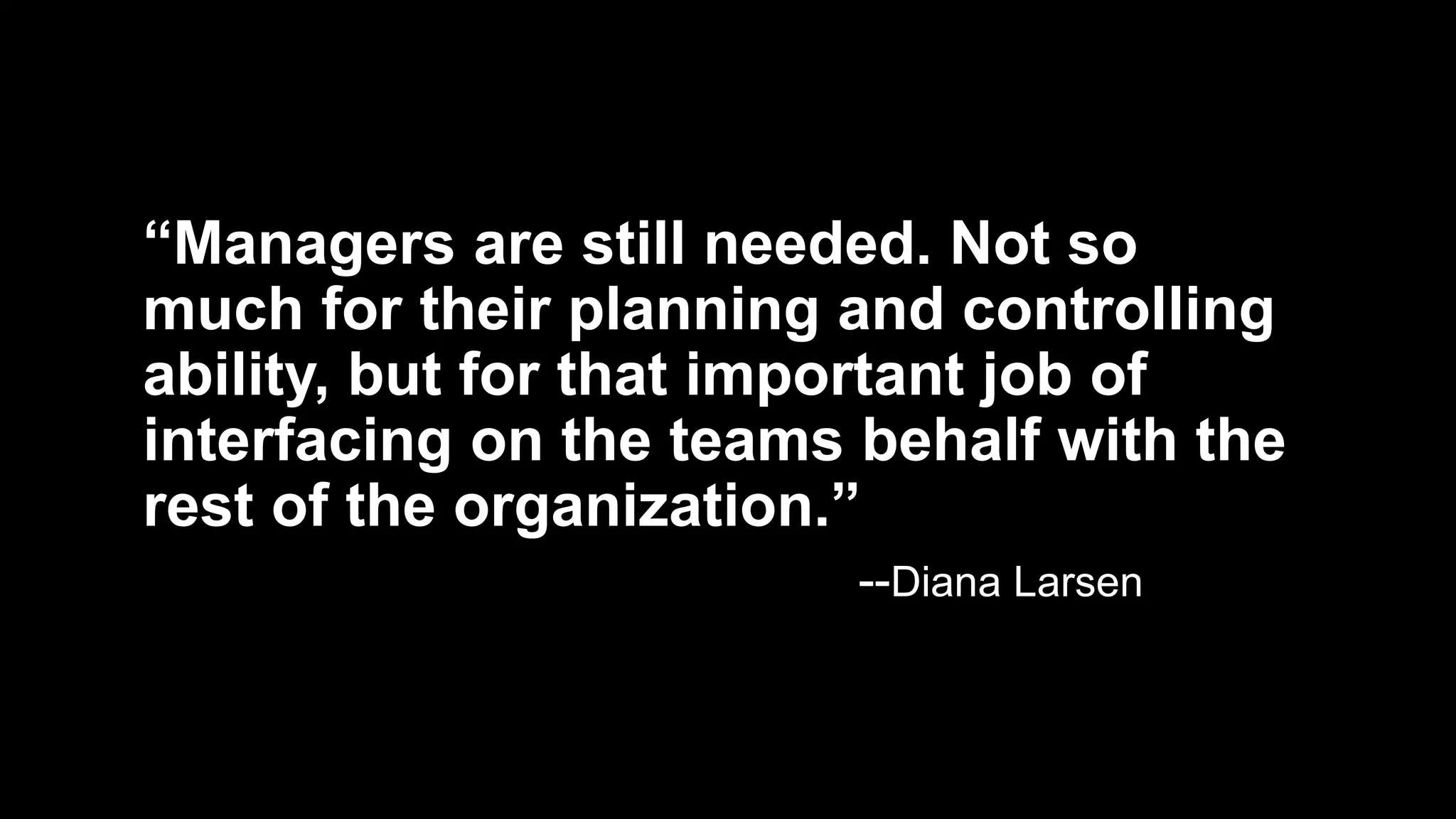
“Managers are still needed. Not so
much for their planning and controlling
ability, but for that important job of
interfacing on the teams behalf with the
rest of the organization.”
--Diana Larsen
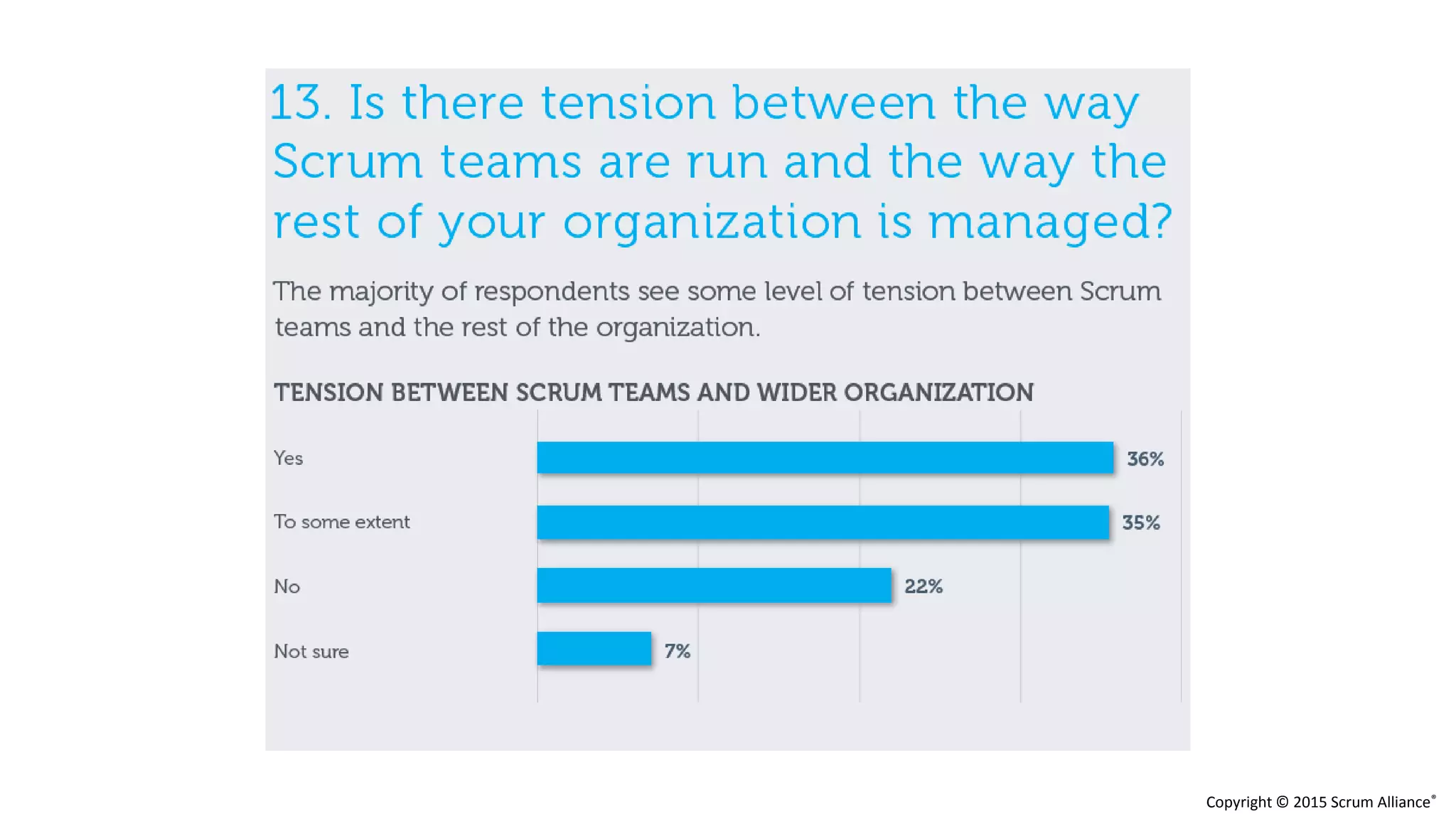
Copyright © 2015 Scrum Alliance®
“Managers are still needed. Not so
much for their planning and controlling
ability, but for that important job of
interfacing on the teams behalf with the
rest of the organization.”
--Diana Larsen
http://agileanswerman.com
ryan@agileanswerman.com
@ryanripley
Podcast available on iTunes,
Stitcher, and
AgileAnswerMan.Com
IMAGE ATTRIBUTION
“At the Office” - ©JnL – Flickr.com – Used with permission
“Ara Pacis” - ©Steven Zucker – Flickr.com – Creative Commons License
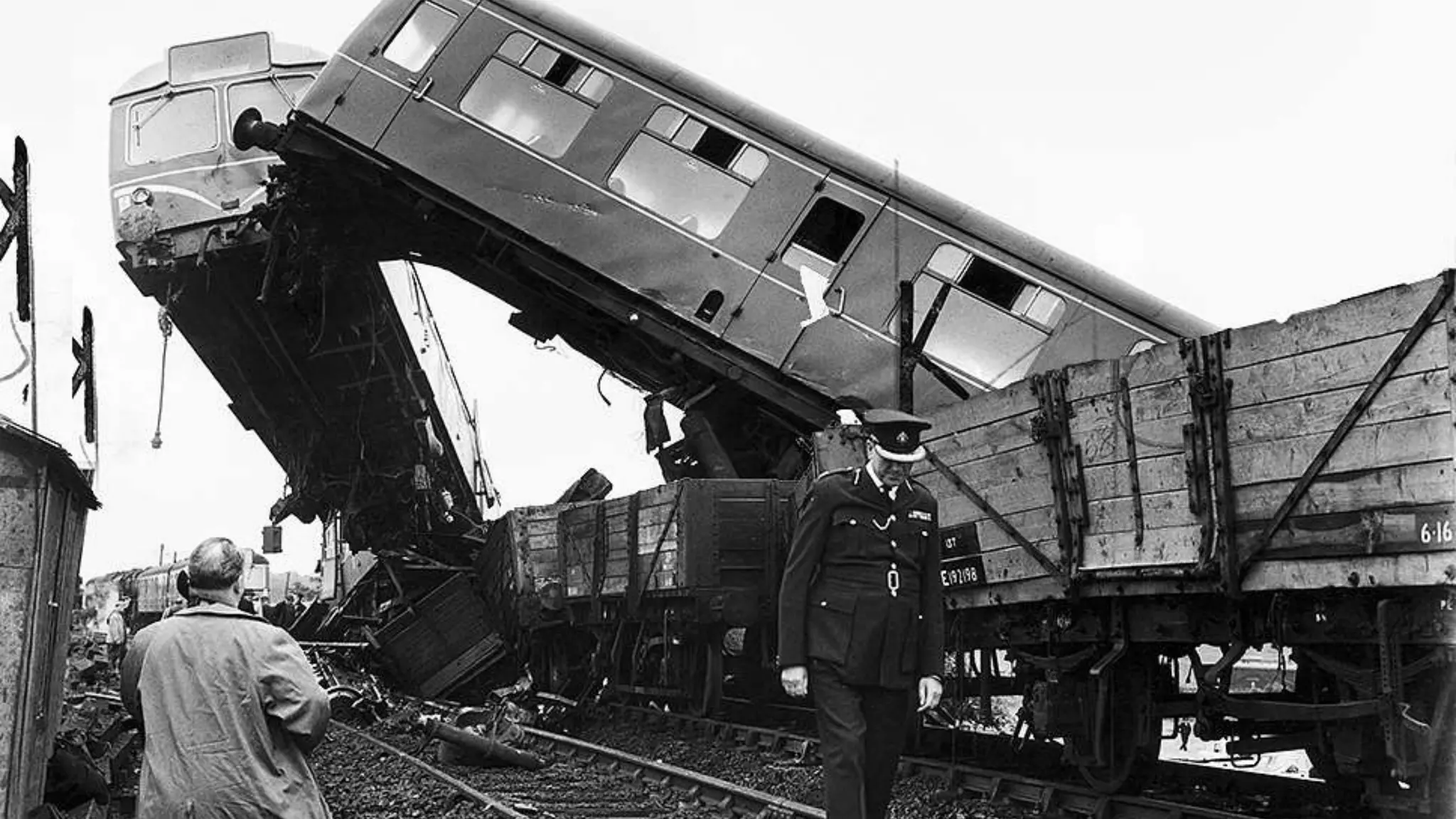
“Singleton Bank Rail Crash” – Public Domain
“Elephant” - ©Jim the Photographer– Flickr.com – Creative Commons License
“Falling Businessman” - © Danomyte | Dreamstime.com - Falling Businessman Photo
“Hey Listen” - ©Quinn Dombrowski – Flickr.com – Creative Commons License

Teaching pointy haired bosses to be agile enablers

  • 1.
  • 2.
  • 3.
  • 6.
    “Regardless of whatwe discover, we understand and truly believe that everyone did the best job they could, given what they knew at the time, their skills and abilities, the resources available, and the situation at hand.” --Norm Kerth, Project Retrospectives: A Handbook for Team Reviews
  • 7.
    Management support iscritical to the success of agile projects and agile adoptions.
  • 8.
    What is amanager?
  • 9.
    What does amanager do?
  • 10.
    “Yet a commonmisconception is that because of this reliance on self- organizing teams, there is little or no role for leaders of agile teams. Nothing could be further from the truth.” --Mike Cohn, Succeeding with Agile
  • 11.
    DILBERT © 2007Scott Adams. Used By permission of UNIVERSAL UCLICK. All rights reserved.
  • 14.
    SCRUM IN ONESLIDE Development Sprint Planning Sprint Review Sprint Retrospective Sprint ROLES: Scrum Master, Product Owner, Developer ARTIFACTS: Product Backlog, Sprint Backlog, Product Increment
  • 16.
  • 17.
    What does amanager stand to lose?
  • 18.
    ?????? AGILE IMPACTS EVERYONE •Organizational Change • Leadership Change • Team Change • Status Change • Job Description Change • Role Change • Culture Change
  • 19.
    We are tellingmanagers to give up the tools, methods, processes, and behaviors that have made them successful.
  • 20.
    “People who askothers to change may not understand what value they are asking people to give up. And in fact, they may not appreciate or even notice what’s valuable to the people they expect to change.” --Esther Derby
  • 22.
    LEADING CAUSES OFFAILED AGILE PROJECTS From the 9th Annual VersionOne State of Agile Report ©2015 VersionOne, Inc. - State of Agile is a trademark of VersionOne, Inc. and VersionOne is a registered trademark of VersionOne, Inc. 42% Company philosophy or culture at odds with core agile values 37% External pressure to follow traditional waterfall processes 38% Lack of management support 30% Insufficient training 33% A broader organizational or communications problem 33% Unwillingness of team to follow agile
  • 23.
    BARRIERS TO FURTHERAGILE ADOPTION From the 9th Annual VersionOne State of Agile Report ©2015 VersionOne, Inc. - State of Agile is a trademark of VersionOne, Inc. and VersionOne is a registered trademark of VersionOne, Inc. 22% Concerns about a loss of management control 24% Management concerns about lack of upfront planning 29% Management support 44% Ability to change organizational culture 34% General organizational resistance to change 35% Not enough personnel with necessary agile experience
  • 24.
    Copyright © 2015Scrum Alliance®
  • 25.
    Agile coaches cangain buy-in from managers during an agile transformation by focusing on their needs.
  • 26.
  • 27.
  • 28.
    How do webuild personas?
  • 29.
    Talk to amanager!
  • 30.
  • 31.
    Managers communicate their concernsand fears through the questions they ask.
  • 32.
    What must betrue for a person to ask that question?
  • 33.
    “What do Icontrol on an agile project?”
  • 34.
    “What does itmatter how many times I reassign team members, isn’t that what self-organization is for?”
  • 35.
    “Agile is forIT. Why are you talking to HR and finance?"
  • 36.
    “Your team leavesat 5:00pm and refuses to work weekends. Why don’t they have a sense of urgency?”
  • 37.
    “That developer isslacking. When is the scrum master going to take care of the poor performer?”
  • 38.
    Pay attention tothe statements that managers make.
  • 39.
    “If the candidatedoes not have CSM after their name, they aren’t worth interviewing."
  • 40.
    “You can’t coachif you’ve never developed software. Pick another scrum master for this team."
  • 41.
    “Teams ship workingsoftware at the end of each sprint. That’s why we implemented scrum. Work the weekends if you’re behind. The team needs to deliver on their commitments.”
  • 42.
    “Your teams velocityis worse than the other scrums teams. Find a way to get your velocity up, or we may have to reassign resources.”
  • 43.
    RESPONSES TO CHANGEARE INVALUABLE What is the source of their resistance? Does the manager know how to do what they are being asked to do? Is there a personal conflict that is causing resistance? Is the manager a champion of the old process? Are there systems in place that reward disruptive behavior? Is the path to success unclear to them? What does the manager lose due to the change?
  • 44.
    Ryan Ripley PSM I,PSM II, PSE, CSM, PMI-ACP, PSPO I, PSD 10+ years experience on agile teams GOALS Add value back to the organization NEEDS To be recognized for the work and contributions delivered to the team WANTS To foster a safe environment for people to experiment and do creative work LIMITATIONS Lack of agile certifications
  • 45.
    “All mankind isdivided into three classes: those that are immovable, those that are movable, and those that move.” --Benjamin Franklin
  • 46.
    Movers • Aligned with change •Motivated • Eager to learn • Coach the coaches Movables • Some convincing required • Early trust issues likely • Support and coaching necessary Immovables • Resistant to change • Disruptive • Low trust • Seeks to control change • Requires significant coaching
  • 47.
  • 48.
    “People don’t resistchange. Change that’s presented as “Follow, or be fired!” feels like coercion. And most people resist coercion” --Esther Derby
  • 49.
  • 50.
  • 51.
    There are noshortcuts
  • 52.
    But here aresome shortcuts
  • 53.
    Make sure peopleare ready to hear what you have to say.
  • 54.
    “500 YARDS OFFOUL-SMELLING MUCK” --Red “The Shawshank Redemption” The management agile transformation pipeline…
  • 55.
    You are goingto face a lot of wrong premises about what makes safety and speed possible.
  • 56.
    Self-organization does not initiallyfeel safe or fast to a traditional manager.
  • 57.
    “A scrum teamsjob is to self-organize around the challenges, and within the boundaries and constraints, put in place by management.” --Mike Cohn, Succeeding with Agile
  • 58.
    SCRUM MANAGEMENT •Manage the boundaries • Build Stable Teams • Hire people – Grow skills • Act transparently • Examine systems & correct faulty ones • Give guidance when asked/needed • Reach across org charts • Definition of Done • Continuous improvement • Expect working software every sprint Vision – Direction – Goals “I finally have time to do my job.”
  • 59.
    Copyright © 2015Scrum Alliance®
  • 60.
    “Managers are stillneeded. Not so much for their planning and controlling ability, but for that important job of interfacing on the teams behalf with the rest of the organization.” --Diana Larsen
  • 61.
    Copyright © 2015Scrum Alliance®
  • 62.
    “Managers are stillneeded. Not so much for their planning and controlling ability, but for that important job of interfacing on the teams behalf with the rest of the organization.” --Diana Larsen
  • 63.
  • 64.
    IMAGE ATTRIBUTION “At theOffice” - ©JnL – Flickr.com – Used with permission “Ara Pacis” - ©Steven Zucker – Flickr.com – Creative Commons License “Singleton Bank Rail Crash” – Public Domain “Elephant” - ©Jim the Photographer– Flickr.com – Creative Commons License “Falling Businessman” - © Danomyte | Dreamstime.com - Falling Businessman Photo “Hey Listen” - ©Quinn Dombrowski – Flickr.com – Creative Commons License