TEACHING
POETRY TO YOUNG
CHILDREN
What is Poetry?
1)Language with intense feeling & imagery
2)Qualities of sound that:
- bounce pleasingly off the tongue
- tickle the ear
- leave the mind with something to ponder
3) Affecting honing of sound and meaning
4) Brings the world alive
5) Gives meaning to life
Poetry = to
Rhythm
Variety
Express
feelings and
opinions
Confidence
Imagination
Creativity
Integration
Language
Skills
Fun
Spoken
Expression
Appreciate
sounds
words and
patterns
Phonic
Skills
Vocabulary
E.g Family,Adventure, Holiday,
Thanksgiving, Food
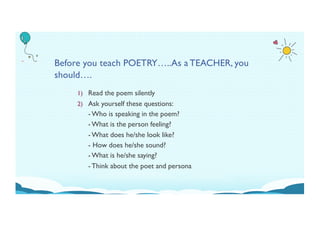
Before you teach POETRY…..As a TEACHER, you
should….
1) Read the poem silently
2) Ask yourself these questions:
- Who is speaking in the poem?
- What is the person feeling?
- What does he/she look like?
- How does he/she sound?
- What is he/she saying?
- Think about the poet and persona
¡ Think of how I can portray this person through
my voice, body and facial expression
¡ Underline key words in the poem
¡ Practice reading the poem aloud
¡ Practice reading aloud to an audience
¡ I record myself reciting the poem and listen to
it. How can I improve?
¡ What props and costumes should I use?
¡ I should remember to have FUN!!
As a Teacher, I should….
TEACHER’S ROLE INTEACHING POETRY
¡ Read the poem thoroughly
¡ Introduce the subject of the poem
¡ Read the poem aloud in class. Let pupils enjoy listening
to the poem
¡ Get pupils to follow along as you reread the poem.
¡ Have them read the poem chorally with you as the
leader keeping the voices together
¡ Discuss new vocabulary to help pupils understand the
poem
¡ As the poem becomes more familiar use the text to
teach aspects of language
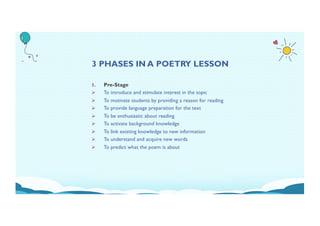
3 PHASES IN A POETRY LESSON
1. Pre-Stage
Ø To introduce and stimulate interest in the topic
Ø To motivate students by providing a reason for reading
Ø To provide language preparation for the text
Ø To be enthusiastic about reading
Ø To activate background knowledge
Ø To link existing knowledge to new information
Ø To understand and acquire new words
Ø To predict what the poem is about
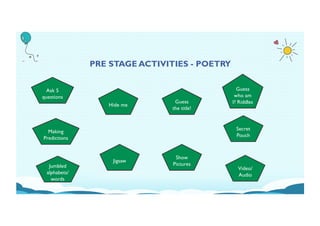
PRE STAGE ACTIVITIES - POETRY
Hide me
Video/
Audio
Ask 5
questions
Jumbled
alphabets/
words
Secret
Pouch
Jigsaw
Making
Predictions
Guess
the title!
Show
Pictures
Guess
who am
I? Riddles
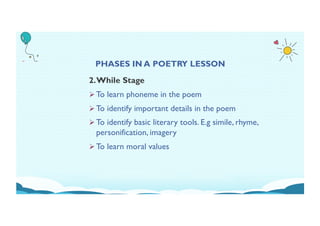
PHASES IN A POETRY LESSON
2.While Stage
Ø To learn phoneme in the poem
Ø To identify important details in the poem
Ø To identify basic literary tools. E.g simile, rhyme,
personification, imagery
Ø To learn moral values
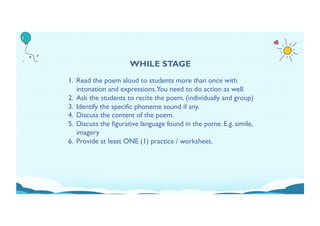
WHILE STAGE
1. Read the poem aloud to students more than once with
intonation and expressions.You need to do action as well.
2. Ask the students to recite the poem. (individually and group)
3. Identify the specific phoneme sound if any.
4. Discuss the content of the poem.
5. Discuss the figurative language found in the pome. E.g. simile,
imagery
6. Provide at least ONE (1) practice / worksheet.
PHASES IN A POETRY LESSON
3. Post Stage
Ø Reflect upon what has been read.
Ø To relate the poem to the students’ own
knowledge/interests/views (personal opinion).
Ø To design Language Arts pertaining activities.
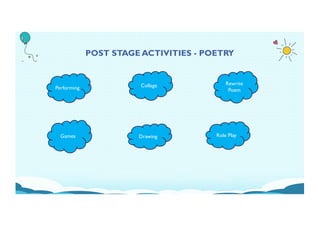
POST STAGE ACTIVITIES - POETRY
Collage
Performing
Drawing
Games Role Play
Rewrite
Poem
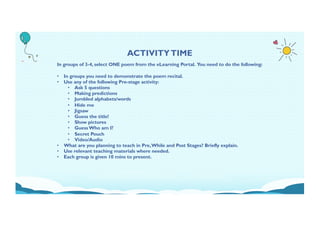
ACTIVITYTIME
In groups of 3-4, select ONE poem from the eLearning Portal. You need to do the following:
• In groups you need to demonstrate the poem recital.
• Use any of the following Pre-stage activity:
• Ask 5 questions
• Making predictions
• Jumbled alphabets/words
• Hide me
• Jigsaw
• Guess the title!
• Show pictures
• GuessWho am I?
• Secret Pouch
• Video/Audio
• What are you planning to teach in Pre,While and Post Stages? Briefly explain.
• Use relevant teaching materials where needed.
• Each group is given 10 mins to present.

Teaching Poetry.pdf

  • 1.
  • 2.
    What is Poetry? 1)Languagewith intense feeling & imagery 2)Qualities of sound that: - bounce pleasingly off the tongue - tickle the ear - leave the mind with something to ponder 3) Affecting honing of sound and meaning 4) Brings the world alive 5) Gives meaning to life
  • 3.
    Poetry = to Rhythm Variety Express feelingsand opinions Confidence Imagination Creativity Integration Language Skills Fun Spoken Expression Appreciate sounds words and patterns Phonic Skills Vocabulary
  • 4.
  • 5.
    Before you teachPOETRY…..As a TEACHER, you should…. 1) Read the poem silently 2) Ask yourself these questions: - Who is speaking in the poem? - What is the person feeling? - What does he/she look like? - How does he/she sound? - What is he/she saying? - Think about the poet and persona
  • 6.
    ¡ Think ofhow I can portray this person through my voice, body and facial expression ¡ Underline key words in the poem ¡ Practice reading the poem aloud ¡ Practice reading aloud to an audience ¡ I record myself reciting the poem and listen to it. How can I improve? ¡ What props and costumes should I use? ¡ I should remember to have FUN!! As a Teacher, I should….
  • 7.
    TEACHER’S ROLE INTEACHINGPOETRY ¡ Read the poem thoroughly ¡ Introduce the subject of the poem ¡ Read the poem aloud in class. Let pupils enjoy listening to the poem ¡ Get pupils to follow along as you reread the poem. ¡ Have them read the poem chorally with you as the leader keeping the voices together ¡ Discuss new vocabulary to help pupils understand the poem ¡ As the poem becomes more familiar use the text to teach aspects of language
  • 8.
    3 PHASES INA POETRY LESSON 1. Pre-Stage Ø To introduce and stimulate interest in the topic Ø To motivate students by providing a reason for reading Ø To provide language preparation for the text Ø To be enthusiastic about reading Ø To activate background knowledge Ø To link existing knowledge to new information Ø To understand and acquire new words Ø To predict what the poem is about
  • 9.
    PRE STAGE ACTIVITIES- POETRY Hide me Video/ Audio Ask 5 questions Jumbled alphabets/ words Secret Pouch Jigsaw Making Predictions Guess the title! Show Pictures Guess who am I? Riddles
  • 10.
    PHASES IN APOETRY LESSON 2.While Stage Ø To learn phoneme in the poem Ø To identify important details in the poem Ø To identify basic literary tools. E.g simile, rhyme, personification, imagery Ø To learn moral values
  • 11.
    WHILE STAGE 1. Readthe poem aloud to students more than once with intonation and expressions.You need to do action as well. 2. Ask the students to recite the poem. (individually and group) 3. Identify the specific phoneme sound if any. 4. Discuss the content of the poem. 5. Discuss the figurative language found in the pome. E.g. simile, imagery 6. Provide at least ONE (1) practice / worksheet.
  • 12.
    PHASES IN APOETRY LESSON 3. Post Stage Ø Reflect upon what has been read. Ø To relate the poem to the students’ own knowledge/interests/views (personal opinion). Ø To design Language Arts pertaining activities.
  • 13.
    POST STAGE ACTIVITIES- POETRY Collage Performing Drawing Games Role Play Rewrite Poem
  • 14.
    ACTIVITYTIME In groups of3-4, select ONE poem from the eLearning Portal. You need to do the following: • In groups you need to demonstrate the poem recital. • Use any of the following Pre-stage activity: • Ask 5 questions • Making predictions • Jumbled alphabets/words • Hide me • Jigsaw • Guess the title! • Show pictures • GuessWho am I? • Secret Pouch • Video/Audio • What are you planning to teach in Pre,While and Post Stages? Briefly explain. • Use relevant teaching materials where needed. • Each group is given 10 mins to present.