Writing Workshop in the
Primary Grades - Poetry Unit
                                    These poems were written
                                      by my second grade
                                      class last year. The
                                      students’ range of
         QuickTime™ and a
                                      abilities was from high
           decompressor
  are needed to see this picture.     academic ability to
                                      those receiving
                                      resource room, ESL,
                                      and/or reading support
                                      services.
Writing Workshop in the Primary
    Grades - Daily Overview
 Time:           Component:
 5 minutes       Read Aloud
 10 minutes      Mini-Lesson
 25 minutes      Independent Writing and
                 Conferring
 5-10 minutes    Share
Writing Workshop in the Primary
 Grades - Poetry Unit Overview
 Week:                   Phase:
 1                       Immersion
 2                       Collect and Generate
                         ideas
 3&4                     Writing, Editing,
                         Revising
 5                       Publishing, Celebrating

         a 2-5 week unit of study
Read Aloud

Create a poetry-rich environment.
Nurture the love of poetry in your students by immersing
them in poems from the very first day of school.
When can you read poetry aloud in the classroom?
 To begin and end the school day
 In songs and nursery rhymes
 To notice word/spelling patterns
 Celebrating special occasions
 Studying the content areas of science, social studies
and math
What to read aloud?
Share your favorite poems, poets, nursery
 rhymes, poetry books, and poems you’ve
 written or collected.
Read silly poems, sad poems, happy
 poems, and poems that make you
 wonder.
Read poems written by students.
Use poems that will teach a particular craft
 technique.
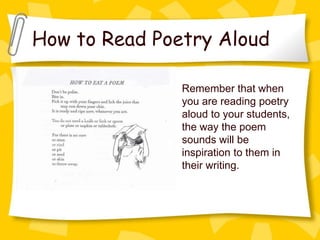
How to Read Poetry Aloud

               Remember that when
               you are reading poetry
               aloud to your students,
               the way the poem
               sounds will be
               inspiration to them in
               their writing.
Reading Aloud through
       Shared Reading
Display poetry on large chart paper in your
classroom.
Make it a multi-sensory experience:
get your students involved in reading, clapping, and acting
 out poems.
Have them visualize pictures in their head.
Distribute student copies of shared poems to
put in their poetry notebooks to read and
illustrate.
Notice white space and line breaks.
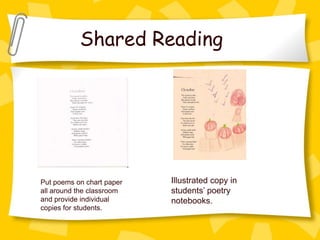
Shared Reading


Put poems on chart paper   Illustrated copy in
all around the classroom   students’ poetry
and provide individual     notebooks.
copies for students.
Offer opportunities for
        independent reading.
Encourage students to choose to read poetry by:
  Displaying favorite poetry books in baskets and bookshelves for
  students to read during independent reading time.
  Laminating copies of familiar poems to place in theme baskets.
  Create class books of poetry and keep in a basket.
  Use poems on sentence strips in pocket charts in your poetry
  center for students to play and experiment with.
  Highlight poets as part of your spotlight on “Authors of the
  Month.”
Talking about poems
Begin to notice elements and structure of
  poems
  Poetic language
  Imagery
  Craft technique
  Rhythm/rhyme
  White space, line breaks
  What poems are about
Spotlight on the Poet

     Share quotes                             “I love finding the right

  from poets you love.
                                              word. The stupendous, the
                                              magnificent, and the
                                              ordinary words. I collect
                                              them.”
                                                   ~ Rebecca Kai Dotlich

“Poetry is really everywhere-especially surprising
places-where most people wouldn’t think of looking.” ~ Georgia Hurd

“…a good poem contains both meaning and music.” ~Eve Merriam
The Mini-Lesson
Keep mini-lessons short and to the
point.
Think of it as planting the seeds of their
future poems.
This is the part of the workshop where
you help students generate ideas and
they collect these ideas in a writer’s
notebook or writing folder.
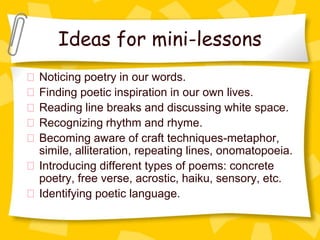
Ideas for mini-lessons
Noticing poetry in our words.
Finding poetic inspiration in our own lives.
Reading line breaks and discussing white space.
Recognizing rhythm and rhyme.
Becoming aware of craft techniques-metaphor,
simile, alliteration, repeating lines, onomatopoeia.
Introducing different types of poems: concrete
poetry, free verse, acrostic, haiku, sensory, etc.
Identifying poetic language.
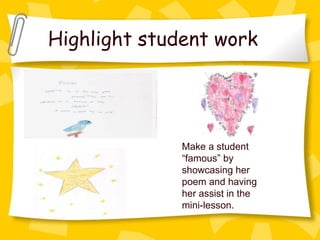
Highlight student work


              Make a student
              “famous” by
              showcasing her
              poem and having
              her assist in the
              mini-lesson.
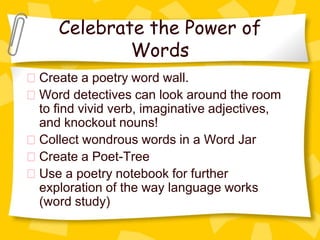
Celebrate the Power of
           Words
Create a poetry word wall.
Word detectives can look around the room
to find vivid verb, imaginative adjectives,
and knockout nouns!
Collect wondrous words in a Word Jar
Create a Poet-Tree
Use a poetry notebook for further
exploration of the way language works
(word study)
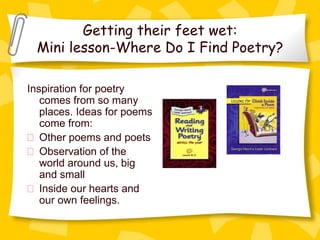
Getting their feet wet:
  Mini lesson-Where Do I Find Poetry?

Inspiration for poetry
   comes from so many
   places. Ideas for poems
   come from:
   Other poems and poets
   Observation of the
   world around us, big
   and small
   Inside our hearts and
   our own feelings.
Mini lesson-Where Do I Find
           Poetry?
Using the poem, Where Do I Find Poetry?
  To prepare, send home parent letter and homework
  assignment.
  In the classroom, have students brainstorm a list of
  ideas about where poetry hides.
  Have each student choose their best one and create
  a class chart using interactive (shared) writing.
  Re-write the chart as a list poem.
  This poem may also be used for a mini-lesson on
  metaphor: “when sky is wrinkled and elephant gray.”
The actual process of writing
Students in the primary grades often need a boost to
  begin writing their own poetry. Once they develop
  their writing confidence, they are happy to write lots
  more poems!
  Offer a template
  Have them write a poem “off” of previously
  written piece
  Buddy-up with younger or older students to
  write poems in two voices.
Writing “off” another piece
        of writing
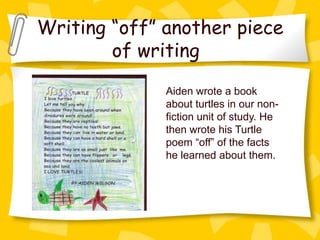
              Aiden wrote a book
              about turtles in our non-
              fiction unit of study. He
              then wrote his Turtle
              poem “off” of the facts
              he learned about them.
Independent Writing and
        Conferring
 Offer support as needed
 Provide templates of different poem structures
 Conferencing should be only a few minutes per
student
 Ask writers to “tell more, say more”
 Keep notes about your conference
 Use the share as an opportunity to conference
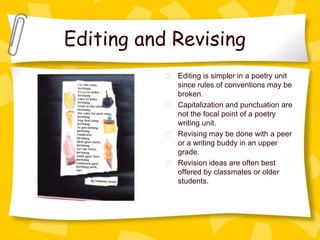
Editing and Revising
            Editing is simpler in a poetry unit
            since rules of conventions may be
            broken.
            Capitalization and punctuation are
            not the focal point of a poetry
            writing unit.
            Revising may be done with a peer
            or a writing buddy in an upper
            grade.
            Revision ideas are often best
            offered by classmates or older
            students.
The Share


 Use the share as a way to offer comments and
suggestions by peers
 Highlight students who incorporated the topic of your
mini-lesson in their writing that day
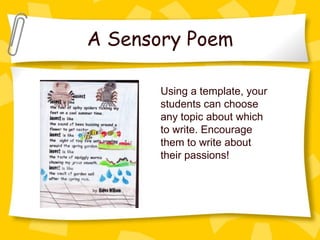
A Sensory Poem

       Using a template, your
       students can choose
       any topic about which
       to write. Encourage
       them to write about
       their passions!
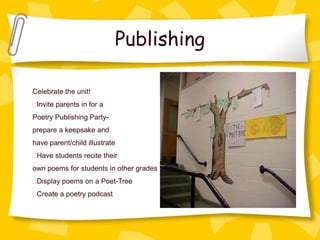
Publishing

Celebrate the unit!
 Invite parents in for a
Poetry Publishing Party-
prepare a keepsake and
have parent/child illustrate
 Have students recite their
own poems for students in other grades
 Display poems on a Poet-Tree
 Create a poetry podcast
Evaluation

Students reflection:
 Even primary students should be encouraged to
reflect upon what they’ve learned in a poetry unit


Teacher assessment:
 Rubric for student achievement
Helpful Websites for Reading
and Writing Poetry and More!

  http://poemfarm.blogspot.com
  http://twowritingteachers.wordpress.com/
  http://teacher.scholastic.com/writewit/poetry
  http://www.poetspath.com
  http://proteacher.com
Ready to have a go?

Choose any type of poem from your packet
and using it as a template, write your own
poem. Or, simply write a poem from your
heart. We will have a brief share if there is
time left!

Hnet

  • 1.
    Writing Workshop inthe Primary Grades - Poetry Unit These poems were written by my second grade class last year. The students’ range of QuickTime™ and a abilities was from high decompressor are needed to see this picture. academic ability to those receiving resource room, ESL, and/or reading support services.
  • 2.
    Writing Workshop inthe Primary Grades - Daily Overview Time: Component: 5 minutes Read Aloud 10 minutes Mini-Lesson 25 minutes Independent Writing and Conferring 5-10 minutes Share
  • 3.
    Writing Workshop inthe Primary Grades - Poetry Unit Overview Week: Phase: 1 Immersion 2 Collect and Generate ideas 3&4 Writing, Editing, Revising 5 Publishing, Celebrating a 2-5 week unit of study
  • 4.
    Read Aloud Create apoetry-rich environment. Nurture the love of poetry in your students by immersing them in poems from the very first day of school. When can you read poetry aloud in the classroom? To begin and end the school day In songs and nursery rhymes To notice word/spelling patterns Celebrating special occasions Studying the content areas of science, social studies and math
  • 5.
    What to readaloud? Share your favorite poems, poets, nursery rhymes, poetry books, and poems you’ve written or collected. Read silly poems, sad poems, happy poems, and poems that make you wonder. Read poems written by students. Use poems that will teach a particular craft technique.
  • 6.
    How to ReadPoetry Aloud Remember that when you are reading poetry aloud to your students, the way the poem sounds will be inspiration to them in their writing.
  • 7.
    Reading Aloud through Shared Reading Display poetry on large chart paper in your classroom. Make it a multi-sensory experience: get your students involved in reading, clapping, and acting out poems. Have them visualize pictures in their head. Distribute student copies of shared poems to put in their poetry notebooks to read and illustrate. Notice white space and line breaks.
  • 8.
    Shared Reading Put poemson chart paper Illustrated copy in all around the classroom students’ poetry and provide individual notebooks. copies for students.
  • 9.
    Offer opportunities for independent reading. Encourage students to choose to read poetry by: Displaying favorite poetry books in baskets and bookshelves for students to read during independent reading time. Laminating copies of familiar poems to place in theme baskets. Create class books of poetry and keep in a basket. Use poems on sentence strips in pocket charts in your poetry center for students to play and experiment with. Highlight poets as part of your spotlight on “Authors of the Month.”
  • 10.
    Talking about poems Beginto notice elements and structure of poems Poetic language Imagery Craft technique Rhythm/rhyme White space, line breaks What poems are about
  • 11.
    Spotlight on thePoet Share quotes “I love finding the right from poets you love. word. The stupendous, the magnificent, and the ordinary words. I collect them.” ~ Rebecca Kai Dotlich “Poetry is really everywhere-especially surprising places-where most people wouldn’t think of looking.” ~ Georgia Hurd “…a good poem contains both meaning and music.” ~Eve Merriam
  • 12.
    The Mini-Lesson Keep mini-lessonsshort and to the point. Think of it as planting the seeds of their future poems. This is the part of the workshop where you help students generate ideas and they collect these ideas in a writer’s notebook or writing folder.
  • 13.
    Ideas for mini-lessons Noticingpoetry in our words. Finding poetic inspiration in our own lives. Reading line breaks and discussing white space. Recognizing rhythm and rhyme. Becoming aware of craft techniques-metaphor, simile, alliteration, repeating lines, onomatopoeia. Introducing different types of poems: concrete poetry, free verse, acrostic, haiku, sensory, etc. Identifying poetic language.
  • 14.
    Highlight student work Make a student “famous” by showcasing her poem and having her assist in the mini-lesson.
  • 15.
    Celebrate the Powerof Words Create a poetry word wall. Word detectives can look around the room to find vivid verb, imaginative adjectives, and knockout nouns! Collect wondrous words in a Word Jar Create a Poet-Tree Use a poetry notebook for further exploration of the way language works (word study)
  • 16.
    Getting their feetwet: Mini lesson-Where Do I Find Poetry? Inspiration for poetry comes from so many places. Ideas for poems come from: Other poems and poets Observation of the world around us, big and small Inside our hearts and our own feelings.
  • 17.
    Mini lesson-Where DoI Find Poetry? Using the poem, Where Do I Find Poetry? To prepare, send home parent letter and homework assignment. In the classroom, have students brainstorm a list of ideas about where poetry hides. Have each student choose their best one and create a class chart using interactive (shared) writing. Re-write the chart as a list poem. This poem may also be used for a mini-lesson on metaphor: “when sky is wrinkled and elephant gray.”
  • 18.
    The actual processof writing Students in the primary grades often need a boost to begin writing their own poetry. Once they develop their writing confidence, they are happy to write lots more poems! Offer a template Have them write a poem “off” of previously written piece Buddy-up with younger or older students to write poems in two voices.
  • 19.
    Writing “off” anotherpiece of writing Aiden wrote a book about turtles in our non- fiction unit of study. He then wrote his Turtle poem “off” of the facts he learned about them.
  • 20.
    Independent Writing and Conferring Offer support as needed Provide templates of different poem structures Conferencing should be only a few minutes per student Ask writers to “tell more, say more” Keep notes about your conference Use the share as an opportunity to conference
  • 21.
    Editing and Revising Editing is simpler in a poetry unit since rules of conventions may be broken. Capitalization and punctuation are not the focal point of a poetry writing unit. Revising may be done with a peer or a writing buddy in an upper grade. Revision ideas are often best offered by classmates or older students.
  • 22.
    The Share Usethe share as a way to offer comments and suggestions by peers Highlight students who incorporated the topic of your mini-lesson in their writing that day
  • 23.
    A Sensory Poem Using a template, your students can choose any topic about which to write. Encourage them to write about their passions!
  • 24.
    Publishing Celebrate the unit! Invite parents in for a Poetry Publishing Party- prepare a keepsake and have parent/child illustrate Have students recite their own poems for students in other grades Display poems on a Poet-Tree Create a poetry podcast
  • 25.
    Evaluation Students reflection: Evenprimary students should be encouraged to reflect upon what they’ve learned in a poetry unit Teacher assessment: Rubric for student achievement
  • 26.
    Helpful Websites forReading and Writing Poetry and More! http://poemfarm.blogspot.com http://twowritingteachers.wordpress.com/ http://teacher.scholastic.com/writewit/poetry http://www.poetspath.com http://proteacher.com
  • 27.
    Ready to havea go? Choose any type of poem from your packet and using it as a template, write your own poem. Or, simply write a poem from your heart. We will have a brief share if there is time left!