How to Teach
Poetry Workshop
By Tiffany Worden
Friday, October 28, 2005
About Me:
I graduated from the
TCNJ in May 2004
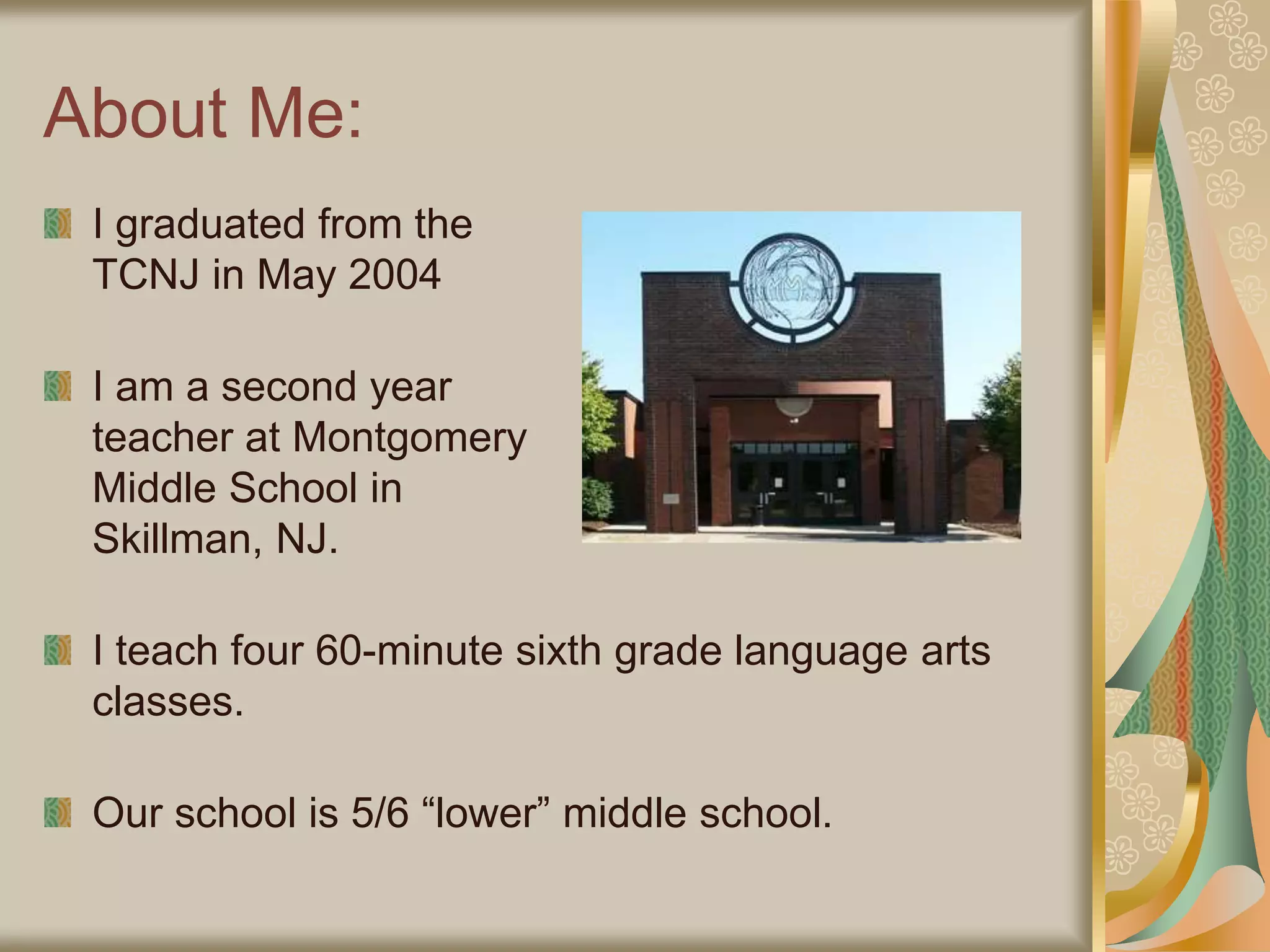
I am a second year
teacher at Montgomery
Middle School in
Skillman, NJ.
I teach four 60-minute sixth grade language arts
classes.
Our school is 5/6 “lower” middle school.
K - W - L
K: What do
you know
about poetry
or teaching
how to write
poetry?
W: What do
you want to
know about
poetry or
teaching how
to write
poetry?
My Objectives This Afternoon:
To share my journey through
constructing a unit of poetry.
To share methods of teaching poetry
that worked well for me (and that I
hope you add to your teaching tool
box).
To become enthusiastic readers and
writers of poetry ourselves.
Overview of Presentation
Answer the “why’s” of writing workshop and
poetry workshop
Bring you through my poetry unit of study—
a study of writing non-rhyming,
contemporary poetry—introduction through
assessment and reflection.
Discuss additional ways to incorporate
poetry into your classroom.
Identify strategies we will use in our own
classroom.
Why Writer’s Workshop?
To become better writers, students
need a consistent chunk of time to
practice writing.
In order for students to live like
writers, and view themselves as
writers, our class time needs to mirror
what writers do in the ‘real world’.
Skills based--students learn a
strategies writers use and apply it to
their own writing—meaningful
experience.
Why Genre-Based Workshop?
Students need a lens through which
they learn strategies for writing; genre
provides this lens.
With different genres comes
opportunity different writing strategies
and skills
Why Poetry Workshop?
Modern and contemporary poetry is written
in our vernacular and is easily accessible
Economy of language: Being specific
Playing with language and using it in new
and interesting ways
Striking word choice
Loaded with crafting techniques (similes,
imagery, rhetorical structures)
Poetry lends itself to critical discussion
about the choices writers make.
Why Poetry Workshop?
In her book, In the Middle, Nancy Atwell writes:
“teachers I knew avoided teaching poetry because
they felt intimidated by it. They perceived poetry
as difficult to read, difficult to understand, and,
especially, difficult to talk about. They stopped
reading it the moment it stopped being required.
Seventy years ago half the literature taught to
fourth grades in the United States was poetry.
Today, it’s 97 percent prose and just 3 percent
poetry. Either we love it, as I did, but can’t imagine
how to begin to help students experience it…or we
don’t read it and don’t love it … Poetry deserves
better and kids deserve better.” (416).
We need to put poetry back in our instruction!
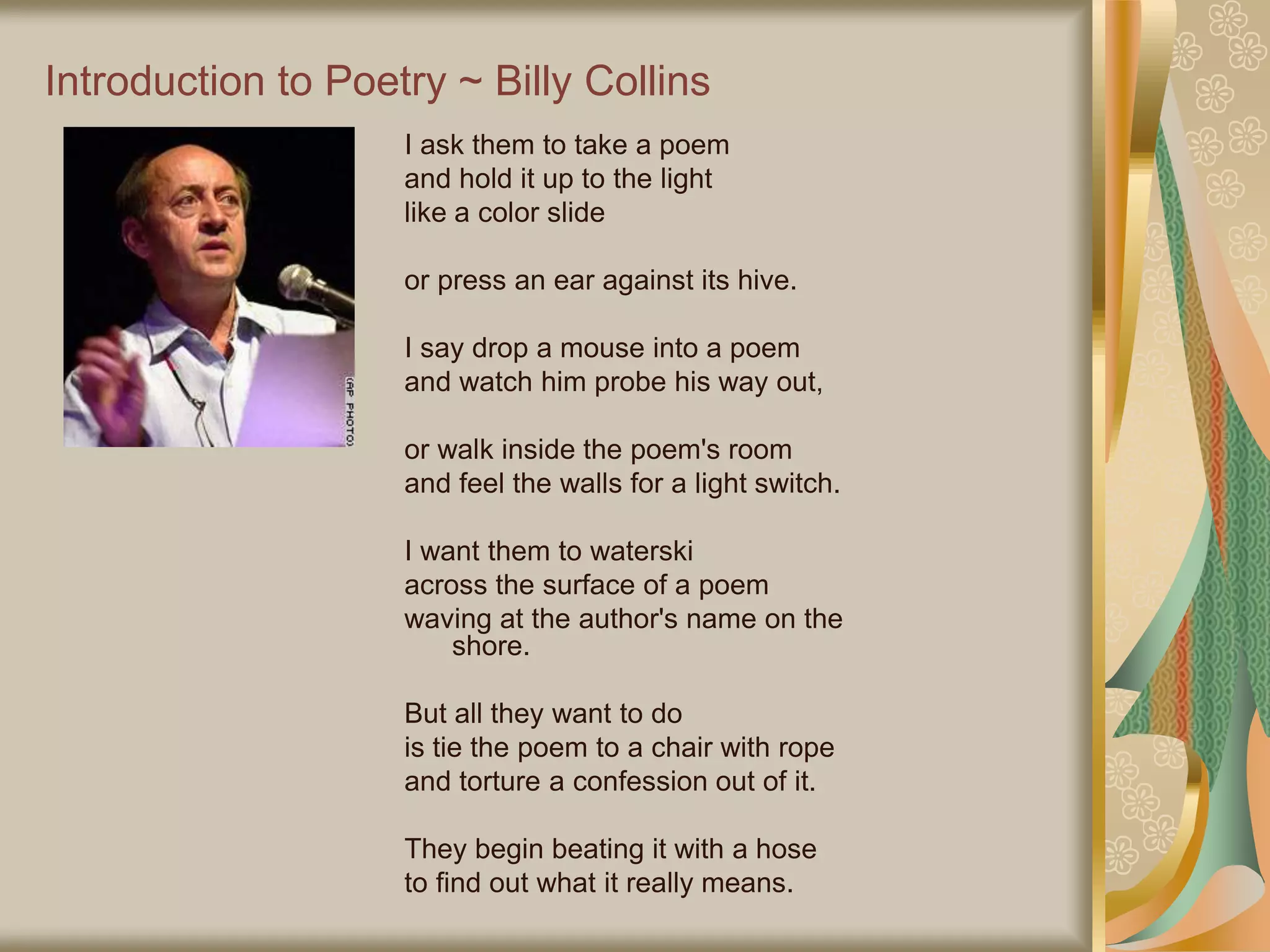
Introduction to Poetry ~ Billy Collins
I ask them to take a poem
and hold it up to the light
like a color slide
or press an ear against its hive.
I say drop a mouse into a poem
and watch him probe his way out,
or walk inside the poem's room
and feel the walls for a light switch.
I want them to waterski
across the surface of a poem
waving at the author's name on the
shore.
But all they want to do
is tie the poem to a chair with rope
and torture a confession out of it.
They begin beating it with a hose
to find out what it really means.
Poetry Workshop Unit: Step One
Immerse Students in the Genre
Before students can begin creating
poetry, they must have a clear vision
of what poetry looks like.
“We (students and teachers) spend
time reading and getting to know the
texts we’ll study. We make notes of
things we notice about how these
texts are written” ~Katie Wood Ray
Poetry Stations
Students are surrounded by poetry.
Differentiation at every level: interest, choice,
ability, multiple intelligences.
Creates a knowledge base for your students to
draw from and to refer to.
A sense of inquiry, curiosity and noticing
pervades the room.
Last two-three days.
Poetry Stations
Create stations based on what you
would like your students to know about
poetry.
For me, it was important that students:
Find poems they loved reading,
Develop a connection with poetry by
responding creatively to it
Poetry is about creating new and surprising
images.
Poetry is meant to be read aloud.
Poetry Stations
Treasure Hunt
Read Aloud
Surprising Poetry Scramble
Responding to Poems
Please get up and check out some of
the stations!
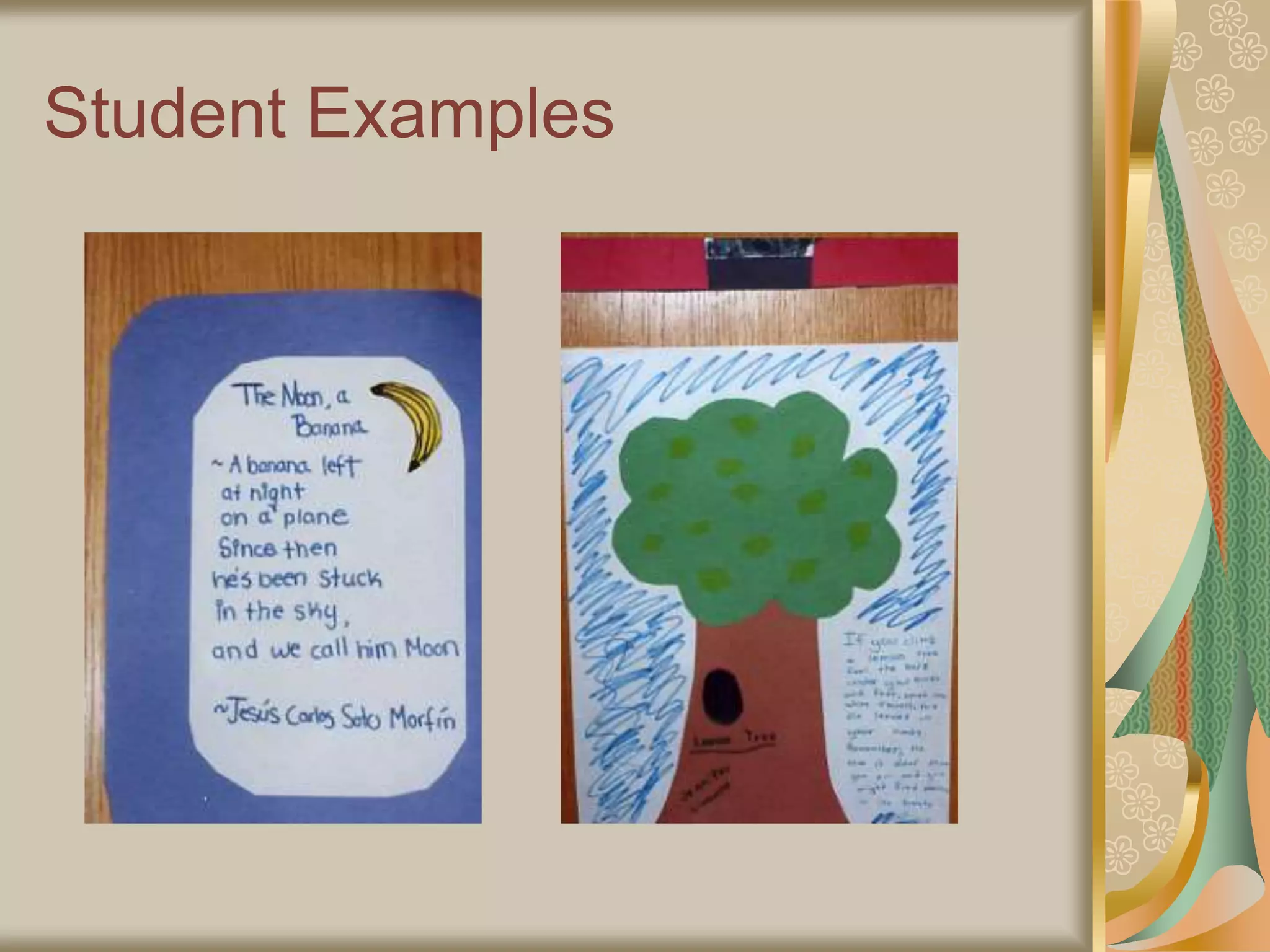
Student Examples
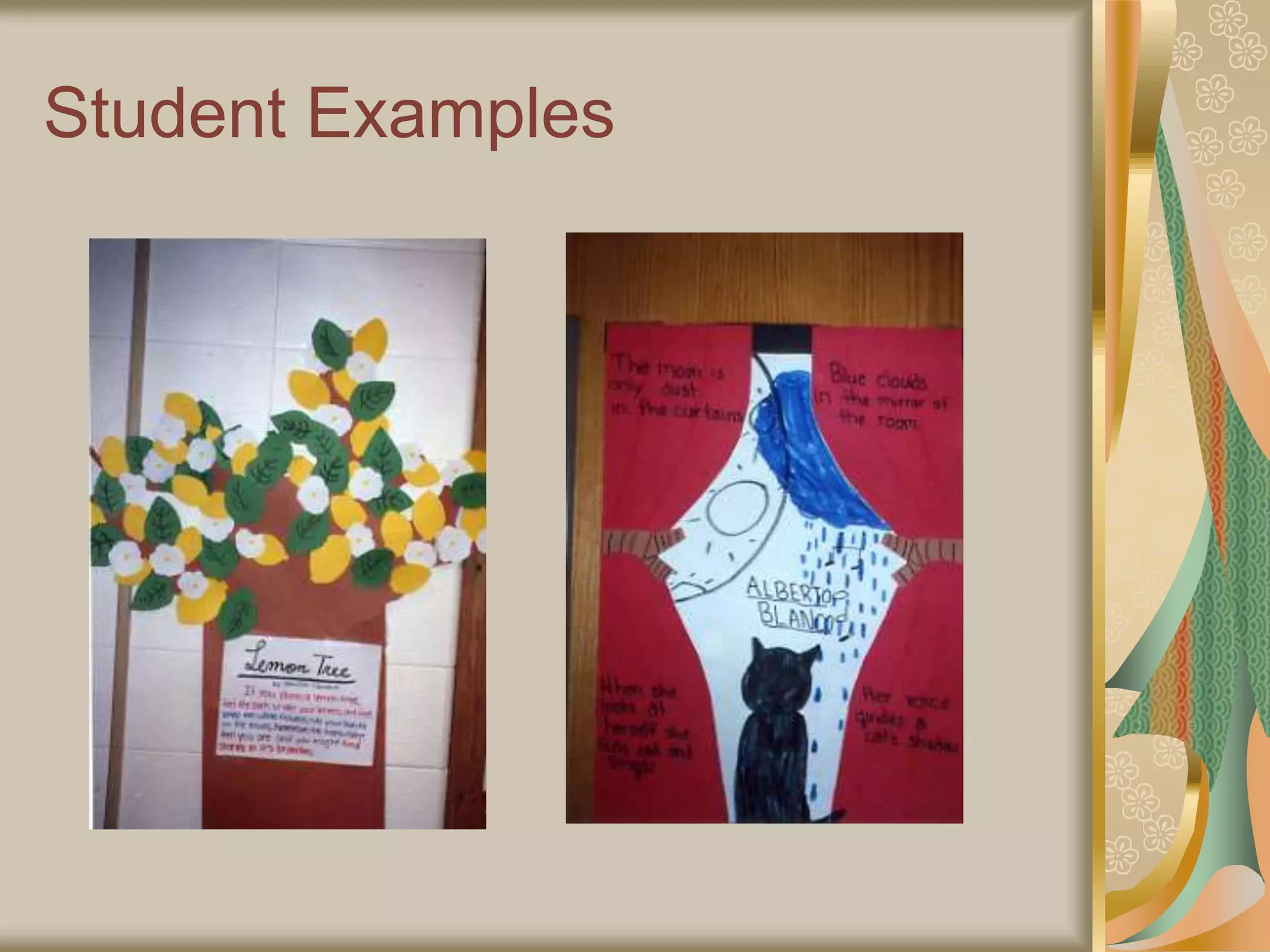
Student Examples
Poetry Stations
Read Aloud can also become a
technology station!
Academy of American Poets Website
www.poets.org
Poetry Stations
At the end of each class, we share
what we have done during the day at
the stations.
Kids share their illustrations, favorite
poems, magnetic poetry they created,
act out poems, and read poems
aloud.
Poetry Workshop: Step Two
“Writing Under the Influence”
Now kids have a vision of what non-
rhyming, contemporary (and modern)
poetry looks like.
Yet students are not ready to go off
and write poems on their own.
We must find poems that can act as
model/mentor texts to help guide
them through the writing process.
Poetry Workshop: Step Two
“Writing Under the Influence”
Think about how you learned to
teach: Turn and talk with a partner
Poetry Workshop: Step Two
“Writing Under the Influence”
Kids need to “apprentice” themselves to
good poetry and imitate the model.
Need to borrow frameworks in which to
express themselves—provides scaffolding
“Continual exposure to structure used often
by professionals will produce attention to,
understanding of, and with practice, normal
use of such structures.” ~Don Killgallon
How do we go about picking mentor
poems?
Read, read, read! Find some poems
you love.
Try to identify the rhetorical structure
in the poem and if any other poems
also use that structure.
Name the type of poem yourself.
Poetry Types I Have Found
Reading Poetry:
Narrative poems
Apology poems
Sound poems
Comparison poems
Persona poems
Question poems
Take a look at your handout!
Structure of Poetry Mini-lesson
Do Now/Anticipatory Set
Introduce model poem
Reading the poem like a reader
Students read poem like writers-noticing chart
Active Engagement (A “Try-it”)
Independent Workshop Time
Share
Closing
Let’s Try It: An Apology Poem
From Kenneth Koch’s Rose, Where Did
You Get That Red?
Apology poems have “a theme children find
irresistible…apologizing for something
you’re really secretly glad you did. They
enjoyed asserting the importance of their
secret pleasure against the world of adult
regulations. They apologized, and were
pleased about, breaking things, taking
things, forgetting and neglecting things,
eating things, hitting people, and looking at
things” (101).
Do Now:
Have you ever had to apologize for
something you were not truly sorry
for?
Turn and talk to your neighbor
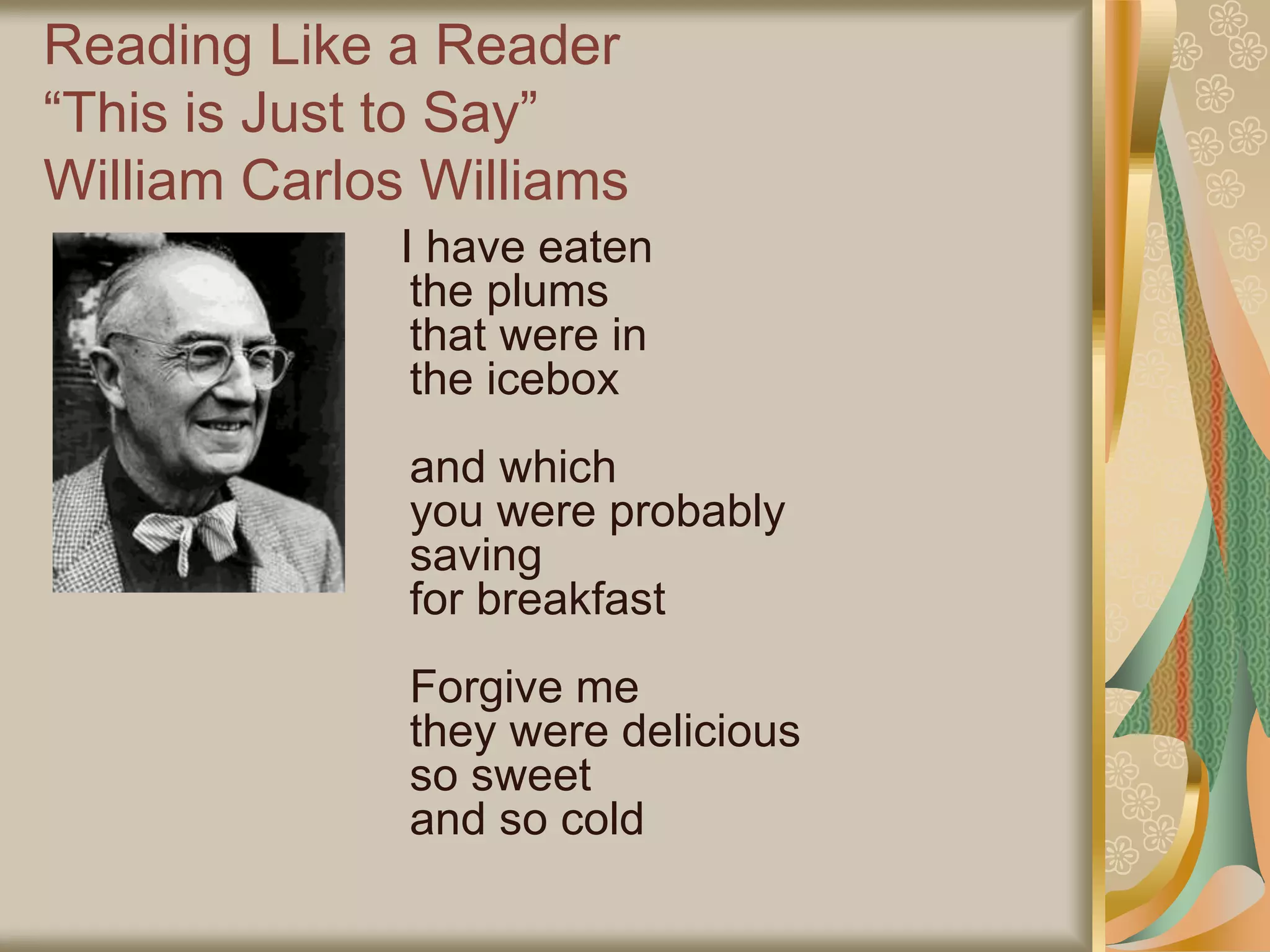
Reading Like a Reader
“This is Just to Say”
William Carlos Williams
I have eaten
the plums
that were in
the icebox
and which
you were probably
saving
for breakfast
Forgive me
they were delicious
so sweet
and so cold
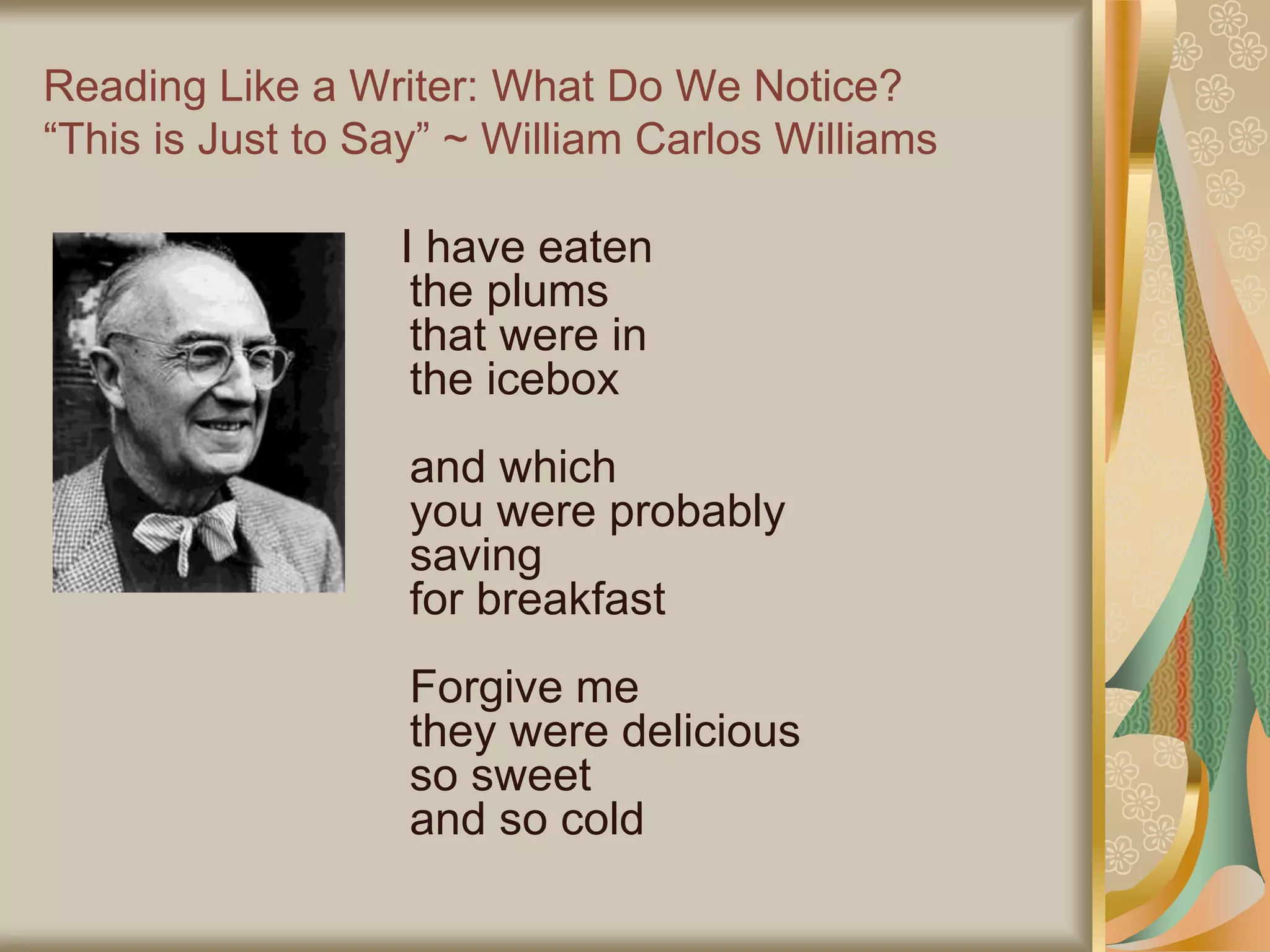
Reading Like a Writer: What Do We Notice?
“This is Just to Say” ~ William Carlos Williams
I have eaten
the plums
that were in
the icebox
and which
you were probably
saving
for breakfast
Forgive me
they were delicious
so sweet
and so cold
Active Engagement:
Class would try one out together on
board, in groups, pairs or individually
on common topic/idea
Example: Sorry for being late, sorry
for not doing our homework, etc.
Independent Workshop Time:
Please try your own apology poem as
I come around to conference with
you.
Share:
Whole group share: sit in circle and
read favorite line or stanza
Partner share
Small group share
Strategy highlight share
Then, teacher would close the lesson.
Students’ Examples
The Armadillo
Please forgive me!!!
I didn’t know
There was a man eating Armadillo
In a box that looked like
It needed to be opened.
If I had read the warnings on the box
I wouldn’t have opened it.
Please forgive me when we get you
Out from that Armadillos belly.
Students’ Examples
Escape
Forgive me
For splashing mud
On my new gleaming white Adidas’
With coral ocean blue stripes
And footpads, soft and rubbery.
I was rushing away, a hurry to escape
And the all out sprint never felt better.
Other types of poems to teach with
mentor texts:
Take a look at your handout and read
over some mentor poems and student
examples.
What are your thoughts so far?
Open Workshop
Once kids have become comfortable
imitating a poem’s structure and craft,
they can choose their own poems to
use as mentor texts.
Revising: Thinking About Choices
Poets Make
Lines and stanzas
Experimenting with line meaning, length and
stanzas
Word choice
Interesting combinations of nouns and verbs
Deleting words we don’t need
Poem titles
Revising: Lines
Take a poem and
put it into prose
form
See how many
different ways we
can break poem
into lines and
stanzas and take a
gallery walk
Give your lines a
haircut—create
uniform lines
Encourages
enjambing—not all
ideas have to start
and end on the
same line!
Revising: Lines ~Let’s Try It!
Lemon Tree ~Jennifer Clement
If you climb a lemon tree feel the bark
under your knees and feet, smell the
white flowers, rub the leave in your
hands. Remember, the tree is older
than you are and you might find
stories in its branches.
Revising: Lines
Lemon Tree ~Jennifer Clement
If you climb a lemon tree
feel the bark
under your knees and feet,
smell the white flowers,
rub the leave in your hands.
Remember,
the tree is older than you are
and you might find stories
in its branches.
Revising: Word Choice
Poetry is all about
surprising and new
word combinations.
Idea from Image
Grammar, Harry
Noden
Have kids brainstorm
a verbs having to do
with occupations: For
example: cooking
Let’s try it!
Put them in a can and
have kids randomly
grab verbs to see if
they can make any
new, surprising
combinations
Revising: Word Choice: Let’s Try It!
Lines of poetry that need
some new noun/verb combinations:
-Dinosaurs roamed the earth
-Violin music fills the air
(from Image Grammar)
Kids Examples:
Before: Blue is the waves on the ocean
After: Blue smoothes out the scribbled ocean
Revision: Poem Titles
Method # 1: Surprising or interesting
phrase from inside your poem
Method # 2: Use the title lead into your
poem.
Method # 3: State the subject of your
poem.
Method # 4: Crafty title
Revision: Homework
You can choose to revise throughout
the writing process by assigning
students to revise for these three
things as homework.
Take a look in your packet for
homework sheet.
Editing: Capitalization and
Punctuation
Have kids look at a variety of poems
with different capitalization and
discuss affect of using capitalization.
Have students use noticing chart to
help understand the uses of
punctuation marks.
Editing: Punctuation
Some answers kids come up with using
punctuation noticing chart:
Period: Stop!
Semicolon: stop a little less than a period—
like a yield sign.
Colon: something important is coming
Comma: slow down, take a breath
Punctuation can happen in the middle and
end of lines of poetry.
Final Assessment: Poetry
Anthology
Take a look at example poetry
anthologies!
Kids created original anthology title,
artwork, dedication, and included five
favorite poems.
Assessment: Process and Product
Rubric
Process Criteria
Incorporate
minilessons?
Have a positive attitude
in writer’s workshop?
Take risks in their
writing?
Revise thoughtfully?
Artifacts from the
writing process (drafts,
revisions, editing
sheets, etc.)
Product Criteria
Specific craft
Line
Word choice
Punctuation and
capitalization
Design and layout of
anthology
Celebration! Creating a Community
of Writers.
Celebration should mimic a book release
party.
Different ways to celebrate:
Author’s share: students share their most
favorite poem.
Invite guests (parents, administrators and other
faculty stop in to listen).
Have food and music playing.
Have students bring in favorite poem. After a
student shares, classmates can jot down a note
to him/her on the back of the poem.
Put anthologies on display in your classroom
library.
Other ways you can incorporate
poetry into your classroom:
Let’s do a whip-around with other
twenty ideas in your packet
Example of a poetry lesson in a
theme-based curriculum:
Greek Myth Persona Poems
Studying Greek Mythology in History
We read Greek Myths and got to know
the characters.
Created persona poems from the
character’s perspective.
Let’s take a look at some examples!
Final Reflections and Thoughts
Kids were willing to take risks in their
writing—finally!
Kids were empowered by the genre:
“Rhyming poems are harder to write
then non rhyming”
“There is no right format when you write
a poem”
“You can arrange your poems in any
way.”
Final Reflections and Thoughts
My struggling writers found their voice in poetry:
“I dedicate this book to google.com for supplying me with
my pictures and my L.A. teacher for helping me discover
what a great poet I am.”
Ruby
Ruby is the center of a volcano.
Feel rubies smooth surface.
Bite in to ruby and taste its intence cinamon flavor.
Ruby sounds like fire cracker on the 4th of July
Bring ruby to your nose
And smell the Smokey ash if its volcano.
Resources
Books
Online: The Academy of American
Poets Teaching Resource Center
http://www.poets.org/page.php/prmID/83
An Invitation to Teach Poetry
K-W-L What Have
You learned about
poetry or teaching
poetry?
What is one way
you will begin using
poetry in your
instruction?
Thank You So Much!
Thank you for taking some time to talk
about poetry with me today!
Thank you, Dr. Meixner, for all your
guidance and arranging the space
and refreshments!
Thank you to the English Department
and students who helped set up the
seminar and made such lovely fliers!
Thanks, also to John for all his help!
The Pen
Take a pen in your uncertain fingers.
Trust, and be assured
That the whole world is a sky-blue butterfly
And words are the nets to capture it.
~Muhammad al-Ghuzzi

how_to_teach_poetry.ppt

  • 1.
    How to Teach PoetryWorkshop By Tiffany Worden Friday, October 28, 2005
  • 2.
    About Me: I graduatedfrom the TCNJ in May 2004 I am a second year teacher at Montgomery Middle School in Skillman, NJ. I teach four 60-minute sixth grade language arts classes. Our school is 5/6 “lower” middle school.
  • 3.
    K - W- L K: What do you know about poetry or teaching how to write poetry? W: What do you want to know about poetry or teaching how to write poetry?
  • 4.
    My Objectives ThisAfternoon: To share my journey through constructing a unit of poetry. To share methods of teaching poetry that worked well for me (and that I hope you add to your teaching tool box). To become enthusiastic readers and writers of poetry ourselves.
  • 5.
    Overview of Presentation Answerthe “why’s” of writing workshop and poetry workshop Bring you through my poetry unit of study— a study of writing non-rhyming, contemporary poetry—introduction through assessment and reflection. Discuss additional ways to incorporate poetry into your classroom. Identify strategies we will use in our own classroom.
  • 6.
    Why Writer’s Workshop? Tobecome better writers, students need a consistent chunk of time to practice writing. In order for students to live like writers, and view themselves as writers, our class time needs to mirror what writers do in the ‘real world’. Skills based--students learn a strategies writers use and apply it to their own writing—meaningful experience.
  • 7.
    Why Genre-Based Workshop? Studentsneed a lens through which they learn strategies for writing; genre provides this lens. With different genres comes opportunity different writing strategies and skills
  • 8.
    Why Poetry Workshop? Modernand contemporary poetry is written in our vernacular and is easily accessible Economy of language: Being specific Playing with language and using it in new and interesting ways Striking word choice Loaded with crafting techniques (similes, imagery, rhetorical structures) Poetry lends itself to critical discussion about the choices writers make.
  • 9.
    Why Poetry Workshop? Inher book, In the Middle, Nancy Atwell writes: “teachers I knew avoided teaching poetry because they felt intimidated by it. They perceived poetry as difficult to read, difficult to understand, and, especially, difficult to talk about. They stopped reading it the moment it stopped being required. Seventy years ago half the literature taught to fourth grades in the United States was poetry. Today, it’s 97 percent prose and just 3 percent poetry. Either we love it, as I did, but can’t imagine how to begin to help students experience it…or we don’t read it and don’t love it … Poetry deserves better and kids deserve better.” (416). We need to put poetry back in our instruction!
  • 10.
    Introduction to Poetry~ Billy Collins I ask them to take a poem and hold it up to the light like a color slide or press an ear against its hive. I say drop a mouse into a poem and watch him probe his way out, or walk inside the poem's room and feel the walls for a light switch. I want them to waterski across the surface of a poem waving at the author's name on the shore. But all they want to do is tie the poem to a chair with rope and torture a confession out of it. They begin beating it with a hose to find out what it really means.
  • 11.
    Poetry Workshop Unit:Step One Immerse Students in the Genre Before students can begin creating poetry, they must have a clear vision of what poetry looks like. “We (students and teachers) spend time reading and getting to know the texts we’ll study. We make notes of things we notice about how these texts are written” ~Katie Wood Ray
  • 12.
    Poetry Stations Students aresurrounded by poetry. Differentiation at every level: interest, choice, ability, multiple intelligences. Creates a knowledge base for your students to draw from and to refer to. A sense of inquiry, curiosity and noticing pervades the room. Last two-three days.
  • 13.
    Poetry Stations Create stationsbased on what you would like your students to know about poetry. For me, it was important that students: Find poems they loved reading, Develop a connection with poetry by responding creatively to it Poetry is about creating new and surprising images. Poetry is meant to be read aloud.
  • 14.
    Poetry Stations Treasure Hunt ReadAloud Surprising Poetry Scramble Responding to Poems Please get up and check out some of the stations!
  • 15.
  • 16.
  • 17.
    Poetry Stations Read Aloudcan also become a technology station! Academy of American Poets Website www.poets.org
  • 18.
    Poetry Stations At theend of each class, we share what we have done during the day at the stations. Kids share their illustrations, favorite poems, magnetic poetry they created, act out poems, and read poems aloud.
  • 19.
    Poetry Workshop: StepTwo “Writing Under the Influence” Now kids have a vision of what non- rhyming, contemporary (and modern) poetry looks like. Yet students are not ready to go off and write poems on their own. We must find poems that can act as model/mentor texts to help guide them through the writing process.
  • 20.
    Poetry Workshop: StepTwo “Writing Under the Influence” Think about how you learned to teach: Turn and talk with a partner
  • 21.
    Poetry Workshop: StepTwo “Writing Under the Influence” Kids need to “apprentice” themselves to good poetry and imitate the model. Need to borrow frameworks in which to express themselves—provides scaffolding “Continual exposure to structure used often by professionals will produce attention to, understanding of, and with practice, normal use of such structures.” ~Don Killgallon
  • 22.
    How do wego about picking mentor poems? Read, read, read! Find some poems you love. Try to identify the rhetorical structure in the poem and if any other poems also use that structure. Name the type of poem yourself.
  • 23.
    Poetry Types IHave Found Reading Poetry: Narrative poems Apology poems Sound poems Comparison poems Persona poems Question poems Take a look at your handout!
  • 24.
    Structure of PoetryMini-lesson Do Now/Anticipatory Set Introduce model poem Reading the poem like a reader Students read poem like writers-noticing chart Active Engagement (A “Try-it”) Independent Workshop Time Share Closing
  • 25.
    Let’s Try It:An Apology Poem From Kenneth Koch’s Rose, Where Did You Get That Red? Apology poems have “a theme children find irresistible…apologizing for something you’re really secretly glad you did. They enjoyed asserting the importance of their secret pleasure against the world of adult regulations. They apologized, and were pleased about, breaking things, taking things, forgetting and neglecting things, eating things, hitting people, and looking at things” (101).
  • 26.
    Do Now: Have youever had to apologize for something you were not truly sorry for? Turn and talk to your neighbor
  • 27.
    Reading Like aReader “This is Just to Say” William Carlos Williams I have eaten the plums that were in the icebox and which you were probably saving for breakfast Forgive me they were delicious so sweet and so cold
  • 28.
    Reading Like aWriter: What Do We Notice? “This is Just to Say” ~ William Carlos Williams I have eaten the plums that were in the icebox and which you were probably saving for breakfast Forgive me they were delicious so sweet and so cold
  • 29.
    Active Engagement: Class wouldtry one out together on board, in groups, pairs or individually on common topic/idea Example: Sorry for being late, sorry for not doing our homework, etc.
  • 30.
    Independent Workshop Time: Pleasetry your own apology poem as I come around to conference with you.
  • 31.
    Share: Whole group share:sit in circle and read favorite line or stanza Partner share Small group share Strategy highlight share Then, teacher would close the lesson.
  • 32.
    Students’ Examples The Armadillo Pleaseforgive me!!! I didn’t know There was a man eating Armadillo In a box that looked like It needed to be opened. If I had read the warnings on the box I wouldn’t have opened it. Please forgive me when we get you Out from that Armadillos belly.
  • 33.
    Students’ Examples Escape Forgive me Forsplashing mud On my new gleaming white Adidas’ With coral ocean blue stripes And footpads, soft and rubbery. I was rushing away, a hurry to escape And the all out sprint never felt better.
  • 34.
    Other types ofpoems to teach with mentor texts: Take a look at your handout and read over some mentor poems and student examples. What are your thoughts so far?
  • 35.
    Open Workshop Once kidshave become comfortable imitating a poem’s structure and craft, they can choose their own poems to use as mentor texts.
  • 36.
    Revising: Thinking AboutChoices Poets Make Lines and stanzas Experimenting with line meaning, length and stanzas Word choice Interesting combinations of nouns and verbs Deleting words we don’t need Poem titles
  • 37.
    Revising: Lines Take apoem and put it into prose form See how many different ways we can break poem into lines and stanzas and take a gallery walk Give your lines a haircut—create uniform lines Encourages enjambing—not all ideas have to start and end on the same line!
  • 38.
    Revising: Lines ~Let’sTry It! Lemon Tree ~Jennifer Clement If you climb a lemon tree feel the bark under your knees and feet, smell the white flowers, rub the leave in your hands. Remember, the tree is older than you are and you might find stories in its branches.
  • 39.
    Revising: Lines Lemon Tree~Jennifer Clement If you climb a lemon tree feel the bark under your knees and feet, smell the white flowers, rub the leave in your hands. Remember, the tree is older than you are and you might find stories in its branches.
  • 40.
    Revising: Word Choice Poetryis all about surprising and new word combinations. Idea from Image Grammar, Harry Noden Have kids brainstorm a verbs having to do with occupations: For example: cooking Let’s try it! Put them in a can and have kids randomly grab verbs to see if they can make any new, surprising combinations
  • 41.
    Revising: Word Choice:Let’s Try It! Lines of poetry that need some new noun/verb combinations: -Dinosaurs roamed the earth -Violin music fills the air (from Image Grammar) Kids Examples: Before: Blue is the waves on the ocean After: Blue smoothes out the scribbled ocean
  • 42.
    Revision: Poem Titles Method# 1: Surprising or interesting phrase from inside your poem Method # 2: Use the title lead into your poem. Method # 3: State the subject of your poem. Method # 4: Crafty title
  • 43.
    Revision: Homework You canchoose to revise throughout the writing process by assigning students to revise for these three things as homework. Take a look in your packet for homework sheet.
  • 44.
    Editing: Capitalization and Punctuation Havekids look at a variety of poems with different capitalization and discuss affect of using capitalization. Have students use noticing chart to help understand the uses of punctuation marks.
  • 45.
    Editing: Punctuation Some answerskids come up with using punctuation noticing chart: Period: Stop! Semicolon: stop a little less than a period— like a yield sign. Colon: something important is coming Comma: slow down, take a breath Punctuation can happen in the middle and end of lines of poetry.
  • 46.
    Final Assessment: Poetry Anthology Takea look at example poetry anthologies! Kids created original anthology title, artwork, dedication, and included five favorite poems.
  • 47.
    Assessment: Process andProduct Rubric Process Criteria Incorporate minilessons? Have a positive attitude in writer’s workshop? Take risks in their writing? Revise thoughtfully? Artifacts from the writing process (drafts, revisions, editing sheets, etc.) Product Criteria Specific craft Line Word choice Punctuation and capitalization Design and layout of anthology
  • 48.
    Celebration! Creating aCommunity of Writers. Celebration should mimic a book release party. Different ways to celebrate: Author’s share: students share their most favorite poem. Invite guests (parents, administrators and other faculty stop in to listen). Have food and music playing. Have students bring in favorite poem. After a student shares, classmates can jot down a note to him/her on the back of the poem. Put anthologies on display in your classroom library.
  • 49.
    Other ways youcan incorporate poetry into your classroom: Let’s do a whip-around with other twenty ideas in your packet
  • 50.
    Example of apoetry lesson in a theme-based curriculum: Greek Myth Persona Poems Studying Greek Mythology in History We read Greek Myths and got to know the characters. Created persona poems from the character’s perspective. Let’s take a look at some examples!
  • 51.
    Final Reflections andThoughts Kids were willing to take risks in their writing—finally! Kids were empowered by the genre: “Rhyming poems are harder to write then non rhyming” “There is no right format when you write a poem” “You can arrange your poems in any way.”
  • 52.
    Final Reflections andThoughts My struggling writers found their voice in poetry: “I dedicate this book to google.com for supplying me with my pictures and my L.A. teacher for helping me discover what a great poet I am.” Ruby Ruby is the center of a volcano. Feel rubies smooth surface. Bite in to ruby and taste its intence cinamon flavor. Ruby sounds like fire cracker on the 4th of July Bring ruby to your nose And smell the Smokey ash if its volcano.
  • 53.
    Resources Books Online: The Academyof American Poets Teaching Resource Center http://www.poets.org/page.php/prmID/83
  • 54.
    An Invitation toTeach Poetry K-W-L What Have You learned about poetry or teaching poetry? What is one way you will begin using poetry in your instruction?
  • 55.
    Thank You SoMuch! Thank you for taking some time to talk about poetry with me today! Thank you, Dr. Meixner, for all your guidance and arranging the space and refreshments! Thank you to the English Department and students who helped set up the seminar and made such lovely fliers! Thanks, also to John for all his help!
  • 56.
    The Pen Take apen in your uncertain fingers. Trust, and be assured That the whole world is a sky-blue butterfly And words are the nets to capture it. ~Muhammad al-Ghuzzi