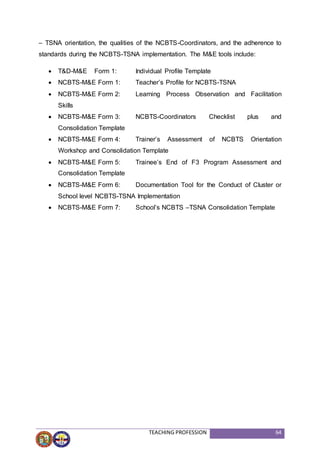
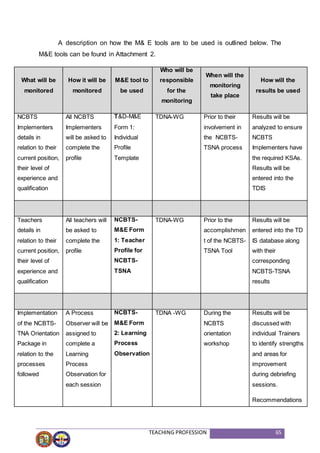
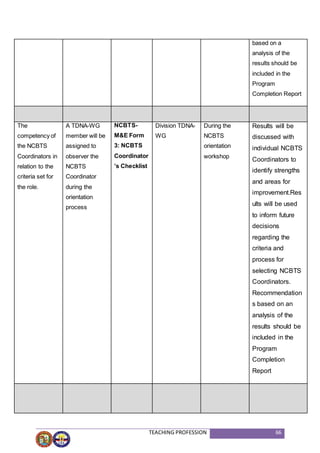
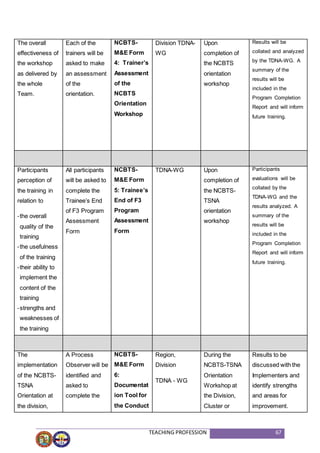
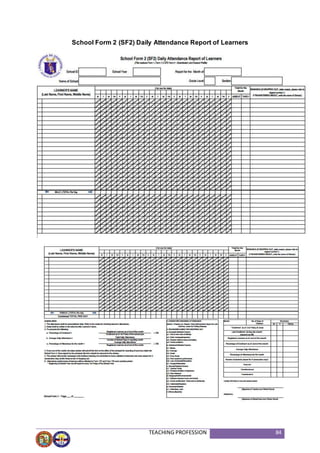
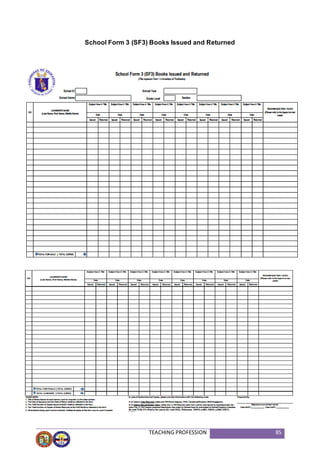
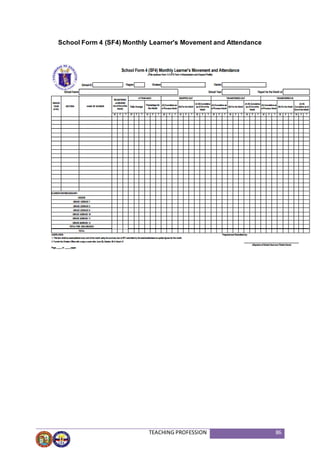
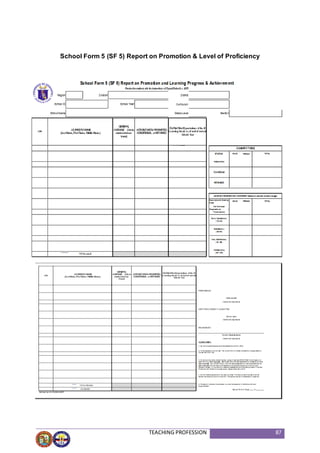
TEACHING PROFESSION 1
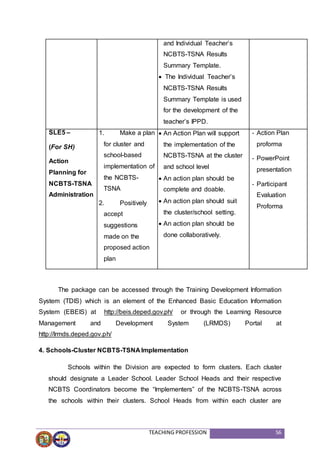
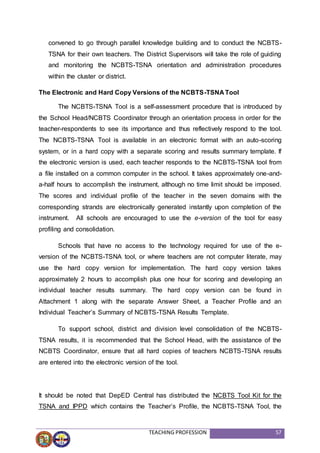
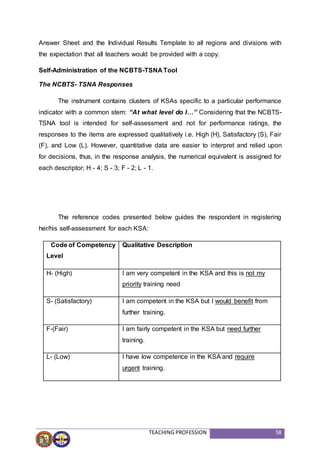
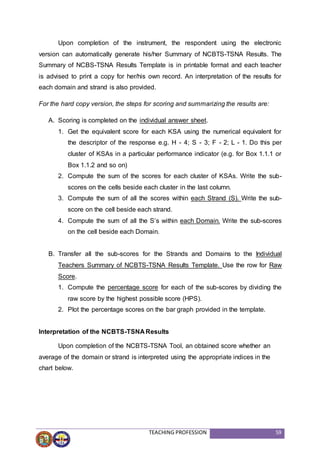
TEACHING PROFESSION 2
This piece of work is whole heartedly dedicated to our Almighty God our Creator for
his guidance, strength, knowledge, wisdom and faith that he gave to me in times of
difficulty while making this Teacher’s manual.
To my The Teaching Profession subject teacher, Dr. Vilma Andoy, for her
considerations, advices, and suggestion regarding this project;
To my loving parents who gave me support both morally and financially, to those
concern specifically in this subject, who become valuable part in the accomplishment
of this work and whose presence inspired me all the way.
TEACHING PROFESSION 3
Table of Contents
Title Page
Acknowledgments
Part 1: The Teacher as a Person
REPUBLIC ACT 7836 (Philippine Teachers
Professionalization Act of 1994)
The Magna Carta for Public School Teachers
Code of Ethics For Professional Teachers
National Competency Based Teacher Standards (Teachers’
Strengths and Needs Assessment (NCBTS – TSNA)
Philosophy of Education
Sample Case Digest
Part 2: The Teacher in the Classroom
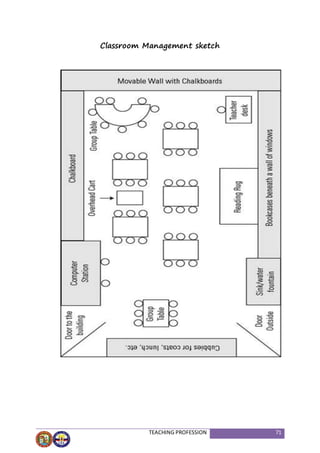
Classroom Management sketch
Tips on How to Manage Classroom Undesirable Student’s
Behaviour and Ways on How to Maintain Positive Learning
Environment
Different School Forms
Proposed programs for school home and community
Sample Training program for Pre-Service Teachers
TEACHING PROFESSION 4
Part 1
The Teacher as a Person
This part consists of laws pertaining to the rights and benefits of a teacher.
These will serve as his/her guide if in case he/she will be put in a situation that is not
favour on him/her and need to defend his/her profession and his/her dignity as a
human.
REPUBLIC ACT 7836
(Philippine Teachers Professionalization Act of 1994)
AN ACT TO STRENGTHEN THE REGULATION AND SUPERVISION OF THE
PRACTICE OF TEACHING IN THE PHILIPPINES AND PRESCRIBING A
LICENSURE EXAMINATION FOR TEACHERS AND FOR OTHER PURPOSES.
Section 1.
Short Title. — This Act shall be known as the "Philippine Teachers
Professionalization Act of 1994."
Section 2.
Statement of Policy. — The State recognizes the vital role of teachers in
nation-building and development through a responsible and literate citizenry.
Towards this end, the State shall ensure and promote quality education by proper
supervision and regulation of the licensure examination and professionalization of
the practice of the teaching profession.
Section 3.
REPUBLIC ACT 7836
TEACHING PROFESSION 5
Objectives. — This Act has the herein objectives:
a) The promotion, development and professionalization of teachers and
the teaching profession; and
b) The supervision and regulation of the licensure examination.
Section 4.
Definition of Terms. — For purposes of this Act, the following terms shall
mean:
A. "Teaching" — refers to the profession concerned primarily with
classroom instruction, at the elementary andsecondary levels in
accordance with the curriculum prescribed by the Department of
Education, Culture and Sports, whether on part-time or full-time basis
in the private or public schools.
B. "Teachers" — refers to all persons engaged in teaching at the
elementary and secondary levels, whether on full-time or part-time
basis, including industrial arts or vocational teachers and all other
persons performing supervisory and/or administrative functions in all
schools in the aforesaid levels and qualified to practice teaching under
this Act.
C. "Board" — refers to the Board for Professional Teachers duly
established and constituted under this Act.
D. "Commission" — refers to the Professional Regulation Commission.
ARTICLE II BOARD FOR PROFESSIONAL TEACHERS
Section 5.
Creation and Composition of the Board. — There is hereby created under this
Act a Board for Professional Teachers, hereinafter called the Board, a collegial body
under the general supervision and administrative control of the Professional
Regulation Commission, hereinafter referred to as the Commission, composed of
five (5) members who shall be appointed by the President of the Philippines from
among the recommendee’s chosen by the Commission. The recommendees shall be
chosen from the list of nominees selected by the accredited association of
teachers, who duly possess all the qualifications prescribed in Section 8 of this Act.
TEACHING PROFESSION 6
The chairman and the voice-chairman of the Board shall be appointed from
these five (5) members by the President: Provided, That the members of the first
Board appointed under this Act shall be automatically registered as professional
teachers and issued with the certificate of registration and professional license upon
payment of the fees for examination, registration, and other fees prescribed by the
Commission.
Section 6.
Duties and Function of the Board. — The Board shall have the following
duties and functions:
a. Promulgate, administer and enforce rules and regulations necessary for
carrying out the provisions of this Act in accordance with the charter of
the Professional Regulation Commission;
b. Determine and fix the frequency, dates, and places of examination,
appoint supervisors, proctors, and other personnel as needed who shall
be entitled to a daily allowance to be fixed by the Board for every
examination day actually attended, use buildings and facilities of public
or private schools for examination purposes;
c. Issue, suspend, or revoke the certificate of registration for the practice of
the teaching profession;
d. Prescribe and collect examination and other fees as it may deem proper;
e. Prescribe and/or adopt a code of ethical and professional standards for
the practice of the teaching profession.Such ethical standards, rules and
regulations to take effect sixty (60) days after its publication in the Official
Gazette or in any newspaper of general circulation;
f. Administer oaths in connection with the administration of this Act;
g. Supervise and regulate the registration, licensure and practice of
professional teachers in the Philippines;
h. Adopt an official seal of the Board;
i. Look into the conditions affecting the practice of the teaching profession
and whenever necessary, adopt such measures as may be deemed
proper for the enhancement and maintenance of high professional and
ethical standards of the profession;
TEACHING PROFESSION 7
j. Ensure that all educational institutions offering elementary and
secondary education comply with the essential requirements for
curricula, faculty and facilities for the elementary and secondary levels;
k. Investigate such violations of this Act, the rules and the code of ethical
and professional standards for professional teachers as it may come to
the knowledge of the Board, and for this purpose, to issue subpoena and
subpoena duces tecum to secure the appearance of witnesses and the
production of documents in connection therewith; and
l. Discharge such other powers, duties and functions as the Board may
deem necessary for the practice of the teaching profession and the
upgrading, enhancement, development and growth of education in the
Philippines.
Section 7.
Term of Office. — The members of the Board shall hold office for a term of
three (3) years from the date they assume office: Provided, That the first
appointees to the Board under this Act shall hold office according to the following
terms: one (1) member shall serve for one (1) year; one (1) member for two (2)
years; the chairman, vice-chairman, and one (1) member for three (3) years.
Vacancies shall be served for the unexpired term only. No person who has served
for two (2) consecutive terms shall be eligible for reappointment. Appointment to fill
an unexpired term shall be considered an appointment to a complete term. The
chairman or any member shall take his oath of office prior to the performance of his
duties.
Section 8.
Qualification of Board Members. — Each Board member must at the time of
his appointment:
a. Be a citizen and resident of the Philippines;
b. Be at least thirty-five (35) years of age, of proven integrity, and
possessed of high moral values in his personal as well as professional
conduct and has not been convicted of any offense involving moral
turpitude;
TEACHING PROFESSION 8
c. Be a holder of the degree of Bachelor of Arts or Bachelor of Science in
Education and preferably a holder of a master's or doctorate degree in
education, or their equivalents, from a university, school, college,
academy or institute duly constituted, recognized and/or accredited by
the Philippine government;
d. Be a professional teacher with a valid certificate of registration and
valid professional license, save those members who shall compose the
first Board for Professional Teachers;
e. Has been a professional teacher in the active practice of the teaching
profession for at least ten (10) years in the elementary and secondary
level; and
f. Not be an official or member of the faculty of, nor have pecuniary
interest in any university, college, school, or institution conferring a
bachelor's degree in education or its equivalents for at least three (3)
years prior to his appointment, and neither connected with a review
center or with any group or association where review classes or
lectures in preparation for the licensure examination are offered or
conducted. Provided, however, that, the membership to the Board shall
be evenly distributed to cover all levels of education, including
equitable representation of the different fields of specialization.
Section 9.
Compensation of the Board. — The chairman, vice-chairman, and members
of the Board shall receive compensation comparable to the compensation received
by existing regulatory boards under the Professional Regulation Commission,
computed on the basis of the number of examinees/candidates.
Section 10.
Supervision of the Board and Custodian of its Records. — The Board shall be
under the supervision and control of the Commission. All records, including
applications for examination, examination papers and results, minutes of
deliberation, administrative cases and investigative cases and investigations
involving professional teachers shall be kept by the Commission.
TEACHING PROFESSION 9
Section 11.
Secretariat and Support Services. — The Professional Regulation
Commission, through its chairman, shall provide the secretariat and other support
services to implement effectively the provisions of this Act.
Section 12.
Removal of a Board Member. — The chairman or any member of the Board
may be removed by the President of the Philippines upon recommendation of the
Commission for neglect of duty, incompetence, unprofessional, unethical, immoral or
dishonourable conduct, commission or toleration of irregularities in the examination,
after having been given the opportunity to defend himself in a proper administrative
investigation.
In the course of investigation, the President may preventively suspend the
respondent.
ARTICLE III EXAMINATION AND REGISTRATION
Section 13.
Examination, Registration and License Required. — Except as otherwise
specifically allowed under the provisions of this Act, all applicants for registration as
professional teachers shall be required to undergo a written examination which shall
be given at least once a year in such places and dates as the Board may determine
upon approval by the Commission. A valid certificate of registration and a valid
professional license from the Commission are required before any person is allowed
to practice as a professional teacher in the Philippines, except as otherwise allowed
under this Act.
Section 14.
Scope of Examination. — The examinations for the elementary and
secondary school teachers shall be separate. The examination for teachers in the
elementary level shall consist of two (2) parts, namely: professional education and
general education. The examination for teachers in the secondary level shall consist
TEACHING PROFESSION 10
of three (3) parts, namely: professional education, general education, and field of
specialization.
Section 15.
Qualification Requirements of Applicants. — No applicant shall be admitted to
take the examination unless, on the date of filing of the application, he shall have
complied with the following requirements:
a. A citizen of the Philippines or an alien whose country has reciprocity
with the Philippines in the practice of the teaching profession;
b. At least eighteen (18) years of age;
c. In good health and of good reputation with high moral values;
d. Has not been convicted by final judgment by a court for an offense
involving moral turpitude;
e. A graduate of a school, college or university recognized by the
government and possesses the minimum educational qualifications, as
follows:
1. For teachers in preschool, a bachelor's degree in early childhood
education (BECED) or its equivalent;
2. For teachers in the elementary grades, a bachelor's degree in
elementary education (BSEED) or its equivalent;
3. For teachers in the secondary grades, a bachelor's degree in
education or its equivalent with a major and minor, or a bachelor's
degree in arts and sciences with at least ten (10) units in
professional education; and
4. For teachers of vocational and two-year technical courses, a
bachelor's degree in the field of specialization or its equivalent, with
at least eighteen (18) units in professional education.
Section 16.
Report of the Results of the Examination. — The Board shall, within one
hundred twenty (120) days after the examination, report the ratings obtained by
each candidate to the Professional Regulation Commission for approval and
appropriate action.
TEACHING PROFESSION 11
Section 17.
Issuance of Certificate of Registration and Professional License. — The
registration of a professional teacher commences from the date his name is enrolled
in the roster of professional teachers.
Every registrant who has satisfactorily met all the requirements specified in
this Act shall, upon payment of the registration fee, be issued a certificate of
registration as a professional teacher bearing the full name of the registrant with
serial number and date of issuance signed by the chairman of the Commission and
the chairman, vice-chairman, and members of the Board, stamped with the official
seal, as evidence that the person named therein is entitled to practice the profession
with all the rights and privileges appurtenant thereto. The certificate shall remain in
full force and effect until withdrawn, suspended and/or revoked in accordance with
law.
A professional license signed by the chairman of the Commission and bearing
the registration number and date of issuance thereof and the month of expiry or
renewability shall likewise be issued to every registrant who has paid the annual
registration fees for three (3) consecutive years. This license shall serve as evidence
that the licensee can lawfully practice his profession until the expiration of its validity.
Section 18.
Oath Before Practice. — Every registrant shall be required to take his
professional oath before practicing as a professional teacher.
Section 19.
Periodic Merit Examination of Teachers. — To encourage continuing
professional growth and development and to provide additional basis for merit
promotion, in addition to their performance rating, teachers may take an oral and
written examination at least once in five (5) years as basis for merit promotion. In
taking this examination, no fee shall be required.
Section 20.
Failure to Pass the Merit Examination. — If a teacher fails to pass the merit
examination, he or she shall be allowed to take the examination for a second time.
Should he or she fail to pass the merit examination for the second time, then he or
TEACHING PROFESSION 12
she shall be required to take a DECS accredited refresher course or program before
being allowed to retake the examination.
Failure of any permanent teacher to pass the merit examination shall not,
however, be used as a ground for his/her dismissal or demotion.
Section 21.
Incentives. — Teachers who pass the merit examination shall:
a. Be awarded a diploma of merit by the Board;
b. Earn merit points for purposes of promotion in salary or to a higher
position or grade level;
c. Be placed in the priority list for government scholarship; and
d. Enjoy such other benefits as may be promulgated by the Board.
Similar incentives shall be given to teachers who make inventions, develop
new methods of teaching, write a book or books and create works of artistic merit.
Section 22.
Integration of the Teaching Profession. — The teaching profession shall be
integrated into one national organization which shall be recognized by the Board and
the Commission as the one and only integrated and accredited association of
professional teachers. Upon registration with the Board, every professional teacher
shall be encouraged to become a member of the integrated national organization.
Those who have been registered with the Board but are not members of the said
integrated organization shall be allowed to register as members of the said
integrated organization within three (3) years after the effectivity of this Act.
Membership in the integrated organization shall not be a bar to membership in other
associations of the teaching profession. The professional teachers shall receive the
benefits and privileges appurtenant to their membership in the said integrated and
accredited organization of professional teachers only upon payment of the required
membership fees and dues.
Section 23.
Revocation of the Certificate of Registration, Suspension from the Practice of
the Teaching Profession, and Cancellation of Temporary or Special Permit. — The
TEACHING PROFESSION 13
Board shall have the power, after due notice and hearing, to suspend or revoke the
certificate of registration of any registrant, to reprimand or to cancel the
temporary/special permit of a holder thereof who is exempt from registration, for any
of the following causes:
a. Conviction for any criminal offense by a court of competent jurisdiction;
b. Immoral, unprofessional or dishonorable conduct;
c. Declaration by a court of competent jurisdiction for being mentally
unsound or insane;
d. Malpractice, gross incompetence, gross negligence or serious
ignorance of the practice of the teaching profession;
e. The use of or perpetration of any fraud or deceit in obtaining a
certificate of registration, professional license or special/temporary
permit;
f. Chronic inebriety or habitual use of drugs;
g. Violation of any of the provisions of this Act, the rules and regulations
and other policies of the Board and the Commission, and the code of
ethical and professional standards for professional teachers; and
h. Unjustified or wilful failure to attend seminars, workshops, conferences
and the like or the continuing education program prescribed by the
Board and the Commission.
The decision of the Board to revoke or suspend a certificate may be appealed
to the regional trial court of the place where the Board holds office within fifteen (15)
days from receipt of the said decision or of the denial of the motion for
reconsideration filed in due time.
Section 24.
Registration by Reciprocity. — No teacher of a foreign nationality shall be
admitted to the examination, or be given a certificate of registration or be entitled to
any of the rights and privileges provided under this Act; unless the country or state of
which he is a subject permits Filipino professional teachers to practice within its
territorial limits on the same basis as subjects or citizens of said country or state:
Provided, that the requirements of certification of teachers with said foreign state or
country are substantially the same as those required and contemplated under this
Act: Provided, further, That the laws of such state or country grant the same privilege
TEACHING PROFESSION 14
to Filipino professional teachers on the same basis as the subject or citizens of such
foreign country or state.
Section 25.
Roster of Professional Teachers. — A roster of professional teachers
containing the names and addresses of professional teachers, date of registration or
issuance of certificate, and other data which in the opinion of the Board may appear
pertinent shall be maintained. Copies of the roster shall be provided by the
Commission to the Board, the Department of Education, Culture and Sports, and the
integrated and accredited organization of professional teachers.
Section 26.
Registration and Exception. — Two (2) years after the effectivity of this Act,
no person shall engage in teaching and/or act as a professional teacher as defined
in this Act, whether in the preschool, elementary or secondary level, unless he is a
duly registered professional teacher, and a holder of a valid certificate of registration
and a valid professional license or a holder of a valid special/temporary permit.
Upon approval of the application and payment of the prescribed fees, the
certificate of registration and professional license as a professional teacher shall be
issued without examination as required in this Act to a qualified applicant, who at the
time of the approval of this Act, is:
a. A holder of a certificate of eligibility as a teacher issued by the Civil
Service Commission and the Department of Education, Culture and
Sports; or
b. A registered professional teacher with the National Board for Teachers
under the Department of Education, Culture and Sports (DECS)
pursuant to Presidential Decree No. 1006; or
c. Not qualified under paragraphs one and two but with any of the
following qualifications. to wit:
1. An elementary or secondary teacher for five (5) years in good
standing and a holder of Bachelor of Science in Education or its
equivalent; or
TEACHING PROFESSION 15
2. An elementary or secondary teacher for three (3) years in good
standing and a holder of a master's degree in education or its
equivalent.
Provided, That they shall be given two (2) years from the organization of the
Board for professional teachers within which to register and be included in the roster
of professional teachers: Provided, further, That those incumbent teachers who are
not qualified to register without examination under this Act or who, albeit qualified,
were unable to register within the two-year period shall be issued a five-year
temporary or special permit from the time the Board is organized within which to
register after passing the examination and complying with the requirements provided
this Act and be included in the roster of professional teachers: Provided, furthermore,
That those who have failed the licensure examination for professional teachers shall
be eligible as para-teachers and as such, shall be issued by the Board a special or
temporary permit, and shall be assigned by the Department of Education, Culture
and Sports (DECS) to schools as it may determine under the circumstances.
ARTICLE IV PROVISIONS RELATIVE TO THE PRACTICE OF THE TEACHING
PROFESSION
Section 27.
Inhibition Against the Practice of the Teaching Profession. — Except as
otherwise allowed under this Act, no person shall practice or offer to practice the
teaching profession in the Philippines or be appointed as teacher to any position
calling for a teaching position without having previously obtained a valid certificate of
registration and a valid professional license from the Commission.
Section 28.
Penal Provisions. — The following shall be punishable by a fine of not less
than Five thousand pesos (P5,000.00) nor more than Twenty thousand pesos
(P20,000.00) or imprisonment of nor less than six (6) months nor more than five (5)
years, or both, at the discretion of the court:
TEACHING PROFESSION 16
a. Any person who practices the teaching profession in the Philippines
without being certified in accordance with the provisions of this Act;
b. Any person who represents or attempts to use as his own certificate of
registration that of another;
c. Any person who gives any false, or fraudulent evidence of any kind to
the Board or any member thereof in obtaining a certificate of
registration as teacher;
d. Any person who impersonates any registrant of the same or different
name;
e. Any person who uses a revoked or suspended certificate of
registration;
f. Any person who, in connection with his name, otherwise assumes,
uses or advertises any title or description t ending to convey or
conveys the impression that he is a teacher without holding a valid
certificate; and
g. Any person who violates or who abets the violation of any of the
provisions of this Act.
The penalty of fine or imprisonment or both, as provided in this section, shall
also apply to any school official who shall cause or be responsible for the
commission of any of the above-enumerated acts.
Section 29.
Appropriations. — Such sums as may be necessary to carry out the
provisions of this Act shall be included in the 1996 General Appropriations Act and
thereafter.
Section 30.
Implementing Guidelines. — The Board shall formulate and adopt the
necessary guidelines for the effective implementation of the provisions of this Act
within sixty (60) days of its approval.
The Board shall submit to both Committees on Education, Arts, and Culture; and the
Committees on Civil Service and Professional Regulation of the Senate and House
TEACHING PROFESSION 17
of Representatives, copies of the implementing rules and guidelines within thirty (30)
days after its promulgation.
Any violation of this section shall render the official/s concerned liable under
Republic Act No. 6713, otherwise known as the "Code of Conduct and Ethical
Standards for Public Officials and Employees" and other pertinent administrative
and/or penal laws.
Section 31.
Transitory Provision. — All incumbent teachers in both the public and private
sector not otherwise certified as professional teachers by virtue of this Act, shall be
given (5) years temporary certificates from the time the Board for Professional
Teachers is organized within which to qualify as required by this Act and be included
in the roster of professionals.
Provided, however, That the Professional Board Examination for Teachers
(PBET) shall still be administered by the Civil Service Commission and the
Department of Education, Culture and Sports for the year 1995.cralaw
Section 32.
Separability Clause. — If, for any reason, any section or provision of this Act
or the application of such section or provision to any person or circumstance is
declared unconstitutional or invalid, no other section or provision of this Act shall be
affected thereby.
Section 33.
Repealing Clause. — All laws, presidential decrees, executive orders, rules
and regulations or parts thereof inconsistent with the provisions of this Act are
hereby repealed or modified accordingly.
Section 34.
Effectivity Clause. — This Act shall take effect after fifteen (15) days following
its complete publication in the Official Gazette or in two (2) newspapers of general
circulation.
Signed: December 16, 1994
TEACHING PROFESSION 18
THE MAGNA CARTA FOR PUBLIC SCHOOL TEACHERS
I. DECLARATION OF POLICY COVERAGE
Section 1.
Declaration of Policy. It is hereby declared to be the policy of this Act to
promote and improve the social and economic status of public school teachers, their
living and working conditions, their terms of employment and career prospects in
order that they may compare favorably with existing opportunities in other walks of
life, attract and retain in the teaching profession more people with the proper
qualifications, it being recognized that advance in education depends on the
qualifications and ability of the teaching staff and that education is an essential factor
in the economic growth of the nation as a productive investment of vital importance.
Section 2.
Title Definition. This Act shall be known as the "Magna Carta for Public School
Teachers" and shall apply to all public school teachers except those in the
professorial staff of state colleges and universities.
As used in this Act, the term "teacher" shall mean all persons engaged in
classroom teaching, in any level of instruction, on full-time basis, including guidance
counselors, school librarians, industrial arts or vocational instructors, and all other
persons performing supervisory and/or administrative functions in all schools,
colleges and universities operated by the Government or its political subdivisions;
but shall not include school nurses, school physicians, school dentists, and other
school employees.
THE MAGNA CARTA FOR
PUBLIC SCHOOL TEACHERS
TEACHING PROFESSION 19
II. RECRUITMENT AND CAREER
Section 3.
Recruitment and Qualification. Recruitment policy with respect to the selection
and appointment of teachers shall be clearly defined by the Department of
Education: Provided, however, That effective upon the approval of this Act, the
following shall constitute the minimum educational qualifications for teacher-
applicants:
a. For teachers in the kindergarten and elementary grades, Bachelor's
degree in Elementary Education (B.S.E.ED.);
b. For teachers of the secondary schools, Bachelor's degree in Education
or its equivalent with a major and a minor; or a Bachelor's degree in
Arts or Science with at least eighteen professional units in Education.
c. For teachers of secondary vocational and two years technical courses,
Bachelor's degree in the field of specialization with at least eighteen
professional units in education;
d. For teachers of courses on the collegiate level, other than vocational,
master's degree with a specific area of specialization;
Provided, further, That in the absence of applicants who possess the
minimum educational qualifications as hereinabove provided, the school
superintendent may appoint, under a temporary status, applicants who do not meet
the minimum qualifications: Provided, further, That should teacher-applicants,
whether they possess the minimum educational qualifications or not, be required to
take competitive examinations, preference in making appointments shall be in the
order of their respective ranks in said competitive examinations: And provided,
finally, That the results of the examinations shall be made public and every applicant
shall be furnished with his score and rank in said examinations.
Section 4.
Probationary Period. When recruitment takes place after adequate training
and professional preparation in any school recognized by the Government, no
probationary period preceding regular appointment shall be imposed if the teacher
possesses the appropriate civil service eligibility: Provided, however, That where,
TEACHING PROFESSION 20
due to the exigencies of the service, it is necessary to employ as teacher a person
who possesses the minimum educational qualifications herein above set forth but
lacks the appropriate civil service eligibility, such person shall be appointed on a
provisional status and shall undergo a period of probation for not less than one year
from and after the date of his provisional appointment.
Section 5.
Tenure of Office. Stability on employment and security of tenure shall be
assured the teachers as provided under existing laws.
Subject to the provisions of Section three hereof, teachers appointed on a
provisional status for lack of necessary civil service eligibility shall be extended
permanent appointment for the position he is holding after having rendered at least
ten years of continuous, efficient and faithful service in such position.
Section 6.
Consent for Transfer Transportation Expenses. Except for cause and as
herein otherwise provided, no teacher shall be transferred without his consent from
one station to another.
Where the exigencies of the service require the transfer of a teacher from one station
to another, such transfer may be effected by the school superintendent who shall
previously notify the teacher concerned of the transfer and the reason or reasons
therefor. If the teacher believes there is no justification for the transfer, he may
appeal his case to the Director of Public Schools or the Director of Vocational
Education, as the case may be. Pending his appeal and the decision thereon, his
transfer shall be held in abeyance: Provided, however, that no transfers whatever
shall be made three months before any local or national election.
Necessary transfer expenses of the teacher and his family shall be paid for by the
Government if his transfer is finally approved.
Section 7.
Code of Professional Conduct for Teachers. Within six months from the
approval of this Act, the Secretary of Education shall formulate and prepare a Code
of Professional Conduct for Public School Teachers. A copy of the Code shall be
TEACHING PROFESSION 21
furnished each teacher: Provided, however, That where this is not possible by
reason of inadequate fiscal resources of the Department of Education, at least three
copies of the same Code shall be deposited with the office of the school principal or
head teacher where they may be accessible for use by the teachers.
Section 8.
Safeguards in Disciplinary Procedure. Every teacher shall enjoy equitable
safeguards at each stage of any disciplinary procedure and shall have:
a. the right to be informed, in writing, of the charges;
b. the right to full access to the evidence in the case;
c. the right to defend himself and to be defended by a representative of
his choice and/or by his organization, adequate time being given to the
teacher for the preparation of his defense; and
d. the right to appeal to clearly designated authorities.
No publicity shall be given to any disciplinary action being taken against a
teacher during the pendency of his case.
Section 9.
Administrative Charges. Administrative charges against a teacher shall be
heard initially by a committee composed of the corresponding School Superintendent
of the Division or a duly authorized representative who should at least have the rank
of a division supervisor, where the teacher belongs, as chairman, a representative of
the local or, in its absence, any existing provincial or national teacher's organization
and a supervisor of the Division, the last two to be designated by the Director of
Public Schools. The committee shall submit its findings and recommendations to the
Director of Public Schools within thirty days from the termination of the
hearings:Provided, however, That where the school superintendent is the
complainant or an interested party, all the members of the committee shall be
appointed by the Secretary of Education.
Section 10.
No Discrimination. There shall be no discrimination whatsoever in entrance to
the teaching profession, or during its exercise, or in the termination of services,
based on other than professional consideration.
TEACHING PROFESSION 22
Section 11.
Married Teachers. Whenever possible, the proper authorities shall take all
steps to enable married couples, both of whom are public school teachers, to be
employed in the same locality.
Section 12.
Academic Freedom. Teachers shall enjoy academic freedom in the discharge
of their professional duties, particularly with regard to teaching and classroom
methods.
III. HOURS OF WORK AND REMUNERATION
Section 13.
Teaching Hours. Any teacher engaged in actual classroom instruction shall
not be required to render more than six hours of actual classroom teaching a day,
which shall be so scheduled as to give him time for the preparation and correction of
exercises and other work incidental to his normal teaching duties: Provided,however,
That where the exigencies of the service so require, any teacher may be required to
render more than six hours but not exceeding eight hours of actual classroom
teaching a day upon payment of additional compensation at the same rate as his
regular remuneration plus at least twenty-five per cent of his basic pay.
Section 14.
Additional Compensation. Notwithstanding any provision of existing law to the
contrary, co-curricula and out of school activities and any other activities outside of
what is defined as normal duties of any teacher shall be paid an additional
compensation of at least twenty-five per cent of his regular remuneration after the
teacher has completed at least six hours of actual classroom teaching a day.
In the case of other teachers or school officials not engaged in actual
classroom instruction, any work performed in excess of eight hours a day shall be
paid an additional compensation of at least twenty-five per cent of their regular
remuneration.
The agencies utilizing the services of teachers shall pay the additional
compensation required under this section. Education authorities shall refuse to allow
TEACHING PROFESSION 23
the rendition of services of teachers for other government agencies without the
assurance that the teachers shall be paid the remuneration provided for under this
section.
Section 15.
Criteria for Salaries. Teacher's salaries shall correspond to the following
criteria:
a. they shall compare favorably with those paid in other occupations
requiring equivalent or similar qualifications, training and abilities;
b. they shall be such as to insure teachers a reasonable standard of life
for themselves and their families; and
c. they shall be properly graded so as to recognize the fact that certain
positions require higher qualifications and greater responsibility than
others: Provided, however, That the general salary scale shall be such
that the relation between the lowest and highest salaries paid in the
profession will be of reasonable order. Narrowing of the salary scale
shall be achieved by raising the lower end of the salary scales relative
to the upper end.
Section 16.
Salary Scale. Salary scales of teachers shall provide for a gradual
progression from a minimum to a maximum salary by means of regular increments,
granted automatically after three years: Provided, That the efficiency rating of the
teacher concerned is at least satisfactory. The progression from the minimum to the
maximum of the salary scale shall not extend over a period of ten years.
Section 17.
Equality in Salary Scales. The salary scales of teachers whose salaries are
appropriated by a city, municipal, municipal district, or provincial government, shall
not be less than those provided for teachers of the National Government.
Section 18.
Cost of Living Allowance. Teacher's salaries shall, at the very least, keep
pace with the rise in the cost of living by the payment of a cost-of-living allowance
TEACHING PROFESSION 24
which shall automatically follow changes in a cost-of-living index. The Secretary of
Education shall, in consultation with the proper government entities, recommend to
Congress, at least annually, the appropriation of the necessary funds for the cost-of-
living allowances of teachers employed by the National Government. The
determination of the cost-of-living allowances by the Secretary of Education shall,
upon approval of the President of the Philippines, be binding on the city, municipal or
provincial government, for the purposes of calculating the cost-of-living allowances of
teachers under its employ.
Section 19.
Special Hardship Allowances. In areas in which teachers are exposed to
hardship such as difficulty in commuting to the place of work or other hazards
peculiar to the place of employment, as determined by the Secretary of Education,
they shall be compensated special hardship allowances equivalent to at least twenty-
five per cent of their monthly salary.
Section 20.
Salaries to be Paid in Legal Tender. Salaries of teachers shall be paid in legal
tender of the Philippines or its equivalent in checks or treasury
warrants. Provided, however, that such checks or treasury warrants shall be
cashable in any national, provincial, city or municipal treasurer's office or any
banking institutions operating under the laws of the Republic of the Philippines.
Section 21.
Deductions Prohibited. No person shall make any deduction whatsoever from
the salaries of teachers except under specific authority of law authorizing such
deductions: Provided, however, That upon written authority executed by the teacher
concerned, (1) lawful dues and fees owing to the Philippine Public School Teachers
Association, and (2) premiums properly due on insurance policies, shall be
considered deductible.
TEACHING PROFESSION 25
IV. HEALTH MEASURES AND INJURY BENEFITS
Section 22.
Medical Examination and Treatment. Compulsory medical examination shall
be provided free of charge for all teachers before they take up teaching, and shall be
repeated not less than once a year during the teacher's professional life. Where
medical examination show that medical treatment and/or hospitalization is
necessary, same shall be provided free by the government entity paying the salary of
the teachers.
In regions where there is scarcity of medical facilities, teachers may obtain
elsewhere the necessary medical care with the right to be reimbursed for their
traveling expenses by the government entity concerned in the first paragraph of this
Section.
Section 23.
Compensation For Injuries. Teachers shall be protected against the
consequences of employment injuries in accordance with existing laws. The effects
of the physical and nervous strain on the teacher's health shall be recognized as a
compensable occupational disease in accordance with existing laws.
V. LEAVE AND RETIREMENT BENEFITS
Section 24.
Study Leave. In addition to the leave privileges now enjoyed by teachers in
the public schools, they shall be entitled to study leave not exceeding one school
year after seven years of service. Such leave shall be granted in accordance with a
schedule set by the Department of Education. During the period of such leave, the
teachers shall be entitled to at least sixty per cent of their monthly
salary: Provided, however, That no teacher shall be allowed to accumulate more
than one year study leave, unless he needs an additional semester to finish his
thesis for a graduate study in education or allied courses: Provided, further, That no
compensation shall be due the teacher after the first year of such leave. In all cases,
the study leave period shall be counted for seniority and pension purposes.
TEACHING PROFESSION 26
The compensation allowed for one year study leave as herein provided shall
be subject to the condition that the teacher takes the regular study load and passes
at least seventy-five per cent of his courses. Study leave of more than one year may
be permitted by the Secretary of Education but without compensation.
Section 25.
Indefinite Leave. An indefinite sick leave of absence shall be granted to
teachers when the nature of the illness demands a long treatment that will exceed
one year at the least.
Sec. 26. Salary Increase upon Retirement. Public school teachers having fulfilled the
age and service requirements of the applicable retirement laws shall be given one
range salary raise upon retirement, which shall be the basis of the computation of
the lump sum of the retirement pay and the monthly benefits thereafter.
VI. TEACHER'S ORGANIZATION
Section 27.
Freedom to Organize. Public school teachers shall have the right to freely and
without previous authorization both to establish and to join organizations of their
choosing, whether local or national to further and defend their interests.
Section 28.
Discrimination Against Teachers Prohibited. The rights established in the
immediately preceding Section shall be exercised without any interference or
coercion. It shall be unlawful for any person to commit any acts of discrimination
against teachers which are calculated to
a. make the employment of a teacher subject to the condition that he shall
not join an organization, or shall relinquish membership in an
organization,
b. to cause the dismissal of or otherwise prejudice a teacher by reason of
his membership in an organization or because of participation in
organization activities outside school hours, or with the consent of the
proper school authorities, within school hours, and
TEACHING PROFESSION 27
c. to prevent him from carrying out the duties laid upon him by his position
in the organization, or to penalize him for an action undertaken in that
capacity.
Section 29.
National Teacher's Organizations. National teachers' organizations shall be
consulted in the formulation of national educational policies and professional
standards, and in the formulation of national policies governing the social security of
the teachers.
VII. ADMINISTRATION AND ENFORCEMENT
Section 30.
Rules and Regulations. The Secretary of Education shall formulate and
prepare the necessary rules and regulations to implement the provisions of this Act.
Rules and regulations issued pursuant to this Section shall take effect thirty days
after publication in a newspaper of general circulation and by such other means as
the Secretary of Education deems reasonably sufficient to give interested parties
general notice of such issuance.
Section 31.
Budgetary Estimates. The Secretary of Education shall submit to Congress
annually the necessary budgetary estimates to implement the provisions of the Act
concerning the benefits herein granted to public school teachers under the employ of
the National Government.
Section 32.
Penal Provision. A person who shall wilfully interfere with, restrain or coerce
any teacher in the exercise of his rights guaranteed by this Act or who shall in any
other manner commit any act to defeat any of the provisions of this Act shall, upon
conviction, be punished by a fine of not less than one hundred pesos nor more than
one thousand pesos, or by imprisonment, in the discretion of the court.
If the offender is a public official, the court shall order his dismissal from the
Government service.
Section 33.
TEACHING PROFESSION 28
Repealing Clause. All Acts or parts of Acts, executive orders and their
implementing rules inconsistent with the provisions of this Act are hereby repealed,
amended or modified accordingly.
Section 34.
Separability Clause. If any provision of this Act is declared invalid, the
remainder of this Act or any provisions not affected thereby shall remain in force and
in effect.
Section 35.
This Act shall take effect upon its approval.
Approved: June 18, 1966
TEACHING PROFESSION 29
CODE OF ETHICS FOR PROFESSIONAL TEACHERS
Pursuant to the provisions of paragraph (e), Article 11, of R.A. No. 7836,
otherwise known as the Philippine Teachers Professionalization Act of 1994
and paragraph (a), section 6, P.D. No. 223, as amended, the Board for
Professional Teachers hereby adopt the Code of Ethics for Professional
Teachers.
PREAMBLE
Teachers are duly licensed professionals who possess dignity and reputation with
high moral values as well as technical and professional competence in the practice
of their noble profession, and they strictly adhere to, observe, and practice this set of
ethical and moral principles, standards, and values.
Article I: Scope and Limitations
Section 1.
The Philippine Constitution provides that all educational institution shall offer
quality education for all competent teachers. Committed to its full realization, the
provision of this Code shall apply, therefore, to all teachers in schools in the
Philippines.
Section 2.
This Code covers all public and private school teachers in all educational
institutions at the preschool, primary, elementary, and secondary levels whether
academic, vocational, special, technical, or non-formal. The term “teacher” shall
include industrial arts or vocational teachers and all other persons performing
supervisory and /or administrative functions in all school at the aforesaid levels,
whether on full time or part-time basis.
Article II: The Teacher and the State
CODE OF ETHICS FOR
PROFESSIONAL TEACHERS
TEACHING PROFESSION 30
Section 1.
The schools are the nurseries of the future citizens of the state; each teacher
is a trustee of the cultural and educational heritage of the nation and is under
obligation to transmit to learners such heritage as well as to elevate national
morality, promote national pride, cultivate love of country, instil allegiance to the
constitution and for all duly constituted authorities, and promote obedience to the
laws of the state.
Section 2.
Every teacher or school official shall actively help carry out the declared
policies of the state, and shall take an oath to this effect.
Section 3.
In the interest of the State and of the Filipino people as much as of his own,
every teacher shall be physically, mentally and morally fit.
Section 4.
Every teacher shall possess and actualize a full commitment and devotion to
duty.
Section 5.
A teacher shall not engage in the promotion of any political, religious, or other
partisan interest, and shall not, directly or indirectly, solicit, require, collect, or receive
any money or service or other valuable material from any person or entity for such
purposes.
Section 6.
Every teacher shall vote and shall exercise all other constitutional rights and
responsibility.
Section 7.
A teacher shall not use his position or official authority or influence to coerce
any other person to follow any political course of action.
Section 8.
TEACHING PROFESSION 31
Every teacher shall enjoy academic freedom and shall have privilege of
expounding the product of his researches and investigations; provided that, if the
results are inimical to the declared policies of the State, they shall be brought to the
proper authorities for appropriate remedial action.
Article III: The Teacher and the Community
Section 1.
A teacher is a facilitator of learning and of the development of the youth; he
shall, therefore, render the best service by providing an environment conducive to
such learning and growth.
Section 2.
Every teacher shall provide leadership and initiative to actively participate in
community movements for moral, social, educational, economic and civic
betterment.
Section 3.
Every teacher shall merit reasonable social recognition for which purpose he
shall behave with honour and dignity at all times and refrain from such activities as
gambling, smoking, drunkenness, and other excesses, much less illicit relations.
Section 4.
Every teacher shall live for and with the community and shall, therefore, study
and understand local customs and traditions in order to have sympathetic attitude,
therefore, refrain from disparaging the community.
Section 5.
Every teacher shall help the school keep the people in the community
informed about the school’s work and accomplishments as well as its needs and
problems.
Section 6.
Every teacher is intellectual leader in the community, especially in the
barangay, and shall welcome the opportunity to provide such leadership when
needed, to extend counselling services, as appropriate, and to actively be involved in
matters affecting the welfare of the people.
TEACHING PROFESSION 32
Section 7.
Every teacher shall maintain harmonious and pleasant personal and official
relations with other professionals, with government officials, and with the people,
individually or collectively
Section 8.
A teacher possesses freedom to attend church and worships as appropriate,
but shall not use his positions and influence to proselyte others.
Article IV: A Teacher and the Profession
Section 1.
Every teacher shall actively insure that teaching is the noblest profession, and
shall manifest genuine enthusiasm and pride in teaching as a noble calling.
Section 2.
Every teacher shall uphold the highest possible standards of quality
education, shall make the best preparations for the career of teaching, and shall be
at his best at all times and in the practice of his profession.
Section 3.
Every teacher shall participate in the Continuing Professional Education
(CPE) program of the Professional Regulation Commission, and shall pursue such
other studies as will improve his efficiency, enhance the prestige of the profession,
and strengthen his competence, virtues, and productivity in order to be nationally
and internationally competitive.
Section 4.
Every teacher shall help, if duly authorized, to seek support from the school,
but shall not make improper misrepresentations through personal advertisements
and other questionable means.
Section 5.
Every teacher shall use the teaching profession in a manner that makes it
dignified means for earning a decent living.
Article V: The Teachers and the Profession
Section 1.
TEACHING PROFESSION 33
Teachers shall, at all times, be imbued with the spirit of professional loyalty,
mutual confidence, and faith in one another, self-sacrifice for the common good; and
full cooperation with colleagues. When the best interest of the learners, the school,
or the profession is at stake in any controversy, teachers shall support one another.
Section 2.
A teacher is not entitled to claim credit or work not of his own, and shall give
due credit for the work of others which he may use.
Section 3.
Before leaving his position, a teacher shall organize for whoever assumes the
position such records and other data as are necessary to carry on the work.
Section 4.
A teacher shall hold inviolate all confidential information concerning
associates and the school, and shall not divulge to anyone documents which has not
been officially released, or remove records from files without permission.
Section 5.
It shall be the responsibility of every teacher to seek correctives for what may
appear to be an unprofessional and unethical conduct of any associate. However,
this may be
done only if there is incontrovertible evidence for such conduct.
Section 6.
A teacher may submit to the proper authorities any justifiable criticism against
an associate, preferably in writing, without violating the right of the individual
concerned.
Section 7.
A teacher may apply for a vacant position for which he is qualified; provided
that he respects the system of selection on the basis of merit and competence;
provided, further, that all qualified candidates are given the opportunity to be
considered.
Article VI: The Teacher and Higher Authorities in the Profession
Section 1.
Every teacher shall make it his duty to make an honest effort to understand
and support the legitimate policies of the school and the administration regardless of
personal feeling or private opinion and shall faithfully carry them out.
TEACHING PROFESSION 34
Section 2.
A teacher shall not make any false accusations or charges against superiors,
especially under anonymity. However, if there are valid charges, he should present
such under oath to competent authority.
Section 3.
A teacher shall transact all official business through channels except when
special conditions warrant a different procedure, such as when special conditions are
advocated but are opposed by immediate superiors, in which case, the teacher shall
appeal directly to the appropriate higher authority.
Section 4.
Every teacher, individually or as part of a group, has a right to seek redress
against injustice to the administration and to extent possible, shall raise grievances
within acceptable democratic possesses. In doing so, they shall avoid jeopardizing
the interest and the welfare of learners whose right to learn must be respected.
Section 5.
Every teacher has a right to invoke the principle that appointments,
promotions, and transfer of teachers are made only on the basis of merit and needed
in the interest of the service.
Section 6.
A teacher who accepts a position assumes a contractual obligation to live up to his
contract, assuming full knowledge of employment terms and conditions.
Article VII: School Officials, Teachers, and Other Personnel
Section 1.
All school officials shall at all times show professional courtesy, helpfulness
and sympathy towards teachers and other personnel, such practices being
standards of effective school supervision, dignified administration, responsible
leadership and enlightened directions.
Section 2.
School officials, teachers, and other school personnel shall consider it their
cooperative responsibility to formulate policies or introduce important changes in the
system at all levels.
TEACHING PROFESSION 35
Section 3.
School officials shall encourage and attend the professional growth of all
teachers under them such as recommending them for promotion, giving them due
recognition for meritorious performance, and allowing them to participate in
conferences in training programs.
Section 4.
No school officials shall dismiss or recommend for dismissal a teacher or
other subordinates except for cause.
Section 5.
School authorities concern shall ensure that public school teachers are
employed in
accordance with pertinent civil service rules, and private school teachers are issued
contracts specifying the terms and conditions of their work; provided that they are
given, if qualified, subsequent permanent tenure, in accordance with existing laws.
Article VIII: The Teachers and Learners
Section 1.
A teacher has a right and duty to determine the academic marks and the
promotions of learners in the subject or grades he handles, provided that such
determination shall be in accordance with generally accepted procedures of
evaluation and measurement. In case of any complaint, teachers concerned shall
immediately take appropriate actions, observing due process.
Section 2.
A teacher shall recognize that the interest and welfare of learners are of first
and foremost concern, and shall deal justifiably and impartially with each of them.
Section 3.
Under no circumstance shall a teacher be prejudiced or discriminate against a
learner.
Section 4.
A teacher shall not accept favours or gifts from learners, their parents or
others in their behalf in exchange for requested concessions, especially if
undeserved.
TEACHING PROFESSION 36
Section 5.
A teacher shall not accept, directly or indirectly, any remuneration from
tutorials other what is authorized for such service.
Section 6.
A teacher shall base the evaluation of the learner’s work only in merit and
quality of academic performance.
Section 7.
In a situation where mutual attraction and subsequent love develop between
teacher and learner, the teacher shall exercise utmost professional discretion to
avoid scandal,gossip and preferential treatment of the learner.
Section 8.
A teacher shall not inflict corporal punishment on offending learners nor make
deductions from their scholastic ratings as a punishment for acts which are clearly
not manifestation of poor scholarship.
Section 9.
A teacher shall ensure that conditions contribute to the maximum
development of learners are adequate, and shall extend needed assistance in
preventing or solving learner’s problems and difficulties.
Article IX: The Teachers and Parents
Section 1.
Every teacher shall establish and maintain cordial relations with parents, and
shall conduct himself to merit their confidence and respect.
Section 2.
Every teacher shall inform parents, through proper authorities, of the progress
and deficiencies of learner under him, exercising utmost candour and tact in pointing
out the learner's deficiencies and in seeking parent’s cooperation for the proper
guidance and improvement of the learners.
TEACHING PROFESSION 37
Section 3.
A teacher shall hear parent’s complaints with sympathy and understanding,
and shall discourage unfair criticism.
Article X: The Teacher and Business
Section 1.
A teacher has the right to engage, directly or indirectly, in legitimate income
generation; provided that it does not relate to or adversely affect his work as a
teacher.
Section 2.
A teacher shall maintain a good reputation with respect to the financial
matters such as in the settlement of his debts and loans in arranging satisfactorily his
private financial affairs.
Section 3.
No teacher shall act, directly or indirectly, as agent of, or be financially interested in,
any commercial venture which furnish textbooks and other school commodities in the
purchase and disposal of which he can exercise official influence, except only when
his assignment is inherently, related to such purchase and disposal; provided they
shall be in accordance with the existing regulations; provided, further, that members
of duly recognized teachers
cooperatives may participate in the distribution and sale of such commodities.
Article XI: The Teacher as a Person
Section 1.
A teacher is, above all, a human being endowed with life for which it is the
highest obligation to live with dignity at all times whether in school, in the home, or
elsewhere.
Section 2.
A teacher shall place premium upon self-discipline as the primary principle of
personal behaviour in all relationships with others and in all situations.
TEACHING PROFESSION 38
Section 3.
A teacher shall maintain at all times a dignified personality which could serve
as a model worthy of emulation by learners, peers and all others.
Section 4.
A teacher shall always recognize the Almighty God as guide of his own
destiny and of the destinies of men and nations.
Article XII: Disciplinary Actions
Section 1.
Any violation of any provision of this code shall be sufficient ground for the
imposition against the erring teacher of the disciplinary action consisting of
revocation of his Certification of Registration and License as a Professional Teacher,
suspension from the practice of teaching profession, or reprimand or cancellation of
his temporary/special permit under causes specified in Sec. 23, Article III or R.A. No.
7836, and under Rule 31, Article VIII, of the Rules and Regulations Implementing
R.A. 7836.
Article XIII: Effectivity
Section 1.
This Code shall take effect upon approval by the Professional Regulation
Commission and after sixty (60) days following its publication in the Official Gazette
or any newspaper of general circulation, whichever is earlier.
TEACHING PROFESSION 39
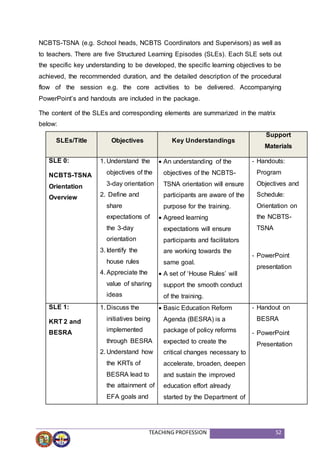
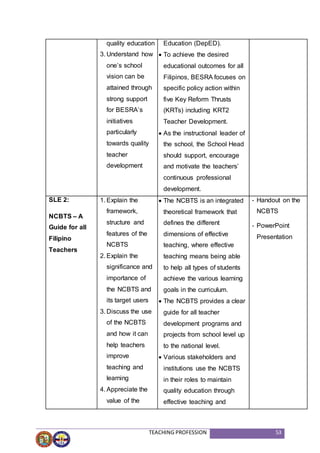
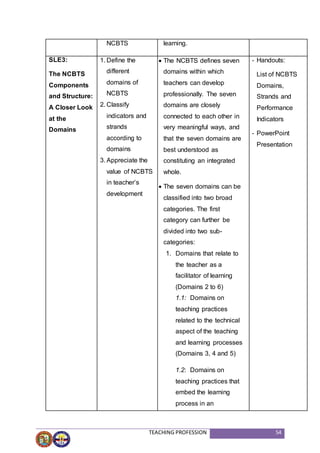
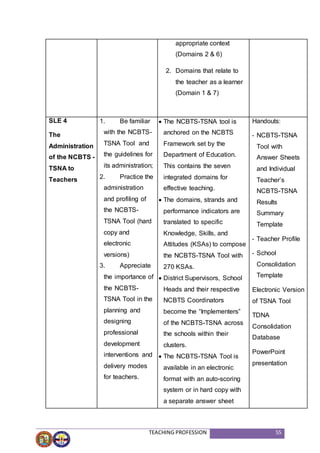
National Competency-Based Teacher Standards -
Teachers’ Strengths and Needs Assessment (NCBTS-TSNA)
1. INTRODUCTORYINFORMATION
Basis of the NCBTS-TSNA
The Department of Education is presently pursuing a package of policy
reforms that seeks to improve the quality of basic education. These policy reforms
are expected to create the critical changes necessary to further accelerate, broaden,
deepen and sustain the improved education effort already started. This package of
policy reforms is referred to as the Basic Education Sector Reform Agenda
(BESRA).
One key element in the reform agenda is the establishment of the National
Competency-Based Teacher Standards (NCBTS). This is a framework that identifies
the competency standards for teacher performance so that teachers, learners and
stakeholders are able to appreciate the complex set of behaviours, attitudes and
skills that each teacher must possess in order to carry out the satisfactory
performance of their roles and responsibilities.
In response to the need for an instrument that identifies the professional
strengths and development needs of the teachers, the NCBTS -TSNA was
developed and validated through the AusAID-funded Project Strengthening the
Implementation of Basic Education in Selected Provinces in the Visayas (STRIVE).
This initiative was undertaken in coordination with the Educational Development
Project Implementing Task Force (EDPITAF) and Regions VI, VII and VIII, Divisions
of Negros Occidental, Bohol/Tagbilaran and Northern Samar, and further validated
by the Teacher Education Development Program-Technical Working Group (TEDP-
TWG) at the national level.
NATIONAL COMPETENCY-BASED TEACHER
STANDARDS
Teachers’ Strengths and Needs Assessment
NCBTS – TSNA
TEACHING PROFESSION 40
The NCBTS- TSNA System Framework
The NCBTS-TSNA adopts the TDNA System Framework. The process
determines the differences between the actual situation (what is) and the desired
condition (what should be) in terms of teacher professional competencies. In the
NCBTS-TSNA, the actual situation is described by the current competencies as
perceived by the teacher. The profile of the teacher’s current competencies is
compared to the NCBTS standards for effective teaching. This NCBTS-TSNA,
therefore, identifies both the competency strengths and needs as a result of
determining the difference between the expected and the current teacher’s
competencies. These competencies are translated in terms of Knowledge, Skills,
and Attitudes (KSAs) that actually define the domains, strands and performance
indicators of the NCBTS.
As in the TDNA Framework, the NCBTS-TSNA involves three essential
stages of strengths and needs analysis: Phase I (Job Analysis for Effective
Performance) is actually done by analyzing nationally set teacher standards in
behavioral terms or by identifying effective teaching competencies. The DepED
Central Office and Regional Offices are tasked to do this phase of the TSNA
process. Phase II (Individual Training Needs Analysis) is the instrumentation to
determine the current teacher competency levels in KSA terms which is done by the
individual teacher at the school level. Phase III (Strengths-Needs analysis) is the
analysis of the discrepancies between the standards set and the current teachers’
data on their competencies. Minimal discrepancies indicate strengths while big
discrepancies indicate learning needs. The consolidation of results is carried out at
the school, cluster, District, Division or Region level for their respective purposes
related to identifying teacher training and development needs.
An important aspect of the NCBTS-TSNA process is the utilization of its
results that will serve as inputs in the preparation of Individual Plan for Professional
Development (IPPD) and in designing programs and activities for teachers at the
school, district and division levels. The consolidated NCBTS-TSNA results at the
school, division, and regional level inform the School Improvement Plan (SIP), the
Division Education Development Plan (DEDP) and the Regional Education
Development Plan (REDP), with respect to the plans for professional development at
the school, division and the regional levels.
TEACHING PROFESSION 41
When established, the NCBTS-TSNA system ensures that “teachers routinely
use CBTS in making self-assessments of their current practices to identify their
individual development needs, and that school heads, division and regional offices
also routinely use CBTS in identifying teacher performance factors that affect school-
wide learning outcomes” (BESRA PIP, 2006 Version (PIP V.1, p. 21).The framework
is illustrated below.
Purpose of the NCBTS-TSNA
To realize the provision of quality Professional Development of Teachers, the
NCBTS-TSNA is conducted to gather data on the competency strengths and needs
of teachers that serve to inform the design and conduct of continuing training and
development programs for the improvement of teaching-learning practice.
Specifically, the NCBTS-TSNA intends to:
1. Determine the competency strengths and learning needs in terms of KSAs of
individual teachers vis-à-vis the standards set by the NCBTS in the seven
domains
COMPETENCY
ASSESSMENT
Current KSA
KSA required
and
PHASEIII
Individual
Training
Instrument
ation
PHASE I
Competency
PHASE
Competenc
y Strengs&
SIP
DEDP
Trainee’s
IPPD
SPPD
Div-MPPD
Job Analysis
for Effective
Consolidated
Strength-Needs
TEACHING PROFESSION 42
2. Consolidate the NCBTS-TSNA results at the school, district, division, and
region levels
Expected Outputs
Based on the purpose stated above, the NCBTS-TSNA is expected to yield the
following specific outputs:
A. At the individual level:
An Individual Teacher Summary of NCBTS-TSNA Results indicating the
strengths and learning needs in each of the seven domains and 23 strands.
B. At the school level:
Consolidated NCBTS-TSNA results that reflect the general strengths and
learning needs of the teachers in the school
C. At the cluster/district /division/region level:
Consolidated NCBTS-TSNA results of participating school teachers in a given
cluster/district/division/region.
The NCBTS and the KSAs Developed for the NCBTS-TSNA
The NCBTS-TSNA tool is anchored on the NCBTS Framework set by the
Department of Education. This contains seven integrated domains for effective
teaching which are:
 Domain 1–Social Regard for Learning;
 Domain 2–Learning Environment;
 Domain 3–Diversity of Learners;
 Domain 4–Curriculum;
 Domain 5– Planning, Assessing and Reporting;
 Domain 6–Community Linkages; and
 Domain 7–Personal Growth and Professional Development.
TEACHING PROFESSION 43
Each domain has its corresponding strands and each strand has performance
indicators. A total of seven domains, 23 strands and 80 performance indicators make
up the NCBTS competency standards set by the DepED.
The domains, strands and performance indicators were translated to specific
KSAs to compose the NCBTS-TSNA Tool with 270 KSAs in the various clusters as
described in the table below:
The NCBTS-TSNA Tool content and methodology were validated by various
groups at different levels across Regions VI, VII, and VIII and at the Central Office
level. The validation process involved the following:
1) Preliminary Content Validation: The validation group included the STRIVE2
Project Component Team composed of 34 educators with 4 Regional
Supervisors, 6 Division Supervisors, 22 Principals, 1 Administrative Officer V
(former HRMO3), and 1 District ALS Coordinator. The process reduced the
original 375 items to 260 items.
DOMAINS STRANDS
PERFORMANCE
INDICATORS
KSAs
Domain 1: Social Regard for Learning 2 5 18
Domain 2: Learning Environment 5 17 59
Domain 3: Diversity of Learners 1 8 27
Domain 4: Curriculum 7 22 78
Domain 5: Planning, Assessing and
Reporting
4 12 40
Domain 6: Community Linkages 1 6 18
Domain 7: Personal and Professional
Growth
3 10 30
Total -7 Domains 23 80 270
TEACHING PROFESSION 44
2) Region, and Division Level Content Validation: Six Regional Education
Division Chiefs; 16 Division Supervisors; 13 District Supervisors; 27 School
Heads, 27 Elementary School Master Teachers and 27 High School Master
Teachers were selected to review the tool for content and language used.
They submitted their comments and marginal notes for the refinement of the
tool.
3) Field Process Validation: Sixty In-service Teachers were asked to respond to
the tool with two versions. Thirty (30) teachers used the manual version and
30 teachers used the electronic version. Results showed that it was more
efficient to complete the electronic version. Time spent in accomplishing both
versions were recorded to be on average two hours for the manual and one
hour for the electronic. There were refinements done for the electronic tool
related to the programming of results per domain and strand.
4) Validation by six of the STRIVE project’s Technical Advisers: TDNA and SBM
Adviser, the National and International T&D Advisers, the National and
International ICT Advisers and the SBM-QAAF Adviser. There was a
recommendation to include items specific to ICT competencies submitted by
the LRMDS Advisers. The ICT4E standards were studied and ten items were
added to the four original items tocompose the ICT “domain”. This made the
total of items 270 in all.
5) Experts’ Validation at the Central Office Level: The TEDP who was
responsible in formulating the NCBTS was consulted to review the tool. The
TEDP group included: the Director of the Teacher Education Council (TEC), a
Professor and former Vice-President for Academics of West Visayas State
University, the Associate College Dean of Arts and Sciences of the University
of the Philippines, the College Dean of Centro Escolar University and National
President of PAFTE, a School Head and the President of NAPSSHI, a School
Head and President of PESPA, and a SPED specialist and Assistant Chief of
the Bureau of Elementary Education. Together with the T&D Team and the
ICT and T&D Technical Advisers, they reviewed the manual and thoroughly
TEACHING PROFESSION 45
inspected the 270 items, item by item. As a result, further refinements were
incorporated to the Tool. Additionally, the TEDP expressed appreciation for
the developed NCBTS tool and for the addition of a set of 14 items that
composed an “ICT domain”.
6) Presentation of the Guide and Tools to a national group of teacher educators:
Comments and points for refinement were gathered from the participants of
the First National Conference of Centers of Training Institutions, attended by
Heads and Deans of 82 Teacher Education Institutions (TEIs), including a few
RDs, ARDs, and SDSs, held at the Development Academy of the Philippines,
Tagaytay City. Points considered for the improvement of the Guide and tool
were the inclusion of the PSDS’s to be co-responsible with the School Heads
for the administration of the NCBTS Tool to teachers in their clusters, the
inclusion of an item for guided reflection as a competency, reconsideration of
the length of the Tool, among others.
7) Preparation of the NCBTS-TSNA Orientation Package: In the course of doing
the steps mentioned above, there was a clear recognition that teachers must
have an adequate understanding of the NCBTS Framework and the standard
competencies that are expected from them before the NCBTS needs
assessment process is done. To address this need, the T&D Team developed
a resource package that aimed to orient the implementers such as the ES,
PSDS and School Heads and NCBTS Coordinators on the BESRA and the
NCBTS. The NCBTS-TSNA Orientation Package, which consists of a series
of Structured Learning Episodes (SLEs), was also to be conducted to
teachers prior to the initial administration of the NCBTS-TSNA Tool.
8) Process Try-out of the NCBTS-TSNA Guide and Tools, including the NCBTS-
TSNA Orientation Package: The NCBTS-TSNA system, procedures were
tried out in a one-school sample that involved all the teachers and the School
Head of the Tabalong National High School, Dauis, Division of Bohol. The
content and processes of conducting the SLEs, the tool administration,
scoring, individual and school consolidation profiling, and the M&E
mechanisms were tried with 33 teachers. Refinements were done following
TEACHING PROFESSION 46
the try-out based on the observations of the T&D Team and feedback from
the teacher respondents. The Pilot Version of the NCBTS-TSNA Guide and
Tools, and NCBTS-TSNA-Orientation Package was then prepared for a
bigger sample of schools.
9) Division Pilot-Test of the NCBTS-TSNA Guide and Tools, including the
NCBTS-TSNA Orientation Package: The pilot-testing of the NCBTS-TSNA
system using the NCBTS-TSNA Guide and Tools and the NCBTS-TSNA
Orientation Package was done in the 300 pilot schools in the Divisions of
Bohol, Negros Occidental and Northern Samar. This expanded to include the
six hundred twenty (620) non-pilot schools in the division of Negros
Occidental. Technical reports were developed to document the process and
were the basis for the finalization of the NCBTS-TSNA Guide and Tool and
NCBTS-TSNA Orientation Package. This was turned-over to the central office
which further validated the Guide and Tools and the Orientation package to
six regions outside the STRIVE sites.
10)Finalization of the NCBTS-TSNA Guide and Tool and NCBTS-TSNA
Orientation Package: Based on the national validation conducted by the
TEDP-TWG in Luzon and Mindanao, further revisions were made such as the
renaming of the package to NCBTS-TSNA (Teachers Strengths and Needs
Assessment), the clustering of 10 ICT items under a new STRAND (4.7),
addition of a performance indicator on ICT (4.7.1). The 10 of the 14 ICT items
found in different strands in the original tool were selected and finally
classified under this performance indicator and ICT strand.
2. Establishment of Regional and Division TDNA-Working Groups
The Regional and Division TDNA Working Groups (TDNA-WGs) may be
convened to take responsibility for the management of the NCBTS-TSNA
process. The Regional TDNA-WG members (representing the elementary and
the secondary levels who are preferably Education Supervisors), would be
designated by the Regional Director. The Division TDNA-WG is organized by the
Schools Division Superintendent (SDS). Both Regional and Division TDNA-WG
TEACHING PROFESSION 47
members are chosen based on experiences in assessment and in the training of
teachers. Chairs and Co-Chairs may be assigned to lead the working groups.
TDNA-WG Roles and Responsibilities
The TDNA-WG’s have overall responsibility for the management of the
NCBTS-TSNA process. They should be familiar with the process for orienting groups
of School Heads with their NCBTS Coordinators at the cluster/district level on the
process for conducting the NCBTS-TSNA, and ensure they are then able to
administer the tools to the teachers at the school level. The TDNA-WG members
are expected to play a key role in the preparation, administration, monitoring, data
consolidation and reporting the results of the NCBTS-TSNA. The general flow of
processes related to the NCBTS-TSNA across the Regional, Division/District and
School levels is seen in the diagram below.
NCBTS- TSNA Structural Process Flow
 Note: The Orientation Package only needs to be delivered when first
introducing the NCBTS-TSNA.
Region Level:
 RD issues memo
to Divisions
commencing the
NCBTS-TSNA
specifying among
Division Level:
 SDS instructs the TDNA-
WG to commence the
NCBTS- TSNA for teachers,
specifying among others,
structure, functions, and
School Level:
 School Head
and NCBTS
Coordinator
Division/District Level:
 Div TDNA-WG monitors
cluster/district
implementation
 RO designates/
instructs Regional
TDNA-WG to
 Reg & Div TDNA-WG
convene
Facilitators/Trainers Team
and conduct a walkthrough
of the NCBTS-TSNA
Orientation Package*
 Teachers make
NCBTS-TSNA
self-assessment
in hard copy or
electronic
format
 Teachers
accomplishes
NCBTS-TSNA
 SDS submits NCBTS-TSNA
report to RD
 Reg TDNA-WG
meets with Div
TDNA-WG to
orient and plan
 Reg TDNA-WG
monitors and
evaluates Div
TDNA-WG
 RO utilizes
NCBTS- TSNA
 SH and NCBTS
Coordinator
consolidate
NCBTS-TSNA
TEACHING PROFESSION 48
Roles and Responsibilities to Support the Orientation on the NCBTS-TSNA
Regional Supervisors
 To support and monitor the Division in the implementation of the NCBTS-
TSNA Orientation and the administration of the NCBTS-TSNA Tool
District/Division Supervisors
 To attend an orientation on the National Competency-Based Teacher
Standards and the Teachers Strengths and Needs Assessment Tool
 To provide assistance to Lead School Heads in coordinating clusters to meet
to undertake an orientation on the National Competency-Based Teacher
Standards and the Teachers Strengths and Needs Assessment Tool
 To assist in generating resources for the Division NCBTS-TSNA activities
 To actively support School Heads and NCBTS Coordinators in the conduct of
the orientation of all teachers regarding the NCBTS
 To actively support School Heads and NCBTS Coordinators in the
administration of the NCBTS-TSNA Tool to all teachers
 To support the consolidation of the results of the teacher NCBTS-TSNA at the
school level and the incorporation of findings into School Improvement
Plans(SIP) and School Plans for Professional Development (SPPD)
 To consolidate district NCBTS-TSNA results and incorporate findings into
plans for District level training
 To monitor and evaluate the conduct of the orientation and administration on
the NCBTS-TSNA
 To give feedback and recommendation on the conduct of orientation and
administration of the NCBTS-TSNA
Lead School Heads
 To orient all School Heads and NCBTS Coordinators within their cluster to the
National Competency-Based Teacher Standards and the Teachers Strengths
and Needs Assessment Tool
TEACHING PROFESSION 49
 To assist Schools Heads in identifying/organizing different working groups for
the school level orientation on the National Competency-Based Teacher
Standards and the Teachers Strengths and Needs Assessment Tool
 Support schools within their clusters with resources to support the NCBTS-
TSNA Orientation and the electronic consolidation of NCBTS-TSNA results
School Heads
 To attend an orientation on the National Competency-Based Teacher
Standards and the Teachers Strengths and Needs Assessment Tool
 To identify/organize different working groups for the orientation on the
National Competency-Based Teacher Standards and the Teachers Strengths
and Needs Assessment Tool
 To orient all teaching staff within their school on the National Competency-
Based Teacher Standards
 To administer the NCBTS-TSNA Tool to all teachers within their school
 To consolidate the school level NCBTS-TSNA results electronically
 To identify the strengths and needs of teachers based on the NCBTS-TSNA
results
 To submit consolidated NCBTS-TSNA Results to the District Supervisor and
the Division TDNA-WG
NCBTS Coordinators
 To attend an orientation on the National Competency-Based Teacher
Standards and the Teachers Strengths and Needs Assessment
 To assist the School Head to orient all teaching staff within their school on the
National Competency-Based Teacher Standards
 To assist the School Head in the administration of the NCBTS-TSNA to all
teachers within their school
 To assist in the electronic consolidation of the school level NCBTS-TSNA
results
TEACHING PROFESSION 50
Teachers
 Attend an orientation on the National Competency-Based Teacher Standards
and the Teachers Strengths and Needs Assessment Tool
 To read and reflect on every item of NCBTS-TSNA Tool
 To answer every item based on an honest assessment of oneself to inform
future professional development activities
 Complete a Teachers Strengths and Needs Assessment including the
development of an Individual Teacher Summary of NCBTS-TSNA Results
 To use the results in developing an Individual Plan for Professional
development (IPPD)
Criteria for the Selection of School NCBTS Coordinators
The orientation on the National Competency-Based Teacher Standards and
the Teachers Strengths and Needs Assessment to teachers in all schools is the
responsibility of the School Heads and their respective NCBTS School Coordinators.
The designation of the NCBTS School Coordinator is at the discretion of the School
Head taking into consideration the following criteria.
NCBTS Coordinator should have:
 at least 3 years of teaching experience;
 knowledge and experience in facilitating training activities;
 computer skills in Word, Excel and PowerPoint;
 good communication and leadership skills;
 willingness and commitment in completing NCBTS related tasks to support
on-going teacher development.
3. Orientation of Supervisors, School Heads and NCBTS School Coordinators
The principle of school-based management empowers the School Heads to
provide instructional leadership and therefore in order for them to support
teachers, School Heads must be aware of the framework of the NCBTS that
defines the concept of effective teaching. In addition, School Heads can only
effectively support the professional development of the teachers when they have
TEACHING PROFESSION 51
the first-hand information about the training and development needs of teachers.
School Heads and Schools Supervisors need to be oriented so they are
knowledgeable of the NCBTS and the features of the NCBTS-TSNA tool and its
proper administration and results utilization if they are to provide effective
instructional leadership.
The Division TDNA-WG is responsible for the orientation of all School
Supervisors and School Heads with their respective NCBTS School Coordinators
on the NCBTS and the TSNA. The NCBTS-TSNA Orientation Package serves
as a guide and resource for the introduction of the NCBTS and the initial
administration of the self-assessment tool. The package with accompanying
resource materials is designed for knowledge building and advocacy on the
NCBTS and for the transfer of the technology to conduct NCBTS-TSNA to the
School Heads. The package can also be used to provide teacher beneficiaries
with a deep understanding of the NCBTS and its relationship to in-service
teachers’ professional development and to introduce the NCBTS-TSNA tool, with
consideration of the tool’s proper administration with teachers and how results
can be utilized.
The NCBTS-TSNA Orientation Package aims to:
 enhance implementers’ understanding of BESRA and the significance of
teacher development in achieving its goals;
 introduce the NCBTS and its relevance to teacher in-service development;
 deepen implementers’ understanding of the seven domains, strands and
performance indicators of the NCBTS;
 introduce the NCBTS-TSNA Tool and consider guidelines for its
implementation;
 prepare School Heads, NCBTS Coordinators and Supervisors to implement
the NCBTS-TSNA to teachers.
The NCBTS-TSNA Orientation Package consists of resource materials for the
conduct of orientation of the NCBTS to those responsible for implementing the
TEACHING PROFESSION 52
NCBTS-TSNA (e.g. School heads, NCBTS Coordinators and Supervisors) as well as
to teachers. There are five Structured Learning Episodes (SLEs). Each SLE sets out
the specific key understanding to be developed, the specific learning objectives to be
achieved, the recommended duration, and the detailed description of the procedural
flow of the session e.g. the core activities to be delivered. Accompanying
PowerPoint’s and handouts are included in the package.
The content of the SLEs and corresponding elements are summarized in the matrix
below:
SLEs/Title Objectives Key Understandings
Support
Materials
SLE 0:
NCBTS-TSNA
Orientation
Overview
1. Understand the
objectives of the
3-day orientation
2. Define and
share
expectations of
the 3-day
orientation
3. Identify the
house rules
4. Appreciate the
value of sharing
ideas
 An understanding of the
objectives of the NCBTS-
TSNA orientation will ensure
participants are aware of the
purpose for the training.
 Agreed learning
expectations will ensure
participants and facilitators
are working towards the
same goal.
 A set of ‘House Rules’ will
support the smooth conduct
of the training.
- Handouts:
Program
Objectives and
Schedule:
Orientation on
the NCBTS-
TSNA
- PowerPoint
presentation
SLE 1:
KRT 2 and
BESRA
1. Discuss the
initiatives being
implemented
through BESRA
2. Understand how
the KRTs of
BESRA lead to
the attainment of
EFA goals and
 Basic Education Reform
Agenda (BESRA) is a
package of policy reforms
expected to create the
critical changes necessary to
accelerate, broaden, deepen
and sustain the improved
education effort already
started by the Department of
- Handout on
BESRA
- PowerPoint
Presentation
TEACHING PROFESSION 53
quality education
3. Understand how
one’s school
vision can be
attained through
strong support
for BESRA’s
initiatives
particularly
towards quality
teacher
development
Education (DepED).
 To achieve the desired
educational outcomes for all
Filipinos, BESRA focuses on
specific policy action within
five Key Reform Thrusts
(KRTs) including KRT2
Teacher Development.
 As the instructional leader of
the school, the School Head
should support, encourage
and motivate the teachers’
continuous professional
development.
SLE 2:
NCBTS – A
Guide for all
Filipino
Teachers
1. Explain the
framework,
structure and
features of the
NCBTS
2. Explain the
significance and
importance of
the NCBTS and
its target users
3. Discuss the use
of the NCBTS
and how it can
help teachers
improve
teaching and
learning
4. Appreciate the
value of the
 The NCBTS is an integrated
theoretical framework that
defines the different
dimensions of effective
teaching, where effective
teaching means being able
to help all types of students
achieve the various learning
goals in the curriculum.
 The NCBTS provides a clear
guide for all teacher
development programs and
projects from school level up
to the national level.
 Various stakeholders and
institutions use the NCBTS
in their roles to maintain
quality education through
effective teaching and
- Handout on the
NCBTS
- PowerPoint
Presentation
TEACHING PROFESSION 54
NCBTS learning.
SLE3:
The NCBTS
Components
and Structure:
A Closer Look
at the
Domains
1. Define the
different
domains of
NCBTS
2. Classify
indicators and
strands
according to
domains
3. Appreciate the
value of NCBTS
in teacher’s
development
 The NCBTS defines seven
domains within which
teachers can develop
professionally. The seven
domains are closely
connected to each other in
very meaningful ways, and
that the seven domains are
best understood as
constituting an integrated
whole.
 The seven domains can be
classified into two broad
categories. The first
category can further be
divided into two sub-
categories:
1. Domains that relate to
the teacher as a
facilitator of learning
(Domains 2 to 6)
1.1: Domains on
teaching practices
related to the technical
aspect of the teaching
and learning processes
(Domains 3, 4 and 5)
1.2: Domains on
teaching practices that
embed the learning
process in an
- Handouts:
List of NCBTS
Domains,
Strands and
Performance
Indicators
- PowerPoint
Presentation
TEACHING PROFESSION 55
appropriate context
(Domains 2 & 6)
2. Domains that relate to
the teacher as a learner
(Domain 1 & 7)
SLE 4
The
Administration
of the NCBTS -
TSNA to
Teachers
1. Be familiar
with the NCBTS-
TSNA Tool and
the guidelines for
its administration;
2. Practice the
administration
and profiling of
the NCBTS-
TSNA Tool (hard
copy and
electronic
versions)
3. Appreciate
the importance of
the NCBTS-
TSNA Tool in the
planning and
designing
professional
development
interventions and
delivery modes
for teachers.
 The NCBTS-TSNA tool is
anchored on the NCBTS
Framework set by the
Department of Education.
This contains the seven
integrated domains for
effective teaching.
 The domains, strands and
performance indicators are
translated to specific
Knowledge, Skills, and
Attitudes (KSAs) to compose
the NCBTS-TSNA Tool with
270 KSAs.
 District Supervisors, School
Heads and their respective
NCBTS Coordinators
become the “Implementers”
of the NCBTS-TSNA across
the schools within their
clusters.
 The NCBTS-TSNA Tool is
available in an electronic
format with an auto-scoring
system or in hard copy with
a separate answer sheet
Handouts:
- NCBTS-TSNA
Tool with
Answer Sheets
and Individual
Teacher’s
NCBTS-TSNA
Results
Summary
Template
- Teacher Profile
- School
Consolidation
Template
Electronic Version
of TSNA Tool
TDNA
Consolidation
Database
PowerPoint
presentation
TEACHING PROFESSION 56
and Individual Teacher’s
NCBTS-TSNA Results
Summary Template.
 The Individual Teacher’s
NCBTS-TSNA Results
Summary Template is used
for the development of the
teacher’s IPPD.
SLE5 –
(For SH)
Action
Planning for
NCBTS-TSNA
Administration
1. Make a plan
for cluster and
school-based
implementation of
the NCBTS-
TSNA
2. Positively
accept
suggestions
made on the
proposed action
plan
 An Action Plan will support
the implementation of the
NCBTS-TSNA at the cluster
and school level
 An action plan should be
complete and doable.
 An action plan should suit
the cluster/school setting.
 An action plan should be
done collaboratively.
- Action Plan
proforma
- PowerPoint
presentation
- Participant
Evaluation
Proforma
The package can be accessed through the Training Development Information
System (TDIS) which is an element of the Enhanced Basic Education Information
System (EBEIS) at http://beis.deped.gov.ph/ or through the Learning Resource
Management and Development System (LRMDS) Portal at
http://lrmds.deped.gov.ph/
4. Schools-Cluster NCBTS-TSNA Implementation
Schools within the Division are expected to form clusters. Each cluster
should designate a Leader School. Leader School Heads and their respective
NCBTS Coordinators become the “Implementers” of the NCBTS-TSNA across
the schools within their clusters. School Heads from within each cluster are
TEACHING PROFESSION 57
convened to go through parallel knowledge building and to conduct the NCBTS-
TSNA for their own teachers. The District Supervisors will take the role of guiding
and monitoring the NCBTS-TSNA orientation and administration procedures
within the cluster or district.
The Electronic and Hard Copy Versions of the NCBTS-TSNA Tool
The NCBTS-TSNA Tool is a self-assessment procedure that is introduced by
the School Head/NCBTS Coordinator through an orientation process in order for the
teacher-respondents to see its importance and thus reflectively respond to the tool.
The NCBTS-TSNA Tool is available in an electronic format with an auto-scoring
system, or in a hard copy with a separate scoring and results summary template. If
the electronic version is used, each teacher responds to the NCBTS-TSNA tool from
a file installed on a common computer in the school. It takes approximately one-and-
a-half hours to accomplish the instrument, although no time limit should be imposed.
The scores and individual profile of the teacher in the seven domains with the
corresponding strands are electronically generated instantly upon completion of the
instrument. All schools are encouraged to use the e-version of the tool for easy
profiling and consolidation.
Schools that have no access to the technology required for use of the e-
version of the NCBTS-TSNA tool, or where teachers are not computer literate, may
use the hard copy version for implementation. The hard copy version takes
approximately 2 hours to accomplish plus one hour for scoring and developing an
individual teacher results summary. The hard copy version can be found in
Attachment 1 along with the separate Answer Sheet, a Teacher Profile and an
Individual Teacher’s Summary of NCBTS-TSNA Results Template.
To support school, district and division level consolidation of the NCBTS-
TSNA results, it is recommended that the School Head, with the assistance of the
NCBTS Coordinator, ensure that all hard copies of teachers NCBTS-TSNA results
are entered into the electronic version of the tool.
It should be noted that DepED Central has distributed the NCBTS Tool Kit for the
TSNA and IPPD which contains the Teacher’s Profile, the NCBTS-TSNA Tool, the
TEACHING PROFESSION 58
Answer Sheet and the Individual Results Template to all regions and divisions with
the expectation that all teachers would be provided with a copy.
Self-Administration of the NCBTS-TSNA Tool
The NCBTS- TSNA Responses
The instrument contains clusters of KSAs specific to a particular performance
indicator with a common stem: “At what level do I…” Considering that the NCBTS-
TSNA tool is intended for self-assessment and not for performance ratings, the
responses to the items are expressed qualitatively i.e. High (H), Satisfactory (S), Fair
(F), and Low (L). However, quantitative data are easier to interpret and relied upon
for decisions, thus, in the response analysis, the numerical equivalent is assigned for
each descriptor; H - 4; S - 3; F - 2; L - 1.
The reference codes presented below guides the respondent in registering
her/his self-assessment for each KSA:
Code of Competency
Level
Qualitative Description
H- (High) I am very competent in the KSA and this is not my
priority training need
S- (Satisfactory) I am competent in the KSA but I would benefit from
further training.
F-(Fair) I am fairly competent in the KSA but need further
training.
L- (Low) I have low competence in the KSA and require
urgent training.
TEACHING PROFESSION 59
Upon completion of the instrument, the respondent using the electronic
version can automatically generate his/her Summary of NCBTS-TSNA Results. The
Summary of NCBS-TSNA Results Template is in printable format and each teacher
is advised to print a copy for her/his own record. An interpretation of the results for
each domain and strand is also provided.
For the hard copy version, the steps for scoring and summarizing the results are:
A. Scoring is completed on the individual answer sheet.
1. Get the equivalent score for each KSA using the numerical equivalent for
the descriptor of the response e.g. H - 4; S - 3; F - 2; L - 1. Do this per
cluster of KSAs in a particular performance indicator (e.g. for Box 1.1.1 or
Box 1.1.2 and so on)
2. Compute the sum of the scores for each cluster of KSAs. Write the sub-
scores on the cells beside each cluster in the last column.
3. Compute the sum of all the scores within each Strand (S). Write the sub-
score on the cell beside each strand.
4. Compute the sum of all the S’s within each Domain. Write the sub-scores
on the cell beside each Domain.
B. Transfer all the sub-scores for the Strands and Domains to the Individual
Teachers Summary of NCBTS-TSNA Results Template. Use the row for Raw
Score.
1. Compute the percentage score for each of the sub-scores by dividing the
raw score by the highest possible score (HPS).
2. Plot the percentage scores on the bar graph provided in the template.
Interpretation of the NCBTS-TSNA Results
Upon completion of the NCBTS-TSNA Tool, an obtained score whether an
average of the domain or strand is interpreted using the appropriate indices in the
chart below.
TEACHING PROFESSION 60
Range Description of the Level of Teaching Competence
(Referred to as Teacher Professional Development Index
inDepED NCBTS-TSNA Primer)
Scale
Scores
Percentage
Scores
3.51- 4.00 87.51 - 100% Expert
Very competent and can support other teachers’
improvement
Teacher has almost all the competencies for effective
teaching at high level. These are the identified strengths.
Strengths have to be sustained and enhanced; however
professional development needs have to be continuously
addressed*
2.51-3.50 62.51 -
87.50%
Experienced
Competent in the KSA but would benefit from further
training and development
Teacher has the majority of the competencies at high
level for effective teaching. Strengths have to be
enhanced. Training and development needs have to be
addressed*.
1.51-2.50 37.51 –
62.50%
Developing
Fairly competent in KSA and need further training and
development
Teacher has average of all the competencies at high level
of effective teaching. These strengths have to be
enhanced; however, training needs have to be addressed
as priority.*
TEACHING PROFESSION 61
1.00-1.50 25.00 –
37.50%
Beginning
Lacking competence in the KSA and require urgent
training and development
Teacher has very few of the competencies at high level
for effective teaching. Training needs have to be given
priority and addressed urgently*.
*Description used in the DepED NCBTS-TSNA Primer and NCBTS Toolkit
Consolidation of NCBTS-TSNA Results
As a component of the Training and Development Information System (TDIS)
a database was developed to support the consolidation of the NCBTS-TSNA results.
The TDNA Consolidation Database allows schools to upload their electronic versions
of the accomplished NCBTS-TSNA tool and automatically generate individual
teacher and school level results. An individual summary result as well as a school
profile can be generated identifying a single teacher’s or a school’s strengths and
priority training and development needs according to the NCBTS domains and
strands. Data can be analyzed and used to inform the teacher’s development of an
Individual Professional Development Plan (IPPD) and the School Plan for
Professional Development (SPPD).
Similarly, the database can be used to support the consolidation and analysis
of NCBTS-TSNA results at the district, division and regional level.
The TDNA Database at the school and district level is a stand alone database
that does not require access to the internet. The database can be obtained from the
Division along with an accompanying TDNA Consolidation Database Manual. The
TDNA database that supports the Division and Regional consolidation of data is
linked to the web-based TDIS and can be accessed through the EBEIS at
http://beis.deped.gov.ph/
School Heads, supported by their NCBTS Coordinators are responsible for
the management of the database at the school level. The Division will be responsible
TEACHING PROFESSION 62
for ensuring that all School Heads are trained in how to manage and operate the
database. The main responsibility at the school level will be to ensure all NCBTS-
TSNA tools accomplished by teachers are in the electronic format i.e. any NCBTS-
TSNA manually accomplished are re-entered into the electronic version of the tool.
Electronic files from all schools will need to be submitted to the
District/Division to support District, Division and Regional consolidation.
A template for manually consolidated school level NCBTS-TSNA results can
be found in Attachment 1.
5. Utilization of NCBTS-TSNA Results
Individual Results
The Individual Teachers NCBTS-TSNA Summary of Results is used for the
development of the teacher’s Individual Plan for Professional Development (IPPD).
The identified learning needs therein are appraised by the teacher while taking into
consideration the priorities set by the school for its future development. It is important
that the teachers develop themselves in order to contribute towards addressing the
most urgent needs and the priorities identified by the school. The IPPD is therefore
prepared by the teachers to identify their training needs in line with their own

priorities and those of the school. A separate document has been developed
detailing the concepts and procedures related to the preparation of IPPDs.
School Level Consolidated NCBTS-TSNA Results
Consolidate NCBTS-TSNA results of all teachers from a school should be used
to identify both strengths and needs of individual teachers and the school as a
whole. Teachers with particular strengths in a domain or stand can become resource
persons/coaches or mentors for other teachers who need further development in the
same domain/strand. Common priority needs identified by groups of teachers should
inform school planning activities such as the development of School Plans for
Professional Development (SPPDs) and SIP/AIP.
District Level Consolidated NCBTS-TSNA Results
TEACHING PROFESSION 63
District consolidated NCBTS-TSNA results should be analyzed by Supervisors
so that technical assistance can be targeted to the identified needs of individuals as
well as groups of teachers. Common needs of teachers across schools can become
the focus for District-led training and development programs.
Division Level Consolidated NCBTS-TSNA Results
An analysis of Division level NCBTS-TSNA results can support the identification
of common training and development needs of teachers across the division. This
information can then inform the type of training and development activities that are
conducted by the Division to support improved teaching and learning and be
incorporated into Division MPPDs. Results should inform Training of Trainer
programs, programs for teachers, as well as the type of technical assistance Division
Supervisors provide to teachers.
Region Level Consolidated NCBTS-TSNA Results
While the Region does not normally provide training directly to teachers, an
analysis of the consolidated NCBTS-TSNA results can be used to inform the region
on the type of technical assistance they need to provide to the Divisions. Results
should be analyzed when developing Regional MPPDs to provide direction on the
type of training programs and resources that the region should be providing Division
personnel. This is done so they are able to assist teachers in improving teaching and
learning practices.
6. Monitoring and Evaluation of the NCBTS-TSNA
Monitoring and evaluation (M&E) activities are vital in ensuring that program
implementation adheres to the standards set. In carrying out these activities, M & E
instruments are indispensable and the processes relating to the use of these
instruments equally important.
In as much as valid data must be collected during the administration of the
NCBTS-TSNA, preparation by the M&E implementers is necessary. The different M
& E tools are intended to support this preparation and assist in the collection of
different types of information such as the overall quality of the delivery of the NCBTS
TEACHING PROFESSION 64
– TSNA orientation, the qualities of the NCBTS-Coordinators, and the adherence to
standards during the NCBTS-TSNA implementation. The M&E tools include:
 T&D-M&E Form 1: Individual Profile Template
 NCBTS-M&E Form 1: Teacher’s Profile for NCBTS-TSNA
 NCBTS-M&E Form 2: Learning Process Observation and Facilitation
Skills
 NCBTS-M&E Form 3: NCBTS-Coordinators Checklist plus and
Consolidation Template
 NCBTS-M&E Form 4: Trainer’s Assessment of NCBTS Orientation
Workshop and Consolidation Template
 NCBTS-M&E Form 5: Trainee’s End of F3 Program Assessment and
Consolidation Template
 NCBTS-M&E Form 6: Documentation Tool for the Conduct of Cluster or
School level NCBTS-TSNA Implementation
 NCBTS-M&E Form 7: School’s NCBTS –TSNA Consolidation Template
TEACHING PROFESSION 65
A description on how the M& E tools are to be used is outlined below. The
M&E tools can be found in Attachment 2.
What will be
monitored
How it will be
monitored
M&E tool to
be used
Who will be
responsible
for the
monitoring
When will the
monitoring
take place
How will the
results be used
NCBTS
Implementers
details in
relation to their
current position,
their level of
experience and
qualification
All NCBTS
Implementers
will be asked to
complete the
profile
T&D-M&E
Form 1:
Individual
Profile
Template
TDNA-WG Prior to their
involvement in
the NCBTS-
TSNA process
Results will be
analyzed to ensure
NCBTS
Implementers have
the required KSAs.
Results will be
entered into the
TDIS
Teachers
details in
relation to their
current position,
their level of
experience and
qualification
All teachers will
be asked to
complete the
profile
NCBTS-
M&E Form
1: Teacher
Profile for
NCBTS-
TSNA
TDNA-WG Prior to the
accomplishmen
t of the NCBTS-
TSNA Tool
Results will be
entered into the TD
IS database along
with their
corresponding
NCBTS-TSNA
results
Implementation
of the NCBTS-
TNA Orientation
Package in
relation to the
processes
followed
A Process
Observer will be
assigned to
complete a
Learning
Process
Observation for
each session
NCBTS-
M&E Form
2: Learning
Process
Observation
TDNA -WG During the
NCBTS
orientation
workshop
Results will be
discussed with
individual Trainers
to identify strengths
and areas for
improvement
during debriefing
sessions.
Recommendations
TEACHING PROFESSION 66
based on a
analysis of the
results should be
included in the
Program
Completion Report
The
competency of
the NCBTS
Coordinators in
relation to the
criteria set for
the role.
A TDNA-WG
member will be
assigned to
observer the
NCBTS
Coordinator
during the
orientation
process
NCBTS-
M&E Form
3: NCBTS
Coordinator
’s Checklist
Division TDNA-
WG
During the
NCBTS
orientation
workshop
Results will be
discussed with
individual NCBTS
Coordinators to
identify strengths
and areas for
improvement.Res
ults will be used
to inform future
decisions
regarding the
criteria and
process for
selecting NCBTS
Coordinators.
Recommendation
s based on an
analysis of the
results should be
included in the
Program
Completion
Report
TEACHING PROFESSION 67
The overall
effectiveness of
the workshop
as delivered by
the whole
Team.
Each of the
trainers will be
asked to make
an assessment
of the
orientation.
NCBTS-
M&E Form
4: Trainer’s
Assessment
of the
NCBTS
Orientation
Workshop
Division TDNA-
WG
Upon
completion of
the NCBTS
orientation
workshop
Results will be
collated and analyzed
by the TDNA-WG. A
summary of the
results will be
included in the
Program Completion
Report and will inform
future training.
Participants
perception of
the training in
relation to
-the overall
quality of the
training
-the usefulness
of the training
-their ability to
implement the
content of the
training
-strengths and
weaknesses of
the training
All participants
will be asked to
complete the
Trainee’s End
of F3 Program
Assessment
Form
NCBTS-
M&E Form
5: Trainee’s
End of F3
Program
Assessment
Form
TDNA-WG Upon
completion of
the NCBTS-
TSNA
orientation
workshop
Participants
evaluations will be
collated by the
TDNA-WG and the
results analyzed. A
summary of the
results will be
included in the
Program Completion
Report and will inform
future training.
The
implementation
of the NCBTS-
TSNA
Orientation at
the division,
A Process
Observer will be
identified and
asked to
complete the
NCBTS-
M&E Form
6:
Documentat
ion Tool for
the Conduct
Region,
Division
TDNA - WG
During the
NCBTS-TSNA
Orientation
Workshop at
the Division,
Cluster or
Results to be
discussed with the
Implementers and
identify strengths
and areas for
improvement.
TEACHING PROFESSION 68
cluster and
school level
Tomorrow
tool of Cluster or
School
Level
NCBTS-
TSNA
Implementat
ion
School Level Observations will
be collated by the
TDNA- WG and the
results analyzed to
inform future
training
The priority
training needs
of teachers
The NCBTS
Coordinator and
the School
Head will
consolidate the
results from the
administration
of the NCBTS –
TSNA tool
NCBTS-
M&E Form
7: School’s
NCBTS-
TSNA
Consolidati
on Template
TDNA-WG After the
accomplishmen
t of the NCBTS-
TSNA tool
Results will be
used to inform
school and division
plans for
professional
development.
Results will be
submitted to the
Division.
TEACHING PROFESSION 69
CASE DIGEST: LABAD V. UNIVERSITY OF
SOUTHEASTERN PHILIPPINES
Published by paul on July 22, 2013 |
MA. VILMA S. LABAD, plaintiff, v.
THE UNIVERSITY OF SOUTHEASTERN PHILIPPINES, defendant.
G. R. No. 139665. August 9, 2001.
Facts:
Labad, an employee of University of Southern Philippines (USP), was under
probation due to a complaint filed to her by the Parent-Teacher Association on
February 1, 1996. The complaints rooted on Dishonesty, Misconduct, and Unfitness
as a teacher, which involved incidents when Labad lied of the amount she paid for
the yearbook, violation of RA 7079 (Campus Journalism Act of 1991), no release of
the said yearbook, and abuse of students. The Investigation Committee, constructed
by USP, held that there should be a non-renewal of Labad’s probationary status. The
salient dates are summarized as follows:
April 14, 1998- Civil Service affirmed the Investigation Committee’s decision
December 11, 1998- Civil services Committee denied Labad’s Motion for
Reconsideration.
December 28, 1998- Labad filed a Motion for Extension to file Petition to CA.
January 12, 1999- Labad filed a Petition for Review to CA.
February 17, 1999- Labad received a Resolution granting her Petition for Extension.
March 10, 1999- Labad received a Resolution from the CA dismissing her Petition for
Review.
The Court also stated that the Petiton for Review was filed beyond the extended
period which ended January 10, 1999.
Issue:
Whether or not the CA erred in dismissing the Petition for Review filed by petitioner
before it on the ground that the petition was filed late.
Whether the extension period started on December 26,1998 or on December 28,
1998.
Ruling:
The Court ruled that the date when the extension should take effect was on
December 28, 1998 since December 26, 1998 fell on a Saturday. According to Sec 1,
Rule 22 of the Rules of Court, “if the last day of the period, as computed, falls on a
Saturday, on Sunday or on a legal holiday in a place where the Court sits, the time
shall not run until the next working day”. Therefore, the Petition for Review can be
submitted until January 12, 1999. Henceforth, the petition was granted and
remanded that the appellate court for further proceedings
TEACHING PROFESSION 70
Part 2
The Teacher in the Classroom
This part contains the methods and alternative styles to have an effective
classroom management. This part also discusses the reason why pupils behave in
such ways that can create problem during teaching demonstration and this part
provides solutions to minimize such behaviour.
TEACHING PROFESSION 71
Classroom Management sketch
TEACHING PROFESSION 72
Classroom Management Strategies
The term classroom management refers to the procedures, strategies, and
instructional techniques teachers use to manage student behavior and learning
activities. Effective classroom management creates an environment that is
conducive to teaching and learning
ANNOYING CLASSROOM DISTRACTIONS
How can a teacher prevent irritating classroom behaviours?
1. The students and teacher should first discuss and then write a "group" contract
adopting acceptable classroom rules and procedures by the end of the first week of
school.
2. Periodically review the rules and procedures of the classroom until the students
can successfully adhere to them.
3. Use simple verbal reprimands when the misbehavior occurs. Make sure that they
are to the point, moderate in tone, and private (e.g., "Stop talking and work on your
math problems, please").
4. Give praise to the entire class as frequently as possible (e.g., "Thank you for
working so quietly," or "I'm delighted to see you all working so well today").
5. A student who continually exhibits an unacceptable behavior (e.g., out of his/her
seat) might profit from an "individualized" contract pinpointing the "desired" behavior
(e.g., remaining in his/her seat) and delineating the consequences (e.g., if goal is
reached, then student will receive designated reward or recognition).
6. Intervene as soon as possible in order to prevent the misbehavior from occurring
(e.g., say "Harry, may I help you with your assignment?" when the student begins to
show signs of frustration).
7. Use facial expressions to convey to the student that the misbehavior was not
totally overlooked. Circulate around the room frequently, to avert potential behavior
problems.
Tips on How to Manage
Undesirable Classroom Student’s Behaviour
&
Ways on How
to Maintain Positive Learning Environment
TEACHING PROFESSION 73
ANTAGONISM WITH AUTHORITY
What can be done to help students improve their interaction with authority figures?
1. Provide opportunities for students to change their hostile and aggressive energy
into socially acceptable channels such as sports, clubs, crafts, hobbies, etc.
2. Give students reading and/or writing assignments that deal with antagonistic
behaviors, and ask them to comment on different socially acceptable ways of
handling conflict situations.
3. Praise the students whenever they are cooperating with other adults (e.g., "That
was very kind of you to help her find her keys").
4. Talk to the student in private to ascertain the reason for his/her misbehavior.
5. Provide the students with models of appropriate communicative behavior through
role-playing activities.
6. Encourage students to strive for greater self-control in as many situations as
possible.
7. Emphasize to students the difference that exists between acceptable
communication in school and that which is used at home and/or in the community.
8. Contact parents and/or administrators when there is no other way of resolving the
conflict situation.
9. Refer the student to appropriate staff members (e.g., the Child Study Team, if the
student frequently displays uncontrollable verbal hostility). Keep anecdotal records to
support your concerns.
ARGUMENTATIVE STUDENT
How can the teacher deal with a child who becomes argumentative upon
confrontation?
1. Do not confront the student in a group situation.
2. Do not use an accusatory tone upon approaching the student.
3. Evaluate the situation that led to the confrontation.
4. Do not back the student into a corner. Leave room for options.
5. Do not make threats that cannot be carried out.
6. Allow your emotions to cool before approaching the student.
7. Maintain the appearance of control at all times. Use a clear, firm voice.
8. Give the child an opportunity to speak his/her piece.
9. Allow for role-playing, doing role reversal.
10. Try to explore and discover what led to the confrontation. Avoid repeating these
circumstances.
11. If you made an error, admit it!
TEACHING PROFESSION 74
BEHAVIOR PROBLEMS
What steps can be followed to resolve a child's constant misbehavior?
1. If possible, meet with the child and describe in exact terms the behavior you find
unacceptable in the classroom.
2. During the discussion, explain the reason(s) why you find the behavior
unacceptable.
3. Be sure the child understands that it is not he/she who is unacceptable, but rather
the behavior.
4. Let the student know exactly what will happen if the problem continues.
5. If the misbehavior occurs again, follow through with the previously planned
disciplinary action.
6. Throughout the process, keep the parents and the principal informed of the
progress or lack of progress.
7. If the child continues to misbehave and you feel that you have utilized all of your
options and resources, send the child to the principal's office. Explain to the child that
he/she is welcome to return when he/she is ready to follow the classroom rules.
BOASTFUL, ATTENTION-SEEKING STUDENT
What can be done for a student who is constantly disrupting the class in order to
gain the teacher's attention?
1. Give the student a position of responsibility in the classroom and encourage
him/her to set a good example for others (e.g., passing out papers).
2. Post a chart in the front of the room delineating the rules to be followed when
responding. For example:
1. Raise your hand if you wish to talk.
2. Wait to be called on.
3. Listen while others talk.
3. Assign the student a special project of interest and let him/her present the report
to the class.
4. Ignore the student's annoying comments, but give praise when the student
describes his/her real achievements.
5. Assign the student to a small group in which he/she must participate primarily as a
follower.
6. Provide recognition and positive attention whenever possible.
7. Model appropriate behavior every day for the student, so that he/she can see what
is expected of him/her (e.g., role-playing by teacher and/or peers).
TEACHING PROFESSION 75
8. Arrange parent conferences to discuss any factors that may be contributing to the
student's problem in school (e.g., sibling rivalry).
CALLING OUT IN CLASS - RESPONSE #l
What do you do with a student who calls out answers or comments during class?
1. Discuss your expectations with the class. Make up rules and consequences at the
very beginning of the school year.
2. Keep a frequency record in your grade book of the calling out, and increase the
severity of the consequence in direct proportion to the frequency of the "calling out."
3. With children in the middle grades and older, divide the class into two groups and
make a game out of questions and answers. Each team scores a point for each
correct answer. If a team member calls out an answer out of turn, that team loses a
set amount of points.
4. Praise the student who does not call out, but waits to be called on.
5. Ignore the calling out. Do not acknowledge having heard it.
6. Use a strict behavior-modification program to lessen and ultimately extinguish this
behavior.
7. Examine the reason for the calling out. Is it for attention? Do you tend to overlook
calling on this student? Is the calling out a result of an inability to sit still? Does this
child have a learning disability? React to these symptoms appropriately.
8. Contact the parents. Try an at-home reward system for good days (days in which
calling out did not occur). This will involve sending a note home daily.
CALLING OUT IN CLASS - RESPONSE # 2
What can you do about children constantly calling out in class, even when they are
supposed to be working quietly at their seats?
1. Be sure that the students know what you expect of them concerning this problem.
Describe what procedure you want them to use to get your attention, and explain
why they should not call out in class.
2. If students' calling out is a major problem, hold a class meeting and ask the
children to make recommendations for solving this problem. This would include the
type of discipline to be used for the children who continue to disturb the class by
calling out.
3. Be consistent and persistent in disciplining the children who call out.
4. If a child communicates with you by calling out, make your only reaction one of
displeasure and do not answer the question or fulfill the request.
5. Tell the class that if calling out in class only occurs a certain number of times
during the week; you will do something special with them on Friday afternoon. Peer
TEACHING PROFESSION 76
pressure is then utilized to solve the problem. In the weeks that follow, calling out will
lessen, as students anticipate the special Friday activity.
6. calling out may be motivated by the student's enthusiasm, or by the fear that
he/she will forget what he/she wanted to say. Have students keep a pad and pencil
on their desk to write down a thought they might forget. That way they can refer to it
when they finally get called upon. Be sure to give everyone a chance to answer
something -- even the slower thinking students!
CLASS CLOWN
How can you deal effectively with a "class clown"?
1. Let the student know in private how you feel about his/her unacceptable behavior,
and explain what is expected of him/her. Try to form a trusting relationship with this
student. Listen to his/her feelings and expectations. Try to channel his/her talent for
humor into something more productive, such as creating a class play or dramatic
skit.
2. If you think it would be beneficial, try role-playing with this student. Give him/her
the role of the teacher who is trying to teach a lesson. You take on the role of the
class clown and exhibit the same behaviors that he/she does in class. This may be a
learning experience for the entire class!
3. Explain to the student that the solution to his/her problem is his/her responsibility
as well as yours. However, if the "class clown" behavior continues and it affects the
level of learning for the rest of the class, then the responsibility for the solution will lie
with him/her and the administration.
4. Try to find the curriculum areas in which the student is interested. Give him/her
some independent work in these areas and observe any change in behavior.
5. Let the child gain the attention of the class in such a way that it has a positive
effect on the class. The student could conduct mini-lessons, lead study groups,
assist students, or make other contributions that will benefit the entire class.
6. Ask for the assistance of a counselor to investigate various possible reasons for
the child's need to be the "class clown."
DEMANDING STUDENTS
How do you cope with a child who demands your constant attention?
1. Give this child a special job to show that you care about and have confidence in
him/her.
2. Make this child the captain or leader whenever possible.
3. Play games that nourish self-confidence. For example, try the Circle Game: Have
TEACHING PROFESSION 77
children sit in a circle and take turns naming someone in the circle who has done
something to help or to make him/her feel good.
4. Use personal evaluation sheets. These can be as simple or as complex as you
desire. In this way, you can help children express feelings and recognize their own
strengths/weaknesses in a non-threatening atmosphere.
5. Provide a wide variety of classroom experiences. Familiarity breeds self-
confidence!
6. Implement a buddy system for this child.
7. Check into the home environment. See what is motivating this dependency.
8. Frequently assign this child simple, easy tasks that allow for success.
9. Provide self-correcting tasks so that the child may see his/her own errors
firsthand.
10. Videotape your class in action and let the student (as well as the other students)
actually see how he/she interacts in class.
FAILURE TO ASK FOR HELP
What can you do about a student who fails to ask for help with matters he/she does
not fully understand in the curriculum or in the classroom in general?
1. For various reasons, the student may not feel comfortable or confident about
asking questions in certain classroom settings. Have an individual conference with
the student to discuss the problem. Work together to develop possible solutions.
2. If the student does not feel comfortable asking questions in the classroom setting,
have him/her write the questions on a piece of paper or a 3x5 card. Then, when time
permits, meet with the child individually to review the questions, or provide general
answers to the class if you think others may have the same questions.
3. Designate other students in the classroom as resource persons, who can meet
with the student and offer assistance. The student may be more apt to ask for help
from a peer than from the teacher.
4. Consider having the child evaluated by the Child Study Team for a possible
learning disability or a health problem (poor hearing, poor vision, etc.).
5. Check to see whether the student exhibits this behavior in other classrooms. If
he/she does not, you may want to focus on the way you relate to this student.
6. If available and practical, utilize the services of a counselor to assist the child in
overcoming his/her reluctance to express him/herself in class.
7. Create a chart listing all students, and give recognition to those who ask questions
in class. Emphasize that asking a question indicates intelligence, not stupidity.
TEACHING PROFESSION 78
HYPERACTIVITY - SHIFT IN ATTENTION
What can be done for students who frequently shift their attention and/or interests in
class?
1. Assign the student some type of classroom responsibility that he/she looks
forward to doing (e.g., collecting completed work, delivering messages, etc.).
2. Carefully arrange the student's work area to minimize classroom distractions (e.g.,
study carrels, room partitions, etc.).
3. Plan individual and/or group lessons that foster the development of analytical
abilities in your students (e.g., a step-by-step approach to solving everyday
problems).
4. Refer the student to a specialist and/or school nurse to check on visual and
auditory deficits.
5. Provide your students with firm but fair classroom rules. Make sure you
consistently adhere to the consequences of breaking rules.
6. Use social reinforcers frequently and as soon as possible (e.g., physical nearness
or contact, a smile or frown, etc.).
7. Prepare a variety of short lessons to maximize student attention and participation
(e.g., manipulation exercises of 15 to 20 minutes in duration).
8. Make suggestions to parents about the possible use of various nutritional diets
(e.g., the Feingold diet).
9. Regularly incorporate "relaxation" techniques into the daily classroom routine. Use
them whenever the student is in need of them.
HYPERACTIVITY AND DISTRACTABILITY
How do you manage the "hyper" student and the student whose ability to screen out
irrelevant stimuli is limited?
1. Employ hands-on activities.
2. Eliminate as many environmental distractions as possible.
3. Establish a well-defined work area for the child. This will help to limit outside
activities that would detract from his/her concentration.
4. Use classroom aids such as headphones, tachistoscope, videos, etc. Provide for
controlled exposures.
5. Pace activities realistically.
6. Incorporate gross motor skills into activities whenever possible.
7. Use bilateral activities, using hands and eyes in the lesson.
8. Make an obstacle course and have the students move through it at varying paces.
9. Use a timer. When the timer stops, students may have a short break. Never use a
timer to speed up work, for it will cause tension and frustration rather than increase
skill.
10. Use a "time-out" period to reward a hyperactive child who has spent time doing
TEACHING PROFESSION 79
correct activities.
LACK OF MOTIVATION - RESPONSE 1
What do you do with students who lack motivation, have a very negative attitude
toward school, and come to class unprepared?
1. Do everything possible to make sure the physical needs of the student have been
met. Has he/she eaten breakfast? Had enough rest? Can he/she see the board
clearly, hear clearly, etc.?
2. Make your classroom interesting and stimulating to the students. Make your
lessons inviting and challenging, so students are interested in finding out what
comes next!
3. Show your students that you take an interest in them. Show that you like them and
that they belong in your classroom.
4. Make your lesson an experience that will allow the student to gain self-esteem
because he/she is successful.
5. Make goals that are challenging, but attainable.
6. Take advantage of the student's interests and formulate some lessons around
them.
7. When developing practice worksheets, use the students' names and some things
you know about them to teach a concept (e.g., "Susan expressed her enjoyment
regarding her trip to Disney World" when identifying parts of speech).
8. Send home weekly reports to parents. Encourage parents to reward their children
for high motivation.
9. Use the concept of students' working together to encourage one another (e.g.,
cooperative learning groups).
10. Have students chart their own behavior for a week.
LACK OF MOTIVATION - RESPONSE 2
What methods can be used to motivate students and increase their interest in
learning?
1. Use incentives in the classroom to reinforce motivation toward accomplishment
(e.g., prizes, stars, or other rewards for completing assignments on time).
2. Get to know each child as an individual, to gain insight into his/her strengths and
interests.
3. Hold monthly conferences with students to discuss their work habits, motivation,
behavior, etc.
4. Have a real purpose in the school work you assign to your students. Make sure
that it relates to their needs.
5. Assist the student in setting realistic goals.
6. Don't always point out errors in a student's work, but show how the finished
TEACHING PROFESSION 80
product can be improved.
7. Provide editing time when you work one-on-one with students to perfect their
creative work.
8. Show enthusiasm when you teach. The teacher is the key to motivation in the
classroom.
9. Develop special projects for the child whose interests have not yet been tapped by
the school routine.
10. Give special recognition through "Student of the Month" or "Star for the Day"
designations.
LACK OF RESPECT
What do you do with students who show a lack of respect for adults, peers, their
belongings, and the property of others?
1. The teacher should practice the 3 R's: Respect, Responsibility, and Reciprocity.
2. Role-play situations where there is lack of respect. For example: Someone fails a
test and others make fun of that person. Follow with group analysis and discussion
of the situation and alternative actions.
3. Clearly state the reasons for respecting other people's property. Publicly
acknowledge those who demonstrate respect for others' property, so their peers can
model their behavior.
4. Show videos dealing with respect and then discuss them. See Guidance
Associates materials. Obtain materials from your county audio library.
5. Don't make unrealistic requests, dictate rules without explanations, or give an
ultimatum that presents students with a boundary they might be tempted to cross
because they feel it is unreasonable.
6. Listen to each student. Never assume that you know what the student is going to
say to explain his/her actions.
7. Show that even though, as the teacher, you are in charge of the class, you respect
the student and expect respect in return.
8. Never make idle, sarcastic threats (e.g., "How many times have I told you to sit
down? I am going to have to take away your recess time for the semester unless you
behave.")
NEGATIVE RESPONSE TO REQUESTS AND RULES
What can you do when you are confronted with students who are negative about
rational requests and/or rules?
1. Try to use these guidelines when establishing classroom rules:
a) Involve your class in making up the rules.
b) State the rules positively.
TEACHING PROFESSION 81
c) Keep rules brief and to the point.
d) Review rules periodically with the class.
2. Arrange private conferences with students to discuss the problem in depth.
3. Ask the student(s) to write down the disturbing behavior in a class logbook. Have
them write some appropriate alternative ways of responding to negativity, for future
reference.
4. Give students choices, in order to minimize negative reactions (e.g., "Would you
rather stay an extra ten minutes and finish the exercise before lunch, or go to lunch
now and finish it when you come back?").
5. Try to have frequent, positive interaction in the class (e.g., praise, group projects,
discussions, etc.).
6. Make sure students clearly understand what is expected from them. (In some
cases, it's the student's confusion that causes oppositional behavior.)
7. Handle difficult students individually outside the classroom, so that there is less
chance that others will get involved.
8. Contact the parents, the principal, and/or the counselor to discuss the student's
inappropriate behavior.
EFFECTIVE TEACHING
The following guidelines are suggested as aids for effective teaching. Teachers
should:
1. Tell students what will occur in the lesson – an agenda.
2. Tell students why they are going to be learning the lesson.
3. Avoid a steady diet of just passing out information.
4. Reinforce their lessons by restating the concepts of the major points of
the lesson.
5. Attempt to relate what is being taught to what was taught in yesterday’s
class and what will be taught in tomorrow’s class.
6. Vary your teaching style and delivery methods.
7. Ask students how previous lessons have been applied to their lives.
8. Be concerned about both the lesson’s content and the method of learning.
9. Be reminded that successful learning comes form the teacher breaking
the larger pieces of content into logical and attainable pieces for learning.
10. Present their lessons in such a way that the learner could tell his/her
parents what was done in class that day.
Evaluation of all teachers will be tied in with effective teaching habits and well written
lesson
plans. Remember, effective teachers do not sit behind their desks; they are
constantly helping their students be successful and are positive in attitude and
actions.81
TEACHING PROFESSION 82
DIFFERENT SCHOOL FORMS
TEACHING PROFESSION 83
School Form 1(SF 1) School Registrar
TEACHING PROFESSION 84
School Form 2 (SF2) Daily Attendance Report of Learners
TEACHING PROFESSION 85
School Form 3 (SF3) Books Issued and Returned
TEACHING PROFESSION 86
School Form 4 (SF4) Monthly Learner's Movement and Attendance
TEACHING PROFESSION 87
School Form 5 (SF 5) Report on Promotion & Level of Proficiency
TEACHING PROFESSION 88
School Form 6 (SF6) Summarized Report on Promotion and level of Proficiency
TEACHING PROFESSION 89
School Form 7(SF7) School Personnel Assignment List and basic Profile
TEACHING PROFESSION 90
Proposedprogramsforschoolhome
and community
Vision
Families and schools work together as partners in the education of children and
young people.
Principles which underpin effective Family-School Partnerships
1. All families and schools want the best for their children.
2. All children have the right to the opportunity to reach their full potential.
3. Families are the first and continuing educators of their children.
4. Effective schools provide a nurturing and supportive learning environment.
5. Families and schools value quality teaching and respect teachers’ professional
expertise.
6. Families and schools value the diversity of families and use this as a resource for
building partnerships and communities.
7. Family-school partnerships are based on mutual responsibility, respect and trust.
8. Leadership is critical to building, maintaining and renewing partnerships.
9. Family-school partnerships improve student motivation and learning.
10. Family-school partnerships strengthen the connections between schools and
their communities.
11. Partnerships can involve all organisations that support families and schools.
Supporting Structures
In order to create the conditions that enable effective family-school partnerships to
be developed and sustained, the following supporting structures need to be in place
at both systemic and school levels:
I. family-school action teams to plan, organise, implement and evaluate partnerships;
II. school policies and procedures which explicitly state and clearly integrate the
principles and practices of effective partnerships;
III. support networks, to enable school communities to share ideas, issues and best
practice; and IV. accountability to the community, to report on successes and drive
improvement in partnerships.
TEACHING PROFESSION 91
School communities are encouraged to review their current supporting structures,
policies and procedures and develop new ones where necessary. This may include
establishing a dedicated family-school action team of school leaders, teachers and
parents (appointed by the parent body) – or using an existing working group that
includes parents – to develop and coordinate partnership plans and activities. Any
successful partnership will involve parents, carers and families in preparation,
planning, implementation and review. A dedicated family-school action team of
teachers, school leaders and parents to develop and coordinate partnership plans
and activities can provide the basis for improving partnerships more broadly.
This family-school action team would:
• audit existing arrangements and practices and collect information on the views,
experiences and wishes of teachers, parents, school leaders and students;
• confirm that the school leaders and the parent network endorse the concept of
partnership and inform the school community;
• develop plans for implementation, setting goals, timelines and success indicators
against the Key Dimensions of the Family-School Partnerships Framework;
• arrange training for action team members;
• implement agreed activities;
• evaluate the effectiveness of the partnership activities;
• continue to improve and coordinate practices against the Key Dimensions of the
Family-School Partnerships Framework; and
• explore options for new partnerships.
Key Dimensions of Family-School Partnerships The Family-School
Partnerships
Framework identifies seven dimensions as guidelines for planning partnership
activities. These seven dimensions are:
A. communicating;
B. connecting learning at home and at school; C. building community and identity;
D. recognising the role of the family;
E. consultative decision-making;
TEACHING PROFESSION 92
F. collaborating beyond the school; and
G. participating
A brief description of each dimension is provided below.
A. Communicating This key dimension emphasises that effective communication:
• is active, personal, frequent and culturally appropriate;
• is where schools go out of their way to make families feel welcome and valued;
• is a two-way exchange between families and schools;
• involves not only an exchange of information, but also an opportunity for schools
and families to learn about each other;
• makes clear that families are genuine partners and can help solve big problems;
• builds bridges across cultural and language divides including actively seeking
access to these families;
• needs to take into account cultural and linguistic diversity and not assume that all
families communicate in the same way;
• is open to families’ needs and attitudes;
• acknowledges and celebrates the families’ input;
• is multi-dimensional – it may:
• be formal or informal,
• happen in different places (both in the school and in other sites such as community
centres), and
• use different methods (oral, written, face-to-face, phone, email, etc).
Family-school communication needs to be taken seriously and must be valued, recognised, and
rewarded by schools and education systems. It is essential to provide teachers and
school leaders with education and training programs to prepare them to
communicate effectively with families in an approachable manner. It is equally
important to empower and encourage families to communicate effectively with
schools.
B. Connecting Learning at Home and at School
This key dimension emphasises:
• Understanding by families and schools of the overlap between the home and
school environments;
TEACHING PROFESSION 93
• The connection between successful partnerships and the child’s learning, including
the importance of high expectations from both teachers and parents to the child’s
success at school;
• Families and schools working together to create positive attitudes to learning in
each child;
• Ensuring families are informed about and understand their child’s progress;
• Families and schools valuing and using the skills and knowledge children bring
both from the home to the school and from the school to the home;
• Families and schools recognising and using learning opportunities in the home
environment;
• Parents working with teachers in the educational decision-making process for their
individual child; and
• schools becoming a venue and agent for parental self-growth, learning and the
development of new skills.
C. Building Community and Identity
This key dimension emphasises activities that improve the quality of life in a
community while honouring the culture, traditions, values and relationships in that
community. By including activities that shape students’ sense of identity and culture,
schools can build a sense of community in each student. The work of schools
includes aspects of the social, emotional, moral and spiritual development of young
people. Thus schools have a role to play in promoting both personal growth and
cultural renewal. Schools can act as a focal point for communities to come together
and engage in capacity-building.
D. Recognising the Role of the Family
This key dimension emphasises that as primary educators of their children, parents
and families have a lasting influence on their children’s attitudes and achievements
at school. They can encourage their children’s learning in and out of school and are
also in a position to support school goals, directions and ethos. Parents look to
schools to provide secure and caring environments for their children.
Families and schools can reach mutual understanding of each other’s roles and
priorities in partnerships by:
• exploring the nature of parent and family’s role in the education of children to
develop mutual understanding;
• offering strategies for family support and encouragement of children’s learning at
school;
TEACHING PROFESSION 94
• organising workshops/discussions/meetings and demonstrations around areas
such as literacy and numeracy, home and classroom work, raising resilience and
confidence in young people, transitions and careers and so on, depending on local
needs and priorities;
• ensuring families understand school goals, curriculum and the social objectives of
schooling;
• ensuring schools understand family, parent and community priorities;
• ensuring schools are sensitive to parents’ sensibilities;
• ensuring schools are realistic, patient and brave;
• establishing an environment where schools show leadership which is visible and
available; • helping schools become a place that parents can call their own including
creating real roles for parents who come into the school;
• building relationships; and
• developing skills, such as communication, collaboration and conflict management.
E. Consultative Decision-Making
This key dimension emphasises that parents are entitled to be consulted and
participate in decisions concerning their own children. Parents can play meaningful
roles in the school decision-making processes. Training and information to make the
most of those opportunities can be provided as part of the partnership activities. An
inclusive approach to school decision-making and parental involvement creates a
sense of shared responsibility among parents, community members, teachers and
school leaders. In turn, shared responsibility:
• ensures that parents’ values and interests are heard and respected; • makes the
school more accountable to its community;
• ensures that the values and opinions of families are sought outside the formal
school structures; and
• ensures that contact with Indigenous parents from within the community is sought
to ensure their engagement in school decision making.
F. Collaborating Beyond the School
This key dimension emphasises identifying, locating and integrating community
resources. The wider community provides services which can strengthen and
support schools, students and their families. Schools, families and students can
assist the community in return. Schools are increasingly collaborating with partners
such as:
TEACHING PROFESSION 95
• local businesses;
• after-school care providers;
• higher education;
• foundations; and
• other community-based agencies.
G Participating
This key dimension emphasises that families’ time, energy and expertise can
support learning and school programs in many ways. This may involve family
members:
• working with students on learning activities in classrooms;
• participating in other school activities outside the classroom; or
• participating in activities outside the school itself; and
• supporting and valuing teachers.
Families participate in the school in a wide variety of ways and all contributions are
valuable. Participation may involve families having the opportunity to do something
that interests them and including activities that are not directly education-related.
Suggested Strategies for School Communities in Developing Partnerships
Outlined below are suggested strategies to develop partnerships based on each of
the key dimensions. They are designed to support school communities in developing
family-school partnerships, to assist them to reflect on their existing practices and
plan for improvement. These strategies provide practical guidance for schools about
how to initiate partnerships, how to help families to initiate partnerships, and how to
have families’ perspectives on issues represented in partnerships overall. The
different strategies are designed to build on each other with none of them being a
‘cure-all’ by itself. They are not intended to be exhaustive but are examples of good
practice to help school communities build partnerships. Strategies can be added or
modified for each key dimension and will also overlap across key dimensions. Skills-
building for families, school leaders and teachers is a crucial strategy for each key
dimension.
TEACHING PROFESSION 96
Sample Training program for Pre-
Service Teachers
Pre-service teacher preparation programmes with strong structure,
coursework, and field experiences are crucial to preparing future teachers.
Pre-service teacher preparation programmes, also called initial teacher
training or initial teacher education, vary greatly across countries. The structure,
coursework, and field experiences of pre-service programmes are important to
consider when designing or reforming teacher training because they all contribute to
the level of preparation. High-quality teachers need high-quality training, but many
countries may need to consider cost-effectiveness in deciding on the specific
combination of pre-service and in-service training experiences needed in order
to deploy enough teachers for growing education systems.
Issues and Discussion
Pre-service training programme structures: Pre-service programmes may be
conducted as part of a secondary school diploma course, on higher education
campuses, in other schools through school partnership programmes, or through
online and other forms of distance education. It is necessary to consider the local
context and national needs in determining which types of programmes are most
appropriate.(4)
For example, Pakistan used distance training via radio, television, and
correspondence beginning in the 1970s to achieve a rapid increase in the number of
trained primary school teachers (see the Allama Iqbal Open University); whereas the
Accelerated Learning Program in Brazil trains new teachers by requiring them to
follow a highly structured curriculum that they implement directly in primary
schools.(12)
In addition to these context-dependent variations in structure, the length of
pre-service training and the qualifications necessary to join the teaching profession
may vary both within and across countries. In some countries the required
qualifications are higher for secondary teachers than for primary teachers, while in
other countries they are the same. The required qualifications might include:
certificate, diploma, degree, or master’s degree.(4)
However, an analysis of PISA
results suggests that a bachelor’s degree is the minimum qualification for achieving
the highest student performance.(17)
The quality of pre-service preparation is more
dependent on the programme’s structure and support than on the
duration.(5)
However, graduates of short duration programs (e.g., 2-10 weeks) will
likely need substantially more in-service support than graduates of long duration
programs (e.g., 2-5 years).
Coursework: Teachers’ knowledge of the subject(s) they teach is often
correlated with their students’ achievement scores. Recent evidence from South
TEACHING PROFESSION 97
Africa, for example, suggests students’ scores increase considerably when taught by
teachers with higher knowledge of the subject.(19)
It is therefore vital for pre-service
teachers to develop deep knowledge of their content area. Courses about pedagogy
are also vital. These courses are most effective when teacher educators
demonstrate and implement varied pedagogical approaches in the courses, rather
than merely lecture about pedagogy, which is common in many countries.(6)(11)
Other
important topics to be covered in pre-service teacher preparation include: classroom
management, learning issues and special needs, assessment practices, and the use
of technology in education. It is also vital for teachers to develop academic content-
related fluency in the language of instruction.(7)(14)
Singapore’s National Institute of
Education goes beyond these considerations by emphasizing that the development
of teachers’ knowledge and skills needs to wrap around a “central pillar” of three
core ensembles of teacher values, focused respectively on the relationship with the
learner, on teacher identity, and on service to the profession and community.
Pedagogical content knowledge: Research about the balance of content and
pedagogy coursework in teacher education is inconclusive.(17)
Yet, the best pre-
service programmes emphasize pedagogical content knowledge, which focuses on
the question of “how to organize and present the content in a way that makes it
accessible for increasingly diverse groups of learners.”(18)(4, p.5)
Programmes build
pedagogical content knowledge by giving detailed consideration to the question of
how to teach a specific subject at a specific level—such as how to teach reading and
language arts in early primary school or how to teach algebra and geometry in lower
secondary school—in addition to reinforcing basic content knowledge and general
pedagogical skills.
Field Experiences: Field experiences such as internships and periods of teaching
practice require pre-service teachers to observe and practice teaching in actual
classrooms. The quality of field experiences varies greatly and depends on their
structure, duration, sequence, and supervision by teacher educators. The duration of
field experience in different programs varies from as little as nine weeks to as many
as nine months or more.(16)(19)
Some programmes have only one field experience while
other have multiple. Research suggests that more experience in classrooms is
better, although if only a short field experience is feasible, it may be supplemented
by giving more support and guidance to new teachers. In some of the best
programmes pre-service teachers spend earlier experiences primarily observing
expert teachers and the remainder practicing how to teach. In addition, cohort
models may provide the best support for pre-service teachers during teaching
practice conducted in rural areas.(10)
If field experiences only occur after or at the end
of training, there are minimal opportunities for guidance and feedback about the
teacher’s practice.(19)
It is therefore important for field experiences to occur early and
throughout the pre-service training in an integrated manner that compliments other
courses.(11)
Teacher Educators/Trainers: In some countries, teacher educators/trainers have little
or no previous experience working as a teacher or supervising teachers. In addition,
TEACHING PROFESSION 98
they often receive no induction or professional development programmes to ensure
the quality of their instruction in the pre-service. These realities influence the quality
of the courses in pre-service programmes, but strong support networks and training
programmes for teacher educators/trainers themselves can significantly improve the
overall quality of pre-service teacher training.(8)
Inclusiveness and Equity
Teaching in large, multi-level, and under-resourced classes: Teachers are more
likely to feel confident and prepared to teach in large and under-resourced classes if
they have training modules or courses on effective teaching methods for such
contexts, such as using small groups and student pairs to enhance learning.(1)(3)
In
addition, some rural areas have multi-level classrooms due to low population density.
Pre-service teachers who may teach in these schools should have training on how to
adapt lesson plans for students of different ability levels, including how to develop
materials for independent study that engage learners.(1)
Teaching students with disabilities: Pre-service teacher preparation programmes in
many countries lack a strong focus on how to diagnose and accommodate learning
disabilities. Those that do address these issues, however, achieve better results
nationally.(15)(19)
Teaching with gender equity: In order to increase academic performance among
girls, prevent gender-based violence, and implement a gender-sensitive curricula,
modules or courses on gender-sensitive pedagogy are also crucial.(2)

Teacher's manual

  • 1.
  • 2.
    TEACHING PROFESSION 2 Thispiece of work is whole heartedly dedicated to our Almighty God our Creator for his guidance, strength, knowledge, wisdom and faith that he gave to me in times of difficulty while making this Teacher’s manual. To my The Teaching Profession subject teacher, Dr. Vilma Andoy, for her considerations, advices, and suggestion regarding this project; To my loving parents who gave me support both morally and financially, to those concern specifically in this subject, who become valuable part in the accomplishment of this work and whose presence inspired me all the way.
  • 3.
    TEACHING PROFESSION 3 Tableof Contents Title Page Acknowledgments Part 1: The Teacher as a Person REPUBLIC ACT 7836 (Philippine Teachers Professionalization Act of 1994) The Magna Carta for Public School Teachers Code of Ethics For Professional Teachers National Competency Based Teacher Standards (Teachers’ Strengths and Needs Assessment (NCBTS – TSNA) Philosophy of Education Sample Case Digest Part 2: The Teacher in the Classroom Classroom Management sketch Tips on How to Manage Classroom Undesirable Student’s Behaviour and Ways on How to Maintain Positive Learning Environment Different School Forms Proposed programs for school home and community Sample Training program for Pre-Service Teachers
  • 4.
    TEACHING PROFESSION 4 Part1 The Teacher as a Person This part consists of laws pertaining to the rights and benefits of a teacher. These will serve as his/her guide if in case he/she will be put in a situation that is not favour on him/her and need to defend his/her profession and his/her dignity as a human. REPUBLIC ACT 7836 (Philippine Teachers Professionalization Act of 1994) AN ACT TO STRENGTHEN THE REGULATION AND SUPERVISION OF THE PRACTICE OF TEACHING IN THE PHILIPPINES AND PRESCRIBING A LICENSURE EXAMINATION FOR TEACHERS AND FOR OTHER PURPOSES. Section 1. Short Title. — This Act shall be known as the "Philippine Teachers Professionalization Act of 1994." Section 2. Statement of Policy. — The State recognizes the vital role of teachers in nation-building and development through a responsible and literate citizenry. Towards this end, the State shall ensure and promote quality education by proper supervision and regulation of the licensure examination and professionalization of the practice of the teaching profession. Section 3. REPUBLIC ACT 7836
  • 5.
    TEACHING PROFESSION 5 Objectives.— This Act has the herein objectives: a) The promotion, development and professionalization of teachers and the teaching profession; and b) The supervision and regulation of the licensure examination. Section 4. Definition of Terms. — For purposes of this Act, the following terms shall mean: A. "Teaching" — refers to the profession concerned primarily with classroom instruction, at the elementary andsecondary levels in accordance with the curriculum prescribed by the Department of Education, Culture and Sports, whether on part-time or full-time basis in the private or public schools. B. "Teachers" — refers to all persons engaged in teaching at the elementary and secondary levels, whether on full-time or part-time basis, including industrial arts or vocational teachers and all other persons performing supervisory and/or administrative functions in all schools in the aforesaid levels and qualified to practice teaching under this Act. C. "Board" — refers to the Board for Professional Teachers duly established and constituted under this Act. D. "Commission" — refers to the Professional Regulation Commission. ARTICLE II BOARD FOR PROFESSIONAL TEACHERS Section 5. Creation and Composition of the Board. — There is hereby created under this Act a Board for Professional Teachers, hereinafter called the Board, a collegial body under the general supervision and administrative control of the Professional Regulation Commission, hereinafter referred to as the Commission, composed of five (5) members who shall be appointed by the President of the Philippines from among the recommendee’s chosen by the Commission. The recommendees shall be chosen from the list of nominees selected by the accredited association of teachers, who duly possess all the qualifications prescribed in Section 8 of this Act.
  • 6.
    TEACHING PROFESSION 6 Thechairman and the voice-chairman of the Board shall be appointed from these five (5) members by the President: Provided, That the members of the first Board appointed under this Act shall be automatically registered as professional teachers and issued with the certificate of registration and professional license upon payment of the fees for examination, registration, and other fees prescribed by the Commission. Section 6. Duties and Function of the Board. — The Board shall have the following duties and functions: a. Promulgate, administer and enforce rules and regulations necessary for carrying out the provisions of this Act in accordance with the charter of the Professional Regulation Commission; b. Determine and fix the frequency, dates, and places of examination, appoint supervisors, proctors, and other personnel as needed who shall be entitled to a daily allowance to be fixed by the Board for every examination day actually attended, use buildings and facilities of public or private schools for examination purposes; c. Issue, suspend, or revoke the certificate of registration for the practice of the teaching profession; d. Prescribe and collect examination and other fees as it may deem proper; e. Prescribe and/or adopt a code of ethical and professional standards for the practice of the teaching profession.Such ethical standards, rules and regulations to take effect sixty (60) days after its publication in the Official Gazette or in any newspaper of general circulation; f. Administer oaths in connection with the administration of this Act; g. Supervise and regulate the registration, licensure and practice of professional teachers in the Philippines; h. Adopt an official seal of the Board; i. Look into the conditions affecting the practice of the teaching profession and whenever necessary, adopt such measures as may be deemed proper for the enhancement and maintenance of high professional and ethical standards of the profession;
  • 7.
    TEACHING PROFESSION 7 j.Ensure that all educational institutions offering elementary and secondary education comply with the essential requirements for curricula, faculty and facilities for the elementary and secondary levels; k. Investigate such violations of this Act, the rules and the code of ethical and professional standards for professional teachers as it may come to the knowledge of the Board, and for this purpose, to issue subpoena and subpoena duces tecum to secure the appearance of witnesses and the production of documents in connection therewith; and l. Discharge such other powers, duties and functions as the Board may deem necessary for the practice of the teaching profession and the upgrading, enhancement, development and growth of education in the Philippines. Section 7. Term of Office. — The members of the Board shall hold office for a term of three (3) years from the date they assume office: Provided, That the first appointees to the Board under this Act shall hold office according to the following terms: one (1) member shall serve for one (1) year; one (1) member for two (2) years; the chairman, vice-chairman, and one (1) member for three (3) years. Vacancies shall be served for the unexpired term only. No person who has served for two (2) consecutive terms shall be eligible for reappointment. Appointment to fill an unexpired term shall be considered an appointment to a complete term. The chairman or any member shall take his oath of office prior to the performance of his duties. Section 8. Qualification of Board Members. — Each Board member must at the time of his appointment: a. Be a citizen and resident of the Philippines; b. Be at least thirty-five (35) years of age, of proven integrity, and possessed of high moral values in his personal as well as professional conduct and has not been convicted of any offense involving moral turpitude;
  • 8.
    TEACHING PROFESSION 8 c.Be a holder of the degree of Bachelor of Arts or Bachelor of Science in Education and preferably a holder of a master's or doctorate degree in education, or their equivalents, from a university, school, college, academy or institute duly constituted, recognized and/or accredited by the Philippine government; d. Be a professional teacher with a valid certificate of registration and valid professional license, save those members who shall compose the first Board for Professional Teachers; e. Has been a professional teacher in the active practice of the teaching profession for at least ten (10) years in the elementary and secondary level; and f. Not be an official or member of the faculty of, nor have pecuniary interest in any university, college, school, or institution conferring a bachelor's degree in education or its equivalents for at least three (3) years prior to his appointment, and neither connected with a review center or with any group or association where review classes or lectures in preparation for the licensure examination are offered or conducted. Provided, however, that, the membership to the Board shall be evenly distributed to cover all levels of education, including equitable representation of the different fields of specialization. Section 9. Compensation of the Board. — The chairman, vice-chairman, and members of the Board shall receive compensation comparable to the compensation received by existing regulatory boards under the Professional Regulation Commission, computed on the basis of the number of examinees/candidates. Section 10. Supervision of the Board and Custodian of its Records. — The Board shall be under the supervision and control of the Commission. All records, including applications for examination, examination papers and results, minutes of deliberation, administrative cases and investigative cases and investigations involving professional teachers shall be kept by the Commission.
  • 9.
    TEACHING PROFESSION 9 Section11. Secretariat and Support Services. — The Professional Regulation Commission, through its chairman, shall provide the secretariat and other support services to implement effectively the provisions of this Act. Section 12. Removal of a Board Member. — The chairman or any member of the Board may be removed by the President of the Philippines upon recommendation of the Commission for neglect of duty, incompetence, unprofessional, unethical, immoral or dishonourable conduct, commission or toleration of irregularities in the examination, after having been given the opportunity to defend himself in a proper administrative investigation. In the course of investigation, the President may preventively suspend the respondent. ARTICLE III EXAMINATION AND REGISTRATION Section 13. Examination, Registration and License Required. — Except as otherwise specifically allowed under the provisions of this Act, all applicants for registration as professional teachers shall be required to undergo a written examination which shall be given at least once a year in such places and dates as the Board may determine upon approval by the Commission. A valid certificate of registration and a valid professional license from the Commission are required before any person is allowed to practice as a professional teacher in the Philippines, except as otherwise allowed under this Act. Section 14. Scope of Examination. — The examinations for the elementary and secondary school teachers shall be separate. The examination for teachers in the elementary level shall consist of two (2) parts, namely: professional education and general education. The examination for teachers in the secondary level shall consist
  • 10.
    TEACHING PROFESSION 10 ofthree (3) parts, namely: professional education, general education, and field of specialization. Section 15. Qualification Requirements of Applicants. — No applicant shall be admitted to take the examination unless, on the date of filing of the application, he shall have complied with the following requirements: a. A citizen of the Philippines or an alien whose country has reciprocity with the Philippines in the practice of the teaching profession; b. At least eighteen (18) years of age; c. In good health and of good reputation with high moral values; d. Has not been convicted by final judgment by a court for an offense involving moral turpitude; e. A graduate of a school, college or university recognized by the government and possesses the minimum educational qualifications, as follows: 1. For teachers in preschool, a bachelor's degree in early childhood education (BECED) or its equivalent; 2. For teachers in the elementary grades, a bachelor's degree in elementary education (BSEED) or its equivalent; 3. For teachers in the secondary grades, a bachelor's degree in education or its equivalent with a major and minor, or a bachelor's degree in arts and sciences with at least ten (10) units in professional education; and 4. For teachers of vocational and two-year technical courses, a bachelor's degree in the field of specialization or its equivalent, with at least eighteen (18) units in professional education. Section 16. Report of the Results of the Examination. — The Board shall, within one hundred twenty (120) days after the examination, report the ratings obtained by each candidate to the Professional Regulation Commission for approval and appropriate action.
  • 11.
    TEACHING PROFESSION 11 Section17. Issuance of Certificate of Registration and Professional License. — The registration of a professional teacher commences from the date his name is enrolled in the roster of professional teachers. Every registrant who has satisfactorily met all the requirements specified in this Act shall, upon payment of the registration fee, be issued a certificate of registration as a professional teacher bearing the full name of the registrant with serial number and date of issuance signed by the chairman of the Commission and the chairman, vice-chairman, and members of the Board, stamped with the official seal, as evidence that the person named therein is entitled to practice the profession with all the rights and privileges appurtenant thereto. The certificate shall remain in full force and effect until withdrawn, suspended and/or revoked in accordance with law. A professional license signed by the chairman of the Commission and bearing the registration number and date of issuance thereof and the month of expiry or renewability shall likewise be issued to every registrant who has paid the annual registration fees for three (3) consecutive years. This license shall serve as evidence that the licensee can lawfully practice his profession until the expiration of its validity. Section 18. Oath Before Practice. — Every registrant shall be required to take his professional oath before practicing as a professional teacher. Section 19. Periodic Merit Examination of Teachers. — To encourage continuing professional growth and development and to provide additional basis for merit promotion, in addition to their performance rating, teachers may take an oral and written examination at least once in five (5) years as basis for merit promotion. In taking this examination, no fee shall be required. Section 20. Failure to Pass the Merit Examination. — If a teacher fails to pass the merit examination, he or she shall be allowed to take the examination for a second time. Should he or she fail to pass the merit examination for the second time, then he or
  • 12.
    TEACHING PROFESSION 12 sheshall be required to take a DECS accredited refresher course or program before being allowed to retake the examination. Failure of any permanent teacher to pass the merit examination shall not, however, be used as a ground for his/her dismissal or demotion. Section 21. Incentives. — Teachers who pass the merit examination shall: a. Be awarded a diploma of merit by the Board; b. Earn merit points for purposes of promotion in salary or to a higher position or grade level; c. Be placed in the priority list for government scholarship; and d. Enjoy such other benefits as may be promulgated by the Board. Similar incentives shall be given to teachers who make inventions, develop new methods of teaching, write a book or books and create works of artistic merit. Section 22. Integration of the Teaching Profession. — The teaching profession shall be integrated into one national organization which shall be recognized by the Board and the Commission as the one and only integrated and accredited association of professional teachers. Upon registration with the Board, every professional teacher shall be encouraged to become a member of the integrated national organization. Those who have been registered with the Board but are not members of the said integrated organization shall be allowed to register as members of the said integrated organization within three (3) years after the effectivity of this Act. Membership in the integrated organization shall not be a bar to membership in other associations of the teaching profession. The professional teachers shall receive the benefits and privileges appurtenant to their membership in the said integrated and accredited organization of professional teachers only upon payment of the required membership fees and dues. Section 23. Revocation of the Certificate of Registration, Suspension from the Practice of the Teaching Profession, and Cancellation of Temporary or Special Permit. — The
  • 13.
    TEACHING PROFESSION 13 Boardshall have the power, after due notice and hearing, to suspend or revoke the certificate of registration of any registrant, to reprimand or to cancel the temporary/special permit of a holder thereof who is exempt from registration, for any of the following causes: a. Conviction for any criminal offense by a court of competent jurisdiction; b. Immoral, unprofessional or dishonorable conduct; c. Declaration by a court of competent jurisdiction for being mentally unsound or insane; d. Malpractice, gross incompetence, gross negligence or serious ignorance of the practice of the teaching profession; e. The use of or perpetration of any fraud or deceit in obtaining a certificate of registration, professional license or special/temporary permit; f. Chronic inebriety or habitual use of drugs; g. Violation of any of the provisions of this Act, the rules and regulations and other policies of the Board and the Commission, and the code of ethical and professional standards for professional teachers; and h. Unjustified or wilful failure to attend seminars, workshops, conferences and the like or the continuing education program prescribed by the Board and the Commission. The decision of the Board to revoke or suspend a certificate may be appealed to the regional trial court of the place where the Board holds office within fifteen (15) days from receipt of the said decision or of the denial of the motion for reconsideration filed in due time. Section 24. Registration by Reciprocity. — No teacher of a foreign nationality shall be admitted to the examination, or be given a certificate of registration or be entitled to any of the rights and privileges provided under this Act; unless the country or state of which he is a subject permits Filipino professional teachers to practice within its territorial limits on the same basis as subjects or citizens of said country or state: Provided, that the requirements of certification of teachers with said foreign state or country are substantially the same as those required and contemplated under this Act: Provided, further, That the laws of such state or country grant the same privilege
  • 14.
    TEACHING PROFESSION 14 toFilipino professional teachers on the same basis as the subject or citizens of such foreign country or state. Section 25. Roster of Professional Teachers. — A roster of professional teachers containing the names and addresses of professional teachers, date of registration or issuance of certificate, and other data which in the opinion of the Board may appear pertinent shall be maintained. Copies of the roster shall be provided by the Commission to the Board, the Department of Education, Culture and Sports, and the integrated and accredited organization of professional teachers. Section 26. Registration and Exception. — Two (2) years after the effectivity of this Act, no person shall engage in teaching and/or act as a professional teacher as defined in this Act, whether in the preschool, elementary or secondary level, unless he is a duly registered professional teacher, and a holder of a valid certificate of registration and a valid professional license or a holder of a valid special/temporary permit. Upon approval of the application and payment of the prescribed fees, the certificate of registration and professional license as a professional teacher shall be issued without examination as required in this Act to a qualified applicant, who at the time of the approval of this Act, is: a. A holder of a certificate of eligibility as a teacher issued by the Civil Service Commission and the Department of Education, Culture and Sports; or b. A registered professional teacher with the National Board for Teachers under the Department of Education, Culture and Sports (DECS) pursuant to Presidential Decree No. 1006; or c. Not qualified under paragraphs one and two but with any of the following qualifications. to wit: 1. An elementary or secondary teacher for five (5) years in good standing and a holder of Bachelor of Science in Education or its equivalent; or
  • 15.
    TEACHING PROFESSION 15 2.An elementary or secondary teacher for three (3) years in good standing and a holder of a master's degree in education or its equivalent. Provided, That they shall be given two (2) years from the organization of the Board for professional teachers within which to register and be included in the roster of professional teachers: Provided, further, That those incumbent teachers who are not qualified to register without examination under this Act or who, albeit qualified, were unable to register within the two-year period shall be issued a five-year temporary or special permit from the time the Board is organized within which to register after passing the examination and complying with the requirements provided this Act and be included in the roster of professional teachers: Provided, furthermore, That those who have failed the licensure examination for professional teachers shall be eligible as para-teachers and as such, shall be issued by the Board a special or temporary permit, and shall be assigned by the Department of Education, Culture and Sports (DECS) to schools as it may determine under the circumstances. ARTICLE IV PROVISIONS RELATIVE TO THE PRACTICE OF THE TEACHING PROFESSION Section 27. Inhibition Against the Practice of the Teaching Profession. — Except as otherwise allowed under this Act, no person shall practice or offer to practice the teaching profession in the Philippines or be appointed as teacher to any position calling for a teaching position without having previously obtained a valid certificate of registration and a valid professional license from the Commission. Section 28. Penal Provisions. — The following shall be punishable by a fine of not less than Five thousand pesos (P5,000.00) nor more than Twenty thousand pesos (P20,000.00) or imprisonment of nor less than six (6) months nor more than five (5) years, or both, at the discretion of the court:
  • 16.
    TEACHING PROFESSION 16 a.Any person who practices the teaching profession in the Philippines without being certified in accordance with the provisions of this Act; b. Any person who represents or attempts to use as his own certificate of registration that of another; c. Any person who gives any false, or fraudulent evidence of any kind to the Board or any member thereof in obtaining a certificate of registration as teacher; d. Any person who impersonates any registrant of the same or different name; e. Any person who uses a revoked or suspended certificate of registration; f. Any person who, in connection with his name, otherwise assumes, uses or advertises any title or description t ending to convey or conveys the impression that he is a teacher without holding a valid certificate; and g. Any person who violates or who abets the violation of any of the provisions of this Act. The penalty of fine or imprisonment or both, as provided in this section, shall also apply to any school official who shall cause or be responsible for the commission of any of the above-enumerated acts. Section 29. Appropriations. — Such sums as may be necessary to carry out the provisions of this Act shall be included in the 1996 General Appropriations Act and thereafter. Section 30. Implementing Guidelines. — The Board shall formulate and adopt the necessary guidelines for the effective implementation of the provisions of this Act within sixty (60) days of its approval. The Board shall submit to both Committees on Education, Arts, and Culture; and the Committees on Civil Service and Professional Regulation of the Senate and House
  • 17.
    TEACHING PROFESSION 17 ofRepresentatives, copies of the implementing rules and guidelines within thirty (30) days after its promulgation. Any violation of this section shall render the official/s concerned liable under Republic Act No. 6713, otherwise known as the "Code of Conduct and Ethical Standards for Public Officials and Employees" and other pertinent administrative and/or penal laws. Section 31. Transitory Provision. — All incumbent teachers in both the public and private sector not otherwise certified as professional teachers by virtue of this Act, shall be given (5) years temporary certificates from the time the Board for Professional Teachers is organized within which to qualify as required by this Act and be included in the roster of professionals. Provided, however, That the Professional Board Examination for Teachers (PBET) shall still be administered by the Civil Service Commission and the Department of Education, Culture and Sports for the year 1995.cralaw Section 32. Separability Clause. — If, for any reason, any section or provision of this Act or the application of such section or provision to any person or circumstance is declared unconstitutional or invalid, no other section or provision of this Act shall be affected thereby. Section 33. Repealing Clause. — All laws, presidential decrees, executive orders, rules and regulations or parts thereof inconsistent with the provisions of this Act are hereby repealed or modified accordingly. Section 34. Effectivity Clause. — This Act shall take effect after fifteen (15) days following its complete publication in the Official Gazette or in two (2) newspapers of general circulation. Signed: December 16, 1994
  • 18.
    TEACHING PROFESSION 18 THEMAGNA CARTA FOR PUBLIC SCHOOL TEACHERS I. DECLARATION OF POLICY COVERAGE Section 1. Declaration of Policy. It is hereby declared to be the policy of this Act to promote and improve the social and economic status of public school teachers, their living and working conditions, their terms of employment and career prospects in order that they may compare favorably with existing opportunities in other walks of life, attract and retain in the teaching profession more people with the proper qualifications, it being recognized that advance in education depends on the qualifications and ability of the teaching staff and that education is an essential factor in the economic growth of the nation as a productive investment of vital importance. Section 2. Title Definition. This Act shall be known as the "Magna Carta for Public School Teachers" and shall apply to all public school teachers except those in the professorial staff of state colleges and universities. As used in this Act, the term "teacher" shall mean all persons engaged in classroom teaching, in any level of instruction, on full-time basis, including guidance counselors, school librarians, industrial arts or vocational instructors, and all other persons performing supervisory and/or administrative functions in all schools, colleges and universities operated by the Government or its political subdivisions; but shall not include school nurses, school physicians, school dentists, and other school employees. THE MAGNA CARTA FOR PUBLIC SCHOOL TEACHERS
  • 19.
    TEACHING PROFESSION 19 II.RECRUITMENT AND CAREER Section 3. Recruitment and Qualification. Recruitment policy with respect to the selection and appointment of teachers shall be clearly defined by the Department of Education: Provided, however, That effective upon the approval of this Act, the following shall constitute the minimum educational qualifications for teacher- applicants: a. For teachers in the kindergarten and elementary grades, Bachelor's degree in Elementary Education (B.S.E.ED.); b. For teachers of the secondary schools, Bachelor's degree in Education or its equivalent with a major and a minor; or a Bachelor's degree in Arts or Science with at least eighteen professional units in Education. c. For teachers of secondary vocational and two years technical courses, Bachelor's degree in the field of specialization with at least eighteen professional units in education; d. For teachers of courses on the collegiate level, other than vocational, master's degree with a specific area of specialization; Provided, further, That in the absence of applicants who possess the minimum educational qualifications as hereinabove provided, the school superintendent may appoint, under a temporary status, applicants who do not meet the minimum qualifications: Provided, further, That should teacher-applicants, whether they possess the minimum educational qualifications or not, be required to take competitive examinations, preference in making appointments shall be in the order of their respective ranks in said competitive examinations: And provided, finally, That the results of the examinations shall be made public and every applicant shall be furnished with his score and rank in said examinations. Section 4. Probationary Period. When recruitment takes place after adequate training and professional preparation in any school recognized by the Government, no probationary period preceding regular appointment shall be imposed if the teacher possesses the appropriate civil service eligibility: Provided, however, That where,
  • 20.
    TEACHING PROFESSION 20 dueto the exigencies of the service, it is necessary to employ as teacher a person who possesses the minimum educational qualifications herein above set forth but lacks the appropriate civil service eligibility, such person shall be appointed on a provisional status and shall undergo a period of probation for not less than one year from and after the date of his provisional appointment. Section 5. Tenure of Office. Stability on employment and security of tenure shall be assured the teachers as provided under existing laws. Subject to the provisions of Section three hereof, teachers appointed on a provisional status for lack of necessary civil service eligibility shall be extended permanent appointment for the position he is holding after having rendered at least ten years of continuous, efficient and faithful service in such position. Section 6. Consent for Transfer Transportation Expenses. Except for cause and as herein otherwise provided, no teacher shall be transferred without his consent from one station to another. Where the exigencies of the service require the transfer of a teacher from one station to another, such transfer may be effected by the school superintendent who shall previously notify the teacher concerned of the transfer and the reason or reasons therefor. If the teacher believes there is no justification for the transfer, he may appeal his case to the Director of Public Schools or the Director of Vocational Education, as the case may be. Pending his appeal and the decision thereon, his transfer shall be held in abeyance: Provided, however, that no transfers whatever shall be made three months before any local or national election. Necessary transfer expenses of the teacher and his family shall be paid for by the Government if his transfer is finally approved. Section 7. Code of Professional Conduct for Teachers. Within six months from the approval of this Act, the Secretary of Education shall formulate and prepare a Code of Professional Conduct for Public School Teachers. A copy of the Code shall be
  • 21.
    TEACHING PROFESSION 21 furnishedeach teacher: Provided, however, That where this is not possible by reason of inadequate fiscal resources of the Department of Education, at least three copies of the same Code shall be deposited with the office of the school principal or head teacher where they may be accessible for use by the teachers. Section 8. Safeguards in Disciplinary Procedure. Every teacher shall enjoy equitable safeguards at each stage of any disciplinary procedure and shall have: a. the right to be informed, in writing, of the charges; b. the right to full access to the evidence in the case; c. the right to defend himself and to be defended by a representative of his choice and/or by his organization, adequate time being given to the teacher for the preparation of his defense; and d. the right to appeal to clearly designated authorities. No publicity shall be given to any disciplinary action being taken against a teacher during the pendency of his case. Section 9. Administrative Charges. Administrative charges against a teacher shall be heard initially by a committee composed of the corresponding School Superintendent of the Division or a duly authorized representative who should at least have the rank of a division supervisor, where the teacher belongs, as chairman, a representative of the local or, in its absence, any existing provincial or national teacher's organization and a supervisor of the Division, the last two to be designated by the Director of Public Schools. The committee shall submit its findings and recommendations to the Director of Public Schools within thirty days from the termination of the hearings:Provided, however, That where the school superintendent is the complainant or an interested party, all the members of the committee shall be appointed by the Secretary of Education. Section 10. No Discrimination. There shall be no discrimination whatsoever in entrance to the teaching profession, or during its exercise, or in the termination of services, based on other than professional consideration.
  • 22.
    TEACHING PROFESSION 22 Section11. Married Teachers. Whenever possible, the proper authorities shall take all steps to enable married couples, both of whom are public school teachers, to be employed in the same locality. Section 12. Academic Freedom. Teachers shall enjoy academic freedom in the discharge of their professional duties, particularly with regard to teaching and classroom methods. III. HOURS OF WORK AND REMUNERATION Section 13. Teaching Hours. Any teacher engaged in actual classroom instruction shall not be required to render more than six hours of actual classroom teaching a day, which shall be so scheduled as to give him time for the preparation and correction of exercises and other work incidental to his normal teaching duties: Provided,however, That where the exigencies of the service so require, any teacher may be required to render more than six hours but not exceeding eight hours of actual classroom teaching a day upon payment of additional compensation at the same rate as his regular remuneration plus at least twenty-five per cent of his basic pay. Section 14. Additional Compensation. Notwithstanding any provision of existing law to the contrary, co-curricula and out of school activities and any other activities outside of what is defined as normal duties of any teacher shall be paid an additional compensation of at least twenty-five per cent of his regular remuneration after the teacher has completed at least six hours of actual classroom teaching a day. In the case of other teachers or school officials not engaged in actual classroom instruction, any work performed in excess of eight hours a day shall be paid an additional compensation of at least twenty-five per cent of their regular remuneration. The agencies utilizing the services of teachers shall pay the additional compensation required under this section. Education authorities shall refuse to allow
  • 23.
    TEACHING PROFESSION 23 therendition of services of teachers for other government agencies without the assurance that the teachers shall be paid the remuneration provided for under this section. Section 15. Criteria for Salaries. Teacher's salaries shall correspond to the following criteria: a. they shall compare favorably with those paid in other occupations requiring equivalent or similar qualifications, training and abilities; b. they shall be such as to insure teachers a reasonable standard of life for themselves and their families; and c. they shall be properly graded so as to recognize the fact that certain positions require higher qualifications and greater responsibility than others: Provided, however, That the general salary scale shall be such that the relation between the lowest and highest salaries paid in the profession will be of reasonable order. Narrowing of the salary scale shall be achieved by raising the lower end of the salary scales relative to the upper end. Section 16. Salary Scale. Salary scales of teachers shall provide for a gradual progression from a minimum to a maximum salary by means of regular increments, granted automatically after three years: Provided, That the efficiency rating of the teacher concerned is at least satisfactory. The progression from the minimum to the maximum of the salary scale shall not extend over a period of ten years. Section 17. Equality in Salary Scales. The salary scales of teachers whose salaries are appropriated by a city, municipal, municipal district, or provincial government, shall not be less than those provided for teachers of the National Government. Section 18. Cost of Living Allowance. Teacher's salaries shall, at the very least, keep pace with the rise in the cost of living by the payment of a cost-of-living allowance
  • 24.
    TEACHING PROFESSION 24 whichshall automatically follow changes in a cost-of-living index. The Secretary of Education shall, in consultation with the proper government entities, recommend to Congress, at least annually, the appropriation of the necessary funds for the cost-of- living allowances of teachers employed by the National Government. The determination of the cost-of-living allowances by the Secretary of Education shall, upon approval of the President of the Philippines, be binding on the city, municipal or provincial government, for the purposes of calculating the cost-of-living allowances of teachers under its employ. Section 19. Special Hardship Allowances. In areas in which teachers are exposed to hardship such as difficulty in commuting to the place of work or other hazards peculiar to the place of employment, as determined by the Secretary of Education, they shall be compensated special hardship allowances equivalent to at least twenty- five per cent of their monthly salary. Section 20. Salaries to be Paid in Legal Tender. Salaries of teachers shall be paid in legal tender of the Philippines or its equivalent in checks or treasury warrants. Provided, however, that such checks or treasury warrants shall be cashable in any national, provincial, city or municipal treasurer's office or any banking institutions operating under the laws of the Republic of the Philippines. Section 21. Deductions Prohibited. No person shall make any deduction whatsoever from the salaries of teachers except under specific authority of law authorizing such deductions: Provided, however, That upon written authority executed by the teacher concerned, (1) lawful dues and fees owing to the Philippine Public School Teachers Association, and (2) premiums properly due on insurance policies, shall be considered deductible.
  • 25.
    TEACHING PROFESSION 25 IV.HEALTH MEASURES AND INJURY BENEFITS Section 22. Medical Examination and Treatment. Compulsory medical examination shall be provided free of charge for all teachers before they take up teaching, and shall be repeated not less than once a year during the teacher's professional life. Where medical examination show that medical treatment and/or hospitalization is necessary, same shall be provided free by the government entity paying the salary of the teachers. In regions where there is scarcity of medical facilities, teachers may obtain elsewhere the necessary medical care with the right to be reimbursed for their traveling expenses by the government entity concerned in the first paragraph of this Section. Section 23. Compensation For Injuries. Teachers shall be protected against the consequences of employment injuries in accordance with existing laws. The effects of the physical and nervous strain on the teacher's health shall be recognized as a compensable occupational disease in accordance with existing laws. V. LEAVE AND RETIREMENT BENEFITS Section 24. Study Leave. In addition to the leave privileges now enjoyed by teachers in the public schools, they shall be entitled to study leave not exceeding one school year after seven years of service. Such leave shall be granted in accordance with a schedule set by the Department of Education. During the period of such leave, the teachers shall be entitled to at least sixty per cent of their monthly salary: Provided, however, That no teacher shall be allowed to accumulate more than one year study leave, unless he needs an additional semester to finish his thesis for a graduate study in education or allied courses: Provided, further, That no compensation shall be due the teacher after the first year of such leave. In all cases, the study leave period shall be counted for seniority and pension purposes.
  • 26.
    TEACHING PROFESSION 26 Thecompensation allowed for one year study leave as herein provided shall be subject to the condition that the teacher takes the regular study load and passes at least seventy-five per cent of his courses. Study leave of more than one year may be permitted by the Secretary of Education but without compensation. Section 25. Indefinite Leave. An indefinite sick leave of absence shall be granted to teachers when the nature of the illness demands a long treatment that will exceed one year at the least. Sec. 26. Salary Increase upon Retirement. Public school teachers having fulfilled the age and service requirements of the applicable retirement laws shall be given one range salary raise upon retirement, which shall be the basis of the computation of the lump sum of the retirement pay and the monthly benefits thereafter. VI. TEACHER'S ORGANIZATION Section 27. Freedom to Organize. Public school teachers shall have the right to freely and without previous authorization both to establish and to join organizations of their choosing, whether local or national to further and defend their interests. Section 28. Discrimination Against Teachers Prohibited. The rights established in the immediately preceding Section shall be exercised without any interference or coercion. It shall be unlawful for any person to commit any acts of discrimination against teachers which are calculated to a. make the employment of a teacher subject to the condition that he shall not join an organization, or shall relinquish membership in an organization, b. to cause the dismissal of or otherwise prejudice a teacher by reason of his membership in an organization or because of participation in organization activities outside school hours, or with the consent of the proper school authorities, within school hours, and
  • 27.
    TEACHING PROFESSION 27 c.to prevent him from carrying out the duties laid upon him by his position in the organization, or to penalize him for an action undertaken in that capacity. Section 29. National Teacher's Organizations. National teachers' organizations shall be consulted in the formulation of national educational policies and professional standards, and in the formulation of national policies governing the social security of the teachers. VII. ADMINISTRATION AND ENFORCEMENT Section 30. Rules and Regulations. The Secretary of Education shall formulate and prepare the necessary rules and regulations to implement the provisions of this Act. Rules and regulations issued pursuant to this Section shall take effect thirty days after publication in a newspaper of general circulation and by such other means as the Secretary of Education deems reasonably sufficient to give interested parties general notice of such issuance. Section 31. Budgetary Estimates. The Secretary of Education shall submit to Congress annually the necessary budgetary estimates to implement the provisions of the Act concerning the benefits herein granted to public school teachers under the employ of the National Government. Section 32. Penal Provision. A person who shall wilfully interfere with, restrain or coerce any teacher in the exercise of his rights guaranteed by this Act or who shall in any other manner commit any act to defeat any of the provisions of this Act shall, upon conviction, be punished by a fine of not less than one hundred pesos nor more than one thousand pesos, or by imprisonment, in the discretion of the court. If the offender is a public official, the court shall order his dismissal from the Government service. Section 33.
  • 28.
    TEACHING PROFESSION 28 RepealingClause. All Acts or parts of Acts, executive orders and their implementing rules inconsistent with the provisions of this Act are hereby repealed, amended or modified accordingly. Section 34. Separability Clause. If any provision of this Act is declared invalid, the remainder of this Act or any provisions not affected thereby shall remain in force and in effect. Section 35. This Act shall take effect upon its approval. Approved: June 18, 1966
  • 29.
    TEACHING PROFESSION 29 CODEOF ETHICS FOR PROFESSIONAL TEACHERS Pursuant to the provisions of paragraph (e), Article 11, of R.A. No. 7836, otherwise known as the Philippine Teachers Professionalization Act of 1994 and paragraph (a), section 6, P.D. No. 223, as amended, the Board for Professional Teachers hereby adopt the Code of Ethics for Professional Teachers. PREAMBLE Teachers are duly licensed professionals who possess dignity and reputation with high moral values as well as technical and professional competence in the practice of their noble profession, and they strictly adhere to, observe, and practice this set of ethical and moral principles, standards, and values. Article I: Scope and Limitations Section 1. The Philippine Constitution provides that all educational institution shall offer quality education for all competent teachers. Committed to its full realization, the provision of this Code shall apply, therefore, to all teachers in schools in the Philippines. Section 2. This Code covers all public and private school teachers in all educational institutions at the preschool, primary, elementary, and secondary levels whether academic, vocational, special, technical, or non-formal. The term “teacher” shall include industrial arts or vocational teachers and all other persons performing supervisory and /or administrative functions in all school at the aforesaid levels, whether on full time or part-time basis. Article II: The Teacher and the State CODE OF ETHICS FOR PROFESSIONAL TEACHERS
  • 30.
    TEACHING PROFESSION 30 Section1. The schools are the nurseries of the future citizens of the state; each teacher is a trustee of the cultural and educational heritage of the nation and is under obligation to transmit to learners such heritage as well as to elevate national morality, promote national pride, cultivate love of country, instil allegiance to the constitution and for all duly constituted authorities, and promote obedience to the laws of the state. Section 2. Every teacher or school official shall actively help carry out the declared policies of the state, and shall take an oath to this effect. Section 3. In the interest of the State and of the Filipino people as much as of his own, every teacher shall be physically, mentally and morally fit. Section 4. Every teacher shall possess and actualize a full commitment and devotion to duty. Section 5. A teacher shall not engage in the promotion of any political, religious, or other partisan interest, and shall not, directly or indirectly, solicit, require, collect, or receive any money or service or other valuable material from any person or entity for such purposes. Section 6. Every teacher shall vote and shall exercise all other constitutional rights and responsibility. Section 7. A teacher shall not use his position or official authority or influence to coerce any other person to follow any political course of action. Section 8.
  • 31.
    TEACHING PROFESSION 31 Everyteacher shall enjoy academic freedom and shall have privilege of expounding the product of his researches and investigations; provided that, if the results are inimical to the declared policies of the State, they shall be brought to the proper authorities for appropriate remedial action. Article III: The Teacher and the Community Section 1. A teacher is a facilitator of learning and of the development of the youth; he shall, therefore, render the best service by providing an environment conducive to such learning and growth. Section 2. Every teacher shall provide leadership and initiative to actively participate in community movements for moral, social, educational, economic and civic betterment. Section 3. Every teacher shall merit reasonable social recognition for which purpose he shall behave with honour and dignity at all times and refrain from such activities as gambling, smoking, drunkenness, and other excesses, much less illicit relations. Section 4. Every teacher shall live for and with the community and shall, therefore, study and understand local customs and traditions in order to have sympathetic attitude, therefore, refrain from disparaging the community. Section 5. Every teacher shall help the school keep the people in the community informed about the school’s work and accomplishments as well as its needs and problems. Section 6. Every teacher is intellectual leader in the community, especially in the barangay, and shall welcome the opportunity to provide such leadership when needed, to extend counselling services, as appropriate, and to actively be involved in matters affecting the welfare of the people.
  • 32.
    TEACHING PROFESSION 32 Section7. Every teacher shall maintain harmonious and pleasant personal and official relations with other professionals, with government officials, and with the people, individually or collectively Section 8. A teacher possesses freedom to attend church and worships as appropriate, but shall not use his positions and influence to proselyte others. Article IV: A Teacher and the Profession Section 1. Every teacher shall actively insure that teaching is the noblest profession, and shall manifest genuine enthusiasm and pride in teaching as a noble calling. Section 2. Every teacher shall uphold the highest possible standards of quality education, shall make the best preparations for the career of teaching, and shall be at his best at all times and in the practice of his profession. Section 3. Every teacher shall participate in the Continuing Professional Education (CPE) program of the Professional Regulation Commission, and shall pursue such other studies as will improve his efficiency, enhance the prestige of the profession, and strengthen his competence, virtues, and productivity in order to be nationally and internationally competitive. Section 4. Every teacher shall help, if duly authorized, to seek support from the school, but shall not make improper misrepresentations through personal advertisements and other questionable means. Section 5. Every teacher shall use the teaching profession in a manner that makes it dignified means for earning a decent living. Article V: The Teachers and the Profession Section 1.
  • 33.
    TEACHING PROFESSION 33 Teachersshall, at all times, be imbued with the spirit of professional loyalty, mutual confidence, and faith in one another, self-sacrifice for the common good; and full cooperation with colleagues. When the best interest of the learners, the school, or the profession is at stake in any controversy, teachers shall support one another. Section 2. A teacher is not entitled to claim credit or work not of his own, and shall give due credit for the work of others which he may use. Section 3. Before leaving his position, a teacher shall organize for whoever assumes the position such records and other data as are necessary to carry on the work. Section 4. A teacher shall hold inviolate all confidential information concerning associates and the school, and shall not divulge to anyone documents which has not been officially released, or remove records from files without permission. Section 5. It shall be the responsibility of every teacher to seek correctives for what may appear to be an unprofessional and unethical conduct of any associate. However, this may be done only if there is incontrovertible evidence for such conduct. Section 6. A teacher may submit to the proper authorities any justifiable criticism against an associate, preferably in writing, without violating the right of the individual concerned. Section 7. A teacher may apply for a vacant position for which he is qualified; provided that he respects the system of selection on the basis of merit and competence; provided, further, that all qualified candidates are given the opportunity to be considered. Article VI: The Teacher and Higher Authorities in the Profession Section 1. Every teacher shall make it his duty to make an honest effort to understand and support the legitimate policies of the school and the administration regardless of personal feeling or private opinion and shall faithfully carry them out.
  • 34.
    TEACHING PROFESSION 34 Section2. A teacher shall not make any false accusations or charges against superiors, especially under anonymity. However, if there are valid charges, he should present such under oath to competent authority. Section 3. A teacher shall transact all official business through channels except when special conditions warrant a different procedure, such as when special conditions are advocated but are opposed by immediate superiors, in which case, the teacher shall appeal directly to the appropriate higher authority. Section 4. Every teacher, individually or as part of a group, has a right to seek redress against injustice to the administration and to extent possible, shall raise grievances within acceptable democratic possesses. In doing so, they shall avoid jeopardizing the interest and the welfare of learners whose right to learn must be respected. Section 5. Every teacher has a right to invoke the principle that appointments, promotions, and transfer of teachers are made only on the basis of merit and needed in the interest of the service. Section 6. A teacher who accepts a position assumes a contractual obligation to live up to his contract, assuming full knowledge of employment terms and conditions. Article VII: School Officials, Teachers, and Other Personnel Section 1. All school officials shall at all times show professional courtesy, helpfulness and sympathy towards teachers and other personnel, such practices being standards of effective school supervision, dignified administration, responsible leadership and enlightened directions. Section 2. School officials, teachers, and other school personnel shall consider it their cooperative responsibility to formulate policies or introduce important changes in the system at all levels.
  • 35.
    TEACHING PROFESSION 35 Section3. School officials shall encourage and attend the professional growth of all teachers under them such as recommending them for promotion, giving them due recognition for meritorious performance, and allowing them to participate in conferences in training programs. Section 4. No school officials shall dismiss or recommend for dismissal a teacher or other subordinates except for cause. Section 5. School authorities concern shall ensure that public school teachers are employed in accordance with pertinent civil service rules, and private school teachers are issued contracts specifying the terms and conditions of their work; provided that they are given, if qualified, subsequent permanent tenure, in accordance with existing laws. Article VIII: The Teachers and Learners Section 1. A teacher has a right and duty to determine the academic marks and the promotions of learners in the subject or grades he handles, provided that such determination shall be in accordance with generally accepted procedures of evaluation and measurement. In case of any complaint, teachers concerned shall immediately take appropriate actions, observing due process. Section 2. A teacher shall recognize that the interest and welfare of learners are of first and foremost concern, and shall deal justifiably and impartially with each of them. Section 3. Under no circumstance shall a teacher be prejudiced or discriminate against a learner. Section 4. A teacher shall not accept favours or gifts from learners, their parents or others in their behalf in exchange for requested concessions, especially if undeserved.
  • 36.
    TEACHING PROFESSION 36 Section5. A teacher shall not accept, directly or indirectly, any remuneration from tutorials other what is authorized for such service. Section 6. A teacher shall base the evaluation of the learner’s work only in merit and quality of academic performance. Section 7. In a situation where mutual attraction and subsequent love develop between teacher and learner, the teacher shall exercise utmost professional discretion to avoid scandal,gossip and preferential treatment of the learner. Section 8. A teacher shall not inflict corporal punishment on offending learners nor make deductions from their scholastic ratings as a punishment for acts which are clearly not manifestation of poor scholarship. Section 9. A teacher shall ensure that conditions contribute to the maximum development of learners are adequate, and shall extend needed assistance in preventing or solving learner’s problems and difficulties. Article IX: The Teachers and Parents Section 1. Every teacher shall establish and maintain cordial relations with parents, and shall conduct himself to merit their confidence and respect. Section 2. Every teacher shall inform parents, through proper authorities, of the progress and deficiencies of learner under him, exercising utmost candour and tact in pointing out the learner's deficiencies and in seeking parent’s cooperation for the proper guidance and improvement of the learners.
  • 37.
    TEACHING PROFESSION 37 Section3. A teacher shall hear parent’s complaints with sympathy and understanding, and shall discourage unfair criticism. Article X: The Teacher and Business Section 1. A teacher has the right to engage, directly or indirectly, in legitimate income generation; provided that it does not relate to or adversely affect his work as a teacher. Section 2. A teacher shall maintain a good reputation with respect to the financial matters such as in the settlement of his debts and loans in arranging satisfactorily his private financial affairs. Section 3. No teacher shall act, directly or indirectly, as agent of, or be financially interested in, any commercial venture which furnish textbooks and other school commodities in the purchase and disposal of which he can exercise official influence, except only when his assignment is inherently, related to such purchase and disposal; provided they shall be in accordance with the existing regulations; provided, further, that members of duly recognized teachers cooperatives may participate in the distribution and sale of such commodities. Article XI: The Teacher as a Person Section 1. A teacher is, above all, a human being endowed with life for which it is the highest obligation to live with dignity at all times whether in school, in the home, or elsewhere. Section 2. A teacher shall place premium upon self-discipline as the primary principle of personal behaviour in all relationships with others and in all situations.
  • 38.
    TEACHING PROFESSION 38 Section3. A teacher shall maintain at all times a dignified personality which could serve as a model worthy of emulation by learners, peers and all others. Section 4. A teacher shall always recognize the Almighty God as guide of his own destiny and of the destinies of men and nations. Article XII: Disciplinary Actions Section 1. Any violation of any provision of this code shall be sufficient ground for the imposition against the erring teacher of the disciplinary action consisting of revocation of his Certification of Registration and License as a Professional Teacher, suspension from the practice of teaching profession, or reprimand or cancellation of his temporary/special permit under causes specified in Sec. 23, Article III or R.A. No. 7836, and under Rule 31, Article VIII, of the Rules and Regulations Implementing R.A. 7836. Article XIII: Effectivity Section 1. This Code shall take effect upon approval by the Professional Regulation Commission and after sixty (60) days following its publication in the Official Gazette or any newspaper of general circulation, whichever is earlier.
  • 39.
    TEACHING PROFESSION 39 NationalCompetency-Based Teacher Standards - Teachers’ Strengths and Needs Assessment (NCBTS-TSNA) 1. INTRODUCTORYINFORMATION Basis of the NCBTS-TSNA The Department of Education is presently pursuing a package of policy reforms that seeks to improve the quality of basic education. These policy reforms are expected to create the critical changes necessary to further accelerate, broaden, deepen and sustain the improved education effort already started. This package of policy reforms is referred to as the Basic Education Sector Reform Agenda (BESRA). One key element in the reform agenda is the establishment of the National Competency-Based Teacher Standards (NCBTS). This is a framework that identifies the competency standards for teacher performance so that teachers, learners and stakeholders are able to appreciate the complex set of behaviours, attitudes and skills that each teacher must possess in order to carry out the satisfactory performance of their roles and responsibilities. In response to the need for an instrument that identifies the professional strengths and development needs of the teachers, the NCBTS -TSNA was developed and validated through the AusAID-funded Project Strengthening the Implementation of Basic Education in Selected Provinces in the Visayas (STRIVE). This initiative was undertaken in coordination with the Educational Development Project Implementing Task Force (EDPITAF) and Regions VI, VII and VIII, Divisions of Negros Occidental, Bohol/Tagbilaran and Northern Samar, and further validated by the Teacher Education Development Program-Technical Working Group (TEDP- TWG) at the national level. NATIONAL COMPETENCY-BASED TEACHER STANDARDS Teachers’ Strengths and Needs Assessment NCBTS – TSNA
  • 40.
    TEACHING PROFESSION 40 TheNCBTS- TSNA System Framework The NCBTS-TSNA adopts the TDNA System Framework. The process determines the differences between the actual situation (what is) and the desired condition (what should be) in terms of teacher professional competencies. In the NCBTS-TSNA, the actual situation is described by the current competencies as perceived by the teacher. The profile of the teacher’s current competencies is compared to the NCBTS standards for effective teaching. This NCBTS-TSNA, therefore, identifies both the competency strengths and needs as a result of determining the difference between the expected and the current teacher’s competencies. These competencies are translated in terms of Knowledge, Skills, and Attitudes (KSAs) that actually define the domains, strands and performance indicators of the NCBTS. As in the TDNA Framework, the NCBTS-TSNA involves three essential stages of strengths and needs analysis: Phase I (Job Analysis for Effective Performance) is actually done by analyzing nationally set teacher standards in behavioral terms or by identifying effective teaching competencies. The DepED Central Office and Regional Offices are tasked to do this phase of the TSNA process. Phase II (Individual Training Needs Analysis) is the instrumentation to determine the current teacher competency levels in KSA terms which is done by the individual teacher at the school level. Phase III (Strengths-Needs analysis) is the analysis of the discrepancies between the standards set and the current teachers’ data on their competencies. Minimal discrepancies indicate strengths while big discrepancies indicate learning needs. The consolidation of results is carried out at the school, cluster, District, Division or Region level for their respective purposes related to identifying teacher training and development needs. An important aspect of the NCBTS-TSNA process is the utilization of its results that will serve as inputs in the preparation of Individual Plan for Professional Development (IPPD) and in designing programs and activities for teachers at the school, district and division levels. The consolidated NCBTS-TSNA results at the school, division, and regional level inform the School Improvement Plan (SIP), the Division Education Development Plan (DEDP) and the Regional Education Development Plan (REDP), with respect to the plans for professional development at the school, division and the regional levels.
  • 41.
    TEACHING PROFESSION 41 Whenestablished, the NCBTS-TSNA system ensures that “teachers routinely use CBTS in making self-assessments of their current practices to identify their individual development needs, and that school heads, division and regional offices also routinely use CBTS in identifying teacher performance factors that affect school- wide learning outcomes” (BESRA PIP, 2006 Version (PIP V.1, p. 21).The framework is illustrated below. Purpose of the NCBTS-TSNA To realize the provision of quality Professional Development of Teachers, the NCBTS-TSNA is conducted to gather data on the competency strengths and needs of teachers that serve to inform the design and conduct of continuing training and development programs for the improvement of teaching-learning practice. Specifically, the NCBTS-TSNA intends to: 1. Determine the competency strengths and learning needs in terms of KSAs of individual teachers vis-à-vis the standards set by the NCBTS in the seven domains COMPETENCY ASSESSMENT Current KSA KSA required and PHASEIII Individual Training Instrument ation PHASE I Competency PHASE Competenc y Strengs& SIP DEDP Trainee’s IPPD SPPD Div-MPPD Job Analysis for Effective Consolidated Strength-Needs
  • 42.
    TEACHING PROFESSION 42 2.Consolidate the NCBTS-TSNA results at the school, district, division, and region levels Expected Outputs Based on the purpose stated above, the NCBTS-TSNA is expected to yield the following specific outputs: A. At the individual level: An Individual Teacher Summary of NCBTS-TSNA Results indicating the strengths and learning needs in each of the seven domains and 23 strands. B. At the school level: Consolidated NCBTS-TSNA results that reflect the general strengths and learning needs of the teachers in the school C. At the cluster/district /division/region level: Consolidated NCBTS-TSNA results of participating school teachers in a given cluster/district/division/region. The NCBTS and the KSAs Developed for the NCBTS-TSNA The NCBTS-TSNA tool is anchored on the NCBTS Framework set by the Department of Education. This contains seven integrated domains for effective teaching which are:  Domain 1–Social Regard for Learning;  Domain 2–Learning Environment;  Domain 3–Diversity of Learners;  Domain 4–Curriculum;  Domain 5– Planning, Assessing and Reporting;  Domain 6–Community Linkages; and  Domain 7–Personal Growth and Professional Development.
  • 43.
    TEACHING PROFESSION 43 Eachdomain has its corresponding strands and each strand has performance indicators. A total of seven domains, 23 strands and 80 performance indicators make up the NCBTS competency standards set by the DepED. The domains, strands and performance indicators were translated to specific KSAs to compose the NCBTS-TSNA Tool with 270 KSAs in the various clusters as described in the table below: The NCBTS-TSNA Tool content and methodology were validated by various groups at different levels across Regions VI, VII, and VIII and at the Central Office level. The validation process involved the following: 1) Preliminary Content Validation: The validation group included the STRIVE2 Project Component Team composed of 34 educators with 4 Regional Supervisors, 6 Division Supervisors, 22 Principals, 1 Administrative Officer V (former HRMO3), and 1 District ALS Coordinator. The process reduced the original 375 items to 260 items. DOMAINS STRANDS PERFORMANCE INDICATORS KSAs Domain 1: Social Regard for Learning 2 5 18 Domain 2: Learning Environment 5 17 59 Domain 3: Diversity of Learners 1 8 27 Domain 4: Curriculum 7 22 78 Domain 5: Planning, Assessing and Reporting 4 12 40 Domain 6: Community Linkages 1 6 18 Domain 7: Personal and Professional Growth 3 10 30 Total -7 Domains 23 80 270
  • 44.
    TEACHING PROFESSION 44 2)Region, and Division Level Content Validation: Six Regional Education Division Chiefs; 16 Division Supervisors; 13 District Supervisors; 27 School Heads, 27 Elementary School Master Teachers and 27 High School Master Teachers were selected to review the tool for content and language used. They submitted their comments and marginal notes for the refinement of the tool. 3) Field Process Validation: Sixty In-service Teachers were asked to respond to the tool with two versions. Thirty (30) teachers used the manual version and 30 teachers used the electronic version. Results showed that it was more efficient to complete the electronic version. Time spent in accomplishing both versions were recorded to be on average two hours for the manual and one hour for the electronic. There were refinements done for the electronic tool related to the programming of results per domain and strand. 4) Validation by six of the STRIVE project’s Technical Advisers: TDNA and SBM Adviser, the National and International T&D Advisers, the National and International ICT Advisers and the SBM-QAAF Adviser. There was a recommendation to include items specific to ICT competencies submitted by the LRMDS Advisers. The ICT4E standards were studied and ten items were added to the four original items tocompose the ICT “domain”. This made the total of items 270 in all. 5) Experts’ Validation at the Central Office Level: The TEDP who was responsible in formulating the NCBTS was consulted to review the tool. The TEDP group included: the Director of the Teacher Education Council (TEC), a Professor and former Vice-President for Academics of West Visayas State University, the Associate College Dean of Arts and Sciences of the University of the Philippines, the College Dean of Centro Escolar University and National President of PAFTE, a School Head and the President of NAPSSHI, a School Head and President of PESPA, and a SPED specialist and Assistant Chief of the Bureau of Elementary Education. Together with the T&D Team and the ICT and T&D Technical Advisers, they reviewed the manual and thoroughly
  • 45.
    TEACHING PROFESSION 45 inspectedthe 270 items, item by item. As a result, further refinements were incorporated to the Tool. Additionally, the TEDP expressed appreciation for the developed NCBTS tool and for the addition of a set of 14 items that composed an “ICT domain”. 6) Presentation of the Guide and Tools to a national group of teacher educators: Comments and points for refinement were gathered from the participants of the First National Conference of Centers of Training Institutions, attended by Heads and Deans of 82 Teacher Education Institutions (TEIs), including a few RDs, ARDs, and SDSs, held at the Development Academy of the Philippines, Tagaytay City. Points considered for the improvement of the Guide and tool were the inclusion of the PSDS’s to be co-responsible with the School Heads for the administration of the NCBTS Tool to teachers in their clusters, the inclusion of an item for guided reflection as a competency, reconsideration of the length of the Tool, among others. 7) Preparation of the NCBTS-TSNA Orientation Package: In the course of doing the steps mentioned above, there was a clear recognition that teachers must have an adequate understanding of the NCBTS Framework and the standard competencies that are expected from them before the NCBTS needs assessment process is done. To address this need, the T&D Team developed a resource package that aimed to orient the implementers such as the ES, PSDS and School Heads and NCBTS Coordinators on the BESRA and the NCBTS. The NCBTS-TSNA Orientation Package, which consists of a series of Structured Learning Episodes (SLEs), was also to be conducted to teachers prior to the initial administration of the NCBTS-TSNA Tool. 8) Process Try-out of the NCBTS-TSNA Guide and Tools, including the NCBTS- TSNA Orientation Package: The NCBTS-TSNA system, procedures were tried out in a one-school sample that involved all the teachers and the School Head of the Tabalong National High School, Dauis, Division of Bohol. The content and processes of conducting the SLEs, the tool administration, scoring, individual and school consolidation profiling, and the M&E mechanisms were tried with 33 teachers. Refinements were done following
  • 46.
    TEACHING PROFESSION 46 thetry-out based on the observations of the T&D Team and feedback from the teacher respondents. The Pilot Version of the NCBTS-TSNA Guide and Tools, and NCBTS-TSNA-Orientation Package was then prepared for a bigger sample of schools. 9) Division Pilot-Test of the NCBTS-TSNA Guide and Tools, including the NCBTS-TSNA Orientation Package: The pilot-testing of the NCBTS-TSNA system using the NCBTS-TSNA Guide and Tools and the NCBTS-TSNA Orientation Package was done in the 300 pilot schools in the Divisions of Bohol, Negros Occidental and Northern Samar. This expanded to include the six hundred twenty (620) non-pilot schools in the division of Negros Occidental. Technical reports were developed to document the process and were the basis for the finalization of the NCBTS-TSNA Guide and Tool and NCBTS-TSNA Orientation Package. This was turned-over to the central office which further validated the Guide and Tools and the Orientation package to six regions outside the STRIVE sites. 10)Finalization of the NCBTS-TSNA Guide and Tool and NCBTS-TSNA Orientation Package: Based on the national validation conducted by the TEDP-TWG in Luzon and Mindanao, further revisions were made such as the renaming of the package to NCBTS-TSNA (Teachers Strengths and Needs Assessment), the clustering of 10 ICT items under a new STRAND (4.7), addition of a performance indicator on ICT (4.7.1). The 10 of the 14 ICT items found in different strands in the original tool were selected and finally classified under this performance indicator and ICT strand. 2. Establishment of Regional and Division TDNA-Working Groups The Regional and Division TDNA Working Groups (TDNA-WGs) may be convened to take responsibility for the management of the NCBTS-TSNA process. The Regional TDNA-WG members (representing the elementary and the secondary levels who are preferably Education Supervisors), would be designated by the Regional Director. The Division TDNA-WG is organized by the Schools Division Superintendent (SDS). Both Regional and Division TDNA-WG
  • 47.
    TEACHING PROFESSION 47 membersare chosen based on experiences in assessment and in the training of teachers. Chairs and Co-Chairs may be assigned to lead the working groups. TDNA-WG Roles and Responsibilities The TDNA-WG’s have overall responsibility for the management of the NCBTS-TSNA process. They should be familiar with the process for orienting groups of School Heads with their NCBTS Coordinators at the cluster/district level on the process for conducting the NCBTS-TSNA, and ensure they are then able to administer the tools to the teachers at the school level. The TDNA-WG members are expected to play a key role in the preparation, administration, monitoring, data consolidation and reporting the results of the NCBTS-TSNA. The general flow of processes related to the NCBTS-TSNA across the Regional, Division/District and School levels is seen in the diagram below. NCBTS- TSNA Structural Process Flow  Note: The Orientation Package only needs to be delivered when first introducing the NCBTS-TSNA. Region Level:  RD issues memo to Divisions commencing the NCBTS-TSNA specifying among Division Level:  SDS instructs the TDNA- WG to commence the NCBTS- TSNA for teachers, specifying among others, structure, functions, and School Level:  School Head and NCBTS Coordinator Division/District Level:  Div TDNA-WG monitors cluster/district implementation  RO designates/ instructs Regional TDNA-WG to  Reg & Div TDNA-WG convene Facilitators/Trainers Team and conduct a walkthrough of the NCBTS-TSNA Orientation Package*  Teachers make NCBTS-TSNA self-assessment in hard copy or electronic format  Teachers accomplishes NCBTS-TSNA  SDS submits NCBTS-TSNA report to RD  Reg TDNA-WG meets with Div TDNA-WG to orient and plan  Reg TDNA-WG monitors and evaluates Div TDNA-WG  RO utilizes NCBTS- TSNA  SH and NCBTS Coordinator consolidate NCBTS-TSNA
  • 48.
    TEACHING PROFESSION 48 Rolesand Responsibilities to Support the Orientation on the NCBTS-TSNA Regional Supervisors  To support and monitor the Division in the implementation of the NCBTS- TSNA Orientation and the administration of the NCBTS-TSNA Tool District/Division Supervisors  To attend an orientation on the National Competency-Based Teacher Standards and the Teachers Strengths and Needs Assessment Tool  To provide assistance to Lead School Heads in coordinating clusters to meet to undertake an orientation on the National Competency-Based Teacher Standards and the Teachers Strengths and Needs Assessment Tool  To assist in generating resources for the Division NCBTS-TSNA activities  To actively support School Heads and NCBTS Coordinators in the conduct of the orientation of all teachers regarding the NCBTS  To actively support School Heads and NCBTS Coordinators in the administration of the NCBTS-TSNA Tool to all teachers  To support the consolidation of the results of the teacher NCBTS-TSNA at the school level and the incorporation of findings into School Improvement Plans(SIP) and School Plans for Professional Development (SPPD)  To consolidate district NCBTS-TSNA results and incorporate findings into plans for District level training  To monitor and evaluate the conduct of the orientation and administration on the NCBTS-TSNA  To give feedback and recommendation on the conduct of orientation and administration of the NCBTS-TSNA Lead School Heads  To orient all School Heads and NCBTS Coordinators within their cluster to the National Competency-Based Teacher Standards and the Teachers Strengths and Needs Assessment Tool
  • 49.
    TEACHING PROFESSION 49 To assist Schools Heads in identifying/organizing different working groups for the school level orientation on the National Competency-Based Teacher Standards and the Teachers Strengths and Needs Assessment Tool  Support schools within their clusters with resources to support the NCBTS- TSNA Orientation and the electronic consolidation of NCBTS-TSNA results School Heads  To attend an orientation on the National Competency-Based Teacher Standards and the Teachers Strengths and Needs Assessment Tool  To identify/organize different working groups for the orientation on the National Competency-Based Teacher Standards and the Teachers Strengths and Needs Assessment Tool  To orient all teaching staff within their school on the National Competency- Based Teacher Standards  To administer the NCBTS-TSNA Tool to all teachers within their school  To consolidate the school level NCBTS-TSNA results electronically  To identify the strengths and needs of teachers based on the NCBTS-TSNA results  To submit consolidated NCBTS-TSNA Results to the District Supervisor and the Division TDNA-WG NCBTS Coordinators  To attend an orientation on the National Competency-Based Teacher Standards and the Teachers Strengths and Needs Assessment  To assist the School Head to orient all teaching staff within their school on the National Competency-Based Teacher Standards  To assist the School Head in the administration of the NCBTS-TSNA to all teachers within their school  To assist in the electronic consolidation of the school level NCBTS-TSNA results
  • 50.
    TEACHING PROFESSION 50 Teachers Attend an orientation on the National Competency-Based Teacher Standards and the Teachers Strengths and Needs Assessment Tool  To read and reflect on every item of NCBTS-TSNA Tool  To answer every item based on an honest assessment of oneself to inform future professional development activities  Complete a Teachers Strengths and Needs Assessment including the development of an Individual Teacher Summary of NCBTS-TSNA Results  To use the results in developing an Individual Plan for Professional development (IPPD) Criteria for the Selection of School NCBTS Coordinators The orientation on the National Competency-Based Teacher Standards and the Teachers Strengths and Needs Assessment to teachers in all schools is the responsibility of the School Heads and their respective NCBTS School Coordinators. The designation of the NCBTS School Coordinator is at the discretion of the School Head taking into consideration the following criteria. NCBTS Coordinator should have:  at least 3 years of teaching experience;  knowledge and experience in facilitating training activities;  computer skills in Word, Excel and PowerPoint;  good communication and leadership skills;  willingness and commitment in completing NCBTS related tasks to support on-going teacher development. 3. Orientation of Supervisors, School Heads and NCBTS School Coordinators The principle of school-based management empowers the School Heads to provide instructional leadership and therefore in order for them to support teachers, School Heads must be aware of the framework of the NCBTS that defines the concept of effective teaching. In addition, School Heads can only effectively support the professional development of the teachers when they have
  • 51.
    TEACHING PROFESSION 51 thefirst-hand information about the training and development needs of teachers. School Heads and Schools Supervisors need to be oriented so they are knowledgeable of the NCBTS and the features of the NCBTS-TSNA tool and its proper administration and results utilization if they are to provide effective instructional leadership. The Division TDNA-WG is responsible for the orientation of all School Supervisors and School Heads with their respective NCBTS School Coordinators on the NCBTS and the TSNA. The NCBTS-TSNA Orientation Package serves as a guide and resource for the introduction of the NCBTS and the initial administration of the self-assessment tool. The package with accompanying resource materials is designed for knowledge building and advocacy on the NCBTS and for the transfer of the technology to conduct NCBTS-TSNA to the School Heads. The package can also be used to provide teacher beneficiaries with a deep understanding of the NCBTS and its relationship to in-service teachers’ professional development and to introduce the NCBTS-TSNA tool, with consideration of the tool’s proper administration with teachers and how results can be utilized. The NCBTS-TSNA Orientation Package aims to:  enhance implementers’ understanding of BESRA and the significance of teacher development in achieving its goals;  introduce the NCBTS and its relevance to teacher in-service development;  deepen implementers’ understanding of the seven domains, strands and performance indicators of the NCBTS;  introduce the NCBTS-TSNA Tool and consider guidelines for its implementation;  prepare School Heads, NCBTS Coordinators and Supervisors to implement the NCBTS-TSNA to teachers. The NCBTS-TSNA Orientation Package consists of resource materials for the conduct of orientation of the NCBTS to those responsible for implementing the
  • 52.
    TEACHING PROFESSION 52 NCBTS-TSNA(e.g. School heads, NCBTS Coordinators and Supervisors) as well as to teachers. There are five Structured Learning Episodes (SLEs). Each SLE sets out the specific key understanding to be developed, the specific learning objectives to be achieved, the recommended duration, and the detailed description of the procedural flow of the session e.g. the core activities to be delivered. Accompanying PowerPoint’s and handouts are included in the package. The content of the SLEs and corresponding elements are summarized in the matrix below: SLEs/Title Objectives Key Understandings Support Materials SLE 0: NCBTS-TSNA Orientation Overview 1. Understand the objectives of the 3-day orientation 2. Define and share expectations of the 3-day orientation 3. Identify the house rules 4. Appreciate the value of sharing ideas  An understanding of the objectives of the NCBTS- TSNA orientation will ensure participants are aware of the purpose for the training.  Agreed learning expectations will ensure participants and facilitators are working towards the same goal.  A set of ‘House Rules’ will support the smooth conduct of the training. - Handouts: Program Objectives and Schedule: Orientation on the NCBTS- TSNA - PowerPoint presentation SLE 1: KRT 2 and BESRA 1. Discuss the initiatives being implemented through BESRA 2. Understand how the KRTs of BESRA lead to the attainment of EFA goals and  Basic Education Reform Agenda (BESRA) is a package of policy reforms expected to create the critical changes necessary to accelerate, broaden, deepen and sustain the improved education effort already started by the Department of - Handout on BESRA - PowerPoint Presentation
  • 53.
    TEACHING PROFESSION 53 qualityeducation 3. Understand how one’s school vision can be attained through strong support for BESRA’s initiatives particularly towards quality teacher development Education (DepED).  To achieve the desired educational outcomes for all Filipinos, BESRA focuses on specific policy action within five Key Reform Thrusts (KRTs) including KRT2 Teacher Development.  As the instructional leader of the school, the School Head should support, encourage and motivate the teachers’ continuous professional development. SLE 2: NCBTS – A Guide for all Filipino Teachers 1. Explain the framework, structure and features of the NCBTS 2. Explain the significance and importance of the NCBTS and its target users 3. Discuss the use of the NCBTS and how it can help teachers improve teaching and learning 4. Appreciate the value of the  The NCBTS is an integrated theoretical framework that defines the different dimensions of effective teaching, where effective teaching means being able to help all types of students achieve the various learning goals in the curriculum.  The NCBTS provides a clear guide for all teacher development programs and projects from school level up to the national level.  Various stakeholders and institutions use the NCBTS in their roles to maintain quality education through effective teaching and - Handout on the NCBTS - PowerPoint Presentation
  • 54.
    TEACHING PROFESSION 54 NCBTSlearning. SLE3: The NCBTS Components and Structure: A Closer Look at the Domains 1. Define the different domains of NCBTS 2. Classify indicators and strands according to domains 3. Appreciate the value of NCBTS in teacher’s development  The NCBTS defines seven domains within which teachers can develop professionally. The seven domains are closely connected to each other in very meaningful ways, and that the seven domains are best understood as constituting an integrated whole.  The seven domains can be classified into two broad categories. The first category can further be divided into two sub- categories: 1. Domains that relate to the teacher as a facilitator of learning (Domains 2 to 6) 1.1: Domains on teaching practices related to the technical aspect of the teaching and learning processes (Domains 3, 4 and 5) 1.2: Domains on teaching practices that embed the learning process in an - Handouts: List of NCBTS Domains, Strands and Performance Indicators - PowerPoint Presentation
  • 55.
    TEACHING PROFESSION 55 appropriatecontext (Domains 2 & 6) 2. Domains that relate to the teacher as a learner (Domain 1 & 7) SLE 4 The Administration of the NCBTS - TSNA to Teachers 1. Be familiar with the NCBTS- TSNA Tool and the guidelines for its administration; 2. Practice the administration and profiling of the NCBTS- TSNA Tool (hard copy and electronic versions) 3. Appreciate the importance of the NCBTS- TSNA Tool in the planning and designing professional development interventions and delivery modes for teachers.  The NCBTS-TSNA tool is anchored on the NCBTS Framework set by the Department of Education. This contains the seven integrated domains for effective teaching.  The domains, strands and performance indicators are translated to specific Knowledge, Skills, and Attitudes (KSAs) to compose the NCBTS-TSNA Tool with 270 KSAs.  District Supervisors, School Heads and their respective NCBTS Coordinators become the “Implementers” of the NCBTS-TSNA across the schools within their clusters.  The NCBTS-TSNA Tool is available in an electronic format with an auto-scoring system or in hard copy with a separate answer sheet Handouts: - NCBTS-TSNA Tool with Answer Sheets and Individual Teacher’s NCBTS-TSNA Results Summary Template - Teacher Profile - School Consolidation Template Electronic Version of TSNA Tool TDNA Consolidation Database PowerPoint presentation
  • 56.
    TEACHING PROFESSION 56 andIndividual Teacher’s NCBTS-TSNA Results Summary Template.  The Individual Teacher’s NCBTS-TSNA Results Summary Template is used for the development of the teacher’s IPPD. SLE5 – (For SH) Action Planning for NCBTS-TSNA Administration 1. Make a plan for cluster and school-based implementation of the NCBTS- TSNA 2. Positively accept suggestions made on the proposed action plan  An Action Plan will support the implementation of the NCBTS-TSNA at the cluster and school level  An action plan should be complete and doable.  An action plan should suit the cluster/school setting.  An action plan should be done collaboratively. - Action Plan proforma - PowerPoint presentation - Participant Evaluation Proforma The package can be accessed through the Training Development Information System (TDIS) which is an element of the Enhanced Basic Education Information System (EBEIS) at http://beis.deped.gov.ph/ or through the Learning Resource Management and Development System (LRMDS) Portal at http://lrmds.deped.gov.ph/ 4. Schools-Cluster NCBTS-TSNA Implementation Schools within the Division are expected to form clusters. Each cluster should designate a Leader School. Leader School Heads and their respective NCBTS Coordinators become the “Implementers” of the NCBTS-TSNA across the schools within their clusters. School Heads from within each cluster are
  • 57.
    TEACHING PROFESSION 57 convenedto go through parallel knowledge building and to conduct the NCBTS- TSNA for their own teachers. The District Supervisors will take the role of guiding and monitoring the NCBTS-TSNA orientation and administration procedures within the cluster or district. The Electronic and Hard Copy Versions of the NCBTS-TSNA Tool The NCBTS-TSNA Tool is a self-assessment procedure that is introduced by the School Head/NCBTS Coordinator through an orientation process in order for the teacher-respondents to see its importance and thus reflectively respond to the tool. The NCBTS-TSNA Tool is available in an electronic format with an auto-scoring system, or in a hard copy with a separate scoring and results summary template. If the electronic version is used, each teacher responds to the NCBTS-TSNA tool from a file installed on a common computer in the school. It takes approximately one-and- a-half hours to accomplish the instrument, although no time limit should be imposed. The scores and individual profile of the teacher in the seven domains with the corresponding strands are electronically generated instantly upon completion of the instrument. All schools are encouraged to use the e-version of the tool for easy profiling and consolidation. Schools that have no access to the technology required for use of the e- version of the NCBTS-TSNA tool, or where teachers are not computer literate, may use the hard copy version for implementation. The hard copy version takes approximately 2 hours to accomplish plus one hour for scoring and developing an individual teacher results summary. The hard copy version can be found in Attachment 1 along with the separate Answer Sheet, a Teacher Profile and an Individual Teacher’s Summary of NCBTS-TSNA Results Template. To support school, district and division level consolidation of the NCBTS- TSNA results, it is recommended that the School Head, with the assistance of the NCBTS Coordinator, ensure that all hard copies of teachers NCBTS-TSNA results are entered into the electronic version of the tool. It should be noted that DepED Central has distributed the NCBTS Tool Kit for the TSNA and IPPD which contains the Teacher’s Profile, the NCBTS-TSNA Tool, the
  • 58.
    TEACHING PROFESSION 58 AnswerSheet and the Individual Results Template to all regions and divisions with the expectation that all teachers would be provided with a copy. Self-Administration of the NCBTS-TSNA Tool The NCBTS- TSNA Responses The instrument contains clusters of KSAs specific to a particular performance indicator with a common stem: “At what level do I…” Considering that the NCBTS- TSNA tool is intended for self-assessment and not for performance ratings, the responses to the items are expressed qualitatively i.e. High (H), Satisfactory (S), Fair (F), and Low (L). However, quantitative data are easier to interpret and relied upon for decisions, thus, in the response analysis, the numerical equivalent is assigned for each descriptor; H - 4; S - 3; F - 2; L - 1. The reference codes presented below guides the respondent in registering her/his self-assessment for each KSA: Code of Competency Level Qualitative Description H- (High) I am very competent in the KSA and this is not my priority training need S- (Satisfactory) I am competent in the KSA but I would benefit from further training. F-(Fair) I am fairly competent in the KSA but need further training. L- (Low) I have low competence in the KSA and require urgent training.
  • 59.
    TEACHING PROFESSION 59 Uponcompletion of the instrument, the respondent using the electronic version can automatically generate his/her Summary of NCBTS-TSNA Results. The Summary of NCBS-TSNA Results Template is in printable format and each teacher is advised to print a copy for her/his own record. An interpretation of the results for each domain and strand is also provided. For the hard copy version, the steps for scoring and summarizing the results are: A. Scoring is completed on the individual answer sheet. 1. Get the equivalent score for each KSA using the numerical equivalent for the descriptor of the response e.g. H - 4; S - 3; F - 2; L - 1. Do this per cluster of KSAs in a particular performance indicator (e.g. for Box 1.1.1 or Box 1.1.2 and so on) 2. Compute the sum of the scores for each cluster of KSAs. Write the sub- scores on the cells beside each cluster in the last column. 3. Compute the sum of all the scores within each Strand (S). Write the sub- score on the cell beside each strand. 4. Compute the sum of all the S’s within each Domain. Write the sub-scores on the cell beside each Domain. B. Transfer all the sub-scores for the Strands and Domains to the Individual Teachers Summary of NCBTS-TSNA Results Template. Use the row for Raw Score. 1. Compute the percentage score for each of the sub-scores by dividing the raw score by the highest possible score (HPS). 2. Plot the percentage scores on the bar graph provided in the template. Interpretation of the NCBTS-TSNA Results Upon completion of the NCBTS-TSNA Tool, an obtained score whether an average of the domain or strand is interpreted using the appropriate indices in the chart below.
  • 60.
    TEACHING PROFESSION 60 RangeDescription of the Level of Teaching Competence (Referred to as Teacher Professional Development Index inDepED NCBTS-TSNA Primer) Scale Scores Percentage Scores 3.51- 4.00 87.51 - 100% Expert Very competent and can support other teachers’ improvement Teacher has almost all the competencies for effective teaching at high level. These are the identified strengths. Strengths have to be sustained and enhanced; however professional development needs have to be continuously addressed* 2.51-3.50 62.51 - 87.50% Experienced Competent in the KSA but would benefit from further training and development Teacher has the majority of the competencies at high level for effective teaching. Strengths have to be enhanced. Training and development needs have to be addressed*. 1.51-2.50 37.51 – 62.50% Developing Fairly competent in KSA and need further training and development Teacher has average of all the competencies at high level of effective teaching. These strengths have to be enhanced; however, training needs have to be addressed as priority.*
  • 61.
    TEACHING PROFESSION 61 1.00-1.5025.00 – 37.50% Beginning Lacking competence in the KSA and require urgent training and development Teacher has very few of the competencies at high level for effective teaching. Training needs have to be given priority and addressed urgently*. *Description used in the DepED NCBTS-TSNA Primer and NCBTS Toolkit Consolidation of NCBTS-TSNA Results As a component of the Training and Development Information System (TDIS) a database was developed to support the consolidation of the NCBTS-TSNA results. The TDNA Consolidation Database allows schools to upload their electronic versions of the accomplished NCBTS-TSNA tool and automatically generate individual teacher and school level results. An individual summary result as well as a school profile can be generated identifying a single teacher’s or a school’s strengths and priority training and development needs according to the NCBTS domains and strands. Data can be analyzed and used to inform the teacher’s development of an Individual Professional Development Plan (IPPD) and the School Plan for Professional Development (SPPD). Similarly, the database can be used to support the consolidation and analysis of NCBTS-TSNA results at the district, division and regional level. The TDNA Database at the school and district level is a stand alone database that does not require access to the internet. The database can be obtained from the Division along with an accompanying TDNA Consolidation Database Manual. The TDNA database that supports the Division and Regional consolidation of data is linked to the web-based TDIS and can be accessed through the EBEIS at http://beis.deped.gov.ph/ School Heads, supported by their NCBTS Coordinators are responsible for the management of the database at the school level. The Division will be responsible
  • 62.
    TEACHING PROFESSION 62 forensuring that all School Heads are trained in how to manage and operate the database. The main responsibility at the school level will be to ensure all NCBTS- TSNA tools accomplished by teachers are in the electronic format i.e. any NCBTS- TSNA manually accomplished are re-entered into the electronic version of the tool. Electronic files from all schools will need to be submitted to the District/Division to support District, Division and Regional consolidation. A template for manually consolidated school level NCBTS-TSNA results can be found in Attachment 1. 5. Utilization of NCBTS-TSNA Results Individual Results The Individual Teachers NCBTS-TSNA Summary of Results is used for the development of the teacher’s Individual Plan for Professional Development (IPPD). The identified learning needs therein are appraised by the teacher while taking into consideration the priorities set by the school for its future development. It is important that the teachers develop themselves in order to contribute towards addressing the most urgent needs and the priorities identified by the school. The IPPD is therefore prepared by the teachers to identify their training needs in line with their own priorities and those of the school. A separate document has been developed detailing the concepts and procedures related to the preparation of IPPDs. School Level Consolidated NCBTS-TSNA Results Consolidate NCBTS-TSNA results of all teachers from a school should be used to identify both strengths and needs of individual teachers and the school as a whole. Teachers with particular strengths in a domain or stand can become resource persons/coaches or mentors for other teachers who need further development in the same domain/strand. Common priority needs identified by groups of teachers should inform school planning activities such as the development of School Plans for Professional Development (SPPDs) and SIP/AIP. District Level Consolidated NCBTS-TSNA Results
  • 63.
    TEACHING PROFESSION 63 Districtconsolidated NCBTS-TSNA results should be analyzed by Supervisors so that technical assistance can be targeted to the identified needs of individuals as well as groups of teachers. Common needs of teachers across schools can become the focus for District-led training and development programs. Division Level Consolidated NCBTS-TSNA Results An analysis of Division level NCBTS-TSNA results can support the identification of common training and development needs of teachers across the division. This information can then inform the type of training and development activities that are conducted by the Division to support improved teaching and learning and be incorporated into Division MPPDs. Results should inform Training of Trainer programs, programs for teachers, as well as the type of technical assistance Division Supervisors provide to teachers. Region Level Consolidated NCBTS-TSNA Results While the Region does not normally provide training directly to teachers, an analysis of the consolidated NCBTS-TSNA results can be used to inform the region on the type of technical assistance they need to provide to the Divisions. Results should be analyzed when developing Regional MPPDs to provide direction on the type of training programs and resources that the region should be providing Division personnel. This is done so they are able to assist teachers in improving teaching and learning practices. 6. Monitoring and Evaluation of the NCBTS-TSNA Monitoring and evaluation (M&E) activities are vital in ensuring that program implementation adheres to the standards set. In carrying out these activities, M & E instruments are indispensable and the processes relating to the use of these instruments equally important. In as much as valid data must be collected during the administration of the NCBTS-TSNA, preparation by the M&E implementers is necessary. The different M & E tools are intended to support this preparation and assist in the collection of different types of information such as the overall quality of the delivery of the NCBTS
  • 64.
    TEACHING PROFESSION 64 –TSNA orientation, the qualities of the NCBTS-Coordinators, and the adherence to standards during the NCBTS-TSNA implementation. The M&E tools include:  T&D-M&E Form 1: Individual Profile Template  NCBTS-M&E Form 1: Teacher’s Profile for NCBTS-TSNA  NCBTS-M&E Form 2: Learning Process Observation and Facilitation Skills  NCBTS-M&E Form 3: NCBTS-Coordinators Checklist plus and Consolidation Template  NCBTS-M&E Form 4: Trainer’s Assessment of NCBTS Orientation Workshop and Consolidation Template  NCBTS-M&E Form 5: Trainee’s End of F3 Program Assessment and Consolidation Template  NCBTS-M&E Form 6: Documentation Tool for the Conduct of Cluster or School level NCBTS-TSNA Implementation  NCBTS-M&E Form 7: School’s NCBTS –TSNA Consolidation Template
  • 65.
    TEACHING PROFESSION 65 Adescription on how the M& E tools are to be used is outlined below. The M&E tools can be found in Attachment 2. What will be monitored How it will be monitored M&E tool to be used Who will be responsible for the monitoring When will the monitoring take place How will the results be used NCBTS Implementers details in relation to their current position, their level of experience and qualification All NCBTS Implementers will be asked to complete the profile T&D-M&E Form 1: Individual Profile Template TDNA-WG Prior to their involvement in the NCBTS- TSNA process Results will be analyzed to ensure NCBTS Implementers have the required KSAs. Results will be entered into the TDIS Teachers details in relation to their current position, their level of experience and qualification All teachers will be asked to complete the profile NCBTS- M&E Form 1: Teacher Profile for NCBTS- TSNA TDNA-WG Prior to the accomplishmen t of the NCBTS- TSNA Tool Results will be entered into the TD IS database along with their corresponding NCBTS-TSNA results Implementation of the NCBTS- TNA Orientation Package in relation to the processes followed A Process Observer will be assigned to complete a Learning Process Observation for each session NCBTS- M&E Form 2: Learning Process Observation TDNA -WG During the NCBTS orientation workshop Results will be discussed with individual Trainers to identify strengths and areas for improvement during debriefing sessions. Recommendations
  • 66.
    TEACHING PROFESSION 66 basedon a analysis of the results should be included in the Program Completion Report The competency of the NCBTS Coordinators in relation to the criteria set for the role. A TDNA-WG member will be assigned to observer the NCBTS Coordinator during the orientation process NCBTS- M&E Form 3: NCBTS Coordinator ’s Checklist Division TDNA- WG During the NCBTS orientation workshop Results will be discussed with individual NCBTS Coordinators to identify strengths and areas for improvement.Res ults will be used to inform future decisions regarding the criteria and process for selecting NCBTS Coordinators. Recommendation s based on an analysis of the results should be included in the Program Completion Report
  • 67.
    TEACHING PROFESSION 67 Theoverall effectiveness of the workshop as delivered by the whole Team. Each of the trainers will be asked to make an assessment of the orientation. NCBTS- M&E Form 4: Trainer’s Assessment of the NCBTS Orientation Workshop Division TDNA- WG Upon completion of the NCBTS orientation workshop Results will be collated and analyzed by the TDNA-WG. A summary of the results will be included in the Program Completion Report and will inform future training. Participants perception of the training in relation to -the overall quality of the training -the usefulness of the training -their ability to implement the content of the training -strengths and weaknesses of the training All participants will be asked to complete the Trainee’s End of F3 Program Assessment Form NCBTS- M&E Form 5: Trainee’s End of F3 Program Assessment Form TDNA-WG Upon completion of the NCBTS- TSNA orientation workshop Participants evaluations will be collated by the TDNA-WG and the results analyzed. A summary of the results will be included in the Program Completion Report and will inform future training. The implementation of the NCBTS- TSNA Orientation at the division, A Process Observer will be identified and asked to complete the NCBTS- M&E Form 6: Documentat ion Tool for the Conduct Region, Division TDNA - WG During the NCBTS-TSNA Orientation Workshop at the Division, Cluster or Results to be discussed with the Implementers and identify strengths and areas for improvement.
  • 68.
    TEACHING PROFESSION 68 clusterand school level Tomorrow tool of Cluster or School Level NCBTS- TSNA Implementat ion School Level Observations will be collated by the TDNA- WG and the results analyzed to inform future training The priority training needs of teachers The NCBTS Coordinator and the School Head will consolidate the results from the administration of the NCBTS – TSNA tool NCBTS- M&E Form 7: School’s NCBTS- TSNA Consolidati on Template TDNA-WG After the accomplishmen t of the NCBTS- TSNA tool Results will be used to inform school and division plans for professional development. Results will be submitted to the Division.
  • 69.
    TEACHING PROFESSION 69 CASEDIGEST: LABAD V. UNIVERSITY OF SOUTHEASTERN PHILIPPINES Published by paul on July 22, 2013 | MA. VILMA S. LABAD, plaintiff, v. THE UNIVERSITY OF SOUTHEASTERN PHILIPPINES, defendant. G. R. No. 139665. August 9, 2001. Facts: Labad, an employee of University of Southern Philippines (USP), was under probation due to a complaint filed to her by the Parent-Teacher Association on February 1, 1996. The complaints rooted on Dishonesty, Misconduct, and Unfitness as a teacher, which involved incidents when Labad lied of the amount she paid for the yearbook, violation of RA 7079 (Campus Journalism Act of 1991), no release of the said yearbook, and abuse of students. The Investigation Committee, constructed by USP, held that there should be a non-renewal of Labad’s probationary status. The salient dates are summarized as follows: April 14, 1998- Civil Service affirmed the Investigation Committee’s decision December 11, 1998- Civil services Committee denied Labad’s Motion for Reconsideration. December 28, 1998- Labad filed a Motion for Extension to file Petition to CA. January 12, 1999- Labad filed a Petition for Review to CA. February 17, 1999- Labad received a Resolution granting her Petition for Extension. March 10, 1999- Labad received a Resolution from the CA dismissing her Petition for Review. The Court also stated that the Petiton for Review was filed beyond the extended period which ended January 10, 1999. Issue: Whether or not the CA erred in dismissing the Petition for Review filed by petitioner before it on the ground that the petition was filed late. Whether the extension period started on December 26,1998 or on December 28, 1998. Ruling: The Court ruled that the date when the extension should take effect was on December 28, 1998 since December 26, 1998 fell on a Saturday. According to Sec 1, Rule 22 of the Rules of Court, “if the last day of the period, as computed, falls on a Saturday, on Sunday or on a legal holiday in a place where the Court sits, the time shall not run until the next working day”. Therefore, the Petition for Review can be submitted until January 12, 1999. Henceforth, the petition was granted and remanded that the appellate court for further proceedings
  • 70.
    TEACHING PROFESSION 70 Part2 The Teacher in the Classroom This part contains the methods and alternative styles to have an effective classroom management. This part also discusses the reason why pupils behave in such ways that can create problem during teaching demonstration and this part provides solutions to minimize such behaviour.
  • 71.
  • 72.
    TEACHING PROFESSION 72 ClassroomManagement Strategies The term classroom management refers to the procedures, strategies, and instructional techniques teachers use to manage student behavior and learning activities. Effective classroom management creates an environment that is conducive to teaching and learning ANNOYING CLASSROOM DISTRACTIONS How can a teacher prevent irritating classroom behaviours? 1. The students and teacher should first discuss and then write a "group" contract adopting acceptable classroom rules and procedures by the end of the first week of school. 2. Periodically review the rules and procedures of the classroom until the students can successfully adhere to them. 3. Use simple verbal reprimands when the misbehavior occurs. Make sure that they are to the point, moderate in tone, and private (e.g., "Stop talking and work on your math problems, please"). 4. Give praise to the entire class as frequently as possible (e.g., "Thank you for working so quietly," or "I'm delighted to see you all working so well today"). 5. A student who continually exhibits an unacceptable behavior (e.g., out of his/her seat) might profit from an "individualized" contract pinpointing the "desired" behavior (e.g., remaining in his/her seat) and delineating the consequences (e.g., if goal is reached, then student will receive designated reward or recognition). 6. Intervene as soon as possible in order to prevent the misbehavior from occurring (e.g., say "Harry, may I help you with your assignment?" when the student begins to show signs of frustration). 7. Use facial expressions to convey to the student that the misbehavior was not totally overlooked. Circulate around the room frequently, to avert potential behavior problems. Tips on How to Manage Undesirable Classroom Student’s Behaviour & Ways on How to Maintain Positive Learning Environment
  • 73.
    TEACHING PROFESSION 73 ANTAGONISMWITH AUTHORITY What can be done to help students improve their interaction with authority figures? 1. Provide opportunities for students to change their hostile and aggressive energy into socially acceptable channels such as sports, clubs, crafts, hobbies, etc. 2. Give students reading and/or writing assignments that deal with antagonistic behaviors, and ask them to comment on different socially acceptable ways of handling conflict situations. 3. Praise the students whenever they are cooperating with other adults (e.g., "That was very kind of you to help her find her keys"). 4. Talk to the student in private to ascertain the reason for his/her misbehavior. 5. Provide the students with models of appropriate communicative behavior through role-playing activities. 6. Encourage students to strive for greater self-control in as many situations as possible. 7. Emphasize to students the difference that exists between acceptable communication in school and that which is used at home and/or in the community. 8. Contact parents and/or administrators when there is no other way of resolving the conflict situation. 9. Refer the student to appropriate staff members (e.g., the Child Study Team, if the student frequently displays uncontrollable verbal hostility). Keep anecdotal records to support your concerns. ARGUMENTATIVE STUDENT How can the teacher deal with a child who becomes argumentative upon confrontation? 1. Do not confront the student in a group situation. 2. Do not use an accusatory tone upon approaching the student. 3. Evaluate the situation that led to the confrontation. 4. Do not back the student into a corner. Leave room for options. 5. Do not make threats that cannot be carried out. 6. Allow your emotions to cool before approaching the student. 7. Maintain the appearance of control at all times. Use a clear, firm voice. 8. Give the child an opportunity to speak his/her piece. 9. Allow for role-playing, doing role reversal. 10. Try to explore and discover what led to the confrontation. Avoid repeating these circumstances. 11. If you made an error, admit it!
  • 74.
    TEACHING PROFESSION 74 BEHAVIORPROBLEMS What steps can be followed to resolve a child's constant misbehavior? 1. If possible, meet with the child and describe in exact terms the behavior you find unacceptable in the classroom. 2. During the discussion, explain the reason(s) why you find the behavior unacceptable. 3. Be sure the child understands that it is not he/she who is unacceptable, but rather the behavior. 4. Let the student know exactly what will happen if the problem continues. 5. If the misbehavior occurs again, follow through with the previously planned disciplinary action. 6. Throughout the process, keep the parents and the principal informed of the progress or lack of progress. 7. If the child continues to misbehave and you feel that you have utilized all of your options and resources, send the child to the principal's office. Explain to the child that he/she is welcome to return when he/she is ready to follow the classroom rules. BOASTFUL, ATTENTION-SEEKING STUDENT What can be done for a student who is constantly disrupting the class in order to gain the teacher's attention? 1. Give the student a position of responsibility in the classroom and encourage him/her to set a good example for others (e.g., passing out papers). 2. Post a chart in the front of the room delineating the rules to be followed when responding. For example: 1. Raise your hand if you wish to talk. 2. Wait to be called on. 3. Listen while others talk. 3. Assign the student a special project of interest and let him/her present the report to the class. 4. Ignore the student's annoying comments, but give praise when the student describes his/her real achievements. 5. Assign the student to a small group in which he/she must participate primarily as a follower. 6. Provide recognition and positive attention whenever possible. 7. Model appropriate behavior every day for the student, so that he/she can see what is expected of him/her (e.g., role-playing by teacher and/or peers).
  • 75.
    TEACHING PROFESSION 75 8.Arrange parent conferences to discuss any factors that may be contributing to the student's problem in school (e.g., sibling rivalry). CALLING OUT IN CLASS - RESPONSE #l What do you do with a student who calls out answers or comments during class? 1. Discuss your expectations with the class. Make up rules and consequences at the very beginning of the school year. 2. Keep a frequency record in your grade book of the calling out, and increase the severity of the consequence in direct proportion to the frequency of the "calling out." 3. With children in the middle grades and older, divide the class into two groups and make a game out of questions and answers. Each team scores a point for each correct answer. If a team member calls out an answer out of turn, that team loses a set amount of points. 4. Praise the student who does not call out, but waits to be called on. 5. Ignore the calling out. Do not acknowledge having heard it. 6. Use a strict behavior-modification program to lessen and ultimately extinguish this behavior. 7. Examine the reason for the calling out. Is it for attention? Do you tend to overlook calling on this student? Is the calling out a result of an inability to sit still? Does this child have a learning disability? React to these symptoms appropriately. 8. Contact the parents. Try an at-home reward system for good days (days in which calling out did not occur). This will involve sending a note home daily. CALLING OUT IN CLASS - RESPONSE # 2 What can you do about children constantly calling out in class, even when they are supposed to be working quietly at their seats? 1. Be sure that the students know what you expect of them concerning this problem. Describe what procedure you want them to use to get your attention, and explain why they should not call out in class. 2. If students' calling out is a major problem, hold a class meeting and ask the children to make recommendations for solving this problem. This would include the type of discipline to be used for the children who continue to disturb the class by calling out. 3. Be consistent and persistent in disciplining the children who call out. 4. If a child communicates with you by calling out, make your only reaction one of displeasure and do not answer the question or fulfill the request. 5. Tell the class that if calling out in class only occurs a certain number of times during the week; you will do something special with them on Friday afternoon. Peer
  • 76.
    TEACHING PROFESSION 76 pressureis then utilized to solve the problem. In the weeks that follow, calling out will lessen, as students anticipate the special Friday activity. 6. calling out may be motivated by the student's enthusiasm, or by the fear that he/she will forget what he/she wanted to say. Have students keep a pad and pencil on their desk to write down a thought they might forget. That way they can refer to it when they finally get called upon. Be sure to give everyone a chance to answer something -- even the slower thinking students! CLASS CLOWN How can you deal effectively with a "class clown"? 1. Let the student know in private how you feel about his/her unacceptable behavior, and explain what is expected of him/her. Try to form a trusting relationship with this student. Listen to his/her feelings and expectations. Try to channel his/her talent for humor into something more productive, such as creating a class play or dramatic skit. 2. If you think it would be beneficial, try role-playing with this student. Give him/her the role of the teacher who is trying to teach a lesson. You take on the role of the class clown and exhibit the same behaviors that he/she does in class. This may be a learning experience for the entire class! 3. Explain to the student that the solution to his/her problem is his/her responsibility as well as yours. However, if the "class clown" behavior continues and it affects the level of learning for the rest of the class, then the responsibility for the solution will lie with him/her and the administration. 4. Try to find the curriculum areas in which the student is interested. Give him/her some independent work in these areas and observe any change in behavior. 5. Let the child gain the attention of the class in such a way that it has a positive effect on the class. The student could conduct mini-lessons, lead study groups, assist students, or make other contributions that will benefit the entire class. 6. Ask for the assistance of a counselor to investigate various possible reasons for the child's need to be the "class clown." DEMANDING STUDENTS How do you cope with a child who demands your constant attention? 1. Give this child a special job to show that you care about and have confidence in him/her. 2. Make this child the captain or leader whenever possible. 3. Play games that nourish self-confidence. For example, try the Circle Game: Have
  • 77.
    TEACHING PROFESSION 77 childrensit in a circle and take turns naming someone in the circle who has done something to help or to make him/her feel good. 4. Use personal evaluation sheets. These can be as simple or as complex as you desire. In this way, you can help children express feelings and recognize their own strengths/weaknesses in a non-threatening atmosphere. 5. Provide a wide variety of classroom experiences. Familiarity breeds self- confidence! 6. Implement a buddy system for this child. 7. Check into the home environment. See what is motivating this dependency. 8. Frequently assign this child simple, easy tasks that allow for success. 9. Provide self-correcting tasks so that the child may see his/her own errors firsthand. 10. Videotape your class in action and let the student (as well as the other students) actually see how he/she interacts in class. FAILURE TO ASK FOR HELP What can you do about a student who fails to ask for help with matters he/she does not fully understand in the curriculum or in the classroom in general? 1. For various reasons, the student may not feel comfortable or confident about asking questions in certain classroom settings. Have an individual conference with the student to discuss the problem. Work together to develop possible solutions. 2. If the student does not feel comfortable asking questions in the classroom setting, have him/her write the questions on a piece of paper or a 3x5 card. Then, when time permits, meet with the child individually to review the questions, or provide general answers to the class if you think others may have the same questions. 3. Designate other students in the classroom as resource persons, who can meet with the student and offer assistance. The student may be more apt to ask for help from a peer than from the teacher. 4. Consider having the child evaluated by the Child Study Team for a possible learning disability or a health problem (poor hearing, poor vision, etc.). 5. Check to see whether the student exhibits this behavior in other classrooms. If he/she does not, you may want to focus on the way you relate to this student. 6. If available and practical, utilize the services of a counselor to assist the child in overcoming his/her reluctance to express him/herself in class. 7. Create a chart listing all students, and give recognition to those who ask questions in class. Emphasize that asking a question indicates intelligence, not stupidity.
  • 78.
    TEACHING PROFESSION 78 HYPERACTIVITY- SHIFT IN ATTENTION What can be done for students who frequently shift their attention and/or interests in class? 1. Assign the student some type of classroom responsibility that he/she looks forward to doing (e.g., collecting completed work, delivering messages, etc.). 2. Carefully arrange the student's work area to minimize classroom distractions (e.g., study carrels, room partitions, etc.). 3. Plan individual and/or group lessons that foster the development of analytical abilities in your students (e.g., a step-by-step approach to solving everyday problems). 4. Refer the student to a specialist and/or school nurse to check on visual and auditory deficits. 5. Provide your students with firm but fair classroom rules. Make sure you consistently adhere to the consequences of breaking rules. 6. Use social reinforcers frequently and as soon as possible (e.g., physical nearness or contact, a smile or frown, etc.). 7. Prepare a variety of short lessons to maximize student attention and participation (e.g., manipulation exercises of 15 to 20 minutes in duration). 8. Make suggestions to parents about the possible use of various nutritional diets (e.g., the Feingold diet). 9. Regularly incorporate "relaxation" techniques into the daily classroom routine. Use them whenever the student is in need of them. HYPERACTIVITY AND DISTRACTABILITY How do you manage the "hyper" student and the student whose ability to screen out irrelevant stimuli is limited? 1. Employ hands-on activities. 2. Eliminate as many environmental distractions as possible. 3. Establish a well-defined work area for the child. This will help to limit outside activities that would detract from his/her concentration. 4. Use classroom aids such as headphones, tachistoscope, videos, etc. Provide for controlled exposures. 5. Pace activities realistically. 6. Incorporate gross motor skills into activities whenever possible. 7. Use bilateral activities, using hands and eyes in the lesson. 8. Make an obstacle course and have the students move through it at varying paces. 9. Use a timer. When the timer stops, students may have a short break. Never use a timer to speed up work, for it will cause tension and frustration rather than increase skill. 10. Use a "time-out" period to reward a hyperactive child who has spent time doing
  • 79.
    TEACHING PROFESSION 79 correctactivities. LACK OF MOTIVATION - RESPONSE 1 What do you do with students who lack motivation, have a very negative attitude toward school, and come to class unprepared? 1. Do everything possible to make sure the physical needs of the student have been met. Has he/she eaten breakfast? Had enough rest? Can he/she see the board clearly, hear clearly, etc.? 2. Make your classroom interesting and stimulating to the students. Make your lessons inviting and challenging, so students are interested in finding out what comes next! 3. Show your students that you take an interest in them. Show that you like them and that they belong in your classroom. 4. Make your lesson an experience that will allow the student to gain self-esteem because he/she is successful. 5. Make goals that are challenging, but attainable. 6. Take advantage of the student's interests and formulate some lessons around them. 7. When developing practice worksheets, use the students' names and some things you know about them to teach a concept (e.g., "Susan expressed her enjoyment regarding her trip to Disney World" when identifying parts of speech). 8. Send home weekly reports to parents. Encourage parents to reward their children for high motivation. 9. Use the concept of students' working together to encourage one another (e.g., cooperative learning groups). 10. Have students chart their own behavior for a week. LACK OF MOTIVATION - RESPONSE 2 What methods can be used to motivate students and increase their interest in learning? 1. Use incentives in the classroom to reinforce motivation toward accomplishment (e.g., prizes, stars, or other rewards for completing assignments on time). 2. Get to know each child as an individual, to gain insight into his/her strengths and interests. 3. Hold monthly conferences with students to discuss their work habits, motivation, behavior, etc. 4. Have a real purpose in the school work you assign to your students. Make sure that it relates to their needs. 5. Assist the student in setting realistic goals. 6. Don't always point out errors in a student's work, but show how the finished
  • 80.
    TEACHING PROFESSION 80 productcan be improved. 7. Provide editing time when you work one-on-one with students to perfect their creative work. 8. Show enthusiasm when you teach. The teacher is the key to motivation in the classroom. 9. Develop special projects for the child whose interests have not yet been tapped by the school routine. 10. Give special recognition through "Student of the Month" or "Star for the Day" designations. LACK OF RESPECT What do you do with students who show a lack of respect for adults, peers, their belongings, and the property of others? 1. The teacher should practice the 3 R's: Respect, Responsibility, and Reciprocity. 2. Role-play situations where there is lack of respect. For example: Someone fails a test and others make fun of that person. Follow with group analysis and discussion of the situation and alternative actions. 3. Clearly state the reasons for respecting other people's property. Publicly acknowledge those who demonstrate respect for others' property, so their peers can model their behavior. 4. Show videos dealing with respect and then discuss them. See Guidance Associates materials. Obtain materials from your county audio library. 5. Don't make unrealistic requests, dictate rules without explanations, or give an ultimatum that presents students with a boundary they might be tempted to cross because they feel it is unreasonable. 6. Listen to each student. Never assume that you know what the student is going to say to explain his/her actions. 7. Show that even though, as the teacher, you are in charge of the class, you respect the student and expect respect in return. 8. Never make idle, sarcastic threats (e.g., "How many times have I told you to sit down? I am going to have to take away your recess time for the semester unless you behave.") NEGATIVE RESPONSE TO REQUESTS AND RULES What can you do when you are confronted with students who are negative about rational requests and/or rules? 1. Try to use these guidelines when establishing classroom rules: a) Involve your class in making up the rules. b) State the rules positively.
  • 81.
    TEACHING PROFESSION 81 c)Keep rules brief and to the point. d) Review rules periodically with the class. 2. Arrange private conferences with students to discuss the problem in depth. 3. Ask the student(s) to write down the disturbing behavior in a class logbook. Have them write some appropriate alternative ways of responding to negativity, for future reference. 4. Give students choices, in order to minimize negative reactions (e.g., "Would you rather stay an extra ten minutes and finish the exercise before lunch, or go to lunch now and finish it when you come back?"). 5. Try to have frequent, positive interaction in the class (e.g., praise, group projects, discussions, etc.). 6. Make sure students clearly understand what is expected from them. (In some cases, it's the student's confusion that causes oppositional behavior.) 7. Handle difficult students individually outside the classroom, so that there is less chance that others will get involved. 8. Contact the parents, the principal, and/or the counselor to discuss the student's inappropriate behavior. EFFECTIVE TEACHING The following guidelines are suggested as aids for effective teaching. Teachers should: 1. Tell students what will occur in the lesson – an agenda. 2. Tell students why they are going to be learning the lesson. 3. Avoid a steady diet of just passing out information. 4. Reinforce their lessons by restating the concepts of the major points of the lesson. 5. Attempt to relate what is being taught to what was taught in yesterday’s class and what will be taught in tomorrow’s class. 6. Vary your teaching style and delivery methods. 7. Ask students how previous lessons have been applied to their lives. 8. Be concerned about both the lesson’s content and the method of learning. 9. Be reminded that successful learning comes form the teacher breaking the larger pieces of content into logical and attainable pieces for learning. 10. Present their lessons in such a way that the learner could tell his/her parents what was done in class that day. Evaluation of all teachers will be tied in with effective teaching habits and well written lesson plans. Remember, effective teachers do not sit behind their desks; they are constantly helping their students be successful and are positive in attitude and actions.81
  • 82.
  • 83.
    TEACHING PROFESSION 83 SchoolForm 1(SF 1) School Registrar
  • 84.
    TEACHING PROFESSION 84 SchoolForm 2 (SF2) Daily Attendance Report of Learners
  • 85.
    TEACHING PROFESSION 85 SchoolForm 3 (SF3) Books Issued and Returned
  • 86.
    TEACHING PROFESSION 86 SchoolForm 4 (SF4) Monthly Learner's Movement and Attendance
  • 87.
    TEACHING PROFESSION 87 SchoolForm 5 (SF 5) Report on Promotion & Level of Proficiency
  • 88.
    TEACHING PROFESSION 88 SchoolForm 6 (SF6) Summarized Report on Promotion and level of Proficiency
  • 89.
    TEACHING PROFESSION 89 SchoolForm 7(SF7) School Personnel Assignment List and basic Profile
  • 90.
    TEACHING PROFESSION 90 Proposedprogramsforschoolhome andcommunity Vision Families and schools work together as partners in the education of children and young people. Principles which underpin effective Family-School Partnerships 1. All families and schools want the best for their children. 2. All children have the right to the opportunity to reach their full potential. 3. Families are the first and continuing educators of their children. 4. Effective schools provide a nurturing and supportive learning environment. 5. Families and schools value quality teaching and respect teachers’ professional expertise. 6. Families and schools value the diversity of families and use this as a resource for building partnerships and communities. 7. Family-school partnerships are based on mutual responsibility, respect and trust. 8. Leadership is critical to building, maintaining and renewing partnerships. 9. Family-school partnerships improve student motivation and learning. 10. Family-school partnerships strengthen the connections between schools and their communities. 11. Partnerships can involve all organisations that support families and schools. Supporting Structures In order to create the conditions that enable effective family-school partnerships to be developed and sustained, the following supporting structures need to be in place at both systemic and school levels: I. family-school action teams to plan, organise, implement and evaluate partnerships; II. school policies and procedures which explicitly state and clearly integrate the principles and practices of effective partnerships; III. support networks, to enable school communities to share ideas, issues and best practice; and IV. accountability to the community, to report on successes and drive improvement in partnerships.
  • 91.
    TEACHING PROFESSION 91 Schoolcommunities are encouraged to review their current supporting structures, policies and procedures and develop new ones where necessary. This may include establishing a dedicated family-school action team of school leaders, teachers and parents (appointed by the parent body) – or using an existing working group that includes parents – to develop and coordinate partnership plans and activities. Any successful partnership will involve parents, carers and families in preparation, planning, implementation and review. A dedicated family-school action team of teachers, school leaders and parents to develop and coordinate partnership plans and activities can provide the basis for improving partnerships more broadly. This family-school action team would: • audit existing arrangements and practices and collect information on the views, experiences and wishes of teachers, parents, school leaders and students; • confirm that the school leaders and the parent network endorse the concept of partnership and inform the school community; • develop plans for implementation, setting goals, timelines and success indicators against the Key Dimensions of the Family-School Partnerships Framework; • arrange training for action team members; • implement agreed activities; • evaluate the effectiveness of the partnership activities; • continue to improve and coordinate practices against the Key Dimensions of the Family-School Partnerships Framework; and • explore options for new partnerships. Key Dimensions of Family-School Partnerships The Family-School Partnerships Framework identifies seven dimensions as guidelines for planning partnership activities. These seven dimensions are: A. communicating; B. connecting learning at home and at school; C. building community and identity; D. recognising the role of the family; E. consultative decision-making;
  • 92.
    TEACHING PROFESSION 92 F.collaborating beyond the school; and G. participating A brief description of each dimension is provided below. A. Communicating This key dimension emphasises that effective communication: • is active, personal, frequent and culturally appropriate; • is where schools go out of their way to make families feel welcome and valued; • is a two-way exchange between families and schools; • involves not only an exchange of information, but also an opportunity for schools and families to learn about each other; • makes clear that families are genuine partners and can help solve big problems; • builds bridges across cultural and language divides including actively seeking access to these families; • needs to take into account cultural and linguistic diversity and not assume that all families communicate in the same way; • is open to families’ needs and attitudes; • acknowledges and celebrates the families’ input; • is multi-dimensional – it may: • be formal or informal, • happen in different places (both in the school and in other sites such as community centres), and • use different methods (oral, written, face-to-face, phone, email, etc). Family-school communication needs to be taken seriously and must be valued, recognised, and rewarded by schools and education systems. It is essential to provide teachers and school leaders with education and training programs to prepare them to communicate effectively with families in an approachable manner. It is equally important to empower and encourage families to communicate effectively with schools. B. Connecting Learning at Home and at School This key dimension emphasises: • Understanding by families and schools of the overlap between the home and school environments;
  • 93.
    TEACHING PROFESSION 93 •The connection between successful partnerships and the child’s learning, including the importance of high expectations from both teachers and parents to the child’s success at school; • Families and schools working together to create positive attitudes to learning in each child; • Ensuring families are informed about and understand their child’s progress; • Families and schools valuing and using the skills and knowledge children bring both from the home to the school and from the school to the home; • Families and schools recognising and using learning opportunities in the home environment; • Parents working with teachers in the educational decision-making process for their individual child; and • schools becoming a venue and agent for parental self-growth, learning and the development of new skills. C. Building Community and Identity This key dimension emphasises activities that improve the quality of life in a community while honouring the culture, traditions, values and relationships in that community. By including activities that shape students’ sense of identity and culture, schools can build a sense of community in each student. The work of schools includes aspects of the social, emotional, moral and spiritual development of young people. Thus schools have a role to play in promoting both personal growth and cultural renewal. Schools can act as a focal point for communities to come together and engage in capacity-building. D. Recognising the Role of the Family This key dimension emphasises that as primary educators of their children, parents and families have a lasting influence on their children’s attitudes and achievements at school. They can encourage their children’s learning in and out of school and are also in a position to support school goals, directions and ethos. Parents look to schools to provide secure and caring environments for their children. Families and schools can reach mutual understanding of each other’s roles and priorities in partnerships by: • exploring the nature of parent and family’s role in the education of children to develop mutual understanding; • offering strategies for family support and encouragement of children’s learning at school;
  • 94.
    TEACHING PROFESSION 94 •organising workshops/discussions/meetings and demonstrations around areas such as literacy and numeracy, home and classroom work, raising resilience and confidence in young people, transitions and careers and so on, depending on local needs and priorities; • ensuring families understand school goals, curriculum and the social objectives of schooling; • ensuring schools understand family, parent and community priorities; • ensuring schools are sensitive to parents’ sensibilities; • ensuring schools are realistic, patient and brave; • establishing an environment where schools show leadership which is visible and available; • helping schools become a place that parents can call their own including creating real roles for parents who come into the school; • building relationships; and • developing skills, such as communication, collaboration and conflict management. E. Consultative Decision-Making This key dimension emphasises that parents are entitled to be consulted and participate in decisions concerning their own children. Parents can play meaningful roles in the school decision-making processes. Training and information to make the most of those opportunities can be provided as part of the partnership activities. An inclusive approach to school decision-making and parental involvement creates a sense of shared responsibility among parents, community members, teachers and school leaders. In turn, shared responsibility: • ensures that parents’ values and interests are heard and respected; • makes the school more accountable to its community; • ensures that the values and opinions of families are sought outside the formal school structures; and • ensures that contact with Indigenous parents from within the community is sought to ensure their engagement in school decision making. F. Collaborating Beyond the School This key dimension emphasises identifying, locating and integrating community resources. The wider community provides services which can strengthen and support schools, students and their families. Schools, families and students can assist the community in return. Schools are increasingly collaborating with partners such as:
  • 95.
    TEACHING PROFESSION 95 •local businesses; • after-school care providers; • higher education; • foundations; and • other community-based agencies. G Participating This key dimension emphasises that families’ time, energy and expertise can support learning and school programs in many ways. This may involve family members: • working with students on learning activities in classrooms; • participating in other school activities outside the classroom; or • participating in activities outside the school itself; and • supporting and valuing teachers. Families participate in the school in a wide variety of ways and all contributions are valuable. Participation may involve families having the opportunity to do something that interests them and including activities that are not directly education-related. Suggested Strategies for School Communities in Developing Partnerships Outlined below are suggested strategies to develop partnerships based on each of the key dimensions. They are designed to support school communities in developing family-school partnerships, to assist them to reflect on their existing practices and plan for improvement. These strategies provide practical guidance for schools about how to initiate partnerships, how to help families to initiate partnerships, and how to have families’ perspectives on issues represented in partnerships overall. The different strategies are designed to build on each other with none of them being a ‘cure-all’ by itself. They are not intended to be exhaustive but are examples of good practice to help school communities build partnerships. Strategies can be added or modified for each key dimension and will also overlap across key dimensions. Skills- building for families, school leaders and teachers is a crucial strategy for each key dimension.
  • 96.
    TEACHING PROFESSION 96 SampleTraining program for Pre- Service Teachers Pre-service teacher preparation programmes with strong structure, coursework, and field experiences are crucial to preparing future teachers. Pre-service teacher preparation programmes, also called initial teacher training or initial teacher education, vary greatly across countries. The structure, coursework, and field experiences of pre-service programmes are important to consider when designing or reforming teacher training because they all contribute to the level of preparation. High-quality teachers need high-quality training, but many countries may need to consider cost-effectiveness in deciding on the specific combination of pre-service and in-service training experiences needed in order to deploy enough teachers for growing education systems. Issues and Discussion Pre-service training programme structures: Pre-service programmes may be conducted as part of a secondary school diploma course, on higher education campuses, in other schools through school partnership programmes, or through online and other forms of distance education. It is necessary to consider the local context and national needs in determining which types of programmes are most appropriate.(4) For example, Pakistan used distance training via radio, television, and correspondence beginning in the 1970s to achieve a rapid increase in the number of trained primary school teachers (see the Allama Iqbal Open University); whereas the Accelerated Learning Program in Brazil trains new teachers by requiring them to follow a highly structured curriculum that they implement directly in primary schools.(12) In addition to these context-dependent variations in structure, the length of pre-service training and the qualifications necessary to join the teaching profession may vary both within and across countries. In some countries the required qualifications are higher for secondary teachers than for primary teachers, while in other countries they are the same. The required qualifications might include: certificate, diploma, degree, or master’s degree.(4) However, an analysis of PISA results suggests that a bachelor’s degree is the minimum qualification for achieving the highest student performance.(17) The quality of pre-service preparation is more dependent on the programme’s structure and support than on the duration.(5) However, graduates of short duration programs (e.g., 2-10 weeks) will likely need substantially more in-service support than graduates of long duration programs (e.g., 2-5 years). Coursework: Teachers’ knowledge of the subject(s) they teach is often correlated with their students’ achievement scores. Recent evidence from South
  • 97.
    TEACHING PROFESSION 97 Africa,for example, suggests students’ scores increase considerably when taught by teachers with higher knowledge of the subject.(19) It is therefore vital for pre-service teachers to develop deep knowledge of their content area. Courses about pedagogy are also vital. These courses are most effective when teacher educators demonstrate and implement varied pedagogical approaches in the courses, rather than merely lecture about pedagogy, which is common in many countries.(6)(11) Other important topics to be covered in pre-service teacher preparation include: classroom management, learning issues and special needs, assessment practices, and the use of technology in education. It is also vital for teachers to develop academic content- related fluency in the language of instruction.(7)(14) Singapore’s National Institute of Education goes beyond these considerations by emphasizing that the development of teachers’ knowledge and skills needs to wrap around a “central pillar” of three core ensembles of teacher values, focused respectively on the relationship with the learner, on teacher identity, and on service to the profession and community. Pedagogical content knowledge: Research about the balance of content and pedagogy coursework in teacher education is inconclusive.(17) Yet, the best pre- service programmes emphasize pedagogical content knowledge, which focuses on the question of “how to organize and present the content in a way that makes it accessible for increasingly diverse groups of learners.”(18)(4, p.5) Programmes build pedagogical content knowledge by giving detailed consideration to the question of how to teach a specific subject at a specific level—such as how to teach reading and language arts in early primary school or how to teach algebra and geometry in lower secondary school—in addition to reinforcing basic content knowledge and general pedagogical skills. Field Experiences: Field experiences such as internships and periods of teaching practice require pre-service teachers to observe and practice teaching in actual classrooms. The quality of field experiences varies greatly and depends on their structure, duration, sequence, and supervision by teacher educators. The duration of field experience in different programs varies from as little as nine weeks to as many as nine months or more.(16)(19) Some programmes have only one field experience while other have multiple. Research suggests that more experience in classrooms is better, although if only a short field experience is feasible, it may be supplemented by giving more support and guidance to new teachers. In some of the best programmes pre-service teachers spend earlier experiences primarily observing expert teachers and the remainder practicing how to teach. In addition, cohort models may provide the best support for pre-service teachers during teaching practice conducted in rural areas.(10) If field experiences only occur after or at the end of training, there are minimal opportunities for guidance and feedback about the teacher’s practice.(19) It is therefore important for field experiences to occur early and throughout the pre-service training in an integrated manner that compliments other courses.(11) Teacher Educators/Trainers: In some countries, teacher educators/trainers have little or no previous experience working as a teacher or supervising teachers. In addition,
  • 98.
    TEACHING PROFESSION 98 theyoften receive no induction or professional development programmes to ensure the quality of their instruction in the pre-service. These realities influence the quality of the courses in pre-service programmes, but strong support networks and training programmes for teacher educators/trainers themselves can significantly improve the overall quality of pre-service teacher training.(8) Inclusiveness and Equity Teaching in large, multi-level, and under-resourced classes: Teachers are more likely to feel confident and prepared to teach in large and under-resourced classes if they have training modules or courses on effective teaching methods for such contexts, such as using small groups and student pairs to enhance learning.(1)(3) In addition, some rural areas have multi-level classrooms due to low population density. Pre-service teachers who may teach in these schools should have training on how to adapt lesson plans for students of different ability levels, including how to develop materials for independent study that engage learners.(1) Teaching students with disabilities: Pre-service teacher preparation programmes in many countries lack a strong focus on how to diagnose and accommodate learning disabilities. Those that do address these issues, however, achieve better results nationally.(15)(19) Teaching with gender equity: In order to increase academic performance among girls, prevent gender-based violence, and implement a gender-sensitive curricula, modules or courses on gender-sensitive pedagogy are also crucial.(2)