Teacher Self-Reflection
Chapter 2 from Guiding children’s Social and Emotional Development: A
Reflective Approach. Katz. 2014
Super Teacher
• With a partner, create a poster depicting characteristics of your
favorite teachers or adults when you were little.
Multiple Intelligences
Emotional Intelligence
• Review the Multiple Intelligences (Howard Gardner) and Emotional
Intelligence (Daniel Goleman)
• The Marshmallow Test
• Define
• Interpersonal
• Intrapersonal
• Introspective

• Use these skills following interactions with children – how might you
improve interactions in the future?
Temperament
• “individual differences in emotional reactivity and regulation that
appear early in life, are relatively stable, and are at least partly
biologically based” (Rothbart & Bates, 2006)
• What are the implications of a child’s temperament? Our
temperament? The combination?
• Look at the Dimensions of Temperament on p. 23. Evaluate your own
temperament using the chart on p. 24. Where might you have
difficulty with someone of another temperament? What type
temperaments might be a better “goodness-of-fit”?
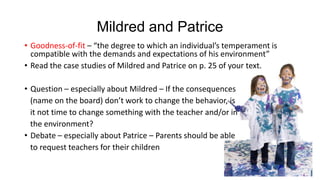
Mildred and Patrice
• Goodness-of-fit – “the degree to which an individual’s temperament is
compatible with the demands and expectations of his environment”
• Read the case studies of Mildred and Patrice on p. 25 of your text.
• Question – especially about Mildred – If the consequences
(name on the board) don’t work to change the behavior, is
it not time to change something with the teacher and/or in
the environment?
• Debate – especially about Patrice – Parents should be able
to request teachers for their children
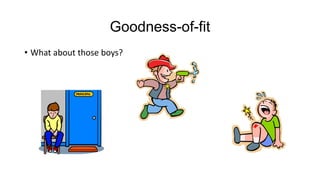
Goodness-of-fit
• What about those boys?
Early Influences
• “Know thyself”! - 1) your ability to reflect on your own early experiences and
relationships, 2) awareness of your ability to develop healthy relationships, and
3)improving ability to understand and attend to the needs of children in your care
take time and effort. Be willing to learn from your experiences and reflect on
better ways to handle difficult situations
• Vocabulary to know!
• Caregiving
• Attachment
• Self-efficacy
• Internal working models
• Ghosts in the nursery
• Angels in the nursery
Looking in the Mirror
• Look at the activities listed in the “Looking in the Mirror” box on p. 29
in your text.
• For those of you in class, we will chart our strengths and areas of
interest.
• For those of you online, we will fill in a Wiki to see how we can
complement each other .
• Remember: We can’t be all things to all people. The better we know
our strengths and shortcomings, the better able we are to work with
others to ensure the “goodness-of-fit” for the children in our care.
Social - Emotional Skills
• Self-regulation
• Autonomy
• Empathy and Sense of Community
• Communication
Click on the following hyperlinks to learn more about these very
important social – emotional skills and what we know from brain
research.
• Executive Functioning
• Conscious Discipline Brain State Model
Looking in the Mirror
• Consider all of the “Looking in the Mirror” questions found on pages
30, 31, and 32.
• What do we know about the differences in the children who often
hear “don’t do” as opposed to “explore, discover, create”?
• What about the children who grow up hearing “If you don’t hit back,
I’ll hit you when you get home!” or “Stop that crying or I’ll give your
something to cry about!”
• What do various classrooms “feel” like to you? Do people walk into
your room and see smiling faces and excited children? Do they hear
angry adults barking orders to children?
Discussion Board Opp 
As you reflect on your own experiences and perspective, it’s time to
articulate what you believe about teaching and learning as it relates to
child guidance and social-emotional development. Perhaps you
already wrote a philosophy of education in your EDU 119 class or
another class. However, a philosophy of education should be ongoing
and a work in progress.
In this DB, I want you to talk about your philosophy of education as it
relates to social-emotional development. What responsibility do
teachers have to plan for and provide opportunities for social –
emotional growth and learning? What responsibility do they have for
the social – emotional climate and environment in the classroom?
What else do you believe about teaching and learning as it relates to
child guidance and social-emotional development?
Leaving It at the Door
• How do you cope with stress?
• Can you differentiate healthy stress from unhealthy stress and
resulting behaviors and interactions?
• Do you take care of yourself and have healthy outlets for your stress?
• Remember the NAEYC Code of Ethical Conduct – Several core values
are based on positive relationships and respect of children, their
families, our colleagues and others with whom we work. If we have
little self-regulation, how can we provide high quality, DAP, healthy,
respectful, supportive, and challenging learning environments? How
can we demonstrate respectful relationships with families and
communities?

Teacher self reflection - chapter 2 2014sp

  • 1.
    Teacher Self-Reflection Chapter 2from Guiding children’s Social and Emotional Development: A Reflective Approach. Katz. 2014
  • 2.
    Super Teacher • Witha partner, create a poster depicting characteristics of your favorite teachers or adults when you were little.
  • 3.
    Multiple Intelligences Emotional Intelligence •Review the Multiple Intelligences (Howard Gardner) and Emotional Intelligence (Daniel Goleman) • The Marshmallow Test • Define • Interpersonal • Intrapersonal • Introspective • Use these skills following interactions with children – how might you improve interactions in the future?
  • 4.
    Temperament • “individual differencesin emotional reactivity and regulation that appear early in life, are relatively stable, and are at least partly biologically based” (Rothbart & Bates, 2006) • What are the implications of a child’s temperament? Our temperament? The combination? • Look at the Dimensions of Temperament on p. 23. Evaluate your own temperament using the chart on p. 24. Where might you have difficulty with someone of another temperament? What type temperaments might be a better “goodness-of-fit”?
  • 5.
    Mildred and Patrice •Goodness-of-fit – “the degree to which an individual’s temperament is compatible with the demands and expectations of his environment” • Read the case studies of Mildred and Patrice on p. 25 of your text. • Question – especially about Mildred – If the consequences (name on the board) don’t work to change the behavior, is it not time to change something with the teacher and/or in the environment? • Debate – especially about Patrice – Parents should be able to request teachers for their children
  • 6.
  • 7.
    Early Influences • “Knowthyself”! - 1) your ability to reflect on your own early experiences and relationships, 2) awareness of your ability to develop healthy relationships, and 3)improving ability to understand and attend to the needs of children in your care take time and effort. Be willing to learn from your experiences and reflect on better ways to handle difficult situations • Vocabulary to know! • Caregiving • Attachment • Self-efficacy • Internal working models • Ghosts in the nursery • Angels in the nursery
  • 8.
    Looking in theMirror • Look at the activities listed in the “Looking in the Mirror” box on p. 29 in your text. • For those of you in class, we will chart our strengths and areas of interest. • For those of you online, we will fill in a Wiki to see how we can complement each other . • Remember: We can’t be all things to all people. The better we know our strengths and shortcomings, the better able we are to work with others to ensure the “goodness-of-fit” for the children in our care.
  • 9.
    Social - EmotionalSkills • Self-regulation • Autonomy • Empathy and Sense of Community • Communication Click on the following hyperlinks to learn more about these very important social – emotional skills and what we know from brain research. • Executive Functioning • Conscious Discipline Brain State Model
  • 10.
    Looking in theMirror • Consider all of the “Looking in the Mirror” questions found on pages 30, 31, and 32. • What do we know about the differences in the children who often hear “don’t do” as opposed to “explore, discover, create”? • What about the children who grow up hearing “If you don’t hit back, I’ll hit you when you get home!” or “Stop that crying or I’ll give your something to cry about!” • What do various classrooms “feel” like to you? Do people walk into your room and see smiling faces and excited children? Do they hear angry adults barking orders to children?
  • 11.
    Discussion Board Opp As you reflect on your own experiences and perspective, it’s time to articulate what you believe about teaching and learning as it relates to child guidance and social-emotional development. Perhaps you already wrote a philosophy of education in your EDU 119 class or another class. However, a philosophy of education should be ongoing and a work in progress. In this DB, I want you to talk about your philosophy of education as it relates to social-emotional development. What responsibility do teachers have to plan for and provide opportunities for social – emotional growth and learning? What responsibility do they have for the social – emotional climate and environment in the classroom? What else do you believe about teaching and learning as it relates to child guidance and social-emotional development?
  • 12.
    Leaving It atthe Door • How do you cope with stress? • Can you differentiate healthy stress from unhealthy stress and resulting behaviors and interactions? • Do you take care of yourself and have healthy outlets for your stress? • Remember the NAEYC Code of Ethical Conduct – Several core values are based on positive relationships and respect of children, their families, our colleagues and others with whom we work. If we have little self-regulation, how can we provide high quality, DAP, healthy, respectful, supportive, and challenging learning environments? How can we demonstrate respectful relationships with families and communities?