FREE COPY
NOT FOR SALE
STUDENT´S BOOK
Level
ENGLISH
A2.2
ENGLISH
-
A2.2
-
BGU
Bachillerato General Unificado
PRESIDENTE DE LA REPÚBLICA
Rafael Correa Delgado
MINISTRO DE EDUCACIÓN
Augusto Espinosa Andrade
Viceministro de Educación
Freddy Peñafiel Larrea
Viceministra de Gestión Educativa
DaysiValentina Rivadeneira Zambrano
Subsecretario de Fundamentos Educativos (E)
Miguel Ángel Herrera Pavo
Subsecretaria de Administración Escolar
Mirian Maribel Guerrero Segovia
Directora Nacional de Currículo (S)
María Cristina Espinosa Salas
Directora Nacional de Operaciones y Logística
Ada Leonora ChamorroVásquez
© Ministerio de Educación del Ecuador, 2016
Av. Amazonas N34-451 y Atahualpa
Quito, Ecuador
www.educacion.gob.ec
La reproducción parcial o total de esta publicación,
en cualquier forma y en cualquier medio mecánico o
electrónico, está permitida siempre y cuando sea autorizada
por los editores y se cite correctamente la fuente.
English A2.2,
Student’s Book
Author
Mariluz Murcia Sierra
Editor-in-Chief
Javier AndrésTibaquirá Pinto
Editors
Carlos Sanabria Páez,
Miguel Ignacio Rodríguez
Proofreader
Andrea Peña
Consulting Reviewer
Randall Barfield
Audio Producer
Juan Carlos Jaramillo
Art Director
Gloria EsperanzaVásquez
Designers
Leonardo Rivas, Alexandra Romero,
Nohora Betancourt
Illustrators
CarmeloVergara, Luisa Uribe, Germán Gutiérrez,
Nelson Hernández, John Joven, Andrés Prieto,
andra González
Photography
Shutterstock ®
© Grupo Editorial Norma SA
Avenida Isaac Albéniz E3-154,Wolfgang Mozart
Quito, Ecuador
ISBN
Primera impresión:
To Our Students
The textbook that you have in your hands is a very important tool that will help
you learn in the best way possible. A textbook should not be your only source of
study and discovery; however, it will always be a good friend that will allow you to
discover for yourself the wonder of learning.
The Ministry of Education has made a curricular adjustment with the goal of
providing better opportunities for all students in the country as part of a project
that promotes full personal development and integration into a society that is
guided by the principles of Good Living, democratic participation and harmonious
coexistence.
To accompany the launching of this educational initiative, we have prepared
several resources according to age and years of schooling. Children in first grade
will receive a textbook that integrates stories and activities appropriate for their
age and that will help to develop the holistic curriculum designed for this Subnivel
de Educación General Básica. Teachers will receive a CD with songs in order to use
music to familiarize students with their first words in English as a complementary
material. From then on, until they complete the Bachillerato General Unificado,
students will receive textbooks, audio CDs and extra resources that will contribute
to the development of their learning in the areas of Science, Social Sciences,
Language and Literature, Mathematics and Foreign Language-English.
Itisalso importanttoknowthatteacherswill receiveteachingguides(teacher’s
books) that will enhance the teaching-learning approach of the student book,
thereby allowing teachers to develop students’ research and learning outside the
classroom.
This resource should be considered a support for the teaching-learning
approach that must be guided by teachers and carried out by students in
order to achieve its goal.
We hope that this adventure of knowledge will be the path
to achieving Good Living.
Ministry of Education
2016
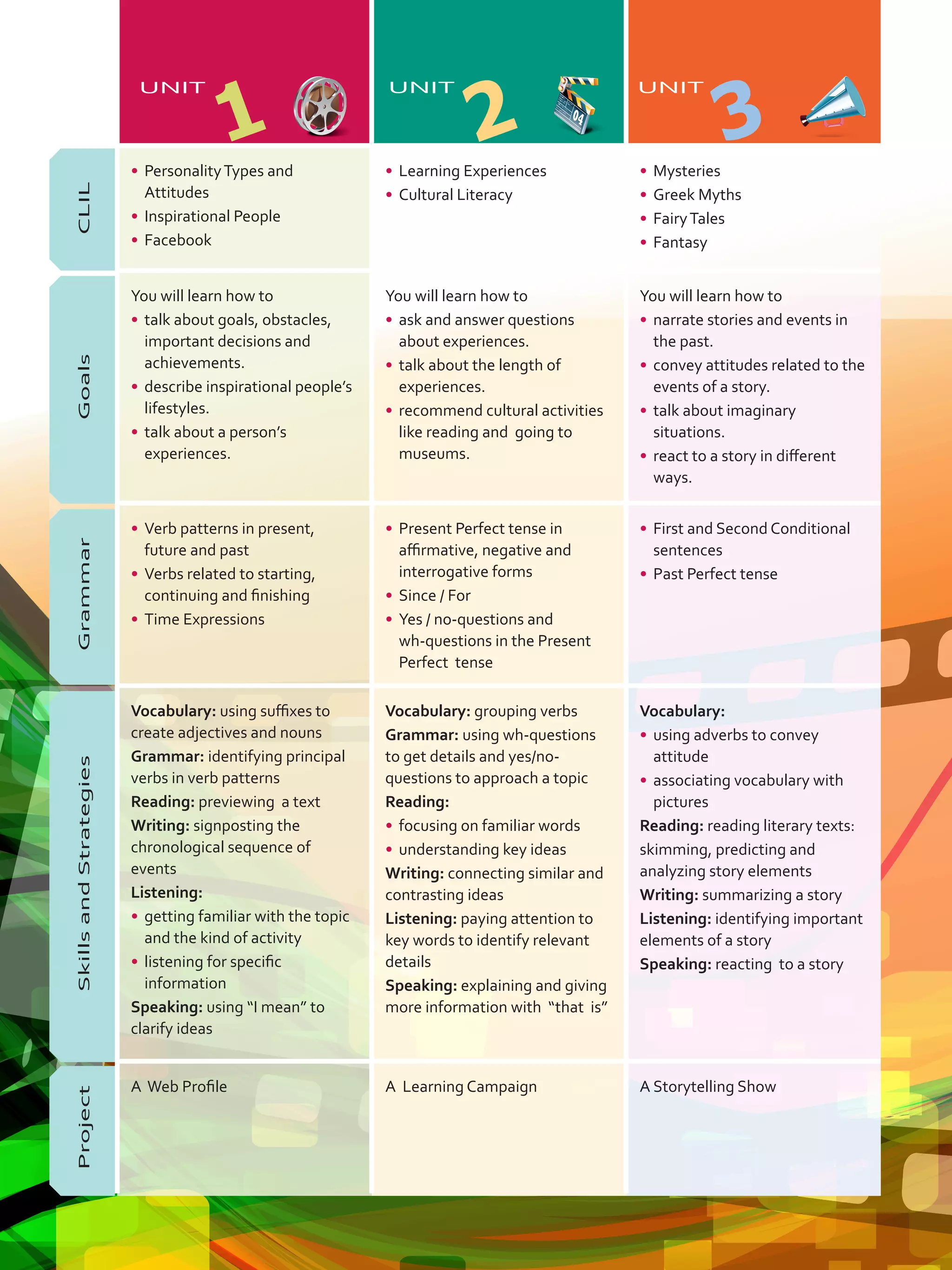
CLIL
• PersonalityTypes and
Attitudes
• Inspirational People
• Facebook
• Learning Experiences
• Cultural Literacy
• Mysteries
• Greek Myths
• FairyTales
• Fantasy
Goals
You will learn how to
• talk about goals, obstacles,
important decisions and
achievements.
• describe inspirational people’s
lifestyles.
• talk about a person’s
experiences.
You will learn how to
• ask and answer questions
about experiences.
• talk about the length of
experiences.
• recommend cultural activities
like reading and going to
museums.
You will learn how to
• narrate stories and events in
the past.
• convey attitudes related to the
events of a story.
• talk about imaginary
situations.
• react to a story in different
ways.
Grammar
• Verb patterns in present,
future and past
• Verbs related to starting,
continuing and finishing
• Time Expressions
• Present Perfect tense in
affirmative, negative and
interrogative forms
• Since / For
• Yes / no-questions and
wh-questions in the Present
Perfect tense
• First and Second Conditional
sentences
• Past Perfect tense
Skills
and
Strategies
Vocabulary: using suffixes to
create adjectives and nouns
Grammar: identifying principal
verbs in verb patterns
Reading: previewing a text
Writing: signposting the
chronological sequence of
events
Listening:
• getting familiar with the topic
and the kind of activity
• listening for specific
information
Speaking: using “I mean” to
clarify ideas
Vocabulary: grouping verbs
Grammar: using wh-questions
to get details and yes/no-
questions to approach a topic
Reading:
• focusing on familiar words
• understanding key ideas
Writing: connecting similar and
contrasting ideas
Listening: paying attention to
key words to identify relevant
details
Speaking: explaining and giving
more information with “that is”
Vocabulary:
• using adverbs to convey
attitude
• associating vocabulary with
pictures
Reading: reading literary texts:
skimming, predicting and
analyzing story elements
Writing: summarizing a story
Listening: identifying important
elements of a story
Speaking: reacting to a story
Project
A Web Profile A Learning Campaign A Storytelling Show
UNIT
1
UNIT
2
UNIT
3
Pre_VP4IngCol2011.indd 4 5/20/16 11:29 AM
4
CLIL
• Types ofTravelers
• Going Green
• ATour of Brasilia
• FindingYourWay in a
Campsite
• TheWeather
• Crazy News
• Disasters
• Digital Lives
• Technology
• TV vs. YouTube
• Tech Gadgets andToys
Goals
You will learn how to
• give and ask for directions and
information in a polite way.
• ask people if they agree with
you.
• give emphasis to descriptions
and comparisons.
You will learn how to
• tell and react to news.
• describe natural disasters and
extreme weather.
• talk about inventors,
inventions, artists and artwork.
You will learn how to
• talk about Internet habits and
wishes.
• give instructions to use
technology.
• give opinions about
technology.
Grammar
• Tag Questions
• Indirect Questions
• Placing Emphasis with much
and very
• PassiveVoice
• Yes / no-questions and
wh-questions in the Passive
Voice
• Past and Past Participle forms
of verbs
• Wishes
• PhrasalVerbs
Skills
and
Strategies
Vocabulary: classifying words
Reading:
• reading a map
• identifying informed opinions
Writing: using facts and reasons
to support opinions
Listening:
• listening for repetition
• using visuals
Speaking:
• asking for directions politely
• addressing people politely
Reading: inferring
Writing:
• generating ideas
• writing an information report
or news
Listening: understanding
numbers
Speaking:
• reacting to news
• introducing a piece of news
Vocabulary: understanding
prepositions
Grammar: visualizing phrasal
verbs
Reading: drawing conclusions
Writing:
• writing a “how to” article
• explaining cause and effect
Listening: taking notes
Speaking: checking instructions
and clarifying
Project
A Brochure A News Broadcast AWeb Survey
UNIT
4
UNIT
5
UNIT
6
Pre_VP4IngCol2011.indd 5 5/20/16 11:29 AM
Review
1. Complete and classify the questions. Then spin a pencil and play.
a. What your family like?
b. What kind of inventions you like?
c. Who you admire?Why?
d. What your city like?
e. What qualities should a friend ?
f. What you and your best friends
have in common?
g. How many cousin you have?
h. What your favorite invention?Why?
i. What your plans for the future?
j. What your favorite place to live?
k. Who been an important person
in your life?
l. What kind of friends you have?
m. What your most memorable vacation?
n. What kind of places you like to visit?
o. What hobbies you have?
p. you and your family get along well?
q. What career you like to study?
r. Where you study that career?
s. What you do in your leisure time?
t. you ever won a medal?
Career
Choices
P
l
a
c
e
s
a
n
d
T
r
a
v
e
l
i
n
g
H
and
I
n
v
e
n
t
o
r
s
I
n
v
e
n
t
i
o
n
s
G
r
e
a
t
P
e
o
p
l
e
T
h
e
W
h
e
e
l
o f
T r u t h
is
6
U0_VP4IngCol2011.indd 6 4/18/16 4:36 PM
Friends
F
a
m
i
l
y
Future Goals
Hobbies, Music
and Leisure Time
A
c
c
o
m
p
l
i
s
h
m
e
n
t
s
2. Read the story. Then complete it by using the words
below. Unscramble them.
One day, I was walking down the street when something
strange (a) to me. A strange man (b)
me a wizard’s wand. A hole in the
ground (c) right in front of me and I (d)
an alien coming out of a spaceship.
Luckily, I (e) a phone, so I called my friend
and I (f) him the story. As expected, he (g)
that I was crazy. He (h)
and didn’t believe me. He (i) to help me
but was not sure how. So, I (j) to look
inside the hole, use the wand and take pictures of the alien.
When I (k) closer to take the picture, I
(l) down the hole, I (m) the
magicwords “AbraKadabra,”andI(n) very
different, as if I were floating. I began to (o)
voices in my mind and to (p) things from
my past. At that moment, I woke up and rushed to go to
school because I was really late.
a. peedahnp
b. vgea
c. poened
d. was
e. dah
f. dolt
g. gutothh
h. helguda
i. foederf
j. ceedidd
k. ecma
l. netw
m. dais
n. elft
o. raeh
p. mebremre
a
happened
7
U0_VP4IngCol2011.indd 7 4/18/16 4:36 PM
3. Choose your answer. Then listen and check.
Welcome to the show where we’ll see
how much you know about the world.
Geography

Which planet is
closer to the sun?
a. Jupiter
b. Neptune
c. Venus
Which country is
the largest?
a. Canada
b. Russia
c. Brazil
Which ocean is the
deepest?
a. The Atlantic
b. The Artic
c. The Pacific
Which is the highest
mountain?
a. Everest
b. Aconcagua
c. The Snowy
Mountains
Who invented the
printing press?
a. Thomas Edison
b. Johannes
Gutenberg
c. Louis Braille
Who invented the
lighting system?
a. Tim Berner Lee
b. Graham Bell
c. Thomas Edison
Who invented the
WWW?
a. Joseph Marie
Jacquard
b. Tim Berner Lee
c. Steve Jobs
4. Go around the class and interview your partners.
Find Someone Who…
Name Extra Information
has learned to play the guitar.
went out of the city on his / her last
vacation.
has practiced karate.
has learned French.
will study architecture in the future.
has visited an interesting city.
has a pet.
has met someone famous.
has been onTV.
is sociable and outgoing.
Who invented the
motor car?
a. Karl Benz
b. Thomas
Edison
c. Graham Bell
Sarah She learnt last year.
8
U0_VP4IngCol2011.indd 8 18/03/2016 09:36:57 a.m.
Inspirational
People
UNIT
1
u
uGeneral Objective
You will be able to talk about lifestyles, personality types,
preferences and interests.
u
uCommunication Goals
You will learn how to
• ask for and give personal information.
about goals, obstacles, important decisions
and achievements.
• describe inspirational people’s lifestyles.
• talk about a person’s experiences.
u
uCLIL
• PersonalityTypes and Attitudes
• Inspirational People
• Facebook
Vocabulary
• Vocabulary related to teens’ lifestyles
• Verbs related to starting, continuing and finishing
processes
Grammar
• Verb patterns,Time expressions, Adverbs of sequence
u
uIdioms and Colloquial Expressions
• To be worlds apart • To have the knack
• To do it for kicks • For one thing
• To facebook • Go for it
u
uProject
AWeb Profile
You will work in groups to create a web profile and make
a visual presentation of an inspirational person in your
life.
Discuss:
• What types of teenagers are
there?
• Do any of these people
represent you?
• Do you think any of these
characters have any
inspirational characteristics?
U1_VP4IngCol2011.indd 9 5/20/16 11:39 AM
a. adventur c. styl
b. success d. spiritu
Lesson 1
TeensofToday!
3. Complete the sentences about the different teen
types. Use the adjectives above.
a. people care about the
spirit.They’re inspired by nature.
b. Trend-setters are very .
They have a lot of talent and imagination.
c. Jane knows what she likes. She will probably be
in finding a career.
d. Go-getters feel most of
the time.They think life is an adventure.
1. Read and complete each list. Use the Word Bank.
a.
b.
c.
d.
e.
f.
g.
h.
brainy
2. Find more adjectives and identify the suffixes.
Key Expressions
For one thing: the first of
many examples
4. Read and practice. Replace the personality type.
What are nature
lovers like?
Well, for one thing,
they’re eco-friendly
and spiritual.
ous
Teens’lives.com
Are you a tech-head?
You’ll enjoy using our
online community with
new apps every day!
Or a nature lover
interested in protecting
the environment? Find
your causes here!
How about trend-setters?
You like to express yourself
in artistic ways. Find a way
here!
Or maybe you’re the go-getter?
Well, you like to take risks
and compete to go after your
dreams. Register now!
Word Bank
• competitive
• artistic
• brainy
• spiritual
• tech-savvy
• eco-friendly
• stylish
• adventurous
Groups for everyone! For one thing, you’ll make friends and
discover your passions for successful future jobs! Join now!
Vocabulary Strategy
Pay attention to suffixes to identify adjectives.
Some common suffixes are ous / ful / y / ish / ive / al.
spiritual
adventurous
10
U1_VP4IngCol2011.indd 10 18/03/2016 10:19:01 a.m.
5. What type of future occupation suits you best according to your personality?
Take this test. Then complete the grammar chart below.
Reflect on Grammar
When you’re using more than one verb in a sentence,
there are some special combinations you need to do.
Only
Gerunds
Gerund and
Infinitives
Gerund after
Prepositions
I
being
indoors.
I to buy new
cell or computer
gadgets.
I having
friends that are online
when I need them.
I’m interested
in
the world and
a creator.
a. When you have free time, do you enjoy…
1. being indoors, searching the web?
2. going out, maybe camping or trekking?
3. looking at fashion and music magazines?
4. recycling paper and participating in social activities?
b. When you have money to spend, do you like...
1. to buy new cell or computer gadgets?
2. to meet new people or learn new things?
3. to go shopping for clothes or go to the beauty
salon?
4. to buy food to feed stray dogs?
c. You likehaving friends that are…
1. online when you need them.
2. risk takers and adventurous.
3. stylish and have a good sense of color and design.
4. eco-friendly and care about the environment.
d. When you think about the future, are you
interested in…
1 getting to know about tech-advancements?
2. traveling the world?
3. being the creator of new trends?
4. being an environmental activist?
6. Complete. Then listen and check.
Results
4 +You’re a .You’ll probably be interested
in working as a marine biolog or an ecolog .
3+You’re a .You’ll enjoy working as a
media communicat or a fashion design .
2+You’re a .You’ll probably love to be a
manag or a political lead .
1+You’re a . You’ll be successful as a
computer programm or a web special .
Grammar Strategy
Pay attention to the principal verb
(the first one in these sentences)
to identify the combinations.
7. Complete the questions and answers.
A: What does she enjoy (a) in her free time?
B: She is interested in (b) to all kinds of music.
A: Does she like (c), too?
B: Of course, she loves samba!
Take this test and discover what occupation suits you best.
Vocabulary Strategy
Use suffixes -or and -er to transform verbs into nouns,
and -ist to change nouns or adjectives into nouns.
• Write some sentences about a person you admire.
• Get in groups and talk about your persons to discover things in common.
Project Stage 1
E.g. Our fathers love to watch sports onTV.
enjoy
nature lover
ist ist
Grammar and Vocabulary
11
U1_VP4IngCol2011.indd 11 18/03/2016 10:19:02 a.m.
1. Listen, read and correct the false statements. Then complete the grammar chart below.
2. Fill in the blanks with the correct verb form. Use the verb in parentheses.
Lesson 2
GreatPeopleInspiringTeens!
Anne:That was an excellent match!
Bill: Thanks, our team needed to win.
Anne: Congratulations! Keep working
hard and you’ll probably be the best.
By the way, do you plan to become
a pro soccer player when you finish
studying?
Bill: Yes, I want to play for the best
teams in the world.You know, just like
Messi. And what would you like to be?
Anne:Well, I want to take drama
classes next semester.
Bill: Drama? But you just began
taking martial arts!
Anne: Yeah, I know. But just like
Noah Ringer, the actor inAvatar,
I’m into acting. Maybe I’ll be a great
taekwondo actress!
Bill:Taekwondo actress? I won’t miss
any of your movies.
Anne: I’ve decided to take up
taekwondo and continue doing
drama.
Bill:Well, then go for it!
a. Bill’s team lost the game.
b. Anne enjoyed watching the game.
c. Bill inspires Messi to be a great soccer player.
d. Bill will probably be a pro soccer player.
e. Anne is going to take taekwondo classes.
Bill’s team won the game.
Key Expressions
Go for it:You can do it
Noah Ringer is the actor who plays the
leading role of Aang in the movie The Last
Airbender. He began
(a. practice) taekwondo when he was 10.
At the age of 12, he obtained his black belt.
Noah kept (b. train) and
(c. learn).The following year
he won theTexas StateTaekwondo Championship.
He became an actor because of his great
resemblance to the character of the television
series Avatar, and, of course, for his excellent
taekwondo skills. For the future he would like
(d. teach) taekwondo to
other kids and teens, but for sure he’s
going (e. continue)
(f. act) in many
more movies.
Good luck, Noah!
f
Reflect on Grammar
Ways to express future Ways to express desire, necessity and decision
a great taekwondo actress!
• I
• You be the best.
• Do you to become a pro soccer player?
• Our team needed to win. (necessity)
• I to take drama classes. (desire)
• I to take up taekwondo and continue doing
drama. (decision)
Use after these verbs. Use after these verbs.
He keeps practicing sports.
He enjoyed taking sports classes.
He’ll finish studying soon.
Notice:
I’ll start
practicing
chess.
begin
to practice
continue
I wanted
She planned to be an actress.
You would like
She is going
´ll be
practicing
acting
12
U1_VP4IngCol2011.indd 12 18/03/2016 10:19:03 a.m.
4. Unscramble. Then listen, check the
questions and tick the correct answers.
• In groups, select an inspirational person and the
aspects of his/her life you want to talk about.
• Write questions about this person and assign
responsibilities to investigate the answers to those
questions.
Project Stage 2
E.g. Who inspired Justin Bieber to…?
3. Answer the questions and compare with a partner. Then complete the grammar chart below.
You think you know a lot about
your favorite soccer star?
Answer these questions.
1. What’s Messi’s full name?
a. Leonardo Messi
b. Lionel Andres Messi
c. Lionel Nicolas Messi
2. Where was he born?
a. Buenos Aires
b. Mendoza
c. Rosario
3. How old was Messi when he
began to play professionally?
a. 12
b. 17
c. 16
4. What is Messi’s position?
a. defender
b. forward
c. midfielder
Reflect on Grammar
How old Messi when he began to play professionally? you plan to become
a pro soccer player when you finish studying?What you going to do after that?
Notice “Who” questions do not have an auxiliary verb, e.g. Who inspired you?
a. inspired / who / to become / you / a soccer player?
1. My father
2. My mother
3. My grandmother
b. do / what / in the future / plan / you / to / do ?
1 Keep playing and traveling around the world.
2. Keep playing and helping sick children through
		UNICEF.
3. Become a soccer coach.
c. an important obstacle / be / what / you / had / to face?
1. My family was very poor.
2. I suffered from a hormone deficiency.
3. I was not fast enough at the beginning.
d. be / your / most / what / achievement / important?
1. My first goal in the Barcelona soccer club.
2. Obtaining a gold medal at the Beijing 2008
		Olympics.
3. The Under 20 SoccerWorld Cup.
Pronunciation
Some sounds are shortened with reductions:
I’m going to / gona / be a pro-soccer player.
Some other sounds are shortened with
contractions:
I’ll / ail / be a taekwondo actress.
I’d / aid / like to become a scientist.
Listening
Strategy
Before listening,
get familiar with
the topic and
type of activity.
Listening Strategy
Listen for specific information that answers wh-questions.
was
Who inspired you to become a soccer player?
Grammar and Vocabulary
1.
13
U1_VP4IngCol2011.indd 13 18/03/2016 10:19:03 a.m.
Lesson 3
1. Read the text quickly to answer the
following questions.
What type of text is this?
a. a blog
b. a wiki
c. an article in a magazine
What’s the topic of the text?
a. The Facebook community
b. Social networks
c. The creator of Facebook
TheCreatorandHisCreation
Reading Strategy
To get familiar with the topic of a text, take a
quick look at the vocabulary it contains.
2. Look at the text below and look for the words in bold type corresponding to these definitions.
a. to give people control over a situation 1.
b. a set of computers connected to each other to share information 2.
c. people with the same occupation or work as you 3.
d. to get unauthorized access to manipulate information 4.
e. a computer system through which programs run 5.
3. Read the text below and identify the heading for each section of the contents.
Contents
Achievements
Future goals
Origins
Obstacles and
controversy
Mission
Achievements 1
In 2004, Mark Zuckerberg surprised the world
when he and other colleagues co-built one of
the most recognized and used social networks
of today. 3 years later Facebook was chosen
by most media experts as “the website of the
decade” with more than 500 million users all
around the world.
2
Mark was born on May 14th, 1984, in Dobbs
Ferry, NewYork. At an early age, he created
Synapse Media Player, an early operative
system version of an Mp3 and an instant
messaging application for his father’s business.
He even designed computer games for his
friends.When Mark was at Harvard, he
developed a university social network based
on the need to join different communities of
the university.
3
In a short time, Mark opened his own
company and became very rich, successful
and famous. But it wasn’t easy. At the
beginning, Harvard University accused him of
violating individual privacy and hacking their
internal system.
4
Behind Facebook’s tech essence there is a
social phenomenon that has revolutionized
people’s lives. Mark sees his company as the
platform to empower people to share openly
and communicate online in rich and varied
ways.
Reading
Strategy
Read quickly
looking for words
to find the topic of
each paragraph.
empower
14
U1_VP4IngCol2011.indd 14 5/23/16 2:15 PM
7. Write a paragraph about a website or social network you use.
Explain past, present and future interests, motivations, obstacles
or joys using it.
• Organize chronologically the information about the person you chose.
• Create a visual presentation for this information.
Project Stage 3
E.g. At an early age, Justin Bieber began
to play the piano. In the year…
4. Read again more carefully and answer the questions.
5
Facebook’s creator is now focused on the future of Facebook. He and his team of collaborators are interested in
improving the social experience of users by giving them more and better options to interact over the net.
Reading Strategy
Use context clues to discover
what comes after or before
these sentences.
5. Read again and decide in which paragraph to put these sentences.
This means that in the years to come the way people search for
information, connect and share online will be different.
Quickly, it worked so well that Mark decided to drop out of the university
to dedicate himself completely to the development of his company.
Recently, in 2010 the famousTime magazine chose Mark as Person of the
Year.
More recently Mark had to face hard critics on privacy issues and the
policies of his company.
6. Read and choose the correct expression.
In a short time / Soon / Currently the social network I use is Facebook.
I enjoy facebooking. Before / When / At the beginning I have free time, I see
pics of my friends and write quick messages on their walls and, of course, I
play games. Two years ago / In the years to come / Now, my favorite social
network was My Space because all my friends had their accounts there. At
an early age / Recently / When I started to have problems logging in and I
got bored. So I signed up withTwitter but I don’t use it much. I think I’ll keep
facebooking!
a. What did Mark do at an early age?
b. What happened in the year 2004?
c. What did Mark do when he was at Harvard?
d. What happened in the year 2007?
e. What will happen to Facebook in the future?
Writing Strategy
Use these expressions to attach
ideas smoothly and to signpost
the chronological sequence of
events.
At an early age, Mark showed
great talent for computers.
In the year 2007, Facebook
became the leading social
network.
When he started / finished…
Recently, currently, eventually…
Before / after…
Finally…
He created Synapse Media Player.
Reading and Writing
5
15
U1_VP4IngCol2011.indd 15 18/03/2016 10:19:05 a.m.
Lesson 4
IHavetheKnack!
Reflect on Values
Always Sometimes Never
¾
¾ I have role models that nourish my life.
¾
¾ I choose the people I admire.
¾
¾ I respect my friends the way they are.
Gap Activity
Student A goes to page 87.
Student B goes to page 89.
1. Complete with the expressions below by listening to the dialogs.
Word Bank
• do it for kicks
• Facebook
• live wire
• have the knack
• worlds apart
2. Match these idioms with their meanings.
a. to be worlds apart
b. to facebook
c. to do something for kicks
d. to be a live wire
e. to have the knack
1. to do something for excitement or fun
2. to have a talent to do things easily
3. to be an energetic and enthusiastic person
4. to post something on Facebook
5. to have different ideas, tastes and interests
3. Complete with information about you.
4. Share with a partner.
Speaking Strategy
Use “I mean” to clarify your ideas.
Conversation 1
Bonny: Look at this picture I took!
Alan: It’s great! I mean,
(a).Why
don’t you (b) it?
Bonny: No, it’s not really good.
Alan: Come on! It’s great. Just
(c). Everybody
is going to enjoy it.
Bonny: All right!
Conversation 2
Ted: Let’s invite the new guy to
be part of our team. He’s a real
(d).
Lynn: What do you mean?
Ted: I mean he’s enthusiastic and very
energetic.
Lynn:Yeah, but we don’t have anything in
common.We’re (e).
Ted: Come on, give him a chance.
• Things I like to do for kicks
• People I know that are live wires
• Things I or friends do when facebooking
• People I know that are worlds apart
➧ Reason
➧ Reason
➧ Reason
➧ Reason
Speaking Strategy
Integrate idiomatic expressions into
your daily communication.
What do you like
to do for kicks?
Do you know anyone
who’s a live wire?
worlds apart
c
16
U1_VP4IngCol2011.indd 16 18/03/2016 10:19:06 a.m.
Give your Presentation
• Give a basic introduction of the person you chose and
his / her personality.
• Talk about the different aspects you investigated.
• Explain clearly why you chose that person as someone
who inspires you.
• Give biographical information to illustrate those
aspects.
ShareYourProject
Useful Expressions
• To Introduce the group: Good morning, this is my
group … I’m … and this is…
• To introduce the topic:We’re going to talk
about…
• To list one of the many qualities of the person:We
admire this person because for one thing,…
• To give reasons: He’s ourVIP (very inspiring
person) because…
1. Discuss your experience.
a. What do you find inspiring in your classmates?
their looks their talents their achievements
their personalities their clothes other:
b. According to your experience, identify and rank (5 - most; 1 - least) how important these personality types are when
working in groups.
the leader the joker the rebel
the brainy one the eco-friendly person other:
c. Check what you learned (L) or need to learn (NL).
to accept my partners just as they are to help my partners
to look for creative ways to solve problems to take the initiative
to share ideas
d. Evaluate your process.
• I contributed interesting and relevant information.
• I had a positive attitude about the activity.
Always Sometimes Never
Understanding personality and people’s preferences
is an important issue for many different professionals.
Psychologists, teachers, researches, marketers, etc. use
labels to fit people into certain descriptors such as tech-
heads, rebels, nature lovers, etc.These descriptors are
used for example to target a product (a book or piece of
clothing) or to discover the important characteristics of
outstanding people who have made a difference in the
world. Unfortunately, sometimes people label others to
place them in boxes and limit their growth. For instance,
when a characteristic of an individual is over-generalized
and projected into a group, e.g. “all tech-heads are
addicted to the net.” In short, even when individuals are
easily identified and labeled, everybody is unique.
• What’s the reason that people are labeled?
• Why do you think labeling limits people’s growth?
• Why do people pay attention to the lives of others?
Real Communication
2. Read and answer.
17
U1_VP4IngCol2011.indd 17 4/28/16 12:39 PM
1. One day, Gina discovered her passion was music!
She loves listening to music and going to concerts.
Comic
BecomingYourDream!
2. In class Gina daydreams too much.
3.That day, Gina is not satisfied with her image. It took time.
I need to look
trendy!
4.When she arrived at the club, the audition
was already over.They found someone else.
5. Gina’s dream is over…
6. But Gina’s not alone. She still needs another opportunity.
7. Gina starts to practice
and practice…
8. Finally, she’s going to
be a great singer!
You need to achieve your dreams by
working hard.That’s what really counts!
I want to become
a great singer!
Look!TheTrendy Rockers
are looking for a guitar player.
This is my
opportunity!
Listen and read.
18
U1_VP4IngCol2011.indd 18 18/03/2016 10:19:07 a.m.
Quiz Time
2. Choose the best option.
1. Listen, read and check the correct boxes.
Self-Evaluation
Now I can... VeryWell OK A Little
¾
¾ talk about styles, personality types, preferences and interests.
¾
¾ describe inspirational people’s lives.
a. Mike is really
. He
dances and sings
beautifully.
1. artistic
2. brainy
3. stylish
b. At an early age, Natalie
showed her energetic
personality. She’s a real
.
1. eco-friendly 		
teen
2. stylish girl
3. live wire
c. Go-getters tend to be
.They love
to compete and win.
1. competition
2. competing
3. competitive
d. teens
are very committed
to animal and
conservation causes.
They always help
animals in need.
1. Trend-setters
2. Eco-friendly
3. Brainy
3. Complete this paragraph with the correct verb
combination.
Kevin Joe Nick
a. He enjoys wearing trendy clothes.
b. He likes nature and loves being outdoors.
c. He’s a tech-head.
d. He will write a book about his life.
e. He’ll go solo or create his own band.
f. He’ll travel around the world.
What’s my brother like? Well, for one thing,
he’s extravagant and the typical rebel. Rebels
(a. be) freedom lovers. He likes
(b. look) different. He’s very smart,
though. He’s interested in (c. know)
all the different views, but he enjoys
(d. create) controversy. Recently he decided
(e. be) more relaxed and friendly.
He plans (f. study) ecology at
the university. My parents think he’ll
(g. become) a great professional.
4. Complete the questions with the correct auxiliary verb. Then, match with the questions.
1. I was 8 years old.
2. I enjoy surfing the web and chatting with friends
online.
3. I’m interested in learning languages.
4. Well, for one thing, I love animals.
5. I will keep studying drawing. It’s my thing.
a. What you enjoy doing?
b. How old you when you began to
pratice taekwondo?
c. What you do next year?
d. What you interested in learning?
e. Why you decide to become a vet?
are
do
19
U1_VP4IngCol2011.indd 19 18/03/2016 10:19:07 a.m.
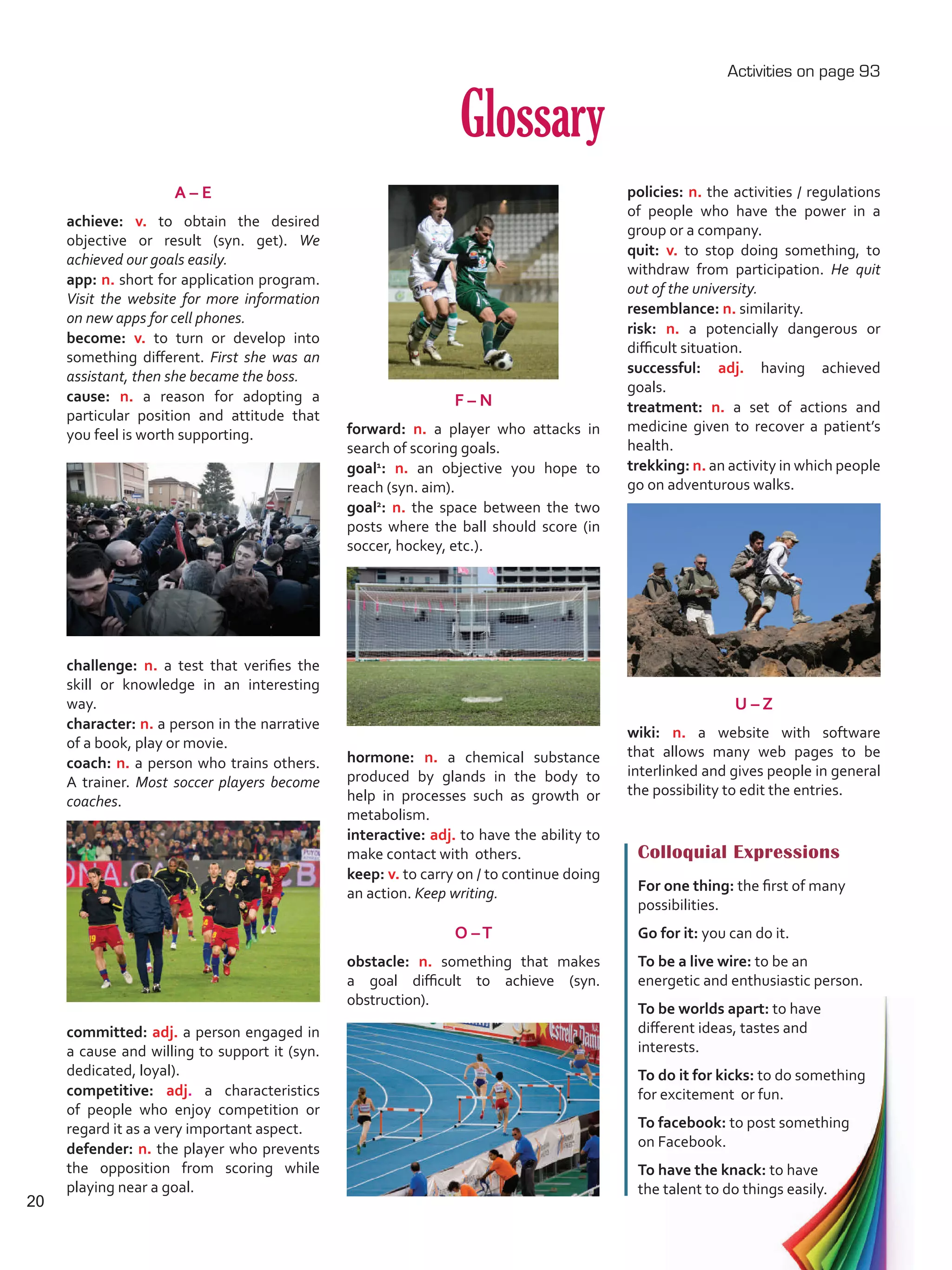
Glossary
A – E
achieve: v. to obtain the desired
objective or result (syn. get). We
achieved our goals easily.
app: n. short for application program.
Visit the website for more information
on new apps for cell phones.
become: v. to turn or develop into
something different. First she was an
assistant, then she became the boss.
cause: n. a reason for adopting a
particular position and attitude that
you feel is worth supporting.
challenge: n. a test that verifies the
skill or knowledge in an interesting
way.
character: n. a person in the narrative
of a book, play or movie.
coach: n. a person who trains others.
A trainer. Most soccer players become
coaches.
committed: adj. a person engaged in
a cause and willing to support it (syn.
dedicated, loyal).
competitive: adj. a characteristics
of people who enjoy competition or
regard it as a very important aspect.
defender: n. the player who prevents
the opposition from scoring while
playing near a goal.
Colloquial Expressions
For one thing: the first of many
possibilities.
Go for it: you can do it.
To be a live wire: to be an
energetic and enthusiastic person.
To be worlds apart: to have
different ideas, tastes and
interests.
To do it for kicks: to do something
for excitement or fun.
To facebook: to post something
on Facebook.
To have the knack: to have
the talent to do things easily.
F – N
forward: n. a player who attacks in
search of scoring goals.
goal1
: n. an objective you hope to
reach (syn. aim).
goal2
: n. the space between the two
posts where the ball should score (in
soccer, hockey, etc.).
hormone: n. a chemical substance
produced by glands in the body to
help in processes such as growth or
metabolism.
interactive: adj. to have the ability to
make contact with others.
keep: v. to carry on / to continue doing
an action. Keep writing.
O –T
obstacle: n. something that makes
a goal difficult to achieve (syn.
obstruction).
policies: n. the activities / regulations
of people who have the power in a
group or a company.
quit: v. to stop doing something, to
withdraw from participation. He quit
out of the university.
resemblance: n. similarity.
risk: n. a potencially dangerous or
difficult situation.
successful: adj. having achieved
goals.
treatment: n. a set of actions and
medicine given to recover a patient’s
health.
trekking: n. an activity in which people
go on adventurous walks.
U – Z
wiki: n. a website with software
that allows many web pages to be
interlinked and gives people in general
the possibility to edit the entries.
Activities on page 93
20
U1_VP4IngCol2011.indd 20 18/03/2016 10:19:09 a.m.
u
uGeneral Objective
You will be able to talk about your most
significant learning experiences in the
context of cultural literacy.
u
uCommunication Goals
You will learn how to
• ask and answer questions about experiences.
• talk about the length of experiences.
• recommend cultural activities like reading and
going to museums.
u
uCLIL
• Learning Experiences: traveling, languages, sports,
camps and hobbies.
• Cultural Literacy: going to museums, attending
lectures, learning dances, reading books, seeing art
films and going to concerts.
Vocabulary
• Vocabulary related to different types of cultural activities and
learning experiences
Grammar
• Present Perfect tense in affirmative, negative and
interrogative forms
• Since / for
• Yes/no questions and wh-questions in the Present Perfect
tense
u
uIdioms and Colloquial Expressions
• That is • To hit the books
• That’s awesome • To be a page turner
• To be in the same boat • To take a rain check
u
uProject
A Learning Campaign
You will work in groups to carry out a learning campaign
promoting cultural literacy.
Experience
Culture!
UNIT
2
Discuss:
• Do you like going to museums, libraries or
cultural centers?Why?
• How can these places contribute to a
person’s education?
• Do you know of free exhibits in your town?
U2_VP4IngCol2011.indd 21 5/20/16 12:01 PM
Lesson 1
WhatHaveYouDoneLately?
a. She’s
abroad for two weeks.
c. They’ve a
foreign language for two months.
e. They’ve
karate since February.
d. They’ve
members of a dance group for more
than a year.
f. We’ve in a
reading campaign since January.
b. I’ve a
workshop at the museum since
December.
1. Look and complete. Use the Word Bank.
Word Bank
• taken up
• attended
• been (2)
• studied
• participated
2. Complete the chart. Listen and check. Then complete the grammar chart.
3. Listen and match each
conversation with the
situations in exercise 1.
Conversation 1
Conversation 2
Conversation 3
Conversation 4
Reflect on Grammar
Present Perfect tense
I
a member of
this museum
for 2 weeks.
You
She
Use the Present Perfect tense for:
a. completed actions (started in the past, finished in the past)
b. uncompleted actions (started in the past, continue at present)
REGULAR VERBS IRREGULAR VERBS
Present travel support study take go be
Past form ____ / ____
Past
participle
4. Circle an option to make these sentences true for you.
a. I have / haven’t taken up
a sport or hobby.
b. I have / haven’t been
abroad.
c. My mother has / hasn’t
studied English.
been
Vocabulary Strategy
Identify the verbs that
have the same form in the
Simple Past tense and Past
Participle form.
traveled
traveled
took
taken
have
22
U2_VP4IngCol2011.indd 22 5/23/16 2:18 PM
6. Unscramble the sentences and complete with your information.
5. Listen and fill in the blanks. Then complete the grammar chart.
Key Expressions
That’s awesome! It’s great!
Pronunciation
Contraction of have and has
I’ve been abroad.
She’s been abroad.
Reduction of have
How long have you been here?
7. Ask and answer the questions in exercise 6 with a partner.
Project Stage 1
E.g. Some students have
practiced martial arts.
• Get in groups and think
about learning activities
for teens.
• Investigate if students in
your class have done these
activities.
A: long / have / you / How / studied English / ?
(a).
B: I have studied English for (b).
That is, since (c).
C: I’ve been in this dance group for (d).
That is, since (e) and you?
long / have / been / you / in / your group / How / ?
(f).
D: I’ve been in my group since (g).
That is, for (h).
E: Martha is my best friend.
F: Really? long / been / she / your friend / How / has / ?
(i)
E: Since (j).
Speaking Strategy
Use “that is” to explain
or give more detailed
information.
How long
have you studied
English?
I’ve studied
English for 2 years.
That is, since I began
to study here.
Conversation 2
Al: I haven’t seen your sister for a long time.
Where is she?
Sarah: She’s abroad. She traveled to Paris.
Al:To Paris? Oh, that’s awesome. How
(a) has she been there?
Sarah: She’s been abroad (b) she graduated.
Al: (c) she visited the Louvre Museum?
Sarah:Yes, she (d). She sent me some
pictures. It’s a great museum.
Conversation 1
Ann: Hi! I’m new to this group.
Bob:Welcome to the group! (a) you taken
karate before?
Ann: No, I (b). I’m just curious. Have you
(c) a member for a long time?
Bob:Yes, I (d). I’ (e) been in
this group (f) January last year!That is,
(g) 20 months or so.
Ann: That’s awesome!
Reflect on Grammar
Questions
you taken karate? Yes, I . / No, I .
she visited the Louvre Museum? Yes, she / No,
hasn’t.
How has she been there? Since
For two weeks.
Use to ask for the duration of the activity.
Use to indicate a period of time.
Use to indicate a point in time.
Have
have ve since
Have have
How long
How long have you studied English?
Grammar and Vocabulary
23
U2_VP4IngCol2011.indd 23 18/03/2016 10:21:37 a.m.
Lesson 2
2. Listen again and fill in the blanks with time
expressions and adverbs of frequency. Then
complete the grammar chart.
a. I Sophie’sWorld
. It was very interesting. I haven’t read
any other book since then.
b. I’ve the same
snacks. I’m picky when I eat. I eat only what I like.
c. I’ spinning
.
d. Yeah. I saw an excellent movie
. I can’t remember its name, though.
e. I have some friends at school and in the neighborhood. I
anyone .
f. Yes, I have. The school the whole class to
the Metropolitan Museum like .
g. I’ to concerts .
For example, my friends and I went to a great concert last
month.We only go to reggaeton concerts.
1. Read, listen and complete.
Use the Word Bank.
Discover how culturally literate you are!
How much knowledge have you acquired
lately?
Name: Linda Diaz
Age: 14
If yes, which one?
Sophie’s World
		 Yes No
a. a good book recently?
b. any new dish or food?
c. a new sport or hobby?
d. a good movie?
e. new people?
f. to museums or exhibits?
g. any special event?
Grammar
Strategy
Use yes/no
questions to
approach a topic.
Use wh-questions
to go into details.
Reflect on Grammar
Present Perfect vs. Simple Past
Present Perfect
I’ve been to concerts .
Simple Past
I went to a great concert .
The is used
for actions that happened at an indefinite time in
the past or actions that are repeated.
The is used
for actions that happened at a definite time in the
past and are finished.
Word Bank
• attend
• take up
• meet
• see
• be
3. Take the test with a partner.
Take turns asking and answering the survey.
CulturalLiteracyforEveryone
read last year
ve practiced
haven’t met
took
many times
Have you read
Have you tried
24
U2_VP4IngCol2011.indd 24 18/03/2016 10:21:38 a.m.
6. Listen again and choose.
a. Webhelper			 Monday 14th
Consider doing this activity more often. In a
family reunion suggest going to museums and
cultural events.
b. Friendly surfer 		 Tuesday 15th
Avoid eating the same things. Make your own
shopping list and give new things a try. Practice
cooking new recipes.
c. Charisma 			 Tuesday 15th
Dare to be different. Learn to listen to other kinds
of music and dance expressions. Be sure to listen
to diverse music.
d. ArtMaster 678 		 Wednesday 16th
You need to interact with more people.You can
start meeting more people by joining hobby
groups like theater troupes. Why not? Give it a try!
• Choose one learning activity
per group to promote in a
campaign.
• Prepare a set of
recommendations for students
to get involved in the activity
your group is promoting.
E.g. Campaign: Learn to enjoy
reading books.
Project Stage 2
Our cultural center is offering
these workshops,
conferences and classes.
• Reading workshop
Saturdays at 5:00 PM.
• Conference Study Abroad
Saturday at 8:00 AM.
• Course Learning toWatch
Movies
Mondays,Wednesdays and
Saturdays at 4:00 PM.
Our cultural center is offering
these workshops,
conferences and classes.
• Reading workshop
Thursdays and Fridays at 4:00 PM.
• Conference Study Abroad
Saturday at 8:00 AM.
• Course Learning toWatch
Movies
Mondays,Wednesdays and
Saturdays at 4:00 PM.
Our cultural center is offering
these workshops,
conferences and classes.
• Reading workshop
Saturdays at 5:00 PM.
• Conference Study Abroad
Saturday at 8:00 AM.
• Course Learning toWatch
Movies
Wednesdays and Saturdays
at 4:00 PM.
4. Match these comments with Linda’s answers in exercise 2. Then complete the grammar chart.
Dare to be different!
5. Listen to a phone call to the Youth Cultural Center and choose the corresponding poster.
Activity Objectives
Workshop
• learn to
a. read fast b. read difficult texts c. enjoy reading
Conference
• give information about
a. traveling abroad b. working abroad c. studying in a
		 foreign country
Course
• learn how to interpret
a. movies b. history c.photographs
Listening Strategy
Concentrate on the specific information by
previewing the information you will need.
a b c
Reflect on Grammar
GivingTips!
Be sure to diverse
music.
Avoid the same things.
Followed by
gerunds
Followed by
infinitives
Listening Strategy
Pay attention to key words to
identify relevant details.
to listen
consider
need
Grammar and Vocabulary
25
U2_VP4IngCol2011.indd 25 18/03/2016 10:21:39 a.m.
Lesson 3
1. Look at the texts below and label them.
I want to share with you a great book that
has taught me incredible things. The book
is called Sophie’s World. Its author is Jostein
Gaarder, who has written many books for
children and young people. Sophie’s World
is a young girl’s journey down through the
history of philosophy. Through a series of
mysteries and the help of a mentor, Albert
Kong, Sophie discovers that philosophy is
extremely important for people because we,
Reading Strategy
Understanding Key Ideas
Key ideas are usually rephrased to make the
reading more cohesive. Look at the beginning
and end of paragraphs to identify rephrasing.
A.
A.
This site is one of those websites you will find very
useful and entertaining. It has very interesting articles
with important advice for young people. You can find
topics such as health, school, careers, family and the
latest news to enlighten the world of teens. It also
contains a school section with the links to educational
sites that cover plenty of academic topics in depth and
accurately. Additionally, these articles are written in
very simple English so that anyone understands.
a. a book review
b. a web-site review
c. a workshop review
d. a summer camp review
e. a video game review
2. Read these reviews and answer the questions below.
B.
B.
as humans, need to question the nature of
our existence. On her journey she discovers
the great philosophers and theories that have
shaped human thought. Who am I?Where do I
come from? Where is God? If you ever wonder
about the same questions, you will probably
discover some interesting answers and also
enjoy reading the adventures that happened
to Sophie and her friends while learning to
think more critically and with a different
perspective. I highly recommend this book
because it is full of mysteries and knowledge.
Reading Strategy
Preview the topic by focusing
on familiar words.
Stop and think.
What’s the author’s opinion about the web-site?
a. The author thinks it’s a great site for students who can’t do their homework.
b. The author thinks it’s important for students to chat about their homework with students in other countries.
c. The author thinks the web-site offers interesting services to students with homework problems.
On the other hand, you can chat with students all over
the world about your homework and your interests.
Unlike wikis –or any other educational web-sites– MSAE
offers the possibility to receive help online by a tutor
that is highly qualified and who is ready to help clarify
your doubts. I definitely recommend this website to all
students who need guidance on their homework and
projects.
Stop and think.
What’s the book about?
a. The history of Sophie
b. Sophie’s journey while learning philosophy
c. The history of philosophy
ReadingtoChoose
A book review
26
U2_VP4IngCol2011.indd 26 18/03/2016 10:21:39 a.m.
• Assign responsibilities e.g. designing flyers or posters,
preparing speeches and slogans.
• Use a strategy to carry out the campaign.
• Rehearse your presentation.
Project Stage 3
3. Complete the expressions to recommend items, services and events.
a. I recommend this book because of its original ending.
b. I like to this movie to all jazz music
fans.
c. This website has an collection of English exercises.
d. It also podcasts and videos to practice your English.
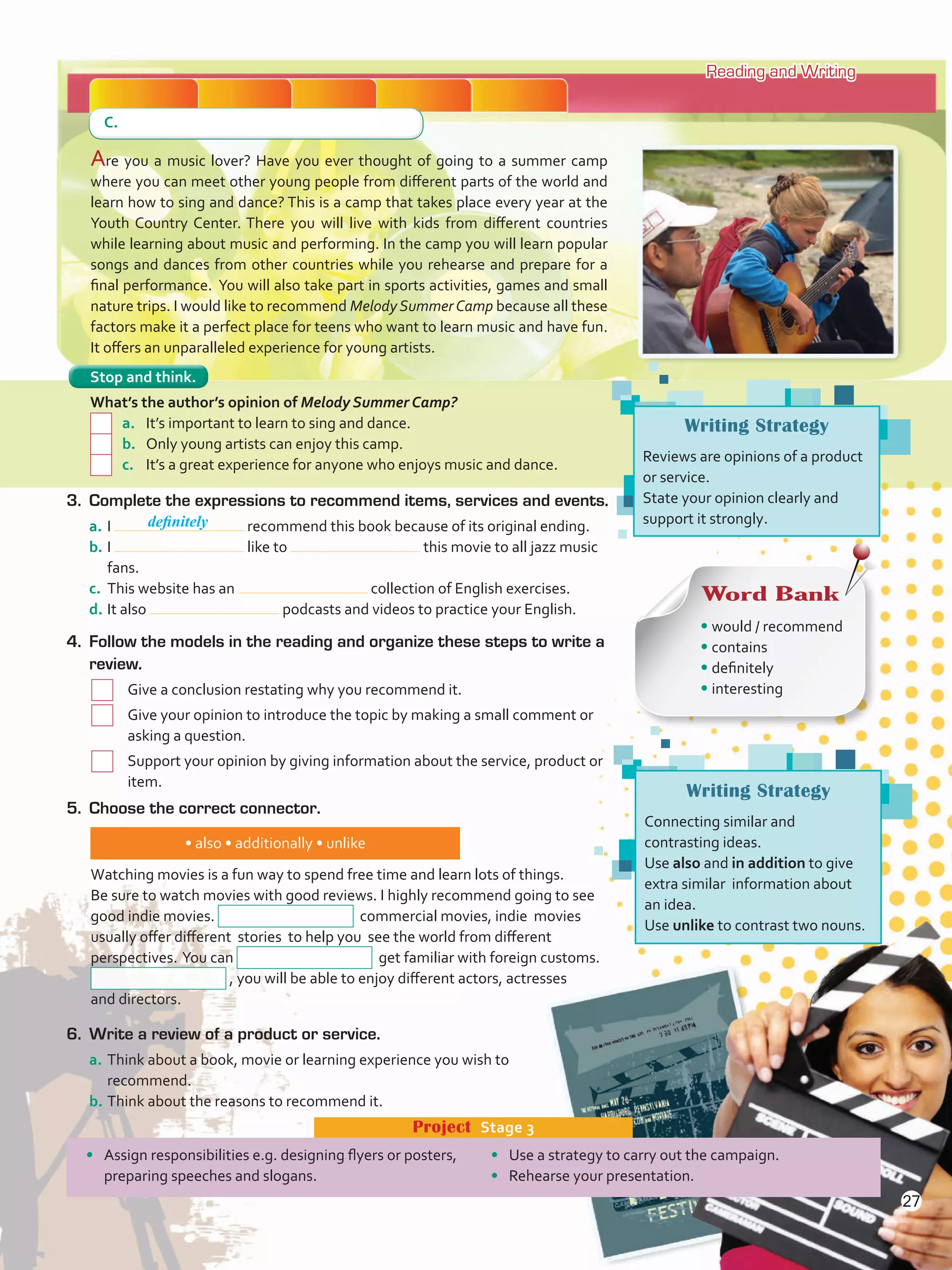
Are you a music lover? Have you ever thought of going to a summer camp
where you can meet other young people from different parts of the world and
learn how to sing and dance? This is a camp that takes place every year at the
Youth Country Center. There you will live with kids from different countries
while learning about music and performing. In the camp you will learn popular
songs and dances from other countries while you rehearse and prepare for a
final performance. You will also take part in sports activities, games and small
nature trips. I would like to recommend MelodySummerCamp because all these
factors make it a perfect place for teens who want to learn music and have fun.
It offers an unparalleled experience for young artists.
Reading and Writing
C.
C.
Stop and think.
What’s the author’s opinion of Melody Summer Camp?
a. It’s important to learn to sing and dance.
b. Only young artists can enjoy this camp.
c. It’s a great experience for anyone who enjoys music and dance.
5. Choose the correct connector.
Word Bank
• would / recommend
• contains
• definitely
• interesting
4. Follow the models in the reading and organize these steps to write a
review.
Give a conclusion restating why you recommend it.
Give your opinion to introduce the topic by making a small comment or
asking a question.
Support your opinion by giving information about the service, product or
item.
Writing Strategy
Reviews are opinions of a product
or service.
State your opinion clearly and
support it strongly.
6. Write a review of a product or service.
a. Think about a book, movie or learning experience you wish to
recommend.
b. Think about the reasons to recommend it.
Writing Strategy
Connecting similar and
contrasting ideas.
Use also and in addition to give
extra similar information about
an idea.
Use unlike to contrast two nouns.
Watching movies is a fun way to spend free time and learn lots of things.
Be sure to watch movies with good reviews. I highly recommend going to see
good indie movies. commercial movies, indie movies
usually offer different stories to help you see the world from different
perspectives. You can get familiar with foreign customs.
, you will be able to enjoy different actors, actresses
and directors.
• also • additionally • unlike
definitely
27
U2_VP4IngCol2011.indd 27 18/03/2016 10:21:40 a.m.
Lesson 4
InTheSameBoat
I have taken a rain check many times.The last time I took a rain
check was
I have hit the books...
Reflect on Values
Always Sometimes Never
¾
¾ I use my free time adequately.
¾
¾ I am learning to learn.
¾
¾ I am open to new things.
Gap Activity
Student A goes to page 87.
Student B goes to page 89.
1. Look and match the pictures with the idioms.
1. a real page turner 2. take a rain check 3. in the same boat 4. hit the books
a. b. c. d.
2. Listen and match the idioms with their meaning.
3. Read and complete the conversations with the correct idiom.
4. Complete. Then share with your partner.
a. To be in the same boat 1. to be a very exciting novel or non-fiction work
b. To hit the books 2. to postpone an invitation or plan
c. To be a real page turner 3. to study hard
d. To take a rain check 4. to be in the same situation
Conversation 1
A: What are you doing this afternoon? How about
going out to a movie?
B: Sorry, I have (a).
I have an exam tomorrow.
A: I promise we’ll get home early. Have you ever seen
A Brilliant Mind? It has great reviews.
B: Sounds like a good movie but I’d rather
(b).
Conversation 2
A: Have you read The Chronicles of Narnia?
B: No, I haven’t.What’s it like?
A: It’s (c).
It’s a fascinating story!
B: Well, I’ve seen the movie but I haven’t read the book.
C: Me too! We’re
(d).
A: OK! Some other time! No problem!
c
to hit the books
28
U2_VP4IngCol2011.indd 28 4/18/16 4:45 PM
1. Discuss your experience.
Give your Presentation
• Describe the objective of your campaign.
• Talk about your motivations to carry it out.
• Present the tips you promoted in your campaign.
• Invite people to read all the reviews you created to
recommend interesting learning experiences.
Useful Expressions
• To introduce your campaign
We’re running a campaign for/against…
We have worked on a campaign...
have created a campaign…
have launched a campaign…
• To express the purpose of the campaign
The purpose of this campaign is…
to create awareness…
to change a habit…
• To engage students into the activity your group is
promoting
We have learned...We have talked to...
Invite your parents to...
Consider doing... Start interacting with...
To show the possibilities for learning…
• To give tips
We want to share with you these tips…
Real Communication
ShareYourProject
Rank these out of class-learning activities according to their importance.
(1 the most, 10 the least)
going to museums or exhibits hanging out with friends attend conferences
going to the movies listening to music talking to parents
joining a hobby group participating in campaigns traveling
Other
Check what you think is true about your group work.
There is a lot of creativity. There’s not much creativity.
There’s respect for all members’ ideas. There’s no respect for all members’ ideas.
Information to carry out the project is enough. Information to carry out the project is not enough.
We spent time appropriately. We didn’t spend time appropriately.
We collected information in a timely manner. We didn’t collect information in a timely manner.
Everybody collaborates. Not everybody collaborates.
There is a lot of motivation. There is not much motivation.
C ampaigns are organized activities to achieve a goal.
Campaigns are designed to bring people together and
involve them in particular ways of thinking and doing
things. Honest campaigns are powerful tools to make
a big difference in the world.They can have a great
educational impact and can also be a fun way to obtain
important skills such as leadership and commitment.
Interesting changes can be obtained when people work
together to make something happen.The strategies or
tactics you use will depend on the kind of message or
idea you will be campaigning for.These strategies have
to be different as not all people respond to the same
thing.You can send messages, write posters, give talks
or have discussions, or even create a slogan.
Answer these questions:
a. What’s a campaign?
b. According to the author, why can campaigns make a
difference in the world?
c. In your opinion, what’s the most important element
in a campaign?
2. Read and answer.
29
U2_VP4IngCol2011.indd 29 18/03/2016 10:21:41 a.m.
Start
Complete.
What
you done lately?
How
have you
English?
YOU’RE
YOU’RE
Talk about it.
Recommend a
good movie.
Transform
these verbs into
the past participle
form: take, be, see,
study and read.
Correct this
sentence.
I have studied
English since five
years.
Answer.
When was the
last time you hit
the books?Why?
Ask a question.
I’ve been a member
of this group for a
short time.
Mention 5
verbs in their
past participle
form.
Mention as
many cultural
activities as
possible. If you
mention 6, you can
advance 3 squares.
Make a question
following this
structure:
Wh + Aux + subject
+ verb in past participle
+ preposition of time +
years?
Organize this
sentence.
a camp you going
thought to summer
ever Have of?
Create 2
sentences for
these time
expressions.
last night
lately
Ask have you
ever questions to
your partners using
these verbs: dance,
travel, escape,
cried, learn, travel
and practice.
Mention three
books you
consider real
page turners.
Complete these
sentences.
I
abroad two times.
I to
Canada in 1990 and
in 2003.
Complete these
sentences.
I’ve been abroad
2 years.
She’s in
a reading campaign.
Talk about it.
Recommend a
book you’ve read
recently.
1 2 3 4
9 8 7 6 5
10 11 12 13 14
19 18 17 16 15
20 21 22 23 24
1. Think about experiences you have had.
• Get in pairs. Move around the board by tossing a coin. Move one or two spaces (Head = 1;Tails = 2).
• Ask and answer questions to be the first one to get to Rome.
Game
Time to Play
30
U2_VP4IngCol2011.indd 30 4/18/16 4:49 PM
2. Complete with the Simple Past tense or the
Present Perfect tense.
All my life I (a. love) to travel.
When I (b. go) to New York in
2005, I (c. meet) wonderful
people and I (d. learn) a lot of
things. It was a great experience.
I’ve never (e. be) to Europe
but one day I’d like to go and travel by train
and visit interesting places like Paris and Rome.
I (f.hear) interesting things about
these cities. My best friend
(g. travel) with her family to Rome last summer and
she (h. take) some great pictures
of the Coliseum.
Self-Evaluation
Now I can... VeryWell OK A Little
¾
¾ talk about learning experiences.
¾
¾ ask and describe the duration of some actions.
¾
¾ give recommendations to improve one’s learning skills.
Quiz Time
1. Listen and choose the right answer.
a. How long has she waited?
1. for a long time
2. She just arrived
3. for 10 minutes
b. What has the girl done lately?
1. She has been to some countries.
2. She has gone to the library.
3. She’s gone to the GreatWaterfall.
c. Who has traveled a lot?
1. the boy
2. the girl
3. both
d. What does the boy think of the GreatWaterfall?
1. He has never heard of it.
2. He thinks it’s not a good place to visit.
3. It’s a beautiful place to visit.
4. Complete with the correct word or expression.
a. Learn advantage of your free time.
1. to take
2. taking
3. take
b. Gina suggested to an exhibit
instead of staying home.
1. to go
2. going
3. went
c. Linda had to because she
needed a better grade than the previous one.
1. take a rain check
2. hit the books
3. get in the same boat
d. Elkin andTeresa are
because they haven’t read the book.
1. hit the books
2. in the same boat
3. a real page turner
3. Complete. Use since or for.
A: Have you been here (a) a long time?
B:Well, I’ve been here (b) you called
me.
A: How long has she been abroad?
B: She’s been abroad (c) 1995. She
left one year after her brother. He’s been in Italy
(d) more than 20 years.
’ve loved
been
for
31
U2_VP4IngCol2011.indd 31 18/03/2016 10:21:43 a.m.
review: n. a text that gives an opinion
about an event or product like a movie
or a book. Movie reviews can help you
decide what to see.
schedule: n. a timely planning of
events. What’s on schedule?
survey: n. a method to collect
information. Please, fill out this survey!
take up: v. start a sport or activity;
become interested in the activity and
spend time practicing it. I took up chess
last month.
U – Z
useful: adj. helpful to do what you
want or need. The books contains useful
information on different jobs.
workshop: n. an educational session
for improving people’s knowledge or
skills. I’m taking a workshop on art.
A – E
abroad: adv. out of the country (syn.
overseas). We’ve traveled abroad twice
this year.
attend: v. to go to an event, to be
present at. He has attended all the
lectures at the conference.
campaign: n. an operation, carried out
by means of propaganda, to obtain
some political, social or commercial
goal. Actions taken in order to achieve
a particular goal. He’s organizing a
campaign.
custom: n. tradition and knowledge
from a place and its people. A
conventional mode of acting. The
movie shows traditional customs from
other countries.
enlighten: v. to provide light, to give
knowledge or truth, to explain (syn.
edify, instruct). This book will enlighten
the world of teens.
entertaining: adj. serving to entertain,
agreeably diverting (syn. amusing, ant.
boring). It’s an entertaining website.
F – N
guidance: n. help and careful
instructions (syn. counseling).
This website provides guidance for
homework.
journey: n. a long overland trip,
travel from one place to another (syn.
expedition). He took a journey to a
distant place.
knowledge: n. information and
abilities acquired through experience
(syn. awareness, understanding).
Reading will help you improve your
knowledge of the world.
leadership: n. the position of being a
leader, the act of leading. This course
develops leadership skills.
Louvre: n. a well-known museum in
Paris.
O –T
picky:adj.apersonwhoiscomplicated.
He’s a picky eater.
recipe: n. instructions for preparing
particular types of food. I have a recipe
for preparing a great sauce.
Glossary
Colloquial Expressions
That is: it is to say.
That’s awesome! It’s great!
To be a real page turner: a great
book to read fast; a very exciting
novel or book.
To hit the books: to study hard.
To be in the same boat: to be in
the same situation.
To take a rain check: to
postpone an invitation or plan
for another time.
Activities on page 94
32
U2_VP4IngCol2011.indd 32 18/03/2016 10:21:44 a.m.
Speaking
You’re
Craig.
You’re
on
a
trip
through
Africa.
You
want
to
help
people
who
live
in
remote
areas
to
get
a
source
of
renewable
energy.
You
have
an
interview
with
a
News
Channel.
Answer
their
questions.
You
are
going
to
talk
about
personal
information
first
and
preferences.
Then
talk
about
experiences
and,
finally,
about
future
plans.
3.
What
will
Pablo
have
to
do?
A
B
C
4.
Where
is
The
Cat
set?
A
B
C
5.
Has
Pablo
seen
“The
Commander”
?
A
B
C
Candidate
A
33
U1-2_VPTT4IngCol2011.indd
34
4/19/16
9:11
AM
Test
Training
A
Listening
Listen
to
a
short
conversation
twice.
There
are
five
questions.
For
questions
1-5
check
(
)
the
correct
answer
(A,
B
or
C).
Example:
0.
What’s
the
situation?
1.
What
does
Pablo
enjoy
doing?
2.
What
type
of
books
does
Pablo
enjoy
reading?
Answers
0
A
B
C
1
A
B
C
2
A
B
C
3
A
B
C
4
A
B
C
5
A
B
C
A
B
C
A
B
C
A
B
C
33
33
U2_VP4IngCol2011.indd 33 4/19/16 9:24 AM
34
U2_VP4IngCol2011.indd 34 18/03/2016 10:21:49 a.m.
u
uGeneral Objective
You will be able to tell stories and reflect on their
messages.
u
uCommunication Goals
You will learn how to:
• narrate stories and events in the past.
• convey attitudes related to the events of a story.
• talk about imaginary situations.
• react to a story in different ways.
u
uCLIL
• Mysteries
• Greek Myths
• FairyTales
• Fantasy
Vocabulary
• Words related to fantasy and mystery, adverbs
Grammar
• Past Perfect vs. Simple Past tense
• First and second conditional sentences
u
uIdioms and Colloquial Expressions
• To give someone the creeps
• To draw a blank
• To have something on the tip of the tongue
• To be between a hard place and a rock
• To be all ears
• To sound creepy
• Not to take it
u
uProject
A Storytelling Show
You will work in groups to create or recreate a
story and tell it in a storytelling show.
Story
Time!
UNIT
3
Discuss:
• What are your favorite stories?Why?
• Who are the main heroes in Roman and Greek mythology?
• Which  are some of the main characters in fairy tales?
• Name some of the most famous fairy tales all over the world.
• Who is your favorite fantasy writer?
• Do you know of any ghost stories?
U3_VP4IngCol2011.indd 35 5/20/16 12:12 PM
Lesson 1
Mysteries
a. When something is unexpected and quick, it happens .
b. When something occurs in a complete manner, it is done .
c. When something is unusual, it happens .
d. When something occurs with surprise, it happens .
e. When something occurs against good luck, it happens .
f. When something is surrounded by mystery, it is said to happen
.
, she picked it up and
examined it very carefully.
Tina had missed the school bus so she was walking
in the park. when she came
close to a tree, she saw a shining object. It was a ring.
, the ring had her initials
marked on it.
So she put it in her backpack and decided to take it
home and show it to her parents.
she found it again under
her bed.
when she was crossing a
bridge on her way home, the ring fell out of her
backpack and disappeared into the river.
1. Listen to the story and match the pictures to the events by placing the
corresponding capital letters in the circles. Then listen again and
complete the texts. Use the Word Bank.
Word Bank
A.
B.
C.
D.
E.
F.
2. Listen again and put the events in (capital letters) chronological order.
1. 3. 5.
2. 4. 6.
Immediately
C
3. Match these adverbs to their meaning.
Vocabulary Strategy
To make adverbs, add–ly to adjectives.
Adverbs of manner and attitude
mysterious – ly
careful – ly
fortunate – ly
surprising – ly
Adverbs that describe manner and
attitude towards an event usually go at
the beginning of a sentence.
Immediately, she picked it up and
examined it carefully.
suddenly
1
a.
F
c. e.
b. d. f.
• strangely
• mysteriously
• immediately
• suddenly
• unfortunately
36
U3_VP4IngCol2011.indd 36 18/03/2016 10:23:30 a.m.
5. Write T (true) or F (false).
a. Tina had decided to go home before she missed
the bus.
b. BeforeTina arrived home, she had lost the ring.
c. Before that day,Tina hadn’t seen a painting of
her grandmother wearing the ring.
d. She had lost the ring in the river before she found
it again under her bed.
e. Before she crossed the bridge over the river, she
had lost her backpack.
Word Bank
• arrive
• see (2)
• walk
• pick
• belong
• lose
Word Bank
• strangely • carefully • mysteriously
• unfortunately
Key Expressions
I’m all ears: I’m paying attention.
4. Complete. Use the two Word Banks. Use either the Simple Past or Past Participle form of the
verbs. Then listen, check and complete the grammar chart below.
A: Listen to this story!
B: I’m all ears!
A: Well, that dayTina had missed the school bus,
so she decided to go back home through the National
Park. She had (a) for 20 minutes when
she felt tired and stopped under a big tree.When she got
close to the tree, she (b) a shiny object.
She (c) it up and examined it (d)
. It was a ring.
B:Was it magical?
A: Shh! Let me finish! (e) , it had her
initials on it. She put it in her bag and continued her journey.
(f) , when she was crossing the bridge
over a river, she tripped, the ring fell out of her backpack and
disappeared into the river. She (g) home
very disappointed; but when she came into the living room,
she noticed a painting she hadn’t (h) before. It
was a painting of her grandmother wearing the same ring she
had found in the park.
B: That’s… unbelievable.
A: Oh, Lucas, why don’t you just listen? Anyway, that night
Tina went to bed very sad. (i) , when she
Key Expressions
Sounds creepy: It’s scary.
was looking for her slippers under the bed…she found the
ring again. It was the same ring.
B: Sounds creepy! How did it happen? She had (j)
the ring in the park.Why was it under her bed
now?
A: Nobody knows. It’s a mystery. Later, her mother told
her the ring had (k) to her great-
grandmother who had the same name asTina.
B: Uh huh.Yes, sure! Let me tell you something, you know, I
don’t buy it!
Reflect on Grammar
Past Perfect
She missed / had missed the school bus, so she decided / had decided to go back home.
She had missed the school bus. She decided to go back home now
X X X
The Past Perfect tense is used to show that one event happened before / at the same time another event in the past.
Grammar and Vocabulary
6. Complete. Use Past Perfect or Simple Past.
a. I (hear) that story before
you (tell) it to me last night.
b. Everyone (think) the story was
true, until they (find) out it was
just an urban legend.
c. The children (fall) asleep when
he (finish) telling the story.
d. By the timeTina (arrive) home
she (lose) the ring.
• Talk about the kinds of stories you like.
• Choose one story. Explain why!
Project Stage 1
E.g.We like stories full of fantasy and magic.
We think they’re entertaining.
Key Expressions
I don’t buy it: I don’t believe it.
F
walked
had heard
37
U3_VP4IngCol2011.indd 37 5/23/16 2:25 PM
Lesson 2
Fantasy!
If I were a king, .
If a fairy granted me a wish, I’d ask for happiness.
If I were a fairy tale character, I’d be .
If I had a mythical creature, I’d have a .
If I wrote a fairy tale, I’d write about .
If I had magical powers, I’d turn into
.
1. Look up the words below in your
dictionary. Then number them based
on the picture.
a fairy a princess
a castle a prince
a magical tree gold
a woodcutter a dragon
a gnome straw
an elf a giant
Puss in Boots a knight
a juicy sausage
2. Classify and complete the chart.
TheThreeWishes
4. Read and complete the story with some of the words in exercise 1.
Then complete the grammar chart on page 39.
O nce in a kingdom far, far away, there was a
woodcutter and his wife. One day the man saw a  
(a) and he thought “If I
cut down this tree, I’ll make some good money. If I
make good money, I’ll get my wife a new dress.”
But the man noticed that the tree was very thick
so he doubted if he could cut it down. However, he
kept thinking about the money “If I could chop it
down, I wouldn’t have to work for a long time.”
Suddenly,abeautifulandtiny(b)
appeared and said “I wouldn’t cut down that tree if
I were you! It’s a magical tree. I will grant you and
your wife three (c) if you don’t
cut it down.” Happily, the man accepted, went to
his house and told his wife about the fairy.
3. Complete the sentences. Use the vocabulary above.
Magical or Mythical
Characters
People Wishes Places
Turn into gold.
Have
for lunch.
Become a strong
.
straw
2
“If a fairy granted me a wish, I’d ask for a
hot(d) ,I’msohungry,”
said the wife jokingly. Immediately, at the
table, a big juicy sausage appeared.
“Oh, come on, you wished for a simple
sausage and now we just have two wishes
left! I wish the sausage would hang from
your nose,” said the (e)
angrily without thinking.
As soon as he spoke the words, the sausage
hung from the woman’s nose. “What did you
do? Look at me,” said the wife, who now had
a sausage hanging from her nose. When the
woodcutter saw his wife looking so sad, he
knew what his next wish would be.
3
1
4
5
7
13
10
I’d live in a castle
12
11
14
9
8
6
11
10
7
5
magical tree
15
a fairy a woodcutter
38
U3_VP4IngCol2011.indd 38 18/03/2016 10:23:33 a.m.
If you were the character of the story, what would you do?
8. Listen to the second part of the story and answer
the questions.
a. What did the main character have to do to solve the problem?
b. How did the story end?
9. Get into groups and play a game. Make a wish game.
If I were , I’d . If I ,
I’d . If I ,
I’d . If I…
• Create a new version of the story you chose.
• Select two top endings and discuss the best possible results.
Project Stage 2
E.g. If the queen didn’t keep her promise,
the gnome would do something bad.
Reflect on Grammar
Conditional Sentences
n Use first conditional sentences when you think
a future situation is possible.
If I this tree down, I
good money.
n Use second conditional sentences when a
situation is very unlikely (almost impossible) to
happen or is contrary to reality.
If I you, I
that tree.
If a fairy me a wish,
I for a hot sausage.
n In the second conditional,
a. the if clause uses the simple present / simple
past.
b. the result clause uses would (’d) / simple
past.
Notice the form of the verb be in the conditional:
If I were you, I wouldn’t cut that tree.
5. Match the if clauses with result clauses.
a. If I were you,
b. If I cut down this tree,
c. If a fairy granted me
a wish,
d. If I could chop it down,
6. Complete with the second conditional.
a. If I (see) a fairy, I
(wish) for richness.
b. If I (to be) rich, I
(live) in a castle.
c. If I (live) in a castle, I
(be) a king or queen.
d. If I (be) a king or queen,
I’d have .
e. If I had , I .
f. .
Listening to a story
When listening to story, identify its most important
elements: characters / setting / conflict / resolution.
7. Use the vocabulary from exercise 1 and
predict the story. Then listen and choose.
Finally complete the sentence below.
Main Characters Setting The Conflict
a gnome and a
baby
a girl and a gnome
a king and a servant
a tower in a castle
an enchanted
forest
a haunted house
a lie and a promise
a mystery and a
murder
a bad decision
Pronunciation
Notice how would is contracted.
I’d wish for a sausage.
She’d wish for a new dress.
I wouldn’t cut down that
tree if I were you.
Grammar and Vocabulary
cut
1. I wouldn’t have to work.
2. I wouldn’t cut down that
tree.
3. I’d wish for a hot sausage.
4. I’ll make some good money.
saw
d
39
U3_VP4IngCol2011.indd 39 18/03/2016 10:23:34 a.m.
Lesson 3
StoriesofAllKinds!
2. Match the columns. Use your dictionary.
a. challenge to separate the head from the body
b. fool to make someone believe something that is not true
c. draw to be in a position that cannot be seen
d. hide not to move
e. stand still to test someone’s abilities
f. behead to stop sleeping
g. awaken to pull an object gently
1. Look at the text quickly and choose the word cloud that best represents it.
Hide and use the reflection
of the shield to locate and kill
her without looking at her.
Fly above her and use the
sword to hit her in the
head.
a. b.
a
3. Read.
“Look for theGraeae, who are the only ones who know where
tofindMedusa,”saidHermes.“Whoarethey?”askedPerseus.
“The Graeae are Phorcys’ daughters. They are three ladies
who have only one glass eye. They can tell you where to find
Medusa.” Saying this, the gods took Perseus to a mysterious
land where theGraeae lived.Taking them by surprise, Perseus
took their precious eye and did not return it until they had told
him how to find Medusa.
When Perseus arrived at the island where Medusa lived, he
found all theGorgons asleep.Silently, he drew his sword,
hid and stood still. Suddenly, Medusa woke up as if she
had smelled his presence and began to look for him.
Stop and think. If you were Perseus, how would
you use the magical objects to kill Medusa?
Choose.
a. b.
Reading Strategy
Skimming
Look over the text quickly
to find important words
(characters and main actions).
A long time ago Perseus, a mortal son of Zeus, lived on
the Greek island of Seriphos. One day he was challenged
byPolydectes,KingofSeriphos,tokillMedusa,amonster
who had serpents as hair, and return with her head.
Medusa had been a beautiful lady and was turned into a
Gorgon because she had offended the goddess Athena
by being excessively proud of her beauty. So, she had to
live with other Gorgons on a faraway island. If someone
looked at her in the eye, she would turn them into
stone and die.
Perseus went on this mission. He didn’t know that
he had been fooled by Polydectes, with the intention
of getting married to Perseus’ mother, Danae.
Perseus traveled to a remote land but he got
lost. However, he received help from the gods
Hermes and Athena who gave him three
magical objects, (1) winged sandals, a (2)
shield and a (3) helmet.
Stop and
think. Look
at the picture
and number
the magical
objects
Perseus
received.
40
U3_VP4IngCol2011.indd 40 4/18/16 4:56 PM
4. Read again and answer the questions.
1. Why did Perseus decide to go after Medusa’s head?
2. Who helped him?
3. What elements did he need to fulfill his mission?
4. How did he find Medusa?
5. How did he kill her?
Reading and Writing
Perseus remembered that if he looked into Medusa’s eyes,
he would turn into stone.So, he used the Medusa’s reflection
on the bronze shield to behead her before she had time to
look at him. Medusa died at once. Immediately, her sisters
awoke and saw Perseus, who quickly ran away with Medusa’s
head.Thanks to the invisibility helmet, Perseus escaped and
with his winged sandals flew back to the island of Seriphos.
When he arrived he found out that Polydectes had turned
his mother into a servant. Desperately, he entered the room
where the evil king and his close friends were gathered.All of
them turned to look at Perseus, not believing he had fulfilled
his task.
“You fool, you think I believed your story?” said Polydectes as
he turned around to look at Perseus.
When all the people in the room were looking, Perseus took
out Medusa’s head petrifying anyone who was looking at it.
And this is how the brave Perseus saved his mother Danae
and became one of the greatest heroes in Greek mythology.
Stop and think. What do you think? What was Perseus’
best quality?
a. braveness and intelligence
b. braveness and strength
c. braveness and impulsiveness
5. Read again and complete the chart.
Reading Strategy
To understand a story
better, identify its most
important elements. Use
a graphic organizer to
visualize those elements
clearly.
6. Summarize the story of Perseus and Medusa by using the map of
the story.
Writing Strategy
To summarize a story,
identify the most basic and
essential information so that
you get the big picture.
Project Stage 3
1. Map your story.
2. Write a summary.
Setting
Characters
Conflict
Resolution
Use the reflection of the
shield to turn the Gorgon into
stone.
Use the helmet to be
invisible and get near to kill
her.
c. d.
41
U3_VP4IngCol2011.indd 41 18/03/2016 10:23:36 a.m.
Lesson 4
HeGivesMetheCreeps!
Reflect on Values
Always Sometimes Never
¾
¾ I enjoy reading.
¾
¾ I like to listen to stories.
¾
¾ I understand the cultural value of stories.
Gap Activity
Student A goes to page 88..
Student B goes to page 91..
2. Complete this anecdote with the expressions above. Make the corresponding changes in the verb tense.
It all happened one day when I arrived late at school. I was coming into
the school and suddenly the principal jumped from behind the gate
and scared me.
God, (a) ! I was so scared. “I’m
sorry I’m late,” I said, and continued walking to my classroom.Then
the principal shouted, “Hold it right there.You can’t pass,” and he
continued, “Well, I´ll let you in if you answer my riddle.”
I looked at him and said, “No problem… just ask!”
“What walks on four legs in the morning, two legs at noon and three
legs in the evening?” asked the principal. “Come on, it’s easy,” I said.
“Then tell me the answer,” said he.
I know the answer but I’m  (b) .
Let me think. Oh yeah, I know… I (c) .
The principal waited patiently for one minute and then he said, “What happened?You would know the answer if…
“Yeah, I know …, the answer is …” I was trying hard to figure out the answer, but I (d) , I didn’t have
any idea. All I could say was ”Man… you got me!”
I hadn’t finished all my sentence when he said, “You read the story
of Oedipus and the Sphinx!Well done!
You can pass.
3. Discuss.
1. Match the expressions with their meaning. Then listen and check.
Expressions Meaning
a. to give someone the creeps
b. to draw a blank
c. to have something on the tip of the
tongue
d. to be between a hard place and a rock
1. to be in a situation which offers two   
alternatives that are both difficult
2. to make someone feel frightened
3. to forget something
4. to fail to find a word you know
• What situations give you the
creeps?
• What do you do when you draw a
blank?
• What situations make you feel
between a hard place and a rock?
a
he gave me the creeps
I was between a hard place and a rock
when I got lost downtown and I didn’t
have any money with me.
Scary stories about ghosts and
spirits give me the creeps.
42
U3_VP4IngCol2011.indd 42 18/03/2016 10:23:38 a.m.
Give your Presentation
• Tell the class the name of the story and some
background information.
• Invite the class to predict what the story is about.  
Show your visuals.
• Tell the story. Create a lot of suspense by using a
special tone of voice together with interesting body
language.
• Invite people to talk about the message or just
opinions about the story.
ShareYourProject
Useful Expressions
• Introduce your story like this…
Once upon a time…
You won’t believe this but…
Here’s what happened long ago…When
Legend has it that …
• To talk about the story…
This story is about a woman who…
This is based on…
1. Discuss your experience.
• Did all of you contribute equally to the project?
• Was it easy to stay on task?
• Did you help each other stay on task?
According to your experience, check the necessary
elements for successful group task completion.
negotiating everyone’s tasks
having an action plan
helping partners learn
assuming responsibilities
discussing all ideas before doing them
staying positive
Real Communication
2. Read and answer.
S tory telling is at the heart of every culture.
Human thought and knowledge have been shaped
and told by stories. Even long ago, when the
writing system hadn’t been invented, stories were
not only told orally but by means of drawings.
According to their purpose and message and how
they’re delivered to an audience, stories have been
classified as myths, legends, folk tales, epic tales,
hymns, etc.
Despite the fact that every culture is different,
legends and myths from all around the world share
some typical elements: the hero, the villains, the
gods, the reward and/or the punishment. Some
stories are meant to teach a moral, some others
are meant to explain a natural phenomenon, and
others, just tell of the heroic acts and accounts of
people and places of other times.
Nowadays, these stories are still a very important
source of inspiration and learning. We find stories in
books, movies, music, art and they still represent a
powerful way to reshape and recreate culture.
Answer these questions:
a. Why are stories at the heart of every culture?
b. What are some typical elements of stories?
c. Where do we find stories nowadays?
43
U3_VP4IngCol2011.indd 43 18/03/2016 10:23:39 a.m.
Comic
The End
Listen and read.
1. Ron went to live in a very old and mysterious house.
2. One day while he was checking the walls he discovered
a secret room that had not been opened for generations.
What is this?
3.The room was locked and there was an inscription that read:
4. One night he invited some friends over and told them the story
of the locked room. His friends advised him different things.
5. Ron was confused
but he kept thinking.
6.The next
morning, he
decided to go
and check it
out. He opened
the door with
difficulty.
When he finally
entered, he saw
a wooden trunk.
If I were you, I’d
keep it closed.
“If you enter,
you will find
the end.”
I’m rich… 7. But when he opened the trunk, all he found was old papers…
lots of old papers all belonging to a book whose title was The End.
If I were you, I’d enter the
room to investigate.
If I opened that
room, I might find
some real treasure,
but I don’t know
for sure.
44
U3_VP4IngCol2011.indd 44 18/03/2016 10:23:40 a.m.
Quiz Time
Self-Evaluation
Now I can... VeryWell OK A Little
¾
¾ tell a story in past.
¾
¾ talk about imaginary situations in the present.
¾
¾ use adverbs to convey attitudes.
1. Listen and put the events in the correct order.
Quetzal was a (a) bird / boy / river.The wise man of the
tribe told him that he (b) would never die / would die soon/
died would if he had with him a hummingbird feather.
Chiruma was (c) the chief / the chief’s brother / Quetzal’s
brother. He wanted to be (d) the chief / a hummingbird
/ a wise man.The wise man gave Quetzal (e) a feather /
a humming bird / a rock and Chiruma stole it because he
thought that if Quetzal didn’t have it, he would die. One day
Chiruma killed Quetzal with an arrow and Quetzal turned
into (f) a bird / a feather / a chief. As the wise man had
predicted, Quetzal didn’t die.
3. Complete with the Simple Past tense or the Past
Perfect tense. Use the verbs in brackets.
I never (a. see) such a
mysterious house until I (b. visit) an
old relative in a lonely and remote village. There I
(c. meet) a strange man. He
(d.look) familiar but I was sure we
(e. not talk) before. He (f. invite)
me to go horseback riding. Before that day I
(h. not go) horseback riding. I liked
it a lot but since I (i. not sleep)
properly the night before I (j. fall) asleep
on the horse and I almost had an accident.
4. Choose the correct adverb.
a. Once my classmates and I were studying at night in
a friend’s house.We had prepared a bunch of food.
I felt hungry at midnight and went to the kitchen to
eat something but there was
nothing in the pots.That was very strange!
1. carefully 2. mysteriously 3. suddenly
b. Something strange happened to me today. I had lost
my wallet on the way to school. my
best friend found it and gave it to me.
1. Fortunately 2. Suddenly   3. Mysteriously
c. Long ago, when the mountains were young,
there lived a king who was loving and generous.
he didn’t have a queen.
1. Suddenly 2. Luckily 3. Sadly
5. Complete the sentences using the second conditional.
a. If he (be) a wizard, he
(turn) the teacher into a tree.
b. If she (remember) the story,
she (tell) it to us.
c. If Tony (study) movie making,
he (make) a film based on
the story.
d. If the story (be) true, it
(be) very strange.
e. If a fairy (grant) me a wish, I
(ask) for happiness.
2. Listen again and choose the correct
option.
45
U3_VP4IngCol2011.indd 45 18/03/2016 10:23:43 a.m.
R – Z
reward: n. something that is given
in exchange for a good action (syn.
prize, recompense) The girls received a
reward for their good action.
riddle: n. a type of question whose
answer is difficult to figure out. Oedipus
was the only one who answered the
riddle of the Sphinx.
sphinx: n. a mythical creature with a
body of a lion and a head of a woman.
straw: n. threshed grain or grass used
for feeding animals. The gnome turned
the straw into gold.
sword: n. a long sharp metal blade
with a handle used for war.
trip: v. lose balance when walking. She
tripped and fell to the ground.
A – E
arrow: n. a thin, straight, generally
pointed missile or weapon.
beyond: prep. outside the limits of.
The land is beyond this world.
brave: adj. courageous (syn.
admirable, intrepid, daring), She was
brave and wise.
chief: n. a boss or person in charge of
a group (syn. head, leader). The chief of
the tribe sent the warriors home.
evil: adj. not good (syn. harmful,
injurious). The evil king sent Perseus on
a dangerous trip.
F – L
far: adj. a long distance away. In a far
kingdom, there lived a princess.
find out: v. to discover or confirm
the truth of something (syn. detect,
uncover).
gnome: n. (in folklore) diminutive
old man that inhabits the interior of
the earth and acts as guardian of its
treasures, usually one of the characters
of fairy tales.
Glossary
Colloquial Expressions
To give someone the creeps: to
scare.
To draw a blank: to forget.
To have something on the tip of
the tongue: to fail to remember
a word.
To be between a hard place
and a rock: to be in a difficult
situation.
I’m all ears: to be willing to pay
attention.
To sound creepy: to sound
scary.
Not to buy it: not to
believe something.
hummingbird: n. a colorful tropical
bird that moves quickly.
M – Q
miller: n. a person who owns a mill.
pillar: n. a thick and strong column
that supports a building. Perseus stood
still against a pillar.
petrify: v. to change into stone. If you
looked into Medusa’s eyes, she would
petrify you.
principal: n. the person in charge of a
school.
quetzal: n. a colorful bird that lives in
Central America.
gorgon: n. a mythical creature who
had serpents as hair.
grant: v. to give something a person
asks for (syn. award, concede) The fairy
granted the woodcutter 3 wishes.
Activities on page 95
46
U3_VP4IngCol2011.indd 46 18/03/2016 10:23:44 a.m.
Traveling
the
World
UNIT
4
Discuss:
• What kind of traveler are you?
• Do you enjoy doing any of these activities
when you travel?
• What’s your dream trip?
u
uGeneral Objective
You will be able to describe, compare and give opinions about
travelers and touristic activities.
u
uCommunication Goals
You will learn how to
• give and ask for directions and information in a
polite way.
• ask people to agree with you.
• place emphasis on descriptions and comparisons.
u
uCLIL
• Types ofTravelers
• Going Green
• ATour of Brasilia
• FindingYourWay
Vocabulary
Vocabulary related to trips, travelers, travel activities and the
environment
Collocations with “go”
Grammar
• Tag questions
• Indirect questions
• Placing emphasis using much and very
u
uIdioms and Colloquial Expressions
• Going green • Get out and about
• Spill the beans • You can’t miss It!
• Shake a leg • Hit the road
• …and that kind of thing!
u
uProject
A Brochure
You will present tourist information on a place
of your selection in a brochure.
U4_VP4IngCol2011.indd 47 5/20/16 12:22 PM
Lesson 1
I like to travel by (a).They’re much faster than cars,
aren’t they? I like staying in (b) with air conditioning
and Internet, cableTV, etc.You know, it’s very comfortable.
I love staying in (c). It’s much closer to nature. I prefer going
(d), (e) and that kind of thing. I also
love (f). On my last trip, I slept in (g). It’s
much harder but much more exciting. It’s all ecological and healthy, isn’t it?
My favorite activity is to go (h). I love taking
pictures of statues and churches so I prefer traveling by bus. It’s more
interesting. I also enjoy going green. On my last vacation, I stayed in
(i). It is much more eco-friendly.
WhatKindofTravelerAreYou?
1. Number the pictures. Then classify them under
the corresponding column. Word Bank
1. kayaking
2. a tent
3. hiking
4. a hotel
5. by plane
6. by canoe
7. on foot
8. a cabin
9. sightseeing
10.a campsite
11.a bicycle trip
12.a bus tour
13. a cruise
2. Listen and complete.
Key Expressions
To go green: to be an
eco-friendly person
Vocabulary Strategy
Classify words to remember
them better.
Neil
Oscar
Jane
Activities Accommodations Transportation Types ofTrips
Key Expressions
…and that kind
of thing: similar
things to the
ones mentioned
previously.
48
U4_VP4IngCol2011.indd 48 18/03/2016 10:25:32 a.m.
A: Let’s compare these three travelers.
B: Well, they’re very different travelers. Neil likes to travel
by plane because they’re (a) faster than
cars and trains.
A: Yeah, and Jane prefers to travel by bus, doesn’t she?
B: Yes, she does, because it’s
(b) interesting to her.
A: How about Oscar? He has traveled by bicycle, hasn’t he?
B: Yeah, he has. He also loves going camping because he feels
(c) closer to nature. He thinks it’s
(d) harder but
(e) exciting.
A: How about accommodations? Neil doesn’t like to sleep in
tents, does he?
B: No, he doesn’t. He loves to stay in hotels with cableTV,
Internet and that kind of thing.You know, hotels are
(f) comfortable than
tents.
A: And Jane stayed in a cabin on her last vacation, didn’t she?
B: Yes, she did. And Oscar…
A: I know… He loves going to campsites.We all know who’s a
(g) greener traveler,
don’t we?
B: Yeah, Oscar is a (h) green traveler, isn’t he?
3. Complete this conversation, listen and check. Then complete the
grammar chart.
• Think about great places to go on vacation.
• Make a list of green activities to do.
Check if the rest of the class agrees or not.
Project Stage 1
E.g. Snorkeling is much greener than fishing, isn’t it?
Pronunciation
Use rising intonation in tag
questions when you don’t
know the answer.
Neil doesn´t like to sleep in
tents, does he? ➚
Use falling intonation
when you are asking for
confirmation or agreement.
It’s ecological and healthy,
isn’t it? ➘
Reflect on Grammar
Placing Emphasis
Use very / much with basic
adjectives.
Use very / much with comparatives.
4. Complete these questions.
a. You are not going with us, _______________?
b. The bus tour was terrible, _______________?
c. It’s much more ecological to travel by bus
than by plane, _______________?
d. They can’t swim, ________________?
e. Dory didn’t go on a cruise, ______________?
Reflect on Grammar
Jane prefers to travel by bus, she?
He has traveled by bicycle, he?
Neil doesn’t like to sleep in tents, he?
Jane stayed in a cabin on her last vacation, she?
We all know who’s a much greener traveler, we?
Oscar is a green traveler, he?
• To make tag questions, use the verb in the corresponding
tense.You must make it negative if it is affirmative in the main clause, or
make if affirmative if it’s negative.
Grammar and Vocabulary
doesn’t
49
U4_VP4IngCol2011.indd 49 18/03/2016 10:25:33 a.m.
Lesson 2
YouCan’tMissIt!
3. Number the sentences (from 1 to 6 with different colors) to
unscramble the two conversations (A-B; C-D).
1. Look at the map to number the map legend. Use the
Word Bank.
2. Read, listen and identify where the speakers are located on the map (A, B, C or D). Then
complete the grammar chart below.
Conversation 1 A B C D
Lynn: Excuse me, ma’am. Could
you tell me where the hiking trail
is?
Guide: Sure, go along the walking
path, go over the lake and turn left.
You can’t miss it.
Lynn: Thanks so much!
Conversation 2 A B C D
Miguel: Excuse me, ma’am. Do you know if we can swim in
the lake?
Guide: No, it’s forbidden. But you can go kayaking.
Miguel: Can you tell me where the kayak rental is?
Guide:Walk across the campsite. It is in front of the lake,
next to the showers. You can’t miss it.
Miguel:Thank you.
Word Bank
1. restrooms
2. maple tree
3. cabin
4. parking lot
5. cafeteria
6. campsite
7. fire ring
8. kayak rental office
9. showers
10. statue
Key Expressions
You can’t miss it: It’s easy to get there.
Map Legend
Reflect on Grammar
Giving Directions
Go the walking
path, the lake and
left.
Walk the campsite.
Prepositions of Place
The statue is in front of the building.
The building is next to the statue.
The statue is between the building
and the tree.
The statue is behind the building.
B: I think it’s on the other side of the forest.
A:That’s OK.
D:Yes, it’s over there, behind the statue.
D: It opens at 8:30 a.m.
C: Can you tell me what time it opens?
A: Excuse me, sir. Do you know if the waterfall is near?
C: I see it, yes, thanks.
C:Thank you, ma’am.
D: But right now, it‘s closed.
B: Sorry, I don’t know.
A: Do you know how to get there?
C: Excuse me, ma’am, do you know if there’s a cafeteria around here?
A
B
C
D
4
50
U4_VP4IngCol2011.indd 50 18/03/2016 10:25:35 a.m.
6. Complete. Use the Word Bank.
a. you tell me if I can camp here?
b you tell me if there is a bike rental around?
c. you have any idea if there are any trash
cans near?
d. Excuse me, you know what eco-tours are?
7. Circle the correct connector.
a. Can you please tell me how / when I can get to the
waterfall?
b. Do you know what / where I can find any eco-friendly
accommodations around here?
c. Could you please tell me what / where I can go
kayaking here?
d. I’d like to know if / where the hotel is.
• Investigate interesting places in your city. (a historical neighborhood /
a theme park, etc.).
• Draw a map and trace the route to explore the area. Give some directions.
Project Stage 2
E.g. If you want to go from the lake
to the soccer pitch, just take the
walking path.
Grammar and Vocabulary
4. Listen and complete by looking at the map on page 50.
Conversation 1
a. She’s at .
b. She’s going to .
Conversation 2
a. He’s on .
b. He’s going to .
Reflect on Grammar
Indirect Questions
Indirect questions are questions inside other questions or
statements.
Could you tell me the waterfall is?
Yes/no-question Do you know we can swim in the lake?
Introduction Question
Do you know if a. we can swim in the lake?
b. can we swim in the lake? Choose:
• For yes/no questions use if / wh-words to
connect the introduction to the question.
• For wh-questions, use wh-words / can to
connect the introduction with the question.
Wh-question
Introduction Question
Could you tell me a. where the hiking trail is?
b. where is the hiking trail?
Introduction Question
Can you tell me what time a. the cafeteria opens?
b. does the cafeteria open?
5. Listen, check your answers and complete the requests.
a. Can tell me where are ?
b. Do you which way the is?
8. Change these direct questions into indirect.
a. What kind of traveler are you?
b. What time is it?
c. Where’s the swimming pool?
9. Role-play conversations about situations in the
camping site.
A: Excuse me, could you tell me if we can go hiking
around here?
B:Well, yes, there’s a hiking trail.
A: Do you know which way it is?
Listening Strategy
Pay attention to repetition
and notice how to ask for
confirmation.
Word Bank
• can
• could
• do (2)
51
U4_VP4IngCol2011.indd 51 18/03/2016 10:25:36 a.m.
Lesson 3
ACityLikeNoOther
1. _____________________
2. _____________________
_____________________
3. _____________________
4. _____________________
5. _____________________
1. Label these landmarks. Word Bank
• TVTower
• City Cathedral
• Lake Bridge		
• City Park
2. Read this brochure and name the places on the map.
Then complete the chart on page 53.
Reading Strategy
Reading a map
Identify the cardinal points.
B
rasilia is a unique city that was declared a
World Heritage site by UNESCO because of its
organization and great architecture. Most of its
buildings were designed by the famous architect Oscar
Niemeyer, known worldwide for his futuristic views.
The city has the shape of an airplane and is divided
by a Monumental Axis (main road) into the northern
and southern sectors. The arched roads that intersect
the axis encompass the commercial and cultural area.
There are sectors assigned for commerce, housing,
hospitals and banking.
Brasilia is very convenient. It offers a variety of
experiences for all kinds of travelers. If you prefer the
city, you’ll love its architecture, monuments, cultural
and entertaining centers. For example, on the southeast
side of the axis, you’ll find the City Cathedral with
its impressive architecture as it looks like two hands
put together moving towards the sky. Don’t miss it.
At one end, on the northeastern part of the axis you
find the Three Powers Square. In this area of the city
you can also find buildings like the Congress (two tall
buildings), the Presidential Palace and the Supreme
Court.
In the middle of the axis and the intersection, we can
find the TV Tower, a spectacular place to see the whole
city from. If you like adventure and eco-activities, you
can visit the City Park, which is much larger than New
York’s Central Park. It is a perfect place to go jogging,
cycling, or just having a picnic. It’s located on the
southwest side of the monumental axis.
Commercial and
cultural area
Monumental
Axis •The Congress
• Supreme Court
•
Presidencial
Palace
First
Avenue
Paranoá Lake
52
U4_VP4IngCol2011.indd 52 18/03/2016 10:25:37 a.m.
4. Think about a place. Investigate and write.
Place:
General description:
Give a general opinion about the place:
Giveareason:
Talk about the alternatives or things to do. (Include
directions to get there)
Conclude(reaffirmyouropinionaboutthecity)
• Investigate interesting information about the place
you chose.
• Write a brochure about that place. Remember to
give strong support to your ideas. Include facts and
reasons. Use a map and visuals.
Project Stage 3
Reading and Writing
Another green alternative is Paranoá Lake.It is all
around the east part of the city. You can practice water
sports and even swim. The Paranoá Lake Bridge is
another excellent place to watch Brasilia’s famous
sunsets.
AveryimportantthingaboutBrasiliaisitstransportation
system. The bus system can take you anywhere inside
the city fast because the city was designed without the
need of many traffic lights and this makes the traffic
very smooth. Besides this, there is a subway system
that connects important and far areas with the city
center. Read more…
Writing Strategy
Writing a Brochure
Brochures are texts that
give information about
travel destinations. Their
purpose is to inform and
recommend the reader
things to do, places to
go to, and general tips to
have a pleasant stay. To
write a brochure, include
some brief historical
information, descriptions
and comparisons. Don’t
forget to give opinions
with reasons in order to
support them.
Opinion Support ( Why is that?)
Brasilia is a unique city. It is organized and has great architecture…
Brasilia is very convenient.
The cathedral has
impressive architecture.
Reading Strategy
Look for reasons that support
opinions. Opinions are just the
impressions people have. Facts
are pieces of information that
can be confirmed.
3. Complete the sentences.
a. Tourists can see great sunsets in
b. The monumental axis divides the city into
.
c. You can practice water sports in .
d. If you don’t have a car, you can go around the city of Brasilia by
and .
53
U4_VP4IngCol2011.indd 53 18/03/2016 10:25:38 a.m.
Lesson 4
Reflect on Values
Always Sometimes Never
¾
¾ I care about the environment.
¾
¾ I value contact with nature.
¾
¾ I enjoy traveling.
Gap Activity
Student A goes to page 88.
Student B goes to page 91.
1. Listen and read these conversations. Then match each idiom with its meaning.
I had a terrible trip. As soon as we
___________________, I felt sick, so we
had to stop a few times on the road.
I’m tired of waiting. _____________
or we’ll go without you.
Could you tell me who
______________________?
Nobody was supposed to know.
I just prefer to stay home alone,
sleeping and that kind of thing.
I don’t understand people who enjoy
_____________________________.
ShakeaLeg!
Conversation 1
Liz: Guess what?
Ted:What?
Liz: Ali is going to India next month.
Ted: I know, but don’t spill the beans.
Liz: I didn’t know I couldn’t tell anyone.
Conversation 2
Father:Time to hit the road.
We need to get going now.
Mother:Wait! I can’t find my
purse.
Father: Come on. Shake a leg.
It’s 7:30.
Mother:We’re not late, are we?
Conversation 3
Myriam: I’m tired of being home all weekends.We never
do anything interesting.
Glen:What do you want to do?
Myriam: Let’s just get out and about. I’m sure we’ll find
something to do.
Glen: Ok! Good idea. Joe and his friends are there for sure.
a. to reveal a secret
b. to start a trip
c. to hurry
d. to go places where you can meet people
2. Read and use the correct idiom.
3. Make short dialogs using the idioms.
I remember when …spilled
the beans about…
…hit the road…
That’s terrible.We just
went out and about…
…shake a leg…
54
U4_VP4IngCol2011.indd 54 18/03/2016 10:25:40 a.m.
Give your Presentation
• Make a little introduction of your place and
ask your classmates how much they know
about it.
• Show your visual aids and the different
interesting sites within that place. Describe,
compare and give opinions about your
place.
• Talk about tourist activities and the facilities
there are, and give green recommendations.
ShareYourProject
Useful Expressions
• Our tour begins at…
• If you want to go sightseeing, you’ll
love to go to…
• There people can…
• There are many interesting
monuments in…
• This is a convenient / great / exciting
/ eco-friendly place because…
1. Discuss your experience.
a. Was it easy to agree on how to proceed in the different steps of the project in your group? Yes No
Why?
b. How did the group negotiate ideas?
Listened to everyone’s ideas and then chose the most interesting place.
Everybody had the same idea.
Couldn’t negotiate; only one person made the decision.
Other
c. Were you happy to be in the group?Yes No What was fun?What wasn’t?
Why?
Going outdoors is a great way to be close to nature
and appreciate the natural world around. But being
close to nature and appreciating it doesn’t mean going
green. Going green is about changing our old ways and
reflecting on the kind of habits and attitudes we assume,
not only when we travel but in most circumstances in
our lives. Being green is not only about the environment.
It is related to the economy of a community, its health,
its culture and its spirituality. So it makes sense to think
that if we make a contribution and make a change, it
will impact positively the lives of others and our own
lives. For example, refilling your water bottle rather
than buying more plastic means less garbage for a
community and more money for you, doesn’t it?
Remember these tips:
Camping can save money and protect the environment.
Still, do not forget to dispose of your garbage properly
and to be careful with the fires you light.We don’t want
to call the fire department, do we?
Hiking, kayaking, trekking and climbing are also
excellent ways to protect the environment, but you need
to follow certain rules.
Eating and drinking local things means your food travels
less distance to get to you, producing less pollution
in transport, plus you have a much more authentic
experience while supporting local economy and that is
the idea, isn’t it?
a. What is the real sense of being green?
b. What aspects of our lives are connected to the caring
of the environment?Why?
c. Mention one green activity at school
and how it relates to other aspects.
Real Communication
2. Read and answer.
55
U4_VP4IngCol2011.indd 55 18/03/2016 10:25:40 a.m.
Game
station?
it?
6
city
2
Do
don’t
staying
in hotels
than
the
is
5
The
1
isn’t
3
don’t You love
going
camping
it? greener
way to
fun
4
where tell traveling Could You isn’t much
you the don’t bus me by train
eco-
friendly
more is
is like you by like don’t are They not? Kayaking
this Could traveling tell They know you are ecological Some
if me what do why their cars
1. Find tag questions or indirect questions in this crossword puzzle.
Use adjacent squares only.
Let’s Have Fun!
Playing in pairs.Take turns to find tag questions or indirect questions.
You can go in any directions and repeat words.
Use capital letters as clues to start sentences.
can be any word the player
wants. / You can use the same words
(even if they start with a capital) but
creating new sentences.
Example:The city isn’t fun, is it?
56
U4_VP4IngCol2011.indd 56 18/03/2016 10:25:41 a.m.
Quiz Time
Self-Evaluation
Now I can... VeryWell OK A Little
¾
¾ compare types of trips, travelers and traveling activities.
¾
¾ ask for and give directions.
¾
¾ ask for and confirm information with tag questions.
1. Listen to the conversations and check the correct option.
2. Complete these tag questions.
a. The restrooms are next to the restaurant, _________________________?
b. You saw the monument on the tour, _________________________?
c. Rick is going camping this weekend, _________________________?
d. They don’t like city tours, _________________________?
e. We can become greener, _________________________?
3. Complete these sentences with much and very.
a. Bicycles are ___________ more eco-friendly than cars.
b. Digital cameras are ___________ convenient.You can decide which photos to print.
c. Feeding wild animals is ___________ irresponsible.
d. Traveling by plane is ___________ fast but it causes a lot of pollution.
4. Change these direct questions into indirect.
Where is the cathedral?
Do you know ______________________________________________________________?
What time does the museum open?
Can ______________________________________________________________________?
Where can I rent a bike?
Could ____________________________________________________________________?
Conversation 1
1. What kind of reservation is the man making?
a. hotel accommodations
b. city bus tour
c. safari
2. What activities make part of the tour?
a. The City Bridge, the River and the City
Museum
b. The CityTower, the Cathedral and the City
Bridge
c. The City Bridge, the National Museum and
the CityTower
3. Where is the National Cathedral?
a. in the National Park
b. in the City
c. in front of the clock
Conversation 2
1. Where is this conversation taking place?
a. in a classroom
b. in a campsite
c. in a museum
2. What’s rule #1?
a. Tourist can’t take pictures of wild
animals.
b. Tourist can’t walk on the trail.
c. Tourist can’t feed the animals.
3. Where can the students swim?
a. both in the river and the lake
b. in the lake
c. Tourist can’t swim anywhere. It’s
dangerous.
57
U4_VP4IngCol2011.indd 57 18/03/2016 10:25:42 a.m.
A – E
cabin: n. a small rural house made of
wood.
convenient: adj. useful in many
ways, something that does not cause
problems (syn. appropriate).
cruise: n. a holliday journey by boat.
environment: n. the living things
aroundus,includingair,waterandland.
We need to protect the environment.
ecological: adj. a caring attitude
towards the environment (syn. eco-
friendly, green).
F – J
forbidden: adj. not permitted. (syn.
prohibited, impermissible). Swimming
is strictly forbidden in this area.
garbage: n. waste material that is
thrown away. Let’s not make too much
garbage.
heritage: n. the cultural value of a
place, thing or person.
hiking:n.anoutdooractivityconsisting
of taking a walk in a mountain.
impressive: adj. to have a strong effect
on the mind or emotions (syn. striking,
remarkable; ant. unimpressive). Shakira
gave an impressive presentation in the
concert last night.
jogging: n. a form of running at a slow
pace or rhythm.
Glossary
Colloquial Expressions
Going green: to care for the
environment, changing attitudes
and actions.
To spill the beans: to reveal a
secret.
To shake a leg: to hurry!
To hit the road: to start a trip.
To get out and about: go out to
meet people.
You can’t miss it: it’s easy to
find.
...and that kind of thing:
similar things to the
ones mentioned
previously.
L – O
kayaking: n. an outdoor activity that
uses a boat and paddles to move
across water.
landmarks: n. places of interest for
tourists because they have interesting
physical characteristics or historical
imporatnce. The Statue of Liberty is a
famous landmark.
landscape: n. an area of land with
specific geographical characteristics. I
love traveling by bus so I can observe the
landscape.
path: n. a road made for a particular
purpose; for instance: a bicycle path.
Bogota has great bicycle paths.
pollution: n. contamination of the
environment.
S – Z
sightseeing: n. tourist activity
consisting of visiting famous places.
square: n. open area in a surrounded
by buildings.
subway: n. transportation system that
runs under the ground.
sunset: n. the time of the day when
the sun goes down and night begins. I
love watching sunsets on the beach.
trails: n. road in dirt or stone used for
traveling or walking in nature.
traveler: n. a person who travels
frequently. I’m a complicated traveler.
UNESCO: n. United Nations
Educational, Scientific, and Cultural
Organization.
waterfall: n. a stream or river that falls
over a cliff.
Activities on page 96
58
U4_VP4IngCol2011.indd 58 18/03/2016 10:25:42 a.m.
59
U4_VP4IngCol2011.indd 59 18/03/2016 10:25:45 a.m.
60
U4_VP4IngCol2011.indd 60 18/03/2016 10:25:47 a.m.
UNIT u
uGeneral Objective
You will be able to report news about general interest topics and
major disasters.
u
uCommunication Goals
You will learn how to
• report on an event.
• react to different news.
• introduce and tell news stories.
u
uCLIL
• Local News
• Disasters
• School News
Vocabulary
• Vocabulary related to local news, disasters and emergencies
Grammar
• PassiveVoice
• Wh- and yes/no-questions in the PassiveVoice
• Past tense and past participle forms of regular and irregular verbs
u
uIdioms and Colloquial Expressions
• At large
• Face the music
• Pull someone’s leg
• Tie the knot
• No kidding
• What a shame
u
uProject
A News Broadcast
You will present a news broadcast reporting
on an interesting event at school.
News
Media
5
Discuss:
• How do you prefer to get
informed?
• Why?
• TV news
• Newspapers
• Internet
• Other
• What’s your favorite kind
of news?
• Sports
• Politics
• Entertainment
• Science
• Why?
U5_VP4IngCol2011.indd 61 5/20/16 12:28 PM
Lesson 1
Extra!Extra!
2. Complete. Use the Word Bank.
1. c
A. 3 According to NASA, the earth
will be hit by an asteroid in about
350 years.This asteroid is made of
rock and metals and it’s not very
big, but it can cause a catastrophe.
Scientists made such a discovery
with the help of the Hubble
telescope.
D. 180 donuts were stolen
from a bakery. Nobody has been
captured but police
officers are investigating
who the robbers might
have been.
B. A pet named Ringo was
trapped inside a car when some
trees fell over it. The trees were
cut into smaller sections to rescue
the dog. Fortunately, the dog was
not hurt.
C. Eight beautiful kittens were left in
a box in front of the local school.The
kittens were found by some students
who are looking for people to adopt
them as pets. 1 kitten was adopted as
mascot of the school soccer team.
E. A UFO was seen
by at least 10,000
people who attended
a soccer match. “It flew
over the stadium. It
was a striking sight,”
said Steven Markle, a
witness.
Reading Strategy
Use pictures, titles and words
you know to activate your
previous knowledge.
1. Match the headlines to the photos and then the photos to the
news.
2.
3. ­­­­­­­­­­­­­­­­­­­­­­­­­­­­­­­­­­
4.
5.
a. The happened in a bakery located on Main Street.
b. The Hubble telescope was used to make the great .
c. The soccer match was interrupted by the strange .
d. The was carried out by the fire department.
e. The campaign has been led by local students.
Word Bank
robbery
Vocabulary Strategy
Associate words in families, to remember
them more easily.
rob - ; sight - ;
discover - ;
adopt - ; rescue -
robbery
• robbery
• rescue
• discovery
• sighting
• adoption
62
U5_VP4IngCol2011.indd 62 22/03/2016 09:27:51 a.m.
a. Someone found a piece of an asteroid in a valley.
b. A famous archeologist discovered the ruins of an
ancient city.
c. A construction company will cut down the tallest tree
in the tropical jungle.
d. A woman left a bag with $300,000 in it in a taxi.
• Brainstorm situations or events you would like to
report on. E.g. The school needs new computers.The
soccer pitch is damaged.
• Select some situations and explain why they would
make a great piece of news.
Project Stage 1
Grammar and Vocabulary
3. Go back to the news and fill in the blanks. Then complete the
grammar chart below.
Sara: Did you hear about the UFO sighting at the stadium?
Peter: Are you kidding me?
Sara: Come on! The UFO (a) by 10,000 people.
Peter: Goodness! Hey, look! Here’s another story.
180 donuts   (b) from a bakery.
Can you believe it?
Sara: No kidding! Maybe Homer Simpson did it.
Peter: Maybe!
Gina: Oh, unbelievable! Listen to this news. The Earth will  
(c) by a dangerous asteroid.
Sara: Yeah, but it might happen 350 years from now.
Peter: Oh, thank goodness!
was
Reflect on Grammar
Passive Voice
Use the PassiveVoice to emphasize on actions or when the doer of the action is not known or not important.
Present
Past
Future
Asteroids made of rock and/or
metals.
180 donuts stolen.
The earth hit by
an asteroid in 350 years.
Passive Voice sentences require auxiliary verb
and the
form of the main verb.
Use the PassiveVoice to focus on the
a. doer of the action
b. the action itself
Use the preposition to introduce
the doer in the PassiveVoice.
Irregular verbs: similar past and past participle forms
left: found:
made:
Different present, past and past participle forms
steal, stole, see, saw,
Regular verbs: similar past and past participle form
trapped: adopted:
captured:
Similar present, past and past participle forms
cut, cut, hurt, hurt, hit, hit,
left
4. Change these sentences from Active to Passive Voice. Introduce the doer of the action only if it’s
important to know it.
A piece of an asteroid was found in a valley.
are
Key Expressions
Are you kidding me?: You’re joking!
No kidding: I can’t believe it!
seen
63
U5_VP4IngCol2011.indd 63 18/03/2016 10:27:11 a.m.
Lesson 2
DisastersandConsequences!
1. “Hurricane Kim is expected to hit the coastal area of San Felipe. Schools and roads
are closed and people are being evacuated.”
2. Yesterday at 4:00 PM, the east coast was hit by a tsunami.The tsunami destroyed
most houses around the beach and damaged important bridges and roads. Luckily,
the tsunami was announced and people could leave the area before it arrived.
3. The small city of Gaia was shaken by a powerful earthquake early this morning. The
earthquake destroyed a big part of the city. Luckily, just a few people were injured
and most were rescued alive from buildings and houses. About 56 were taken to
hospitals with minor injuries.
4. A huge tornado was detected by the National Emergency Center and people were
taken to shelters before it happened. No one was injured but all houses were
destroyed. “We’re happy to be alive. Houses are ruined but they will be rebuilt and
we’ll move on,” said an affected citizen.

detected

expected
destroyed

caused
injured
produced
evacuated
predicted
trapped
ruined
rescued
announced
closed
damaged
/t/
/d/ /id/
• If a disaster is ,
people have time  to prepare.
• If a tornado is ,
people are or
to shelters.
• Houses are or damaged.
• Cities are by
earthquakes or by
tsunamis.
• People are or injured.
• Houses are .
• People who are trapped are
.
• Cities will be .
People affected / rescued / evacuated / injured / taken to shelters or hospitals
Disasters
Places
1. Match the pictures with the news.
2. Write verbs (actions) that apply to people, disasters and places.
Vocabulary Strategy
Relate actions to subjects
and agents, that is, associate
or categorize words to
remember them better.
3. Complete the sentences choosing words from the vocabulary in
exercise 2.
Before the disaster During the disaster After the disaster
evacuated
Pronunciation
Identify voiced sounds
by placing your hand on
your throat.
detected
a.
b.
c.
d.
destroyed caused
detected
4
4. Listen and classify the verbs according to their /ed/ endings.
64
U5_VP4IngCol2011.indd 64 18/03/2016 10:27:12 a.m.
• Create questions to explore your piece of news.
• Investigate the answers to those questions: read, talk to
people, interview people, etc.
Project Stage 2
E.g.What’s the problem?The soccer pitch is damaged.
How much money is needed to repair the soccer pitch?
Grammar and Vocabulary
Listening Strategy
Preview the questions and
possible answers before you
listen. Make predictions when
possible.  Say numbers out loud.
5. Listen to the conversation and tick (True) or (False) below.
Then, complete the grammar chart.
A: Koichi, was your house destroyed or damaged by the earthquake in Japan?
B: Well, Frank, yes, my house and my school were completely destroyed, so I’ve come to
study in America for a year.
A: Oh, what a shame! I heard it was the strongest quake ever.  9.0 on the Richter scale.
wasn’t it?
B: Yeah and that’s not all. After a strong seaquake, more destruction
comes with tsunamis.
A: Why? What is destroyed by a tsunami?
B: All the nearest sea towns are destroyed and lots of people are
killed by it.
A: That’s terrible! Will quakes be predicted one day?
B: Well, I really hope so.
Reflect on Grammar
Questions
Past
your house destroyed by the
quake? (Yes / no question)
Present
What destroyed in a tsunami?
(Wh-question)
Future
quakes predicted
one day? (Yes/no question)
1. Questions in the PassiveVoice use
the auxiliary and the
form of the verb.
2. Auxiliary verb to be for different tenses:
Past Present Future
T F
a. Koichi’s house was destroyed in the disaster.
b. Koichi’s in America on vacation.
c. 9.0 on the Richter scale is said to be a low number.
d. Tsunamis are produced by earthquakes.
e. Earthquakes are predicted nowadays.
6. Unscramble the words to create a question in the
Passive Voice.
Key Expressions
What a shame!:
That’s terrible!
a. earthquake / shaken / the city
b. cut / electric service / tornado
c. people / tsunami / injured
d. announced / hurricane / on time
7. Listen to the interviews and choose the correct answer.
1. A. Where were the people 		
taken?
a. to the hospital
b. to a shelter
c. to the police station
B. How many houses in total 		
were damaged?
a. 1 b. 3 c. 4
C. When was the house built?
a. in 1993
b. in 1893
c. in 1883
2. A. How many houses were damaged?
a. 12 b. 5 c. 2
B. How many houses were 		
destroyed?
a. 12
b. 5
c. 24
C. How many people are staying in
the refuge?
a. 512
b. 500
c. 524
was
65
U5_VP4IngCol2011.indd 65 18/03/2016 10:27:13 a.m.
Lesson 3
School News!
2. Read and choose the best headline for this news article.
Clearly, there are pros and cons
about using a cell phone in class.
As Margaret Hillon, a student
counselor, puts it: “Students do
not need prohibition; instead they
should be taught how to use these
technologies in a responsible way.
After all, new technologies like cell
phones are not only possessions.
They represent the acquisition of
newtechnological,social,andethical
skills.”
Southlake educational community
has been divided by the recent
announcement by the principal of
the school about the banning of cell
phones.
Principal Kaila Cramp has decided
to ban the use of cell phones in our
school as some teachers and parents
complained about the inappropriate
use of those devices. According to
her announcement, as of May 23rd,
students won’t be able to use their
phones inside the school building.
When Mrs. Cramp was asked, she
explained that there were many
examples of cell phone abuse:
unimportant calls are made in the
middle of classes, distracting messages
are received, pranks are played and
some illegal activities like cheating,
copying, stealing and
bullying are being
carried out.
a. to ban
b. to complain
c. to cheat
d. to steal
e. to bully
f. to prance
A. prank
B. complaining
C. bullying
D. banning
E. cheating
F. stealing
On the other hand, we have students
who disagree with these reasons.
They think some of the problems will
continue even if students do not have
cell phones in class. “We could not
believe it when the principal made the
announcement. A month ago, a cell
phone survey, where around 1,000
students participated, showed clearly
that only 15 % of students were using
the cell phone in inappropriate and
illegal ways,” said Mark Cling, a 10th
grade student.
The survey also showed that 78%
of students used their phones for
educational activities like searching
the web for information, e-mailing
assignments for classes, and taking
pictures or making videos for class
projects. Only 15 % accepted having
used the cell phone inappropriately.
1. to take someone’s property
2. to behave dishonestly
3. to frighten or hurt people who are weaker
4. to make fun of other people
5. to prohibit
6. to express dissatisfaction about something
1. Look up the following words in a dictionary. Then, match them to their meaning and
finally to their corresponding nouns.
A
B
C
D E
66
U5_VP4IngCol2011.indd 66 18/03/2016 10:27:14 a.m.
• Write your news following
the suggestions in the
writing section. Look for
photos that go with your
article and adapt it for an
oral presentation.
Project Stage 3
Reading and Writing
Reading Strategy
Inferring
To infer, use  context and personal
knowledge to build connections
between stated information and what
is not  expressed explicitly.
3. Read the article again and identify its parts.
a. E more facts or opinions to lead to a conclusion
b summary of what the news article is about
c. all the important facts (answers to wh-questions)
d. one opinion (one side of the story)
e. the other side of the story
4. Who would say it? Write S for students, P for principal or C for
counselor.
a. Cell phones are badly used at school.
b Cell phones can be used to record important information in class.
c. Students forget to turn off their cell phones in class.
d. Schools are the perfect place for a student to learn to use cell
phones in an ethical way.
e. Cell phones can’t be turned off in clas. Sometimes our parents call
us because of an emergency.
5. Scan the text for signal words and match them to their
function.
a. according to 1. to show a difference or alternative
b. on the other hand 2. to give obvious reasons and generalize
c. clearly 3. to identify a source of information
d. Instead 4. to introduce a different opinion
Writing Strategy
Writing a News Report
When writing a news story go
straight to the point by giving
all the important information
explaining who, what, where,
when, how and why things
happen.
Don’t forget to quote the
source of your information.
Provide opinions, facts and
statistics that can help the
reader reach a conclusion.
Some news includes a lead-
which is a small summary of
the article.
6. Complete these opinions with the correct signal word.
a. “ the statistics, people are spending a lot of money on
cell phones.”
b. “Last month 150 cell phone thefts were reported at school.
This month, the number has increased. , we need
better school security.”
c. “The cell phone is not the problem. , it’s how, where
and when it is used.
d. “The good thing about cell phones is that you can call your parents any
moment you need them. , they sometimes ring
and interrupt the classes.”
7. Write a news story based on a situation at school.
67
U5_VP4IngCol2011.indd 67 18/03/2016 10:27:15 a.m.
p33a
Lesson 4
You’rePullingMyLeg!
Reflect on Values
Always Sometimes Never
¾
¾ I read to inform myself.
¾
¾ I am critical of the news I read.
Gap Activity
Student A goes to page 90.
Student B goes to page 92.
3. Discuss.
Name some situations in which people do something wrong and they have to face the music.
Listen up! Brad and
Jennifer are going to
tie the knot. I bet it’s
going to be a wonderful
wedding!
Police officers have
identified some of the
criminals but they’re
still at large. If you
have any information,
please, call. Brad and Jennifer are
getting married? They’re
pulling people’s legs.They
broke up long ago!
I can’t believe those
criminals escaped. I hope
they face the music soon.
1. Listen, read and choose
the correct meaning.
To be at large means: a. to be fugitives b. to be in jail c. to be innocent
To face the music means: a. to go dancing b. to escape from jail c. to assume the consequences
To tie the knot means: a. to be in a movie b. to travel on vacation c. to get married
To pull someone’s leg means: a. to fool people b. to fight with someone c. to hurt people’s legs
2. Complete this conversation with the correct idiom. Then listen and check.
A: I just can’t stop watching this TV series every afternoon.
It’s a great program.
B: The program about the bank robbery? I missed it last
Saturday. What happened?
A: Well, the cops discovered the bad guys’ hiding place.
B: Were they caught?
A: No, not yet. They’re still ________________ (a).
B: I heard this is based on a true story. Some innocent
people made a mistake so they had to _____________
_________________ (b) because of their mistakes.
Jimmy just told me what happens at the end.
A: Really?
B: They’re captured and then in jail they ___________
_______________ (c).
B: They get married in jail? ____________________
______________________________ (d)
A: No, I’m not. It’s true. I read it somewhere.
68
U5_VP4IngCol2011.indd 68 18/03/2016 10:27:16 a.m.
Give your Presentation
• Present the headline and the summary of the news.
• Continue with the extra information and the support
you have for the news: statistics, interview, quotations
or pictures.
• Give the conclusion of the news based on the different
sides of the story.
ShareYourProject
Useful Expressions
To introduce yourself
This is with the
(your name)
news.
(kind of news)
To quote a source
The police officer said / announced / commented:
“ ”
(the direct quote)
To introduce an interviewee
Mr. is here with us to talk
(name of the person)
about…
1. Discuss your experience.
Grade from 1 to 5 the important learning experiences in this project.
1 very poor, 5 enriching experience.
In this project, there was …
• active participation of all members.
• respect for everyone’s ideas.
• autonomy and commitment from all people in the group.
• the same amount of work for everyone.
• good time management to complete the task.
• happiness.
1 2 3 4 5
1 2 3 4 5
1 2 3 4 5
1 2 3 4 5
1 2 3 4 5
1 2 3 4 5
Real Communication
Decide if this is true or false of your group. Yes No
Decisions were easy to make.
There was a lot of cooperation.
Communication among group member was effective.
Everyone had a great attitude.
There was a great outcome
2. Read and answer the questions.
W hen writing a news story, journalists have to be
careful about the information they are supplying. The
news has to have two important characteristics. First,
the information has to be true. It cannot be based on
a rumor and it cannot be invented. The best way to
validate the information is to obtain it from a reliable
source and quote it. When you quote, you repeat what
is said directly by the people involved. You can also use
interviews. They’re a great technique to get opinions to
support the news. Secondly, the information has to be
objective. Objectivity means to present the situation just
as it is, providing all sides of the story so that the reader
can make an interpretation based on the facts and not
feelings or opinions of the person who writes the story.
Answer these questions:
a. What important characteristics should news have?
b. How can information be validated as true
information?
c. Can you give an example
of objectivity in
the news?
69
U5_VP4IngCol2011.indd 69 18/03/2016 10:27:16 a.m.
Comic
The Great Moon Hoax!
Read and listen.
1. In 1835, the New York Sun published an
unbelievable story!
2. The scientific community was amazed!
3. Soon the news was copied and published in most
media. Everyday new information was added.
4. In a short time, the New York Sun reached a circulation
of 15,000 daily printings.
5. More stories were told and the newspaper
became the biggest best seller ever. 6. Soon people demanded more and more information.  
7. One day, an announcement was made. Some people
were disappointed, others were very suspicious!  
The discovery was made
by means of a powerful
telescope!
A powerful telescope,
are you kidding me?
“There are people almost like
human beings. They walk
erect but they have wings…”
Did you read about the
discovery of life on the moon?
According to the newspaper,
there are temples.They’re made
of precious stones like sapphires.
Where do these people
live?What are cities like
on the moon?
How was that
telescope made?
Who made that
discovery?
Sorry!We cannot report
anymore. The telescope
was damaged by the
sun’s rays.
They pulled
our legs.
They
discovered us!
8. Many people thought it was a hoax. However, on the
moon, somebody was reading a newspaper.
70
U5_VP4IngCol2011.indd 70 18/03/2016 10:27:17 a.m.
Quiz Time
Self-Evaluation
Now I can... Very Well OK A Little
¾
¾ report on an event.
¾
¾ react to different news.
¾
¾ Introduce  and tell  news stories.
1. Listen and choose the right answer.
News 1
What emergency is the report talking
about?
a. a tornado
b. an earthquake
c. a tsunami
News 2
What time is the hurricane
expected to hit?
a. 4:30 PM
b. 3:30 PM
c. 5:30 PM
News 3
What happened?
a. a dog was trapped in an elevator.
b. a police officer was trapped in an old building.
c. a man was trapped in an elevator.
News 4
How old is the discovery?
a. 10,000
b. 10,000,000
c. 1,000
2. Complete this report in the Passive Voice. Use the Word Bank.
About 1,200 people ________________ (a) yesterday
when a tornado hit the city of Joplin. After the
disaster, most people __________________ (b)
in the basement of the houses. The Fire Department
and the National Department for Emergencies
rescued them today in the morning. Some people
_____________________ (c) to hospitals where
they’re recovering now. Some old buildings resisted the
tornado but they ________________ (d) so people
living there ________________ (e) today because
they are in terrible condition and might collapse any
minute.“These buildings _______________ (f) to fall
in any moment” said the national security officer.
3. Change these sentences to the Passive.
a. City planners will build a new stadium. _________
__________________________________________
b. Seaquakes produce tsunamis. _______________
__________________________________________
c. Someone stole 100 cell phones. _______________
__________________________________________
d. Some people saw a UFO near the western
mountains. ________________________________
__________________________________________
4. Choose the correct idiom or expression.
Word Bank
Conversation 1
Adam: I’m going out with Pat next Saturday.
Dana: Really? I don’t believe it. (a. are you pulling my leg? /
b. Are you going to tie the knot? / c. Are you at large?)
Adam: No, it’s not a joke. It’s true. I asked her out and she
said “yes.”
Dana: (a. Thank goodness! / b. What a shame! / c. No kidding!)
She has a boyfriend, and she doesn’t like you. I know.
Conversation 2
A:Were you playing soccer in the living room?
B: No, I wasn’t. I was studying in my room.Why?
A:Well, the window is broken!
B: (a. What a shame! / b. No, kidding! /
c. Goodness!) It’s impossible.
A:Whoever did it will (a. tie the knot / b. face the
music / c. be at large).
• damage
• injure
• evacuate
• expect
• trap
• take
71
U5_VP4IngCol2011.indd 71 18/03/2016 10:27:18 a.m.
Glossary
shelter: n. a place where people go for
protection (syn. refuge).
source: n. a person who gives
information to a reporter. For security
reason I cannot reveal my source.
theft: n. the illegal taking of other
person’s property (syn. robbery).
witness: n. a person who can testify
about an incident because she was
there to experience it.
A – E
bakery: n. place to make or sell baked
products like cakes, bread and cookies.
to be on time: v. to bepunctual. I like to
be on time so people take me seriously.
to be trapped: v. to be caught in a
place where you cannot get out.
bridge: n. structure built over a
depression or obstacle to permit
transportation of products and people.
car crash: n. when cars collide or
come together hard and noisily (syn.
collision).
citizen: n. a person who inhabits or
lives in a city or town.
collide: v. to come together in a solid
impact.
eager: n. with the desire to do
something.
F – L
headline: n. title of a story or article
printed in large type in a newspaper.
hoax: n. something used to trick or
cheat (syn. fraud). The 2012 Mayan
predictions are just a hoax.
interview: n. meeting in which a
reporter asks questions to obtain
answers from a person.
inundated: adj. a place covered in
water (syn. flooded).
kitten: n. a baby or young cat.
M – Q
mascot: n. a person, animal or object
believed to bring good luck. The
university’s mascot will start with a
dance before the football match.
move on: v. to move forward;
metaphor for conquering any obstacle
and continue one’s life.
quote: v. n. to speak or write using a
passage or words from another person
recognizing they are his or her words.
When you quote someone else’s words
you should use quotation marks.
R – Z
Richter scale: n. a scale used to
express the total quantity of energy
liberated by an earthquake. Its values
typically fall between 0 and 9.
refuge: n. a place providing protection
or shelter.
road: n. open way for the passage of
vehicles, people and animals.
to shake: v. to move with short and
quick irregular vibrations.
Colloquial Expressions
To be at large: to be a fugitive.
To face the music: to assume the
consequences of one’s actions.
To pull someone’s leg: to fool
someone.
To tie the knot: to get married.
Are you kidding?: You’re joking!
No kidding: I don’t believe it; be
serious.
What a shame: That’s
terrible.
Activities on page 97
72
U5_VP4IngCol2011.indd 72 18/03/2016 10:27:19 a.m.
A
Tech-World
UNIT
6
u
uGeneral Objective
You will be able to describe tech habits and
wishes.
u
uCommunication Goals
You will learn how to
• express a wish.
• talk about tech habits.
• describe the kind of tech-user you are.
u
uCLIL
• Smartphones
• Phantom Energy
Vocabulary
• Vocabulary related to computers and cell phones
• Compound nouns
• Antonyms and synonyms
Grammar
• Making wishes
• Phrasal verbs
u
uIdioms and Colloquial Expressions
• Wait a sec
• To cost an arm and a leg
• To shape up or ship out
• To pull the plug
• 24/7
u
uProject
AWeb Survey
You will carry out a survey on tech issues
and present it with a graph.
Vote and then discuss.
How is technology changing our lives?
• It’s creating problems because people are
socializing differently.
• It’s making our lives easier and safer.
• It’s a mix of advantages and disadvantages.
U6_VP4IngCol2011.indd 73 5/20/16 12:31 PM
Lesson 1
IWishIHadOne
Features
a. Cell phone
b. Music player
c. Messenger
d. Internet access
e. Digital Camera
1. Match the features to the actions.
2. Complete the chart. Use exercise one.
3. Complete the questionnaire. Then listen and check.
Vocabulary Strategy
A compound noun is a noun that can be modified
by a preposition, adjective or another noun.
To create or understand a compound noun,
the second word (always a noun) is the most
significant.
web page
(gives information (principal idea)
about the kind of page)
1. go online, browse the web, send e-mails, access your favorite
social network; and find thousands of apps to download!
2. listen to music, record audio
3. send instant messages and chat
4. take pictures , make video calls, record video
5. send and receive calls, send text messages
Name: ______________________________________________ Age: ______ Gender:______
Are you satisfied with your cell phone? Check.
Yes. No, but I wish Don’t need it.
I could / did.
Do you have access?
Do you have a music ?
Can you access your e-mail and your social ?
Can you apps?
Can you send messages?
Can you make calls?
Do you have a camera?
Introducing… Centauries XXZ new generation.It’s not a regular
cell phone,it’s a smartphone! Don’t you wish you had one?
Adjective- Noun Noun-Noun
Preposition-
Noun
With space
_________ message
______ camera
______ mail
_______ message
_______ calls
_______ phone
_______ player
With no space
________ phone _______ work ______ line
text
Internet
d
74
U6_VP4IngCol2011.indd 74 18/03/2016 10:29:11 a.m.
Key Expressions
Wait a sec: wait a second
Reflect on Grammar
Wishes
I wish I how to use this cell
phone.
I wish you write normally.
I wish it December already.
Choose:
1. After “I wish” you need the verb in the
a. present
b. past tense.
2. The sentence “I wish it were
December already.” is
a. simple past tense
b. present tense
Grammar and Vocabulary
• Think about popular tech devices and survey your
classmates to find out which ones they have or wish they
had. E.g. Do you have a cell phone with Internet access?
Project Stage 1
Listening Strategy
Infer information by using the
context and your own ideas
about a situation.
5. Complete each sentence about the conversation.
a. Francy wishes she how to use her cell phone.
b. Joe wishes .
6. Write sentences using “wish.”
a. Grandpa would love to send photos to his friends by e-mail, but he
doesn’t know how to do it.
He wishes he knew how
b. Mary wants to call Peter but she doesn’t have his number.
c. Paul doesn’t have the money to buy a smartphone.
d. Diana’s boyfriend is away. She keeps sending text messages to him
but she doesn’t have any news from him.
4. Complete. Use the Word Bank. Then listen and check.
Joe: I _________ (a) a text message an hour
ago, did you ______________(b) it?
Francy: Sorry, I haven’t checked. I wish I knew
how to use this cell phone.Wait a sec! Oh,
yeah, it’s right here! Goodness!What are all
those numbers and letters? I wish you could
write normally.
Joe: Sorry! It’s texting. It has to be short.
Francy: Anyway, I really hope you can make it
today. I need your help.
Joe: I know, it’s your new cell phone. Don’t
worry, I’ll show you how to use it. It’s a great
phone. You can ____________ (c) the web,
____________(d) video calls, ____________
(e) pictures and ____________(f) instant
messages. I wish I had one like that.
Francy: Really? Marcos is planning to
give you one for your birthday.
Joe: Oh, I wish it were December
already.
Word Bank
sent
8. Listen again and choose.
a. Someone wishes you could wait,
so he or she writes…
1. U8
2. W8
3. WAT
b. If you wish to say “I don’t know”
you can type…
1. 4004
2. 444
3. 404
c. Laughing out loud can be typed
like…
1. lol
2. latl
3. lgl
d. As soon as possible is…
1. ASSP
2. ASAP
3. ASSPO
e. You wish you could send a kiss, so
you write…
1. KX
2. KS
3. X
f. “OMG” means…
1. Oh, my love!
2. Oh, my God!
3. Oh, my goodness!
7. Listen to the conversation and tick [ ] yes or no.
a. The people in the conversation are young. Yes No
b. They wish they could learn to text. Yes No
c. They plan to use “textese.” Yes No
knew
• Find out what they do with the devices and how they
use them. E.g. What activities do you do with your cell
phone? What activities do you wish you could do?
• sent
• make
• receive
• browse
• send
• take
75
U6_VP4IngCol2011.indd 75 18/03/2016 10:29:12 a.m.
Lesson 2
1. Match the photos to the tech profiles.
TechUsersandCommonHabits
3. Match these words with their synonyms.
a. unplug 1. enter
b. turn on 2. switch on
c. hook up 3. connect
d. take off 4. remove
e. sign in 5. disconnect
I’m a technophobe. I wish
I didn’t have to work with
computers.When I get
home, I unplug.You know,
noTV, no computers. I
just take my shoes off, sit
down on the couch and
read a book.
I’m a computer
geek. I love to go
online and stay
up all night, you
know, to browse
the web and do
cool stuff.
I’m a texter. I love
texting. I sign in to
my social network,
or use the messenger
and text all day. I wish
I could do it in class,
too.
I’m a music lover. As
soon as I get up, I plug
in to my iPod. I put on
my headphones, turn
up the volume and I
just forget about the
world.
Key Expressions
Computer geek:
a computer enthusiast
What kind of tech user are you?
2. Look at the picture and complete the sentences. Use the Word Bank.
___________________
___________________
Don’t waste energy.
___________________
the computer. I finished
doing my task.
__________________
the volume. I can’t
hear the music.
_______________
your headphones.
We need to talk.
I need to ___________
my glasses. I can’t see.
Don’t __________
late. You have to get
up early.
___________ theTV to
the camcorder. I want
to see the recording.
To ___________ your
social network, you
need your password.
Vocabulary Strategy
Use synonyms (words
with similar meaning) and
antonyms (words with
opposite meaning) to
remember new vocabulary.
Use a thesaurus to find
these relations.
4. Match these words with their antonyms.
a. turn on 1. turn down
b. put on 2. unplug
c. turn up 3. take off
d. plug in 4. turn off
e. sign in 5. sign out
a. b. c. d.
1.
Word Bank
• turn on / off
• plug in / unplug
• put on
• hook up
• turn up / down
• stay up
• take off
• sign in / out
Unplug the phone
charger.
1. 1. 1.
c
a.
b. c.
h.
d.
g.
f.
e.
76
U6_VP4IngCol2011.indd 76 18/03/2016 10:29:13 a.m.
7. Choose the correct form to complete each sentence.
5. Read and complete. Then listen and check.
Dare to be different!
Grammar and Vocabulary
6. Look at the pictures and give an instruction. Write the
three possibilities.
Reflect on Grammar
Separable PhrasalVerbs
How do I the computer?
To turn on, you need
to plug it in.
Then you can turn on.
Notice:
Separable phrasal verbs take an object
(computer).
The object can be replaced by an object
pronoun (it).
Choose:
The object pronoun position is between
the verb and the particle / after the
particle.
Inseparable PhrasalVerbs
I could up all night.
Notice:
Inseparable phrasal verbs do not take
objects.
Choose:
Verbs like stay up, sign in / get up
do not take / take an object.
Plug in the cell phone charger.
Plug the cell phone charger in.
Plug it in.
Hook up ____________________
__________________________
__________________________
Put on _____________________
__________________________
__________________________
Turn down __________________
__________________________
__________________________
a. I always my
earphones when I listen to music.
1. put on
2. put it on
3. put them on
b. I love to go online at night.
l late , you know.
1. sign out
2. stay it on
3. stay up
c. Help me with my e-mail account.
I want to in
order to check my messages.
1. sign it in
2. sign in
3. sign out
• Brainstorm on the different technological habits people
have when they entertain and communicate.E.g. Some
people spend too much time on the Internet.
Project Stage 2
• Survey your friends’ tech habits to confirm or
refute your ideas. E.g. Do you spend a lot of time
online? How much?
Father: I don’t understand. I can’t
_______________(a) the computer.
Son: Before you turn the computer on,
you need to ___________(b) it in, and then
you can ________ it ________ (c). See?
Father:Thanks, son. Oh yeah, of course!
I just need to _____________(d) my
glasses.
Son:What do you want to do?
Father: Let me think... I want to watch a
music video.
Son: In that case, let’s _______________
(e) the speakers and theTV to the
computer.
Father: I wish I knew how to hook them
up.
Son: No problem. I’ll show you. Now click
on your favorite video, and ____________
(f) the volume.
Father:There are thousands of videos.
I could ______________ (g)
all night.
turn on
Pronunciation
Notice the linking of sounds!
Turn it on. Plug it in.
Hook them up!
77
U6_VP4IngCol2011.indd 77 18/03/2016 10:29:14 a.m.
Lesson 3
1. Match each word with its definition.
Graph 2.
Graph 2.
a. appliance		 1. a smart machine that does a specific job
b. phantom 		 2. a piece of equipment used in people’s homes, 		
				 especially one that requires electricity to work.
c. power			 3. ghost
d. device			 4. electrical force
Graph 1.
Graph 1.
BeaSmartTechUser!
2. Match the title to the correct graph.
a. Distribution of phantom energy per device or appliance.
b. Distribution of energy used at home.
3. Read the caption and choose its graph.
According to the U.S. Energy Information
Administration, 20% of the energy used at home is
phantom energy (wasted energy from devices that
are not turned off, or unplugged while they are not
performing their primary function). Graph # ______
Graph # ______
4. Write True or False. Correct the false statements.
a. Computers that are not turned off waste the most
energy.
b. 18 % of the computers at home waste energy.
c. Phantom energy is the energy wasted when the
appliance is not in use, but it is plugged in.
d. If you don’t unplug the charger of your cell phone
when the battery is charged, you will waste 3% of the
total phantom energy you waste at home.
e. 80% of the total energy used at home is not phantom
energy.
True.
Gaming Console
Speakers
Printer
Television
Power tools (battery chargers)
Computer
DVD player
5%
45%
11%
18%
10%
8%
3%
Energy spent
when in use
Phantom
Reading Strategy
Reading a Graph
To interpret a graph, ask yourself: “What is the
purpose of the graph?” and explore its elements.
Identify how the different labels, colors and
numbers relate to the title. Finally, read the caption
(the text near the picture) to find extra information.
78
U6_VP4IngCol2011.indd 78 18/03/2016 10:29:15 a.m.
• Create a graph illustrating the findings of the survey. • Analyze the results of the survey and write a report.
Project Stage 3
6. Find in the report…
Reading and Writing
Word Bank
• Results
• Purpose
• Methodology
• Recommendations
Writing Strategy
Writing a Report
A report is an objective summary of data and
findings collected with the purpose of informing
and describing a situation.
Use an impersonal style to sound more reliable.
5. Read this report and label the sub sections.
Use the Word Bank.
This report describes the findings of some research made
by The Civilian Group with 100 people living in High Cliff
Apartments.
The residents of High Cliff Apartments answered a survey
about their home habits and attitudes in relation to the
consumptionofenergyoftypicalappliancesandequipment
like desktop and laptop computers, digital cameras, iPods,
Mp3 players, cell phones, and small power tools (cell phone
chargers, and battery chargers). The survey asked the
residents to identify the state in which the device was left
after using it.
The results showed that 30 people out of 100 were always
careful about saving energy, while 25 other people reported
caring but not being conscientious of that thought, and 45
people reported not knowing about phantom energy. It was
also found that TVs and computers tend to be unattended
for a long time on a daily basis. 67% of the people left the
cell phone changers plugged in overnight and 30 percent
7. Write a report about the results of a survey on a tech issue.
of the people reported forgetting to unplug the cell phone
charger right after the battery is charged. Furthermore 45%
admitted they did not forget but simply felt lazy to unplug
right away.
According to the findings in the survey, the tendency
of the people living in High Cliff is to leave their devices
plugged in when not in use, and the main reasons are
laziness 67%, ignorance of phantom energy 15%, and 18%
indifference.
The following are some recommendations for people
interested in lowering their consumption of phantom
energy:
• Unplug equipment and appliances that are not
frequently used.
• Leave the charger plugged in for two hours maximum.
Cell phone batteries do not need to be plugged in all
night.
• Turn off the TV when nobody is watching and unplug it
out when not in use. Among entertainment equipment,
TVs are the biggest energy vampires.
• Buy a power strip through which you can turn off all
equipment connected to it, at the same time.
Remember, we can be better
every day! Let’s not waste energy.
a. An expression introducing the purpose of the report
b. Two expressions to introduce the methodology of the
survey
c. Three expressions to introduce the findings of the
survey
d. One expression for making a recommendation
79
U6_VP4IngCol2011.indd 79 18/03/2016 10:29:15 a.m.
Lesson 4
PullthePlug!
Reflect on Values
Always Sometimes Never
¾
¾ I control my online time.
¾
¾ I am careful about saving energy.
Gap Activity
Student A goes to page 90.
Student B goes to page 92.
1. Read the expressions below and choose the option that best corresponds to its meaning.
• 24/7 		 a. all the time b. 24 or 7 c. 24 divided by 7
• to cost an arm and a leg a. very cheap b. good price c. very expensive
• to pull the plug a. stop an activity b. go to bed c. change the game
• shape up or ship out a. to turn off the cell phone b. to behave or leave c. to attend class
2. Complete the conversation and match it with a picture. Then listen and check.
Conversation 1
Tutor:Well, when you sign up for the
virtual English course, you get a
personal tutor .
Student: Any time I want?
Tutor:Yes, any time.
Conversation 2
Abby: Check out the new cell
phone I want.
Lynn:Wow! It’s awesome! But look
at the price!
Abby:Yeah, it
. I don’t
think my parents can afford it.
Conversation 3
Mother:You have been playing that
online game all day. Don’t you have
something else to do? I think it’s time
to .
Son: No, mom, please!
I’m about to win.
Give me 5 minutes
more.
Mother: OK, but
that’s all.
Conversation 4
Teacher: Could you please
turn off your cell phones and
stop texting your friends?
!
You know, here there are rules,
if they’re broken, there are
consequences.
Student: Sorry!
Discuss
• What kind of services should be 24/7?
• Is there anything you would like to buy but it costs an arm and a leg?
• Name some circumstances when you have pulled the plug.
Buy now!
$5,000
a.
b. d.
80
U6_VP4IngCol2011.indd 80 18/03/2016 10:29:16 a.m.
Give your Presentation
• Present the purpose of your report.
• Talk about how the information was collected.
• Talk about the significant information that was found.
• Show the graphics to illustrate your findings.
• Finish with some recommendations.
Useful Expressions
To start the presentation…
• We made a survey / poll because we wanted to
research…
To talk about how the information was
collected…
• We made a survey about…
• …participated in this survey…
• We chose people taking into account…
To show the graphics to illustrate your
findings…
• This graph shows…
• It can be concluded that…
• 34 out of 45 people…
To finish with some recommendations…
• We think it’s important to…
Real Communication
ShareYourProject
S urveys and polls are instruments to document data
like attitudes, opinions, feelings and personal or factual
information from a specific population. A poll is usually
a single and simple question that can be answered
by picking an option from a set of answers. Surveys
are more complex because they include many types
of questions and answer forms. Both surveys and
polls have research purposes for fields like marketing,
health, psychology, sociology, etc. Since surveys and
polls use a sample of the population, it’s crucial to select
participants that reflect the characteristics that need
to be measured or documented. This means that if we
want to poll people about their cell phone habits, the
participants will be the people who have cell phones
and have used them for some time.
Answer these questions:
a. What’s the purpose of surveys and polls?
b. What’s the difference between a survey and a poll?
c. What kind of data are collected by surveys and polls?
2. Read and answer.
a. I prefer doing things by
myself.
b. I develop excellent ideas
when I’m working in groups.
c. I can never do what I do best.
d. It’s difficult to learn when I’m
in a group.
e. I wish I didn’t have to work in
groups.
50 0 50
1. Discuss your experience. Check where you are on the spectrum.
a. I enjoy working in
groups.
b. I develop excellent ideas
when I’m alone.
c. I always get to do in a
group what I do best.
d. I’m learning a lot of
things from my partners.
e. I wish we had more
group activities.
81
U6_VP4IngCol2011.indd 81 18/03/2016 10:29:18 a.m.
1 2
3
4
9
8
7 6
5
10 11
12
13
14
18
17
16
20
15
19
Game
Race to the finish line.Take turns tossing a coin. Fulfill the tasks in each space.
Start
Finish
What do you wish you
could change about your
life?
Use shape up or
ship out in a
sentence.
Make 5 compound nouns
with these words: video /
call / online / message /
phone / instant
Unscramble this
sentence:
glasses / on / put / my
/ I / need / to
What do these
abbreviations mean?
OMG!
LOL
XX
What does
she wish she
could buy?
What does
he wish he
knew?
What features
does this
telephone
have?
What
does this
man
wish?
Use this idiom in a
sentence: pull the
plug.
Complete this sentence:
If a person is an
enthusiast of computers,
he / she is a
.
Write the synonyms.
turn on
wear
remove
connect
go to bed late
What can
people do when
they want to
save energy?
Look at the picture
and say what the
problem is.
What does this mean?
…CU@4
Go back
2 spaces.
Go forward
2 spaces.
Go back
2 spaces.
Go forward
2 spaces.
Go back
2 spaces.
Time to Play
82
U6_VP4IngCol2011.indd 82 18/03/2016 10:29:19 a.m.
Quiz Time
Self-Evaluation
Now I can... VeryWell OK A Little
¾
¾ make a wish in the present.
¾
¾ talk about tech habits.
¾
¾ describe the kind of tech-user you are
5. Match the synonyms with a line and antonyms with a double line.
1. Listen and choose the correct sentence.
Conversation 1
The man can’t hook up the computer to theTV because
a. He doesn’t understand the instructions.
b. He can’t find the computer or theTV.
c. He can’t read the instructions.
Conversation 3
Why doesn’t the man buy a cell phone with MP3 player?
a. He doesn’t have the money.
b. He has one but it doesn’t work.
c. He already has an iPod.
Conversation 2
What’s the girl’s problem?
a. She doesn’t know how to turn off the computer.
b. She doesn’t know how to turn on the cell phone.
c. She left the phone at home.
Conversation 4
What does they boy do when he crosses a street?
a. He puts on his earphones.
b. He takes them off.
c. He turns the volume down.
2. Unscramble the words.
the printer / just / plug in / Let / me /
________________________________________
turn off / before / you / leave / the house / the lights.
____________________________________________
hook up / the computer / I’ll / it / to /
_____________________________________
them / I / turn off / always
______________________________________
3. Look at the picture and write a wish.
Sara: I want to enter the photography contest but I need a new camera.
Tom: Really? I have a new digital camera but I don’t know how to take good pictures.
Let’s do this. I’ll lend you my camera and you teach me how to take good pictures.
4. Choose the correct expression.
turn down put on
wear turn up
remove turn on
turn off take off
If you get 24/7 access to a
website or service, it means…
a. unlimited access.
b. only the 24 of July.
c. you have to pay $24.7.
If you don’t behave in class,
the teacher will tell you to…
a. pull the plug.
b. wait a sec.
c. shape up or ship out.
If you’re afraid of technology
or don’t like it much, you’re a…
a. computer geek.
b. technophobe.
c. texter.
83
U6_VP4IngCol2011.indd 83 18/03/2016 10:29:20 a.m.
socialnetwork:n. onlinecommunityin
which people share their preferences.
stuff: n. informal for “things.”
texting:n. theactofwritingmessages.
thesaurus: n. dictionary where you
find synonyms and antonyms.
U – Z
unattended: adj. without attention.
wish: v. a desire.
waste: n. the ineffective use of
resources.
A – E
afford: v. to have enough money to
buy something. I can’t afford to buy a
new cell phone.
behave: v. to do something according
to the norms of society.
browse: v. look for information
superficially (syn. examine).
charger: n. a piece of equipment used
to put energy into a battery. Don’t
forget to unplug the charger.
contest: n. a competition. I entered a
texting contest and I won.
couch: n. a comfortable sofa.
device: n. a machine that does a
specialized job. Devices left plugged in
waste energy.
F – N
features: n. characteristics. Check the
features of this new model.
full: adj. complete or with the
necessary amount of something (ant.
empty).
headphones: n. an electrical device
consisting of two earphones held in
position by a flexible metallic strap
passing over the head.
O –T
overnight: adj. all night.
phantom: n. a ghost or something
that is difficult to perceive.
perform: v. to do a task.
power strip: n. a set of plugs all
connected in a unit.
pull: v. to move something towards
you. Pull the door to open it.
put on: v. wear something.
reliable: adj. a person, company or
service that has a good reputation.
residents: n. people who live in a
place like an apartment, house or
neighborhood.
sample:n.asmallpartof abiggerthing
that is analyzed to find something.
sign in: v. to enter a password to get
access (syn. log in).
Glossary
Colloquial Expressions
24/7: all the time, twenty-four
hours, seven days a week.
To cost an arm and a leg: to be
very expensive.
To pull the plug: a to stop doing
an activity.
To shape up or ship out: to
behave properly or leave.
Activities on page 98
84
U6_VP4IngCol2011.indd 84 18/03/2016 10:29:20 a.m.
85
U6_VP4IngCol2011.indd 85 18/03/2016 10:29:21 a.m.
86
U6_VP4IngCol2011.indd 86 18/03/2016 10:29:23 a.m.
GapActivity Unit 1
Unit 2
Gypsy Rocker
STUDENT A
1. Use this information to answer student B’s
questions about Gypsy Rocker.
Interest: music
Goal: to become a song writer and a rock singer
Joys: to be outdoors and write songs
Likes: to listen to all kinds of music
Obstacle: couldn’t go to music school
Achievement: learned to play the guitar on her own
2. Then ask your partner questions and complete
the information about Green Savvy.
n What’s Green Savvy’s plan for the future?
n What does he enjoy doing?
n What does he like to do in his free time?
n What obstacle did he have to face?
n What’s his biggest achievement?
STUDENT A
1. Your friend is on a trip in Australia for the first time.You phone him / her and ask her/him about his/her experiences as a
tourist in that country. Use the pictures as clues.
E.g. Student A: Have you taken pictures of the Sidney Opera House?
Student B: Yes, I’ve taken some pictures. I visited the Opera House yesterday at 4:00 p.m.
2. You’re on a trip in NewYork.Your friend calls you and
asks you about your experiences. Check your list and
answer your partner’s questions saying what you have
or haven’t done and when you did it.
go sightseeing toTimes Square (yesterday midday)
go to a Broadway show (last night)
go to the top of the Empire State Building
go to the Metropolitan Museum ofArt (this morning)
take pictures of the Sidney
Opera House?
see a kangaroo? go snorkeling?
go on a tour of the
Australian countryside?
87
VP4GapActivity.indd 87 18/03/2016 09:22:19 a.m.
Unit 3
1 2
3
STUDENT A
Answer student B’s questions about HillyTown.Then ask
him / her questions to complete the chart about Central
Town.
Finally, compare the two places and decide where you two
would like to go on vacation.
Use indirect questions and tag questions.
CentralTown
HillyTown
Facilities
Weather
Tourist activites
Landscape
cabins, natural park, hiking trail, lake,
colonial church, street market
very hot
hiking , kayaking, fishing, swimming
small town in the mountains near a river
Unit 4
STUDENT A
Look at the comic and ask questions to your partner to complete the story.Then tell the complete story between the two of
you.
I’m a shepard and I take
care of sheep.
Wolf!
Wolf! Help!
The wolf is here! What’s wrong?
Nobody comes!
They came again,
ha, ha!
HillyTown
88
VP4GapActivity.indd 88 18/03/2016 09:22:20 a.m.
GapActivity Unit 1
Unit 2
Green Savvy
STUDENT B
1. Ask student A these questions about Gypsy
Rocker.
n What’s Gypsy Rocker’s plan for the future?
n What does she enjoy doing?
n What does she like to do in her free time?
n What obstacle did she have to face?
n What’s her biggest achievement?
2. Then use this information about Green Savvy
to answer student A’s questions.
Goal: to go around the world in a balloon
Joys: to go hiking and take pictures of eagles and
condors
Likes: to watch movies and read
Obstacle: was afraid of heights
Achievement: designed and constructed his
own balloon
STUDENT B
1. You’re a trip in Australia. A friend calls you and asks you about your experiences as a tourist. Look at the list and answer
her/his questions by saying what you have or haven’t done and when you did it.
E.g. Student A: Have you taken pictures of the Sidney Opera House?
Student B: Yes, I have. I visited the Opera House yesterday at 4:00 p.m.
take pictures of the Sidney Opera House (yesterday at 4:00 P.M.)
see a kangaroo
go snorkeling (two days ago)
go on a tour of the Australian countryside (on the weekend)
2. Your friend is on a trip in NewYork.You call him / her and ask him/her about his/her experiences as a tourist. Use the
pictures as clues.
go sightseeing to
Times Square?
go to a Broadway
show?
go to the top of the
Empire State Building?
go to the Metropolitan
Museum of Art?
89
VP4GapActivity.indd 89 18/03/2016 09:22:21 a.m.
Unit 5
STUDENT A
Complete the questions.Then answer them in your notebook by writing a wish for each square.
Unit 6
STUDENT A
Part A
You’re writing a news report about a museum robbery.You do not have all the information, but fortunately, your partner
had access to the security camera and has some images of the robbery. Ask and answer questions to solve the mystery.
Ask: what time / how many / which painting / who / how much….?
Yesterday at AM, men broke into the National Museum and stole the
famous painting “ ” by the great artist .
The painting is valued at about Euros. Fortunately, it was a copy.The museum had taken the
original one to the vaults until some repairs were done in the exhibit room.
Part B
Now look at the pictures and give your partner information about these pictures.
A manuscript is found by Isabella
Einstein, Albert Einstein’s niece.
It was written by Albert Einstein.
Reporters and experts are
called to see the discovery.
They discovered that the
manuscript is a cookbook.
Same / Different ?
Your Classmate’s Wishes
Possessions
Friends
Family
Talents
School
City
Then, get together with student B, ask and answer each question and find things in common.
Possessions
What do you wish you could
_______?
Friends
What do you wish you _______
change about your friends?
Family
How _______ you wish your
family _______ different?
Talents
What do you wish you could
_______?
School
What do you wish you could
_______ about your school?
City
What changes do you wish you
_______ make to your city?
90
VP4GapActivity.indd 90 18/03/2016 09:22:22 a.m.
Unit 3
STUDENT B
Look at the comic and ask questions to your partner to complete the story.Then tell the complete story between the two of
you.
1 2
3
STUDENT B
Ask your partner questions to complete the chart about
HillyTown.Then answer his/her questions about Central
Town.
Finally, compare the two places and decide where you two
would like to go on vacation.
Use indirect questions and tag questions.
CentralTown
HillyTown
Facilities
Weather
Tourist activites
Landscape
two airports, banking area, hotels,
museums , cathedral, malls, beaches
hot
sightseeing , shopping
big city near the sea
Unit 4
They all came
to help me!
If a wolf came close, I’d
cry and people would
come and help me.
I’ve learned my
lesson!
CentralTown
91
VP4GapActivity.indd 91 18/03/2016 09:22:24 a.m.
Unit 5
Unit 6
STUDENT B
Complete the questions.Then answer them in your notebook by writing a wish for each square.
Same / Different ?
Your Classmate’s Wishes
Possessions
Friends
Family
Talents
School
City
Then, get together with student A, ask and answer each question and find things in common.
Possessions
What do you wish you could
_______?
Friends
What do you wish you _______
change about your friends?
Family
How _______ you wish your
family _______ different?
Talents
What do you wish you could
_______?
School
What do you wish you could
_______ about your school?
City
What changes do you wish you
_______ make to your city?
STUDENT A
Part A
You are a private investigator.You’re investigating a robbery at the National Museum. You had access to the recordings of
the security camera, but the pictures do not make sense to you.Talk to the reporter and complete the case. Answer student
A’s questions based on the information below.
Last week, a very important written by the famous
was discovered by his when she was moving to a new house. Immediately, the woman
called some experts and told the press the story of the discovery. When it was examined, it was found that the
was his valuable .
Part B
You are a private investigator.You’re investigating the discovery of an old manuscript.You were the first one to go to the
house and take pictures of the manuscript but you did not talk to anyone.Talk to the reporter and ask questions to complete
the case. Ask: what/who, etc. to complete this text.
The men taking “Starry Night” by
VincentVan Gogh, which is priced
at $ 65,000,000.
The director of the museum
and police officers laughing.
3 men breaking into the museum
You can see a clock. It’s 4AM.
92
VP4GapActivity.indd 92 18/03/2016 09:22:24 a.m.
Unit 1
GlossaryActivities
1. Label the pictures.
2. Read the definitions in the box to find the corresponding words in the puzzle.
3. Classify the words above into nouns, adjectives and verbs.
NOUNS VERBS ADJECTIVES
4. Complete the sentences.
a. Leonel Messi plays as f d.
b. The c h gave the players clear instructions to win the match.
c. If you love outdoor activities and the mountains, you’ll enjoy t g.
d. He was a s l student. He got good grades in all subjects.
e. If you don’t succeed at first, k p trying.
f. People who play sports are usually very c e.They love competition.
1. having achieved goals
2. to stop doing something
3. person engaged in a cause
4. person who enjoys competition
5. outdoor adventurous activity
6. person who attacks to score goals
7. to obtain a goal
8. person who defends in soccer
9. to carry on
10. to turn into something
11. able to establish contact
12. person who trains others
orwar
w p o i e q d t h k u d j f l
t g b o j v q e c c p l s o u
i u t k d y i w f r a n w r f
u p a j y b c t n e h o o w s
q c i o u s g o i z n o c a s
k j n y k g m g j t o d p r e
c q z b u i o i t u e m e d c
e v i t c a r e t n i p d r c
d c f t r e k k i n g h m l u
e f e m o c e b f t i p s o s
c o m m i t t e d e e m l a c
u b x g u y t k v e h o s g v
e p t k k e r e k v c m t f t
93
VP4GlossaryActivities.indd 93 18/03/2016 09:25:31 a.m.
1. Find these words in the crossword puzzle.
Unit 2
GlossaryActivities
5. Use the matched words in exercise 2 to complete the following sentences.
a. I was sick yesterday. I couldn´t Did you tell the teacher?
b. I have a lot of free time. I think I am going to like basketball or tennis.
c. They are going to soon.They want to see the world.
d. For this job, you need . It’s important to take a leading role later.
e. What a .Write it down so you don’t forget. We can use it later.
f. He enjoys going on a . He’s quite a traveler.
g. We are promoting a .We believe books are great teachers.
h. He’s a . He avoids eating vegetables and grains.
i. Sit down and watch. It’s an .
g d e k e m c a c m h k y l m
w q a g t l e a f k f a m g l
v b b o s a m y e n r u o j e
e v x g r p o p a j a c h a a
q n r i a b u n m j a v z v d
p x t i q e a i p d d h m k e
y i g e k u s e f u l l w d r
f n c a r k v c h r y d e d s
j x t k d t r n x k m f k n h
d t n n y b a p f y r i w e i
x h i l r t u i s x a i j t p
t j t x q l q g n x y k g t a
i h r v w d g e u i q d t a y
w l b o w i w a t x n u o r v
z i o v i m p o v a g g y y e
4. Write the numbers of the correct match next to each word.
Word Bank
a. travel
b. attend
c. take up
d. leadership
e. entertaining
f. picky
g. sea
h. useful
i. reading
j. meet
1. a sport
2. movie
3. class
4. campaign
5. idea
6. people
7. abroad
8. journey
9. eater
10. skills
3. Find the synonym.
a. instruct
b. amusing
c. expedition
d. counseling
2. Complete with an idiom and then match it
with the exercise above.
a. .
Basketball is a great sport.
b. Sorry I didn’t go to class, either. I think
we
.
c. Sorry, .
I have a lot of things to do. Maybe we
can do something next Friday.
d. Some books like Soul can be
		 .
• abroad
• attend
• take up
• leadership
• entertaining
• picky
• journey
• useful
• campaign
94
VP4GlossaryActivities.indd 94 18/03/2016 09:25:32 a.m.
Unit 3
GlossaryActivities
1. Label the pictures.
2. Unscramble the words. Use the clues.
a. rowra
b. wodrs
c. diedrl
d. veli
e. rabev
f. tagrn
g. pirt
h. drwear
i. dinf tou
j. arf
a. a thin pointed weapon
b. a long sharp metal blade
c. a question whose answer is difficult to figure out
d. not good
e. courageous and intrepid
f. to give something to a person
g. to lose balance when walking
h. something that is given to someone as a result of his / her
good action
i. to discover or confirm the truth about something
j. a long distance away
3. Classify the words and then complete the story.
NOUNS VERBS ADJECTIVES
4. Complete with the words in exercises 1 and 2.
Once upon a time, there lived a (a) who had a (b) son. One day the son found a fairy who
noun adjective
(c) him a wish. In return, he had to (d) the way to turn an (e) gorgon into a
verb verb adjective
beautiful princess. The fairy gave him a (f) to protect himself. When he arrived at the gorgon’s
noun
place, she asked him a (g). “What falls but never (h), and never gets hurt?The son said
noun verb
“the rain.” Immediately, the gorgon turned into a beautiful princess and they lived happily ever after.
95
VP4GlossaryActivities.indd 95 18/03/2016 09:25:34 a.m.
Unit 4
GlossaryActivities
1. Label the pictures.
2. Use the clues to discover the words in this puzzle.
9
1
2 10
3
4
5
11
6
7
8
3. Match the synonyms.
a. convenient
b. ecological
c. forbidden
d. impressive
1. prohibited
2. influential
3. eco-friendly
4. appropriate
4. Complete the sentence with a word from the glossary.
It’s f n to throw g e on the street.
Let’s all take care of the e t and let’s all beautify
the l e.
I practice j g on the beach from 5- 6 PM. because I
love to see s s.They’re b l.
Down
9. a stream or river that falls over a
cliff (inv)
10. outdoor activity in which people
use a boat and paddles to move
across water (inv)
11. contamination of the environment
(inv)
Across
1. place of interest for tourists
2. transportation system that runs
underground
3. waste material that is thrown away
4. the living things around us
including air, water and land
5. area of land with specific
geographical characteristics
6. taking a walk in a mountain
7. activity consisting of visiting
famous places
8. the time of the day when the sun
goes down and evening begins
96
VP4GlossaryActivities.indd 96 18/03/2016 09:25:35 a.m.
Unit 5
GlossaryActivities
1. Unscramble the words.
RAC SACHR VINWEERIT SETLERH DOOFLDE
2. Find the words below in the puzzle.
move on
inundated
witness
hoax
flooded
shake
interview
collide
eager
x a k i e o m v o y p z p s k
t x i c n o q a r c u x h r i
z f c r v u e k a h s a a y t
y v e e e z n d e d o o l f t
t t o h z f f d n m h h b t e
r n d k t l u w a d d i a h n
b t p i s l p g i t h w v a k
v o k z h z v w e k e j y s e
y w l y u y w d t r a d h e b
a t e n r j a l g k d e i d o
e c b e h e r w f p l q o i p
f t k q e j b c q t i p z l r
w a i y r i n b e r n r a l q
b r i d g e y r o b e h y o c
w o k c u h z j k r g t m c w
3. Classify the words and then complete the story.
NOUNS VERBS ADJECTIVES
Word Bank
• bakery
• bridge
• shelter
• headline
• hoax
• refuge
• shake
• inundated
• fooded
• kitten
• theft
• robbery
• move on
• collide
4. Complete the sentences with the words above.
a. After a tragedy people just have to m n.
b. The i d areas were evacuated 2 hours before the hurricane.
c. The sighting at the stadium was just a h x.
d. It was confirmed that the asteroid will not c e with the planet.
97
VP4GlossaryActivities.indd 97 18/03/2016 09:25:35 a.m.
Unit 6
GlossaryActivities
1. Label the pictures.
2. Unscramble the words. Use the clues.
a. faorfd
b. veehab
c. nisg ni
d. tufsf
e. merrofp
f. waets
g. rillaebe
h. reposhena
i. deivec
j. chcou
k. lufl
a. to have enough money to buy something
b. to do things according to the norms of society
c. to register to get access
d. informal for “things”
e. to do a task
f. the ineffective use of resources
g. a person, company or service that has a good
reputation
h. device to listen to audio that is put in people’s
ears
i. a machine that does a specialized job
j. a comfortable sofa
k. complete or with the necessary amount of
something
3. Find synonyms and antonyms. Match synonyms with a line and antonyms with a double line.
a. sign in
b. browse
c. empty
1. full
2. log in
3. examine
4. Complete the sentence with a word from the glossary.
a. I can’t s n because I forgot my password.
b. When the battery is f l, unplug.
c. B e the web and look for a new charger.
d. I can a d to buy a new cell.
e. These devices are r e.
f. Unplug your devices in order not to w e energy.
98
VP4GlossaryActivities.indd 98 18/03/2016 09:25:36 a.m.
Test Training A
Units 1 -2
Listening
Listen to a short conversation twice. There are five questions. For questions 1-5 check
( ) the correct answer (A, B or C).
Example:
0. What’s the situation?
1. What does Pablo enjoy doing?
2. What type of books does Pablo enjoy reading?
Answers
0 A B C
1 A B C
2 A B C
3 A B C
4 A B C
5 A B C
A B C
A B C
A B C
33
U1-2_VPTT4IngCol2011.indd 33 5/20/16 12:35 PM
Speaking
You’re Craig.You’re on a trip through Africa.You want to help people who live in remote areas to get a source of renewable
energy.You have an interview with a News Channel.
Answer their questions. You are going to talk about personal information first and preferences. Then talk
about experiences and, finally, about future plans.
3. What will Pablo have to do?
A B C
4. Where is The Cat set?
A B C
5. Has Pablo seen “The Commander” ?
A B C
Candidate A
33
U1-2_VPTT4IngCol2011.indd 34 5/23/16 2:57 PM
Reading
Example:
0. Craig has loved cycling all his life. A B C
6. He started helping the poor when he was at university. A B C
7. He got sponsorship from an African organization. A B C
8. Craig started pedaling through Africa with the intention of making people aware
of the benefits of installing solar panels in their homes. A B C
9. Solar panels can serve as a source of power for cell phones. A B C
10. Craig’s initiative can have positive consequences for people who live in rural areas. A B C
11. He has visited all the countries in Africa and five more countries. A B C
12. Craig thinks pedaling will help him enjoy cycling. A B C
13. Craig thinks cycling is the best outdoor activity in Africa. A B C
14. “The Solar System Aid” has helped Craig by selling him the solar panels for a
very low price. A B C
15. Craig is a multimillionaire who enjoys helping poor people. A B C
Answers
0 A B C
6 A B C
7 A B C
8 A B C
9 A B C
10 A B C
11 A B C
12 A B C
13 A B C
14 A B C
15 A B C
Read the article. Are sentences 6-15 “Right” (A) or “Wrong” (B)? If there is not
enough information to answer, choose “Doesn’t say” (C).
CyclingforaCause!
Craig has always loved sports, adventure and the outdoors. He has loved cycling all his life. When he
was a kid, he got interested in sports like surfing and sailing but later he became interested in traveling
the world in his bicycle. After he finished his university studies, he realized that he wanted to join a
cause to help improve the living conditions of millions of people who live in extreme poverty. But how
can a man with a bicycle help people? In time Craig discovered that there are many ways to help. Craig
began to look for partners and sponsors for this project. He joined a campaign “The Solar System Aid”
which made it possible for Craig to begin pedaling through Africa with the noble intention of collecting
funds and raising awareness about the benefits of installing and using solar panels in schools, clinics
and community centers.These solar panels can power their medical equipment, irrigation systems as
well as their cell phones, radios and lamps, and impact greatly the lives of thousands of Africans who
live in remote places and do not have electricity. For 3 months, he has cycled through Africa and has
visited and gone through 5 countries and nearly 3000 kilometers. He will cycle another 2000 kilometers
because he firmly believes that this is a great way to make a difference in the world and do what he
enjoys doing the most: cycling and caring about others!
34
U1-2_VPTT4IngCol2011.indd 35 18/03/2016 09:39:06 a.m.
Writing
Speaking
You’re interested in joining a cause similar to Craig’s.
 Write
• About your interests, preferences and future plans.
• Write about a cause you would like to support and why.
• (Explain how you’re planning to support the cause and the relevant experience you have.)
 Write between 30 to 45 words.
Candidate B
You’re a reporter covering the epic trip of Craig through Africa. Ask him questions. Use the guidelines. You can ask
about personal information first and preferences. Then ask about experiences and, finally, about future plans.
a. How long have you...?
b. Where did you...?
c. When did you...?
d. How many countries...?
e. Why have you...?
34
U1-2_VPTT4IngCol2011.indd 36 18/03/2016 09:39:06 a.m.
Test Training B
Units 3 -4
Listening
Listen to five different conversations twice. There are five questions. For each question
check ( ) the correct answers (A, B or C).
1. What was the dream about?
2. What would the boy do?
Answers
0 A B C
1 A B C
2 A B C
3 A B C
4 A B C
5 A B C
A B C
A B C
A B C
Example:
0. What are they talking about?
59
U3-4_VPTT4IngCol2011.indd 39 5/20/16 12:36 PM
Speaking
Bus City Tour
Look at this information. Answer your partner’s questions about the tour. Introduce yourself to the
customer.
3. Where are the restrooms?
4. Where are they going?
5. What kind of traveler is she?
Candidate A
A B C
A B C
A B C
Starts 8:30 AM
Finishes 5:00 PM
Activities Visit to the pyramids, the National Museum and the Street Market
Price $ 35 each person
Meals Lunch included
Tickets Entrance to the pyramids and the museum not included
Begin like this:
Hello, this is _____________.
I’m your tour guide.
59
U3-4_VPTT4IngCol2011.indd 40 18/03/2016 10:07:56 a.m.
Reading
Example:
0. The traveler was going to his house.
A. Right B. Wrong C. Doesn’t say
6. When the wind blew, the traveler took off the cloak.
A. Right B. Wrong C. Doesn’t say		
7. The bet was to make the man go for a swim.
A. Right B. Wrong C. Doesn’t say
8. The sun didn’t say anything as he tried to make the man take off his cloak.
A. Right B. Wrong C. Doesn’t say
9. First the traveler took off his cloak, then the sun began to shine brighter and brighter.
A. Right B. Wrong C. Doesn’t say		
Answers
0 A B C
6 A B C
7 A B C
8 A B C
9 A B C
0 A B C
10 A B C
11 A B C
12 A B C
13 A B C
Read and decide if the sentences from 6 to 9 are true or false. If the text does not
have the information, choose “it doesn’t say.”
TheSunandtheWind
Once the sun and the wind decided to prove their forces with a traveler who was walking down
a road. The bet was to make the man take his cloak off. First came the wind. “I’m much stronger
than you,” the wind said to the sun as it began to blow. The wind blew and blew and blew as
hard as he could. Surprisingly, the traveler did not take off his cloak. Instead, he held
his cloak much tighter, and after some time the wind got very tired and stopped
blowing. The traveler continued walking down the road with the cloak on. Then
came the sun. Silently, it began to shine, brighter and brighter
until it was very hot.The traveler had not walked much when
he stopped to take off his cloak and all his clothes.Then
he went for a swim in a river that ran along the road.
Choose A, B or C to complete the sentences.
Example:
0. “I’m stronger than you,” said
A. the traveler
B. the sun
C. the wind
10. The sun proved to be
A. powerful.
B. more powerful than the wind.
C. much brighter than the wind.
11. The traveler was wearing
A. a cloak.
B. a hat.
C. a swimming suit.
12. When the sun shone,
A. the wind stopped.
B. it became hot.
C. the traveler continued his trip with the cloak on.
13. What is the moral of the story?
A. The most powerful one wins.
B. Use force to win your battles.
C. Good reasons are more effective than force.
60
U3-4_VPTT4IngCol2011.indd 41 18/03/2016 10:07:56 a.m.
Writing
Speaking
You are camping. Your father/mother is picking you up.
 Write a letter to tell them about the campsite.
Include:
a. General description of the campsite
b. Directions from the parking lot to your tent
Use the map.
Candidate B
You’re interested in going on a bus tour around the Central City. Ask the receptionist questions about the
tour. Be very polite.
Example:
Could you tell me what time the tour begins?
Ask about:
a. The time the tour begins and finishes
b. The activities offered by the tour
c. The price
d. If meals and the tickets are included
e. Finally, decide if you’re interested in the tour and make or don’t make the reservation
60
U3-4_VPTT4IngCol2011.indd 42 18/03/2016 10:07:56 a.m.
Test Training C
Units 5 -6
Listening
Listen to journalist Sarah Smith reporting on a disaster.
For each item, choose the right answer (A, B or C).
Listen to the report twice.
Answers
0 A B C
1 A B C
2 A B C
3 A B C
4 A B C
5 A B C
6 A B C
Example:
0. The disaster was a
A. a flood B. a fire C. an earthquake
1. Saint Marino will be hit by
A. an earthquake B. a tornado C. a hurricane
2. Saint Marino is
A. a country B. an island C. an airport
3. A ____________ was discovered.
A. diamond B. planet C. spaceship
4. It’s
A. four times bigger than the earth.
B. four times bigger than a regular diamond.
C. very small.
5. The money was found by
A. a garbage collector B. a police officer C. a train operator
6. The amount of money was
A. $ 2,000 B. $ 12,000 C. $ 20,000
85
U5-6_VPTT4IngCol2011.indd 39 5/20/16 12:38 PM
Speaking
You’re a journalist. You want to write an article about a new cell
phone. You have the photo. Complete the questions and call the
seller to interview him/her.
Candidate A
Listen to the following dialog and choose what each person (7 to 11) wants to
buy (A to F). Listen to the dialog twice.
Example:
0. Justin
7. Melissa
8. Luis
9. Rick
10. Martin
11. Sandra
A an e-reader
B a laptop
C a smartphone
D an Ipod
E aTV
F a digital camera
Ask questions:
Who / invent / it ?
What kind of energy / it / use?
How / it / connect to internet?
How / it / work ?
When / be / it / sell?
Have / new / functions?
When / be / sell?
Who invented it?
Answers
0 A B C D E F
7 A B C D E F
8 A B C D E F
9 A B C D E F
10 A B C D E F
11 A B C D E F
85
U5-6_VPTT4IngCol2011.indd 40 18/03/2016 10:15:10 a.m.
Reading
Example:
0. A. by B. on C. for
12. A. turn B. put C. take
13. A. it B. out C. them
14. A. down B. on C. up
15. A. designing B. designed C. design
16. A. is B. have C. are
Answers
0 A B C
12 A B C
13 A B C
14 A B C
15 A B C
16 A B C
Complete the following report about frequent accidents people are facing now.
Choose the best word for each space (12-16).
Psychologists called it “Ipod oblivion, divided attention and inattention blindness.” These are
all words that refer to a deficit of attention caused ___________(0) the use of earphones plugged
into high tech devices such as Ipods, music players and cell phones. It happens when people
___________(12) on their earphones, plug ___________(13) into their ears and turn ___________
(14) the volume while doing activities that demand their complete attention like driving, cycling
and crossing streets. “Clearly this is causing not only ear problems but it’s putting their lives at risk,”
says Jenny Perks, a police officer, who has witnessed this kind of accidents many times. People
should know that earphones are ___________(15) to block all external sounds and that is what
makes them dangerous to use if you’re walking, cycling or driving. According to national and world
reports, a high number of accidents involving pedestrians and drivers ___________(16) caused by
the inappropriate use of electronic devices under such conditions.
Choose the correct answer.
Example:
0. What kind of text is this?
A. a wiki
B. a news article
C. an anecdote
17. What is the problem ?
A. Attention deficit
B. Driving problems
C. Ear problems
18. Who is involved?
A. police officers
B. high tech-users
C. people in general
19. Where does it happen?
A. at home
B. on streets
C. at offices
20. Why does it happen? Because users…
A. drink and drive at the same time
B. walk and text at the same time
C. use earphones inappropriately
Answers 0 A B C
17 A B C
18 A B C
19 A B C
20 A B C
86
U5-6_VPTT4IngCol2011.indd 41 18/03/2016 10:15:10 a.m.
Writing
Speaking
Look at these pictures of a campaign to promote the intelligent use of technology.
Then write a text giving recommendations to users to become smarter tech users.
 Give an introduction, recommendations and a conclusion.
Candidate B
You’re a tech-store owner. You’re showing a prototype phone of the future.
Answer the journalist‘s questions.
Use this information:
Inventor: Elizabeth Collin
Energy: Doesn’t need to plug it in, it works with solar energy.
Connectivity: all social networks and websites 24/7
How it will work: people put it on their wrist and it will turn on automatically.
Features: connects to internet directly through a satellite
New functions: will give information about people’s health.
Selling date: year 2018
86
U5-6_VPTT4IngCol2011.indd 42 18/03/2016 10:15:11 a.m.
WORKBOOK
Level
ENGLISH
A2.2
Bachillerato General Unificado
PRESIDENTE DE LA REPÚBLICA
Rafael Correa Delgado
MINISTRO DE EDUCACIÓN
Augusto Espinosa Andrade
Viceministro de Educación
Freddy Peñafiel Larrea
Viceministra de Gestión Educativa
DaysiValentina Rivadeneira Zambrano
Subsecretario de Fundamentos Educativos (E)
Miguel Ángel Herrera Pavo
Subsecretaria de Administración Escolar
Mirian Maribel Guerrero Segovia
Directora Nacional de Currículo (S)
María Cristina Espinosa Salas
Directora Nacional de Operaciones y Logística
Ada Leonora ChamorroVásquez
© Ministerio de Educación del Ecuador, 2016
Av. Amazonas N34-451 y Atahualpa
Quito, Ecuador
www.educacion.gob.ec
La reproducción parcial o total de esta publicación,
en cualquier forma y en cualquier medio mecánico o
electrónico, está permitida siempre y cuando sea autorizada
por los editores y se cite correctamente la fuente.
English A2.2,
Workbook
Author
Mariluz Murcia Sierra
Editor-in-Chief
Javier AndrésTibaquirá Pinto
Editors
Carlos Sanabria Páez, Ángela Sierra Galvis
Proofreaders
Germán Obando, Andrea Peña,
Margarita Orbegozo
Consulting Reviewers
Thomas Francis Frederick, Mark Forbes
Art Director
Gloria EsperanzaVásquez
Designers
Leonardo Rivas, Libardo Mahecha,
Juan CarlosVera, Nohora Betancourt
Illustrators
Mery Laura Hernández, Edwin Cruz
Photography
Shutterstock ®
© Grupo Editorial Norma SA
Avenida Isaac Albéniz E3-154,Wolfgang Mozart
Quito, Ecuador
ADVERTENCIA
Un objetivo manifiesto del Ministerio de Educación es combatir el sexismo y la discriminación de género en la sociedad
ecuatoriana y promover, a través del sistema educativo, la equidad entre mujeres y hombres. Para alcanzar este objetivo,
promovemos el uso de un lenguaje que no reproduzca esquemas sexistas, y de conformidad con esta práctica preferimos
emplearennuestrosdocumentosoficialespalabrasneutras,talescomolaspersonas(enlugardeloshombres)oelprofesorado
(en lugar de los profesores), etc. Sólo en los casos en que tales expresiones no existan, se usará la forma masculina como
genérica tanto para hacer referencia a las personas del sexo femenino como masculino. Esta práctica comunicativa, que es
recomendada por la RealAcademia Española en su Diccionario Panhispánico de Dudas, obedece a dos razones: (a) en español
es posible referirse a colectivos mixtos a través del género gramatical masculino, y (b) es preferible aplicar la ley lingüísti-
ca de la economía expresiva para así evitar el abultamiento gráfico y la consiguiente ilegibilidad que ocurriría en caso de
utilizar expresiones como las y los, os/as y otras fórmulas que buscan visibilizar la presencia de ambos sexos.
To Our Students
The textbook that you have in your hands is a very important tool that will help
you learn in the best way possible. A textbook should not be your only source of
study and discovery; however, it will always be a good friend that will allow you to
discover for yourself the wonder of learning.
The Ministry of Education has made a curricular adjustment with the goal of
providing better opportunities for all students in the country as part of a project
that promotes full personal development and integration into a society that is
guided by the principles of Good Living, democratic participation and harmonious
coexistence.
To accompany the launching of this educational initiative, we have prepared
several resources according to age and years of schooling. Children in first grade
will receive a textbook that integrates stories and activities appropriate for their
age and that will help to develop the holistic curriculum designed for this Subnivel
de Educación General Básica. Teachers will receive a CD with songs in order to use
music to familiarize students with their first words in English as a complementary
material. From then on, until they complete the Bachillerato General Unificado,
students will receive textbooks, audio CDs and extra resources that will contribute
to the development of their learning in the areas of Science, Social Sciences,
Language and Literature, Mathematics and Foreign Language-English.
Itisalso importanttoknowthatteacherswill receiveteachingguides(teacher’s
books) that will enhance the teaching-learning approach of the student book,
thereby allowing teachers to develop students’ research and learning outside the
classroom.
This resource should be considered a support for the teaching-learning
approach that must be guided by teachers and carried out by students in
order to achieve its goal.
We hope that this adventure of knowledge will be the path
to achieving Good Living.
Ministry of Education
2016
To Our Students
The textbook that you have in your hands is a very important tool that will help
you learn in the best way possible. A textbook should not be your only source of
study and discovery; however, it will always be a good friend that will allow you to
discover for yourself the wonder of learning.
The Ministry of Education has made a curricular adjustment with the goal of
providing better opportunities for all students in the country as part of a project
that promotes full personal development and integration into a society that is
guided by the principles of Good Living, democratic participation and harmonious
coexistence.
To accompany the launching of this educational initiative, we have prepared
several resources according to age and years of schooling. Children in first grade
will receive a textbook that integrates stories and activities appropriate for their
age and that will help to develop the holistic curriculum designed for this Subnivel
de Educación General Básica. Teachers will receive a CD with songs in order to use
music to familiarize students with their first words in English as a complementary
material. From then on, until they complete the Bachillerato General Unificado,
students will receive textbooks, audio CDs and extra resources that will contribute
to the development of their learning in the areas of Science, Social Sciences,
Language and Literature, Mathematics and Foreign Language-English.
Itisalso importanttoknowthatteacherswill receiveteachingguides(teacher’s
books) that will enhance the teaching-learning approach of the student book,
thereby allowing teachers to develop students’ research and learning outside the
classroom.
This resource should be considered a support for the teaching-learning
approach that must be guided by teachers and carried out by students in
order to achieve its goal.
We hope that this adventure of knowledge will be the path
to achieving Good Living.
Ministry of Education
2016
CLIL
• PersonalityTypes and Attitudes
• Inspirational People
• Learning Experiences
• Cultural Literacy
• Mysteries
• Greek Myths
• FairyTales
Goals
You will learn how to
• describe goals, obstacles,
important decisions and
achievements.
• describe inspirational people’s
lifestyles.
• describe a person’s
experiences.
You will learn how to
• ask and answer questions
about experiences.
• describe the length of
experiences.
• recommend cultural activities
like reading and going to
museums.
You will learn how to
• narrate stories and events in
the past.
• convey attitudes related to the
events of a story.
• describe imaginary situations.
• react to a story in different
ways.
Grammar
• Verb patterns in present, future
and past
• Verbs related to processes
• Time Expressions
• Present Perfect tense in
affirmative, negative and
interrogative forms
• Since / For
• Yes / no-questions and
wh-questions in the Present
Perfect tense
• First and Second Conditional
sentences
• Past Perfect tense
Skills
and
Strategies
Vocabulary: using suffixes to
create adjectives
Grammar: identifying the
communicative function of
grammar patterns
Reading: going over the text and
pictures quickly to get a general
sense of their content
Writing: using time expressions
to sequence the organizational
pattern of events
Vocabulary:
• associating verbs with their
possible complement to
remember new words
• identifying similar words in
English and Spanish help you
understand their meaning
• rephrasing an idea, with
synonyms or different words
Grammar:
• using time lines to understand
the difference between verb
tenses
• paying attention to the time
expressions when deciding
what tense to use
Reading:
• identifying key words in a text
to find the topic
Writing: using connectors to link
similar nouns, to contrast two
opposite ideas, and to add new
information
Vocabulary: making adverbs
from adjectives
Reading: using myths to
explain the creation of natural
phenomenons
Writing:
• outlining the story and its
principal elements
• using expressions to signal the
transition of the events
UNIT
1
UNIT
2
UNIT
3
VP4_Prelim WorkBook.indd 4 5/20/16 12:48 PM
4
CLIL
• Types ofTravelers
• Going Green
• FindingYourWay in a
Campsite
• TheWeather
• News
• Disasters
• Digital Lives
• Technology
• Tech Gadgets
Goals
You will learn how to
• give and ask for directions and
information in a polite way.
• ask people if they agree with
you.
• give emphasis to descriptions
and comparisons.
You will learn how to
• tell and react to news.
• describe natural disasters and
extreme weather.
• describe inventors, inventions,
artists and artwork.
You will learn how to
• describe Internet habits and
wishes.
• give instructions on how to use
technology.
• give opinions about
technology.
Grammar
• Tag Questions
• Indirect Questions
• Placing Emphasis with much
and very
• PassiveVoice
• Yes / No-questions and
wh-questions in the Passive
Voice
• Past and Past Participle forms
of verbs
• Wishes
• PhrasalVerbs
Skills
and
Strategies
Vocabulary:
• using pictures to discover
missing words in texts
• inferring missing information
by using visual and linguistic
clues
Reading: checking the validity
of opinions by looking for the
reasons that support them
Writing: identifying what
information to include
depending on the purpose and
audience of a brochure
Vocabulary: Associating
words to help remember new
vocabulary
Grammar: using by to mention
the doer of the action when this
extra information is important
Reading:
• identifying connectors to
understand the author’s thesis
and arguments
• using the information
provided and your background
knowledge to infer and
generalize about information
which isn’t clearly stated
Writing: following steps to help
organize writing drafts
Vocabulary: creating a visual
representation of prepositions
to help remember their meaning
Grammar: visualizing phrasal
verbs
Reading: paying attention to
numbers, colors, size and labels
to interpret a graph.
Writing:
• making observations,
interviewing people and
conducting surveys to get
the facts of an ongoing
investigation
• giving background information
and explaining the purpose of
the report in the introduction
UNIT
4
UNIT
5
UNIT
6
VP4_Prelim WorkBook.indd 5 5/20/16 12:48 PM
Review
1. Unscramble the questions from an interview with Johnny Depp.
a. /you / were / you / what / a / like / were/ teenager /when /?

b. you / a / student / good / school / were /at/?
c. have / siblings / how / you / do / many /?
d. the/you / ever / enjoyable / who/ have / played / been / has / character / most/?
e. been / greatest / your / what / achievement /has /?
f. actor / you / did / how / become /an/?
2. Read the answers and underline the correct form of the verbs. Then, match the questions from exercise
1 with the correct answer.
I wasn’t / am not / weren’t (a) a good student. I
dropped out of school when I had / is / was (b) 13
years old. I wanted to join a rock band.
Well, I have been / has been / have be (g)
nominated for 3 Oscar Awards and I win /
won / wins (h) the Golden Globe once.
When I did live / was living / was live (c) in Los
Angeles, my ex-wife met Nicolas Cage. He
introduced me to a Hollywood agent. I begin /
did begin / began (d) with small roles as a film
extra.Then I took acting classes in Los Angeles.
I have two sisters and a brother. My older sister
is a teacher. My younger sister work / working /
works (i) with me. She’s my personal assistant. My
brother has helped / have helped / was helped (j) me
in some movies.
The most enjoyable character I has / have / am (e)
ever played was Captain Jack Sparrow. I had fun
while I was working / working / work (f) on the
three movies.
I was introverted. I didn’t have / had /
having (k) friends. I didn’t like go out /
going out / went out (l).
3. Now it is your turn to ask Johnny Depp questions. Write two for each topic.
a. Famous people:
b. Hobbies:
c. Family:
d. Future goals:
Who do you admire?
What were you like when you were a teenager?
a
6
VP4_Review_WorkBook.indd 6 3/17/16 2:54 PM
4. Complete your profile.
5. Complete the statements with the superlative form of the adjectives in parentheses. Then, complete the
sentences with information about yourself.
a. The movie I have ever seen is  . (interesting)
b. My friend’s name is  . (good)
c. The book I read was  . (late)
d. The TV show I have ever seen is  . (bad)
e. The person I know is  . (friendly)
f. The problem I see in my country is  . (big)
g. The place to visit in my country is  . (spectacular)
h. The person in my city is  . (important)
i. The activity in my neighborhood is  . (popular)
I am…
a. 
b. 
c. 
d. 
e. 
f. 
I like to…
a. 
b. 
c. 
I care about …
a. 
b. 
c. 
I … 
(a. name)

(b. age)

(c. place of birth)
This year, I would like to…


3 things I like
to do in my
free time
My future
plans
6 words to
describe me
Some
personal
information
about me
The 3 most
important
things in
my life
most interesting
7
VP4_Review_WorkBook.indd 7 3/17/16 2:54 PM
Lesson 1
TeensofToday!
UNIT
1
1. Unscramble the letters and label the pictures.
a. have “save-nature” initiatives; they always invite people
to use products.
b. create and popularize their ideas, so they can make things
look .They can be very artistic, thanks to their creativity.
c. are experts or fans of technology. As years go by, people
are becoming more and more .
d. know what they want in life, so they are really
and have an appetite for risks.They are also very .
4. Match the words in column A with the right suffix in column B. Then, choose the type of personality in
column C.
a. ecolog
b. fashion design
c. manag
d. communicat
e. web special
A B C
-er
-0r
-ist
tech-head
nature lover
go-getter
trend-setter
a. g -getters
o
c
c
3. Fill in the blanks with the words in exercises 1 and 2 to complete the descriptions below.
c. t -h
b. t -s d. n l
echt-daehs
2. Use suffixes to complete the words below.
og-teretgs
nerdt - testers teranu lervos
Nature lovers
Vocabulary
Strategy
Use suffixes to
create adjectives.
a. tech-savv___
b. adventur___
c. eco-friend___
d. styl___
e. competit___
8
VP4_U1_WorkBook Folder.indd 8 3/17/16 3:50 PM
5. Locate the verbs in the place that suits them best.
a.
b.
c.
6. Circle the word that completes each sentence correctly.
a. Trendy people are interested in creating – to create new styles and tendencies.
b. Tom is a tech-savvy person, so he enjoys to surf – surfing the web.
c. You will be a go-getter if you are interested in to take – taking risks.
d. We like having – to have friends who care about the environment.
e. I enjoy to spend – spending my free time hiking.
7. Put the words in order to make sentences.
a. watching /TV fashion shows / sister / My / enjoys

b. taking / Our teacher / of nature / interested in / care / is

c. computer gadgets / like / I / buy / to

d. Mom / having / things / control / likes / under

e. adventurous / Nature lovers / sharing / experiences / enjoy

8. Describe your personality using the vocabulary studied.
I consider myself a(n) (a) because I enjoy (b).
I like (c) and I am interested in (d). In the future
I want to ________________________________________________________________________________ (e).
enjoy
Grammar and Vocabulary
Teens of today…
Conclusion
searching the web.
going out.
taking risks.
to meet new people.
getting to know about technology.
traveling the world.
like
enjoy
be interested in
Word
Bank
and are always followed by gerunds.
can be followed by both gerunds and infinitives.
9
VP4_U1_WorkBook Folder.indd 9 3/17/16 3:50 PM
Lesson 2
GreatPeopleInspiringTeens!
1. Classify the verbs in the Word Bank.
2. Complete Lio’s information using gerunds and infinitives.
I’m Lionel Andres Messi, but people called me Lio,
“La Pulga.” I’m an Argentinian soccer player. I started
(a. play) soccer when I was very little.
At the age of 11, I needed (b. move) to
Barcelona to treat a growth hormone deficiency I
used to have.
I planned (c. train) every day and
kept (d. practice) soccer. I
began (e. play) with the
FCBARCELONAandmademyofficialdebut
on November 16th, 2003. I was only 16.
In the future, I want (f. win) as many
titles as possible, and I will continue
(g. work) on my foundation: “La fundación Leo Messi.”
I’m going (h. try) to make children’s lives
happier. I would like (i. support) children to
get an education, so they can have a chance in life.
I really enjoy (j. play) soccer and
(k. help) children. There’s nothing more
satisfying than seeing a happy and smiling child.
3. There is a mistake in each sentence. Underline the mistake, correct it and rewrite the sentences.
a. Lio really enjoys to help children.
b. I wanted to being a biologist.
c. You will probably are a pro soccer player.
d. Lio Messi would like winning many titles.
e. My sister wanted giving me her designs.
Followed by gerunds
or infinitives
start
Word
Bank
• keep
• want
• finish
• enjoy
• need
• start
• plan
• begin
• continue
• be going
• would like
Followed only by gerunds
Followed only by
infinitives
10
VP4_U1_WorkBook Folder.indd 10 5/23/16 3:05 PM
Express desire
a.
b.
4. Write sentences that express the indicated function. Use the words in parentheses.
I’d like to be a great goalkeeper.
- (be/goalkeeper)
- (bec0me/famous soccer player)
Express necessity Express decision
- (score/a goal)
- (win/the match)
- (train/every day)
- (help/my team)
5. Complete the questions and place them in the correct space. Use the Word Bank.
6. Answer these questions with personal information.
a. What your most important achievement?
b. Who you to become a martial arts practitioner?
c. How you get the leading role in the movie, The Last Airbender?
d. What you plan to do in the future?
Reporter:Welcome to the show.Today, Noah Ringer, film star and taekwondo
black belt, is going to tell us about himself.  ?
Noah:Well, my taekwondo teacher advised me to send a DVD to Paramount
pictures. It was a homemade video.
Reporter:  ?
Noah: My father inspired me to begin practicing taekwondo.
Reporter:  ?
Noah:Well, I achieved black belt category when I was 10 years old.
Reporter:  ?
Noah: I think I’ll make a couple of movies and then I’m going to help other teens
become great martial arts practitioners.
a. What do you enjoy doing?
b. Who inspires you?
c. What is your biggest achievement?
d. What do you plan to do in the future?
Grammar and Vocabulary
Grammar
Strategy
Identify the
communicative
function of
grammar
patterns.
c.
d.
e.
f.
• did
• do
• inspired
• is
Word
Bank
11
VP4_U1_WorkBook Folder.indd 11 3/17/16 3:50 PM
a. What kind of text is this?
a biography
a story
a profile
b. What’s the topic of the text?
Mickey Mouse
Walt Disney
Disney Corporation
Lesson 3
TheCreatorandHisCreation
1. Preview the text and answer these questions.
2 . Read and label each paragraph.
Use the Word Bank.
c.
At the beginning of 1920, Alice in Wonderland was
Walt Disney’s first production. It mixed a real actress
interacting with animated characters. In 1922, he created
his first animation company, Laugh-o-Gram. A few years
later, the company went bankrupt but he did not give up.
Instead, he decided to continue trying and went straight
to the movie industry in Hollywood. Soon he set up a
cartoon studio with his brother. They called it the Disney
Brothers Studio.
d.
In the early 30’s, a big success came with the creation
of his most famous character, Mickey Mouse. Although
Walt Disney created and drew many more characters, it
was Mickey Mouse that embodied the unique vision and
essence of his creator. Walt Disney used his voice for this
character. In 1932, he received his first special Academy
Award for the creation of Mickey Mouse.
a.
Walt Disney is one of the most recognized icons
of American popular culture for his influence and
contribution to the development of the motion
picture and the entertainment industry. His creations
revolutionized movies and television, and inspired the
theme park industry of today.
b.
He was born in Chicago, Illinois, on December 5th, 1901.
As a child, Walt Disney lived on a farm in Missouri where
he enjoyed doodling. He also made a lot of detailed
drawings of animals and flowers. He took long distance
cartoon classes and went to night school to study art.
Back in Chicago, he studied art and photography at The
Academy of Fine Arts. In his younger years, he worked at
different jobs such as a cartoonist for a school newspaper
and for small commercial art studios.
Word Bank
•The legend •The artist •The producer
•The achiever •The innovator •The entrepreneur
Reading Strategy
Go over the text and pictures
quickly to get a general sense
of their content.
The producer
12
VP4_U1_WorkBook Folder.indd 12 3/17/16 3:50 PM
e.
Following the success of animated cartoon shorts, the Disney
studio expanded and incorporated new technology. It produced
full-length films such as Snow White, Pinocchio, Fantasy, and
Bamby. These were films that combined not only pioneering
technological advancements, but also heartwarming stories that
broughtWalt worldwide recognition.
f.
In the following years, the studio also diversified into other
media.Walt Disney created his own music division called, Disney
Records, and consolidated his companies in the film industry.
He did not stop there. He kept envisioning and developing new
kinds of live entertainment: Theme Parks. In 1955, Disneyland
opened. It was based on successful Disney characters and films.
Later came DisneyWorld, in Orlando Florida.
Walt Disney died on December 15th, 1966, but he left a heritage
that keeps growing and evolving into new kinds of media and
entertainment.
3. Go back to the text and identify the words in bold that match the following definitions.
a. to introduce or use something new for the first time 1.
b. to imagine an idea that might happen in the future 2.
c. to represent an idea or quality 3.
d. to draw patterns and figures unconsciously 4.
e. to establish 5.
4. Answer the following questions based on the text.
a. Where and when wasWalt Disney born?
.
b. What happened to his first animation company?
.
c. What brought him fame and recognition?
.
d. Why was he an entrepreneur?
.
e. What do you think ofWalt Disney’s creations?
.
Reading
13
VP4_U1_WorkBook Folder.indd 13 5/23/16 3:09 PM
a. As a child
b. Once
c. By the time
d. Eventually
1. Match the expressions to their meaning.
2. Read and complete this excerpt from Walt Disney’s autobiography. Use
the timeline and the Word Bank.
3. Write a short autobiography. Use the expressions above to organize your ideas cronologically.
1901 - Walt Disney was born in Chicago.
1910 - His family moved to Kansas City.
1917 - His family moved back to Chicago.
1920 - He started his career.
1924 - He opened his own animation company.
(a), I lived on a farm in Missouri. I was interested in all kinds of animals. I used to sit under a big
plumtreenearmyhousejusttowatchthesquirrelsandotherwildanimalsandtosketchthem. (b),
my family decided to go to the city so we went to Kansas City. , I did not go to school. Instead,
I took long distance art classes. (c) 16, we went back to Chicago and I wanted to join the army,
but I got rejected for being too young. Then, I decided to join the Red Cross and traveled to France where I drove an
ambulance. (d) I had nothing to do, so I sat inside the ambulance and I covered it with all my
drawings. (e) I was 19, I had decided to start my career as an advertising cartoonist. I began to
experiment with different cartoons and stories. (f), I opened my own animation studio.
(place / date of birth)
(significant people/moments/places in childhood)
(significant people/moments in elementary school)
1. At an unspecified later time
2. Before a certain point in time
3. On one particular occasion
4. When I was a child
• By the time
• In those days
• Eventually
• When I was
• In 1910
• As a child
• Once
Word
Bank
Writing
Writing Strategy
Use time expressions to
sequence the organizational
pattern of events.
In those days
14
VP4_U1_WorkBook Folder.indd 14 3/17/16 3:50 PM
2. Complete the sentences using some of the idiomatic expressions.
1. Solve the crossword puzzle. Use the Word Bank.
3. Use the idioms above to complete the conversation.
a. From Monday to Friday, Susan gets up at 5:30 AM, exercises for an hour, goes to school, works at a music store, does
homework and watchesTV. She is a .
b. Bob and Jack are . Bob likes to play video games, surf the Internet and read a
lot. On the contrary, Jack enjoys playing basketball in the park, hanging out with his friends, and going to the movies.
c. Paul is good at math. He does difficult calculations really fast. He solves complex trigonometry problems easily. In
physics, he remembers lots of the principles and equations. He for numbers.
Lila: I heard your brother is coming to see you.
Pat:Yes, he is.
Lila: Do you have a lot in common?
Pat: Not really! On the contrary, we’re ___________________ (a).
Lila:What do you mean?
Pat: I mean, he’s a very talented musician. He
___________________ (b), and I’m not musical at all.
Lila: Do you spend time together?
Pat: Actually, we don’t. In his free time he prefers to
___________________ (c) pictures and videos of his
presentations on the web.
Lila:Well, why don’t we invite him to our party? I heard
he’s a ___________________ (d).
Pat: Yes, he’s very enthusiastic and energetic. But I don’t
know…
Lila: Come on! Let’s ___________________ (e).
Lesson 4
IHavetheKnack!
Clues
Down
a. to have different ideas
d. to post something on facebook
Across
b. to be energetic
c. to have talent
e. to do something for excitement
a.
b.
c.
d.
e.
Word Bank
• worlds apart
• live wire
• do it for kicks
• have the knack
• facebook
Real Communication
15
VP4_U1_WorkBook Folder.indd 15 3/17/16 3:50 PM
Lesson 1
WhatHaveYouDoneLately?
UNIT
2
1. Match the verbs with their complements.
a. travel
b. take up
c. participate
d. attend
1. in a contest
2. class
3. a sport or hobby
4. abroad
2. Read the clues and complete the crossword puzzle. Use the verbs above.
Clues
Down
a. to go to an event.
Across
b. to take part in an event.
c. to go on a trip out of the
country.
d. to start practicing a sport
or hobby.
Vocabulary
Strategy
Associate verbs
with their possible
complement to
remember new words.
3. Complete the sentences with the Simple Past or the Present Perfect form of the verbs from the
exercises above. Then, match each sentence with its explanation.

She‘s not attending class. She’s been absent for several days.
It’s been ten years since she started to practice ballet.
She has been in different countries three times.
It’s not the first time she’s participating in a dance competition.
a. Jenny is now 15 years old.When she was 5, she
ballet. Since then, she’s dedicated a lot of her free time to her passion,
dancing.
b. She in several dance competitions.
c. She to represent her city in important contests
three times.
d. She’s been busy with trips and presentations, so she (not)
class lately.
a.
b.
c.
d.
c
took up
a
16
VP4_U2_WorkBook Folder.indd 16 3/17/16 4:22 PM
Grammar and Vocabulary
4. Complete the conversation between Ann and Bob with the correct form of the Present Perfect tense.
Activity Jan. Feb. Mar. Apr. May.
E.g. play tennis
a. be abroad
b. attend a music workshop
c. study Italian
5. Look at Matt’s agenda. Complete the questions and answer them. Use since and for.
Ann: you (d.
talk) to Diego, I (e. not
be able to) reach him.
Bob: you ?
(f. not hear) He
(g. be) abroad with his father since March. He had
to attend a meeting in San Francisco and they
went together.
Ann: He’s in San Francisco?That’s awesome!
Bob: Yeah!
E.g. 
How long has he played tennis?
He has played tennis since January or He has played tennis for five months.
a. How long  
?
 .
or  .
b. How long  
?
 .
or  .
c. How long  
?
 .
or  .
Grammar Strategy
Use time lines to help understand
the difference in verb tenses.
Ann:Where (be) lately?
I (a. call) you many times and
you (not answer).
Bob: I lost my cell phone. Didn’t you know? I
(b. be) without my phone
since last week.
Ann: Oh, gosh!That’s terrible.
Bob:Well, actually, it (c.
not be) so bad. It’s good to take a break.
have you been
haven’t answered
6. Here are some questions you need to answer to become a member of a high school
cultural festival. Unscramble the questions. Then, answer them based on your experience.
a. in / have / been/ long /school / you / How / high?
?
.
b. festival / before / participated / you / in / Have / cultural / a?
?
.
17
VP4_U2_WorkBook Folder.indd 17 3/17/16 4:22 PM
Lesson 2
CulturalLiteracyforEveryone!
Word Bank
• recently
• last December
• since February
• four months ago
• lately
• when I began
school
• before
• last Christmas
Grammar Strategy Pay attention to the time expressions when deciding what tense to use.
Questions Box
Hello, Jay! How are you? It’s (be) a wonderful year abroad. I (a. arrive) in Quebec
last December. Canada is a wonderful country. Four months ago, I (b. go) to Niagara Falls. It was
amazing. I have learned a lot too! I (c. attend) French class since February when I
(d. begin) school, and now I’m very fluent. I also (e. take up) basketball last January. Now I’m in the
school team.We (f. win) 5 matches since the championship started. Lately, it
(g. be) wonderful. I have traveled with the team to many cities here in Canada.What about you? I
(h. not hear) from you recently.What you (i. do) last Christmas? Love, Kim.
3. Ben’s a movie club director. Identify
the question he asks Sue. Use the
Questions Box.
Ben: So you want to participate in the movie club?
Sue:Yeah, I’ve always loved movies.
Ben:  ?
Sue: I saw “The Red Rose” last Friday. It’s wonderful.
Ben: Really?  ? (a)
Sue: It’s about a musician’s life.
Ben: I think that movie is based on a book.
 ? (b)
Sue:
Well, not really! But I’ve seen the movie many times.
Ben:Wow!  ? (c)
Sue: I’ve seen it three times.
Ben:Well, you must love it.
a. Definite time expressions to talk about finished actions:

b. Indefinite time expressions to talk about unfinished or repeated actions:

4. Ben asks you these questions to make you part of his club.
a. What book have you read recently?  .
b. What was it about?  .
c. Have you seen a good movie lately?  .
d. What’s it about?  .
• How many times have you seen it?
• What movies have you seen recently?
• Have you read it?
• What’s it about?
been
What movies have you seen recently
1. Classify the expressions in the Word Bank according to the two categories.
2. Kim is on a school exchange. Complete her e-mail with the Simple
Past or Present Perfect form of the verbs in parentheses.
last December,
18
VP4_U2_WorkBook Folder.indd 18 3/17/16 4:22 PM
Grammar and Vocabulary
How culturally literate
are you?
Take this test to find out!
a. How many times have you
been to a museum?
b. Have you participated in any
cultural event like traditional
dance contests or theater
plays?
c. Have you taken up any new
hobby or sport lately?
d. Have you eaten food from
other countries or regions?
Adam:
You’ve had some good experiences.
Dare to experiencing /
to experience (i) new things. Don’t
avoid going out / to go out. (j)
You’ll learn great things. Be sure
to discover / discovering (k) new
ways to learn.
Claire:
Congrats!
You enjoy experiencing / to experience
(e) culture.You’re not afraid of the
unknown.You dare to be / being (f)
a global citizen.You want to learn /
learning (g) new things!We suggest
sharing / to share (h) your experiences
with others.
Jonathan:
You need to open up / opening up
(a) to new possibilities. Learn to
appreciate / appreciating (b) culture
and knowledge. Start going / to go (c)
museums and concerts. Consider to
read / reading (d) more. It will help
you open up your mind.
My teacher says I should read
more,but books are boring.
I’m traveling abroad. I’d like
some advice! I’m a little nervous.
You need
Learn
Be sure
When I meet new people I feel shy
because I don’t know what to say.
6. Circle the correct form of the verbs to give these teens some suggestions.
7. Read the comments some teens say in their study group, and give them some suggestions.
5. Read the Cultural Test. Then, label each answer with the question letter.
Adam
a. 
Yes, two months ago I took up origami, but I’ve lost interest.
b. 
I’ve eaten food from other countries once or twice.
c. 
I participated in a theater play a long time ago.
d. 
I’ve been once. I went to an art exhibit when I was a child.
Jonathan
a. 
Not really! I only like soccer.
b. 
No, I don’t like to participate in those activities.
c. 
I’ve never been to a place like that.
d. 
I’ve always eaten local food.
Claire
a. 
I’m taking karate. It’s been a great experience.
b. 
I’ve taken part in some events. Last month I
participated in a dance contest.
c. 
I love going to museums whenever time I can.
d. 
I’ve eaten a lot of different types of food.
19
VP4_U2_WorkBook Folder.indd 19 3/17/16 4:22 PM
Headings Box
Lesson 3
ReadingtoChoose!
• Movie Review
1
2
3
4
5
6
7
8
9
10
1
2
3
4
5
6
7
Reading Strategy
To find the topic, pass your
eyes quickly over the text
and identify key words.
Reading Strategy
The key idea in a review is the main
point usually stated as an opinion.
1. Scan the two texts and choose a heading for each review.
• Book Review • Website Review • Video Game Review
2. Read the reviews and underline the key idea.
Are you tired of trying to find the right book for you? Just like when you buy new
clothes, and you try them on; wouldn’t it be convenient to make sure you like
a book before buying it?You can do this on Readingfun.com.You’ll enjoy using
this practical and innovative website with plenty of services. Unlike other online
bookstores, you can browse the first pages of a book in the website’s book list.
Book lovers will get familiar with literature by reading book reviews written by
experts. In addition, you can find a large number of e-books in diverse formats. For
members, there is a big discount on all books. I think this website is very useful
because it offers the possibility to preview and get familiar with a book before
buying it. I highly recommend it!
In my opinion, Wall-E is an inspiring animated production that captivates children,
as well as adults, through a wonderful story told in an unusual way. It’s the story
of two robots that keep humans’ hope of returning to their homeland alive. Unlike
other Pixar productions, it has long silent scenes and cultural references that might
not be suitable for some kids. Still, the story manages to touch most viewers
as it is very clever, and fun. In addition, it brings up a very important ecological
message. I strongly recommend it!
Stop and think. Which of the sentences below best expresses the key idea?
a. 
The author thinks this movie has an interesting message for very young
children.
b. 
The author thinks this movie is unusual and captivating.
c. 
The author thinks this movie is inspiring because it contains a beautiful
ecological message.
Stop and think. Which of the sentences below best expresses the key idea?
a. 
The author thinks it’s better to read reviews and not the complete books.
b. 
The author thinks it’s better to know something about a books and its
author before buying it.
c. 
The author thinks it’s better to read a book online.
20
VP4_U2_WorkBook Folder.indd 20 3/17/16 4:22 PM
Reading
3. There are five features that characterize a review. Identify the lines where you find them.
Characteristics Review Review
a. Differences with other products Lines Lines
b. An opinion about the product Lines Lines
c. Rephrasing opinion Lines Lines
d. Description of the product’s characteristics Lines Lines
e. Introducing the topic Lines Lines
1. captivate
2. innovative
3. useful
4. inspiring
5. convenient
6. unusual
7. suitable
a. a better, different or new way of doing things
b. better, helpful
c. helpful and practical
d. a feeling of excitement about doing something
e. to attract and be interesting
f. the right qualities for a particular purpose
g. strange and exceptional
4. Go back to the reviews and match the word with the definition.
Vocabulary Strategy
Identifying similar words in
English and Spanish help
you to get their meaning.
Vocabulary
Strategy
When you
rephrase an idea,
you express
the idea with
synonyms or
different words.
5. Restate the following opinions using the synonyms or definitions from exercise 4.
Eg. 
You’ll enjoy using this innovative website with plenty of useful services.
The website offers a lot of different, new and practical services you’ll love.
a. Wouldn’t it be convenient to make sure you like a book before buying it?


b. Wall-E might not be suitable for some kids.


c. I highly recommend this movie because it’s inspiring and very clever.


21
VP4_U2_WorkBook Folder.indd 21 3/17/16 4:22 PM
Writing
2. You’re writing a review for the school magazine. Plan your review. Follow the steps.
a. Choose a topic: an event or product you recommend (use your background knowledge)

b. Write your key idea.

c. Support the idea: give a description or mention some characteristics of your product or event.

d. Compare and find similarities with or differences from other products or events of the same kind.

e. Rephrase the main idea in a conclusion.

Writing Strategy
• 
To connect similar ideas and nouns, use
like or and.
• 
To contrast two opposing ideas use unlike.
• 
To add new information use also or in
addition.
1. Read this chart and complete the review with the appropriate connector.
SKYUP is a fresh social network with a useful cultural schedule
where you can connect with friends, family and people around
the world. (a) most social networks, you
can upload photos and videos, chat, post comments and make
video calls. It (b) customizes your profile
with a great look. (c), SKYUP has security
settings to protect your information. (d)
many social networks, SKYUP is unique because it is educational
and advertisement free.You can have access to your own
educational feeds. I recommend it as it has limitless possibilities
for you to keep in touch and manage your cultural agenda.
Word Bank
• like
• unlike
• also
• in addition


3. Based on the steps, write your review.
also
22
VP4_U2_WorkBook Folder.indd 22 3/17/16 4:22 PM
Lesson 4
IntheSameBoat
a. to be in the same
b. to the books
c. to take a check
d. to be a real page
1. to be a very exciting book
2. to reschedule an invitation or plan
3. to study hard
4. to be in the same unpleasant situation
2. Circle the correct idiom in each conversation.
• turner
• rain
• hit
• boat
Word
Bank
Conversation 1
Mom: Stop playing now. It’s raining.
Kid: But mom, we are having so much fun.
Mom: Yeah, but don’t you have to take a rain check /
hit the books? (a)
Kid: Ok mom, you are right.
Conversation 2
Ann:Why don’t we go and see a movie?
Ben: I haven’t seen the new Pixar movie.They say it’s
awesome, but I don’t have money.
Ann: I haven’t either. We’re in the same boat. / It’s a
real page turner. (b)
Conversation 3
Ben: Let’s go.
Kim: There’s a new cafe on Bleeker Street. Let’s try it.
Jessie:Yeah, the atmosphere is great.
Alexis: I’d love to go, but not now. I’ll take a rain check. /
I’ll hit the books. (c) I’m reading a book and I haven’t
finished. I have an exam tomorrow.
Jessie: Poor thing!What’s it about?
Alexis:Well, it’s about the influence of music on our
society. Actually, it’s a real page turner. / it's a rain check.
(d) I love it.
3. Read the conversations. Cross out the mistakes and correct if necessary.
1. Complete the colloquial expressions with the correct word. Then, match them with
their definition.
wonderful
a. Kim: This is a boring book.
Alexis: Yeah I know! It’s real page turner.
b. Kid: I don't need to hit books if I want to pass the exam.
Mom: Yeah! Do it.
c. Jessie: John invited me to go to the soccer game with him.
Kim: Did you accept?
Jessie:Yes, I had to take a rain check. I have to attend my reading club.
d. Ann: Have you been to the new library?
Ben: No I haven’t. I’ve been too busy. I have had too much work.
Ann: We’re not in the same boat. I also have almost no free time.
Real Communication
23
VP4_U2_WorkBook Folder.indd 23 3/17/16 4:22 PM
Adverb


Lesson 1
Mysteries
UNIT
3
luckily
surprisingly
The Impostor
It all happened one night when Raj arrived home late.
(a), someone had eaten his dinner.
(b), he went upstairs and noticed
that someone had been in his room.
(c), he ran to ask his mother about
these unusual things.What she told him was very, very
strange.
(d), he went back to his bedroom
and began to look for the person who had done all those
things. He thought that it must have been an impostor.
Raj felt really scared. (f), his best
friend, Carl, knew exactly what was happening.
The next day, when he arrived at school, his class had
already finished. (e), someone had
already taken an exam for him. It wasn’t him.
Vocabulary Strategy
Make adverbs from adjectives
• add “ly” at the end of an adjective.
• If the adjective finishes in “y”,
replace it with an “i” and add “ly”.
Adjective
• lucky
• surprising
a. mysterious
b. angry
c. quick
d. suspicious
2. Read the comic. Then, look at Raj’s face nd write the correct adverb. Use the words above.
Let’s talk.
There’s an
impostor
You failed!
It can’t be.
To be continued
1. Write the adverbs for the corresponding adjective in the chart below.
You did it!
24
VP4_U3_WorkBook.indd 24 3/17/16 4:57 PM
3. Look at Raj’s bedroom. Complete the sentences using the Past
Perfect.
By the time Raj went to his bedroom, someone into
his e-mail account. Someone (a. check)
his chemistry files. Someone (b. play)
his guitar. Someone (c. call) his friends.
Someone (d. leave) the room through
the window. Luckily, that person (e. not /
wear) his pajamas.
4. The comic continues… Complete it with the Simple Past or Past
Perfect tense.
Raj (show) his friend Carl what (happen)
in his bedroom. Carl was worried about him, so he (a.
explain) to Raj that some days ago, at the chemistry lab, he
(b. fall) down and (c. hit) his head badly. Raj immediately
remembered the incident, but he also (d. remember)
that something strange (e. happen) before to him. A
strange guy (f. follow) him. Raj
(g. realized) he (h. not fall); down as he remembered
someone (i. hit) him from behind. Suddenly, everything
was clear to Raj. Before the incident (j. happen), he
(k. create) a formula to become invisible. Unfortunately,
someone was trying to steal it. Raj ran to his computer and searched for his files.
There was no record of his experiment. Mysteriously, all ran files were gone.The
impostor already (l. take) them.
Grammar and Vocabulary
had happened
showed
had signed
Grammar Strategy
The Past Perfect shows the action
in past that happened first.
• I don’t buy it.
• Sounds creepy!
• I’m all ears.
Word
Bank
5. Complete the narration. Use the Word Bank.
Ash: Hey Beth! Listen to this story my chemistry teacher
told me.
Beth: (a).
Ash: Once, a student was working on a formula at the chemistry
lab. After he had completed it, strange things happened to him.
Beth: (b)What happened?
Ash: Well, he began to forget the things he had done. Instead he thought there
was an impostor doing all his things.
Beth: Really?What happened after that?
Ash: He went crazy and had to go to a mental hospital.That is why the lab had
to close.
Beth: (c). It’s just an urban legend people tell.
Ash: Maybe it is…
25
VP4_U3_WorkBook.indd 25 3/17/16 4:57 PM
Lesson 2
Fantasy
2. Complete the story with some of the words above. Use the words in bold as clues.
The Prince and his Quest
Once upon a time, there was a who lived in a big, old
(a).One night, the prince felt really sad, so he thought: “If I had a princess, I’d be a happy prince.”
The next day, he decided to start a romantic quest. On the road, he found three different men, a
(b), with his ax in his hand, a (c) in a shining armor, and a
(d) by his mill. The prince asked each one about a place to find a princess but he
always got the same reply from them: “If I knew that, I’d tell you. But I don’t so I won’t.”
One morning, the prince saw a (e) counting all his golden coins. He told the
prince, “If I told you where she lives, what would you give me?”
The prince offered him something he can turn into gold. “If you tell me, I’ll give you a some
.” (f) The gnome did not like the offer so he left hurriedly. The prince
continued walking. In the afternoon, he came to a beautiful tree and he said to himself, “If I
found a beautiful (g) it would surely tell me where to find the princess.”
Instead, an (h) with pointed ears appeared and told him
about a girl who was a prisoner in the cave of a (i) as tall as
a mountain. Quickly, the prince went to the cave. On his way, he found a terrible
winged creature. It was a (j). The prince gave it a delicious
(k), and they became friends.The dragon was taller than the
giant.With its size and the prince’s abilities, they rescued the princess.The prince
and the princess met and went back to the castle to live happily ever after with
their big pet!
1. Find these words in the word puzzle.
prince
Word Bank
castle
dragon
elf
fairy
giant
gnome
gold
knight
miller
prince
princess
sausage
straw
woodcutter
26
VP4_U3_WorkBook.indd 26 3/17/16 4:57 PM
a. elves/ if / were/ we / tiny/ live/ in/ we’d /tree/ a
 .
b. dragon /If/ my/ brother/ had /a/ as/ a/ mom /wouldn’t/ like/ my /pet / it
 .
c. If / were/ a/ knight/ he’d /kingdom/have/ to/ defend/ the /king/ his
 .
d. If/ I/ fairy/ a / in/ I’d /my/ ask/ saw /her /garden/ to /me /a / wish/ grant
 .
e. had /If/ I/ turn/ powers/ I’d /magical/ straw /gold/ into
 .
Grammar and Vocabulary
1. he’d tell the prince about it.
2. it’d be easy to rescue the princess
3. he wouldn’t be so sad.
4. he’d help him find the princess.
5. he wouldn’t be friendly.
a. If the prince had a princess,
b. If the dragon didn’t like the sausage,
c. If the prince gave money to the gnome,
d. If the woodcutter knew where to find the princess,
e. If the giant weren’t so tall,
If I were (be) a prince or a princess, I would live (live) in a castle. If I lived (live) in a
castle,I’dhave(have)abigyard.IfIhad(have)abigyard,I’dplant(plant)amagic
tree. If I planted (plant) a magic tree, I (a. climb) to the
sky. If I climbed to the sky, I
If
If my pet (b. be) a dragon, we (c. fly)
to school. If we (d. fly) to school, we
(e. have) a lot of friends. If we (f. have) a lot of friends, we
.
If
If
If we were elves, we’d live in a tiny tree.
a
4. Unscramble the words to write conditionals about famous fairy tale stories.
Grammar
Strategy
Notice:
If I saw a fairy, I’d be
surprised.
Or
I’d be surprised if I
saw a fairy.
3. Based on the story, match the condition with its result.
5. Look at the pictures and complete the conditionals with your ideas.
27
VP4_U3_WorkBook.indd 27 3/17/16 4:57 PM
Lesson 3
StoriesofallKinds
1. Preview the text and match the gods to their powers. Check after reading.
1. the god of love
2. the god of the underworld, where the dead live
3. the messenger of the gods
4. the king of the gods and god of the sky
5. the goddess of harvest and fertility
a. Demeter
b. Eros
c. Hades
d. Hermes
e. Zeus
Reading Strategy
A myth explains the
creation of a natural
phenomenon.
The Rescue of Persephone
Long ago, in the mountainous island of Sicily, there lived a goddess called Demeter, the
goddess of harvest and fertility. She allowed people to collect fruits, vegetables, and animals
to eat. She and her beautiful daughter, Persephone, lived happily, but one day this changed.
It all started when Hades, the god of the underworld, wandered into Persephone’s garden.
All of a sudden, he was shot by an arrow sent by Eros, the god of love, who made him fall in
love with Persephone. Sometime later, when this girl was picking some flowers, she magically
vanished from the earth. Zeus, the king of gods, witnessed everything.
Demeter looked for her daughter angrily and worriedly, but she could not find her. She felt
so sad that she stopped blessing the earth. Plants stopped growing, seeds didn’t sprout, so
animals died.
Soon, Zeus realized the terrible consequences of these happenings. So, he told Demeter that
Hades had kidnapped Persephone and had taken her as a prisoner in his realm. Zeus asked
Hermes, the messenger of the gods, to look for Persephone in the underworld. But, Zeus
warnedDemeter,“Icanonlybringherbackifshehasnoteatenanyfoodfromtheunderworld.”
Meanwhile, Persephone was tempted to eat some fruits, but she knew she couldn’t, “If I eat
them, I will never get out of this place.” She thought. Unfortunately, the underworld gardener
tricked her, “It won’t do you any harm to smell their fragrance.”She thought. Persephone took
the fruits. They reminded her of the outside world, so she ate them thoughtlessly. Sadly, by
the time Hermes arrived, Persephone had already eaten the fruits. “She cannot leave, she just
ate some fruits, now she’s my wife,” said Hades to Hermes.
When Demeter found out about her daughter’s fate, she begged Zeus to change her terrible
destiny. “If you don’t help her, I won’t fertilize the soil anymore and all people will die.” Zeus,
almighty, decided that Persephone could stay with her mother for two-thirds of the year. She
had to stay with her husband in the underworld for the other third.
In the end, Demeter accepted the conditions. Every time Persephone came out of the
underworld, the warm touch of Demeter was felt all over the earth for eight months. Seeds
grew and blossomed. Once Persephone had to go back to the underworld to stay with her
husband, for the next 4 months, Demeter’s sadness made the earth sterile. This happened
year after year.
2. Read the myth.
a
Persephone
Hades
Demeter
Zeus
Eros
28
VP4_U3_WorkBook.indd 28 3/17/16 4:57 PM
Reading
3. Read again. Identify the characters, the settings, the conflict and the resolution
of the myth.
a. Characters


b. Settings


c. Conflict


d. Resolution


1. a kingdom
2. part of a plant that produces a new one
3. to take and keep someone illegally
4. destiny
5. to disappear
6. process of collecting food crops
7. to provide something good or desirable
8. to grow
5. Answer these questions.
4. Go back to the reading and match the words with the definitions. Use context clues.
Persephone,
The island of Sicily.
Persephone vanishes from the earth.
a
a. Why couldn’t Demeter find Persephone when she went around the world looking for her?


b. What would the consequences be if plants stopped growing and seeds didn’t sprout?


c. What natural phenomenon does this myth explain?Why?


a. bless
b. fate
c. harvest
d. kidnap
e. realm
f. vanish
g. seed
h. sprout
29
VP4_U3_WorkBook.indd 29 3/17/16 4:57 PM
Writing
1. Write your own story. Outline the following aspects.
Main characters


Secondary characters


Conflict


 .
Resolution


 .
Expressions
to begin a story to introduce the main events to indicate the ending
Once upon a time
Initially, 


Suddenly
Unfortunately 


Finally
Eventually


Writing
Strategy
Outline the story
and its principal
elements. Use
expressions to
signal the transition
of the events.
3. Write your story. Use the expressions from the exercise above.
2. Go back to the story “The Rescue of Persephone” and find expressions to complete the chart.


 .
30
VP4_U3_WorkBook.indd 30 3/17/16 4:57 PM
Lesson 4
HeGivesMetheCreeps
3. Complete the conversations with some colloquial expressions.
Real Communication
1. Label the pictures with the colloquial expressions in the Word Bank.
2. Use the colloquial expressions to rewrite the sentence.
a. I had a dilemma. I didn’t know what decision to make.  .
b. He had no idea. Nothing came to his mind.  .
c. I was horrified when I saw the spider. I just ran.  .
d. I hate it when I can’t remember a word I know.  .
Anne: Have you heard of the story of Odysseus?
Bob: Yeah, he killed… Umm what was the monster called?
Anne: He killed a couple of monsters, which one?
Bob: It was a six-headed sea monster.What’s it called? I know it. I
(a.).
Anne: Medussa?
Bob: No… It was Scylla.That monster (b.). It’s really scary.
Anne: Yeah, anyway, last week I had a quiz on Greek myths.
Bob: How did it go?
Anne: It was terrible.The quiz was aboutThe Odyssey. I hadn’t read the book.
Bob: I know the story. Odysseus returns home after theTroy war,
but it takes him a long time to get home. Most of the time, he
(c.). He had to face monsters and
dangers.
Anne: Why didn’t I talk to you before the quiz?
Word Bank
a. To draw a blank
b. To give someone the creeps
c. To have something on the tip of the tongue
d. To be between a rock and a hard place
I was between a rock and a hard place. I didn’t know what decision to make
31
VP4_U3_WorkBook.indd 31 3/17/16 4:57 PM
Lesson 1
WhatKindofTravelerAreYou?
UNIT
4
A
You prefer to stay in a luxurious (a) and
travel by (b). It’s quick and comfortable.
You enjoy going on a (c) to do relaxing
activities like sun bathing.
C
You prefer to stay in a (i) and to travel by
(j) or on . (k)You enjoy
going on (l) and practicing activities like
(m) and (n).
B
You prefer to stay in a peaceful (d) and
to travel by (e) or by (f).
You love to enjoy the landscape.You enjoy going on a
(g) and going (h) around
the woods, towns and cities.
Are you a green traveler?
2. Complete with much or very. Then, find out what kind of traveler you are depending
on the option you chose above.
If your answer is A, you prefer to feel more comfortable than ecological.
Remember that if you make smarter choices, it will benefit you and also the environment, the people and
destination you visit. You might need to be careful when searching or planning your activities to become
(a) greener.
If your answer is B, you’re (b) more conscious and eco-friendly. You’re (c) practical
and responsible. Remember to choose places, travel agencies, and tours that also show responsible attitudes towards the
environment and the local culture.
If your answer is C, congratulations! You’re a (d) green traveler. You’re helping the environment to be
(e) cleaner and healthier. Pass on your tips!
much
very
Vocabulary
Strategy
Use pictures to discover
missing words in texts.
1. Look at the pictures to complete the sentences. Use the Word Bank.
Then, choose which option (A, B or C) best describes you. Word Bank
• bicycle trips
• bus
• bus tours
• cabin
• canoe
• car
• cruise
• foot
• hiking
• hotel
• kayaking
• plane
• sightseeing
• tent
32
VP4_U4_WorkBook.indd 32 3/17/16 4:53 PM
Grammar and Vocabulary
6. You’re going camping. Look at these signs and ask about the rules. Use tag questions.
E.g.We can go kayaking, can’t we?
a.
a.
b.
c.
d.
3. Write sentences to defend a greener position. Use the clues.
E.g. Water skiing is very exciting.
a. Planes are very convenient.
bicycles / ecological / cars.
b. Hotels are very comfortable.
When camping / you / close to nature
c. Crocodile leather hats are very exotic.
Crafts made with other materials / green.
Well, kayaking is much eco-friendly.
4. Underline the correct tag question. Then, match it with an answer.
a. You love traveling by plane, don’t you? / aren’t you? 1. Yes, they do.They’re on sale.
b. The landscape is lovely, don’t you? / isn’t it? 2. Actually, I bought them in Japan.
c. Train tickets cost less than plane tickets, doesn’t it? / don’t they? 3. Yes, I do. It’s comfortable.
d. You bought these crafts in Mexico, don’t they? / didn’t you? 4. No, she hasn’t.
e. She’s been kayaking before, hasn’t she? / doesn’t it? 5. Yes, it is. I love it.
5. Read and complete with a tag question.
Mr. Coe:	Hello class, I have good news!We’re going out of town. It will
be fun, (a)?
Lynn:	
Oh no!We’re sleeping in a hotel, (b)?
Mr. Coe:	No, we’re not.We‘re going green!
Tom:	We don’t have to wear green clothes, (c)?
Mr. Coe:	Actually, to be green is helping to protect the environment.
We’re going camping near Lake Season to appreciate nature.
Meg:	We went there last year, (d)?
Mr. Coe:	No, we didn’t.We went to Lake Superior. By the way, you
love water sports, (e)?
Meg: Of course!
a
33
VP4_U4_WorkBook.indd 33 3/17/16 4:53 PM
Lesson 2
YouCan’tMissIt!
1. Look at the campsite’s map. Use the clues to complete the missing places.
Vocabulary Strategy
Infer missing information using
the visual and linguistic clues
Map Legend
a.
b.
c.
d.
e.
f.
g.
h.
i.
j.
2. Look at the map and follow the directions. Find the right place.
At the entrance
Bill: Excuse me, ma’am, could you tell me where the (a) is?
Guide:	Sure! Just go straight ahead, and take the road on the left. Keep walking and go past the cafeteria
and the bike rental office.Then cross the intersection and you’ll see three roads.Take the road in the
middle. Go along the trail until you get there.You can’t miss it!
At the vending machine
Ann: Excuse me, Can you tell me where the (b) is?
Sam:	I think it’s on the other side of the campsite. Just walk across the campsite and go south along the bike
path, walk down until you get to the cafeteria, then turn left. It’s just behind the information office.
Ann: Along the bike path until the cafeteria, and left at the corner.Thanks!
Clues
• The cafeteria is between the bike rental
office and the information office.
• The cabins are in front of the tree house,
the information office, and the bike rental.
• The showers are between the restrooms
and the vending machine in the camp site.
• The playground is in front of the restrooms.
• The tree house is behind the information
office.
the cafeteria
waterfall
restrooms
34
VP4_U4_WorkBook.indd 34 3/17/16 4:54 PM
5. You’re camping and you need some information about the campsite. Ask polite questions
about these things.
a. The money you need to spend to stay in a cabin.
b. The time the bike rental office opens.
c. A place where you can get a bottle of water.
d. Dangerous animals around.
e. Other:
Grammar and Vocabulary
Todd: Could you tell me where the playground is?
You:	 (a) and
(b)
Then, (c)
(d)You
can’t miss it!
4. Complete the request and match it with an answer.
Use the Word Bank
a. Do you know swimming is forbidden?
b. Do you know there is a pool in the camp
ground?
c. Could you tell me I can get something to eat?
d. Could you tell me the river is near?
e. Do you have any idea the information
office opens?
f. Can you tell me I can rent bikes here?
1. No, there isn’t.
 
2.	
Sure you can.The bike rental is next to the
cafeteria.
 
3.	
Actually, it’s kind of far.You need to walk for
about 45 minutes.
 
4.	
I think it’s because there are some dangerous
animals in the river.
5.	
It opens at 7:30.
6.	There is a vending machine
is next to the showers.
Could you tell me how much money I need to spend to stay in a cabin for a night?
Word Bank
• walk across the campsite
• go straight ahead
• it’s in front of the restrooms.
• take the road on your left.
Go straight ahead
• where
Word Bank
• what time • if (x3) • why
3. You’re at the cafeteria. Give directions to get to the playground. Use
the map and the Word Bank.
35
VP4_U4_WorkBook.indd 35 3/17/16 4:54 PM
Lesson 3
ACityLikeNoOther
a. London is a small / medium / big city.
b. London has a river that runs through the city / around the city / in the
north of city.
c. The last time London hosted the Olympics was in 2012 / 2010 / 2011.
d. London doesn’t have / has good cycling facilities.
Cycling Around London
When you live or visit a city like London, getting can be a bit complicated because it has the biggest
population in the UK and Europe (more than 7 million inhabitants) and the number of tourists who visit every year
(almost1millionvisitorsayear)isextremelyhigh.Thatiswhycyclinghasbecomethepreferredmeansoftransportation
for a lot of Londoners as well as tourists. Join the bike revolution and discover this magnificent city, full of history
and modernity, in as green a way as possible. Our tour includes a visit to famous landmarks, and some of the most
recognizedOlympic venues. Pedal your way bicycle paths, cycle canals and roadsides, and enjoy all
the cycling facilities London has to offer.There’s something exciting for everyone.Why not checking it?
2. Read. Analyze the map, and use the Word Bank to complete the text.
• around
• along
• through
• across
• eastward
Word
Bank
around
along
1. How much do you know about London? Circle the right option.
36
VP4_U4_WorkBook.indd 36 3/17/16 4:54 PM
Reading
Hyde Park Cycling Route
Our tour starts at the greenest and most relaxing place in the middle of London: Hyde Park. It has a wide range of amenities
like restrooms, restaurants, and cafes, as well as sporting facilities like tennis courts, boat rides, children’s playgrounds and
different monuments. There are various cycling possibilities within the park, but we recommend going (a)
the Serpentine Lake and visiting a very important monument along the route: Diana’s Fountain, a memorial built to pay
tribute to the late Princess Diana of Wales. Hyde Park is also well known for its vibrant sporting and cultural activities like
concerts, festivals, horse riding, and exhibitions. Don’t worry about your bike if you want to take part in these activities.There
are docking stations to keep your bike safe.
River Thames Route
This route includes a visit to Buckingham palace.Then, it goes (b) the RiverThames and (c)
its banks. It will take you past must-see places like Big Ben, the House of Parliament, the London Eye, The Tate modern, St.
Paul‘sCathedral and the famous, iconicTower Bridge. Enjoy its impressive construction and witness years of history that have
made this bridge one of the most visited tourist attractions.To get there, cycle (d) along the north bank for a
great view of the river.
Olympic Venues Route
London has been an Olympic city on three occasions: in 1908, 1948, and 2012. Visit the Olympic venues and admire the
legacy of these world events with our tour. After theTower Bridge, the tour makes its way (e) the Olympic
Park to the Olympic Stadium where the opening and closing ceremony of the 2012 Olympics took place. Then it goes
(f) the Olympic Park where you can see other interesting Olympic venues, such as the Basketball Arena
and the incredibleVelopark Aquatics Center where some of the most important competitions took place.
1. popular
2. a highly recommended attraction or place
3. land along the side of a river or a lake
4. to be present and see when something happens
5. a location for an organized event
6. variety
7.	a place or a person that represent an important idea
8. a small road
5. Answer the questions according to the text.
4. Match the words in bold with their definition.
a. must-see
b. iconic
c. path
d. bank
e. venues
f. witness
g. range
h. well-known
a. Why is cycling a popular activity in London?
b. Why is Hyde Park a well-known place?
c. Why is London a city attractive for tourists?
Reading Strategy
To check the validity of
opinions, look for the
reasons that support
them.
37
VP4_U4_WorkBook.indd 37 3/17/16 4:54 PM
Writing
Purpose
to choose a place to study
to select a tour
to get information about an iconic place
to promote a product
Places
a school or university
a city or town
a store
c.
b.
a. Welcome to
(name of the place)
Writing Strategy
The information you include
in a brochure depends on its
purpose and audience.
2. Investigate the necessary information to complete this outline according to the place you chose.
1. Design a brochure about a place you choose. Then, select your purpose
for making it. Next, complete the outline using specific information.
Characteristics of the place


Activities


Historical or interesting information


Other important Information


3. Follow these steps to organize your brochure.
a. Write an introduction that attracts attention to the place.
b. Include background information about the city or place you chose.
c. Describe your opinion about the place, its facilities, and its advantages.
Remember to support your opinions with good reasons.
38
VP4_U4_WorkBook.indd 38 3/17/16 4:54 PM
Lesson 4
ShakeaLeg
2. Complete the crossword puzzle with the right
colloquial expressions.
When I got on the bus, I realized that a
friend was driving.We started our journey.
One day, I almost missed the school
bus back home. I had to hurry.
a.
b.
c.
d.
When we
finally got
home,
everyone
in the bus
agreed not
to reveal the
secret.
We won’t (d)
Let’s (c)
(a) Let’s (b)
But we didn’t go home.We went all around the
city, sightseeing.We were all very excited.
3. Answer the questions with personal information.
a. Do you remember the last time you spilled the beans?
What happened?


b. When was the last time you hit the road?Where did
you go?


1. Read the story, look at the pictures and complete the dialogs. Use the Word Bank.
Clues
Down
a. when someone is late for something you say…
b. when you start a trip, you say…
Across
c. when you reveal a secret, you…
d. When you go out to public placas to meet
people, you…
Real Communication
• spill the beans
• hit the road
• shake a leg
• go out and
about
Word
Bank
39
VP4_U4_WorkBook.indd 39 3/17/16 4:54 PM
Lesson 1
ExtraExtra!
UNIT
5
Ann: What news do we have for today?
Ben:Well, my story is about the discovery of an ancient city that
located in an ancient underwater cave in Marino lake. Mommies dating back as
far as 5000 years ago (a) been found at the site.
Ann: Sounds interesting! Listen to my news!The KingdomTower, the tallest
building in the world, (b) be finished in 2017. It’ll be 1007 meters
tall; that is more than 1 kilometer high.
Carl:Yeah, but it (c) expected to be the tallest building for a long
time.There are plans to build an even higher building called, the Azerbaijan
Tower. It’ll be 1050 meters tall.
Ann:Yeah, but the Azerbaijan project (d) be approved because
of design problems. It’s too tall. Anyway, how about your story Carl?
Carl: I have a story about a robbery that ended up being a rescue.The thieves
(e) trapped inside the bank’s vault.
Ben: So the police didn’t catch the thieves; instead they rescued them?
Carl:That’s right! And they (f) taken to jail but to a hospital.The
vault was a real trap.
is
1. Complete the conversation with the correct form of the auxiliary to be.
Use the Word Bank.
2. Write the noun form of each verb.
Use the conversation above.
3. Complete the chart.
IN THE NEWSROOM
Verb
Tense
Auxiliaries
Affirmative Negative
Present are (a) aren’t
Past was / (b) wasn’t / (c)
Future (d) (e)
Present
Perfect
has been
(f)
(g)
haven’t been
Verb Noun
rob (a)
locate (a)
rescue (b)
discover (c)
trap (d)
robbery
Word Bank
• weren’t
• is
• have
• will
• won’t
• isn’t
• were
40
VP4_U5_WorkBook.indd 40 3/18/16 1:59 PM
Grammar and Vocabulary
4. Complete the headline with the words from the Word Bank.
Then, underline the correct form of the verb.
Tallest Skyscraper
(2) revealed
The tallest building in the world finished
/ will be finished (e) by the year 2017.
It will build / will be built (f) in the city
of Jeddah, Saudi Arabia and it will be 1
kilometer high. It has been designed
/ designed (g) by architect Adrian
Smith.The tower will be divided / will
divide (h) into a hotel, observatory,
condominium and offices.
Unlucky (1)
Two robbers trapped / were
trapped (a) in a bank’s safety
vault. Police had to rescue / had
to be rescued (b) them when the
criminals were called / called (c)
for help. Authorities took / were
taken (d) the men to the city
hospital as they had spent a lot of
time inside the vault.
Scientists Amazed by
Ancient City (3)
Archeologist, Dave Franco, was
discovered / discovered (i) one of the
most important ancient ruins of a city
that has been covered / has covered
(j) by water for almost 5000 years. Its
exact location has not been revealed
/ has not revealed yet (k), but its
discovery confirmed / was confirmed
(l) by local experts.
• Well, it’s all group work.
a.  .
b. 

c. 
d. 
e. 
f. 

• Well, it’s all group work.
a. First, we hold a meeting to plan the bulletin.
b. The editing committee selects and edits
the best stories.
c. Then, someone writes the script.
d. Some others select the video images.
e. Next, the producer makes the bulletin.
f. Finally, the anchor reports the news in front
of the camera.
5. How is a TV news bulletin made? Change the sentences (a-f) into Passive Voice.
Grammar Strategy 
Use “by” to mention the doer of the action
only if this extra information is important.
A meeting is held to plan the bulletin
Word Bank
• location • discovery • robbery
41
VP4_U5_WorkBook.indd 41 3/18/16 1:59 PM
Lesson 2
DisastersandConsequences!
Clues
Down
a. When a town is hit by a tsunami, buildings are
destroyed by the waves.
b. When a house is destroyed, it needs to be fixed.
Across
c. When someone is hurt in a disaster, he or she
needs medical assistance.
d. When people are evacuated, they’re guided to
a safe place.
e. When people are trapped after an earthquake,
they must be saved.
C
1. No it wasn’t. Everyone was surprised.
2. Yes, they have.Check before you hit the road.
3. Yes, some people were hurt.
4. Yes it will.Go to a shelter.
B
1. been damaged by the earthquake?
2. injured by the disaster?
3. be hit by huge waves?
4. expected?
A
a. Were people
b. Will the coastal area
c. Was the hurricane
d. Have the main roads
2. Identify synonyms to complete this puzzle. Use the words in bold as clues.
3. Match column A with column B to complete the questions. Then, find the answer in column C.
a.
b.
c.
d.
a.
d.
c.
e.
b.
Vocabulary Strategy
Associations help you remember new words.
Word Bank
• hurricane
• tsunami
• tornado
• earthquake
a
a
1. Label the pictures.
hurricane
42
VP4_U5_WorkBook.indd 42 3/18/16 1:59 PM
Grammar and Vocabulary
4. Journalists are interviewing experts. Write the questions. Use the answers as clues.
Journalist:Thanks for being with us today.We’d like to ask you a
few questions about some natural disasters.The first question
is about earthquakes. (a)
Mr. Gomez: No, they cannot be predicted.The only thing we
can do is measure them when they happen.
Journalist: How (b)
Mr. Gomez:They’re measured with a device called, seismograph.
Journalist:What about tornados? How (c)
Mr. Gomez: Well, this phenomenon is not fully understood yet,
but they are produced when two masses of air with different
temperatures and conditions create atmospheric instability.
5. Choose the correct option from the box to complete
the questions.
a. 1. be
2. is
3. were
b. 1. can - be
2. is - be
3. can - is
c. 1. Was
2. Be
3. Will
d. 1. were
2. are
3. will
a. Journalist: How a tornado’s strength determined?
Mr. Gomez: Its strength is determined by the damage it causes.
b. Journalist: How we prepared for a disaster?
Mr. Gomez: It’s important to create a plan and prepare an emergency kit.
c. Journalist: the Japanese tsunami caused by the earthquake in 2010?
Mr. Gomez: Yes, it was. An earthquake caused the tsunami.
d. Journalist:When the people in the affected area be helped and rescued?
Mr. Gomez: As soon as the storm stops, a group of local volunteers are sent to the area.
6. You’re being interviewed. Answer the questions according to your personal experiences.
a. Have you ever been injured in a disaster? If not, do you know someone who has?


b. In your opinion, what kind of disaster is the worst?Why?


c. How can we be prepared for a disaster?


43
VP4_U5_WorkBook.indd 43 3/18/16 1:59 PM
Lesson 3
1. Rank the following students’ problems from 1 to 6, with 1 being the most critical and 6 the least critical.
School absenteeism
Lack of parental care
Name calling
Bullying
Disrespect for teachers
Student apathy
2. Read and complete with the correct expression. Use the Word Bank.
Reading Strategy
Identify connectors to
understand the author’s
thesis and arguments.
Saint Joseph school has joined the anti-bullying campaign
that aims to eradicate bullying from schools across the
nation. “The central idea of the campaign is to help students
find ways to resolve conflict in healthy ways”, said Miriam
Tellez, an educational specialist who is behind the campaign.
Mrs. Tellez, when attacking this
problem, we have to pay attention to all the people involved.
The consequences of this aggressive behavior affect both
the victims and the aggressors.
(a), the victims suffer from social
isolation, suicidal tendencies, school absenteeism, poor
school performance, depression, anxiety and lack of self-
esteem. (b), the aggressors are very
likely to behave in a hostile way in most situations in their
lives. Consequently, the whole community is affected in the
long run.
The evidence suggests that an alarming number of school
shootings, suicides and teen crimes are caused by the
despair and feelings of isolation that bullying produces.
(c) bullying is not a new problem, it has
definitely turned into a big issue. A recent national survey of
schools showed that almost 35% of students are bullied or
have been bullied.
Bullying is the hostile behavior toward
peers and it can take the form of verbal, physical or relational
abuse, like when students are the center of pranks, called
names, or excluded from activities in a way that hurts their
feelings.
The good news is that now there are strict school policies
that demand parents, teachers, and school officials to take a
standagainstbullying.“We’regladtosaythat,now,bullying
is not seen as a personal problem. , (d)
it is a social problem that must be stopped,” said Claire
Rodriguez, a 10th grade student at South Lake High School
who has been victimized by bullies in her school.
According to
Word Bank
• instead
• according to
• on the other hand
• although
• on one hand
School News
44
VP4_U5_WorkBook.indd 44 3/18/16 1:59 PM
Reading
3. Read the text again and choose the most appropriate headline for the news story.
 	
Techniques to stop bullying at Saint Joseph!
 	
Saint Joseph School problems!
 	
Saint Joseph School joins Anti-bullying Campaign!
 	
Celebrate Anti-bullying Day at Saint Joseph!
 	
Cyber-bullying penalized!
4. Go back to the text and answer the questions.
a. What is bullying?

b. What are the effects of bullying in schools?


c. What’s the purpose of the campaign at Saint Joseph School?

5. Match the words from column A with their definitions in column B. Then, go back to the text to find
the noun form of the words and write them in column C. Use the clues from the context.
1. to separate oneself from others
2. to act in a certain way
3. to lose control of one’s emotions
4. to not to be present
5. to discriminate against
1. 
2. 
3. 
4. 
5. 
a. to be absent
b. to victimize
c. to behave
d. to despair
e. to isolate
6. Make an inference from what is stated in the text.
Statement Inference
a. Saint Joseph school has joined the anti-
bullying campaign that aims to eradicate
bullying from schools across the nation.


b. We’re glad to see that, now, bullying is
not seen as a personal problem.


c. The central idea of the campaign is
to help students to resolve conflict in
healthy ways.


Reading Strategy When inferring, use the information provided and your background knowledge
to generalize about information which isn’t clearly stated.
A C
B
a. a. absenteeism
45
VP4_U5_WorkBook.indd 45 3/18/16 1:59 PM
Gather the facts. Identify who, what, why, how, where, and when.

Identify a situation to write about.

Write the article and add helpful details like testimonies or experts’ views.

Write the headline.
c. Write your story. Use your own words.
a. Identify the situation.
 	
A teacher is in shock.
 	
A snake was on a teacher’s desk.
 	
A snake prank caused an emergency.
b. Complete the chart to identify the important facts and
the elements.
d. Choose a headline for the story!
Snake Prank!
Prank Turned into Emergency!
Snake on the Loose!
1. Number the steps to write a newspaper article.
2. Read the events and organize them to write your story.
a. Lila Markle was taken to the hospital in an ambulance.
b. The snake was fake. Someone put the snake on the desk.
c. The central hospital has revealed that she was in shock when she arrived, but now she’s recovering in her house.
d. Ms. Markle found a snake on her desk.
e. There was an emergency at Lincoln High School in the afternoon.
f. “She got so scared that she couldn’t breathe” said Marge Smith, a student from her class.
g. “We will investigate who is responsible for this prank.” said RayGomez, the principal of Lincoln High School.
1
2. Use the information (sentences a-g) to write your newspaper article. Follow the four steps.
Wh-Question Information
1. Who
2. What
3. Where
4. When
5. How
Writing Strategy
Following steps helps you
organize writing drafts.
Writing
46
VP4_U5_WorkBook.indd 46 3/18/16 1:59 PM
Lesson 4
PullthePlug
1. Match the idioms with their definitions.
1. to be a fugitive
2. to fool people
3. to accept responsibility for one’s actions
4. to get married
Lincoln High School
Student to
for Snake Prank!
Museum Thieves
Royal Youngsters’
will
School Newspaper
with ghost story!
a. to pull someone’s leg
b. to face the music
c. to be at large
d. to tie the knot
Vocabulary Strategy
Great headlines are short and meaningful. Use only
content words like nouns, verbs, adjectives and adverbs.
2. Read this dialog and match each news Ann and Ted talk about
to their headlines. Then, complete the headlines with an idiom.
a. Ted:	
What are you doing?
Ann:	I’m reading the news. Did you know
there was a robbery at the museum?
Ted:	Yeah, the criminals escaped and the
police are chasing them.
b. Ann:	There’s another story about an Indian
princess and prince who are just 12
years old, but they will get married
soon.
Ted: Yeah, that’s normal in their culture.
c. Ted:	Did you know that the principal
discovered who brought the fake
snake to school.
Ann:	Poor thing, he or she will have to pay.
d. Ted:	
Talking about pranks and school, did
you know that the school newspaper
fooled us when they published the
story about a ghost in the restaurant’s
kitchen?
Ann:	
Yeah, they just did it to keep students
away from the kitchen. It was not
true.
Real Communication
47
VP4_U5_WorkBook.indd 47 3/18/16 1:59 PM
1. Read the definitions and match the words from the word clouds to
make the compound noun that best fits each of them.
a. A message that is sent in real time over the internet.
b. A phone characterized by the latest technology.
c. A camera that takes digital images.
d. A short written message sent via mobile devices.
e. A call that uses video images.
f. A group of people sharing information on the web.
g. A mail sent electronically.
h. A device for playing music.
Lesson 1
IWishIHadOne
UNIT
6
3. Complete the description. Choose some of the compound nouns and verbs from exercise 1 and 2.
The new Sun XY incorporates a (a) that
analyzes human emotions to (b) the best pictures. With the
newSunXY,youcanmakeHD (c), (d)theweb
easily and get immediate access to your (e) like Facebook
and Twitter. Sun XY allows you to receive and send (f  ) from
different accounts. Text your friends faster than ever with an abbreviated
keyboard and improved autocorrect function. Don’t you wish you could
have one now?
cell phone
g. Touch it to to music.
2. Look at the smartphone icons. Complete the
instructions with words from the Word Bank.
a. Tap it to a phone call.
b. Tap it to a picture.
c. Select it to a text message.
d. Touch it to a video call.
e. Touch it to the web.
f. Tap it to a video.
h. Tap it to e-mails.
Word Bank
• take
• record
• send (2x)
• browse
• make (2x)
• listen
instant message
48
VP4_U6_WorkBook.indd 48 3/18/16 2:11 PM
Jeff: Welcome to our technology show. Rose is here to talk about the latest innovative gadgets.
Rose:	There are definitely cool things going on! For example, don’t you wish you
operate theTV set without the remote control?
Jeff:	
Yeah, I usually spend a lot of time looking for it. I wish remote controls (a)
easier to find.
Rose:	Well, now a new brand of high-endTV sets incorporates voice recognition,
so you just tell yourTV the channel you want!
Jeff: Wow, pretty cool!
Rose:	And, don’t you wish your cell phone battery (b) longer?
Smartphone batteries consume a lot of energy. Check out this power bag!
Jeff: Wait a sec! A power bag?
Rose:	Yeah, you can use it to carry your cell phone and any other electronic
items and it will charge their batteries for you!.
Jeff: Wow, I wish I (c) one of those.
Grammar and Vocabulary
could
• be
• last
• have
• can
Word
Bank
5. Read the conversation again. Write T (true) or F (false). Write a wish for
each statement.
E.g.  
Jeff doesn’t have any problems with remote controls.

a.  
Jeff’s cell phone battery lasts for a long time.

b.  
Jeff doesn’t have a power bag.

Grammar
Strategy
Use the Simple Past
form after the verb
to wish.
He wishes he didn’t spend so much time looking for the remote control.
F
6. Angela is trying to convince hes father to buy a tablet. Analyze her problems and write her wishes. Then,
write yours.
Dad, look at this tablet. It has
voice recognition! I’m tired of typing my
homework. It takes so much time. It also lets
us download all our textbooks so that we don’t
have to carry them to school.They’re so
heavy!
I just saw a 
(gadget)
I want to have it because…


Your wishes
I wish I 
I wish I 

I wish 

Angela’s wishes
E.g. 
a. She wishes she 
b. She wishes she 

Angie wishes she had a tablet.
4. Read this TV show about new gadgets. Complete the dialog with the correct form
of the verbs to express wishes. Use the Word Bank.
49
VP4_U6_WorkBook.indd 49 3/18/16 2:11 PM
Lesson 2
1. Read the definition and match with the correct phrasal verb.
1. to sign in
2. to stay up
3. to turn down
4. to plug in
5. to turn off
6. to put on
7. to hook up
8. to take off
Turn (a) the
computer when you‘re not
using it.
Take (c) the earplugs
or turn the volume
(d) when you’re crossing a busy
street. It’s dangerous.
Plug (b) your cell
phone charger.
Never follow a link to
sign (e) to your
accounts.Type the URL
directly into your browser’s
address bar.
Go to bed early. Don’t stay
(g) all night.
Sign (f) of your
accounts properly.
a. To get dressed with clothes or accessories.
b. To remove clothes or accessories from one’s body.
c. To not go to bed.
d. To connect a device to an electricity supply.
e. To stop a device or machine from working.
f. To make a connection between components of a system.
g. To enter a computer program or internet account that requires a password.
h. To decrease the volume.
2. Be a smart tech user! Complete the recommendation with the correct preposition. Use the Word Bank.
Word Bank
• off
• down
• out (2x)
• in (2x)
• up
Vocabulary Strategy
Create a visual representation of the prepositions
to help you remember their meaning.
Tech Users and Common Habits
off
50
VP4_U6_WorkBook.indd 50 3/18/16 2:11 PM
a. I love to put my on and listen to my favorite tracks.
b. I’m always connected to my friends. As soon as I get up, I turn my on
and sign in to check my e-mail and my social network messages. I also use my cell
phone to text my friends. I sign out at night just before I go to bed.
c. Could you help me hook the up to the computer? I can’t do it. It’s so
difficult. I hate computers.
d. I’ll stay up late until I finish downloading this new software. I’m sorry, I won’t be able
to turn the off until I finish.
Grammar and Vocabulary
3. Complete the sentences below. Use the Word Bank. Then, underline all the phrasal verbs.
Turn down the volume. I’m
trying to read.
a. I’ll turn
down in a minute.
b. I didn’t plug
in.
Who plugged in the
cell charger?
I need to hook up the
speakers to the computer.
c. Let me help you hook
up.
Put on your headphones.
It’s your favorite song on
the radio!
d. I can’t put
on. I can’t find them.
Word
Bank
• printer
• lights
• headphones
• computer
4. Classify the verbs you underlined in the exercise above into separable and inseparable.
Separable Inseparable
a.
b.
c.
d.
e.
f.
g.
5. Write the answers using an object pronoun it or them.
headphones
51
VP4_U6_WorkBook.indd 51 3/18/16 2:11 PM
Lesson 3
BeaSmartTech-User!
1. Look at the graph. Match the parts (a-d) to the correct explanation.
a. title 1. They display the data.
b. scale 2. They give information about the data displayed by the bars.
c. bars 3. It shows the units of measurement of the data.
d. labels 4. It describes what the graph is about.
Percentage of Colorado School students concerned about
their digital footprint according to age and gender
a
b
c
d
80
60
40
20
0
Percentage
of
students
67 %
50 %
FEMALES
39 %
25 %
15-17
11-14
Age groups
2. Identify the elements from the exercise above in the graph. Some of them are used twice.
Reading Strategy
To interpret a graph, pay attention
to numbers, colors, size and labels.
They all show different aspects of
the information given in the chart.
3. While you read, complete the results of the report according to the data shown in the graph.
Your Digital Footprint Matters!
I. Introduction
The term ‘digital footprint’ refers to all tech activities that leave a digital record of who you are, what
you look like, what you think, where you live, who your friends are and what you like and do not like.
This includes posting photos, uploading videos, commenting on another person’s status, blogging,
chatting, downloading and anything that you put up or upload onto the net which creates a digital
record or gives away aspects of your personality. Unlike a paper that can be destroyed, your digital
information is permanent.
II. Methodology
The principal objective of this report is to find out the number of students atColoradoSchool that care
about their digital footprint. For this purpose, 400 students between years old
were surveyed.These participants identified themselves as constant internet users.Two groups were
made, age and gender, in order to find the most vulnerable population.
MALES
11 and 17
52
VP4_U6_WorkBook.indd 52 3/18/16 2:11 PM
5. Go back to the text and answer these questions.
a. What is the main purpose of the report?

b. What is a digital footprint?

c. How is a digital footprint formed?

d. Based on the study, why do you think it is important to have a positive digital footprint?

6. Go back to the text and find the expression used to convey the structured information from the report.
a. Introducing the purpose: 
b. Introducing results: 
c. To interpret the results: 
d. To compare results: 
e. To introduce advice it: 
Reading
III. Results
The survey results have shown that, regarding age, there is a clear difference in students’ awareness of their digital
footprint. Older students care more about their online profile than the younger ones.
Analyzing the results by gender, females between (a) years old are the most vulnerable group as only
(b) of the females surveyed admitted they were concerned about their online behavior.
However, (c) of older females between (d) years old admitted they were worried about their
online safety and reputation. This suggests that females go through a process where they become more cautious
about their online actions.
By contrast, (e) of the younger males, between 11 and 14, seem to be more concerned and knowledgeable
about the topic, but as they grow up and become older, they tend to be less concerned than females. Only
(f) of the older males said they cared about digital footprint.
IV. Conclusions
Comparing the percentages of older females and males with those of the younger ones, the results show a very low
level of awareness in young people. It’s necessary to help younger students understand the importance of a positive
and responsible digital footprint from the moment they start using the internet.Young people have limited experience
to figure out the consequences of their actions or to understand the outcomes of activities that seem to be “just for
fun.”
V. Advice
It is advisable that parents, teachers and older siblings should be involved in guiding young students in their use of new
technologies.As an internet user, you should learn to use privacy tools that help you protect your personal information.
It is important to know that no one is anonymous when using the Internet.Anyone using a computer can be identified.
Remember that the safe and responsible use of the internet depends on all of us.
1. to post on any digital space
2. to become older
3. to understand
4. to make a present of
5. to discover
4. Match the phrasal verb to its definition.
a. to give away
b. to put up
c. to grow up
d. to figure out
e. to find out
53
VP4_U6_WorkBook.indd 53 3/18/16 2:11 PM
3. Write an introduction to a report on one of the
issues above.


Name Age
Gender Issue A Issue B
F M
Text
message
Call Yes No
4. Complete the sentences to explain how you
collected the data.
I surveyed friends. (a) were females and (b)
males.Their ages are between (c) and (d) years
old.
5
6. Summarize the findings.


(title)
7. Based on the findings provide recommendations.


Writing Strategy
A report presents the result of an investigation
about a problem or situation.To get facts,
researchers make observations, interview
people and conduct surveys. Give background
information and explain the purpose of the
report in the introduction.
1. Match the issue with a question to conduct a
survey. Then, choose one to write a report.
a. Calls or text messages
b. Dangerous tech activities
Have you ever chatted to strangers online?
What do you prefer: texting or to calling?
2. Choose an issue (a or b) from exercise 1 and ask
5 classmates the corresponding question. Tally
the answers in the chart below.
5. Make a graph for the results. Give a title to the
graph and label the sides.
Writing
54
VP4_U6_WorkBook.indd 54 3/18/16 2:11 PM
Lesson 4
Pull the Plug!
1. Match the phrases with the pictures. Then, complete the sentences
with the correct colloquial expression. Use the Word Bank.
Word Bank
• to pull the plug
• 24 / 7
• to cost an arm and a leg
• to shape up or ship out
a. The drugstore in my neighborhood is open
b. I’m not happy with my job, I need
c. Wow, this device is expensive.
d. We haven’t finish the project yet, you should
3. Complete the conversations with the correct colloquial expression.
Ann: Hey Guys, what’s up?
Greg and Sam: SHHH!
Ted: Check out this new video game I bought.
Ann:Wow! I bet it
(a)
Ted:Yeah. But I worked extra hours to
pay for it.
Greg: Hey, I’m playing. Let
me focus on the game.
(b)
Two hours later
2. Read the definitions and check the correct idiom.
a. When services are available all the time, they are open…
7/7   7/24   24/7
b. When someone needs to stop doing an activity that’s been going on for a long time, you say…
pull the plug   put the plug   plug the pull.
c. When someone that is part of a group, an activity or a class is not behaving, you say …
shape up or shape out   shape up or ship out   ship up or ship out.
d. When something is very expensive, you say…
it costs an eye.   it costs an arm and a leg   it costs a leg and an eye.
Real Communication
Vocabulary
Strategy
Remember to
conjugate verbs
according to the
context of the
phrase.
Ann: I can’t believe it.You’re still playing. Don’t you think it’s
time . (c) Come on let’s go out
and do something exciting.
Greg and Sam: Uhhh like what?
Ann: Let’s go out for a bike ride.
Ted:Yeah, let’s ride to the tech shop, I want to buy a
new game.
Ann: It’s already closed!
Sam: No!They are open (d)
Greg andTed:Yeah let’s go!
Ann: Boring!
55
VP4_U6_WorkBook.indd 55 3/18/16 2:11 PM
Dictionary M - P
Q - T
U - Z
A - D
E - H
I - L
168
S
VP2_WB_Dictionary-2016.indd 168 3/11/16 11:47 AM
Suggested
Online
Resources Unit 1
* Inspirational Musicians
http://www.thefamouspeople.com/profiles/vanessa-mae-6164.php
* Mark Zuckerberg
http://content.time.com/time/video/player/0,32068,711047870001_2037225,00.html
Unit 2
* The Importance of Cultural Awareness
https://www.internations.org/magazine/cultural-awareness-15426
* Story Star
http://www.storystar.com/php/list.php?sub_category_id=2
Unit 3
* Tell aTale
https://www.tell-a-tale.com/storytelling-can-benefit-teenagers/
* Audio Stories
http://www.agendaweb.org/listening/intermediate_advanced.html
Unit 4
* English forTravelers
http://www.fluentu.com/english/blog/english-for-travelers/
* English Around theWorld
http://www.5minuteenglish.com/mar24.htm
Unit 5
* English Conversation
http://www.englishwithjo.com/english-conversation-news-media/
* The EnglishWe Speak
http://www.bbc.co.uk/learningenglish/english/features/the-english-we-speak/ep-160308
Unit 6
* Experience English
https://www.experienceenglish.com/social-english/articles/10-reasons-learn-english
* Using the Simpsons in EFL classes
http://americanenglish.state.gov/files/ae/resource_files/49_1_3_rucynski.pdf
169
S
VP1 BGU_WB_Dictionary-2016.indd 169 05/04/2016 12:13:42 p.m.
Unit 1
GrammarChart
VERB USES IN DIFFERENTTENSES
To talk about permanent or
repetitive actions in the present.
To talk about actions in the
past.
To talk about future activities.
Simple Present Simple past WILL (not sure) BE GOINGTO (sure)
He keeps practicing sports.
I want to take drama classes.
I played the best I could.
It was a great match.
You’ll probably be the
best.
I’m going to be like Messi.
Do you want to become a pro
soccer player?
Where did you learn to
play?
Who was your inspiration?
Who helped you?
What will you do when
you finish working in the
movie?
What are you going to do
after that?
Notice: To ask questions in different tenses, you need different auxiliary verbs. But, questions with “who” (When you are
asking about the subject of an action) do not have an auxiliary:Who inspired you?
VERB COMBINATIONS
Some verbs are only followed
by gerunds:
Some verbs can be followed by
either infinitive or gerund:
Some verbs are only followed by
infinitives:
keep
mention
mind
miss
postpone
practice
recommend
resume
risk
suggest
tolerate
finish
admit
anticipate
appreciate
avoid
can’t help
complete
consider
deny
discuss
dislike
enjoy
imagine
begin continue
hate
like
love
prefer
start
know how
learn
manage
offer
plan
prepare
pretend
promise
refuse
seem
tend
wait
want
wish
would like
agree
appear
arrange
ask
care
choose
claim
decide
demand
deserve
expect
fail
get
hesitate
I enjoy being outdoors.
Keep working.
I like to buy new cell phone or
computer gadgets.
I like having friends that are online
when I need them.
Our team needed to win.
Do you plan to become a professional
soccer player?
170
170
170
S
VP4Grammar Chart.indd 170 18/03/2016 09:28:34 a.m.
Unit 2
GrammarChart
PARTICIPLE FORMS
Regular verbs have
the same past and
participle forms.
Some irregular verbs have different past and
participle forms.
Some irregular verbs have similar past
and participle forms.
traveled
heard
tried
worked
cleaned
practiced
completed
missed
asked
wanted
stopped
decided
traveled
heard
tried
worked
cleaned
practiced
completed
missed
asked
wanted
stopped
decided
was / were
saw
went
rode
ran
rang
forgot
spoke
showed
began
broke
ate
been
seen
gone
ridden
run
rung
forgotten
spoken
shown
begun
broken
eaten
took
did
swam
wore
sang
stole
throw
wrote
became
got
knew
fell
taken
done
swum
worn
sung
stolen
thrown
written
become
gotten
known
fallen
had
brought
bought
thought
felt
found
lent
taught
told
built
cost
heard
had
brought
bought
thought
felt
found
lent
taught
told
built
cost
heard
kept
left
lost
made
said
met
read
won
sat
sent
stood
slept
kept
left
lost
made
said
met
read
won
sat
sent
stood
slept
PRESENT PERFECT / SINCE AND FOR
Use the Present Perfect to
Time Expressions and adverbs frequently used with
the Present Perfect
a. talk about actions that began in the past and continue to
the present (unfinished actions).
I’ve lived here since December.
She’s studied languages for 3 years.
b. talk about actions that happened in an indefinite time in
the past.
I’ve traveled abroad.
She’s been there.
lately		 recently
before		 yet
already still
so		 far
never		 always
for		 since
QUESTION FORM
Have
you
we
they
been
here
long?
Yes,
I
you
we
they
have.
Use How long to ask about the duration of the
activity.
How long have you been here?
No, haven’t.
Use “for” to indicate a period of time.
I’ve been here for 10 minutes.
Use “since” to indicate a point in time.
She’s been here since September.
Has
she
he
been
here
long?
Yes,
he
she
has.
No, hasn’t.
Past
since last week
______x______
Present
______x______
for a week
171
171
S
VP4Grammar Chart.indd 171 18/03/2016 09:28:34 a.m.
Unit 3
GrammarChart
PAST PERFECT
The past perfect is used to show that one event
happened before another event in the past.
____________x__________________x____________
First: I heard the story. Second:You told it to me.
I had heard that story before you told it to me last night.
Use the auxiliary had for all subjects and the participle of the
verbs. Use hadn’t for negative sentences.
When I / you / she / we saw the movie, I / you / she / we had
already read the book.
Jerry hadn’t heard the story before, so when I told it, he thought
it was a true story.
Use the following time expressions with the past perfect.
before
They had never seen a fairy before.
After they had asked for the wish, they realized it was a silly wish.
until
Everyone had believed the story was true until they found out it
was just an urban legend.
already We had already finished reading the book when we returned it.
by the time
By the time the three bears arrived home, Goldilocks had fallen
asleep.
In conversation, the auxiliary had is contracted to “‘d.”
I’d read that book many times by the time the movie came out.
SECOND CONDITIONAL
The second conditional is also called “unreal conditional” because it refers to a situation that is not believed to be
possible or real.
If I were a gnome, I’d grant you a wish.
It has two parts: the “if clause” and the result
clause.
If clause: “If I were a gnome,”
Result clause “I’d grant you a wish.”
The if clause The result clause
PASTTENSE WOULD + BASE FORM OF AVERB
If they knew the way home, they wouldn’t be lost.
Notice:
In American English, it’s common to use the verb “to be” as “were”
for the singular and the plural.This happens only in the conditional
forms.
If she were a fairy, she’d have magical powers.
If I were you, I wouldn’t cut down that tree.
The second conditional can also be used with “could” or “might.”These modal auxiliaries reflect the degree of certainty
about the result.
you would (100 % sure)
If you went inside that room, you could (60 % not so sure) find a hidden treasure.
you might (30% a little possibility)
172
172
172
S
VP4Grammar Chart.indd 172 18/03/2016 09:28:34 a.m.
Unit 4
GrammarChart
TAG QUESTIONS
Tag Questions are used for asking or checking information.They are formed by adding an auxiliary and a subject,
at the end of a negative or positive statement.
Positive statement / Negative state NegativeTag / Positive tag
You’re lost,
He doesn’t like traveling,
aren’t you?
does he?
Notice: They use the auxiliary corresponding to the tense in the statement.
Tense Statement Tag
Verb be You’re late, aren’t you?
Simple present She doesn’t like camping, does she?
Simple past They took the wrong trail, didn’t they?
Tag questions can have different intonation depending on the intention of the speaker.
Intonation Meaning
You know where the lake is , don’t you? rising the answer is needed
She’s quite a traveler, isn’t she? falling the answer is not needed
INDIRECT QUESTIONS
Indirect questions are questions that are inside another question or statement. They are used for requesting information
in a polite way. ForYes / No questions, use if to connect the introduction to the question. For Wh-questions, use the Wh-
word to connect the introduction to the question.
Direct Question Introduction Connector Question
Where are the restrooms? Could you tell me where the restrooms are?
Can we go kayaking here? Do you know if we can go kayaking here?
Direct Question Indirect Question
Where are the restrooms? Could you tell me where the restrooms are?
What time does the park open?
Where did they go?
Do you know what time the park opens?
Can you tell me where they went?
173
173
S
VP4Grammar Chart.indd 173 18/03/2016 09:28:35 a.m.
Unit 5
GrammarChart
PASSIVE VOICE
There are two voices in English, active and passive voice. In active voice the important information gives emphasis to the
subject that does the action. In the passive voice, the object of the verb is the most important information. When the
subject of an active voice is not important, it’s not included in the passive.
Active A woman found $ 10,000 in a garbage can. The woman is the central focus of the sentence.
Passive $10,000 were found in a garbage can.
The word woman is not mentioned and the
receiver of the action is the focus.
In other cases, if the subject is important, it is introduced in the passive voice with the preposition by:
Active A brave fire fighter rescued a dog from a house on fire.
Passive A dog was rescued from a house on fire by a brave fire fighter.
To form the PassiveVoice , you need to use the verb be as auxiliary + the past participle form of a verb.
Subject Auxiliary Verb Complement
A dog was rescued from a house on fire.
Earthquakes can’t be predicted.
A new planet is found every 24 hours.
You can use any tense to make a passive sentence.
Tense Active Passive
Present He writes a news report. A news report is written by him.
Past He wrote a news report. A news report was written by him.
Future He will write a news report. A news report will be written by him.
Present perfect He has written a news report. A news report has been written by him.
Only transitive verbs take objects (direct and indirect complements of verbs.
Subject verb object of the verb
He rescued the dog.
Notice:
He will arrive tomorrow.
This sentence cannot be transformed into PassiveVoice
because the verb does not have an object (Tomorrow is the
time expression, not the object).
If you ask a what- question , you find some options. Intransitive verbs do not have objects.
find: a job, an object, a person
rescue: an animal, a person
write: a document, an e-mail
produce: a movie, a product
send: a letter, a package
live
work
arrive
die
sit
174
174
174
S
VP4Grammar Chart.indd 174 18/03/2016 09:28:35 a.m.
Unit 6
GrammarChart
PHRASAL VERBS
Phrasal verbs are composed of a verb and a participle. The particle can be a preposition or sometimes an adverb.
Some phrasal verbs have a lot of combinations but these combinations have different meanings from the original.
Some phrasal verbs can take objects and therefore can be separated.
Separable
Turn up the volume.
Turn the volume up.
Inseparable
Why don’t you sit down?
I’m going to stay up all night.
When the object of the separable verb is replaced by a pronoun, the
pronoun can only be placed between the verb and the particle.
Take your shoes off, please. Take them off, please.
Put on your earphones. Put them on.
Some separable phrasal verbs
look up: find a word in the dictionary
call off: to cancel
set up: establish
If you don’t know the word, look it up in the dictionary.
The meeting was called off. They called it off.
Set up a password for safety. Set it up.
Some inseparable phrasal verbs
break down: to stop working
run out: to be without something
The computer broke down.
The battery ran out of energy.
Sometimes a phrasal verb can have more than one meaning. It can be both separable and inseparable.
Take off: remove (separable)
Take your glasses off.
Take off: start to fly (inseparable)
The plane is going to take off soon.
WISH
Use wish to express a desire about something you want
to change.
I wish I had a microphone. (You don’t have one at this
moment.)
When you wish for a situation to be different in the present, you use the past tense.
Real situation Wish
I don’t know how to turn the gaming console on.
He doesn’t have enough money to buy an iPod.
I wish I knew how to turn it on.
He wishes he had the money to buy it.
You can ask questions using the simple present.
Use negative questions to persuade your listener about
the wish.
Do you wish you had a computer? Don’t you wish you had a new computer?
turn
up
down
on
off
175
175
S
VP4Grammar Chart.indd 175 18/03/2016 09:28:35 a.m.
References Most texts included in these books are the result of the authors’ creativity and academic background. In
specific cases, the texts were based on the following online sources:
STUDENT’S BOOK
Unit 1
* Mark Zuckerberg. Retrieved from: http://www.biography.com/people/mark-zuckerberg-507402
* Lionel Messi. Retrieved from: https://es.wikipedia.org/wiki/Lionel_Messi
* EmmaWatson. Retrieved from: http://www.lifetimetv.co.uk/biography/biography-emma-watson
Unit 3
* Rock in Rio. Retrieved from: https://en.wikipedia.org/wiki/Rock_in_Rio
* Cannes Film Festival. Retrieved from: http://www.festival-cannes.fr/en/about/aboutFestivalHistory.html
* Rock al parque. Retrieved from: http://www.rockalparque.gov.co/
* Theater Festival. Retrieved from: http://festivaldeteatro.com.co/
* WorldTango Festival. Retrieved from: http://www.festivales.gob.ar/es/tango
Unit 4
* Prague. Retrieved from: http://www.prague.eu/en
* Tokyo. Retrieved from: http://www.japan-guide.com/e/e2164.html
* Barcelona. Retrieved from: http://www.barcelona-tourist-guide.com/es/barrio/el-raval-barrio.html
* Rio de Janeiro. Retrieved from: https://es.wikipedia.org/wiki/R%C3%ADo_de_Janeiro
Unit 5
* Dubai. Retrieved from: http://www.visitdubai.com/#heritage-and-culture
Unit 6
* Cesar Millan. Retrieved from: http://www.cesarsway.com/cesar
* Glossary adapted fromWeheimer S., McIntosh C.,Turnbull J. (2005) Oxford Advanced Learner’s
* Dictionary of Current English. Oxford: Oxford University Press.
WORKBOOK
Unit 1
* DavidVilla. Retrieved from: http://www.davidvilla7.es/biografia/
* Jack Dorsey. Retrieved from: http://www.biography.com/people/jack-dorsey-578280
* Keira Knightley. Retrieved from: https://en.wikipedia.org/wiki/Keira_Knightley
Unit 3
* Famous Book Fairs around theWorld. Retrieved from: http://www.mapsofworld.com/around-theworld/
book-fairs.html
Unit 4
* Puyehue National Park. Retrieved from: https://www.gochile.cl/en/puyehue-national-park/
* Cartagena de Indias. Retrieved from: http://www.colombia.travel/en/where-to-go/caribe/
cartagena-de-indias
Unit 5
* Tokyo Metropolitan Government. Retrieved from: http://www.metro.tokyo.jp/ENGLISH/
* Barcelona. Retrieved from: http://www.barcelona-tourist-guide.com/en/attractions/barcelonatourist-
* attractions.html
* Sidney. Retrieved from: http://www.cityofsydney.nsw.gov.au/
Unit 6
* The Obama Family. Retrieved from: http://www.huffingtonpost.com/news/obama-family/
176
S
VP1 BGU_WB_Dictionary-2016.indd 176 05/04/2016 12:13:43 p.m.

Level A2.2 Students Book.pdf

  • 1.
    FREE COPY NOT FORSALE STUDENT´S BOOK Level ENGLISH A2.2 ENGLISH - A2.2 - BGU Bachillerato General Unificado
  • 2.
    PRESIDENTE DE LAREPÚBLICA Rafael Correa Delgado MINISTRO DE EDUCACIÓN Augusto Espinosa Andrade Viceministro de Educación Freddy Peñafiel Larrea Viceministra de Gestión Educativa DaysiValentina Rivadeneira Zambrano Subsecretario de Fundamentos Educativos (E) Miguel Ángel Herrera Pavo Subsecretaria de Administración Escolar Mirian Maribel Guerrero Segovia Directora Nacional de Currículo (S) María Cristina Espinosa Salas Directora Nacional de Operaciones y Logística Ada Leonora ChamorroVásquez © Ministerio de Educación del Ecuador, 2016 Av. Amazonas N34-451 y Atahualpa Quito, Ecuador www.educacion.gob.ec La reproducción parcial o total de esta publicación, en cualquier forma y en cualquier medio mecánico o electrónico, está permitida siempre y cuando sea autorizada por los editores y se cite correctamente la fuente. English A2.2, Student’s Book Author Mariluz Murcia Sierra Editor-in-Chief Javier AndrésTibaquirá Pinto Editors Carlos Sanabria Páez, Miguel Ignacio Rodríguez Proofreader Andrea Peña Consulting Reviewer Randall Barfield Audio Producer Juan Carlos Jaramillo Art Director Gloria EsperanzaVásquez Designers Leonardo Rivas, Alexandra Romero, Nohora Betancourt Illustrators CarmeloVergara, Luisa Uribe, Germán Gutiérrez, Nelson Hernández, John Joven, Andrés Prieto, andra González Photography Shutterstock ® © Grupo Editorial Norma SA Avenida Isaac Albéniz E3-154,Wolfgang Mozart Quito, Ecuador ISBN Primera impresión:
  • 3.
    To Our Students Thetextbook that you have in your hands is a very important tool that will help you learn in the best way possible. A textbook should not be your only source of study and discovery; however, it will always be a good friend that will allow you to discover for yourself the wonder of learning. The Ministry of Education has made a curricular adjustment with the goal of providing better opportunities for all students in the country as part of a project that promotes full personal development and integration into a society that is guided by the principles of Good Living, democratic participation and harmonious coexistence. To accompany the launching of this educational initiative, we have prepared several resources according to age and years of schooling. Children in first grade will receive a textbook that integrates stories and activities appropriate for their age and that will help to develop the holistic curriculum designed for this Subnivel de Educación General Básica. Teachers will receive a CD with songs in order to use music to familiarize students with their first words in English as a complementary material. From then on, until they complete the Bachillerato General Unificado, students will receive textbooks, audio CDs and extra resources that will contribute to the development of their learning in the areas of Science, Social Sciences, Language and Literature, Mathematics and Foreign Language-English. Itisalso importanttoknowthatteacherswill receiveteachingguides(teacher’s books) that will enhance the teaching-learning approach of the student book, thereby allowing teachers to develop students’ research and learning outside the classroom. This resource should be considered a support for the teaching-learning approach that must be guided by teachers and carried out by students in order to achieve its goal. We hope that this adventure of knowledge will be the path to achieving Good Living. Ministry of Education 2016
  • 4.
    CLIL • PersonalityTypes and Attitudes •Inspirational People • Facebook • Learning Experiences • Cultural Literacy • Mysteries • Greek Myths • FairyTales • Fantasy Goals You will learn how to • talk about goals, obstacles, important decisions and achievements. • describe inspirational people’s lifestyles. • talk about a person’s experiences. You will learn how to • ask and answer questions about experiences. • talk about the length of experiences. • recommend cultural activities like reading and going to museums. You will learn how to • narrate stories and events in the past. • convey attitudes related to the events of a story. • talk about imaginary situations. • react to a story in different ways. Grammar • Verb patterns in present, future and past • Verbs related to starting, continuing and finishing • Time Expressions • Present Perfect tense in affirmative, negative and interrogative forms • Since / For • Yes / no-questions and wh-questions in the Present Perfect tense • First and Second Conditional sentences • Past Perfect tense Skills and Strategies Vocabulary: using suffixes to create adjectives and nouns Grammar: identifying principal verbs in verb patterns Reading: previewing a text Writing: signposting the chronological sequence of events Listening: • getting familiar with the topic and the kind of activity • listening for specific information Speaking: using “I mean” to clarify ideas Vocabulary: grouping verbs Grammar: using wh-questions to get details and yes/no- questions to approach a topic Reading: • focusing on familiar words • understanding key ideas Writing: connecting similar and contrasting ideas Listening: paying attention to key words to identify relevant details Speaking: explaining and giving more information with “that is” Vocabulary: • using adverbs to convey attitude • associating vocabulary with pictures Reading: reading literary texts: skimming, predicting and analyzing story elements Writing: summarizing a story Listening: identifying important elements of a story Speaking: reacting to a story Project A Web Profile A Learning Campaign A Storytelling Show UNIT 1 UNIT 2 UNIT 3 Pre_VP4IngCol2011.indd 4 5/20/16 11:29 AM
  • 5.
    4 CLIL • Types ofTravelers •Going Green • ATour of Brasilia • FindingYourWay in a Campsite • TheWeather • Crazy News • Disasters • Digital Lives • Technology • TV vs. YouTube • Tech Gadgets andToys Goals You will learn how to • give and ask for directions and information in a polite way. • ask people if they agree with you. • give emphasis to descriptions and comparisons. You will learn how to • tell and react to news. • describe natural disasters and extreme weather. • talk about inventors, inventions, artists and artwork. You will learn how to • talk about Internet habits and wishes. • give instructions to use technology. • give opinions about technology. Grammar • Tag Questions • Indirect Questions • Placing Emphasis with much and very • PassiveVoice • Yes / no-questions and wh-questions in the Passive Voice • Past and Past Participle forms of verbs • Wishes • PhrasalVerbs Skills and Strategies Vocabulary: classifying words Reading: • reading a map • identifying informed opinions Writing: using facts and reasons to support opinions Listening: • listening for repetition • using visuals Speaking: • asking for directions politely • addressing people politely Reading: inferring Writing: • generating ideas • writing an information report or news Listening: understanding numbers Speaking: • reacting to news • introducing a piece of news Vocabulary: understanding prepositions Grammar: visualizing phrasal verbs Reading: drawing conclusions Writing: • writing a “how to” article • explaining cause and effect Listening: taking notes Speaking: checking instructions and clarifying Project A Brochure A News Broadcast AWeb Survey UNIT 4 UNIT 5 UNIT 6 Pre_VP4IngCol2011.indd 5 5/20/16 11:29 AM
  • 6.
    Review 1. Complete andclassify the questions. Then spin a pencil and play. a. What your family like? b. What kind of inventions you like? c. Who you admire?Why? d. What your city like? e. What qualities should a friend ? f. What you and your best friends have in common? g. How many cousin you have? h. What your favorite invention?Why? i. What your plans for the future? j. What your favorite place to live? k. Who been an important person in your life? l. What kind of friends you have? m. What your most memorable vacation? n. What kind of places you like to visit? o. What hobbies you have? p. you and your family get along well? q. What career you like to study? r. Where you study that career? s. What you do in your leisure time? t. you ever won a medal? Career Choices P l a c e s a n d T r a v e l i n g H and I n v e n t o r s I n v e n t i o n s G r e a t P e o p l e T h e W h e e l o f T r u t h is 6 U0_VP4IngCol2011.indd 6 4/18/16 4:36 PM
  • 7.
    Friends F a m i l y Future Goals Hobbies, Music andLeisure Time A c c o m p l i s h m e n t s 2. Read the story. Then complete it by using the words below. Unscramble them. One day, I was walking down the street when something strange (a) to me. A strange man (b) me a wizard’s wand. A hole in the ground (c) right in front of me and I (d) an alien coming out of a spaceship. Luckily, I (e) a phone, so I called my friend and I (f) him the story. As expected, he (g) that I was crazy. He (h) and didn’t believe me. He (i) to help me but was not sure how. So, I (j) to look inside the hole, use the wand and take pictures of the alien. When I (k) closer to take the picture, I (l) down the hole, I (m) the magicwords “AbraKadabra,”andI(n) very different, as if I were floating. I began to (o) voices in my mind and to (p) things from my past. At that moment, I woke up and rushed to go to school because I was really late. a. peedahnp b. vgea c. poened d. was e. dah f. dolt g. gutothh h. helguda i. foederf j. ceedidd k. ecma l. netw m. dais n. elft o. raeh p. mebremre a happened 7 U0_VP4IngCol2011.indd 7 4/18/16 4:36 PM
  • 8.
    3. Choose youranswer. Then listen and check. Welcome to the show where we’ll see how much you know about the world. Geography Which planet is closer to the sun? a. Jupiter b. Neptune c. Venus Which country is the largest? a. Canada b. Russia c. Brazil Which ocean is the deepest? a. The Atlantic b. The Artic c. The Pacific Which is the highest mountain? a. Everest b. Aconcagua c. The Snowy Mountains Who invented the printing press? a. Thomas Edison b. Johannes Gutenberg c. Louis Braille Who invented the lighting system? a. Tim Berner Lee b. Graham Bell c. Thomas Edison Who invented the WWW? a. Joseph Marie Jacquard b. Tim Berner Lee c. Steve Jobs 4. Go around the class and interview your partners. Find Someone Who… Name Extra Information has learned to play the guitar. went out of the city on his / her last vacation. has practiced karate. has learned French. will study architecture in the future. has visited an interesting city. has a pet. has met someone famous. has been onTV. is sociable and outgoing. Who invented the motor car? a. Karl Benz b. Thomas Edison c. Graham Bell Sarah She learnt last year. 8 U0_VP4IngCol2011.indd 8 18/03/2016 09:36:57 a.m.
  • 9.
    Inspirational People UNIT 1 u uGeneral Objective You willbe able to talk about lifestyles, personality types, preferences and interests. u uCommunication Goals You will learn how to • ask for and give personal information. about goals, obstacles, important decisions and achievements. • describe inspirational people’s lifestyles. • talk about a person’s experiences. u uCLIL • PersonalityTypes and Attitudes • Inspirational People • Facebook Vocabulary • Vocabulary related to teens’ lifestyles • Verbs related to starting, continuing and finishing processes Grammar • Verb patterns,Time expressions, Adverbs of sequence u uIdioms and Colloquial Expressions • To be worlds apart • To have the knack • To do it for kicks • For one thing • To facebook • Go for it u uProject AWeb Profile You will work in groups to create a web profile and make a visual presentation of an inspirational person in your life. Discuss: • What types of teenagers are there? • Do any of these people represent you? • Do you think any of these characters have any inspirational characteristics? U1_VP4IngCol2011.indd 9 5/20/16 11:39 AM
  • 10.
    a. adventur c.styl b. success d. spiritu Lesson 1 TeensofToday! 3. Complete the sentences about the different teen types. Use the adjectives above. a. people care about the spirit.They’re inspired by nature. b. Trend-setters are very . They have a lot of talent and imagination. c. Jane knows what she likes. She will probably be in finding a career. d. Go-getters feel most of the time.They think life is an adventure. 1. Read and complete each list. Use the Word Bank. a. b. c. d. e. f. g. h. brainy 2. Find more adjectives and identify the suffixes. Key Expressions For one thing: the first of many examples 4. Read and practice. Replace the personality type. What are nature lovers like? Well, for one thing, they’re eco-friendly and spiritual. ous Teens’lives.com Are you a tech-head? You’ll enjoy using our online community with new apps every day! Or a nature lover interested in protecting the environment? Find your causes here! How about trend-setters? You like to express yourself in artistic ways. Find a way here! Or maybe you’re the go-getter? Well, you like to take risks and compete to go after your dreams. Register now! Word Bank • competitive • artistic • brainy • spiritual • tech-savvy • eco-friendly • stylish • adventurous Groups for everyone! For one thing, you’ll make friends and discover your passions for successful future jobs! Join now! Vocabulary Strategy Pay attention to suffixes to identify adjectives. Some common suffixes are ous / ful / y / ish / ive / al. spiritual adventurous 10 U1_VP4IngCol2011.indd 10 18/03/2016 10:19:01 a.m.
  • 11.
    5. What typeof future occupation suits you best according to your personality? Take this test. Then complete the grammar chart below. Reflect on Grammar When you’re using more than one verb in a sentence, there are some special combinations you need to do. Only Gerunds Gerund and Infinitives Gerund after Prepositions I being indoors. I to buy new cell or computer gadgets. I having friends that are online when I need them. I’m interested in the world and a creator. a. When you have free time, do you enjoy… 1. being indoors, searching the web? 2. going out, maybe camping or trekking? 3. looking at fashion and music magazines? 4. recycling paper and participating in social activities? b. When you have money to spend, do you like... 1. to buy new cell or computer gadgets? 2. to meet new people or learn new things? 3. to go shopping for clothes or go to the beauty salon? 4. to buy food to feed stray dogs? c. You likehaving friends that are… 1. online when you need them. 2. risk takers and adventurous. 3. stylish and have a good sense of color and design. 4. eco-friendly and care about the environment. d. When you think about the future, are you interested in… 1 getting to know about tech-advancements? 2. traveling the world? 3. being the creator of new trends? 4. being an environmental activist? 6. Complete. Then listen and check. Results 4 +You’re a .You’ll probably be interested in working as a marine biolog or an ecolog . 3+You’re a .You’ll enjoy working as a media communicat or a fashion design . 2+You’re a .You’ll probably love to be a manag or a political lead . 1+You’re a . You’ll be successful as a computer programm or a web special . Grammar Strategy Pay attention to the principal verb (the first one in these sentences) to identify the combinations. 7. Complete the questions and answers. A: What does she enjoy (a) in her free time? B: She is interested in (b) to all kinds of music. A: Does she like (c), too? B: Of course, she loves samba! Take this test and discover what occupation suits you best. Vocabulary Strategy Use suffixes -or and -er to transform verbs into nouns, and -ist to change nouns or adjectives into nouns. • Write some sentences about a person you admire. • Get in groups and talk about your persons to discover things in common. Project Stage 1 E.g. Our fathers love to watch sports onTV. enjoy nature lover ist ist Grammar and Vocabulary 11 U1_VP4IngCol2011.indd 11 18/03/2016 10:19:02 a.m.
  • 12.
    1. Listen, readand correct the false statements. Then complete the grammar chart below. 2. Fill in the blanks with the correct verb form. Use the verb in parentheses. Lesson 2 GreatPeopleInspiringTeens! Anne:That was an excellent match! Bill: Thanks, our team needed to win. Anne: Congratulations! Keep working hard and you’ll probably be the best. By the way, do you plan to become a pro soccer player when you finish studying? Bill: Yes, I want to play for the best teams in the world.You know, just like Messi. And what would you like to be? Anne:Well, I want to take drama classes next semester. Bill: Drama? But you just began taking martial arts! Anne: Yeah, I know. But just like Noah Ringer, the actor inAvatar, I’m into acting. Maybe I’ll be a great taekwondo actress! Bill:Taekwondo actress? I won’t miss any of your movies. Anne: I’ve decided to take up taekwondo and continue doing drama. Bill:Well, then go for it! a. Bill’s team lost the game. b. Anne enjoyed watching the game. c. Bill inspires Messi to be a great soccer player. d. Bill will probably be a pro soccer player. e. Anne is going to take taekwondo classes. Bill’s team won the game. Key Expressions Go for it:You can do it Noah Ringer is the actor who plays the leading role of Aang in the movie The Last Airbender. He began (a. practice) taekwondo when he was 10. At the age of 12, he obtained his black belt. Noah kept (b. train) and (c. learn).The following year he won theTexas StateTaekwondo Championship. He became an actor because of his great resemblance to the character of the television series Avatar, and, of course, for his excellent taekwondo skills. For the future he would like (d. teach) taekwondo to other kids and teens, but for sure he’s going (e. continue) (f. act) in many more movies. Good luck, Noah! f Reflect on Grammar Ways to express future Ways to express desire, necessity and decision a great taekwondo actress! • I • You be the best. • Do you to become a pro soccer player? • Our team needed to win. (necessity) • I to take drama classes. (desire) • I to take up taekwondo and continue doing drama. (decision) Use after these verbs. Use after these verbs. He keeps practicing sports. He enjoyed taking sports classes. He’ll finish studying soon. Notice: I’ll start practicing chess. begin to practice continue I wanted She planned to be an actress. You would like She is going ´ll be practicing acting 12 U1_VP4IngCol2011.indd 12 18/03/2016 10:19:03 a.m.
  • 13.
    4. Unscramble. Thenlisten, check the questions and tick the correct answers. • In groups, select an inspirational person and the aspects of his/her life you want to talk about. • Write questions about this person and assign responsibilities to investigate the answers to those questions. Project Stage 2 E.g. Who inspired Justin Bieber to…? 3. Answer the questions and compare with a partner. Then complete the grammar chart below. You think you know a lot about your favorite soccer star? Answer these questions. 1. What’s Messi’s full name? a. Leonardo Messi b. Lionel Andres Messi c. Lionel Nicolas Messi 2. Where was he born? a. Buenos Aires b. Mendoza c. Rosario 3. How old was Messi when he began to play professionally? a. 12 b. 17 c. 16 4. What is Messi’s position? a. defender b. forward c. midfielder Reflect on Grammar How old Messi when he began to play professionally? you plan to become a pro soccer player when you finish studying?What you going to do after that? Notice “Who” questions do not have an auxiliary verb, e.g. Who inspired you? a. inspired / who / to become / you / a soccer player? 1. My father 2. My mother 3. My grandmother b. do / what / in the future / plan / you / to / do ? 1 Keep playing and traveling around the world. 2. Keep playing and helping sick children through UNICEF. 3. Become a soccer coach. c. an important obstacle / be / what / you / had / to face? 1. My family was very poor. 2. I suffered from a hormone deficiency. 3. I was not fast enough at the beginning. d. be / your / most / what / achievement / important? 1. My first goal in the Barcelona soccer club. 2. Obtaining a gold medal at the Beijing 2008 Olympics. 3. The Under 20 SoccerWorld Cup. Pronunciation Some sounds are shortened with reductions: I’m going to / gona / be a pro-soccer player. Some other sounds are shortened with contractions: I’ll / ail / be a taekwondo actress. I’d / aid / like to become a scientist. Listening Strategy Before listening, get familiar with the topic and type of activity. Listening Strategy Listen for specific information that answers wh-questions. was Who inspired you to become a soccer player? Grammar and Vocabulary 1. 13 U1_VP4IngCol2011.indd 13 18/03/2016 10:19:03 a.m.
  • 14.
    Lesson 3 1. Readthe text quickly to answer the following questions. What type of text is this? a. a blog b. a wiki c. an article in a magazine What’s the topic of the text? a. The Facebook community b. Social networks c. The creator of Facebook TheCreatorandHisCreation Reading Strategy To get familiar with the topic of a text, take a quick look at the vocabulary it contains. 2. Look at the text below and look for the words in bold type corresponding to these definitions. a. to give people control over a situation 1. b. a set of computers connected to each other to share information 2. c. people with the same occupation or work as you 3. d. to get unauthorized access to manipulate information 4. e. a computer system through which programs run 5. 3. Read the text below and identify the heading for each section of the contents. Contents Achievements Future goals Origins Obstacles and controversy Mission Achievements 1 In 2004, Mark Zuckerberg surprised the world when he and other colleagues co-built one of the most recognized and used social networks of today. 3 years later Facebook was chosen by most media experts as “the website of the decade” with more than 500 million users all around the world. 2 Mark was born on May 14th, 1984, in Dobbs Ferry, NewYork. At an early age, he created Synapse Media Player, an early operative system version of an Mp3 and an instant messaging application for his father’s business. He even designed computer games for his friends.When Mark was at Harvard, he developed a university social network based on the need to join different communities of the university. 3 In a short time, Mark opened his own company and became very rich, successful and famous. But it wasn’t easy. At the beginning, Harvard University accused him of violating individual privacy and hacking their internal system. 4 Behind Facebook’s tech essence there is a social phenomenon that has revolutionized people’s lives. Mark sees his company as the platform to empower people to share openly and communicate online in rich and varied ways. Reading Strategy Read quickly looking for words to find the topic of each paragraph. empower 14 U1_VP4IngCol2011.indd 14 5/23/16 2:15 PM
  • 15.
    7. Write aparagraph about a website or social network you use. Explain past, present and future interests, motivations, obstacles or joys using it. • Organize chronologically the information about the person you chose. • Create a visual presentation for this information. Project Stage 3 E.g. At an early age, Justin Bieber began to play the piano. In the year… 4. Read again more carefully and answer the questions. 5 Facebook’s creator is now focused on the future of Facebook. He and his team of collaborators are interested in improving the social experience of users by giving them more and better options to interact over the net. Reading Strategy Use context clues to discover what comes after or before these sentences. 5. Read again and decide in which paragraph to put these sentences. This means that in the years to come the way people search for information, connect and share online will be different. Quickly, it worked so well that Mark decided to drop out of the university to dedicate himself completely to the development of his company. Recently, in 2010 the famousTime magazine chose Mark as Person of the Year. More recently Mark had to face hard critics on privacy issues and the policies of his company. 6. Read and choose the correct expression. In a short time / Soon / Currently the social network I use is Facebook. I enjoy facebooking. Before / When / At the beginning I have free time, I see pics of my friends and write quick messages on their walls and, of course, I play games. Two years ago / In the years to come / Now, my favorite social network was My Space because all my friends had their accounts there. At an early age / Recently / When I started to have problems logging in and I got bored. So I signed up withTwitter but I don’t use it much. I think I’ll keep facebooking! a. What did Mark do at an early age? b. What happened in the year 2004? c. What did Mark do when he was at Harvard? d. What happened in the year 2007? e. What will happen to Facebook in the future? Writing Strategy Use these expressions to attach ideas smoothly and to signpost the chronological sequence of events. At an early age, Mark showed great talent for computers. In the year 2007, Facebook became the leading social network. When he started / finished… Recently, currently, eventually… Before / after… Finally… He created Synapse Media Player. Reading and Writing 5 15 U1_VP4IngCol2011.indd 15 18/03/2016 10:19:05 a.m.
  • 16.
    Lesson 4 IHavetheKnack! Reflect onValues Always Sometimes Never ¾ ¾ I have role models that nourish my life. ¾ ¾ I choose the people I admire. ¾ ¾ I respect my friends the way they are. Gap Activity Student A goes to page 87. Student B goes to page 89. 1. Complete with the expressions below by listening to the dialogs. Word Bank • do it for kicks • Facebook • live wire • have the knack • worlds apart 2. Match these idioms with their meanings. a. to be worlds apart b. to facebook c. to do something for kicks d. to be a live wire e. to have the knack 1. to do something for excitement or fun 2. to have a talent to do things easily 3. to be an energetic and enthusiastic person 4. to post something on Facebook 5. to have different ideas, tastes and interests 3. Complete with information about you. 4. Share with a partner. Speaking Strategy Use “I mean” to clarify your ideas. Conversation 1 Bonny: Look at this picture I took! Alan: It’s great! I mean, (a).Why don’t you (b) it? Bonny: No, it’s not really good. Alan: Come on! It’s great. Just (c). Everybody is going to enjoy it. Bonny: All right! Conversation 2 Ted: Let’s invite the new guy to be part of our team. He’s a real (d). Lynn: What do you mean? Ted: I mean he’s enthusiastic and very energetic. Lynn:Yeah, but we don’t have anything in common.We’re (e). Ted: Come on, give him a chance. • Things I like to do for kicks • People I know that are live wires • Things I or friends do when facebooking • People I know that are worlds apart ➧ Reason ➧ Reason ➧ Reason ➧ Reason Speaking Strategy Integrate idiomatic expressions into your daily communication. What do you like to do for kicks? Do you know anyone who’s a live wire? worlds apart c 16 U1_VP4IngCol2011.indd 16 18/03/2016 10:19:06 a.m.
  • 17.
    Give your Presentation •Give a basic introduction of the person you chose and his / her personality. • Talk about the different aspects you investigated. • Explain clearly why you chose that person as someone who inspires you. • Give biographical information to illustrate those aspects. ShareYourProject Useful Expressions • To Introduce the group: Good morning, this is my group … I’m … and this is… • To introduce the topic:We’re going to talk about… • To list one of the many qualities of the person:We admire this person because for one thing,… • To give reasons: He’s ourVIP (very inspiring person) because… 1. Discuss your experience. a. What do you find inspiring in your classmates? their looks their talents their achievements their personalities their clothes other: b. According to your experience, identify and rank (5 - most; 1 - least) how important these personality types are when working in groups. the leader the joker the rebel the brainy one the eco-friendly person other: c. Check what you learned (L) or need to learn (NL). to accept my partners just as they are to help my partners to look for creative ways to solve problems to take the initiative to share ideas d. Evaluate your process. • I contributed interesting and relevant information. • I had a positive attitude about the activity. Always Sometimes Never Understanding personality and people’s preferences is an important issue for many different professionals. Psychologists, teachers, researches, marketers, etc. use labels to fit people into certain descriptors such as tech- heads, rebels, nature lovers, etc.These descriptors are used for example to target a product (a book or piece of clothing) or to discover the important characteristics of outstanding people who have made a difference in the world. Unfortunately, sometimes people label others to place them in boxes and limit their growth. For instance, when a characteristic of an individual is over-generalized and projected into a group, e.g. “all tech-heads are addicted to the net.” In short, even when individuals are easily identified and labeled, everybody is unique. • What’s the reason that people are labeled? • Why do you think labeling limits people’s growth? • Why do people pay attention to the lives of others? Real Communication 2. Read and answer. 17 U1_VP4IngCol2011.indd 17 4/28/16 12:39 PM
  • 18.
    1. One day,Gina discovered her passion was music! She loves listening to music and going to concerts. Comic BecomingYourDream! 2. In class Gina daydreams too much. 3.That day, Gina is not satisfied with her image. It took time. I need to look trendy! 4.When she arrived at the club, the audition was already over.They found someone else. 5. Gina’s dream is over… 6. But Gina’s not alone. She still needs another opportunity. 7. Gina starts to practice and practice… 8. Finally, she’s going to be a great singer! You need to achieve your dreams by working hard.That’s what really counts! I want to become a great singer! Look!TheTrendy Rockers are looking for a guitar player. This is my opportunity! Listen and read. 18 U1_VP4IngCol2011.indd 18 18/03/2016 10:19:07 a.m.
  • 19.
    Quiz Time 2. Choosethe best option. 1. Listen, read and check the correct boxes. Self-Evaluation Now I can... VeryWell OK A Little ¾ ¾ talk about styles, personality types, preferences and interests. ¾ ¾ describe inspirational people’s lives. a. Mike is really . He dances and sings beautifully. 1. artistic 2. brainy 3. stylish b. At an early age, Natalie showed her energetic personality. She’s a real . 1. eco-friendly teen 2. stylish girl 3. live wire c. Go-getters tend to be .They love to compete and win. 1. competition 2. competing 3. competitive d. teens are very committed to animal and conservation causes. They always help animals in need. 1. Trend-setters 2. Eco-friendly 3. Brainy 3. Complete this paragraph with the correct verb combination. Kevin Joe Nick a. He enjoys wearing trendy clothes. b. He likes nature and loves being outdoors. c. He’s a tech-head. d. He will write a book about his life. e. He’ll go solo or create his own band. f. He’ll travel around the world. What’s my brother like? Well, for one thing, he’s extravagant and the typical rebel. Rebels (a. be) freedom lovers. He likes (b. look) different. He’s very smart, though. He’s interested in (c. know) all the different views, but he enjoys (d. create) controversy. Recently he decided (e. be) more relaxed and friendly. He plans (f. study) ecology at the university. My parents think he’ll (g. become) a great professional. 4. Complete the questions with the correct auxiliary verb. Then, match with the questions. 1. I was 8 years old. 2. I enjoy surfing the web and chatting with friends online. 3. I’m interested in learning languages. 4. Well, for one thing, I love animals. 5. I will keep studying drawing. It’s my thing. a. What you enjoy doing? b. How old you when you began to pratice taekwondo? c. What you do next year? d. What you interested in learning? e. Why you decide to become a vet? are do 19 U1_VP4IngCol2011.indd 19 18/03/2016 10:19:07 a.m.
  • 20.
    Glossary A – E achieve:v. to obtain the desired objective or result (syn. get). We achieved our goals easily. app: n. short for application program. Visit the website for more information on new apps for cell phones. become: v. to turn or develop into something different. First she was an assistant, then she became the boss. cause: n. a reason for adopting a particular position and attitude that you feel is worth supporting. challenge: n. a test that verifies the skill or knowledge in an interesting way. character: n. a person in the narrative of a book, play or movie. coach: n. a person who trains others. A trainer. Most soccer players become coaches. committed: adj. a person engaged in a cause and willing to support it (syn. dedicated, loyal). competitive: adj. a characteristics of people who enjoy competition or regard it as a very important aspect. defender: n. the player who prevents the opposition from scoring while playing near a goal. Colloquial Expressions For one thing: the first of many possibilities. Go for it: you can do it. To be a live wire: to be an energetic and enthusiastic person. To be worlds apart: to have different ideas, tastes and interests. To do it for kicks: to do something for excitement or fun. To facebook: to post something on Facebook. To have the knack: to have the talent to do things easily. F – N forward: n. a player who attacks in search of scoring goals. goal1 : n. an objective you hope to reach (syn. aim). goal2 : n. the space between the two posts where the ball should score (in soccer, hockey, etc.). hormone: n. a chemical substance produced by glands in the body to help in processes such as growth or metabolism. interactive: adj. to have the ability to make contact with others. keep: v. to carry on / to continue doing an action. Keep writing. O –T obstacle: n. something that makes a goal difficult to achieve (syn. obstruction). policies: n. the activities / regulations of people who have the power in a group or a company. quit: v. to stop doing something, to withdraw from participation. He quit out of the university. resemblance: n. similarity. risk: n. a potencially dangerous or difficult situation. successful: adj. having achieved goals. treatment: n. a set of actions and medicine given to recover a patient’s health. trekking: n. an activity in which people go on adventurous walks. U – Z wiki: n. a website with software that allows many web pages to be interlinked and gives people in general the possibility to edit the entries. Activities on page 93 20 U1_VP4IngCol2011.indd 20 18/03/2016 10:19:09 a.m.
  • 21.
    u uGeneral Objective You willbe able to talk about your most significant learning experiences in the context of cultural literacy. u uCommunication Goals You will learn how to • ask and answer questions about experiences. • talk about the length of experiences. • recommend cultural activities like reading and going to museums. u uCLIL • Learning Experiences: traveling, languages, sports, camps and hobbies. • Cultural Literacy: going to museums, attending lectures, learning dances, reading books, seeing art films and going to concerts. Vocabulary • Vocabulary related to different types of cultural activities and learning experiences Grammar • Present Perfect tense in affirmative, negative and interrogative forms • Since / for • Yes/no questions and wh-questions in the Present Perfect tense u uIdioms and Colloquial Expressions • That is • To hit the books • That’s awesome • To be a page turner • To be in the same boat • To take a rain check u uProject A Learning Campaign You will work in groups to carry out a learning campaign promoting cultural literacy. Experience Culture! UNIT 2 Discuss: • Do you like going to museums, libraries or cultural centers?Why? • How can these places contribute to a person’s education? • Do you know of free exhibits in your town? U2_VP4IngCol2011.indd 21 5/20/16 12:01 PM
  • 22.
    Lesson 1 WhatHaveYouDoneLately? a. She’s abroadfor two weeks. c. They’ve a foreign language for two months. e. They’ve karate since February. d. They’ve members of a dance group for more than a year. f. We’ve in a reading campaign since January. b. I’ve a workshop at the museum since December. 1. Look and complete. Use the Word Bank. Word Bank • taken up • attended • been (2) • studied • participated 2. Complete the chart. Listen and check. Then complete the grammar chart. 3. Listen and match each conversation with the situations in exercise 1. Conversation 1 Conversation 2 Conversation 3 Conversation 4 Reflect on Grammar Present Perfect tense I a member of this museum for 2 weeks. You She Use the Present Perfect tense for: a. completed actions (started in the past, finished in the past) b. uncompleted actions (started in the past, continue at present) REGULAR VERBS IRREGULAR VERBS Present travel support study take go be Past form ____ / ____ Past participle 4. Circle an option to make these sentences true for you. a. I have / haven’t taken up a sport or hobby. b. I have / haven’t been abroad. c. My mother has / hasn’t studied English. been Vocabulary Strategy Identify the verbs that have the same form in the Simple Past tense and Past Participle form. traveled traveled took taken have 22 U2_VP4IngCol2011.indd 22 5/23/16 2:18 PM
  • 23.
    6. Unscramble thesentences and complete with your information. 5. Listen and fill in the blanks. Then complete the grammar chart. Key Expressions That’s awesome! It’s great! Pronunciation Contraction of have and has I’ve been abroad. She’s been abroad. Reduction of have How long have you been here? 7. Ask and answer the questions in exercise 6 with a partner. Project Stage 1 E.g. Some students have practiced martial arts. • Get in groups and think about learning activities for teens. • Investigate if students in your class have done these activities. A: long / have / you / How / studied English / ? (a). B: I have studied English for (b). That is, since (c). C: I’ve been in this dance group for (d). That is, since (e) and you? long / have / been / you / in / your group / How / ? (f). D: I’ve been in my group since (g). That is, for (h). E: Martha is my best friend. F: Really? long / been / she / your friend / How / has / ? (i) E: Since (j). Speaking Strategy Use “that is” to explain or give more detailed information. How long have you studied English? I’ve studied English for 2 years. That is, since I began to study here. Conversation 2 Al: I haven’t seen your sister for a long time. Where is she? Sarah: She’s abroad. She traveled to Paris. Al:To Paris? Oh, that’s awesome. How (a) has she been there? Sarah: She’s been abroad (b) she graduated. Al: (c) she visited the Louvre Museum? Sarah:Yes, she (d). She sent me some pictures. It’s a great museum. Conversation 1 Ann: Hi! I’m new to this group. Bob:Welcome to the group! (a) you taken karate before? Ann: No, I (b). I’m just curious. Have you (c) a member for a long time? Bob:Yes, I (d). I’ (e) been in this group (f) January last year!That is, (g) 20 months or so. Ann: That’s awesome! Reflect on Grammar Questions you taken karate? Yes, I . / No, I . she visited the Louvre Museum? Yes, she / No, hasn’t. How has she been there? Since For two weeks. Use to ask for the duration of the activity. Use to indicate a period of time. Use to indicate a point in time. Have have ve since Have have How long How long have you studied English? Grammar and Vocabulary 23 U2_VP4IngCol2011.indd 23 18/03/2016 10:21:37 a.m.
  • 24.
    Lesson 2 2. Listenagain and fill in the blanks with time expressions and adverbs of frequency. Then complete the grammar chart. a. I Sophie’sWorld . It was very interesting. I haven’t read any other book since then. b. I’ve the same snacks. I’m picky when I eat. I eat only what I like. c. I’ spinning . d. Yeah. I saw an excellent movie . I can’t remember its name, though. e. I have some friends at school and in the neighborhood. I anyone . f. Yes, I have. The school the whole class to the Metropolitan Museum like . g. I’ to concerts . For example, my friends and I went to a great concert last month.We only go to reggaeton concerts. 1. Read, listen and complete. Use the Word Bank. Discover how culturally literate you are! How much knowledge have you acquired lately? Name: Linda Diaz Age: 14 If yes, which one? Sophie’s World Yes No a. a good book recently? b. any new dish or food? c. a new sport or hobby? d. a good movie? e. new people? f. to museums or exhibits? g. any special event? Grammar Strategy Use yes/no questions to approach a topic. Use wh-questions to go into details. Reflect on Grammar Present Perfect vs. Simple Past Present Perfect I’ve been to concerts . Simple Past I went to a great concert . The is used for actions that happened at an indefinite time in the past or actions that are repeated. The is used for actions that happened at a definite time in the past and are finished. Word Bank • attend • take up • meet • see • be 3. Take the test with a partner. Take turns asking and answering the survey. CulturalLiteracyforEveryone read last year ve practiced haven’t met took many times Have you read Have you tried 24 U2_VP4IngCol2011.indd 24 18/03/2016 10:21:38 a.m.
  • 25.
    6. Listen againand choose. a. Webhelper Monday 14th Consider doing this activity more often. In a family reunion suggest going to museums and cultural events. b. Friendly surfer Tuesday 15th Avoid eating the same things. Make your own shopping list and give new things a try. Practice cooking new recipes. c. Charisma Tuesday 15th Dare to be different. Learn to listen to other kinds of music and dance expressions. Be sure to listen to diverse music. d. ArtMaster 678 Wednesday 16th You need to interact with more people.You can start meeting more people by joining hobby groups like theater troupes. Why not? Give it a try! • Choose one learning activity per group to promote in a campaign. • Prepare a set of recommendations for students to get involved in the activity your group is promoting. E.g. Campaign: Learn to enjoy reading books. Project Stage 2 Our cultural center is offering these workshops, conferences and classes. • Reading workshop Saturdays at 5:00 PM. • Conference Study Abroad Saturday at 8:00 AM. • Course Learning toWatch Movies Mondays,Wednesdays and Saturdays at 4:00 PM. Our cultural center is offering these workshops, conferences and classes. • Reading workshop Thursdays and Fridays at 4:00 PM. • Conference Study Abroad Saturday at 8:00 AM. • Course Learning toWatch Movies Mondays,Wednesdays and Saturdays at 4:00 PM. Our cultural center is offering these workshops, conferences and classes. • Reading workshop Saturdays at 5:00 PM. • Conference Study Abroad Saturday at 8:00 AM. • Course Learning toWatch Movies Wednesdays and Saturdays at 4:00 PM. 4. Match these comments with Linda’s answers in exercise 2. Then complete the grammar chart. Dare to be different! 5. Listen to a phone call to the Youth Cultural Center and choose the corresponding poster. Activity Objectives Workshop • learn to a. read fast b. read difficult texts c. enjoy reading Conference • give information about a. traveling abroad b. working abroad c. studying in a foreign country Course • learn how to interpret a. movies b. history c.photographs Listening Strategy Concentrate on the specific information by previewing the information you will need. a b c Reflect on Grammar GivingTips! Be sure to diverse music. Avoid the same things. Followed by gerunds Followed by infinitives Listening Strategy Pay attention to key words to identify relevant details. to listen consider need Grammar and Vocabulary 25 U2_VP4IngCol2011.indd 25 18/03/2016 10:21:39 a.m.
  • 26.
    Lesson 3 1. Lookat the texts below and label them. I want to share with you a great book that has taught me incredible things. The book is called Sophie’s World. Its author is Jostein Gaarder, who has written many books for children and young people. Sophie’s World is a young girl’s journey down through the history of philosophy. Through a series of mysteries and the help of a mentor, Albert Kong, Sophie discovers that philosophy is extremely important for people because we, Reading Strategy Understanding Key Ideas Key ideas are usually rephrased to make the reading more cohesive. Look at the beginning and end of paragraphs to identify rephrasing. A. A. This site is one of those websites you will find very useful and entertaining. It has very interesting articles with important advice for young people. You can find topics such as health, school, careers, family and the latest news to enlighten the world of teens. It also contains a school section with the links to educational sites that cover plenty of academic topics in depth and accurately. Additionally, these articles are written in very simple English so that anyone understands. a. a book review b. a web-site review c. a workshop review d. a summer camp review e. a video game review 2. Read these reviews and answer the questions below. B. B. as humans, need to question the nature of our existence. On her journey she discovers the great philosophers and theories that have shaped human thought. Who am I?Where do I come from? Where is God? If you ever wonder about the same questions, you will probably discover some interesting answers and also enjoy reading the adventures that happened to Sophie and her friends while learning to think more critically and with a different perspective. I highly recommend this book because it is full of mysteries and knowledge. Reading Strategy Preview the topic by focusing on familiar words. Stop and think. What’s the author’s opinion about the web-site? a. The author thinks it’s a great site for students who can’t do their homework. b. The author thinks it’s important for students to chat about their homework with students in other countries. c. The author thinks the web-site offers interesting services to students with homework problems. On the other hand, you can chat with students all over the world about your homework and your interests. Unlike wikis –or any other educational web-sites– MSAE offers the possibility to receive help online by a tutor that is highly qualified and who is ready to help clarify your doubts. I definitely recommend this website to all students who need guidance on their homework and projects. Stop and think. What’s the book about? a. The history of Sophie b. Sophie’s journey while learning philosophy c. The history of philosophy ReadingtoChoose A book review 26 U2_VP4IngCol2011.indd 26 18/03/2016 10:21:39 a.m.
  • 27.
    • Assign responsibilitiese.g. designing flyers or posters, preparing speeches and slogans. • Use a strategy to carry out the campaign. • Rehearse your presentation. Project Stage 3 3. Complete the expressions to recommend items, services and events. a. I recommend this book because of its original ending. b. I like to this movie to all jazz music fans. c. This website has an collection of English exercises. d. It also podcasts and videos to practice your English. Are you a music lover? Have you ever thought of going to a summer camp where you can meet other young people from different parts of the world and learn how to sing and dance? This is a camp that takes place every year at the Youth Country Center. There you will live with kids from different countries while learning about music and performing. In the camp you will learn popular songs and dances from other countries while you rehearse and prepare for a final performance. You will also take part in sports activities, games and small nature trips. I would like to recommend MelodySummerCamp because all these factors make it a perfect place for teens who want to learn music and have fun. It offers an unparalleled experience for young artists. Reading and Writing C. C. Stop and think. What’s the author’s opinion of Melody Summer Camp? a. It’s important to learn to sing and dance. b. Only young artists can enjoy this camp. c. It’s a great experience for anyone who enjoys music and dance. 5. Choose the correct connector. Word Bank • would / recommend • contains • definitely • interesting 4. Follow the models in the reading and organize these steps to write a review. Give a conclusion restating why you recommend it. Give your opinion to introduce the topic by making a small comment or asking a question. Support your opinion by giving information about the service, product or item. Writing Strategy Reviews are opinions of a product or service. State your opinion clearly and support it strongly. 6. Write a review of a product or service. a. Think about a book, movie or learning experience you wish to recommend. b. Think about the reasons to recommend it. Writing Strategy Connecting similar and contrasting ideas. Use also and in addition to give extra similar information about an idea. Use unlike to contrast two nouns. Watching movies is a fun way to spend free time and learn lots of things. Be sure to watch movies with good reviews. I highly recommend going to see good indie movies. commercial movies, indie movies usually offer different stories to help you see the world from different perspectives. You can get familiar with foreign customs. , you will be able to enjoy different actors, actresses and directors. • also • additionally • unlike definitely 27 U2_VP4IngCol2011.indd 27 18/03/2016 10:21:40 a.m.
  • 28.
    Lesson 4 InTheSameBoat I havetaken a rain check many times.The last time I took a rain check was I have hit the books... Reflect on Values Always Sometimes Never ¾ ¾ I use my free time adequately. ¾ ¾ I am learning to learn. ¾ ¾ I am open to new things. Gap Activity Student A goes to page 87. Student B goes to page 89. 1. Look and match the pictures with the idioms. 1. a real page turner 2. take a rain check 3. in the same boat 4. hit the books a. b. c. d. 2. Listen and match the idioms with their meaning. 3. Read and complete the conversations with the correct idiom. 4. Complete. Then share with your partner. a. To be in the same boat 1. to be a very exciting novel or non-fiction work b. To hit the books 2. to postpone an invitation or plan c. To be a real page turner 3. to study hard d. To take a rain check 4. to be in the same situation Conversation 1 A: What are you doing this afternoon? How about going out to a movie? B: Sorry, I have (a). I have an exam tomorrow. A: I promise we’ll get home early. Have you ever seen A Brilliant Mind? It has great reviews. B: Sounds like a good movie but I’d rather (b). Conversation 2 A: Have you read The Chronicles of Narnia? B: No, I haven’t.What’s it like? A: It’s (c). It’s a fascinating story! B: Well, I’ve seen the movie but I haven’t read the book. C: Me too! We’re (d). A: OK! Some other time! No problem! c to hit the books 28 U2_VP4IngCol2011.indd 28 4/18/16 4:45 PM
  • 29.
    1. Discuss yourexperience. Give your Presentation • Describe the objective of your campaign. • Talk about your motivations to carry it out. • Present the tips you promoted in your campaign. • Invite people to read all the reviews you created to recommend interesting learning experiences. Useful Expressions • To introduce your campaign We’re running a campaign for/against… We have worked on a campaign... have created a campaign… have launched a campaign… • To express the purpose of the campaign The purpose of this campaign is… to create awareness… to change a habit… • To engage students into the activity your group is promoting We have learned...We have talked to... Invite your parents to... Consider doing... Start interacting with... To show the possibilities for learning… • To give tips We want to share with you these tips… Real Communication ShareYourProject Rank these out of class-learning activities according to their importance. (1 the most, 10 the least) going to museums or exhibits hanging out with friends attend conferences going to the movies listening to music talking to parents joining a hobby group participating in campaigns traveling Other Check what you think is true about your group work. There is a lot of creativity. There’s not much creativity. There’s respect for all members’ ideas. There’s no respect for all members’ ideas. Information to carry out the project is enough. Information to carry out the project is not enough. We spent time appropriately. We didn’t spend time appropriately. We collected information in a timely manner. We didn’t collect information in a timely manner. Everybody collaborates. Not everybody collaborates. There is a lot of motivation. There is not much motivation. C ampaigns are organized activities to achieve a goal. Campaigns are designed to bring people together and involve them in particular ways of thinking and doing things. Honest campaigns are powerful tools to make a big difference in the world.They can have a great educational impact and can also be a fun way to obtain important skills such as leadership and commitment. Interesting changes can be obtained when people work together to make something happen.The strategies or tactics you use will depend on the kind of message or idea you will be campaigning for.These strategies have to be different as not all people respond to the same thing.You can send messages, write posters, give talks or have discussions, or even create a slogan. Answer these questions: a. What’s a campaign? b. According to the author, why can campaigns make a difference in the world? c. In your opinion, what’s the most important element in a campaign? 2. Read and answer. 29 U2_VP4IngCol2011.indd 29 18/03/2016 10:21:41 a.m.
  • 30.
    Start Complete. What you done lately? How haveyou English? YOU’RE YOU’RE Talk about it. Recommend a good movie. Transform these verbs into the past participle form: take, be, see, study and read. Correct this sentence. I have studied English since five years. Answer. When was the last time you hit the books?Why? Ask a question. I’ve been a member of this group for a short time. Mention 5 verbs in their past participle form. Mention as many cultural activities as possible. If you mention 6, you can advance 3 squares. Make a question following this structure: Wh + Aux + subject + verb in past participle + preposition of time + years? Organize this sentence. a camp you going thought to summer ever Have of? Create 2 sentences for these time expressions. last night lately Ask have you ever questions to your partners using these verbs: dance, travel, escape, cried, learn, travel and practice. Mention three books you consider real page turners. Complete these sentences. I abroad two times. I to Canada in 1990 and in 2003. Complete these sentences. I’ve been abroad 2 years. She’s in a reading campaign. Talk about it. Recommend a book you’ve read recently. 1 2 3 4 9 8 7 6 5 10 11 12 13 14 19 18 17 16 15 20 21 22 23 24 1. Think about experiences you have had. • Get in pairs. Move around the board by tossing a coin. Move one or two spaces (Head = 1;Tails = 2). • Ask and answer questions to be the first one to get to Rome. Game Time to Play 30 U2_VP4IngCol2011.indd 30 4/18/16 4:49 PM
  • 31.
    2. Complete withthe Simple Past tense or the Present Perfect tense. All my life I (a. love) to travel. When I (b. go) to New York in 2005, I (c. meet) wonderful people and I (d. learn) a lot of things. It was a great experience. I’ve never (e. be) to Europe but one day I’d like to go and travel by train and visit interesting places like Paris and Rome. I (f.hear) interesting things about these cities. My best friend (g. travel) with her family to Rome last summer and she (h. take) some great pictures of the Coliseum. Self-Evaluation Now I can... VeryWell OK A Little ¾ ¾ talk about learning experiences. ¾ ¾ ask and describe the duration of some actions. ¾ ¾ give recommendations to improve one’s learning skills. Quiz Time 1. Listen and choose the right answer. a. How long has she waited? 1. for a long time 2. She just arrived 3. for 10 minutes b. What has the girl done lately? 1. She has been to some countries. 2. She has gone to the library. 3. She’s gone to the GreatWaterfall. c. Who has traveled a lot? 1. the boy 2. the girl 3. both d. What does the boy think of the GreatWaterfall? 1. He has never heard of it. 2. He thinks it’s not a good place to visit. 3. It’s a beautiful place to visit. 4. Complete with the correct word or expression. a. Learn advantage of your free time. 1. to take 2. taking 3. take b. Gina suggested to an exhibit instead of staying home. 1. to go 2. going 3. went c. Linda had to because she needed a better grade than the previous one. 1. take a rain check 2. hit the books 3. get in the same boat d. Elkin andTeresa are because they haven’t read the book. 1. hit the books 2. in the same boat 3. a real page turner 3. Complete. Use since or for. A: Have you been here (a) a long time? B:Well, I’ve been here (b) you called me. A: How long has she been abroad? B: She’s been abroad (c) 1995. She left one year after her brother. He’s been in Italy (d) more than 20 years. ’ve loved been for 31 U2_VP4IngCol2011.indd 31 18/03/2016 10:21:43 a.m.
  • 32.
    review: n. atext that gives an opinion about an event or product like a movie or a book. Movie reviews can help you decide what to see. schedule: n. a timely planning of events. What’s on schedule? survey: n. a method to collect information. Please, fill out this survey! take up: v. start a sport or activity; become interested in the activity and spend time practicing it. I took up chess last month. U – Z useful: adj. helpful to do what you want or need. The books contains useful information on different jobs. workshop: n. an educational session for improving people’s knowledge or skills. I’m taking a workshop on art. A – E abroad: adv. out of the country (syn. overseas). We’ve traveled abroad twice this year. attend: v. to go to an event, to be present at. He has attended all the lectures at the conference. campaign: n. an operation, carried out by means of propaganda, to obtain some political, social or commercial goal. Actions taken in order to achieve a particular goal. He’s organizing a campaign. custom: n. tradition and knowledge from a place and its people. A conventional mode of acting. The movie shows traditional customs from other countries. enlighten: v. to provide light, to give knowledge or truth, to explain (syn. edify, instruct). This book will enlighten the world of teens. entertaining: adj. serving to entertain, agreeably diverting (syn. amusing, ant. boring). It’s an entertaining website. F – N guidance: n. help and careful instructions (syn. counseling). This website provides guidance for homework. journey: n. a long overland trip, travel from one place to another (syn. expedition). He took a journey to a distant place. knowledge: n. information and abilities acquired through experience (syn. awareness, understanding). Reading will help you improve your knowledge of the world. leadership: n. the position of being a leader, the act of leading. This course develops leadership skills. Louvre: n. a well-known museum in Paris. O –T picky:adj.apersonwhoiscomplicated. He’s a picky eater. recipe: n. instructions for preparing particular types of food. I have a recipe for preparing a great sauce. Glossary Colloquial Expressions That is: it is to say. That’s awesome! It’s great! To be a real page turner: a great book to read fast; a very exciting novel or book. To hit the books: to study hard. To be in the same boat: to be in the same situation. To take a rain check: to postpone an invitation or plan for another time. Activities on page 94 32 U2_VP4IngCol2011.indd 32 18/03/2016 10:21:44 a.m.
  • 33.
    Speaking You’re Craig. You’re on a trip through Africa. You want to help people who live in remote areas to get a source of renewable energy. You have an interview with a News Channel. Answer their questions. You are going to talk about personal information first and preferences. Then talk about experiences and, finally, about future plans. 3. What will Pablo have to do? A B C 4. Where is The Cat set? A B C 5. Has Pablo seen “The Commander” ? A B C Candidate A 33 U1-2_VPTT4IngCol2011.indd 34 4/19/16 9:11 AM Test Training A Listening Listen to a short conversation twice. There are five questions. For questions 1-5 check ( ) the correct answer (A, B or C). Example: 0. What’s the situation? 1. What does Pablo enjoy doing? 2. What type of books does Pablo enjoy reading? Answers 0 A B C 1 A B C 2 A B C 3 A B C 4 A B C 5 A B C A B C A B C A B C 33 33 U2_VP4IngCol2011.indd 33 4/19/169:24 AM
  • 34.
  • 35.
    u uGeneral Objective You willbe able to tell stories and reflect on their messages. u uCommunication Goals You will learn how to: • narrate stories and events in the past. • convey attitudes related to the events of a story. • talk about imaginary situations. • react to a story in different ways. u uCLIL • Mysteries • Greek Myths • FairyTales • Fantasy Vocabulary • Words related to fantasy and mystery, adverbs Grammar • Past Perfect vs. Simple Past tense • First and second conditional sentences u uIdioms and Colloquial Expressions • To give someone the creeps • To draw a blank • To have something on the tip of the tongue • To be between a hard place and a rock • To be all ears • To sound creepy • Not to take it u uProject A Storytelling Show You will work in groups to create or recreate a story and tell it in a storytelling show. Story Time! UNIT 3 Discuss: • What are your favorite stories?Why? • Who are the main heroes in Roman and Greek mythology? • Which are some of the main characters in fairy tales? • Name some of the most famous fairy tales all over the world. • Who is your favorite fantasy writer? • Do you know of any ghost stories? U3_VP4IngCol2011.indd 35 5/20/16 12:12 PM
  • 36.
    Lesson 1 Mysteries a. Whensomething is unexpected and quick, it happens . b. When something occurs in a complete manner, it is done . c. When something is unusual, it happens . d. When something occurs with surprise, it happens . e. When something occurs against good luck, it happens . f. When something is surrounded by mystery, it is said to happen . , she picked it up and examined it very carefully. Tina had missed the school bus so she was walking in the park. when she came close to a tree, she saw a shining object. It was a ring. , the ring had her initials marked on it. So she put it in her backpack and decided to take it home and show it to her parents. she found it again under her bed. when she was crossing a bridge on her way home, the ring fell out of her backpack and disappeared into the river. 1. Listen to the story and match the pictures to the events by placing the corresponding capital letters in the circles. Then listen again and complete the texts. Use the Word Bank. Word Bank A. B. C. D. E. F. 2. Listen again and put the events in (capital letters) chronological order. 1. 3. 5. 2. 4. 6. Immediately C 3. Match these adverbs to their meaning. Vocabulary Strategy To make adverbs, add–ly to adjectives. Adverbs of manner and attitude mysterious – ly careful – ly fortunate – ly surprising – ly Adverbs that describe manner and attitude towards an event usually go at the beginning of a sentence. Immediately, she picked it up and examined it carefully. suddenly 1 a. F c. e. b. d. f. • strangely • mysteriously • immediately • suddenly • unfortunately 36 U3_VP4IngCol2011.indd 36 18/03/2016 10:23:30 a.m.
  • 37.
    5. Write T(true) or F (false). a. Tina had decided to go home before she missed the bus. b. BeforeTina arrived home, she had lost the ring. c. Before that day,Tina hadn’t seen a painting of her grandmother wearing the ring. d. She had lost the ring in the river before she found it again under her bed. e. Before she crossed the bridge over the river, she had lost her backpack. Word Bank • arrive • see (2) • walk • pick • belong • lose Word Bank • strangely • carefully • mysteriously • unfortunately Key Expressions I’m all ears: I’m paying attention. 4. Complete. Use the two Word Banks. Use either the Simple Past or Past Participle form of the verbs. Then listen, check and complete the grammar chart below. A: Listen to this story! B: I’m all ears! A: Well, that dayTina had missed the school bus, so she decided to go back home through the National Park. She had (a) for 20 minutes when she felt tired and stopped under a big tree.When she got close to the tree, she (b) a shiny object. She (c) it up and examined it (d) . It was a ring. B:Was it magical? A: Shh! Let me finish! (e) , it had her initials on it. She put it in her bag and continued her journey. (f) , when she was crossing the bridge over a river, she tripped, the ring fell out of her backpack and disappeared into the river. She (g) home very disappointed; but when she came into the living room, she noticed a painting she hadn’t (h) before. It was a painting of her grandmother wearing the same ring she had found in the park. B: That’s… unbelievable. A: Oh, Lucas, why don’t you just listen? Anyway, that night Tina went to bed very sad. (i) , when she Key Expressions Sounds creepy: It’s scary. was looking for her slippers under the bed…she found the ring again. It was the same ring. B: Sounds creepy! How did it happen? She had (j) the ring in the park.Why was it under her bed now? A: Nobody knows. It’s a mystery. Later, her mother told her the ring had (k) to her great- grandmother who had the same name asTina. B: Uh huh.Yes, sure! Let me tell you something, you know, I don’t buy it! Reflect on Grammar Past Perfect She missed / had missed the school bus, so she decided / had decided to go back home. She had missed the school bus. She decided to go back home now X X X The Past Perfect tense is used to show that one event happened before / at the same time another event in the past. Grammar and Vocabulary 6. Complete. Use Past Perfect or Simple Past. a. I (hear) that story before you (tell) it to me last night. b. Everyone (think) the story was true, until they (find) out it was just an urban legend. c. The children (fall) asleep when he (finish) telling the story. d. By the timeTina (arrive) home she (lose) the ring. • Talk about the kinds of stories you like. • Choose one story. Explain why! Project Stage 1 E.g.We like stories full of fantasy and magic. We think they’re entertaining. Key Expressions I don’t buy it: I don’t believe it. F walked had heard 37 U3_VP4IngCol2011.indd 37 5/23/16 2:25 PM
  • 38.
    Lesson 2 Fantasy! If Iwere a king, . If a fairy granted me a wish, I’d ask for happiness. If I were a fairy tale character, I’d be . If I had a mythical creature, I’d have a . If I wrote a fairy tale, I’d write about . If I had magical powers, I’d turn into . 1. Look up the words below in your dictionary. Then number them based on the picture. a fairy a princess a castle a prince a magical tree gold a woodcutter a dragon a gnome straw an elf a giant Puss in Boots a knight a juicy sausage 2. Classify and complete the chart. TheThreeWishes 4. Read and complete the story with some of the words in exercise 1. Then complete the grammar chart on page 39. O nce in a kingdom far, far away, there was a woodcutter and his wife. One day the man saw a (a) and he thought “If I cut down this tree, I’ll make some good money. If I make good money, I’ll get my wife a new dress.” But the man noticed that the tree was very thick so he doubted if he could cut it down. However, he kept thinking about the money “If I could chop it down, I wouldn’t have to work for a long time.” Suddenly,abeautifulandtiny(b) appeared and said “I wouldn’t cut down that tree if I were you! It’s a magical tree. I will grant you and your wife three (c) if you don’t cut it down.” Happily, the man accepted, went to his house and told his wife about the fairy. 3. Complete the sentences. Use the vocabulary above. Magical or Mythical Characters People Wishes Places Turn into gold. Have for lunch. Become a strong . straw 2 “If a fairy granted me a wish, I’d ask for a hot(d) ,I’msohungry,” said the wife jokingly. Immediately, at the table, a big juicy sausage appeared. “Oh, come on, you wished for a simple sausage and now we just have two wishes left! I wish the sausage would hang from your nose,” said the (e) angrily without thinking. As soon as he spoke the words, the sausage hung from the woman’s nose. “What did you do? Look at me,” said the wife, who now had a sausage hanging from her nose. When the woodcutter saw his wife looking so sad, he knew what his next wish would be. 3 1 4 5 7 13 10 I’d live in a castle 12 11 14 9 8 6 11 10 7 5 magical tree 15 a fairy a woodcutter 38 U3_VP4IngCol2011.indd 38 18/03/2016 10:23:33 a.m.
  • 39.
    If you werethe character of the story, what would you do? 8. Listen to the second part of the story and answer the questions. a. What did the main character have to do to solve the problem? b. How did the story end? 9. Get into groups and play a game. Make a wish game. If I were , I’d . If I , I’d . If I , I’d . If I… • Create a new version of the story you chose. • Select two top endings and discuss the best possible results. Project Stage 2 E.g. If the queen didn’t keep her promise, the gnome would do something bad. Reflect on Grammar Conditional Sentences n Use first conditional sentences when you think a future situation is possible. If I this tree down, I good money. n Use second conditional sentences when a situation is very unlikely (almost impossible) to happen or is contrary to reality. If I you, I that tree. If a fairy me a wish, I for a hot sausage. n In the second conditional, a. the if clause uses the simple present / simple past. b. the result clause uses would (’d) / simple past. Notice the form of the verb be in the conditional: If I were you, I wouldn’t cut that tree. 5. Match the if clauses with result clauses. a. If I were you, b. If I cut down this tree, c. If a fairy granted me a wish, d. If I could chop it down, 6. Complete with the second conditional. a. If I (see) a fairy, I (wish) for richness. b. If I (to be) rich, I (live) in a castle. c. If I (live) in a castle, I (be) a king or queen. d. If I (be) a king or queen, I’d have . e. If I had , I . f. . Listening to a story When listening to story, identify its most important elements: characters / setting / conflict / resolution. 7. Use the vocabulary from exercise 1 and predict the story. Then listen and choose. Finally complete the sentence below. Main Characters Setting The Conflict a gnome and a baby a girl and a gnome a king and a servant a tower in a castle an enchanted forest a haunted house a lie and a promise a mystery and a murder a bad decision Pronunciation Notice how would is contracted. I’d wish for a sausage. She’d wish for a new dress. I wouldn’t cut down that tree if I were you. Grammar and Vocabulary cut 1. I wouldn’t have to work. 2. I wouldn’t cut down that tree. 3. I’d wish for a hot sausage. 4. I’ll make some good money. saw d 39 U3_VP4IngCol2011.indd 39 18/03/2016 10:23:34 a.m.
  • 40.
    Lesson 3 StoriesofAllKinds! 2. Matchthe columns. Use your dictionary. a. challenge to separate the head from the body b. fool to make someone believe something that is not true c. draw to be in a position that cannot be seen d. hide not to move e. stand still to test someone’s abilities f. behead to stop sleeping g. awaken to pull an object gently 1. Look at the text quickly and choose the word cloud that best represents it. Hide and use the reflection of the shield to locate and kill her without looking at her. Fly above her and use the sword to hit her in the head. a. b. a 3. Read. “Look for theGraeae, who are the only ones who know where tofindMedusa,”saidHermes.“Whoarethey?”askedPerseus. “The Graeae are Phorcys’ daughters. They are three ladies who have only one glass eye. They can tell you where to find Medusa.” Saying this, the gods took Perseus to a mysterious land where theGraeae lived.Taking them by surprise, Perseus took their precious eye and did not return it until they had told him how to find Medusa. When Perseus arrived at the island where Medusa lived, he found all theGorgons asleep.Silently, he drew his sword, hid and stood still. Suddenly, Medusa woke up as if she had smelled his presence and began to look for him. Stop and think. If you were Perseus, how would you use the magical objects to kill Medusa? Choose. a. b. Reading Strategy Skimming Look over the text quickly to find important words (characters and main actions). A long time ago Perseus, a mortal son of Zeus, lived on the Greek island of Seriphos. One day he was challenged byPolydectes,KingofSeriphos,tokillMedusa,amonster who had serpents as hair, and return with her head. Medusa had been a beautiful lady and was turned into a Gorgon because she had offended the goddess Athena by being excessively proud of her beauty. So, she had to live with other Gorgons on a faraway island. If someone looked at her in the eye, she would turn them into stone and die. Perseus went on this mission. He didn’t know that he had been fooled by Polydectes, with the intention of getting married to Perseus’ mother, Danae. Perseus traveled to a remote land but he got lost. However, he received help from the gods Hermes and Athena who gave him three magical objects, (1) winged sandals, a (2) shield and a (3) helmet. Stop and think. Look at the picture and number the magical objects Perseus received. 40 U3_VP4IngCol2011.indd 40 4/18/16 4:56 PM
  • 41.
    4. Read againand answer the questions. 1. Why did Perseus decide to go after Medusa’s head? 2. Who helped him? 3. What elements did he need to fulfill his mission? 4. How did he find Medusa? 5. How did he kill her? Reading and Writing Perseus remembered that if he looked into Medusa’s eyes, he would turn into stone.So, he used the Medusa’s reflection on the bronze shield to behead her before she had time to look at him. Medusa died at once. Immediately, her sisters awoke and saw Perseus, who quickly ran away with Medusa’s head.Thanks to the invisibility helmet, Perseus escaped and with his winged sandals flew back to the island of Seriphos. When he arrived he found out that Polydectes had turned his mother into a servant. Desperately, he entered the room where the evil king and his close friends were gathered.All of them turned to look at Perseus, not believing he had fulfilled his task. “You fool, you think I believed your story?” said Polydectes as he turned around to look at Perseus. When all the people in the room were looking, Perseus took out Medusa’s head petrifying anyone who was looking at it. And this is how the brave Perseus saved his mother Danae and became one of the greatest heroes in Greek mythology. Stop and think. What do you think? What was Perseus’ best quality? a. braveness and intelligence b. braveness and strength c. braveness and impulsiveness 5. Read again and complete the chart. Reading Strategy To understand a story better, identify its most important elements. Use a graphic organizer to visualize those elements clearly. 6. Summarize the story of Perseus and Medusa by using the map of the story. Writing Strategy To summarize a story, identify the most basic and essential information so that you get the big picture. Project Stage 3 1. Map your story. 2. Write a summary. Setting Characters Conflict Resolution Use the reflection of the shield to turn the Gorgon into stone. Use the helmet to be invisible and get near to kill her. c. d. 41 U3_VP4IngCol2011.indd 41 18/03/2016 10:23:36 a.m.
  • 42.
    Lesson 4 HeGivesMetheCreeps! Reflect onValues Always Sometimes Never ¾ ¾ I enjoy reading. ¾ ¾ I like to listen to stories. ¾ ¾ I understand the cultural value of stories. Gap Activity Student A goes to page 88.. Student B goes to page 91.. 2. Complete this anecdote with the expressions above. Make the corresponding changes in the verb tense. It all happened one day when I arrived late at school. I was coming into the school and suddenly the principal jumped from behind the gate and scared me. God, (a) ! I was so scared. “I’m sorry I’m late,” I said, and continued walking to my classroom.Then the principal shouted, “Hold it right there.You can’t pass,” and he continued, “Well, I´ll let you in if you answer my riddle.” I looked at him and said, “No problem… just ask!” “What walks on four legs in the morning, two legs at noon and three legs in the evening?” asked the principal. “Come on, it’s easy,” I said. “Then tell me the answer,” said he. I know the answer but I’m (b) . Let me think. Oh yeah, I know… I (c) . The principal waited patiently for one minute and then he said, “What happened?You would know the answer if… “Yeah, I know …, the answer is …” I was trying hard to figure out the answer, but I (d) , I didn’t have any idea. All I could say was ”Man… you got me!” I hadn’t finished all my sentence when he said, “You read the story of Oedipus and the Sphinx!Well done! You can pass. 3. Discuss. 1. Match the expressions with their meaning. Then listen and check. Expressions Meaning a. to give someone the creeps b. to draw a blank c. to have something on the tip of the tongue d. to be between a hard place and a rock 1. to be in a situation which offers two alternatives that are both difficult 2. to make someone feel frightened 3. to forget something 4. to fail to find a word you know • What situations give you the creeps? • What do you do when you draw a blank? • What situations make you feel between a hard place and a rock? a he gave me the creeps I was between a hard place and a rock when I got lost downtown and I didn’t have any money with me. Scary stories about ghosts and spirits give me the creeps. 42 U3_VP4IngCol2011.indd 42 18/03/2016 10:23:38 a.m.
  • 43.
    Give your Presentation •Tell the class the name of the story and some background information. • Invite the class to predict what the story is about. Show your visuals. • Tell the story. Create a lot of suspense by using a special tone of voice together with interesting body language. • Invite people to talk about the message or just opinions about the story. ShareYourProject Useful Expressions • Introduce your story like this… Once upon a time… You won’t believe this but… Here’s what happened long ago…When Legend has it that … • To talk about the story… This story is about a woman who… This is based on… 1. Discuss your experience. • Did all of you contribute equally to the project? • Was it easy to stay on task? • Did you help each other stay on task? According to your experience, check the necessary elements for successful group task completion. negotiating everyone’s tasks having an action plan helping partners learn assuming responsibilities discussing all ideas before doing them staying positive Real Communication 2. Read and answer. S tory telling is at the heart of every culture. Human thought and knowledge have been shaped and told by stories. Even long ago, when the writing system hadn’t been invented, stories were not only told orally but by means of drawings. According to their purpose and message and how they’re delivered to an audience, stories have been classified as myths, legends, folk tales, epic tales, hymns, etc. Despite the fact that every culture is different, legends and myths from all around the world share some typical elements: the hero, the villains, the gods, the reward and/or the punishment. Some stories are meant to teach a moral, some others are meant to explain a natural phenomenon, and others, just tell of the heroic acts and accounts of people and places of other times. Nowadays, these stories are still a very important source of inspiration and learning. We find stories in books, movies, music, art and they still represent a powerful way to reshape and recreate culture. Answer these questions: a. Why are stories at the heart of every culture? b. What are some typical elements of stories? c. Where do we find stories nowadays? 43 U3_VP4IngCol2011.indd 43 18/03/2016 10:23:39 a.m.
  • 44.
    Comic The End Listen andread. 1. Ron went to live in a very old and mysterious house. 2. One day while he was checking the walls he discovered a secret room that had not been opened for generations. What is this? 3.The room was locked and there was an inscription that read: 4. One night he invited some friends over and told them the story of the locked room. His friends advised him different things. 5. Ron was confused but he kept thinking. 6.The next morning, he decided to go and check it out. He opened the door with difficulty. When he finally entered, he saw a wooden trunk. If I were you, I’d keep it closed. “If you enter, you will find the end.” I’m rich… 7. But when he opened the trunk, all he found was old papers… lots of old papers all belonging to a book whose title was The End. If I were you, I’d enter the room to investigate. If I opened that room, I might find some real treasure, but I don’t know for sure. 44 U3_VP4IngCol2011.indd 44 18/03/2016 10:23:40 a.m.
  • 45.
    Quiz Time Self-Evaluation Now Ican... VeryWell OK A Little ¾ ¾ tell a story in past. ¾ ¾ talk about imaginary situations in the present. ¾ ¾ use adverbs to convey attitudes. 1. Listen and put the events in the correct order. Quetzal was a (a) bird / boy / river.The wise man of the tribe told him that he (b) would never die / would die soon/ died would if he had with him a hummingbird feather. Chiruma was (c) the chief / the chief’s brother / Quetzal’s brother. He wanted to be (d) the chief / a hummingbird / a wise man.The wise man gave Quetzal (e) a feather / a humming bird / a rock and Chiruma stole it because he thought that if Quetzal didn’t have it, he would die. One day Chiruma killed Quetzal with an arrow and Quetzal turned into (f) a bird / a feather / a chief. As the wise man had predicted, Quetzal didn’t die. 3. Complete with the Simple Past tense or the Past Perfect tense. Use the verbs in brackets. I never (a. see) such a mysterious house until I (b. visit) an old relative in a lonely and remote village. There I (c. meet) a strange man. He (d.look) familiar but I was sure we (e. not talk) before. He (f. invite) me to go horseback riding. Before that day I (h. not go) horseback riding. I liked it a lot but since I (i. not sleep) properly the night before I (j. fall) asleep on the horse and I almost had an accident. 4. Choose the correct adverb. a. Once my classmates and I were studying at night in a friend’s house.We had prepared a bunch of food. I felt hungry at midnight and went to the kitchen to eat something but there was nothing in the pots.That was very strange! 1. carefully 2. mysteriously 3. suddenly b. Something strange happened to me today. I had lost my wallet on the way to school. my best friend found it and gave it to me. 1. Fortunately 2. Suddenly 3. Mysteriously c. Long ago, when the mountains were young, there lived a king who was loving and generous. he didn’t have a queen. 1. Suddenly 2. Luckily 3. Sadly 5. Complete the sentences using the second conditional. a. If he (be) a wizard, he (turn) the teacher into a tree. b. If she (remember) the story, she (tell) it to us. c. If Tony (study) movie making, he (make) a film based on the story. d. If the story (be) true, it (be) very strange. e. If a fairy (grant) me a wish, I (ask) for happiness. 2. Listen again and choose the correct option. 45 U3_VP4IngCol2011.indd 45 18/03/2016 10:23:43 a.m.
  • 46.
    R – Z reward:n. something that is given in exchange for a good action (syn. prize, recompense) The girls received a reward for their good action. riddle: n. a type of question whose answer is difficult to figure out. Oedipus was the only one who answered the riddle of the Sphinx. sphinx: n. a mythical creature with a body of a lion and a head of a woman. straw: n. threshed grain or grass used for feeding animals. The gnome turned the straw into gold. sword: n. a long sharp metal blade with a handle used for war. trip: v. lose balance when walking. She tripped and fell to the ground. A – E arrow: n. a thin, straight, generally pointed missile or weapon. beyond: prep. outside the limits of. The land is beyond this world. brave: adj. courageous (syn. admirable, intrepid, daring), She was brave and wise. chief: n. a boss or person in charge of a group (syn. head, leader). The chief of the tribe sent the warriors home. evil: adj. not good (syn. harmful, injurious). The evil king sent Perseus on a dangerous trip. F – L far: adj. a long distance away. In a far kingdom, there lived a princess. find out: v. to discover or confirm the truth of something (syn. detect, uncover). gnome: n. (in folklore) diminutive old man that inhabits the interior of the earth and acts as guardian of its treasures, usually one of the characters of fairy tales. Glossary Colloquial Expressions To give someone the creeps: to scare. To draw a blank: to forget. To have something on the tip of the tongue: to fail to remember a word. To be between a hard place and a rock: to be in a difficult situation. I’m all ears: to be willing to pay attention. To sound creepy: to sound scary. Not to buy it: not to believe something. hummingbird: n. a colorful tropical bird that moves quickly. M – Q miller: n. a person who owns a mill. pillar: n. a thick and strong column that supports a building. Perseus stood still against a pillar. petrify: v. to change into stone. If you looked into Medusa’s eyes, she would petrify you. principal: n. the person in charge of a school. quetzal: n. a colorful bird that lives in Central America. gorgon: n. a mythical creature who had serpents as hair. grant: v. to give something a person asks for (syn. award, concede) The fairy granted the woodcutter 3 wishes. Activities on page 95 46 U3_VP4IngCol2011.indd 46 18/03/2016 10:23:44 a.m.
  • 47.
    Traveling the World UNIT 4 Discuss: • What kindof traveler are you? • Do you enjoy doing any of these activities when you travel? • What’s your dream trip? u uGeneral Objective You will be able to describe, compare and give opinions about travelers and touristic activities. u uCommunication Goals You will learn how to • give and ask for directions and information in a polite way. • ask people to agree with you. • place emphasis on descriptions and comparisons. u uCLIL • Types ofTravelers • Going Green • ATour of Brasilia • FindingYourWay Vocabulary Vocabulary related to trips, travelers, travel activities and the environment Collocations with “go” Grammar • Tag questions • Indirect questions • Placing emphasis using much and very u uIdioms and Colloquial Expressions • Going green • Get out and about • Spill the beans • You can’t miss It! • Shake a leg • Hit the road • …and that kind of thing! u uProject A Brochure You will present tourist information on a place of your selection in a brochure. U4_VP4IngCol2011.indd 47 5/20/16 12:22 PM
  • 48.
    Lesson 1 I liketo travel by (a).They’re much faster than cars, aren’t they? I like staying in (b) with air conditioning and Internet, cableTV, etc.You know, it’s very comfortable. I love staying in (c). It’s much closer to nature. I prefer going (d), (e) and that kind of thing. I also love (f). On my last trip, I slept in (g). It’s much harder but much more exciting. It’s all ecological and healthy, isn’t it? My favorite activity is to go (h). I love taking pictures of statues and churches so I prefer traveling by bus. It’s more interesting. I also enjoy going green. On my last vacation, I stayed in (i). It is much more eco-friendly. WhatKindofTravelerAreYou? 1. Number the pictures. Then classify them under the corresponding column. Word Bank 1. kayaking 2. a tent 3. hiking 4. a hotel 5. by plane 6. by canoe 7. on foot 8. a cabin 9. sightseeing 10.a campsite 11.a bicycle trip 12.a bus tour 13. a cruise 2. Listen and complete. Key Expressions To go green: to be an eco-friendly person Vocabulary Strategy Classify words to remember them better. Neil Oscar Jane Activities Accommodations Transportation Types ofTrips Key Expressions …and that kind of thing: similar things to the ones mentioned previously. 48 U4_VP4IngCol2011.indd 48 18/03/2016 10:25:32 a.m.
  • 49.
    A: Let’s comparethese three travelers. B: Well, they’re very different travelers. Neil likes to travel by plane because they’re (a) faster than cars and trains. A: Yeah, and Jane prefers to travel by bus, doesn’t she? B: Yes, she does, because it’s (b) interesting to her. A: How about Oscar? He has traveled by bicycle, hasn’t he? B: Yeah, he has. He also loves going camping because he feels (c) closer to nature. He thinks it’s (d) harder but (e) exciting. A: How about accommodations? Neil doesn’t like to sleep in tents, does he? B: No, he doesn’t. He loves to stay in hotels with cableTV, Internet and that kind of thing.You know, hotels are (f) comfortable than tents. A: And Jane stayed in a cabin on her last vacation, didn’t she? B: Yes, she did. And Oscar… A: I know… He loves going to campsites.We all know who’s a (g) greener traveler, don’t we? B: Yeah, Oscar is a (h) green traveler, isn’t he? 3. Complete this conversation, listen and check. Then complete the grammar chart. • Think about great places to go on vacation. • Make a list of green activities to do. Check if the rest of the class agrees or not. Project Stage 1 E.g. Snorkeling is much greener than fishing, isn’t it? Pronunciation Use rising intonation in tag questions when you don’t know the answer. Neil doesn´t like to sleep in tents, does he? ➚ Use falling intonation when you are asking for confirmation or agreement. It’s ecological and healthy, isn’t it? ➘ Reflect on Grammar Placing Emphasis Use very / much with basic adjectives. Use very / much with comparatives. 4. Complete these questions. a. You are not going with us, _______________? b. The bus tour was terrible, _______________? c. It’s much more ecological to travel by bus than by plane, _______________? d. They can’t swim, ________________? e. Dory didn’t go on a cruise, ______________? Reflect on Grammar Jane prefers to travel by bus, she? He has traveled by bicycle, he? Neil doesn’t like to sleep in tents, he? Jane stayed in a cabin on her last vacation, she? We all know who’s a much greener traveler, we? Oscar is a green traveler, he? • To make tag questions, use the verb in the corresponding tense.You must make it negative if it is affirmative in the main clause, or make if affirmative if it’s negative. Grammar and Vocabulary doesn’t 49 U4_VP4IngCol2011.indd 49 18/03/2016 10:25:33 a.m.
  • 50.
    Lesson 2 YouCan’tMissIt! 3. Numberthe sentences (from 1 to 6 with different colors) to unscramble the two conversations (A-B; C-D). 1. Look at the map to number the map legend. Use the Word Bank. 2. Read, listen and identify where the speakers are located on the map (A, B, C or D). Then complete the grammar chart below. Conversation 1 A B C D Lynn: Excuse me, ma’am. Could you tell me where the hiking trail is? Guide: Sure, go along the walking path, go over the lake and turn left. You can’t miss it. Lynn: Thanks so much! Conversation 2 A B C D Miguel: Excuse me, ma’am. Do you know if we can swim in the lake? Guide: No, it’s forbidden. But you can go kayaking. Miguel: Can you tell me where the kayak rental is? Guide:Walk across the campsite. It is in front of the lake, next to the showers. You can’t miss it. Miguel:Thank you. Word Bank 1. restrooms 2. maple tree 3. cabin 4. parking lot 5. cafeteria 6. campsite 7. fire ring 8. kayak rental office 9. showers 10. statue Key Expressions You can’t miss it: It’s easy to get there. Map Legend Reflect on Grammar Giving Directions Go the walking path, the lake and left. Walk the campsite. Prepositions of Place The statue is in front of the building. The building is next to the statue. The statue is between the building and the tree. The statue is behind the building. B: I think it’s on the other side of the forest. A:That’s OK. D:Yes, it’s over there, behind the statue. D: It opens at 8:30 a.m. C: Can you tell me what time it opens? A: Excuse me, sir. Do you know if the waterfall is near? C: I see it, yes, thanks. C:Thank you, ma’am. D: But right now, it‘s closed. B: Sorry, I don’t know. A: Do you know how to get there? C: Excuse me, ma’am, do you know if there’s a cafeteria around here? A B C D 4 50 U4_VP4IngCol2011.indd 50 18/03/2016 10:25:35 a.m.
  • 51.
    6. Complete. Usethe Word Bank. a. you tell me if I can camp here? b you tell me if there is a bike rental around? c. you have any idea if there are any trash cans near? d. Excuse me, you know what eco-tours are? 7. Circle the correct connector. a. Can you please tell me how / when I can get to the waterfall? b. Do you know what / where I can find any eco-friendly accommodations around here? c. Could you please tell me what / where I can go kayaking here? d. I’d like to know if / where the hotel is. • Investigate interesting places in your city. (a historical neighborhood / a theme park, etc.). • Draw a map and trace the route to explore the area. Give some directions. Project Stage 2 E.g. If you want to go from the lake to the soccer pitch, just take the walking path. Grammar and Vocabulary 4. Listen and complete by looking at the map on page 50. Conversation 1 a. She’s at . b. She’s going to . Conversation 2 a. He’s on . b. He’s going to . Reflect on Grammar Indirect Questions Indirect questions are questions inside other questions or statements. Could you tell me the waterfall is? Yes/no-question Do you know we can swim in the lake? Introduction Question Do you know if a. we can swim in the lake? b. can we swim in the lake? Choose: • For yes/no questions use if / wh-words to connect the introduction to the question. • For wh-questions, use wh-words / can to connect the introduction with the question. Wh-question Introduction Question Could you tell me a. where the hiking trail is? b. where is the hiking trail? Introduction Question Can you tell me what time a. the cafeteria opens? b. does the cafeteria open? 5. Listen, check your answers and complete the requests. a. Can tell me where are ? b. Do you which way the is? 8. Change these direct questions into indirect. a. What kind of traveler are you? b. What time is it? c. Where’s the swimming pool? 9. Role-play conversations about situations in the camping site. A: Excuse me, could you tell me if we can go hiking around here? B:Well, yes, there’s a hiking trail. A: Do you know which way it is? Listening Strategy Pay attention to repetition and notice how to ask for confirmation. Word Bank • can • could • do (2) 51 U4_VP4IngCol2011.indd 51 18/03/2016 10:25:36 a.m.
  • 52.
    Lesson 3 ACityLikeNoOther 1. _____________________ 2._____________________ _____________________ 3. _____________________ 4. _____________________ 5. _____________________ 1. Label these landmarks. Word Bank • TVTower • City Cathedral • Lake Bridge • City Park 2. Read this brochure and name the places on the map. Then complete the chart on page 53. Reading Strategy Reading a map Identify the cardinal points. B rasilia is a unique city that was declared a World Heritage site by UNESCO because of its organization and great architecture. Most of its buildings were designed by the famous architect Oscar Niemeyer, known worldwide for his futuristic views. The city has the shape of an airplane and is divided by a Monumental Axis (main road) into the northern and southern sectors. The arched roads that intersect the axis encompass the commercial and cultural area. There are sectors assigned for commerce, housing, hospitals and banking. Brasilia is very convenient. It offers a variety of experiences for all kinds of travelers. If you prefer the city, you’ll love its architecture, monuments, cultural and entertaining centers. For example, on the southeast side of the axis, you’ll find the City Cathedral with its impressive architecture as it looks like two hands put together moving towards the sky. Don’t miss it. At one end, on the northeastern part of the axis you find the Three Powers Square. In this area of the city you can also find buildings like the Congress (two tall buildings), the Presidential Palace and the Supreme Court. In the middle of the axis and the intersection, we can find the TV Tower, a spectacular place to see the whole city from. If you like adventure and eco-activities, you can visit the City Park, which is much larger than New York’s Central Park. It is a perfect place to go jogging, cycling, or just having a picnic. It’s located on the southwest side of the monumental axis. Commercial and cultural area Monumental Axis •The Congress • Supreme Court • Presidencial Palace First Avenue Paranoá Lake 52 U4_VP4IngCol2011.indd 52 18/03/2016 10:25:37 a.m.
  • 53.
    4. Think abouta place. Investigate and write. Place: General description: Give a general opinion about the place: Giveareason: Talk about the alternatives or things to do. (Include directions to get there) Conclude(reaffirmyouropinionaboutthecity) • Investigate interesting information about the place you chose. • Write a brochure about that place. Remember to give strong support to your ideas. Include facts and reasons. Use a map and visuals. Project Stage 3 Reading and Writing Another green alternative is Paranoá Lake.It is all around the east part of the city. You can practice water sports and even swim. The Paranoá Lake Bridge is another excellent place to watch Brasilia’s famous sunsets. AveryimportantthingaboutBrasiliaisitstransportation system. The bus system can take you anywhere inside the city fast because the city was designed without the need of many traffic lights and this makes the traffic very smooth. Besides this, there is a subway system that connects important and far areas with the city center. Read more… Writing Strategy Writing a Brochure Brochures are texts that give information about travel destinations. Their purpose is to inform and recommend the reader things to do, places to go to, and general tips to have a pleasant stay. To write a brochure, include some brief historical information, descriptions and comparisons. Don’t forget to give opinions with reasons in order to support them. Opinion Support ( Why is that?) Brasilia is a unique city. It is organized and has great architecture… Brasilia is very convenient. The cathedral has impressive architecture. Reading Strategy Look for reasons that support opinions. Opinions are just the impressions people have. Facts are pieces of information that can be confirmed. 3. Complete the sentences. a. Tourists can see great sunsets in b. The monumental axis divides the city into . c. You can practice water sports in . d. If you don’t have a car, you can go around the city of Brasilia by and . 53 U4_VP4IngCol2011.indd 53 18/03/2016 10:25:38 a.m.
  • 54.
    Lesson 4 Reflect onValues Always Sometimes Never ¾ ¾ I care about the environment. ¾ ¾ I value contact with nature. ¾ ¾ I enjoy traveling. Gap Activity Student A goes to page 88. Student B goes to page 91. 1. Listen and read these conversations. Then match each idiom with its meaning. I had a terrible trip. As soon as we ___________________, I felt sick, so we had to stop a few times on the road. I’m tired of waiting. _____________ or we’ll go without you. Could you tell me who ______________________? Nobody was supposed to know. I just prefer to stay home alone, sleeping and that kind of thing. I don’t understand people who enjoy _____________________________. ShakeaLeg! Conversation 1 Liz: Guess what? Ted:What? Liz: Ali is going to India next month. Ted: I know, but don’t spill the beans. Liz: I didn’t know I couldn’t tell anyone. Conversation 2 Father:Time to hit the road. We need to get going now. Mother:Wait! I can’t find my purse. Father: Come on. Shake a leg. It’s 7:30. Mother:We’re not late, are we? Conversation 3 Myriam: I’m tired of being home all weekends.We never do anything interesting. Glen:What do you want to do? Myriam: Let’s just get out and about. I’m sure we’ll find something to do. Glen: Ok! Good idea. Joe and his friends are there for sure. a. to reveal a secret b. to start a trip c. to hurry d. to go places where you can meet people 2. Read and use the correct idiom. 3. Make short dialogs using the idioms. I remember when …spilled the beans about… …hit the road… That’s terrible.We just went out and about… …shake a leg… 54 U4_VP4IngCol2011.indd 54 18/03/2016 10:25:40 a.m.
  • 55.
    Give your Presentation •Make a little introduction of your place and ask your classmates how much they know about it. • Show your visual aids and the different interesting sites within that place. Describe, compare and give opinions about your place. • Talk about tourist activities and the facilities there are, and give green recommendations. ShareYourProject Useful Expressions • Our tour begins at… • If you want to go sightseeing, you’ll love to go to… • There people can… • There are many interesting monuments in… • This is a convenient / great / exciting / eco-friendly place because… 1. Discuss your experience. a. Was it easy to agree on how to proceed in the different steps of the project in your group? Yes No Why? b. How did the group negotiate ideas? Listened to everyone’s ideas and then chose the most interesting place. Everybody had the same idea. Couldn’t negotiate; only one person made the decision. Other c. Were you happy to be in the group?Yes No What was fun?What wasn’t? Why? Going outdoors is a great way to be close to nature and appreciate the natural world around. But being close to nature and appreciating it doesn’t mean going green. Going green is about changing our old ways and reflecting on the kind of habits and attitudes we assume, not only when we travel but in most circumstances in our lives. Being green is not only about the environment. It is related to the economy of a community, its health, its culture and its spirituality. So it makes sense to think that if we make a contribution and make a change, it will impact positively the lives of others and our own lives. For example, refilling your water bottle rather than buying more plastic means less garbage for a community and more money for you, doesn’t it? Remember these tips: Camping can save money and protect the environment. Still, do not forget to dispose of your garbage properly and to be careful with the fires you light.We don’t want to call the fire department, do we? Hiking, kayaking, trekking and climbing are also excellent ways to protect the environment, but you need to follow certain rules. Eating and drinking local things means your food travels less distance to get to you, producing less pollution in transport, plus you have a much more authentic experience while supporting local economy and that is the idea, isn’t it? a. What is the real sense of being green? b. What aspects of our lives are connected to the caring of the environment?Why? c. Mention one green activity at school and how it relates to other aspects. Real Communication 2. Read and answer. 55 U4_VP4IngCol2011.indd 55 18/03/2016 10:25:40 a.m.
  • 56.
    Game station? it? 6 city 2 Do don’t staying in hotels than the is 5 The 1 isn’t 3 don’t Youlove going camping it? greener way to fun 4 where tell traveling Could You isn’t much you the don’t bus me by train eco- friendly more is is like you by like don’t are They not? Kayaking this Could traveling tell They know you are ecological Some if me what do why their cars 1. Find tag questions or indirect questions in this crossword puzzle. Use adjacent squares only. Let’s Have Fun! Playing in pairs.Take turns to find tag questions or indirect questions. You can go in any directions and repeat words. Use capital letters as clues to start sentences. can be any word the player wants. / You can use the same words (even if they start with a capital) but creating new sentences. Example:The city isn’t fun, is it? 56 U4_VP4IngCol2011.indd 56 18/03/2016 10:25:41 a.m.
  • 57.
    Quiz Time Self-Evaluation Now Ican... VeryWell OK A Little ¾ ¾ compare types of trips, travelers and traveling activities. ¾ ¾ ask for and give directions. ¾ ¾ ask for and confirm information with tag questions. 1. Listen to the conversations and check the correct option. 2. Complete these tag questions. a. The restrooms are next to the restaurant, _________________________? b. You saw the monument on the tour, _________________________? c. Rick is going camping this weekend, _________________________? d. They don’t like city tours, _________________________? e. We can become greener, _________________________? 3. Complete these sentences with much and very. a. Bicycles are ___________ more eco-friendly than cars. b. Digital cameras are ___________ convenient.You can decide which photos to print. c. Feeding wild animals is ___________ irresponsible. d. Traveling by plane is ___________ fast but it causes a lot of pollution. 4. Change these direct questions into indirect. Where is the cathedral? Do you know ______________________________________________________________? What time does the museum open? Can ______________________________________________________________________? Where can I rent a bike? Could ____________________________________________________________________? Conversation 1 1. What kind of reservation is the man making? a. hotel accommodations b. city bus tour c. safari 2. What activities make part of the tour? a. The City Bridge, the River and the City Museum b. The CityTower, the Cathedral and the City Bridge c. The City Bridge, the National Museum and the CityTower 3. Where is the National Cathedral? a. in the National Park b. in the City c. in front of the clock Conversation 2 1. Where is this conversation taking place? a. in a classroom b. in a campsite c. in a museum 2. What’s rule #1? a. Tourist can’t take pictures of wild animals. b. Tourist can’t walk on the trail. c. Tourist can’t feed the animals. 3. Where can the students swim? a. both in the river and the lake b. in the lake c. Tourist can’t swim anywhere. It’s dangerous. 57 U4_VP4IngCol2011.indd 57 18/03/2016 10:25:42 a.m.
  • 58.
    A – E cabin:n. a small rural house made of wood. convenient: adj. useful in many ways, something that does not cause problems (syn. appropriate). cruise: n. a holliday journey by boat. environment: n. the living things aroundus,includingair,waterandland. We need to protect the environment. ecological: adj. a caring attitude towards the environment (syn. eco- friendly, green). F – J forbidden: adj. not permitted. (syn. prohibited, impermissible). Swimming is strictly forbidden in this area. garbage: n. waste material that is thrown away. Let’s not make too much garbage. heritage: n. the cultural value of a place, thing or person. hiking:n.anoutdooractivityconsisting of taking a walk in a mountain. impressive: adj. to have a strong effect on the mind or emotions (syn. striking, remarkable; ant. unimpressive). Shakira gave an impressive presentation in the concert last night. jogging: n. a form of running at a slow pace or rhythm. Glossary Colloquial Expressions Going green: to care for the environment, changing attitudes and actions. To spill the beans: to reveal a secret. To shake a leg: to hurry! To hit the road: to start a trip. To get out and about: go out to meet people. You can’t miss it: it’s easy to find. ...and that kind of thing: similar things to the ones mentioned previously. L – O kayaking: n. an outdoor activity that uses a boat and paddles to move across water. landmarks: n. places of interest for tourists because they have interesting physical characteristics or historical imporatnce. The Statue of Liberty is a famous landmark. landscape: n. an area of land with specific geographical characteristics. I love traveling by bus so I can observe the landscape. path: n. a road made for a particular purpose; for instance: a bicycle path. Bogota has great bicycle paths. pollution: n. contamination of the environment. S – Z sightseeing: n. tourist activity consisting of visiting famous places. square: n. open area in a surrounded by buildings. subway: n. transportation system that runs under the ground. sunset: n. the time of the day when the sun goes down and night begins. I love watching sunsets on the beach. trails: n. road in dirt or stone used for traveling or walking in nature. traveler: n. a person who travels frequently. I’m a complicated traveler. UNESCO: n. United Nations Educational, Scientific, and Cultural Organization. waterfall: n. a stream or river that falls over a cliff. Activities on page 96 58 U4_VP4IngCol2011.indd 58 18/03/2016 10:25:42 a.m.
  • 59.
  • 60.
  • 61.
    UNIT u uGeneral Objective Youwill be able to report news about general interest topics and major disasters. u uCommunication Goals You will learn how to • report on an event. • react to different news. • introduce and tell news stories. u uCLIL • Local News • Disasters • School News Vocabulary • Vocabulary related to local news, disasters and emergencies Grammar • PassiveVoice • Wh- and yes/no-questions in the PassiveVoice • Past tense and past participle forms of regular and irregular verbs u uIdioms and Colloquial Expressions • At large • Face the music • Pull someone’s leg • Tie the knot • No kidding • What a shame u uProject A News Broadcast You will present a news broadcast reporting on an interesting event at school. News Media 5 Discuss: • How do you prefer to get informed? • Why? • TV news • Newspapers • Internet • Other • What’s your favorite kind of news? • Sports • Politics • Entertainment • Science • Why? U5_VP4IngCol2011.indd 61 5/20/16 12:28 PM
  • 62.
    Lesson 1 Extra!Extra! 2. Complete.Use the Word Bank. 1. c A. 3 According to NASA, the earth will be hit by an asteroid in about 350 years.This asteroid is made of rock and metals and it’s not very big, but it can cause a catastrophe. Scientists made such a discovery with the help of the Hubble telescope. D. 180 donuts were stolen from a bakery. Nobody has been captured but police officers are investigating who the robbers might have been. B. A pet named Ringo was trapped inside a car when some trees fell over it. The trees were cut into smaller sections to rescue the dog. Fortunately, the dog was not hurt. C. Eight beautiful kittens were left in a box in front of the local school.The kittens were found by some students who are looking for people to adopt them as pets. 1 kitten was adopted as mascot of the school soccer team. E. A UFO was seen by at least 10,000 people who attended a soccer match. “It flew over the stadium. It was a striking sight,” said Steven Markle, a witness. Reading Strategy Use pictures, titles and words you know to activate your previous knowledge. 1. Match the headlines to the photos and then the photos to the news. 2. 3. ­­­­­­­­­­­­­­­­­­­­­­­­­­­­­­­­­­ 4. 5. a. The happened in a bakery located on Main Street. b. The Hubble telescope was used to make the great . c. The soccer match was interrupted by the strange . d. The was carried out by the fire department. e. The campaign has been led by local students. Word Bank robbery Vocabulary Strategy Associate words in families, to remember them more easily. rob - ; sight - ; discover - ; adopt - ; rescue - robbery • robbery • rescue • discovery • sighting • adoption 62 U5_VP4IngCol2011.indd 62 22/03/2016 09:27:51 a.m.
  • 63.
    a. Someone founda piece of an asteroid in a valley. b. A famous archeologist discovered the ruins of an ancient city. c. A construction company will cut down the tallest tree in the tropical jungle. d. A woman left a bag with $300,000 in it in a taxi. • Brainstorm situations or events you would like to report on. E.g. The school needs new computers.The soccer pitch is damaged. • Select some situations and explain why they would make a great piece of news. Project Stage 1 Grammar and Vocabulary 3. Go back to the news and fill in the blanks. Then complete the grammar chart below. Sara: Did you hear about the UFO sighting at the stadium? Peter: Are you kidding me? Sara: Come on! The UFO (a) by 10,000 people. Peter: Goodness! Hey, look! Here’s another story. 180 donuts (b) from a bakery. Can you believe it? Sara: No kidding! Maybe Homer Simpson did it. Peter: Maybe! Gina: Oh, unbelievable! Listen to this news. The Earth will (c) by a dangerous asteroid. Sara: Yeah, but it might happen 350 years from now. Peter: Oh, thank goodness! was Reflect on Grammar Passive Voice Use the PassiveVoice to emphasize on actions or when the doer of the action is not known or not important. Present Past Future Asteroids made of rock and/or metals. 180 donuts stolen. The earth hit by an asteroid in 350 years. Passive Voice sentences require auxiliary verb and the form of the main verb. Use the PassiveVoice to focus on the a. doer of the action b. the action itself Use the preposition to introduce the doer in the PassiveVoice. Irregular verbs: similar past and past participle forms left: found: made: Different present, past and past participle forms steal, stole, see, saw, Regular verbs: similar past and past participle form trapped: adopted: captured: Similar present, past and past participle forms cut, cut, hurt, hurt, hit, hit, left 4. Change these sentences from Active to Passive Voice. Introduce the doer of the action only if it’s important to know it. A piece of an asteroid was found in a valley. are Key Expressions Are you kidding me?: You’re joking! No kidding: I can’t believe it! seen 63 U5_VP4IngCol2011.indd 63 18/03/2016 10:27:11 a.m.
  • 64.
    Lesson 2 DisastersandConsequences! 1. “HurricaneKim is expected to hit the coastal area of San Felipe. Schools and roads are closed and people are being evacuated.” 2. Yesterday at 4:00 PM, the east coast was hit by a tsunami.The tsunami destroyed most houses around the beach and damaged important bridges and roads. Luckily, the tsunami was announced and people could leave the area before it arrived. 3. The small city of Gaia was shaken by a powerful earthquake early this morning. The earthquake destroyed a big part of the city. Luckily, just a few people were injured and most were rescued alive from buildings and houses. About 56 were taken to hospitals with minor injuries. 4. A huge tornado was detected by the National Emergency Center and people were taken to shelters before it happened. No one was injured but all houses were destroyed. “We’re happy to be alive. Houses are ruined but they will be rebuilt and we’ll move on,” said an affected citizen. detected expected destroyed caused injured produced evacuated predicted trapped ruined rescued announced closed damaged /t/ /d/ /id/ • If a disaster is , people have time to prepare. • If a tornado is , people are or to shelters. • Houses are or damaged. • Cities are by earthquakes or by tsunamis. • People are or injured. • Houses are . • People who are trapped are . • Cities will be . People affected / rescued / evacuated / injured / taken to shelters or hospitals Disasters Places 1. Match the pictures with the news. 2. Write verbs (actions) that apply to people, disasters and places. Vocabulary Strategy Relate actions to subjects and agents, that is, associate or categorize words to remember them better. 3. Complete the sentences choosing words from the vocabulary in exercise 2. Before the disaster During the disaster After the disaster evacuated Pronunciation Identify voiced sounds by placing your hand on your throat. detected a. b. c. d. destroyed caused detected 4 4. Listen and classify the verbs according to their /ed/ endings. 64 U5_VP4IngCol2011.indd 64 18/03/2016 10:27:12 a.m.
  • 65.
    • Create questionsto explore your piece of news. • Investigate the answers to those questions: read, talk to people, interview people, etc. Project Stage 2 E.g.What’s the problem?The soccer pitch is damaged. How much money is needed to repair the soccer pitch? Grammar and Vocabulary Listening Strategy Preview the questions and possible answers before you listen. Make predictions when possible. Say numbers out loud. 5. Listen to the conversation and tick (True) or (False) below. Then, complete the grammar chart. A: Koichi, was your house destroyed or damaged by the earthquake in Japan? B: Well, Frank, yes, my house and my school were completely destroyed, so I’ve come to study in America for a year. A: Oh, what a shame! I heard it was the strongest quake ever. 9.0 on the Richter scale. wasn’t it? B: Yeah and that’s not all. After a strong seaquake, more destruction comes with tsunamis. A: Why? What is destroyed by a tsunami? B: All the nearest sea towns are destroyed and lots of people are killed by it. A: That’s terrible! Will quakes be predicted one day? B: Well, I really hope so. Reflect on Grammar Questions Past your house destroyed by the quake? (Yes / no question) Present What destroyed in a tsunami? (Wh-question) Future quakes predicted one day? (Yes/no question) 1. Questions in the PassiveVoice use the auxiliary and the form of the verb. 2. Auxiliary verb to be for different tenses: Past Present Future T F a. Koichi’s house was destroyed in the disaster. b. Koichi’s in America on vacation. c. 9.0 on the Richter scale is said to be a low number. d. Tsunamis are produced by earthquakes. e. Earthquakes are predicted nowadays. 6. Unscramble the words to create a question in the Passive Voice. Key Expressions What a shame!: That’s terrible! a. earthquake / shaken / the city b. cut / electric service / tornado c. people / tsunami / injured d. announced / hurricane / on time 7. Listen to the interviews and choose the correct answer. 1. A. Where were the people taken? a. to the hospital b. to a shelter c. to the police station B. How many houses in total were damaged? a. 1 b. 3 c. 4 C. When was the house built? a. in 1993 b. in 1893 c. in 1883 2. A. How many houses were damaged? a. 12 b. 5 c. 2 B. How many houses were destroyed? a. 12 b. 5 c. 24 C. How many people are staying in the refuge? a. 512 b. 500 c. 524 was 65 U5_VP4IngCol2011.indd 65 18/03/2016 10:27:13 a.m.
  • 66.
    Lesson 3 School News! 2.Read and choose the best headline for this news article. Clearly, there are pros and cons about using a cell phone in class. As Margaret Hillon, a student counselor, puts it: “Students do not need prohibition; instead they should be taught how to use these technologies in a responsible way. After all, new technologies like cell phones are not only possessions. They represent the acquisition of newtechnological,social,andethical skills.” Southlake educational community has been divided by the recent announcement by the principal of the school about the banning of cell phones. Principal Kaila Cramp has decided to ban the use of cell phones in our school as some teachers and parents complained about the inappropriate use of those devices. According to her announcement, as of May 23rd, students won’t be able to use their phones inside the school building. When Mrs. Cramp was asked, she explained that there were many examples of cell phone abuse: unimportant calls are made in the middle of classes, distracting messages are received, pranks are played and some illegal activities like cheating, copying, stealing and bullying are being carried out. a. to ban b. to complain c. to cheat d. to steal e. to bully f. to prance A. prank B. complaining C. bullying D. banning E. cheating F. stealing On the other hand, we have students who disagree with these reasons. They think some of the problems will continue even if students do not have cell phones in class. “We could not believe it when the principal made the announcement. A month ago, a cell phone survey, where around 1,000 students participated, showed clearly that only 15 % of students were using the cell phone in inappropriate and illegal ways,” said Mark Cling, a 10th grade student. The survey also showed that 78% of students used their phones for educational activities like searching the web for information, e-mailing assignments for classes, and taking pictures or making videos for class projects. Only 15 % accepted having used the cell phone inappropriately. 1. to take someone’s property 2. to behave dishonestly 3. to frighten or hurt people who are weaker 4. to make fun of other people 5. to prohibit 6. to express dissatisfaction about something 1. Look up the following words in a dictionary. Then, match them to their meaning and finally to their corresponding nouns. A B C D E 66 U5_VP4IngCol2011.indd 66 18/03/2016 10:27:14 a.m.
  • 67.
    • Write yournews following the suggestions in the writing section. Look for photos that go with your article and adapt it for an oral presentation. Project Stage 3 Reading and Writing Reading Strategy Inferring To infer, use context and personal knowledge to build connections between stated information and what is not expressed explicitly. 3. Read the article again and identify its parts. a. E more facts or opinions to lead to a conclusion b summary of what the news article is about c. all the important facts (answers to wh-questions) d. one opinion (one side of the story) e. the other side of the story 4. Who would say it? Write S for students, P for principal or C for counselor. a. Cell phones are badly used at school. b Cell phones can be used to record important information in class. c. Students forget to turn off their cell phones in class. d. Schools are the perfect place for a student to learn to use cell phones in an ethical way. e. Cell phones can’t be turned off in clas. Sometimes our parents call us because of an emergency. 5. Scan the text for signal words and match them to their function. a. according to 1. to show a difference or alternative b. on the other hand 2. to give obvious reasons and generalize c. clearly 3. to identify a source of information d. Instead 4. to introduce a different opinion Writing Strategy Writing a News Report When writing a news story go straight to the point by giving all the important information explaining who, what, where, when, how and why things happen. Don’t forget to quote the source of your information. Provide opinions, facts and statistics that can help the reader reach a conclusion. Some news includes a lead- which is a small summary of the article. 6. Complete these opinions with the correct signal word. a. “ the statistics, people are spending a lot of money on cell phones.” b. “Last month 150 cell phone thefts were reported at school. This month, the number has increased. , we need better school security.” c. “The cell phone is not the problem. , it’s how, where and when it is used. d. “The good thing about cell phones is that you can call your parents any moment you need them. , they sometimes ring and interrupt the classes.” 7. Write a news story based on a situation at school. 67 U5_VP4IngCol2011.indd 67 18/03/2016 10:27:15 a.m.
  • 68.
    p33a Lesson 4 You’rePullingMyLeg! Reflect onValues Always Sometimes Never ¾ ¾ I read to inform myself. ¾ ¾ I am critical of the news I read. Gap Activity Student A goes to page 90. Student B goes to page 92. 3. Discuss. Name some situations in which people do something wrong and they have to face the music. Listen up! Brad and Jennifer are going to tie the knot. I bet it’s going to be a wonderful wedding! Police officers have identified some of the criminals but they’re still at large. If you have any information, please, call. Brad and Jennifer are getting married? They’re pulling people’s legs.They broke up long ago! I can’t believe those criminals escaped. I hope they face the music soon. 1. Listen, read and choose the correct meaning. To be at large means: a. to be fugitives b. to be in jail c. to be innocent To face the music means: a. to go dancing b. to escape from jail c. to assume the consequences To tie the knot means: a. to be in a movie b. to travel on vacation c. to get married To pull someone’s leg means: a. to fool people b. to fight with someone c. to hurt people’s legs 2. Complete this conversation with the correct idiom. Then listen and check. A: I just can’t stop watching this TV series every afternoon. It’s a great program. B: The program about the bank robbery? I missed it last Saturday. What happened? A: Well, the cops discovered the bad guys’ hiding place. B: Were they caught? A: No, not yet. They’re still ________________ (a). B: I heard this is based on a true story. Some innocent people made a mistake so they had to _____________ _________________ (b) because of their mistakes. Jimmy just told me what happens at the end. A: Really? B: They’re captured and then in jail they ___________ _______________ (c). B: They get married in jail? ____________________ ______________________________ (d) A: No, I’m not. It’s true. I read it somewhere. 68 U5_VP4IngCol2011.indd 68 18/03/2016 10:27:16 a.m.
  • 69.
    Give your Presentation •Present the headline and the summary of the news. • Continue with the extra information and the support you have for the news: statistics, interview, quotations or pictures. • Give the conclusion of the news based on the different sides of the story. ShareYourProject Useful Expressions To introduce yourself This is with the (your name) news. (kind of news) To quote a source The police officer said / announced / commented: “ ” (the direct quote) To introduce an interviewee Mr. is here with us to talk (name of the person) about… 1. Discuss your experience. Grade from 1 to 5 the important learning experiences in this project. 1 very poor, 5 enriching experience. In this project, there was … • active participation of all members. • respect for everyone’s ideas. • autonomy and commitment from all people in the group. • the same amount of work for everyone. • good time management to complete the task. • happiness. 1 2 3 4 5 1 2 3 4 5 1 2 3 4 5 1 2 3 4 5 1 2 3 4 5 1 2 3 4 5 Real Communication Decide if this is true or false of your group. Yes No Decisions were easy to make. There was a lot of cooperation. Communication among group member was effective. Everyone had a great attitude. There was a great outcome 2. Read and answer the questions. W hen writing a news story, journalists have to be careful about the information they are supplying. The news has to have two important characteristics. First, the information has to be true. It cannot be based on a rumor and it cannot be invented. The best way to validate the information is to obtain it from a reliable source and quote it. When you quote, you repeat what is said directly by the people involved. You can also use interviews. They’re a great technique to get opinions to support the news. Secondly, the information has to be objective. Objectivity means to present the situation just as it is, providing all sides of the story so that the reader can make an interpretation based on the facts and not feelings or opinions of the person who writes the story. Answer these questions: a. What important characteristics should news have? b. How can information be validated as true information? c. Can you give an example of objectivity in the news? 69 U5_VP4IngCol2011.indd 69 18/03/2016 10:27:16 a.m.
  • 70.
    Comic The Great MoonHoax! Read and listen. 1. In 1835, the New York Sun published an unbelievable story! 2. The scientific community was amazed! 3. Soon the news was copied and published in most media. Everyday new information was added. 4. In a short time, the New York Sun reached a circulation of 15,000 daily printings. 5. More stories were told and the newspaper became the biggest best seller ever. 6. Soon people demanded more and more information. 7. One day, an announcement was made. Some people were disappointed, others were very suspicious! The discovery was made by means of a powerful telescope! A powerful telescope, are you kidding me? “There are people almost like human beings. They walk erect but they have wings…” Did you read about the discovery of life on the moon? According to the newspaper, there are temples.They’re made of precious stones like sapphires. Where do these people live?What are cities like on the moon? How was that telescope made? Who made that discovery? Sorry!We cannot report anymore. The telescope was damaged by the sun’s rays. They pulled our legs. They discovered us! 8. Many people thought it was a hoax. However, on the moon, somebody was reading a newspaper. 70 U5_VP4IngCol2011.indd 70 18/03/2016 10:27:17 a.m.
  • 71.
    Quiz Time Self-Evaluation Now Ican... Very Well OK A Little ¾ ¾ report on an event. ¾ ¾ react to different news. ¾ ¾ Introduce and tell news stories. 1. Listen and choose the right answer. News 1 What emergency is the report talking about? a. a tornado b. an earthquake c. a tsunami News 2 What time is the hurricane expected to hit? a. 4:30 PM b. 3:30 PM c. 5:30 PM News 3 What happened? a. a dog was trapped in an elevator. b. a police officer was trapped in an old building. c. a man was trapped in an elevator. News 4 How old is the discovery? a. 10,000 b. 10,000,000 c. 1,000 2. Complete this report in the Passive Voice. Use the Word Bank. About 1,200 people ________________ (a) yesterday when a tornado hit the city of Joplin. After the disaster, most people __________________ (b) in the basement of the houses. The Fire Department and the National Department for Emergencies rescued them today in the morning. Some people _____________________ (c) to hospitals where they’re recovering now. Some old buildings resisted the tornado but they ________________ (d) so people living there ________________ (e) today because they are in terrible condition and might collapse any minute.“These buildings _______________ (f) to fall in any moment” said the national security officer. 3. Change these sentences to the Passive. a. City planners will build a new stadium. _________ __________________________________________ b. Seaquakes produce tsunamis. _______________ __________________________________________ c. Someone stole 100 cell phones. _______________ __________________________________________ d. Some people saw a UFO near the western mountains. ________________________________ __________________________________________ 4. Choose the correct idiom or expression. Word Bank Conversation 1 Adam: I’m going out with Pat next Saturday. Dana: Really? I don’t believe it. (a. are you pulling my leg? / b. Are you going to tie the knot? / c. Are you at large?) Adam: No, it’s not a joke. It’s true. I asked her out and she said “yes.” Dana: (a. Thank goodness! / b. What a shame! / c. No kidding!) She has a boyfriend, and she doesn’t like you. I know. Conversation 2 A:Were you playing soccer in the living room? B: No, I wasn’t. I was studying in my room.Why? A:Well, the window is broken! B: (a. What a shame! / b. No, kidding! / c. Goodness!) It’s impossible. A:Whoever did it will (a. tie the knot / b. face the music / c. be at large). • damage • injure • evacuate • expect • trap • take 71 U5_VP4IngCol2011.indd 71 18/03/2016 10:27:18 a.m.
  • 72.
    Glossary shelter: n. aplace where people go for protection (syn. refuge). source: n. a person who gives information to a reporter. For security reason I cannot reveal my source. theft: n. the illegal taking of other person’s property (syn. robbery). witness: n. a person who can testify about an incident because she was there to experience it. A – E bakery: n. place to make or sell baked products like cakes, bread and cookies. to be on time: v. to bepunctual. I like to be on time so people take me seriously. to be trapped: v. to be caught in a place where you cannot get out. bridge: n. structure built over a depression or obstacle to permit transportation of products and people. car crash: n. when cars collide or come together hard and noisily (syn. collision). citizen: n. a person who inhabits or lives in a city or town. collide: v. to come together in a solid impact. eager: n. with the desire to do something. F – L headline: n. title of a story or article printed in large type in a newspaper. hoax: n. something used to trick or cheat (syn. fraud). The 2012 Mayan predictions are just a hoax. interview: n. meeting in which a reporter asks questions to obtain answers from a person. inundated: adj. a place covered in water (syn. flooded). kitten: n. a baby or young cat. M – Q mascot: n. a person, animal or object believed to bring good luck. The university’s mascot will start with a dance before the football match. move on: v. to move forward; metaphor for conquering any obstacle and continue one’s life. quote: v. n. to speak or write using a passage or words from another person recognizing they are his or her words. When you quote someone else’s words you should use quotation marks. R – Z Richter scale: n. a scale used to express the total quantity of energy liberated by an earthquake. Its values typically fall between 0 and 9. refuge: n. a place providing protection or shelter. road: n. open way for the passage of vehicles, people and animals. to shake: v. to move with short and quick irregular vibrations. Colloquial Expressions To be at large: to be a fugitive. To face the music: to assume the consequences of one’s actions. To pull someone’s leg: to fool someone. To tie the knot: to get married. Are you kidding?: You’re joking! No kidding: I don’t believe it; be serious. What a shame: That’s terrible. Activities on page 97 72 U5_VP4IngCol2011.indd 72 18/03/2016 10:27:19 a.m.
  • 73.
    A Tech-World UNIT 6 u uGeneral Objective You willbe able to describe tech habits and wishes. u uCommunication Goals You will learn how to • express a wish. • talk about tech habits. • describe the kind of tech-user you are. u uCLIL • Smartphones • Phantom Energy Vocabulary • Vocabulary related to computers and cell phones • Compound nouns • Antonyms and synonyms Grammar • Making wishes • Phrasal verbs u uIdioms and Colloquial Expressions • Wait a sec • To cost an arm and a leg • To shape up or ship out • To pull the plug • 24/7 u uProject AWeb Survey You will carry out a survey on tech issues and present it with a graph. Vote and then discuss. How is technology changing our lives? • It’s creating problems because people are socializing differently. • It’s making our lives easier and safer. • It’s a mix of advantages and disadvantages. U6_VP4IngCol2011.indd 73 5/20/16 12:31 PM
  • 74.
    Lesson 1 IWishIHadOne Features a. Cellphone b. Music player c. Messenger d. Internet access e. Digital Camera 1. Match the features to the actions. 2. Complete the chart. Use exercise one. 3. Complete the questionnaire. Then listen and check. Vocabulary Strategy A compound noun is a noun that can be modified by a preposition, adjective or another noun. To create or understand a compound noun, the second word (always a noun) is the most significant. web page (gives information (principal idea) about the kind of page) 1. go online, browse the web, send e-mails, access your favorite social network; and find thousands of apps to download! 2. listen to music, record audio 3. send instant messages and chat 4. take pictures , make video calls, record video 5. send and receive calls, send text messages Name: ______________________________________________ Age: ______ Gender:______ Are you satisfied with your cell phone? Check. Yes. No, but I wish Don’t need it. I could / did. Do you have access? Do you have a music ? Can you access your e-mail and your social ? Can you apps? Can you send messages? Can you make calls? Do you have a camera? Introducing… Centauries XXZ new generation.It’s not a regular cell phone,it’s a smartphone! Don’t you wish you had one? Adjective- Noun Noun-Noun Preposition- Noun With space _________ message ______ camera ______ mail _______ message _______ calls _______ phone _______ player With no space ________ phone _______ work ______ line text Internet d 74 U6_VP4IngCol2011.indd 74 18/03/2016 10:29:11 a.m.
  • 75.
    Key Expressions Wait asec: wait a second Reflect on Grammar Wishes I wish I how to use this cell phone. I wish you write normally. I wish it December already. Choose: 1. After “I wish” you need the verb in the a. present b. past tense. 2. The sentence “I wish it were December already.” is a. simple past tense b. present tense Grammar and Vocabulary • Think about popular tech devices and survey your classmates to find out which ones they have or wish they had. E.g. Do you have a cell phone with Internet access? Project Stage 1 Listening Strategy Infer information by using the context and your own ideas about a situation. 5. Complete each sentence about the conversation. a. Francy wishes she how to use her cell phone. b. Joe wishes . 6. Write sentences using “wish.” a. Grandpa would love to send photos to his friends by e-mail, but he doesn’t know how to do it. He wishes he knew how b. Mary wants to call Peter but she doesn’t have his number. c. Paul doesn’t have the money to buy a smartphone. d. Diana’s boyfriend is away. She keeps sending text messages to him but she doesn’t have any news from him. 4. Complete. Use the Word Bank. Then listen and check. Joe: I _________ (a) a text message an hour ago, did you ______________(b) it? Francy: Sorry, I haven’t checked. I wish I knew how to use this cell phone.Wait a sec! Oh, yeah, it’s right here! Goodness!What are all those numbers and letters? I wish you could write normally. Joe: Sorry! It’s texting. It has to be short. Francy: Anyway, I really hope you can make it today. I need your help. Joe: I know, it’s your new cell phone. Don’t worry, I’ll show you how to use it. It’s a great phone. You can ____________ (c) the web, ____________(d) video calls, ____________ (e) pictures and ____________(f) instant messages. I wish I had one like that. Francy: Really? Marcos is planning to give you one for your birthday. Joe: Oh, I wish it were December already. Word Bank sent 8. Listen again and choose. a. Someone wishes you could wait, so he or she writes… 1. U8 2. W8 3. WAT b. If you wish to say “I don’t know” you can type… 1. 4004 2. 444 3. 404 c. Laughing out loud can be typed like… 1. lol 2. latl 3. lgl d. As soon as possible is… 1. ASSP 2. ASAP 3. ASSPO e. You wish you could send a kiss, so you write… 1. KX 2. KS 3. X f. “OMG” means… 1. Oh, my love! 2. Oh, my God! 3. Oh, my goodness! 7. Listen to the conversation and tick [ ] yes or no. a. The people in the conversation are young. Yes No b. They wish they could learn to text. Yes No c. They plan to use “textese.” Yes No knew • Find out what they do with the devices and how they use them. E.g. What activities do you do with your cell phone? What activities do you wish you could do? • sent • make • receive • browse • send • take 75 U6_VP4IngCol2011.indd 75 18/03/2016 10:29:12 a.m.
  • 76.
    Lesson 2 1. Matchthe photos to the tech profiles. TechUsersandCommonHabits 3. Match these words with their synonyms. a. unplug 1. enter b. turn on 2. switch on c. hook up 3. connect d. take off 4. remove e. sign in 5. disconnect I’m a technophobe. I wish I didn’t have to work with computers.When I get home, I unplug.You know, noTV, no computers. I just take my shoes off, sit down on the couch and read a book. I’m a computer geek. I love to go online and stay up all night, you know, to browse the web and do cool stuff. I’m a texter. I love texting. I sign in to my social network, or use the messenger and text all day. I wish I could do it in class, too. I’m a music lover. As soon as I get up, I plug in to my iPod. I put on my headphones, turn up the volume and I just forget about the world. Key Expressions Computer geek: a computer enthusiast What kind of tech user are you? 2. Look at the picture and complete the sentences. Use the Word Bank. ___________________ ___________________ Don’t waste energy. ___________________ the computer. I finished doing my task. __________________ the volume. I can’t hear the music. _______________ your headphones. We need to talk. I need to ___________ my glasses. I can’t see. Don’t __________ late. You have to get up early. ___________ theTV to the camcorder. I want to see the recording. To ___________ your social network, you need your password. Vocabulary Strategy Use synonyms (words with similar meaning) and antonyms (words with opposite meaning) to remember new vocabulary. Use a thesaurus to find these relations. 4. Match these words with their antonyms. a. turn on 1. turn down b. put on 2. unplug c. turn up 3. take off d. plug in 4. turn off e. sign in 5. sign out a. b. c. d. 1. Word Bank • turn on / off • plug in / unplug • put on • hook up • turn up / down • stay up • take off • sign in / out Unplug the phone charger. 1. 1. 1. c a. b. c. h. d. g. f. e. 76 U6_VP4IngCol2011.indd 76 18/03/2016 10:29:13 a.m.
  • 77.
    7. Choose thecorrect form to complete each sentence. 5. Read and complete. Then listen and check. Dare to be different! Grammar and Vocabulary 6. Look at the pictures and give an instruction. Write the three possibilities. Reflect on Grammar Separable PhrasalVerbs How do I the computer? To turn on, you need to plug it in. Then you can turn on. Notice: Separable phrasal verbs take an object (computer). The object can be replaced by an object pronoun (it). Choose: The object pronoun position is between the verb and the particle / after the particle. Inseparable PhrasalVerbs I could up all night. Notice: Inseparable phrasal verbs do not take objects. Choose: Verbs like stay up, sign in / get up do not take / take an object. Plug in the cell phone charger. Plug the cell phone charger in. Plug it in. Hook up ____________________ __________________________ __________________________ Put on _____________________ __________________________ __________________________ Turn down __________________ __________________________ __________________________ a. I always my earphones when I listen to music. 1. put on 2. put it on 3. put them on b. I love to go online at night. l late , you know. 1. sign out 2. stay it on 3. stay up c. Help me with my e-mail account. I want to in order to check my messages. 1. sign it in 2. sign in 3. sign out • Brainstorm on the different technological habits people have when they entertain and communicate.E.g. Some people spend too much time on the Internet. Project Stage 2 • Survey your friends’ tech habits to confirm or refute your ideas. E.g. Do you spend a lot of time online? How much? Father: I don’t understand. I can’t _______________(a) the computer. Son: Before you turn the computer on, you need to ___________(b) it in, and then you can ________ it ________ (c). See? Father:Thanks, son. Oh yeah, of course! I just need to _____________(d) my glasses. Son:What do you want to do? Father: Let me think... I want to watch a music video. Son: In that case, let’s _______________ (e) the speakers and theTV to the computer. Father: I wish I knew how to hook them up. Son: No problem. I’ll show you. Now click on your favorite video, and ____________ (f) the volume. Father:There are thousands of videos. I could ______________ (g) all night. turn on Pronunciation Notice the linking of sounds! Turn it on. Plug it in. Hook them up! 77 U6_VP4IngCol2011.indd 77 18/03/2016 10:29:14 a.m.
  • 78.
    Lesson 3 1. Matcheach word with its definition. Graph 2. Graph 2. a. appliance 1. a smart machine that does a specific job b. phantom 2. a piece of equipment used in people’s homes, especially one that requires electricity to work. c. power 3. ghost d. device 4. electrical force Graph 1. Graph 1. BeaSmartTechUser! 2. Match the title to the correct graph. a. Distribution of phantom energy per device or appliance. b. Distribution of energy used at home. 3. Read the caption and choose its graph. According to the U.S. Energy Information Administration, 20% of the energy used at home is phantom energy (wasted energy from devices that are not turned off, or unplugged while they are not performing their primary function). Graph # ______ Graph # ______ 4. Write True or False. Correct the false statements. a. Computers that are not turned off waste the most energy. b. 18 % of the computers at home waste energy. c. Phantom energy is the energy wasted when the appliance is not in use, but it is plugged in. d. If you don’t unplug the charger of your cell phone when the battery is charged, you will waste 3% of the total phantom energy you waste at home. e. 80% of the total energy used at home is not phantom energy. True. Gaming Console Speakers Printer Television Power tools (battery chargers) Computer DVD player 5% 45% 11% 18% 10% 8% 3% Energy spent when in use Phantom Reading Strategy Reading a Graph To interpret a graph, ask yourself: “What is the purpose of the graph?” and explore its elements. Identify how the different labels, colors and numbers relate to the title. Finally, read the caption (the text near the picture) to find extra information. 78 U6_VP4IngCol2011.indd 78 18/03/2016 10:29:15 a.m.
  • 79.
    • Create agraph illustrating the findings of the survey. • Analyze the results of the survey and write a report. Project Stage 3 6. Find in the report… Reading and Writing Word Bank • Results • Purpose • Methodology • Recommendations Writing Strategy Writing a Report A report is an objective summary of data and findings collected with the purpose of informing and describing a situation. Use an impersonal style to sound more reliable. 5. Read this report and label the sub sections. Use the Word Bank. This report describes the findings of some research made by The Civilian Group with 100 people living in High Cliff Apartments. The residents of High Cliff Apartments answered a survey about their home habits and attitudes in relation to the consumptionofenergyoftypicalappliancesandequipment like desktop and laptop computers, digital cameras, iPods, Mp3 players, cell phones, and small power tools (cell phone chargers, and battery chargers). The survey asked the residents to identify the state in which the device was left after using it. The results showed that 30 people out of 100 were always careful about saving energy, while 25 other people reported caring but not being conscientious of that thought, and 45 people reported not knowing about phantom energy. It was also found that TVs and computers tend to be unattended for a long time on a daily basis. 67% of the people left the cell phone changers plugged in overnight and 30 percent 7. Write a report about the results of a survey on a tech issue. of the people reported forgetting to unplug the cell phone charger right after the battery is charged. Furthermore 45% admitted they did not forget but simply felt lazy to unplug right away. According to the findings in the survey, the tendency of the people living in High Cliff is to leave their devices plugged in when not in use, and the main reasons are laziness 67%, ignorance of phantom energy 15%, and 18% indifference. The following are some recommendations for people interested in lowering their consumption of phantom energy: • Unplug equipment and appliances that are not frequently used. • Leave the charger plugged in for two hours maximum. Cell phone batteries do not need to be plugged in all night. • Turn off the TV when nobody is watching and unplug it out when not in use. Among entertainment equipment, TVs are the biggest energy vampires. • Buy a power strip through which you can turn off all equipment connected to it, at the same time. Remember, we can be better every day! Let’s not waste energy. a. An expression introducing the purpose of the report b. Two expressions to introduce the methodology of the survey c. Three expressions to introduce the findings of the survey d. One expression for making a recommendation 79 U6_VP4IngCol2011.indd 79 18/03/2016 10:29:15 a.m.
  • 80.
    Lesson 4 PullthePlug! Reflect onValues Always Sometimes Never ¾ ¾ I control my online time. ¾ ¾ I am careful about saving energy. Gap Activity Student A goes to page 90. Student B goes to page 92. 1. Read the expressions below and choose the option that best corresponds to its meaning. • 24/7 a. all the time b. 24 or 7 c. 24 divided by 7 • to cost an arm and a leg a. very cheap b. good price c. very expensive • to pull the plug a. stop an activity b. go to bed c. change the game • shape up or ship out a. to turn off the cell phone b. to behave or leave c. to attend class 2. Complete the conversation and match it with a picture. Then listen and check. Conversation 1 Tutor:Well, when you sign up for the virtual English course, you get a personal tutor . Student: Any time I want? Tutor:Yes, any time. Conversation 2 Abby: Check out the new cell phone I want. Lynn:Wow! It’s awesome! But look at the price! Abby:Yeah, it . I don’t think my parents can afford it. Conversation 3 Mother:You have been playing that online game all day. Don’t you have something else to do? I think it’s time to . Son: No, mom, please! I’m about to win. Give me 5 minutes more. Mother: OK, but that’s all. Conversation 4 Teacher: Could you please turn off your cell phones and stop texting your friends? ! You know, here there are rules, if they’re broken, there are consequences. Student: Sorry! Discuss • What kind of services should be 24/7? • Is there anything you would like to buy but it costs an arm and a leg? • Name some circumstances when you have pulled the plug. Buy now! $5,000 a. b. d. 80 U6_VP4IngCol2011.indd 80 18/03/2016 10:29:16 a.m.
  • 81.
    Give your Presentation •Present the purpose of your report. • Talk about how the information was collected. • Talk about the significant information that was found. • Show the graphics to illustrate your findings. • Finish with some recommendations. Useful Expressions To start the presentation… • We made a survey / poll because we wanted to research… To talk about how the information was collected… • We made a survey about… • …participated in this survey… • We chose people taking into account… To show the graphics to illustrate your findings… • This graph shows… • It can be concluded that… • 34 out of 45 people… To finish with some recommendations… • We think it’s important to… Real Communication ShareYourProject S urveys and polls are instruments to document data like attitudes, opinions, feelings and personal or factual information from a specific population. A poll is usually a single and simple question that can be answered by picking an option from a set of answers. Surveys are more complex because they include many types of questions and answer forms. Both surveys and polls have research purposes for fields like marketing, health, psychology, sociology, etc. Since surveys and polls use a sample of the population, it’s crucial to select participants that reflect the characteristics that need to be measured or documented. This means that if we want to poll people about their cell phone habits, the participants will be the people who have cell phones and have used them for some time. Answer these questions: a. What’s the purpose of surveys and polls? b. What’s the difference between a survey and a poll? c. What kind of data are collected by surveys and polls? 2. Read and answer. a. I prefer doing things by myself. b. I develop excellent ideas when I’m working in groups. c. I can never do what I do best. d. It’s difficult to learn when I’m in a group. e. I wish I didn’t have to work in groups. 50 0 50 1. Discuss your experience. Check where you are on the spectrum. a. I enjoy working in groups. b. I develop excellent ideas when I’m alone. c. I always get to do in a group what I do best. d. I’m learning a lot of things from my partners. e. I wish we had more group activities. 81 U6_VP4IngCol2011.indd 81 18/03/2016 10:29:18 a.m.
  • 82.
    1 2 3 4 9 8 7 6 5 1011 12 13 14 18 17 16 20 15 19 Game Race to the finish line.Take turns tossing a coin. Fulfill the tasks in each space. Start Finish What do you wish you could change about your life? Use shape up or ship out in a sentence. Make 5 compound nouns with these words: video / call / online / message / phone / instant Unscramble this sentence: glasses / on / put / my / I / need / to What do these abbreviations mean? OMG! LOL XX What does she wish she could buy? What does he wish he knew? What features does this telephone have? What does this man wish? Use this idiom in a sentence: pull the plug. Complete this sentence: If a person is an enthusiast of computers, he / she is a . Write the synonyms. turn on wear remove connect go to bed late What can people do when they want to save energy? Look at the picture and say what the problem is. What does this mean? …CU@4 Go back 2 spaces. Go forward 2 spaces. Go back 2 spaces. Go forward 2 spaces. Go back 2 spaces. Time to Play 82 U6_VP4IngCol2011.indd 82 18/03/2016 10:29:19 a.m.
  • 83.
    Quiz Time Self-Evaluation Now Ican... VeryWell OK A Little ¾ ¾ make a wish in the present. ¾ ¾ talk about tech habits. ¾ ¾ describe the kind of tech-user you are 5. Match the synonyms with a line and antonyms with a double line. 1. Listen and choose the correct sentence. Conversation 1 The man can’t hook up the computer to theTV because a. He doesn’t understand the instructions. b. He can’t find the computer or theTV. c. He can’t read the instructions. Conversation 3 Why doesn’t the man buy a cell phone with MP3 player? a. He doesn’t have the money. b. He has one but it doesn’t work. c. He already has an iPod. Conversation 2 What’s the girl’s problem? a. She doesn’t know how to turn off the computer. b. She doesn’t know how to turn on the cell phone. c. She left the phone at home. Conversation 4 What does they boy do when he crosses a street? a. He puts on his earphones. b. He takes them off. c. He turns the volume down. 2. Unscramble the words. the printer / just / plug in / Let / me / ________________________________________ turn off / before / you / leave / the house / the lights. ____________________________________________ hook up / the computer / I’ll / it / to / _____________________________________ them / I / turn off / always ______________________________________ 3. Look at the picture and write a wish. Sara: I want to enter the photography contest but I need a new camera. Tom: Really? I have a new digital camera but I don’t know how to take good pictures. Let’s do this. I’ll lend you my camera and you teach me how to take good pictures. 4. Choose the correct expression. turn down put on wear turn up remove turn on turn off take off If you get 24/7 access to a website or service, it means… a. unlimited access. b. only the 24 of July. c. you have to pay $24.7. If you don’t behave in class, the teacher will tell you to… a. pull the plug. b. wait a sec. c. shape up or ship out. If you’re afraid of technology or don’t like it much, you’re a… a. computer geek. b. technophobe. c. texter. 83 U6_VP4IngCol2011.indd 83 18/03/2016 10:29:20 a.m.
  • 84.
    socialnetwork:n. onlinecommunityin which peopleshare their preferences. stuff: n. informal for “things.” texting:n. theactofwritingmessages. thesaurus: n. dictionary where you find synonyms and antonyms. U – Z unattended: adj. without attention. wish: v. a desire. waste: n. the ineffective use of resources. A – E afford: v. to have enough money to buy something. I can’t afford to buy a new cell phone. behave: v. to do something according to the norms of society. browse: v. look for information superficially (syn. examine). charger: n. a piece of equipment used to put energy into a battery. Don’t forget to unplug the charger. contest: n. a competition. I entered a texting contest and I won. couch: n. a comfortable sofa. device: n. a machine that does a specialized job. Devices left plugged in waste energy. F – N features: n. characteristics. Check the features of this new model. full: adj. complete or with the necessary amount of something (ant. empty). headphones: n. an electrical device consisting of two earphones held in position by a flexible metallic strap passing over the head. O –T overnight: adj. all night. phantom: n. a ghost or something that is difficult to perceive. perform: v. to do a task. power strip: n. a set of plugs all connected in a unit. pull: v. to move something towards you. Pull the door to open it. put on: v. wear something. reliable: adj. a person, company or service that has a good reputation. residents: n. people who live in a place like an apartment, house or neighborhood. sample:n.asmallpartof abiggerthing that is analyzed to find something. sign in: v. to enter a password to get access (syn. log in). Glossary Colloquial Expressions 24/7: all the time, twenty-four hours, seven days a week. To cost an arm and a leg: to be very expensive. To pull the plug: a to stop doing an activity. To shape up or ship out: to behave properly or leave. Activities on page 98 84 U6_VP4IngCol2011.indd 84 18/03/2016 10:29:20 a.m.
  • 85.
  • 86.
  • 87.
    GapActivity Unit 1 Unit2 Gypsy Rocker STUDENT A 1. Use this information to answer student B’s questions about Gypsy Rocker. Interest: music Goal: to become a song writer and a rock singer Joys: to be outdoors and write songs Likes: to listen to all kinds of music Obstacle: couldn’t go to music school Achievement: learned to play the guitar on her own 2. Then ask your partner questions and complete the information about Green Savvy. n What’s Green Savvy’s plan for the future? n What does he enjoy doing? n What does he like to do in his free time? n What obstacle did he have to face? n What’s his biggest achievement? STUDENT A 1. Your friend is on a trip in Australia for the first time.You phone him / her and ask her/him about his/her experiences as a tourist in that country. Use the pictures as clues. E.g. Student A: Have you taken pictures of the Sidney Opera House? Student B: Yes, I’ve taken some pictures. I visited the Opera House yesterday at 4:00 p.m. 2. You’re on a trip in NewYork.Your friend calls you and asks you about your experiences. Check your list and answer your partner’s questions saying what you have or haven’t done and when you did it. go sightseeing toTimes Square (yesterday midday) go to a Broadway show (last night) go to the top of the Empire State Building go to the Metropolitan Museum ofArt (this morning) take pictures of the Sidney Opera House? see a kangaroo? go snorkeling? go on a tour of the Australian countryside? 87 VP4GapActivity.indd 87 18/03/2016 09:22:19 a.m.
  • 88.
    Unit 3 1 2 3 STUDENTA Answer student B’s questions about HillyTown.Then ask him / her questions to complete the chart about Central Town. Finally, compare the two places and decide where you two would like to go on vacation. Use indirect questions and tag questions. CentralTown HillyTown Facilities Weather Tourist activites Landscape cabins, natural park, hiking trail, lake, colonial church, street market very hot hiking , kayaking, fishing, swimming small town in the mountains near a river Unit 4 STUDENT A Look at the comic and ask questions to your partner to complete the story.Then tell the complete story between the two of you. I’m a shepard and I take care of sheep. Wolf! Wolf! Help! The wolf is here! What’s wrong? Nobody comes! They came again, ha, ha! HillyTown 88 VP4GapActivity.indd 88 18/03/2016 09:22:20 a.m.
  • 89.
    GapActivity Unit 1 Unit2 Green Savvy STUDENT B 1. Ask student A these questions about Gypsy Rocker. n What’s Gypsy Rocker’s plan for the future? n What does she enjoy doing? n What does she like to do in her free time? n What obstacle did she have to face? n What’s her biggest achievement? 2. Then use this information about Green Savvy to answer student A’s questions. Goal: to go around the world in a balloon Joys: to go hiking and take pictures of eagles and condors Likes: to watch movies and read Obstacle: was afraid of heights Achievement: designed and constructed his own balloon STUDENT B 1. You’re a trip in Australia. A friend calls you and asks you about your experiences as a tourist. Look at the list and answer her/his questions by saying what you have or haven’t done and when you did it. E.g. Student A: Have you taken pictures of the Sidney Opera House? Student B: Yes, I have. I visited the Opera House yesterday at 4:00 p.m. take pictures of the Sidney Opera House (yesterday at 4:00 P.M.) see a kangaroo go snorkeling (two days ago) go on a tour of the Australian countryside (on the weekend) 2. Your friend is on a trip in NewYork.You call him / her and ask him/her about his/her experiences as a tourist. Use the pictures as clues. go sightseeing to Times Square? go to a Broadway show? go to the top of the Empire State Building? go to the Metropolitan Museum of Art? 89 VP4GapActivity.indd 89 18/03/2016 09:22:21 a.m.
  • 90.
    Unit 5 STUDENT A Completethe questions.Then answer them in your notebook by writing a wish for each square. Unit 6 STUDENT A Part A You’re writing a news report about a museum robbery.You do not have all the information, but fortunately, your partner had access to the security camera and has some images of the robbery. Ask and answer questions to solve the mystery. Ask: what time / how many / which painting / who / how much….? Yesterday at AM, men broke into the National Museum and stole the famous painting “ ” by the great artist . The painting is valued at about Euros. Fortunately, it was a copy.The museum had taken the original one to the vaults until some repairs were done in the exhibit room. Part B Now look at the pictures and give your partner information about these pictures. A manuscript is found by Isabella Einstein, Albert Einstein’s niece. It was written by Albert Einstein. Reporters and experts are called to see the discovery. They discovered that the manuscript is a cookbook. Same / Different ? Your Classmate’s Wishes Possessions Friends Family Talents School City Then, get together with student B, ask and answer each question and find things in common. Possessions What do you wish you could _______? Friends What do you wish you _______ change about your friends? Family How _______ you wish your family _______ different? Talents What do you wish you could _______? School What do you wish you could _______ about your school? City What changes do you wish you _______ make to your city? 90 VP4GapActivity.indd 90 18/03/2016 09:22:22 a.m.
  • 91.
    Unit 3 STUDENT B Lookat the comic and ask questions to your partner to complete the story.Then tell the complete story between the two of you. 1 2 3 STUDENT B Ask your partner questions to complete the chart about HillyTown.Then answer his/her questions about Central Town. Finally, compare the two places and decide where you two would like to go on vacation. Use indirect questions and tag questions. CentralTown HillyTown Facilities Weather Tourist activites Landscape two airports, banking area, hotels, museums , cathedral, malls, beaches hot sightseeing , shopping big city near the sea Unit 4 They all came to help me! If a wolf came close, I’d cry and people would come and help me. I’ve learned my lesson! CentralTown 91 VP4GapActivity.indd 91 18/03/2016 09:22:24 a.m.
  • 92.
    Unit 5 Unit 6 STUDENTB Complete the questions.Then answer them in your notebook by writing a wish for each square. Same / Different ? Your Classmate’s Wishes Possessions Friends Family Talents School City Then, get together with student A, ask and answer each question and find things in common. Possessions What do you wish you could _______? Friends What do you wish you _______ change about your friends? Family How _______ you wish your family _______ different? Talents What do you wish you could _______? School What do you wish you could _______ about your school? City What changes do you wish you _______ make to your city? STUDENT A Part A You are a private investigator.You’re investigating a robbery at the National Museum. You had access to the recordings of the security camera, but the pictures do not make sense to you.Talk to the reporter and complete the case. Answer student A’s questions based on the information below. Last week, a very important written by the famous was discovered by his when she was moving to a new house. Immediately, the woman called some experts and told the press the story of the discovery. When it was examined, it was found that the was his valuable . Part B You are a private investigator.You’re investigating the discovery of an old manuscript.You were the first one to go to the house and take pictures of the manuscript but you did not talk to anyone.Talk to the reporter and ask questions to complete the case. Ask: what/who, etc. to complete this text. The men taking “Starry Night” by VincentVan Gogh, which is priced at $ 65,000,000. The director of the museum and police officers laughing. 3 men breaking into the museum You can see a clock. It’s 4AM. 92 VP4GapActivity.indd 92 18/03/2016 09:22:24 a.m.
  • 93.
    Unit 1 GlossaryActivities 1. Labelthe pictures. 2. Read the definitions in the box to find the corresponding words in the puzzle. 3. Classify the words above into nouns, adjectives and verbs. NOUNS VERBS ADJECTIVES 4. Complete the sentences. a. Leonel Messi plays as f d. b. The c h gave the players clear instructions to win the match. c. If you love outdoor activities and the mountains, you’ll enjoy t g. d. He was a s l student. He got good grades in all subjects. e. If you don’t succeed at first, k p trying. f. People who play sports are usually very c e.They love competition. 1. having achieved goals 2. to stop doing something 3. person engaged in a cause 4. person who enjoys competition 5. outdoor adventurous activity 6. person who attacks to score goals 7. to obtain a goal 8. person who defends in soccer 9. to carry on 10. to turn into something 11. able to establish contact 12. person who trains others orwar w p o i e q d t h k u d j f l t g b o j v q e c c p l s o u i u t k d y i w f r a n w r f u p a j y b c t n e h o o w s q c i o u s g o i z n o c a s k j n y k g m g j t o d p r e c q z b u i o i t u e m e d c e v i t c a r e t n i p d r c d c f t r e k k i n g h m l u e f e m o c e b f t i p s o s c o m m i t t e d e e m l a c u b x g u y t k v e h o s g v e p t k k e r e k v c m t f t 93 VP4GlossaryActivities.indd 93 18/03/2016 09:25:31 a.m.
  • 94.
    1. Find thesewords in the crossword puzzle. Unit 2 GlossaryActivities 5. Use the matched words in exercise 2 to complete the following sentences. a. I was sick yesterday. I couldn´t Did you tell the teacher? b. I have a lot of free time. I think I am going to like basketball or tennis. c. They are going to soon.They want to see the world. d. For this job, you need . It’s important to take a leading role later. e. What a .Write it down so you don’t forget. We can use it later. f. He enjoys going on a . He’s quite a traveler. g. We are promoting a .We believe books are great teachers. h. He’s a . He avoids eating vegetables and grains. i. Sit down and watch. It’s an . g d e k e m c a c m h k y l m w q a g t l e a f k f a m g l v b b o s a m y e n r u o j e e v x g r p o p a j a c h a a q n r i a b u n m j a v z v d p x t i q e a i p d d h m k e y i g e k u s e f u l l w d r f n c a r k v c h r y d e d s j x t k d t r n x k m f k n h d t n n y b a p f y r i w e i x h i l r t u i s x a i j t p t j t x q l q g n x y k g t a i h r v w d g e u i q d t a y w l b o w i w a t x n u o r v z i o v i m p o v a g g y y e 4. Write the numbers of the correct match next to each word. Word Bank a. travel b. attend c. take up d. leadership e. entertaining f. picky g. sea h. useful i. reading j. meet 1. a sport 2. movie 3. class 4. campaign 5. idea 6. people 7. abroad 8. journey 9. eater 10. skills 3. Find the synonym. a. instruct b. amusing c. expedition d. counseling 2. Complete with an idiom and then match it with the exercise above. a. . Basketball is a great sport. b. Sorry I didn’t go to class, either. I think we . c. Sorry, . I have a lot of things to do. Maybe we can do something next Friday. d. Some books like Soul can be . • abroad • attend • take up • leadership • entertaining • picky • journey • useful • campaign 94 VP4GlossaryActivities.indd 94 18/03/2016 09:25:32 a.m.
  • 95.
    Unit 3 GlossaryActivities 1. Labelthe pictures. 2. Unscramble the words. Use the clues. a. rowra b. wodrs c. diedrl d. veli e. rabev f. tagrn g. pirt h. drwear i. dinf tou j. arf a. a thin pointed weapon b. a long sharp metal blade c. a question whose answer is difficult to figure out d. not good e. courageous and intrepid f. to give something to a person g. to lose balance when walking h. something that is given to someone as a result of his / her good action i. to discover or confirm the truth about something j. a long distance away 3. Classify the words and then complete the story. NOUNS VERBS ADJECTIVES 4. Complete with the words in exercises 1 and 2. Once upon a time, there lived a (a) who had a (b) son. One day the son found a fairy who noun adjective (c) him a wish. In return, he had to (d) the way to turn an (e) gorgon into a verb verb adjective beautiful princess. The fairy gave him a (f) to protect himself. When he arrived at the gorgon’s noun place, she asked him a (g). “What falls but never (h), and never gets hurt?The son said noun verb “the rain.” Immediately, the gorgon turned into a beautiful princess and they lived happily ever after. 95 VP4GlossaryActivities.indd 95 18/03/2016 09:25:34 a.m.
  • 96.
    Unit 4 GlossaryActivities 1. Labelthe pictures. 2. Use the clues to discover the words in this puzzle. 9 1 2 10 3 4 5 11 6 7 8 3. Match the synonyms. a. convenient b. ecological c. forbidden d. impressive 1. prohibited 2. influential 3. eco-friendly 4. appropriate 4. Complete the sentence with a word from the glossary. It’s f n to throw g e on the street. Let’s all take care of the e t and let’s all beautify the l e. I practice j g on the beach from 5- 6 PM. because I love to see s s.They’re b l. Down 9. a stream or river that falls over a cliff (inv) 10. outdoor activity in which people use a boat and paddles to move across water (inv) 11. contamination of the environment (inv) Across 1. place of interest for tourists 2. transportation system that runs underground 3. waste material that is thrown away 4. the living things around us including air, water and land 5. area of land with specific geographical characteristics 6. taking a walk in a mountain 7. activity consisting of visiting famous places 8. the time of the day when the sun goes down and evening begins 96 VP4GlossaryActivities.indd 96 18/03/2016 09:25:35 a.m.
  • 97.
    Unit 5 GlossaryActivities 1. Unscramblethe words. RAC SACHR VINWEERIT SETLERH DOOFLDE 2. Find the words below in the puzzle. move on inundated witness hoax flooded shake interview collide eager x a k i e o m v o y p z p s k t x i c n o q a r c u x h r i z f c r v u e k a h s a a y t y v e e e z n d e d o o l f t t t o h z f f d n m h h b t e r n d k t l u w a d d i a h n b t p i s l p g i t h w v a k v o k z h z v w e k e j y s e y w l y u y w d t r a d h e b a t e n r j a l g k d e i d o e c b e h e r w f p l q o i p f t k q e j b c q t i p z l r w a i y r i n b e r n r a l q b r i d g e y r o b e h y o c w o k c u h z j k r g t m c w 3. Classify the words and then complete the story. NOUNS VERBS ADJECTIVES Word Bank • bakery • bridge • shelter • headline • hoax • refuge • shake • inundated • fooded • kitten • theft • robbery • move on • collide 4. Complete the sentences with the words above. a. After a tragedy people just have to m n. b. The i d areas were evacuated 2 hours before the hurricane. c. The sighting at the stadium was just a h x. d. It was confirmed that the asteroid will not c e with the planet. 97 VP4GlossaryActivities.indd 97 18/03/2016 09:25:35 a.m.
  • 98.
    Unit 6 GlossaryActivities 1. Labelthe pictures. 2. Unscramble the words. Use the clues. a. faorfd b. veehab c. nisg ni d. tufsf e. merrofp f. waets g. rillaebe h. reposhena i. deivec j. chcou k. lufl a. to have enough money to buy something b. to do things according to the norms of society c. to register to get access d. informal for “things” e. to do a task f. the ineffective use of resources g. a person, company or service that has a good reputation h. device to listen to audio that is put in people’s ears i. a machine that does a specialized job j. a comfortable sofa k. complete or with the necessary amount of something 3. Find synonyms and antonyms. Match synonyms with a line and antonyms with a double line. a. sign in b. browse c. empty 1. full 2. log in 3. examine 4. Complete the sentence with a word from the glossary. a. I can’t s n because I forgot my password. b. When the battery is f l, unplug. c. B e the web and look for a new charger. d. I can a d to buy a new cell. e. These devices are r e. f. Unplug your devices in order not to w e energy. 98 VP4GlossaryActivities.indd 98 18/03/2016 09:25:36 a.m.
  • 99.
    Test Training A Units1 -2 Listening Listen to a short conversation twice. There are five questions. For questions 1-5 check ( ) the correct answer (A, B or C). Example: 0. What’s the situation? 1. What does Pablo enjoy doing? 2. What type of books does Pablo enjoy reading? Answers 0 A B C 1 A B C 2 A B C 3 A B C 4 A B C 5 A B C A B C A B C A B C 33 U1-2_VPTT4IngCol2011.indd 33 5/20/16 12:35 PM
  • 100.
    Speaking You’re Craig.You’re ona trip through Africa.You want to help people who live in remote areas to get a source of renewable energy.You have an interview with a News Channel. Answer their questions. You are going to talk about personal information first and preferences. Then talk about experiences and, finally, about future plans. 3. What will Pablo have to do? A B C 4. Where is The Cat set? A B C 5. Has Pablo seen “The Commander” ? A B C Candidate A 33 U1-2_VPTT4IngCol2011.indd 34 5/23/16 2:57 PM
  • 101.
    Reading Example: 0. Craig hasloved cycling all his life. A B C 6. He started helping the poor when he was at university. A B C 7. He got sponsorship from an African organization. A B C 8. Craig started pedaling through Africa with the intention of making people aware of the benefits of installing solar panels in their homes. A B C 9. Solar panels can serve as a source of power for cell phones. A B C 10. Craig’s initiative can have positive consequences for people who live in rural areas. A B C 11. He has visited all the countries in Africa and five more countries. A B C 12. Craig thinks pedaling will help him enjoy cycling. A B C 13. Craig thinks cycling is the best outdoor activity in Africa. A B C 14. “The Solar System Aid” has helped Craig by selling him the solar panels for a very low price. A B C 15. Craig is a multimillionaire who enjoys helping poor people. A B C Answers 0 A B C 6 A B C 7 A B C 8 A B C 9 A B C 10 A B C 11 A B C 12 A B C 13 A B C 14 A B C 15 A B C Read the article. Are sentences 6-15 “Right” (A) or “Wrong” (B)? If there is not enough information to answer, choose “Doesn’t say” (C). CyclingforaCause! Craig has always loved sports, adventure and the outdoors. He has loved cycling all his life. When he was a kid, he got interested in sports like surfing and sailing but later he became interested in traveling the world in his bicycle. After he finished his university studies, he realized that he wanted to join a cause to help improve the living conditions of millions of people who live in extreme poverty. But how can a man with a bicycle help people? In time Craig discovered that there are many ways to help. Craig began to look for partners and sponsors for this project. He joined a campaign “The Solar System Aid” which made it possible for Craig to begin pedaling through Africa with the noble intention of collecting funds and raising awareness about the benefits of installing and using solar panels in schools, clinics and community centers.These solar panels can power their medical equipment, irrigation systems as well as their cell phones, radios and lamps, and impact greatly the lives of thousands of Africans who live in remote places and do not have electricity. For 3 months, he has cycled through Africa and has visited and gone through 5 countries and nearly 3000 kilometers. He will cycle another 2000 kilometers because he firmly believes that this is a great way to make a difference in the world and do what he enjoys doing the most: cycling and caring about others! 34 U1-2_VPTT4IngCol2011.indd 35 18/03/2016 09:39:06 a.m.
  • 102.
    Writing Speaking You’re interested injoining a cause similar to Craig’s.  Write • About your interests, preferences and future plans. • Write about a cause you would like to support and why. • (Explain how you’re planning to support the cause and the relevant experience you have.)  Write between 30 to 45 words. Candidate B You’re a reporter covering the epic trip of Craig through Africa. Ask him questions. Use the guidelines. You can ask about personal information first and preferences. Then ask about experiences and, finally, about future plans. a. How long have you...? b. Where did you...? c. When did you...? d. How many countries...? e. Why have you...? 34 U1-2_VPTT4IngCol2011.indd 36 18/03/2016 09:39:06 a.m.
  • 103.
    Test Training B Units3 -4 Listening Listen to five different conversations twice. There are five questions. For each question check ( ) the correct answers (A, B or C). 1. What was the dream about? 2. What would the boy do? Answers 0 A B C 1 A B C 2 A B C 3 A B C 4 A B C 5 A B C A B C A B C A B C Example: 0. What are they talking about? 59 U3-4_VPTT4IngCol2011.indd 39 5/20/16 12:36 PM
  • 104.
    Speaking Bus City Tour Lookat this information. Answer your partner’s questions about the tour. Introduce yourself to the customer. 3. Where are the restrooms? 4. Where are they going? 5. What kind of traveler is she? Candidate A A B C A B C A B C Starts 8:30 AM Finishes 5:00 PM Activities Visit to the pyramids, the National Museum and the Street Market Price $ 35 each person Meals Lunch included Tickets Entrance to the pyramids and the museum not included Begin like this: Hello, this is _____________. I’m your tour guide. 59 U3-4_VPTT4IngCol2011.indd 40 18/03/2016 10:07:56 a.m.
  • 105.
    Reading Example: 0. The travelerwas going to his house. A. Right B. Wrong C. Doesn’t say 6. When the wind blew, the traveler took off the cloak. A. Right B. Wrong C. Doesn’t say 7. The bet was to make the man go for a swim. A. Right B. Wrong C. Doesn’t say 8. The sun didn’t say anything as he tried to make the man take off his cloak. A. Right B. Wrong C. Doesn’t say 9. First the traveler took off his cloak, then the sun began to shine brighter and brighter. A. Right B. Wrong C. Doesn’t say Answers 0 A B C 6 A B C 7 A B C 8 A B C 9 A B C 0 A B C 10 A B C 11 A B C 12 A B C 13 A B C Read and decide if the sentences from 6 to 9 are true or false. If the text does not have the information, choose “it doesn’t say.” TheSunandtheWind Once the sun and the wind decided to prove their forces with a traveler who was walking down a road. The bet was to make the man take his cloak off. First came the wind. “I’m much stronger than you,” the wind said to the sun as it began to blow. The wind blew and blew and blew as hard as he could. Surprisingly, the traveler did not take off his cloak. Instead, he held his cloak much tighter, and after some time the wind got very tired and stopped blowing. The traveler continued walking down the road with the cloak on. Then came the sun. Silently, it began to shine, brighter and brighter until it was very hot.The traveler had not walked much when he stopped to take off his cloak and all his clothes.Then he went for a swim in a river that ran along the road. Choose A, B or C to complete the sentences. Example: 0. “I’m stronger than you,” said A. the traveler B. the sun C. the wind 10. The sun proved to be A. powerful. B. more powerful than the wind. C. much brighter than the wind. 11. The traveler was wearing A. a cloak. B. a hat. C. a swimming suit. 12. When the sun shone, A. the wind stopped. B. it became hot. C. the traveler continued his trip with the cloak on. 13. What is the moral of the story? A. The most powerful one wins. B. Use force to win your battles. C. Good reasons are more effective than force. 60 U3-4_VPTT4IngCol2011.indd 41 18/03/2016 10:07:56 a.m.
  • 106.
    Writing Speaking You are camping.Your father/mother is picking you up.  Write a letter to tell them about the campsite. Include: a. General description of the campsite b. Directions from the parking lot to your tent Use the map. Candidate B You’re interested in going on a bus tour around the Central City. Ask the receptionist questions about the tour. Be very polite. Example: Could you tell me what time the tour begins? Ask about: a. The time the tour begins and finishes b. The activities offered by the tour c. The price d. If meals and the tickets are included e. Finally, decide if you’re interested in the tour and make or don’t make the reservation 60 U3-4_VPTT4IngCol2011.indd 42 18/03/2016 10:07:56 a.m.
  • 107.
    Test Training C Units5 -6 Listening Listen to journalist Sarah Smith reporting on a disaster. For each item, choose the right answer (A, B or C). Listen to the report twice. Answers 0 A B C 1 A B C 2 A B C 3 A B C 4 A B C 5 A B C 6 A B C Example: 0. The disaster was a A. a flood B. a fire C. an earthquake 1. Saint Marino will be hit by A. an earthquake B. a tornado C. a hurricane 2. Saint Marino is A. a country B. an island C. an airport 3. A ____________ was discovered. A. diamond B. planet C. spaceship 4. It’s A. four times bigger than the earth. B. four times bigger than a regular diamond. C. very small. 5. The money was found by A. a garbage collector B. a police officer C. a train operator 6. The amount of money was A. $ 2,000 B. $ 12,000 C. $ 20,000 85 U5-6_VPTT4IngCol2011.indd 39 5/20/16 12:38 PM
  • 108.
    Speaking You’re a journalist.You want to write an article about a new cell phone. You have the photo. Complete the questions and call the seller to interview him/her. Candidate A Listen to the following dialog and choose what each person (7 to 11) wants to buy (A to F). Listen to the dialog twice. Example: 0. Justin 7. Melissa 8. Luis 9. Rick 10. Martin 11. Sandra A an e-reader B a laptop C a smartphone D an Ipod E aTV F a digital camera Ask questions: Who / invent / it ? What kind of energy / it / use? How / it / connect to internet? How / it / work ? When / be / it / sell? Have / new / functions? When / be / sell? Who invented it? Answers 0 A B C D E F 7 A B C D E F 8 A B C D E F 9 A B C D E F 10 A B C D E F 11 A B C D E F 85 U5-6_VPTT4IngCol2011.indd 40 18/03/2016 10:15:10 a.m.
  • 109.
    Reading Example: 0. A. byB. on C. for 12. A. turn B. put C. take 13. A. it B. out C. them 14. A. down B. on C. up 15. A. designing B. designed C. design 16. A. is B. have C. are Answers 0 A B C 12 A B C 13 A B C 14 A B C 15 A B C 16 A B C Complete the following report about frequent accidents people are facing now. Choose the best word for each space (12-16). Psychologists called it “Ipod oblivion, divided attention and inattention blindness.” These are all words that refer to a deficit of attention caused ___________(0) the use of earphones plugged into high tech devices such as Ipods, music players and cell phones. It happens when people ___________(12) on their earphones, plug ___________(13) into their ears and turn ___________ (14) the volume while doing activities that demand their complete attention like driving, cycling and crossing streets. “Clearly this is causing not only ear problems but it’s putting their lives at risk,” says Jenny Perks, a police officer, who has witnessed this kind of accidents many times. People should know that earphones are ___________(15) to block all external sounds and that is what makes them dangerous to use if you’re walking, cycling or driving. According to national and world reports, a high number of accidents involving pedestrians and drivers ___________(16) caused by the inappropriate use of electronic devices under such conditions. Choose the correct answer. Example: 0. What kind of text is this? A. a wiki B. a news article C. an anecdote 17. What is the problem ? A. Attention deficit B. Driving problems C. Ear problems 18. Who is involved? A. police officers B. high tech-users C. people in general 19. Where does it happen? A. at home B. on streets C. at offices 20. Why does it happen? Because users… A. drink and drive at the same time B. walk and text at the same time C. use earphones inappropriately Answers 0 A B C 17 A B C 18 A B C 19 A B C 20 A B C 86 U5-6_VPTT4IngCol2011.indd 41 18/03/2016 10:15:10 a.m.
  • 110.
    Writing Speaking Look at thesepictures of a campaign to promote the intelligent use of technology. Then write a text giving recommendations to users to become smarter tech users.  Give an introduction, recommendations and a conclusion. Candidate B You’re a tech-store owner. You’re showing a prototype phone of the future. Answer the journalist‘s questions. Use this information: Inventor: Elizabeth Collin Energy: Doesn’t need to plug it in, it works with solar energy. Connectivity: all social networks and websites 24/7 How it will work: people put it on their wrist and it will turn on automatically. Features: connects to internet directly through a satellite New functions: will give information about people’s health. Selling date: year 2018 86 U5-6_VPTT4IngCol2011.indd 42 18/03/2016 10:15:11 a.m.
  • 111.
  • 112.
    PRESIDENTE DE LAREPÚBLICA Rafael Correa Delgado MINISTRO DE EDUCACIÓN Augusto Espinosa Andrade Viceministro de Educación Freddy Peñafiel Larrea Viceministra de Gestión Educativa DaysiValentina Rivadeneira Zambrano Subsecretario de Fundamentos Educativos (E) Miguel Ángel Herrera Pavo Subsecretaria de Administración Escolar Mirian Maribel Guerrero Segovia Directora Nacional de Currículo (S) María Cristina Espinosa Salas Directora Nacional de Operaciones y Logística Ada Leonora ChamorroVásquez © Ministerio de Educación del Ecuador, 2016 Av. Amazonas N34-451 y Atahualpa Quito, Ecuador www.educacion.gob.ec La reproducción parcial o total de esta publicación, en cualquier forma y en cualquier medio mecánico o electrónico, está permitida siempre y cuando sea autorizada por los editores y se cite correctamente la fuente. English A2.2, Workbook Author Mariluz Murcia Sierra Editor-in-Chief Javier AndrésTibaquirá Pinto Editors Carlos Sanabria Páez, Ángela Sierra Galvis Proofreaders Germán Obando, Andrea Peña, Margarita Orbegozo Consulting Reviewers Thomas Francis Frederick, Mark Forbes Art Director Gloria EsperanzaVásquez Designers Leonardo Rivas, Libardo Mahecha, Juan CarlosVera, Nohora Betancourt Illustrators Mery Laura Hernández, Edwin Cruz Photography Shutterstock ® © Grupo Editorial Norma SA Avenida Isaac Albéniz E3-154,Wolfgang Mozart Quito, Ecuador ADVERTENCIA Un objetivo manifiesto del Ministerio de Educación es combatir el sexismo y la discriminación de género en la sociedad ecuatoriana y promover, a través del sistema educativo, la equidad entre mujeres y hombres. Para alcanzar este objetivo, promovemos el uso de un lenguaje que no reproduzca esquemas sexistas, y de conformidad con esta práctica preferimos emplearennuestrosdocumentosoficialespalabrasneutras,talescomolaspersonas(enlugardeloshombres)oelprofesorado (en lugar de los profesores), etc. Sólo en los casos en que tales expresiones no existan, se usará la forma masculina como genérica tanto para hacer referencia a las personas del sexo femenino como masculino. Esta práctica comunicativa, que es recomendada por la RealAcademia Española en su Diccionario Panhispánico de Dudas, obedece a dos razones: (a) en español es posible referirse a colectivos mixtos a través del género gramatical masculino, y (b) es preferible aplicar la ley lingüísti- ca de la economía expresiva para así evitar el abultamiento gráfico y la consiguiente ilegibilidad que ocurriría en caso de utilizar expresiones como las y los, os/as y otras fórmulas que buscan visibilizar la presencia de ambos sexos.
  • 113.
    To Our Students Thetextbook that you have in your hands is a very important tool that will help you learn in the best way possible. A textbook should not be your only source of study and discovery; however, it will always be a good friend that will allow you to discover for yourself the wonder of learning. The Ministry of Education has made a curricular adjustment with the goal of providing better opportunities for all students in the country as part of a project that promotes full personal development and integration into a society that is guided by the principles of Good Living, democratic participation and harmonious coexistence. To accompany the launching of this educational initiative, we have prepared several resources according to age and years of schooling. Children in first grade will receive a textbook that integrates stories and activities appropriate for their age and that will help to develop the holistic curriculum designed for this Subnivel de Educación General Básica. Teachers will receive a CD with songs in order to use music to familiarize students with their first words in English as a complementary material. From then on, until they complete the Bachillerato General Unificado, students will receive textbooks, audio CDs and extra resources that will contribute to the development of their learning in the areas of Science, Social Sciences, Language and Literature, Mathematics and Foreign Language-English. Itisalso importanttoknowthatteacherswill receiveteachingguides(teacher’s books) that will enhance the teaching-learning approach of the student book, thereby allowing teachers to develop students’ research and learning outside the classroom. This resource should be considered a support for the teaching-learning approach that must be guided by teachers and carried out by students in order to achieve its goal. We hope that this adventure of knowledge will be the path to achieving Good Living. Ministry of Education 2016 To Our Students The textbook that you have in your hands is a very important tool that will help you learn in the best way possible. A textbook should not be your only source of study and discovery; however, it will always be a good friend that will allow you to discover for yourself the wonder of learning. The Ministry of Education has made a curricular adjustment with the goal of providing better opportunities for all students in the country as part of a project that promotes full personal development and integration into a society that is guided by the principles of Good Living, democratic participation and harmonious coexistence. To accompany the launching of this educational initiative, we have prepared several resources according to age and years of schooling. Children in first grade will receive a textbook that integrates stories and activities appropriate for their age and that will help to develop the holistic curriculum designed for this Subnivel de Educación General Básica. Teachers will receive a CD with songs in order to use music to familiarize students with their first words in English as a complementary material. From then on, until they complete the Bachillerato General Unificado, students will receive textbooks, audio CDs and extra resources that will contribute to the development of their learning in the areas of Science, Social Sciences, Language and Literature, Mathematics and Foreign Language-English. Itisalso importanttoknowthatteacherswill receiveteachingguides(teacher’s books) that will enhance the teaching-learning approach of the student book, thereby allowing teachers to develop students’ research and learning outside the classroom. This resource should be considered a support for the teaching-learning approach that must be guided by teachers and carried out by students in order to achieve its goal. We hope that this adventure of knowledge will be the path to achieving Good Living. Ministry of Education 2016
  • 114.
    CLIL • PersonalityTypes andAttitudes • Inspirational People • Learning Experiences • Cultural Literacy • Mysteries • Greek Myths • FairyTales Goals You will learn how to • describe goals, obstacles, important decisions and achievements. • describe inspirational people’s lifestyles. • describe a person’s experiences. You will learn how to • ask and answer questions about experiences. • describe the length of experiences. • recommend cultural activities like reading and going to museums. You will learn how to • narrate stories and events in the past. • convey attitudes related to the events of a story. • describe imaginary situations. • react to a story in different ways. Grammar • Verb patterns in present, future and past • Verbs related to processes • Time Expressions • Present Perfect tense in affirmative, negative and interrogative forms • Since / For • Yes / no-questions and wh-questions in the Present Perfect tense • First and Second Conditional sentences • Past Perfect tense Skills and Strategies Vocabulary: using suffixes to create adjectives Grammar: identifying the communicative function of grammar patterns Reading: going over the text and pictures quickly to get a general sense of their content Writing: using time expressions to sequence the organizational pattern of events Vocabulary: • associating verbs with their possible complement to remember new words • identifying similar words in English and Spanish help you understand their meaning • rephrasing an idea, with synonyms or different words Grammar: • using time lines to understand the difference between verb tenses • paying attention to the time expressions when deciding what tense to use Reading: • identifying key words in a text to find the topic Writing: using connectors to link similar nouns, to contrast two opposite ideas, and to add new information Vocabulary: making adverbs from adjectives Reading: using myths to explain the creation of natural phenomenons Writing: • outlining the story and its principal elements • using expressions to signal the transition of the events UNIT 1 UNIT 2 UNIT 3 VP4_Prelim WorkBook.indd 4 5/20/16 12:48 PM
  • 115.
    4 CLIL • Types ofTravelers •Going Green • FindingYourWay in a Campsite • TheWeather • News • Disasters • Digital Lives • Technology • Tech Gadgets Goals You will learn how to • give and ask for directions and information in a polite way. • ask people if they agree with you. • give emphasis to descriptions and comparisons. You will learn how to • tell and react to news. • describe natural disasters and extreme weather. • describe inventors, inventions, artists and artwork. You will learn how to • describe Internet habits and wishes. • give instructions on how to use technology. • give opinions about technology. Grammar • Tag Questions • Indirect Questions • Placing Emphasis with much and very • PassiveVoice • Yes / No-questions and wh-questions in the Passive Voice • Past and Past Participle forms of verbs • Wishes • PhrasalVerbs Skills and Strategies Vocabulary: • using pictures to discover missing words in texts • inferring missing information by using visual and linguistic clues Reading: checking the validity of opinions by looking for the reasons that support them Writing: identifying what information to include depending on the purpose and audience of a brochure Vocabulary: Associating words to help remember new vocabulary Grammar: using by to mention the doer of the action when this extra information is important Reading: • identifying connectors to understand the author’s thesis and arguments • using the information provided and your background knowledge to infer and generalize about information which isn’t clearly stated Writing: following steps to help organize writing drafts Vocabulary: creating a visual representation of prepositions to help remember their meaning Grammar: visualizing phrasal verbs Reading: paying attention to numbers, colors, size and labels to interpret a graph. Writing: • making observations, interviewing people and conducting surveys to get the facts of an ongoing investigation • giving background information and explaining the purpose of the report in the introduction UNIT 4 UNIT 5 UNIT 6 VP4_Prelim WorkBook.indd 5 5/20/16 12:48 PM
  • 116.
    Review 1. Unscramble thequestions from an interview with Johnny Depp. a. /you / were / you / what / a / like / were/ teenager /when /? b. you / a / student / good / school / were /at/? c. have / siblings / how / you / do / many /? d. the/you / ever / enjoyable / who/ have / played / been / has / character / most/? e. been / greatest / your / what / achievement /has /? f. actor / you / did / how / become /an/? 2. Read the answers and underline the correct form of the verbs. Then, match the questions from exercise 1 with the correct answer. I wasn’t / am not / weren’t (a) a good student. I dropped out of school when I had / is / was (b) 13 years old. I wanted to join a rock band. Well, I have been / has been / have be (g) nominated for 3 Oscar Awards and I win / won / wins (h) the Golden Globe once. When I did live / was living / was live (c) in Los Angeles, my ex-wife met Nicolas Cage. He introduced me to a Hollywood agent. I begin / did begin / began (d) with small roles as a film extra.Then I took acting classes in Los Angeles. I have two sisters and a brother. My older sister is a teacher. My younger sister work / working / works (i) with me. She’s my personal assistant. My brother has helped / have helped / was helped (j) me in some movies. The most enjoyable character I has / have / am (e) ever played was Captain Jack Sparrow. I had fun while I was working / working / work (f) on the three movies. I was introverted. I didn’t have / had / having (k) friends. I didn’t like go out / going out / went out (l). 3. Now it is your turn to ask Johnny Depp questions. Write two for each topic. a. Famous people: b. Hobbies: c. Family: d. Future goals: Who do you admire? What were you like when you were a teenager? a 6 VP4_Review_WorkBook.indd 6 3/17/16 2:54 PM
  • 117.
    4. Complete yourprofile. 5. Complete the statements with the superlative form of the adjectives in parentheses. Then, complete the sentences with information about yourself. a. The movie I have ever seen is . (interesting) b. My friend’s name is . (good) c. The book I read was . (late) d. The TV show I have ever seen is . (bad) e. The person I know is . (friendly) f. The problem I see in my country is . (big) g. The place to visit in my country is . (spectacular) h. The person in my city is . (important) i. The activity in my neighborhood is . (popular) I am… a. b. c. d. e. f. I like to… a. b. c. I care about … a. b. c. I … (a. name) (b. age) (c. place of birth) This year, I would like to… 3 things I like to do in my free time My future plans 6 words to describe me Some personal information about me The 3 most important things in my life most interesting 7 VP4_Review_WorkBook.indd 7 3/17/16 2:54 PM
  • 118.
    Lesson 1 TeensofToday! UNIT 1 1. Unscramblethe letters and label the pictures. a. have “save-nature” initiatives; they always invite people to use products. b. create and popularize their ideas, so they can make things look .They can be very artistic, thanks to their creativity. c. are experts or fans of technology. As years go by, people are becoming more and more . d. know what they want in life, so they are really and have an appetite for risks.They are also very . 4. Match the words in column A with the right suffix in column B. Then, choose the type of personality in column C. a. ecolog b. fashion design c. manag d. communicat e. web special A B C -er -0r -ist tech-head nature lover go-getter trend-setter a. g -getters o c c 3. Fill in the blanks with the words in exercises 1 and 2 to complete the descriptions below. c. t -h b. t -s d. n l echt-daehs 2. Use suffixes to complete the words below. og-teretgs nerdt - testers teranu lervos Nature lovers Vocabulary Strategy Use suffixes to create adjectives. a. tech-savv___ b. adventur___ c. eco-friend___ d. styl___ e. competit___ 8 VP4_U1_WorkBook Folder.indd 8 3/17/16 3:50 PM
  • 119.
    5. Locate theverbs in the place that suits them best. a. b. c. 6. Circle the word that completes each sentence correctly. a. Trendy people are interested in creating – to create new styles and tendencies. b. Tom is a tech-savvy person, so he enjoys to surf – surfing the web. c. You will be a go-getter if you are interested in to take – taking risks. d. We like having – to have friends who care about the environment. e. I enjoy to spend – spending my free time hiking. 7. Put the words in order to make sentences. a. watching /TV fashion shows / sister / My / enjoys b. taking / Our teacher / of nature / interested in / care / is c. computer gadgets / like / I / buy / to d. Mom / having / things / control / likes / under e. adventurous / Nature lovers / sharing / experiences / enjoy 8. Describe your personality using the vocabulary studied. I consider myself a(n) (a) because I enjoy (b). I like (c) and I am interested in (d). In the future I want to ________________________________________________________________________________ (e). enjoy Grammar and Vocabulary Teens of today… Conclusion searching the web. going out. taking risks. to meet new people. getting to know about technology. traveling the world. like enjoy be interested in Word Bank and are always followed by gerunds. can be followed by both gerunds and infinitives. 9 VP4_U1_WorkBook Folder.indd 9 3/17/16 3:50 PM
  • 120.
    Lesson 2 GreatPeopleInspiringTeens! 1. Classifythe verbs in the Word Bank. 2. Complete Lio’s information using gerunds and infinitives. I’m Lionel Andres Messi, but people called me Lio, “La Pulga.” I’m an Argentinian soccer player. I started (a. play) soccer when I was very little. At the age of 11, I needed (b. move) to Barcelona to treat a growth hormone deficiency I used to have. I planned (c. train) every day and kept (d. practice) soccer. I began (e. play) with the FCBARCELONAandmademyofficialdebut on November 16th, 2003. I was only 16. In the future, I want (f. win) as many titles as possible, and I will continue (g. work) on my foundation: “La fundación Leo Messi.” I’m going (h. try) to make children’s lives happier. I would like (i. support) children to get an education, so they can have a chance in life. I really enjoy (j. play) soccer and (k. help) children. There’s nothing more satisfying than seeing a happy and smiling child. 3. There is a mistake in each sentence. Underline the mistake, correct it and rewrite the sentences. a. Lio really enjoys to help children. b. I wanted to being a biologist. c. You will probably are a pro soccer player. d. Lio Messi would like winning many titles. e. My sister wanted giving me her designs. Followed by gerunds or infinitives start Word Bank • keep • want • finish • enjoy • need • start • plan • begin • continue • be going • would like Followed only by gerunds Followed only by infinitives 10 VP4_U1_WorkBook Folder.indd 10 5/23/16 3:05 PM
  • 121.
    Express desire a. b. 4. Writesentences that express the indicated function. Use the words in parentheses. I’d like to be a great goalkeeper. - (be/goalkeeper) - (bec0me/famous soccer player) Express necessity Express decision - (score/a goal) - (win/the match) - (train/every day) - (help/my team) 5. Complete the questions and place them in the correct space. Use the Word Bank. 6. Answer these questions with personal information. a. What your most important achievement? b. Who you to become a martial arts practitioner? c. How you get the leading role in the movie, The Last Airbender? d. What you plan to do in the future? Reporter:Welcome to the show.Today, Noah Ringer, film star and taekwondo black belt, is going to tell us about himself. ? Noah:Well, my taekwondo teacher advised me to send a DVD to Paramount pictures. It was a homemade video. Reporter: ? Noah: My father inspired me to begin practicing taekwondo. Reporter: ? Noah:Well, I achieved black belt category when I was 10 years old. Reporter: ? Noah: I think I’ll make a couple of movies and then I’m going to help other teens become great martial arts practitioners. a. What do you enjoy doing? b. Who inspires you? c. What is your biggest achievement? d. What do you plan to do in the future? Grammar and Vocabulary Grammar Strategy Identify the communicative function of grammar patterns. c. d. e. f. • did • do • inspired • is Word Bank 11 VP4_U1_WorkBook Folder.indd 11 3/17/16 3:50 PM
  • 122.
    a. What kindof text is this? a biography a story a profile b. What’s the topic of the text? Mickey Mouse Walt Disney Disney Corporation Lesson 3 TheCreatorandHisCreation 1. Preview the text and answer these questions. 2 . Read and label each paragraph. Use the Word Bank. c. At the beginning of 1920, Alice in Wonderland was Walt Disney’s first production. It mixed a real actress interacting with animated characters. In 1922, he created his first animation company, Laugh-o-Gram. A few years later, the company went bankrupt but he did not give up. Instead, he decided to continue trying and went straight to the movie industry in Hollywood. Soon he set up a cartoon studio with his brother. They called it the Disney Brothers Studio. d. In the early 30’s, a big success came with the creation of his most famous character, Mickey Mouse. Although Walt Disney created and drew many more characters, it was Mickey Mouse that embodied the unique vision and essence of his creator. Walt Disney used his voice for this character. In 1932, he received his first special Academy Award for the creation of Mickey Mouse. a. Walt Disney is one of the most recognized icons of American popular culture for his influence and contribution to the development of the motion picture and the entertainment industry. His creations revolutionized movies and television, and inspired the theme park industry of today. b. He was born in Chicago, Illinois, on December 5th, 1901. As a child, Walt Disney lived on a farm in Missouri where he enjoyed doodling. He also made a lot of detailed drawings of animals and flowers. He took long distance cartoon classes and went to night school to study art. Back in Chicago, he studied art and photography at The Academy of Fine Arts. In his younger years, he worked at different jobs such as a cartoonist for a school newspaper and for small commercial art studios. Word Bank •The legend •The artist •The producer •The achiever •The innovator •The entrepreneur Reading Strategy Go over the text and pictures quickly to get a general sense of their content. The producer 12 VP4_U1_WorkBook Folder.indd 12 3/17/16 3:50 PM
  • 123.
    e. Following the successof animated cartoon shorts, the Disney studio expanded and incorporated new technology. It produced full-length films such as Snow White, Pinocchio, Fantasy, and Bamby. These were films that combined not only pioneering technological advancements, but also heartwarming stories that broughtWalt worldwide recognition. f. In the following years, the studio also diversified into other media.Walt Disney created his own music division called, Disney Records, and consolidated his companies in the film industry. He did not stop there. He kept envisioning and developing new kinds of live entertainment: Theme Parks. In 1955, Disneyland opened. It was based on successful Disney characters and films. Later came DisneyWorld, in Orlando Florida. Walt Disney died on December 15th, 1966, but he left a heritage that keeps growing and evolving into new kinds of media and entertainment. 3. Go back to the text and identify the words in bold that match the following definitions. a. to introduce or use something new for the first time 1. b. to imagine an idea that might happen in the future 2. c. to represent an idea or quality 3. d. to draw patterns and figures unconsciously 4. e. to establish 5. 4. Answer the following questions based on the text. a. Where and when wasWalt Disney born? . b. What happened to his first animation company? . c. What brought him fame and recognition? . d. Why was he an entrepreneur? . e. What do you think ofWalt Disney’s creations? . Reading 13 VP4_U1_WorkBook Folder.indd 13 5/23/16 3:09 PM
  • 124.
    a. As achild b. Once c. By the time d. Eventually 1. Match the expressions to their meaning. 2. Read and complete this excerpt from Walt Disney’s autobiography. Use the timeline and the Word Bank. 3. Write a short autobiography. Use the expressions above to organize your ideas cronologically. 1901 - Walt Disney was born in Chicago. 1910 - His family moved to Kansas City. 1917 - His family moved back to Chicago. 1920 - He started his career. 1924 - He opened his own animation company. (a), I lived on a farm in Missouri. I was interested in all kinds of animals. I used to sit under a big plumtreenearmyhousejusttowatchthesquirrelsandotherwildanimalsandtosketchthem. (b), my family decided to go to the city so we went to Kansas City. , I did not go to school. Instead, I took long distance art classes. (c) 16, we went back to Chicago and I wanted to join the army, but I got rejected for being too young. Then, I decided to join the Red Cross and traveled to France where I drove an ambulance. (d) I had nothing to do, so I sat inside the ambulance and I covered it with all my drawings. (e) I was 19, I had decided to start my career as an advertising cartoonist. I began to experiment with different cartoons and stories. (f), I opened my own animation studio. (place / date of birth) (significant people/moments/places in childhood) (significant people/moments in elementary school) 1. At an unspecified later time 2. Before a certain point in time 3. On one particular occasion 4. When I was a child • By the time • In those days • Eventually • When I was • In 1910 • As a child • Once Word Bank Writing Writing Strategy Use time expressions to sequence the organizational pattern of events. In those days 14 VP4_U1_WorkBook Folder.indd 14 3/17/16 3:50 PM
  • 125.
    2. Complete thesentences using some of the idiomatic expressions. 1. Solve the crossword puzzle. Use the Word Bank. 3. Use the idioms above to complete the conversation. a. From Monday to Friday, Susan gets up at 5:30 AM, exercises for an hour, goes to school, works at a music store, does homework and watchesTV. She is a . b. Bob and Jack are . Bob likes to play video games, surf the Internet and read a lot. On the contrary, Jack enjoys playing basketball in the park, hanging out with his friends, and going to the movies. c. Paul is good at math. He does difficult calculations really fast. He solves complex trigonometry problems easily. In physics, he remembers lots of the principles and equations. He for numbers. Lila: I heard your brother is coming to see you. Pat:Yes, he is. Lila: Do you have a lot in common? Pat: Not really! On the contrary, we’re ___________________ (a). Lila:What do you mean? Pat: I mean, he’s a very talented musician. He ___________________ (b), and I’m not musical at all. Lila: Do you spend time together? Pat: Actually, we don’t. In his free time he prefers to ___________________ (c) pictures and videos of his presentations on the web. Lila:Well, why don’t we invite him to our party? I heard he’s a ___________________ (d). Pat: Yes, he’s very enthusiastic and energetic. But I don’t know… Lila: Come on! Let’s ___________________ (e). Lesson 4 IHavetheKnack! Clues Down a. to have different ideas d. to post something on facebook Across b. to be energetic c. to have talent e. to do something for excitement a. b. c. d. e. Word Bank • worlds apart • live wire • do it for kicks • have the knack • facebook Real Communication 15 VP4_U1_WorkBook Folder.indd 15 3/17/16 3:50 PM
  • 126.
    Lesson 1 WhatHaveYouDoneLately? UNIT 2 1. Matchthe verbs with their complements. a. travel b. take up c. participate d. attend 1. in a contest 2. class 3. a sport or hobby 4. abroad 2. Read the clues and complete the crossword puzzle. Use the verbs above. Clues Down a. to go to an event. Across b. to take part in an event. c. to go on a trip out of the country. d. to start practicing a sport or hobby. Vocabulary Strategy Associate verbs with their possible complement to remember new words. 3. Complete the sentences with the Simple Past or the Present Perfect form of the verbs from the exercises above. Then, match each sentence with its explanation. She‘s not attending class. She’s been absent for several days. It’s been ten years since she started to practice ballet. She has been in different countries three times. It’s not the first time she’s participating in a dance competition. a. Jenny is now 15 years old.When she was 5, she ballet. Since then, she’s dedicated a lot of her free time to her passion, dancing. b. She in several dance competitions. c. She to represent her city in important contests three times. d. She’s been busy with trips and presentations, so she (not) class lately. a. b. c. d. c took up a 16 VP4_U2_WorkBook Folder.indd 16 3/17/16 4:22 PM
  • 127.
    Grammar and Vocabulary 4.Complete the conversation between Ann and Bob with the correct form of the Present Perfect tense. Activity Jan. Feb. Mar. Apr. May. E.g. play tennis a. be abroad b. attend a music workshop c. study Italian 5. Look at Matt’s agenda. Complete the questions and answer them. Use since and for. Ann: you (d. talk) to Diego, I (e. not be able to) reach him. Bob: you ? (f. not hear) He (g. be) abroad with his father since March. He had to attend a meeting in San Francisco and they went together. Ann: He’s in San Francisco?That’s awesome! Bob: Yeah! E.g. How long has he played tennis? He has played tennis since January or He has played tennis for five months. a. How long   ? . or . b. How long   ? . or . c. How long   ? . or . Grammar Strategy Use time lines to help understand the difference in verb tenses. Ann:Where (be) lately? I (a. call) you many times and you (not answer). Bob: I lost my cell phone. Didn’t you know? I (b. be) without my phone since last week. Ann: Oh, gosh!That’s terrible. Bob:Well, actually, it (c. not be) so bad. It’s good to take a break. have you been haven’t answered 6. Here are some questions you need to answer to become a member of a high school cultural festival. Unscramble the questions. Then, answer them based on your experience. a. in / have / been/ long /school / you / How / high? ? . b. festival / before / participated / you / in / Have / cultural / a? ? . 17 VP4_U2_WorkBook Folder.indd 17 3/17/16 4:22 PM
  • 128.
    Lesson 2 CulturalLiteracyforEveryone! Word Bank •recently • last December • since February • four months ago • lately • when I began school • before • last Christmas Grammar Strategy Pay attention to the time expressions when deciding what tense to use. Questions Box Hello, Jay! How are you? It’s (be) a wonderful year abroad. I (a. arrive) in Quebec last December. Canada is a wonderful country. Four months ago, I (b. go) to Niagara Falls. It was amazing. I have learned a lot too! I (c. attend) French class since February when I (d. begin) school, and now I’m very fluent. I also (e. take up) basketball last January. Now I’m in the school team.We (f. win) 5 matches since the championship started. Lately, it (g. be) wonderful. I have traveled with the team to many cities here in Canada.What about you? I (h. not hear) from you recently.What you (i. do) last Christmas? Love, Kim. 3. Ben’s a movie club director. Identify the question he asks Sue. Use the Questions Box. Ben: So you want to participate in the movie club? Sue:Yeah, I’ve always loved movies. Ben: ? Sue: I saw “The Red Rose” last Friday. It’s wonderful. Ben: Really? ? (a) Sue: It’s about a musician’s life. Ben: I think that movie is based on a book. ? (b) Sue: Well, not really! But I’ve seen the movie many times. Ben:Wow! ? (c) Sue: I’ve seen it three times. Ben:Well, you must love it. a. Definite time expressions to talk about finished actions: b. Indefinite time expressions to talk about unfinished or repeated actions: 4. Ben asks you these questions to make you part of his club. a. What book have you read recently? . b. What was it about? . c. Have you seen a good movie lately? . d. What’s it about? . • How many times have you seen it? • What movies have you seen recently? • Have you read it? • What’s it about? been What movies have you seen recently 1. Classify the expressions in the Word Bank according to the two categories. 2. Kim is on a school exchange. Complete her e-mail with the Simple Past or Present Perfect form of the verbs in parentheses. last December, 18 VP4_U2_WorkBook Folder.indd 18 3/17/16 4:22 PM
  • 129.
    Grammar and Vocabulary Howculturally literate are you? Take this test to find out! a. How many times have you been to a museum? b. Have you participated in any cultural event like traditional dance contests or theater plays? c. Have you taken up any new hobby or sport lately? d. Have you eaten food from other countries or regions? Adam: You’ve had some good experiences. Dare to experiencing / to experience (i) new things. Don’t avoid going out / to go out. (j) You’ll learn great things. Be sure to discover / discovering (k) new ways to learn. Claire: Congrats! You enjoy experiencing / to experience (e) culture.You’re not afraid of the unknown.You dare to be / being (f) a global citizen.You want to learn / learning (g) new things!We suggest sharing / to share (h) your experiences with others. Jonathan: You need to open up / opening up (a) to new possibilities. Learn to appreciate / appreciating (b) culture and knowledge. Start going / to go (c) museums and concerts. Consider to read / reading (d) more. It will help you open up your mind. My teacher says I should read more,but books are boring. I’m traveling abroad. I’d like some advice! I’m a little nervous. You need Learn Be sure When I meet new people I feel shy because I don’t know what to say. 6. Circle the correct form of the verbs to give these teens some suggestions. 7. Read the comments some teens say in their study group, and give them some suggestions. 5. Read the Cultural Test. Then, label each answer with the question letter. Adam a. Yes, two months ago I took up origami, but I’ve lost interest. b. I’ve eaten food from other countries once or twice. c. I participated in a theater play a long time ago. d. I’ve been once. I went to an art exhibit when I was a child. Jonathan a. Not really! I only like soccer. b. No, I don’t like to participate in those activities. c. I’ve never been to a place like that. d. I’ve always eaten local food. Claire a. I’m taking karate. It’s been a great experience. b. I’ve taken part in some events. Last month I participated in a dance contest. c. I love going to museums whenever time I can. d. I’ve eaten a lot of different types of food. 19 VP4_U2_WorkBook Folder.indd 19 3/17/16 4:22 PM
  • 130.
    Headings Box Lesson 3 ReadingtoChoose! •Movie Review 1 2 3 4 5 6 7 8 9 10 1 2 3 4 5 6 7 Reading Strategy To find the topic, pass your eyes quickly over the text and identify key words. Reading Strategy The key idea in a review is the main point usually stated as an opinion. 1. Scan the two texts and choose a heading for each review. • Book Review • Website Review • Video Game Review 2. Read the reviews and underline the key idea. Are you tired of trying to find the right book for you? Just like when you buy new clothes, and you try them on; wouldn’t it be convenient to make sure you like a book before buying it?You can do this on Readingfun.com.You’ll enjoy using this practical and innovative website with plenty of services. Unlike other online bookstores, you can browse the first pages of a book in the website’s book list. Book lovers will get familiar with literature by reading book reviews written by experts. In addition, you can find a large number of e-books in diverse formats. For members, there is a big discount on all books. I think this website is very useful because it offers the possibility to preview and get familiar with a book before buying it. I highly recommend it! In my opinion, Wall-E is an inspiring animated production that captivates children, as well as adults, through a wonderful story told in an unusual way. It’s the story of two robots that keep humans’ hope of returning to their homeland alive. Unlike other Pixar productions, it has long silent scenes and cultural references that might not be suitable for some kids. Still, the story manages to touch most viewers as it is very clever, and fun. In addition, it brings up a very important ecological message. I strongly recommend it! Stop and think. Which of the sentences below best expresses the key idea? a. The author thinks this movie has an interesting message for very young children. b. The author thinks this movie is unusual and captivating. c. The author thinks this movie is inspiring because it contains a beautiful ecological message. Stop and think. Which of the sentences below best expresses the key idea? a. The author thinks it’s better to read reviews and not the complete books. b. The author thinks it’s better to know something about a books and its author before buying it. c. The author thinks it’s better to read a book online. 20 VP4_U2_WorkBook Folder.indd 20 3/17/16 4:22 PM
  • 131.
    Reading 3. There arefive features that characterize a review. Identify the lines where you find them. Characteristics Review Review a. Differences with other products Lines Lines b. An opinion about the product Lines Lines c. Rephrasing opinion Lines Lines d. Description of the product’s characteristics Lines Lines e. Introducing the topic Lines Lines 1. captivate 2. innovative 3. useful 4. inspiring 5. convenient 6. unusual 7. suitable a. a better, different or new way of doing things b. better, helpful c. helpful and practical d. a feeling of excitement about doing something e. to attract and be interesting f. the right qualities for a particular purpose g. strange and exceptional 4. Go back to the reviews and match the word with the definition. Vocabulary Strategy Identifying similar words in English and Spanish help you to get their meaning. Vocabulary Strategy When you rephrase an idea, you express the idea with synonyms or different words. 5. Restate the following opinions using the synonyms or definitions from exercise 4. Eg. You’ll enjoy using this innovative website with plenty of useful services. The website offers a lot of different, new and practical services you’ll love. a. Wouldn’t it be convenient to make sure you like a book before buying it? b. Wall-E might not be suitable for some kids. c. I highly recommend this movie because it’s inspiring and very clever. 21 VP4_U2_WorkBook Folder.indd 21 3/17/16 4:22 PM
  • 132.
    Writing 2. You’re writinga review for the school magazine. Plan your review. Follow the steps. a. Choose a topic: an event or product you recommend (use your background knowledge) b. Write your key idea. c. Support the idea: give a description or mention some characteristics of your product or event. d. Compare and find similarities with or differences from other products or events of the same kind. e. Rephrase the main idea in a conclusion. Writing Strategy • To connect similar ideas and nouns, use like or and. • To contrast two opposing ideas use unlike. • To add new information use also or in addition. 1. Read this chart and complete the review with the appropriate connector. SKYUP is a fresh social network with a useful cultural schedule where you can connect with friends, family and people around the world. (a) most social networks, you can upload photos and videos, chat, post comments and make video calls. It (b) customizes your profile with a great look. (c), SKYUP has security settings to protect your information. (d) many social networks, SKYUP is unique because it is educational and advertisement free.You can have access to your own educational feeds. I recommend it as it has limitless possibilities for you to keep in touch and manage your cultural agenda. Word Bank • like • unlike • also • in addition 3. Based on the steps, write your review. also 22 VP4_U2_WorkBook Folder.indd 22 3/17/16 4:22 PM
  • 133.
    Lesson 4 IntheSameBoat a. tobe in the same b. to the books c. to take a check d. to be a real page 1. to be a very exciting book 2. to reschedule an invitation or plan 3. to study hard 4. to be in the same unpleasant situation 2. Circle the correct idiom in each conversation. • turner • rain • hit • boat Word Bank Conversation 1 Mom: Stop playing now. It’s raining. Kid: But mom, we are having so much fun. Mom: Yeah, but don’t you have to take a rain check / hit the books? (a) Kid: Ok mom, you are right. Conversation 2 Ann:Why don’t we go and see a movie? Ben: I haven’t seen the new Pixar movie.They say it’s awesome, but I don’t have money. Ann: I haven’t either. We’re in the same boat. / It’s a real page turner. (b) Conversation 3 Ben: Let’s go. Kim: There’s a new cafe on Bleeker Street. Let’s try it. Jessie:Yeah, the atmosphere is great. Alexis: I’d love to go, but not now. I’ll take a rain check. / I’ll hit the books. (c) I’m reading a book and I haven’t finished. I have an exam tomorrow. Jessie: Poor thing!What’s it about? Alexis:Well, it’s about the influence of music on our society. Actually, it’s a real page turner. / it's a rain check. (d) I love it. 3. Read the conversations. Cross out the mistakes and correct if necessary. 1. Complete the colloquial expressions with the correct word. Then, match them with their definition. wonderful a. Kim: This is a boring book. Alexis: Yeah I know! It’s real page turner. b. Kid: I don't need to hit books if I want to pass the exam. Mom: Yeah! Do it. c. Jessie: John invited me to go to the soccer game with him. Kim: Did you accept? Jessie:Yes, I had to take a rain check. I have to attend my reading club. d. Ann: Have you been to the new library? Ben: No I haven’t. I’ve been too busy. I have had too much work. Ann: We’re not in the same boat. I also have almost no free time. Real Communication 23 VP4_U2_WorkBook Folder.indd 23 3/17/16 4:22 PM
  • 134.
    Adverb Lesson 1 Mysteries UNIT 3 luckily surprisingly The Impostor Itall happened one night when Raj arrived home late. (a), someone had eaten his dinner. (b), he went upstairs and noticed that someone had been in his room. (c), he ran to ask his mother about these unusual things.What she told him was very, very strange. (d), he went back to his bedroom and began to look for the person who had done all those things. He thought that it must have been an impostor. Raj felt really scared. (f), his best friend, Carl, knew exactly what was happening. The next day, when he arrived at school, his class had already finished. (e), someone had already taken an exam for him. It wasn’t him. Vocabulary Strategy Make adverbs from adjectives • add “ly” at the end of an adjective. • If the adjective finishes in “y”, replace it with an “i” and add “ly”. Adjective • lucky • surprising a. mysterious b. angry c. quick d. suspicious 2. Read the comic. Then, look at Raj’s face nd write the correct adverb. Use the words above. Let’s talk. There’s an impostor You failed! It can’t be. To be continued 1. Write the adverbs for the corresponding adjective in the chart below. You did it! 24 VP4_U3_WorkBook.indd 24 3/17/16 4:57 PM
  • 135.
    3. Look atRaj’s bedroom. Complete the sentences using the Past Perfect. By the time Raj went to his bedroom, someone into his e-mail account. Someone (a. check) his chemistry files. Someone (b. play) his guitar. Someone (c. call) his friends. Someone (d. leave) the room through the window. Luckily, that person (e. not / wear) his pajamas. 4. The comic continues… Complete it with the Simple Past or Past Perfect tense. Raj (show) his friend Carl what (happen) in his bedroom. Carl was worried about him, so he (a. explain) to Raj that some days ago, at the chemistry lab, he (b. fall) down and (c. hit) his head badly. Raj immediately remembered the incident, but he also (d. remember) that something strange (e. happen) before to him. A strange guy (f. follow) him. Raj (g. realized) he (h. not fall); down as he remembered someone (i. hit) him from behind. Suddenly, everything was clear to Raj. Before the incident (j. happen), he (k. create) a formula to become invisible. Unfortunately, someone was trying to steal it. Raj ran to his computer and searched for his files. There was no record of his experiment. Mysteriously, all ran files were gone.The impostor already (l. take) them. Grammar and Vocabulary had happened showed had signed Grammar Strategy The Past Perfect shows the action in past that happened first. • I don’t buy it. • Sounds creepy! • I’m all ears. Word Bank 5. Complete the narration. Use the Word Bank. Ash: Hey Beth! Listen to this story my chemistry teacher told me. Beth: (a). Ash: Once, a student was working on a formula at the chemistry lab. After he had completed it, strange things happened to him. Beth: (b)What happened? Ash: Well, he began to forget the things he had done. Instead he thought there was an impostor doing all his things. Beth: Really?What happened after that? Ash: He went crazy and had to go to a mental hospital.That is why the lab had to close. Beth: (c). It’s just an urban legend people tell. Ash: Maybe it is… 25 VP4_U3_WorkBook.indd 25 3/17/16 4:57 PM
  • 136.
    Lesson 2 Fantasy 2. Completethe story with some of the words above. Use the words in bold as clues. The Prince and his Quest Once upon a time, there was a who lived in a big, old (a).One night, the prince felt really sad, so he thought: “If I had a princess, I’d be a happy prince.” The next day, he decided to start a romantic quest. On the road, he found three different men, a (b), with his ax in his hand, a (c) in a shining armor, and a (d) by his mill. The prince asked each one about a place to find a princess but he always got the same reply from them: “If I knew that, I’d tell you. But I don’t so I won’t.” One morning, the prince saw a (e) counting all his golden coins. He told the prince, “If I told you where she lives, what would you give me?” The prince offered him something he can turn into gold. “If you tell me, I’ll give you a some .” (f) The gnome did not like the offer so he left hurriedly. The prince continued walking. In the afternoon, he came to a beautiful tree and he said to himself, “If I found a beautiful (g) it would surely tell me where to find the princess.” Instead, an (h) with pointed ears appeared and told him about a girl who was a prisoner in the cave of a (i) as tall as a mountain. Quickly, the prince went to the cave. On his way, he found a terrible winged creature. It was a (j). The prince gave it a delicious (k), and they became friends.The dragon was taller than the giant.With its size and the prince’s abilities, they rescued the princess.The prince and the princess met and went back to the castle to live happily ever after with their big pet! 1. Find these words in the word puzzle. prince Word Bank castle dragon elf fairy giant gnome gold knight miller prince princess sausage straw woodcutter 26 VP4_U3_WorkBook.indd 26 3/17/16 4:57 PM
  • 137.
    a. elves/ if/ were/ we / tiny/ live/ in/ we’d /tree/ a . b. dragon /If/ my/ brother/ had /a/ as/ a/ mom /wouldn’t/ like/ my /pet / it . c. If / were/ a/ knight/ he’d /kingdom/have/ to/ defend/ the /king/ his . d. If/ I/ fairy/ a / in/ I’d /my/ ask/ saw /her /garden/ to /me /a / wish/ grant . e. had /If/ I/ turn/ powers/ I’d /magical/ straw /gold/ into . Grammar and Vocabulary 1. he’d tell the prince about it. 2. it’d be easy to rescue the princess 3. he wouldn’t be so sad. 4. he’d help him find the princess. 5. he wouldn’t be friendly. a. If the prince had a princess, b. If the dragon didn’t like the sausage, c. If the prince gave money to the gnome, d. If the woodcutter knew where to find the princess, e. If the giant weren’t so tall, If I were (be) a prince or a princess, I would live (live) in a castle. If I lived (live) in a castle,I’dhave(have)abigyard.IfIhad(have)abigyard,I’dplant(plant)amagic tree. If I planted (plant) a magic tree, I (a. climb) to the sky. If I climbed to the sky, I If If my pet (b. be) a dragon, we (c. fly) to school. If we (d. fly) to school, we (e. have) a lot of friends. If we (f. have) a lot of friends, we . If If If we were elves, we’d live in a tiny tree. a 4. Unscramble the words to write conditionals about famous fairy tale stories. Grammar Strategy Notice: If I saw a fairy, I’d be surprised. Or I’d be surprised if I saw a fairy. 3. Based on the story, match the condition with its result. 5. Look at the pictures and complete the conditionals with your ideas. 27 VP4_U3_WorkBook.indd 27 3/17/16 4:57 PM
  • 138.
    Lesson 3 StoriesofallKinds 1. Previewthe text and match the gods to their powers. Check after reading. 1. the god of love 2. the god of the underworld, where the dead live 3. the messenger of the gods 4. the king of the gods and god of the sky 5. the goddess of harvest and fertility a. Demeter b. Eros c. Hades d. Hermes e. Zeus Reading Strategy A myth explains the creation of a natural phenomenon. The Rescue of Persephone Long ago, in the mountainous island of Sicily, there lived a goddess called Demeter, the goddess of harvest and fertility. She allowed people to collect fruits, vegetables, and animals to eat. She and her beautiful daughter, Persephone, lived happily, but one day this changed. It all started when Hades, the god of the underworld, wandered into Persephone’s garden. All of a sudden, he was shot by an arrow sent by Eros, the god of love, who made him fall in love with Persephone. Sometime later, when this girl was picking some flowers, she magically vanished from the earth. Zeus, the king of gods, witnessed everything. Demeter looked for her daughter angrily and worriedly, but she could not find her. She felt so sad that she stopped blessing the earth. Plants stopped growing, seeds didn’t sprout, so animals died. Soon, Zeus realized the terrible consequences of these happenings. So, he told Demeter that Hades had kidnapped Persephone and had taken her as a prisoner in his realm. Zeus asked Hermes, the messenger of the gods, to look for Persephone in the underworld. But, Zeus warnedDemeter,“Icanonlybringherbackifshehasnoteatenanyfoodfromtheunderworld.” Meanwhile, Persephone was tempted to eat some fruits, but she knew she couldn’t, “If I eat them, I will never get out of this place.” She thought. Unfortunately, the underworld gardener tricked her, “It won’t do you any harm to smell their fragrance.”She thought. Persephone took the fruits. They reminded her of the outside world, so she ate them thoughtlessly. Sadly, by the time Hermes arrived, Persephone had already eaten the fruits. “She cannot leave, she just ate some fruits, now she’s my wife,” said Hades to Hermes. When Demeter found out about her daughter’s fate, she begged Zeus to change her terrible destiny. “If you don’t help her, I won’t fertilize the soil anymore and all people will die.” Zeus, almighty, decided that Persephone could stay with her mother for two-thirds of the year. She had to stay with her husband in the underworld for the other third. In the end, Demeter accepted the conditions. Every time Persephone came out of the underworld, the warm touch of Demeter was felt all over the earth for eight months. Seeds grew and blossomed. Once Persephone had to go back to the underworld to stay with her husband, for the next 4 months, Demeter’s sadness made the earth sterile. This happened year after year. 2. Read the myth. a Persephone Hades Demeter Zeus Eros 28 VP4_U3_WorkBook.indd 28 3/17/16 4:57 PM
  • 139.
    Reading 3. Read again.Identify the characters, the settings, the conflict and the resolution of the myth. a. Characters b. Settings c. Conflict d. Resolution 1. a kingdom 2. part of a plant that produces a new one 3. to take and keep someone illegally 4. destiny 5. to disappear 6. process of collecting food crops 7. to provide something good or desirable 8. to grow 5. Answer these questions. 4. Go back to the reading and match the words with the definitions. Use context clues. Persephone, The island of Sicily. Persephone vanishes from the earth. a a. Why couldn’t Demeter find Persephone when she went around the world looking for her? b. What would the consequences be if plants stopped growing and seeds didn’t sprout? c. What natural phenomenon does this myth explain?Why? a. bless b. fate c. harvest d. kidnap e. realm f. vanish g. seed h. sprout 29 VP4_U3_WorkBook.indd 29 3/17/16 4:57 PM
  • 140.
    Writing 1. Write yourown story. Outline the following aspects. Main characters Secondary characters Conflict . Resolution . Expressions to begin a story to introduce the main events to indicate the ending Once upon a time Initially, Suddenly Unfortunately Finally Eventually Writing Strategy Outline the story and its principal elements. Use expressions to signal the transition of the events. 3. Write your story. Use the expressions from the exercise above. 2. Go back to the story “The Rescue of Persephone” and find expressions to complete the chart. . 30 VP4_U3_WorkBook.indd 30 3/17/16 4:57 PM
  • 141.
    Lesson 4 HeGivesMetheCreeps 3. Completethe conversations with some colloquial expressions. Real Communication 1. Label the pictures with the colloquial expressions in the Word Bank. 2. Use the colloquial expressions to rewrite the sentence. a. I had a dilemma. I didn’t know what decision to make. . b. He had no idea. Nothing came to his mind. . c. I was horrified when I saw the spider. I just ran. . d. I hate it when I can’t remember a word I know. . Anne: Have you heard of the story of Odysseus? Bob: Yeah, he killed… Umm what was the monster called? Anne: He killed a couple of monsters, which one? Bob: It was a six-headed sea monster.What’s it called? I know it. I (a.). Anne: Medussa? Bob: No… It was Scylla.That monster (b.). It’s really scary. Anne: Yeah, anyway, last week I had a quiz on Greek myths. Bob: How did it go? Anne: It was terrible.The quiz was aboutThe Odyssey. I hadn’t read the book. Bob: I know the story. Odysseus returns home after theTroy war, but it takes him a long time to get home. Most of the time, he (c.). He had to face monsters and dangers. Anne: Why didn’t I talk to you before the quiz? Word Bank a. To draw a blank b. To give someone the creeps c. To have something on the tip of the tongue d. To be between a rock and a hard place I was between a rock and a hard place. I didn’t know what decision to make 31 VP4_U3_WorkBook.indd 31 3/17/16 4:57 PM
  • 142.
    Lesson 1 WhatKindofTravelerAreYou? UNIT 4 A You preferto stay in a luxurious (a) and travel by (b). It’s quick and comfortable. You enjoy going on a (c) to do relaxing activities like sun bathing. C You prefer to stay in a (i) and to travel by (j) or on . (k)You enjoy going on (l) and practicing activities like (m) and (n). B You prefer to stay in a peaceful (d) and to travel by (e) or by (f). You love to enjoy the landscape.You enjoy going on a (g) and going (h) around the woods, towns and cities. Are you a green traveler? 2. Complete with much or very. Then, find out what kind of traveler you are depending on the option you chose above. If your answer is A, you prefer to feel more comfortable than ecological. Remember that if you make smarter choices, it will benefit you and also the environment, the people and destination you visit. You might need to be careful when searching or planning your activities to become (a) greener. If your answer is B, you’re (b) more conscious and eco-friendly. You’re (c) practical and responsible. Remember to choose places, travel agencies, and tours that also show responsible attitudes towards the environment and the local culture. If your answer is C, congratulations! You’re a (d) green traveler. You’re helping the environment to be (e) cleaner and healthier. Pass on your tips! much very Vocabulary Strategy Use pictures to discover missing words in texts. 1. Look at the pictures to complete the sentences. Use the Word Bank. Then, choose which option (A, B or C) best describes you. Word Bank • bicycle trips • bus • bus tours • cabin • canoe • car • cruise • foot • hiking • hotel • kayaking • plane • sightseeing • tent 32 VP4_U4_WorkBook.indd 32 3/17/16 4:53 PM
  • 143.
    Grammar and Vocabulary 6.You’re going camping. Look at these signs and ask about the rules. Use tag questions. E.g.We can go kayaking, can’t we? a. a. b. c. d. 3. Write sentences to defend a greener position. Use the clues. E.g. Water skiing is very exciting. a. Planes are very convenient. bicycles / ecological / cars. b. Hotels are very comfortable. When camping / you / close to nature c. Crocodile leather hats are very exotic. Crafts made with other materials / green. Well, kayaking is much eco-friendly. 4. Underline the correct tag question. Then, match it with an answer. a. You love traveling by plane, don’t you? / aren’t you? 1. Yes, they do.They’re on sale. b. The landscape is lovely, don’t you? / isn’t it? 2. Actually, I bought them in Japan. c. Train tickets cost less than plane tickets, doesn’t it? / don’t they? 3. Yes, I do. It’s comfortable. d. You bought these crafts in Mexico, don’t they? / didn’t you? 4. No, she hasn’t. e. She’s been kayaking before, hasn’t she? / doesn’t it? 5. Yes, it is. I love it. 5. Read and complete with a tag question. Mr. Coe: Hello class, I have good news!We’re going out of town. It will be fun, (a)? Lynn: Oh no!We’re sleeping in a hotel, (b)? Mr. Coe: No, we’re not.We‘re going green! Tom: We don’t have to wear green clothes, (c)? Mr. Coe: Actually, to be green is helping to protect the environment. We’re going camping near Lake Season to appreciate nature. Meg: We went there last year, (d)? Mr. Coe: No, we didn’t.We went to Lake Superior. By the way, you love water sports, (e)? Meg: Of course! a 33 VP4_U4_WorkBook.indd 33 3/17/16 4:53 PM
  • 144.
    Lesson 2 YouCan’tMissIt! 1. Lookat the campsite’s map. Use the clues to complete the missing places. Vocabulary Strategy Infer missing information using the visual and linguistic clues Map Legend a. b. c. d. e. f. g. h. i. j. 2. Look at the map and follow the directions. Find the right place. At the entrance Bill: Excuse me, ma’am, could you tell me where the (a) is? Guide: Sure! Just go straight ahead, and take the road on the left. Keep walking and go past the cafeteria and the bike rental office.Then cross the intersection and you’ll see three roads.Take the road in the middle. Go along the trail until you get there.You can’t miss it! At the vending machine Ann: Excuse me, Can you tell me where the (b) is? Sam: I think it’s on the other side of the campsite. Just walk across the campsite and go south along the bike path, walk down until you get to the cafeteria, then turn left. It’s just behind the information office. Ann: Along the bike path until the cafeteria, and left at the corner.Thanks! Clues • The cafeteria is between the bike rental office and the information office. • The cabins are in front of the tree house, the information office, and the bike rental. • The showers are between the restrooms and the vending machine in the camp site. • The playground is in front of the restrooms. • The tree house is behind the information office. the cafeteria waterfall restrooms 34 VP4_U4_WorkBook.indd 34 3/17/16 4:54 PM
  • 145.
    5. You’re campingand you need some information about the campsite. Ask polite questions about these things. a. The money you need to spend to stay in a cabin. b. The time the bike rental office opens. c. A place where you can get a bottle of water. d. Dangerous animals around. e. Other: Grammar and Vocabulary Todd: Could you tell me where the playground is? You: (a) and (b) Then, (c) (d)You can’t miss it! 4. Complete the request and match it with an answer. Use the Word Bank a. Do you know swimming is forbidden? b. Do you know there is a pool in the camp ground? c. Could you tell me I can get something to eat? d. Could you tell me the river is near? e. Do you have any idea the information office opens? f. Can you tell me I can rent bikes here? 1. No, there isn’t.   2. Sure you can.The bike rental is next to the cafeteria.   3. Actually, it’s kind of far.You need to walk for about 45 minutes.   4. I think it’s because there are some dangerous animals in the river. 5. It opens at 7:30. 6. There is a vending machine is next to the showers. Could you tell me how much money I need to spend to stay in a cabin for a night? Word Bank • walk across the campsite • go straight ahead • it’s in front of the restrooms. • take the road on your left. Go straight ahead • where Word Bank • what time • if (x3) • why 3. You’re at the cafeteria. Give directions to get to the playground. Use the map and the Word Bank. 35 VP4_U4_WorkBook.indd 35 3/17/16 4:54 PM
  • 146.
    Lesson 3 ACityLikeNoOther a. Londonis a small / medium / big city. b. London has a river that runs through the city / around the city / in the north of city. c. The last time London hosted the Olympics was in 2012 / 2010 / 2011. d. London doesn’t have / has good cycling facilities. Cycling Around London When you live or visit a city like London, getting can be a bit complicated because it has the biggest population in the UK and Europe (more than 7 million inhabitants) and the number of tourists who visit every year (almost1millionvisitorsayear)isextremelyhigh.Thatiswhycyclinghasbecomethepreferredmeansoftransportation for a lot of Londoners as well as tourists. Join the bike revolution and discover this magnificent city, full of history and modernity, in as green a way as possible. Our tour includes a visit to famous landmarks, and some of the most recognizedOlympic venues. Pedal your way bicycle paths, cycle canals and roadsides, and enjoy all the cycling facilities London has to offer.There’s something exciting for everyone.Why not checking it? 2. Read. Analyze the map, and use the Word Bank to complete the text. • around • along • through • across • eastward Word Bank around along 1. How much do you know about London? Circle the right option. 36 VP4_U4_WorkBook.indd 36 3/17/16 4:54 PM
  • 147.
    Reading Hyde Park CyclingRoute Our tour starts at the greenest and most relaxing place in the middle of London: Hyde Park. It has a wide range of amenities like restrooms, restaurants, and cafes, as well as sporting facilities like tennis courts, boat rides, children’s playgrounds and different monuments. There are various cycling possibilities within the park, but we recommend going (a) the Serpentine Lake and visiting a very important monument along the route: Diana’s Fountain, a memorial built to pay tribute to the late Princess Diana of Wales. Hyde Park is also well known for its vibrant sporting and cultural activities like concerts, festivals, horse riding, and exhibitions. Don’t worry about your bike if you want to take part in these activities.There are docking stations to keep your bike safe. River Thames Route This route includes a visit to Buckingham palace.Then, it goes (b) the RiverThames and (c) its banks. It will take you past must-see places like Big Ben, the House of Parliament, the London Eye, The Tate modern, St. Paul‘sCathedral and the famous, iconicTower Bridge. Enjoy its impressive construction and witness years of history that have made this bridge one of the most visited tourist attractions.To get there, cycle (d) along the north bank for a great view of the river. Olympic Venues Route London has been an Olympic city on three occasions: in 1908, 1948, and 2012. Visit the Olympic venues and admire the legacy of these world events with our tour. After theTower Bridge, the tour makes its way (e) the Olympic Park to the Olympic Stadium where the opening and closing ceremony of the 2012 Olympics took place. Then it goes (f) the Olympic Park where you can see other interesting Olympic venues, such as the Basketball Arena and the incredibleVelopark Aquatics Center where some of the most important competitions took place. 1. popular 2. a highly recommended attraction or place 3. land along the side of a river or a lake 4. to be present and see when something happens 5. a location for an organized event 6. variety 7. a place or a person that represent an important idea 8. a small road 5. Answer the questions according to the text. 4. Match the words in bold with their definition. a. must-see b. iconic c. path d. bank e. venues f. witness g. range h. well-known a. Why is cycling a popular activity in London? b. Why is Hyde Park a well-known place? c. Why is London a city attractive for tourists? Reading Strategy To check the validity of opinions, look for the reasons that support them. 37 VP4_U4_WorkBook.indd 37 3/17/16 4:54 PM
  • 148.
    Writing Purpose to choose aplace to study to select a tour to get information about an iconic place to promote a product Places a school or university a city or town a store c. b. a. Welcome to (name of the place) Writing Strategy The information you include in a brochure depends on its purpose and audience. 2. Investigate the necessary information to complete this outline according to the place you chose. 1. Design a brochure about a place you choose. Then, select your purpose for making it. Next, complete the outline using specific information. Characteristics of the place Activities Historical or interesting information Other important Information 3. Follow these steps to organize your brochure. a. Write an introduction that attracts attention to the place. b. Include background information about the city or place you chose. c. Describe your opinion about the place, its facilities, and its advantages. Remember to support your opinions with good reasons. 38 VP4_U4_WorkBook.indd 38 3/17/16 4:54 PM
  • 149.
    Lesson 4 ShakeaLeg 2. Completethe crossword puzzle with the right colloquial expressions. When I got on the bus, I realized that a friend was driving.We started our journey. One day, I almost missed the school bus back home. I had to hurry. a. b. c. d. When we finally got home, everyone in the bus agreed not to reveal the secret. We won’t (d) Let’s (c) (a) Let’s (b) But we didn’t go home.We went all around the city, sightseeing.We were all very excited. 3. Answer the questions with personal information. a. Do you remember the last time you spilled the beans? What happened? b. When was the last time you hit the road?Where did you go? 1. Read the story, look at the pictures and complete the dialogs. Use the Word Bank. Clues Down a. when someone is late for something you say… b. when you start a trip, you say… Across c. when you reveal a secret, you… d. When you go out to public placas to meet people, you… Real Communication • spill the beans • hit the road • shake a leg • go out and about Word Bank 39 VP4_U4_WorkBook.indd 39 3/17/16 4:54 PM
  • 150.
    Lesson 1 ExtraExtra! UNIT 5 Ann: Whatnews do we have for today? Ben:Well, my story is about the discovery of an ancient city that located in an ancient underwater cave in Marino lake. Mommies dating back as far as 5000 years ago (a) been found at the site. Ann: Sounds interesting! Listen to my news!The KingdomTower, the tallest building in the world, (b) be finished in 2017. It’ll be 1007 meters tall; that is more than 1 kilometer high. Carl:Yeah, but it (c) expected to be the tallest building for a long time.There are plans to build an even higher building called, the Azerbaijan Tower. It’ll be 1050 meters tall. Ann:Yeah, but the Azerbaijan project (d) be approved because of design problems. It’s too tall. Anyway, how about your story Carl? Carl: I have a story about a robbery that ended up being a rescue.The thieves (e) trapped inside the bank’s vault. Ben: So the police didn’t catch the thieves; instead they rescued them? Carl:That’s right! And they (f) taken to jail but to a hospital.The vault was a real trap. is 1. Complete the conversation with the correct form of the auxiliary to be. Use the Word Bank. 2. Write the noun form of each verb. Use the conversation above. 3. Complete the chart. IN THE NEWSROOM Verb Tense Auxiliaries Affirmative Negative Present are (a) aren’t Past was / (b) wasn’t / (c) Future (d) (e) Present Perfect has been (f) (g) haven’t been Verb Noun rob (a) locate (a) rescue (b) discover (c) trap (d) robbery Word Bank • weren’t • is • have • will • won’t • isn’t • were 40 VP4_U5_WorkBook.indd 40 3/18/16 1:59 PM
  • 151.
    Grammar and Vocabulary 4.Complete the headline with the words from the Word Bank. Then, underline the correct form of the verb. Tallest Skyscraper (2) revealed The tallest building in the world finished / will be finished (e) by the year 2017. It will build / will be built (f) in the city of Jeddah, Saudi Arabia and it will be 1 kilometer high. It has been designed / designed (g) by architect Adrian Smith.The tower will be divided / will divide (h) into a hotel, observatory, condominium and offices. Unlucky (1) Two robbers trapped / were trapped (a) in a bank’s safety vault. Police had to rescue / had to be rescued (b) them when the criminals were called / called (c) for help. Authorities took / were taken (d) the men to the city hospital as they had spent a lot of time inside the vault. Scientists Amazed by Ancient City (3) Archeologist, Dave Franco, was discovered / discovered (i) one of the most important ancient ruins of a city that has been covered / has covered (j) by water for almost 5000 years. Its exact location has not been revealed / has not revealed yet (k), but its discovery confirmed / was confirmed (l) by local experts. • Well, it’s all group work. a. . b. c. d. e. f. • Well, it’s all group work. a. First, we hold a meeting to plan the bulletin. b. The editing committee selects and edits the best stories. c. Then, someone writes the script. d. Some others select the video images. e. Next, the producer makes the bulletin. f. Finally, the anchor reports the news in front of the camera. 5. How is a TV news bulletin made? Change the sentences (a-f) into Passive Voice. Grammar Strategy  Use “by” to mention the doer of the action only if this extra information is important. A meeting is held to plan the bulletin Word Bank • location • discovery • robbery 41 VP4_U5_WorkBook.indd 41 3/18/16 1:59 PM
  • 152.
    Lesson 2 DisastersandConsequences! Clues Down a. Whena town is hit by a tsunami, buildings are destroyed by the waves. b. When a house is destroyed, it needs to be fixed. Across c. When someone is hurt in a disaster, he or she needs medical assistance. d. When people are evacuated, they’re guided to a safe place. e. When people are trapped after an earthquake, they must be saved. C 1. No it wasn’t. Everyone was surprised. 2. Yes, they have.Check before you hit the road. 3. Yes, some people were hurt. 4. Yes it will.Go to a shelter. B 1. been damaged by the earthquake? 2. injured by the disaster? 3. be hit by huge waves? 4. expected? A a. Were people b. Will the coastal area c. Was the hurricane d. Have the main roads 2. Identify synonyms to complete this puzzle. Use the words in bold as clues. 3. Match column A with column B to complete the questions. Then, find the answer in column C. a. b. c. d. a. d. c. e. b. Vocabulary Strategy Associations help you remember new words. Word Bank • hurricane • tsunami • tornado • earthquake a a 1. Label the pictures. hurricane 42 VP4_U5_WorkBook.indd 42 3/18/16 1:59 PM
  • 153.
    Grammar and Vocabulary 4.Journalists are interviewing experts. Write the questions. Use the answers as clues. Journalist:Thanks for being with us today.We’d like to ask you a few questions about some natural disasters.The first question is about earthquakes. (a) Mr. Gomez: No, they cannot be predicted.The only thing we can do is measure them when they happen. Journalist: How (b) Mr. Gomez:They’re measured with a device called, seismograph. Journalist:What about tornados? How (c) Mr. Gomez: Well, this phenomenon is not fully understood yet, but they are produced when two masses of air with different temperatures and conditions create atmospheric instability. 5. Choose the correct option from the box to complete the questions. a. 1. be 2. is 3. were b. 1. can - be 2. is - be 3. can - is c. 1. Was 2. Be 3. Will d. 1. were 2. are 3. will a. Journalist: How a tornado’s strength determined? Mr. Gomez: Its strength is determined by the damage it causes. b. Journalist: How we prepared for a disaster? Mr. Gomez: It’s important to create a plan and prepare an emergency kit. c. Journalist: the Japanese tsunami caused by the earthquake in 2010? Mr. Gomez: Yes, it was. An earthquake caused the tsunami. d. Journalist:When the people in the affected area be helped and rescued? Mr. Gomez: As soon as the storm stops, a group of local volunteers are sent to the area. 6. You’re being interviewed. Answer the questions according to your personal experiences. a. Have you ever been injured in a disaster? If not, do you know someone who has? b. In your opinion, what kind of disaster is the worst?Why? c. How can we be prepared for a disaster? 43 VP4_U5_WorkBook.indd 43 3/18/16 1:59 PM
  • 154.
    Lesson 3 1. Rankthe following students’ problems from 1 to 6, with 1 being the most critical and 6 the least critical. School absenteeism Lack of parental care Name calling Bullying Disrespect for teachers Student apathy 2. Read and complete with the correct expression. Use the Word Bank. Reading Strategy Identify connectors to understand the author’s thesis and arguments. Saint Joseph school has joined the anti-bullying campaign that aims to eradicate bullying from schools across the nation. “The central idea of the campaign is to help students find ways to resolve conflict in healthy ways”, said Miriam Tellez, an educational specialist who is behind the campaign. Mrs. Tellez, when attacking this problem, we have to pay attention to all the people involved. The consequences of this aggressive behavior affect both the victims and the aggressors. (a), the victims suffer from social isolation, suicidal tendencies, school absenteeism, poor school performance, depression, anxiety and lack of self- esteem. (b), the aggressors are very likely to behave in a hostile way in most situations in their lives. Consequently, the whole community is affected in the long run. The evidence suggests that an alarming number of school shootings, suicides and teen crimes are caused by the despair and feelings of isolation that bullying produces. (c) bullying is not a new problem, it has definitely turned into a big issue. A recent national survey of schools showed that almost 35% of students are bullied or have been bullied. Bullying is the hostile behavior toward peers and it can take the form of verbal, physical or relational abuse, like when students are the center of pranks, called names, or excluded from activities in a way that hurts their feelings. The good news is that now there are strict school policies that demand parents, teachers, and school officials to take a standagainstbullying.“We’regladtosaythat,now,bullying is not seen as a personal problem. , (d) it is a social problem that must be stopped,” said Claire Rodriguez, a 10th grade student at South Lake High School who has been victimized by bullies in her school. According to Word Bank • instead • according to • on the other hand • although • on one hand School News 44 VP4_U5_WorkBook.indd 44 3/18/16 1:59 PM
  • 155.
    Reading 3. Read thetext again and choose the most appropriate headline for the news story.   Techniques to stop bullying at Saint Joseph!   Saint Joseph School problems!   Saint Joseph School joins Anti-bullying Campaign!   Celebrate Anti-bullying Day at Saint Joseph!   Cyber-bullying penalized! 4. Go back to the text and answer the questions. a. What is bullying? b. What are the effects of bullying in schools? c. What’s the purpose of the campaign at Saint Joseph School? 5. Match the words from column A with their definitions in column B. Then, go back to the text to find the noun form of the words and write them in column C. Use the clues from the context. 1. to separate oneself from others 2. to act in a certain way 3. to lose control of one’s emotions 4. to not to be present 5. to discriminate against 1. 2. 3. 4. 5. a. to be absent b. to victimize c. to behave d. to despair e. to isolate 6. Make an inference from what is stated in the text. Statement Inference a. Saint Joseph school has joined the anti- bullying campaign that aims to eradicate bullying from schools across the nation. b. We’re glad to see that, now, bullying is not seen as a personal problem. c. The central idea of the campaign is to help students to resolve conflict in healthy ways. Reading Strategy When inferring, use the information provided and your background knowledge to generalize about information which isn’t clearly stated. A C B a. a. absenteeism 45 VP4_U5_WorkBook.indd 45 3/18/16 1:59 PM
  • 156.
    Gather the facts.Identify who, what, why, how, where, and when. Identify a situation to write about. Write the article and add helpful details like testimonies or experts’ views. Write the headline. c. Write your story. Use your own words. a. Identify the situation.   A teacher is in shock.   A snake was on a teacher’s desk.   A snake prank caused an emergency. b. Complete the chart to identify the important facts and the elements. d. Choose a headline for the story! Snake Prank! Prank Turned into Emergency! Snake on the Loose! 1. Number the steps to write a newspaper article. 2. Read the events and organize them to write your story. a. Lila Markle was taken to the hospital in an ambulance. b. The snake was fake. Someone put the snake on the desk. c. The central hospital has revealed that she was in shock when she arrived, but now she’s recovering in her house. d. Ms. Markle found a snake on her desk. e. There was an emergency at Lincoln High School in the afternoon. f. “She got so scared that she couldn’t breathe” said Marge Smith, a student from her class. g. “We will investigate who is responsible for this prank.” said RayGomez, the principal of Lincoln High School. 1 2. Use the information (sentences a-g) to write your newspaper article. Follow the four steps. Wh-Question Information 1. Who 2. What 3. Where 4. When 5. How Writing Strategy Following steps helps you organize writing drafts. Writing 46 VP4_U5_WorkBook.indd 46 3/18/16 1:59 PM
  • 157.
    Lesson 4 PullthePlug 1. Matchthe idioms with their definitions. 1. to be a fugitive 2. to fool people 3. to accept responsibility for one’s actions 4. to get married Lincoln High School Student to for Snake Prank! Museum Thieves Royal Youngsters’ will School Newspaper with ghost story! a. to pull someone’s leg b. to face the music c. to be at large d. to tie the knot Vocabulary Strategy Great headlines are short and meaningful. Use only content words like nouns, verbs, adjectives and adverbs. 2. Read this dialog and match each news Ann and Ted talk about to their headlines. Then, complete the headlines with an idiom. a. Ted: What are you doing? Ann: I’m reading the news. Did you know there was a robbery at the museum? Ted: Yeah, the criminals escaped and the police are chasing them. b. Ann: There’s another story about an Indian princess and prince who are just 12 years old, but they will get married soon. Ted: Yeah, that’s normal in their culture. c. Ted: Did you know that the principal discovered who brought the fake snake to school. Ann: Poor thing, he or she will have to pay. d. Ted: Talking about pranks and school, did you know that the school newspaper fooled us when they published the story about a ghost in the restaurant’s kitchen? Ann: Yeah, they just did it to keep students away from the kitchen. It was not true. Real Communication 47 VP4_U5_WorkBook.indd 47 3/18/16 1:59 PM
  • 158.
    1. Read thedefinitions and match the words from the word clouds to make the compound noun that best fits each of them. a. A message that is sent in real time over the internet. b. A phone characterized by the latest technology. c. A camera that takes digital images. d. A short written message sent via mobile devices. e. A call that uses video images. f. A group of people sharing information on the web. g. A mail sent electronically. h. A device for playing music. Lesson 1 IWishIHadOne UNIT 6 3. Complete the description. Choose some of the compound nouns and verbs from exercise 1 and 2. The new Sun XY incorporates a (a) that analyzes human emotions to (b) the best pictures. With the newSunXY,youcanmakeHD (c), (d)theweb easily and get immediate access to your (e) like Facebook and Twitter. Sun XY allows you to receive and send (f  ) from different accounts. Text your friends faster than ever with an abbreviated keyboard and improved autocorrect function. Don’t you wish you could have one now? cell phone g. Touch it to to music. 2. Look at the smartphone icons. Complete the instructions with words from the Word Bank. a. Tap it to a phone call. b. Tap it to a picture. c. Select it to a text message. d. Touch it to a video call. e. Touch it to the web. f. Tap it to a video. h. Tap it to e-mails. Word Bank • take • record • send (2x) • browse • make (2x) • listen instant message 48 VP4_U6_WorkBook.indd 48 3/18/16 2:11 PM
  • 159.
    Jeff: Welcome toour technology show. Rose is here to talk about the latest innovative gadgets. Rose: There are definitely cool things going on! For example, don’t you wish you operate theTV set without the remote control? Jeff: Yeah, I usually spend a lot of time looking for it. I wish remote controls (a) easier to find. Rose: Well, now a new brand of high-endTV sets incorporates voice recognition, so you just tell yourTV the channel you want! Jeff: Wow, pretty cool! Rose: And, don’t you wish your cell phone battery (b) longer? Smartphone batteries consume a lot of energy. Check out this power bag! Jeff: Wait a sec! A power bag? Rose: Yeah, you can use it to carry your cell phone and any other electronic items and it will charge their batteries for you!. Jeff: Wow, I wish I (c) one of those. Grammar and Vocabulary could • be • last • have • can Word Bank 5. Read the conversation again. Write T (true) or F (false). Write a wish for each statement. E.g.   Jeff doesn’t have any problems with remote controls. a.   Jeff’s cell phone battery lasts for a long time. b.   Jeff doesn’t have a power bag. Grammar Strategy Use the Simple Past form after the verb to wish. He wishes he didn’t spend so much time looking for the remote control. F 6. Angela is trying to convince hes father to buy a tablet. Analyze her problems and write her wishes. Then, write yours. Dad, look at this tablet. It has voice recognition! I’m tired of typing my homework. It takes so much time. It also lets us download all our textbooks so that we don’t have to carry them to school.They’re so heavy! I just saw a (gadget) I want to have it because… Your wishes I wish I I wish I I wish Angela’s wishes E.g. a. She wishes she b. She wishes she Angie wishes she had a tablet. 4. Read this TV show about new gadgets. Complete the dialog with the correct form of the verbs to express wishes. Use the Word Bank. 49 VP4_U6_WorkBook.indd 49 3/18/16 2:11 PM
  • 160.
    Lesson 2 1. Readthe definition and match with the correct phrasal verb. 1. to sign in 2. to stay up 3. to turn down 4. to plug in 5. to turn off 6. to put on 7. to hook up 8. to take off Turn (a) the computer when you‘re not using it. Take (c) the earplugs or turn the volume (d) when you’re crossing a busy street. It’s dangerous. Plug (b) your cell phone charger. Never follow a link to sign (e) to your accounts.Type the URL directly into your browser’s address bar. Go to bed early. Don’t stay (g) all night. Sign (f) of your accounts properly. a. To get dressed with clothes or accessories. b. To remove clothes or accessories from one’s body. c. To not go to bed. d. To connect a device to an electricity supply. e. To stop a device or machine from working. f. To make a connection between components of a system. g. To enter a computer program or internet account that requires a password. h. To decrease the volume. 2. Be a smart tech user! Complete the recommendation with the correct preposition. Use the Word Bank. Word Bank • off • down • out (2x) • in (2x) • up Vocabulary Strategy Create a visual representation of the prepositions to help you remember their meaning. Tech Users and Common Habits off 50 VP4_U6_WorkBook.indd 50 3/18/16 2:11 PM
  • 161.
    a. I loveto put my on and listen to my favorite tracks. b. I’m always connected to my friends. As soon as I get up, I turn my on and sign in to check my e-mail and my social network messages. I also use my cell phone to text my friends. I sign out at night just before I go to bed. c. Could you help me hook the up to the computer? I can’t do it. It’s so difficult. I hate computers. d. I’ll stay up late until I finish downloading this new software. I’m sorry, I won’t be able to turn the off until I finish. Grammar and Vocabulary 3. Complete the sentences below. Use the Word Bank. Then, underline all the phrasal verbs. Turn down the volume. I’m trying to read. a. I’ll turn down in a minute. b. I didn’t plug in. Who plugged in the cell charger? I need to hook up the speakers to the computer. c. Let me help you hook up. Put on your headphones. It’s your favorite song on the radio! d. I can’t put on. I can’t find them. Word Bank • printer • lights • headphones • computer 4. Classify the verbs you underlined in the exercise above into separable and inseparable. Separable Inseparable a. b. c. d. e. f. g. 5. Write the answers using an object pronoun it or them. headphones 51 VP4_U6_WorkBook.indd 51 3/18/16 2:11 PM
  • 162.
    Lesson 3 BeaSmartTech-User! 1. Lookat the graph. Match the parts (a-d) to the correct explanation. a. title 1. They display the data. b. scale 2. They give information about the data displayed by the bars. c. bars 3. It shows the units of measurement of the data. d. labels 4. It describes what the graph is about. Percentage of Colorado School students concerned about their digital footprint according to age and gender a b c d 80 60 40 20 0 Percentage of students 67 % 50 % FEMALES 39 % 25 % 15-17 11-14 Age groups 2. Identify the elements from the exercise above in the graph. Some of them are used twice. Reading Strategy To interpret a graph, pay attention to numbers, colors, size and labels. They all show different aspects of the information given in the chart. 3. While you read, complete the results of the report according to the data shown in the graph. Your Digital Footprint Matters! I. Introduction The term ‘digital footprint’ refers to all tech activities that leave a digital record of who you are, what you look like, what you think, where you live, who your friends are and what you like and do not like. This includes posting photos, uploading videos, commenting on another person’s status, blogging, chatting, downloading and anything that you put up or upload onto the net which creates a digital record or gives away aspects of your personality. Unlike a paper that can be destroyed, your digital information is permanent. II. Methodology The principal objective of this report is to find out the number of students atColoradoSchool that care about their digital footprint. For this purpose, 400 students between years old were surveyed.These participants identified themselves as constant internet users.Two groups were made, age and gender, in order to find the most vulnerable population. MALES 11 and 17 52 VP4_U6_WorkBook.indd 52 3/18/16 2:11 PM
  • 163.
    5. Go backto the text and answer these questions. a. What is the main purpose of the report? b. What is a digital footprint? c. How is a digital footprint formed? d. Based on the study, why do you think it is important to have a positive digital footprint? 6. Go back to the text and find the expression used to convey the structured information from the report. a. Introducing the purpose: b. Introducing results: c. To interpret the results: d. To compare results: e. To introduce advice it: Reading III. Results The survey results have shown that, regarding age, there is a clear difference in students’ awareness of their digital footprint. Older students care more about their online profile than the younger ones. Analyzing the results by gender, females between (a) years old are the most vulnerable group as only (b) of the females surveyed admitted they were concerned about their online behavior. However, (c) of older females between (d) years old admitted they were worried about their online safety and reputation. This suggests that females go through a process where they become more cautious about their online actions. By contrast, (e) of the younger males, between 11 and 14, seem to be more concerned and knowledgeable about the topic, but as they grow up and become older, they tend to be less concerned than females. Only (f) of the older males said they cared about digital footprint. IV. Conclusions Comparing the percentages of older females and males with those of the younger ones, the results show a very low level of awareness in young people. It’s necessary to help younger students understand the importance of a positive and responsible digital footprint from the moment they start using the internet.Young people have limited experience to figure out the consequences of their actions or to understand the outcomes of activities that seem to be “just for fun.” V. Advice It is advisable that parents, teachers and older siblings should be involved in guiding young students in their use of new technologies.As an internet user, you should learn to use privacy tools that help you protect your personal information. It is important to know that no one is anonymous when using the Internet.Anyone using a computer can be identified. Remember that the safe and responsible use of the internet depends on all of us. 1. to post on any digital space 2. to become older 3. to understand 4. to make a present of 5. to discover 4. Match the phrasal verb to its definition. a. to give away b. to put up c. to grow up d. to figure out e. to find out 53 VP4_U6_WorkBook.indd 53 3/18/16 2:11 PM
  • 164.
    3. Write anintroduction to a report on one of the issues above. Name Age Gender Issue A Issue B F M Text message Call Yes No 4. Complete the sentences to explain how you collected the data. I surveyed friends. (a) were females and (b) males.Their ages are between (c) and (d) years old. 5 6. Summarize the findings. (title) 7. Based on the findings provide recommendations. Writing Strategy A report presents the result of an investigation about a problem or situation.To get facts, researchers make observations, interview people and conduct surveys. Give background information and explain the purpose of the report in the introduction. 1. Match the issue with a question to conduct a survey. Then, choose one to write a report. a. Calls or text messages b. Dangerous tech activities Have you ever chatted to strangers online? What do you prefer: texting or to calling? 2. Choose an issue (a or b) from exercise 1 and ask 5 classmates the corresponding question. Tally the answers in the chart below. 5. Make a graph for the results. Give a title to the graph and label the sides. Writing 54 VP4_U6_WorkBook.indd 54 3/18/16 2:11 PM
  • 165.
    Lesson 4 Pull thePlug! 1. Match the phrases with the pictures. Then, complete the sentences with the correct colloquial expression. Use the Word Bank. Word Bank • to pull the plug • 24 / 7 • to cost an arm and a leg • to shape up or ship out a. The drugstore in my neighborhood is open b. I’m not happy with my job, I need c. Wow, this device is expensive. d. We haven’t finish the project yet, you should 3. Complete the conversations with the correct colloquial expression. Ann: Hey Guys, what’s up? Greg and Sam: SHHH! Ted: Check out this new video game I bought. Ann:Wow! I bet it (a) Ted:Yeah. But I worked extra hours to pay for it. Greg: Hey, I’m playing. Let me focus on the game. (b) Two hours later 2. Read the definitions and check the correct idiom. a. When services are available all the time, they are open… 7/7   7/24   24/7 b. When someone needs to stop doing an activity that’s been going on for a long time, you say… pull the plug   put the plug   plug the pull. c. When someone that is part of a group, an activity or a class is not behaving, you say … shape up or shape out   shape up or ship out   ship up or ship out. d. When something is very expensive, you say… it costs an eye.   it costs an arm and a leg   it costs a leg and an eye. Real Communication Vocabulary Strategy Remember to conjugate verbs according to the context of the phrase. Ann: I can’t believe it.You’re still playing. Don’t you think it’s time . (c) Come on let’s go out and do something exciting. Greg and Sam: Uhhh like what? Ann: Let’s go out for a bike ride. Ted:Yeah, let’s ride to the tech shop, I want to buy a new game. Ann: It’s already closed! Sam: No!They are open (d) Greg andTed:Yeah let’s go! Ann: Boring! 55 VP4_U6_WorkBook.indd 55 3/18/16 2:11 PM
  • 166.
    Dictionary M -P Q - T U - Z A - D E - H I - L 168 S VP2_WB_Dictionary-2016.indd 168 3/11/16 11:47 AM
  • 167.
    Suggested Online Resources Unit 1 *Inspirational Musicians http://www.thefamouspeople.com/profiles/vanessa-mae-6164.php * Mark Zuckerberg http://content.time.com/time/video/player/0,32068,711047870001_2037225,00.html Unit 2 * The Importance of Cultural Awareness https://www.internations.org/magazine/cultural-awareness-15426 * Story Star http://www.storystar.com/php/list.php?sub_category_id=2 Unit 3 * Tell aTale https://www.tell-a-tale.com/storytelling-can-benefit-teenagers/ * Audio Stories http://www.agendaweb.org/listening/intermediate_advanced.html Unit 4 * English forTravelers http://www.fluentu.com/english/blog/english-for-travelers/ * English Around theWorld http://www.5minuteenglish.com/mar24.htm Unit 5 * English Conversation http://www.englishwithjo.com/english-conversation-news-media/ * The EnglishWe Speak http://www.bbc.co.uk/learningenglish/english/features/the-english-we-speak/ep-160308 Unit 6 * Experience English https://www.experienceenglish.com/social-english/articles/10-reasons-learn-english * Using the Simpsons in EFL classes http://americanenglish.state.gov/files/ae/resource_files/49_1_3_rucynski.pdf 169 S VP1 BGU_WB_Dictionary-2016.indd 169 05/04/2016 12:13:42 p.m.
  • 168.
    Unit 1 GrammarChart VERB USESIN DIFFERENTTENSES To talk about permanent or repetitive actions in the present. To talk about actions in the past. To talk about future activities. Simple Present Simple past WILL (not sure) BE GOINGTO (sure) He keeps practicing sports. I want to take drama classes. I played the best I could. It was a great match. You’ll probably be the best. I’m going to be like Messi. Do you want to become a pro soccer player? Where did you learn to play? Who was your inspiration? Who helped you? What will you do when you finish working in the movie? What are you going to do after that? Notice: To ask questions in different tenses, you need different auxiliary verbs. But, questions with “who” (When you are asking about the subject of an action) do not have an auxiliary:Who inspired you? VERB COMBINATIONS Some verbs are only followed by gerunds: Some verbs can be followed by either infinitive or gerund: Some verbs are only followed by infinitives: keep mention mind miss postpone practice recommend resume risk suggest tolerate finish admit anticipate appreciate avoid can’t help complete consider deny discuss dislike enjoy imagine begin continue hate like love prefer start know how learn manage offer plan prepare pretend promise refuse seem tend wait want wish would like agree appear arrange ask care choose claim decide demand deserve expect fail get hesitate I enjoy being outdoors. Keep working. I like to buy new cell phone or computer gadgets. I like having friends that are online when I need them. Our team needed to win. Do you plan to become a professional soccer player? 170 170 170 S VP4Grammar Chart.indd 170 18/03/2016 09:28:34 a.m.
  • 169.
    Unit 2 GrammarChart PARTICIPLE FORMS Regularverbs have the same past and participle forms. Some irregular verbs have different past and participle forms. Some irregular verbs have similar past and participle forms. traveled heard tried worked cleaned practiced completed missed asked wanted stopped decided traveled heard tried worked cleaned practiced completed missed asked wanted stopped decided was / were saw went rode ran rang forgot spoke showed began broke ate been seen gone ridden run rung forgotten spoken shown begun broken eaten took did swam wore sang stole throw wrote became got knew fell taken done swum worn sung stolen thrown written become gotten known fallen had brought bought thought felt found lent taught told built cost heard had brought bought thought felt found lent taught told built cost heard kept left lost made said met read won sat sent stood slept kept left lost made said met read won sat sent stood slept PRESENT PERFECT / SINCE AND FOR Use the Present Perfect to Time Expressions and adverbs frequently used with the Present Perfect a. talk about actions that began in the past and continue to the present (unfinished actions). I’ve lived here since December. She’s studied languages for 3 years. b. talk about actions that happened in an indefinite time in the past. I’ve traveled abroad. She’s been there. lately recently before yet already still so far never always for since QUESTION FORM Have you we they been here long? Yes, I you we they have. Use How long to ask about the duration of the activity. How long have you been here? No, haven’t. Use “for” to indicate a period of time. I’ve been here for 10 minutes. Use “since” to indicate a point in time. She’s been here since September. Has she he been here long? Yes, he she has. No, hasn’t. Past since last week ______x______ Present ______x______ for a week 171 171 S VP4Grammar Chart.indd 171 18/03/2016 09:28:34 a.m.
  • 170.
    Unit 3 GrammarChart PAST PERFECT Thepast perfect is used to show that one event happened before another event in the past. ____________x__________________x____________ First: I heard the story. Second:You told it to me. I had heard that story before you told it to me last night. Use the auxiliary had for all subjects and the participle of the verbs. Use hadn’t for negative sentences. When I / you / she / we saw the movie, I / you / she / we had already read the book. Jerry hadn’t heard the story before, so when I told it, he thought it was a true story. Use the following time expressions with the past perfect. before They had never seen a fairy before. After they had asked for the wish, they realized it was a silly wish. until Everyone had believed the story was true until they found out it was just an urban legend. already We had already finished reading the book when we returned it. by the time By the time the three bears arrived home, Goldilocks had fallen asleep. In conversation, the auxiliary had is contracted to “‘d.” I’d read that book many times by the time the movie came out. SECOND CONDITIONAL The second conditional is also called “unreal conditional” because it refers to a situation that is not believed to be possible or real. If I were a gnome, I’d grant you a wish. It has two parts: the “if clause” and the result clause. If clause: “If I were a gnome,” Result clause “I’d grant you a wish.” The if clause The result clause PASTTENSE WOULD + BASE FORM OF AVERB If they knew the way home, they wouldn’t be lost. Notice: In American English, it’s common to use the verb “to be” as “were” for the singular and the plural.This happens only in the conditional forms. If she were a fairy, she’d have magical powers. If I were you, I wouldn’t cut down that tree. The second conditional can also be used with “could” or “might.”These modal auxiliaries reflect the degree of certainty about the result. you would (100 % sure) If you went inside that room, you could (60 % not so sure) find a hidden treasure. you might (30% a little possibility) 172 172 172 S VP4Grammar Chart.indd 172 18/03/2016 09:28:34 a.m.
  • 171.
    Unit 4 GrammarChart TAG QUESTIONS TagQuestions are used for asking or checking information.They are formed by adding an auxiliary and a subject, at the end of a negative or positive statement. Positive statement / Negative state NegativeTag / Positive tag You’re lost, He doesn’t like traveling, aren’t you? does he? Notice: They use the auxiliary corresponding to the tense in the statement. Tense Statement Tag Verb be You’re late, aren’t you? Simple present She doesn’t like camping, does she? Simple past They took the wrong trail, didn’t they? Tag questions can have different intonation depending on the intention of the speaker. Intonation Meaning You know where the lake is , don’t you? rising the answer is needed She’s quite a traveler, isn’t she? falling the answer is not needed INDIRECT QUESTIONS Indirect questions are questions that are inside another question or statement. They are used for requesting information in a polite way. ForYes / No questions, use if to connect the introduction to the question. For Wh-questions, use the Wh- word to connect the introduction to the question. Direct Question Introduction Connector Question Where are the restrooms? Could you tell me where the restrooms are? Can we go kayaking here? Do you know if we can go kayaking here? Direct Question Indirect Question Where are the restrooms? Could you tell me where the restrooms are? What time does the park open? Where did they go? Do you know what time the park opens? Can you tell me where they went? 173 173 S VP4Grammar Chart.indd 173 18/03/2016 09:28:35 a.m.
  • 172.
    Unit 5 GrammarChart PASSIVE VOICE Thereare two voices in English, active and passive voice. In active voice the important information gives emphasis to the subject that does the action. In the passive voice, the object of the verb is the most important information. When the subject of an active voice is not important, it’s not included in the passive. Active A woman found $ 10,000 in a garbage can. The woman is the central focus of the sentence. Passive $10,000 were found in a garbage can. The word woman is not mentioned and the receiver of the action is the focus. In other cases, if the subject is important, it is introduced in the passive voice with the preposition by: Active A brave fire fighter rescued a dog from a house on fire. Passive A dog was rescued from a house on fire by a brave fire fighter. To form the PassiveVoice , you need to use the verb be as auxiliary + the past participle form of a verb. Subject Auxiliary Verb Complement A dog was rescued from a house on fire. Earthquakes can’t be predicted. A new planet is found every 24 hours. You can use any tense to make a passive sentence. Tense Active Passive Present He writes a news report. A news report is written by him. Past He wrote a news report. A news report was written by him. Future He will write a news report. A news report will be written by him. Present perfect He has written a news report. A news report has been written by him. Only transitive verbs take objects (direct and indirect complements of verbs. Subject verb object of the verb He rescued the dog. Notice: He will arrive tomorrow. This sentence cannot be transformed into PassiveVoice because the verb does not have an object (Tomorrow is the time expression, not the object). If you ask a what- question , you find some options. Intransitive verbs do not have objects. find: a job, an object, a person rescue: an animal, a person write: a document, an e-mail produce: a movie, a product send: a letter, a package live work arrive die sit 174 174 174 S VP4Grammar Chart.indd 174 18/03/2016 09:28:35 a.m.
  • 173.
    Unit 6 GrammarChart PHRASAL VERBS Phrasalverbs are composed of a verb and a participle. The particle can be a preposition or sometimes an adverb. Some phrasal verbs have a lot of combinations but these combinations have different meanings from the original. Some phrasal verbs can take objects and therefore can be separated. Separable Turn up the volume. Turn the volume up. Inseparable Why don’t you sit down? I’m going to stay up all night. When the object of the separable verb is replaced by a pronoun, the pronoun can only be placed between the verb and the particle. Take your shoes off, please. Take them off, please. Put on your earphones. Put them on. Some separable phrasal verbs look up: find a word in the dictionary call off: to cancel set up: establish If you don’t know the word, look it up in the dictionary. The meeting was called off. They called it off. Set up a password for safety. Set it up. Some inseparable phrasal verbs break down: to stop working run out: to be without something The computer broke down. The battery ran out of energy. Sometimes a phrasal verb can have more than one meaning. It can be both separable and inseparable. Take off: remove (separable) Take your glasses off. Take off: start to fly (inseparable) The plane is going to take off soon. WISH Use wish to express a desire about something you want to change. I wish I had a microphone. (You don’t have one at this moment.) When you wish for a situation to be different in the present, you use the past tense. Real situation Wish I don’t know how to turn the gaming console on. He doesn’t have enough money to buy an iPod. I wish I knew how to turn it on. He wishes he had the money to buy it. You can ask questions using the simple present. Use negative questions to persuade your listener about the wish. Do you wish you had a computer? Don’t you wish you had a new computer? turn up down on off 175 175 S VP4Grammar Chart.indd 175 18/03/2016 09:28:35 a.m.
  • 174.
    References Most textsincluded in these books are the result of the authors’ creativity and academic background. In specific cases, the texts were based on the following online sources: STUDENT’S BOOK Unit 1 * Mark Zuckerberg. Retrieved from: http://www.biography.com/people/mark-zuckerberg-507402 * Lionel Messi. Retrieved from: https://es.wikipedia.org/wiki/Lionel_Messi * EmmaWatson. Retrieved from: http://www.lifetimetv.co.uk/biography/biography-emma-watson Unit 3 * Rock in Rio. Retrieved from: https://en.wikipedia.org/wiki/Rock_in_Rio * Cannes Film Festival. Retrieved from: http://www.festival-cannes.fr/en/about/aboutFestivalHistory.html * Rock al parque. Retrieved from: http://www.rockalparque.gov.co/ * Theater Festival. Retrieved from: http://festivaldeteatro.com.co/ * WorldTango Festival. Retrieved from: http://www.festivales.gob.ar/es/tango Unit 4 * Prague. Retrieved from: http://www.prague.eu/en * Tokyo. Retrieved from: http://www.japan-guide.com/e/e2164.html * Barcelona. Retrieved from: http://www.barcelona-tourist-guide.com/es/barrio/el-raval-barrio.html * Rio de Janeiro. Retrieved from: https://es.wikipedia.org/wiki/R%C3%ADo_de_Janeiro Unit 5 * Dubai. Retrieved from: http://www.visitdubai.com/#heritage-and-culture Unit 6 * Cesar Millan. Retrieved from: http://www.cesarsway.com/cesar * Glossary adapted fromWeheimer S., McIntosh C.,Turnbull J. (2005) Oxford Advanced Learner’s * Dictionary of Current English. Oxford: Oxford University Press. WORKBOOK Unit 1 * DavidVilla. Retrieved from: http://www.davidvilla7.es/biografia/ * Jack Dorsey. Retrieved from: http://www.biography.com/people/jack-dorsey-578280 * Keira Knightley. Retrieved from: https://en.wikipedia.org/wiki/Keira_Knightley Unit 3 * Famous Book Fairs around theWorld. Retrieved from: http://www.mapsofworld.com/around-theworld/ book-fairs.html Unit 4 * Puyehue National Park. Retrieved from: https://www.gochile.cl/en/puyehue-national-park/ * Cartagena de Indias. Retrieved from: http://www.colombia.travel/en/where-to-go/caribe/ cartagena-de-indias Unit 5 * Tokyo Metropolitan Government. Retrieved from: http://www.metro.tokyo.jp/ENGLISH/ * Barcelona. Retrieved from: http://www.barcelona-tourist-guide.com/en/attractions/barcelonatourist- * attractions.html * Sidney. Retrieved from: http://www.cityofsydney.nsw.gov.au/ Unit 6 * The Obama Family. Retrieved from: http://www.huffingtonpost.com/news/obama-family/ 176 S VP1 BGU_WB_Dictionary-2016.indd 176 05/04/2016 12:13:43 p.m.