© 2015 Cognizant
© 2015 Cognizant© 2015 Cognizant
30-JUN-2015
Prathap G
TCA Oracle AppsR12 Overview
© 2015 Cognizant
Agenda
2
Trading Community Architecture (TCA)
• What is TCA
• TCA data model and its components
• TCA in R12 and beyond
• Why TCA matters
• Q&A
© 2015 Cognizant3
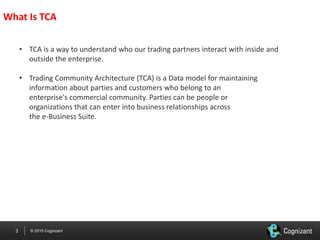
What Is TCA
• TCA is a way to understand who our trading partners interact with inside and
outside the enterprise.
• Trading Community Architecture (TCA) is a Data model for maintaining
information about parties and customers who belong to an
enterprise's commercial community. Parties can be people or
organizations that can enter into business relationships across
the e-Business Suite.
© 2015 Cognizant4
TCA Data Model: Major components
1. Components
 Party
 Account
 Contact Point
 Location
 Relationships
© 2015 Cognizant5
TCA Data Model: Party Concept
A party is an entity/participant that can enter into a business relationship
Person: A unique individual (dead or alive) of interest to the user.
Organization: A legal entity recognized by some government authority.
Group: A combination of two or more people, organizations or groups.
Relationship: User-definable link between two parties, regardless
of type.
A Party can belong to an unlimited number of relationships.
No duplication of entities
© 2015 Cognizant6
TCA Data Model: Account Concept
• The financial roll-up point to track a customer’s purchases and payments.
• Stores details about a customer relationship between a Party and your business.
• A Party may have one or more Customer Accounts.
• Because a party and accounts are separate entities, no need to duplicate parties
- Customer Account Sites: A Party Site that is used within the context
of a Customer Account (e.g., for billing or shipping purposes).
- Customer Account Contacts: A Party Contact that is used
in the context of a Customer Account.
© 2015 Cognizant7
TCA Data Model: Contact Point Concept
• Contact Point - An identifier for a method of contact
(e.g., telephone, email, URL, fax, cell phone etc.)
This can be applied to:
– A Party (person, organization, group or relationship)
– A Site or Location
– A Party at a Site or Location
– An entity may have one or more Contact Points.
© 2015 Cognizant8
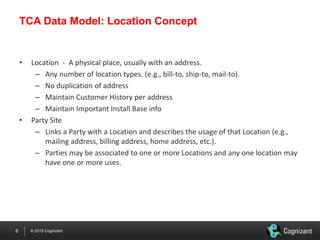
TCA Data Model: Location Concept
• Location - A physical place, usually with an address.
– Any number of location types. (e.g., bill-to, ship-to, mail-to).
– No duplication of address
– Maintain Customer History per address
– Maintain Important Install Base info
• Party Site
– Links a Party with a Location and describes the usage of that Location (e.g.,
mailing address, billing address, home address, etc.).
– Parties may be associated to one or more Locations and any one location may
have one or more uses.
© 2015 Cognizant9
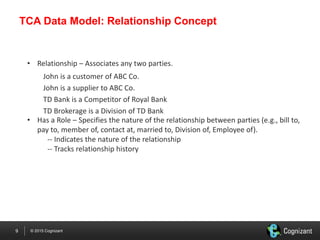
TCA Data Model: Relationship Concept
• Relationship – Associates any two parties.
John is a customer of ABC Co.
John is a supplier to ABC Co.
TD Bank is a Competitor of Royal Bank
TD Brokerage is a Division of TD Bank
• Has a Role – Specifies the nature of the relationship between parties (e.g., bill to,
pay to, member of, contact at, married to, Division of, Employee of).
-- Indicates the nature of the relationship
-- Tracks relationship history
© 2015 Cognizant10
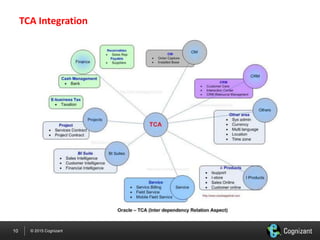
TCA Integration
© 2015 Cognizant11
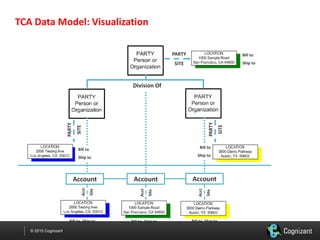
TCA Data Model: Visualization
PARTY
SITE
PARTY
SITE
PARTY
SITE
Bill to
Ship to
Division Of
Bill to
Ship to
Bill to
Ship to
Account Account Account
Bill to, Ship to Bill to, Ship to Bill to, Ship to
Acct
Site
Acct
Site
Acct
Site
© 2015 Cognizant12
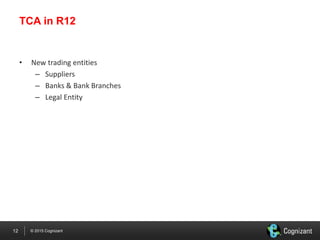
TCA in R12
• New trading entities
– Suppliers
– Banks & Bank Branches
– Legal Entity
© 2015 Cognizant13
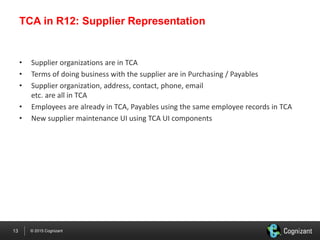
TCA in R12: Supplier Representation
• Supplier organizations are in TCA
• Terms of doing business with the supplier are in Purchasing / Payables
• Supplier organization, address, contact, phone, email
etc. are all in TCA
• Employees are already in TCA, Payables using the same employee records in TCA
• New supplier maintenance UI using TCA UI components
© 2015 Cognizant14
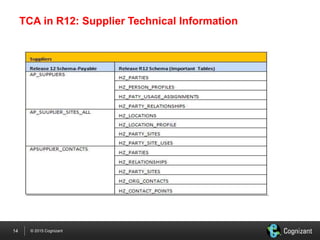
TCA in R12: Supplier Technical Information
© 2015 Cognizant15
• To begin with, we need to create a Supplier. Lets name it Go4Gold [which also
happens to be the name of my old company].
• Simply enter name of the Supplier in organization name field and click on Apply. This
will create a Supplier.
.
© 2015 Cognizant16
• You can double check the created Supplier, which has Supplier Number 20186.
• THIS SUPPLIER number comes from a table named AP_SUPPLIERS.
• The registry id that you see is the Party_number field from hz_parties [TCA Party Table]
© 2015 Cognizant17
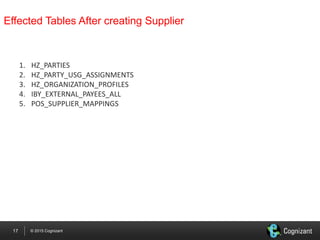
Effected Tables After creating Supplier
1. HZ_PARTIES
2. HZ_PARTY_USG_ASSIGNMENTS
3. HZ_ORGANIZATION_PROFILES
4. IBY_EXTERNAL_PAYEES_ALL
5. POS_SUPPLIER_MAPPINGS
© 2015 Cognizant18
TCA in R12: Banks Representation
New Bank Account Model
• Central place to define internal bank accounts
-Keep track of all bank accounts in one place
-Explicitly grant account access to multiple operating units/functions and
users
Multi-Org Access
- In the new model, bank accounts are owned by Legal Entities with the
option to grant account use to Operating Unit (Payables, Receivables),
Legal Entity (Treasury), Business Group (Payroll)
© 2015 Cognizant19
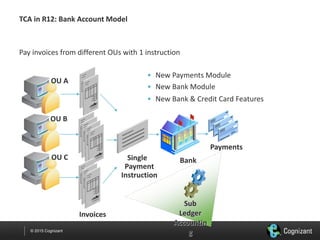
TCA in R12: Bank Account Model
OU A
OU B
OU C BankSingle
Payment
Instruction
Invoices
Payments
Sub
Ledger
Accountin
g
• New Payments Module
• New Bank Module
• New Bank & Credit Card Features
Pay invoices from different OUs with 1 instruction
© 2015 Cognizant20
TCA in R12: Integration with HRMS
• TCA creates the global view of person
• TCA enables you to store person Information at a corporate level
• Person is stored as party in TCA
• Comprehensive duplicate person check when entering a new person – Across the
business group
• Propagate some information entered in one business group to the record in the
other business group
• PER_ALL_PEOPLE_F.PARTY_ID is a foreign key to the HZ_PARTIES table, an integral
part of Oracle's "Trading Community Architecture" (TCA).
© 2015 Cognizant21
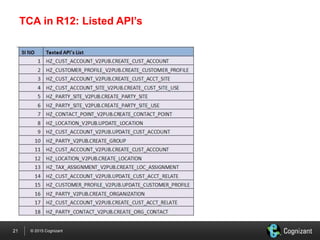
TCA in R12: Listed API’s
© 2015 Cognizant
Thank You

Tca presentation

  • 1.
    © 2015 Cognizant ©2015 Cognizant© 2015 Cognizant 30-JUN-2015 Prathap G TCA Oracle AppsR12 Overview
  • 2.
    © 2015 Cognizant Agenda 2 TradingCommunity Architecture (TCA) • What is TCA • TCA data model and its components • TCA in R12 and beyond • Why TCA matters • Q&A
  • 3.
    © 2015 Cognizant3 WhatIs TCA • TCA is a way to understand who our trading partners interact with inside and outside the enterprise. • Trading Community Architecture (TCA) is a Data model for maintaining information about parties and customers who belong to an enterprise's commercial community. Parties can be people or organizations that can enter into business relationships across the e-Business Suite.
  • 4.
    © 2015 Cognizant4 TCAData Model: Major components 1. Components  Party  Account  Contact Point  Location  Relationships
  • 5.
    © 2015 Cognizant5 TCAData Model: Party Concept A party is an entity/participant that can enter into a business relationship Person: A unique individual (dead or alive) of interest to the user. Organization: A legal entity recognized by some government authority. Group: A combination of two or more people, organizations or groups. Relationship: User-definable link between two parties, regardless of type. A Party can belong to an unlimited number of relationships. No duplication of entities
  • 6.
    © 2015 Cognizant6 TCAData Model: Account Concept • The financial roll-up point to track a customer’s purchases and payments. • Stores details about a customer relationship between a Party and your business. • A Party may have one or more Customer Accounts. • Because a party and accounts are separate entities, no need to duplicate parties - Customer Account Sites: A Party Site that is used within the context of a Customer Account (e.g., for billing or shipping purposes). - Customer Account Contacts: A Party Contact that is used in the context of a Customer Account.
  • 7.
    © 2015 Cognizant7 TCAData Model: Contact Point Concept • Contact Point - An identifier for a method of contact (e.g., telephone, email, URL, fax, cell phone etc.) This can be applied to: – A Party (person, organization, group or relationship) – A Site or Location – A Party at a Site or Location – An entity may have one or more Contact Points.
  • 8.
    © 2015 Cognizant8 TCAData Model: Location Concept • Location - A physical place, usually with an address. – Any number of location types. (e.g., bill-to, ship-to, mail-to). – No duplication of address – Maintain Customer History per address – Maintain Important Install Base info • Party Site – Links a Party with a Location and describes the usage of that Location (e.g., mailing address, billing address, home address, etc.). – Parties may be associated to one or more Locations and any one location may have one or more uses.
  • 9.
    © 2015 Cognizant9 TCAData Model: Relationship Concept • Relationship – Associates any two parties. John is a customer of ABC Co. John is a supplier to ABC Co. TD Bank is a Competitor of Royal Bank TD Brokerage is a Division of TD Bank • Has a Role – Specifies the nature of the relationship between parties (e.g., bill to, pay to, member of, contact at, married to, Division of, Employee of). -- Indicates the nature of the relationship -- Tracks relationship history
  • 10.
  • 11.
    © 2015 Cognizant11 TCAData Model: Visualization PARTY SITE PARTY SITE PARTY SITE Bill to Ship to Division Of Bill to Ship to Bill to Ship to Account Account Account Bill to, Ship to Bill to, Ship to Bill to, Ship to Acct Site Acct Site Acct Site
  • 12.
    © 2015 Cognizant12 TCAin R12 • New trading entities – Suppliers – Banks & Bank Branches – Legal Entity
  • 13.
    © 2015 Cognizant13 TCAin R12: Supplier Representation • Supplier organizations are in TCA • Terms of doing business with the supplier are in Purchasing / Payables • Supplier organization, address, contact, phone, email etc. are all in TCA • Employees are already in TCA, Payables using the same employee records in TCA • New supplier maintenance UI using TCA UI components
  • 14.
    © 2015 Cognizant14 TCAin R12: Supplier Technical Information
  • 15.
    © 2015 Cognizant15 •To begin with, we need to create a Supplier. Lets name it Go4Gold [which also happens to be the name of my old company]. • Simply enter name of the Supplier in organization name field and click on Apply. This will create a Supplier. .
  • 16.
    © 2015 Cognizant16 •You can double check the created Supplier, which has Supplier Number 20186. • THIS SUPPLIER number comes from a table named AP_SUPPLIERS. • The registry id that you see is the Party_number field from hz_parties [TCA Party Table]
  • 17.
    © 2015 Cognizant17 EffectedTables After creating Supplier 1. HZ_PARTIES 2. HZ_PARTY_USG_ASSIGNMENTS 3. HZ_ORGANIZATION_PROFILES 4. IBY_EXTERNAL_PAYEES_ALL 5. POS_SUPPLIER_MAPPINGS
  • 18.
    © 2015 Cognizant18 TCAin R12: Banks Representation New Bank Account Model • Central place to define internal bank accounts -Keep track of all bank accounts in one place -Explicitly grant account access to multiple operating units/functions and users Multi-Org Access - In the new model, bank accounts are owned by Legal Entities with the option to grant account use to Operating Unit (Payables, Receivables), Legal Entity (Treasury), Business Group (Payroll)
  • 19.
    © 2015 Cognizant19 TCAin R12: Bank Account Model OU A OU B OU C BankSingle Payment Instruction Invoices Payments Sub Ledger Accountin g • New Payments Module • New Bank Module • New Bank & Credit Card Features Pay invoices from different OUs with 1 instruction
  • 20.
    © 2015 Cognizant20 TCAin R12: Integration with HRMS • TCA creates the global view of person • TCA enables you to store person Information at a corporate level • Person is stored as party in TCA • Comprehensive duplicate person check when entering a new person – Across the business group • Propagate some information entered in one business group to the record in the other business group • PER_ALL_PEOPLE_F.PARTY_ID is a foreign key to the HZ_PARTIES table, an integral part of Oracle's "Trading Community Architecture" (TCA).
  • 21.
    © 2015 Cognizant21 TCAin R12: Listed API’s
  • 22.