ADF Security in a Project-Centric
Environment
An ADF Case Study
Jean-Marc Desvaux - General Construction Co.Ltd
Agenda
GCC Business Case
Security Approach for the overall Ecosystem
Enabling ADF Security
Enabling Per Project & Module Security in ADF
Setting up the Infrastructure
The Business Case
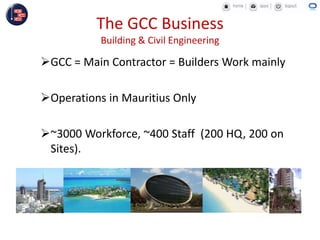
The GCC Business
Building & Civil Engineering
GCC = Main Contractor = Builders Work mainly
Operations in Mauritius Only
~3000 Workforce, ~400 Staff (200 HQ, 200 on
Sites).
The GCC IT Team
4 Engineers & Developers
 1 ADF dedicated since 2 years + Forms/Reports (6yrs)
 1 ADF dedicated since 1 year
 1 Forms/Reports dedicated +20yrs (new/reviews &
upgrades)
 2 of them dealing with overall infrastructure (Installation,
Admin of DB,AS,Storage,DR,Firewalls,...)
2 Desktop & Peripheral Support Technicians
 Sites Networking
Desktop/Clients Configs & Support
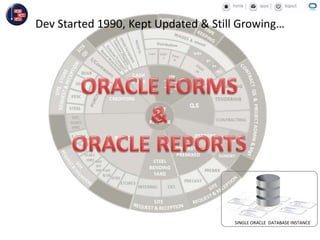
Dev Started 1990, Kept Updated & Still Growing…
SINGLE ORACLE DATABASE INSTANCE
Today ~1500 Forms & 1500 Reports
covering most aspects of line of
services/business units
(Logistics, Professional Support &
Coorporate Services)
each backing up Sites Operations
Need for our Sites to be
Active Players
in this
Services Ecosystem
We saw there a good case
for an ADF transition
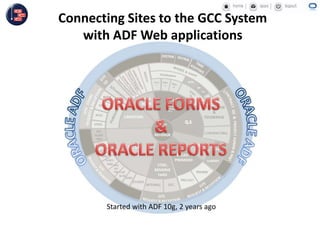
Started with ADF 10g, 2 years ago
Connecting Sites to the GCC System
with ADF Web applications
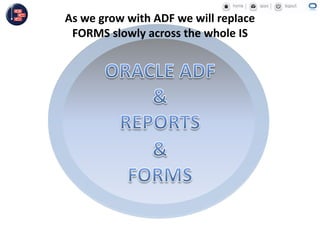
As we grow with ADF we will replace
FORMS slowly across the whole IS
Security Approach for the
overall Ecosystem
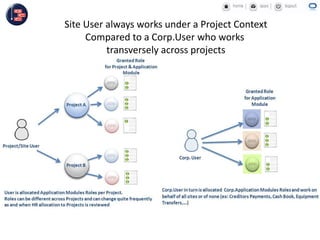
Site User always works under a Project Context
Compared to a Corp.User who works
transversely across projects
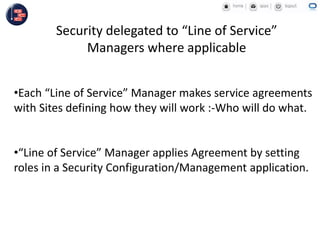
Security delegated to “Line of Service”
Managers where applicable
•Each “Line of Service” Manager makes service agreements
with Sites defining how they will work :-Who will do what.
•“Line of Service” Manager applies Agreement by setting
roles in a Security Configuration/Management application.
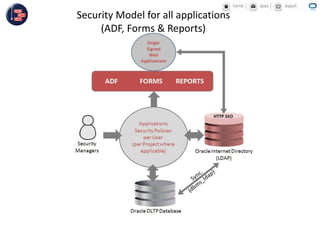
Security Model for all applications
(ADF, Forms & Reports)
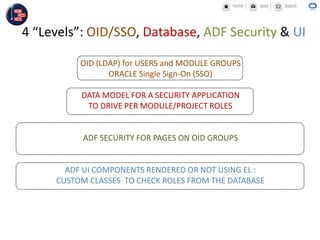
4 “Levels”: OID/SSO, Database, ADF Security & UI
OID (LDAP) for USERS and MODULE GROUPS
ORACLE Single Sign-On (SSO)
DATA MODEL FOR A SECURITY APPLICATION
TO DRIVE PER MODULE/PROJECT ROLES
ADF SECURITY FOR PAGES ON OID GROUPS
ADF UI COMPONENTS RENDERED OR NOT USING EL :
CUSTOM CLASSES TO CHECK ROLES FROM THE DATABASE
Security Application
Built with both Forms & ADF
to support delegation to Line of Service Managers
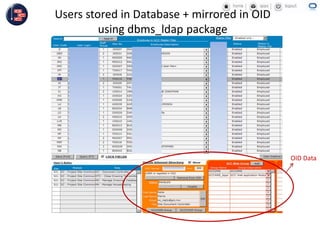
Users stored in Database + mirrored in OID
using dbms_ldap package
OID Data
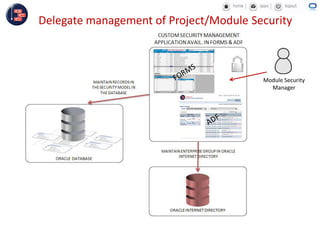
Delegate management of Project/Module Security
Module Security
Manager
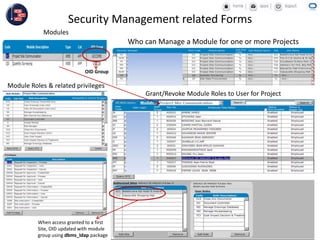
Who can Manage a Module for one or more Projects
Grant/Revoke Module Roles to User for Project
OID Group
Security Management related Forms
Module Roles & related privileges
Modules
When access granted to a first
Site, OID updated with module
group using dbms_ldap package
Other advantages of using the Database is
the integration of security with HR Data
New Users are added to the Site from HR Employees data by the
Security manager.
Auditing Accesses inside the database and Timesheet cross-
checking (Absent but logged on, not assigned to a Site but still
authorized etc..)
When an employee leaves the company, authorization is
automatically revoked
Ability to do more control as & when needed/decided
Security Data is backed up with Database
Setting up the Infrastructure
WebLogic, OID & SSO
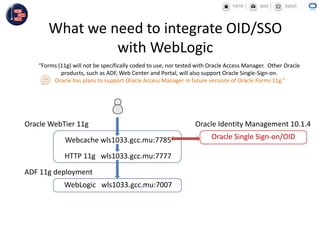
What we need to integrate OID/SSO
with WebLogic
Webcache wls1033.gcc.mu:7785
HTTP 11g wls1033.gcc.mu:7777
WebLogic wls1033.gcc.mu:7007
Oracle Single Sign-on/OID
Oracle WebTier 11g
ADF 11g deployment
Oracle Identity Management 10.1.4
“Forms (11g) will not be specifically coded to use, nor tested with Oracle Access Manager. Other Oracle
products, such as ADF, Web Center and Portal, will also support Oracle Single-Sign-on.
Oracle has plans to support Oracle Access Manager in future versions of Oracle Forms 11g.”
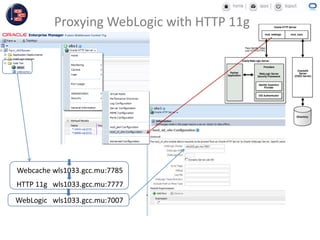
Proxying WebLogic with HTTP 11g
WebLogic wls1033.gcc.mu:7007
Webcache wls1033.gcc.mu:7785
HTTP 11g wls1033.gcc.mu:7777
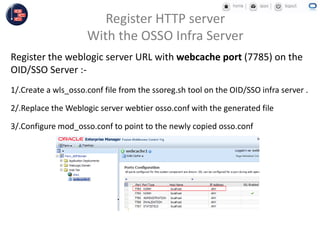
Register the weblogic server URL with webcache port (7785) on the
OID/SSO Server :-
1/.Create a wls_osso.conf file from the ssoreg.sh tool on the OID/SSO infra server .
2/.Replace the Weblogic server webtier osso.conf with the generated file
3/.Configure mod_osso.conf to point to the newly copied osso.conf
Register HTTP server
With the OSSO Infra Server
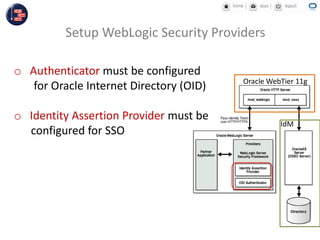
Setup WebLogic Security Providers
o Authenticator must be configured
for Oracle Internet Directory (OID)
o Identity Assertion Provider must be
configured for SSO
Oracle WebTier 11g
IdM
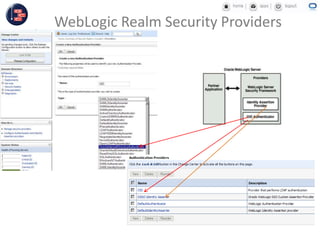
WebLogic Realm Security Providers
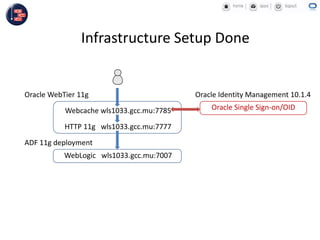
Infrastructure Setup Done
Webcache wls1033.gcc.mu:7785
HTTP 11g wls1033.gcc.mu:7777
WebLogic wls1033.gcc.mu:7007
Oracle Single Sign-on/OID
Oracle WebTier 11g
ADF 11g deployment
Oracle Identity Management 10.1.4
Enabling ADF Security
Normal ADF Security
(Not Project related yet)
Authentication
&
ADF application pages Authorization using OID Groups
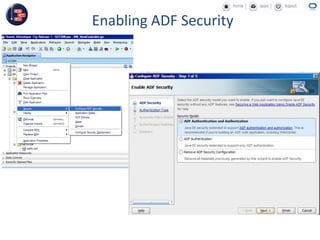
Enabling ADF Security
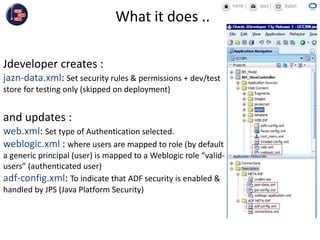
Jdeveloper creates :
jazn-data.xml: Set security rules & permissions + dev/test
store for testing only (skipped on deployment)
What it does ..
and updates :
web.xml: Set type of Authentication selected.
weblogic.xml : where users are mapped to role (by default
a generic principal (user) is mapped to a Weblogic role “valid-
users” (authenticated user)
adf-config.xml: To indicate that ADF security is enabled &
handled by JPS (Java Platform Security)
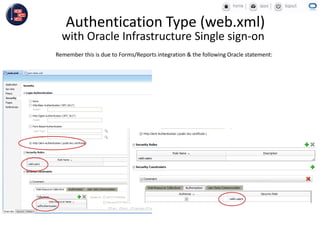
Authentication Type (web.xml)
with Oracle Infrastructure Single sign-on
Remember this is due to Forms/Reports integration & the following Oracle statement:
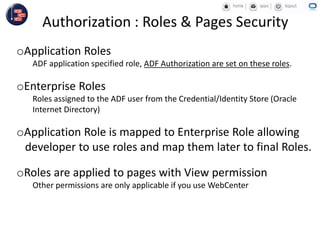
Authorization : Roles & Pages Security
oApplication Roles
ADF application specified role, ADF Authorization are set on these roles.
oEnterprise Roles
Roles assigned to the ADF user from the Credential/Identity Store (Oracle
Internet Directory)
oApplication Role is mapped to Enterprise Role allowing
developer to use roles and map them later to final Roles.
oRoles are applied to pages with View permission
Other permissions are only applicable if you use WebCenter
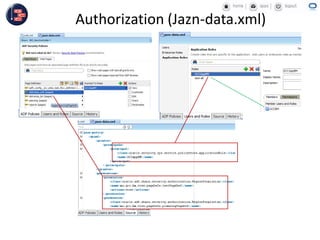
Authorization (Jazn-data.xml)
What we have at this stage
o A user with an OID account and OID Groups
(enterprise roles) gets a SSO login form to identify
himself when trying to access an ADF application
(all pages being protected by ADF Security).
o Once authenticated, he can navigate to the page if he
has the necessary enterprise role (mapped to the
application role set to protect the page).
On each page, we only want
the authorized UI components
to be rendered.
UI components level
Rendering or not a UI component
(button, panel etc..)
JSF Expression Language (EL)
CurrentPeriod <= (le for less or equal) Period
#{securityContext.userInRole[‘rolename’]} for “static” role
We will see later how we use EL to apply per project security
Enabling Per Project &
Module Security in ADF
Before proceeding let’s see a normal
navigation use case demo of the
application
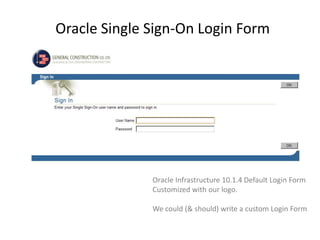
Oracle Single Sign-On Login Form
Oracle Infrastructure 10.1.4 Default Login Form
Customized with our logo.
We could (& should) write a custom Login Form
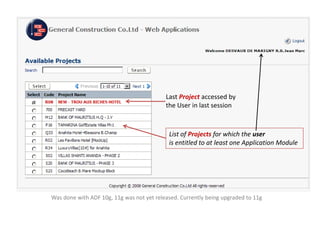
List of Projects for which the user
is entitled to at least one Application Module
Was done with ADF 10g, 11g was not yet released. Currently being upgraded to 11g
Last Project accessed by
the User in last session
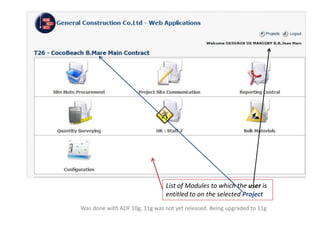
List of Modules to which the user is
entitled to on the selected Project
Was done with ADF 10g, 11g was not yet released. Being upgraded to 11g
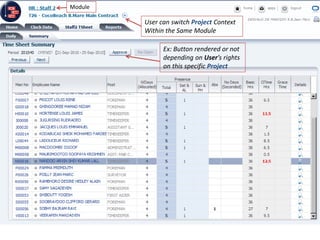
User can switch Project Context
Within the Same Module
Module
Ex: Button rendered or not
depending on User’s rights
on this specific Project
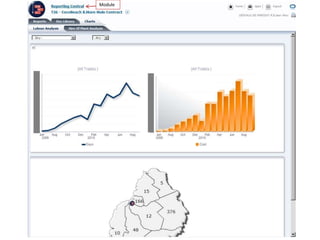
Module
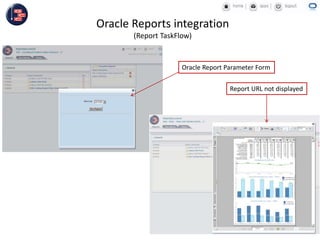
Oracle Reports integration
(Report TaskFlow)
Report URL not displayed
Oracle Report Parameter Form
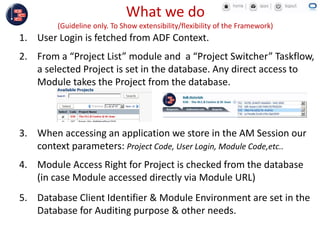
What we do
(Guideline only. To Show extensibility/flexibility of the Framework)
1. User Login is fetched from ADF Context.
2. From a “Project List” module and a “Project Switcher” Taskflow,
a selected Project is set in the database. Any direct access to
Module takes the Project from the database.
3. When accessing an application we store in the AM Session our
context parameters: Project Code, User Login, Module Code,etc..
4. Module Access Right for Project is checked from the database
(in case Module accessed directly via Module URL)
5. Database Client Identifier & Module Environment are set in the
Database for Auditing purpose & other needs.
6. A “Module access” audit event is logged in the Database
7. When a page is accessed, session parameters are stored (if
not already done) in a Session bean.
8. User’s Privileges Codes for Module/Project is fetched from
the Security Database and stored in HTTP session as a Map.
9. Bind Variables on our View Objects (VOs) are automatically
replaced by our parameters value to filter data at VO level
when VOs are executed.
10. We have a session bean method (SecurityScope.userinRole)
that is used in EL to check Privileges from our HTTP session
Map to Render or not a Component.
Normal EL Expression to check from static role
#{securityContext.userInRole[‘Role Name']}
Custom EL Expression to check from Database
privileges Codes assigned to Role
#{securityScope.userInRole[‘Priv List Code']}
Reusability
Task Flows, Libraries & Page Templates
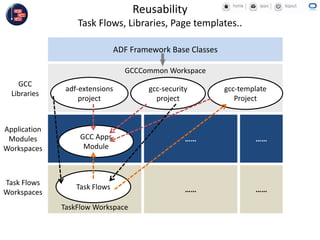
ADF Framework Base Classes
TaskFlow Workspace
GCCCommon Workspace
Reusability
Task Flows, Libraries, Page templates..
adf-extensions
project
gcc-security
project
gcc-template
Project
GCC Apps
Module
Task Flows ……
……
……
……
Application
Modules
Workspaces
Task Flows
Workspaces
GCC
Libraries
Oracle WebCenter
Application Entry point (Portal) + Customization for tasks shortcuts (Approving Requests etc..)
Improve Application Structure using Catalogs
Content Integration & Web 2.0 features
(ex: Project Site Communications Module extended with Chat/Forum/Workspace)
The Future
Potential grounds for improvements
Move to Oracle Access Manager (When Forms/Reports support it) &
investigate/try to leverage Oracle Entitlement Server
“Oracle Entitlements Server is a fine grained authorization engine that externalizes, unifies,
and simplifies the management of complex entitlement policies”
ADF Mobile
Pervasiveness of our Applications (ex: allowing an approval anywhere on site)
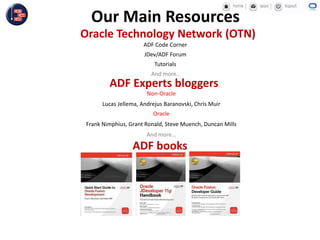
Non-Oracle
Lucas Jellema, Andrejus Baranovski, Chris Muir
Oracle
Frank Nimphius, Grant Ronald, Steve Muench, Duncan Mills
And more…
ADF Experts bloggers
Oracle Technology Network (OTN)
ADF Code Corner
JDev/ADF Forum
Tutorials
And more..
ADF books
Our Main Resources
ADF EMG
• A place to discuss best practices and methodologies
for JDeveloper ADF enterprise applications
• Founded mid-2008, now 400+ members
• Focus is Fusion Tech Stack (ADF Faces, ADF BC)
• Sessions at ODTUG, OOW
• Expert bloggers
• Sub Groups: Expert Panel (Ex: Inter-Region communication
Expert Panel, Security Expert Panel)
http://groups.google.com/group/adf-methodology
Thank You

Oracle ADF Case Study

  • 1.
    ADF Security ina Project-Centric Environment An ADF Case Study Jean-Marc Desvaux - General Construction Co.Ltd
  • 2.
    Agenda GCC Business Case SecurityApproach for the overall Ecosystem Enabling ADF Security Enabling Per Project & Module Security in ADF Setting up the Infrastructure
  • 3.
  • 4.
    The GCC Business Building& Civil Engineering GCC = Main Contractor = Builders Work mainly Operations in Mauritius Only ~3000 Workforce, ~400 Staff (200 HQ, 200 on Sites).
  • 5.
    The GCC ITTeam 4 Engineers & Developers  1 ADF dedicated since 2 years + Forms/Reports (6yrs)  1 ADF dedicated since 1 year  1 Forms/Reports dedicated +20yrs (new/reviews & upgrades)  2 of them dealing with overall infrastructure (Installation, Admin of DB,AS,Storage,DR,Firewalls,...) 2 Desktop & Peripheral Support Technicians  Sites Networking Desktop/Clients Configs & Support
  • 6.
    Dev Started 1990,Kept Updated & Still Growing… SINGLE ORACLE DATABASE INSTANCE
  • 7.
    Today ~1500 Forms& 1500 Reports covering most aspects of line of services/business units (Logistics, Professional Support & Coorporate Services) each backing up Sites Operations
  • 8.
    Need for ourSites to be Active Players in this Services Ecosystem We saw there a good case for an ADF transition
  • 9.
    Started with ADF10g, 2 years ago Connecting Sites to the GCC System with ADF Web applications
  • 10.
    As we growwith ADF we will replace FORMS slowly across the whole IS
  • 11.
    Security Approach forthe overall Ecosystem
  • 12.
    Site User alwaysworks under a Project Context Compared to a Corp.User who works transversely across projects
  • 13.
    Security delegated to“Line of Service” Managers where applicable •Each “Line of Service” Manager makes service agreements with Sites defining how they will work :-Who will do what. •“Line of Service” Manager applies Agreement by setting roles in a Security Configuration/Management application.
  • 14.
    Security Model forall applications (ADF, Forms & Reports)
  • 15.
    4 “Levels”: OID/SSO,Database, ADF Security & UI OID (LDAP) for USERS and MODULE GROUPS ORACLE Single Sign-On (SSO) DATA MODEL FOR A SECURITY APPLICATION TO DRIVE PER MODULE/PROJECT ROLES ADF SECURITY FOR PAGES ON OID GROUPS ADF UI COMPONENTS RENDERED OR NOT USING EL : CUSTOM CLASSES TO CHECK ROLES FROM THE DATABASE
  • 16.
    Security Application Built withboth Forms & ADF to support delegation to Line of Service Managers
  • 17.
    Users stored inDatabase + mirrored in OID using dbms_ldap package OID Data
  • 18.
    Delegate management ofProject/Module Security Module Security Manager
  • 19.
    Who can Managea Module for one or more Projects Grant/Revoke Module Roles to User for Project OID Group Security Management related Forms Module Roles & related privileges Modules When access granted to a first Site, OID updated with module group using dbms_ldap package
  • 20.
    Other advantages ofusing the Database is the integration of security with HR Data New Users are added to the Site from HR Employees data by the Security manager. Auditing Accesses inside the database and Timesheet cross- checking (Absent but logged on, not assigned to a Site but still authorized etc..) When an employee leaves the company, authorization is automatically revoked Ability to do more control as & when needed/decided Security Data is backed up with Database
  • 21.
    Setting up theInfrastructure WebLogic, OID & SSO
  • 22.
    What we needto integrate OID/SSO with WebLogic Webcache wls1033.gcc.mu:7785 HTTP 11g wls1033.gcc.mu:7777 WebLogic wls1033.gcc.mu:7007 Oracle Single Sign-on/OID Oracle WebTier 11g ADF 11g deployment Oracle Identity Management 10.1.4 “Forms (11g) will not be specifically coded to use, nor tested with Oracle Access Manager. Other Oracle products, such as ADF, Web Center and Portal, will also support Oracle Single-Sign-on. Oracle has plans to support Oracle Access Manager in future versions of Oracle Forms 11g.”
  • 23.
    Proxying WebLogic withHTTP 11g WebLogic wls1033.gcc.mu:7007 Webcache wls1033.gcc.mu:7785 HTTP 11g wls1033.gcc.mu:7777
  • 24.
    Register the weblogicserver URL with webcache port (7785) on the OID/SSO Server :- 1/.Create a wls_osso.conf file from the ssoreg.sh tool on the OID/SSO infra server . 2/.Replace the Weblogic server webtier osso.conf with the generated file 3/.Configure mod_osso.conf to point to the newly copied osso.conf Register HTTP server With the OSSO Infra Server
  • 25.
    Setup WebLogic SecurityProviders o Authenticator must be configured for Oracle Internet Directory (OID) o Identity Assertion Provider must be configured for SSO Oracle WebTier 11g IdM
  • 26.
  • 27.
    Infrastructure Setup Done Webcachewls1033.gcc.mu:7785 HTTP 11g wls1033.gcc.mu:7777 WebLogic wls1033.gcc.mu:7007 Oracle Single Sign-on/OID Oracle WebTier 11g ADF 11g deployment Oracle Identity Management 10.1.4
  • 28.
    Enabling ADF Security NormalADF Security (Not Project related yet) Authentication & ADF application pages Authorization using OID Groups
  • 29.
  • 30.
    Jdeveloper creates : jazn-data.xml:Set security rules & permissions + dev/test store for testing only (skipped on deployment) What it does .. and updates : web.xml: Set type of Authentication selected. weblogic.xml : where users are mapped to role (by default a generic principal (user) is mapped to a Weblogic role “valid- users” (authenticated user) adf-config.xml: To indicate that ADF security is enabled & handled by JPS (Java Platform Security)
  • 31.
    Authentication Type (web.xml) withOracle Infrastructure Single sign-on Remember this is due to Forms/Reports integration & the following Oracle statement:
  • 32.
    Authorization : Roles& Pages Security oApplication Roles ADF application specified role, ADF Authorization are set on these roles. oEnterprise Roles Roles assigned to the ADF user from the Credential/Identity Store (Oracle Internet Directory) oApplication Role is mapped to Enterprise Role allowing developer to use roles and map them later to final Roles. oRoles are applied to pages with View permission Other permissions are only applicable if you use WebCenter
  • 33.
  • 34.
    What we haveat this stage o A user with an OID account and OID Groups (enterprise roles) gets a SSO login form to identify himself when trying to access an ADF application (all pages being protected by ADF Security). o Once authenticated, he can navigate to the page if he has the necessary enterprise role (mapped to the application role set to protect the page).
  • 35.
    On each page,we only want the authorized UI components to be rendered.
  • 36.
    UI components level Renderingor not a UI component (button, panel etc..) JSF Expression Language (EL) CurrentPeriod <= (le for less or equal) Period #{securityContext.userInRole[‘rolename’]} for “static” role We will see later how we use EL to apply per project security
  • 37.
    Enabling Per Project& Module Security in ADF
  • 38.
    Before proceeding let’ssee a normal navigation use case demo of the application
  • 39.
    Oracle Single Sign-OnLogin Form Oracle Infrastructure 10.1.4 Default Login Form Customized with our logo. We could (& should) write a custom Login Form
  • 40.
    List of Projectsfor which the user is entitled to at least one Application Module Was done with ADF 10g, 11g was not yet released. Currently being upgraded to 11g Last Project accessed by the User in last session
  • 41.
    List of Modulesto which the user is entitled to on the selected Project Was done with ADF 10g, 11g was not yet released. Being upgraded to 11g
  • 42.
    User can switchProject Context Within the Same Module Module Ex: Button rendered or not depending on User’s rights on this specific Project
  • 43.
  • 44.
    Oracle Reports integration (ReportTaskFlow) Report URL not displayed Oracle Report Parameter Form
  • 45.
    What we do (Guidelineonly. To Show extensibility/flexibility of the Framework) 1. User Login is fetched from ADF Context. 2. From a “Project List” module and a “Project Switcher” Taskflow, a selected Project is set in the database. Any direct access to Module takes the Project from the database. 3. When accessing an application we store in the AM Session our context parameters: Project Code, User Login, Module Code,etc.. 4. Module Access Right for Project is checked from the database (in case Module accessed directly via Module URL) 5. Database Client Identifier & Module Environment are set in the Database for Auditing purpose & other needs.
  • 46.
    6. A “Moduleaccess” audit event is logged in the Database 7. When a page is accessed, session parameters are stored (if not already done) in a Session bean. 8. User’s Privileges Codes for Module/Project is fetched from the Security Database and stored in HTTP session as a Map. 9. Bind Variables on our View Objects (VOs) are automatically replaced by our parameters value to filter data at VO level when VOs are executed. 10. We have a session bean method (SecurityScope.userinRole) that is used in EL to check Privileges from our HTTP session Map to Render or not a Component.
  • 47.
    Normal EL Expressionto check from static role #{securityContext.userInRole[‘Role Name']} Custom EL Expression to check from Database privileges Codes assigned to Role #{securityScope.userInRole[‘Priv List Code']}
  • 48.
  • 49.
    ADF Framework BaseClasses TaskFlow Workspace GCCCommon Workspace Reusability Task Flows, Libraries, Page templates.. adf-extensions project gcc-security project gcc-template Project GCC Apps Module Task Flows …… …… …… …… Application Modules Workspaces Task Flows Workspaces GCC Libraries
  • 50.
    Oracle WebCenter Application Entrypoint (Portal) + Customization for tasks shortcuts (Approving Requests etc..) Improve Application Structure using Catalogs Content Integration & Web 2.0 features (ex: Project Site Communications Module extended with Chat/Forum/Workspace) The Future Potential grounds for improvements Move to Oracle Access Manager (When Forms/Reports support it) & investigate/try to leverage Oracle Entitlement Server “Oracle Entitlements Server is a fine grained authorization engine that externalizes, unifies, and simplifies the management of complex entitlement policies” ADF Mobile Pervasiveness of our Applications (ex: allowing an approval anywhere on site)
  • 51.
    Non-Oracle Lucas Jellema, AndrejusBaranovski, Chris Muir Oracle Frank Nimphius, Grant Ronald, Steve Muench, Duncan Mills And more… ADF Experts bloggers Oracle Technology Network (OTN) ADF Code Corner JDev/ADF Forum Tutorials And more.. ADF books Our Main Resources
  • 52.
    ADF EMG • Aplace to discuss best practices and methodologies for JDeveloper ADF enterprise applications • Founded mid-2008, now 400+ members • Focus is Fusion Tech Stack (ADF Faces, ADF BC) • Sessions at ODTUG, OOW • Expert bloggers • Sub Groups: Expert Panel (Ex: Inter-Region communication Expert Panel, Security Expert Panel) http://groups.google.com/group/adf-methodology
  • 53.