Tc-99m sestamibi
Scans
Parathyroid and Heart
Dr Muhammad Qasim Khan
Tc-99m sestamibi
• Tc-99m sestamibi (sestamibi is a shortening of sesta-
methoxyisobutylisonitrile) is one of the technetium
radiopharmaceuticals.
Characteristics
• photon energy: 140 KeV
• physical half-life: 6 hours
• lipophilic cation
• normal distribution: thyroid, parathyroid, heart (myocardium)
• excretion: hepatobiliary and renal
• target organ: colon, kidneys, bladder, gallbladder
• brain uptake depends on blood-brain barrier (BBB) rupture;
correlates with cell proliferation indices (Ki67)
• Tc-99m-sestamibi is a radiopharmaceutical that is taken up by
cells with a high concentration of mitochondria i.e. highly
cellular/metabolically active tissues such as the myocardium of
the heart, but also abnormal tissues such as oxyphil cell
parathyroid adenomas, myeloma and breast cancer (the basis of
so-called scintimammography). This latter technique has a high
specificity for cancer but uses significant radiation dose.
Uses, doses and timings
Parathyroid scan
• adult dose: 740 MBq (20 mCi) IV
• timing: early scan at 15 min; delayed scan at 2 hours
When the radiopharmaceutical is used for parathyroid imaging,
immediate and delayed imaging of the neck and mediastinum is
performed; parathyroid adenomas are best demonstrated on
delayed imaging (1-2 hours). A thyroid scan using Tc-99m
pertechnetate follows. Parathyroid adenomas do not demonstrate
uptake on thyroid scans, whereas normal thyroid tissue does.
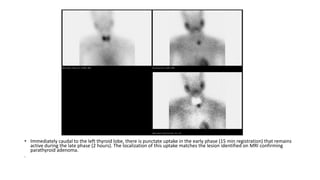
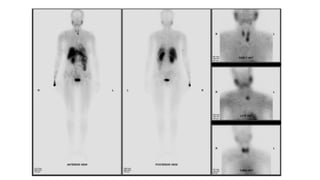
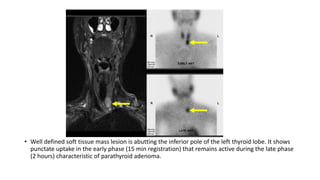
• Immediately caudal to the left thyroid lobe, there is punctate uptake in the early phase (15 min registration) that remains
active during the late phase (2 hours). The localization of this uptake matches the lesion identified on MRI confirming
parathyroid adenoma.
•
• Well defined soft tissue mass lesion is abutting the inferior pole of the left thyroid lobe. It shows
punctate uptake in the early phase (15 min registration) that remains active during the late phase
(2 hours) characteristic of parathyroid adenoma.
Myocardial perfusion scintigraphy
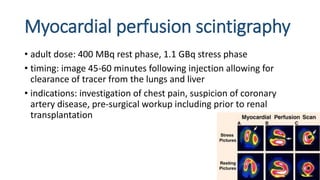
• adult dose: 400 MBq rest phase, 1.1 GBq stress phase
• timing: image 45-60 minutes following injection allowing for
clearance of tracer from the lungs and liver
• indications: investigation of chest pain, suspicion of coronary
artery disease, pre-surgical workup including prior to renal
transplantation
• Tc-99m sestamibi is the most common agent for performing
myocardial perfusion scintigraphy. Sestamibi is a lipophilic
cation, which diffuses from the blood into the myocardial cells.
The tracer is held intracellularly proximate to the mitochondria.
60% of sestamibi is extracted first pass from the coronary
blood flow and there is minimal myocardial clearance.
• Myocardial perfusion scintigraphy is performed with
both rest and stress phases, looking for areas of reversible
ischemia (exercise stress) or impaired myocardial flow reserve
(pharmacologic stress). Rest imaging is usually performed first,
with a stress phase conducted on the same day with a higher
dose injection or a subsequent day.
• An exercise stress test requires the patient to exercise on a
treadmill (or other equipment in some centers) to achieve 85%
of their maximum predicted heart rate e.g. following the "Bruce
protocol"/"modified Bruce protocol". Tc-99m sestamibi is
injected at 85% predicted maximum heart rate and the patient
continues to exercise for an additional 60 seconds while the
tracer is extracted by the myocardium. The patient is imaged 30-
60 minutes later. Beta-blockers should be avoided in the days
prior to the exercise stress test as they may prevent the patient
from reaching higher heart rates.
• A pharmacological stress test involves the infusion of a coronary
vasodilator such as adenosine, persantin or regadenoson. Each
drug has a unique infusion protocol. Caffeine is contraindicated
for 24 hours prior to persantin and adenosine studies.
Pharmacological stress testing examines coronary flow reserve,
with diseased coronary vessels having impaired physiological
response to the infused medication. Other territories of the
heart with normal flow will have a relatively higher amount of Tc-
99m tracer than those supplied by the diseased vessel.

Tc 99m sestamibi

  • 1.
    Tc-99m sestamibi Scans Parathyroid andHeart Dr Muhammad Qasim Khan
  • 2.
  • 3.
    • Tc-99m sestamibi(sestamibi is a shortening of sesta- methoxyisobutylisonitrile) is one of the technetium radiopharmaceuticals.
  • 4.
    Characteristics • photon energy:140 KeV • physical half-life: 6 hours • lipophilic cation • normal distribution: thyroid, parathyroid, heart (myocardium) • excretion: hepatobiliary and renal • target organ: colon, kidneys, bladder, gallbladder • brain uptake depends on blood-brain barrier (BBB) rupture; correlates with cell proliferation indices (Ki67)
  • 5.
    • Tc-99m-sestamibi isa radiopharmaceutical that is taken up by cells with a high concentration of mitochondria i.e. highly cellular/metabolically active tissues such as the myocardium of the heart, but also abnormal tissues such as oxyphil cell parathyroid adenomas, myeloma and breast cancer (the basis of so-called scintimammography). This latter technique has a high specificity for cancer but uses significant radiation dose.
  • 6.
  • 7.
    Parathyroid scan • adultdose: 740 MBq (20 mCi) IV • timing: early scan at 15 min; delayed scan at 2 hours When the radiopharmaceutical is used for parathyroid imaging, immediate and delayed imaging of the neck and mediastinum is performed; parathyroid adenomas are best demonstrated on delayed imaging (1-2 hours). A thyroid scan using Tc-99m pertechnetate follows. Parathyroid adenomas do not demonstrate uptake on thyroid scans, whereas normal thyroid tissue does.
  • 8.
    • Immediately caudalto the left thyroid lobe, there is punctate uptake in the early phase (15 min registration) that remains active during the late phase (2 hours). The localization of this uptake matches the lesion identified on MRI confirming parathyroid adenoma. •
  • 10.
    • Well definedsoft tissue mass lesion is abutting the inferior pole of the left thyroid lobe. It shows punctate uptake in the early phase (15 min registration) that remains active during the late phase (2 hours) characteristic of parathyroid adenoma.
  • 11.
    Myocardial perfusion scintigraphy •adult dose: 400 MBq rest phase, 1.1 GBq stress phase • timing: image 45-60 minutes following injection allowing for clearance of tracer from the lungs and liver • indications: investigation of chest pain, suspicion of coronary artery disease, pre-surgical workup including prior to renal transplantation
  • 12.
    • Tc-99m sestamibiis the most common agent for performing myocardial perfusion scintigraphy. Sestamibi is a lipophilic cation, which diffuses from the blood into the myocardial cells. The tracer is held intracellularly proximate to the mitochondria. 60% of sestamibi is extracted first pass from the coronary blood flow and there is minimal myocardial clearance. • Myocardial perfusion scintigraphy is performed with both rest and stress phases, looking for areas of reversible ischemia (exercise stress) or impaired myocardial flow reserve (pharmacologic stress). Rest imaging is usually performed first, with a stress phase conducted on the same day with a higher dose injection or a subsequent day.
  • 13.
    • An exercisestress test requires the patient to exercise on a treadmill (or other equipment in some centers) to achieve 85% of their maximum predicted heart rate e.g. following the "Bruce protocol"/"modified Bruce protocol". Tc-99m sestamibi is injected at 85% predicted maximum heart rate and the patient continues to exercise for an additional 60 seconds while the tracer is extracted by the myocardium. The patient is imaged 30- 60 minutes later. Beta-blockers should be avoided in the days prior to the exercise stress test as they may prevent the patient from reaching higher heart rates.
  • 14.
    • A pharmacologicalstress test involves the infusion of a coronary vasodilator such as adenosine, persantin or regadenoson. Each drug has a unique infusion protocol. Caffeine is contraindicated for 24 hours prior to persantin and adenosine studies. Pharmacological stress testing examines coronary flow reserve, with diseased coronary vessels having impaired physiological response to the infused medication. Other territories of the heart with normal flow will have a relatively higher amount of Tc- 99m tracer than those supplied by the diseased vessel.