Accounting & Tax Basics for  Start up Business Gary Hessenaur, C.P.C. Hessenaur & Associates, CPA, P.C.
C-Corp vs Pass Through Entity Income from Business C-Corp pays their own taxes on income Pass Through Entity owners pay the taxes Net Losses from Business C-Corp applies to prior year income or carries forward to future taxable years Pass Through Entity – Owners may offset other taxable income, provided they have bases.  Pass Through Entity – Risks of losses being suspended  Hessenaur & Associates, CPA, P.C.
C-Corp vs Pass Through Entity Responsible Party for Income taxes C-Corp the business is responsible for paying the taxes Pass Through Entity owners are responsible for paying taxes Owner agreements may require business to make distributions to pay income taxes. Agreements difficult to enforce if business does not have cash flow Hessenaur & Associates, CPA, P.C.
C-Corp vs Pass Through Entity Need to Retain Profit in Business C-Corp generally has more favorable tax rates on first $100,000 of income. Some Pass Through Entities may also pay self employment taxes on income Hessenaur & Associates, CPA, P.C.
C-Corp vs Pass Through Entity Are Owners Looking for Dividends or Distributions  C-Corp double taxation for dividends Favorable tax brackets may off set Pass Through Entity no additional taxation on dividends or distributions May be rules on how distributions are made Will change owners basis for later sale of business Hessenaur & Associates, CPA, P.C.
C-Corp vs Pass Through Entity Is There a Sale of Business Planned Taxation issues can be complicated. Use professional help. Basic Types of Business Sale Stock or Sale of Business Entity Asset Sale Liquidation Hessenaur & Associates, CPA, P.C.
C-Corp vs Pass Through Entity Will Owners Agree to Type of Entity Owner operated not much issue on Type of Entity Friends and Family investors Pass Through Entity can work well Most Angel and VC investors do not want pass through entity  Hessenaur & Associates, CPA, P.C.
C-Corp vs Pass Through Entity Year End of Entity C-Corp may elect any year end Pass Through Entity must be December year end Hessenaur & Associates, CPA, P.C.
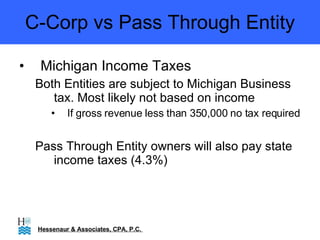
C-Corp vs Pass Through Entity Michigan Income Taxes Both Entities are subject to Michigan Business tax. Most likely not based on income If gross revenue less than 350,000 no tax required Pass Through Entity owners will also pay state income taxes (4.3%) Hessenaur & Associates, CPA, P.C.
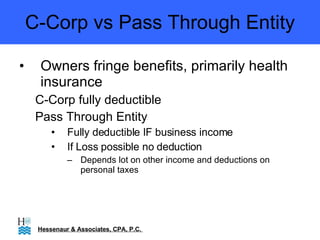
C-Corp vs Pass Through Entity Owners fringe benefits, primarily health insurance C-Corp fully deductible Pass Through Entity  Fully deductible IF business income If Loss possible no deduction Depends lot on other income and deductions on personal taxes Hessenaur & Associates, CPA, P.C.
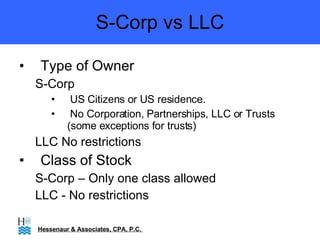
S-Corp vs LLC Type of Owner S-Corp US Citizens or US residence. No Corporation, Partnerships, LLC or Trusts (some exceptions for trusts) LLC No restrictions Class of Stock S-Corp – Only one class allowed LLC - No restrictions Hessenaur & Associates, CPA, P.C.
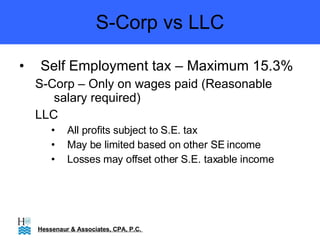
S-Corp vs LLC Self Employment tax – Maximum 15.3% S-Corp – Only on wages paid (Reasonable salary required) LLC All profits subject to S.E. tax May be limited based on other SE income Losses may offset other S.E. taxable income Hessenaur & Associates, CPA, P.C.
S-Corp vs LLC Losses, At Risk Rules S-Corp shareholder losses limited to stock basis and direct loans to company LLC owners losses limited to equity, direct loans and loans guaranteed Both may result in suspended losses if ownership disproportion to basis Both allow for loss carryforwards Hessenaur & Associates, CPA, P.C.
S-Corp vs LLC Later Conversion to C-Corp S-Corp Simple election beginning of tax year or disqualify. Can’t change back to S-Corp for 5 years LLC Need to Dissolve and Incorporate Can be costly direct and indirect costs Caution to avoid taxable event Hessenaur & Associates, CPA, P.C.

Taxes - Business Entity

  • 1.
    Accounting & TaxBasics for Start up Business Gary Hessenaur, C.P.C. Hessenaur & Associates, CPA, P.C.
  • 2.
    C-Corp vs PassThrough Entity Income from Business C-Corp pays their own taxes on income Pass Through Entity owners pay the taxes Net Losses from Business C-Corp applies to prior year income or carries forward to future taxable years Pass Through Entity – Owners may offset other taxable income, provided they have bases. Pass Through Entity – Risks of losses being suspended Hessenaur & Associates, CPA, P.C.
  • 3.
    C-Corp vs PassThrough Entity Responsible Party for Income taxes C-Corp the business is responsible for paying the taxes Pass Through Entity owners are responsible for paying taxes Owner agreements may require business to make distributions to pay income taxes. Agreements difficult to enforce if business does not have cash flow Hessenaur & Associates, CPA, P.C.
  • 4.
    C-Corp vs PassThrough Entity Need to Retain Profit in Business C-Corp generally has more favorable tax rates on first $100,000 of income. Some Pass Through Entities may also pay self employment taxes on income Hessenaur & Associates, CPA, P.C.
  • 5.
    C-Corp vs PassThrough Entity Are Owners Looking for Dividends or Distributions C-Corp double taxation for dividends Favorable tax brackets may off set Pass Through Entity no additional taxation on dividends or distributions May be rules on how distributions are made Will change owners basis for later sale of business Hessenaur & Associates, CPA, P.C.
  • 6.
    C-Corp vs PassThrough Entity Is There a Sale of Business Planned Taxation issues can be complicated. Use professional help. Basic Types of Business Sale Stock or Sale of Business Entity Asset Sale Liquidation Hessenaur & Associates, CPA, P.C.
  • 7.
    C-Corp vs PassThrough Entity Will Owners Agree to Type of Entity Owner operated not much issue on Type of Entity Friends and Family investors Pass Through Entity can work well Most Angel and VC investors do not want pass through entity Hessenaur & Associates, CPA, P.C.
  • 8.
    C-Corp vs PassThrough Entity Year End of Entity C-Corp may elect any year end Pass Through Entity must be December year end Hessenaur & Associates, CPA, P.C.
  • 9.
    C-Corp vs PassThrough Entity Michigan Income Taxes Both Entities are subject to Michigan Business tax. Most likely not based on income If gross revenue less than 350,000 no tax required Pass Through Entity owners will also pay state income taxes (4.3%) Hessenaur & Associates, CPA, P.C.
  • 10.
    C-Corp vs PassThrough Entity Owners fringe benefits, primarily health insurance C-Corp fully deductible Pass Through Entity Fully deductible IF business income If Loss possible no deduction Depends lot on other income and deductions on personal taxes Hessenaur & Associates, CPA, P.C.
  • 11.
    S-Corp vs LLCType of Owner S-Corp US Citizens or US residence. No Corporation, Partnerships, LLC or Trusts (some exceptions for trusts) LLC No restrictions Class of Stock S-Corp – Only one class allowed LLC - No restrictions Hessenaur & Associates, CPA, P.C.
  • 12.
    S-Corp vs LLCSelf Employment tax – Maximum 15.3% S-Corp – Only on wages paid (Reasonable salary required) LLC All profits subject to S.E. tax May be limited based on other SE income Losses may offset other S.E. taxable income Hessenaur & Associates, CPA, P.C.
  • 13.
    S-Corp vs LLCLosses, At Risk Rules S-Corp shareholder losses limited to stock basis and direct loans to company LLC owners losses limited to equity, direct loans and loans guaranteed Both may result in suspended losses if ownership disproportion to basis Both allow for loss carryforwards Hessenaur & Associates, CPA, P.C.
  • 14.
    S-Corp vs LLCLater Conversion to C-Corp S-Corp Simple election beginning of tax year or disqualify. Can’t change back to S-Corp for 5 years LLC Need to Dissolve and Incorporate Can be costly direct and indirect costs Caution to avoid taxable event Hessenaur & Associates, CPA, P.C.