Strategies in Business
PG- A Group 1
Sagarika Govalkar 14 Himanshu Karambelkar 21
Arun Gupta 15 Shradheay Singh 51
Chandan Gupta 16 Ashish Yadav 60
Introduction & Strategic Intent
PESTLE Analysis
Porter’s 5 Forces
Product Mix
Implementation of Strategies
Strategies for Growth
Conclusion
Topics to be
covered
Introduction
• Established on September 1945 as TELCO
• MD & CEO : Guenter Butschek
• Design & R&D centres : India, UK, Italy and Korea
• Subsidiaries : Jaguar Land Rover (UK), Daewoo (South Korea)
• Joint Ventures : Marcopolo (Brazil), Fiat (Italy)
Strategic Intent
We innovate mobility solutions with passion to enhance quality of life
Mission
By FY 2024, we will become the most aspirational Indian auto brand, consistently
winning, by
1. Delivering superior financial returns
2. Driving sustainable mobility solutions
Vision 3. Exceeding customer expectations
4. Creating a highly engaged work force
PESTEL Analysis
P E
S
TE
L
IOT and Intelligent cars
CNG and Electric carsInvestment in Sustainable
operations and Climate change
EGR and SCR
Loss at Nano Plant
Intensive competition
Nano as cheaper car
Changing millennial’s
Lifestyle
India’s Median age 29
GST
Singur plant litigation
Changing environment
regulation
Cars (28%)
Spare Parts (18%)
Make in India,
Demonetization and Political
confrontation
Industry analysis - Porter’s five forces model
Factors
Level of power
in the factor Reasons
Threat of new entrants Lower
Higher entry cost, High cost of switching, very little
market share available, etc.
Power in the hands of buyers Medium
Large number of buyers available, high switching
costs
Power in the hands of
suppliers
Lower
Large number of suppliers, low possibility of forward
integration, high possibility of backward integration
by companies
Threat of substitutes Higher
High level of awareness of substitutes, low priced,
high performance
Competitive rivalry Higher
Each player- different market segments, some are
similar, very high cost/barriers for exiting the
industry (Maruti Suzuki, Hyundai)
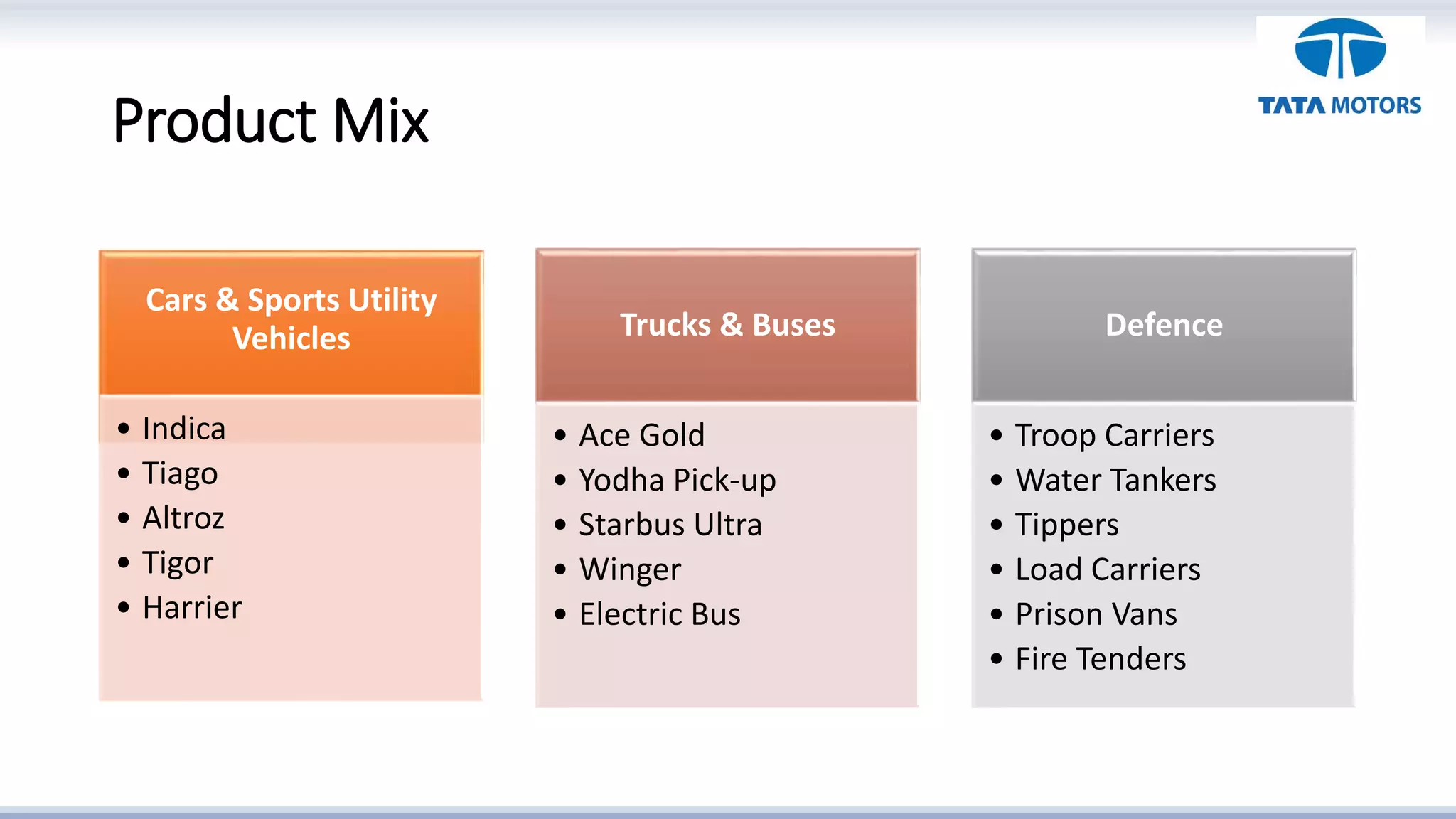
Product Mix
Cars & Sports Utility
Vehicles
• Indica
• Tiago
• Altroz
• Tigor
• Harrier
Trucks & Buses
• Ace Gold
• Yodha Pick-up
• Starbus Ultra
• Winger
• Electric Bus
Defence
• Troop Carriers
• Water Tankers
• Tippers
• Load Carriers
• Prison Vans
• Fire Tenders
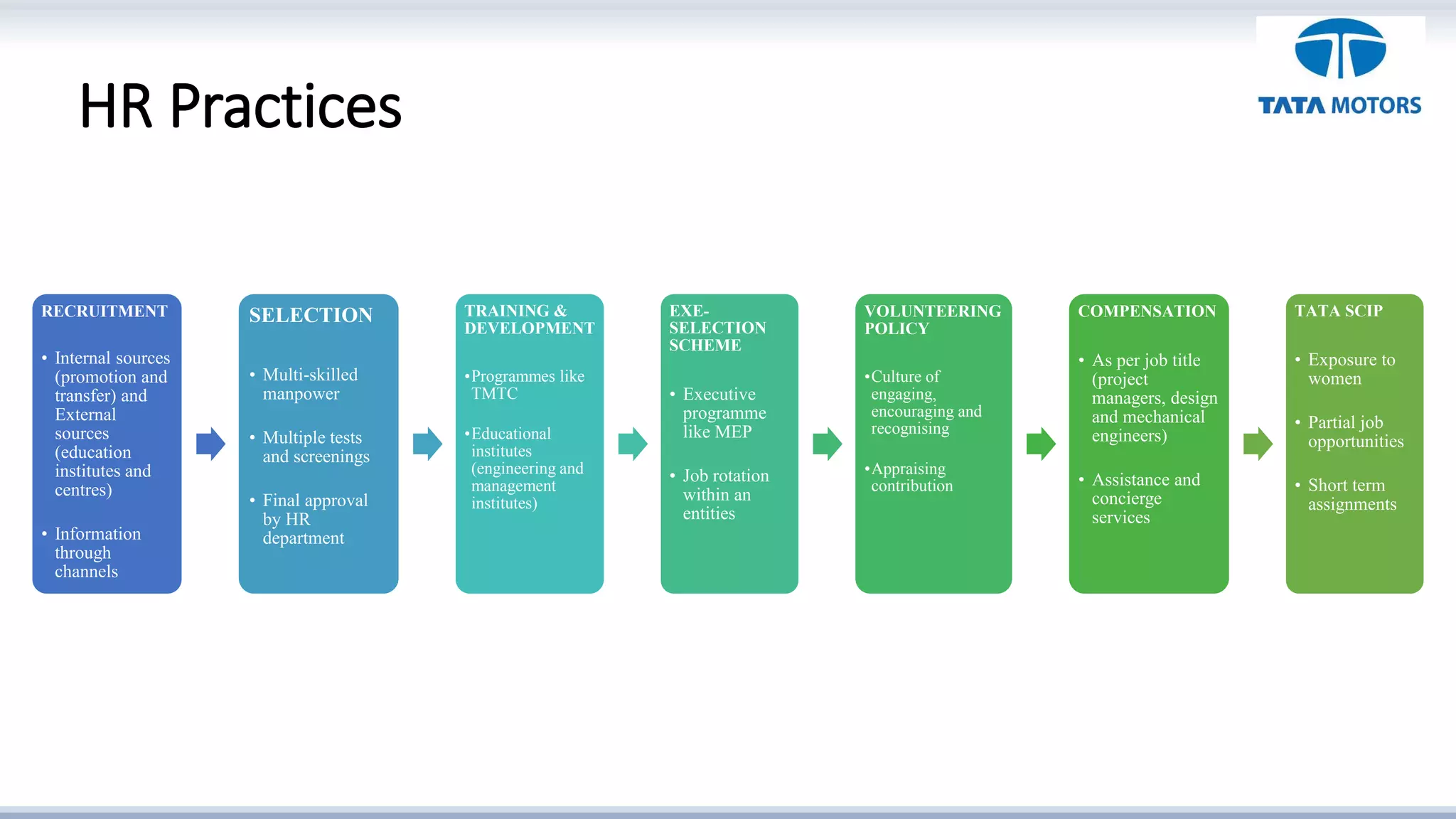
HR Practices
RECRUITMENT
• Internal sources
(promotion and
transfer) and
External
sources
(education
institutes and
centres)
• Information
through
channels
SELECTION
• Multi-skilled
manpower
• Multiple tests
and screenings
• Final approval
by HR
department
TRAINING &
DEVELOPMENT
•Programmes like
TMTC
•Educational
institutes
(engineering and
management
institutes)
EXE-
SELECTION
SCHEME
• Executive
programme
like MEP
• Job rotation
within an
entities
VOLUNTEERING
POLICY
•Culture of
engaging,
encouraging and
recognising
•Appraising
contribution
COMPENSATION
• As per job title
(project
managers, design
and mechanical
engineers)
• Assistance and
concierge
services
TATA SCIP
• Exposure to
women
• Partial job
opportunities
• Short term
assignments
Supply Chain
D
A
S Demand Side
Supply Side
After Sales
Proprietary design- Establish Supplier like Bosch.
In house design
Long Term Contract
Commercial vehicle, Passenger Vehicle and Defense vehicle
Company Owned showrooms
Four Part warehouse at suitable locations
Channels of Communication
Tata sources of Finance
• Equity
• Debt
• Cash generated from operation
• Disinvestment of stakes in Subsidiary
• Sale of Investment
Revenue generation
266707.9
278545
275246.66
292340.64
301938.4
261067.97
240000
250000
260000
270000
280000
290000
300000
310000
2015 2016 2017 2018 2019 2020
Total revenue Consolidated
47383.61 49054.49
58689.81
68323.69
43928.17
0
10000
20000
30000
40000
50000
60000
70000
80000
2016 2017 2018 2019 2020
Total revenue standalone
Total
14
4
79
2
1
Revenue % mix
CV PV JLR TMFL others
Financials Performance
• No profit For 2 years
• Rising Debt In capital
• Falling Share price
• Impacting liquidity
• Declining P/B ratio
Ratio 2017 2018 2019 2020
Current Ratio 1 0.95 0.95 0.85
Quick Ratio 0.7 0.66 0.58 0.58
Debt- Equity Ratio 1.35 0.93 1.76 1.91
ROA(%) 2.28 2.28 0 0
ROE(%) 8.85 8.88 0 0
ROCE(%) 9.51 9.87 0 0
Share price(in Rs) 465.85 326.85 174.25 71.05
P/B ratio 2.73 1.17 0.98 0.41
IT Strategies
SAP SRM (1997, 2
years)
SOX Compliance
(Sarbanes-Oxley
Act)
3D CAD for
Product
Development
Process (early 90’s)
KNext (in-house)
KM framework for
reusing
Engineering rules
AI for Predictive
Maintenance
Turnaround 2.0
Win decisively
in CV
Win proactively
in EV
Win sustainably
in PV
Manage
challenges
Conclusion
• Focus on Financial Stability
• Customer centricity
• Digital Transformation with AI, IOT, Machine Learning
Thank you

ANALYSIS OF TATA MOTORS LONG TERM STRATEGY

  • 1.
    Strategies in Business PG-A Group 1 Sagarika Govalkar 14 Himanshu Karambelkar 21 Arun Gupta 15 Shradheay Singh 51 Chandan Gupta 16 Ashish Yadav 60
  • 2.
    Introduction & StrategicIntent PESTLE Analysis Porter’s 5 Forces Product Mix Implementation of Strategies Strategies for Growth Conclusion Topics to be covered
  • 3.
    Introduction • Established onSeptember 1945 as TELCO • MD & CEO : Guenter Butschek • Design & R&D centres : India, UK, Italy and Korea • Subsidiaries : Jaguar Land Rover (UK), Daewoo (South Korea) • Joint Ventures : Marcopolo (Brazil), Fiat (Italy)
  • 4.
    Strategic Intent We innovatemobility solutions with passion to enhance quality of life Mission By FY 2024, we will become the most aspirational Indian auto brand, consistently winning, by 1. Delivering superior financial returns 2. Driving sustainable mobility solutions Vision 3. Exceeding customer expectations 4. Creating a highly engaged work force
  • 5.
    PESTEL Analysis P E S TE L IOTand Intelligent cars CNG and Electric carsInvestment in Sustainable operations and Climate change EGR and SCR Loss at Nano Plant Intensive competition Nano as cheaper car Changing millennial’s Lifestyle India’s Median age 29 GST Singur plant litigation Changing environment regulation Cars (28%) Spare Parts (18%) Make in India, Demonetization and Political confrontation
  • 6.
    Industry analysis -Porter’s five forces model Factors Level of power in the factor Reasons Threat of new entrants Lower Higher entry cost, High cost of switching, very little market share available, etc. Power in the hands of buyers Medium Large number of buyers available, high switching costs Power in the hands of suppliers Lower Large number of suppliers, low possibility of forward integration, high possibility of backward integration by companies Threat of substitutes Higher High level of awareness of substitutes, low priced, high performance Competitive rivalry Higher Each player- different market segments, some are similar, very high cost/barriers for exiting the industry (Maruti Suzuki, Hyundai)
  • 7.
    Product Mix Cars &Sports Utility Vehicles • Indica • Tiago • Altroz • Tigor • Harrier Trucks & Buses • Ace Gold • Yodha Pick-up • Starbus Ultra • Winger • Electric Bus Defence • Troop Carriers • Water Tankers • Tippers • Load Carriers • Prison Vans • Fire Tenders
  • 8.
    HR Practices RECRUITMENT • Internalsources (promotion and transfer) and External sources (education institutes and centres) • Information through channels SELECTION • Multi-skilled manpower • Multiple tests and screenings • Final approval by HR department TRAINING & DEVELOPMENT •Programmes like TMTC •Educational institutes (engineering and management institutes) EXE- SELECTION SCHEME • Executive programme like MEP • Job rotation within an entities VOLUNTEERING POLICY •Culture of engaging, encouraging and recognising •Appraising contribution COMPENSATION • As per job title (project managers, design and mechanical engineers) • Assistance and concierge services TATA SCIP • Exposure to women • Partial job opportunities • Short term assignments
  • 9.
    Supply Chain D A S DemandSide Supply Side After Sales Proprietary design- Establish Supplier like Bosch. In house design Long Term Contract Commercial vehicle, Passenger Vehicle and Defense vehicle Company Owned showrooms Four Part warehouse at suitable locations
  • 10.
  • 11.
    Tata sources ofFinance • Equity • Debt • Cash generated from operation • Disinvestment of stakes in Subsidiary • Sale of Investment
  • 12.
    Revenue generation 266707.9 278545 275246.66 292340.64 301938.4 261067.97 240000 250000 260000 270000 280000 290000 300000 310000 2015 20162017 2018 2019 2020 Total revenue Consolidated 47383.61 49054.49 58689.81 68323.69 43928.17 0 10000 20000 30000 40000 50000 60000 70000 80000 2016 2017 2018 2019 2020 Total revenue standalone Total 14 4 79 2 1 Revenue % mix CV PV JLR TMFL others
  • 13.
    Financials Performance • Noprofit For 2 years • Rising Debt In capital • Falling Share price • Impacting liquidity • Declining P/B ratio Ratio 2017 2018 2019 2020 Current Ratio 1 0.95 0.95 0.85 Quick Ratio 0.7 0.66 0.58 0.58 Debt- Equity Ratio 1.35 0.93 1.76 1.91 ROA(%) 2.28 2.28 0 0 ROE(%) 8.85 8.88 0 0 ROCE(%) 9.51 9.87 0 0 Share price(in Rs) 465.85 326.85 174.25 71.05 P/B ratio 2.73 1.17 0.98 0.41
  • 14.
    IT Strategies SAP SRM(1997, 2 years) SOX Compliance (Sarbanes-Oxley Act) 3D CAD for Product Development Process (early 90’s) KNext (in-house) KM framework for reusing Engineering rules AI for Predictive Maintenance
  • 15.
    Turnaround 2.0 Win decisively inCV Win proactively in EV Win sustainably in PV Manage challenges
  • 16.
    Conclusion • Focus onFinancial Stability • Customer centricity • Digital Transformation with AI, IOT, Machine Learning
  • 17.

Editor's Notes

  • #3 Intro, strategic Pest 5 Hr strategy Product Mix SCM Marketing strategy Financial strategy IT strategy growth
  • #4 Tata Engineering and Locomotive Co Ltd for manufacturing locomotives and other engineering products. International Market : Europe, Africa, the Middle East, South Asia, South East Asia, South America, Australia CIS and Russia https://www.forbes.com/lists/best-regarded-companies/#94bac29124dd top 250 best-regarded businesses ranked based on trustworthiness, social conduct, the strength of their products and services and how they fare as employers https://www.tata.com/newsroom/heritage/birth-of-a-giant-tata-motors
  • #5 first set of Tigor Electric Vehicles (EVs) to state-run Energy Efficiency Services Limited (EESL)
  • #6 PESTLE Political: Tariff to promote flagship make in India is an opportunity for Indian company like TATA Motors Demonetization: This has largely affected the economic growth and cash intensive industries like manufacturing due to less cash availability. Political confrontation with opposition party in west Bengal where plant was to be setup. Economic: Huge losses for investments made at initial Nano plant at Singur Intensive competition in the global automobile industry is a major trend that is impacting negatively on companies like Tata Motors. Brand positioning is becoming more challenging due to the competitive pressure from existing manufactures like Hyundai and new disruptive entrants like Volvo due to globalization Social Perception of Nano as cheap car Changing Life style of millennial from owning a car to renting cars. As India is expected to become youngest country with median Age 29, Tata should look to attract more customers Technological Tata motors partnered with Microsoft India: Tata motor’s adoption of microsoft’s technology will leverage the benefits of AI, Machine learning and IOT which will create highly personalized , smart and safe driving experience IOT and Intelligent connected car will be major trend. CNG and Electric car have promising market potential. Turbotronn series of diesel engines- Fuel efficiency and high performance Environmental: Investment in sustainable operation and climate change. EGR and SCR : The Indian government has toughened its emission norms on automobile manufacturers where by all manufacturers have to give a declaration about the emission levels of cars they manufacture In response, Tata motors has planned on adopting EGR (Exhaust Gas Recirculation) and SCR(Silicon Controlled Rectifier) in order to be at the forefront to meet emission regulations   Legal: GST - In GST tax is charged at point of supplier, earlier it was charged on manufacturer and on exported vehicle. Also it is straight away 28% which is less than earlier tax. Ongoing litigation for the Singur plant Changing environment regulation in Indian States      
  • #7 Threat of entrant – automobile industry is a capital intensive industry. There is very little scope for someone to take the share in current existing market. Although there are new types of cars like E-vehicles, that also requires huge capital. Along with it there are other factors like regulations for foreign players to enter market, even profitability regulations for domestic players make it harder to enter into the market. Buyer power – Very little power in the hands of buyers. Before corona there were large number of buyers available for automobile industry in India (before corona). Also switching cost for the buyer would be too high, and that’s why negotiating power or buying power in the hands of buyers is very low. Supplier power – There is very little power in the hands of suppliers because there are very large number of suppliers in India both in organised and unorganised market. Also forward integration in this case is not easily possible. Forward integration refers to in this case as the supplier went on to become competitor in the market. Threat of substitutes – this is the case where companies could feel threatened as in India there is always going to be threat of substitutes. In India people are highly price sensitive and also very much aware about the substitutes available. Performance of the substitutes in this industry is very high (cabs, taxis, buses, etc.) Competitive Rivalry:   The number of recognized and influential brands is low and the exit barriers very high. Any brand trying to exit would have to bear large losses. The level of customer loyalty is high and while the industry is large, it has matured. This intensifies the competition for market share. However, different brands target different market segments but yet they overlap. Brands compete on the basis of price, design, quality, technology, customer safety and several other points. Overall, competition in the auto industry is a strong force or rather very strong. Auto firms are investing aggressively in research and development, digitalization as well as marketing and overall customer experience to grow sales and customer base. Whether in the premium category or the small car segment and SUVs, level of competitive rivalry among leading brands is strong. With higher competition, brands are trying to maximize customer satisfaction and competing to provide the best customer experience. They are also investing in growing their sales and distribution network as well as focus on after sales service is higher now.     Overall we could conclude that this industry is healthy with cash flows. Each player enjoys its own share in the industry (ashok Leyland trucks and tractors, maruti Suzuki passenger vehicles etc.). There is no power either in the hands of buyers or suppliers making the cash inflow healthier in the industry. Although threat of substitutes and competitive rivalry affect market in little bit adverse way all in all, huge profitability in the market.
  • #10 For the Automotive organisation, the main products provided by their suppliers are different automobile parts such as radiators, heat exchangers, seating system, gear boxes etc., TML mainly divide its component into two different types: proprietary design and Tata Motors design. For proprietary design sector, TML use established suppliers such as Bosch who supplies engine management system whereas for in-house parts and system design TML choose supplier with strong process capabilities who can give valuable suggestions as well as improve the designs. TML prefers to go for long term contract instead of annual contract which helps them to low down their cost. As Tata Motors dealing in commercial vehicles, passenger vehicles and defence vehicles, Tata Motors vehicle mainly sold to dealer, agent, businesses, army etc. They also sale their cars directly to the customers such as house holds and small businesses through company owned show rooms. They have set up four parts warehouses at suitable locations to make the genuine spare parts available throughout the country at reasonable rate.TML has also set up toll free phone number accessed from 51 cities as well as they have set up customer help lines, dealer help lines and mobile service vans in more than 50% of dealerships. To meet the demand of all tire customers they have gone a long way in providing customer service in very short time
  • #15 SAP SRM Chosen in 1997 (implementation 1998-2000), Supplier Relationship Management (SRM) SOX (Sarbanes-Oxley Act 2002) compliance is not just a legal obligation but also a good business practice. Of course, companies should behave ethically and limit access to internal financial systems. But implementing SOX financial security controls has the side benefit of also helping to protect the company from data theft by insider threat or cyberattack. SOX compliance can encompass many of the same practices as any data security initiative. https://www.tatamotors.com/press/tata-motors-and-microsoft-india-collaborate-to-redefine-the-connected-experience-for-automobile-users/ https://kupdf.net/download/erp-in-tata-motors_59c1204108bbc56811686ffb_pdfhttps://www.expresscomputer.in/interviews/digital-product-development-systems-team-anchors-the-digital-transformation-efforts-at-tata-motors/31458/
  • #16 https://www.forbesindia.com/article/ceo-work/tata-motors-2.0/52177/1