SUBMITTED BY
ARPIT KUMAR
ABES ENGINEERING COLLEGE,
GHAZIABAD
SUMMER TRAINING
AT
TATA MOTORS,
LUCKNOW
Project Report
PROJECT REPORT
TATA MOTORS, LUCKNOW
21st June 16 – 19th July 16
Project On
Process Validation Of Critical And Major
Processes on Trim Line 2
Under the Guidance of:
Mr. Manoj Mahajan(TM4)
&
Mr. Abhishek Singh(TM1)
Submitted by:
ARPIT KUMAR
B.Tech(ME)- 3rd year
ABES EC,GHAZIABAD
Submitted to:
Mr Neeraj Sharma
Mr. Mayank Kushwaha
Mr. Chetan Rajauria
Acknowledgement
I, ARPIT KUMAR ,Student of ABES ENGINEERING COLLEGE GHAZIABAD, am extremely grateful
to “Tata Motors Limited Lucknow” for the confidence bestowed in me and entrusting my project. I am
very grateful to the HR Department, especially Mr. Prashant Pandey for providing me this opportunity
to work in this prestigious organization.
I would like to express my deep gratitude to Mr. Manoj Mahajan(TM4), for providing me with a
wonderful & conductive environment to work in. He has been very helpful & supportive.
All that I have acquired would not have been possible without the kind guidance of my Project Guide
Mr. Abhishek Singh(TM1). I would like to thank him for the support he provided throughout the
project.
At this juncture I feel deeply honoured in expressing my sincere thanks to Mr. Bhaw Mishra(Junior
Technician), for making the resources available at the right time and providing valuable insights
leading to the successful completion of my project.
CONTENTS
 TATA GROUP – AN INTRODUCTION
 ABOUT TATA MOTORS
 TATA MOTORS LUCKNOW
 DEPARTMENT PROFILE(TRIM LINE-2)
 PROJECT DESCRIPTION
 RESULT
 CONCLUSION
TATA GROUP
The Tata group’s core purpose is to improve the quality of life of the communities it serves
globally, through long-term stakeholder value creation based on leadership with trust.
Brief Synopsis
 Type: Private
 Industry: Global Diversified Enterprise
 Founded: 1868
 Founder: Jamsedji Tata
 Headquarters: Mumbai, Maharashtra, India
 Area served: Worldwide
 Key people: Cyrus P Mistry
 Products: Airline, Automotive, steel, IT, Electricity generation, Chemicals, Beverages,
Telecom, Hospitality, Retail, Consumer goods, Engineering, Construction, Financial services
TATA MOTORS
Tata Motors Limited (formerly TELCO, short for Tata Engineering and Locomotive Company) is an
Indian multinational automotive manufacturing company headquartered in Mumbai, Maharashtra,
India, and a subsidiary of the Tata Group. Its products include passenger cars, trucks, vans,
coaches, buses, construction equipment and military vehicles. It is the world's 17th-largest motor
vehicle manufacturing company, fourth-largest truck manufacturer, and second-largest bus
manufacturer by volume.
Tata Motors has auto manufacturing and assembly plants in Jamshedpur, Pantnagar, Lucknow,
Sanand, Dharwad, and Pune in India, as well as in Argentina, South Africa, Thailand, and the
United Kingdom. It has research and development centres in Pune, Jamshedpur, Lucknow, and
Dharwad, India and in South Korea, Spain, and the United Kingdom.
Founded in 1945 as a manufacturer of locomotives, the company manufactured its first commercial
vehicle in 1954 in a collaboration with Daimler-Benz AG, which ended in 1969.
TATA Motors - Lucknow
PlantTata Motors Lucknow (TML-Lucknow) was established in 1992 to meet the
growing demand for Commercial Vehicles in the Indian market.
This plant rolls out commercial
vehicles & is specialized in the
designing & manufacturing of a range
of modern buses which includes Low-
floor, Semi Low-floor, and High Deck
& CNG Buses. Lucknow plant has
recently commissioned JV Company,
Tata Marcopolo Motors Ltd. in the
premises.
The major facilities at the plant
comprises of:
 Vehicle Factory - Assembly Plant for Trucks and Bus Chassis
 Integral Bus Factory - Assembly Plant for Module Buses catering to the needs of Tata
Marcopolo Motors Limited and FBV operations
 Transmission Factory - Gear Parts, Crown wheel & Pinion and Heat Treatment facility
 Production Engineering Shop catering to the tool design and manufacturing needs
 A well established Training Centre through which around 500 apprentices are trained in
various trades.
 Engineering Research Centre with specific focus on buses, including a Digital prototyping
lab, use of PLM software etc.
 Service Training Centre providing training to drivers and technicians of the STU's.
 RECON Factory (for Reconditioning Business)
 The satellite plant of TMML which caters to the Hi-end buses for the Northern Market.
 State of the art facilities like the Paint Shop, BIW Shop and the TCF factory with automated
lines have been benchmarked with the best in the world.
TRIM LINE
Purpose of TCF Trim Line is to assemble Cab & Cowl, to deliver defect free
product to the next customer with optimum cost at required time.
TRIM LINE
COWL CAB
LPT 2518 LPT 1615 LPT 3118 LPS
4018
TRIM LINE 2(Cowl)
Open Pilot cabins are known as Cowls. The Cowl line is almost 30 years old.
It was first commissioned at the Pune plant and then it was transferred to
Lucknow in 2009.
The major classification of Cowls are:
 FACELESS COWLS: They have no front wall as the name very well
suggests.
 FACE COWLS: Face Cowl differ depending on the make and model of the
lorry or truck, even though the difference are only minor.
Trim Line 2 only produces FACE COWLS
TRIM LINE 2(Cab)
Closed pilot cabins are known as CABs. The Cab comes in two models:
Sleeper: This Cab comes with a berth box in which driver can sleep.
Generally customer who have to travel large distances prefer the sleeper
model.
Non Sleeper: This model comes without the berth box and is thus smaller as
compared to sleeper model.
Trim Line 2 was only concerned with production of Cowls only. But to meet
the increased demand of Cab models, production of Cab has been started on
Trim Line 2 recently.
At Trim Line 2 various parts are assembled on Cowl & Cab before passing the them to respective
assembly lines(Line2 & Line 3). Following models are manufactured :
 LPT 3118 - 52
 LPT 3118 - 56
 LPT 3118 - 62
 LPT 2518 - 48
 LPT 2518 - 62
 LPT 1615 – 62
 LPS 4018 - 32
TRIM LINE 2
LPT 1615 & LPT 2518 before dropping on Trim Line 2
LPT 1615 & LPT 2518 after completed
There are 20 stations on Trim
Line 2 which have more than
100 operations distributed
among them.
This includes operations from
Air Filter Assy. & Driver Seat
fitment to small operations
like Engine Lamp & Horn
fitment
Description of My Project
Process Validation is the analysis of data gathered throughout the design and
manufacturing of a product in order to confirm that the process can reliably output
products of a determined standard. The purpose of process validation is to ensure
varied inputs lead to consistent and high quality outputs. Process validation is an
ongoing process that must be frequently adapted as manufacturing feedback is
gathered. End-to-end validation of production processes is essential in determining
product quality because quality cannot always be determined by finished-product
inspection. Process validation can be broken down into 3 steps: process design,
process qualification, and continued process verification.
WHAT IS PROCESS VALIDATION ?
Over view of Qcos (Quality control
operation system)
 Torque Qcos is a standardized practice applied to all
threaded fasteners operation with the no. of ensuring
torque control.
 All fastners require a minimum level of control
 Some critical fasteners, determined by product
engineering, require a higher level of control.
PURPOSE:
 To ensure that each torque process is capable of
meeting its defined product quality standards facility.
 1.To detect process or product failure early in the system to prevent disruption in a
manufacturing facility.
2. To deliver a safe, reliable, and high quality vehicle to our customers .
SCOPE:
All threaded fasteners secured in an assembly lines.
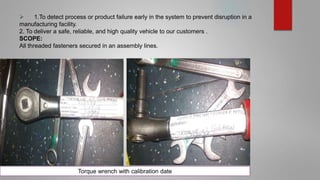
Torque wrench with calibration date
Qcos Classification:
Pointer Description
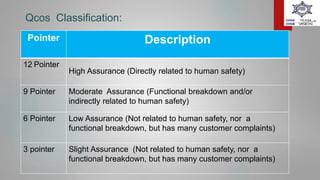
12 Pointer
High Assurance (Directly related to human safety)
9 Pointer Moderate Assurance (Functional breakdown and/or
indirectly related to human safety)
6 Pointer Low Assurance (Not related to human safety, nor a
functional breakdown, but has many customer complaints)
3 pointer Slight Assurance (Not related to human safety, nor a
functional breakdown, but has many customer complaints)
Qcos Scoring Parameters
Points earned by any torque process is calculated by
summing up all points earned on the following parameters
 Tooling
 Inspection
 Error detection
 Process monitoring
Details of some critical process
Steering fitment:
 Steering fitment comes under critical process because it is concern with
safety.
 There are many parts in steering are shown below:
1. Steering column
2. Steering wheel
3. Steering spindle
4. Nachelle
5. Combination switch
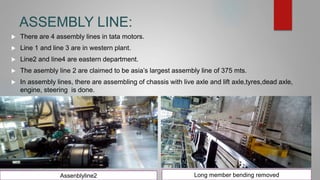
ASSEMBLY LINE:
 There are 4 assembly lines in tata motors.
 Line 1 and line 3 are in western plant.
 Line2 and line4 are eastern department.
 The asembly line 2 are claimed to be asia’s largest assembly line of 375 mts.
 In assembly lines, there are assembling of chassis with live axle and lift axle,tyres,dead axle,
engine, steering is done.
Assenblyline2 Long member bending removed
CONCLUSION
The sole motive of this four weeks summer training was to give an idea what a real
industry is all about and getting training in such an esteemed organization is definitely
a thing to be proud of. I got the chance to learn much more than I expected before I
came here.
During my training I learnt how to plan the activities regarding different work and
develop the techniques to solve the problem. I also learnt the power of team work that
how onerous tasks can be accomplished easily with the help of team work.
Apart from the allotted projects, I also learnt a lot about Organizational Culture.
Working with people from different areas taught me a lot of managerial as well as
personal skills that are definitely very helpful for my future
My experience in TATA motors has been really enriching and has provided me a
stepping stone for a prospective bright future in the industrial Sector. I wish that every
engineer get a chance to get associated with such a giant and reputed group
AKS

AKS

  • 1.
    SUBMITTED BY ARPIT KUMAR ABESENGINEERING COLLEGE, GHAZIABAD SUMMER TRAINING AT TATA MOTORS, LUCKNOW Project Report
  • 2.
    PROJECT REPORT TATA MOTORS,LUCKNOW 21st June 16 – 19th July 16 Project On Process Validation Of Critical And Major Processes on Trim Line 2 Under the Guidance of: Mr. Manoj Mahajan(TM4) & Mr. Abhishek Singh(TM1) Submitted by: ARPIT KUMAR B.Tech(ME)- 3rd year ABES EC,GHAZIABAD Submitted to: Mr Neeraj Sharma Mr. Mayank Kushwaha Mr. Chetan Rajauria
  • 3.
    Acknowledgement I, ARPIT KUMAR,Student of ABES ENGINEERING COLLEGE GHAZIABAD, am extremely grateful to “Tata Motors Limited Lucknow” for the confidence bestowed in me and entrusting my project. I am very grateful to the HR Department, especially Mr. Prashant Pandey for providing me this opportunity to work in this prestigious organization. I would like to express my deep gratitude to Mr. Manoj Mahajan(TM4), for providing me with a wonderful & conductive environment to work in. He has been very helpful & supportive. All that I have acquired would not have been possible without the kind guidance of my Project Guide Mr. Abhishek Singh(TM1). I would like to thank him for the support he provided throughout the project. At this juncture I feel deeply honoured in expressing my sincere thanks to Mr. Bhaw Mishra(Junior Technician), for making the resources available at the right time and providing valuable insights leading to the successful completion of my project.
  • 4.
    CONTENTS  TATA GROUP– AN INTRODUCTION  ABOUT TATA MOTORS  TATA MOTORS LUCKNOW  DEPARTMENT PROFILE(TRIM LINE-2)  PROJECT DESCRIPTION  RESULT  CONCLUSION
  • 5.
    TATA GROUP The Tatagroup’s core purpose is to improve the quality of life of the communities it serves globally, through long-term stakeholder value creation based on leadership with trust. Brief Synopsis  Type: Private  Industry: Global Diversified Enterprise  Founded: 1868  Founder: Jamsedji Tata  Headquarters: Mumbai, Maharashtra, India  Area served: Worldwide  Key people: Cyrus P Mistry  Products: Airline, Automotive, steel, IT, Electricity generation, Chemicals, Beverages, Telecom, Hospitality, Retail, Consumer goods, Engineering, Construction, Financial services
  • 6.
    TATA MOTORS Tata MotorsLimited (formerly TELCO, short for Tata Engineering and Locomotive Company) is an Indian multinational automotive manufacturing company headquartered in Mumbai, Maharashtra, India, and a subsidiary of the Tata Group. Its products include passenger cars, trucks, vans, coaches, buses, construction equipment and military vehicles. It is the world's 17th-largest motor vehicle manufacturing company, fourth-largest truck manufacturer, and second-largest bus manufacturer by volume. Tata Motors has auto manufacturing and assembly plants in Jamshedpur, Pantnagar, Lucknow, Sanand, Dharwad, and Pune in India, as well as in Argentina, South Africa, Thailand, and the United Kingdom. It has research and development centres in Pune, Jamshedpur, Lucknow, and Dharwad, India and in South Korea, Spain, and the United Kingdom. Founded in 1945 as a manufacturer of locomotives, the company manufactured its first commercial vehicle in 1954 in a collaboration with Daimler-Benz AG, which ended in 1969.
  • 7.
    TATA Motors -Lucknow PlantTata Motors Lucknow (TML-Lucknow) was established in 1992 to meet the growing demand for Commercial Vehicles in the Indian market. This plant rolls out commercial vehicles & is specialized in the designing & manufacturing of a range of modern buses which includes Low- floor, Semi Low-floor, and High Deck & CNG Buses. Lucknow plant has recently commissioned JV Company, Tata Marcopolo Motors Ltd. in the premises.
  • 8.
    The major facilitiesat the plant comprises of:  Vehicle Factory - Assembly Plant for Trucks and Bus Chassis  Integral Bus Factory - Assembly Plant for Module Buses catering to the needs of Tata Marcopolo Motors Limited and FBV operations  Transmission Factory - Gear Parts, Crown wheel & Pinion and Heat Treatment facility  Production Engineering Shop catering to the tool design and manufacturing needs  A well established Training Centre through which around 500 apprentices are trained in various trades.  Engineering Research Centre with specific focus on buses, including a Digital prototyping lab, use of PLM software etc.  Service Training Centre providing training to drivers and technicians of the STU's.  RECON Factory (for Reconditioning Business)  The satellite plant of TMML which caters to the Hi-end buses for the Northern Market.  State of the art facilities like the Paint Shop, BIW Shop and the TCF factory with automated lines have been benchmarked with the best in the world.
  • 9.
    TRIM LINE Purpose ofTCF Trim Line is to assemble Cab & Cowl, to deliver defect free product to the next customer with optimum cost at required time. TRIM LINE COWL CAB LPT 2518 LPT 1615 LPT 3118 LPS 4018
  • 10.
    TRIM LINE 2(Cowl) OpenPilot cabins are known as Cowls. The Cowl line is almost 30 years old. It was first commissioned at the Pune plant and then it was transferred to Lucknow in 2009. The major classification of Cowls are:  FACELESS COWLS: They have no front wall as the name very well suggests.  FACE COWLS: Face Cowl differ depending on the make and model of the lorry or truck, even though the difference are only minor. Trim Line 2 only produces FACE COWLS
  • 11.
    TRIM LINE 2(Cab) Closedpilot cabins are known as CABs. The Cab comes in two models: Sleeper: This Cab comes with a berth box in which driver can sleep. Generally customer who have to travel large distances prefer the sleeper model. Non Sleeper: This model comes without the berth box and is thus smaller as compared to sleeper model. Trim Line 2 was only concerned with production of Cowls only. But to meet the increased demand of Cab models, production of Cab has been started on Trim Line 2 recently.
  • 12.
    At Trim Line2 various parts are assembled on Cowl & Cab before passing the them to respective assembly lines(Line2 & Line 3). Following models are manufactured :  LPT 3118 - 52  LPT 3118 - 56  LPT 3118 - 62  LPT 2518 - 48  LPT 2518 - 62  LPT 1615 – 62  LPS 4018 - 32 TRIM LINE 2 LPT 1615 & LPT 2518 before dropping on Trim Line 2 LPT 1615 & LPT 2518 after completed There are 20 stations on Trim Line 2 which have more than 100 operations distributed among them. This includes operations from Air Filter Assy. & Driver Seat fitment to small operations like Engine Lamp & Horn fitment
  • 13.
    Description of MyProject Process Validation is the analysis of data gathered throughout the design and manufacturing of a product in order to confirm that the process can reliably output products of a determined standard. The purpose of process validation is to ensure varied inputs lead to consistent and high quality outputs. Process validation is an ongoing process that must be frequently adapted as manufacturing feedback is gathered. End-to-end validation of production processes is essential in determining product quality because quality cannot always be determined by finished-product inspection. Process validation can be broken down into 3 steps: process design, process qualification, and continued process verification. WHAT IS PROCESS VALIDATION ?
  • 14.
    Over view ofQcos (Quality control operation system)  Torque Qcos is a standardized practice applied to all threaded fasteners operation with the no. of ensuring torque control.  All fastners require a minimum level of control  Some critical fasteners, determined by product engineering, require a higher level of control. PURPOSE:  To ensure that each torque process is capable of meeting its defined product quality standards facility.
  • 15.
     1.To detectprocess or product failure early in the system to prevent disruption in a manufacturing facility. 2. To deliver a safe, reliable, and high quality vehicle to our customers . SCOPE: All threaded fasteners secured in an assembly lines. Torque wrench with calibration date
  • 16.
    Qcos Classification: Pointer Description 12Pointer High Assurance (Directly related to human safety) 9 Pointer Moderate Assurance (Functional breakdown and/or indirectly related to human safety) 6 Pointer Low Assurance (Not related to human safety, nor a functional breakdown, but has many customer complaints) 3 pointer Slight Assurance (Not related to human safety, nor a functional breakdown, but has many customer complaints)
  • 17.
    Qcos Scoring Parameters Pointsearned by any torque process is calculated by summing up all points earned on the following parameters  Tooling  Inspection  Error detection  Process monitoring
  • 18.
    Details of somecritical process Steering fitment:  Steering fitment comes under critical process because it is concern with safety.  There are many parts in steering are shown below: 1. Steering column 2. Steering wheel 3. Steering spindle 4. Nachelle 5. Combination switch
  • 19.
    ASSEMBLY LINE:  Thereare 4 assembly lines in tata motors.  Line 1 and line 3 are in western plant.  Line2 and line4 are eastern department.  The asembly line 2 are claimed to be asia’s largest assembly line of 375 mts.  In assembly lines, there are assembling of chassis with live axle and lift axle,tyres,dead axle, engine, steering is done. Assenblyline2 Long member bending removed
  • 20.
    CONCLUSION The sole motiveof this four weeks summer training was to give an idea what a real industry is all about and getting training in such an esteemed organization is definitely a thing to be proud of. I got the chance to learn much more than I expected before I came here. During my training I learnt how to plan the activities regarding different work and develop the techniques to solve the problem. I also learnt the power of team work that how onerous tasks can be accomplished easily with the help of team work. Apart from the allotted projects, I also learnt a lot about Organizational Culture. Working with people from different areas taught me a lot of managerial as well as personal skills that are definitely very helpful for my future My experience in TATA motors has been really enriching and has provided me a stepping stone for a prospective bright future in the industrial Sector. I wish that every engineer get a chance to get associated with such a giant and reputed group