INTRODUCTION TO

CORPORATE FINANCE
Laurence Booth • W. Sean Cleary

Chapter 15 – Mergers and Acquisitions

Prepared by
Ken Hartviksen
CHAPTER 15
Mergers and Acquisitions
Lecture Agenda
•
•
•
•
•
•
•
•
•

Learning Objectives
Important Terms
Types of Takeovers
Securities Legislation
Friendly versus hostile takeovers
Motivations for Mergers and Acquisitions
Valuation Issues
Accounting for Acquisitions
Summary and Conclusions
– Concept Review Questions
CHAPTER 15 – Mergers and Acquisitions 15 - 3
Learning Objectives
1.
2.
3.

The different types of acquisitions
How a typical acquisition proceeds
What differentiates a friendly from a hostile
acquisition
4. Different forms of combinations of firms
5. Where to look for acquisition gains
6. How accounting may affect the acquisition
decision

CHAPTER 15 – Mergers and Acquisitions 15 - 4
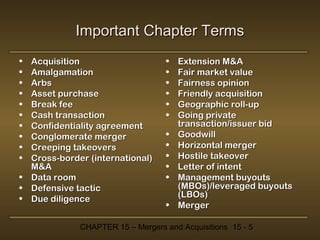
Important Chapter Terms
•
•
•
•
•
•
•
•
•
•

Acquisition
Amalgamation
Arbs
Asset purchase
Break fee
Cash transaction
Confidentiality agreement
Conglomerate merger
Creeping takeovers
Cross-border (international)
M&A
• Data room
• Defensive tactic
• Due diligence

•
•
•
•
•
•
•
•
•
•
•
•

Extension M&A
Fair market value
Fairness opinion
Friendly acquisition
Geographic roll-up
Going private
transaction/issuer bid
Goodwill
Horizontal merger
Hostile takeover
Letter of intent
Management buyouts
(MBOs)/leveraged buyouts
(LBOs)
Merger

CHAPTER 15 – Mergers and Acquisitions 15 - 5
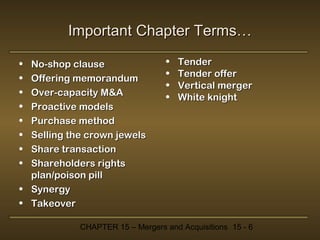
Important Chapter Terms…
•
•
•
•
•
•
•
•

No-shop clause
Offering memorandum
Over-capacity M&A
Proactive models
Purchase method
Selling the crown jewels
Share transaction
Shareholders rights
plan/poison pill
• Synergy
• Takeover

•
•
•
•

Tender
Tender offer
Vertical merger
White knight

CHAPTER 15 – Mergers and Acquisitions 15 - 6
Types of Takeovers
Mergers and Acquisitions
Types of Takeovers
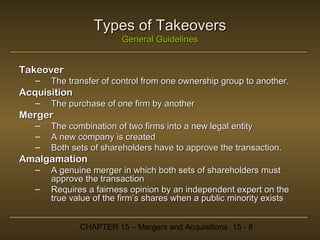
General Guidelines

Takeover
–

The transfer of control from one ownership group to another.

Acquisition
–

The purchase of one firm by another

Merger
–
–
–

The combination of two firms into a new legal entity
A new company is created
Both sets of shareholders have to approve the transaction.

Amalgamation
–
–

A genuine merger in which both sets of shareholders must
approve the transaction
Requires a fairness opinion by an independent expert on the
true value of the firm’s shares when a public minority exists
CHAPTER 15 – Mergers and Acquisitions 15 - 8
Types of Takeovers
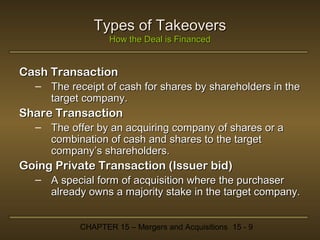
How the Deal is Financed

Cash Transaction
– The receipt of cash for shares by shareholders in the
target company.

Share Transaction
– The offer by an acquiring company of shares or a
combination of cash and shares to the target
company’s shareholders.

Going Private Transaction (Issuer bid)
– A special form of acquisition where the purchaser
already owns a majority stake in the target company.
CHAPTER 15 – Mergers and Acquisitions 15 - 9
Securities Laws Pertaining to
Takeovers
Mergers and Acquisitions
General Intent of the Legislation
Transparency – Information Disclosure
• To ensure complete and timely information be available
to all parties (especially minority shareholders)
throughout the process while at the same time not letting
this requirement stall the process unduly.
Fair Treatment
• To avoid oppression or coercion of minority
shareholders.
• To permit competing bids during the process and not
have the first bidder have special rights. (In this way,
shareholders have the opportunity to get the greatest
and fairest price for their shares.)
• To limit the ability of a minority to frustrate the will of a
majority. (minority squeeze out provisions)
CHAPTER 15 – Mergers and Acquisitions 15 - 11
Exempt Takeovers
• Private companies are generally exempt from
provincial securities legislation.
• Public companies that have few shareholders in
one province may be subject to takeover laws
of another province where the majority of
shareholders reside.

CHAPTER 15 – Mergers and Acquisitions 15 - 12
Exemption from Takeover Requirements
for Control Blocks
• Purchase of securities from 5 or fewer
shareholders are permitted without a tender
offer requirement provided the premium over
the market price is less than 15%

CHAPTER 15 – Mergers and Acquisitions 15 - 13
Creeping Takeovers
The 5% Rule

The 5% rule
• Normal course tender offer is not required as
long as no more than 5% of the outstanding
shares are purchased through the exchange
over a one-year period of time.
• This allows creeping takeovers where the
company acquires the target over a long period
of time.

CHAPTER 15 – Mergers and Acquisitions 15 - 14
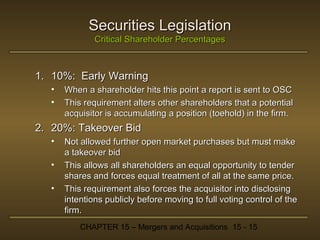
Securities Legislation
Critical Shareholder Percentages

1. 10%: Early Warning
•
•

When a shareholder hits this point a report is sent to OSC
This requirement alters other shareholders that a potential
acquisitor is accumulating a position (toehold) in the firm.

2. 20%: Takeover Bid
•
•
•

Not allowed further open market purchases but must make
a takeover bid
This allows all shareholders an equal opportunity to tender
shares and forces equal treatment of all at the same price.
This requirement also forces the acquisitor into disclosing
intentions publicly before moving to full voting control of the
firm.
CHAPTER 15 – Mergers and Acquisitions 15 - 15
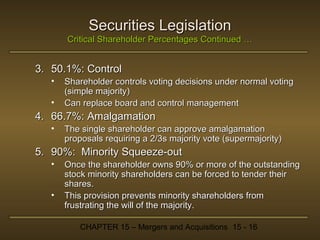
Securities Legislation
Critical Shareholder Percentages Continued …

3. 50.1%: Control
•
•

Shareholder controls voting decisions under normal voting
(simple majority)
Can replace board and control management

4. 66.7%: Amalgamation
•

The single shareholder can approve amalgamation
proposals requiring a 2/3s majority vote (supermajority)

5. 90%: Minority Squeeze-out
•
•

Once the shareholder owns 90% or more of the outstanding
stock minority shareholders can be forced to tender their
shares.
This provision prevents minority shareholders from
frustrating the will of the majority.
CHAPTER 15 – Mergers and Acquisitions 15 - 16
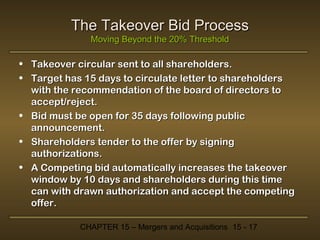
The Takeover Bid Process
Moving Beyond the 20% Threshold

•
•

Takeover circular sent to all shareholders.
Target has 15 days to circulate letter to shareholders
with the recommendation of the board of directors to
accept/reject.
• Bid must be open for 35 days following public
announcement.
• Shareholders tender to the offer by signing
authorizations.
• A Competing bid automatically increases the takeover
window by 10 days and shareholders during this time
can with drawn authorization and accept the competing
offer.
CHAPTER 15 – Mergers and Acquisitions 15 - 17
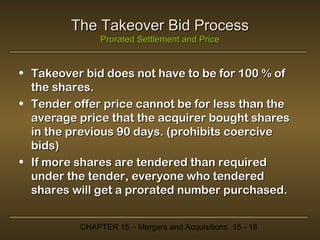
The Takeover Bid Process
Prorated Settlement and Price

• Takeover bid does not have to be for 100 % of
the shares.
• Tender offer price cannot be for less than the
average price that the acquirer bought shares
in the previous 90 days. (prohibits coercive
bids)
• If more shares are tendered than required
under the tender, everyone who tendered
shares will get a prorated number purchased.
CHAPTER 15 – Mergers and Acquisitions 15 - 18
Friendly Acquisition

The acquisition of a target company that is willing to
be taken over.
Usually, the target will accommodate overtures and
provide access to confidential information to facilitate
the scoping and due diligence processes.

CHAPTER 15 – Mergers and Acquisitions 15 - 19
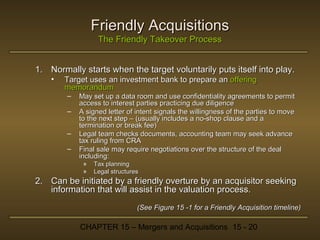
Friendly Acquisitions
The Friendly Takeover Process
1. Normally starts when the target voluntarily puts itself into play.
•

Target uses an investment bank to prepare an offering
memorandum
–
–
–
–

May set up a data room and use confidentiality agreements to permit
access to interest parties practicing due diligence
A signed letter of intent signals the willingness of the parties to move
to the next step – (usually includes a no-shop clause and a
termination or break fee)
Legal team checks documents, accounting team may seek advance
tax ruling from CRA
Final sale may require negotiations over the structure of the deal
including:
»
»

Tax planning
Legal structures

2. Can be initiated by a friendly overture by an acquisitor seeking
information that will assist in the valuation process.
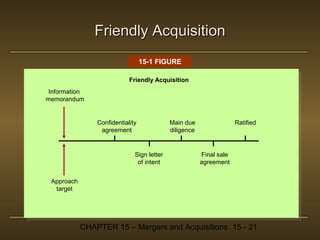
(See Figure 15 -1 for a Friendly Acquisition timeline)

CHAPTER 15 – Mergers and Acquisitions 15 - 20
Friendly Acquisition
15-1 FIGURE
Friendly Acquisition
Information
memorandum

Confidentiality
agreement

Sign letter
of intent

Main due
diligence

Ratified

Final sale
agreement

Approach
target

CHAPTER 15 – Mergers and Acquisitions 15 - 21
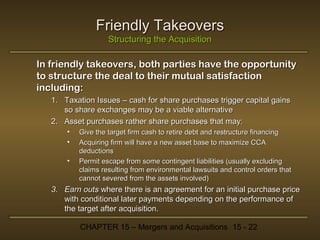
Friendly Takeovers
Structuring the Acquisition

In friendly takeovers, both parties have the opportunity
to structure the deal to their mutual satisfaction
including:
1. Taxation Issues – cash for share purchases trigger capital gains
so share exchanges may be a viable alternative
2. Asset purchases rather share purchases that may:
•
•
•

Give the target firm cash to retire debt and restructure financing
Acquiring firm will have a new asset base to maximize CCA
deductions
Permit escape from some contingent liabilities (usually excluding
claims resulting from environmental lawsuits and control orders that
cannot severed from the assets involved)

3. Earn outs where there is an agreement for an initial purchase price
with conditional later payments depending on the performance of
the target after acquisition.
CHAPTER 15 – Mergers and Acquisitions 15 - 22
Hostile Takeovers

A takeover in which the target has no desire to be
acquired and actively rebuffs the acquirer and
refuses to provide any confidential information.
The acquirer usually has already accumulated an
interest in the target (20% of the outstanding shares)
and this preemptive investment indicates the
strength of resolve of the acquirer.

CHAPTER 15 – Mergers and Acquisitions 15 - 23
Hostile Takeovers
The Typical Process
The typical hostile takeover process:
1.
2.
3.
4.

Slowly acquire a toehold (beach head) by open market purchase of
shares at market prices without attracting attention.
File statement with OSC at the 10% early warning stage while not
trying to attract too much attention.
Accumulate 20% of the outstanding shares through open market
purchase over a longer period of time
Make a tender offer to bring ownership percentage to the desired level
(either the control (50.1%) or amalgamation level (67%)) - this offer
contains a provision that it will be made only if a certain minimum
percentage is obtained.

During this process the acquirer will try to monitor
management/board reaction and fight attempts by them to
put into effect shareholder rights plans or to launch other
defensive tactics.
CHAPTER 15 – Mergers and Acquisitions 15 - 24
Hostile Takeovers
Capital Market Reactions and Other Dynamics
Market clues to the potential outcome of a hostile takeover
attempt:
1.

Market price jumps above the offer price
•
•

1.

Market price stays close to the offer price
•

1.

The offer price is fair and the deal will likely go through

Little trading in the shares
•

1.

A competing offer is likely or
The bid price is too low

A bad sign for the acquirer because shareholders are reluctant to sell.

Great deal of trading in the shares
•

Large numbers of shares being sold from normal investors to arbitrageurs
(arbs) who are, themselves building a position to negotiate an even bigger
premium for themselves by coordinating a response to the tender offer.

CHAPTER 15 – Mergers and Acquisitions 15 - 25
Hostile Takeovers
Defensive Tactics
Shareholders Rights Plan
•
•

Known as a poison pill or deal killer
Can take different forms but often


Gives non-acquiring shareholders get the right to buy 50 percent more
shares at a discount price in the event of a takeover.

Selling the Crown Jewels
•
•

The selling of a target company’s key assets that the acquiring
company is most interested in to make it less attractive for takeover.
Can involve a large dividend to remove excess cash from the target’s
balance sheet.

White Knight
•

The target seeks out another acquirer considered friendly to make a
counter offer and thereby rescue the target from a hostile takeover
CHAPTER 15 – Mergers and Acquisitions 15 - 26
Motives for Takeovers
Mergers and Acquisitions
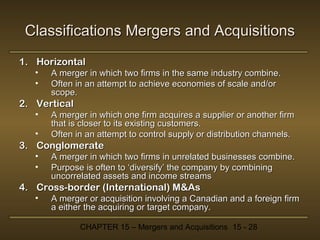
Classifications Mergers and Acquisitions
1. Horizontal
•
•

A merger in which two firms in the same industry combine.
Often in an attempt to achieve economies of scale and/or
scope.

2. Vertical
•
•

A merger in which one firm acquires a supplier or another firm
that is closer to its existing customers.
Often in an attempt to control supply or distribution channels.

3. Conglomerate
•
•

A merger in which two firms in unrelated businesses combine.
Purpose is often to ‘diversify’ the company by combining
uncorrelated assets and income streams

4. Cross-border (International) M&As
•

A merger or acquisition involving a Canadian and a foreign firm
a either the acquiring or target company.
CHAPTER 15 – Mergers and Acquisitions 15 - 28
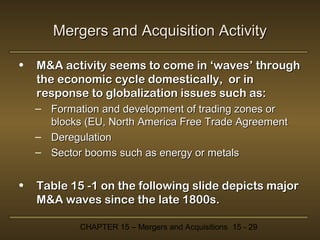
Mergers and Acquisition Activity
•

M&A activity seems to come in ‘waves’ through
the economic cycle domestically, or in
response to globalization issues such as:
– Formation and development of trading zones or
blocks (EU, North America Free Trade Agreement
– Deregulation
– Sector booms such as energy or metals

•

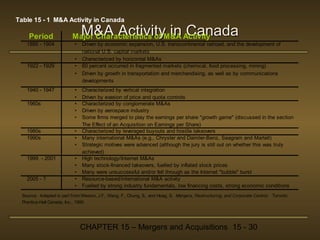
Table 15 -1 on the following slide depicts major
M&A waves since the late 1800s.
CHAPTER 15 – Mergers and Acquisitions 15 - 29
Table 15 - 1 M&A Activity in Canada

Period

M&A Activity in Canada

Major Characteristics of M&A Activity

1895 - 1904

•

1922 - 1929

•
•
•

1940 - 1947
1960s

•
•
•
•
•

1980s
1990s

•
•
•

1999 - 2001

•
•
•
•
•

2005 - ?

Driven by economic expansion, U.S. transcontinental railroad, and the development of
national U.S. capital markets
Characterized by horizontal M&As
60 percent occurred in fragmented markets (chemical, food processing, mining)
Driven by growth in transportation and merchandising, as well as by communications
developments
Characterized by vertical integration
Driven by evasion of price and quota controls
Characterized by conglomerate M&As
Driven by aerospace industry
Some firms merged to play the earnings per share "growth game" (discussed in the section
The Effect of an Acquisition on Earnings per Share)
Characterized by leveraged buyouts and hostile takeovers
Many international M&As (e.g., Chrysler and Daimler-Benz, Seagram and Martell)
Strategic motives were advanced (although the jury is still out on whether this was truly
achieved)
High technology/Internet M&As
Many stock-financed takeovers, fuelled by inflated stock prices
Many were unsuccessful and/or fell through as the Internet "bubble" burst
Resource-based/international M&A activity
Fuelled by strong industry fundamentals, low financing costs, strong economic conditions

Source: Adapted in part from Weston, J.F., Wang, F., Chung, S., and Hoag, S. Mergers, Restructuring, and Corporate Control. Toronto:
Prentice-Hall Canada, Inc., 1990.

CHAPTER 15 – Mergers and Acquisitions 15 - 30
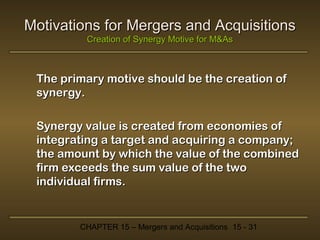
Motivations for Mergers and Acquisitions
Creation of Synergy Motive for M&As

The primary motive should be the creation of
synergy.
Synergy value is created from economies of
integrating a target and acquiring a company;
the amount by which the value of the combined
firm exceeds the sum value of the two
individual firms.

CHAPTER 15 – Mergers and Acquisitions 15 - 31
Creation of Synergy Motive for M&As
Synergy is the additional value created (∆V) :

[ 15-1]

∆ V = VA− T -(VA + VT )

Where:
VT = the pre-merger value of the target firm
VA - T = value of the post merger firm
VA = value of the pre-merger acquiring firm
CHAPTER 15 – Mergers and Acquisitions 15 - 32
Value Creation Motivations for M&As
Operating Synergies

Operating Synergies
1. Economies of Scale
•
•
•

Reducing capacity (consolidation in the number of firms in the
industry)
Spreading fixed costs (increase size of firm so fixed costs per unit
are decreased)
Geographic synergies (consolidation in regional disparate
operations to operate on a national or international basis)

2. Economies of Scope
•

Combination of two activities reduces costs

2. Complementary Strengths
•

Combining the different relative strengths of the two firms creates
a firm with both strengths that are complementary to one another.
CHAPTER 15 – Mergers and Acquisitions 15 - 33
Value Creation Motivations for M&A
Efficiency Increases and Financing Synergies

Efficiency Increases
– New management team will be more efficient and
add more value than what the target now has.
– The combined firm can make use of unused
production/sales/marketing channel capacity

Financing Synergy
–
–
–
–

Reduced cash flow variability
Increase in debt capacity
Reduction in average issuing costs
Fewer information problems
CHAPTER 15 – Mergers and Acquisitions 15 - 34
Value Creation Motivations for M&A
Tax Benefits and Strategic Realignments

Tax Benefits
–

Make better use of tax deductions and credits
•
•
•
•

Use them before they lapse or expire (loss carry-back, carryforward provisions)
Use of deduction in a higher tax bracket to obtain a large tax shield
Use of deductions to offset taxable income (non-operating capital
losses offsetting taxable capital gains that the target firm was
unable to use)
New firm will have operating income to make full use of available
CCA.

Strategic Realignments
–

Permits new strategies that were not feasible for prior to the
acquisition because of the acquisition of new management
skills, connections to markets or people, and new
products/services.

CHAPTER 15 – Mergers and Acquisitions 15 - 35
Managerial Motivations for M&As
Managers may have their own motivations to pursue
M&As. The two most common, are not necessarily in
the best interest of the firm or shareholders, but do
address common needs of managers
1. Increased firm size
–
–

Managers are often more highly rewarded financially for building a
bigger business (compensation tied to assets under administration for
example)
Many associate power and prestige with the size of the firm.

1. Reduced firm risk through diversification
•

•

Managers have an undiversified stake in the business (unlike
shareholders who hold a diversified portfolio of investments and don’t
need the firm to be diversified) and so they tend to dislike risk
(volatility of sales and profits)
M&As can be used to diversify the company and reduce volatility (risk)
that might concern managers.

CHAPTER 15 – Mergers and Acquisitions 15 - 36
Empirical Evidence of Gains through
M&As
•

Target shareholders gain the most
–

Through premiums paid to them to acquire their shares
•
•

–

•

15 – 20% for stock-finance acquisitions
25 – 30% for cash-financed acquisitions (triggering capital gains
taxes for these shareholders)

Gains may be greater for shareholders will to wait for ‘arbs’ to
negotiate higher offers or bidding wars develop between
multiple acquirers.

Between 1995 and 2001, 302 deals worth US$500.
–
–

61% lost value over the following year
The biggest losers were deals financed through shares which
lost an average 8%.
CHAPTER 15 – Mergers and Acquisitions 15 - 37
Empirical Evidence of Gains through M&As
Shareholder Value at Risk (SVAR)

•

Shareholder Value at Risk (SVAR)
– Is the potential in an M&A that synergies will not be
realized or that the premium paid will be greater than
the synergies that are realized.
•
•

•

When using cash, the acquirer bears all the risk
When using share swaps, the risk is borne by the
shareholders in both companies

SVAR supports the argument that firms making
cash deals are much more careful about the
acquisition price.
CHAPTER 15 – Mergers and Acquisitions 15 - 38
Valuation Issues in Corporate
Takeovers
Mergers and Acquisitions
Valuation Issues
What is Fair Market Value?

Fair market value (FMV) is the highest price obtainable
in an open and unrestricted market between
knowledgeable, informed and prudent parties acting at
arm’s length, with neither party being under any
compulsion to transact.
Key phrases in this definition:
1. Open and unrestricted market (where supply and demand can
freely operate – see Figure 15 -2 on the following slide)
2. Knowledgeable, informed and prudent parties
3. Arm’s length
4. Neither party under any compulsion to transact.

CHAPTER 15 – Mergers and Acquisitions 15 - 40
Valuation Issues
Valuation Framework
15-2 FIGURE

Demand

Supply

P
S1

B1

P*
Q

CHAPTER 15 – Mergers and Acquisitions 15 - 41
Valuation Issues
Types of Acquirers
Determining fair market value depends on the perspective of the
acquirer. Some acquirers are more likely to be able to realize
synergies than others and those with the greatest ability to generate
synergies are the ones who can justify higher prices.

Types of acquirers and the impact of their perspective on value
include:
1.
2.
3.
4.

Passive investors – use estimated cash flows currently present
Strategic investors – use estimated synergies and changes that are
forecast to arise through integration of operations with their own
Financials – valued on the basis of reorganized and refinanced
operations
Managers – value the firm based on their own job potential and ability
to motivate staff and reorganize the firm’s operations. MBOs and
LBOs

Market pricing will reflect these different buyers and their
importance at different stages of the business cycle.
CHAPTER 15 – Mergers and Acquisitions 15 - 42
Market Pricing Approaches
Reactive Pricing Approaches
Models reacting to general rules of thumb and the
relative pricing compared to other securities
1. Multiples or relative valuation
2. Liquidation or breakup values

Proactive Models
A valuation method to determine what a target firm’s
value should be based on future values of cash flow
and earnings
1. Discounted cash flow (DCF) models
CHAPTER 15 – Mergers and Acquisitions 15 - 43
Reactive Approaches
Valuation Using Multiples
1.

Find appropriate comparators

– Individual firm that is highly comparable to the target
– Industry average if appropriate

2.

Adjust/normalize the data (income statement and balance sheet) for
differences between target and comparator including:
– Accounting differences
• LIFO versus FIFO
• Accelerated versus straight-line depreciation
• Age of depreciable assets
• Pension liabilities, etc.
– Different capital structures

3.

Calculate a variety of ratios for both the target and the comparator
including:
–
–
–
–

4.

Price-earnings ratio (trailing)
Value/EBITDA
Price/Book Value
Return on Equity

Obtain a range of justifiable values based on the ratios
CHAPTER 15 – Mergers and Acquisitions 15 - 44
Reactive Approaches
Liquidation Valuation

1.
2.
3.

Estimate the liquidation value of current assets
Estimate the present value of tangible assets
Subtract the value of the firm’s liability from
estimated liquidation value of all the firm’s
assets = liquidation value of the firm.

This approach values the firm based on existing assets and is not
forward looking.
CHAPTER 15 – Mergers and Acquisitions 15 - 45
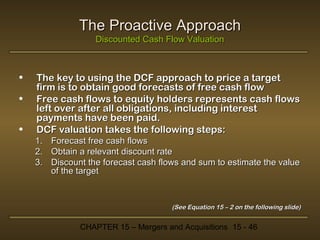
The Proactive Approach
Discounted Cash Flow Valuation

•
•
•

The key to using the DCF approach to price a target
firm is to obtain good forecasts of free cash flow
Free cash flows to equity holders represents cash flows
left over after all obligations, including interest
payments have been paid.
DCF valuation takes the following steps:
1.
2.
3.

Forecast free cash flows
Obtain a relevant discount rate
Discount the forecast cash flows and sum to estimate the value
of the target

(See Equation 15 – 2 on the following slide)

CHAPTER 15 – Mergers and Acquisitions 15 - 46
Discounted Cash Flow Analysis
Free Cash Flow to Equity

Free cash flow to equity = net income + / − non − cash items (amortization,
[ 15-2]

deferred taxes, etc.) + / − changes in net working capital (not including cash
and marketable securities ) − net capital expenditures

CHAPTER 15 – Mergers and Acquisitions 15 - 47
Discounted Cash Flow Analysis
The General DCF Model

• Equation 15 – 3 is the generalized version of the
DCF model showing how forecast free cash
flows are discounted to the present and then
summed.

[ 15-3]

α
CFα
CFt
CF1
CF2
V0 =
+
+ ... +
=∑
(1 + k )1 (1 + k ) 2
(1 + k )α t =1 (1 + k ) t

CHAPTER 15 – Mergers and Acquisitions 15 - 48
Discounted Cash Flow Analysis
The Constant Growth DCF Model

• Equation 15 – 4 is the DCF model for a target firm where
the free cash flows are expected to grow at a constant
rate for the foreseeable future.

[ 15-4]

V0 =

CF1
k−g

• Many target firms are high growth firms and so a multistage model may be more appropriate.
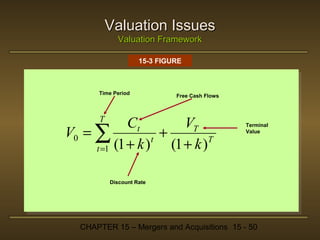
(See Figure 15 -3 on the following slide for the DCF Valuation Framework.)

CHAPTER 15 – Mergers and Acquisitions 15 - 49
Valuation Issues
Valuation Framework
15-3 FIGURE

Time Period

T

Free Cash Flows

Ct
VT
V0 = ∑
+
t
T
(1 + k )
t =1 (1 + k )

Terminal
Value

Discount Rate

CHAPTER 15 – Mergers and Acquisitions 15 - 50
Discounted Cash Flow Analysis
The Multiple Stage DCF Model

• The multi-stage DCF model can be amended to
include numerous stages of growth in the
forecast period.
• This is exhibited in equation 15 – 5:

T

[ 15-5]

CFt
VT
V0 = ∑
+
t
(1 + k )T
t =1 (1 + k )

CHAPTER 15 – Mergers and Acquisitions 15 - 51
Valuation Issues
The Acquisition Decision and Risks that Must be Managed

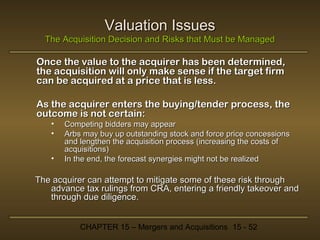
Once the value to the acquirer has been determined,
the acquisition will only make sense if the target firm
can be acquired at a price that is less.
As the acquirer enters the buying/tender process, the
outcome is not certain:
•
•
•

Competing bidders may appear
Arbs may buy up outstanding stock and force price concessions
and lengthen the acquisition process (increasing the costs of
acquisitions)
In the end, the forecast synergies might not be realized

The acquirer can attempt to mitigate some of these risk through
advance tax rulings from CRA, entering a friendly takeover and
through due diligence.
CHAPTER 15 – Mergers and Acquisitions 15 - 52
Valuation Issues
The Effect of an Acquisition on Earnings per Share

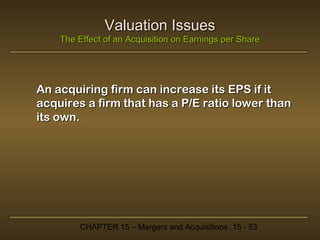
An acquiring firm can increase its EPS if it
acquires a firm that has a P/E ratio lower than
its own.

CHAPTER 15 – Mergers and Acquisitions 15 - 53
Accounting Implications of Takeovers
Mergers and Acquisitions
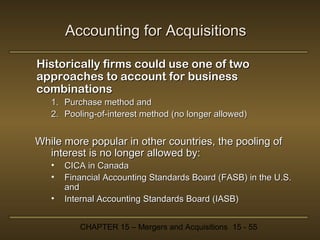
Accounting for Acquisitions
Historically firms could use one of two
approaches to account for business
combinations
1. Purchase method and
2. Pooling-of-interest method (no longer allowed)

While more popular in other countries, the pooling of
interest is no longer allowed by:
•
•
•

CICA in Canada
Financial Accounting Standards Board (FASB) in the U.S.
and
Internal Accounting Standards Board (IASB)
CHAPTER 15 – Mergers and Acquisitions 15 - 55
Accounting for Acquisitions
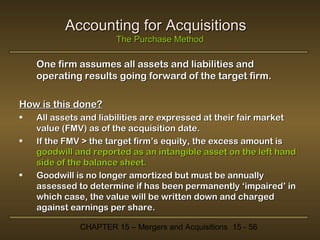
The Purchase Method

One firm assumes all assets and liabilities and
operating results going forward of the target firm.
How is this done?
•
•

•

All assets and liabilities are expressed at their fair market
value (FMV) as of the acquisition date.
If the FMV > the target firm’s equity, the excess amount is
goodwill and reported as an intangible asset on the left hand
side of the balance sheet.
Goodwill is no longer amortized but must be annually
assessed to determine if has been permanently ‘impaired’ in
which case, the value will be written down and charged
against earnings per share.
CHAPTER 15 – Mergers and Acquisitions 15 - 56
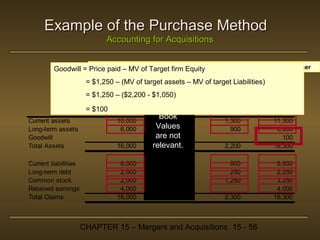
Example of the Purchase Method
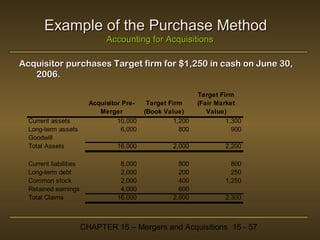
Accounting for Acquisitions
Acquisitor purchases Target firm for $1,250 in cash on June 30,
2006.

Current assets
Long-term assets
Goodwill
Total Assets
Current liabilities
Long-term debt
Common stock
Retained earnings
Total Claims

Acquisitor PreMerger
10,000
6,000

Target Firm
(Book Value)
1,200
800

Target Firm
(Fair Market
Value)
1,300
900

16,000

2,000

2,200

8,000
2,000
2,000
4,000
16,000

800
200
400
600
2,000

800
250
1,250
2,300

CHAPTER 15 – Mergers and Acquisitions 15 - 57
Example of the Purchase Method
Accounting for Acquisitions
Acquisitor Value pre merger + Target Firm (FMV) = Acquisitor Post Merger
Goodwill = Price paid – MV of Target firm Equity

= $1,250 – (MV of target assets – MV of target Liabilities)
= $1,250 – ($2,200 - $1,050)
Acquisitor Pre-

= $100
Merger

Target Firm
(Book Value)
Book
1,200
Values
800

Current assets
Long-term assets
Goodwill
Total Assets

10,000
6,000
16,000

are not
relevant.
2,000

Current liabilities
Long-term debt
Common stock
Retained earnings
Total Claims

8,000
2,000
2,000
4,000
16,000

800
200
400
600
2,000

Target Firm
(Fair Market
Acquisitor Post
Value)
Merger
1,300
11,300
900
6,900
100
2,200
18,300
800
250
1,250
2,300

CHAPTER 15 – Mergers and Acquisitions 15 - 58

8,800
2,250
3,250
4,000
18,300
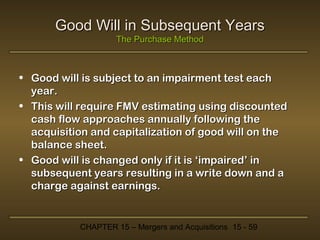
Good Will in Subsequent Years
The Purchase Method

• Good will is subject to an impairment test each
year.
• This will require FMV estimating using discounted
cash flow approaches annually following the
acquisition and capitalization of good will on the
balance sheet.
• Good will is changed only if it is ‘impaired’ in
subsequent years resulting in a write down and a
charge against earnings.

CHAPTER 15 – Mergers and Acquisitions 15 - 59
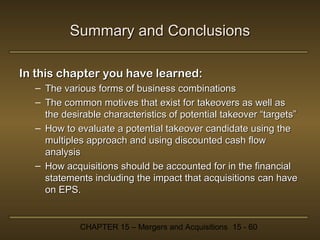
Summary and Conclusions
In this chapter you have learned:
– The various forms of business combinations
– The common motives that exist for takeovers as well as
the desirable characteristics of potential takeover “targets”
– How to evaluate a potential takeover candidate using the
multiples approach and using discounted cash flow
analysis
– How acquisitions should be accounted for in the financial
statements including the impact that acquisitions can have
on EPS.

CHAPTER 15 – Mergers and Acquisitions 15 - 60
Concept Review Questions
Mergers and Acquisitions
Concept Review Question 1
Acquisition versus Merger

What is the difference between an acquisition
and a merger?

CHAPTER 15 – Mergers and Acquisitions 15 - 62
Copyright
Copyright © 2007 John Wiley & Sons
Canada, Ltd. All rights reserved.
Reproduction or translation of this
work beyond that permitted by
Access Copyright (the Canadian
copyright licensing agency) is
unlawful. Requests for further
information should be addressed to
the Permissions Department, John
Wiley & Sons Canada, Ltd. The
purchaser may make back-up copies
for his or her own use only and not for
distribution or resale. The author and
the publisher assume no
responsibility for errors, omissions,
or damages caused by the use of
these files or programs or from the
use of the information contained
herein.

CHAPTER 15 – Mergers and Acquisitions 15 - 63

Chapter 15 mergers and acquisitions

  • 1.
    INTRODUCTION TO CORPORATE FINANCE LaurenceBooth • W. Sean Cleary Chapter 15 – Mergers and Acquisitions Prepared by Ken Hartviksen
  • 2.
  • 3.
    Lecture Agenda • • • • • • • • • Learning Objectives ImportantTerms Types of Takeovers Securities Legislation Friendly versus hostile takeovers Motivations for Mergers and Acquisitions Valuation Issues Accounting for Acquisitions Summary and Conclusions – Concept Review Questions CHAPTER 15 – Mergers and Acquisitions 15 - 3
  • 4.
    Learning Objectives 1. 2. 3. The differenttypes of acquisitions How a typical acquisition proceeds What differentiates a friendly from a hostile acquisition 4. Different forms of combinations of firms 5. Where to look for acquisition gains 6. How accounting may affect the acquisition decision CHAPTER 15 – Mergers and Acquisitions 15 - 4
  • 5.
    Important Chapter Terms • • • • • • • • • • Acquisition Amalgamation Arbs Assetpurchase Break fee Cash transaction Confidentiality agreement Conglomerate merger Creeping takeovers Cross-border (international) M&A • Data room • Defensive tactic • Due diligence • • • • • • • • • • • • Extension M&A Fair market value Fairness opinion Friendly acquisition Geographic roll-up Going private transaction/issuer bid Goodwill Horizontal merger Hostile takeover Letter of intent Management buyouts (MBOs)/leveraged buyouts (LBOs) Merger CHAPTER 15 – Mergers and Acquisitions 15 - 5
  • 6.
    Important Chapter Terms… • • • • • • • • No-shopclause Offering memorandum Over-capacity M&A Proactive models Purchase method Selling the crown jewels Share transaction Shareholders rights plan/poison pill • Synergy • Takeover • • • • Tender Tender offer Vertical merger White knight CHAPTER 15 – Mergers and Acquisitions 15 - 6
  • 7.
  • 8.
    Types of Takeovers GeneralGuidelines Takeover – The transfer of control from one ownership group to another. Acquisition – The purchase of one firm by another Merger – – – The combination of two firms into a new legal entity A new company is created Both sets of shareholders have to approve the transaction. Amalgamation – – A genuine merger in which both sets of shareholders must approve the transaction Requires a fairness opinion by an independent expert on the true value of the firm’s shares when a public minority exists CHAPTER 15 – Mergers and Acquisitions 15 - 8
  • 9.
    Types of Takeovers Howthe Deal is Financed Cash Transaction – The receipt of cash for shares by shareholders in the target company. Share Transaction – The offer by an acquiring company of shares or a combination of cash and shares to the target company’s shareholders. Going Private Transaction (Issuer bid) – A special form of acquisition where the purchaser already owns a majority stake in the target company. CHAPTER 15 – Mergers and Acquisitions 15 - 9
  • 10.
    Securities Laws Pertainingto Takeovers Mergers and Acquisitions
  • 11.
    General Intent ofthe Legislation Transparency – Information Disclosure • To ensure complete and timely information be available to all parties (especially minority shareholders) throughout the process while at the same time not letting this requirement stall the process unduly. Fair Treatment • To avoid oppression or coercion of minority shareholders. • To permit competing bids during the process and not have the first bidder have special rights. (In this way, shareholders have the opportunity to get the greatest and fairest price for their shares.) • To limit the ability of a minority to frustrate the will of a majority. (minority squeeze out provisions) CHAPTER 15 – Mergers and Acquisitions 15 - 11
  • 12.
    Exempt Takeovers • Privatecompanies are generally exempt from provincial securities legislation. • Public companies that have few shareholders in one province may be subject to takeover laws of another province where the majority of shareholders reside. CHAPTER 15 – Mergers and Acquisitions 15 - 12
  • 13.
    Exemption from TakeoverRequirements for Control Blocks • Purchase of securities from 5 or fewer shareholders are permitted without a tender offer requirement provided the premium over the market price is less than 15% CHAPTER 15 – Mergers and Acquisitions 15 - 13
  • 14.
    Creeping Takeovers The 5%Rule The 5% rule • Normal course tender offer is not required as long as no more than 5% of the outstanding shares are purchased through the exchange over a one-year period of time. • This allows creeping takeovers where the company acquires the target over a long period of time. CHAPTER 15 – Mergers and Acquisitions 15 - 14
  • 15.
    Securities Legislation Critical ShareholderPercentages 1. 10%: Early Warning • • When a shareholder hits this point a report is sent to OSC This requirement alters other shareholders that a potential acquisitor is accumulating a position (toehold) in the firm. 2. 20%: Takeover Bid • • • Not allowed further open market purchases but must make a takeover bid This allows all shareholders an equal opportunity to tender shares and forces equal treatment of all at the same price. This requirement also forces the acquisitor into disclosing intentions publicly before moving to full voting control of the firm. CHAPTER 15 – Mergers and Acquisitions 15 - 15
  • 16.
    Securities Legislation Critical ShareholderPercentages Continued … 3. 50.1%: Control • • Shareholder controls voting decisions under normal voting (simple majority) Can replace board and control management 4. 66.7%: Amalgamation • The single shareholder can approve amalgamation proposals requiring a 2/3s majority vote (supermajority) 5. 90%: Minority Squeeze-out • • Once the shareholder owns 90% or more of the outstanding stock minority shareholders can be forced to tender their shares. This provision prevents minority shareholders from frustrating the will of the majority. CHAPTER 15 – Mergers and Acquisitions 15 - 16
  • 17.
    The Takeover BidProcess Moving Beyond the 20% Threshold • • Takeover circular sent to all shareholders. Target has 15 days to circulate letter to shareholders with the recommendation of the board of directors to accept/reject. • Bid must be open for 35 days following public announcement. • Shareholders tender to the offer by signing authorizations. • A Competing bid automatically increases the takeover window by 10 days and shareholders during this time can with drawn authorization and accept the competing offer. CHAPTER 15 – Mergers and Acquisitions 15 - 17
  • 18.
    The Takeover BidProcess Prorated Settlement and Price • Takeover bid does not have to be for 100 % of the shares. • Tender offer price cannot be for less than the average price that the acquirer bought shares in the previous 90 days. (prohibits coercive bids) • If more shares are tendered than required under the tender, everyone who tendered shares will get a prorated number purchased. CHAPTER 15 – Mergers and Acquisitions 15 - 18
  • 19.
    Friendly Acquisition The acquisitionof a target company that is willing to be taken over. Usually, the target will accommodate overtures and provide access to confidential information to facilitate the scoping and due diligence processes. CHAPTER 15 – Mergers and Acquisitions 15 - 19
  • 20.
    Friendly Acquisitions The FriendlyTakeover Process 1. Normally starts when the target voluntarily puts itself into play. • Target uses an investment bank to prepare an offering memorandum – – – – May set up a data room and use confidentiality agreements to permit access to interest parties practicing due diligence A signed letter of intent signals the willingness of the parties to move to the next step – (usually includes a no-shop clause and a termination or break fee) Legal team checks documents, accounting team may seek advance tax ruling from CRA Final sale may require negotiations over the structure of the deal including: » » Tax planning Legal structures 2. Can be initiated by a friendly overture by an acquisitor seeking information that will assist in the valuation process. (See Figure 15 -1 for a Friendly Acquisition timeline) CHAPTER 15 – Mergers and Acquisitions 15 - 20
  • 21.
    Friendly Acquisition 15-1 FIGURE FriendlyAcquisition Information memorandum Confidentiality agreement Sign letter of intent Main due diligence Ratified Final sale agreement Approach target CHAPTER 15 – Mergers and Acquisitions 15 - 21
  • 22.
    Friendly Takeovers Structuring theAcquisition In friendly takeovers, both parties have the opportunity to structure the deal to their mutual satisfaction including: 1. Taxation Issues – cash for share purchases trigger capital gains so share exchanges may be a viable alternative 2. Asset purchases rather share purchases that may: • • • Give the target firm cash to retire debt and restructure financing Acquiring firm will have a new asset base to maximize CCA deductions Permit escape from some contingent liabilities (usually excluding claims resulting from environmental lawsuits and control orders that cannot severed from the assets involved) 3. Earn outs where there is an agreement for an initial purchase price with conditional later payments depending on the performance of the target after acquisition. CHAPTER 15 – Mergers and Acquisitions 15 - 22
  • 23.
    Hostile Takeovers A takeoverin which the target has no desire to be acquired and actively rebuffs the acquirer and refuses to provide any confidential information. The acquirer usually has already accumulated an interest in the target (20% of the outstanding shares) and this preemptive investment indicates the strength of resolve of the acquirer. CHAPTER 15 – Mergers and Acquisitions 15 - 23
  • 24.
    Hostile Takeovers The TypicalProcess The typical hostile takeover process: 1. 2. 3. 4. Slowly acquire a toehold (beach head) by open market purchase of shares at market prices without attracting attention. File statement with OSC at the 10% early warning stage while not trying to attract too much attention. Accumulate 20% of the outstanding shares through open market purchase over a longer period of time Make a tender offer to bring ownership percentage to the desired level (either the control (50.1%) or amalgamation level (67%)) - this offer contains a provision that it will be made only if a certain minimum percentage is obtained. During this process the acquirer will try to monitor management/board reaction and fight attempts by them to put into effect shareholder rights plans or to launch other defensive tactics. CHAPTER 15 – Mergers and Acquisitions 15 - 24
  • 25.
    Hostile Takeovers Capital MarketReactions and Other Dynamics Market clues to the potential outcome of a hostile takeover attempt: 1. Market price jumps above the offer price • • 1. Market price stays close to the offer price • 1. The offer price is fair and the deal will likely go through Little trading in the shares • 1. A competing offer is likely or The bid price is too low A bad sign for the acquirer because shareholders are reluctant to sell. Great deal of trading in the shares • Large numbers of shares being sold from normal investors to arbitrageurs (arbs) who are, themselves building a position to negotiate an even bigger premium for themselves by coordinating a response to the tender offer. CHAPTER 15 – Mergers and Acquisitions 15 - 25
  • 26.
    Hostile Takeovers Defensive Tactics ShareholdersRights Plan • • Known as a poison pill or deal killer Can take different forms but often  Gives non-acquiring shareholders get the right to buy 50 percent more shares at a discount price in the event of a takeover. Selling the Crown Jewels • • The selling of a target company’s key assets that the acquiring company is most interested in to make it less attractive for takeover. Can involve a large dividend to remove excess cash from the target’s balance sheet. White Knight • The target seeks out another acquirer considered friendly to make a counter offer and thereby rescue the target from a hostile takeover CHAPTER 15 – Mergers and Acquisitions 15 - 26
  • 27.
  • 28.
    Classifications Mergers andAcquisitions 1. Horizontal • • A merger in which two firms in the same industry combine. Often in an attempt to achieve economies of scale and/or scope. 2. Vertical • • A merger in which one firm acquires a supplier or another firm that is closer to its existing customers. Often in an attempt to control supply or distribution channels. 3. Conglomerate • • A merger in which two firms in unrelated businesses combine. Purpose is often to ‘diversify’ the company by combining uncorrelated assets and income streams 4. Cross-border (International) M&As • A merger or acquisition involving a Canadian and a foreign firm a either the acquiring or target company. CHAPTER 15 – Mergers and Acquisitions 15 - 28
  • 29.
    Mergers and AcquisitionActivity • M&A activity seems to come in ‘waves’ through the economic cycle domestically, or in response to globalization issues such as: – Formation and development of trading zones or blocks (EU, North America Free Trade Agreement – Deregulation – Sector booms such as energy or metals • Table 15 -1 on the following slide depicts major M&A waves since the late 1800s. CHAPTER 15 – Mergers and Acquisitions 15 - 29
  • 30.
    Table 15 -1 M&A Activity in Canada Period M&A Activity in Canada Major Characteristics of M&A Activity 1895 - 1904 • 1922 - 1929 • • • 1940 - 1947 1960s • • • • • 1980s 1990s • • • 1999 - 2001 • • • • • 2005 - ? Driven by economic expansion, U.S. transcontinental railroad, and the development of national U.S. capital markets Characterized by horizontal M&As 60 percent occurred in fragmented markets (chemical, food processing, mining) Driven by growth in transportation and merchandising, as well as by communications developments Characterized by vertical integration Driven by evasion of price and quota controls Characterized by conglomerate M&As Driven by aerospace industry Some firms merged to play the earnings per share "growth game" (discussed in the section The Effect of an Acquisition on Earnings per Share) Characterized by leveraged buyouts and hostile takeovers Many international M&As (e.g., Chrysler and Daimler-Benz, Seagram and Martell) Strategic motives were advanced (although the jury is still out on whether this was truly achieved) High technology/Internet M&As Many stock-financed takeovers, fuelled by inflated stock prices Many were unsuccessful and/or fell through as the Internet "bubble" burst Resource-based/international M&A activity Fuelled by strong industry fundamentals, low financing costs, strong economic conditions Source: Adapted in part from Weston, J.F., Wang, F., Chung, S., and Hoag, S. Mergers, Restructuring, and Corporate Control. Toronto: Prentice-Hall Canada, Inc., 1990. CHAPTER 15 – Mergers and Acquisitions 15 - 30
  • 31.
    Motivations for Mergersand Acquisitions Creation of Synergy Motive for M&As The primary motive should be the creation of synergy. Synergy value is created from economies of integrating a target and acquiring a company; the amount by which the value of the combined firm exceeds the sum value of the two individual firms. CHAPTER 15 – Mergers and Acquisitions 15 - 31
  • 32.
    Creation of SynergyMotive for M&As Synergy is the additional value created (∆V) : [ 15-1] ∆ V = VA− T -(VA + VT ) Where: VT = the pre-merger value of the target firm VA - T = value of the post merger firm VA = value of the pre-merger acquiring firm CHAPTER 15 – Mergers and Acquisitions 15 - 32
  • 33.
    Value Creation Motivationsfor M&As Operating Synergies Operating Synergies 1. Economies of Scale • • • Reducing capacity (consolidation in the number of firms in the industry) Spreading fixed costs (increase size of firm so fixed costs per unit are decreased) Geographic synergies (consolidation in regional disparate operations to operate on a national or international basis) 2. Economies of Scope • Combination of two activities reduces costs 2. Complementary Strengths • Combining the different relative strengths of the two firms creates a firm with both strengths that are complementary to one another. CHAPTER 15 – Mergers and Acquisitions 15 - 33
  • 34.
    Value Creation Motivationsfor M&A Efficiency Increases and Financing Synergies Efficiency Increases – New management team will be more efficient and add more value than what the target now has. – The combined firm can make use of unused production/sales/marketing channel capacity Financing Synergy – – – – Reduced cash flow variability Increase in debt capacity Reduction in average issuing costs Fewer information problems CHAPTER 15 – Mergers and Acquisitions 15 - 34
  • 35.
    Value Creation Motivationsfor M&A Tax Benefits and Strategic Realignments Tax Benefits – Make better use of tax deductions and credits • • • • Use them before they lapse or expire (loss carry-back, carryforward provisions) Use of deduction in a higher tax bracket to obtain a large tax shield Use of deductions to offset taxable income (non-operating capital losses offsetting taxable capital gains that the target firm was unable to use) New firm will have operating income to make full use of available CCA. Strategic Realignments – Permits new strategies that were not feasible for prior to the acquisition because of the acquisition of new management skills, connections to markets or people, and new products/services. CHAPTER 15 – Mergers and Acquisitions 15 - 35
  • 36.
    Managerial Motivations forM&As Managers may have their own motivations to pursue M&As. The two most common, are not necessarily in the best interest of the firm or shareholders, but do address common needs of managers 1. Increased firm size – – Managers are often more highly rewarded financially for building a bigger business (compensation tied to assets under administration for example) Many associate power and prestige with the size of the firm. 1. Reduced firm risk through diversification • • Managers have an undiversified stake in the business (unlike shareholders who hold a diversified portfolio of investments and don’t need the firm to be diversified) and so they tend to dislike risk (volatility of sales and profits) M&As can be used to diversify the company and reduce volatility (risk) that might concern managers. CHAPTER 15 – Mergers and Acquisitions 15 - 36
  • 37.
    Empirical Evidence ofGains through M&As • Target shareholders gain the most – Through premiums paid to them to acquire their shares • • – • 15 – 20% for stock-finance acquisitions 25 – 30% for cash-financed acquisitions (triggering capital gains taxes for these shareholders) Gains may be greater for shareholders will to wait for ‘arbs’ to negotiate higher offers or bidding wars develop between multiple acquirers. Between 1995 and 2001, 302 deals worth US$500. – – 61% lost value over the following year The biggest losers were deals financed through shares which lost an average 8%. CHAPTER 15 – Mergers and Acquisitions 15 - 37
  • 38.
    Empirical Evidence ofGains through M&As Shareholder Value at Risk (SVAR) • Shareholder Value at Risk (SVAR) – Is the potential in an M&A that synergies will not be realized or that the premium paid will be greater than the synergies that are realized. • • • When using cash, the acquirer bears all the risk When using share swaps, the risk is borne by the shareholders in both companies SVAR supports the argument that firms making cash deals are much more careful about the acquisition price. CHAPTER 15 – Mergers and Acquisitions 15 - 38
  • 39.
    Valuation Issues inCorporate Takeovers Mergers and Acquisitions
  • 40.
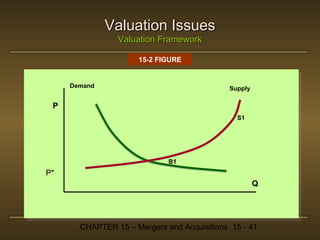
    Valuation Issues What isFair Market Value? Fair market value (FMV) is the highest price obtainable in an open and unrestricted market between knowledgeable, informed and prudent parties acting at arm’s length, with neither party being under any compulsion to transact. Key phrases in this definition: 1. Open and unrestricted market (where supply and demand can freely operate – see Figure 15 -2 on the following slide) 2. Knowledgeable, informed and prudent parties 3. Arm’s length 4. Neither party under any compulsion to transact. CHAPTER 15 – Mergers and Acquisitions 15 - 40
  • 41.
    Valuation Issues Valuation Framework 15-2FIGURE Demand Supply P S1 B1 P* Q CHAPTER 15 – Mergers and Acquisitions 15 - 41
  • 42.
    Valuation Issues Types ofAcquirers Determining fair market value depends on the perspective of the acquirer. Some acquirers are more likely to be able to realize synergies than others and those with the greatest ability to generate synergies are the ones who can justify higher prices. Types of acquirers and the impact of their perspective on value include: 1. 2. 3. 4. Passive investors – use estimated cash flows currently present Strategic investors – use estimated synergies and changes that are forecast to arise through integration of operations with their own Financials – valued on the basis of reorganized and refinanced operations Managers – value the firm based on their own job potential and ability to motivate staff and reorganize the firm’s operations. MBOs and LBOs Market pricing will reflect these different buyers and their importance at different stages of the business cycle. CHAPTER 15 – Mergers and Acquisitions 15 - 42
  • 43.
    Market Pricing Approaches ReactivePricing Approaches Models reacting to general rules of thumb and the relative pricing compared to other securities 1. Multiples or relative valuation 2. Liquidation or breakup values Proactive Models A valuation method to determine what a target firm’s value should be based on future values of cash flow and earnings 1. Discounted cash flow (DCF) models CHAPTER 15 – Mergers and Acquisitions 15 - 43
  • 44.
    Reactive Approaches Valuation UsingMultiples 1. Find appropriate comparators – Individual firm that is highly comparable to the target – Industry average if appropriate 2. Adjust/normalize the data (income statement and balance sheet) for differences between target and comparator including: – Accounting differences • LIFO versus FIFO • Accelerated versus straight-line depreciation • Age of depreciable assets • Pension liabilities, etc. – Different capital structures 3. Calculate a variety of ratios for both the target and the comparator including: – – – – 4. Price-earnings ratio (trailing) Value/EBITDA Price/Book Value Return on Equity Obtain a range of justifiable values based on the ratios CHAPTER 15 – Mergers and Acquisitions 15 - 44
  • 45.
    Reactive Approaches Liquidation Valuation 1. 2. 3. Estimatethe liquidation value of current assets Estimate the present value of tangible assets Subtract the value of the firm’s liability from estimated liquidation value of all the firm’s assets = liquidation value of the firm. This approach values the firm based on existing assets and is not forward looking. CHAPTER 15 – Mergers and Acquisitions 15 - 45
  • 46.
    The Proactive Approach DiscountedCash Flow Valuation • • • The key to using the DCF approach to price a target firm is to obtain good forecasts of free cash flow Free cash flows to equity holders represents cash flows left over after all obligations, including interest payments have been paid. DCF valuation takes the following steps: 1. 2. 3. Forecast free cash flows Obtain a relevant discount rate Discount the forecast cash flows and sum to estimate the value of the target (See Equation 15 – 2 on the following slide) CHAPTER 15 – Mergers and Acquisitions 15 - 46
  • 47.
    Discounted Cash FlowAnalysis Free Cash Flow to Equity Free cash flow to equity = net income + / − non − cash items (amortization, [ 15-2] deferred taxes, etc.) + / − changes in net working capital (not including cash and marketable securities ) − net capital expenditures CHAPTER 15 – Mergers and Acquisitions 15 - 47
  • 48.
    Discounted Cash FlowAnalysis The General DCF Model • Equation 15 – 3 is the generalized version of the DCF model showing how forecast free cash flows are discounted to the present and then summed. [ 15-3] α CFα CFt CF1 CF2 V0 = + + ... + =∑ (1 + k )1 (1 + k ) 2 (1 + k )α t =1 (1 + k ) t CHAPTER 15 – Mergers and Acquisitions 15 - 48
  • 49.
    Discounted Cash FlowAnalysis The Constant Growth DCF Model • Equation 15 – 4 is the DCF model for a target firm where the free cash flows are expected to grow at a constant rate for the foreseeable future. [ 15-4] V0 = CF1 k−g • Many target firms are high growth firms and so a multistage model may be more appropriate. (See Figure 15 -3 on the following slide for the DCF Valuation Framework.) CHAPTER 15 – Mergers and Acquisitions 15 - 49
  • 50.
    Valuation Issues Valuation Framework 15-3FIGURE Time Period T Free Cash Flows Ct VT V0 = ∑ + t T (1 + k ) t =1 (1 + k ) Terminal Value Discount Rate CHAPTER 15 – Mergers and Acquisitions 15 - 50
  • 51.
    Discounted Cash FlowAnalysis The Multiple Stage DCF Model • The multi-stage DCF model can be amended to include numerous stages of growth in the forecast period. • This is exhibited in equation 15 – 5: T [ 15-5] CFt VT V0 = ∑ + t (1 + k )T t =1 (1 + k ) CHAPTER 15 – Mergers and Acquisitions 15 - 51
  • 52.
    Valuation Issues The AcquisitionDecision and Risks that Must be Managed Once the value to the acquirer has been determined, the acquisition will only make sense if the target firm can be acquired at a price that is less. As the acquirer enters the buying/tender process, the outcome is not certain: • • • Competing bidders may appear Arbs may buy up outstanding stock and force price concessions and lengthen the acquisition process (increasing the costs of acquisitions) In the end, the forecast synergies might not be realized The acquirer can attempt to mitigate some of these risk through advance tax rulings from CRA, entering a friendly takeover and through due diligence. CHAPTER 15 – Mergers and Acquisitions 15 - 52
  • 53.
    Valuation Issues The Effectof an Acquisition on Earnings per Share An acquiring firm can increase its EPS if it acquires a firm that has a P/E ratio lower than its own. CHAPTER 15 – Mergers and Acquisitions 15 - 53
  • 54.
    Accounting Implications ofTakeovers Mergers and Acquisitions
  • 55.
    Accounting for Acquisitions Historicallyfirms could use one of two approaches to account for business combinations 1. Purchase method and 2. Pooling-of-interest method (no longer allowed) While more popular in other countries, the pooling of interest is no longer allowed by: • • • CICA in Canada Financial Accounting Standards Board (FASB) in the U.S. and Internal Accounting Standards Board (IASB) CHAPTER 15 – Mergers and Acquisitions 15 - 55
  • 56.
    Accounting for Acquisitions ThePurchase Method One firm assumes all assets and liabilities and operating results going forward of the target firm. How is this done? • • • All assets and liabilities are expressed at their fair market value (FMV) as of the acquisition date. If the FMV > the target firm’s equity, the excess amount is goodwill and reported as an intangible asset on the left hand side of the balance sheet. Goodwill is no longer amortized but must be annually assessed to determine if has been permanently ‘impaired’ in which case, the value will be written down and charged against earnings per share. CHAPTER 15 – Mergers and Acquisitions 15 - 56
  • 57.
    Example of thePurchase Method Accounting for Acquisitions Acquisitor purchases Target firm for $1,250 in cash on June 30, 2006. Current assets Long-term assets Goodwill Total Assets Current liabilities Long-term debt Common stock Retained earnings Total Claims Acquisitor PreMerger 10,000 6,000 Target Firm (Book Value) 1,200 800 Target Firm (Fair Market Value) 1,300 900 16,000 2,000 2,200 8,000 2,000 2,000 4,000 16,000 800 200 400 600 2,000 800 250 1,250 2,300 CHAPTER 15 – Mergers and Acquisitions 15 - 57
  • 58.
    Example of thePurchase Method Accounting for Acquisitions Acquisitor Value pre merger + Target Firm (FMV) = Acquisitor Post Merger Goodwill = Price paid – MV of Target firm Equity = $1,250 – (MV of target assets – MV of target Liabilities) = $1,250 – ($2,200 - $1,050) Acquisitor Pre- = $100 Merger Target Firm (Book Value) Book 1,200 Values 800 Current assets Long-term assets Goodwill Total Assets 10,000 6,000 16,000 are not relevant. 2,000 Current liabilities Long-term debt Common stock Retained earnings Total Claims 8,000 2,000 2,000 4,000 16,000 800 200 400 600 2,000 Target Firm (Fair Market Acquisitor Post Value) Merger 1,300 11,300 900 6,900 100 2,200 18,300 800 250 1,250 2,300 CHAPTER 15 – Mergers and Acquisitions 15 - 58 8,800 2,250 3,250 4,000 18,300
  • 59.
    Good Will inSubsequent Years The Purchase Method • Good will is subject to an impairment test each year. • This will require FMV estimating using discounted cash flow approaches annually following the acquisition and capitalization of good will on the balance sheet. • Good will is changed only if it is ‘impaired’ in subsequent years resulting in a write down and a charge against earnings. CHAPTER 15 – Mergers and Acquisitions 15 - 59
  • 60.
    Summary and Conclusions Inthis chapter you have learned: – The various forms of business combinations – The common motives that exist for takeovers as well as the desirable characteristics of potential takeover “targets” – How to evaluate a potential takeover candidate using the multiples approach and using discounted cash flow analysis – How acquisitions should be accounted for in the financial statements including the impact that acquisitions can have on EPS. CHAPTER 15 – Mergers and Acquisitions 15 - 60
  • 61.
  • 62.
    Concept Review Question1 Acquisition versus Merger What is the difference between an acquisition and a merger? CHAPTER 15 – Mergers and Acquisitions 15 - 62
  • 63.
    Copyright Copyright © 2007John Wiley & Sons Canada, Ltd. All rights reserved. Reproduction or translation of this work beyond that permitted by Access Copyright (the Canadian copyright licensing agency) is unlawful. Requests for further information should be addressed to the Permissions Department, John Wiley & Sons Canada, Ltd. The purchaser may make back-up copies for his or her own use only and not for distribution or resale. The author and the publisher assume no responsibility for errors, omissions, or damages caused by the use of these files or programs or from the use of the information contained herein. CHAPTER 15 – Mergers and Acquisitions 15 - 63

Editor's Notes