C O N N E C T I N G W I T H , E N G A G I N G & S U P P O R T I N G
S T U D E N T S W H O D O N ’ T T H I N K T H E Y N E E D Y O U
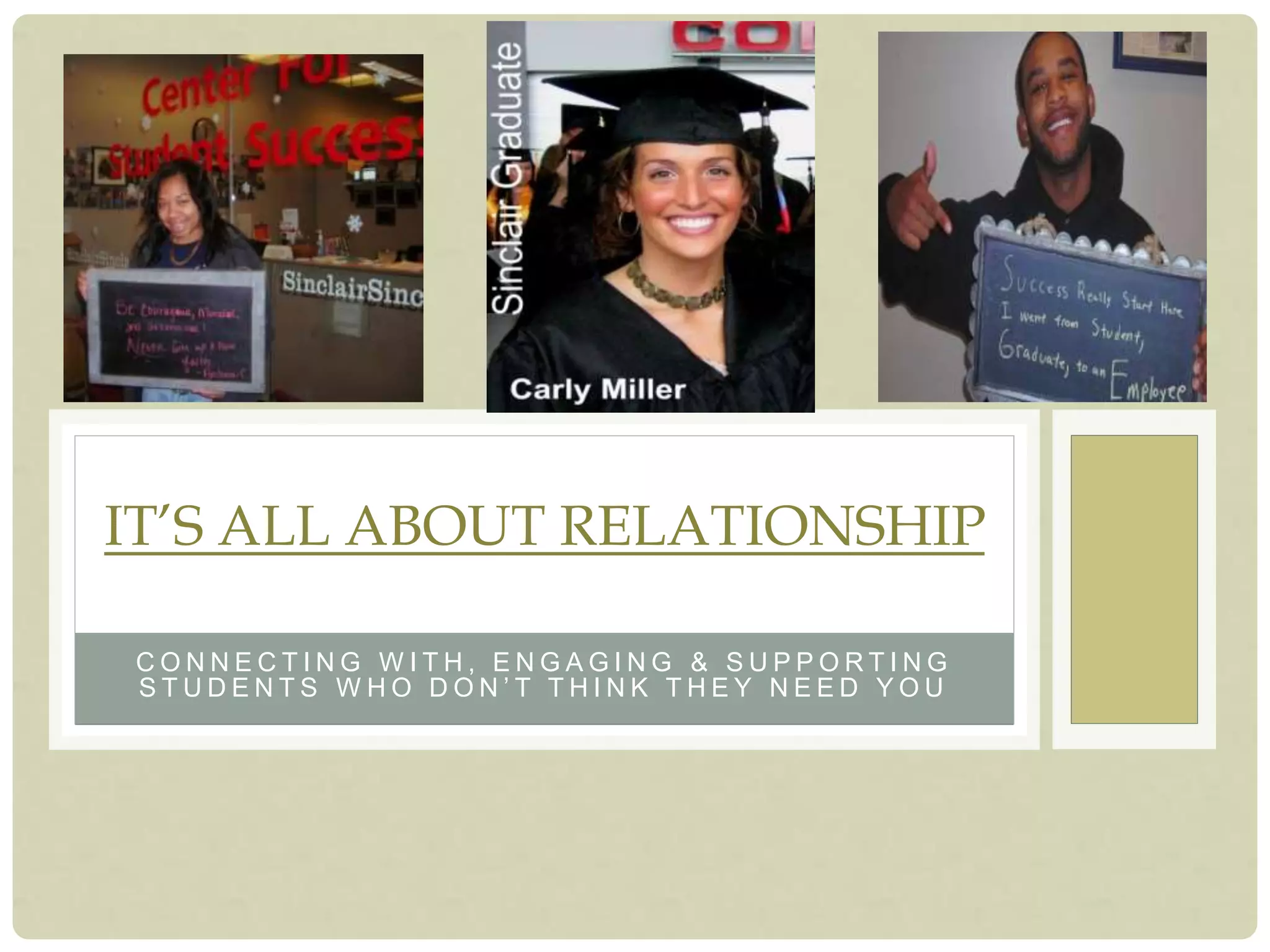
IT’S ALL ABOUT RELATIONSHIP
WHO AM I & HOW DO I KNOW WHAT
I’M TALKING ABOUT?
• 20+ years working with at-risk populations
A SNAPSHOT OF DAYTON
& SINCLAIR COMMUNITY COLLEGE
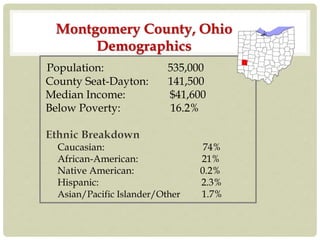
Population: 535,000
County Seat-Dayton: 141,500
Median Income: $41,600
Below Poverty: 16.2%
Caucasian: 74%
African-American: 21%
Native American: 0.2%
Hispanic: 2.3%
Asian/Pacific Islander/Other 1.7%
Montgomery County, Ohio
Demographics
• Headquartered in Dayton, Ohio
• 125 years of providing affordable, accessible,
high-quality college and workforce training
Sinclair Community College has been recognized as a Vanguard Learning
College by the League for Innovation
2003 TITLE III HOLISTIC APPROACH
TO STUDENT SUPPORT
INDIVIDUALIZED LEARNING PLAN TO PAT HWAY TO
COMPLETION
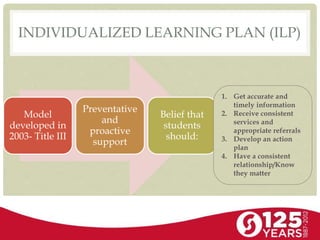
INDIVIDUALIZED LEARNING PLAN (ILP)
Model
developed in
2003- Title III
Preventative
and
proactive
support
Belief that
students
should:
1. Get accurate and
timely information
2. Receive consistent
services and
appropriate referrals
3. Develop an action
plan
4. Have a consistent
relationship/Know
they matter
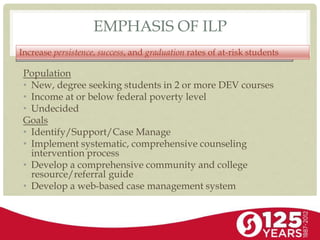
EMPHASIS OF ILP
Population
• New, degree seeking students in 2 or more DEV courses
• Income at or below federal poverty level
• Undecided
Goals
• Identify/Support/Case Manage
• Implement systematic, comprehensive counseling
intervention process
• Develop a comprehensive community and college
resource/referral guide
• Develop a web-based case management system
Increase persistence, success, and graduation rates of at-risk students
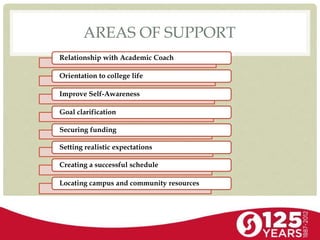
AREAS OF SUPPORT
Relationship with Academic Coach
Orientation to college life
Improve Self-Awareness
Goal clarification
Securing funding
Setting realistic expectations
Creating a successful schedule
Locating campus and community resources
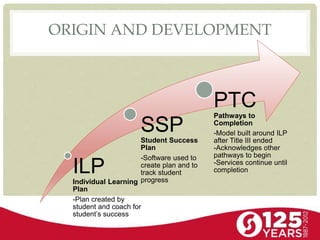
ORIGIN AND DEVELOPMENT
ILP
Individual Learning
Plan
-Plan created by
student and coach for
student’s success
SSP
Student Success
Plan
-Software used to
create plan and to
track student
progress
PTC
Pathways to
Completion
-Model built around ILP
after Title III ended
-Acknowledges other
pathways to begin
-Services continue until
completion
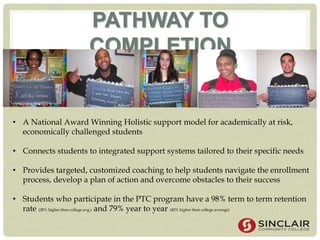
PATHWAY TO
COMPLETION
• A National Award Winning Holistic support model for academically at risk,
economically challenged students
• Connects students to integrated support systems tailored to their specific needs
• Provides targeted, customized coaching to help students navigate the enrollment
process, develop a plan of action and overcome obstacles to their success
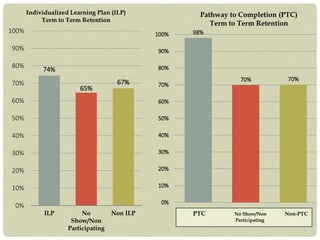
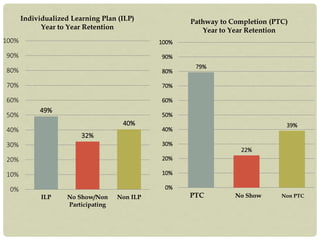
• Students who participate in the PTC program have a 98% term to term retention
rate (28% higher than college avg.) and 79% year to year (40% higher than college average)
SSP AWARDS
• 2012 ITC Awards for Excellence in eLearning - Outstanding
Student Services
• 2010 NASPA Grand Gold (for Early Alert)
• 2009 NASPA Grand Silver, Gold in Category
• 2008 NACADA Program Merit Award
• 2007 Bellwether Finalist Award - CC Futures Assembly
• 2006 MetLife Best Practice College Award
• 2005 Macromedia Higher Education Innovation Award
• 2005 National Council for Student Development Exemplary
Practice Award
• 2005 League for Innovation Terry O’Banion Shared Journey First
Place Award
• 2004 Educause Excellence in Information Technology Solutions
Award
Funding,Partners,Supporter
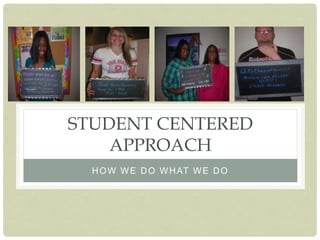
STUDENT CENTERED
APPROACH
HOW WE DO WHAT WE DO
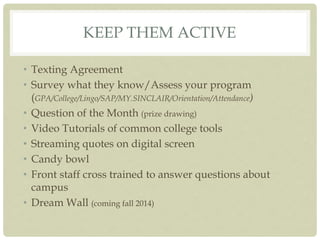
KEEP THEM ACTIVE
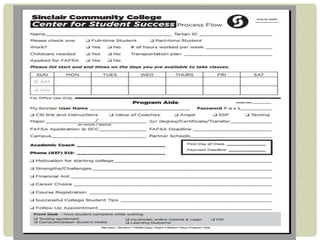
• Texting Agreement
• Survey what they know/Assess your program
(GPA/College/Lingo/SAP/MY.SINCLAIR/Orientation/Attendance)
• Question of the Month (prize drawing)
• Video Tutorials of common college tools
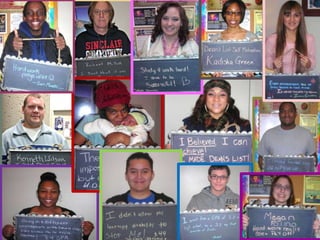
• Streaming quotes on digital screen
• Candy bowl
• Front staff cross trained to answer questions about
campus
• Dream Wall (coming fall 2014)
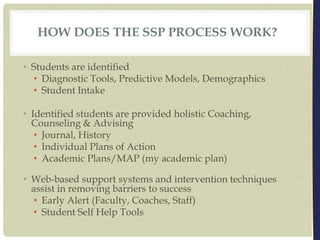
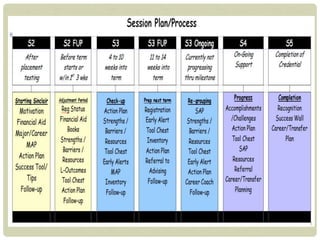
HOW DOES THE SSP PROCESS WORK?
• Students are identified
• Diagnostic Tools, Predictive Models, Demographics
• Student Intake
• Identified students are provided holistic Coaching,
Counseling & Advising
• Journal, History
• Individual Plans of Action
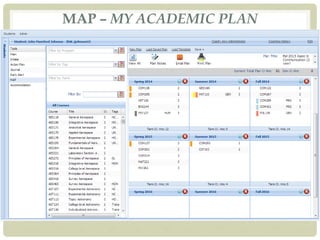
• Academic Plans/MAP (my academic plan)
• Web-based support systems and intervention techniques
assist in removing barriers to success
• Early Alert (Faculty, Coaches, Staff)
• Student Self Help Tools
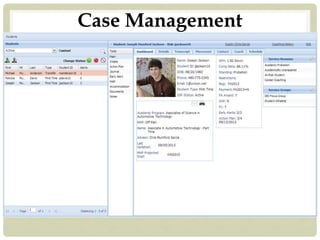
Case Management
MAP – MY ACADEMIC PLAN
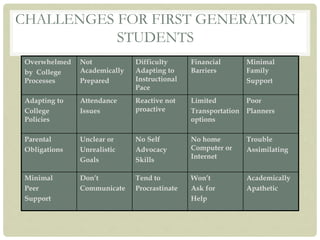
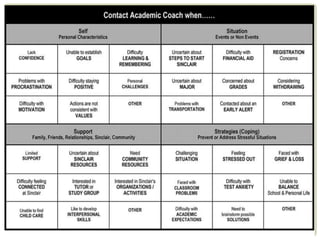
CHALLENGES FOR FIRST GENERATION
STUDENTS
Overwhelmed
by College
Processes
Not
Academically
Prepared
Difficulty
Adapting to
Instructional
Pace
Financial
Barriers
Minimal
Family
Support
Adapting to
College
Policies
Attendance
Issues
Reactive not
proactive
Limited
Transportation
options
Poor
Planners
Parental
Obligations
Unclear or
Unrealistic
Goals
No Self
Advocacy
Skills
No home
Computer or
Internet
Trouble
Assimilating
Minimal
Peer
Support
Don’t
Communicate
Tend to
Procrastinate
Won’t
Ask for
Help
Academically
Apathetic
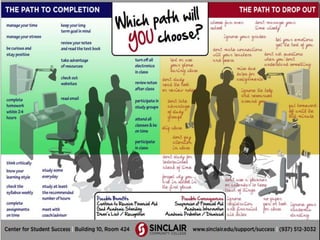
HOW THEY DERAIL
Homeless Family steals
bus pass
Raising 3
siblings
House fire Car stolen
Lost Title XX
Criminal
charge
Victim of
Break in
Domestic
Violence Pregnancy
Parent won’t
cooperate W/
FAFSA
Custody
change
Room mate
moved out
Death in
family
Boyfriend
shot
2 ID’s for bus
pass
Section 8
Voucher
Job
Loss
Warrant
Arrest Hospitalized
Turtle
Syndrome
Stop
Attending
Sick
Child
Campus
Conduct
No
Childcare
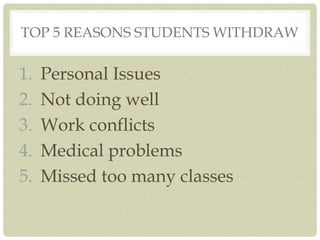
TOP 5 REASONS STUDENTS WITHDRAW
1. Personal Issues
2. Not doing well
3. Work conflicts
4. Medical problems
5. Missed too many classes
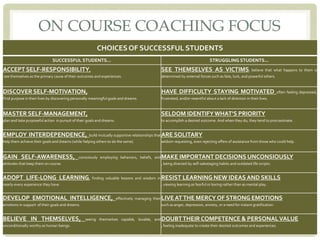
ON COURSE COACHING FOCUS
CHOICES OF SUCCESSFUL STUDENTS
SUCCESSFUL STUDENTS... STRUGGLING STUDENTS...
ACCEPT SELF-RESPONSIBILITY,
see themselves as the primary cause of their outcomes and experiences.
SEE THEMSELVES AS VICTIMS, believe that what happens to them is
determined by external forces such as fate, luck, and powerful others.
DISCOVER SELF-MOTIVATION,
Find purpose in their lives by discovering personally meaningful goals and dreams.
HAVE DIFFICULTY STAYING MOTIVATED often feeling depressed,
frustrated, and/or resentful about a lack of direction in their lives.
MASTER SELF-MANAGEMENT,
plan and take purposeful action in pursuit of their goals and dreams.
SELDOM IDENTIFYWHAT’S PRIORITY
to accomplish a desired outcome. And when they do, they tend to procrastinate.
EMPLOY INTERDEPENDENCE, build mutually supportive relationships that
help them achieve their goals and dreams (while helping others to do the same).
ARE SOLITARY
seldom requesting, even rejecting offers of assistance from those who could help.
GAIN SELF-AWARENESS, consciously employing behaviors, beliefs, and
attitudes that keep them on course.
MAKE IMPORTANT DECISIONS UNCONSIOUSLY
, being directed by self-sabotaging habits and outdated life scripts.
ADOPT LIFE-LONG LEARNING, finding valuable lessons and wisdom in
nearly every experience they have.
RESIST LEARNING NEW IDEAS AND SKILLS
, viewing learning as fearful or boring rather than as mental play.
DEVELOP EMOTIONAL INTELLIGENCE, effectively managing their
emotions in support of their goals and dreams.
LIVE ATTHE MERCY OF STRONG EMOTIONS
such as anger, depression, anxiety, or a need for instant gratification.
BELIEVE IN THEMSELVES, seeing themselves capable, lovable, and
unconditionally worthy as human beings.
DOUBTTHEIR COMPETENCE & PERSONALVALUE
, feeling inadequate to create their desired outcomes and experiences.
DATA DRIVEN PRACTICE
10 YEARS OF DATA
74%
65%
67%
0%
10%
20%
30%
40%
50%
60%
70%
80%
90%
100%
ILP No
Show/Non
Participating
Non ILP
Individualized Learning Plan (ILP)
Term to Term Retention
98%
70% 70%
0%
10%
20%
30%
40%
50%
60%
70%
80%
90%
100%
Pathway to Completion (PTC)
Term to Term Retention
PTC No Show/Non Non-PTC
Participating
49%
32%
40%
0%
10%
20%
30%
40%
50%
60%
70%
80%
90%
100%
ILP No Show/Non
Participating
Non ILP
Individualized Learning Plan (ILP)
Year to Year Retention
79%
22%
39%
0%
10%
20%
30%
40%
50%
60%
70%
80%
90%
100%
Pathway to Completion (PTC)
Year to Year Retention
PTC No Show Non PTC
QUESTIONS
SSP OPEN SOURCE h t t p : / / w ww. S t u d e n t s u c c e s s p l a n . o r g /

TASS Presentation

  • 1.
    C O NN E C T I N G W I T H , E N G A G I N G & S U P P O R T I N G S T U D E N T S W H O D O N ’ T T H I N K T H E Y N E E D Y O U IT’S ALL ABOUT RELATIONSHIP
  • 2.
    WHO AM I& HOW DO I KNOW WHAT I’M TALKING ABOUT? • 20+ years working with at-risk populations
  • 3.
    A SNAPSHOT OFDAYTON & SINCLAIR COMMUNITY COLLEGE
  • 4.
    Population: 535,000 County Seat-Dayton:141,500 Median Income: $41,600 Below Poverty: 16.2% Caucasian: 74% African-American: 21% Native American: 0.2% Hispanic: 2.3% Asian/Pacific Islander/Other 1.7% Montgomery County, Ohio Demographics
  • 5.
    • Headquartered inDayton, Ohio • 125 years of providing affordable, accessible, high-quality college and workforce training Sinclair Community College has been recognized as a Vanguard Learning College by the League for Innovation
  • 10.
    2003 TITLE IIIHOLISTIC APPROACH TO STUDENT SUPPORT INDIVIDUALIZED LEARNING PLAN TO PAT HWAY TO COMPLETION
  • 11.
    INDIVIDUALIZED LEARNING PLAN(ILP) Model developed in 2003- Title III Preventative and proactive support Belief that students should: 1. Get accurate and timely information 2. Receive consistent services and appropriate referrals 3. Develop an action plan 4. Have a consistent relationship/Know they matter
  • 12.
    EMPHASIS OF ILP Population •New, degree seeking students in 2 or more DEV courses • Income at or below federal poverty level • Undecided Goals • Identify/Support/Case Manage • Implement systematic, comprehensive counseling intervention process • Develop a comprehensive community and college resource/referral guide • Develop a web-based case management system Increase persistence, success, and graduation rates of at-risk students
  • 13.
    AREAS OF SUPPORT Relationshipwith Academic Coach Orientation to college life Improve Self-Awareness Goal clarification Securing funding Setting realistic expectations Creating a successful schedule Locating campus and community resources
  • 14.
    ORIGIN AND DEVELOPMENT ILP IndividualLearning Plan -Plan created by student and coach for student’s success SSP Student Success Plan -Software used to create plan and to track student progress PTC Pathways to Completion -Model built around ILP after Title III ended -Acknowledges other pathways to begin -Services continue until completion
  • 15.
    PATHWAY TO COMPLETION • ANational Award Winning Holistic support model for academically at risk, economically challenged students • Connects students to integrated support systems tailored to their specific needs • Provides targeted, customized coaching to help students navigate the enrollment process, develop a plan of action and overcome obstacles to their success • Students who participate in the PTC program have a 98% term to term retention rate (28% higher than college avg.) and 79% year to year (40% higher than college average)
  • 16.
    SSP AWARDS • 2012ITC Awards for Excellence in eLearning - Outstanding Student Services • 2010 NASPA Grand Gold (for Early Alert) • 2009 NASPA Grand Silver, Gold in Category • 2008 NACADA Program Merit Award • 2007 Bellwether Finalist Award - CC Futures Assembly • 2006 MetLife Best Practice College Award • 2005 Macromedia Higher Education Innovation Award • 2005 National Council for Student Development Exemplary Practice Award • 2005 League for Innovation Terry O’Banion Shared Journey First Place Award • 2004 Educause Excellence in Information Technology Solutions Award
  • 17.
  • 18.
  • 20.
    KEEP THEM ACTIVE •Texting Agreement • Survey what they know/Assess your program (GPA/College/Lingo/SAP/MY.SINCLAIR/Orientation/Attendance) • Question of the Month (prize drawing) • Video Tutorials of common college tools • Streaming quotes on digital screen • Candy bowl • Front staff cross trained to answer questions about campus • Dream Wall (coming fall 2014)
  • 23.
    HOW DOES THESSP PROCESS WORK? • Students are identified • Diagnostic Tools, Predictive Models, Demographics • Student Intake • Identified students are provided holistic Coaching, Counseling & Advising • Journal, History • Individual Plans of Action • Academic Plans/MAP (my academic plan) • Web-based support systems and intervention techniques assist in removing barriers to success • Early Alert (Faculty, Coaches, Staff) • Student Self Help Tools
  • 24.
  • 25.
    MAP – MYACADEMIC PLAN
  • 26.
    CHALLENGES FOR FIRSTGENERATION STUDENTS Overwhelmed by College Processes Not Academically Prepared Difficulty Adapting to Instructional Pace Financial Barriers Minimal Family Support Adapting to College Policies Attendance Issues Reactive not proactive Limited Transportation options Poor Planners Parental Obligations Unclear or Unrealistic Goals No Self Advocacy Skills No home Computer or Internet Trouble Assimilating Minimal Peer Support Don’t Communicate Tend to Procrastinate Won’t Ask for Help Academically Apathetic
  • 27.
    HOW THEY DERAIL HomelessFamily steals bus pass Raising 3 siblings House fire Car stolen Lost Title XX Criminal charge Victim of Break in Domestic Violence Pregnancy Parent won’t cooperate W/ FAFSA Custody change Room mate moved out Death in family Boyfriend shot 2 ID’s for bus pass Section 8 Voucher Job Loss Warrant Arrest Hospitalized Turtle Syndrome Stop Attending Sick Child Campus Conduct No Childcare
  • 28.
    TOP 5 REASONSSTUDENTS WITHDRAW 1. Personal Issues 2. Not doing well 3. Work conflicts 4. Medical problems 5. Missed too many classes
  • 32.
    ON COURSE COACHINGFOCUS CHOICES OF SUCCESSFUL STUDENTS SUCCESSFUL STUDENTS... STRUGGLING STUDENTS... ACCEPT SELF-RESPONSIBILITY, see themselves as the primary cause of their outcomes and experiences. SEE THEMSELVES AS VICTIMS, believe that what happens to them is determined by external forces such as fate, luck, and powerful others. DISCOVER SELF-MOTIVATION, Find purpose in their lives by discovering personally meaningful goals and dreams. HAVE DIFFICULTY STAYING MOTIVATED often feeling depressed, frustrated, and/or resentful about a lack of direction in their lives. MASTER SELF-MANAGEMENT, plan and take purposeful action in pursuit of their goals and dreams. SELDOM IDENTIFYWHAT’S PRIORITY to accomplish a desired outcome. And when they do, they tend to procrastinate. EMPLOY INTERDEPENDENCE, build mutually supportive relationships that help them achieve their goals and dreams (while helping others to do the same). ARE SOLITARY seldom requesting, even rejecting offers of assistance from those who could help. GAIN SELF-AWARENESS, consciously employing behaviors, beliefs, and attitudes that keep them on course. MAKE IMPORTANT DECISIONS UNCONSIOUSLY , being directed by self-sabotaging habits and outdated life scripts. ADOPT LIFE-LONG LEARNING, finding valuable lessons and wisdom in nearly every experience they have. RESIST LEARNING NEW IDEAS AND SKILLS , viewing learning as fearful or boring rather than as mental play. DEVELOP EMOTIONAL INTELLIGENCE, effectively managing their emotions in support of their goals and dreams. LIVE ATTHE MERCY OF STRONG EMOTIONS such as anger, depression, anxiety, or a need for instant gratification. BELIEVE IN THEMSELVES, seeing themselves capable, lovable, and unconditionally worthy as human beings. DOUBTTHEIR COMPETENCE & PERSONALVALUE , feeling inadequate to create their desired outcomes and experiences.
  • 33.
  • 34.
    74% 65% 67% 0% 10% 20% 30% 40% 50% 60% 70% 80% 90% 100% ILP No Show/Non Participating Non ILP IndividualizedLearning Plan (ILP) Term to Term Retention 98% 70% 70% 0% 10% 20% 30% 40% 50% 60% 70% 80% 90% 100% Pathway to Completion (PTC) Term to Term Retention PTC No Show/Non Non-PTC Participating
  • 35.
    49% 32% 40% 0% 10% 20% 30% 40% 50% 60% 70% 80% 90% 100% ILP No Show/Non Participating NonILP Individualized Learning Plan (ILP) Year to Year Retention 79% 22% 39% 0% 10% 20% 30% 40% 50% 60% 70% 80% 90% 100% Pathway to Completion (PTC) Year to Year Retention PTC No Show Non PTC
  • 36.
    QUESTIONS SSP OPEN SOURCEh t t p : / / w ww. S t u d e n t s u c c e s s p l a n . o r g /