Measuring
Learning
Readiness for
TRIO
Students
Carol Moody, Solutions Consultant,
SmarterServices
Julie Owen, Chief Sales & Marketing
Officer, SmarterServices
Autumn Scott, Director TRIO Student
Support Services,
Carl Sandburg College
Velia Mendoza, SSS Tutoring Coordinator
Garden City Community College
POLL
What motivates you to do your job?
 Paycheck
 Colleagues
 Knowing that I am making a positive impact
 What? I’m not motivated
 The success stories I witness with students
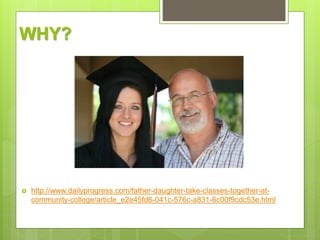
WHY?
 http://www.dailyprogress.com/father-daughter-take-classes-together-at-
community-college/article_e2e45fd6-041c-576c-a831-6c00f9cdc53e.html
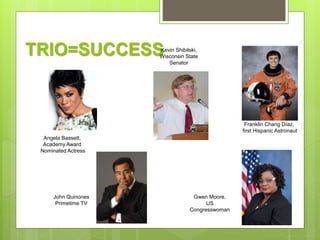
TRIO=SUCCESS
John Quinones
Primetime TV
Franklin Chang Díaz,
first Hispanic Astronaut
Kevin Shibilski,
Wisconsin State
Senator
Angela Bassett,
Academy Award
Nominated Actress
Gwen Moore,
US
Congresswoman
Carol Moody
Solutions
Consultant
SmarterServices
334.491.0435
carol@smarterservices.com
LinkedIn -
https://www.linkedin.com/in/carolmoody2
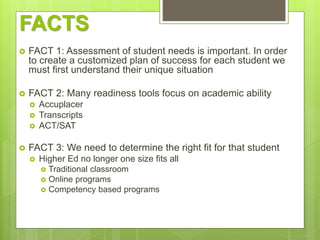
FACTS
 FACT 1: Assessment of student needs is important. In order
to create a customized plan of success for each student we
must first understand their unique situation
 FACT 2: Many readiness tools focus on academic ability
 Accuplacer
 Transcripts
 ACT/SAT
 FACT 3: We need to determine the right fit for that student
 Higher Ed no longer one size fits all
 Traditional classroom
 Online programs
 Competency based programs
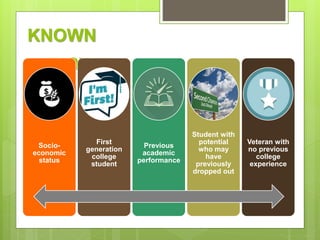
KNOWN
Socio-
economic
status
First
generation
college
student
Previous
academic
performance
Student with
potential
who may
have
previously
dropped out
Veteran with
no previous
college
experience
KNOWN
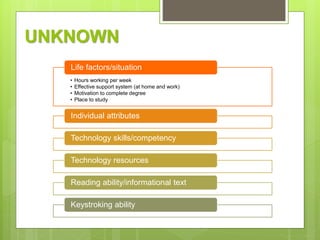
UNKNOWN
• Hours working per week
• Effective support system (at home and work)
• Motivation to complete degree
• Place to study
Life factors/situation
Individual attributes
Technology skills/competency
Technology resources
Reading ability/informational text
Keystroking ability
QUESTION (type your answers in the
question area)
 What do you think are some of the top 10
reasons why students do not complete their
degree?
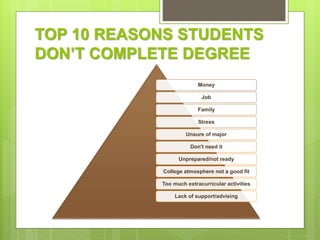
TOP 10 REASONS STUDENTS
DON’T COMPLETE DEGREE
Money
Job
Family
Stress
Unsure of major
Don't need it
Unprepared/not ready
College atmosphere not a good fit
Too much extracurricular activities
Lack of support/advising
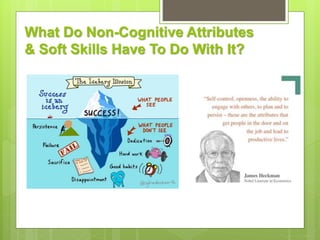
What Do Non-Cognitive Attributes
& Soft Skills Have To Do With It?
POLL-In your experience, have
you noticed a stronger success
rate for TRIO students in a
traditional classroom vs. an
online environment?
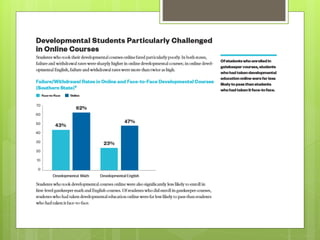
http://www.achievingthedream.org/sites/default/files/resources/Online-Learning-Practitioner-
Packet.pdf
Julie Owen Chief Sales &
Marketing Officer
SmarterServices
334.491.0427
julie@smarterservices.com
LinkedIn -
https://www.linkedin.com/in/julieowen4
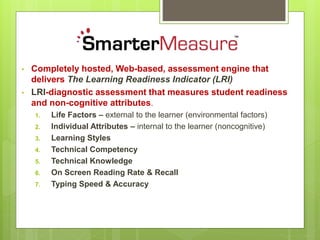
• Completely hosted, Web-based, assessment engine that
delivers The Learning Readiness Indicator (LRI)
• LRI-diagnostic assessment that measures student readiness
and non-cognitive attributes.
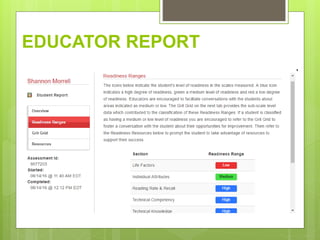
1. Life Factors – external to the learner (environmental factors)
2. Individual Attributes – internal to the learner (noncognitive)
3. Learning Styles
4. Technical Competency
5. Technical Knowledge
6. On Screen Reading Rate & Recall
7. Typing Speed & Accuracy
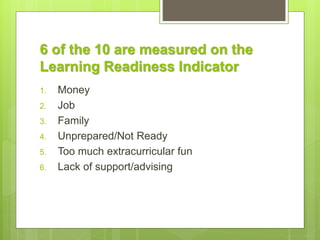
6 of the 10 are measured on the
Learning Readiness Indicator
1. Money
2. Job
3. Family
4. Unprepared/Not Ready
5. Too much extracurricular fun
6. Lack of support/advising
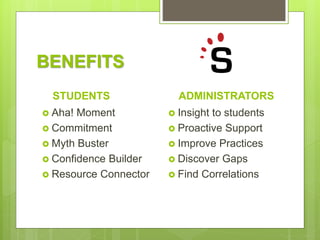
BENEFITS
STUDENTS
 Aha! Moment
 Commitment
 Myth Buster
 Confidence Builder
 Resource Connector
ADMINISTRATORS
 Insight to students
 Proactive Support
 Improve Practices
 Discover Gaps
 Find Correlations
SAMPLE STUDENT
REPORT
 http://www.smartermeasure.com/smartermeasure/asset
s/File/resources/SampleReport.html
BENEFITS
STUDENTS
 Aha! Moment
 Commitment
 Myth Buster
 Confidence Builder
 Resource Connector
ADMINISTRATORS
 Insight to students
 Proactive Support
 Improve Practices
 Discover Gaps
 Find Correlations
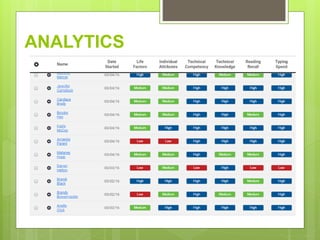
ANALYTICS
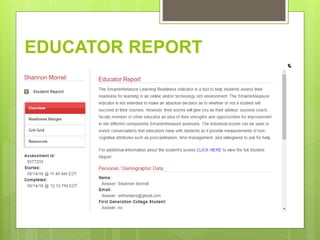
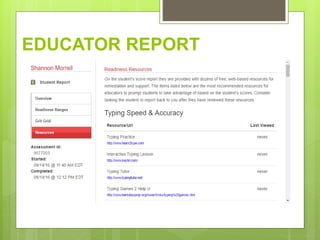
EDUCATOR REPORT
EDUCATOR REPORT
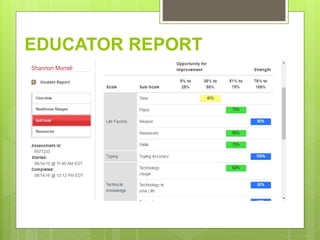
EDUCATOR REPORT
EDUCATOR REPORT
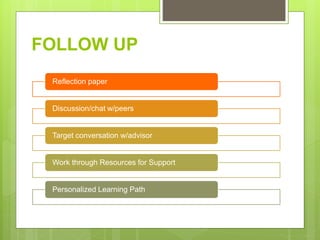
FOLLOW UP
Reflection paper
Discussion/chat w/peers
Target conversation w/advisor
Work through Resources for Support
Personalized Learning Path
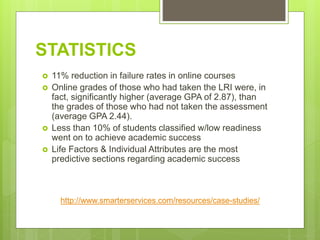
STATISTICS
 11% reduction in failure rates in online courses
 Online grades of those who had taken the LRI were, in
fact, significantly higher (average GPA of 2.87), than
the grades of those who had not taken the assessment
(average GPA 2.44).
 Less than 10% of students classified w/low readiness
went on to achieve academic success
 Life Factors & Individual Attributes are the most
predictive sections regarding academic success
http://www.smarterservices.com/resources/case-studies/
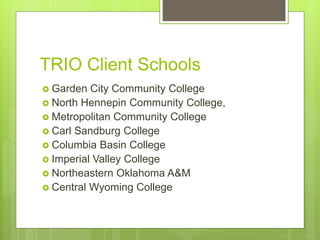
TRIO Client Schools
 Garden City Community College
 North Hennepin Community College,
 Metropolitan Community College
 Carl Sandburg College
 Columbia Basin College
 Imperial Valley College
 Northeastern Oklahoma A&M
 Central Wyoming College
Autumn Scott
Director TRIO Student
Support Services
Carl Sandburg College
309-341-5462
anscott@sandburg.edu
LinkedIn - http://linkedin.com/in/autumn-
scott-30a61991
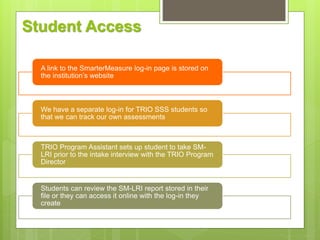
Student Access
A link to the SmarterMeasure log-in page is stored on
the institution’s website
We have a separate log-in for TRIO SSS students so
that we can track our own assessments
TRIO Program Assistant sets up student to take SM-
LRI prior to the intake interview with the TRIO Program
Director
Students can review the SM-LRI report stored in their
file or they can access it online with the log-in they
create
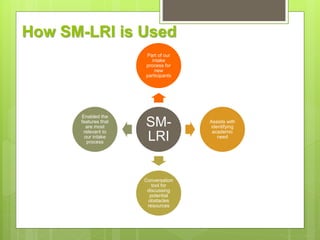
How SM-LRI is Used
SM-
LRI
Part of our
intake
process for
new
participants
Assists with
identifying
academic
need
Conversation
tool for
discussing
potential
obstacles
resources
Enabled the
features that
are most
relevant to
our intake
process
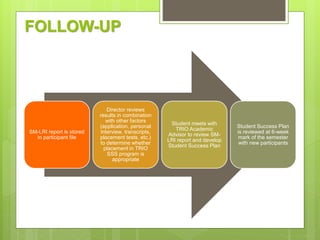
FOLLOW-UP
SM-LRI report is stored
in participant file
Director reviews
results in combination
with other factors
(application, personal
interview, transcripts,
placement tests, etc.)
to determine whether
placement in TRIO
SSS program is
appropriate
Student meets with
TRIO Academic
Advisor to review SM-
LRI report and develop
Student Success Plan
is reviewed at 6-week
mark of the semester
with new participants
Velia Mendoza
SSS Tutoring
Coordinator
Garden City
Community College
Velia.mendoza@gcccks.edu
Student Success
Comments
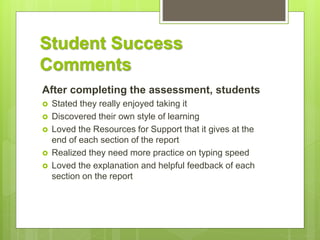
After completing the assessment, students
 Stated they really enjoyed taking it
 Discovered their own style of learning
 Loved the Resources for Support that it gives at the
end of each section of the report
 Realized they need more practice on typing speed
 Loved the explanation and helpful feedback of each
section on the report
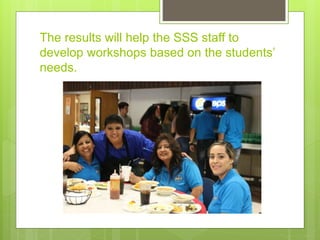
The results will help the SSS staff to
develop workshops based on the students’
needs.
RESOURCES
 http://www.dailyprogress.com/father-daughter-take-classes-together-at-
community-college/article_e2e45fd6-041c-576c-a831-6c00f9cdc53e.html
 http://blogs.wsj.com/economics/2016/10/04/soft-skills-give-workers-a-big-
edge-its-time-to-start-focusing-on-them-in-school-report-says/
 http://www.epi.org/publication/the-need-to-address-noncognitive-skills-in-
the-education-policy-agenda
 http://www.hamiltonproject.org/
 http://blogs.wsj.com/economics/2016/10/04/soft-skills-give-workers-a-big-
edge-its-time-to-start-focusing-on-them-in-school-report-says/
 http://www.smarterservices.com/resources/case-studies/
 http://www.achievingthedream.org/sites/default/files/resources/Online-
Learning-Practitioner-Packet.pdf
 http://www.thedialogue.org/resources/untangling-the-soft-skills-
conversation/
Q&A
• Slidedeck & recording of webinar will be sent to all participants
and listed at http://www.smarterservices.com/resources/webinars/
• Closing survey – We appreciate your feedback!

Measuring Learning Readiness for TRIO Students

Editor's Notes

  • #4 Ella & Gerad – John Wood CC "I know things he doesn't. He knows things I don't," Ella said. "He's a little better at the book work. I'm better at the other stuff. It makes things really easy.” Gerad, who became a father at an early age, basically had a 10th-grade education. A placement test for JWCC offered some encouragement, and so did help available through the school. "I wish I'd done it 20 years ago," he said. "If you think there's even a slight chance you might want to do it, you need to jump in. There's nothing to fear. This place will work with you to get you through anything.” Ella struggled in the traditional classroom and found success. She'd already decided to attend JWCC, and a First Year Experience class offered by JWCC during her senior year in the Regional Safe Schools program provided even more encouragement, along with so-called soft skills such as writing resumes and filling out job applications. "I thought I'd be far behind, and some things I probably could have known better when I started, but it's been a whole lot easier academically than I thought it would be," said Ella, who hopes to major in clinical psychology.
  • #12 It starts EARLY According to a paper released by The Hamilton Project there are 7 Facts which have emerged relating to the importance of Non-cognitive Attributes and Soft Skills. The U.S. economy is demanding more noncognitive skills There are strong labor-market payoffs to both cognitive and noncognitive skills The labor market is increasingly rewarding noncognitive skills Those in the bottom quartile of noncognitive skills are only about one-third as likely to complete a postsecondary degree as are those in the top quartile. Noncognitive skill development interventions improve student achievement and reduce behavior-related problems. Preschool interventions emphasizing cognitive and noncognitive skill development have long-term economic benefits for participants. A teacher’s ability to improve noncognitve skills has more effect on graduation rates than does her ability to raise test scores. Economic Policy Institute – “The Need to Address Noncognitive Skills in the Education Policy Agenda http://www.epi.org/publication/the-need-to-address-noncognitive-skills-in-the-education-policy-agenda/ http://www.hamiltonproject.org/ http://blogs.wsj.com/economics/2016/10/04/soft-skills-give-workers-a-big-edge-its-time-to-start-focusing-on-them-in-school-report-says/