In what ways does your media product use, develop or challenge

                forms and conventions of real media products?

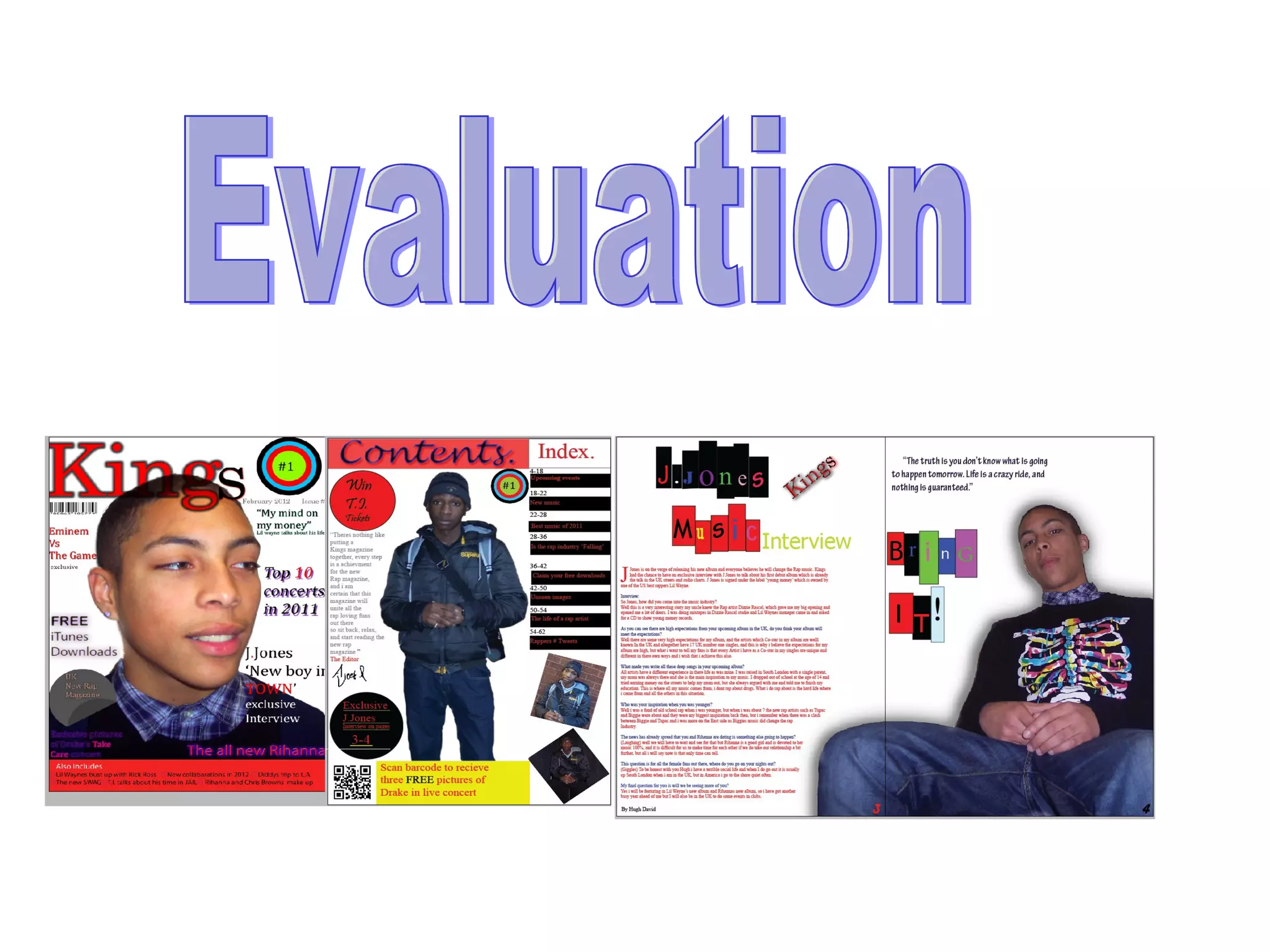
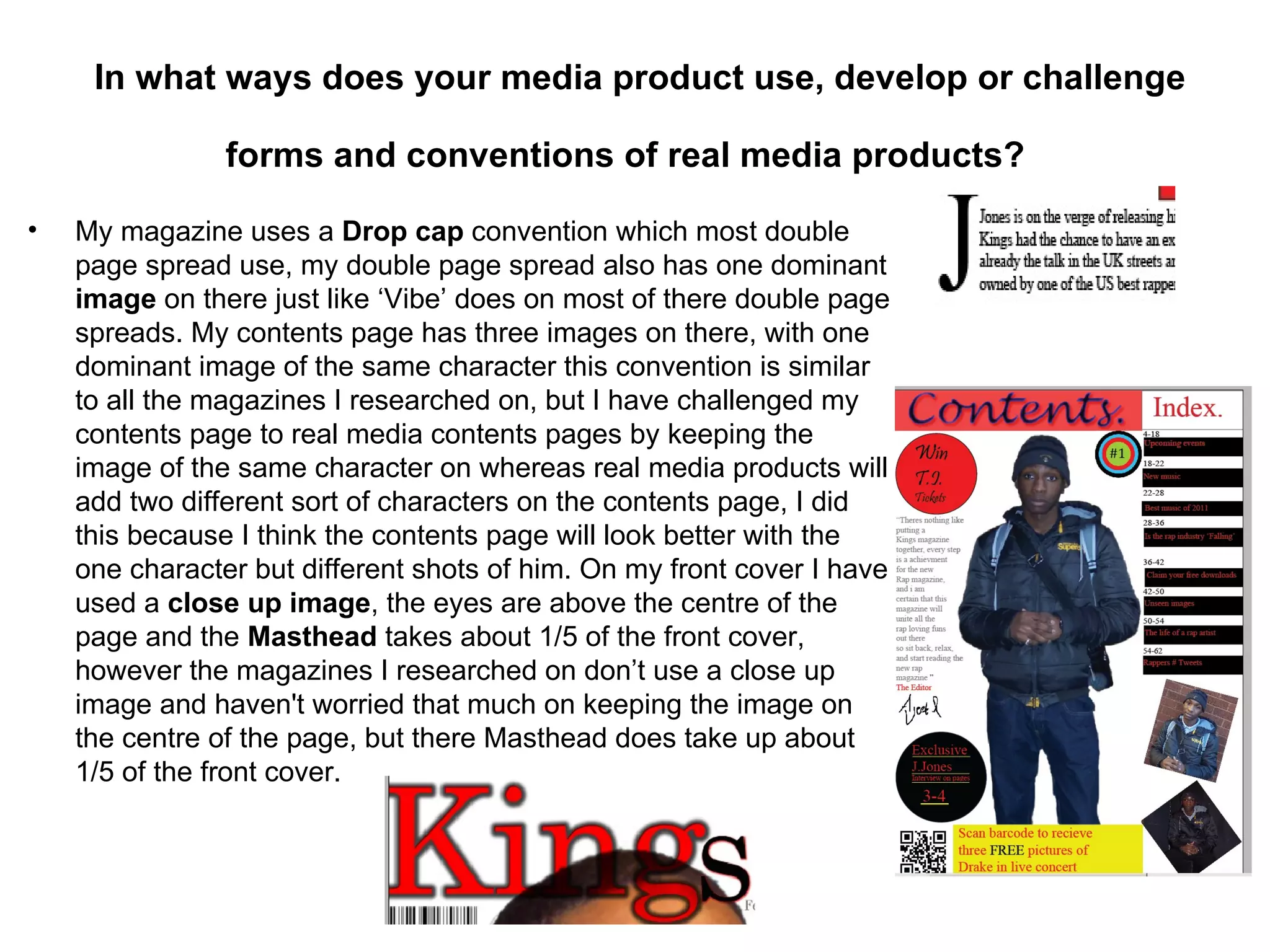
•   My magazine uses a Drop cap convention which most double
    page spread use, my double page spread also has one dominant
    image on there just like ‘Vibe’ does on most of there double page
    spreads. My contents page has three images on there, with one
    dominant image of the same character this convention is similar
    to all the magazines I researched on, but I have challenged my
    contents page to real media contents pages by keeping the
    image of the same character on whereas real media products will
    add two different sort of characters on the contents page, I did
    this because I think the contents page will look better with the
    one character but different shots of him. On my front cover I have
    used a close up image, the eyes are above the centre of the
    page and the Masthead takes about 1/5 of the front cover,
    however the magazines I researched on don’t use a close up
    image and haven't worried that much on keeping the image on
    the centre of the page, but there Masthead does take up about
    1/5 of the front cover.
In what ways does your media product use, develop or challenge

            forms and conventions of real media products?


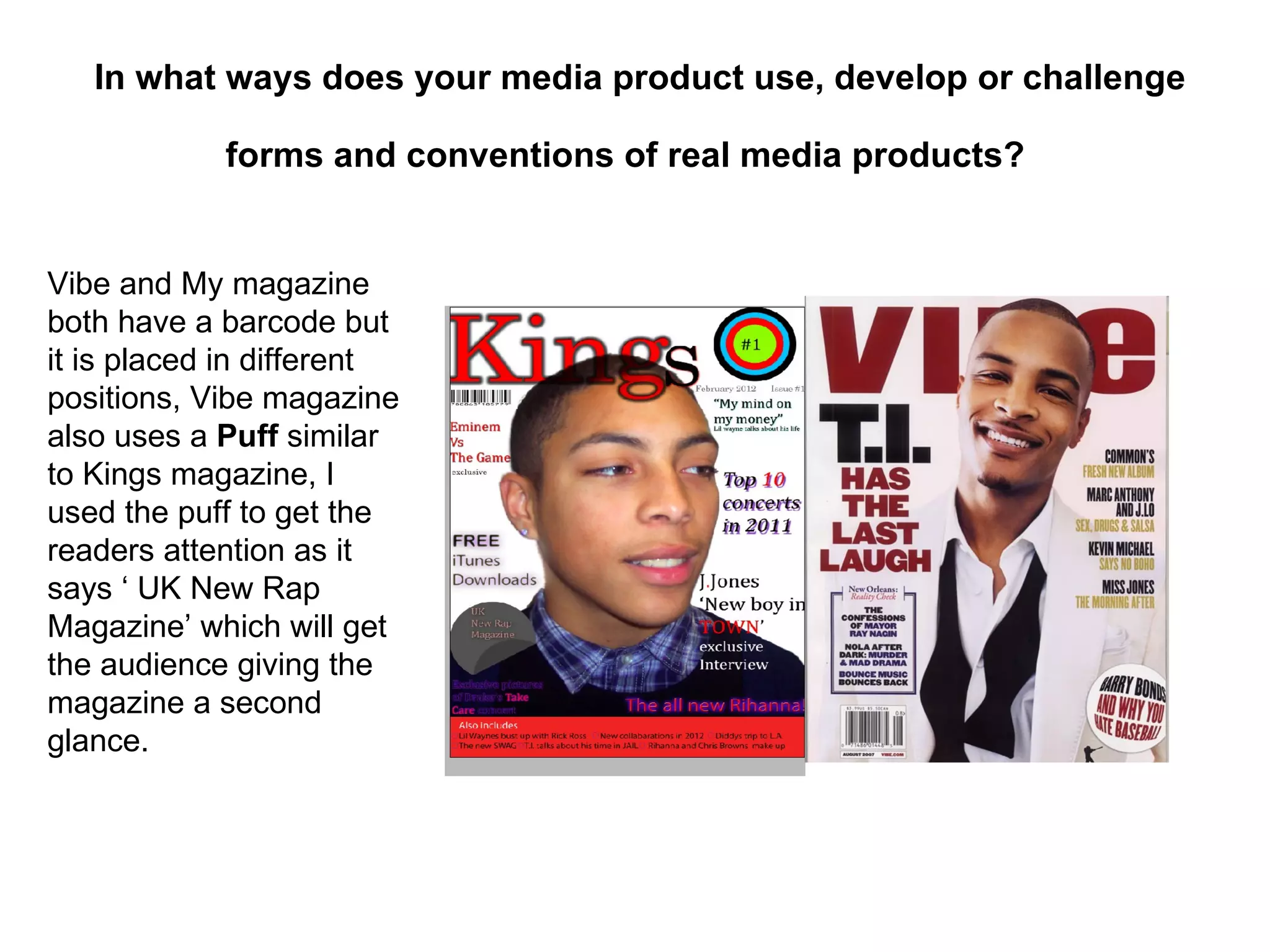
Vibe and My magazine
both have a barcode but
it is placed in different
positions, Vibe magazine
also uses a Puff similar
to Kings magazine, I
used the puff to get the
readers attention as it
says ‘ UK New Rap
Magazine’ which will get
the audience giving the
magazine a second
glance.
In what ways does your media product use, develop or challenge

         forms and conventions of real media products?


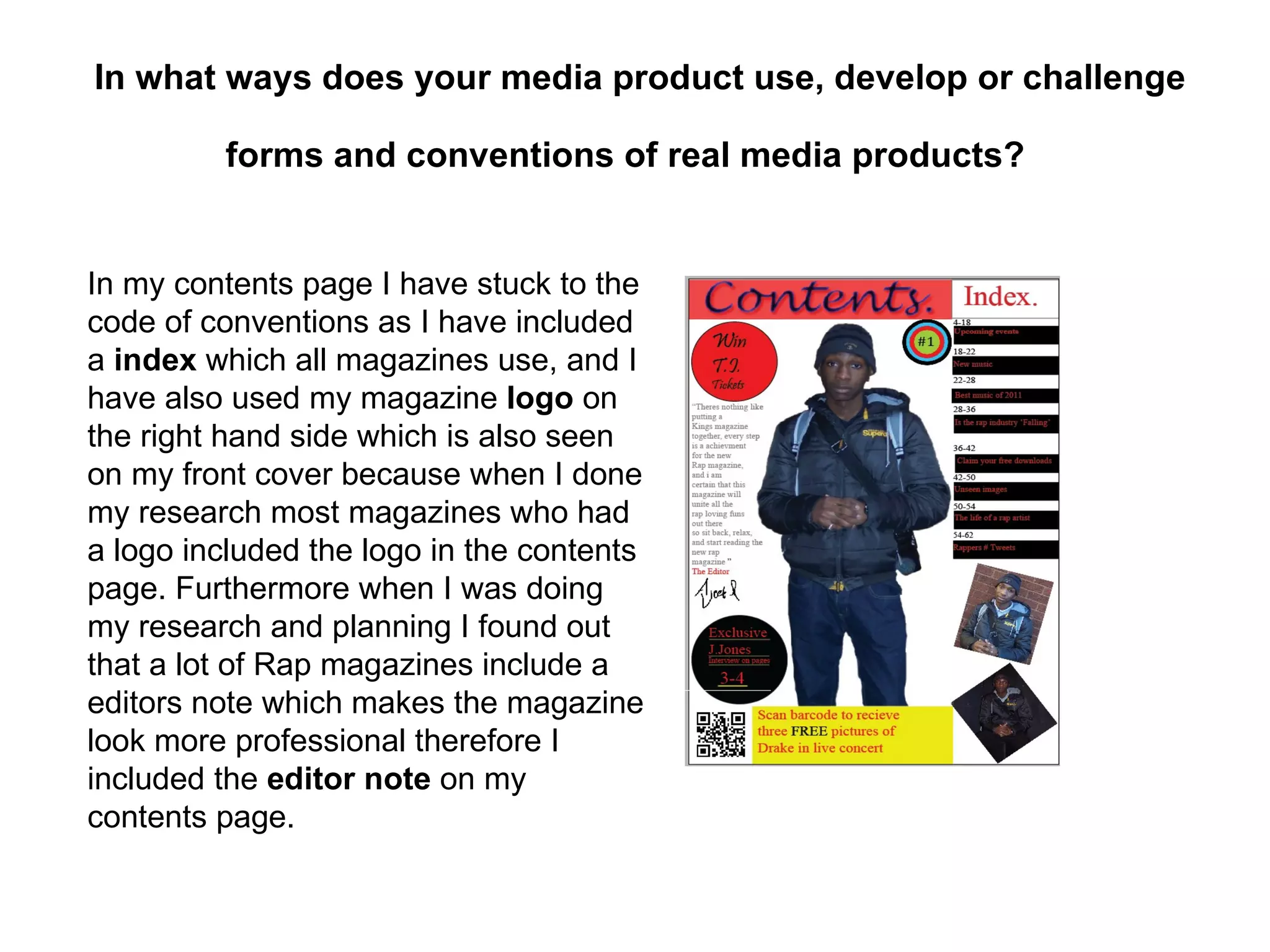
In my contents page I have stuck to the
code of conventions as I have included
a index which all magazines use, and I
have also used my magazine logo on
the right hand side which is also seen
on my front cover because when I done
my research most magazines who had
a logo included the logo in the contents
page. Furthermore when I was doing
my research and planning I found out
that a lot of Rap magazines include a
editors note which makes the magazine
look more professional therefore I
included the editor note on my
contents page.
How does your media product represent particular

                            social groups?

•   My magazine represents one area of society which is ‘Rap’/‘Hip Hop’, my
    magazine also deals with issue of race as Rap was produced by the ‘Black’
    race and my images are of two black males. The magazine is also aimed for
    people who fit in the age group of 15-24, I have done this as on the front
    cover there is a strap line which says ‘FREE iTunes downloads’ this will
    attract this social group because most people in that category owns a iPod
    and will be interested in the Free iTunes download. The audience that listen
    to hip hop is the youth subculture who are into hip hop that has meaningful
    lyrics and want to listen to music with a deep beat.
What kind of media institution might distribute your

                      media product and why?

•   The company that might distribute my magazine could be Bauer as they
    already publish successful magazines such as Heat, FHM Kerrang etc, and
    I think that Bauer would be able to take my magazine further, IPC is also a
    good media publisher but they don’t publish a lot of music magazines but it
    does publish NME which is a successful magazine in the UK but IPC also
    publishes other magazines like Match and Your home. The other media
    institution that might publish my magazine could be Inter media Publish
    partners but they already publish a Rap magazine which will be my rival in
    the market (vibe), and Intermedia will not publish my magazine if it will give
    rival to a magazine it already publishes.
Who would the audience be for your media product?


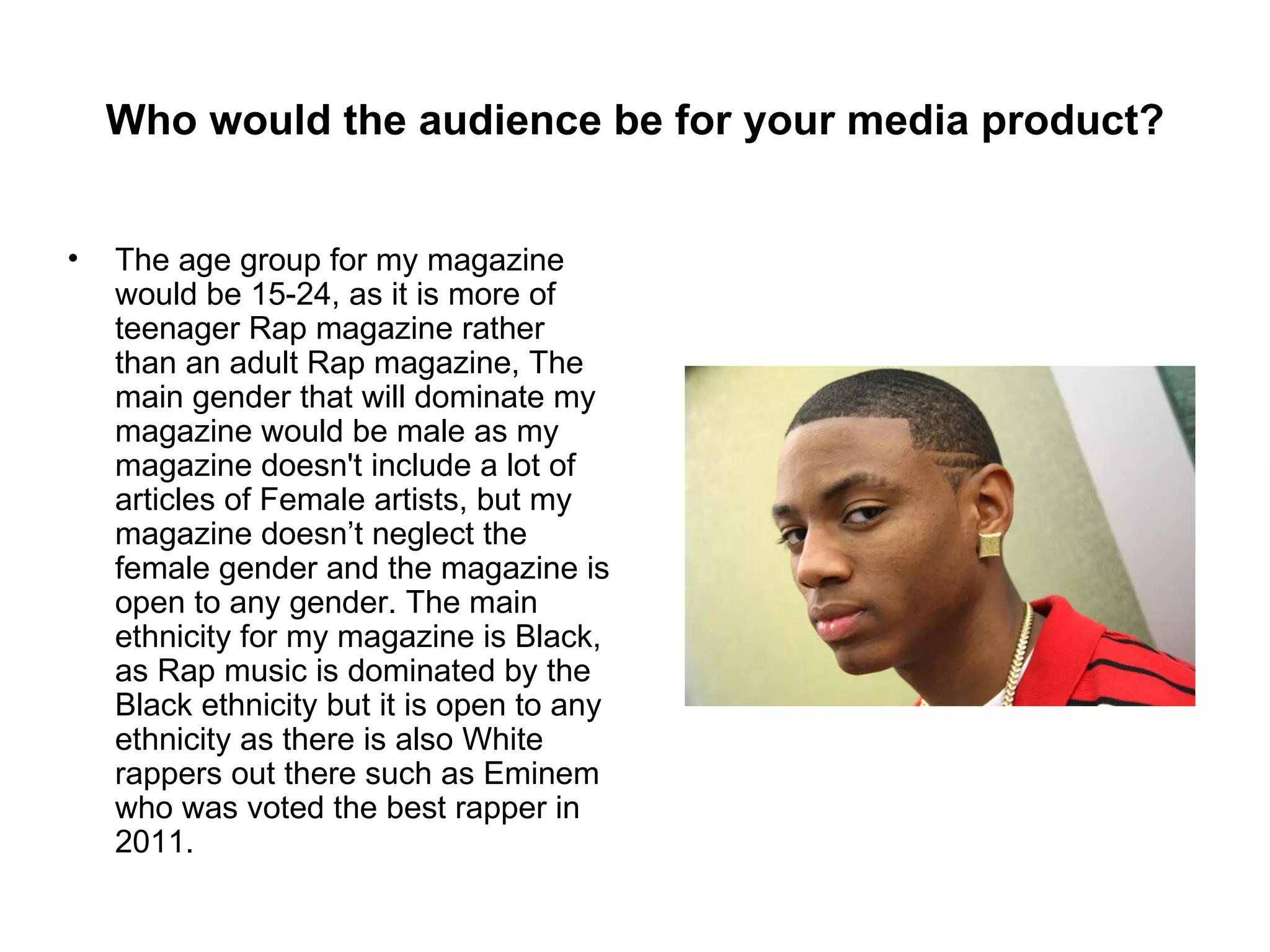
•   The age group for my magazine
    would be 15-24, as it is more of
    teenager Rap magazine rather
    than an adult Rap magazine, The
    main gender that will dominate my
    magazine would be male as my
    magazine doesn't include a lot of
    articles of Female artists, but my
    magazine doesn’t neglect the
    female gender and the magazine is
    open to any gender. The main
    ethnicity for my magazine is Black,
    as Rap music is dominated by the
    Black ethnicity but it is open to any
    ethnicity as there is also White
    rappers out there such as Eminem
    who was voted the best rapper in
    2011.
Who would the audience be for your media
                    product?
•   The audience that will buy
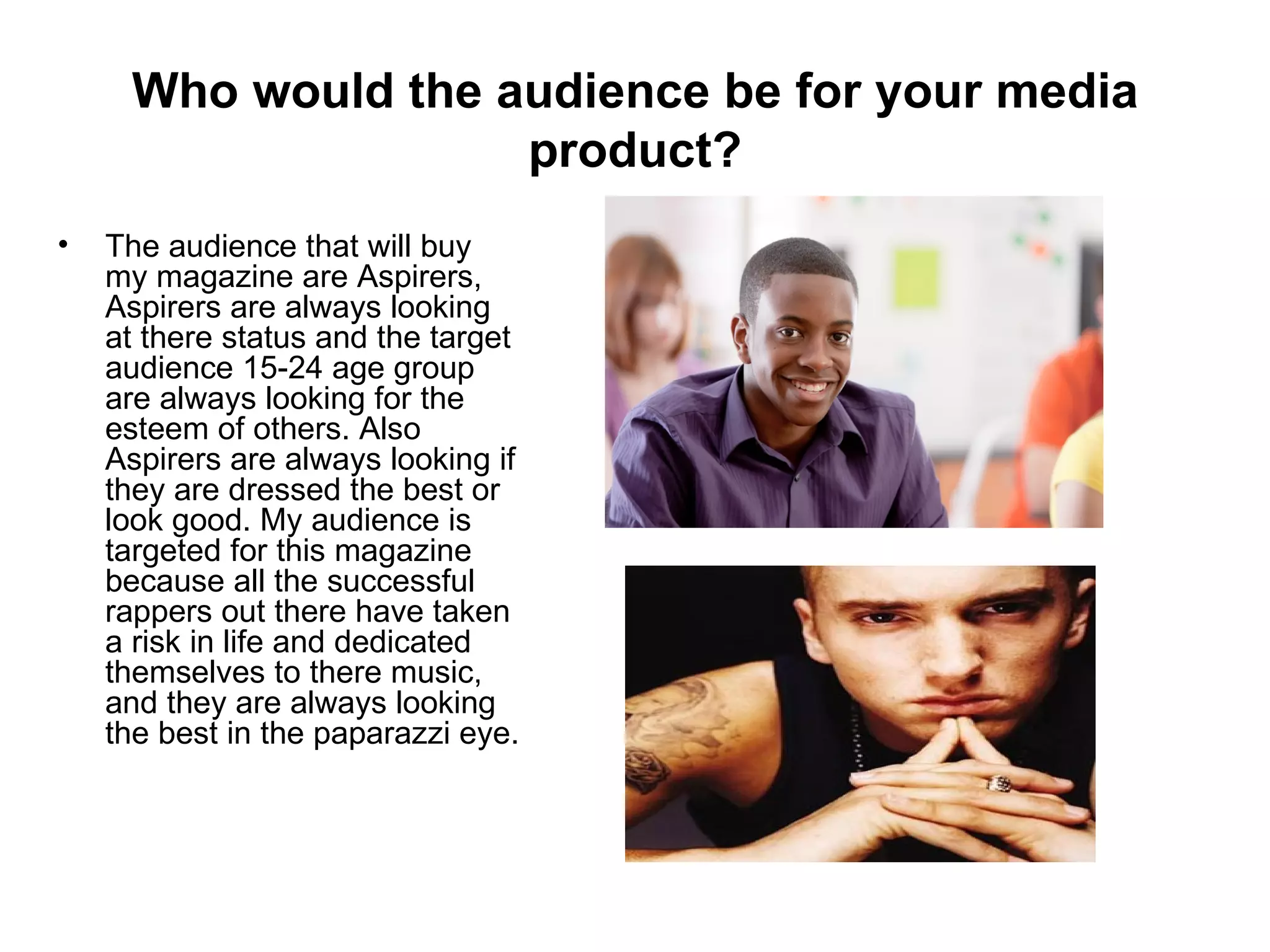
    my magazine are Aspirers,
    Aspirers are always looking
    at there status and the target
    audience 15-24 age group
    are always looking for the
    esteem of others. Also
    Aspirers are always looking if
    they are dressed the best or
    look good. My audience is
    targeted for this magazine
    because all the successful
    rappers out there have taken
    a risk in life and dedicated
    themselves to there music,
    and they are always looking
    the best in the paparazzi eye.
How did you attract/address your audience?

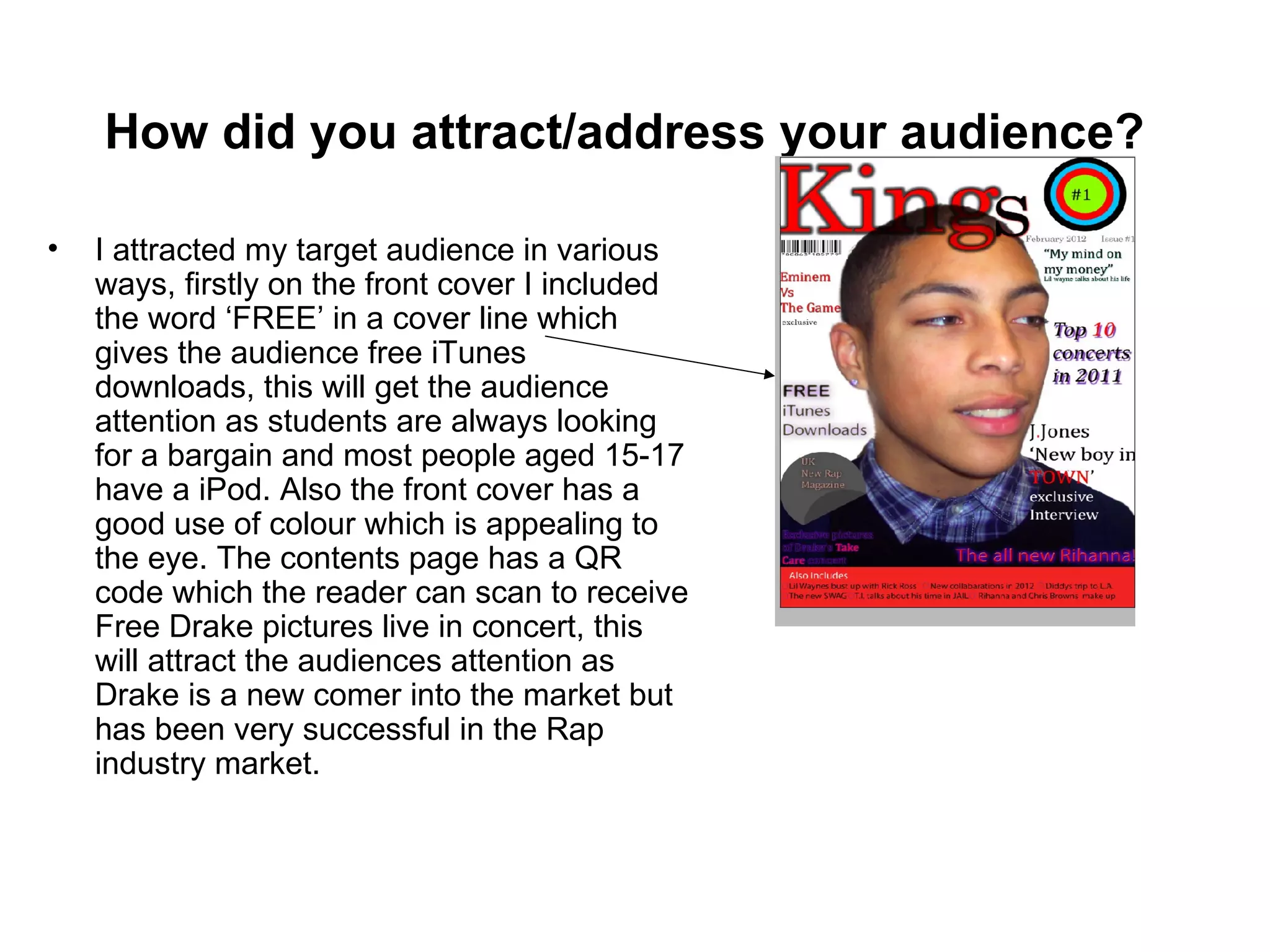
•   I attracted my target audience in various
    ways, firstly on the front cover I included
    the word ‘FREE’ in a cover line which
    gives the audience free iTunes
    downloads, this will get the audience
    attention as students are always looking
    for a bargain and most people aged 15-17
    have a iPod. Also the front cover has a
    good use of colour which is appealing to
    the eye. The contents page has a QR
    code which the reader can scan to receive
    Free Drake pictures live in concert, this
    will attract the audiences attention as
    Drake is a new comer into the market but
    has been very successful in the Rap
    industry market.
How did you attract/address your
                   audience?

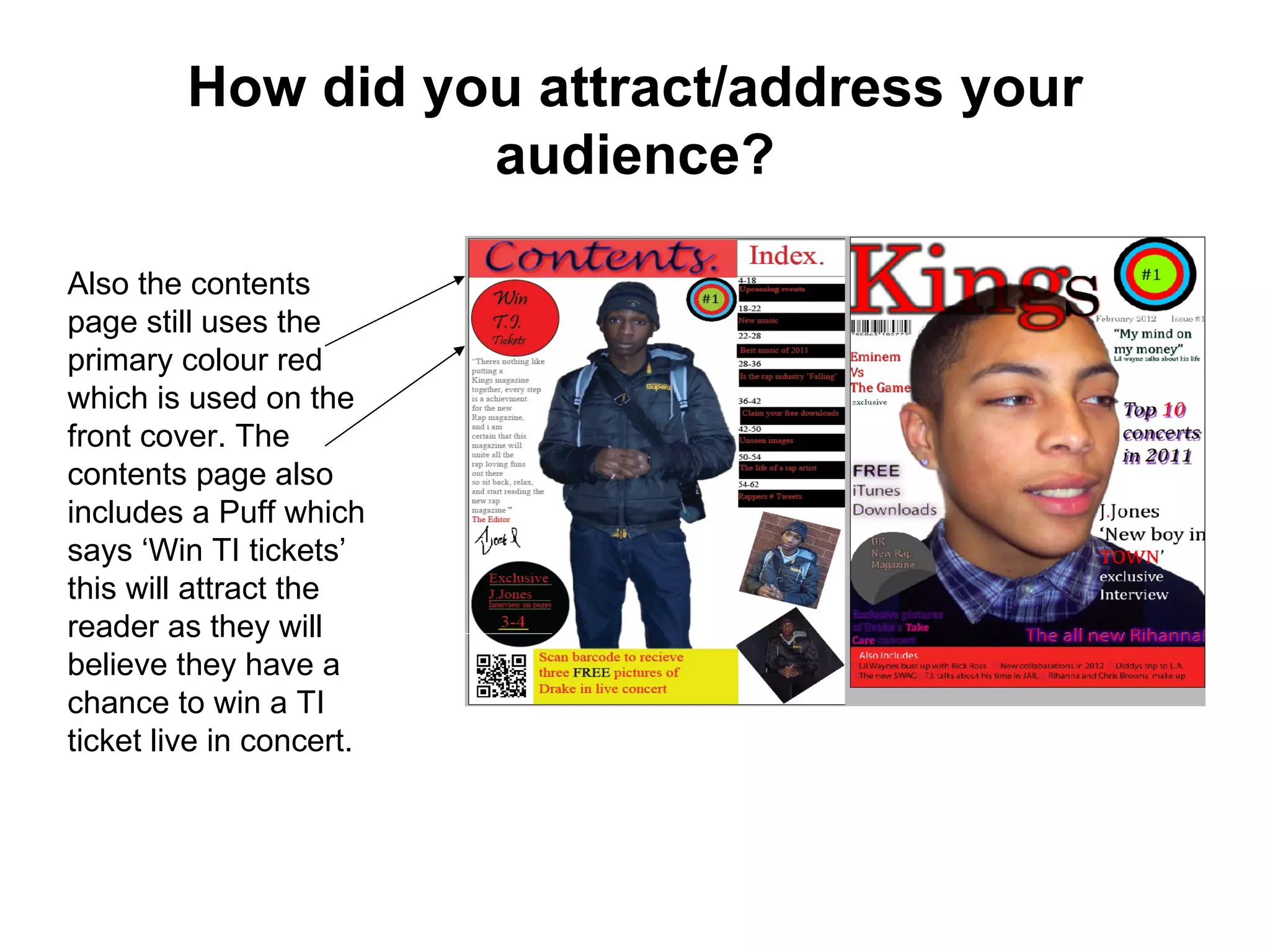
Also the contents
page still uses the
primary colour red
which is used on the
front cover. The
contents page also
includes a Puff which
says ‘Win TI tickets’
this will attract the
reader as they will
believe they have a
chance to win a TI
ticket live in concert.
How did you attract/address your
          audience?
How did you attract/address your
                  audience?
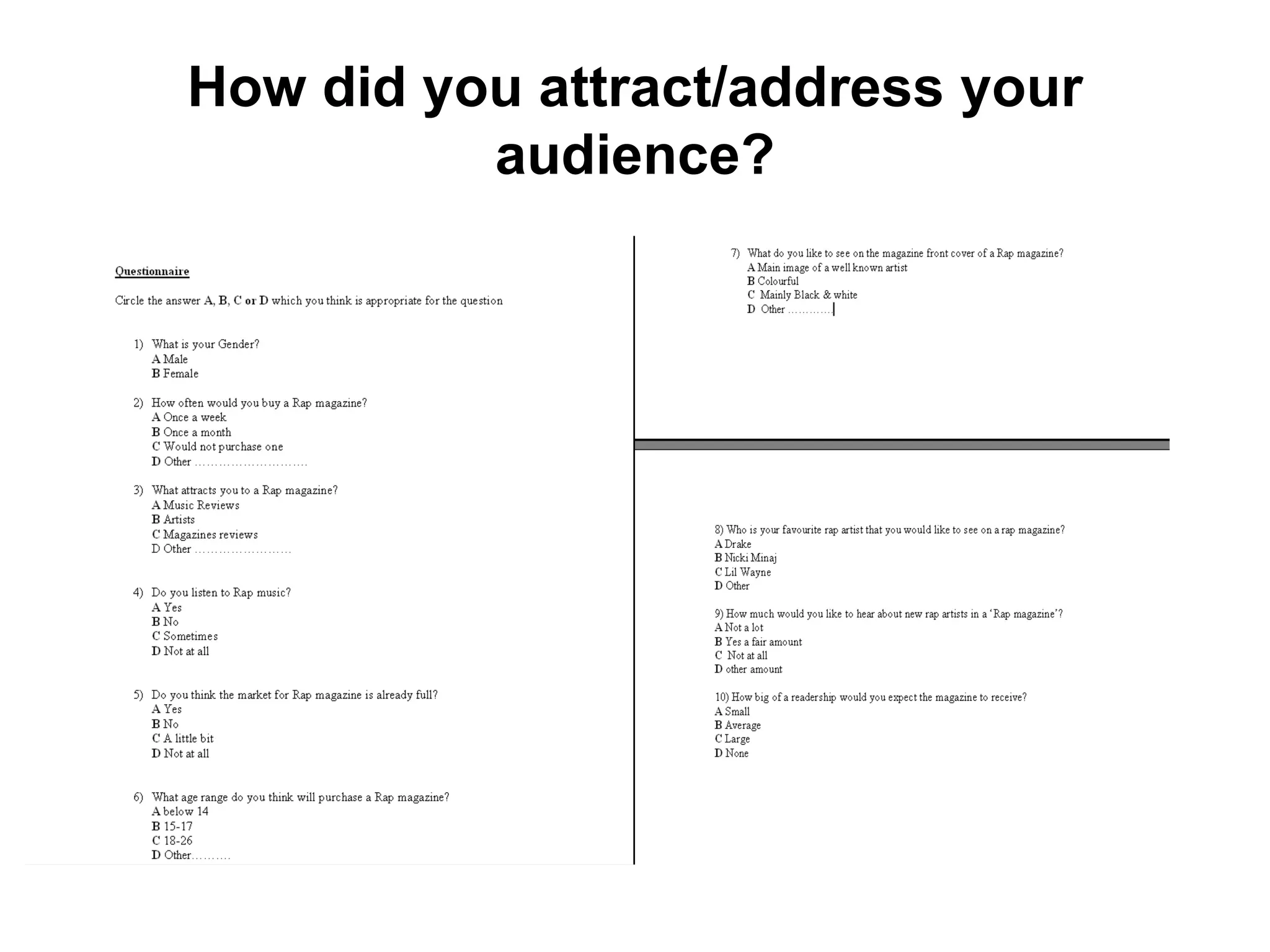
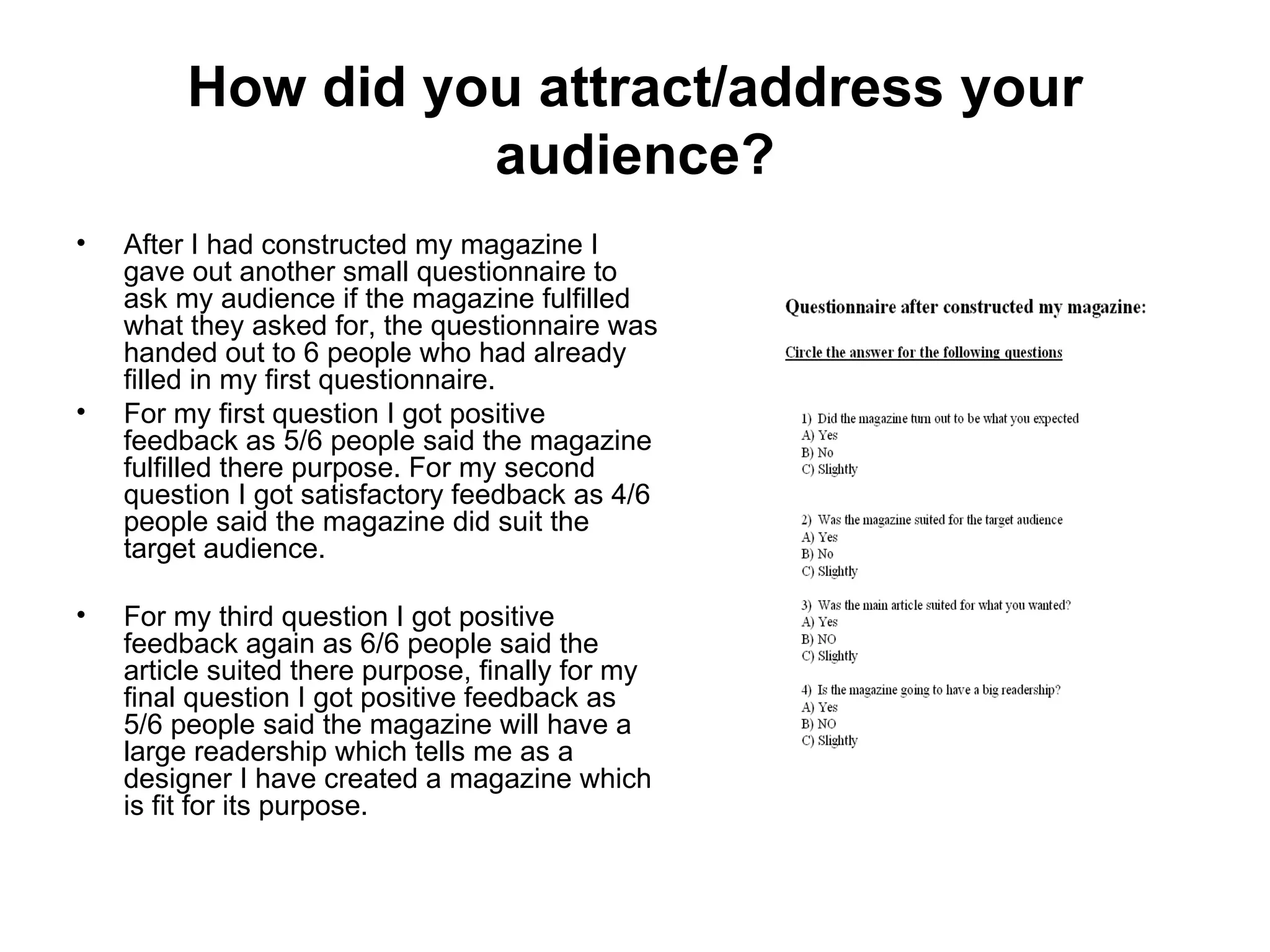
•   I attracted my audience by giving out a questionnaire which they would fill in
    and hand back to me, I tried to do my best to include what my audience
    wanted the most in the magazine, for example the audience wanted to hear
    more about a new rap artist entering the industry and I included my main
    article about this. Most of my audience wanted to hear about Rap artists
    news so I included strap lines about other Rap artists.
•   After I had constructed my magazine I gave out another small questionnaire
    to ask my audience if the magazine fulfilled what they asked for
How did you attract/address your
                   audience?
•   After I had constructed my magazine I
    gave out another small questionnaire to
    ask my audience if the magazine fulfilled
    what they asked for, the questionnaire was
    handed out to 6 people who had already
    filled in my first questionnaire.
•   For my first question I got positive
    feedback as 5/6 people said the magazine
    fulfilled there purpose. For my second
    question I got satisfactory feedback as 4/6
    people said the magazine did suit the
    target audience.

•   For my third question I got positive
    feedback again as 6/6 people said the
    article suited there purpose, finally for my
    final question I got positive feedback as
    5/6 people said the magazine will have a
    large readership which tells me as a
    designer I have created a magazine which
    is fit for its purpose.
What have you learnt about technologies from the
         process of constructing this product?

• I have learnt a lot about
  technology whilst
  constructing my
  magazine, the main
  websites I used was
  Adobe Photoshop & In
  design. I used
  Photoshop for my front
  cover and I used In
  design for my contents
  page and main article.
  Photoshop was much
  better for manipulating
  images and In design
  was better for publishing
  and better layout.
What have you learnt about technologies from
     the process of constructing this product?
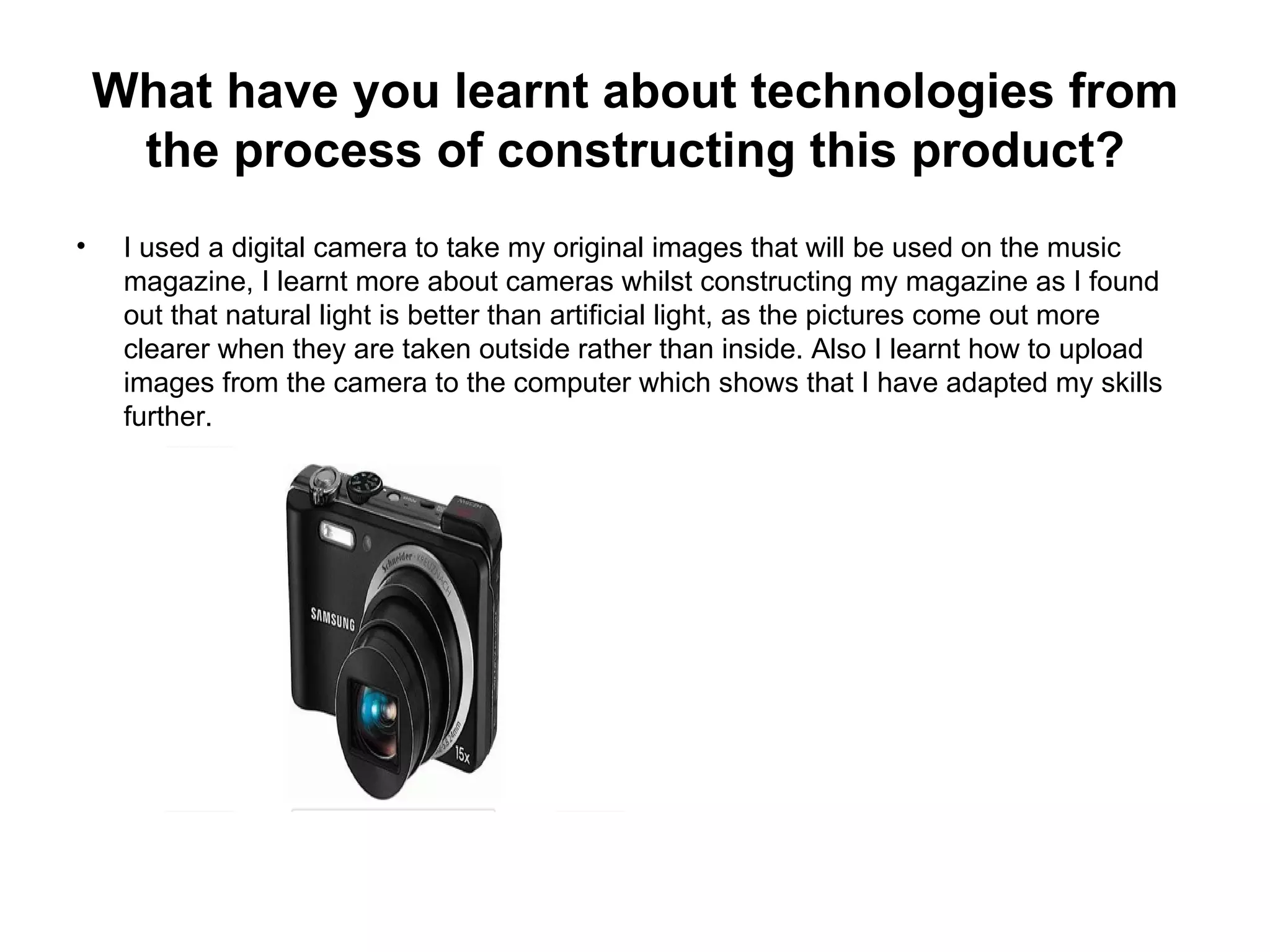
•    I used a digital camera to take my original images that will be used on the music
     magazine, I learnt more about cameras whilst constructing my magazine as I found
     out that natural light is better than artificial light, as the pictures come out more
     clearer when they are taken outside rather than inside. Also I learnt how to upload
     images from the camera to the computer which shows that I have adapted my skills
     further.
What have you learnt about technologies from
 the process of constructing this product?

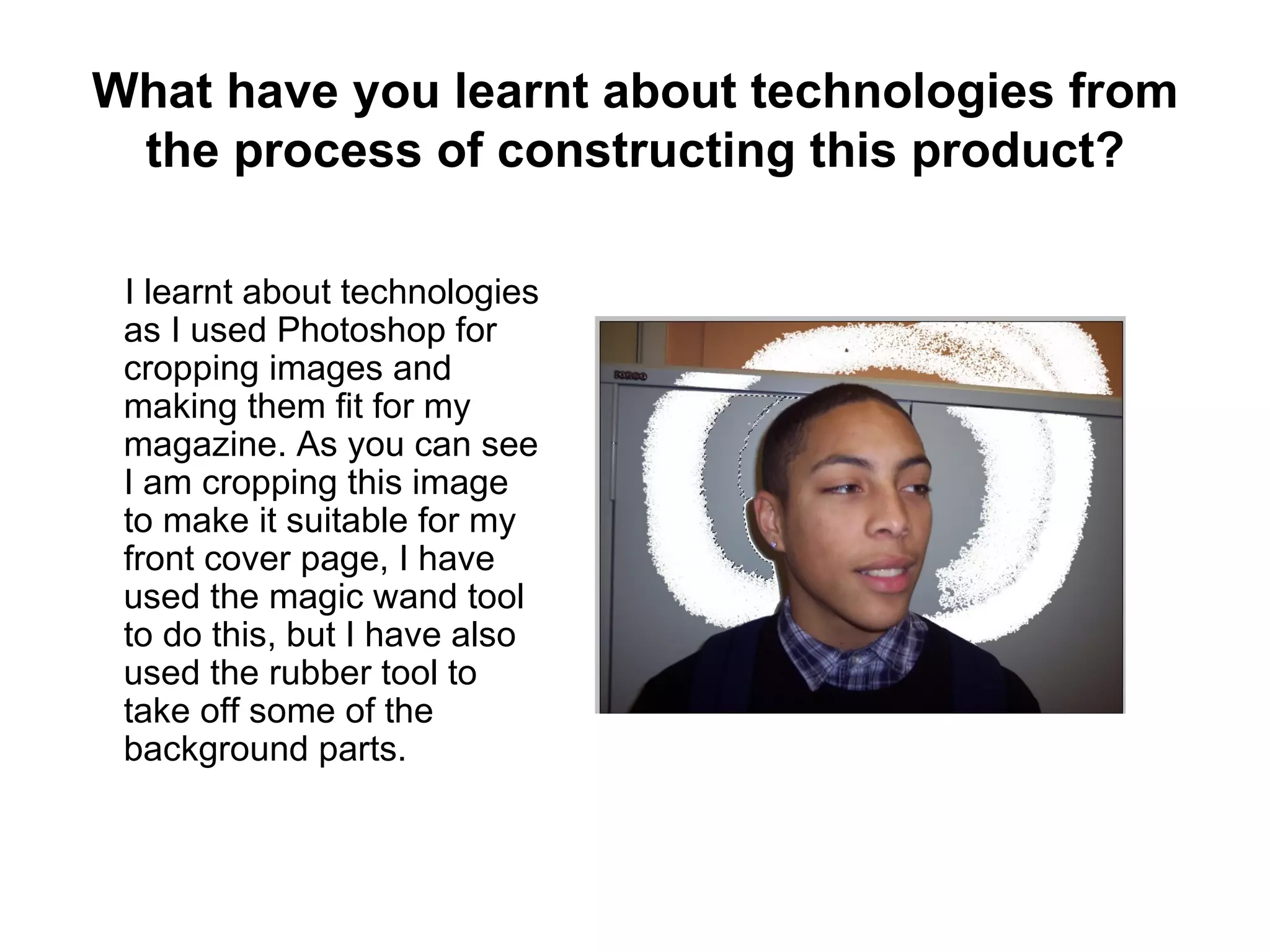
 I learnt about technologies
 as I used Photoshop for
 cropping images and
 making them fit for my
 magazine. As you can see
 I am cropping this image
 to make it suitable for my
 front cover page, I have
 used the magic wand tool
 to do this, but I have also
 used the rubber tool to
 take off some of the
 background parts.
What have you learnt about technologies from
 the process of constructing this product?


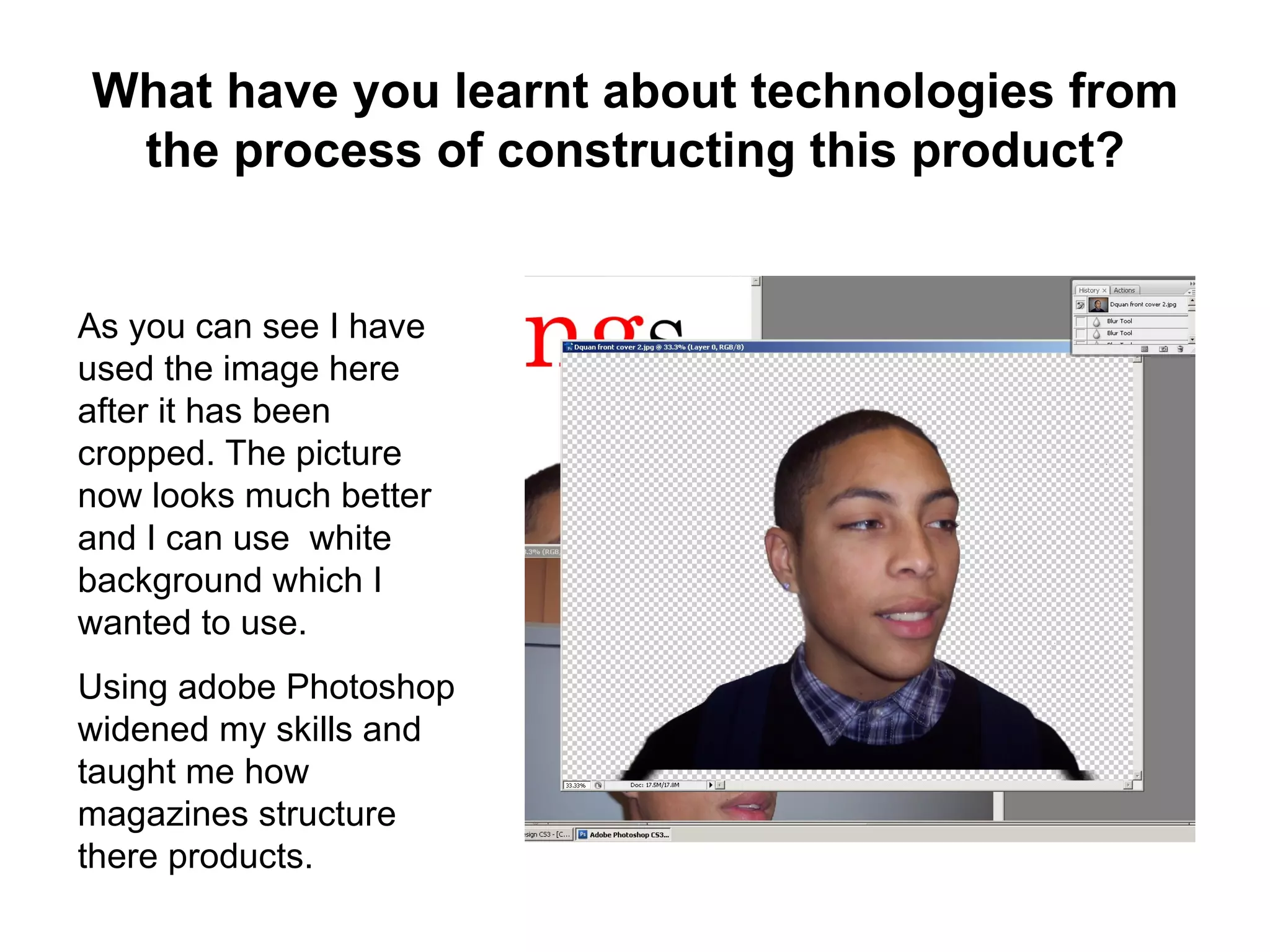
As you can see I have
used the image here
after it has been
cropped. The picture
now looks much better
and I can use white
background which I
wanted to use.
Using adobe Photoshop
widened my skills and
taught me how
magazines structure
there products.
What have you learnt about technologies from
 the process of constructing this product?

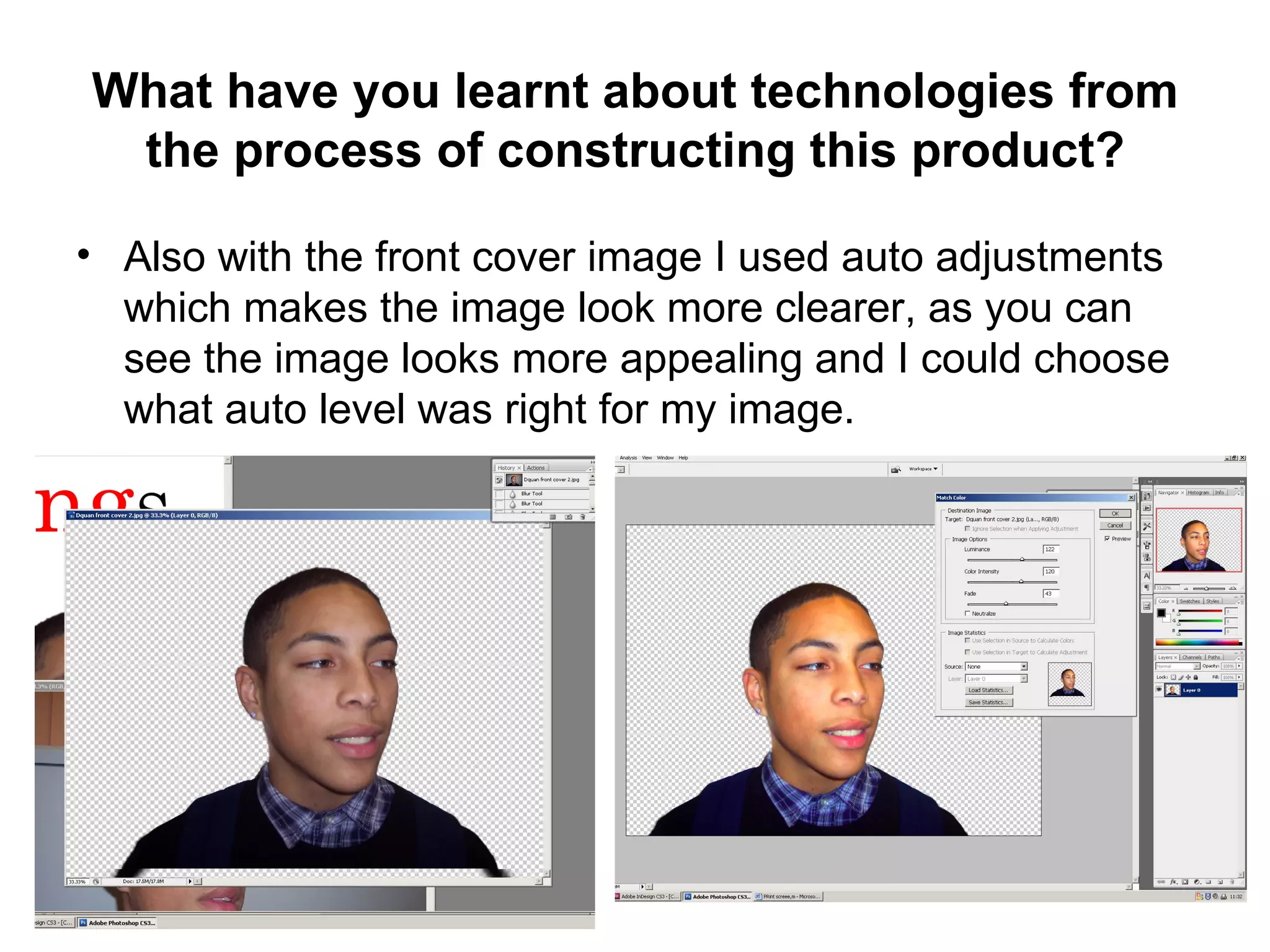
• Also with the front cover image I used auto adjustments
  which makes the image look more clearer, as you can
  see the image looks more appealing and I could choose
  what auto level was right for my image.
What have you learnt about technologies from
 the process of constructing this product?


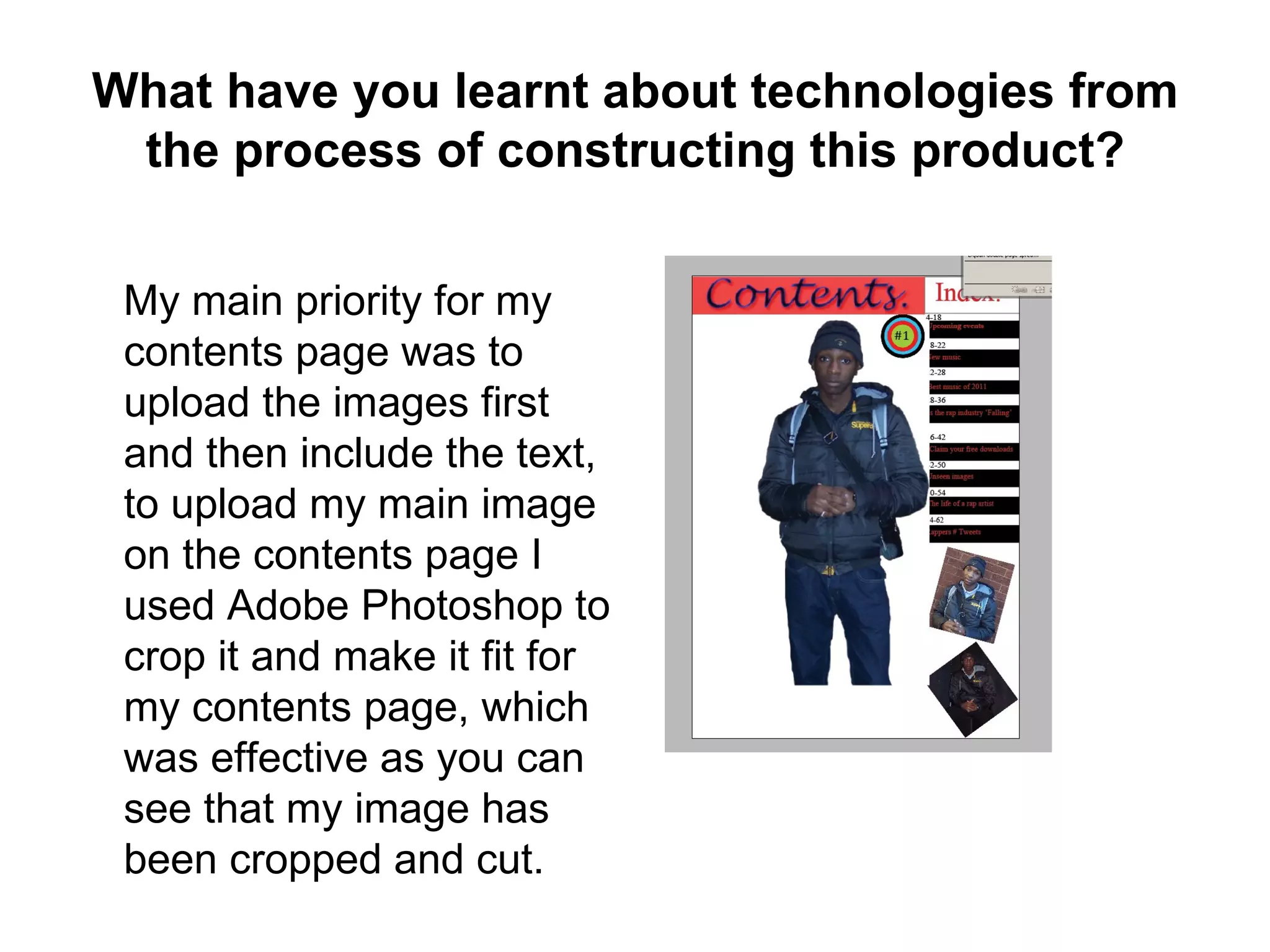
 My main priority for my
 contents page was to
 upload the images first
 and then include the text,
 to upload my main image
 on the contents page I
 used Adobe Photoshop to
 crop it and make it fit for
 my contents page, which
 was effective as you can
 see that my image has
 been cropped and cut.
What have you learnt about technologies from
     the process of constructing this product?
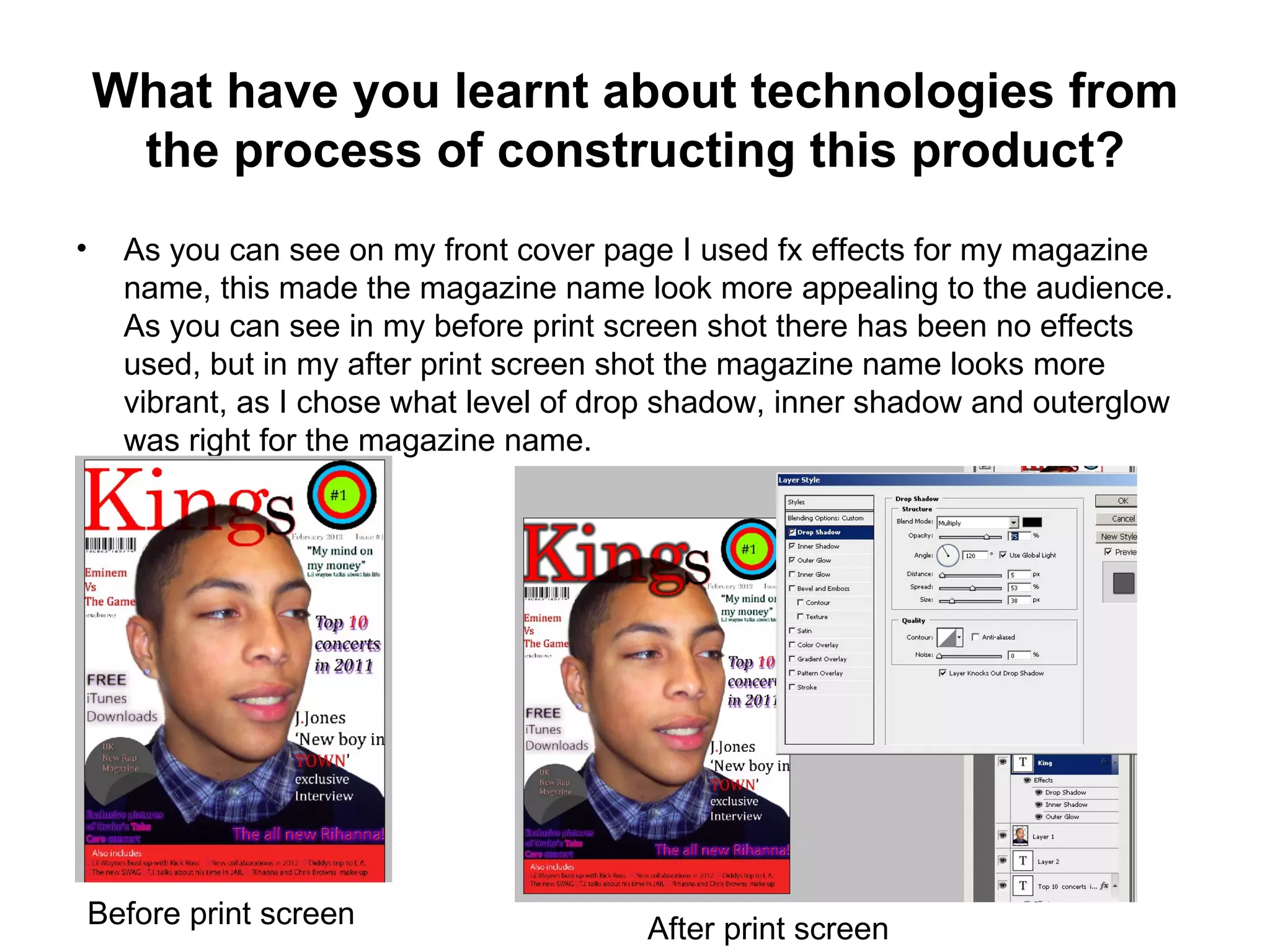
•     As you can see on my front cover page I used fx effects for my magazine
      name, this made the magazine name look more appealing to the audience.
      As you can see in my before print screen shot there has been no effects
      used, but in my after print screen shot the magazine name looks more
      vibrant, as I chose what level of drop shadow, inner shadow and outerglow
      was right for the magazine name.


    Before print screen                   After print screen
What have you learnt about technologies from
 the process of constructing this product?
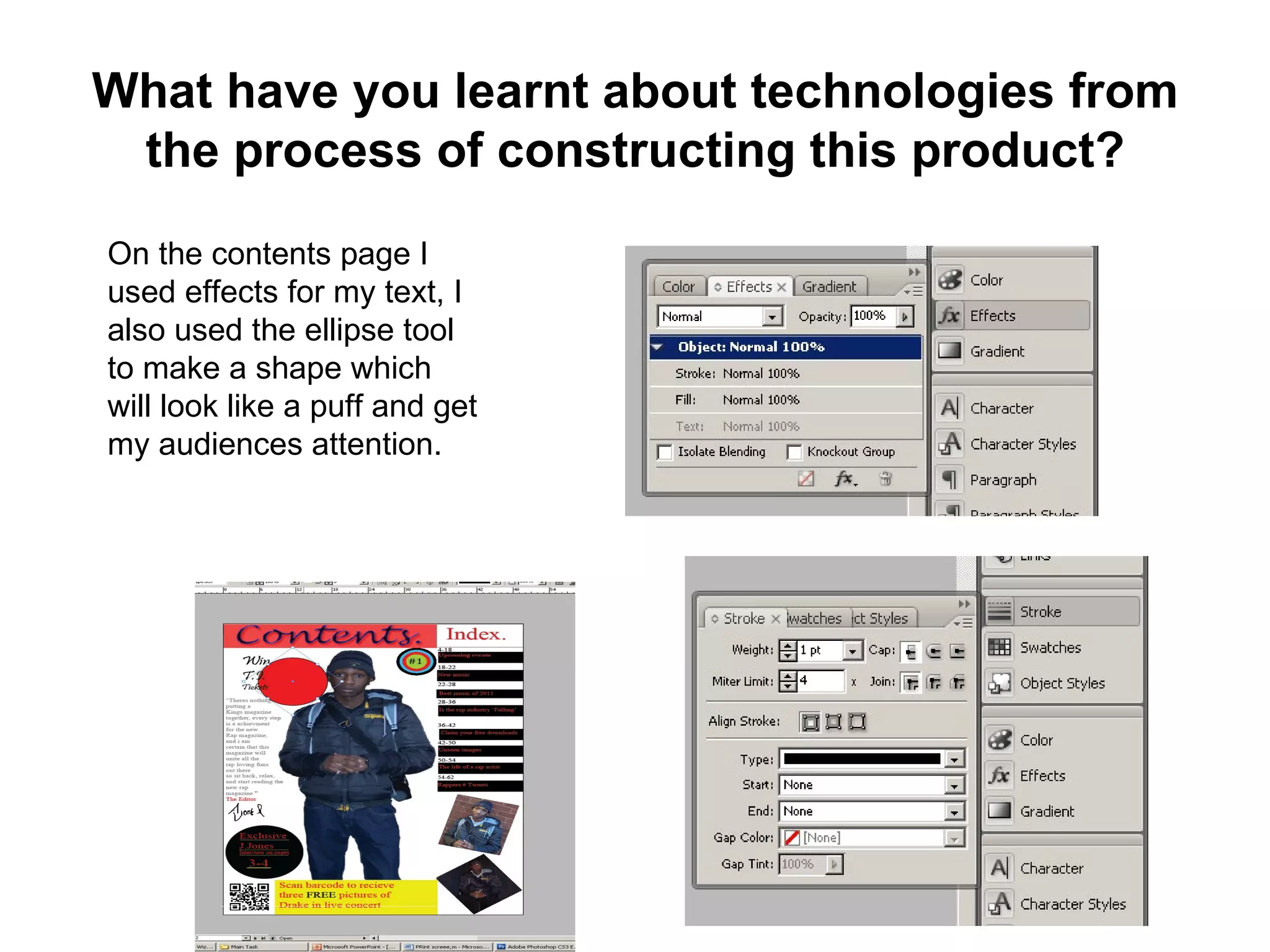
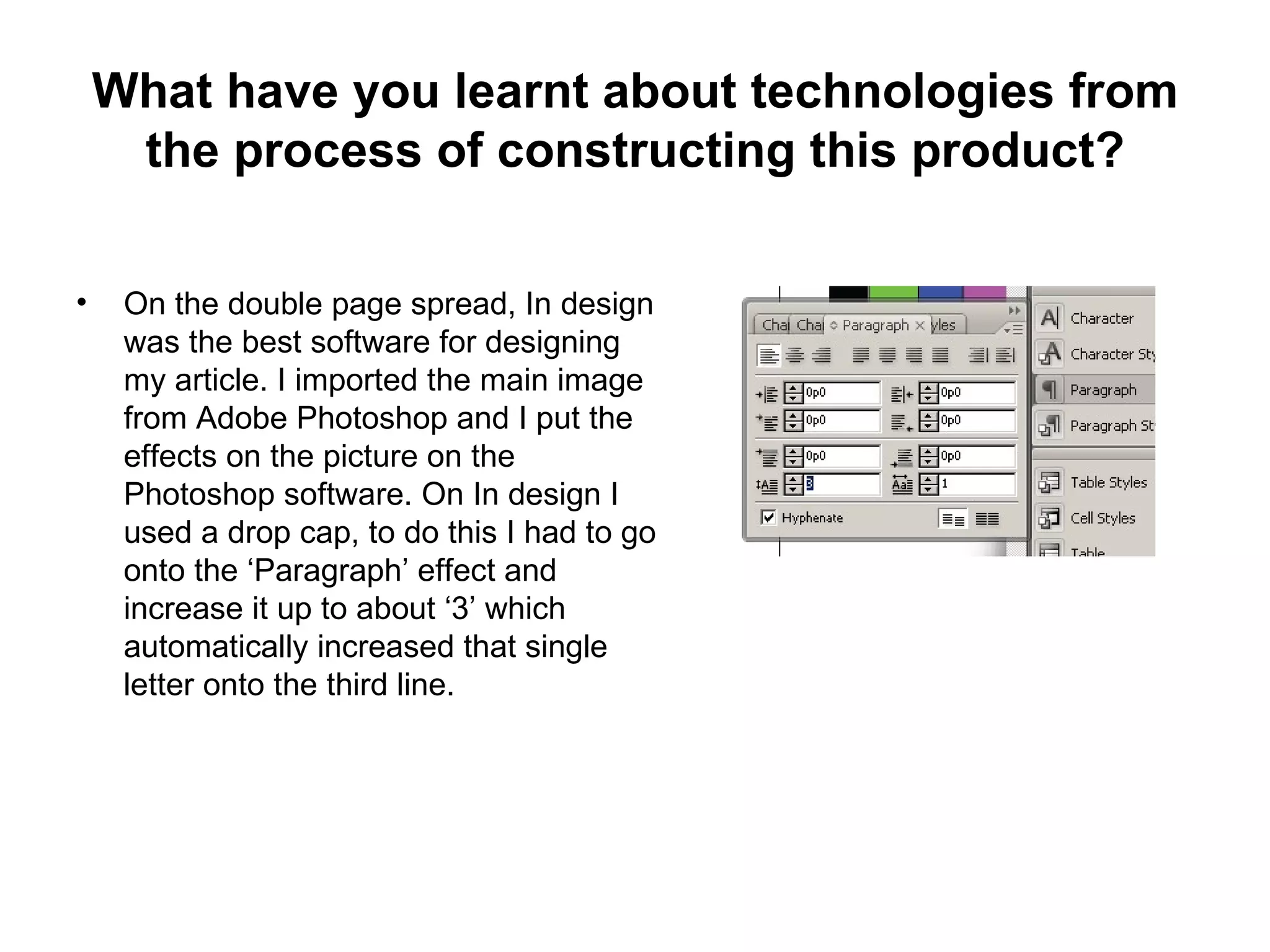
On the contents page I
used effects for my text, I
also used the ellipse tool
to make a shape which
will look like a puff and get
my audiences attention.
What have you learnt about technologies from
     the process of constructing this product?

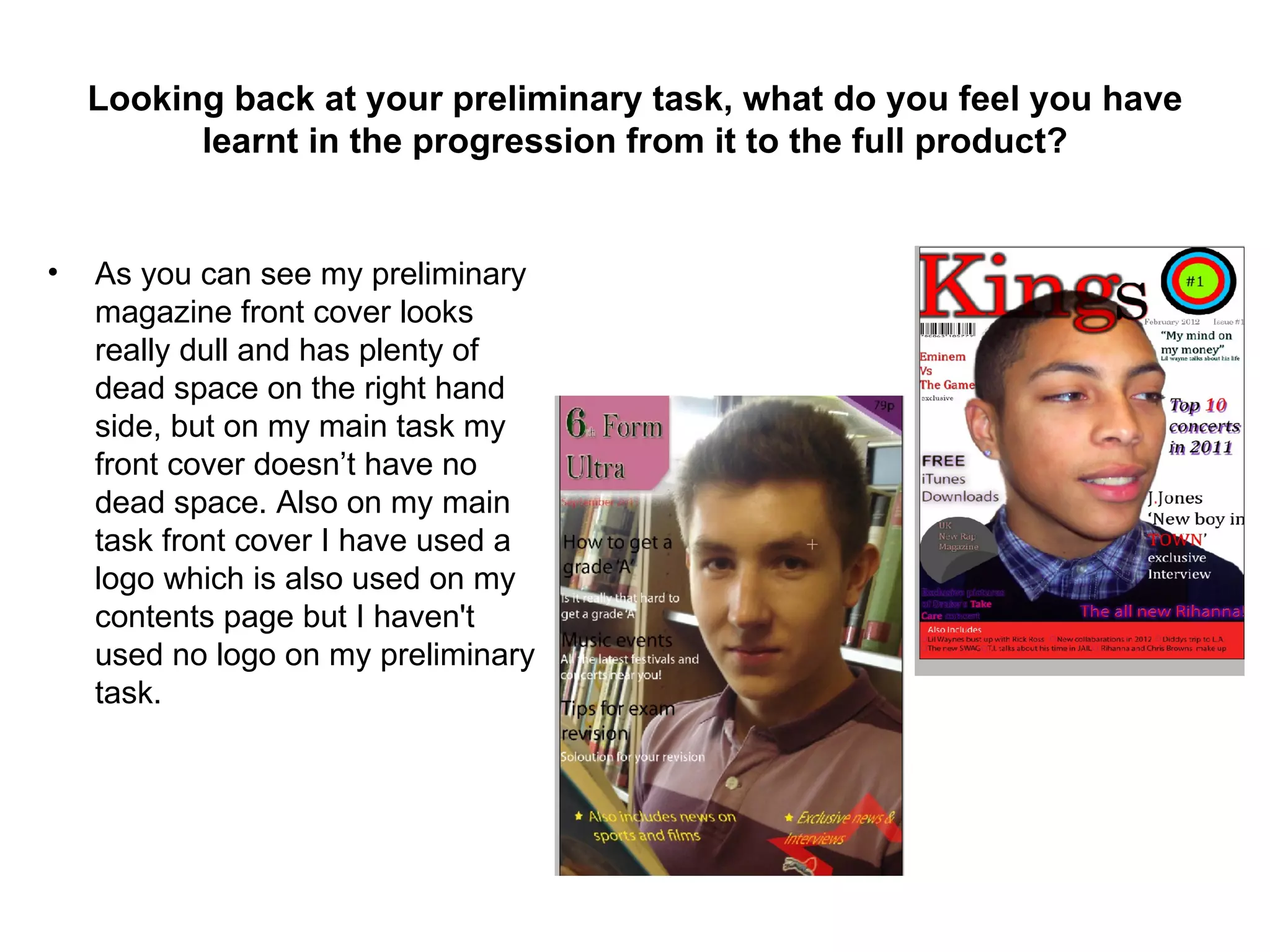
•    On the double page spread, In design
     was the best software for designing
     my article. I imported the main image
     from Adobe Photoshop and I put the
     effects on the picture on the
     Photoshop software. On In design I
     used a drop cap, to do this I had to go
     onto the ‘Paragraph’ effect and
     increase it up to about ‘3’ which
     automatically increased that single
     letter onto the third line.
Looking back at your preliminary task, what do you feel you have
          learnt in the progression from it to the full product?


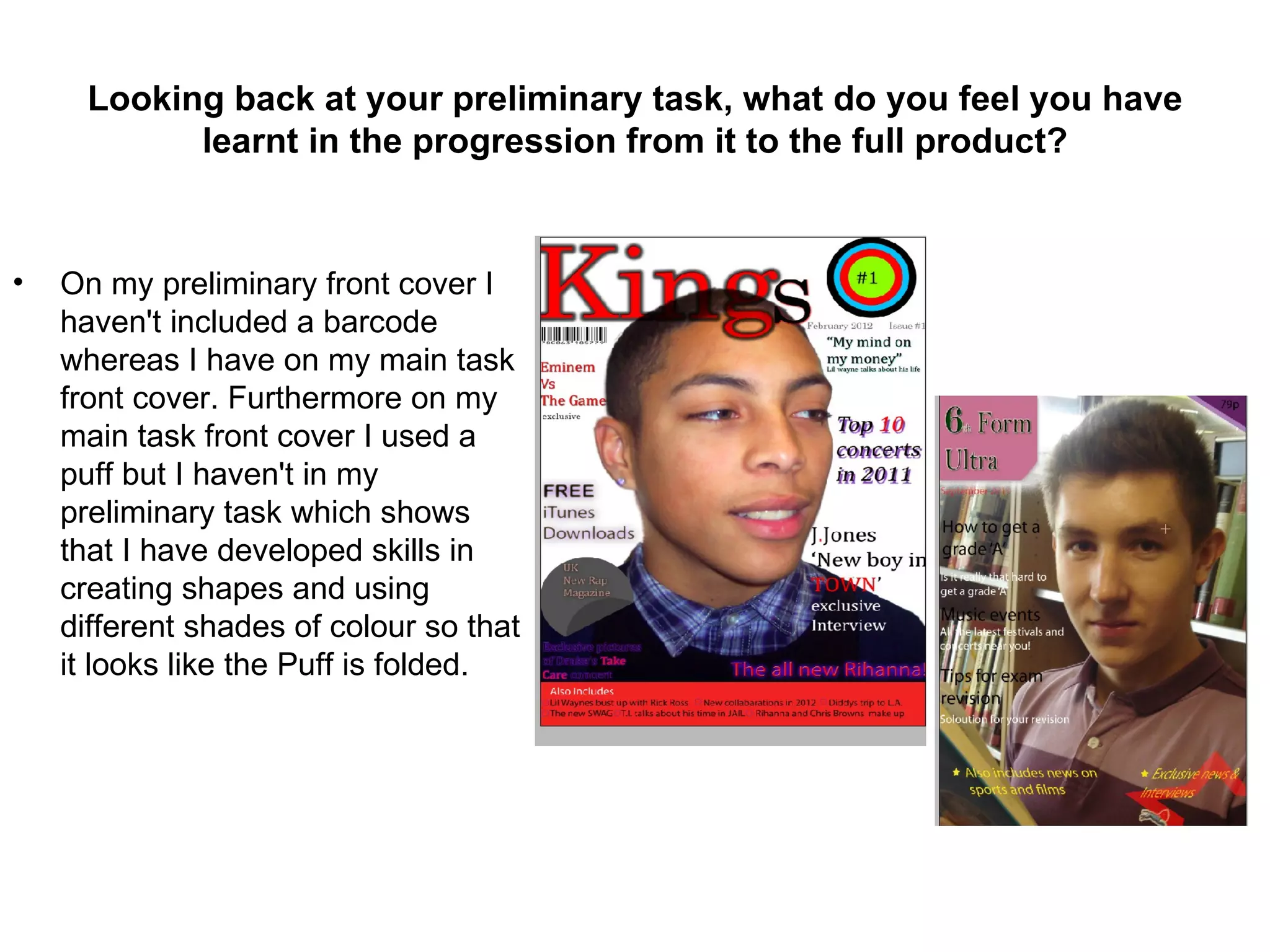
•   As you can see my preliminary
    magazine front cover looks
    really dull and has plenty of
    dead space on the right hand
    side, but on my main task my
    front cover doesn’t have no
    dead space. Also on my main
    task front cover I have used a
    logo which is also used on my
    contents page but I haven't
    used no logo on my preliminary
    task.
Looking back at your preliminary task, what do you feel you have
            learnt in the progression from it to the full product?


•   On my preliminary front cover I
    haven't included a barcode
    whereas I have on my main task
    front cover. Furthermore on my
    main task front cover I used a
    puff but I haven't in my
    preliminary task which shows
    that I have developed skills in
    creating shapes and using
    different shades of colour so that
    it looks like the Puff is folded.
Looking back at your preliminary task, what do you feel you have
        learnt in the progression from it to the full product?

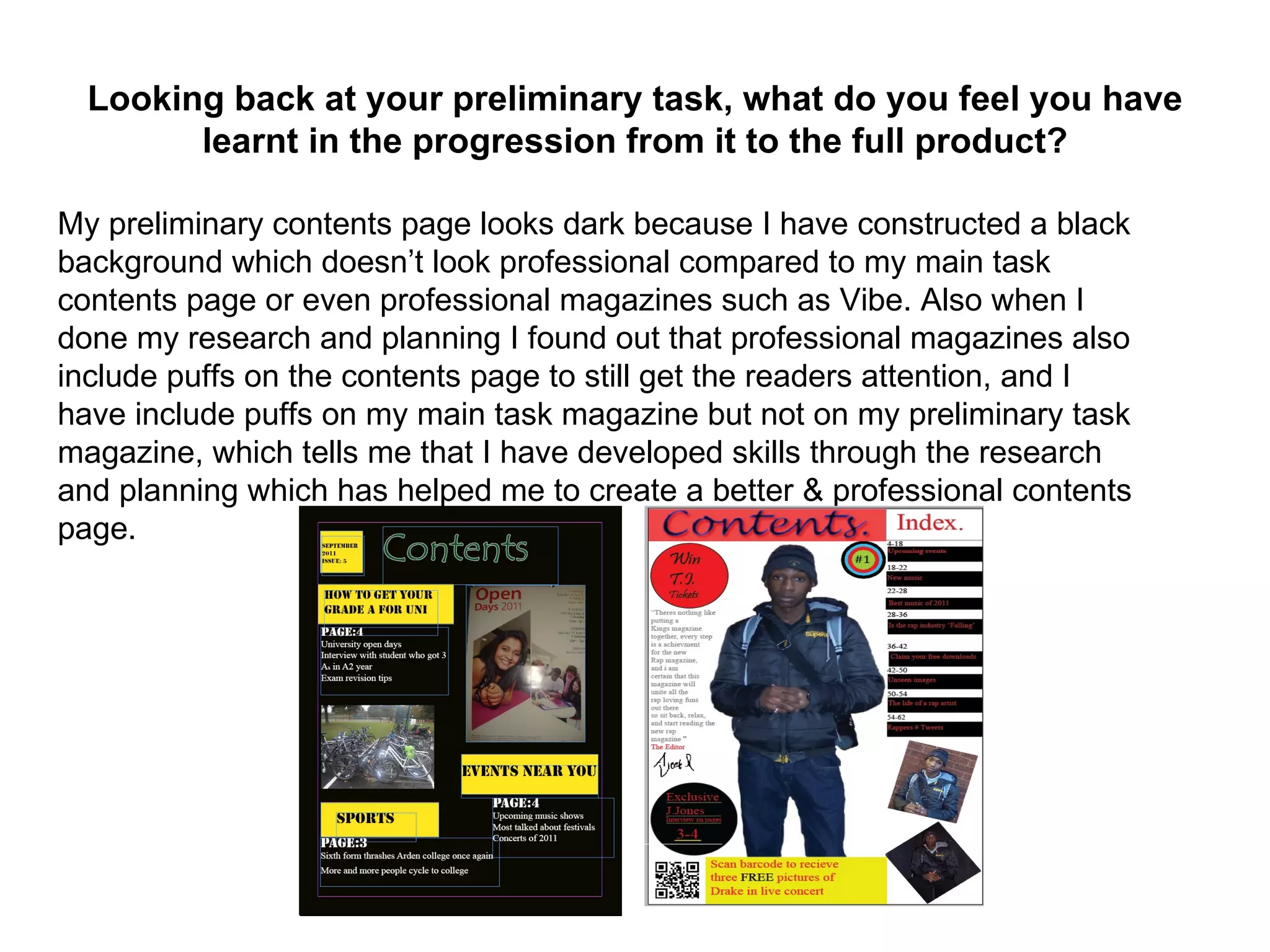
My preliminary contents page looks dark because I have constructed a black
background which doesn’t look professional compared to my main task
contents page or even professional magazines such as Vibe. Also when I
done my research and planning I found out that professional magazines also
include puffs on the contents page to still get the readers attention, and I
have include puffs on my main task magazine but not on my preliminary task
magazine, which tells me that I have developed skills through the research
and planning which has helped me to create a better & professional contents
page.
Looking back at your preliminary task, what do you feel you have

          learnt in the progression from it to the full product?

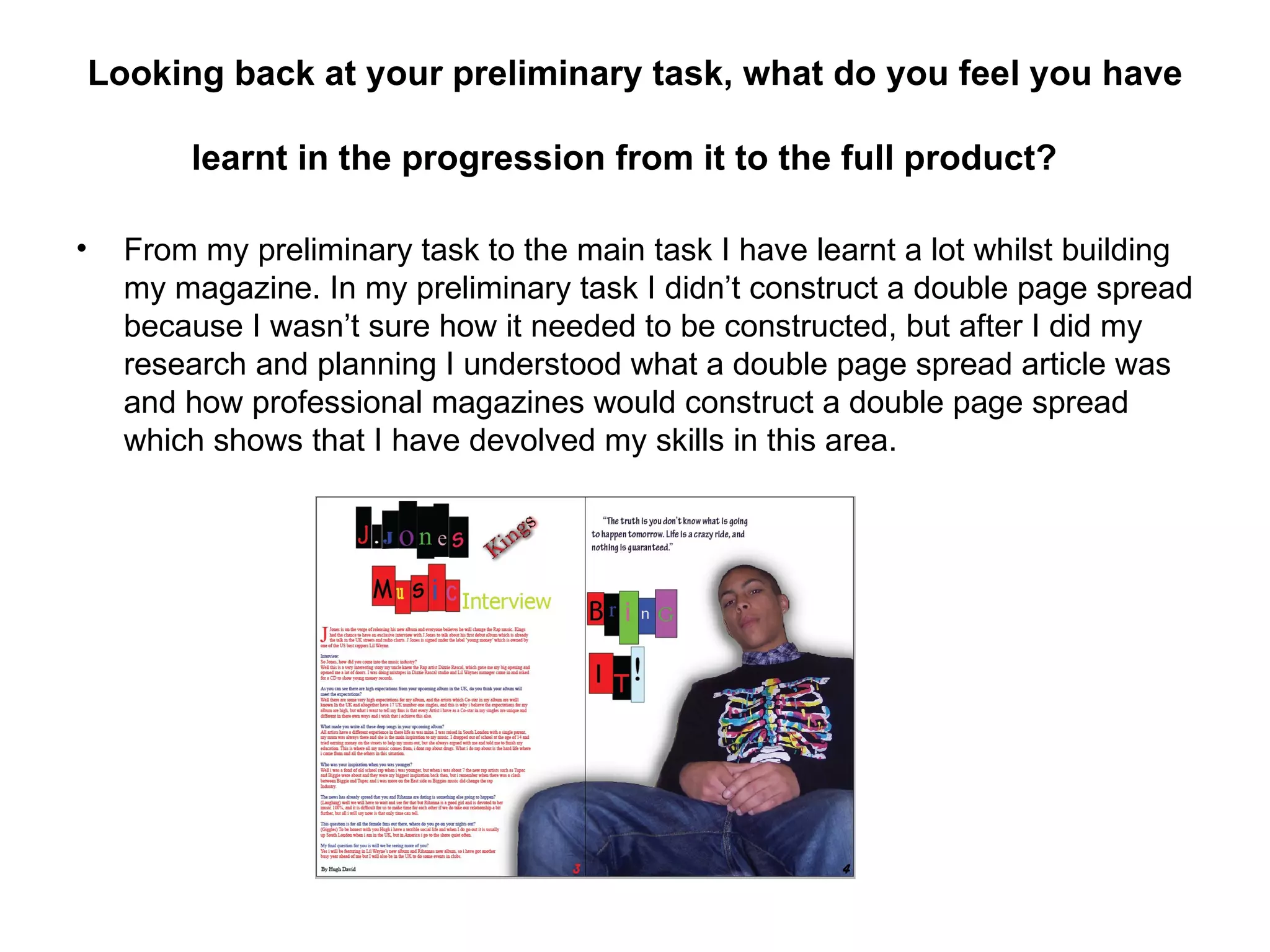
•     From my preliminary task to the main task I have learnt a lot whilst building
      my magazine. In my preliminary task I didn’t construct a double page spread
      because I wasn’t sure how it needed to be constructed, but after I did my
      research and planning I understood what a double page spread article was
      and how professional magazines would construct a double page spread
      which shows that I have devolved my skills in this area.
Looking back at your preliminary task, what do you feel you have
          learnt in the progression from it to the full product?


•    Overall I have developed a lot of skills whilst I
     was constructing the main task music magazine,
     I feel like I have come a far way since creating
     my college magazine and I have devolved skills
     on software's that I haven't used before which I
     am now more confident with. I have learnt skills
     like cropping images on Photoshop, using
     Photoshop to make images look more clearer
     and constructing magazine articles on In Design.


                Evaluation by

Tasks!!!!

  • 2.
    In what waysdoes your media product use, develop or challenge forms and conventions of real media products? • My magazine uses a Drop cap convention which most double page spread use, my double page spread also has one dominant image on there just like ‘Vibe’ does on most of there double page spreads. My contents page has three images on there, with one dominant image of the same character this convention is similar to all the magazines I researched on, but I have challenged my contents page to real media contents pages by keeping the image of the same character on whereas real media products will add two different sort of characters on the contents page, I did this because I think the contents page will look better with the one character but different shots of him. On my front cover I have used a close up image, the eyes are above the centre of the page and the Masthead takes about 1/5 of the front cover, however the magazines I researched on don’t use a close up image and haven't worried that much on keeping the image on the centre of the page, but there Masthead does take up about 1/5 of the front cover.
  • 3.
    In what waysdoes your media product use, develop or challenge forms and conventions of real media products? Vibe and My magazine both have a barcode but it is placed in different positions, Vibe magazine also uses a Puff similar to Kings magazine, I used the puff to get the readers attention as it says ‘ UK New Rap Magazine’ which will get the audience giving the magazine a second glance.
  • 4.
    In what waysdoes your media product use, develop or challenge forms and conventions of real media products? In my contents page I have stuck to the code of conventions as I have included a index which all magazines use, and I have also used my magazine logo on the right hand side which is also seen on my front cover because when I done my research most magazines who had a logo included the logo in the contents page. Furthermore when I was doing my research and planning I found out that a lot of Rap magazines include a editors note which makes the magazine look more professional therefore I included the editor note on my contents page.
  • 5.
    How does yourmedia product represent particular social groups? • My magazine represents one area of society which is ‘Rap’/‘Hip Hop’, my magazine also deals with issue of race as Rap was produced by the ‘Black’ race and my images are of two black males. The magazine is also aimed for people who fit in the age group of 15-24, I have done this as on the front cover there is a strap line which says ‘FREE iTunes downloads’ this will attract this social group because most people in that category owns a iPod and will be interested in the Free iTunes download. The audience that listen to hip hop is the youth subculture who are into hip hop that has meaningful lyrics and want to listen to music with a deep beat.
  • 6.
    What kind ofmedia institution might distribute your media product and why? • The company that might distribute my magazine could be Bauer as they already publish successful magazines such as Heat, FHM Kerrang etc, and I think that Bauer would be able to take my magazine further, IPC is also a good media publisher but they don’t publish a lot of music magazines but it does publish NME which is a successful magazine in the UK but IPC also publishes other magazines like Match and Your home. The other media institution that might publish my magazine could be Inter media Publish partners but they already publish a Rap magazine which will be my rival in the market (vibe), and Intermedia will not publish my magazine if it will give rival to a magazine it already publishes.
  • 7.
    Who would theaudience be for your media product? • The age group for my magazine would be 15-24, as it is more of teenager Rap magazine rather than an adult Rap magazine, The main gender that will dominate my magazine would be male as my magazine doesn't include a lot of articles of Female artists, but my magazine doesn’t neglect the female gender and the magazine is open to any gender. The main ethnicity for my magazine is Black, as Rap music is dominated by the Black ethnicity but it is open to any ethnicity as there is also White rappers out there such as Eminem who was voted the best rapper in 2011.
  • 8.
    Who would theaudience be for your media product? • The audience that will buy my magazine are Aspirers, Aspirers are always looking at there status and the target audience 15-24 age group are always looking for the esteem of others. Also Aspirers are always looking if they are dressed the best or look good. My audience is targeted for this magazine because all the successful rappers out there have taken a risk in life and dedicated themselves to there music, and they are always looking the best in the paparazzi eye.
  • 9.
    How did youattract/address your audience? • I attracted my target audience in various ways, firstly on the front cover I included the word ‘FREE’ in a cover line which gives the audience free iTunes downloads, this will get the audience attention as students are always looking for a bargain and most people aged 15-17 have a iPod. Also the front cover has a good use of colour which is appealing to the eye. The contents page has a QR code which the reader can scan to receive Free Drake pictures live in concert, this will attract the audiences attention as Drake is a new comer into the market but has been very successful in the Rap industry market.
  • 10.
    How did youattract/address your audience? Also the contents page still uses the primary colour red which is used on the front cover. The contents page also includes a Puff which says ‘Win TI tickets’ this will attract the reader as they will believe they have a chance to win a TI ticket live in concert.
  • 11.
    How did youattract/address your audience?
  • 12.
    How did youattract/address your audience? • I attracted my audience by giving out a questionnaire which they would fill in and hand back to me, I tried to do my best to include what my audience wanted the most in the magazine, for example the audience wanted to hear more about a new rap artist entering the industry and I included my main article about this. Most of my audience wanted to hear about Rap artists news so I included strap lines about other Rap artists. • After I had constructed my magazine I gave out another small questionnaire to ask my audience if the magazine fulfilled what they asked for
  • 13.
    How did youattract/address your audience? • After I had constructed my magazine I gave out another small questionnaire to ask my audience if the magazine fulfilled what they asked for, the questionnaire was handed out to 6 people who had already filled in my first questionnaire. • For my first question I got positive feedback as 5/6 people said the magazine fulfilled there purpose. For my second question I got satisfactory feedback as 4/6 people said the magazine did suit the target audience. • For my third question I got positive feedback again as 6/6 people said the article suited there purpose, finally for my final question I got positive feedback as 5/6 people said the magazine will have a large readership which tells me as a designer I have created a magazine which is fit for its purpose.
  • 14.
    What have youlearnt about technologies from the process of constructing this product? • I have learnt a lot about technology whilst constructing my magazine, the main websites I used was Adobe Photoshop & In design. I used Photoshop for my front cover and I used In design for my contents page and main article. Photoshop was much better for manipulating images and In design was better for publishing and better layout.
  • 15.
    What have youlearnt about technologies from the process of constructing this product? • I used a digital camera to take my original images that will be used on the music magazine, I learnt more about cameras whilst constructing my magazine as I found out that natural light is better than artificial light, as the pictures come out more clearer when they are taken outside rather than inside. Also I learnt how to upload images from the camera to the computer which shows that I have adapted my skills further.
  • 16.
    What have youlearnt about technologies from the process of constructing this product? I learnt about technologies as I used Photoshop for cropping images and making them fit for my magazine. As you can see I am cropping this image to make it suitable for my front cover page, I have used the magic wand tool to do this, but I have also used the rubber tool to take off some of the background parts.
  • 17.
    What have youlearnt about technologies from the process of constructing this product? As you can see I have used the image here after it has been cropped. The picture now looks much better and I can use white background which I wanted to use. Using adobe Photoshop widened my skills and taught me how magazines structure there products.
  • 18.
    What have youlearnt about technologies from the process of constructing this product? • Also with the front cover image I used auto adjustments which makes the image look more clearer, as you can see the image looks more appealing and I could choose what auto level was right for my image.
  • 19.
    What have youlearnt about technologies from the process of constructing this product? My main priority for my contents page was to upload the images first and then include the text, to upload my main image on the contents page I used Adobe Photoshop to crop it and make it fit for my contents page, which was effective as you can see that my image has been cropped and cut.
  • 20.
    What have youlearnt about technologies from the process of constructing this product? • As you can see on my front cover page I used fx effects for my magazine name, this made the magazine name look more appealing to the audience. As you can see in my before print screen shot there has been no effects used, but in my after print screen shot the magazine name looks more vibrant, as I chose what level of drop shadow, inner shadow and outerglow was right for the magazine name. Before print screen After print screen
  • 21.
    What have youlearnt about technologies from the process of constructing this product? On the contents page I used effects for my text, I also used the ellipse tool to make a shape which will look like a puff and get my audiences attention.
  • 22.
    What have youlearnt about technologies from the process of constructing this product? • On the double page spread, In design was the best software for designing my article. I imported the main image from Adobe Photoshop and I put the effects on the picture on the Photoshop software. On In design I used a drop cap, to do this I had to go onto the ‘Paragraph’ effect and increase it up to about ‘3’ which automatically increased that single letter onto the third line.
  • 23.
    Looking back atyour preliminary task, what do you feel you have learnt in the progression from it to the full product? • As you can see my preliminary magazine front cover looks really dull and has plenty of dead space on the right hand side, but on my main task my front cover doesn’t have no dead space. Also on my main task front cover I have used a logo which is also used on my contents page but I haven't used no logo on my preliminary task.
  • 24.
    Looking back atyour preliminary task, what do you feel you have learnt in the progression from it to the full product? • On my preliminary front cover I haven't included a barcode whereas I have on my main task front cover. Furthermore on my main task front cover I used a puff but I haven't in my preliminary task which shows that I have developed skills in creating shapes and using different shades of colour so that it looks like the Puff is folded.
  • 25.
    Looking back atyour preliminary task, what do you feel you have learnt in the progression from it to the full product? My preliminary contents page looks dark because I have constructed a black background which doesn’t look professional compared to my main task contents page or even professional magazines such as Vibe. Also when I done my research and planning I found out that professional magazines also include puffs on the contents page to still get the readers attention, and I have include puffs on my main task magazine but not on my preliminary task magazine, which tells me that I have developed skills through the research and planning which has helped me to create a better & professional contents page.
  • 26.
    Looking back atyour preliminary task, what do you feel you have learnt in the progression from it to the full product? • From my preliminary task to the main task I have learnt a lot whilst building my magazine. In my preliminary task I didn’t construct a double page spread because I wasn’t sure how it needed to be constructed, but after I did my research and planning I understood what a double page spread article was and how professional magazines would construct a double page spread which shows that I have devolved my skills in this area.
  • 27.
    Looking back atyour preliminary task, what do you feel you have learnt in the progression from it to the full product? • Overall I have developed a lot of skills whilst I was constructing the main task music magazine, I feel like I have come a far way since creating my college magazine and I have devolved skills on software's that I haven't used before which I am now more confident with. I have learnt skills like cropping images on Photoshop, using Photoshop to make images look more clearer and constructing magazine articles on In Design. Evaluation by