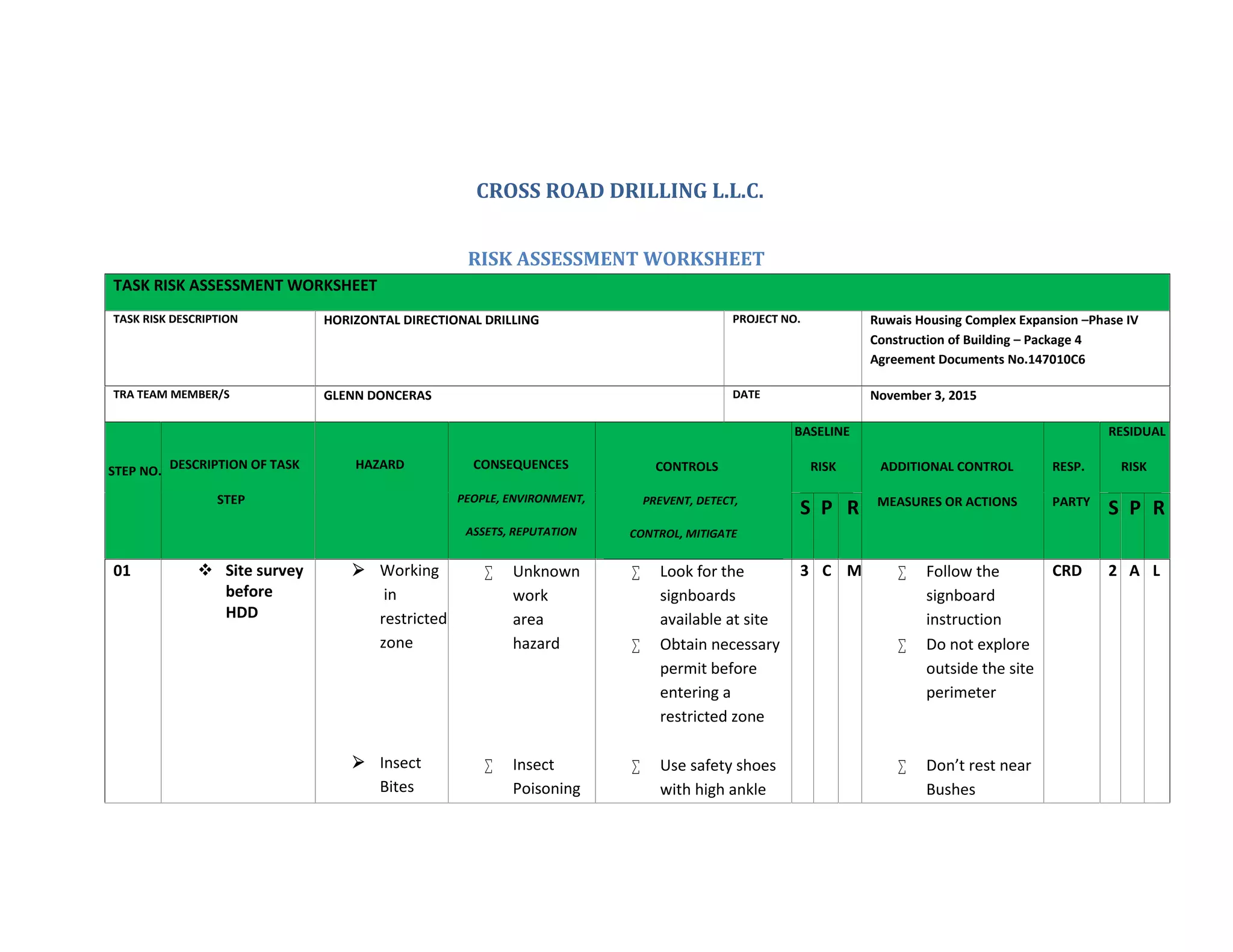
CROSS ROAD DRILLING L.L.C.
RISK ASSESSMENT WORKSHEET
TASK RISK ASSESSMENT WORKSHEET
TASK RISK DESCRIPTION HORIZONTAL DIRECTIONAL DRILLING PROJECT NO. Ruwais Housing Complex Expansion –Phase IV
Construction of Building – Package 4
Agreement Documents No.147010C6
TRA TEAM MEMBER/S GLENN DONCERAS DATE November 3, 2015
W
STEP NO. DESCRIPTION OF TASK
STEP
HAZARD CONSEQUENCES
PEOPLE, ENVIRONMENT,
ASSETS, REPUTATION
CONTROLS
PREVENT, DETECT,
CONTROL, MITIGATE
BASELINE
RISK ADDITIONAL CONTROL
MEASURES OR ACTIONS
RESP.
PARTY
RESIDUAL RISK
RISK
S P R S P R
01  Site survey
before
HDD
 Working
in
restricted
zone
 Insect
Bites
 Unknown
work
area
hazard
 Insect
Poisoning
 Look for the
signboards
available at site
 Obtain necessary
permit before
entering a
restricted zone
 Use safety shoes
with high ankle
3 C M  Follow the
signboard
instruction
 Do not explore
outside the site
perimeter
 Don’t rest near
Bushes
CRD 2 A L
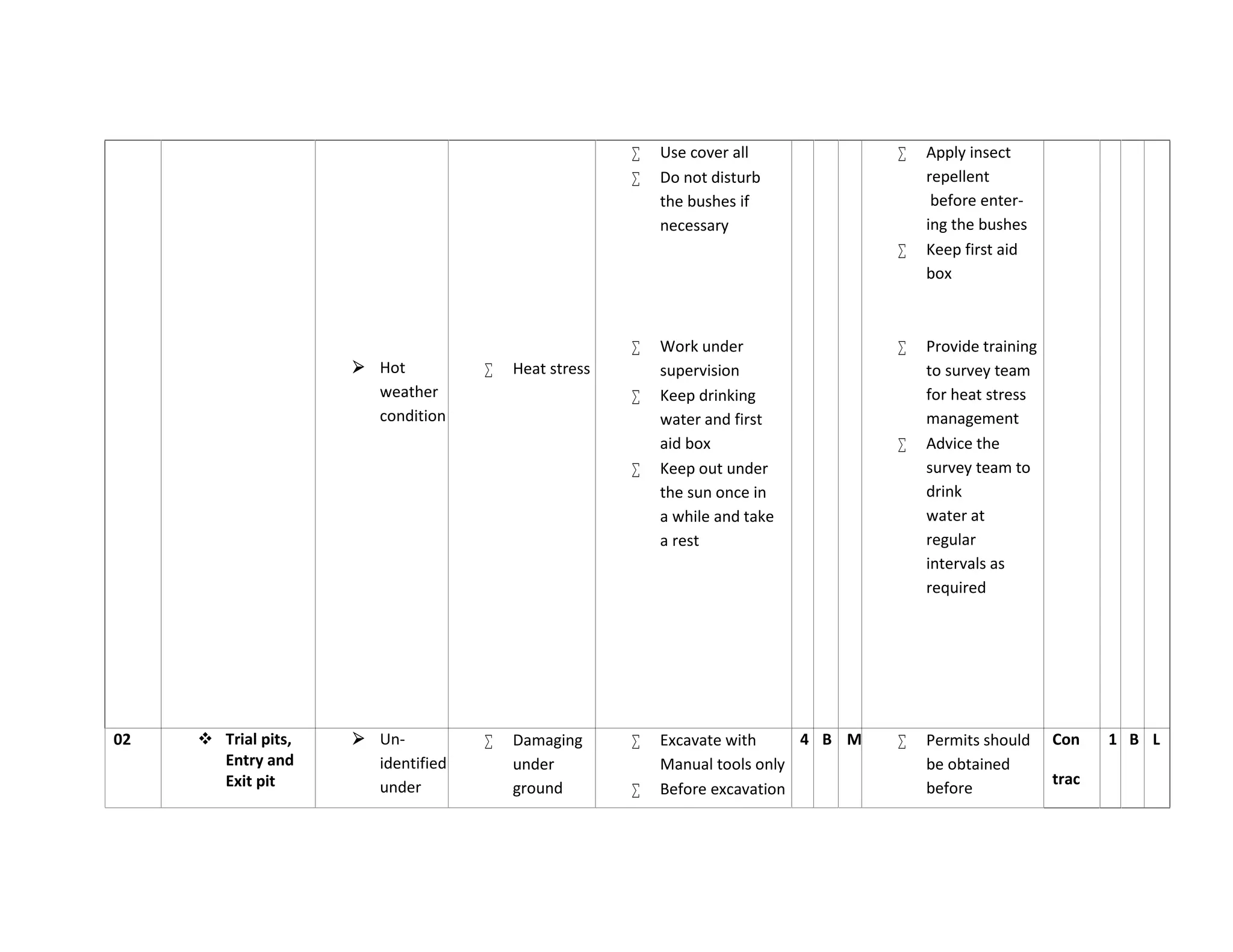
 Hot
weather
condition
 Heat stress
 Use cover all
 Do not disturb
the bushes if
necessary
 Work under
supervision
 Keep drinking
water and first
aid box
 Keep out under
the sun once in
a while and take
a rest
 Apply insect
repellent
before enter-
ing the bushes
 Keep first aid
box
 Provide training
to survey team
for heat stress
management
 Advice the
survey team to
drink
water at
regular
intervals as
required
02  Trial pits,
Entry and
Exit pit
 Un-
identified
under
 Damaging
under
ground
 Excavate with
Manual tools only
 Before excavation
4 B M  Permits should
be obtained
before
Con
trac
1 B L
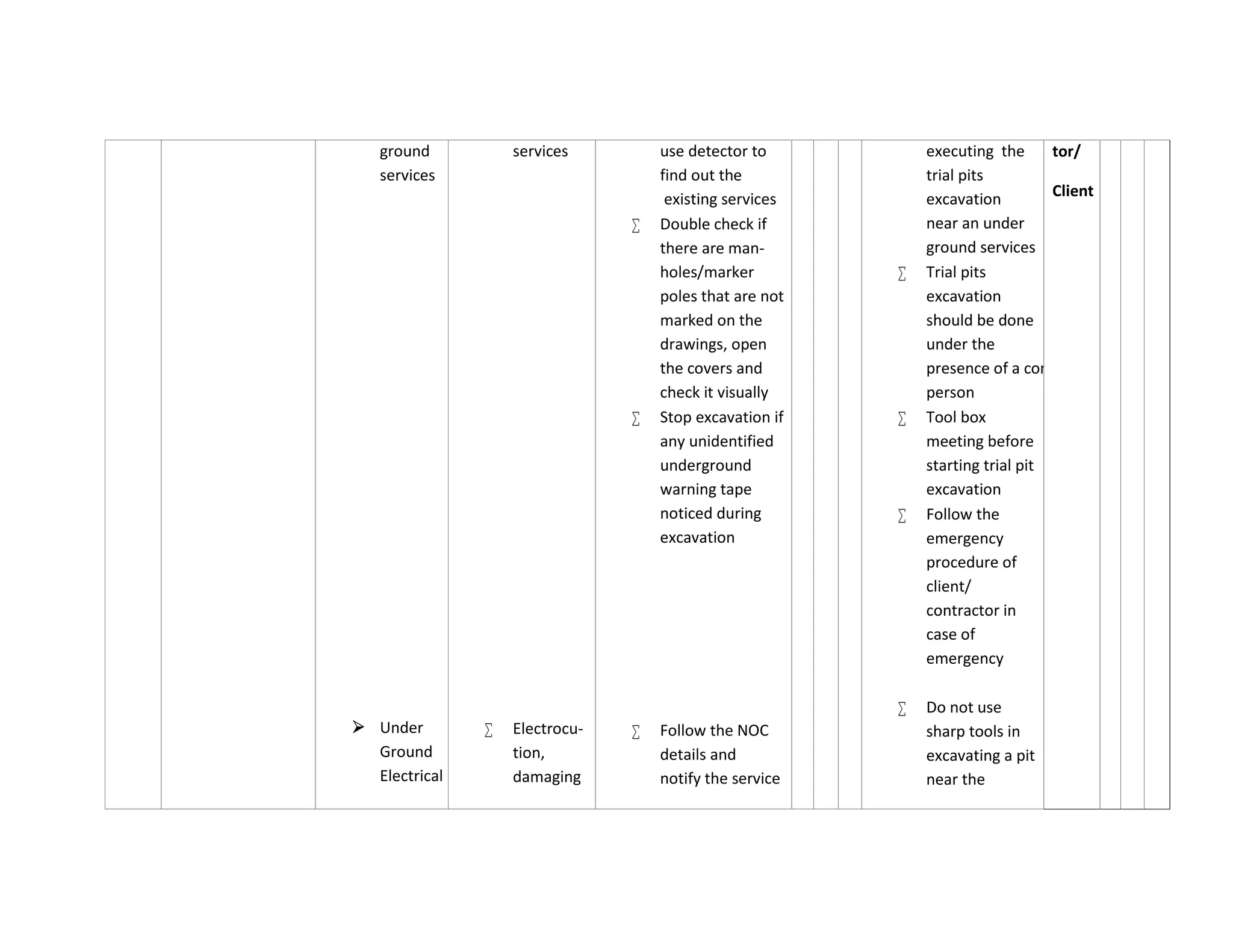
ground
services
 Under
Ground
Electrical
services
 Electrocu-
tion,
damaging
use detector to
find out the
existing services
 Double check if
there are man-
holes/marker
poles that are not
marked on the
drawings, open
the covers and
check it visually
 Stop excavation if
any unidentified
underground
warning tape
noticed during
excavation
 Follow the NOC
details and
notify the service
executing the
trial pits
excavation
near an under
ground services
 Trial pits
excavation
should be done
under the
presence of a competent
person
 Tool box
meeting before
starting trial pit
excavation
 Follow the
emergency
procedure of
client/
contractor in
case of
emergency
 Do not use
sharp tools in
excavating a pit
near the
tor/
Client
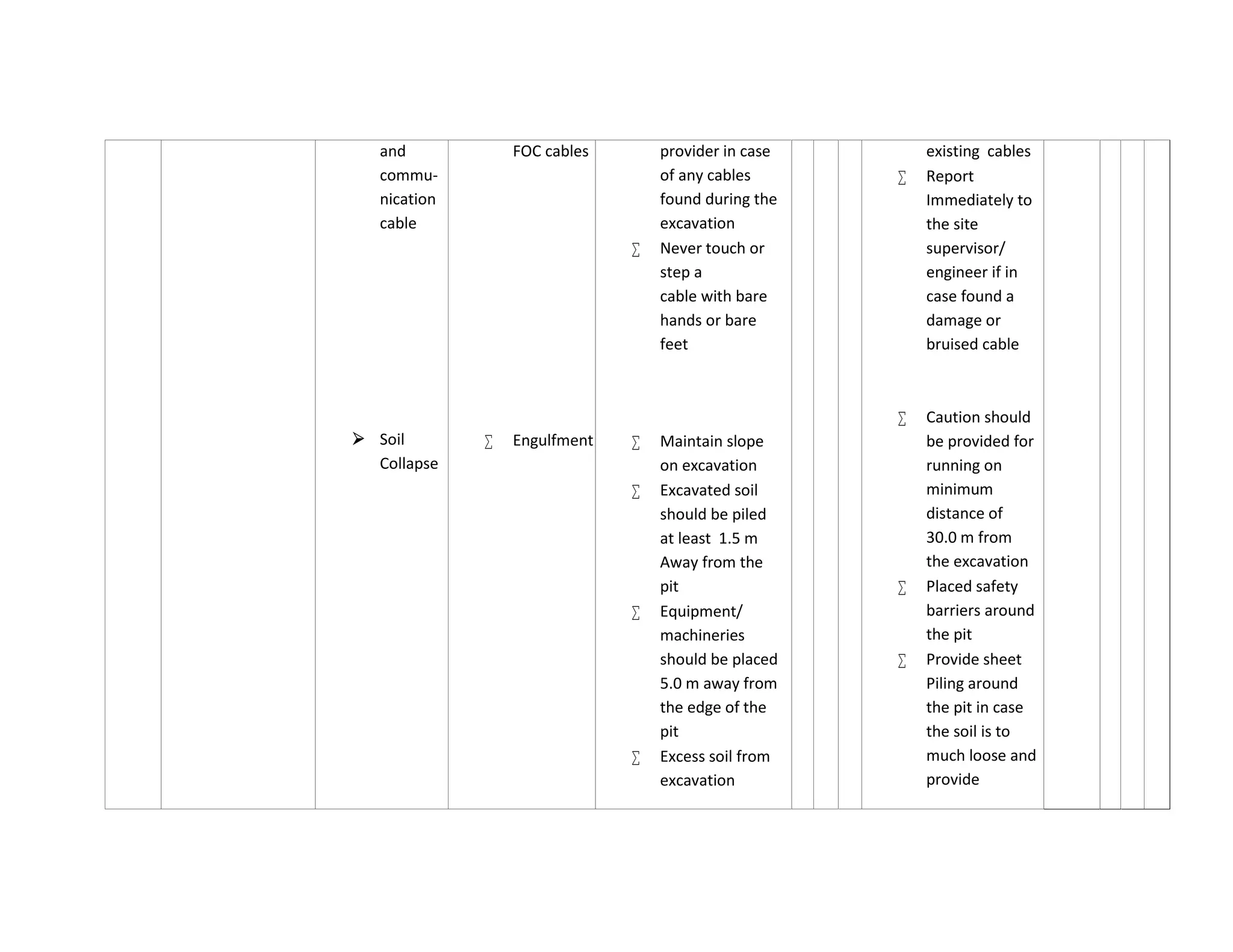
and
commu-
nication
cable
 Soil
Collapse
FOC cables
 Engulfment
provider in case
of any cables
found during the
excavation
 Never touch or
step a
cable with bare
hands or bare
feet
 Maintain slope
on excavation
 Excavated soil
should be piled
at least 1.5 m
Away from the
pit
 Equipment/
machineries
should be placed
5.0 m away from
the edge of the
pit
 Excess soil from
excavation
existing cables
 Report
Immediately to
the site
supervisor/
engineer if in
case found a
damage or
bruised cable
 Caution should
be provided for
running on
minimum
distance of
30.0 m from
the excavation
 Placed safety
barriers around
the pit
 Provide sheet
Piling around
the pit in case
the soil is to
much loose and
provide
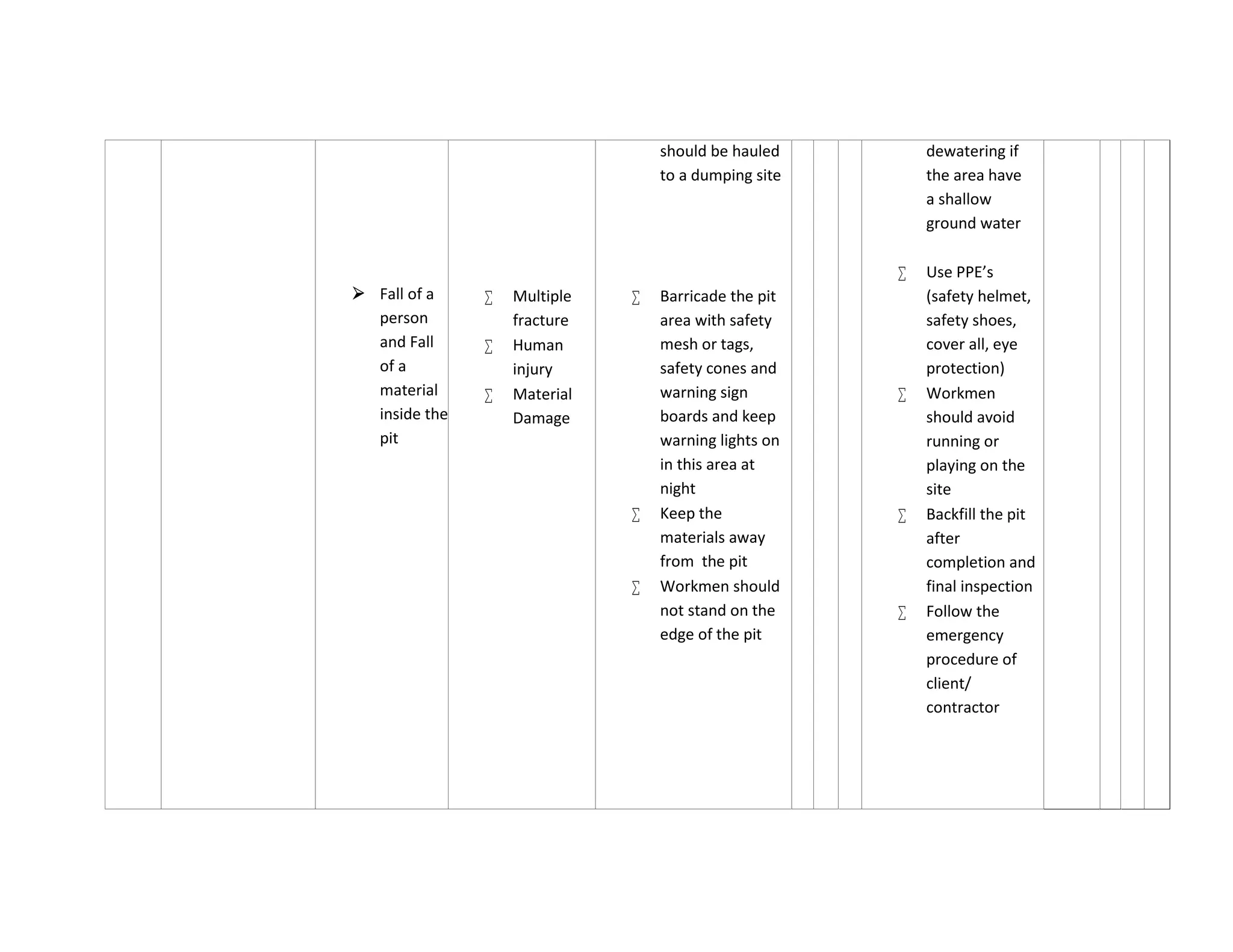
 Fall of a
person
and Fall
of a
material
inside the
pit
 Multiple
fracture
 Human
injury
 Material
Damage
should be hauled
to a dumping site
 Barricade the pit
area with safety
mesh or tags,
safety cones and
warning sign
boards and keep
warning lights on
in this area at
night
 Keep the
materials away
from the pit
 Workmen should
not stand on the
edge of the pit
dewatering if
the area have
a shallow
ground water
 Use PPE’s
(safety helmet,
safety shoes,
cover all, eye
protection)
 Workmen
should avoid
running or
playing on the
site
 Backfill the pit
after
completion and
final inspection
 Follow the
emergency
procedure of
client/
contractor
03
 Horizontal
Directional
Drilling
 Hot
Weather
Condition
 Unidenti-
fied
under
 Heat stress
 Damaging
under
ground
 Keep cool by
drinking water
and electrolyte
 Keep first aid box
 Keep out under
the sun once in
a while and take
a rest
 Work under
supervision
 Follow local
authority work
timing specially at summer
time.
 Trial pits should
be done before
3 C M
 Heat stress
Management
Training
 Advice
workmen to
drink water at
regular intervals
as required
 Details of
Emergency
Contact no. and
Hospital to be
Provided
 Permits should
be obtained
before doing
the drilling
CRD 2 A L
ground
services
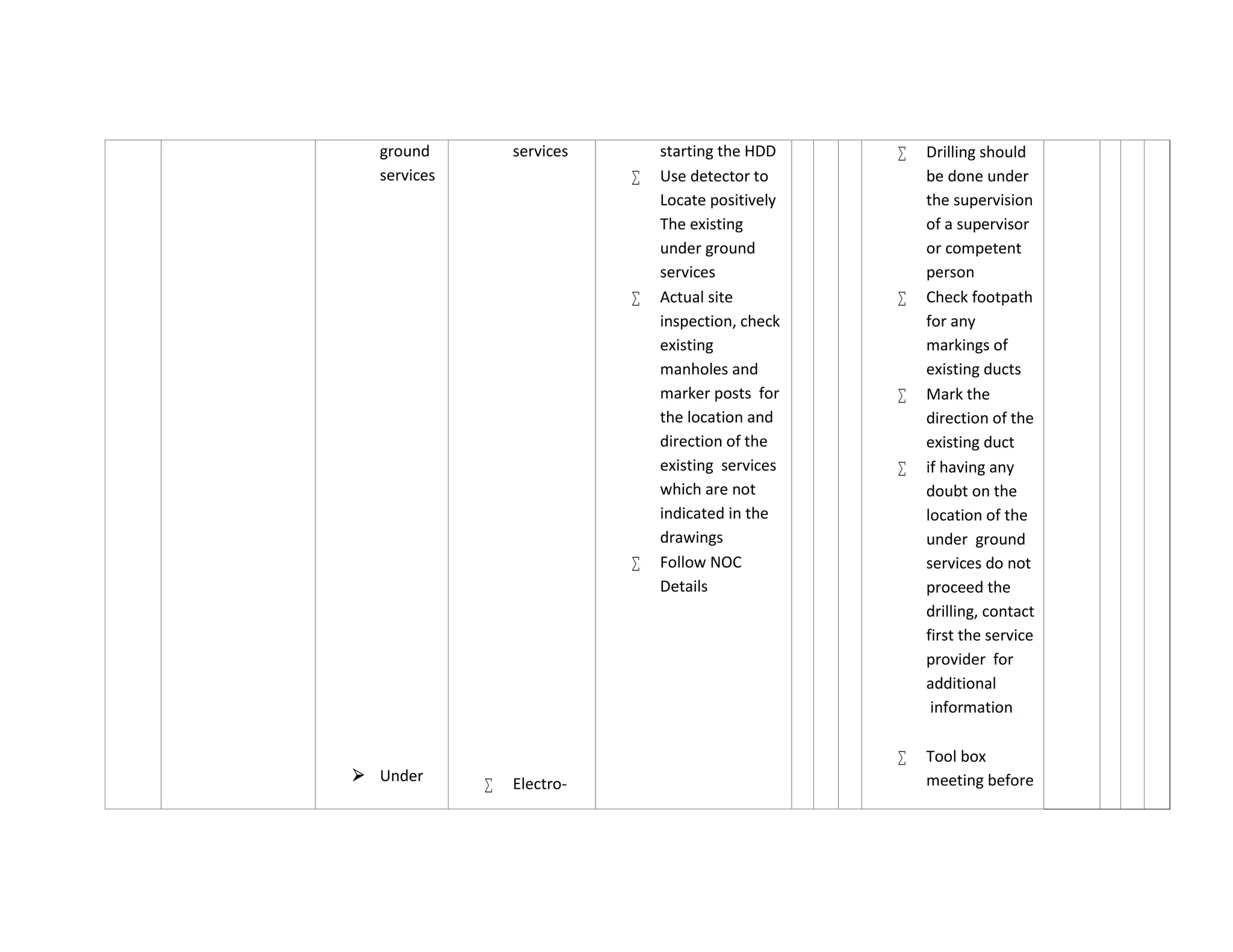
 Under
services
 Electro-
starting the HDD
 Use detector to
Locate positively
The existing
under ground
services
 Actual site
inspection, check
existing
manholes and
marker posts for
the location and
direction of the
existing services
which are not
indicated in the
drawings
 Follow NOC
Details
 Drilling should
be done under
the supervision
of a supervisor
or competent
person
 Check footpath
for any
markings of
existing ducts
 Mark the
direction of the
existing duct
 if having any
doubt on the
location of the
under ground
services do not
proceed the
drilling, contact
first the service
provider for
additional
information
 Tool box
meeting before
ground
electrical
and
com-
muni-
cation
cables
 Rotating
Part of
HDD
cution,
damaging
FOC cable
 Multiple
Fracture/
 Machine earthing
should be
installed
to the ground
before starting
the drilling
 Check the
machine
electric sensor
if properly
working before
starting the HDD
 Provide barricade
around the
machine and pits
to avoid un-
authorized entry
 Barricade the
HDD machine,
starting the
drilling
 Drilling should
be done under
the super-
vision of an
engineer or
supervisor
 Double check
the drawing
and the actual
site condition
to make sure
no existing
cables was
overlooked
 Follow the
emergency
procedure of
client/contrac-
tor
 Use PPE’s
 Caution should
be provided on
a distance of
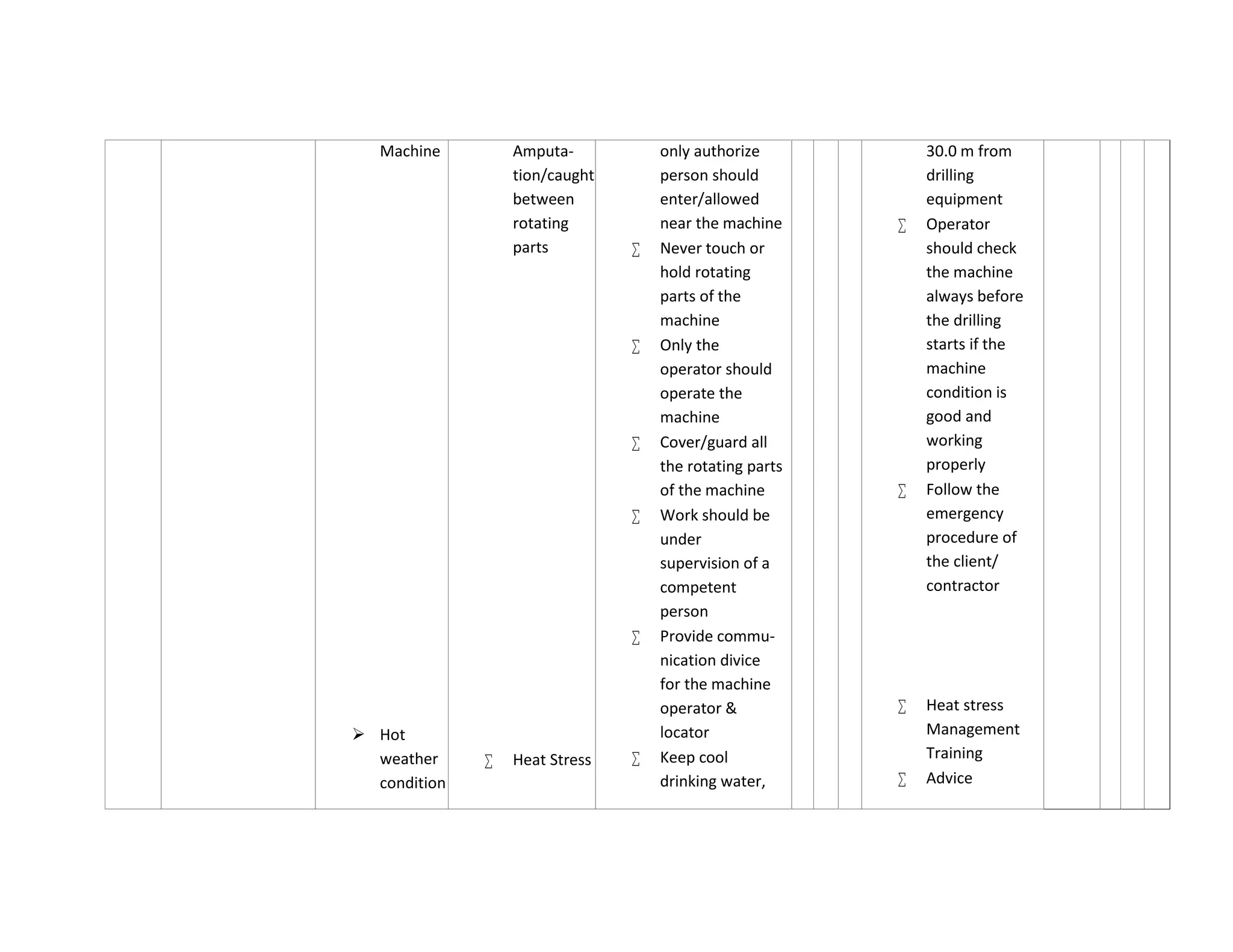
Machine
 Hot
weather
condition
Amputa-
tion/caught
between
rotating
parts
 Heat Stress
only authorize
person should
enter/allowed
near the machine
 Never touch or
hold rotating
parts of the
machine
 Only the
operator should
operate the
machine
 Cover/guard all
the rotating parts
of the machine
 Work should be
under
supervision of a
competent
person
 Provide commu-
nication divice
for the machine
operator &
locator
 Keep cool
drinking water,
30.0 m from
drilling
equipment
 Operator
should check
the machine
always before
the drilling
starts if the
machine
condition is
good and
working
properly
 Follow the
emergency
procedure of
the client/
contractor
 Heat stress
Management
Training
 Advice
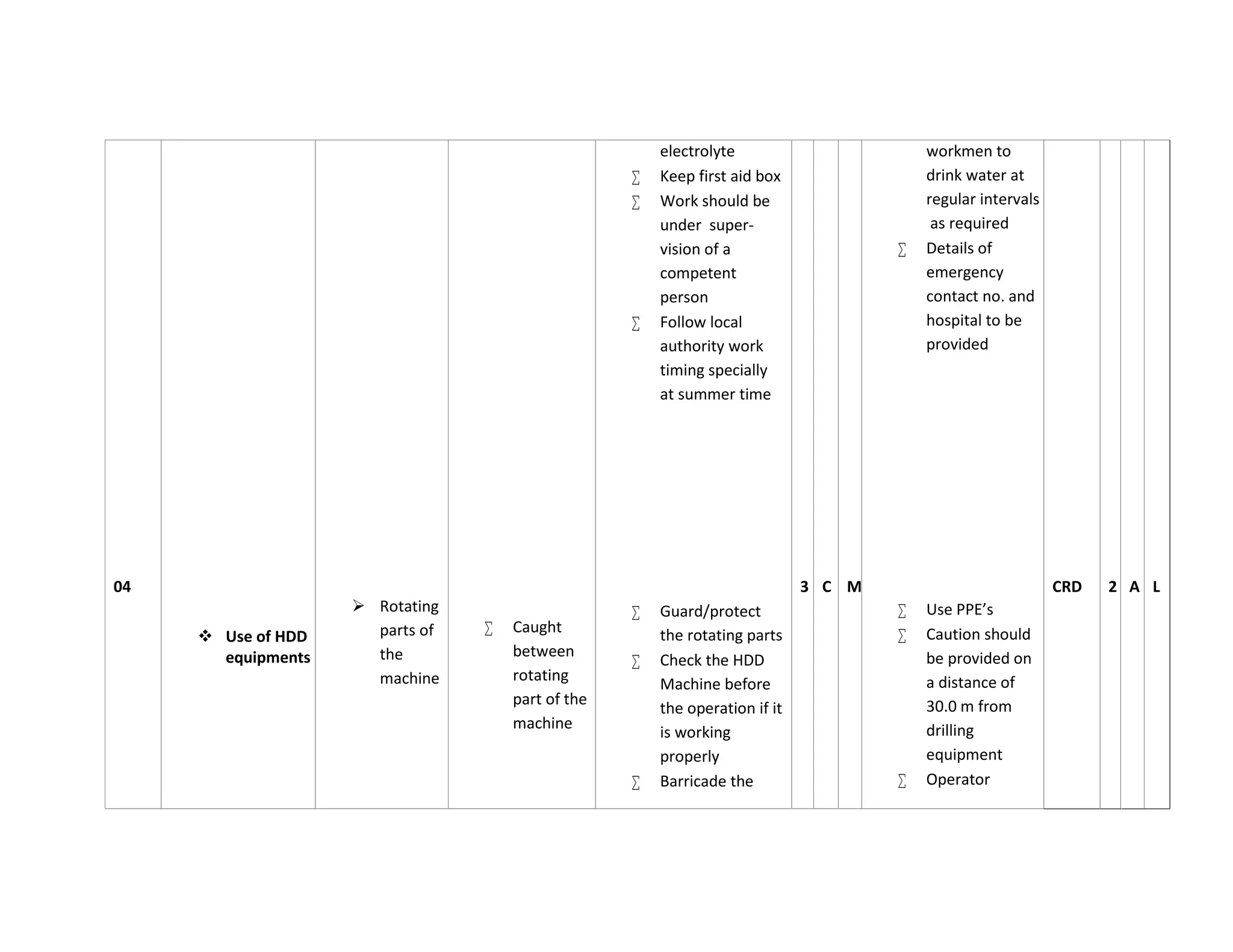
04
 Use of HDD
equipments
 Rotating
parts of
the
machine
 Caught
between
rotating
part of the
machine
electrolyte
 Keep first aid box
 Work should be
under super-
vision of a
competent
person
 Follow local
authority work
timing specially
at summer time
 Guard/protect
the rotating parts
 Check the HDD
Machine before
the operation if it
is working
properly
 Barricade the
3 C M
workmen to
drink water at
regular intervals
as required
 Details of
emergency
contact no. and
hospital to be
provided
 Use PPE’s
 Caution should
be provided on
a distance of
30.0 m from
drilling
equipment
 Operator
CRD 2 A L
 Un-
Balanced
Ground
 Damage of
the
HDD machine,
only authorize
person should
enter/allowed
near the machine
 Never touch or
hold rotating
parts of the
machine
 Only the
operator should
operate the
machine
 Work should be
under
supervision of a
competent
person
 Before placing
the HDD machine
should check
the machine
always before
the drilling
starts if the
machine
condition is
good and
working
properly
 Follow the
emergency
procedure of
the client/
contractor
 Inspect the
equipment
daily for its
fitness before
starting the
operation
 Checked
operator
competency
certificate
 Check the
compaction of
 Non cir-
culation
of fluid
through
drill
stem
equipment
 Damage on
the electro-
nic tracking
com-
ponents in
the drill
head
check the ground
condition, it must
be hard and
compacted
 Never put the
machine/
equipment
directly on the
top of a man-
holes
 Check the water
Tanker and
mixing unit tanks
if have sufficient
water for the
HDD
 Check the fluid
hose if it is free
of Solidified
drilling fluid
 Do not let any
vehicles or
ground
 Put the
equipment on
a level ground
 Provide
Wooden planks
underneath
the ramps
 Checked the
machine/
equipment
fitness
certificate
 Tool box
meeting
before the
HDD starts
 Use PPE’s
 Workmen
should not stay
near the fluid
hose
 Oil
Leakage
 Slips
equipment step
unto the fluid
hose
 Barricade the
machine area
with safety mesh,
safety tags,
safety cones and
warning sign
boards
 During night
operation keep
the warning
lights always on
 Use Biodegradable
Hydraulic Oil
 Prior to operation,
inspect drilling
equipment if free
of leaks
 Check Valves
regularly/fitted
where
appropriate
 Do not step on
Oil
 Spill kits stocked
On site
 Noise  Permanent
hearing
disability
 Provide sound
deadening barriers
if problem with
local residents
 Use proper
PPE’s
 Sign area of
high noise
Received By:
General Manager
Cross Road Drilling
Name: Elie Tadros
Signature:
Date:
Approved by:
Client:
Name:
Signature:
Date:
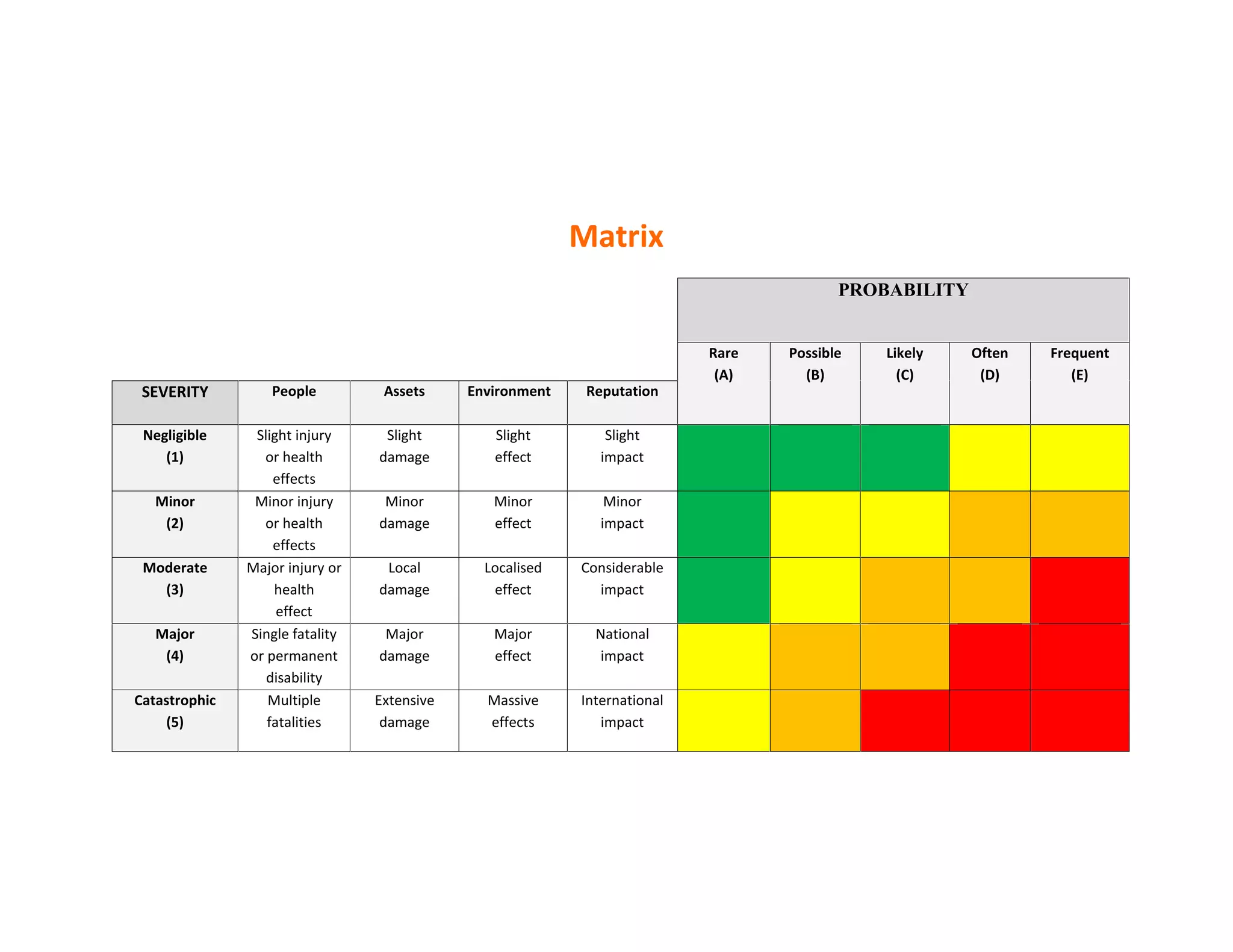
Matrix
PROBABILITY
Rare
(A)
Possible
(B)
Likely
(C)
Often
(D)
Frequent
(E)
SEVERITY People Assets Environment Reputation
Negligible
(1)
Slight injury
or health
effects
Slight
damage
Slight
effect
Slight
impact
Minor
(2)
Minor injury
or health
effects
Minor
damage
Minor
effect
Minor
impact
Moderate
(3)
Major injury or
health
effect
Local
damage
Localised
effect
Considerable
impact
Major
(4)
Single fatality
or permanent
disability
Major
damage
Major
effect
National
impact
Catastrophic
(5)
Multiple
fatalities
Extensive
damage
Massive
effects
International
impact
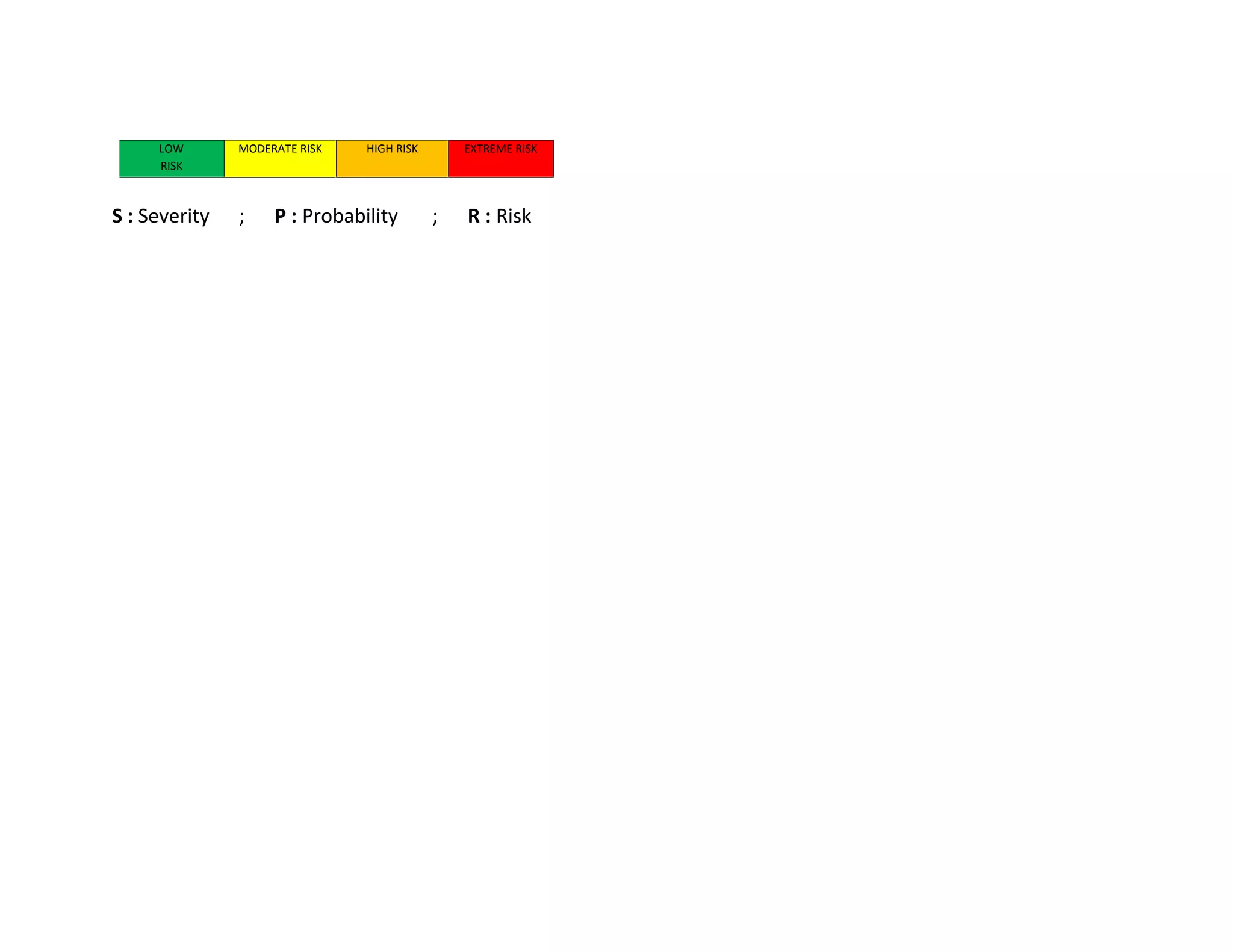
LOW
RISK
MODERATE RISK HIGH RISK EXTREME RISK
S : Severity ; P : Probability ; R : Risk

Task Risk Worksheet Rev1.pdf

  • 1.
    CROSS ROAD DRILLINGL.L.C. RISK ASSESSMENT WORKSHEET TASK RISK ASSESSMENT WORKSHEET TASK RISK DESCRIPTION HORIZONTAL DIRECTIONAL DRILLING PROJECT NO. Ruwais Housing Complex Expansion –Phase IV Construction of Building – Package 4 Agreement Documents No.147010C6 TRA TEAM MEMBER/S GLENN DONCERAS DATE November 3, 2015 W STEP NO. DESCRIPTION OF TASK STEP HAZARD CONSEQUENCES PEOPLE, ENVIRONMENT, ASSETS, REPUTATION CONTROLS PREVENT, DETECT, CONTROL, MITIGATE BASELINE RISK ADDITIONAL CONTROL MEASURES OR ACTIONS RESP. PARTY RESIDUAL RISK RISK S P R S P R 01  Site survey before HDD  Working in restricted zone  Insect Bites  Unknown work area hazard  Insect Poisoning  Look for the signboards available at site  Obtain necessary permit before entering a restricted zone  Use safety shoes with high ankle 3 C M  Follow the signboard instruction  Do not explore outside the site perimeter  Don’t rest near Bushes CRD 2 A L
  • 2.
     Hot weather condition  Heatstress  Use cover all  Do not disturb the bushes if necessary  Work under supervision  Keep drinking water and first aid box  Keep out under the sun once in a while and take a rest  Apply insect repellent before enter- ing the bushes  Keep first aid box  Provide training to survey team for heat stress management  Advice the survey team to drink water at regular intervals as required 02  Trial pits, Entry and Exit pit  Un- identified under  Damaging under ground  Excavate with Manual tools only  Before excavation 4 B M  Permits should be obtained before Con trac 1 B L
  • 3.
    ground services  Under Ground Electrical services  Electrocu- tion, damaging usedetector to find out the existing services  Double check if there are man- holes/marker poles that are not marked on the drawings, open the covers and check it visually  Stop excavation if any unidentified underground warning tape noticed during excavation  Follow the NOC details and notify the service executing the trial pits excavation near an under ground services  Trial pits excavation should be done under the presence of a competent person  Tool box meeting before starting trial pit excavation  Follow the emergency procedure of client/ contractor in case of emergency  Do not use sharp tools in excavating a pit near the tor/ Client
  • 4.
    and commu- nication cable  Soil Collapse FOC cables Engulfment provider in case of any cables found during the excavation  Never touch or step a cable with bare hands or bare feet  Maintain slope on excavation  Excavated soil should be piled at least 1.5 m Away from the pit  Equipment/ machineries should be placed 5.0 m away from the edge of the pit  Excess soil from excavation existing cables  Report Immediately to the site supervisor/ engineer if in case found a damage or bruised cable  Caution should be provided for running on minimum distance of 30.0 m from the excavation  Placed safety barriers around the pit  Provide sheet Piling around the pit in case the soil is to much loose and provide
  • 5.
     Fall ofa person and Fall of a material inside the pit  Multiple fracture  Human injury  Material Damage should be hauled to a dumping site  Barricade the pit area with safety mesh or tags, safety cones and warning sign boards and keep warning lights on in this area at night  Keep the materials away from the pit  Workmen should not stand on the edge of the pit dewatering if the area have a shallow ground water  Use PPE’s (safety helmet, safety shoes, cover all, eye protection)  Workmen should avoid running or playing on the site  Backfill the pit after completion and final inspection  Follow the emergency procedure of client/ contractor
  • 6.
    03  Horizontal Directional Drilling  Hot Weather Condition Unidenti- fied under  Heat stress  Damaging under ground  Keep cool by drinking water and electrolyte  Keep first aid box  Keep out under the sun once in a while and take a rest  Work under supervision  Follow local authority work timing specially at summer time.  Trial pits should be done before 3 C M  Heat stress Management Training  Advice workmen to drink water at regular intervals as required  Details of Emergency Contact no. and Hospital to be Provided  Permits should be obtained before doing the drilling CRD 2 A L
  • 7.
    ground services  Under services  Electro- startingthe HDD  Use detector to Locate positively The existing under ground services  Actual site inspection, check existing manholes and marker posts for the location and direction of the existing services which are not indicated in the drawings  Follow NOC Details  Drilling should be done under the supervision of a supervisor or competent person  Check footpath for any markings of existing ducts  Mark the direction of the existing duct  if having any doubt on the location of the under ground services do not proceed the drilling, contact first the service provider for additional information  Tool box meeting before
  • 8.
    ground electrical and com- muni- cation cables  Rotating Part of HDD cution, damaging FOCcable  Multiple Fracture/  Machine earthing should be installed to the ground before starting the drilling  Check the machine electric sensor if properly working before starting the HDD  Provide barricade around the machine and pits to avoid un- authorized entry  Barricade the HDD machine, starting the drilling  Drilling should be done under the super- vision of an engineer or supervisor  Double check the drawing and the actual site condition to make sure no existing cables was overlooked  Follow the emergency procedure of client/contrac- tor  Use PPE’s  Caution should be provided on a distance of
  • 9.
    Machine  Hot weather condition Amputa- tion/caught between rotating parts  HeatStress only authorize person should enter/allowed near the machine  Never touch or hold rotating parts of the machine  Only the operator should operate the machine  Cover/guard all the rotating parts of the machine  Work should be under supervision of a competent person  Provide commu- nication divice for the machine operator & locator  Keep cool drinking water, 30.0 m from drilling equipment  Operator should check the machine always before the drilling starts if the machine condition is good and working properly  Follow the emergency procedure of the client/ contractor  Heat stress Management Training  Advice
  • 10.
    04  Use ofHDD equipments  Rotating parts of the machine  Caught between rotating part of the machine electrolyte  Keep first aid box  Work should be under super- vision of a competent person  Follow local authority work timing specially at summer time  Guard/protect the rotating parts  Check the HDD Machine before the operation if it is working properly  Barricade the 3 C M workmen to drink water at regular intervals as required  Details of emergency contact no. and hospital to be provided  Use PPE’s  Caution should be provided on a distance of 30.0 m from drilling equipment  Operator CRD 2 A L
  • 11.
     Un- Balanced Ground  Damageof the HDD machine, only authorize person should enter/allowed near the machine  Never touch or hold rotating parts of the machine  Only the operator should operate the machine  Work should be under supervision of a competent person  Before placing the HDD machine should check the machine always before the drilling starts if the machine condition is good and working properly  Follow the emergency procedure of the client/ contractor  Inspect the equipment daily for its fitness before starting the operation  Checked operator competency certificate  Check the compaction of
  • 12.
     Non cir- culation offluid through drill stem equipment  Damage on the electro- nic tracking com- ponents in the drill head check the ground condition, it must be hard and compacted  Never put the machine/ equipment directly on the top of a man- holes  Check the water Tanker and mixing unit tanks if have sufficient water for the HDD  Check the fluid hose if it is free of Solidified drilling fluid  Do not let any vehicles or ground  Put the equipment on a level ground  Provide Wooden planks underneath the ramps  Checked the machine/ equipment fitness certificate  Tool box meeting before the HDD starts  Use PPE’s  Workmen should not stay near the fluid hose
  • 13.
     Oil Leakage  Slips equipmentstep unto the fluid hose  Barricade the machine area with safety mesh, safety tags, safety cones and warning sign boards  During night operation keep the warning lights always on  Use Biodegradable Hydraulic Oil  Prior to operation, inspect drilling equipment if free of leaks  Check Valves regularly/fitted where appropriate  Do not step on Oil  Spill kits stocked On site
  • 14.
     Noise Permanent hearing disability  Provide sound deadening barriers if problem with local residents  Use proper PPE’s  Sign area of high noise Received By: General Manager Cross Road Drilling Name: Elie Tadros Signature: Date: Approved by: Client: Name: Signature: Date:
  • 15.
    Matrix PROBABILITY Rare (A) Possible (B) Likely (C) Often (D) Frequent (E) SEVERITY People AssetsEnvironment Reputation Negligible (1) Slight injury or health effects Slight damage Slight effect Slight impact Minor (2) Minor injury or health effects Minor damage Minor effect Minor impact Moderate (3) Major injury or health effect Local damage Localised effect Considerable impact Major (4) Single fatality or permanent disability Major damage Major effect National impact Catastrophic (5) Multiple fatalities Extensive damage Massive effects International impact
  • 16.
    LOW RISK MODERATE RISK HIGHRISK EXTREME RISK S : Severity ; P : Probability ; R : Risk