COMPARE DIGITAL PUBLISHING
TECHNIQUES WITH TRADITIONAL
PUBLISHING TECHNIQUES
WHICH TRADITIONAL TECHNIQUES,
TECHNOLOGY AND PRINTING WERE USED FOR
PRINT PRODUCTS?
Woodblock printing
Lithography
Chromolithography
Hectograph
Offset printing
Screen printing
Xerography
3D printing
Digital printing
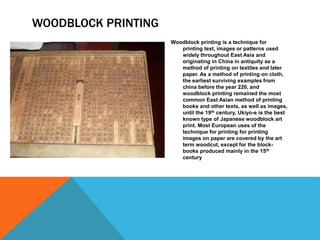
WOODBLOCK PRINTING
Woodblock printing is a technique for
printing text, images or patterns used
widely throughout East Asia and
originating in China in antiquity as a
method of printing on textiles and later
paper. As a method of printing on cloth,
the earliest surviving examples from
china before the year 220, and
woodblock printing remained the most
common East Asian method of printing
books and other texts, as well as images,
until the 19th century, Ukiyo-e is the best
known type of Japanese woodblock art
print. Most European uses of the
technique for printing for printing
images on paper are covered by the art
term woodcut, except for the block-
books produced mainly in the 15th
century
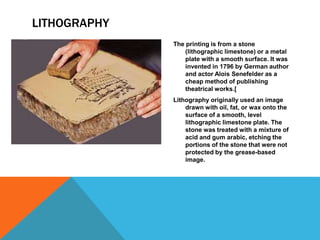
LITHOGRAPHY
The printing is from a stone
(lithographic limestone) or a metal
plate with a smooth surface. It was
invented in 1796 by German author
and actor Alois Senefelder as a
cheap method of publishing
theatrical works.[
Lithography originally used an image
drawn with oil, fat, or wax onto the
surface of a smooth, level
lithographic limestone plate. The
stone was treated with a mixture of
acid and gum arabic, etching the
portions of the stone that were not
protected by the grease-based
image.
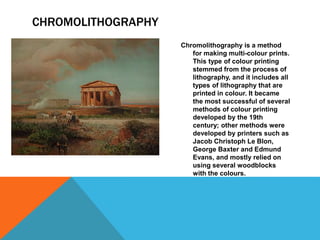
CHROMOLITHOGRAPHY
Chromolithography is a method
for making multi-colour prints.
This type of colour printing
stemmed from the process of
lithography, and it includes all
types of lithography that are
printed in colour. It became
the most successful of several
methods of colour printing
developed by the 19th
century; other methods were
developed by printers such as
Jacob Christoph Le Blon,
George Baxter and Edmund
Evans, and mostly relied on
using several woodblocks
with the colours.
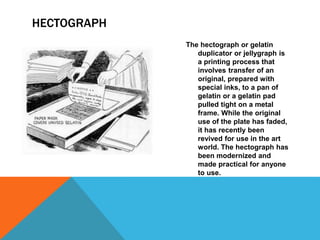
HECTOGRAPH
The hectograph or gelatin
duplicator or jellygraph is
a printing process that
involves transfer of an
original, prepared with
special inks, to a pan of
gelatin or a gelatin pad
pulled tight on a metal
frame. While the original
use of the plate has faded,
it has recently been
revived for use in the art
world. The hectograph has
been modernized and
made practical for anyone
to use.
OFFSET PRINTING
Offset printing is a commonly used
technique in which the inked
image is transferred (or “offset”)
from a plate to a rubber blanket,
then to the printing surface. When
used in combination with the
lithographic process, which is
based on the repulsion of oil and
water, the offset technique
employs a flat (planographic)
image carrier on which the image
to be printed obtains ink from ink
rollers, while the non-printing area
attracts a water-based film (called
“fountain solution”), keeping the
non-printing areas ink-free. The
modern “web” process feeds a
large reel of paper through a large
press machine in several parts,
typically for several metres, which
then prints continuously as the
paper is fed through.
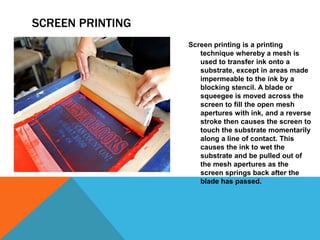
SCREEN PRINTING
Screen printing is a printing
technique whereby a mesh is
used to transfer ink onto a
substrate, except in areas made
impermeable to the ink by a
blocking stencil. A blade or
squeegee is moved across the
screen to fill the open mesh
apertures with ink, and a reverse
stroke then causes the screen to
touch the substrate momentarily
along a line of contact. This
causes the ink to wet the
substrate and be pulled out of
the mesh apertures as the
screen springs back after the
blade has passed.
XEROGRAPHY
Xerography or electrophotography
is a dry photocopying
technique. Its fundamental
principle was invented by
Hungarian physicist Pál Selényi
and based on Selényi's
publications Chester Carlson
applied for and was awarded
U.S. Patent 2,297,691 on
October 6, 1942. The technique
was originally called
electrophotography. It was later
renamed xerography—from the
Greek roots ξηρός xeros, "dry"
and -γραφία -graphia,
"writing"—to emphasize that,
unlike reproduction techniques
then in use such as cyanotype,
this process used no liquid
chemicals.[1]
3D PRINTING
3D printing, also known as
additive manufacturing
(AM), refers to various
processes used to
synthesize a three-
dimensional object.[1] In
3D printing, successive
layers of material are
formed under computer
control to create an
object.[2] These objects
can be of almost any
shape or geometry and are
produced from a 3D model
or other electronic data
source. A 3D printer is a
type of industrial robot.
DIGITAL PRINTING Digital printing refers to methods
of printing from a digital-
based image directly to a
variety of media.[1] It usually
refers to professional printing
where small-run jobs from
desktop publishing and other
digital sources are printed
using large-format and/or
high-volume laser or inkjet
printers. Digital printing has a
higher cost per page than
more traditional offset printing
methods, but this price is
usually offset by avoiding the
cost of all the technical steps
required to make printing
plates. It also allows for on-
demand printing, short
turnaround time, and even a
modification of the image
(variable data) used for each
impression.[2]

Task 2 - printing techniques

  • 1.
    COMPARE DIGITAL PUBLISHING TECHNIQUESWITH TRADITIONAL PUBLISHING TECHNIQUES
  • 2.
    WHICH TRADITIONAL TECHNIQUES, TECHNOLOGYAND PRINTING WERE USED FOR PRINT PRODUCTS? Woodblock printing Lithography Chromolithography Hectograph Offset printing Screen printing Xerography 3D printing Digital printing
  • 3.
    WOODBLOCK PRINTING Woodblock printingis a technique for printing text, images or patterns used widely throughout East Asia and originating in China in antiquity as a method of printing on textiles and later paper. As a method of printing on cloth, the earliest surviving examples from china before the year 220, and woodblock printing remained the most common East Asian method of printing books and other texts, as well as images, until the 19th century, Ukiyo-e is the best known type of Japanese woodblock art print. Most European uses of the technique for printing for printing images on paper are covered by the art term woodcut, except for the block- books produced mainly in the 15th century
  • 4.
    LITHOGRAPHY The printing isfrom a stone (lithographic limestone) or a metal plate with a smooth surface. It was invented in 1796 by German author and actor Alois Senefelder as a cheap method of publishing theatrical works.[ Lithography originally used an image drawn with oil, fat, or wax onto the surface of a smooth, level lithographic limestone plate. The stone was treated with a mixture of acid and gum arabic, etching the portions of the stone that were not protected by the grease-based image.
  • 5.
    CHROMOLITHOGRAPHY Chromolithography is amethod for making multi-colour prints. This type of colour printing stemmed from the process of lithography, and it includes all types of lithography that are printed in colour. It became the most successful of several methods of colour printing developed by the 19th century; other methods were developed by printers such as Jacob Christoph Le Blon, George Baxter and Edmund Evans, and mostly relied on using several woodblocks with the colours.
  • 6.
    HECTOGRAPH The hectograph orgelatin duplicator or jellygraph is a printing process that involves transfer of an original, prepared with special inks, to a pan of gelatin or a gelatin pad pulled tight on a metal frame. While the original use of the plate has faded, it has recently been revived for use in the art world. The hectograph has been modernized and made practical for anyone to use.
  • 7.
    OFFSET PRINTING Offset printingis a commonly used technique in which the inked image is transferred (or “offset”) from a plate to a rubber blanket, then to the printing surface. When used in combination with the lithographic process, which is based on the repulsion of oil and water, the offset technique employs a flat (planographic) image carrier on which the image to be printed obtains ink from ink rollers, while the non-printing area attracts a water-based film (called “fountain solution”), keeping the non-printing areas ink-free. The modern “web” process feeds a large reel of paper through a large press machine in several parts, typically for several metres, which then prints continuously as the paper is fed through.
  • 8.
    SCREEN PRINTING Screen printingis a printing technique whereby a mesh is used to transfer ink onto a substrate, except in areas made impermeable to the ink by a blocking stencil. A blade or squeegee is moved across the screen to fill the open mesh apertures with ink, and a reverse stroke then causes the screen to touch the substrate momentarily along a line of contact. This causes the ink to wet the substrate and be pulled out of the mesh apertures as the screen springs back after the blade has passed.
  • 9.
    XEROGRAPHY Xerography or electrophotography isa dry photocopying technique. Its fundamental principle was invented by Hungarian physicist Pál Selényi and based on Selényi's publications Chester Carlson applied for and was awarded U.S. Patent 2,297,691 on October 6, 1942. The technique was originally called electrophotography. It was later renamed xerography—from the Greek roots ξηρός xeros, "dry" and -γραφία -graphia, "writing"—to emphasize that, unlike reproduction techniques then in use such as cyanotype, this process used no liquid chemicals.[1]
  • 10.
    3D PRINTING 3D printing,also known as additive manufacturing (AM), refers to various processes used to synthesize a three- dimensional object.[1] In 3D printing, successive layers of material are formed under computer control to create an object.[2] These objects can be of almost any shape or geometry and are produced from a 3D model or other electronic data source. A 3D printer is a type of industrial robot.
  • 11.
    DIGITAL PRINTING Digitalprinting refers to methods of printing from a digital- based image directly to a variety of media.[1] It usually refers to professional printing where small-run jobs from desktop publishing and other digital sources are printed using large-format and/or high-volume laser or inkjet printers. Digital printing has a higher cost per page than more traditional offset printing methods, but this price is usually offset by avoiding the cost of all the technical steps required to make printing plates. It also allows for on- demand printing, short turnaround time, and even a modification of the image (variable data) used for each impression.[2]