Marketing & PR
Task 2 – Case Study
Patrick Gouldsbrough
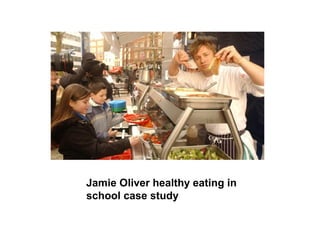
Jamie Oliver healthy eating in
school case study
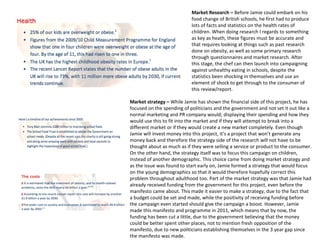
Market Research – Before Jamie could embark on his
food change of British schools, he first had to produce
lots of facts and statistics on the health rates of
children. When doing research I regards to something
as key as heath, these figures must be accurate and
that requires looking at things such as past research
done on obesity, as well as some primary research
through questionnaires and market research. After
this stage, the chef can then launch into campaigning
against unhealthy eating in schools, despite the
statistics been shocking in themselves and use an
element of shock to get through to the consumer of
this review/report.
Market strategy – While Jamie has shown the financial side of this project, he has
focused on the spending of politicians and the government and not set it out like a
normal marketing and PR company would; displaying their spending and how they
would use this to fit into the market and if they will attempt to break into a
different market or if they would create a new market completely. Even though
Jamie will invest money into this project, it’s a project that won’t generate any
money back and therefore the strategy side of the research will not have to be
thought about as much as if they were selling a service or product to the consumer.
On the other hand, the strategy itself was to focus this campaign on children,
instead of another demographic. This choice came from doing market strategy and
as the issue was found to start early on, Jamie formed a strategy that would focus
on the young demographics so that it would therefore hopefully correct this
problem throughout adulthood too. Part of the market strategy was that Jamie had
already received funding from the government for this project, even before the
manifesto came about. This made it easier to make a strategy, due to the fact that
a budget could be set and made, while the positivity of receiving funding before
the campaign even started should give the campaign a boost. However, Jamie
made this manifesto and programme in 2011, which means that by now, the
funding has been cut a little, due to the government believing that the money
could be better spent other places, not to mention fresh opposition of the
manifesto, due to new politicians establishing themselves in the 3 year gap since
the manifesto was made.
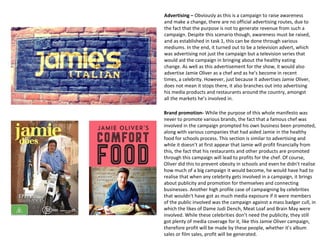
Advertising – Obviously as this is a campaign to raise awareness
and make a change, there are no official advertising routes, due to
the fact that the purpose is not to generate revenue from such a
campaign. Despite this scenario though, awareness must be raised,
and as established in task 1, this can be done through various
mediums. In the end, it turned out to be a television advert, which
was advertising not just the campaign but a television series that
would aid the campaign in bringing about the healthy eating
change. As well as this advertisement for the show, it would also
advertise Jamie Oliver as a chef and as he’s become in recent
times, a celebrity. However, just because it advertises Jamie Oliver,
does not mean it stops there, it also branches out into advertising
his media products and restaurants around the country, amongst
all the markets he’s involved in.
Brand promotion- While the purpose of this whole manifesto was
never to promote various brands, the fact that a famous chef was
involved in the campaign prompted his own business been promoted,
along with various companies that had aided Jamie in the healthy
food for schools process. This section is similar to advertising and
while it doesn’t at first appear that Jamie will profit financially from
this, the fact that his restaurants and other products are promoted
through this campaign will lead to profits for the chef. Of course,
Oliver did this to prevent obesity in schools and even he didn’t realise
how much of a big campaign it would become, he would have had to
realise that when any celebrity gets involved in a campaign, it brings
about publicity and promotion for themselves and connecting
businesses. Another high profile case of campaigning by celebrities
that wouldn't have got as much media exposure if it were members
of the public involved was the campaign against a mass badger cull, in
which the likes of Dame Judi Dench, Meat Loaf and Brain May were
involved. While these celebrities don’t need the publicity, they still
got plenty of media coverage for it, like this Jamie Oliver campaign,
therefore profit will be made by these people, whether it’s album
sales or film sales, profit will be generated.
Managing the message – Like any other campaign, profit based or otherwise, needs a
slogan/tag-line. The function of this textual element is to be memorable while been short and
concise so it won’t bore the consumer with information. For the slogan, Jamie has decided to
go for the guilt element of trying to make it sound like the children he’s campaigning for have
written it. This message will sway a lot of consumers and get a lot of people onside, which is
the purpose of this whole manifesto; Jamie hasn’t done this to fight the politicians alone, he
needs to help of the schools and most of all, the public. Due to the huge impact this message
could have on the campaign, this slogan will have been researched and experimented with in
various ways to get it to where it is now. For example, if they had a tag-line that didn’t sway the
consumer of the manifesto or the television show, it wouldn’t have worked as well as it did and
change wouldn’t have been made, therefore Jamie’s work would have been wasted to try and
bring about this change. A big part of making the campaign successful itself was to show kids
that healthy eating was a good thing. For example, if the parents and Jamie thought it was a
good idea but the kids didn’t like the idea, the campaign wouldn’t have even got off the
ground. This prompted Jamie to advertise and try and entice the young demographic he was
trying to make healthier with media products, such as adverts. The childlike aesthetics of the
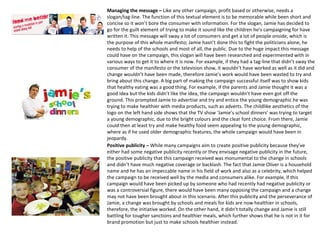
logo on the left hand side shows that the TV show ‘Jamie’s school dinners’ was trying to target
a young demographic, due to the bright colours and the clear font choice. From there, Jamie
could then at least try and make healthy food seem appealing to the young demographic,
where as if he used older demographic features, the whole campaign would have been in
jeopardy.
Positive publicity – While many campaigns aim to create positive publicity because they’ve
either had some negative publicity recently or they envisage negative publicity in the future,
the positive publicity that this campaign received was monumental to the change in schools
and didn’t have much negative coverage or backlash. The fact that Jamie Oliver is a household
name and he has an impeccable name in his field of work and also as a celebrity, which helped
the campaign to be received well by the media and consumers alike. For example, if this
campaign would have been picked up by someone who had recently had negative publicity or
was a controversial figure, there would have been many opposing the campaign and a change
may not have been brought about in this scenario. After this publicity and the perseverance of
Jamie, a change was brought by schools and meals for kids are now healthier in schools,
therefore, the initiative worked. On the other hand, it didn’t totally change and Jamie is still
battling for tougher sanctions and healthier meals, which further shows that he is not in it for
brand promotion but just to make schools healthier instead.
‘Spin’- As I mentioned earlier in the market research section, the
figures in the manifesto must be accurate and must be a true
representation of what is happening in schools, due to the
seriousness of the campaign and the children's welfare and
health in question. Even though they must be accurate and fair,
some statistics and figures may have been lifted from the
government and spun to make the problem look more severe to
the consumer; the very people that you are trying to appeal to
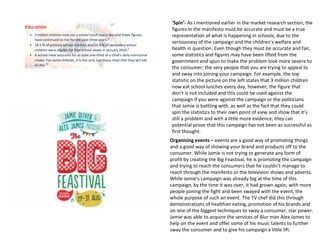
and sway into joining your campaign. For example, the top
statistic on the picture on the left states that 3 million children
now eat school lunches every day, however, the figure that
don’t is not included and this could be used against the
campaign if you were against the campaign or the politicians
that Jamie is battling with, as well as the fact that they could
spin the statistics to their own point of view and show that it’s
still a problem and with a little more evidence, they can
potential prove that this campaign has not been as successful as
first thought.
Organising events – events are a good way of promoting things
and a good way of showing your brand and products off to the
consumer. While Jamie is not trying to generate any form of
profit by creating the Big Feastival, he is promoting the campaign
and trying to reach the consumers that he couldn’t manage to
reach through the manifesto or the television shows and adverts.
While Jamie's campaign was already big at the time of this
campaign, by the time it was over, it had grown again, with more
people joining the fight and been swayed with the event, the
whole purpose of such an event. The TV chef did this through
demonstrations of healthier eating, promotion of his brands and
on one of the biggest techniques to sway a consumer, star power.
Jamie was able to acquire the services of Blur man Alex James to
help on the event and offer some of his music talents to further
sway the consumer and to give his campaign a little lift.
Lobbying- Lobbying is the action of talking to a politician or
person of power to try and sway them to join your campaign
for change. In this manifesto that Jamie Oliver had, there was
always going to be dividing opinions, whether it was cost of
the project or the nature of the project, politicians pledged
allegiance for and against the project. While Jamie didn’t
lobby any person of power, there were still politicians who
made up their own mind on the matter and joined the fight
for healthier school meals. However, early in the campaign,
Jamie challenged politicians to meet the criteria for the
manifesto he had created, while verbally attacking the
secretary of state for education, Michael Gove. The
Conservative politician did not respond to the TV chef and
without meaning to, Jamie Oliver had technically lobbied
many politicians to join or go against his campaign; by
publically challenging politicians.
Damage limitation – Despite all the positive publicity Jamie received
over this campaign. He also experience some negative coverage from
parents of the children he was trying to make healthier through the
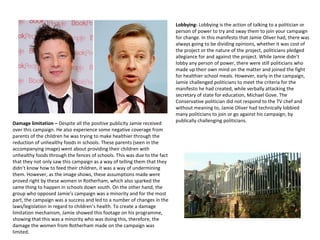
reduction of unhealthy foods in schools. These parents (seen in the
accompanying image) went about providing their children with
unhealthy foods through the fences of schools. This was due to the fact
that they not only saw this campaign as a way of telling them that they
didn’t know how to feed their children, it was a way of undermining
them. However, as the image shows, these assumptions made were
proved right by these women in Rotherham, which also sparked the
same thing to happen in schools down south. On the other hand, the
group who opposed Jamie’s campaign was a minority and for the most
part, the campaign was a success and led to a number of changes in the
laws/legislation in regard to children’s health. To create a damage
limitation mechanism, Jamie showed this footage on his programme,
showing that this was a minority who was doing this, therefore, the
damage the women from Rotherham made on the campaign was
limited.
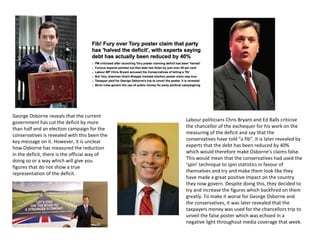
George Osborne reveals that the current
government has cut the deficit by more
than half and an election campaign for the
conservatives is revealed with this been the
key message on it. However, it is unclear
how Osborne has measured the reduction
in the deficit, there is the official way of
doing so or a way which will give you
figures that do not show a true
representation of the deficit.
Labour politicians Chris Bryant and Ed Balls criticise
the chancellor of the exchequer for his work on the
measuring of the deficit and say that the
conservatives have told “a fib”. It is later revealed by
experts that the debt has been reduced by 40%
which would therefore make Osborne’s claims false.
This would mean that the conservatives had used the
‘spin’ technique to spin statistics in favour of
themselves and try and make them look like they
have made a great positive impact on the country
they now govern. Despite doing this, they decided to
try and increase the figures which backfired on them
greatly. To make it worse for George Osborne and
the conservatives, it was later revealed that the
taxpayers money was used for the chancellors trip to
unveil the false poster which was echoed in a
negative light throughout media coverage that week.

Task 2 (case study)

  • 1.
    Marketing & PR Task2 – Case Study Patrick Gouldsbrough
  • 2.
    Jamie Oliver healthyeating in school case study
  • 3.
    Market Research –Before Jamie could embark on his food change of British schools, he first had to produce lots of facts and statistics on the health rates of children. When doing research I regards to something as key as heath, these figures must be accurate and that requires looking at things such as past research done on obesity, as well as some primary research through questionnaires and market research. After this stage, the chef can then launch into campaigning against unhealthy eating in schools, despite the statistics been shocking in themselves and use an element of shock to get through to the consumer of this review/report. Market strategy – While Jamie has shown the financial side of this project, he has focused on the spending of politicians and the government and not set it out like a normal marketing and PR company would; displaying their spending and how they would use this to fit into the market and if they will attempt to break into a different market or if they would create a new market completely. Even though Jamie will invest money into this project, it’s a project that won’t generate any money back and therefore the strategy side of the research will not have to be thought about as much as if they were selling a service or product to the consumer. On the other hand, the strategy itself was to focus this campaign on children, instead of another demographic. This choice came from doing market strategy and as the issue was found to start early on, Jamie formed a strategy that would focus on the young demographics so that it would therefore hopefully correct this problem throughout adulthood too. Part of the market strategy was that Jamie had already received funding from the government for this project, even before the manifesto came about. This made it easier to make a strategy, due to the fact that a budget could be set and made, while the positivity of receiving funding before the campaign even started should give the campaign a boost. However, Jamie made this manifesto and programme in 2011, which means that by now, the funding has been cut a little, due to the government believing that the money could be better spent other places, not to mention fresh opposition of the manifesto, due to new politicians establishing themselves in the 3 year gap since the manifesto was made.
  • 4.
    Advertising – Obviouslyas this is a campaign to raise awareness and make a change, there are no official advertising routes, due to the fact that the purpose is not to generate revenue from such a campaign. Despite this scenario though, awareness must be raised, and as established in task 1, this can be done through various mediums. In the end, it turned out to be a television advert, which was advertising not just the campaign but a television series that would aid the campaign in bringing about the healthy eating change. As well as this advertisement for the show, it would also advertise Jamie Oliver as a chef and as he’s become in recent times, a celebrity. However, just because it advertises Jamie Oliver, does not mean it stops there, it also branches out into advertising his media products and restaurants around the country, amongst all the markets he’s involved in. Brand promotion- While the purpose of this whole manifesto was never to promote various brands, the fact that a famous chef was involved in the campaign prompted his own business been promoted, along with various companies that had aided Jamie in the healthy food for schools process. This section is similar to advertising and while it doesn’t at first appear that Jamie will profit financially from this, the fact that his restaurants and other products are promoted through this campaign will lead to profits for the chef. Of course, Oliver did this to prevent obesity in schools and even he didn’t realise how much of a big campaign it would become, he would have had to realise that when any celebrity gets involved in a campaign, it brings about publicity and promotion for themselves and connecting businesses. Another high profile case of campaigning by celebrities that wouldn't have got as much media exposure if it were members of the public involved was the campaign against a mass badger cull, in which the likes of Dame Judi Dench, Meat Loaf and Brain May were involved. While these celebrities don’t need the publicity, they still got plenty of media coverage for it, like this Jamie Oliver campaign, therefore profit will be made by these people, whether it’s album sales or film sales, profit will be generated.
  • 5.
    Managing the message– Like any other campaign, profit based or otherwise, needs a slogan/tag-line. The function of this textual element is to be memorable while been short and concise so it won’t bore the consumer with information. For the slogan, Jamie has decided to go for the guilt element of trying to make it sound like the children he’s campaigning for have written it. This message will sway a lot of consumers and get a lot of people onside, which is the purpose of this whole manifesto; Jamie hasn’t done this to fight the politicians alone, he needs to help of the schools and most of all, the public. Due to the huge impact this message could have on the campaign, this slogan will have been researched and experimented with in various ways to get it to where it is now. For example, if they had a tag-line that didn’t sway the consumer of the manifesto or the television show, it wouldn’t have worked as well as it did and change wouldn’t have been made, therefore Jamie’s work would have been wasted to try and bring about this change. A big part of making the campaign successful itself was to show kids that healthy eating was a good thing. For example, if the parents and Jamie thought it was a good idea but the kids didn’t like the idea, the campaign wouldn’t have even got off the ground. This prompted Jamie to advertise and try and entice the young demographic he was trying to make healthier with media products, such as adverts. The childlike aesthetics of the logo on the left hand side shows that the TV show ‘Jamie’s school dinners’ was trying to target a young demographic, due to the bright colours and the clear font choice. From there, Jamie could then at least try and make healthy food seem appealing to the young demographic, where as if he used older demographic features, the whole campaign would have been in jeopardy. Positive publicity – While many campaigns aim to create positive publicity because they’ve either had some negative publicity recently or they envisage negative publicity in the future, the positive publicity that this campaign received was monumental to the change in schools and didn’t have much negative coverage or backlash. The fact that Jamie Oliver is a household name and he has an impeccable name in his field of work and also as a celebrity, which helped the campaign to be received well by the media and consumers alike. For example, if this campaign would have been picked up by someone who had recently had negative publicity or was a controversial figure, there would have been many opposing the campaign and a change may not have been brought about in this scenario. After this publicity and the perseverance of Jamie, a change was brought by schools and meals for kids are now healthier in schools, therefore, the initiative worked. On the other hand, it didn’t totally change and Jamie is still battling for tougher sanctions and healthier meals, which further shows that he is not in it for brand promotion but just to make schools healthier instead.
  • 6.
    ‘Spin’- As Imentioned earlier in the market research section, the figures in the manifesto must be accurate and must be a true representation of what is happening in schools, due to the seriousness of the campaign and the children's welfare and health in question. Even though they must be accurate and fair, some statistics and figures may have been lifted from the government and spun to make the problem look more severe to the consumer; the very people that you are trying to appeal to and sway into joining your campaign. For example, the top statistic on the picture on the left states that 3 million children now eat school lunches every day, however, the figure that don’t is not included and this could be used against the campaign if you were against the campaign or the politicians that Jamie is battling with, as well as the fact that they could spin the statistics to their own point of view and show that it’s still a problem and with a little more evidence, they can potential prove that this campaign has not been as successful as first thought. Organising events – events are a good way of promoting things and a good way of showing your brand and products off to the consumer. While Jamie is not trying to generate any form of profit by creating the Big Feastival, he is promoting the campaign and trying to reach the consumers that he couldn’t manage to reach through the manifesto or the television shows and adverts. While Jamie's campaign was already big at the time of this campaign, by the time it was over, it had grown again, with more people joining the fight and been swayed with the event, the whole purpose of such an event. The TV chef did this through demonstrations of healthier eating, promotion of his brands and on one of the biggest techniques to sway a consumer, star power. Jamie was able to acquire the services of Blur man Alex James to help on the event and offer some of his music talents to further sway the consumer and to give his campaign a little lift.
  • 7.
    Lobbying- Lobbying isthe action of talking to a politician or person of power to try and sway them to join your campaign for change. In this manifesto that Jamie Oliver had, there was always going to be dividing opinions, whether it was cost of the project or the nature of the project, politicians pledged allegiance for and against the project. While Jamie didn’t lobby any person of power, there were still politicians who made up their own mind on the matter and joined the fight for healthier school meals. However, early in the campaign, Jamie challenged politicians to meet the criteria for the manifesto he had created, while verbally attacking the secretary of state for education, Michael Gove. The Conservative politician did not respond to the TV chef and without meaning to, Jamie Oliver had technically lobbied many politicians to join or go against his campaign; by publically challenging politicians. Damage limitation – Despite all the positive publicity Jamie received over this campaign. He also experience some negative coverage from parents of the children he was trying to make healthier through the reduction of unhealthy foods in schools. These parents (seen in the accompanying image) went about providing their children with unhealthy foods through the fences of schools. This was due to the fact that they not only saw this campaign as a way of telling them that they didn’t know how to feed their children, it was a way of undermining them. However, as the image shows, these assumptions made were proved right by these women in Rotherham, which also sparked the same thing to happen in schools down south. On the other hand, the group who opposed Jamie’s campaign was a minority and for the most part, the campaign was a success and led to a number of changes in the laws/legislation in regard to children’s health. To create a damage limitation mechanism, Jamie showed this footage on his programme, showing that this was a minority who was doing this, therefore, the damage the women from Rotherham made on the campaign was limited.
  • 8.
    George Osborne revealsthat the current government has cut the deficit by more than half and an election campaign for the conservatives is revealed with this been the key message on it. However, it is unclear how Osborne has measured the reduction in the deficit, there is the official way of doing so or a way which will give you figures that do not show a true representation of the deficit. Labour politicians Chris Bryant and Ed Balls criticise the chancellor of the exchequer for his work on the measuring of the deficit and say that the conservatives have told “a fib”. It is later revealed by experts that the debt has been reduced by 40% which would therefore make Osborne’s claims false. This would mean that the conservatives had used the ‘spin’ technique to spin statistics in favour of themselves and try and make them look like they have made a great positive impact on the country they now govern. Despite doing this, they decided to try and increase the figures which backfired on them greatly. To make it worse for George Osborne and the conservatives, it was later revealed that the taxpayers money was used for the chancellors trip to unveil the false poster which was echoed in a negative light throughout media coverage that week.