Why Market to Children?
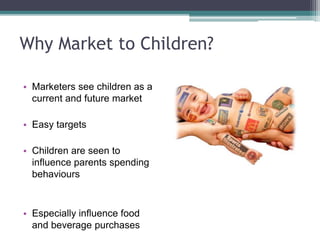
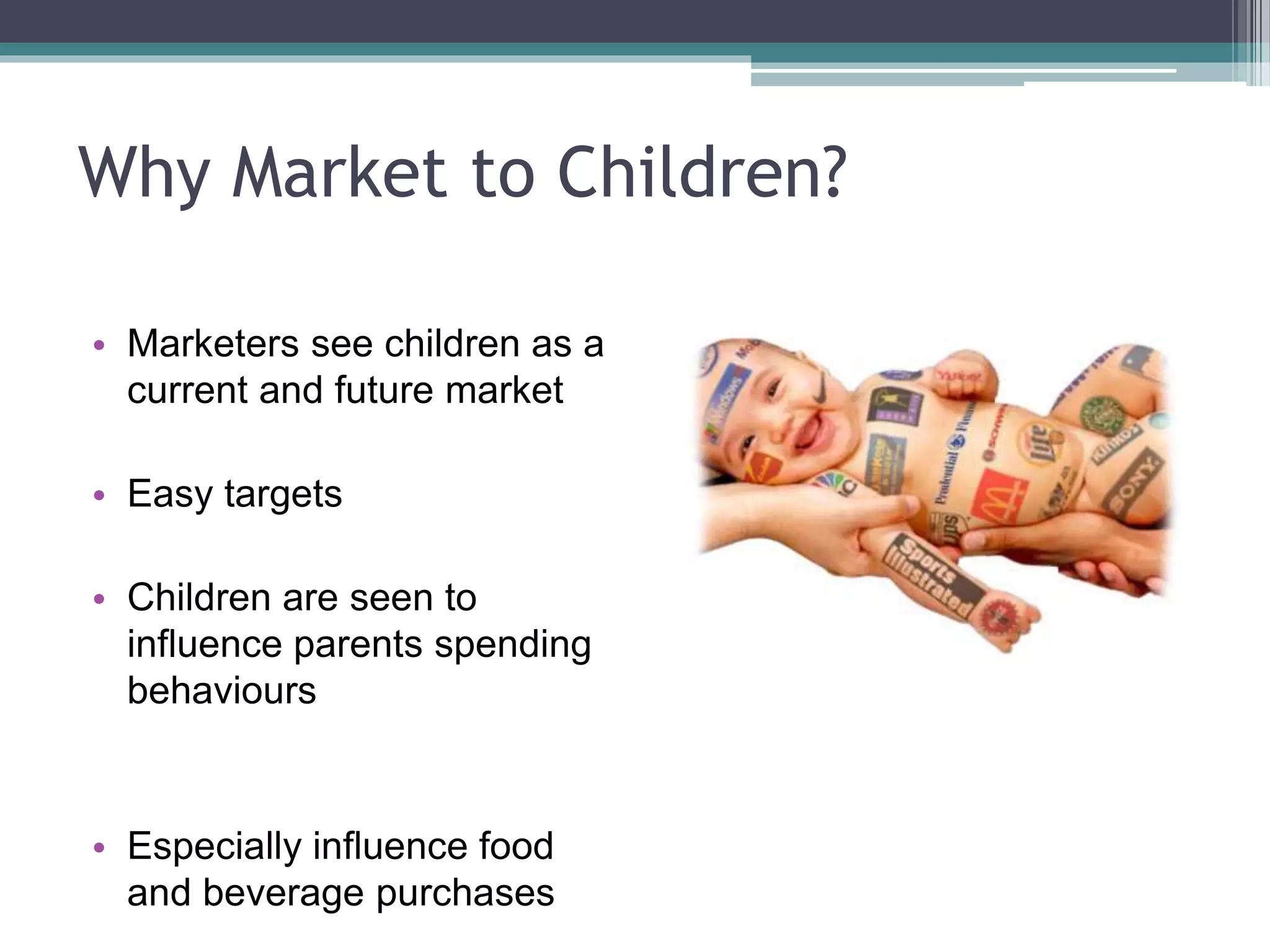
• Marketers see children as a
current and future market
• Easy targets
• Children are seen to
influence parents spending
behaviours
• Especially influence food
and beverage purchases
Poulton (2008)
How much of an influence?
• Breakfast choices (97%
of the time)
• Lunch choices (95% of
the time)
• Where to go for casual
family meals (98% of the
time)
• Clothing purchases (95%
of the time)
• Software purchases
(76% of the time) and
computer purchases
(60% of the time)
• Family entertainment
choices (98% of the time)
and family trips and
excursions (94% of the
time)
Marketing Food to Children
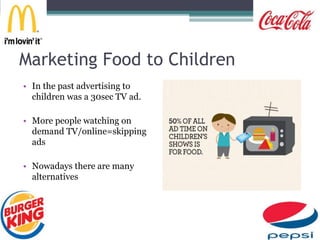
• In the past advertising to
children was a 30sec TV ad.
• More people watching on
demand TV/online=skipping
ads
• Nowadays there are many
alternatives
What's the problem?
Is it effective?
• Children aged between 7-11 consumed 45% more food when
exposed to television content with food advertisements
Harris et al, 2009)
Children vs Adults QSR Ads
• Child script emphasised giveaways and movie tie in
• Adult script emphasised food taste, price and
portion size
• Top 25 QSR-70% of ads were McDonalds & 29%
were Burger King
• 79% of ads targeting children aired were on just 4
channels (Cartoon Network, Nickelodeon, Disney
XD and Nicktoons)
Marketing techniques
• Television ads
• Product placement
• Celebrity endorsements
• Advergames
• Cross-promotions
• Branded websites
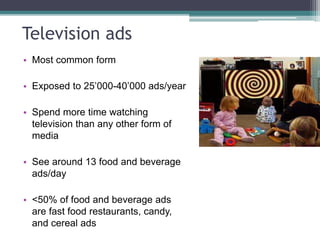
Television ads
• Most common form
• Exposed to 25’000-40’000 ads/year
• Spend more time watching
television than any other form of
media
• See around 13 food and beverage
ads/day
• <50% of food and beverage ads
are fast food restaurants, candy,
and cereal ads
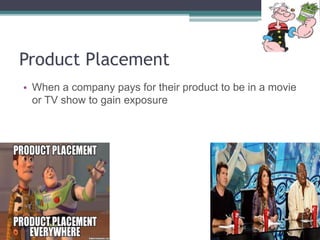
Product Placement
• When a company pays for their product to be in a movie
or TV show to gain exposure
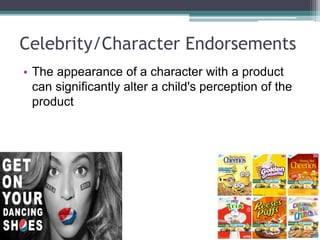
Celebrity/Character Endorsements
• The appearance of a character with a product
can significantly alter a child's perception of the
product
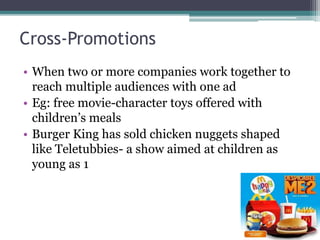
Cross-Promotions
• When two or more companies work together to
reach multiple audiences with one ad
• Eg: free movie-character toys offered with
children’s meals
• Burger King has sold chicken nuggets shaped
like Teletubbies- a show aimed at children as
young as 1
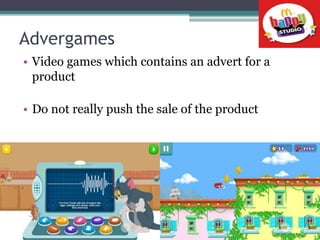
Advergames
• Video games which contains an advert for a
product
• Do not really push the sale of the product
Branded Websites
• Companies create branded websites that include
content designed to attract children
• Promoted in television ads and on product
packaging
• Typically include games, contests, videos, and
downloadable branded products, links to social
media
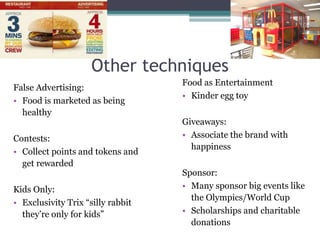
Other techniques
False Advertising:
• Food is marketed as being
healthy
Contests:
• Collect points and tokens and
get rewarded
Kids Only:
• Exclusivity Trix “silly rabbit
they’re only for kids”
Food as Entertainment
• Kinder egg toy
Giveaways:
• Associate the brand with
happiness
Sponsor:
• Many sponsor big events like
the Olympics/World Cup
• Scholarships and charitable
donations
Techniques in practice
• https://www.youtube.com/watch?v=xk_hkdGf1
tc
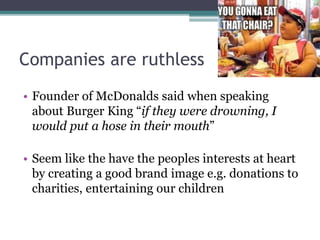
Companies are ruthless
• Founder of McDonalds said when speaking
about Burger King “if they were drowning, I
would put a hose in their mouth”
• Seem like the have the peoples interests at heart
by creating a good brand image e.g. donations to
charities, entertaining our children
Pester Power
• https://youtu.be/E6Yc3hzVsBc
• Attention grab, impulse, ultimatum, threat +
body language, give in and extra rewards
• Funny Sketch – Powerful Message
Pester Power
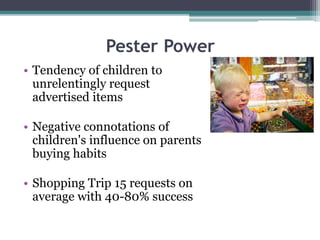
• Tendency of children to
unrelentingly request
advertised items
• Negative connotations of
children's influence on parents
buying habits
• Shopping Trip 15 requests on
average with 40-80% success
Pester Power Value
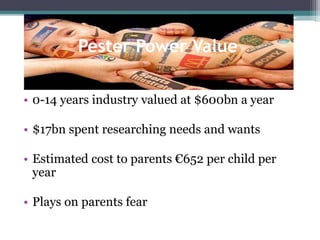
• 0-14 years industry valued at $600bn a year
• $17bn spent researching needs and wants
• Estimated cost to parents €652 per child per
year
• Plays on parents fear
What the Companies Say
• “If you own the child at an early age, you can own this child for years
to come” Mike Searles, former President of Kids ‘R’ Us
• “Advertising at its best is making people feel that without their
product, you’re a loser. Children are very sensitive to this. You open
up emotional vulnerabilities, and its very easy to do with kids
because they’re the most emotionally vulnerable” Nancy Shalek,
former President of Shalek Advertising
• “Driving the kid nag factor with parents is crucial to the categories
success” Betty Crocker Website
• “All our advertising is targeted to kids. You want that nag factor so
that 7 year old Sarah is nagging Mom in the grocery store to buy
Funky Purple (ketchup). We’re not sure Mom would reach out for it
on her own” Kelly Stitt, Senior Brand Manager at Heinz
Mc Donalds – A Case Study
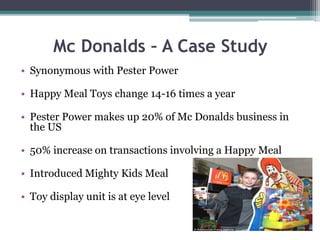
• Synonymous with Pester Power
• Happy Meal Toys change 14-16 times a year
• Pester Power makes up 20% of Mc Donalds business in
the US
• 50% increase on transactions involving a Happy Meal
• Introduced Mighty Kids Meal
• Toy display unit is at eye level
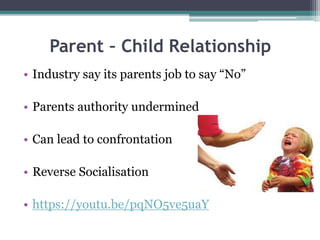
Parent – Child Relationship
• Industry say its parents job to say “No”
• Parents authority undermined
• Can lead to confrontation
• Reverse Socialisation
• https://youtu.be/pqNO5ve5uaY
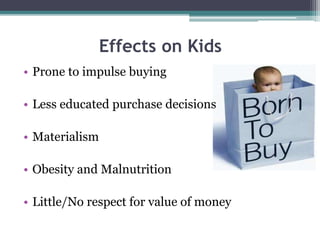
Effects on Kids
• Prone to impulse buying
• Less educated purchase decisions
• Materialism
• Obesity and Malnutrition
• Little/No respect for value of money
Broadcasting Authority of Ireland
Children's Commercial Code
• Protection of children from harmful
communications
• Acknowledge susceptibility of children
• Ensure advertisements are fair
• Unambiguous guidelines
Advertising a Product to Children
• https://youtu.be/aCUbvOwwfWM?list=PLPySrp
k-4TiL2pcMWuoebs3HxF2Twa3l4
• Price in €
• Price must not be dependent on another
purchase
• Number of Products
• Free Gifts – Qualifying Terms and Conditions
• Price in audio for U15s
• Toys over €30 must state cost
Undue Pressure
• Should not encourage children to ask adults to
buy them products
• Should not imply the product makes them
superior
▫ Nor that they’ll be ridiculed if they don’t have a
given product
• Self Image
Diet and Nutrition
• Should not encourage unhealthy lifestyle
• Depicted in framework of a balanced diet
• Product not a substitute for Fruit and Veg
• High Fat, Sugar and Salt (HFSS)
▫ Not permitted in Children’s programmes
▫ No Licensed Characters
▫ No Health and Nutrition claims
▫ No Promotional Offers
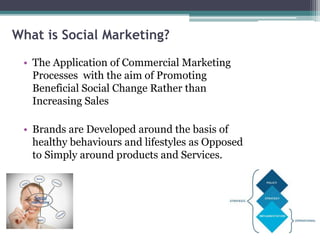
What is Social Marketing?
• The Application of Commercial Marketing
Processes with the aim of Promoting
Beneficial Social Change Rather than
Increasing Sales
• Brands are Developed around the basis of
healthy behaviours and lifestyles as Opposed
to Simply around products and Services.
Who’s in Charge?
• Governmental organisations
▫ The Department of the Environment
▫ The Department of Health
• Charitable Organisations
▫ Self-funded NGO’s
▫ Commercially Funded Organisations (CSR)
Why Target Children?
• Social marketing messages can help prevent unhealthy
behaviour through education or the promotion of
behavioural alternatives.
• By targeting young children it is possible to;
▫ Circumvent the formation of unhealthy attitudes towards
food and physical activity.
▫ Instil a sense of pride in their environment.
Challenges
• Competition with Commercial Marketers
▫ compete for children’s and adolescents’ time,
attention, and behavioural choices
• Budget
▫ Limited Budget in Comparison to many
Commercial Advertisers.
▫ Must Optimise Funding Allocation
• Parental Engagement
▫ Parents are a Vital Resource in Maximising
Campaign Message Lifespan
Vital Aspects
• Use of Conventional Marketing Techniques
▫ Segmentation
▫ Prior Research
▫ 4 P’s
• Maintain Focus on Behavioural Change
• Uniformity of approach
• Continuously Reinforce Benefits
• Provide Necessary Post Campaign Follow Up
Let’s Move
• ‘Let's Move! is about putting children on the path to a
healthy future during their earliest months and years. ‘
• Government Backed Programme Focused on
Improving Children's Diets and Approach to Exercise
• Giving parents helpful information and fostering
environments that support healthy choices.
• Providing healthier foods in schools
Positives
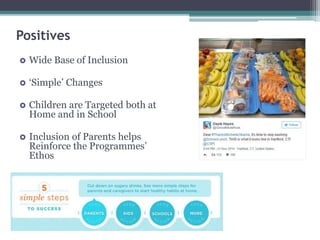
 Wide Base of Inclusion
 ‘Simple’ Changes
 Children are Targeted both at
Home and in School
 Inclusion of Parents helps
Reinforce the Programmes’
Ethos
Negatives
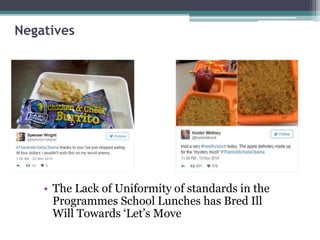
• The Lack of Uniformity of standards in the
Programmes School Lunches has Bred Ill
Will Towards ‘Let’s Move
School Dinners
• Began in 2005 in Greenwich London
▫ working class backgrounds, 21% employed in
low earner jobs
• Aimed to Improve Diets Through Healthier
School Dinners
School Dinners
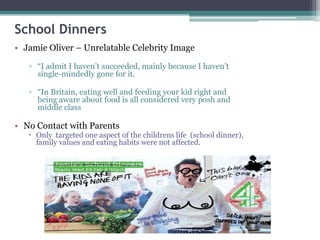
• Jamie Oliver – Unrelatable Celebrity Image
▫ “I admit I haven’t succeeded, mainly because I haven’t
single-mindedly gone for it.
▫ “In Britain, eating well and feeding your kid right and
being aware about food is all considered very posh and
middle class
• No Contact with Parents
 Only targeted one aspect of the childrens life (school dinner),
family values and eating habits were not affected.
• Perfect Example of how to run a Social Marketing
Campaign.
• Launched in 2002 aiming to increase activity of
9-13 year olds
• Utilised a Large Amount of Prior Research Data
• Engaged with Youth Directed Advertisers to
Create Brand Image
• Exhibited Message of Social Inclusion
• The VERB Brand
▫ Based on healthy behaviour, marketed
using socially appealing images
▫ Portrayed healthy lifestyles as preferable to
junk food or fast food
▫ Portrayed Sedentary Behaviour, such as
watching television—as socially
undesirable, dull, and boring

Marketing Towards Children

  • 1.
    Why Market toChildren? • Marketers see children as a current and future market • Easy targets • Children are seen to influence parents spending behaviours • Especially influence food and beverage purchases
  • 2.
    Poulton (2008) How muchof an influence? • Breakfast choices (97% of the time) • Lunch choices (95% of the time) • Where to go for casual family meals (98% of the time) • Clothing purchases (95% of the time) • Software purchases (76% of the time) and computer purchases (60% of the time) • Family entertainment choices (98% of the time) and family trips and excursions (94% of the time)
  • 3.
    Marketing Food toChildren • In the past advertising to children was a 30sec TV ad. • More people watching on demand TV/online=skipping ads • Nowadays there are many alternatives
  • 4.
    What's the problem? Isit effective? • Children aged between 7-11 consumed 45% more food when exposed to television content with food advertisements Harris et al, 2009)
  • 5.
    Children vs AdultsQSR Ads • Child script emphasised giveaways and movie tie in • Adult script emphasised food taste, price and portion size • Top 25 QSR-70% of ads were McDonalds & 29% were Burger King • 79% of ads targeting children aired were on just 4 channels (Cartoon Network, Nickelodeon, Disney XD and Nicktoons)
  • 6.
    Marketing techniques • Televisionads • Product placement • Celebrity endorsements • Advergames • Cross-promotions • Branded websites
  • 7.
    Television ads • Mostcommon form • Exposed to 25’000-40’000 ads/year • Spend more time watching television than any other form of media • See around 13 food and beverage ads/day • <50% of food and beverage ads are fast food restaurants, candy, and cereal ads
  • 8.
    Product Placement • Whena company pays for their product to be in a movie or TV show to gain exposure
  • 9.
    Celebrity/Character Endorsements • Theappearance of a character with a product can significantly alter a child's perception of the product
  • 10.
    Cross-Promotions • When twoor more companies work together to reach multiple audiences with one ad • Eg: free movie-character toys offered with children’s meals • Burger King has sold chicken nuggets shaped like Teletubbies- a show aimed at children as young as 1
  • 11.
    Advergames • Video gameswhich contains an advert for a product • Do not really push the sale of the product
  • 12.
    Branded Websites • Companiescreate branded websites that include content designed to attract children • Promoted in television ads and on product packaging • Typically include games, contests, videos, and downloadable branded products, links to social media
  • 13.
    Other techniques False Advertising: •Food is marketed as being healthy Contests: • Collect points and tokens and get rewarded Kids Only: • Exclusivity Trix “silly rabbit they’re only for kids” Food as Entertainment • Kinder egg toy Giveaways: • Associate the brand with happiness Sponsor: • Many sponsor big events like the Olympics/World Cup • Scholarships and charitable donations
  • 14.
    Techniques in practice •https://www.youtube.com/watch?v=xk_hkdGf1 tc
  • 15.
    Companies are ruthless •Founder of McDonalds said when speaking about Burger King “if they were drowning, I would put a hose in their mouth” • Seem like the have the peoples interests at heart by creating a good brand image e.g. donations to charities, entertaining our children
  • 16.
    Pester Power • https://youtu.be/E6Yc3hzVsBc •Attention grab, impulse, ultimatum, threat + body language, give in and extra rewards • Funny Sketch – Powerful Message
  • 17.
    Pester Power • Tendencyof children to unrelentingly request advertised items • Negative connotations of children's influence on parents buying habits • Shopping Trip 15 requests on average with 40-80% success
  • 18.
    Pester Power Value •0-14 years industry valued at $600bn a year • $17bn spent researching needs and wants • Estimated cost to parents €652 per child per year • Plays on parents fear
  • 19.
    What the CompaniesSay • “If you own the child at an early age, you can own this child for years to come” Mike Searles, former President of Kids ‘R’ Us • “Advertising at its best is making people feel that without their product, you’re a loser. Children are very sensitive to this. You open up emotional vulnerabilities, and its very easy to do with kids because they’re the most emotionally vulnerable” Nancy Shalek, former President of Shalek Advertising • “Driving the kid nag factor with parents is crucial to the categories success” Betty Crocker Website • “All our advertising is targeted to kids. You want that nag factor so that 7 year old Sarah is nagging Mom in the grocery store to buy Funky Purple (ketchup). We’re not sure Mom would reach out for it on her own” Kelly Stitt, Senior Brand Manager at Heinz
  • 20.
    Mc Donalds –A Case Study • Synonymous with Pester Power • Happy Meal Toys change 14-16 times a year • Pester Power makes up 20% of Mc Donalds business in the US • 50% increase on transactions involving a Happy Meal • Introduced Mighty Kids Meal • Toy display unit is at eye level
  • 21.
    Parent – ChildRelationship • Industry say its parents job to say “No” • Parents authority undermined • Can lead to confrontation • Reverse Socialisation • https://youtu.be/pqNO5ve5uaY
  • 22.
    Effects on Kids •Prone to impulse buying • Less educated purchase decisions • Materialism • Obesity and Malnutrition • Little/No respect for value of money
  • 23.
    Broadcasting Authority ofIreland Children's Commercial Code • Protection of children from harmful communications • Acknowledge susceptibility of children • Ensure advertisements are fair • Unambiguous guidelines
  • 24.
    Advertising a Productto Children • https://youtu.be/aCUbvOwwfWM?list=PLPySrp k-4TiL2pcMWuoebs3HxF2Twa3l4 • Price in € • Price must not be dependent on another purchase • Number of Products • Free Gifts – Qualifying Terms and Conditions • Price in audio for U15s • Toys over €30 must state cost
  • 25.
    Undue Pressure • Shouldnot encourage children to ask adults to buy them products • Should not imply the product makes them superior ▫ Nor that they’ll be ridiculed if they don’t have a given product • Self Image
  • 26.
    Diet and Nutrition •Should not encourage unhealthy lifestyle • Depicted in framework of a balanced diet • Product not a substitute for Fruit and Veg • High Fat, Sugar and Salt (HFSS) ▫ Not permitted in Children’s programmes ▫ No Licensed Characters ▫ No Health and Nutrition claims ▫ No Promotional Offers
  • 27.
    What is SocialMarketing? • The Application of Commercial Marketing Processes with the aim of Promoting Beneficial Social Change Rather than Increasing Sales • Brands are Developed around the basis of healthy behaviours and lifestyles as Opposed to Simply around products and Services.
  • 28.
    Who’s in Charge? •Governmental organisations ▫ The Department of the Environment ▫ The Department of Health • Charitable Organisations ▫ Self-funded NGO’s ▫ Commercially Funded Organisations (CSR)
  • 29.
    Why Target Children? •Social marketing messages can help prevent unhealthy behaviour through education or the promotion of behavioural alternatives. • By targeting young children it is possible to; ▫ Circumvent the formation of unhealthy attitudes towards food and physical activity. ▫ Instil a sense of pride in their environment.
  • 30.
    Challenges • Competition withCommercial Marketers ▫ compete for children’s and adolescents’ time, attention, and behavioural choices • Budget ▫ Limited Budget in Comparison to many Commercial Advertisers. ▫ Must Optimise Funding Allocation • Parental Engagement ▫ Parents are a Vital Resource in Maximising Campaign Message Lifespan
  • 31.
    Vital Aspects • Useof Conventional Marketing Techniques ▫ Segmentation ▫ Prior Research ▫ 4 P’s • Maintain Focus on Behavioural Change • Uniformity of approach • Continuously Reinforce Benefits • Provide Necessary Post Campaign Follow Up
  • 32.
    Let’s Move • ‘Let'sMove! is about putting children on the path to a healthy future during their earliest months and years. ‘ • Government Backed Programme Focused on Improving Children's Diets and Approach to Exercise • Giving parents helpful information and fostering environments that support healthy choices. • Providing healthier foods in schools
  • 33.
    Positives  Wide Baseof Inclusion  ‘Simple’ Changes  Children are Targeted both at Home and in School  Inclusion of Parents helps Reinforce the Programmes’ Ethos
  • 34.
    Negatives • The Lackof Uniformity of standards in the Programmes School Lunches has Bred Ill Will Towards ‘Let’s Move
  • 35.
    School Dinners • Beganin 2005 in Greenwich London ▫ working class backgrounds, 21% employed in low earner jobs • Aimed to Improve Diets Through Healthier School Dinners
  • 36.
    School Dinners • JamieOliver – Unrelatable Celebrity Image ▫ “I admit I haven’t succeeded, mainly because I haven’t single-mindedly gone for it. ▫ “In Britain, eating well and feeding your kid right and being aware about food is all considered very posh and middle class • No Contact with Parents  Only targeted one aspect of the childrens life (school dinner), family values and eating habits were not affected.
  • 37.
    • Perfect Exampleof how to run a Social Marketing Campaign. • Launched in 2002 aiming to increase activity of 9-13 year olds • Utilised a Large Amount of Prior Research Data • Engaged with Youth Directed Advertisers to Create Brand Image • Exhibited Message of Social Inclusion
  • 38.
    • The VERBBrand ▫ Based on healthy behaviour, marketed using socially appealing images ▫ Portrayed healthy lifestyles as preferable to junk food or fast food ▫ Portrayed Sedentary Behaviour, such as watching television—as socially undesirable, dull, and boring

Editor's Notes

  • #2  Ask the class why do companies market to children? children before a certain age are defenceless against advertisements-cant tell what is an ad and what isnt an ad Brand loyalty-catch them young Mention PESTER power-Wayne will discuss this further.
  • #3 Kids seem to get whatever they want! Does this sound like your own kids?
  • #4 candy, sugar cereals and fast food accounted for almost half of all food and beverage advertisements seen by children and adolescents
  • #5 Advertising spent on fast food and junk food and beverages is causing Children becoming obese/diabetes Obesity has doubled in children in the last 30 years
  • #7 Sponsor: completely unrelated everts McDonalds and the Olympics
  • #8 Children still spend more time watching tele average American child age 8 or older spends more than seven hours a day with screen media, watching TV, using the computer, playing video games, and using hand-held devices (Rideout et al., 2010). Can see it myself-3 year olds can use ipads better than me
  • #9 Toy Story made characters out of toys that were on the market- Slinkey, Etch-A-Sketch, and Mr Potato Head. Etch-a-Sketch sales increased by 4’500% and mr potato head by 800% . 20 most viewed movies between 1996-2005 69% of them contained at least one beverage, food or retail establishment brand. Can go well beyond just placement-in 08a full episode of the apprentice was about designing Burger Kings new Angus Steak Burger
  • #10 Frozen is everywhere!
  • #11 more than 120 cross-promotions in 2009 (up from 80 in 2006) “tying food and beverage products to popular movies, TV programs, cartoon characters, toys, websites, video games, theme parks, and other entertainment venues.” toys change periodocially Associate the brand with happiness In 2012 McDonalds spent 2.7 times more money to advertise their products ($972 million) as fruit, vegetable, bottled water, and milk advertisers combined ($367 million) (Fast Food Facts, 2013).
  • #12 Online or digital method of advertising Easier to reach children without parent being aware Increase brand exposure, emotional investment, brand loyalty Don’t actually push the sale of food.
  • #13 Coco Pops have their own website with games and stuff-design the character, 87% of the most popular children’s websites include some types of advertising Downloadable content-posters/mcdonalds colouring book SOCIAL MEDIA-In Europe, it is estimated that 38% of 9-12 year olds have a social network profile McDonalds and Ballygown teaming up- both on the bottle
  • #14 False advertising: trix cereal all you hear is fruity flavour and colours/sunny delight ad Kids only: silly rabbits there only for kids. Food as entertainment: Giveaways: interest children in food for reasons unrelated with food/happy meal focus on playing with toys/rewarded with a toy for consuming foods with high amounts of fat Contest: Scholarship/Sponsor: designed to improve their corporate image. By associating their names with images of kindness, companies hope that children and their parents will trust them and their products, and thus, in the long term, buy more of their products Positioning: where the products are positioned in supermarkets-ceareal at children eye level-character on box looking down https://www.youtube.com/watch?v=9tD6OQExL5Q
  • #16 In 2008 coca cola accounded for 15% of all product placements that occurred on tv and 70% of all placements viewed by children Coke don’t advertise directly on childrens shows, - American Idol isnt seen as a childs show, chidren actually viewed nearly 10 times as many coke brand appearance through product placement then in traditional TV commercials, again children don’t see this as advertising Coca-Cola accounted for 15 percent of all product placements that occurred on TV and 70 percent of all placements viewed by children In supermarkets sugery cereals are located at around eye-level for children and the characters on the box seem to be looking down, research shows that brand trust and connectivity in increased with this eye contact
  • #28 This study showed that behaviours that need to be changed once or only a few times are easier to promote than those that must be repeated and maintained over time
  • #37 meal cost at Central City Elementary during television production more than doubled with ABC Productions paying the excess expense