KRIYAKALPA WITH SPECIAL REFERENCE
           TO TARPANA

                       By
         Dr.B.A.Venkatesh B.S.A.M , B.A.M.S , M.D.Ay)
               Professor & H.O.D
         DEPT of P.G.studies in shalakya
         Govt/ Ayurvedic medical college
                  Bangalore:9
• Ayurveda has highlighted unique therapeutic
  procedures taking into consideration the
  strength of Nidana, Dosha, Vyadhi Adhishtana &
  such other Samprapti ghatakas.
  Though broad classification of treatment include
  Samshamana & Shodhana, in certain conditions
  Shastra & Anushastra chikitsa becomes
  imminent. Therefore chikitsa is further simplified
  into Bheshaja–Shastraja-Ksharaja –
  AgniKarmaja.
• Bheshaja chikitsa happens to be the
 strong hold of Ayurvedic practitioners as
 Management through panchavidha
 Kashaya Kalpana & Rasoushadhis are
 most desired in the existing
 circumstances.
• Each wing of Ayurveda has come out with
 visishtachikitsa apart from
 samanyachikitsa. For instance,
 vasthichikitsa happens to be the
 chikitsardha in Kayachikitsa,
 Rakthamokshana-Chikitsardha in
 Shalyachikitsa similarly kriyakalpas form
 chikitsardha in Shalakyachikitsa.
• Kriyakalpas are unique procedures practiced in
    ShalakyaTantra having wide range of
    implications in the Management of Netra
    Vikaras.
•   Kriyakalpas are meant to alleviate the Sthanika
    Khavaigunya resulted out of vitiated doshas &
    their impact on Netra-Avayavas.
• KriyaKalpas have Major role in overcoming
  the complications & arrest the progress of
  few identified Asadhyavydhis.
• KriyaKalpas can also be used as Swasthya
  Smarakshaka prayoga to maintain
  functional integrity of the Sense organs &
  overcome age related disorders.
• KriyaKalpas also have important role in
  prevention of Jathrurdhvagatha vikaras &
  Degenerative disorders.
• KriyaKalpas to some extent are effective in
  Vishanirharana & Sarvadaihikavikaras.
• KriyaKalpas
• Seka
• Aschyothana
• Tarpana
• Putapaka
• Anjana
• Bidalaka
• Pindi
• Seka: Procedure in which liquids
     [medicated] are poured on the
     closed eyes from a height of four
     Angulis in a thin Stream.
•    Prayogakala : Morning – noon –
     evening
•    Prakara : Snehana – Ropana –
     Lekhana
•    Dharanakala : 400 – 600 - 200
     Matrocharanakala
•    Dosha: Vataja – pitha & Raktha –
     Kaphaja vyadhi – Adopted till
     Vyadhinivruthi.
    useful in Balavathara or chronic
     Netravikaras like vedana – Kandu
     – Harshana – Ashrusrava – daha
     & Ragatha.
• Procedure: Patient should be laid down in
  Supine position with eyes closed & from a height
  of 4 Angulis thin stream of Medicated fluids are
  poured all along the eye from Kaninika to
  ApangaSandhi.
Aschyothana:
  Application of liquid medicaments into open Eye
  in the form of drops or Bindu from a height of
  two Angulis.
• It is useful in accute conditions where prabhala
  doshas are not seen.
• Prayogakala: Poorvanha madhyahna
  Sayahna.
• Prakara: Snehana Ropana Lekhana.
• Dharana kala: 10Bindu 12Bindu 6-8Bindu
Dosha: Vataja-pithaRaktha-Kaphaja
• Procedure can be followed till Vyadhi Nivruthi.
• Anjana:
 A procedure in which medicaments like collyrium
 are applied into the eye through a Shalaka. It is
 normally advised after Aschyothana vidhi where
 Amavastha of condition is relieved & prominent
 dosha in the eye becomes evident. In other
 words Anjana is usefull in Jeernavastha than in
 Teevravastha.
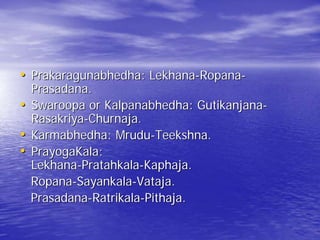
• Prakaragunabhedha: Lekhana-Ropana-
    Prasadana.
•   Swaroopa or Kalpanabhedha: Gutikanjana-
    Rasakriya-Churnaja.
•   Karmabhedha: Mrudu-Teekshna.
•   PrayogaKala:
    Lekhana-Pratahkala-Kaphaja.
    Ropana-Sayankala-Vataja.
    Prasadana-Ratrikala-Pithaja.
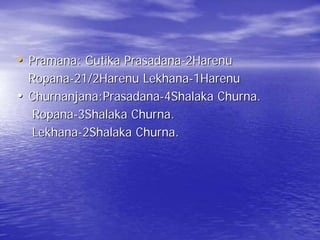
• Pramana: Gutika Prasadana-2Harenu
    Ropana-21/2Harenu Lekhana-1Harenu
•   Churnanjana:Prasadana-4Shalaka Churna.
     Ropana-3Shalaka Churna.
     Lekhana-2Shalaka Churna.
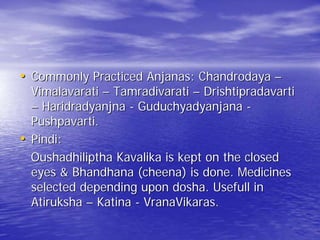
• Commonly Practiced Anjanas: Chandrodaya –
    Vimalavarati – Tamradivarati – Drishtipradavarti
    – Haridradyanjna - Guduchyadyanjana -
    Pushpavarti.
•   Pindi:
    Oushadhiliptha Kavalika is kept on the closed
    eyes & Bhandhana (cheena) is done. Medicines
    selected depending upon dosha. Usefull in
    Atiruksha – Katina - VranaVikaras.
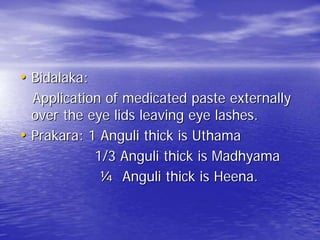
• Bidalaka:
  Application of medicated paste externally
  over the eye lids leaving eye lashes.
• Prakara: 1 Anguli thick is Uthama
            1/3 Anguli thick is Madhyama
             ¼ Anguli thick is Heena.
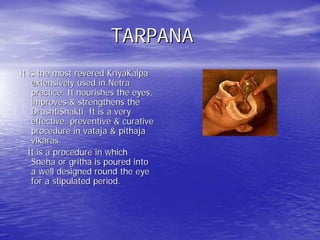
TARPANA
It is the most revered KriyaKalpa
    extensively used in Netra
    practice. It nourishes the eyes,
    improves & strengthens the
    DrushtiShakti. It is a very
    effective, preventive & curative
    procedure in vataja & pithaja
    vikaras.
   It is a procedure in which
    Sneha or gritha is poured into
    a well designed round the eye
    for a stipulated period.
• Procedure: Poorvakarma- Appropriate shodhanakarma is
 carried out according to procedure. Later Sthanika
 Abhyanga & Mrudu Sweda is done.
 Pradhana Karma: Patient is made to attain Uthana
 position in a good lighted, ventilated room free from
 dust & smoke. Clean the eyes with dry sterile vastra &
 construct a parimandala (pali or well) around the eye to
 a height of 2Angulis with Mashapishti in such a way that
 any thing poured inside should not leak out.
• Later gritha that is selected for therapy
 should be warmed by placing the
 container in hot water. This Luke warm
 gritha in liquid state is poured through
 sterile cotton dipped in gritha into the
 parimandala till the eye lashes level with
 eye closed. Patient is asked to open &
 close the eye intermittently & steadily for
 a stipulated period.
• Paschyath Karma: A small opening is made in
  the pali near apanga sandhi & gritha is slowly
  drained out, eyes should be cleared with shudha
  Karpasa by removing the Mashapishti. Mrudu
  Sweda is done with clean cloth dipped in hot
  water. Dhoomapana and gandusha with
  Ushnodaka indicated to prevent kaphajaulbana.
  Patient is instructed not to expose to Rajodhuma
  & Atapa.
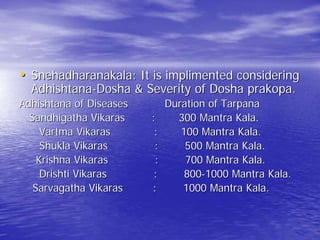
• Snehadharanakala: It is implimented considering
  Adhishtana-Dosha & Severity of Dosha prakopa.
Adhishtana of Diseases        Duration of Tarpana
  Sandhigatha Vikaras    :      300 Mantra Kala.
     Vartma Vikaras       :      100 Mantra Kala.
     Shukla Vikaras       :       500 Mantra Kala.
    Krishna Vikaras       :       700 Mantra Kala.
     Drishti Vikaras     :        800-1000 Mantra Kala.
   Sarvagatha Vikaras    :       1000 Mantra Kala.
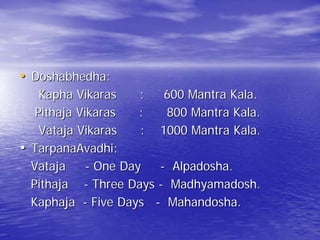
• Doshabhedha:
      Kapha Vikaras     :  600 Mantra Kala.
     Pithaja Vikaras    :  800 Mantra Kala.
      Vataja Vikaras    : 1000 Mantra Kala.
•   TarpanaAvadhi:
    Vataja     - One Day  - Alpadosha.
    Pithaja - Three Days - Madhyamadosh.
    Kaphaja - Five Days - Mahandosha.
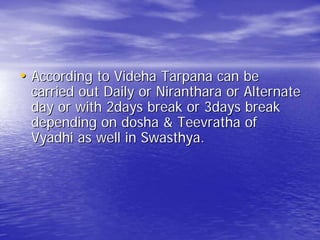
• According to Videha Tarpana can be
 carried out Daily or Niranthara or Alternate
 day or with 2days break or 3days break
 depending on dosha & Teevratha of
 Vyadhi as well in Swasthya.
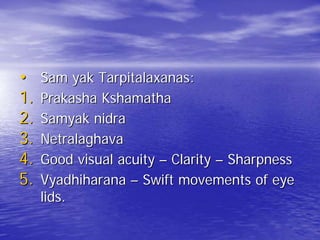
•    Sam yak Tarpitalaxanas:
1.   Prakasha Kshamatha
2.   Samyak nidra
3.   Netralaghava
4.   Good visual acuity – Clarity – Sharpness
5.   Vyadhiharana – Swift movements of eye
     lids.
Ati-Tarpitha Laxanas:
  Netragourava – Avilatha – Atisnigdhata –
  Atiupadeha – AdhikaAshruSrava – Visesha
  doshavyapth Laxana.
Heena Tarpitha Laxana:
  Netrarukshatha – Avilatha – Atisnigdhata
 – Blurred vision – Rogavridhi.
  These laxanas can be managed by snigda
 & Ruksha Dhooma – Nasya – Anjana &
 Sekaprayoga.
Prayoga Dravya in Tarpana:
  Triphalagritha – patoladigritha –
  Jeevanthyadigritha – yeshtyadigritha &
  Mayuradhyagritha.
Prime indications of Tarpana:
• C.V.S
• Dry eye Syndrome
• Non specific corneal Disorders
• Allergic conjunctivitis
• All types of glaucoma
• Early cataract
• Degenerative disorders
• Refractive errors.
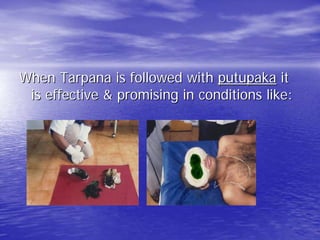
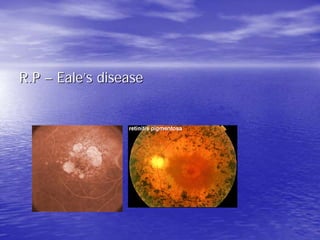
When Tarpana is followed with putupaka it
 is effective & promising in conditions like:
R.P – Eale’s disease
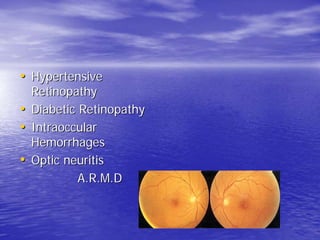
• Hypertensive
    Retinopathy
•   Diabetic Retinopathy
•   Intraoccular
    Hemorrhages
•   Optic neuritis
             A.R.M.D
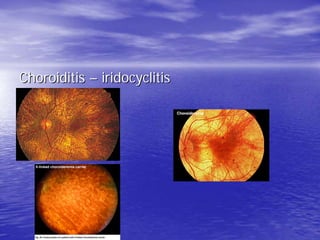
Choroiditis – iridocyclitis
Prevention & Rehabilitation of Blindness is the
  principle objective of Netratagna-Government
  (local-central)-Nation-continent & W.H.O.
Kriyakalpas especially Tarpana putapaka & Anjana
  have a definite role in prevention of Blindness,
  upon which Ayurvedic practitioners should be
  humble and proude.
• CONCLUSIONS
 Tarpana procedure is unique & easy to
 practice. It is promising & can be used
 with confidence in many of the common
 eye problems. It can be implemented in
 general practice, hospital practice &
 Institutional practice.

Tarpana netra kriyakalpa

  • 1.
    KRIYAKALPA WITH SPECIALREFERENCE TO TARPANA By Dr.B.A.Venkatesh B.S.A.M , B.A.M.S , M.D.Ay) Professor & H.O.D DEPT of P.G.studies in shalakya Govt/ Ayurvedic medical college Bangalore:9
  • 2.
    • Ayurveda hashighlighted unique therapeutic procedures taking into consideration the strength of Nidana, Dosha, Vyadhi Adhishtana & such other Samprapti ghatakas. Though broad classification of treatment include Samshamana & Shodhana, in certain conditions Shastra & Anushastra chikitsa becomes imminent. Therefore chikitsa is further simplified into Bheshaja–Shastraja-Ksharaja – AgniKarmaja.
  • 3.
    • Bheshaja chikitsahappens to be the strong hold of Ayurvedic practitioners as Management through panchavidha Kashaya Kalpana & Rasoushadhis are most desired in the existing circumstances.
  • 4.
    • Each wingof Ayurveda has come out with visishtachikitsa apart from samanyachikitsa. For instance, vasthichikitsa happens to be the chikitsardha in Kayachikitsa, Rakthamokshana-Chikitsardha in Shalyachikitsa similarly kriyakalpas form chikitsardha in Shalakyachikitsa.
  • 5.
    • Kriyakalpas areunique procedures practiced in ShalakyaTantra having wide range of implications in the Management of Netra Vikaras. • Kriyakalpas are meant to alleviate the Sthanika Khavaigunya resulted out of vitiated doshas & their impact on Netra-Avayavas.
  • 6.
    • KriyaKalpas haveMajor role in overcoming the complications & arrest the progress of few identified Asadhyavydhis. • KriyaKalpas can also be used as Swasthya Smarakshaka prayoga to maintain functional integrity of the Sense organs & overcome age related disorders.
  • 7.
    • KriyaKalpas alsohave important role in prevention of Jathrurdhvagatha vikaras & Degenerative disorders. • KriyaKalpas to some extent are effective in Vishanirharana & Sarvadaihikavikaras.
  • 8.
    • KriyaKalpas • Seka •Aschyothana • Tarpana • Putapaka • Anjana • Bidalaka • Pindi
  • 9.
    • Seka: Procedurein which liquids [medicated] are poured on the closed eyes from a height of four Angulis in a thin Stream. • Prayogakala : Morning – noon – evening • Prakara : Snehana – Ropana – Lekhana • Dharanakala : 400 – 600 - 200 Matrocharanakala • Dosha: Vataja – pitha & Raktha – Kaphaja vyadhi – Adopted till Vyadhinivruthi. useful in Balavathara or chronic Netravikaras like vedana – Kandu – Harshana – Ashrusrava – daha & Ragatha.
  • 10.
    • Procedure: Patientshould be laid down in Supine position with eyes closed & from a height of 4 Angulis thin stream of Medicated fluids are poured all along the eye from Kaninika to ApangaSandhi. Aschyothana: Application of liquid medicaments into open Eye in the form of drops or Bindu from a height of two Angulis.
  • 11.
    • It isuseful in accute conditions where prabhala doshas are not seen. • Prayogakala: Poorvanha madhyahna Sayahna. • Prakara: Snehana Ropana Lekhana. • Dharana kala: 10Bindu 12Bindu 6-8Bindu Dosha: Vataja-pithaRaktha-Kaphaja • Procedure can be followed till Vyadhi Nivruthi.
  • 12.
    • Anjana: Aprocedure in which medicaments like collyrium are applied into the eye through a Shalaka. It is normally advised after Aschyothana vidhi where Amavastha of condition is relieved & prominent dosha in the eye becomes evident. In other words Anjana is usefull in Jeernavastha than in Teevravastha.
  • 13.
    • Prakaragunabhedha: Lekhana-Ropana- Prasadana. • Swaroopa or Kalpanabhedha: Gutikanjana- Rasakriya-Churnaja. • Karmabhedha: Mrudu-Teekshna. • PrayogaKala: Lekhana-Pratahkala-Kaphaja. Ropana-Sayankala-Vataja. Prasadana-Ratrikala-Pithaja.
  • 14.
    • Pramana: GutikaPrasadana-2Harenu Ropana-21/2Harenu Lekhana-1Harenu • Churnanjana:Prasadana-4Shalaka Churna. Ropana-3Shalaka Churna. Lekhana-2Shalaka Churna.
  • 15.
    • Commonly PracticedAnjanas: Chandrodaya – Vimalavarati – Tamradivarati – Drishtipradavarti – Haridradyanjna - Guduchyadyanjana - Pushpavarti. • Pindi: Oushadhiliptha Kavalika is kept on the closed eyes & Bhandhana (cheena) is done. Medicines selected depending upon dosha. Usefull in Atiruksha – Katina - VranaVikaras.
  • 16.
    • Bidalaka: Application of medicated paste externally over the eye lids leaving eye lashes. • Prakara: 1 Anguli thick is Uthama 1/3 Anguli thick is Madhyama ¼ Anguli thick is Heena.
  • 17.
    TARPANA It is themost revered KriyaKalpa extensively used in Netra practice. It nourishes the eyes, improves & strengthens the DrushtiShakti. It is a very effective, preventive & curative procedure in vataja & pithaja vikaras. It is a procedure in which Sneha or gritha is poured into a well designed round the eye for a stipulated period.
  • 18.
    • Procedure: Poorvakarma-Appropriate shodhanakarma is carried out according to procedure. Later Sthanika Abhyanga & Mrudu Sweda is done. Pradhana Karma: Patient is made to attain Uthana position in a good lighted, ventilated room free from dust & smoke. Clean the eyes with dry sterile vastra & construct a parimandala (pali or well) around the eye to a height of 2Angulis with Mashapishti in such a way that any thing poured inside should not leak out.
  • 19.
    • Later grithathat is selected for therapy should be warmed by placing the container in hot water. This Luke warm gritha in liquid state is poured through sterile cotton dipped in gritha into the parimandala till the eye lashes level with eye closed. Patient is asked to open & close the eye intermittently & steadily for a stipulated period.
  • 20.
    • Paschyath Karma:A small opening is made in the pali near apanga sandhi & gritha is slowly drained out, eyes should be cleared with shudha Karpasa by removing the Mashapishti. Mrudu Sweda is done with clean cloth dipped in hot water. Dhoomapana and gandusha with Ushnodaka indicated to prevent kaphajaulbana. Patient is instructed not to expose to Rajodhuma & Atapa.
  • 21.
    • Snehadharanakala: Itis implimented considering Adhishtana-Dosha & Severity of Dosha prakopa. Adhishtana of Diseases Duration of Tarpana Sandhigatha Vikaras : 300 Mantra Kala. Vartma Vikaras : 100 Mantra Kala. Shukla Vikaras : 500 Mantra Kala. Krishna Vikaras : 700 Mantra Kala. Drishti Vikaras : 800-1000 Mantra Kala. Sarvagatha Vikaras : 1000 Mantra Kala.
  • 22.
    • Doshabhedha: Kapha Vikaras : 600 Mantra Kala. Pithaja Vikaras : 800 Mantra Kala. Vataja Vikaras : 1000 Mantra Kala. • TarpanaAvadhi: Vataja - One Day - Alpadosha. Pithaja - Three Days - Madhyamadosh. Kaphaja - Five Days - Mahandosha.
  • 23.
    • According toVideha Tarpana can be carried out Daily or Niranthara or Alternate day or with 2days break or 3days break depending on dosha & Teevratha of Vyadhi as well in Swasthya.
  • 24.
    Sam yak Tarpitalaxanas: 1. Prakasha Kshamatha 2. Samyak nidra 3. Netralaghava 4. Good visual acuity – Clarity – Sharpness 5. Vyadhiharana – Swift movements of eye lids.
  • 25.
    Ati-Tarpitha Laxanas: Netragourava – Avilatha – Atisnigdhata – Atiupadeha – AdhikaAshruSrava – Visesha doshavyapth Laxana.
  • 26.
    Heena Tarpitha Laxana: Netrarukshatha – Avilatha – Atisnigdhata – Blurred vision – Rogavridhi. These laxanas can be managed by snigda & Ruksha Dhooma – Nasya – Anjana & Sekaprayoga.
  • 27.
    Prayoga Dravya inTarpana: Triphalagritha – patoladigritha – Jeevanthyadigritha – yeshtyadigritha & Mayuradhyagritha.
  • 28.
    Prime indications ofTarpana: • C.V.S • Dry eye Syndrome • Non specific corneal Disorders • Allergic conjunctivitis • All types of glaucoma • Early cataract • Degenerative disorders • Refractive errors.
  • 29.
    When Tarpana isfollowed with putupaka it is effective & promising in conditions like:
  • 30.
  • 31.
    • Hypertensive Retinopathy • Diabetic Retinopathy • Intraoccular Hemorrhages • Optic neuritis A.R.M.D
  • 32.
  • 33.
    Prevention & Rehabilitationof Blindness is the principle objective of Netratagna-Government (local-central)-Nation-continent & W.H.O. Kriyakalpas especially Tarpana putapaka & Anjana have a definite role in prevention of Blindness, upon which Ayurvedic practitioners should be humble and proude.
  • 34.
    • CONCLUSIONS Tarpanaprocedure is unique & easy to practice. It is promising & can be used with confidence in many of the common eye problems. It can be implemented in general practice, hospital practice & Institutional practice.