The TARA Project
Empowering Communities.  
Ending Poverty.
The Tara Project Mission
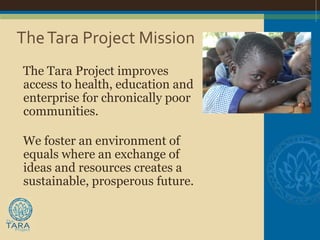
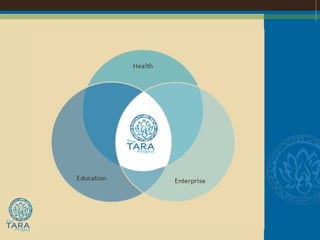
The Tara Project improves
access to health, education and
enterprise for chronically poor
communities.

We foster an environment of
equals where an exchange of
ideas and resources creates a
sustainable, prosperous future.
The Tara Project Vision
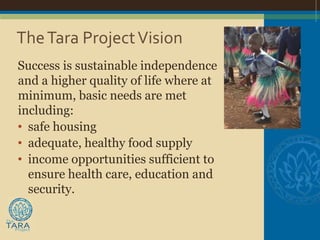
Success is sustainable independence
and a higher quality of life where at
minimum, basic needs are met
including:
• safe housing
• adequate, healthy food supply
• income opportunities sufficient to
  ensure health care, education and
  security.
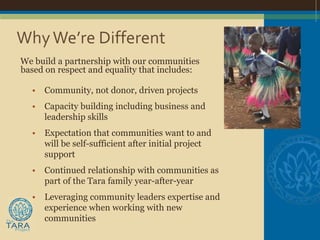
Why We’re Different
We build a partnership with our communities
based on respect and equality that includes:

  •   Community, not donor, driven projects
  •   Capacity building including business and
      leadership skills
  •   Expectation that communities want to and
      will be self-sufficient after initial project
      support
  •   Continued relationship with communities as
      part of the Tara family year-after-year
  •   Leveraging community leaders expertise and
      experience when working with new
      communities
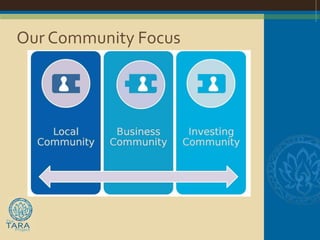
Our Community Focus
Our Community Focus
        • Impoverished
        • Lacks access to
          opportunities
        • Ready for change
        • International or
          Domestic
Our Community Focus
        • Multinational
          corporations or large
          businesses
        • Doing business in or
          around target
          communities
        • Open to creating
          profitable, equitable &
          ethical local
          partnerships
Our Community Focus
        • Individual investors or
          philanthropic
          organizations
        • Invested in
          communities and
          projects
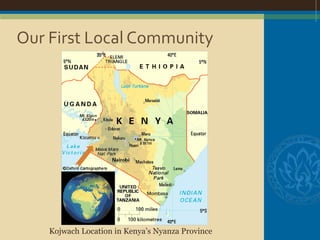
Our First Local Community


    Kojwach Location in Kenya’s Nyanza Province
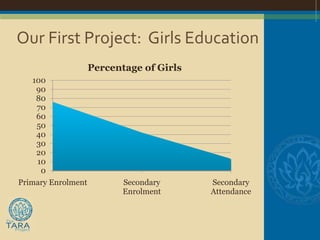
Our First Project:  Girls Education
                    Percentage of Girls
    100
     90
     80
     70
     60
     50
     40
     30
     20
     10
      0
Primary Enrolment          Secondary      Secondary
                           Enrolment      Attendance
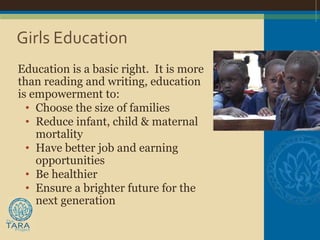
Girls Education
Education is a basic right. It is more
than reading and writing, education
is empowerment to:
  • Choose the size of families
  • Reduce infant, child & maternal
    mortality
  • Have better job and earning
    opportunities
  • Be healthier
  • Ensure a brighter future for the
    next generation
Girls Education
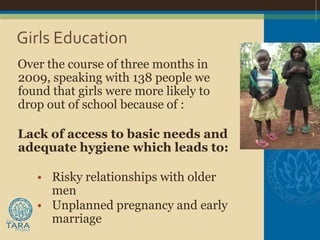
Over the course of three months in
2009, speaking with 138 people we
found that girls were more likely to
drop out of school because of :

Lack of access to basic needs and
adequate hygiene which leads to:

   • Risky relationships with older
     men
   • Unplanned pregnancy and early
     marriage
Girls Education
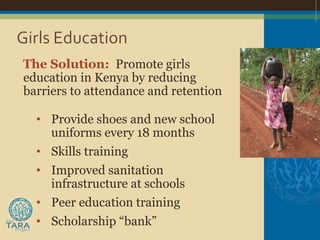
The Solution: Promote girls
education in Kenya by reducing
barriers to attendance and retention

  • Provide shoes and new school
    uniforms every 18 months
  • Skills training
  • Improved sanitation
    infrastructure at schools
  • Peer education training
  • Scholarship “bank”
Girls Education
The Timeline:
  • December 2009: Field preparation
    and detailed project development
  • June 2010: Launch project
  • December 2010: Initial Evaluation
  • January 2011: Program
    modifications based on evaluation
    findings.
  • June 2011: 1st Year Program
    Evaluations
How You Can Help
• Immediate needs: $10K for December
  Field Preparation
• Bring your kids to our ornament events
• Skilled volunteers: Website coder, Flash
  Designer
• Hosting Parties
• Tell a Friend!
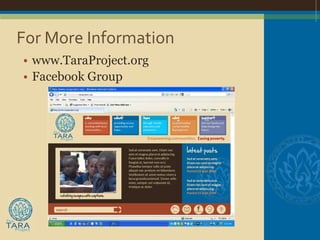
For More Information
• www.TaraProject.org
• Facebook Group
Thank you!

Tara Public Presentation

  • 1.
  • 2.
    The Tara Project Mission The Tara Projectimproves access to health, education and enterprise for chronically poor communities. We foster an environment of equals where an exchange of ideas and resources creates a sustainable, prosperous future.
  • 3.
    The Tara Project Vision Success is sustainableindependence and a higher quality of life where at minimum, basic needs are met including: • safe housing • adequate, healthy food supply • income opportunities sufficient to ensure health care, education and security.
  • 5.
    Why We’re Different We build apartnership with our communities based on respect and equality that includes: • Community, not donor, driven projects • Capacity building including business and leadership skills • Expectation that communities want to and will be self-sufficient after initial project support • Continued relationship with communities as part of the Tara family year-after-year • Leveraging community leaders expertise and experience when working with new communities
  • 6.
  • 7.
    Our Community Focus • Impoverished • Lacks access to opportunities • Ready for change • International or Domestic
  • 8.
    Our Community Focus • Multinational corporations or large businesses • Doing business in or around target communities • Open to creating profitable, equitable & ethical local partnerships
  • 9.
    Our Community Focus • Individual investors or philanthropic organizations • Invested in communities and projects
  • 10.
    Our First Local Community Kojwach Location in Kenya’s Nyanza Province
  • 11.
    Our First Project:  Girls Education Percentage of Girls 100 90 80 70 60 50 40 30 20 10 0 Primary Enrolment Secondary Secondary Enrolment Attendance
  • 12.
    Girls Education Education is abasic right. It is more than reading and writing, education is empowerment to: • Choose the size of families • Reduce infant, child & maternal mortality • Have better job and earning opportunities • Be healthier • Ensure a brighter future for the next generation
  • 13.
    Girls Education Over the courseof three months in 2009, speaking with 138 people we found that girls were more likely to drop out of school because of : Lack of access to basic needs and adequate hygiene which leads to: • Risky relationships with older men • Unplanned pregnancy and early marriage
  • 14.
    Girls Education The Solution: Promotegirls education in Kenya by reducing barriers to attendance and retention • Provide shoes and new school uniforms every 18 months • Skills training • Improved sanitation infrastructure at schools • Peer education training • Scholarship “bank”
  • 15.
    Girls Education The Timeline: • December 2009: Field preparation and detailed project development • June 2010: Launch project • December 2010: Initial Evaluation • January 2011: Program modifications based on evaluation findings. • June 2011: 1st Year Program Evaluations
  • 16.
    How You Can Help • Immediate needs:$10K for December Field Preparation • Bring your kids to our ornament events • Skilled volunteers: Website coder, Flash Designer • Hosting Parties • Tell a Friend!
  • 17.
  • 18.