Downloaded 13 times
![Thermoacoustic Refrigerator
Anand Kumar
Department of Mechanical Engineering
Shri Balwant Institute of Technology
Sonepat, Haryana, India
me13710.sbit@gmail.com
Abstract— In an early 19th century, modern refrigeration
technologies were introduced to the world. In the last few
decades, the use of refrigeration systems has significantly
increased. Currently, Cooling is achieved with vapour
compression system that uses a specific refrigerant. In recent
years, it has been discovered that conventional refrigerants affect
the environment adversely. For the safety of the environment, it
is necessary to avoid the use of environmentally hazardous
refrigerants by developing new alternative refrigeration
technologies such as Thermoacoustic Refrigeration System. This
paper describes the variation of hot end temperature and the
temperature difference between the stack ends with the various
parameters like frequency, mean pressure.
Keywords— Refrigeration, Vapour Compression System,
Refrigerants, Thermoacoustic Refrigeration System, Sound Waves,
Oscillating Flow, Heat Exchangers
I. INTRODUCTION
A. Brief History
“Thermoacoustic refrigerators are systems which use
sound waves to produce cooling power [1]”. If the system has
the ability to convert acoustics into energy it is hence, called a
thermoacoustic refrigerator. During the last two decades
thermoacoustic refrigeration is explored as a new cooling
technology. The thermoacoustic device contains no adverse
chemicals or environmentally unsafe elements that are
characteristics of the current refrigeration systems.
Thermoacoustics deals with the conversion of sound energy to
heat energy and vice versa. There are two types of
thermoacoustic devices: thermoacoustic engine and
thermoacoustic refrigerator. In a thermoacoustic engine, heat
is converted into sound energy and the energy is available for
the useful work. In this device, heat flows from a source of
higher temperature to a sink at lower temperature. In a
thermoacoustic refrigerator, the reverse of the above process
occurs, i.e., it utilizes work (in the form of acoustic power) to
absorb heat from a low temperature medium and reject it to a
high temperature medium. For this project we will
concentrate on the latter, thermoacoustic refrigeration. The
efficiency of the thermoacoustic devices is currently lower
than that of their conventional counterparts, which needs to be
improved to make them competitive. Although thermoacoustic
refrigerators have many advantages which include:
• Mechanical simplicity
• No lubricants needed
• Use of cheap and readily available gases (air)
• Power saving by proportional control
• Lower life cycle cost
Another major benefit includes the environmental aspect; the
international restriction on the use of CFC gives
thermoacoustic devices a strong advantage over traditional
refrigerators. The gases used in these devices (air etc) are
totally harmless to the ozone and have no greenhouse effect.
The process of refrigeration means the cooling the desired
space and maintaining the temperature below the ambient
temperature. Acoustics deals with study of sound production,
transmission, and effects. Thermoacoustic deals with thermal
effects of the sound waves and the inter conversion of sound
energy and heat. Sound waves travel in a longitudinal fashion.
They travel with successive compression and rarefaction of
the medium in which they travel (gaseous medium in this
case). This compression and expansion respectively lead to the
heating and cooling of the gas. This principle is employed to
bring about the refrigeration effect in a thermoacoustic
refrigerator. In Los Alamos National Laboratories (LANL), a
team consisting of Gregory W Swift, J. C. Wheatley and
Thomas J. Hofler accidently developed the first modern TAR
when they tried to power a heat pump with the help of a
Stirling engine [1].
The Recent advancements in the field of Thermo acoustics
guarantee to revolutionize the way that many machines as of
now work. By controlling the temperature-changes along the
acoustic longitudinal waves, a machine can be made that can
supplant current refrigeration and cooling gadgets. These
machines can be coordinated into refrigerators, home
generators, high temp water warmers and coolers. The Thermo
acoustics gadgets contain no hazardous chemicals or
ecologically hazardous components that are attributes of the
present refrigeration systems. There are two sorts of thermo
acoustic devices: Thermo acoustic motor and Thermo acoustic
refrigerators. In a thermo acoustic motor, warmth is changed
over into sound energy and this energy is accessible for the
helpful work. In this device, heat flows source at higher
temperature to a sink at lower temperature. In a thermo
acoustic refrigerator, the reverse of the above process occurs,
i.e., it utilizes work (in the form of acoustic power) to absorb](https://image.slidesharecdn.com/thermoacousticrefrigerator-170523172838/85/Thermoacoustic-Refrigerator-1-320.jpg)
![Thermoacoustic Refrigerator
Anand Kumar
Department of Mechanical Engineering
Shri Balwant Institute of Technology
Sonepat, Haryana, India
me13710.sbit@gmail.com
Abstract— In an early 19th century, modern refrigeration
technologies were introduced to the world. In the last few
decades, the use of refrigeration systems has significantly
increased. Currently, Cooling is achieved with vapour
compression system that uses a specific refrigerant. In recent
years, it has been discovered that conventional refrigerants affect
the environment adversely. For the safety of the environment, it
is necessary to avoid the use of environmentally hazardous
refrigerants by developing new alternative refrigeration
technologies such as Thermoacoustic Refrigeration System. This
paper describes the variation of hot end temperature and the
temperature difference between the stack ends with the various
parameters like frequency, mean pressure.
Keywords— Refrigeration, Vapour Compression System,
Refrigerants, Thermoacoustic Refrigeration System, Sound Waves,
Oscillating Flow, Heat Exchangers
I. INTRODUCTION
A. Brief History
“Thermoacoustic refrigerators are systems which use
sound waves to produce cooling power [1]”. If the system has
the ability to convert acoustics into energy it is hence, called a
thermoacoustic refrigerator. During the last two decades
thermoacoustic refrigeration is explored as a new cooling
technology. The thermoacoustic device contains no adverse
chemicals or environmentally unsafe elements that are
characteristics of the current refrigeration systems.
Thermoacoustics deals with the conversion of sound energy to
heat energy and vice versa. There are two types of
thermoacoustic devices: thermoacoustic engine and
thermoacoustic refrigerator. In a thermoacoustic engine, heat
is converted into sound energy and the energy is available for
the useful work. In this device, heat flows from a source of
higher temperature to a sink at lower temperature. In a
thermoacoustic refrigerator, the reverse of the above process
occurs, i.e., it utilizes work (in the form of acoustic power) to
absorb heat from a low temperature medium and reject it to a
high temperature medium. For this project we will
concentrate on the latter, thermoacoustic refrigeration. The
efficiency of the thermoacoustic devices is currently lower
than that of their conventional counterparts, which needs to be
improved to make them competitive. Although thermoacoustic
refrigerators have many advantages which include:
• Mechanical simplicity
• No lubricants needed
• Use of cheap and readily available gases (air)
• Power saving by proportional control
• Lower life cycle cost
Another major benefit includes the environmental aspect; the
international restriction on the use of CFC gives
thermoacoustic devices a strong advantage over traditional
refrigerators. The gases used in these devices (air etc) are
totally harmless to the ozone and have no greenhouse effect.
The process of refrigeration means the cooling the desired
space and maintaining the temperature below the ambient
temperature. Acoustics deals with study of sound production,
transmission, and effects. Thermoacoustic deals with thermal
effects of the sound waves and the inter conversion of sound
energy and heat. Sound waves travel in a longitudinal fashion.
They travel with successive compression and rarefaction of
the medium in which they travel (gaseous medium in this
case). This compression and expansion respectively lead to the
heating and cooling of the gas. This principle is employed to
bring about the refrigeration effect in a thermoacoustic
refrigerator. In Los Alamos National Laboratories (LANL), a
team consisting of Gregory W Swift, J. C. Wheatley and
Thomas J. Hofler accidently developed the first modern TAR
when they tried to power a heat pump with the help of a
Stirling engine [1].
The Recent advancements in the field of Thermo acoustics
guarantee to revolutionize the way that many machines as of
now work. By controlling the temperature-changes along the
acoustic longitudinal waves, a machine can be made that can
supplant current refrigeration and cooling gadgets. These
machines can be coordinated into refrigerators, home
generators, high temp water warmers and coolers. The Thermo
acoustics gadgets contain no hazardous chemicals or
ecologically hazardous components that are attributes of the
present refrigeration systems. There are two sorts of thermo
acoustic devices: Thermo acoustic motor and Thermo acoustic
refrigerators. In a thermo acoustic motor, warmth is changed
over into sound energy and this energy is accessible for the
helpful work. In this device, heat flows source at higher
temperature to a sink at lower temperature. In a thermo
acoustic refrigerator, the reverse of the above process occurs,
i.e., it utilizes work (in the form of acoustic power) to absorb](https://image.slidesharecdn.com/thermoacousticrefrigerator-170523172838/75/Thermoacoustic-Refrigerator-1-2048.jpg)
![heat from a low temperature medium and reject it to a high
temperature medium.
The Thermo Acoustic phenomenon can be clarified as
Acoustic waves encounter displacement motions, and
temperature motions in relationship with the pressure
varieties. Keeping in mind the end goal to create thermo
acoustic effect, these motions in a gas ought to happen near a
strong surface, with the goal that heat can be exchanged to or
from the surface. A stack of firmly dispersed parallel plates is
set inside the thermo acoustic device so as to give such a
strong surface. The thermo acoustic phenomenon happens by
the interaction of the gas particles and the stack plate. At the
point when expansive temperature slopes are made over the
stack, sound waves are produced i.e. work is delivered as
acoustic power (shaping a thermo acoustic motor). In the other
case, the acoustic work is utilized in order to make
temperature gradients over the stack, which is utilized to
exchange warm from a lower temperature medium to a high
temperature medium (as the instance of a thermo acoustic
refrigerator). A thermo acoustic cooler comprises of a tube
loaded with a gas. This tube is shut down toward one side and
a wavering device is set at the other side to make an acoustic
standing wave inside the tube.
B. Thermoacoustic Phenomenon
Acoustic waves are oscillations in a medium that cause it to
experience pressure, displacement and temperature variations.
In order to produce thermoacoustic effect, these oscillations in
a gas should occur close to a solid surface. A stack is placed
inside the thermoacoustic device in order to produce such a
solid surface. The thermoacoustic phenomenon occurs by the
interaction of the gas particles and the stack plate. The sound
wave (driven from a loudspeaker) is used in order to create
temperature gradient across the stack, which is used to transfer
heat from low temperature medium to a high temperature
medium.
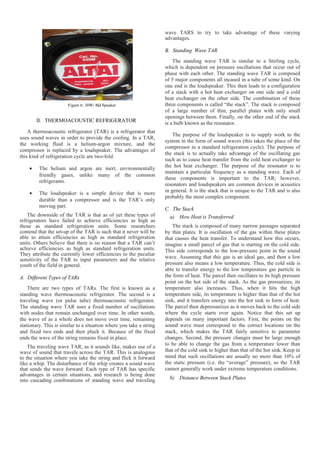
A thermoacoustic refrigerator consists of a tube filled with a
gas, air for this system. This tube is closed at one end and an
oscillating device (loud speaker) is placed at the other end to
create an acoustic standing wave inside the tube.
Figure 1: Thermoacoustic Refrigerator
To be able to create or move heat, work must be done, and the
acoustic power provides this work. When a stack is placed
inside the resonator a pressure drop occurs. Interference
between the incoming and reflected wave is now imperfect
since there is now a difference in amplitude causing the
standing wave to travel a little, giving it acoustic power. In
the acoustic wave, parcels of gas adiabatically expand and
compress.
Pressure and temperature change simultaneously; to
understand the thermoacoustic cycle we must consider the
four processes in the Brayton cycle.
Figure 2: P – V diagram showing the four stages in the thermoacoustic
refrigerator cycle [2]
Solid circle shows the parcel state at the beginning of process
and the dashed circle shows the parcel at the end of the
process.
• Adiabatic compression of the gas. (Temperature of
gas increases). The temperature of the gas parcel is
now higher than that of the stack wall and heat flows
from the parcel to the wall.
• Isobaric heat transfer. (Constant pressure with
decreasing temperature). The parcels temperature is
higher than that of the stack causing it to transfer heat
to the stack.
• Adiabatic expansion of the gas. (Gas is cooled). The
temperature of the gas is lower than that of the stack.
• Isobaric heat transfer. (constant pressure, temperature
of gas increased back to its original value) Heat is
transferred from the stack back to the gas.
C. Working Gas
The thermoacoustic impact was initially found in the
nineteenth century when heat driven acoustic oscillations were
seen in open-finished glass tubes. Thermoacoustic
refrigerators offer both straightforwardness and dependability.
Dissimilar to current business gadgets that require crank shafts
and cylinders, these gadgets utilize just a solitary moving part
the amplifier's diaphragm. What right now makes them
extremely appealing as a contrasting option to different
methodologies is their utilization of an inert gas as the
working liquid, making them naturally perfect.](https://image.slidesharecdn.com/thermoacousticrefrigerator-170523172838/85/Thermoacoustic-Refrigerator-2-320.jpg)
![The working gas used here is Helium. The purpose behind this
decision is that helium has the most noteworthy or highest
speed of sound and thermal conductivity of all ideal gasses.
Moreover, helium is cheap in examination with the other
respectable gasses. A high conductivity is insightful since
thermal penetration depth is relative to the square root of the
thermal conductivity coefficient K (〖"δ” 〗_k∝ (√k
Diatomic helium molecules showed existence of weak
electrostatic attractions. Because of low scattering powers and
a low nuclear mass, helium particles have a more noteworthy
thermal conductivity than some other gas with the exception
of hydrogen. Hydrogen is more responsive contrasted with
helium which is dormant. Utilizing helium as a sound
medium, however past the span of this study, would just
require a cleared impermeable tube that would then be
pressurized with helium gas (Johnathan Newman). This
procedure is utilized as a part of numerous expert review
thermoacoustic fridges where helium gas has prompt to
expanded effectiveness and thermal exchange over the stack.
Table 1.
Even though the table above shows that hydrogen has the
highest speed of sound. In simple words, it is not used, due to
the reason that hydrogen is highly inflammable and difficult to
store.
D. Thermoacoustic Stack
The stack is the most important and influential component in a
thermoacoustic refrigerator. This will determine the cooling
effect at the set frequency of the fridge. The key to improving
the efficiency of the fridge is developing the stack. The
primary constraint in designing the stack is the fact that stack
layers need to be a few thermal penetration depths apart, with
four penetration depths been the optimal separation. [2] The
thermal penetration depth, dk, is defined as the distance that
heat can diffuse through a gas during the time t = 1/π f, where
f is the frequency of the standing wave. [2]
dk=√(k/πfρCp) [1]
k = Thermal conductivity
ρ = Density of the gas
Cp = Isobaric specific heat per unit mass
If stack layers are too far apart the gas cannot effectively
transfer heat to and from the stack walls. If the layers are too
close together viscous effects hamper the motion of the gas
particles.
E. Pin Stack Array
The pin stack array was constructed using carbon fibre tubes.
For optimum performance a material with low thermal
conductivity is required. The internal diameter of the tubes
was 1mm and optimum separation four thermal penetration
depths. This is the gas corridor the air travels through.
(1 x ¬〖10〗^ (-3) m)/4 = 2 x 〖10〗^ (-4) m (dk) [2]
dk = Thermal penetration depth
From this we can calculate the optimum frequency from the
diameter of the tubes.
Then determine the length of the tube needed to create
resonance at this frequency.
Figure 3: Pin stack array inside resonance tube [3]
F. Honeycomb Stack
This stack is new to the market and is being introduced in
thermo applications. We constructed the design by using the
catalytic converter from the exhaust of a car.
Figure 4: Honeycomb stack design [3]
G. Resonance Frequency
Resonant frequency is the natural frequency of vibration
determined by the physical parameters of the vibrating object.](https://image.slidesharecdn.com/thermoacousticrefrigerator-170523172838/85/Thermoacoustic-Refrigerator-3-320.jpg)
![[4] The resonant frequency of air columns depend upon the
speed of sound in air as well as the length and geometry of the
air column. The speed of sound in dry air is approx 334.1 m/s.
For the purpose of this project this is accurate and we do not
need to consider room temperature variation effects.
The frequency of the system can be calculated using dk
(equation 1)
dk = √(K/(Π f p Cp)) [2]
Rearrange for f gives
f = K/ (Π p Cp 〖dk〗^2) [3]
Where K = thermal conductivity, p = density of gas, Cp =
isobaric specific heat per unit mass
The density of air and isobaric specific heat per unit mass
were calculated using an online calculator at room
temperature, which was measured with a mercury
thermometer.
f =
f = 169 HZ
H. Length Of Tube
We can now calculate the length (L) of the tube needed
f = (n V)/ (4 L) [4]
Rearrange for L gives
L = (n V)/ (f 4)
L = ([1] (340))/ ([4] (169))
L = 0.5m
Where n = Harmonic number (1, 3, 5...) This tube produces
only odd harmonics because it is closed.
V = Speed of sound in air, f = resonance frequency , 4 = ¼
wavelength for closed end
I. Closed End Pipes
The air at the closed end of the pipe must be a node (not
moving) since the air is not free to move there and must be
able to be reflected back.
There must also be an antinode where the opening is, since
that is where there is maximum movement of the air.
Figure 5: Closed Cylinder
The red line represents sound pressure and the blue line
represents the amplitude of the motion of the air. The pressure
has a node at the open end, and an antinode at the closed end.
The amplitude has a node at the closed end and an antinode at
the open end. Therefore, optimum stack position in the tube
should be close to the pressure maximum, but away from the
particle displacement minimum. Even harmonics are absent as
they would be out-of-phase, causing destructive interference
instead of constructive interference.
J. The Speaker
The ohm (Ω) is the unit of measure for impedance, which is
the property of a speaker that restricts the flow of electrical
current through it. [6] Study shows that the temperature
differences between the hot and cold sides of the stack
increase with speaker power.
The amplifier will deliver maximum power to the speaker
when the speaker impedance matches the internal impedance
of the amplifier. Too low impedance will result in weak output
and poor tone. If the speaker impedance is higher than that of
the amplifier, its output power will again be less than its
capable of. [6]
For optimum speaker performance in our system the speaker
impedance should equal the amplifier impedance.
To calculate the impedance of an amplifier
Output
impedance
The resistance was measured with a digital millimeter, with
the speaker being the load on the system. The load resistance
is the resistance of the speaker.
Voltage measurement at the points at OUT:
V1 = Open-circuit voltage (Rload = ∞ Ω, that is without Rload,
switch S is open)
Rload = Load resistance (Rtest is resistor to measure Ω value)
V2 = Loaded circuit voltage with resistor Rload = resistance Rtest
Zsource = The output impedance can be calculated
8Ω x ((16.9 mv)/ (7.7 mv) - 1) = 9.6 Ω [5]](https://image.slidesharecdn.com/thermoacousticrefrigerator-170523172838/85/Thermoacoustic-Refrigerator-4-320.jpg)
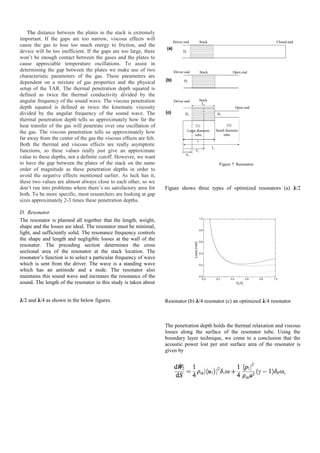
![Where
�k = Thermal penetration depth
� = Angular frequency of the sound wave
� = Ratio of isobaric to isochoric specific heats
a = Sound velocity
= Average density
p = Pressure
The first term on the right-hand side is the kinetic energy
dissipated by viscous shear. The second term is the energy
dissipated by thermal relaxation. The �/2 resonator dissipates
double the energy dissipated by �/4 resonator because the total
dissipated energy depends on the wall surface. Therefore, �/4
resonator is preferred. This �/4 resonator is further optimized
by reducing the diameter of the tube on the right hand side of
the stack, and this is done by minimizing the acoustic power
equation which is shown above. As shown in the figure, the
larger diameter tube is marked [1] with diameter D1 and the
smaller diameter tube is marked [2] with diameter D2. The
losses to some degree in [2] are plotted as function of the
proportion D2/D1 as shown in the figure.
Figure 8: Losses in Part
Figure shows the losses in part [2] are plotted as function of
the ratio D2/D1. The thermal loss increases monotonically as
function of the ratio D2/D1, but the viscous losses decrease
rapidly up to about D2/D1 = 0.5 and then increase slowly. As
a result, the total loss (sum) has a minimum at about D2/D1 =
0.54. The dots are the thermal losses, the dashed-line is the
viscous losses, and the solid plot represents the total loss.
Scientists utilized a metallic round globule to end the
resonator. The circle had sufficient volume to reenact an open
end. Yet, at the open end, which is a speed antinode, the speed
is maximum so that a sudden move from the little diameter
tube to the globule can produce turbulence thus losses happen.
This is shown in the figure below.
Figure 9:
When longitudinal waves are sent from the driver, they pass
through the stack and then through the resonator. The
resonator’s closed end will act like a mirror and reflect back
the waves. In order to stop this, a buffer volume is kept at the
end which will disperse the waves and stimulates the open
end. A tapering is additionally utilized between the substantial
distance across D1 tube and the D2 tube. The calculation for
the minimal losses at the cone for half angle was found to be 9
degrees. Estimations of the standing wave acoustic weight
appropriation inside the resonator demonstrate that the
framework is almost a quarter- wavelength resonator..
The resonance condition to control the length can be found out
by matching the pressure and volume velocity at the interface
between the small diameter and large diameter tube. The
operation frequency is 400Hz.
The amplitudes of the dynamic pressure and gas velocity due
to the standing wave in the large diameter tube [1] are given
by
p[1]
= po
[1]
(cos (kx))
and
u[1]
= ( po
[1]
sin(kx) )/pm a
where the superscript [1] refers to the large diameter tube [1],
and po
[1]
is the dynamic pressure amplitude at the driver
location (antinode). Pressure and velocity in the small
diameter tube [2] are given by
p[2]
= po
[2]
(sin K(Lt –x) )
and
u[2]
= ( po
[2]
cos(k(Lt –x)) )/pm a
Where, Lt is the total length of the resonator, and subscript [2]
refers to the small diameter tube.
The vast width resonator comprises chiefly of the stack and
the two heat exchangers. Subsequently, the energy losses
occur in these components. The main losses are located at the](https://image.slidesharecdn.com/thermoacousticrefrigerator-170523172838/85/Thermoacoustic-Refrigerator-7-320.jpg)
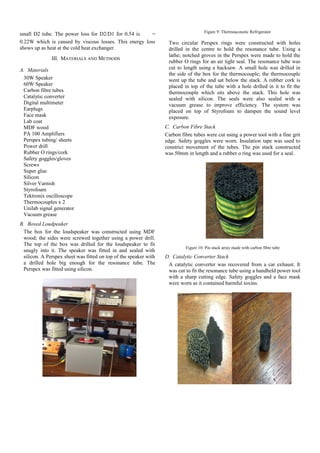
![Figure 11: Catalytic converter stack
E. Photographic Film Stack
This stack was used in the original paper on tabletop
thermoacoustic refrigerator by Daniel A. Russell and Pontus
Weibull. [2]
The stack was designed using photographic film,
fishing line and a copper rod as the centre piece. Super glue
was used to stick the fishing line to the photographic film.
Figure 12: Photographic film stack
Testing of the stack proved problematic as the stack got
damaged when changing the stack position. Preliminary
results were poor so this was not tested any further.
F. Calibration Of Thermocouples
For accurate results the two thermocouples were calibrated
before the experiment was conducted. A mercury thermometer
was used as a control and the adjustment screw on the
thermocouples was changed to match the temperature on the
thermometer.
G. Amplifing Sound Wave
The maximum temperature gradient achieved using the
UNILAB signal generator was 2.9 °C (see results). An
amplifier was introduced to our system to improve the power
output of the speaker and increase the thermoacoustic effect.
This increased our temperature gradient to 9 °C.
Figure 13: PA 100 Amplifiers
The signal was viewed on the oscilloscope to see what the
maximum gain achievable is before saturation occurs. Gain =
output/input. The max gain of the amplifier before saturation
occurs, A = 7.
Figure 14: Sound wave on Oscilloscope
H. Increasing The Efficiency
To improve the efficiency of the system the speaker was
changed. The speaker was very wide for the small opening in
the tube and some of the acoustic wave energy was being
absorbed by the Perspex walls.
Figure 15: Changing the speaker
A piece of wood was placed between the Perspex top and the
speaker to accommodate the change in size of the speaker.
Figure 16: New speaker set-up
The new speaker had also higher impedance. The original
speaker was 3Ω, whereas the new speaker was 8Ω which is
much closer to the desired 9.6Ω of the amplifier for maximum
performance. This increased our temperature difference a
further 2.1°C giving us a change of 10.7°C.
I. Experimental Set-Up
This is the experimental set up used in the testing of the
thermoacoustic refrigerator.](https://image.slidesharecdn.com/thermoacousticrefrigerator-170523172838/85/Thermoacoustic-Refrigerator-9-320.jpg)
![execution of the driver prompts to a higher execution of the
entire refrigerator framework. Moreover, elite of the driver
implies that the important acoustic power can be effectively
acquired without utilizing high electrical streams.
This sine wave can be created by a sine wave generator
programming or application which will work in Windows and
Android separately.
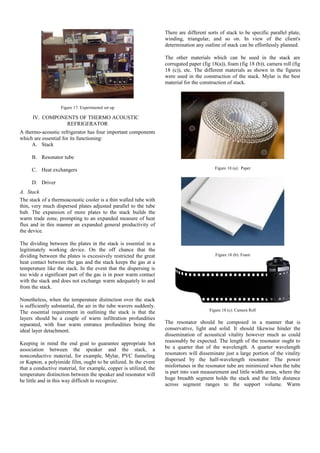
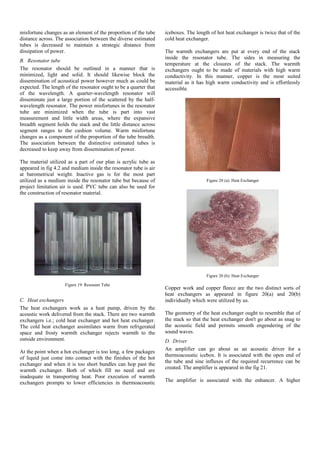
Figure 21: Driver
V. CONSTRUCTION AND WORKING OF
THERMOACOUSTIC REFRIGERATION SYSTEM
Thermoacoustic Refrigeration System mainly consist of a
loudspeaker attached to an acoustic resonator (tube) filled with
a gas. In the resonator, a stack consisting of a number of
parallel plates and two heat exchangers are installed. The
loudspeaker, which acts as the driver, sustains acoustic
standing waves in the gas at the fundamental resonance
frequency of the resonator. The acoustic standing wave
displaces the gas in the channels of the stack while
compressing and expanding respectively leading to heating
and cooling of the gas. The gas, which is cooled due to
expansion absorbs heat from the cold side of the stack and as
it subsequently heats up due to compression while moving to
the hot side, rejects the heat to the stack. Thus the thermal
interaction between the oscillating gas and the surface of the
stack generates an acoustic heat pumping action from the cold
side to the hot side. The heat exchangers exchange heat with
the surroundings, at the cold and hot sides of the stack.
Figure 22: Schematic representation of construction of
thermoacoustic refrigerator.
Fig. 22 shows the schematic representation of the
construction of thermoacoustic refrigerator where the
loudspeaker is used as a driver, the resonance tube sustains the
standing wave.
Figure 23: Pressure variation and displacement of sound waves.
The heat exchangers are used so that heat interaction with
the surrounding takes place. Heat is pumped from the cold end
heat exchanger to the hot end heat exchanger.[2] Fig. 22
shows the pressure variation and displacement of sound waves
in thermoacoustic refrigeration system [5]. It is known that
sound waves are longitudinal waves. They produce
compression and rarefaction in the medium they travel.
Maximum pressure occurs at the point of zero velocity and
minimum pressure at maximum velocity.
VI. DESCRIPTION OF TECHNOLOGY
Thermoacoustic refrigeration systems operate by using
sound waves and a non-flammable mixture of inert gas
(helium, argon, air) or a mixture of gases in a resonator to
produce cooling. Thermoacoustic devices are typically
characterised as either ‘standing-wave’ or ‘travelling-wave’. A
schematic diagram of a standing wave device is shown in
figure 1. The main components are a closed cylinder, an
acoustic driver, a porous component called a "stack, and two
heat exchanger systems. Application of acoustic waves
through a driver such as a loudspeaker makes the gas resonant.
As the gas oscillates back and forth, it creates a temperature
difference along the length of the stack. This temperature
change comes from compression and expansion of the gas by
the sound pressure and the rest is a consequence of heat
transfer between the gas and the stack. The temperature
difference is used to remove heat from the cold side and reject
it at the hot side of the system. As the gas oscillates back and
forth because of the standing sound wave, it changes in
temperature. Much of the temperature change comes from
compression and expansion of the gas by the sound pressure
(as always in a sound wave), and the rest is a consequence of
heat transfer between the gas and the stack.
In the travelling-wave device, the pressure is created with a
moving piston and the conversion of acoustic power to heat
occurs in a regenerator rather than a stack. The regenerator
contains a matrix of channels which are much smaller than
those in a stack and relies on good thermal contact between
the gas and the matrix. The design is such that the gas moves
towards the hot heat exchanger when the pressure is high and
towards the cold heat exchanger when the pressure is low,
transferring heat between the two sides. An example of a
travelling wave thermoacoustic device is the Ben & Jerry ice-
cream cabinet, figure 3.](https://image.slidesharecdn.com/thermoacousticrefrigerator-170523172838/85/Thermoacoustic-Refrigerator-12-320.jpg)
![Figure 24: A travelling-wave thermoacoustic refrigerator
VII. COMPRAISON OF THERMOACOUSTIC
REFRIGERATION SYSTEM WITH OTHER
REFRIGERATION SYSTEM
Apart from vapour compression devices, there are several
other ways to provide cooling and refrigeration. Although
none of these are currently as versatile as a Vapour
Compression Systems but some of these systems hold a high
possibility of replacing the pollution causing Vapour
Compression Systems. Comparison with various systems is as
follows [3].
A. Type of Refrigerent
The Absorption Refrigeration uses a binary mixture of
refrigerant and absorbent like Water/ammonia or LiBr/water.
The Adsorption system uses natural refrigerants like water,
ammonia or alcohol. Thermo-electric and Thermoacoustic
Refrigeration Systems do not use any refrigerant.
B. Working cycle
Vapour Absorption Refrigeration is a two stage process.
The vapour refrigerant is absorbed in a binary solution which
then regenerates the refrigerant on heating externally. It is
cooled in the condenser to the required pressure level and the
cycle repeats. Much like the Vapour Compression
Refrigeration Systems the Adsorption Systems are also based
on withdrawing heat from surroundings during an evaporation
process. Thermo-electric System is based on the Peltier Effect
wherein an electric current passing through a junction of two
materials will cause a change in temperature. The
Thermoacoustic Refrigeration System is powered by either a
heat engine running on waste heat or an electric source. Due to
compression and expansion of air packets heat transfer across
two mediums is made possible.
VIII.RESULTS
A. Introduction
This section reports the results of the study. Following the
testing off the system the carbon fibre stack proved most
efficient with the optimum stack position being 8cm from the
closed end. The efficiency of the system was increased by the
addition of the amplifier and by changing the speaker
impedance. The study also viewed the difference in
temperature difference between the first, third, fifth
harmonics. The system worked for the purpose designed and
demonstrated the thermoacoustic effect successfully with a
maximum temperature gradient of 10.7°C after 10mins being
achieved.
For the following sets of data Tc and Th will refer to the cold
and hot sides of the stack respectfully.
Data was recorded for time intervals at which significant
changes happened, after this time the temperature gradient
between both ends of the stack all but stopped increasing.
B. Testing Of Isolated Tube
Firstly the system was tested without the stack in place or the
speaker connected to check for any temperature variations.
The two thermocouples were placed inside the tube in the
positions they would sit when the stack is in the tube.
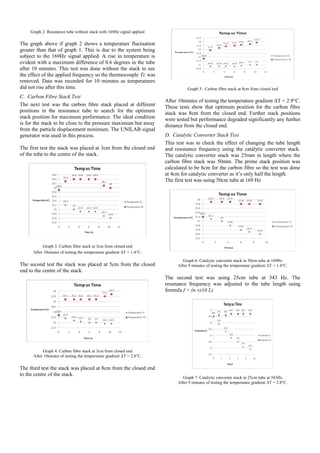
Graph 1: Testing of isolated tube
As can be seen from the above graph the temperature does
fluctuate inside the tube without the stack or speaker
connected. However, the variation is small with a maximum
fluctuation of 0.2 degrees Celsius for both Tc and Th. This
could be due to ambient temperatures which is the temperature
in the room and around the thermoacoustic refrigerator. Room
temperature was monitored using a mercury thermometer and
changes were very small and considered not important to the
experiment. Data was recorded for 12 minutes as the
fluctuations in this time was steady and changes were not
expected to happen after this time.
The speaker was then connected with the applied resonance
frequency of 169 Hz.](https://image.slidesharecdn.com/thermoacousticrefrigerator-170523172838/85/Thermoacoustic-Refrigerator-13-320.jpg)
![minutes of testing the performance decreased by 4.3°C.
Therefore, stack position is crucial in the set up of the system.
G. Effect Of Speaker Impedance And Size
To increase the size of the temperature differential the speaker
was changed. (see 2.6 increasing the efficiency)
The new speaker had higher impedance closer to that of the
amplifier and a smaller diameter to better suit the diameter of
the resonance tube.
The test was done with the carbon fibre stack under the same
conditions which achieved the maximum temperature
difference of 8.6°C. ( Gain of amp = 7, f = 169Hz, tube =
50cm, stack position = 8cm)
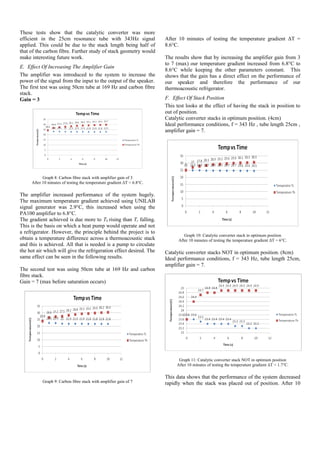
Graph 12: Higher impedance speaker at optimum conditions
After 10 minutes of testing the temperature gradient ΔT = 10.7°C.
This increase in temperature shows us that changing the
speaker made the system more efficient. This is due to the new
speaker having higher impedance closer to that off the
amplifier.
Another important factor is the diameter of the new speaker is
smaller and more power will therefore get up the resonance
tube and not absorbed in the Perspex walls.
H. TESTING THE 3rd
AND 5th
HARMONICS
A harmonic of a wave is a component frequency of the signal
that is an integer multiple of the fundamental frequency.[6]
The wave displacement has only quarter of a cycle of a sine
wave, so the longest sine wave that fits into the closed pipe is
four times as long as the pipe.
L = λ/4 [6]
We can also fit in a wave if the length of the pipe is three
quarters of the wavelength, i.e. if wavelength is one third that
of the fundamental and the frequency is three times that of the
fundamental. But we cannot fit in a wave with half or a quarter
the fundamental wavelength (twice or four times the
frequency). Therefore this type of tube produces only odd
harmonics.
f = (n V)/ (4 L)
f1 (1st
harmonic) = ([1] (343))/ ([4] (0.5)) = 169 Hz
f3 (3rd
harmonic) = ([3] (343))/ ([4] (0.5)) = 515 Hz
f5 (5th
harmonic) = ([5] (343))/ ([4] (0.5)) = 858 Hz
3rd
HARMONIC TEST
Test done under ideal conditions for performance, carbon fibre
stack, stack position = 8cm, tube 50cm, amp gain = 7, new
speaker used.
f3 = 515Hz
Graph 13: 3rd
harmonic f3 at optimum conditions
After 10 minutes of testing the temperature gradient ΔT = 2.6°C.
Performance of the system degraded from 10.7°C to 2.6°C
from the first harmonic f1 to the third harmonic f3.
This gives an efficiency drop of approx 75%.
5th
HARMONIC TEST
Test done under ideal conditions for performance, carbon fibre
stack, stack position = 8cm, tube 50cm, amp gain = 7, new
speaker used.
f3 = 858Hz
Graph 14: 5th
harmonic f5 at optimum conditions
After 10 minutes of testing the temperature gradient ΔT = 0.7°C.
Performance of the system degraded from 2.3°C to 0.7°C from
the third harmonic f3 to the fifth harmonic f5. This gives an
efficiency drop of approx 75%.
In summary, the performance of the system decreases by
approx 75% per overtone. This was due to the standing wave
pattern changing as the harmonics increased while the stack
position remained in the optimum position for the first
harmonic and was not adjusted accordingly.](https://image.slidesharecdn.com/thermoacousticrefrigerator-170523172838/85/Thermoacoustic-Refrigerator-16-320.jpg)
![IX. CONCLUSION
In this paper, the manufacturing procedure of a thermo
acoustic refrigerator is discussed. The construction of the
different parts of the refrigerator is described in detail. The
system has been assembled and the first performance
measurements have been done. The measurements show that
the system behaves very well as expected. A low temperature
of -65 0C is achieved. The refrigerator is used to study the
effect of some important thermo acoustic parameters, such as
the Prandtl number using binary gas mixtures, and the stack
plate spacing.
The device worked as a proof of concept device showing
that a thermo acoustic device is possible and is able to cool air,
but for only a short period of time. If the device is build up
with better materials, such has a more insulating tube, better
results can be obtained. In order to create a working
refrigerator, it is required to attach a heat sink to the top of the
device, thus, allowing the excess heat to dissipate to the
surroundings. However, this device demonstrate that thermo
acoustic device have the ability to create and maintain a large
temperature gradient, more than 20 degrees Centigrade, which
would be useful as a heat pump or refrigerator.
X. ACKNOWLEDGMENT
The authors would like to present their sincere gratitude
towards the Faculty of Mechanical Engineering in Shri
Balwant Institute of Technology, Sonepat.
XI. REFERENCES
[1] G.W. Swift,“What is thermoacoustics? A brief description”. Condensed
Matter and Thermal Physics Group. Los Alamos National Laboratory,
Los Alamos, New Mexico. 2004.
[2] M.E.H. Tijani, J.C.H. Zeegers, A.T.A.M. de Waele, “Design of
thermoacoustic refrigerators”. Elsevier, Cryogenics 42 (2002) 49–57.
[3] F. Zink, J. S. Vipperman, L. A. Schaefer, “Environmental motivation to
switch to thermoacoustic refrigeration”. Applied Thermal Engineering
30 (2010) 119-126.
[4] E. C. Nsofor, A. Ali, “Experimental study on the performance of the
thermoacoustic refrigerating system”. Applied Thermal Engineering 29
(2009) 2672-2679.
[5] http://hyperphysics.phy-astr.gsu.edu/hbase/sound/tralon.html
[6] http://www.nevis.columbia.edu/~ju/Paper/Paper-
thermoacoustic/Construction%20therm%20refrigerator.pdf
[7] http://www.acs.psu.edu/drussell/publications/thermodemo.pdf
[8] http://www.nevis.columbia.edu/~ju/Paper/Paper-
thermoacoustic/Construction%20therm%20refrigerator.pdf
[9] http://hyperphysics.phy-astr.gsu.edu/hbase/sound/reson.html
[10] http://www.phys.unsw.edu.au/jw/pipes.html
[11] http://www.prestonelectronics.com/audio/Impedance.html](https://image.slidesharecdn.com/thermoacousticrefrigerator-170523172838/85/Thermoacoustic-Refrigerator-17-320.jpg)

This document describes the key components and operating principles of a thermoacoustic refrigerator. It begins with an introduction to thermoacoustics and how sound waves can be used to produce cooling effects. It then discusses the specific components of a thermoacoustic refrigerator, including the stack, resonator tube, working gas, and speaker. The stack is identified as the most important component, as it facilitates the transfer of heat between the gas and solid surfaces when acoustic waves pass through. The document provides equations to calculate the optimal design parameters, such as resonance frequency and tube length. In summary, it outlines how a thermoacoustic refrigerator uses sound waves instead of chemical refrigerants to drive a refrigeration cycle for cooling purposes


