Disability Awareness
Training
Presented
by
Bobby Dodd Institute
The

understanding that people with
disabilities are people first who just
happen to have a disability.

The

recognition that each individual – with
or without a disability – faces challenges.
Individuals with disabilities face some
unique challenges related to their
disabilities, which can be accommodated.

Disability Awareness Defined
Source: Nish Disability Etiquette and the
IDEA Bank

2
True

or False: People who are deaf or
have hearing loss cannot speak.

FALSE.

Some people make a conscious
choice not to use their voices while others
choose to speak. The type and degree of
hearing loss as well as the age of the
individual when he or she becomes deaf
can also influence speech.

Myths, Misconceptions and
Realities of Disabilities
Source: Nish Disability Etiquette and the
IDEA Bank

3
True

or False: People who are blind
acquire a “6th sense” for directing
themselves.

FALSE.

Although many people who are
blind develop their remaining senses more
fully, they do not have a “6th sense.”

Myths, Misconceptions and
Realities of Disability
Source: Nish Disability Etiquette and the
IDEA Bank

4
True

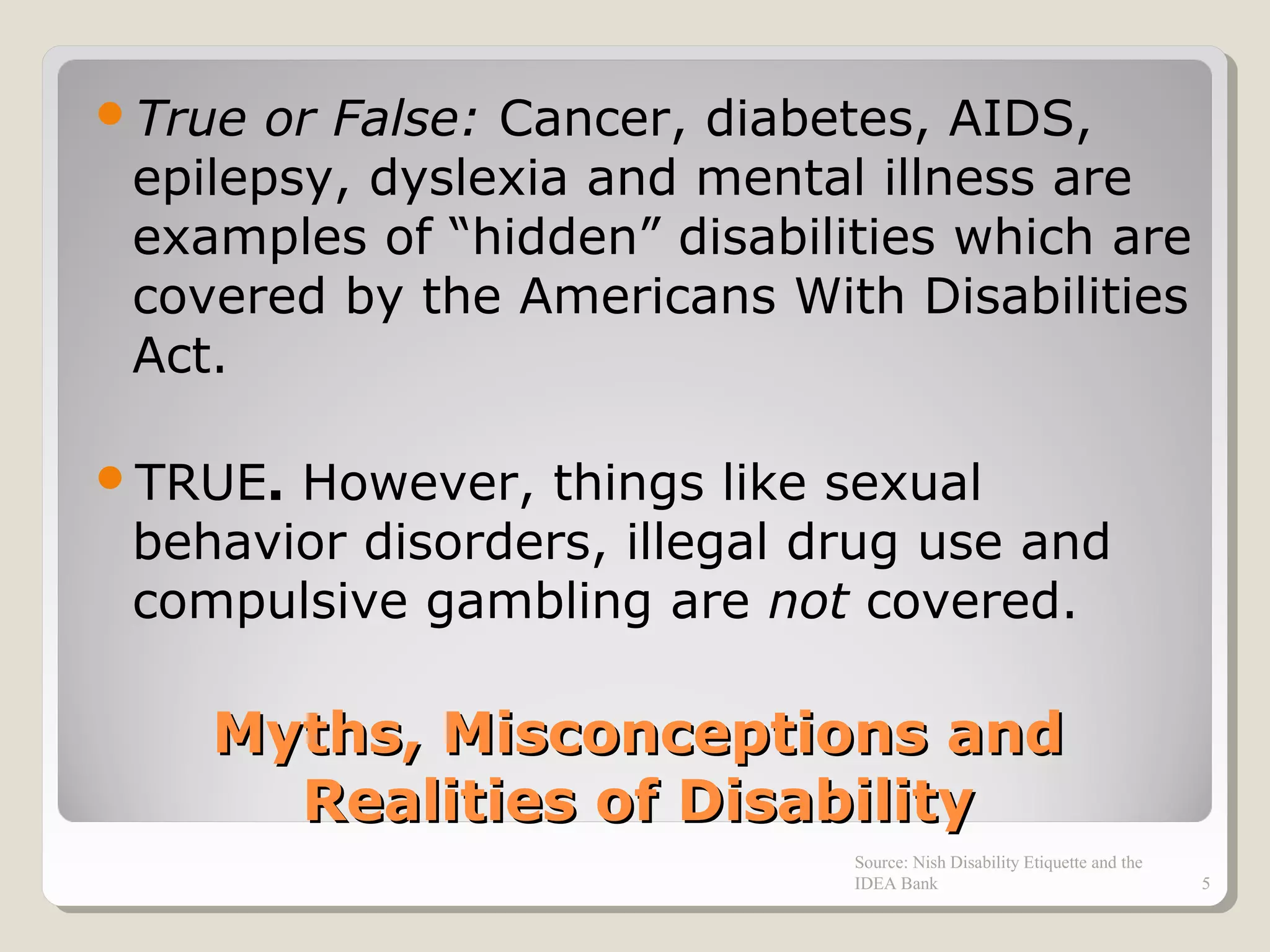
or False: Cancer, diabetes, AIDS,
epilepsy, dyslexia and mental illness are
examples of “hidden” disabilities which are
covered by the Americans With Disabilities
Act.

TRUE.

However, things like sexual
behavior disorders, illegal drug use and
compulsive gambling are not covered.

Myths, Misconceptions and
Realities of Disability
Source: Nish Disability Etiquette and the
IDEA Bank

5
True

or False: If someone has a disability
and appears to need help, it is polite to
provide assistance before you’ve been
asked.

FALSE.

Simply ask the person to let you
know if they require assistance.

Myths, Misconceptions and
Realities of Disability
Source: Nish Disability Etiquette and the
IDEA Bank

6
True

or False: It’s appropriate to sit down
when you’re speaking to someone in a
wheelchair.

TRUE.

Try to sit down in order to share
the same eye level. If seating is not
available, give the person some space.
Standing too close while you talk can
create an uncomfortable viewing angle.

Myths, Misconceptions and
Realities of Disability
Source: Nish Disability Etiquette and the
IDEA Bank

7
True

or False: If you’re assisting a person
who uses a seeing-eye dog, petting the
dog is okay.

FALSE.

For safety reasons, a dog needs
to be alert and undistracted while
working. Avoid treating the dog like you
would a pet.

Myths, Misconceptions and
Realities of Disability
Source: Nish Disability Etiquette and the
IDEA Bank

8
True

of False. More than 65% of all people
who have cerebral palsy (CP) have a
mental disability

FALSE.

This is a common misconception.
There is a wide range of abilities among
people who have cerebral palsy and most
do not have a mental disability.

Myths, Misconceptions and
Realities of Disability
Source: Nish Disability Etiquette and the
IDEA Bank

9
True

or False. If a person is having a
seizure, it is appropriate to put something
in his/her mouth to prevent him/her from
swallowing his/her tongue.

FALSE.

If you do that, there is a risk that
the person will choke on whatever you put
in his/her mouth.

Myths, Misconceptions and
Realities of Disability
Source: Nish Disability Etiquette and the
IDEA Bank

10
True

or False. Considerable expense is
required to accommodate employees with
disabilities.

FALSE.

Most workers with disabilities require
no special accommodations and the cost for
those who do is minimal or much lower than
many people believe. A 1999 survey by the
Job Accommodation Network (JAN) showed
that 20% of the accommodations cost
nothing and 51% of the accommodations
cost between $1 and $500.

Myths, Misconceptions and
Realities of Disability
Source: Nish Disability Etiquette and the
IDEA Bank

11
Disability Awareness
Training
!
Important Points To Remember
 The

key to creating an
accepting work
environment is to treat
each individual with
respect and equality!

 Do

not be overly
friendly or
condescending toward
individuals with
disabilities.
Source: Nish Disability Etiquette and the IDEA Bank

13
Important Points To Remember
 Emphasize

“person
first” terminology
(e.g., person who is
blind)
 Avoid words with
negative connotations
like: “handicapped”,
“afflicted”, “crippled”,
“victim”, “sufferer” etc.
 Do not refer to
individuals by their
disability. A person is
not a condition.

Source: Nish Disability Etiquette and the IDEA Bank

14
The

definition of legally blind is 20/200
vision with best correction. However,
many people who are considered blind do
have some sight.
Introduce yourself and explain what your
job role is. Speak in a normal tone of
voice. There is no need to shout.
When you move around, let the person
who is blind know so that he/she won’t be
talking to “empty air.”

Important Points To Remember:
People With Visual Impairments
Source: Nish Disability Etiquette and the
IDEA Bank

15
American

Sign Language (ASL) is not
another form of English. It is an official
language with its own grammar, context
and rules.
Lip-reading is only 30 – 50% effective and
can be tiring during long conversations.
Get the attention of the deaf person
before starting a conversation. Be patient
if you are asked to repeat yourself.

Important Points To Remember:
People With Hearing Loss
Source: Nish Disability Etiquette and the
IDEA Bank

16
If

needed, use a paper and pencil to
communicate.
If the person uses a sign language
interpreter, address the person, not the
interpreter.

Important Points To Remember:
People With Hearing Loss
Source: Nish Disability Etiquette and the
IDEA Bank

17
There

is a wide range of physical ability
among people who use wheelchairs and
people who use them will likely require
different degrees of assistance.
Make sure the person is ready before you
start pushing the wheelchair.
Sometimes people are told a place is
accessible when it is not. Consider
distance, weather and obstacles such as
stairs, curbs or hills when you give
directions.

Important Points To Remember:
People Who Use Wheelchairs
Source: Nish Disability Etiquette and the
IDEA Bank

18
Grand

Mal Seizures: Person will generally
fall to the ground and lose consciousness.
Usually last 1-5 minutes.
Petit Mal Seizures: Person usually stares
into space and may blink eyes rapidly.
Usually lasts a few seconds.
Both types MAY be controlled by
medications.

Important Points To Remember:
People Who Have Seizures
Source: Nish Disability Etiquette and the
IDEA Bank

19
If a person has a seizure:
-- Remain calm at all times.
-- Do not attempt to move the person.
-- Turn the person on his/her side to
clear the airway and avoid choking.
-- Remain with the person throughout
the seizure. Call 911 if the seizure
exceeds 10 minutes or if a serious
injury occurs.

Important Points To Remember:
People Who Have Seizures
Source: Nish Disability Etiquette and the
IDEA Bank

20
It

is a myth that people with mental illness
are more likely to be violent than people
without mental illness.
Do not assume that people with mental
illness are less intelligent than the general
population.
If someone with a mental illness becomes
upset, ask calmly if there is anything that
you can do and respect their wishes. If you
believe harm may be done to the person or
to someone else, call 911.

Important Points To Remember:
People With Mental Illness
Source: Nish Disability Etiquette and the
IDEA Bank

21
Any Questions???

I have too little time to ponder about all the good things I've been
given in this life to worry much over what I've been denied.“
-- Helen Keller

BDI Disability Awareness Training

  • 1.
  • 2.
    The understanding that peoplewith disabilities are people first who just happen to have a disability. The recognition that each individual – with or without a disability – faces challenges. Individuals with disabilities face some unique challenges related to their disabilities, which can be accommodated. Disability Awareness Defined Source: Nish Disability Etiquette and the IDEA Bank 2
  • 3.
    True or False: Peoplewho are deaf or have hearing loss cannot speak. FALSE. Some people make a conscious choice not to use their voices while others choose to speak. The type and degree of hearing loss as well as the age of the individual when he or she becomes deaf can also influence speech. Myths, Misconceptions and Realities of Disabilities Source: Nish Disability Etiquette and the IDEA Bank 3
  • 4.
    True or False: Peoplewho are blind acquire a “6th sense” for directing themselves. FALSE. Although many people who are blind develop their remaining senses more fully, they do not have a “6th sense.” Myths, Misconceptions and Realities of Disability Source: Nish Disability Etiquette and the IDEA Bank 4
  • 5.
    True or False: Cancer,diabetes, AIDS, epilepsy, dyslexia and mental illness are examples of “hidden” disabilities which are covered by the Americans With Disabilities Act. TRUE. However, things like sexual behavior disorders, illegal drug use and compulsive gambling are not covered. Myths, Misconceptions and Realities of Disability Source: Nish Disability Etiquette and the IDEA Bank 5
  • 6.
    True or False: Ifsomeone has a disability and appears to need help, it is polite to provide assistance before you’ve been asked. FALSE. Simply ask the person to let you know if they require assistance. Myths, Misconceptions and Realities of Disability Source: Nish Disability Etiquette and the IDEA Bank 6
  • 7.
    True or False: It’sappropriate to sit down when you’re speaking to someone in a wheelchair. TRUE. Try to sit down in order to share the same eye level. If seating is not available, give the person some space. Standing too close while you talk can create an uncomfortable viewing angle. Myths, Misconceptions and Realities of Disability Source: Nish Disability Etiquette and the IDEA Bank 7
  • 8.
    True or False: Ifyou’re assisting a person who uses a seeing-eye dog, petting the dog is okay. FALSE. For safety reasons, a dog needs to be alert and undistracted while working. Avoid treating the dog like you would a pet. Myths, Misconceptions and Realities of Disability Source: Nish Disability Etiquette and the IDEA Bank 8
  • 9.
    True of False. Morethan 65% of all people who have cerebral palsy (CP) have a mental disability FALSE. This is a common misconception. There is a wide range of abilities among people who have cerebral palsy and most do not have a mental disability. Myths, Misconceptions and Realities of Disability Source: Nish Disability Etiquette and the IDEA Bank 9
  • 10.
    True or False. Ifa person is having a seizure, it is appropriate to put something in his/her mouth to prevent him/her from swallowing his/her tongue. FALSE. If you do that, there is a risk that the person will choke on whatever you put in his/her mouth. Myths, Misconceptions and Realities of Disability Source: Nish Disability Etiquette and the IDEA Bank 10
  • 11.
    True or False. Considerableexpense is required to accommodate employees with disabilities. FALSE. Most workers with disabilities require no special accommodations and the cost for those who do is minimal or much lower than many people believe. A 1999 survey by the Job Accommodation Network (JAN) showed that 20% of the accommodations cost nothing and 51% of the accommodations cost between $1 and $500. Myths, Misconceptions and Realities of Disability Source: Nish Disability Etiquette and the IDEA Bank 11
  • 12.
  • 13.
    Important Points ToRemember  The key to creating an accepting work environment is to treat each individual with respect and equality!  Do not be overly friendly or condescending toward individuals with disabilities. Source: Nish Disability Etiquette and the IDEA Bank 13
  • 14.
    Important Points ToRemember  Emphasize “person first” terminology (e.g., person who is blind)  Avoid words with negative connotations like: “handicapped”, “afflicted”, “crippled”, “victim”, “sufferer” etc.  Do not refer to individuals by their disability. A person is not a condition. Source: Nish Disability Etiquette and the IDEA Bank 14
  • 15.
    The definition of legallyblind is 20/200 vision with best correction. However, many people who are considered blind do have some sight. Introduce yourself and explain what your job role is. Speak in a normal tone of voice. There is no need to shout. When you move around, let the person who is blind know so that he/she won’t be talking to “empty air.” Important Points To Remember: People With Visual Impairments Source: Nish Disability Etiquette and the IDEA Bank 15
  • 16.
    American Sign Language (ASL)is not another form of English. It is an official language with its own grammar, context and rules. Lip-reading is only 30 – 50% effective and can be tiring during long conversations. Get the attention of the deaf person before starting a conversation. Be patient if you are asked to repeat yourself. Important Points To Remember: People With Hearing Loss Source: Nish Disability Etiquette and the IDEA Bank 16
  • 17.
    If needed, use apaper and pencil to communicate. If the person uses a sign language interpreter, address the person, not the interpreter. Important Points To Remember: People With Hearing Loss Source: Nish Disability Etiquette and the IDEA Bank 17
  • 18.
    There is a widerange of physical ability among people who use wheelchairs and people who use them will likely require different degrees of assistance. Make sure the person is ready before you start pushing the wheelchair. Sometimes people are told a place is accessible when it is not. Consider distance, weather and obstacles such as stairs, curbs or hills when you give directions. Important Points To Remember: People Who Use Wheelchairs Source: Nish Disability Etiquette and the IDEA Bank 18
  • 19.
    Grand Mal Seizures: Personwill generally fall to the ground and lose consciousness. Usually last 1-5 minutes. Petit Mal Seizures: Person usually stares into space and may blink eyes rapidly. Usually lasts a few seconds. Both types MAY be controlled by medications. Important Points To Remember: People Who Have Seizures Source: Nish Disability Etiquette and the IDEA Bank 19
  • 20.
    If a personhas a seizure: -- Remain calm at all times. -- Do not attempt to move the person. -- Turn the person on his/her side to clear the airway and avoid choking. -- Remain with the person throughout the seizure. Call 911 if the seizure exceeds 10 minutes or if a serious injury occurs. Important Points To Remember: People Who Have Seizures Source: Nish Disability Etiquette and the IDEA Bank 20
  • 21.
    It is a myththat people with mental illness are more likely to be violent than people without mental illness. Do not assume that people with mental illness are less intelligent than the general population. If someone with a mental illness becomes upset, ask calmly if there is anything that you can do and respect their wishes. If you believe harm may be done to the person or to someone else, call 911. Important Points To Remember: People With Mental Illness Source: Nish Disability Etiquette and the IDEA Bank 21
  • 22.
    Any Questions??? I havetoo little time to ponder about all the good things I've been given in this life to worry much over what I've been denied.“ -- Helen Keller