ARTICULATE
                               In pairs....

                         Rules of the game:
• You will be describing and guessing words
• Play in pairs – one person sits with back to the screen – they listen
  and do the guessing
• The person giving clues may only speak – they cannot
  mime, gesticulate or use any part of the word being described.
• You can pick the words in any order
• Move on if you need to
• Try to guess as many as possible in 30 seconds
• Don’t cheat, it’s more fun trying to do the game properly and you
  learn more!
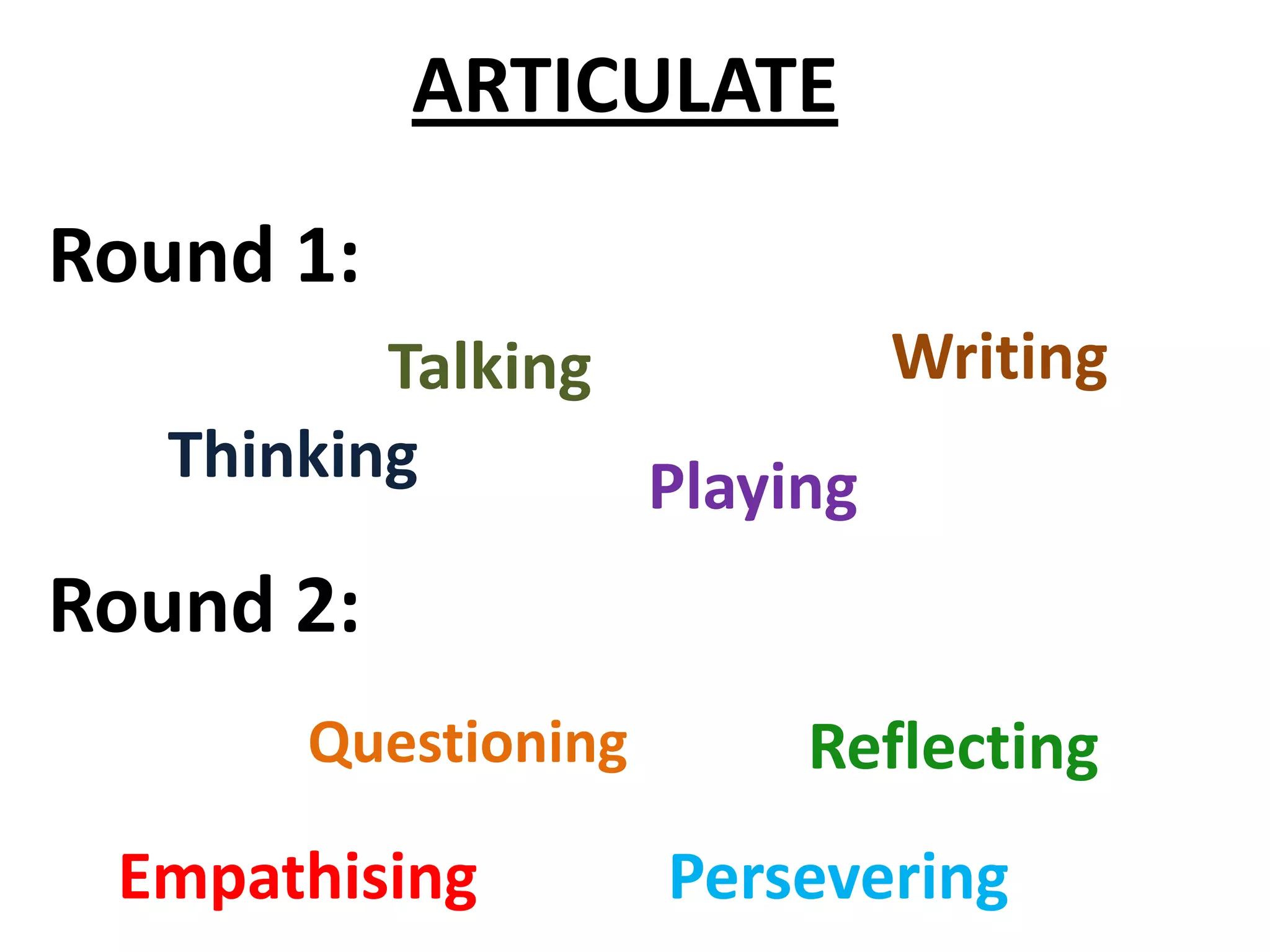
ARTICULATE

Round 1:
          Talking         Writing
   Thinking       Playing
Round 2:
       Questioning       Reflecting
 Empathising         Persevering
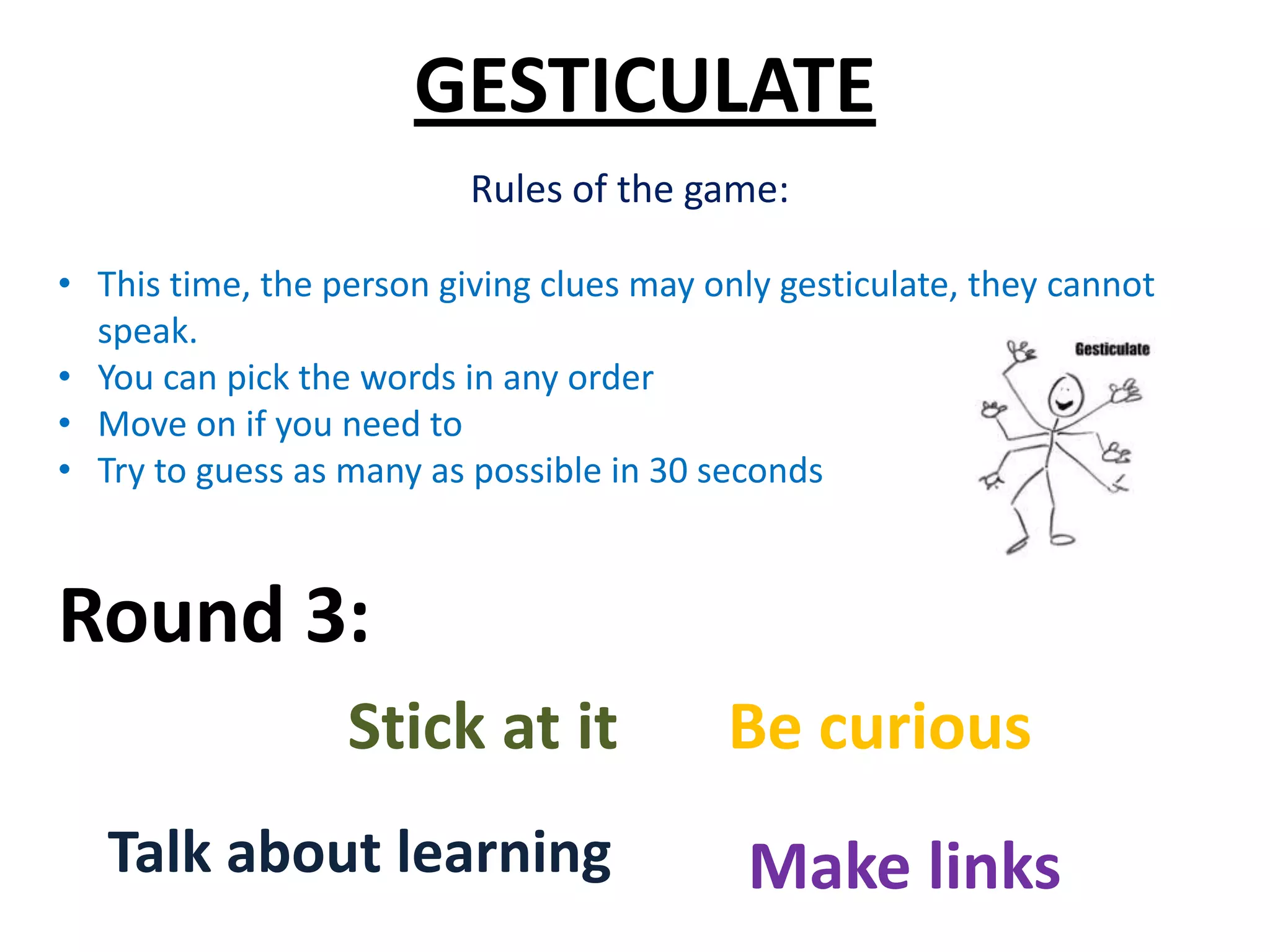
GESTICULATE
                          Rules of the game:

• This time, the person giving clues may only gesticulate, they cannot
  speak.
• You can pick the words in any order
• Move on if you need to
• Try to guess as many as possible in 30 seconds


Round 3:
                  Stick at it             Be curious
   Talk about learning                      Make links
Time to Think, Reflect and
                   Talk about learning

         Talk to your partner about the following
          questions. Be prepared to share your
                         thoughts.


1.   What do you think was the purpose of that activity?
2.   Did you learn anything from doing that?
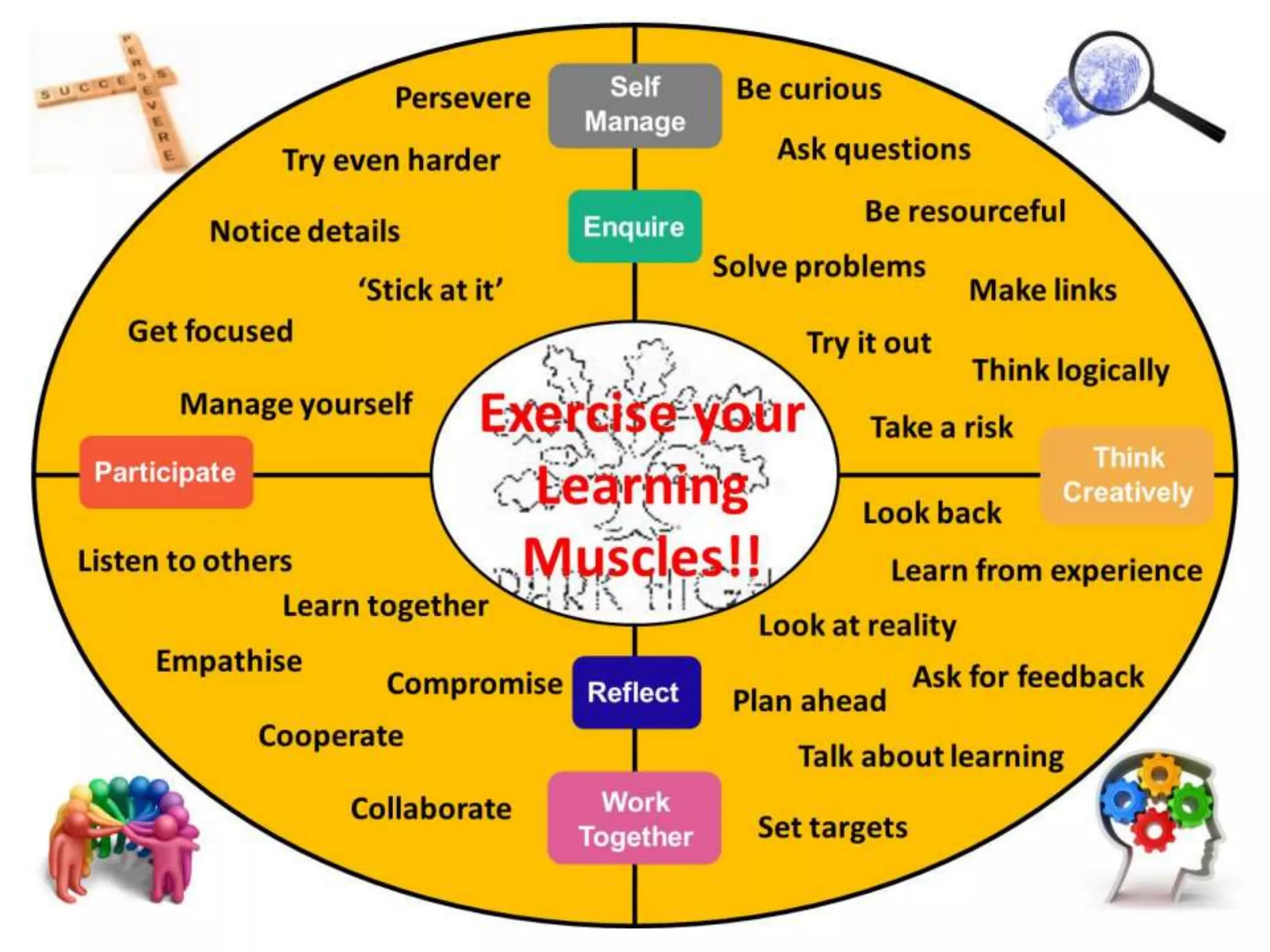
3.   What ‘learning skills’ did you use when explaining/miming?
4.   What ‘learning skills’ did you use when guessing?
5.    In what other situations could/would you use those
     ‘learning skills’?
Articulate
Why Articulate (in its various
forms)?
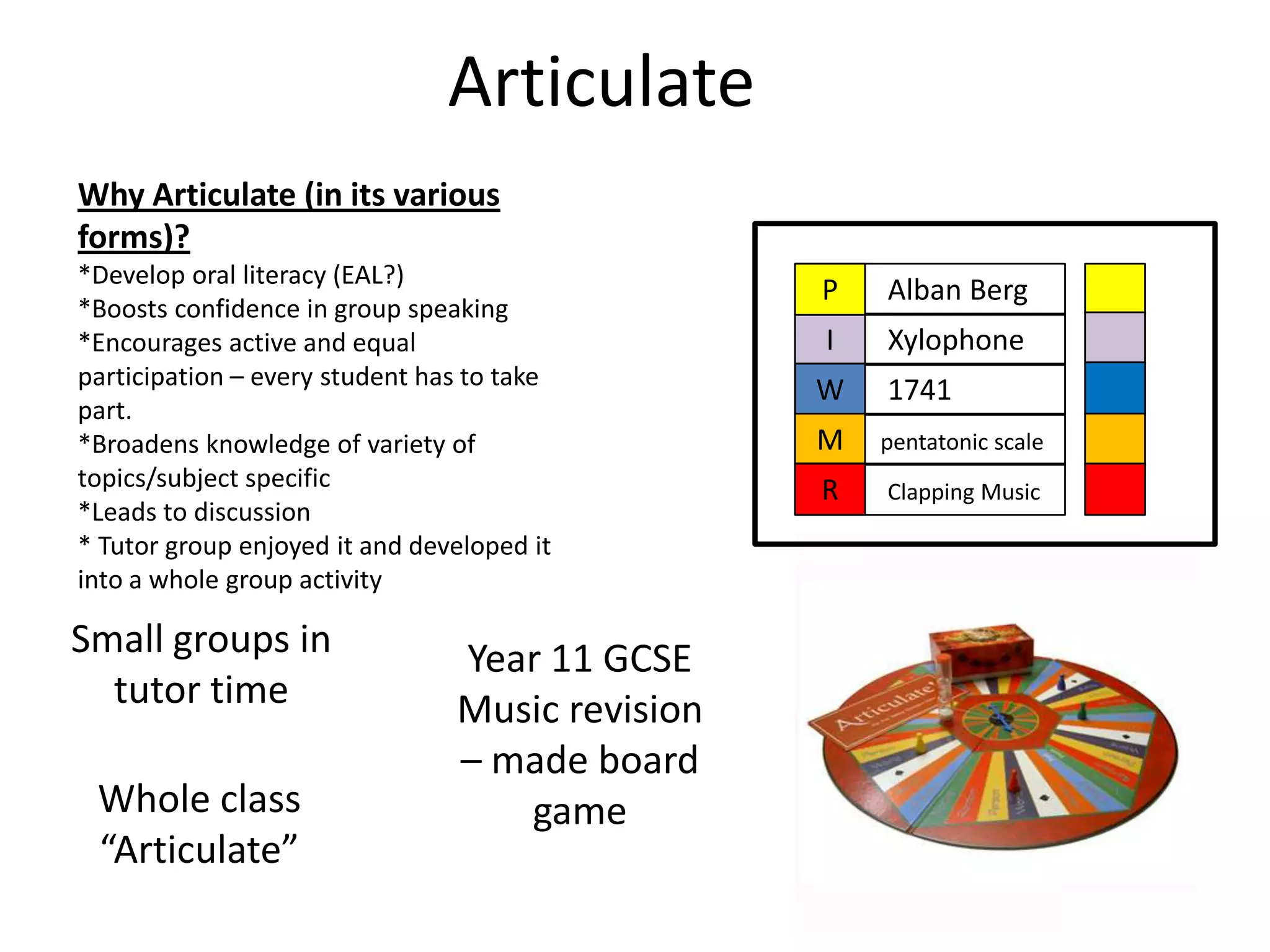
*Develop oral literacy (EAL?)
                                                 P   Alban Berg
*Boosts confidence in group speaking
*Encourages active and equal                     I   Xylophone
participation – every student has to take
                                                 W   1741
part.
*Broadens knowledge of variety of                M   pentatonic scale
topics/subject specific                          R   Clapping Music
*Leads to discussion
* Tutor group enjoyed it and developed it
into a whole group activity

Small groups in                 Year 11 GCSE
  tutor time                    Music revision
                                – made board
 Whole class                       game
 “Articulate”
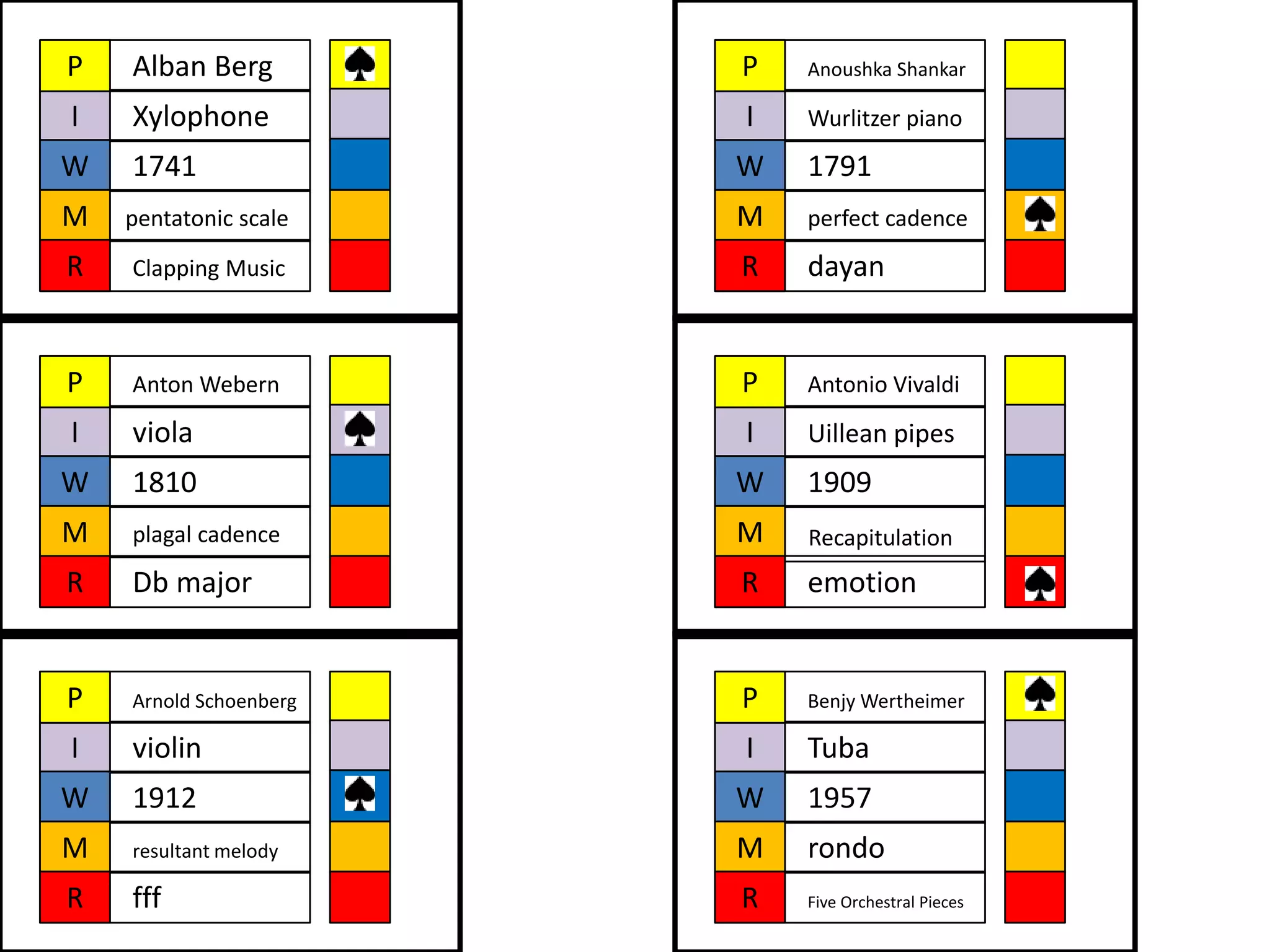
P   Alban Berg          P   Anoushka Shankar

I   Xylophone           I   Wurlitzer piano

W   1741                W   1791
M   pentatonic scale    M   perfect cadence

R   Clapping Music      R   dayan


P   Anton Webern        P   Antonio Vivaldi

I   viola               I   Uillean pipes
W   1810                W   1909
M   plagal cadence      M   Recapitulation
R   Db major            R   emotion


P   Arnold Schoenberg   P   Benjy Wertheimer

I   violin              I   Tuba
W   1912                W   1957
M   resultant melody    M   rondo
R   fff                 R   Five Orchestral Pieces
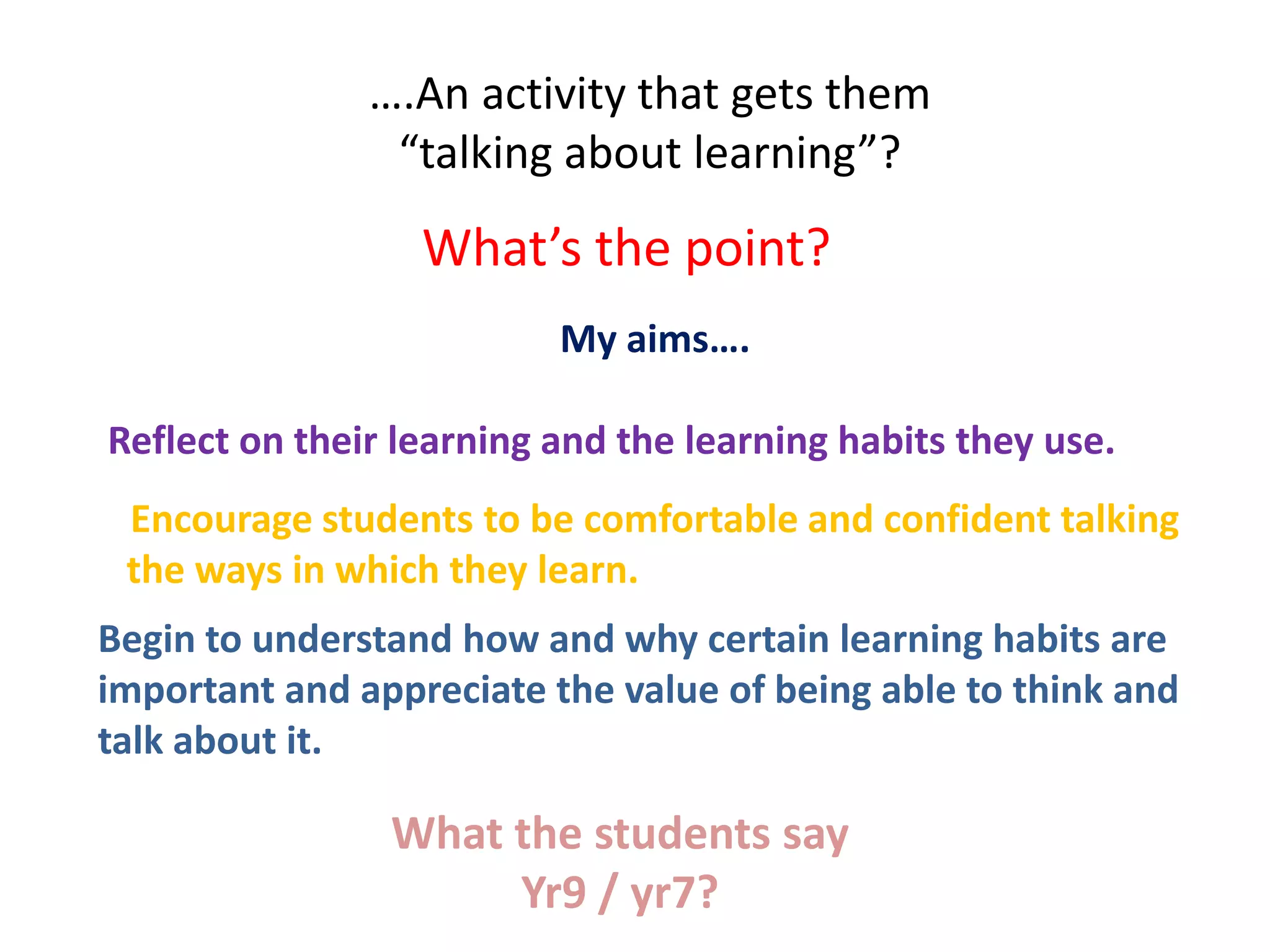
….An activity that gets them
                “talking about learning”?
                  What’s the point?
                          My aims….

Reflect on their learning and the learning habits they use.
 Encourage students to be comfortable and confident talking
 the ways in which they learn.
Begin to understand how and why certain learning habits are
important and appreciate the value of being able to think and
talk about it.

                What the students say
                     Yr9 / yr7?
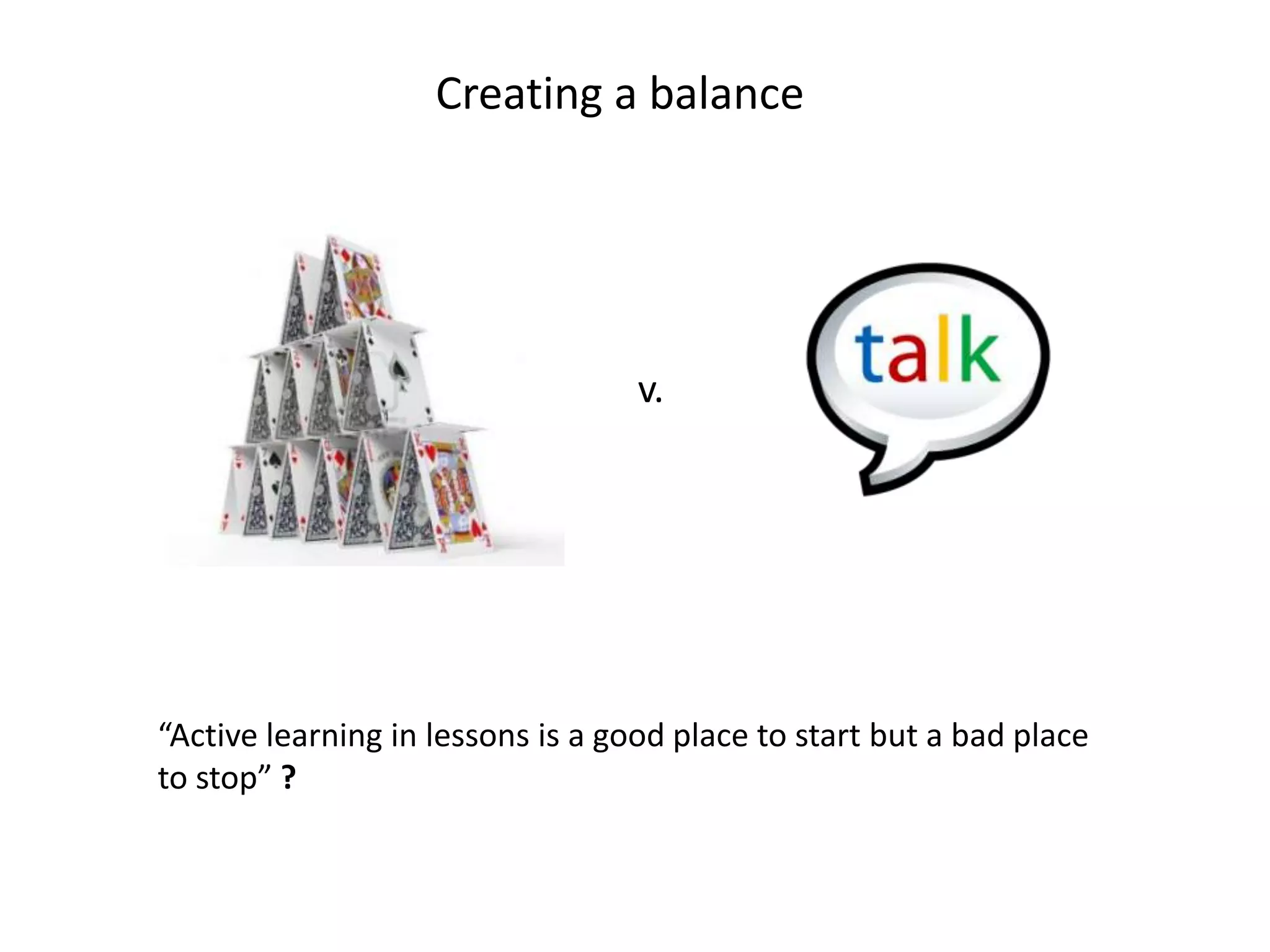
Creating a balance


                                   v.


“Active learning in lessons is a good place to start but a bad place
to stop” ?
Talking about Learning?
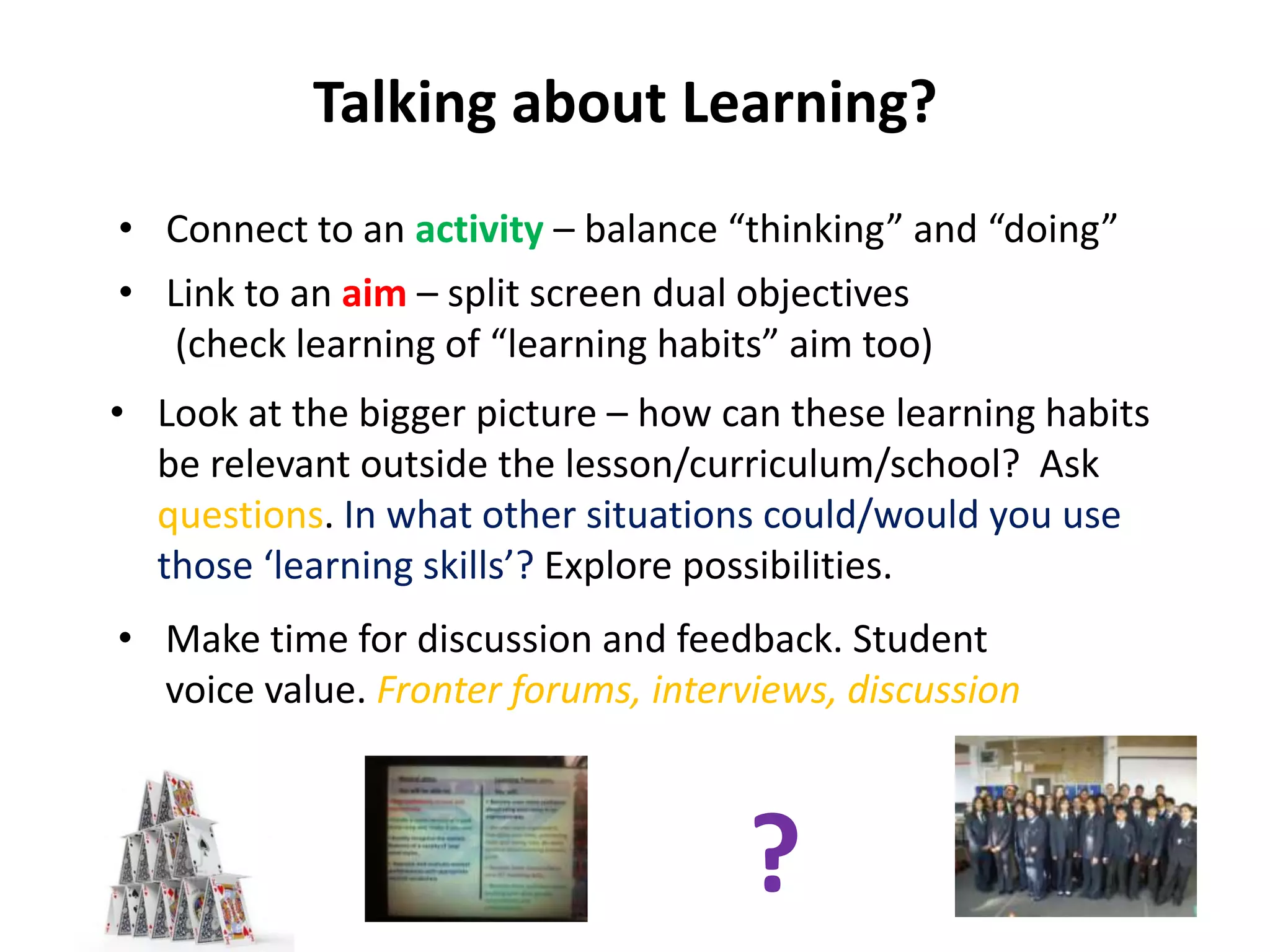
• Connect to an activity – balance “thinking” and “doing”
• Link to an aim – split screen dual objectives
   (check learning of “learning habits” aim too)
• Look at the bigger picture – how can these learning habits
  be relevant outside the lesson/curriculum/school? Ask
  questions. In what other situations could/would you use
  those ‘learning skills’? Explore possibilities.
• Make time for discussion and feedback. Student
  voice value. Fronter forums, interviews, discussion


                                     ?
Talking about Learning?

      “Learning is not a spectator sport.”
                   D. Blocher

Daybreak this morning questioning the value of
                   GCSEs?
Talking about learning   23rd may 2012

Talking about learning 23rd may 2012

  • 1.
    ARTICULATE In pairs.... Rules of the game: • You will be describing and guessing words • Play in pairs – one person sits with back to the screen – they listen and do the guessing • The person giving clues may only speak – they cannot mime, gesticulate or use any part of the word being described. • You can pick the words in any order • Move on if you need to • Try to guess as many as possible in 30 seconds • Don’t cheat, it’s more fun trying to do the game properly and you learn more!
  • 2.
    ARTICULATE Round 1: Talking Writing Thinking Playing Round 2: Questioning Reflecting Empathising Persevering
  • 3.
    GESTICULATE Rules of the game: • This time, the person giving clues may only gesticulate, they cannot speak. • You can pick the words in any order • Move on if you need to • Try to guess as many as possible in 30 seconds Round 3: Stick at it Be curious Talk about learning Make links
  • 4.
    Time to Think,Reflect and Talk about learning Talk to your partner about the following questions. Be prepared to share your thoughts. 1. What do you think was the purpose of that activity? 2. Did you learn anything from doing that? 3. What ‘learning skills’ did you use when explaining/miming? 4. What ‘learning skills’ did you use when guessing? 5. In what other situations could/would you use those ‘learning skills’?
  • 5.
    Articulate Why Articulate (inits various forms)? *Develop oral literacy (EAL?) P Alban Berg *Boosts confidence in group speaking *Encourages active and equal I Xylophone participation – every student has to take W 1741 part. *Broadens knowledge of variety of M pentatonic scale topics/subject specific R Clapping Music *Leads to discussion * Tutor group enjoyed it and developed it into a whole group activity Small groups in Year 11 GCSE tutor time Music revision – made board Whole class game “Articulate”
  • 6.
    P Alban Berg P Anoushka Shankar I Xylophone I Wurlitzer piano W 1741 W 1791 M pentatonic scale M perfect cadence R Clapping Music R dayan P Anton Webern P Antonio Vivaldi I viola I Uillean pipes W 1810 W 1909 M plagal cadence M Recapitulation R Db major R emotion P Arnold Schoenberg P Benjy Wertheimer I violin I Tuba W 1912 W 1957 M resultant melody M rondo R fff R Five Orchestral Pieces
  • 7.
    ….An activity thatgets them “talking about learning”? What’s the point? My aims…. Reflect on their learning and the learning habits they use. Encourage students to be comfortable and confident talking the ways in which they learn. Begin to understand how and why certain learning habits are important and appreciate the value of being able to think and talk about it. What the students say Yr9 / yr7?
  • 8.
    Creating a balance v. “Active learning in lessons is a good place to start but a bad place to stop” ?
  • 9.
    Talking about Learning? •Connect to an activity – balance “thinking” and “doing” • Link to an aim – split screen dual objectives (check learning of “learning habits” aim too) • Look at the bigger picture – how can these learning habits be relevant outside the lesson/curriculum/school? Ask questions. In what other situations could/would you use those ‘learning skills’? Explore possibilities. • Make time for discussion and feedback. Student voice value. Fronter forums, interviews, discussion ?
  • 10.
    Talking about Learning? “Learning is not a spectator sport.” D. Blocher Daybreak this morning questioning the value of GCSEs?